Dynamics 365 Intelligent Order Management launches new guided tour

Dynamics 365 Intelligent Order Management launches new guided tour

This article is contributed. See the original author and article here.

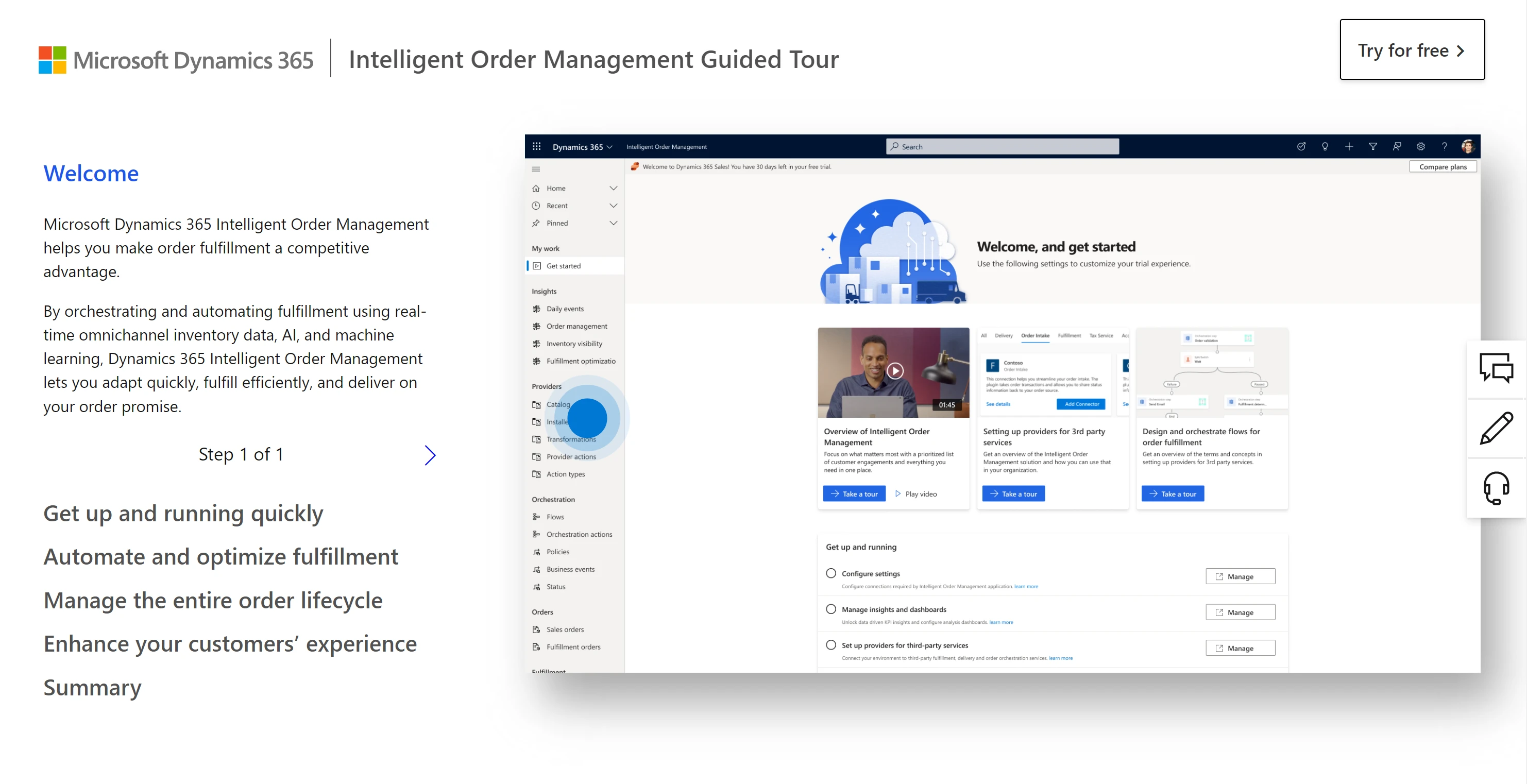
Today we are excited to announce the new guided tour for Microsoft Dynamics 365 Intelligent Order Management. We are also taking this opportunity to talk about businesses’ need for order management solutions to move beyond the limitations of traditional enterprise resource planning (ERP) systems and keep pace with the fast-changing landscape of e-commerce.

View of one of the steps of Dynamics 365 Intelligent Order Management guided tour.

View of one of the steps of Dynamics 365 Intelligent Order Management guided tour.

Moving beyond traditional ERP

An excellent customer experience is a requirement for organizational success in today’s modern business environment. This is particularly true for retailers, distributors, and manufacturers that are embracing direct-to-consumer business models. When it comes to selling, manufacturing, or distributing physical goods, a critical component of providing an excellent customer experience is ensuring that customer orders are shipped On Time and In Full (OTIF), every time.

And more and more companies are realizing that traditional ERP systems lack the adaptability, agility, and resiliency necessary to keep pace with the ever-evolving demands and growing complexity of modern digital commerce. To meet these challenges, forward-thinking organizations have found that order management solutions provide them the required capability to accept orders from anywhere and fulfill them everywhere in a cost-efficient manner. To this end, let’s look at two ways that Dynamics 365 Intelligent Order Management allows businesses to move beyond the limitations of traditional ERP systems.

Faster delivery

The accelerated shift to buying online that accompanied the global pandemic came alongside the trend of consumers demanding shorter delivery times. The result is that for companies interested in selling direct-to-consumer, delivering within two daysif not soonerbecame table stakes. It makes sense then that when McKinsey & Company surveyed apparel, hard goods, and specialty retailers in 2021, they found that the overwhelming majority75 percenthad active plans to build out fulfillment networks that offer two-day or faster delivery times by 2022.1

And this is just one area where traditional ERP systems face challenges and where organizations need advanced solutions to move beyond their limitations. For example, consider that modern digital commerce companies frequently need to add new partners and apps for e-commerce, customer relationship management (CRM), shipping, billing, tax calculations, etc. To be effective this requires an easy-to-deploy solution that integrates with internal and external ecosystems without the need for costly and time-consuming rip and replace processes. Enter Dynamics 365 Intelligent Order Management, a modern, and open platform that allows organizations to overcome supply chain constraints and disruptions, and capitalize seasonal peak volumes.

Composable approach

Gartner predicts that by 2023, organizations that have adopted a composable approach will outpace the competition by 80 percent in the speed of new feature implementation.2 A primary reason for adopting a composable approach is because it provides greater agility and resiliency. Traditional ERP falls short on delivering this agility and resiliency because of their lack of real-time inventory visibility into siloed data. Plus, traditional ERPs don’t have the ability to easily support customized rules for the latest fulfillment methods such as Buy-online, Pickup in-store (BOPIS), and AI and machine learning capabilities.

Dynamics 365 Intelligent Order Management seamlessly works with existing ERPs and supply chain solutions to enhance end-to-end visibility. It enables customers to create an execution-based control tower, suited to companies that must delight customers with accurate, timely fulfillment of frequent orders, perhaps using third-party logistics (3PL) providers.

It uses rules based-fulfillment orchestration and AI-based anomaly detection models to proactively identify and address fulfillment constraints and improve delivery times while reducing costs. This helps accelerate decision-making to mitigate the impact of disruptions. As massive amounts of data are generated across the order management processes, technologies such as AI and machine learning are increasingly necessary because businesses must be able to deliver actionable insights at scale.

Dynamics 365 Intelligent Order Management enables organizations to extend and operate in complex environments, where there are many internal and external supply chain partners. Moreover, it is designed to easily configure order orchestration flows through low-code or no-code interfaces and quickly scale by adding new partners’ connectors to the best-of-breed solutions for e-commerce, shipping, tax calculation, and more.

At this point, it makes sense to conclude that order management systems need to be open and flexible solutions, capable of handling and integrating with multiple order sources and order orchestration applications. In this way, Dynamics 365 Intelligent Order Management is far more flexible than traditional ERPs. It can be used as a started point to build a control tower with this desirable composable approach, as it integrates with existing ERPs, making them much faster and cheaper to customize and support.

In summary, this composable approach is what makes it possible for organizations to connect their existing supply chain systems, enhance these systems with an order management solution, and to integrate all business platforms with new e-commerce, payments, shipping, taxes, and other partners. This is accomplished by using prebuilt connectors to manage the entire order life cycle more efficiently and to provide more organizational agility and resiliency in the process.

Learn more about how to create agile and digital supply chains in this webinar.

What’s next?

We have reviewed some of the areas where Dynamics 365 Intelligent Order Management allows businesses to move beyond the limitations of traditional ERP systems. We invite you to experience a free trial of Dynamics 365 Intelligent Order Management or visit our new guided tour to learn more.


1-McKinsey & Company, Retail’s need for speed: Unlocking value in omnichannel delivery, September 2021.

2-Gartner, Composable Commerce Must Be Adopted for the Future of Applications, June 2020. GARTNER is a registered trademark and service mark of Gartner Inc., in the U.S. and internationally, and is used herein with permission. All rights reserved.

The post Dynamics 365 Intelligent Order Management launches new guided tour appeared first on Microsoft Dynamics 365 Blog.

Brought to you by Dr. Ware, Microsoft Office 365 Silver Partner, Charleston SC.
VMware Releases Security Advisory

This article is contributed. See the original author and article here.

VMware has released a security advisory to address a privilege escalation vulnerability in vCenter Server and Cloud Foundation. An attacker could exploit this vulnerability to take control of an affected system.

CISA encourages users and administrators to review VMware Security Advisory VMSA-2021-0025 and apply the necessary workaround.  

Automated Machine Learning on the M5 Forecasting Competition

Automated Machine Learning on the M5 Forecasting Competition

This article is contributed. See the original author and article here.


We announce here that Microsoft’s Automated Machine Learning, with nearly default settings, achieves a score in the 99th percentile of private leaderboard entries for the high-profile M5 forecasting competition. Customers use Automated Machine Learning (AutoML) for ML applications in regression, classification, and time series forecasting. For example, The Kantar Group leverages AutoML for churn analysis, allowing clients to boost customer loyalty and increase their revenue.


Our M5 result demonstrates the power and effectiveness of our Many Models Solution which combines classical time-series algorithms and modern machine learning methods. Many Models is used in production pipelines by customers such as AGL, Adamed, and Oriflame for demand forecasting applications. We also use our open-source Responsible AI tools to understand how the model leverages information in the training data. All computations take place on our scalable, cloud-based Azure Machine Learning platform.


The M5 Competition


The M5 Competition, the fifth iteration of the Makridakis time-series forecasting competition, provides a useful benchmark for retail forecasting methods. The data contains historical daily sales information for about 3,000 products from 10 different Wal-Mart retail store locations. As is often the case in retail scenarios, the data has hierarchical structure along product catalog and geographic dimensions. Data features like sales price, SNAP (food stamp) eligibility, and calendar events are provided by the organizers in addition to historical sales. The accuracy track of the competition evaluates 28-day-ahead forecasts for 30,490 store-product combinations. With submissions from over 5,000 teams and 24 baseline models, the competition provides a rich set of comparisons between different modeling strategies.


Modeling Strategy


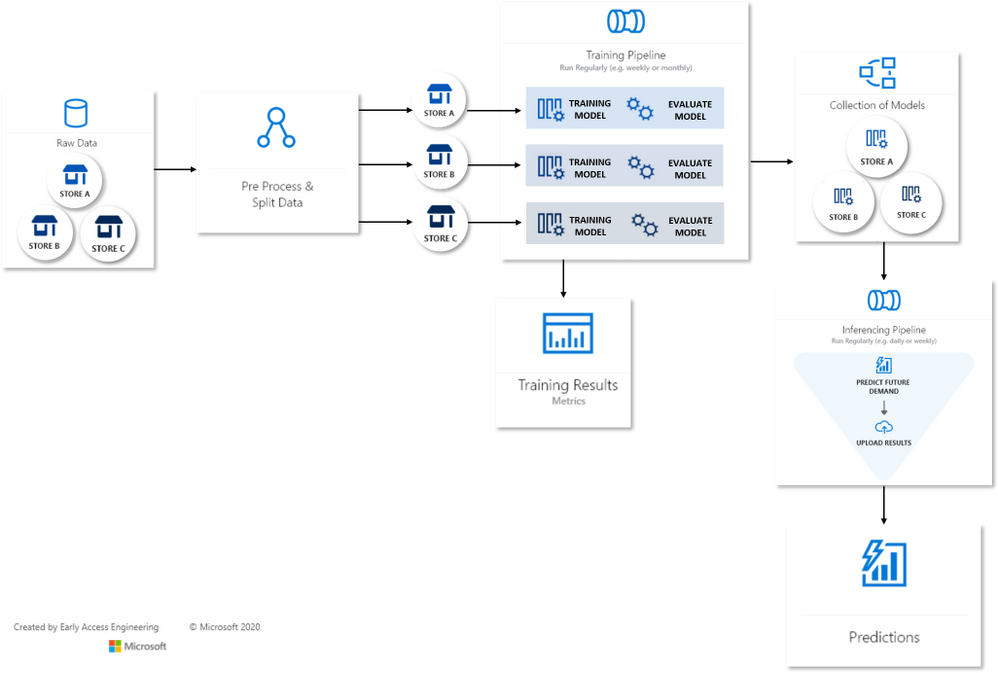
There are myriad approaches to modeling the M5 data, especially given its hierarchical structure. Since our goal is to demonstrate an automated solution, we executed what we considered the most simple strategy: build a model for each individual store-product combination. The result is a composite model with 30,490 constituent time-series models. Our Many Models Solution, born out of deep engagement with customers, is precisely suited to this task.


Many Models Flow MapMany Models Flow Map


The Many Models accelerator runs independent Automated Machine Learning (AutoML) jobs on each store-product time-series, creating a model dictionary over the entire dataset. In turn, each AutoML job generates engineered features and sweeps over model classes and hyperparameters using a novel collaborative filtering algorithm. AutoML then selects the best model for each time-series via temporal cross-validation. Training and scoring are data-parallel operations for Many Models and easily scalable on Azure-managed compute resources.


Understanding the Final Model


The final composite model is a mix of three model types: classical time-series models, machine learning (ML) regression models, and ensembles which can contain multiple models from either or both of the first two types. AutoML creates the ensembles from weighted combinations of top performing time-series and ML models found during sweeping. Naturally, the ensemble models are often the best models for a given store-product combo.


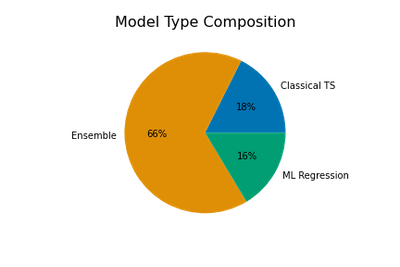
model_type_pie.png

The chart above shows that two-thirds of the selected models are ensembles, with classical time-series and ML models making up approximately equal portions of the remainder.


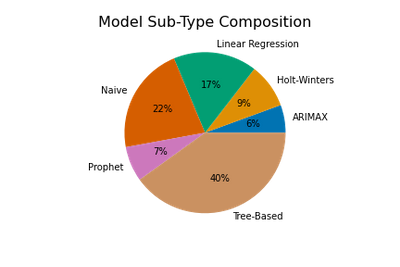
We get a more detailed view of the composite model by breaking into model sub-types. AutoML sweeps over three ML regression subtypes: regularized linear models, tree-based models, and Facebook’s Prophet model. Classical algorithms include Holt-Winters Exponential Smoothing, ARIMAX (ARIMA with regressors), and a suite of “Naive”, or persistence, models. Ensembles are weighted combinations of these sub-types.  


model_subtypes_pie.png

The proportions of subtypes in the full composite model are shown above, where ensemble weights are used to apportion subtypes from each ensemble. Tree-based models like Random Forest and XGBoost that are capable of learning complex, non-linear patterns are a plurality. However, relatively simple linear and Naive time-series models are also quite common!


Feature Importance


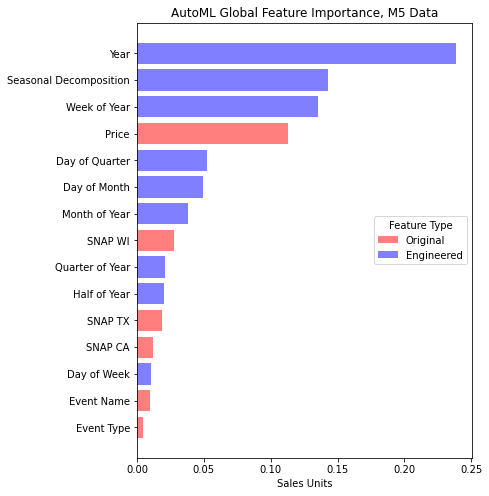
Most of AutoML’s models can make use of the data features beyond the historical sales, so we find yet more insight into the composite model by examining the impact, or importance, of these features relative to the model’s predictions. A common way to quantify feature importance is with game-theoretic Shapley value estimates. AutoML optionally calculates these for the best model selected from sweeping, so we make use of them here by aggregating values over all models in the composite.


m5_feature_importance.png


In the feature importance chart, we distinguish between features present in the original dataset, such as price, and those engineered by AutoML to aid model accuracy. Evidently, engineered features associated with the calendar and a seasonal decomposition make the most impact on predictions. The seasonal decomposition is derived from weekly sales patterns detected by AutoML. Price is the most important of the original features which is expected in retail scenarios given the likely significant effects of price on demand.


The Value of AutoML and Many Models


Our automatically tuned composite model performs exceedingly well on the M5 data – better than 99% of the other competition entries. Many of these teams spent weeks tuning their models. Despite this excellent result, it is important to note that no single modeling approach will always be the best. In this case, we achieved great accuracy with an assumption that the product-store time-series could be modeled independently of one another. This implies that the dynamics driving changes across sales at different stores and products may vary widely. We’ve learned from several successful engagements with our enterprise customers that the Many Models approach achieves good accuracy and scales well across other forecasting scenarios as well.


From more information, see our other Many Models post: Train and Score Hundreds of Thousands of Models in Parallel.


Special thanks to Sabina Cartacio for contributing text and editorial guidance.

Microsoft Releases November 2021 Security Updates

This article is contributed. See the original author and article here.

Microsoft has released updates to address multiple vulnerabilities in Microsoft software. An attacker can exploit some of these vulnerabilities to take control of an affected system.

CISA encourages users and administrators to review Microsoft’s November 2021 Security Update Summary and Deployment Information and apply the necessary updates.

#M365GovCommunityCall November 2021: Teach a Govie to Fish (through MSFT updates)

This article is contributed. See the original author and article here.


https://www.youtube-nocookie.com/embed/hsNc_QjYwfw


At the beginning of November, Microsoft had their second Ignite of the year, announcing or further clarifying details around many of the latest and near-immediate future features expected to rollout to Microsoft 365. However, as many of the US Federal cloud tenants see features months (if not longer) after they hit the commercial tenant, these users are often left wondering “what’s next for us” instead of having the same excitement commercial tenant owners have coming out of these conferences.


In this episode, we meet with Microsoft architect John Moh (LinkedIn) to discuss our favorite ways to stay up to date on what’s available to us in the GCC, GCC-H, and DOD tenants!


Government Community Events


In the News


Roadmap Update


Today’s Discussion


Today’s Panelists


Today’s panelists can be found on Twitter if you want to connect with them further!


CISA Releases Security Advisory on Siemens Nucleus Real-Time Operating Systems

This article is contributed. See the original author and article here.

CISA has released an Industrial Control Systems (ICS) advisory detailing multiple vulnerabilities found in Siemens Nucleus Real-Time Operating Systems (RTOS) and supporting libraries. A remote attacker could exploit some of these vulnerabilities to take control of an affected system.

CISA encourages users and administrators to review ICS Advisory: ICSA-21-313-03 Siemens Nucleus RTOS TCP/IP Stack for more information and apply the necessary mitigations.