by Contributed | Nov 12, 2021 | Technology
This article is contributed. See the original author and article here.
As the season of Fall begins to color the leaves of northern hemisphere locales such as Microsoft’s headquarters in Redmond, it brings with it the joy of connecting with loved ones through seasonal holidays and connecting with the transient beauty of nature preparing for cold, dark winter. This is also a time for Azure Sphere to focus on a different sort of connectivity. This month’s OS update paves the way for Azure Sphere to be connected in more relevant environments than ever.
Azure Sphere now supports web proxy. We’re really excited about this because it’s so helpful for so many customer applications. Azure Sphere was designed to provide end-to-end encrypted dataflow, but I’ve been asked what does this do for network security? Does it help participate in the policies and analysis of network traffic to detect and thwart malicious network intruders? With web proxy, Azure Sphere devices can now engage with enterprise network security systems, policies, tools and procedures!
Another item of interest is that Azure Sphere has laid the foundations for improving MQTT support across multiple clouds. Hybrid cloud solutions are more relevant now than ever, and Azure Sphere was designed to support connectivity for anything you may want to securely connect to. One of the best benefits of Azure Sphere is its Microsoft managed identity, backed by our Azure Sphere Security Service. This service provides a certificate that proves that the device is authentic, rooted in hardware trust, and has been forced to attest its configuration. This certificate, by default, is used as a client TLS certificate to connect to any Azure service. We’re paving the way to make this certificate even more useful for connecting to other cloud services so you can trust the device’s identity and easily connect as needed. We hope to put out additional documentation around how to solve these problems, so stay tuned for more!
Whatever season you may be experiencing this month, we wish you the best—and many connections both digital and human!

by Contributed | Nov 11, 2021 | Technology
This article is contributed. See the original author and article here.
We are excited to be partnering with SWOOP Analytics to host our 2021 Yammer Community Festival on December 8th-9th! This event has been curated and designed for our customers, for you to learn from each another and hear how to build culture and community in your own organizations. Whether you are just launching your Yammer network and not sure where to begin or are curious to hear what’s coming down the product pipeline, there are sessions for you!
Agenda
This virtual event will span across European, Americas, and Asia Pacific time zones. Look at the agenda to see an idea of the types of stories and sessions that will be available. All sessions will be recorded to be able to watch on demand following the event.
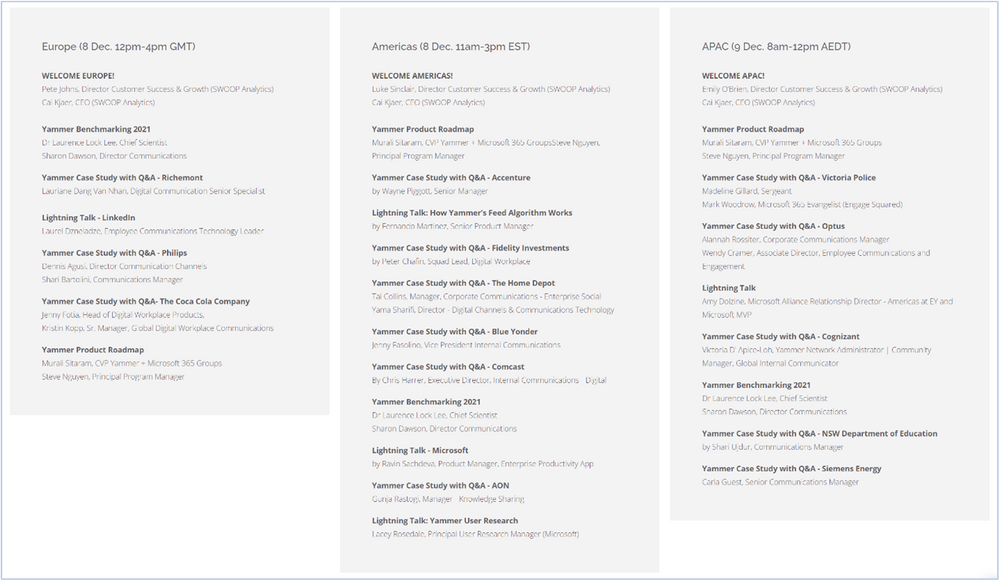
*Exact timing and content subject to change.
Speakers
We have an incredible line up of Yammer customer speakers that have a variety of experiences and types of organizations from across the world. They’ll share best practices, lessons learned and provide practical guidance that you’ll be able to take and use at your organization. You’ll also hear directly from Microsoft , including the product teams who build Yammer and learn more about the future of products like Microsoft Viva. You might see new faces and familiar brands that have great stories to share. Take a closer look at all the presenters here.
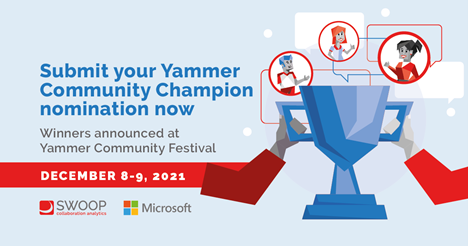
Nominate your colleagues for the Community Champion Award
The Yammer Community Champion Award is an opportunity to recognize passionate community managers around the world who are committed to employee engagement, knowledge sharing, and collaboration in their Yammer networks and communities.
As part of our first Yammer Community Festival, we will announce regional winners of the Yammer Community Champion Award.
Can you think of anyone who deserves this title? Tell us who you think should win this award!
There will be one winner per regional session and winners will be contacted in advance of session that they have been ‘shortlisted’ as a top contender for the Yammer Community Champion Award. This is to ensure the winners are present to virtually accept their award. Based on network size, the number of nominations per organization is not limited as there may be many opportunities within a company to submit a nomination.
Register today!
We’re running the event as an interactive Microsoft Teams meeting with Q&A enabled. Bring your questions and ideas as we want to make the chat component active, with many voices heard. Speakers are there to prompt conversations in chat and be prepared to unmute!
“We are so excited to present the future of Yammer to this community. We’ve heard from customers like you, that you want to connect and learn from the Yammer community of customers that exist across the globe. This is a great opportunity to showcase your success and learn from others in the community. We look forward to seeing you all at the festival!”
MURALI SITARAM
CVP Yammer+M365 Groups, Microsoft
Save your seat and register now!
FAQ
How much does this cost?
This event is free so invite your whole team!
Can I attend a session outside of my time zone?
Yes! Feel free to attend any session that fits your schedule, regardless of your location.
Will sessions be recorded?
Yes, sessions will be recorded and made available after the event.
How many people can I nominate for the Community Champion Award?
We do not have a set limit for number of nominations by organization or person. Feel free to nominate all the Community Champions you know!
What do the Community Champion Award members win?
There will be custom swag sent to each award winner.
Who should attend?
All roles and departments are welcome. Customer speakers will be a variety of backgrounds and roles within an organization and you’ll be sure to find similar roles that support the work you do, regardless if you are in marketing, communications, sales, product development or IT.
by Contributed | Nov 10, 2021 | Technology
This article is contributed. See the original author and article here.
We announce here that Microsoft’s Automated Machine Learning, with nearly default settings, achieves a score in the 99th percentile of private leaderboard entries for the high-profile M5 forecasting competition. Customers use Automated Machine Learning (AutoML) for ML applications in regression, classification, and time series forecasting. For example, The Kantar Group leverages AutoML for churn analysis, allowing clients to boost customer loyalty and increase their revenue.
Our M5 result demonstrates the power and effectiveness of our Many Models Solution which combines classical time-series algorithms and modern machine learning methods. Many Models is used in production pipelines by customers such as AGL, Adamed, and Oriflame for demand forecasting applications. We also use our open-source Responsible AI tools to understand how the model leverages information in the training data. All computations take place on our scalable, cloud-based Azure Machine Learning platform.
The M5 Competition
The M5 Competition, the fifth iteration of the Makridakis time-series forecasting competition, provides a useful benchmark for retail forecasting methods. The data contains historical daily sales information for about 3,000 products from 10 different Wal-Mart retail store locations. As is often the case in retail scenarios, the data has hierarchical structure along product catalog and geographic dimensions. Data features like sales price, SNAP (food stamp) eligibility, and calendar events are provided by the organizers in addition to historical sales. The accuracy track of the competition evaluates 28-day-ahead forecasts for 30,490 store-product combinations. With submissions from over 5,000 teams and 24 baseline models, the competition provides a rich set of comparisons between different modeling strategies.
Modeling Strategy
There are myriad approaches to modeling the M5 data, especially given its hierarchical structure. Since our goal is to demonstrate an automated solution, we executed what we considered the most simple strategy: build a model for each individual store-product combination. The result is a composite model with 30,490 constituent time-series models. Our Many Models Solution, born out of deep engagement with customers, is precisely suited to this task.
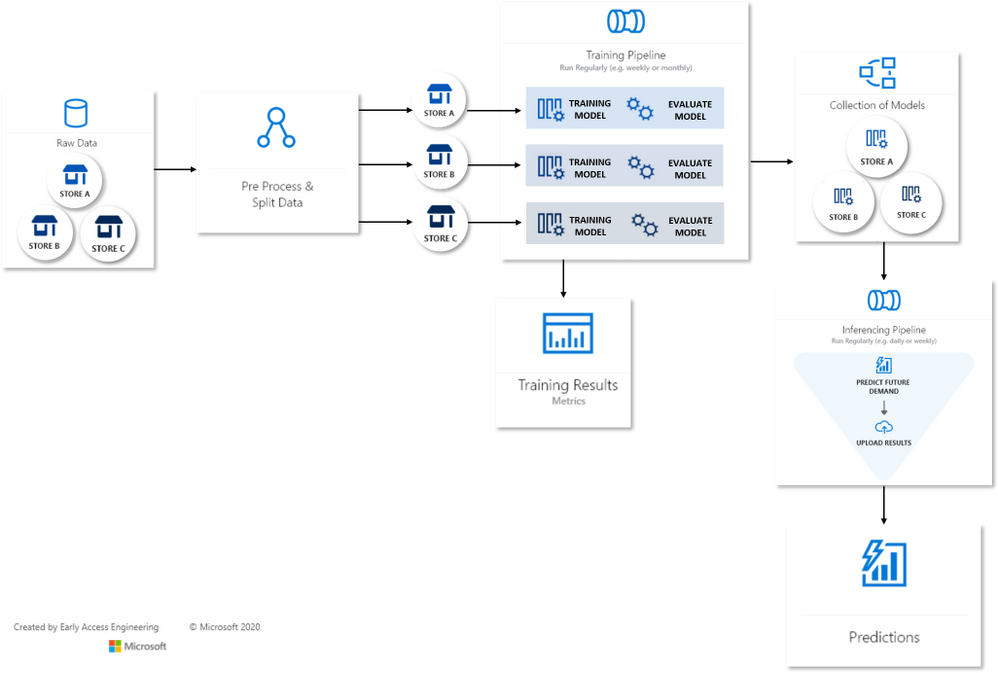
Many Models Flow Map
The Many Models accelerator runs independent Automated Machine Learning (AutoML) jobs on each store-product time-series, creating a model dictionary over the entire dataset. In turn, each AutoML job generates engineered features and sweeps over model classes and hyperparameters using a novel collaborative filtering algorithm. AutoML then selects the best model for each time-series via temporal cross-validation. Training and scoring are data-parallel operations for Many Models and easily scalable on Azure-managed compute resources.
Understanding the Final Model
The final composite model is a mix of three model types: classical time-series models, machine learning (ML) regression models, and ensembles which can contain multiple models from either or both of the first two types. AutoML creates the ensembles from weighted combinations of top performing time-series and ML models found during sweeping. Naturally, the ensemble models are often the best models for a given store-product combo.
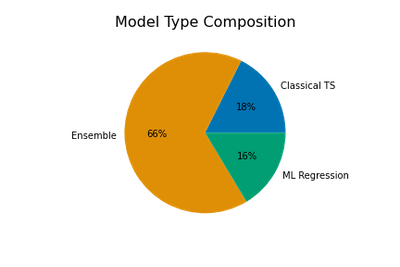
The chart above shows that two-thirds of the selected models are ensembles, with classical time-series and ML models making up approximately equal portions of the remainder.
We get a more detailed view of the composite model by breaking into model sub-types. AutoML sweeps over three ML regression subtypes: regularized linear models, tree-based models, and Facebook’s Prophet model. Classical algorithms include Holt-Winters Exponential Smoothing, ARIMAX (ARIMA with regressors), and a suite of “Naive”, or persistence, models. Ensembles are weighted combinations of these sub-types.
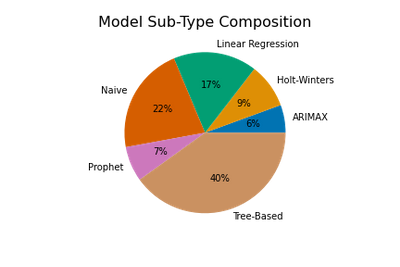
The proportions of subtypes in the full composite model are shown above, where ensemble weights are used to apportion subtypes from each ensemble. Tree-based models like Random Forest and XGBoost that are capable of learning complex, non-linear patterns are a plurality. However, relatively simple linear and Naive time-series models are also quite common!
Feature Importance
Most of AutoML’s models can make use of the data features beyond the historical sales, so we find yet more insight into the composite model by examining the impact, or importance, of these features relative to the model’s predictions. A common way to quantify feature importance is with game-theoretic Shapley value estimates. AutoML optionally calculates these for the best model selected from sweeping, so we make use of them here by aggregating values over all models in the composite.
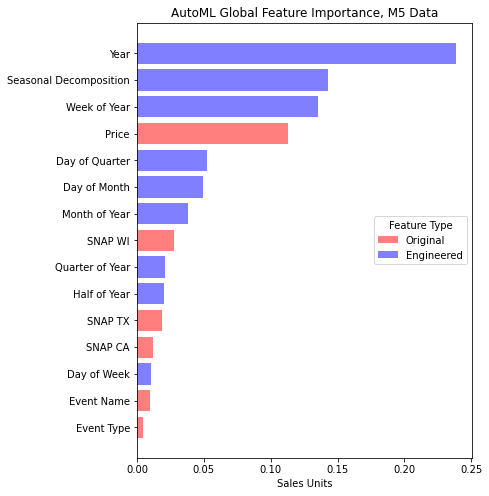
In the feature importance chart, we distinguish between features present in the original dataset, such as price, and those engineered by AutoML to aid model accuracy. Evidently, engineered features associated with the calendar and a seasonal decomposition make the most impact on predictions. The seasonal decomposition is derived from weekly sales patterns detected by AutoML. Price is the most important of the original features which is expected in retail scenarios given the likely significant effects of price on demand.
The Value of AutoML and Many Models
Our automatically tuned composite model performs exceedingly well on the M5 data – better than 99% of the other competition entries. Many of these teams spent weeks tuning their models. Despite this excellent result, it is important to note that no single modeling approach will always be the best. In this case, we achieved great accuracy with an assumption that the product-store time-series could be modeled independently of one another. This implies that the dynamics driving changes across sales at different stores and products may vary widely. We’ve learned from several successful engagements with our enterprise customers that the Many Models approach achieves good accuracy and scales well across other forecasting scenarios as well.
Special thanks to Sabina Cartacio for contributing text and editorial guidance.
by Contributed | Nov 8, 2021 | Technology
This article is contributed. See the original author and article here.
TLDR; Using minimal API, you can create a Web API in just 4 lines of code by leveraging new features like top-level statements and more.
Why Minimal API
There are many reasons for wanting to create an API in a few lines of code:
- Create a prototype. Sometimes you want a quick result, a prototype, something to discuss with your colleagues. Having something up and running quickly enables you to quickly do changes to it until you get what you want.
- Progressive enhancement. You might not want all the “bells and whistles” to start with but you may need them over time. Minimal API makes it easy to gradually add what you need, when you need it.
How is it different from a normal Web API?
There are a few differences:
- Less files. Startup.cs isn’t there anymore, only Program.cs remains.
- Top level statements and implicit global usings. Because it’s using top level statements,
using and namespace are gone as well, so this code:
 using System;
   namespace Application
   {
        class Program
        {
            static void Main(string[] args)
            {
                Console.WriteLine("Hello World!");
            }
        }
   }
is now this code:
Console.WriteLine("Hello World!");
- Routes Your routes aren’t mapped to controller classes but rather setup with a
Map[VERB] function, like you see above with MapGet() which takes a route and a function to invoke when said route is hit.
Your first API
To get started with minimal API, you need to make sure that .NET 6 is installed and then you can scaffold an API via the command line, like so:
dotnet new web -o MyApi -f net6.0
Once you run that, you get a folder MyApi with your API in it.
What you get is the following code in Program.cs:
var builder = WebApplication.CreateBuilder(args);
var app = builder.Build();

if (app.Environment.IsDevelopment())
{
    app.UseDeveloperExceptionPage();
}

app.MapGet("/", () => "Hello World!");

app.Run();
To run it, type dotnet run. A little difference here with the port is that it assumes random ports in a range rather than 5000/5001 that you may be used to. You can however configure the ports as needed. Learn more on this docs page
Explaining the parts
Ok so you have a minimal API, what’s going on with the code?
Creating a builder
var builder = WebApplication.CreateBuilder(args);
On the first line you create a builder instance. builder has a Services property on it, so you can add capabilities on it like Swagger Cors, Entity Framework and more. Here’s an example where you set up Swagger capabilities (this needs install of the Swashbuckle NuGet to work though):
builder.Services.AddEndpointsApiExplorer();
builder.Services.AddSwaggerGen(c =>
    {
        c.SwaggerDoc("v1", new OpenApiInfo { Title = "Todo API", Description = "Keep track of your tasks", Version = "v1" });
    });
Creating the app instance
Here’s the next line:
var app = builder.Build();
Here we create an app instance. Via the app instance, we can do things like:
- Starting the app,
app.Run()
- Configuring routes,
app.MapGet()
- Configure middleware,
app.UseSwagger()
Defining the routes
With the following code, a route and route handler is configured:
app.MapGet("/", () => "Hello World!");
The method MapGet() sets up a new route and takes the route “/” and a route handler, a function as the second argument () => “Hello World!”.
Starting the app
To start the app, and have it serve requests, the last thing you do is call Run() on the app instance like so:
app.Run();
Add routes
To add an additional route, we can type like so:
public record Pizza(int Id, string Name);
app.MapGet("/pizza", () => new Pizza(1, "Margherita"));
Now you have code that looks like so:
var builder = WebApplication.CreateBuilder(args);
var app = builder.Build();

if (app.Environment.IsDevelopment())
{
    app.UseDeveloperExceptionPage();
}

app.MapGet("/pizza", () => new Pizza(1, "Margherita"));
app.MapGet("/", () => "Hello World!");

public record Pizza(int Id, string Name);

app.Run();
Where you to run this code, with dotnet run and navigate to /pizza you would get a JSON response:
{
  "pizza" : {
    "id" : 1,
    "name" : "Margherita"
  }
}
Example app
Let’s take all our learnings so far and put that into an app that supports GET and POST and lets also show easily you can use query parameters:
var builder = WebApplication.CreateBuilder(args);
var app = builder.Build();

if (app.Environment.IsDevelopment())
{
    app.UseDeveloperExceptionPage();
}

var pizzas = new List<Pizza>(){
   new Pizza(1, "Margherita"),
   new Pizza(2, "Al Tonno"),
   new Pizza(3, "Pineapple"),
   new Pizza(4, "Meat meat meat")
};

app.MapGet("/", () => "Hello World!");
app.MapGet("/pizzas/{id}", (int id) => pizzas.SingleOrDefault(pizzas => pizzas.Id == id));
app.MapGet("/pizzas", (int ? page, int ? pageSize) => {
    if(page.HasValue && pageSize.HasValue)
    {
        return pizzas.Skip((page.Value -1) * pageSize.Value).Take(pageSize.Value);
    } else {
        return pizzas;
    }
});
app.MapPost("/pizza", (Pizza pizza) => pizzas.Add(pizza));

app.Run();

public record Pizza(int Id, string Name);
Run this app with dotnet run
In your browser, try various things like:
Learn more
Check out these LEARN modules on learning to use minimal API


Recent Comments