Ingestion, ETL, and Stream Processing with Azure Databricks

Ingestion, ETL, and Stream Processing with Azure Databricks

This article is contributed. See the original author and article here.

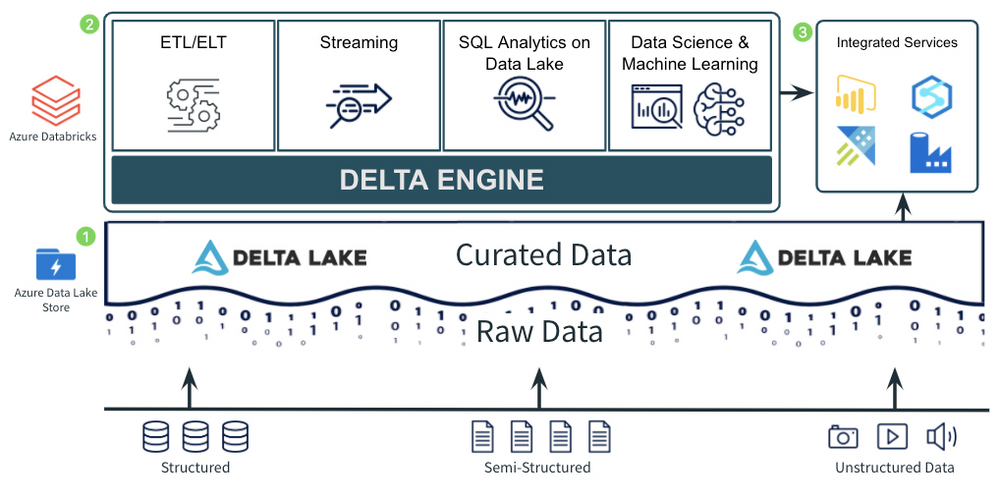
This post is part of a multi-part series titled “Patterns with Azure Databricks”.  Each highlighted pattern holds true to 3 principles for modern data analytics:


MikeCornell_0-1606336011284.png


  1. A Data Lake to store all data, with a curated layer in an open-source format.  The format should support ACID transactions for reliability and should also be optimized for efficient queries.

  2. A foundational compute layer built on open standards.  The foundational compute Layer should support most core use cases for the Data Lake.  This includes ETL, stream processing, data science and ML, and SQL analytics on the data lake.  Standardizing on a foundational compute service provides consistency across the majority of use cases.  Being built on open standards ensures rapid innovation and a non-locking, future-proof architecture.

  3. Easy integration for additional and/or new use cases.  No single service can do everything.  There are always going to be new or additional use cases that aren’t best handled by the foundational compute layer.  Both the open, curated data lake and the foundational compute layer should provide easy integration with other services to tackle these specialized use cases.


Pattern for Ingestion, ETL, and Stream Processing


Companies need to ingest data in any format, of any size, and at any speed into the cloud in a consistent and repeatable way. Once that data is ingested into the cloud, it needs to be moved into the open, curated data lake, where it can be processed further to be used by high value use cases such as SQL analytics, BI, reporting, and data science and machine learning.


MikeCornell_0-1606337288033.png


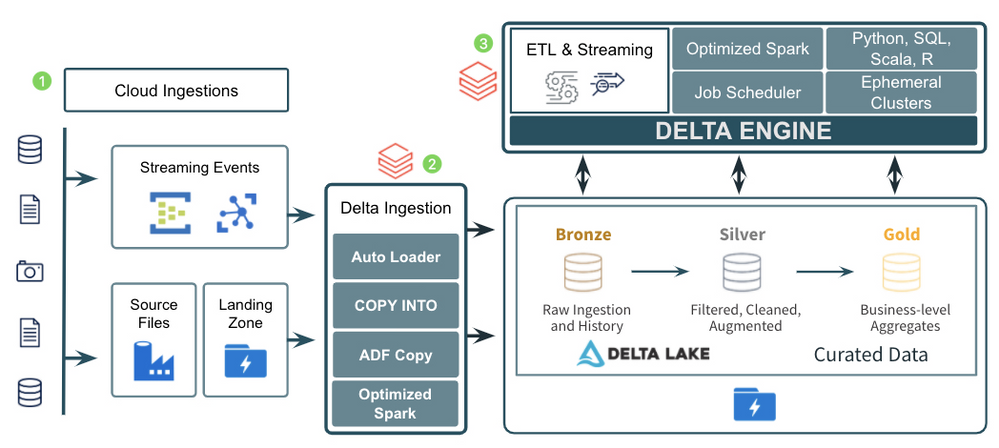
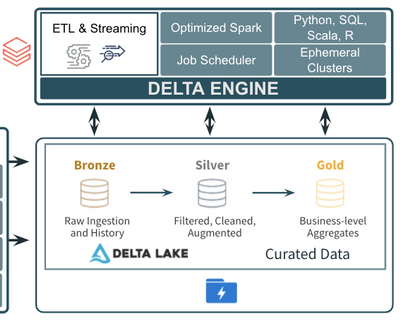
The diagram above demonstrates a common pattern used by many companies to ingest and process data of all types, sizes, and speed into a curated data lake.  Let’s look at the 3 major components of the pattern:


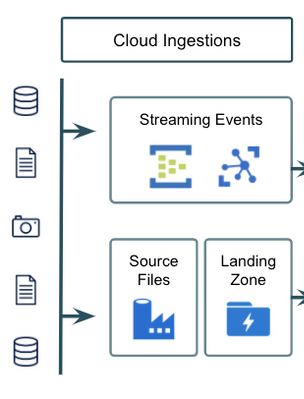
  1. There are several great tools in Azure for ingesting raw data from external sources into the cloud.  Azure Data Factory provides the standard for importing data on a schedule or trigger from almost any data source and landing it in its raw format into Azure Data Lake Storage/Blob Storage.  Other services such as Azure IoT Hub and Azure Event Hubs provide fully managed services for real time ingestion.  Using a mix of Azure Data Factory and Azure IoT/Event Hubs should allow a company to get data of just about any type, size, and speed into Azure. 


    MikeCornell_0-1606339083241.png


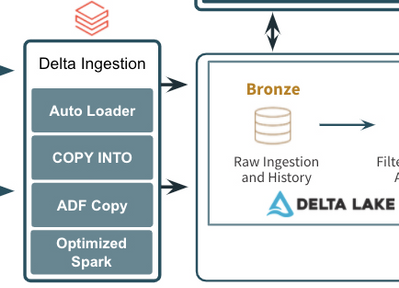
  2. After landing the raw data into Azure, companies typically move it into the raw, or Bronze, layer of the curated data lake.  This usually means just taking the data in its raw, source format, and converting it to the open, transactional Delta Lake format where it can be more efficiently and reliably queried and processed.  Ingesting the data into the Bronze curated layer can be done in a number of ways including: 


    MikeCornell_0-1606339528397.png


    1. Basic, open Apache Spark APIs in Azure Databricks for reading streaming events from Event/IoT Hubs and then writing those events or raw files to the Delta Lake format.

    2. The COPY INTO command to easily copy data from a source file/directory directly into Delta Lake.

    3. The Azure Databricks Auto Loader to efficiently grab files as they arrive in the data lake and write them to the Delta Lake format.

    4. The Azure Data Factory Copy Activity which supports copying data from any of its supported formats into the Delta Lake format.


  3. After the raw data has been ingested to the Bronze layer, companies perform additional ETL and stream processing tasks to filter, clean, transform, join, and aggregate the data into more curated Silver and Gold datasets. Using Azure Databricks as the foundational service for these processing tasks provides companies with a single, consistent compute engine (the Delta Engine) built on open standards with support for programming languages they are already familiar with (SQL, Python, R, Scala).  It also provides them with repeatable DevOps processes and ephemeral compute clusters sized to their individual workloads. 

    MikeCornell_0-1606340949593.png


The ingestion, ETL, and stream processing pattern discussed above has been used successfully with many different companies across many different industries and verticals.  It also holds true to the 3 principles discussed for modern data analytics: 1) using an open, curated data lake for all data (Delta Lake), 2) using a foundational compute layer built on open standards for the core ETL and stream processing (Azure Databricks), and 3) using easy integrations with other services like Azure Data Factory and IoT/Event Hubs which specialize in ingesting data into the cloud.


If you are interested learning more about Azure Databricks, attend an event, and check back soon for additional blogs in the “Patterns with Azure Databricks” series.

Self-Chained APIM request limitation in internal Virtual network mode (Developer and Premium tier)

Self-Chained APIM request limitation in internal Virtual network mode (Developer and Premium tier)

This article is contributed. See the original author and article here.

Known Issue


When you are running API Management instance in “internal” Virtual network mode and trying to call APIs hosted in the same APIM service (use APIM gateway endpoint Url as backend Url), you may experience 500 errors with “BackendConnectionFailure”.


Below screenshots demonstrate the steps to reproduce this issue.


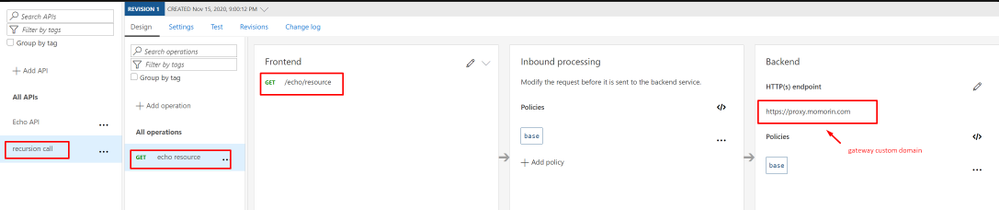
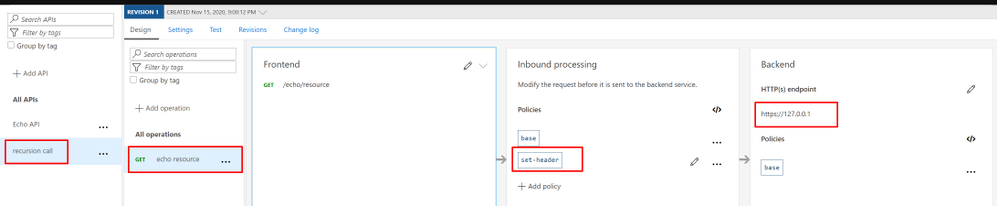
  1. Define Recursion API/operation configuration in APIM instance. Here we let APIM forward http request https://proxy.momorin.com/recursion/echo/resource to https://proxy.momorin.com/echo/resource, which is API in the same APIM instance:


image001.png


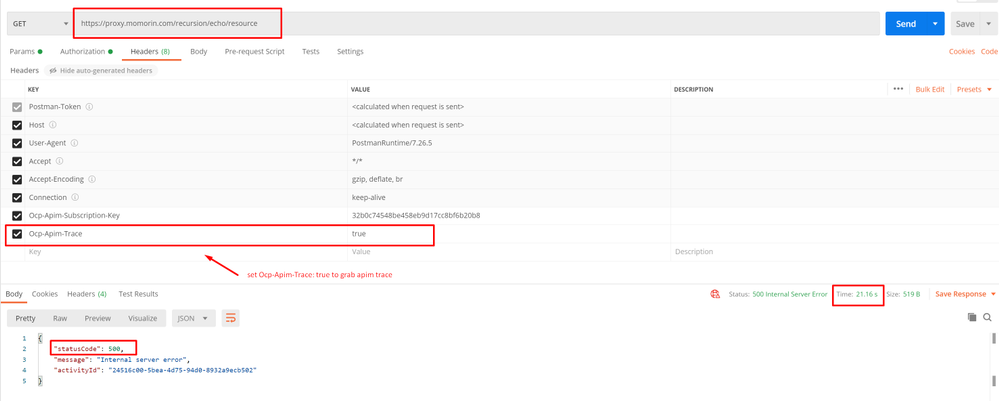
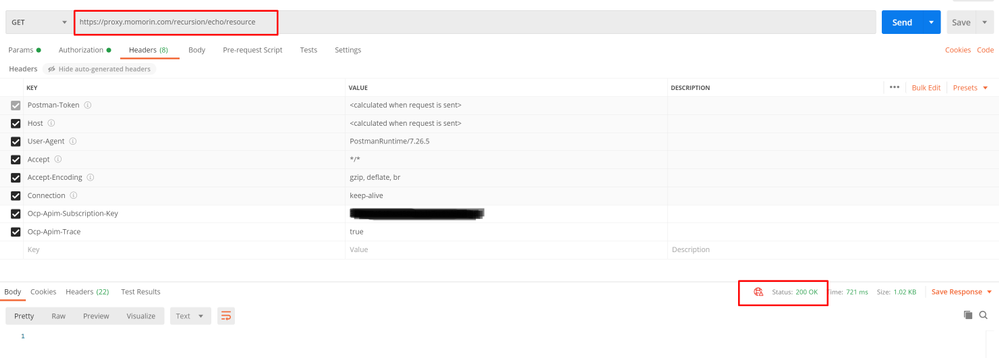
  1. Try to send request through Postman, we need allow inspector trace to better troubleshoot. As a result, 500 error returned after 21 seconds.


image003.png


  1. Now check the APIM inspector trace for more detailed information. We can get trace url from response header “Ocp-Apim-Trace-Location”.


image005.png


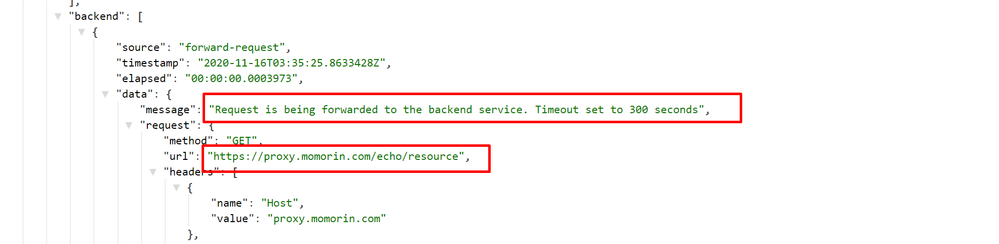
  1. As you can see in the inspector trace, the error happens at backend level, when trying to forward request to APIM itself. Error message is “Unable to connect to the remote server”.


image007.pngimage009.png


You checked all the network configurations, there are no NSG or force tunneling blocking the traffic from internal VNet to APIM gateway endpoint, or even though you logged into one VM inside the same VNet, the connection from this VM to APIM gateway endpoint still works well.


It’s very confusing, because you may just send a call without any other policy or any other configurations related to the backend Url and it should not fail, as the first request layer with same domain succeeded.


Internal Load Balancer Limitation


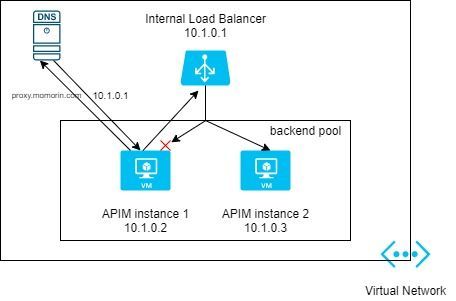
The root cause of this issue is the load balancer limitation when accessing the internal Load Balancer frontend from the participating Load Balancer backend pool VM, as documented here:


https://docs.microsoft.com/en-us/azure/load-balancer/load-balancer-troubleshoot#cause-4-accessing-the-internal-load-balancer-frontend-from-the-participating-load-balancer-backend-pool-vm.


When deploying APIM service into internal VNet mode, the load balancer of gateway (proxy) endpoint is in the same subnet where APIM backend instances are deployed in.


image011.jpg


If an internal Load Balancer is configured inside a VNet, and one of the participant backend VMs is trying to access the internal Load Balancer frontend, failures can occur when the flow is mapped to the originating VM (same VM). This scenario is not supported.


If you use APIM Premium tier, you will have at least two VMs in the subnet, so this issue may intermittently happen (traffic from instance 1 to instance2 will succeed, traffic from instance 1 back to instance 1 will fail). But if you are using Developer pricing tier, you only have one VM instance in the APIM backend pool, this issue will consistently occur.


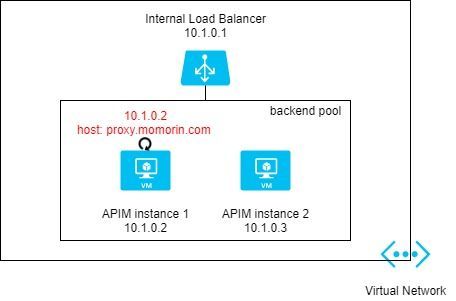
Historically for Internal VNET mode, APIM used to override environment level DNS on the APIM VMs for Gateway hostnames (default and custom ones) to map them to loopback interface (127.0.0.1) using host file entries on the VMs so that every time Gateway (or any other software on the VM) tried to call one of these hostnames, it would connect to itself through loopback network interface defined in the host file.


After an update in February 2020, a decision was made to stop doing host file DNS overrides. This change caused outgoing traffic from APIM VM to its own hostname to be routed to APIM Load Balancer instead of loopback interface. As a result, API calls that were sent to the same APIM service via forward-request or send-request policies started failing.


Resolution


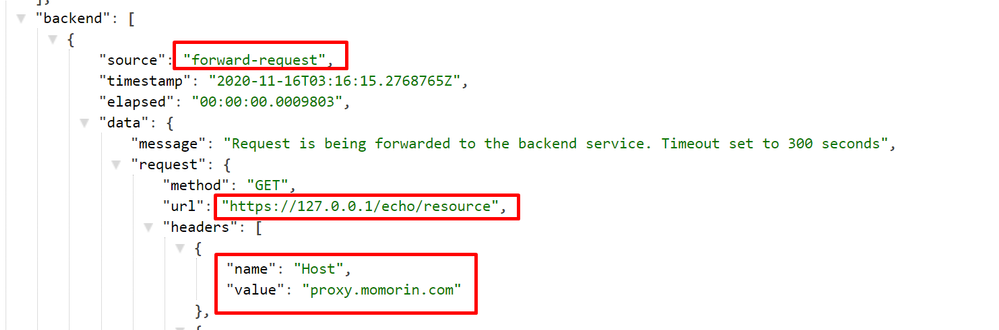
The best solution for this issue is to change the Url of the API in the policy to https://127.0.0.1 *and* add a “host” header to the request for the desired proxy host.image012.jpg


APIM proxy can send requests to backend (including itself) using forward-request or send-request policies. Below are the solutions for each kind of policy.


Change Url of forward-request policy


If the failing request is being sent via forward-request policy (the backendUrl of the API has been set as the Url of the APIM Proxy), the hostname of backendUrl should be changed to https://127.0.0.1. Additionally, a set-header policy should be added in <inbound> section to add the desired host header (which previously used to be part of the Url):


<policies>
    <inbound>
        <set-header name="Host" exists-action="override">
            <value>proxy.momorin.com</value>
        </set-header>
    </inbound>
    <backend>
        <forward-request />
    </backend>
</policies>


Below is one simple instruction & test result of this resolution:


image013.png


200OK returned from https://proxy.momorin.com/recursion/echo/resource this time.


image015.png


The forwarding url is https://127.0.0.1/echo/resource with host “proxy.momorin.com”.


image017.png


Or we can apply the following in the global scope (All APIs) so that we don’t need to modify each API in the backend Url.


    <inbound>
        <choose>
            <when condition="@(context.Request.Url.ToString().Contains("proxy.momorin.com"))">
                <set-header name="Host" exists-action="override">
                    <value>proxy.momorin.com</value>
                </set-header>
                <set-backend-service base-url="@(context.Request.OriginalUrl.Scheme.ToString() + "://127.0.0.1")" />
            </when>
        </choose>
    </inbound>


Change Url of send-request policy


If APIM is called using send-request policy, host can be added directly inside the policy:


<send-request>
    <set-url>https://127.0.0.1/echo/resource</set-url>
    <set-header name="Host">
        <value>proxy.momorin.com</value>
    </set-header>
</send-request>


Vulnerability Summary for the Week of November 23, 2020

This article is contributed. See the original author and article here.

Original release date: November 30, 2020

The CISA Weekly Vulnerability Summary Bulletin is created using information from the NIST NVD. In some cases, the vulnerabilities in the Bulletin may not yet have assigned CVSS scores. Please visit NVD for updated vulnerability entries, which include CVSS scores once they are available.


High Vulnerabilities

Primary
Vendor — Product
Description Published CVSS Score Source & Patch Info
cdata — 72408a_firmware An issue was discovered on CDATA 72408A, 9008A, 9016A, 92408A, 92416A, 9288, 97016, 97024P, 97028P, 97042P, 97084P, 97168P, FD1002S, FD1104, FD1104B, FD1104S, FD1104SN, FD1108S, FD1204S-R2, FD1204SN, FD1204SN-R2, FD1208S-R2, FD1216S-R1, FD1608GS, FD1608SN, FD1616GS, FD1616SN, and FD8000 devices. One can escape from a shell and acquire root privileges by leveraging the TFTP download configuration. 2020-11-24 10 CVE-2020-29056
MISC
cdata — 72408a_firmware An issue was discovered on CDATA 72408A, 9008A, 9016A, 92408A, 92416A, 9288, 97016, 97024P, 97028P, 97042P, 97084P, 97168P, FD1002S, FD1104, FD1104B, FD1104S, FD1104SN, FD1108S, FD1204S-R2, FD1204SN, FD1204SN-R2, FD1208S-R2, FD1216S-R1, FD1608GS, FD1608SN, FD1616GS, FD1616SN, and FD8000 devices. It allows remote attackers to cause a denial of service (reboot) by sending random bytes to the telnet server on port 23, aka a “shawarma” attack. 2020-11-24 7.8 CVE-2020-29057
MISC
cdata — 72408a_firmware An issue was discovered on CDATA 72408A, 9008A, 9016A, 92408A, 92416A, 9288, 97016, 97024P, 97028P, 97042P, 97084P, 97168P, FD1002S, FD1104, FD1104B, FD1104S, FD1104SN, FD1108S, FD1204S-R2, FD1204SN, FD1204SN-R2, FD1208S-R2, FD1216S-R1, FD1608GS, FD1608SN, FD1616GS, FD1616SN, and FD8000 devices. There is a default panger123 password for the suma123 account for certain old firmware. 2020-11-24 7.5 CVE-2020-29059
MISC
cdata — 72408a_firmware An issue was discovered on CDATA 72408A, 9008A, 9016A, 92408A, 92416A, 9288, 97016, 97024P, 97028P, 97042P, 97084P, 97168P, FD1002S, FD1104, FD1104B, FD1104S, FD1104SN, FD1108S, FD1204S-R2, FD1204SN, FD1204SN-R2, FD1208S-R2, FD1216S-R1, FD1608GS, FD1608SN, FD1616GS, FD1616SN, and FD8000 devices. There is a default debug124 password for the debug account. 2020-11-24 7.5 CVE-2020-29060
MISC
cdata — 72408a_firmware An issue was discovered on CDATA 72408A, 9008A, 9016A, 92408A, 92416A, 9288, 97016, 97024P, 97028P, 97042P, 97084P, 97168P, FD1002S, FD1104, FD1104B, FD1104S, FD1104SN, FD1108S, FD1204S-R2, FD1204SN, FD1204SN-R2, FD1208S-R2, FD1216S-R1, FD1608GS, FD1608SN, FD1616GS, FD1616SN, and FD8000 devices. There is a default root126 password for the root account. 2020-11-24 7.5 CVE-2020-29061
MISC
cdata — 72408a_firmware An issue was discovered on CDATA 72408A, 9008A, 9016A, 92408A, 92416A, 9288, 97016, 97024P, 97028P, 97042P, 97084P, 97168P, FD1002S, FD1104, FD1104B, FD1104S, FD1104SN, FD1108S, FD1204S-R2, FD1204SN, FD1204SN-R2, FD1208S-R2, FD1216S-R1, FD1608GS, FD1608SN, FD1616GS, FD1616SN, and FD8000 devices. There is a default blank password for the guest account. 2020-11-24 7.5 CVE-2020-29062
MISC
craftercms — crafter_cms In Crafter CMS Crafter Studio 3.0.1 a directory traversal vulnerability exists which allows unauthenticated attackers to overwrite files from the operating system which can lead to RCE. 2020-11-27 7.5 CVE-2017-15681
MISC
MISC
ibm — spectrum_protect_plus IBM Spectrum Protect Plus 10.1.0 thorugh 10.1.6 contains hard-coded credentials, such as a password or cryptographic key, which it uses for its own inbound authentication, outbound communication to external components, or encryption of internal data. IBM X-Force ID: 190454. 2020-11-23 7.5 CVE-2020-4854
XF
CONFIRM
newsscriptphp — news_script_php_pro SimplePHPscripts News Script PHP Pro 2.3 is affected by a SQL Injection via the id parameter in an editNews action. 2020-11-24 7.5 CVE-2020-25475
MISC
MISC
pcanalyser — pc_analyser An issue was discovered in Devid Espenschied PC Analyser through 4.10. The PCADRVX64.SYS kernel driver exposes IOCTL functionality that allows low-privilege users to read and write to arbitrary Model Specific Registers (MSRs). This could lead to arbitrary Ring-0 code execution and escalation of privileges. 2020-11-27 7.2 CVE-2020-28921
MISC
MISC
MISC
pcanalyser — pc_analyser An issue was discovered in Devid Espenschied PC Analyser through 4.10. The PCADRVX64.SYS kernel driver exposes IOCTL functionality that allows low-privilege users to read and write arbitrary physical memory. This could lead to arbitrary Ring-0 code execution and escalation of privileges. 2020-11-27 7.2 CVE-2020-28922
MISC
MISC
MISC

Back to top


Medium Vulnerabilities

Primary
Vendor — Product
Description Published CVSS Score Source & Patch Info
bigbluebutton — bigbluebutton An issue was discovered in BigBlueButton through 2.2.29. A brute-force attack may occur because an unlimited number of codes can be entered for a meeting that is protected by an access code. 2020-11-26 4.3 CVE-2020-29042
MISC
MISC
MISC
bigbluebutton — bigbluebutton An issue was discovered in BigBlueButton through 2.2.29. When at attacker is able to view an account_activations/edit?token= URI, the attacker can create an approved user account associated with an email address that has an arbitrary domain name. 2020-11-26 5 CVE-2020-29043
MISC
MISC
MISC
cdata — 72408a_firmware An issue was discovered on CDATA 72408A, 9008A, 9016A, 92408A, 92416A, 9288, 97016, 97024P, 97028P, 97042P, 97084P, 97168P, FD1002S, FD1104, FD1104B, FD1104S, FD1104SN, FD1108S, FD1204S-R2, FD1204SN, FD1204SN-R2, FD1208S-R2, FD1216S-R1, FD1608GS, FD1608SN, FD1616GS, FD1616SN, and FD8000 devices. Attackers can discover cleartext web-server credentials via certain /opt/lighttpd/web/cgi/ requests. 2020-11-24 5 CVE-2020-29058
MISC
cdata — 72408a_firmware An issue was discovered on CDATA 72408A, 9008A, 9016A, 92408A, 92416A, 9288, 97016, 97024P, 97028P, 97042P, 97084P, 97168P, FD1002S, FD1104, FD1104B, FD1104S, FD1104SN, FD1108S, FD1204S-R2, FD1204SN, FD1204SN-R2, FD1208S-R2, FD1216S-R1, FD1608GS, FD1608SN, FD1616GS, FD1616SN, and FD8000 devices. By default, the appliance can be managed remotely only with HTTP, telnet, and SNMP. It doesn’t support SSL/TLS for HTTP or SSH. An attacker can intercept passwords sent in cleartext and conduct man-in-the-middle attacks on the management of the appliance. 2020-11-24 4.3 CVE-2020-29055
MISC
cdata — 72408a_firmware An issue was discovered on CDATA 72408A, 9008A, 9016A, 92408A, 92416A, 9288, 97016, 97024P, 97028P, 97042P, 97084P, 97168P, FD1002S, FD1104, FD1104B, FD1104S, FD1104SN, FD1108S, FD1204S-R2, FD1204SN, FD1204SN-R2, FD1208S-R2, FD1216S-R1, FD1608GS, FD1608SN, FD1616GS, FD1616SN, and FD8000 devices. A custom encryption algorithm is used to store encrypted passwords. This algorithm will XOR the password with the hardcoded *j7a(L#yZ98sSd5HfSgGjMj8;Ss;d)(*&^#@$a2s0i3g value. 2020-11-24 5 CVE-2020-29063
MISC
cdata — 72408a_firmware An issue was discovered on CDATA 72408A, 9008A, 9016A, 92408A, 92416A, 9288, 97016, 97024P, 97028P, 97042P, 97084P, 97168P, FD1002S, FD1104, FD1104B, FD1104S, FD1104SN, FD1108S, FD1204S-R2, FD1204SN, FD1204SN-R2, FD1208S-R2, FD1216S-R1, FD1608GS, FD1608SN, FD1616GS, FD1616SN, and FD8000 devices. Attackers can use “show system infor” to discover cleartext TELNET credentials. 2020-11-24 5 CVE-2020-29054
MISC
craftercms — crafter_cms Crafter CMS Crafter Studio 3.0.1 has a directory traversal vulnerability which allows unauthenticated attackers to view files from the operating system. 2020-11-27 5 CVE-2017-15684
MISC
MISC
craftercms — crafter_cms Crafter CMS Crafter Studio 3.0.1 is affected by: XML External Entity (XXE). An unauthenticated attacker is able to create a site with specially crafted XML that allows the retrieval of OS files out-of-band. 2020-11-27 5 CVE-2017-15685
MISC
MISC
craftercms — crafter_cms In Crafter CMS Crafter Studio 3.0.1 an unauthenticated attacker is able to create a site with specially crafted XML that allows the retrieval of OS files out-of-band. 2020-11-27 5 CVE-2017-15683
MISC
MISC
craftercms — crafter_cms In Crafter CMS Crafter Studio 3.0.1 an unauthenticated attacker is able to inject malicious JavaScript code resulting in a stored/blind XSS in the admin panel. 2020-11-27 4.3 CVE-2017-15682
MISC
MISC
craftercms — crafter_cms Crafter CMS Crafter Studio 3.0.1 is affected by: Cross Site Scripting (XSS), which allows remote attackers to steal users’ cookies. 2020-11-27 4.3 CVE-2017-15686
MISC
craftercms — crafter_cms In Crafter CMS Crafter Studio 3.0.1 an IDOR vulnerability exists which allows unauthenticated attackers to view and modify administrative data. 2020-11-27 6.4 CVE-2017-15680
MISC
MISC
glpi-project — glpi In GLPI before 9.5.3, ajax/getDropdownValue.php has an Insecure Direct Object Reference (IDOR) vulnerability that allows an attacker to read data from any itemType (e.g., Ticket, Users, etc.). 2020-11-26 4 CVE-2020-27663
MISC
glpi-project — glpi In GLPI before 9.5.3, ajax/comments.php has an Insecure Direct Object Reference (IDOR) vulnerability that allows an attacker to read data from any database table (e.g., glpi_tickets, glpi_users, etc.). 2020-11-26 4 CVE-2020-27662
MISC
hrsale — hrsale HRSALE 2.0.0 allows XSS via the admin/project/projects_calendar set_date parameter. 2020-11-24 4.3 CVE-2020-29053
MISC
MISC
ibm — spectrum_control IBM Spectrum Protect Plus 10.1.0 through 10.1.6 could allow a remote attacker to obtain sensitive information, caused by the failure to properly enable HTTP Strict Transport Security. An attacker could exploit this vulnerability to obtain sensitive information using man in the middle techniques. IBM X-Force ID: 189214. 2020-11-23 4.3 CVE-2020-4783
XF
CONFIRM
ibm — spectrum_protect_operations_center IBM Spectrum Protect Operations Center 8.1.0.000 through 8.1.10.and 7.1.0.000 through 7.1.11 could allow a remote attacker to obtain sensitive information, caused by improper authentication of a websocket endpoint. By using known tools to subscribe to the websocket event stream, an attacker could exploit this vulnerability to obtain sensitive information. IBM X-Force ID: 188993. 2020-11-23 5 CVE-2020-4771
XF
CONFIRM
ibm — sterling_b2b_integrator IBM Sterling B2B Integrator Standard Edition 5.2.0.0 through 6.0.3.2 uses weaker than expected cryptographic algorithms that could allow an attacker to decrypt highly sensitive information. IBM X-Force ID: 191814. 2020-11-20 5 CVE-2020-4937
XF
CONFIRM
mongodb — mongodb A user authorized to perform database queries may trigger denial of service by issuing specially crafted applyOps invocations. This issue affects: MongoDB Inc. MongoDB Server v4.0 versions prior to 4.0.10; v3.6 versions prior to 3.6.13. 2020-11-23 4 CVE-2018-20804
CONFIRM
mongodb — mongodb A user authorized to perform database queries may cause denial of service by issuing a specially crafted query which violates an invariant in the server selection subsystem. This issue affects: MongoDB Server version 4.4 prior to 4.4.1. Versions before 4.4 are not affected. 2020-11-23 4 CVE-2020-7926
CONFIRM
mongodb — mongodb A user authorized to perform database queries may trigger denial of service by issuing specially crafted queries with compound indexes affecting QueryPlanner. This issue affects: MongoDB Inc. MongoDB Server v3.6 versions prior to 3.6.9, v4.0 versions prior to 4.0.3. 2020-11-23 4 CVE-2018-20802
CONFIRM
mongodb — mongodb A user authorized to perform database queries may trigger denial of service by issuing specially crafted queries, which use the $mod operator to overflow negative values. This issue affects: MongoDB Inc. MongoDB Server v4.4 versions prior to 4.4.1; v4.2 versions prior to 4.2.9; v4.0 versions prior to 4.0.20; v3.6 versions prior to 3.6.20. 2020-11-23 4 CVE-2019-2392
CONFIRM
mongodb — mongodb A user authorized to perform database queries may trigger denial of service by issuing specially crafted queries, which perform an $elemMatch This issue affects: MongoDB Inc. MongoDB Server v4.0 versions prior to 4.0.5; v3.6 versions prior to 3.6.10. This issue affects: MongoDB Inc. MongoDB Server 3.6 versions prior to 3.6.10; 4.0 versions prior to 4.0.5. 2020-11-23 4 CVE-2018-20805
CONFIRM
mongodb — mongodb A user authorized to perform database queries may trigger denial of service by issuing specially crafted queries, which throw unhandled Javascript exceptions containing types intended to be scoped to the Javascript engine’s internals. This issue affects: MongoDB Inc. MongoDB Server v4.0 versions prior to 4.0.7. 2020-11-23 4 CVE-2019-20923
CONFIRM
mongodb — mongodb A user authorized to perform database queries may trigger denial of service by issuing specially crafted queries which trigger an invariant in the IndexBoundsBuilder. This issue affects: MongoDB Inc. MongoDB Server v4.2 versions prior to 4.2.2. 2020-11-23 4 CVE-2019-20924
CONFIRM
mongodb — mongodb A user authorized to perform database queries may trigger denial of service by issuing specially crafted queries, which use $lookup and collations. This issue affects: MongoDB Inc. MongoDB Server v4.2 versions prior to 4.2.1; v4.0 versions prior to 4.0.13; v3.6 versions prior to 3.6.15. 2020-11-23 4 CVE-2019-2393
CONFIRM
newsscriptphp — news_script_php_pro SimplePHPscripts News Script PHP Pro 2.3 is affected by a Cross Site Scripting (XSS) vulnerability via the editor_name parameter. 2020-11-24 4.3 CVE-2020-25474
MISC
MISC
MISC
newsscriptphp — news_script_php_pro SimplePHPscripts News Script PHP Pro 2.3 is affected by a Cross Site Request Forgery (CSRF) vulnerability, which allows attackers to add new users. 2020-11-24 4.3 CVE-2020-25472
MISC
MISC
MISC
tianocore — edk2 Use after free vulnerability in EDK II may allow an authenticated user to potentially enable escalation of privilege, information disclosure and/or denial of service via adjacent access. 2020-11-23 5.2 CVE-2019-14586
MISC
tianocore — edk2 Logic issue in DxeImageVerificationHandler() for EDK II may allow an authenticated user to potentially enable escalation of privilege via local access. 2020-11-23 4.6 CVE-2019-14575
MISC
tianocore — edk2 Improper authentication in EDK II may allow a privileged user to potentially enable information disclosure via network access. 2020-11-23 4 CVE-2019-14553
MISC
tianocore — edk2 Integer truncation in EDK II may allow an authenticated user to potentially enable escalation of privilege via local access. 2020-11-23 4.6 CVE-2019-14563
MISC
tianocore — edk2 Uncontrolled resource consumption in EDK II may allow an unauthenticated user to potentially enable denial of service via network access. 2020-11-23 5 CVE-2019-14559
MISC
v-secure — jingyun_antivirus In Jingyun Antivirus v2.4.2.39, the driver file (ZySandbox.sys) allows local users to cause a denial of service (BSOD) or possibly have unspecified other impact because of not validating input values from IOCtl 0x12364020. 2020-11-23 4.6 CVE-2018-16723
MISC
MISC
v-secure — jingyun_antivirus In Jingyun Antivirus v2.4.2.39, the driver file (ZySandbox.sys) allows local users to cause a denial of service (BSOD) or possibly have unspecified other impact because of not validating input values from IOCtl 0x12360094, a related issue to CVE-2018-16305. 2020-11-23 4.6 CVE-2018-16722
MISC
MISC
v-secure — jingyun_antivirus In Jingyun Antivirus v2.4.2.39, the driver file (ZySandbox.sys) allows local users to cause a denial of service (BSOD) or possibly have unspecified other impact because of not validating input values from IOCtl 0x12360090, a related issue to CVE-2018-16306. 2020-11-23 4.6 CVE-2018-16721
MISC
MISC
v-secure — jingyun_antivirus In Jingyun Antivirus v2.4.2.39, the driver file (ZySandbox.sys) allows local users to cause a denial of service (BSOD) or possibly have unspecified other impact because of not validating input values from IOCtl 0x1236001c, a related issue to CVE-2018-16304. 2020-11-23 4.6 CVE-2018-16720
MISC
MISC
v-secure — jingyun_antivirus In Jingyun Antivirus v2.4.2.39, the driver file (hookbody.sys) allows local users to cause a denial of service (BSOD) or possibly have unspecified other impact because of not validating input values from IOCtl 0x00221482. 2020-11-23 4.6 CVE-2018-16719
MISC
MISC

Back to top


Low Vulnerabilities

Primary
Vendor — Product
Description Published CVSS Score Source & Patch Info
oscommerce — oscommerce osCommerce 2.3.4.1 has XSS vulnerability via the authenticated user entering the XSS payload into the title section of newsletters. 2020-11-25 3.5 CVE-2020-29070
MISC
MISC
MISC
tianocore — edk2 Logic issue EDK II may allow an unauthenticated user to potentially enable denial of service via adjacent access. 2020-11-23 3.3 CVE-2019-14587
MISC
tianocore — edk2 Integer overflow in DxeImageVerificationHandler() EDK II may allow an authenticated user to potentially enable denial of service via local access. 2020-11-23 2.1 CVE-2019-14562
MISC

Back to top


Severity Not Yet Assigned

Primary
Vendor — Product
Description Published CVSS Score Source & Patch Info
apache — unomi
 
It is possible to inject malicious OGNL or MVEL scripts into the /context.json public endpoint. This was partially fixed in 1.5.1 but a new attack vector was found. In Apache Unomi version 1.5.2 scripts are now completely filtered from the input. It is highly recommended to upgrade to the latest available version of the 1.5.x release to fix this problem. 2020-11-24 not yet calculated CVE-2020-13942
CONFIRM
MLIST
MLIST
MLIST
MLIST
MLIST
MLIST
atlassian — fisheye/crucible Affected versions of Atlassian Fisheye/Crucible allow remote attackers to impact the application’s availability via a Denial of Service (DoS) vulnerability in the MessageBundleResource within Atlassian Gadgets. The affected versions are before version 4.8.4. 2020-11-25 not yet calculated CVE-2020-14191
MISC
MISC
atlassian — fisheye/crucible
 
Affected versions of Atlassian Fisheye/Crucible allow remote attackers to achieve Regex Denial of Service via user-supplied regex in EyeQL. The affected versions are before version 4.8.4. 2020-11-25 not yet calculated CVE-2020-14190
MISC
MISC
b&r_industrial_automation — aprol An issue was discovered in B&R Industrial Automation APROL before R4.2 V7.08. An attacker can get information from the AprolSqlServer DBMS by bypassing authentication, a different vulnerability than CVE-2019-16356 and CVE-2019-9983. 2020-11-27 not yet calculated CVE-2019-19873
MISC
b&r_industrial_automation — aprol
 
An issue was discovered in B&R Industrial Automation APROL before R4.2 V7.08. An EnMon PHP script was vulnerable to SQL injection, a different vulnerability than CVE-2019-10006. 2020-11-27 not yet calculated CVE-2019-19876
MISC
b&r_industrial_automation — aprol
 
An issue was discovered in B&R Industrial Automation APROL before R4.2 V7.08. An attacker can get access to historical data from AprolSqlServer by bypassing authentication, a different vulnerability than CVE-2019-16358. 2020-11-27 not yet calculated CVE-2019-19878
MISC
b&r_industrial_automation — aprol
 
An issue was discovered in B&R Industrial Automation APROL before R4.2 V7.08. An attacker can get access to sensitive information outside the working directory via Directory Traversal attacks against AprolSqlServer, a different vulnerability than CVE-2019-16357. 2020-11-27 not yet calculated CVE-2019-19877
MISC
b&r_industrial_automation — aprol
 
An issue was discovered in B&R Industrial Automation APROL before R4.2 V7.08. Arbitrary commands could be injected (using Python scripts) via the AprolCluster script that is invoked via sudo and thus executes with root privileges, a different vulnerability than CVE-2019-16364. 2020-11-27 not yet calculated CVE-2019-19875
MISC
b&r_industrial_automation — aprol
 
An issue was discovered in B&R Industrial Automation APROL before R4.2 V7.08. Some web scripts in the web interface allowed injection and execution of arbitrary unintended commands on the web server, a different vulnerability than CVE-2019-16364. 2020-11-27 not yet calculated CVE-2019-19874
MISC
b&r_industrial_automation — aprol
 
An issue was discovered in B&R Industrial Automation APROL before R4.2 V7.08. The AprolLoader could be used to inject and execute arbitrary unintended commands via an unspecified attack scenario, a different vulnerability than CVE-2019-16364. 2020-11-27 not yet calculated CVE-2019-19872
MISC
b&r_industrial_automation — aprol
 
An issue was discovered in B&R Industrial Automation APROL before R4.2 V7.08. PVs could be changed (unencrypted) by using the IosHttp service and the JSON interface. 2020-11-27 not yet calculated CVE-2019-19869
MISC
barco — wepresent_wiph-1600w_devices


Barco wePresent WiPG-1600W devices allow Authentication Bypass. Affected Version(s): 2.5.1.8. The Barco wePresent WiPG-1600W web interface does not use session cookies for tracking authenticated sessions. Instead, the web interface uses a “SEID” token that is appended to the end of URLs in GET requests. Thus the “SEID” would be exposed in web proxy logs and browser history. An attacker that is able to capture the “SEID” and originate requests from the same IP address (via a NAT device or web proxy) would be able to access the user interface of the device without having to know the credentials. 2020-11-24 not yet calculated CVE-2020-28333
MISC
MISC
barco — wepresent_wiph-1600w_devices


Barco wePresent WiPG-1600W devices use Hard-coded Credentials (issue 2 of 2). Affected Version(s): 2.5.1.8, 2.5.0.25, 2.5.0.24, 2.4.1.19. The Barco wePresent WiPG-1600W device has a hardcoded root password hash included in the firmware image. Exploiting CVE-2020-28329, CVE-2020-28330 and CVE-2020-28331 could potentially be used in a simple and automated exploit chain to go from unauthenticated remote attacker to root shell. 2020-11-24 not yet calculated CVE-2020-28334
MISC
MISC
barco — wepresent_wiph-1600w_devices
 
Barco wePresent WiPG-1600W firmware includes a hardcoded API account and password that is discoverable by inspecting the firmware image. A malicious actor could use this password to access authenticated, administrative functions in the API. Affected Version(s): 2.5.1.8, 2.5.0.25, 2.5.0.24, 2.4.1.19. 2020-11-24 not yet calculated CVE-2020-28329
MISC
barco — wepresent_wiph-1600w_devices
 
Barco wePresent WiPG-1600W devices have Unprotected Transport of Credentials. Affected Version(s): 2.5.1.8. An attacker armed with hardcoded API credentials (retrieved by exploiting CVE-2020-28329) can issue an authenticated query to display the admin password for the main web user interface listening on port 443/tcp of a Barco wePresent WiPG-1600W device. 2020-11-24 not yet calculated CVE-2020-28330
MISC
barco — wepresent_wiph-1600w_devices
 
Barco wePresent WiPG-1600W devices have Improper Access Control. Affected Version(s): 2.5.1.8. The Barco wePresent WiPG-1600W device has an SSH daemon included in the firmware image. By default, the SSH daemon is disabled and does not start at system boot. The system initialization scripts read a device configuration file variable to see if the SSH daemon should be started. The web interface does not provide a visible capability to alter this configuration file variable. However, a malicious actor can include this variable in a POST such that the SSH daemon will be started when the device boots. 2020-11-24 not yet calculated CVE-2020-28331
MISC
MISC
barco — wepresent_wiph-1600w_devices
 
Barco wePresent WiPG-1600W devices download code without an Integrity Check. Affected Version(s): 2.5.1.8, 2.5.0.25, 2.5.0.24, 2.4.1.19. The Barco wePresent WiPG-1600W firmware does not perform verification of digitally signed firmware updates and is susceptible to processing and installing modified/malicious images. 2020-11-24 not yet calculated CVE-2020-28332
MISC
MISC
blosc — c-blosc2
 
blosc2.c in Blosc C-Blosc2 through 2.0.0.beta.5 has a heap-based buffer overflow when there is a lack of space to write compressed data. 2020-11-27 not yet calculated CVE-2020-29367
MISC
MISC
broadcom — ca_unified_infrastructure_management
 
CA Unified Infrastructure Management 20.1 and earlier contains a vulnerability in the robot (controller) component that allows local attackers to elevate privileges. 2020-11-23 not yet calculated CVE-2020-28421
FULLDISC
MISC
cephx — cephx
 
A flaw was found in the Cephx authentication protocol in versions before 15.2.6 and before 14.2.14, where it does not verify Ceph clients correctly and is then vulnerable to replay attacks in Nautilus. This flaw allows an attacker with access to the Ceph cluster network to authenticate with the Ceph service via a packet sniffer and perform actions allowed by the Ceph service. This issue is a reintroduction of CVE-2018-1128, affecting the msgr2 protocol. The msgr 2 protocol is used for all communication except older clients that do not support the msgr2 protocol. The msgr1 protocol is not affected. The highest threat from this vulnerability is to confidentiality, integrity, and system availability. 2020-11-23 not yet calculated CVE-2020-25660
MISC
MISC
MISC
cloudera — data_engineering
 
Cloudera Data Engineering (CDE) before 1.1 was vulnerable to a CSRF attack. 2020-11-26 not yet calculated CVE-2020-26936
MISC
CONFIRM
coremail — coremail_xt
 
jsp/upload.jsp in Coremail XT 5.0 allows XSS via an uploaded personal signature, as demonstrated by a .jpg.html filename in the signImgFile parameter. 2020-11-27 not yet calculated CVE-2020-29133
MISC
cpanel — cpanel cPanel before 90.0.17 allows self-XSS via the WHM Transfer Tool interface (SEC-577). 2020-11-27 not yet calculated CVE-2020-29137
MISC
cpanel — cpanel
 
In cPanel before 90.0.17, 2FA can be bypassed via a brute-force approach (SEC-575). 2020-11-27 not yet calculated CVE-2020-29136
MISC
cpanel — cpanel
 
cPanel before 90.0.17 has multiple instances of URL parameter injection (SEC-567). 2020-11-27 not yet calculated CVE-2020-29135
MISC
crixp — opencrx
 
CRIXP OpenCRX version 4.30 and 5.0-20200717 and prior suffers from an unverified password change vulnerability. An attacker who is able to connect to the affected OpenCRX instance can change the password of any user, including admin-Standard, to any chosen value. This issue was resolved in version 5.0-20200904, released September 4, 2020. 2020-11-24 not yet calculated CVE-2020-7378
MISC
cron-utils — cron-utils
 
Cron-utils is a Java library to parse, validate, migrate crons as well as get human readable descriptions for them. In cron-utils before version 9.1.3, a template Injection vulnerability is present. This enables attackers to inject arbitrary Java EL expressions, leading to unauthenticated Remote Code Execution (RCE) vulnerability. Only projects using the @Cron annotation to validate untrusted Cron expressions are affected. This issue was patched in version 9.1.3. 2020-11-25 not yet calculated CVE-2020-26238
MISC
MISC
CONFIRM
cyberark — endpoint_privilege_manager
 
CyberArk Endpoint Privilege Manager (EPM) 11.1.0.173 allows attackers to bypass a Credential Theft protection mechanism by injecting a DLL into a process that normally has credential access, such as a Chrome process that reads credentials from a SQLite database. 2020-11-27 not yet calculated CVE-2020-25738
MISC
MISC
eclipse — jetty
 
In Eclipse Jetty version 9.4.0.RC0 to 9.4.34.v20201102, 10.0.0.alpha0 to 10.0.0.beta2, and 11.0.0.alpha0 to 11.0.0.beta2, if GZIP request body inflation is enabled and requests from different clients are multiplexed onto a single connection, and if an attacker can send a request with a body that is received entirely but not consumed by the application, then a subsequent request on the same connection will see that body prepended to its body. The attacker will not see any data but may inject data into the body of the subsequent request. 2020-11-28 not yet calculated CVE-2020-27218
CONFIRM
CONFIRM
ericsson — bscs_ix_r18_billing&rating_ix
 
In Ericsson BSCS iX R18 Billing & Rating iX R18, ADMX is a web base module in BSCS iX that is vulnerable to stored XSS via the name or description field to a solutionUnitServlet?SuName=UserReferenceDataSU Access Rights Group. In most test cases, session hijacking was also possible by utilizing the XSS vulnerability. This potentially allows for full account takeover, or exploiting admins’ browsers by using the beef framework. 2020-11-27 not yet calculated CVE-2020-29145
MISC
ericsson — bscs_ix_r18_billing&rating_ix
 
In Ericsson BSCS iX R18 Billing & Rating iX R18, MX is a web base module in BSCS iX that is vulnerable to stored XSS via an Alert Dashboard comment. In most test cases, session hijacking was also possible by utilizing the XSS vulnerability. This potentially allows for full account takeover, or exploiting admins’ browsers by using the beef framework. 2020-11-27 not yet calculated CVE-2020-29144
MISC
fastgate — gpon_fga2130fwb_devices
 
Fastweb FASTGate GPON FGA2130FWB devices through 2020-05-26 allow CSRF via the router administration web panel, leading to an attacker’s ability to perform administrative actions such as modifying the configuration. 2020-11-24 not yet calculated CVE-2020-13620
MISC
MISC
fedora — pacemaker
 
An ACL bypass flaw was found in pacemaker before 1.1.24-rc1 and 2.0.5-rc2. An attacker having a local account on the cluster and in the haclient group could use IPC communication with various daemons directly to perform certain tasks that they would be prevented by ACLs from doing if they went through the configuration. 2020-11-24 not yet calculated CVE-2020-25654
MISC
MISC
FEDORA
FEDORA
MISC
geth — geth
 
Go Ethereum, or “Geth”, is the official Golang implementation of the Ethereum protocol. In Geth before version 1.9.18, there is a Denial-of-service (crash) during block processing. This is fixed in 1.9.18. 2020-11-25 not yet calculated CVE-2020-26242
MISC
CONFIRM
geth — geth
 
Go Ethereum, or “Geth”, is the official Golang implementation of the Ethereum protocol. An ethash mining DAG generation flaw in Geth before version 1.9.24 could cause miners to erroneously calculate PoW in an upcoming epoch (estimated early January, 2021). This happened on the ETC chain on 2020-11-06. This issue is relevant only for miners, non-mining nodes are unaffected. This issue is fixed as of 1.9.24 2020-11-25 not yet calculated CVE-2020-26240
MISC
MISC
MISC
CONFIRM
geth — geth
 
Go Ethereum, or “Geth”, is the official Golang implementation of the Ethereum protocol. This is a Consensus vulnerability in Geth before version 1.9.17 which can be used to cause a chain-split where vulnerable nodes reject the canonical chain. Geth’s pre-compiled dataCopy (at 0x00…04) contract did a shallow copy on invocation. An attacker could deploy a contract that writes X to an EVM memory region R, then calls 0x00..04 with R as an argument, then overwrites R to Y, and finally invokes the RETURNDATACOPY opcode. When this contract is invoked, a consensus-compliant node would push X on the EVM stack, whereas Geth would push Y. This is fixed in version 1.9.17. 2020-11-25 not yet calculated CVE-2020-26241
MISC
CONFIRM
gitea — gitea
 
Gitea 0.9.99 through 1.12.x before 1.12.6 does not prevent a git protocol path that specifies a TCP port number and also contains newlines (with URL encoding) in ParseRemoteAddr in modules/auth/repo_form.go. 2020-11-24 not yet calculated CVE-2020-28991
MISC
MISC
glpi — glpi
 
GLPI stands for Gestionnaire Libre de Parc Informatique and it is a Free Asset and IT Management Software package, that provides ITIL Service Desk features, licenses tracking and software auditing. In GLPI before version 9.5.3, any authenticated user has read-only permissions to the planning of every other user, even admin ones. Steps to reproduce the behavior: 1. Create a new planning with ‘eduardo.mozart’ user (from ‘IT’ group that belongs to ‘Super-admin’) into it’s personal planning at ‘Assistance’ > ‘Planning’. 2. Copy the CalDAV url and use a CalDAV client (e.g. Thunderbird) to sync the planning with the provided URL. 3. Inform the username and password from any valid user (e.g. ‘camila’ from ‘Proativa’ group). 4. ‘Camila’ has read-only access to ‘eduardo.mozart’ personal planning. The same behavior happens to any group. E.g. ‘Camila’ has access to ‘IT’ group planning, even if she doesn’t belong to this group and has a ‘Self-service’ profile permission). This issue is fixed in version 9.5.3. As a workaround, one can remove the `caldav.php` file to block access to CalDAV server. 2020-11-25 not yet calculated CVE-2020-26212
MISC
MISC
CONFIRM
gluster-block — gluster-block
 
An information-disclosure flaw was found in the way that gluster-block before 0.5.1 logs the output from gluster-block CLI operations. This includes recording passwords to the cmd_history.log file which is world-readable. This flaw allows local users to obtain sensitive information by reading the log file. The highest threat from this vulnerability is to data confidentiality. 2020-11-24 not yet calculated CVE-2020-10762
MISC
MISC
hashicorp — consul_and_consul_enterprise
 
HashiCorp Consul and Consul Enterprise 1.2.0 up to 1.8.5 allowed operators with operator:read ACL permissions to read the Connect CA private key configuration. Fixed in 1.6.10, 1.7.10, and 1.8.6. 2020-11-23 not yet calculated CVE-2020-28053
MISC
MISC
hasicorp — nomad_and_nomad_enterprise
 
HashiCorp Nomad and Nomad Enterprise 0.9.0 up to 0.12.7 client Docker file sandbox feature may be subverted when not explicitly disabled or when using a volume mount type. Fixed in 0.12.8, 0.11.7, and 0.10.8. 2020-11-24 not yet calculated CVE-2020-28348
MISC
MISC
hcl — domino
 
HCL Domino is susceptible to a Denial of Service vulnerability caused by improper validation of user-supplied input. A remote unauthenticated attacker could exploit this vulnerability using a specially-crafted email message to hang the server. Versions previous to releases 9.0.1 FP10 IF6, 10.0.1 FP5 and 11.0.1 are affected. 2020-11-21 not yet calculated CVE-2020-14230
CONFIRM
hcl — domino
 
HCL Domino is susceptible to a Denial of Service vulnerability due to improper validation of user-supplied input, potentially giving an attacker the ability to crash the server. Versions previous to release 9.0.1 FP10 IF6 and release 10.0.1 are affected. 2020-11-21 not yet calculated CVE-2020-14234
CONFIRM
hcl — notes
 
HCL Notes is susceptible to a Denial of Service vulnerability caused by improper validation of user-supplied input. A remote unauthenticated attacker could exploit this vulnerability using a specially-crafted email message to hang the client. Versions 9, 10 and 11 are affected. 2020-11-21 not yet calculated CVE-2020-14258
CONFIRM
heketi — hecketi_server
 
An information-disclosure flaw was found in the way Heketi before 10.1.0 logs sensitive information. This flaw allows an attacker with local access to the Heketi server to read potentially sensitive information such as gluster-block passwords. 2020-11-24 not yet calculated CVE-2020-10763
MISC
MISC
highlight.js — highlight.js
 
Highlight.js is a syntax highlighter written in JavaScript. Highlight.js versions before 9.18.2 and 10.1.2 are vulnerable to Prototype Pollution. A malicious HTML code block can be crafted that will result in prototype pollution of the base object’s prototype during highlighting. If you allow users to insert custom HTML code blocks into your page/app via parsing Markdown code blocks (or similar) and do not filter the language names the user can provide you may be vulnerable. The pollution should just be harmless data but this can cause problems for applications not expecting these properties to exist and can result in strange behavior or application crashes, i.e. a potential DOS vector. If your website or application does not render user provided data it should be unaffected. Versions 9.18.2 and 10.1.2 and newer include fixes for this vulnerability. If you are using version 7 or 8 you are encouraged to upgrade to a newer release. 2020-11-24 not yet calculated CVE-2020-26237
MISC
MISC
CONFIRM
MISC
ibm — power9
 
IBM Power9 (AIX 7.1, 7.2, and VIOS 3.1) processors could allow a local user to obtain sensitive information from the data in the L1 cache under extenuating circumstances. IBM X-Force ID: 189296. 2020-11-20 not yet calculated CVE-2020-4788
MLIST
MLIST
XF
FEDORA
FEDORA
CONFIRM
intel — bluez
 
Improper input validation in BlueZ may allow an unauthenticated user to potentially enable escalation of privilege via adjacent access. 2020-11-23 not yet calculated CVE-2020-12351
MISC
intel — bluez
 
Improper access control in BlueZ may allow an unauthenticated user to potentially enable information disclosure via adjacent access. 2020-11-23 not yet calculated CVE-2020-12352
MISC
intel — proset/wireless_wifi_products
 
Out of bounds write in Intel(R) PROSet/Wireless WiFi products on Windows 10 may allow an authenticated user to potentially enable denial of service via local access. 2020-11-23 not yet calculated CVE-2020-0569
MISC
intelbras — multiple_devices
 
Intelbras TIP200 60.61.75.15, TIP200LITE 60.61.75.15, and TIP300 65.61.75.15 devices allow /cgi-bin/cgiServer.exx?page= XSS. 2020-11-27 not yet calculated CVE-2020-12262
MISC
MISC
intelbras — tip_devices
 
Intelbras TIP 200 60.61.75.15, TIP 200 LITE 60.61.75.15, and TIP 300 65.61.75.22 devices allow cgi-bin/cgiServer.exx?page=../ Directory Traversal. 2020-11-26 not yet calculated CVE-2020-13886
MISC
MISC
jupyter — jupyter_server
 
Jupyter Server before version 1.0.6 has an Open redirect vulnerability. A maliciously crafted link to a jupyter server could redirect the browser to a different website. All jupyter servers are technically affected, however, these maliciously crafted links can only be reasonably made for known jupyter server hosts. A link to your jupyter server may appear safe, but ultimately redirect to a spoofed server on the public internet. 2020-11-24 not yet calculated CVE-2020-26232
CONFIRM
MISC
MISC
karenderia — multiple_restuarant_system
 
A SQL injection vulnerability was discovered in Karenderia Multiple Restaurant System, affecting versions 5.4.2 and below. The vulnerability allows for an unauthenticated attacker to perform various tasks such as modifying and leaking all contents of the database. 2020-11-24 not yet calculated CVE-2020-28994
MISC
laravel — php_framework
 
October is a free, open-source, self-hosted CMS platform based on the Laravel PHP Framework. In October CMS from version 1.0.319 and before version 1.0.469, an authenticated backend user with the cms.manage_pages, cms.manage_layouts, or cms.manage_partials permissions who would normally not be permitted to provide PHP code to be executed by the CMS due to cms.enableSafeMode being enabled is able to write specific Twig code to escape the Twig sandbox and execute arbitrary PHP. This is not a problem for anyone that trusts their users with those permissions to normally write & manage PHP within the CMS by not having cms.enableSafeMode enabled, but would be a problem for anyone relying on cms.enableSafeMode to ensure that users with those permissions in production do not have access to write & execute arbitrary PHP. Issue has been patched in Build 469 (v1.0.469) and v1.1.0. 2020-11-23 not yet calculated CVE-2020-15247
MISC
CONFIRM
laravel — php_framework
 
October is a free, open-source, self-hosted CMS platform based on the Laravel PHP Framework. In October CMS from version 1.0.319 and before version 1.0.469, backend users with access to upload files were permitted to upload SVG files without any sanitization applied to the uploaded files. Since SVG files support being parsed as HTML by browsers, this means that they could theoretically upload Javascript that would be executed on a path under the website’s domain (i.e. /storage/app/media/evil.svg), but they would have to convince their target to visit that location directly in the target’s browser as the backend does not display SVGs inline anywhere, SVGs are only displayed as image resources in the backend and are thus unable to be executed. Issue has been patched in Build 469 (v1.0.469) & v1.1.0. 2020-11-23 not yet calculated CVE-2020-15249
MISC
CONFIRM
laravel — php_framework
 
October is a free, open-source, self-hosted CMS platform based on the Laravel PHP Framework. A bypass of CVE-2020-15247 (fixed in 1.0.469 and 1.1.0) was discovered that has the same impact as CVE-2020-15247. An authenticated backend user with the cms.manage_pages, cms.manage_layouts, or cms.manage_partials permissions who would normally not be permitted to provide PHP code to be executed by the CMS due to cms.enableSafeMode being enabled is able to write specific Twig code to escape the Twig sandbox and execute arbitrary PHP. This is not a problem for anyone that trusts their users with those permissions to normally write & manage PHP within the CMS by not having cms.enableSafeMode enabled, but would be a problem for anyone relying on cms.enableSafeMode to ensure that users with those permissions in production do not have access to write & execute arbitrary PHP. Issue has been patched in Build 470 (v1.0.470) and v1.1.1. 2020-11-23 not yet calculated CVE-2020-26231
MISC
CONFIRM
laravel — php_framework
 
October is a free, open-source, self-hosted CMS platform based on the Laravel PHP Framework. In October CMS from version 1.0.319 and before version 1.0.470, backend users with the default “Publisher” system role have access to create & manage users where they can choose which role the new user has. This means that a user with “Publisher” access has the ability to escalate their access to “Developer” access. Issue has been patched in Build 470 (v1.0.470) & v1.1.1. 2020-11-23 not yet calculated CVE-2020-15248
MISC
CONFIRM
laravel — php_framework
 
October is a free, open-source, self-hosted CMS platform based on the Laravel PHP Framework. In October CMS from version 1.0.421 and before version 1.0.469, an attacker can read local files on an October CMS server via a specially crafted request. Issue has been patched in Build 469 (v1.0.469) and v1.1.0. 2020-11-23 not yet calculated CVE-2020-15246
MISC
CONFIRM
libslirp — ncsi.c
 
slirp.c in libslirp through 4.3.1 has a buffer over-read because it tries to read a certain amount of header data even if that exceeds the total packet length. 2020-11-26 not yet calculated CVE-2020-29130
MLIST
MISC
libslirp — ncsi.c
 
ncsi.c in libslirp through 4.3.1 has a buffer over-read because it tries to read a certain amount of header data even if that exceeds the total packet length. 2020-11-26 not yet calculated CVE-2020-29129
MLIST
MISC
libvncserver — libvncserver
 
A divide by zero issue was found to occur in libvncserver-0.9.12. A malicious client could use this flaw to send a specially crafted message that, when processed by the VNC server, would lead to a floating point exception, resulting in a denial of service. 2020-11-27 not yet calculated CVE-2020-25708
MISC
linux — linux_kernel
 
An issue was discovered in the Linux kernel before 5.7.3, related to mm/gup.c and mm/huge_memory.c. The get_user_pages (aka gup) implementation, when used for a copy-on-write page, does not properly consider the semantics of read operations and therefore can grant unintended write access, aka CID-17839856fd58. 2020-11-28 not yet calculated CVE-2020-29374
MISC
MISC
MISC
linux — linux_kernel
 
The Linux kernel before version 5.8 is vulnerable to a NULL pointer dereference in drivers/tty/serial/8250/8250_core.c:serial8250_isa_init_ports() that allows local users to cause a denial of service by using the p->serial_in pointer which uninitialized. 2020-11-23 not yet calculated CVE-2020-15437
MISC
linux — linux_kernel
 
Use-after-free vulnerability in fs/block_dev.c in the Linux kernel before 5.8 allows local users to gain privileges or cause a denial of service by leveraging improper access to a certain error field. 2020-11-23 not yet calculated CVE-2020-15436
MISC
linux — linux_kernel
 
An issue was discovered in the Linux kernel before 5.2.6. On NUMA systems, the Linux fair scheduler has a use-after-free in show_numa_stats() because NUMA fault statistics are inappropriately freed, aka CID-16d51a590a8c. 2020-11-28 not yet calculated CVE-2019-20934
MISC
MISC
MISC
linux — linux_kernel
 
A slab-out-of-bounds read in fbcon in the Linux kernel before 5.9.7 could be used by local attackers to read privileged information or potentially crash the kernel, aka CID-3c4e0dff2095. This occurs because KD_FONT_OP_COPY in drivers/tty/vt/vt.c can be used for manipulations such as font height. 2020-11-20 not yet calculated CVE-2020-28974
MLIST
MISC
MISC
MISC
linux — linux_kernel
 
An issue was discovered in fs/io_uring.c in the Linux kernel before 5.6. It unsafely handles the root directory during path lookups, and thus a process inside a mount namespace can escape to unintended filesystem locations, aka CID-ff002b30181d. 2020-11-28 not yet calculated CVE-2020-29373
MISC
MISC
MISC
linux — linux_kernel
 
An issue was discovered in do_madvise in mm/madvise.c in the Linux kernel before 5.6.8. There is a race condition between coredump operations and the IORING_OP_MADVISE implementation, aka CID-bc0c4d1e176e. 2020-11-28 not yet calculated CVE-2020-29372
MISC
MISC
MISC
linux — linux_kernel
 
An issue was discovered in romfs_dev_read in fs/romfs/storage.c in the Linux kernel before 5.8.4. Uninitialized memory leaks to userspace, aka CID-bcf85fcedfdd. 2020-11-28 not yet calculated CVE-2020-29371
MISC
MISC
MISC
MISC
linux — linux_kernel
 
An issue was discovered in kmem_cache_alloc_bulk in mm/slub.c in the Linux kernel before 5.5.11. The slowpath lacks the required TID increment, aka CID-fd4d9c7d0c71. 2020-11-28 not yet calculated CVE-2020-29370
MISC
MISC
MISC
linux — linux_kernel
 
An issue was discovered in mm/mmap.c in the Linux kernel before 5.7.11. There is a race condition between certain expand functions (expand_downwards and expand_upwards) and page-table free operations from an munmap call, aka CID-246c320a8cfe. 2020-11-28 not yet calculated CVE-2020-29369
MISC
MISC
MISC
linux — linux_kernel
 
An issue was discovered in __split_huge_pmd in mm/huge_memory.c in the Linux kernel before 5.7.5. The copy-on-write implementation can grant unintended write access because of a race condition in a THP mapcount check, aka CID-c444eb564fb1. 2020-11-28 not yet calculated CVE-2020-29368
MISC
MISC
MISC
liquidfiles — liquidfiles A Cross-Site Script Inclusion vulnerability was found on LiquidFiles before 3.3.19. This client-side attack requires user interaction (opening a link) and successful exploitation could lead to encrypted e-mail content leakage via messages/sent?format=js and popup?format=js. 2020-11-25 not yet calculated CVE-2020-29072
MISC
MISC
liquidfiles — liquidfiles
 
An XSS issue was found in the Shares feature of LiquidFiles before 3.3.19. The issue arises from the insecure rendering of HTML files uploaded to the platform as attachments, when the -htmlview URL is directly accessed. The impact ranges from executing commands as root on the server to retrieving sensitive information about encrypted e-mails, depending on the permissions of the target user. 2020-11-25 not yet calculated CVE-2020-29071
MISC
MISC
magicpin — magicpin
 
There is a Stored XSS in Magicpin v2.1 in the User Registration section. Each time an admin visits the manage user section from the admin panel, the XSS triggers and the attacker can able to steal the cookie according to the crafted payload. 2020-11-23 not yet calculated CVE-2020-28927
MISC
MISC
microstrategy — microstrategy
 
A Server-Side Request Forgery (SSRF) affecting the PDF generation in MicroStrategy 10.4, 2019 before Update 6, and 2020 before Update 2 allows authenticated users to access the content of internal network resources or leak files from the local system via HTML containers embedded in a dossier/dashboard document. NOTE: 10.4., no fix will be released as version will reach end-of-life on 31/12/2020. 2020-11-24 not yet calculated CVE-2020-24815
MISC
MISC
MISC
misp — misp
 
MISP before 2.4.135 lacks an ACL check, related to app/Controller/GalaxyElementsController.php and app/Model/GalaxyElement.php. 2020-11-24 not yet calculated CVE-2020-29006
MISC
MISC
modern_honey_network — modern_honey_network
 
_get_flag_ip_localdb in server/mhn/ui/utils.py in Modern Honey Network (MHN) through 2020-11-23 allows attackers to cause a denial-of-service via an IP address that is absent from a local geolocation database, because the code tries to uppercase a return value even if that value is not a string. 2020-11-25 not yet calculated CVE-2020-29069
MISC
mongodb — mongodb_server Incorrect validation of user input in the role name parser may lead to use of uninitialized memory allowing an unauthenticated attacker to use a specially crafted request to cause a denial of service. This issue affects: MongoDB Inc. MongoDB Server v4.4 versions prior to 4.4.0-rc12; v4.2 versions prior to 4.2.9. 2020-11-23 not yet calculated CVE-2020-7925
CONFIRM
mongodb — mongodb_server
 
A user authorized to perform database queries may trigger denial of service by issuing specially crafted queries, which loop indefinitely in mathematics processing while retaining locks. This issue affects: MongoDB Inc. MongoDB Server v4.0 versions prior to 4.0.5; v3.6 versions prior to 3.6.10; v3.4 versions prior to 3.4.19. 2020-11-23 not yet calculated CVE-2018-20803
MISC
mongodb — mongodb_server
 
An unauthenticated client can trigger denial of service by issuing specially crafted wire protocol messages, which cause the message decompressor to incorrectly allocate memory. This issue affects: MongoDB Inc. MongoDB Server v4.2 versions prior to 4.2.1; v4.0 versions prior to 4.0.13; v3.6 versions prior to 3.6.15; v3.4 versions prior to 3.4.24. 2020-11-24 not yet calculated CVE-2019-20925
CONFIRM
mongodb — mongodb_server
 
A user authorized to perform database queries may trigger a read overrun and access arbitrary memory by issuing specially crafted queries. This issue affects: MongoDB Inc. MongoDB Server v4.5 versions prior to 4.5.1; v4.4 versions prior to 4.4.1; v4.2 versions prior to 4.2.9; v4.0 versions prior to 4.0.20; v3.6 versions prior to 3.6.20. 2020-11-23 not yet calculated CVE-2020-7928
MISC
mongodb — ops_manager
 
Specially crafted API calls may allow an authenticated user who holds Organization Owner privilege to obtain an API key with Global Role privilege. This issue affects MongoDB Ops Manager v4.2 versions 4.2.0-4.2.17, v4.3 versions 4.3.0-4.3.9 and v4.4 versions 4.4.0-4.4.2. 2020-11-23 not yet calculated CVE-2020-7927
CONFIRM
musl_libc — musl_libc
 
In musl libc through 1.2.1, wcsnrtombs mishandles particular combinations of destination buffer size and source character limit, as demonstrated by an invalid write access (buffer overflow). 2020-11-24 not yet calculated CVE-2020-28928
CONFIRM
MISC
mutt — mutt_and_neomutt
 
Mutt before 2.0.2 and NeoMutt before 2020-11-20 did not ensure that $ssl_force_tls was processed if an IMAP server’s initial server response was invalid. The connection was not properly closed, and the code could continue attempting to authenticate. This could result in authentication credentials being exposed on an unencrypted connection, or to a machine-in-the-middle. 2020-11-23 not yet calculated CVE-2020-28896
MISC
MISC
MISC
MISC
nanopb — nonopb
 
Nanopb is a small code-size Protocol Buffers implementation. In Nanopb before versions 0.4.4 and 0.3.9.7, decoding specifically formed message can leak memory if dynamic allocation is enabled and an oneof field contains a static submessage that contains a dynamic field, and the message being decoded contains the submessage multiple times. This is rare in normal messages, but it is a concern when untrusted data is parsed. This is fixed in versions 0.3.9.7 and 0.4.4. The following workarounds are available: 1) Set the option `no_unions` for the oneof field. This will generate fields as separate instead of C union, and avoids triggering the problematic code. 2) Set the type of the submessage field inside oneof to `FT_POINTER`. This way the whole submessage will be dynamically allocated and the problematic code is not executed. 3) Use an arena allocator for nanopb, to make sure all memory can be released afterwards. 2020-11-25 not yet calculated CVE-2020-26243
MISC
MISC
MISC
CONFIRM
netgear — gs108ev3
 
Cross-site request forgery (CSRF) vulnerability in GS108Ev3 firmware version 2.06.10 and earlier allows remote attackers to hijack the authentication of administrators and the product’s settings may be changed without the user’s intention or consent via unspecified vectors. 2020-11-24 not yet calculated CVE-2020-5641
MISC
MISC
openwall — spice-vdagentd A race condition vulnerability was found in the way the spice-vdagentd daemon handled new client connections. This flaw may allow an unprivileged local guest user to become the active agent for spice-vdagentd, possibly resulting in a denial of service or information leakage from the host. The highest threat from this vulnerability is to data confidentiality as well as system availability. This flaw affects spice-vdagent versions 0.20 and prior. 2020-11-26 not yet calculated CVE-2020-25653
MISC
MISC
openwall — spice-vdagentd
 
A flaw was found in the SPICE file transfer protocol. File data from the host system can end up in full or in parts in the client connection of an illegitimate local user in the VM system. Active file transfers from other users could also be interrupted, resulting in a denial of service. The highest threat from this vulnerability is to data confidentiality as well as system availability. This flaw affects spice-vdagent versions 0.20 and prior. 2020-11-26 not yet calculated CVE-2020-25651
MISC
MISC
openwall — spice-vdagentd
 
A flaw was found in the spice-vdagentd daemon, where it did not properly handle client connections that can be established via the UNIX domain socket in `/run/spice-vdagentd/spice-vdagent-sock`. Any unprivileged local guest user could use this flaw to prevent legitimate agents from connecting to the spice-vdagentd daemon, resulting in a denial of service. The highest threat from this vulnerability is to system availability. This flaw affects spice-vdagent versions 0.20 and prior. 2020-11-26 not yet calculated CVE-2020-25652
MISC
MISC
openwall — spice-vdagentd
 
A flaw was found in the way the spice-vdagentd daemon handled file transfers from the host system to the virtual machine. Any unprivileged local guest user with access to the UNIX domain socket path `/run/spice-vdagentd/spice-vdagent-sock` could use this flaw to perform a memory denial of service for spice-vdagentd or even other processes in the VM system. The highest threat from this vulnerability is to system availability. This flaw affects spice-vdagent versions 0.20 and previous versions. 2020-11-25 not yet calculated CVE-2020-25650
MISC
MISC
ortus — testbox
 
In Ortus TestBox 2.4.0 through 4.1.0, unvalidated query string parameters passed to system/runners/HTMLRunner.cfm allow an attacker to write an arbitrary CFM file (within the application’s context) containing attacker-defined CFML tags, leading to Remote Code Execution. 2020-11-24 not yet calculated CVE-2020-15929
MISC
ortus — testbox
 
In Ortus TestBox 2.4.0 through 4.1.0, unvalidated query string parameters to test-browser/index.cfm allow directory traversal. 2020-11-24 not yet calculated CVE-2020-15928
MISC
otrs — otrs
 
When OTRS uses multiple backends for user authentication (with LDAP), agents are able to login even if the account is set to invalid. This issue affects OTRS; 8.0.9 and prior versions. 2020-11-23 not yet calculated CVE-2020-1778
CONFIRM
paradox — ip150
 
The affected product is vulnerable to three stack-based buffer overflows, which may allow an unauthenticated attacker to remotely execute arbitrary code on the IP150 (firmware versions 5.02.09). 2020-11-21 not yet calculated CVE-2020-25189
MISC
paradox — ip150
 
The affected product is vulnerable to five post-authentication buffer overflows, which may allow a logged in user to remotely execute arbitrary code on the IP150 (firmware versions 5.02.09). 2020-11-21 not yet calculated CVE-2020-25185
MISC
petl — petl
 
petl before 1.68, in some configurations, allows resolution of entities in an XML document. 2020-11-26 not yet calculated CVE-2020-29128
MISC
MISC
MISC
MISC
MISC
playground — playground_sessions
 
Playground Sessions v2.5.582 (and earlier) for Windows, stores the user credentials in plain text allowing anyone with access to UserProfiles.sol to extract the email and password. 2020-11-23 not yet calculated CVE-2020-24227
MISC
postgresql — postgresql A flaw was found in the psql interactive terminal of PostgreSQL in versions before 13.1, before 12.5, before 11.10, before 10.15, before 9.6.20 and before 9.5.24. If an interactive psql session uses gset when querying a compromised server, the attacker can execute arbitrary code as the operating system account running psql. The highest threat from this vulnerability is to data confidentiality and integrity as well as system availability. 2020-11-23 not yet calculated CVE-2020-25696
MISC
MISC
real_time_automation — 499es_ethernet/ip_adaptor_source_code
 
499ES EtherNet/IP (ENIP) Adaptor Source Code is vulnerable to a stack-based buffer overflow, which may allow an attacker to send a specially crafted packet that may result in a denial-of-service condition or code execution. 2020-11-24 not yet calculated CVE-2020-25159
MISC
red_hat — red_hat_enterprise_linux_7
 
An incomplete fix for CVE-2020-12662 was shipped for Unbound in Red Hat Enterprise Linux 7, as part of erratum RHSA-2020:2414. Vulnerable versions of Unbound could still amplify an incoming query into a large number of queries directed to a target, even with a lower amplification ratio compared to versions of Unbound that shipped before the mentioned erratum. This issue is about the incomplete fix for CVE-2020-12662, and it does not affect upstream versions of Unbound. 2020-11-27 not yet calculated CVE-2020-10772
MISC
regex — regex
 
Insufficient RegEx in private-ip npm package v1.0.5 and below insufficiently filters reserved IP ranges resulting in indeterminate SSRF. An attacker can perform a large range of requests to ARIN reserved IP ranges, resulting in an indeterminable number of critical attack vectors, allowing remote attackers to request server-side resources or potentially execute arbitrary code through various SSRF techniques. 2020-11-23 not yet calculated CVE-2020-28360
MISC
MISC
rhacm — rhacm A flaw was found in rhacm versions before 2.0.5 and before 2.1.0. Two internal service APIs were incorrectly provisioned using a test certificate from the source repository. This would result in all installations using the same certificates. If an attacker could observe network traffic internal to a cluster, they could use the private key to decode API requests that should be protected by TLS sessions, potentially obtaining information they would not otherwise be able to. These certificates are not used for service authentication, so no opportunity for impersonation or active MITM attacks were made possible. 2020-11-23 not yet calculated CVE-2020-25688
MISC
rockwell_automation — factorytalk_linx
 
A flaw exists in the Ingress/Egress checks routine of FactoryTalk Linx Version 6.11 and prior. This vulnerability could allow a remote, unauthenticated attacker to specifically craft a malicious packet resulting in a denial-of-service condition on the device. 2020-11-26 not yet calculated CVE-2020-27253
MISC
rockwell_automation — factorytalk_linx
 
A heap overflow vulnerability exists within FactoryTalk Linx Version 6.11 and prior. This vulnerability could allow a remote, unauthenticated attacker to send malicious port ranges, which could result in remote code execution. 2020-11-26 not yet calculated CVE-2020-27251
MISC
rockwell_automation — factorytalk_linx
 
A heap overflow vulnerability exists within FactoryTalk Linx Version 6.11 and prior. This vulnerability could allow a remote, unauthenticated attacker to send malicious set attribute requests, which could result in the leaking of sensitive information. This information disclosure could lead to the bypass of address space layout randomization (ASLR). 2020-11-26 not yet calculated CVE-2020-27255
MISC
rust — time_crate
 
In Rust time crate from version 0.2.7 and before version 0.2.23, unix-like operating systems may segfault due to dereferencing a dangling pointer in specific circumstances. This requires the user to set any environment variable in a different thread than the affected functions. The affected functions are time::UtcOffset::local_offset_at, time::UtcOffset::try_local_offset_at, time::UtcOffset::current_local_offset, time::UtcOffset::try_current_local_offset, time::OffsetDateTime::now_local and time::OffsetDateTime::try_now_local. Non-Unix targets are unaffected. This includes Windows and wasm. The issue was introduced in version 0.2.7 and fixed in version 0.2.23. 2020-11-24 not yet calculated CVE-2020-26235
MISC
MISC
CONFIRM
sagecom — f@st3486_net_docsis
 
Incorrect Access Control in the configuration backup path in SAGEMCOM F@ST3486 NET DOCSIS 3.0, software NET_4.109.0, allows remote unauthenticated users to download the router configuration file via the /backupsettings.conf URI, when any valid session is running. 2020-11-27 not yet calculated CVE-2020-29138
MISC
schedmd — slurm
 
Slurm before 19.05.8 and 20.x before 20.02.6 has an RPC Buffer Overflow in the PMIx MPI plugin. 2020-11-27 not yet calculated CVE-2020-27745
MISC
schedmd — slurm
 
Slurm before 19.05.8 and 20.x before 20.02.6 exposes Sensitive Information to an Unauthorized Actor because xauth for X11 magic cookies is affected by a race condition in a read operation on the /proc filesystem. 2020-11-27 not yet calculated CVE-2020-27746
MISC
scratch — addons
 
Scratch Addons is a WebExtension that supports both Chrome and Firefox. Scratch Addons before version 1.3.2 is vulnerable to DOM-based XSS. If the victim visited a specific website, the More Links addon of the Scratch Addons extension used incorrect regular expression which caused the HTML-escaped values to be unescaped, leading to XSS. Scratch Addons version 1.3.2 fixes the bug. The extension will be automatically updated by the browser. More Links addon can be disabled via the option of the extension. 2020-11-23 not yet calculated CVE-2020-26239
MISC
MISC
MISC
CONFIRM
security_onion — security_onion
 
Security Onion v2 prior to 2.3.10 has an incorrect sudo configuration, which allows local users to obtain root access by editing and executing /home/<user>/SecurityOnion/setup/so-setup. 2020-11-23 not yet calculated CVE-2020-27985
MISC
MISC
MISC
seiko — epson
 
Untrusted search path vulnerability in the installers of multiple SEIKO EPSON products allows an attacker to gain privileges via a Trojan horse DLL in an unspecified directory. 2020-11-24 not yet calculated CVE-2020-5674
MISC
MISC
MISC
simplephpscripts — news_script_php_pro
 
SimplePHPscripts News Script PHP Pro 2.3 does not properly set the HttpOnly Flag from Session Cookies. 2020-11-24 not yet calculated CVE-2020-25473
MISC
MISC
MISC
snyk — com.softwaremill.akka-http-session:core
 
This affects the package com.softwaremill.akka-http-session:core_2.13 before 0.5.11; the package com.softwaremill.akka-http-session:core_2.12 before 0.5.11; the package com.softwaremill.akka-http-session:core_2.11 before 0.5.11. For older versions, endpoints protected by randomTokenCsrfProtection could be bypassed with an empty X-XSRF-TOKEN header and an empty XSRF-TOKEN cookie. 2020-11-27 not yet calculated CVE-2020-7780
MISC
MISC
MISC
MISC
MISC
MISC
snyk — djvalidator
 
All versions of package djvalidator are vulnerable to Regular Expression Denial of Service (ReDoS) by sending crafted invalid emails – for example, –@————————————————————————————————————————!. 2020-11-26 not yet calculated CVE-2020-7779
MISC
snyk — jsen
 
This affects all versions of package jsen. If an attacker can control the schema file, it could run arbitrary JavaScript code on the victim machine. In the module description and README file there is no mention about the risks of untrusted schema files, so I assume that this is applicable. In particular the required field of the schema is not properly sanitized. The resulting string that is build based on the schema definition is then passed to a Function.apply();, leading to an Arbitrary Code Execution. 2020-11-23 not yet calculated CVE-2020-7777
MISC
MISC
snyk — systeminformation
 
This affects the package systeminformation before 4.30.2. The attacker can overwrite the properties and functions of an object, which can lead to executing OS commands. 2020-11-26 not yet calculated CVE-2020-7778
MISC
MISC
MISC
MISC
MISC
sourceforge — seedms
 
Open redirect in SeedDMS 6.0.13 via the dropfolderfileform1 parameter to out/out.AddDocument.php. 2020-11-24 not yet calculated CVE-2020-28726
CONFIRM
spip — spip
 
prive/formulaires/configurer_preferences.php in SPIP before 3.2.8 does not properly validate the couleur, display, display_navigation, display_outils, imessage, and spip_ecran parameters. 2020-11-23 not yet calculated CVE-2020-28984
MISC
MISC
DEBIAN
synapse — matrix
 
Matrix Synapse before 1.20.0 erroneously permits non-standard NaN, Infinity, and -Infinity JSON values in fields of m.room.member events, allowing remote attackers to execute a denial of service attack against the federation and common Matrix clients. If such a malformed event is accepted into the room’s state, the impact is long-lasting and is not fixed by an upgrade to a newer version, requiring the event to be manually redacted instead. Since events are replicated to servers of other room members, the impact is not constrained to the server of the event sender. 2020-11-24 not yet calculated CVE-2020-26890
MISC
systeminformation — systeminformation
 
npm package systeminformation before version 4.30.5 is vulnerable to Prototype Pollution leading to Command Injection. The issue was fixed with a rewrite of shell sanitations to avoid prototyper pollution problems. The issue is fixed in version 4.30.5. If you cannot upgrade, be sure to check or sanitize service parameter strings that are passed to si.inetChecksite(). 2020-11-27 not yet calculated CVE-2020-26245
MISC
CONFIRM
tableau — tableau_server
 
Tableau Server installations configured with Site-Specific SAML that allows the APIs to be used by unauthenticated users. If exploited, this could allow a malicious user to configure Site-Specific SAML settings and could lead to account takeover for users of that site. Tableau Server versions affected on both Windows and Linux are: 2018.2 through 2018.2.27, 2018.3 through 2018.3.24, 2019.1 through 2019.1.22, 2019.2 through 2019.2.18, 2019.3 through 2019.3.14, 2019.4 through 2019.4.13, 2020.1 through 2020.1.10, 2020.2 through 2020.2.7, and 2020.3 through 2020.3.2. 2020-11-23 not yet calculated CVE-2020-6939
CONFIRM
totolink — multiple_products
 
An issue was discovered on TOTOLINK A850R-V1 through 1.0.1-B20150707.1612 and F1-V2 through 1.1-B20150708.1646 devices. By sending a specific hel,xasf packet to the WAN interface, it is possible to open the web management interface on the WAN interface. 2020-11-24 not yet calculated CVE-2015-9550
MISC
totolink — multiple_products
 
An issue was discovered on TOTOLINK A850R-V1 through 1.0.1-B20150707.1612 and F1-V2 through 1.1-B20150708.1646 devices. There is Remote Code Execution in the management interface via the formSysCmd sysCmd parameter. 2020-11-24 not yet calculated CVE-2015-9551
MISC
typ03 — typ03
 
TYPO3 is an open source PHP based web content management system. In TYPO3 from version 10.4.0, and before version 10.4.10, RSS widgets are susceptible to XML external entity processing. This vulnerability is reasonable, but is theoretical – it was not possible to actually reproduce the vulnerability with current PHP versions of supported and maintained system distributions. At least with libxml2 version 2.9, the processing of XML external entities is disabled per default – and cannot be exploited. Besides that, a valid backend user account is needed. Update to TYPO3 version 10.4.10 to fix the problem described. 2020-11-23 not yet calculated CVE-2020-26229
CONFIRM
MISC
typ03 — typ03
 
TYPO3 is an open source PHP based web content management system. In TYPO3 before versions 9.5.23 and 10.4.10 user session identifiers were stored in cleartext – without processing with additional cryptographic hashing algorithms. This vulnerability cannot be exploited directly and occurs in combination with a chained attack – like for instance SQL injection in any other component of the system. Update to TYPO3 versions 9.5.23 or 10.4.10 that fix the problem described. 2020-11-23 not yet calculated CVE-2020-26228
CONFIRM
MISC
typ03 — typ03
 
TYPO3 is an open source PHP based web content management system. In TYPO3 before versions 9.5.23 and 10.4.10 the system extension Fluid (typo3/cms-fluid) of the TYPO3 core is vulnerable to cross-site scripting passing user-controlled data as argument to Fluid view helpers. Update to TYPO3 versions 9.5.23 or 10.4.10 that fix the problem described. 2020-11-23 not yet calculated CVE-2020-26227
CONFIRM
MISC
unix — symbolic_link
 
UNIX Symbolic Link (Symlink) Following in TP-Link Archer C9(US)_V1_180125 firmware allows an unauthenticated actor, with physical access and network access, to read sensitive files and write to a limited set of files after plugging a crafted USB drive into the router. 2020-11-21 not yet calculated CVE-2020-5797
MISC
vmware — multiple_products
 
VMware Workspace One Access, Access Connector, Identity Manager, and Identity Manager Connector address have a command injection vulnerability. 2020-11-23 not yet calculated CVE-2020-4006
MISC
vmware — sd-wan_orchestrator


The SD-WAN Orchestrator 3.3.2 prior to 3.3.2 P3 and 3.4.x prior to 3.4.4 allows an access to set arbitrary authorization levels leading to a privilege escalation issue. An authenticated SD-WAN Orchestrator user may exploit an application weakness and call a vulnerable API to elevate their privileges. 2020-11-24 not yet calculated CVE-2020-3985
MISC
vmware — sd-wan_orchestrator


The SD-WAN Orchestrator 3.3.2 prior to 3.3.2 P3 and 3.4.x prior to 3.4.4 does not apply correct input validation which allows for SQL-injection. An authenticated SD-WAN Orchestrator user may exploit a vulnerable API call using specially crafted SQL queries which may lead to unauthorized data access. 2020-11-24 not yet calculated CVE-2020-3984
MISC
vmware — sd-wan_orchestrator


The SD-WAN Orchestrator 3.3.2 prior to 3.3.2 P3, 3.4.x prior to 3.4.4, and 4.0.x prior to 4.0.1 handles system parameters in an insecure way. An authenticated SD-WAN Orchestrator user with high privileges may be able to execute arbitrary code on the underlying operating system. 2020-11-24 not yet calculated CVE-2020-4003
MISC
vmware — sd-wan_orchestrator


The SD-WAN Orchestrator 3.3.2, 3.4.x, and 4.0.x has default passwords allowing for a Pass-the-Hash Attack. SD-WAN Orchestrator ships with default passwords for predefined accounts which may lead to to a Pass-the-Hash attack. 2020-11-24 not yet calculated CVE-2020-4001
MISC
vmware — sd-wan_orchestrator
 
The SD-WAN Orchestrator 3.3.2 prior to 3.3.2 P3, 3.4.x prior to 3.4.4, and 4.0.x prior to 4.0.1 allows for executing files through directory traversal. An authenticated SD-WAN Orchestrator user is able to traversal directories which may lead to code execution of files. 2020-11-24 not yet calculated CVE-2020-4000
MISC
vmware — sd-wan_orchestrator
 
VMware SD-WAN Orchestrator 3.3.2 prior to 3.3.2 P3, 3.4.x prior to 3.4.4, and 4.0.x prior to 4.0.1 was found to be vulnerable to SQL-injection attacks allowing for potential information disclosure. An authenticated SD-WAN Orchestrator user may inject code into SQL queries which may lead to information disclosure. 2020-11-24 not yet calculated CVE-2020-4003
MISC
wikimedia — colognebluetemplate.php
 
includes/CologneBlueTemplate.php in the CologneBlue skin for MediaWiki through 1.35 allows XSS via a qbfind message supplied by an administrator. 2020-11-24 not yet calculated CVE-2020-29002
MISC
MISC
wikimedia — pollny_extension
 
The PollNY extension for MediaWiki through 1.35 allows XSS via an answer option for a poll question, entered during Special:CreatePoll or Special:UpdatePoll. 2020-11-24 not yet calculated CVE-2020-29003
MISC
wildfly — wildfly
 
A flaw was discovered in WildFly before 21.0.0.Final where, Resource adapter logs plain text JMS password at warning level on connection error, inserting sensitive information in the log file. 2020-11-24 not yet calculated CVE-2020-25640
MISC
MISC
winscp — winscp
 
Buffer overflow in WinSCP 5.17.8 allows a malicious FTP server to cause a denial of service or possibly have other unspecified impact via a long file name. 2020-11-23 not yet calculated CVE-2020-28864
MISC
MISC
x11vnc — x11vnc
 
scan.c in x11vnc 0.9.16 uses IPC_CREAT|0777 in shmget calls, which allows access by actors other than the current user. 2020-11-25 not yet calculated CVE-2020-29074
MISC
DEBIAN
xen — xen
 
An issue was discovered in Xen through 4.14.x allowing x86 HVM guest OS users to cause a denial of service (stack corruption), cause a data leak, or possibly gain privileges because of an off-by-one error. NOTE: this issue is caused by an incorrect fix for CVE-2020-27671. 2020-11-24 not yet calculated CVE-2020-29040
MISC
xpdf — xpdf
 
In Xpdf 4.02, SplashOutputDev::endType3Char(GfxState *state) SplashOutputDev.cc:3079 is trying to use the freed `t3GlyphStack->cache`, which causes an `heap-use-after-free` problem. The codes of a previous fix for nested Type 3 characters wasn’t correctly handling the case where a Type 3 char referred to another char in the same Type 3 font. 2020-11-21 not yet calculated CVE-2020-25725
CONFIRM
MISC
zetetic — sqlcipher
 
Zetetic SQLCipher 4.x before 4.4.1 has a use-after-free, related to sqlcipher_codec_pragma and sqlite3Strlen30 in sqlite3.c. A remote denial of service attack can be performed. For example, a SQL injection can be used to execute the crafted SQL command sequence. After that, some unexpected RAM data is read. 2020-11-26 not yet calculated CVE-2020-27207
CONFIRM
MISC
MISC
zyxel — zyxel
 
A stack-based buffer overflow in fbwifi_continue.cgi on Zyxel UTM and VPN series of gateways running firmware version V4.30 through to V4.55 allows remote unauthenticated attackers to execute arbitrary code via a crafted http packet. 2020-11-27 not yet calculated CVE-2020-25014
MISC
CONFIRM

Back to top

This product is provided subject to this Notification and this Privacy & Use policy.

Log Analytics scopes explained

This article is contributed. See the original author and article here.

Log Analytics Allows users and admin to configure and use multiple scopes to ingest and query logs.


Admins can configure ingestion to various workspaces and query logs in workspaces, resources and even resource types.


To help you better understand the various concepts and scopes in Log Analytics and to help you better leverage Log Analytics flexibility and make the most out of Logs we have created this short movie:


We value your input! Tell us what you think about this movie by adding comments to this blog.

Using partitioned tables or multiple tables to improve big deletes performance

This article is contributed. See the original author and article here.


Thamires Lemes
Thamires Lemes
2
115
2020-11-30T11:45:00Z
5
1424
8118
67
19
9523
16.00

true
2020-11-26T11:24:29Z
Standard
Internal
72f988bf-86f1-41af-91ab-2d7cd011db47
e2002e1c-6ae2-4efb-82fe-097026bef49b
0

Clean
Clean
false

false
false
false

EN-US
X-NONE
<w:LidThemeComplexscript>X-NONE</w:LidThemeComplexscript>

There are cases in which the time It takes to perform the delete operations are higher than what is acceptable, even if there are no resources constraint and the execution plan is good. In such a cases, we may consider reviewing the process.


I will show two options to achieve this, one using multiple tables and other using a partitioned table, which will not only improve the performance, but also reduce transaction log consumption, table fragmentation and eliminate the need to scale up the database and reduce the costs or prevent increasing It.


I have provided some examples, but please keep in mind you should implement your own process and test It in a non-production environment first.


For a simple demonstration, we will consider a table called ‘Log’ which may contain several columns, but the ones we are most interested in are: ‘ID’, that is an int identity(1,1) column and ‘insert_time’, which is a datetime column that stores when the data was inserted. The only index present is the primary key PK_Log on ID. We will perform the clean-up task once a month and delete everything that is older than 2 months.


  1. Store the data by month in different tables


We could switch between 3 tables once a month and truncate the one that contains the older data. We can have a view with the union all of the 3 tables if necessary.


If the application only writes to this table and It is only read manually when necessary, it may not be necessary application changes. However, if the application also needs to read the data, it may be necessary to make a few changes to have It read from the view or It would only show the most recent data (< 1 month). We need to take this in consideration when performing this change.


EXAMPLE


–Initial setup:


–1. Create two additional tables to store the older data per month, as for example: Log_1month, Log_2month


–2. Grant permissions to the new tables


–3. Create a new index for insert_time on the tables.


–CREATE INDEX Log_insert_time ON Log (insert_time);


–CREATE INDEX Log_1month_insert_time ON Log_1month (insert_time);


–CREATE INDEX Log_2month_insert_time ON Log_2month (insert_time);


–4. Create a view to select the 3 tables if necessary, as for example:


–CREATE VIEW dbo.Log_select


–AS


–select * from dbo.[Log]


–UNION ALL


–select * from dbo.[Log_1month]


–UNION ALL


–select * from dbo.[Log_2month]


–5. Update Statistics 


DECLARE @minDate DATE;


DECLARE @limitDate DATE;


–We will remove everything that is older than 2 months, so that is going to be the limitDate:


SET @limitDate = cast(DATEADD(month,-2,CURRENT_TIMESTAMP) AS DATE);


–Checking what is the newest data in the table log_2month:


SELECT @minDate = max(insert_time) from dbo.log_2month;


print @minDate


print @limitDate


–If the table log_2month has data newer than 2 months, which is the retention period, the process is not executed


IF (@minDate <= @limitDate or @minDate is NULL)


BEGIN


       truncate table dbo.[Log_2month]


       BEGIN TRANSACTION


              EXEC sp_rename dbo.Log_2month’,‘Log_new’; 


              EXEC sp_rename dbo.Log_1month’,‘Log_2month’;


              EXEC sp_rename dbo.Log,‘Log_1month’;


              EXEC sp_rename dbo.Log_new’,‘Log;


              –Change the identity of the table to continue from the ID the other one was


              declare @currentSeedValue int;


              declare @changeIdent_sql nvarchar(max);


              set @currentSeedValue = IDENT_CURRENT( dbo.Log_1month’ );


              set @changeIdent_sql = ‘DBCC CHECKIDENT (”dbo.Log”, RESEED, ‘ + cast(@currentSeedValue as varchar) + ‘)’;


              exec sp_executesql @changeIdent_sql;


       COMMIT;


END


ELSE


       print ‘Please double check you need to run this process, as It might have been executed recently!’


  1. Partition the current table or create a new partitioned table.


It is important to point out that, since on Azure SQL DB you do not have control on where the data is physically stored, we can only configure the partitions to use the primary filegroup.


If we partition by insert_time, keeping the primary key in the ID, we will need to first recreate the primary key as nonclustered. It would also require to, every time we perform the clean-up process, drop the primary key before performing the truncate and recreate It afterwards, because It will not be a partitioned index, so It won’t support this operation. In terms of efficiency, I believe this is not the best option, so I recommend partitioning by ID.


If we partition by the ID, it will not be as precise as the insert_time when we need to perform the truncate. We might have to leave a partition with data that has already reached the retention period, because It might also have newer data. The amount of data will depend on the range of each partition, so this can be mitigated by having smaller ranges.


We could partition the current table or create a new partitioned table: The creation of a new partitioned table would avoid the maintenance window, but It would require to grant permissions and rename the tables, so the new one can assume the place of the old one and the application start writing to It. We could then keep the old table for the historical data until the retention period is reached.


EXAMPLE (Partitioning the existing table)


–I create the partitions for every 100.000 records, but you can reduce the range as much as you would like


CREATE PARTITION FUNCTION [PF_PARTITIONBYID](int) AS RANGE RIGHT


FOR VALUES (‘100000’,‘200000’,‘300000’,‘400000’,‘500000’,‘600000’, ‘700000’,‘800000’,‘900000’,‘1000000’,


            ‘1100000’,‘1200000’,‘1300000’,‘1400000’,‘1500000’, ‘1600000’,‘1700000’,‘1800000’,‘1900000’,‘2000000’);


–As It’s not possible to manage where the data will be physically stored on Azure SQL DB, you have to set all to primary


CREATE PARTITION SCHEME [PS_PARTITIONBYID]


AS PARTITION [PF_PARTITIONBYID]


ALL TO ([PRIMARY]);


–You can recreate the PK as the clustered partitioned index


alter table dbo.[Log] DROP CONSTRAINT [PK_Log]


ALTER TABLE dbo.[Log] ADD CONSTRAINT [PK_Log] PRIMARY KEY CLUSTERED  (id)


   WITH (STATISTICS_NORECOMPUTE = OFF, IGNORE_DUP_KEY = OFF,


         ALLOW_ROW_LOCKS = ON, ALLOW_PAGE_LOCKS = ON) ON PS_PARTITIONBYID(id)


–You can create a partitioned index on insert_time and id to make the search for the partitions to remove/truncate faster. 


CREATE INDEX Log_insert_time ON Log (insert_time, id);


–To check the partitions


SELECT SCHEMA_NAME(o.schema_id) + ‘.’ + OBJECT_NAME(i.object_id) AS [object]


       , p.partition_number


       , i.index_id


       , p.rows


       , CASE boundary_value_on_right


              WHEN 1 THEN ‘less than’


              ELSE ‘less than or equal to’


          END AS comparison


       , rv.value


FROM sys.partitions p


INNER JOIN sys.indexes i


ON p.object_id = i.object_id


AND p.index_id = i.index_id


INNER JOIN sys.objects o


ON p.object_id = o.object_id


INNER JOIN sys.partition_schemes ps


       ON ps.data_space_id = i.data_space_id


INNER JOIN sys.partition_functions f


       ON f.function_id = ps.function_id


INNER JOIN sys.destination_data_spaces dds


       ON dds.partition_scheme_id = ps.data_space_id AND dds.destination_id = p.partition_number


INNER JOIN sys.filegroups fg


       ON dds.data_space_id = fg.data_space_id


LEFT OUTER JOIN sys.partition_range_values rv


       ON f.function_id = rv.function_id AND p.partition_number = rv.boundary_id


WHERE o.object_id = OBJECT_ID(dbo.Log)


Note: For a new table, it would be basically the same steps, since we will first need to create a copy, without data, of the old one. The only thing that would change would be the name of the table in which we would be creating the partition and the rename of both tables at the end.


EXAMPLE (Truncating the partition)


–Get the list of partitions to be removed, based on the 2 months retention period


DECLARE @Max_id int;


declare @truncate_sql nvarchar(max)


declare @merge_sql nvarchar(max)


SELECT @Max_id = max(id) from dbo.Log where insert_time < cast(DATEADD(month,-2,CURRENT_TIMESTAMP) As Date);


SELECT @truncate_sql = ‘TRUNCATE TABLE dbo.[Log] WITH (PARTITIONS(‘ + CAST(min(partition_number) AS VARCHAR) + ‘ TO ‘ + CAST(max(partition_number) AS VARCHAR) + ‘))’


, @merge_sql = ‘ALTER PARTITION FUNCTION [PF_PARTITIONBYID]() MERGE RANGE (‘ + cast(max(rv.value) as varchar) + ‘)’


FROM sys.partitions p


INNER JOIN sys.indexes i


ON p.object_id = i.object_id


AND p.index_id = i.index_id


INNER JOIN sys.objects o


ON p.object_id = o.object_id


INNER JOIN sys.partition_schemes ps


       ON ps.data_space_id = i.data_space_id


INNER JOIN sys.partition_functions f


       ON f.function_id = ps.function_id


INNER JOIN sys.destination_data_spaces dds


       ON dds.partition_scheme_id = ps.data_space_id AND dds.destination_id = p.partition_number


INNER JOIN sys.filegroups fg


       ON dds.data_space_id = fg.data_space_id


LEFT OUTER JOIN sys.partition_range_values rv


       ON f.function_id = rv.function_id AND p.partition_number = rv.boundary_id


WHERE i.index_id < 2 AND o.object_id = OBJECT_ID(dbo.Log) AND rv.value <= @Max_id


print max_id: ‘ + cast(@Max_id as varchar)


print


print ‘truncate command: ‘ + @truncate_sql


print


print ‘merge command:’ + @merge_sql


–I will leave the executions commented, so there is no risk of running by mistake


–exec sp_executesql @truncate_sql


–exec sp_executesql @truncate_sql


Securing a Windows Server VM in Azure

This article is contributed. See the original author and article here.

If you’ve built and managed Windows Servers in an on-premises environment, you may have a set of configuration steps as well as regular process and monitoring alerts, to ensure that server is as secure as possible. But if you run a Windows Server VM in Azure, apart from not having to manage the physical security of the underlying compute hardware, what on-premises concepts still apply, what may you need to alter and what capabilities of Azure should you include?


Windows Security Baselines – Most server administrators would start by configuring the default Group Policy settings to meet their organization’s security requirements, and would search for guidance on other settings that could be tweak to make the environment more restrictive. Traditional Windows Server hardening guidance can now get out of date easily, as we ship more frequent updates and changes to the operating system, though some practices are universally good to apply. In addition, security guidance can change, especially as we learn from the latest threats.


To keep up with the current advice, relevant to your server’s current patch levels, we recommend the use of the Windows Security Baselines. Provided inside the Security Compliance Toolkit, the baselines bring together feedback from Microsoft security engineering teams, product groups, partner and customers into a set of Microsoft-recommended configuration settings and their security impact. On the Microsoft Security Baselines blog, you can keep track of changes to the baselines through the Draft and Final stages, for example as they relate to the Windows Server version 20H2 release
This guidance applies to Windows Server whether it’s on-premises or in the Cloud.


Hardening your Windows Server – In addition, my colleague Orin Thomas does a great presentation on Hardening your Windows Server environment. It includes things like Credential Guard, Privileged Administration Workstations, Shielded VMs and more. Download the presentation deck and the demo videos here: Orin-Thomas/HardenWinSvr: Hardening Windows Server presentation (github.com)


Server Roles and applications
You also need to pay attention to the role that your server is performing, which will install additional files and settings to the base operating system, for example if it’s running IIS or SQL Server. These components come with their own security guidance, and Orin has written up advice on hardening IIS here: Windows Server 101: Hardening IIS via Security Control Configuration


And then there’s the configuration of any applications you are hosting on the server. Have you custom applications been developed to protect against attacks or exploits? Are any third-party applications secure or do they require you to “relax” your security configurations for them to function properly (for example, turning off UAC)? Do you restrict who can install applications onto your server and which applications can be installed or run?


Microsoft Azure considerations
With some of the Windows Server considerations covered, let’s explore the Azure considerations and capabilities.


Networking
One of the biggest differences to running an on-premises server is how you manage the network configuration. IaaS VMs should always be managed through Azure, not via their network settings inside the operating system.


RDP – It’s still not a good idea to leave open the default RDP port, due to the high number of malicious attempts at taking servers down by flooding this port with invalid authentication attempts. Instead, for a secure connection to a remote server session for administration, check out Azure Bastion instead which is instigated through the Azure Portal. 


Network security groupsNetwork security groups allow granular control of traffic to and from Azure resources, including traffic between different resources in Azure. Plan your routing requirements and configure these virtual firewalls to only allow necessary traffic. 


Just-in-time VM access – If you do have a requirement to open ports sometimes, consider implementing just-in-time (JIT) VM access. This allows Azure Security Center to change networking settings for a specified period of time only, for approved user requests.


VPN Gateways – Implement a virtual network gateway for encrypted traffic between your on-premises location and your Azure resources. This can be from physical sites (such as branch offices), individual devices (via Point to Site gateways) or through private Express Route connections which don’t traverse the public internet. Learn more at What is a VPN Gateway? 


Identity
Role Based Access Control – Specific to Azure, Role Based Access Control (RBAC) lets you control who has access to the properties and configuration settings of your Azure resources via the Azure Resource Manager (including the Azure Portal, PowerShell, the Azure CLI and Cloud Shell). These permissions are packaged by common roles, so you could assign someone as a Backup Operator and they’d get the necessary rights to manage Azure Backup for the VM, for example. This identity capability helps you implement a “least privilege” model, with the right people having only the access that they need to perform their roles. 


Privileged Identity Management – Similar to JIT VM access, Privileged Identity Management enables an approved user to elevate to a higher level of permissions for a limited time, usually to perform administration tasks.


Other advanced Identity features – With the Cloud, you can take advantage of additional advanced security features for securing authentication requests, including Conditional Access and Multi-Factor Authentication. Check out Phase 1:Build a foundation of security in the Azure Active Directory feature deployment guide. 


Security Compliance & Monitoring
Azure Security Benchmarks – Similar to the Windows Security Benchmarks, the Azure Security Benchmarks help you baseline your configuration against Microsoft recommended security practices. These include how security recommendations map to security controls from industry sources like NIST and CIS, and include Azure configuration settings for your VM (such as privileged access, logging and governance). 


Azure Defender for Servers – Azure Security Center allows for advanced security capabilities and monitoring of server VMs with Azure Defender for Servers. This is my “if you only do one thing in this article, do this” recommendation. It’s needed for JIT access and also includes things like file integrity monitoring, adaptive network hardening and fileless attack detection. 


Azure Policy – Other things can fall under the security umbrella, like staying compliant with the Payment Card Industry’s Data Security Standard (PCI DSS), or ensuring that Cloud resources can only be created in an approved list of countries (with corresponding Azure regions) for your organization. Investigate how Azure Policy can help enforce these requirements when a new VM is created or can alert you if an existing VM has it’s configuration changed so it’s now non-compliant. 


Conclusion
While it’s easy to imagine a security scenario of an open application database or a hacking attempt to exploit application code, there are a significant number of security aspects to running a Windows Server VM in the cloud too. Start with this list and you’re going in the right direction to make your cloud servers as secure as possible, aligned with the specific requirements for your organization.


How to enable MSI (Managed Service Identity) for Batch compute nodes in User Subscription Mode

How to enable MSI (Managed Service Identity) for Batch compute nodes in User Subscription Mode

This article is contributed. See the original author and article here.

Background:


Currently we can enable Azure Managed Identity to use platform-managed keys or customer-managed keys to encrypt the customer data which is stored in Azure Batch: https://docs.microsoft.com/en-us/azure/batch/batch-customer-managed-key. However, the managed identity on the Batch account is not available on the compute nodes. There was an active feature request submitted to Azure Batch team and Azure Active Directory team asking for supporting MSI in Azure Batch environment: https://feedback.azure.com/forums/269742-batch/suggestions/33640984-support-managed-service-identity#:~:text=Actually%2C%20Azure%20Batch%20is%20not,variables%20and%20clear%20text%20configuration. The implementation of this feature has begun but there is no ETA at this time. As an optional plan,  we could enable MSI for compute nodes in user subscription mode which means that user would need to manage his own Virtual Machine Scale Sets (VMSS) and those nodes are in MSI enabled environment.


Purpose:


In user subscription mode, customer can enable MSI for compute nodes directly by their own. Please note the following limitations:


  1. Right now this optional plan is only valid when the pool allocation mode is user subscription which means all the compute nodes are going to be provisioned in your subscription. Please check this document for the details: https://docs.microsoft.com/en-us/azure/batch/batch-account-create-portal#create-a-batch-account

  2. When these Batch VMs are provisioned every time,  for example, Batch Service creates a new Virtual Machine Scale Sets due to some scale out activity, you are required to enable the MSI manually. You can do it via Portal, PowerShell or REST API .


Pre-requirement:


  • Prepare an Azure Batch account with User Subscription mode


1.jpg


Steps:


  1. Create a new pool in the Batch account, the VMSS will be added to your subscription in a different resource group.


2.jpg


  1. Access to the resource group and select VMSS.


  1. Access to the VMSS and select the Identity tab to enable the MSI. This document provides more information about enabling system-assigned managed identify and user-assigned managed identity: https://docs.microsoft.com/en-us/azure/active-directory/managed-identities-azure-resources/qs-configure-portal-windows-vm#enable-system-assigned-managed-identity-on-an-existing-vm.


3.jpg


  1. You will be able to modify the role assignments. In my example, I assigned Owner role of subscription in the Azure role assignments.


  1. RDP to the VMSS to test if the MSI works or not. Now I can get the token to list the information of my resource group. This document lists the PowerShell command that I used in this example: https://docs.microsoft.com/en-us/azure/active-directory/managed-identities-azure-resources/tutorial-windows-vm-access-arm#get-an-access-token-using-the-vms-system-assigned-managed-identity-and-use-it-to-call-azure-resource-manager.


$response = Invoke-WebRequest -Uri ‘http://169.254.169.254/metadata/identity/oauth2/token?api-version=2018-02-01&resource=https://management.azure.com/‘ -Method GET -Headers @{Metadata=”true”}


$content = $response.Content | ConvertFrom-Json


$ArmToken = $content.access_token


(Invoke-WebRequest -Uri ‘https://management.azure.com/subscriptions/a2d49d28-b5b1-48fe-83dc-ada50a035a99/resourceGroups/moshi?api-version=2016-06-01‘ -Method GET -ContentType “application/json” -Headers @{ Authorization=”Bearer $ArmToken”}).content


4.jpg


Lesson Learned #148: High wait time due to Parameter Sniffing

Lesson Learned #148: High wait time due to Parameter Sniffing

This article is contributed. See the original author and article here.

This last week I had a service request where our customer faced a high wait time due to a parameter sniffing. In this situation, our customer is not able to change any option of the query and they asked about if there is any other option to fix this issue.


We have several alternatives but I would like to share 3 of them besides other ones:


Alternative 1


  • I developed an application that is running a parametrized query like our customer has.


Code1.png


  • As you could see we have a process that creates a cached plan.


SELECT plan_handle,UseCounts,RefCounts, Cacheobjtype, Objtype,  TEXT AS SQL 
FROM sys.dm_exec_cached_plans 
CROSS APPLY sys.dm_exec_sql_text(plan_handle) 
where text like '%SELECT count(Id) FROM PerformanceVarcharNVarchar%' AND objtype='Prepared'


code2.png


Alternative 2


  • Other option that you have is to disable parameter sniffing in the database properties. But, you could have other performance issue for the rest of the queries.


Code3.png


Alternative 3


  • Finally, you could use plan guide, for example:


    • My C# is converted the TSQL is this way: (@Name nvarchar(200))SELECT count(Id) FROM PerformanceVarcharNVarchar Where TextToSearch = @Name


      • If you need this info you could see it using the following TSQL if needed:


SELECT TOP 2500
       databases.name,
       dm_exec_sql_text.text AS TSQL_Text,
       CAST(CAST(dm_exec_query_stats.total_worker_time AS DECIMAL)/CAST(dm_exec_query_stats.execution_count AS DECIMAL) AS INT) as cpu_per_execution,
       CAST(CAST(dm_exec_query_stats.total_logical_reads AS DECIMAL)/CAST(dm_exec_query_stats.execution_count AS DECIMAL) AS INT) as logical_reads_per_execution,
       CAST(CAST(dm_exec_query_stats.total_elapsed_time AS DECIMAL)/CAST(dm_exec_query_stats.execution_count AS DECIMAL) AS INT) as elapsed_time_per_execution,
       dm_exec_query_stats.creation_time, 
       dm_exec_query_stats.execution_count,
       dm_exec_query_stats.total_worker_time AS total_cpu_time,
       dm_exec_query_stats.max_worker_time AS max_cpu_time, 
       dm_exec_query_stats.total_elapsed_time, 
       dm_exec_query_stats.max_elapsed_time, 
       dm_exec_query_stats.total_logical_reads, 
       dm_exec_query_stats.max_logical_reads,
       dm_exec_query_stats.total_physical_reads, 
       dm_exec_query_stats.max_physical_reads,
       dm_exec_query_plan.query_plan,
       dm_exec_cached_plans.cacheobjtype,
       dm_exec_cached_plans.objtype,
       dm_exec_cached_plans.size_in_bytes,*
FROM sys.dm_exec_query_stats 
CROSS APPLY sys.dm_exec_sql_text(dm_exec_query_stats.plan_handle)
CROSS APPLY sys.dm_exec_query_plan(dm_exec_query_stats.plan_handle)
INNER JOIN sys.databases
ON dm_exec_sql_text.dbid = databases.database_id
INNER JOIN sys.dm_exec_cached_plans 
ON dm_exec_cached_plans.plan_handle = dm_exec_query_stats.plan_handle
WHERE NAME='DotNetExample'
and dm_exec_sql_text.text like '%SELECT count(Id) FROM PerformanceVarcharNVarchar%'
ORDER BY tsql_text DESC;


  • I created a plan guide recompiling the query every time that I executed the query in this way:


EXEC sp_create_plan_guide   
    @name =  N'Guide1',  
    @stmt = N'SELECT count(Id) FROM PerformanceVarcharNVarchar Where TextToSearch = @Name',  
    @type = N'SQL',  
    @module_or_batch = null,  
    @params = N'@Name nvarchar(200)',  
    @hints = N'OPTION (RECOMPILE)';


  • Finally, if I need to drop the plan guide, basically, I could run the following command to delete it:  


EXEC sp_control_plan_guide N'DROP', N'Guide1';  


Enjoy!


Giving wisely in the time of COVID

This article was originally posted by the FTC. See the original article here.

Thanks to COVID-19, many charitable organizations are faced with greater demand for their services, but less in donations as people have less to give. Now, more than ever, it’s important to make sure that your donation will be used wisely and well. Tomorrow is Giving Tuesday, and as you consider new places to send your donations, now and throughout the holiday season, don’t forget these four tips for giving wisely:

Brought to you by Dr. Ware, Microsoft Office 365 Silver Partner, Charleston SC.

MSIX – Batch Conversion of your App-V 5 Packages

MSIX – Batch Conversion of your App-V 5 Packages

This article is contributed. See the original author and article here.


Hello everyone, this is Ingmar Oosterhoff, a Customer Engineer at Microsoft. In an earlier post I described how to set up an environment for a bulk conversion of  .msi and .exe installers. But what about App-V? In this blog I will explain how easy it is to batch convert your App-V 5 packages to MSIX.


Create new MSIX packageCreate new MSIX package


The MSIX packaging tool natively converts a single App-V package to MSIX, removing the requirement to re-package them and a feature we will make use of.


Let us start by preparing the host machine. In this case, my laptop. Components needed are contained in the shopping list below.


The shopping list: 


  • MSIX Packaging tool 

  • Folder containing App-V packages. 

  • A Signing certificate. 

  • Signtool.exe 

  • Conversion script

  • Xml template


The MSIX Packaging Tool is free and can be installed from the Microsoft Store, so that is an easy step.


 For the folder containing App-V packages, I am going to use my App-V Content Share. However, any folder that contains App-V packages will suffice.


Please keep in mind that User- and/or DeploymentConfig files of the App-V packages will be ignored.


Signing Certificate 


I will need to sign the newly created MSIX packages with a certificate, so on my laptop on my C: drive I have created a folder named MSIX. In this folder I have created a folder Signing, this folder contains the certificate, used to sign the packages, and signtool.exe, which is part of the Windows 10 SDK (Software Developer Kit). (Have a look at our earlier post on how to set that up)  Signing.png


The Script and xml template


In the MSIX folder I created earlier on the C: drive, I have a folder BatchConversion  from my last post, and created an additional PowerShell file named batch_convert_appv.ps1, and the template file MsixPackagingToolTemplate.xml


scripts.png


batch_convert_appv.ps1


The script below was created together with my fellow Customer Engineer Ryan Cobb. This script iterates through the list of App-V packages and converts them to MSIX. All that is needed is to copy the script and xml template from below, modify the following parameters within the script. 


  • $AppvContentStore


The location containing the App-V packages


  • $PublisherName


Certificate Publisher information must match the signing certificate. Have a look at my earlier post on how to retrieve that


  • $PublisherDisplayName 


The Certificate friendly name


  • $Certificate


The path to the signing certificate


  • $CertificatePassword


The password to use with the certificate


$AppvContentStore = "C:repositoryApp-VPackages"
$PublisherName = "CN=Contoso Software (FOR LAB USE ONLY), O=Contoso Corporation, C=US"
$PublisherDisplayName = "Contoso"
$counter = 1
$Certificate = "C:MSIXSigningContosoLab.pfx"
$CertificatePassword = "notreallythecertificatepassword"
# Creating a folder to store the template files used for the conversion
New-Item -Force -Type Directory ([System.IO.Path]::Combine($workingDirectory, "MPT_Templates"))
# Creating a folder to store the MSIX packages
New-Item -Force -Type Directory ([System.IO.Path]::Combine($workingDirectory, "MSIX"))
# get all the App-V packages from the ContentStore
get-childitem $AppvContentStore -recurse | Where-Object { $_.extension -eq ".appv" } | ForEach-Object {
    $Installerpath = $_.FullName
    $filename = $_.BaseName
    write-host "starting the conversion of: " $Installerpath
    # MSIX package name cannot contain spaces, dashes or dots, so replacing these
    $packageStrippedName = $filename -replace 's+', '' -replace '.', '' -replace '-', ''
    $job = "job" + $counter
    
    # get the contents of the template XML
    [String]$newXml = Get-Content -path $PSScriptRootMsixPackagingToolTemplate.xml | Out-String
    # Replace the placeholders with the correct values
    $newXml = $newXml.Replace("[Installer]", "$Installerpath")
    $newXml = $newXml.Replace("[SaveLocation]", "$SaveLocation")
    $newXml = $newXml.Replace("[PackageName]", "$packageStrippedName")
    $newXml = $newXml.Replace("[PackageDisplayName]", "$filename")
    $newXml = $newXml.Replace("[PublisherName]", "$PublisherName")
    $newXml = $newXml.Replace("[PublisherDisplayName]", "$PublisherDisplayName")
    # saving the newly created template
    $newXml | out-File $MPTtemplateMsixPackagingToolTemplate_$job.xml -Encoding Ascii -Force
    # Starting the conversion
    MsixPackagingTool.exe create-package --template "$MPTtemplateMsixPackagingToolTemplate_$job.xml"
    MsixPackagingTool.exe cleanup
    $counter = $counter + 1
}
# App-V packages converted to MSIX. Signing the new MSIX packages
Get-ChildItem $msixFolder | foreach-object {
    $MSIXpackage = $_.FullName
    C:MSIXSigningsigntool.exe sign /a /v /fd SHA256 /f $Certificate /p $CertificatePassword "$MSIXpackage"


MsixPackagingToolTemplate.xml


Below the contents of the xml template file


<MsixPackagingToolTemplate
    xmlns="http://schemas.microsoft.com/appx/msixpackagingtool/template/2018"
    xmlns:mptv2="http://schemas.microsoft.com/msix/msixpackagingtool/template/1904">
<Installer Path="[Installer]"/>
<SaveLocation PackagePath="[SaveLocation]" />
<PackageInformation
    PackageName="[PackageName]"
    PackageDisplayName="[PackageDisplayName]"
    PublisherName="[PublisherName]"
    PublisherDisplayName="[PublisherDisplayName]"
    Version="1.0.0.0">
</PackageInformation>
</MsixPackagingToolTemplate>


Once all the changes have been made and the script saved Batch Conversion can begin.


Open a PowerShell window as an administrator and change location to the Batch Conversion folder where the script is stored.


Type .batch_convert_appv.ps1 and press enter


The script will convert all the App-V packages to signed MSIX packages and store them in a subfolder named MSIX.


Happy converting! Let me know how it went!


Ingmar Oosterhoff, Ryan Cobb, and Matthias Herfurth


Disclaimer
The sample scripts are not supported under any Microsoft standard support program or service. The sample scripts are provided AS IS without warranty of any kind. Microsoft further disclaims all implied warranties including, without limitation, any implied warranties of merchantability or of fitness for a particular purpose. The entire risk arising out of the use or performance of the sample scripts and documentation remains with you. In no event shall Microsoft, its authors, or anyone else involved in the creation, production, or delivery of the scripts be liable for any damages whatsoever (including, without limitation, damages for loss of business profits, business interruption, loss of business information, or other pecuniary loss) arising out of the use of or inability to use the sample scripts or documentation, even if Microsoft has been advised of the possibility of such damages.