by Contributed | Dec 11, 2020 | Technology
This article is contributed. See the original author and article here.
Today, when more and more organizations are using Microsoft Teams on a daily basis, we are happy to add more apps to our Marketplace that help our users, managers and employees enjoy using Teams more. This week we added Eloops, an employee engagement platform at Microsoft AppSource. With Eloops employees get to earn company virtual currency through engaging with content and activities like quizzes, challenges and a Peer-2-Peer recognition program and then redeem for rewards of their choosing in their virtual and customized company store. Eloops adds value by bringing a fun element to Teams.
Eloops helps HR professionals engage and align employees with company culture, values and goals at scale. The secret sauce behind the platform is endless pre-made content and virtual activities available in the Eloops marketplace that HRs can choose and customize based on short or long-term company needs. The content is designed to boost engagement, build company culture and improve overall employee experience.
Onboarding
Once you’ve added Eloops as an app to your Microsoft Teams account, you’re able to log into your Eloops account and you are immediately in the loop! (if If you don’t have an Eloops company account, you can easily create one and sign up using your Microsoft SSO!)
Engage & Earn Coins
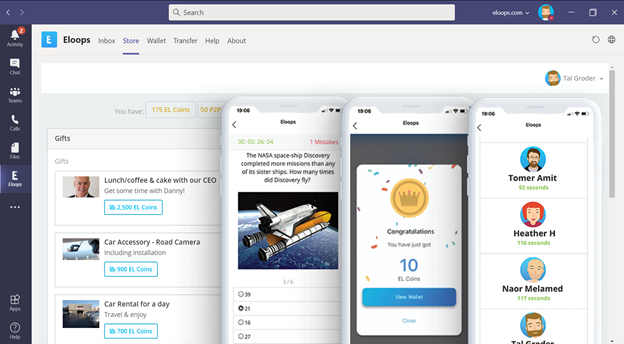
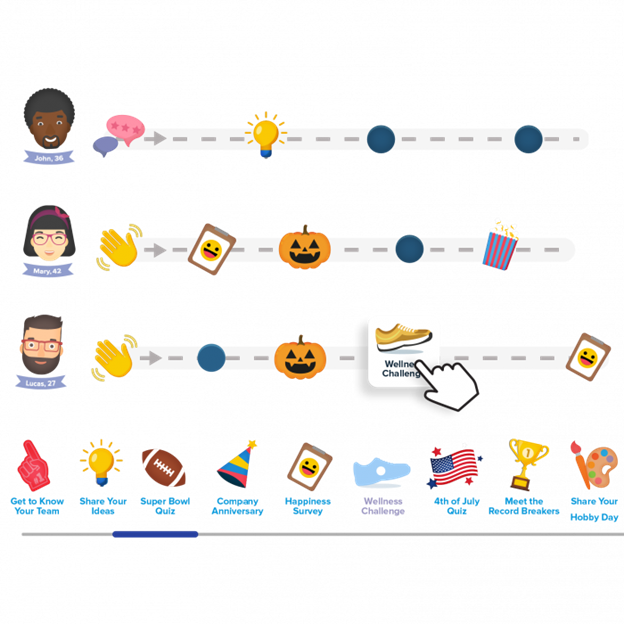
Each company’s ‘Admins’ use the Eloops Dashboard to customize and send activities to their employees in Teams. Employees engage with the different content and earn themselves virtual coins.
Appreciate And Recognize Colleagues
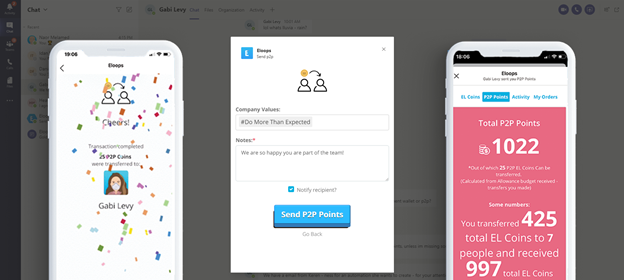
Admins are able to customize the Peer-2-Peer Recognition feature by adding their company values. Employees are then able to reward their colleagues with virtual coins for ‘living’ these values as well as for other reasons.
Collect and Redeem Virtual Coins
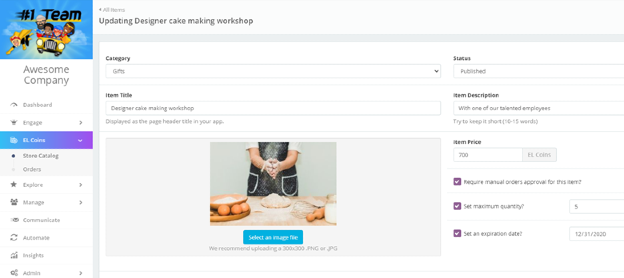
Admins create their virtual currency by choosing its name, color, and how much employees will earn for participation and engaging with different activities.
The company store can also be customized with different gifts, experiences, and perks.
Measure and improve
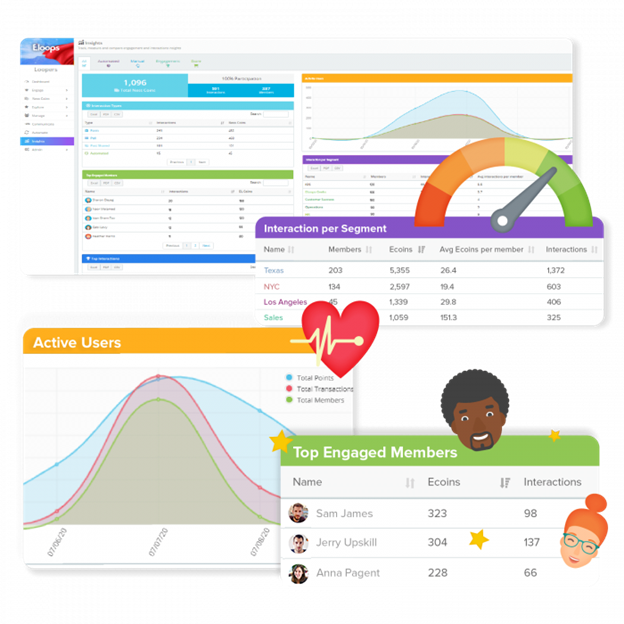
Through the Eloops Dashboard, Admins can instantly find out which content works best, who are the most engaged employees or teams or departments, who are the most recognized employees, what are the most valued company values, and more!
Personalized Communications
Eloops allow managers to schedule, automate and send targeted and personalized messages to specific audiences and employees with special announcements, updates, birthdays and work anniversaries, or any kind of message from the Eloops dashboard.
How to get started?
If you haven’t already, you can install Eloops directly from Microsoft AppSource.
For more info and to see how Eloops works, go to https://eloops.com/microsoft-teams-app/.
Or if you prefer, watch this video to learn all about how to use Eloops in Microsoft Teams:

by Contributed | Dec 11, 2020 | Technology
This article is contributed. See the original author and article here.
Azure Durable Functions and External Events
Jaliya Udagedara is a Developer Technologies MVP based in Auckland, New Zealand. Originally from Sri Lanka, Jaliya is currently working as a Technical Lead for a US-based software development company. He has found his most significant interest in the world of Microsoft Software Development Technologies and Azure Stack. He likes to write blog posts and maintains his personal blog. Follow him on Twitter @JaliyaUdagedara

How to fix the borderless window “problem” in Windows Virtual Desktop
Robin Hobo is an Enterprise Mobility MVP and Senior Solutions Architect from the Netherlands who advises companies about the modern workplace. Robin is broadly oriented and has in-depth knowledge of various solutions like Windows Virtual Desktop (WVD) and Microsoft EM+S (including Microsoft Endpoint Manager – Microsoft Intune). For more, check out Robin’s blog and Twitter @robinhobo

Stay Up To Date With Power BI
Mohamed El-Qassas is a Microsoft MVP, SharePoint StackExchange (StackOverflow) Moderator, C# Corner MVP, Microsoft TechNet Wiki Judge, Blogger, and Senior Technical Consultant with +10 years of experience in SharePoint, Project Server, and BI. In SharePoint StackExchange, he has been elected as the 1st Moderator in the GCC, Middle East, and Africa, and ranked as the 2nd top contributor of all the time. Check out his blog here.

Windows Admin Center with Azure Security Center integration
James van den Berg has been working in ICT with Microsoft Technology since 1987. He works for the largest educational institution in the Netherlands as an ICT Specialist, managing datacenters for students. He’s proud to have been a Cloud and Datacenter Management since 2011, and a Microsoft Azure Advisor for the community since February this year. In July 2013, James started his own ICT consultancy firm called HybridCloud4You, which is all about transforming datacenters with Microsoft Hybrid Cloud, Azure, AzureStack, Containers, and Analytics like Microsoft OMS Hybrid IT Management. Follow him on Twitter @JamesvandenBerg and on his blog here.

WPF: HOW TO CONVERT BASE64 IMAGE TO BITMAPIMAGE
Asma Khalid is an Entrepreneur, ISV, Product Manager, Full Stack .Net Expert, Community Speaker, Contributor, and Aspiring YouTuber. Asma counts more than 7 years of hands-on experience in Leading, Developing & Managing IT related projects and products as an IT industry professional. Asma is the first woman from Pakistan to receive the MVP award three times, and the first to receive C-sharp corner online developer community MVP award four times. See her blog here.
by Contributed | Dec 11, 2020 | Technology
This article is contributed. See the original author and article here.
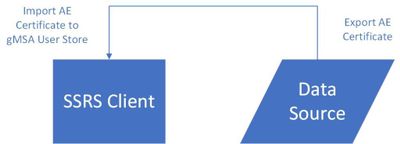
Let’s take a look at how to display Always Encrypted Data in SSRS with a gMSA (Group Managed Service Account). We are mixing some technologies and the one that throws a wrench into things is the gMSA. Here is the flow for moving the certificates.
Always Encrypted protects our data both at rest and in transit. To accomplish that, SQL only stores the encrypted data and cannot decrypt it; all the work is done by the client. In our case the client is SSRS and it is the account running the SSRS service that will need the certificate to decrypt data. Note that it is not the account running the report.
Certificate Stores
When configuring Always Encrypted, we have a choice between two key stores. In our example we will use the Windows Certificate Store. You can also use Azure Key Vault, but direct access with that method is not supported with SSRS. You could use the Windows Certificate Store, export the certificate, and import it into Azure Key Vault. However, SSRS cannot directly access Azure Key Vault.
The certificate is important because we must export it so we can later import it to our clients. Best practice is to run the Encrypt Column Wizard in SSMS from a server that is not the server hosting your data. This prevents us from accidentally leaving the cert on the server where if it gets compromised the attacker could get both the data and the certificate.
Always Encrypted Wizard
If you run the wizard from the client or application server, you have two choices. The first is to run SSMS as an administrator so you can store the certificate in the local machine store. This allows any application on the server to use the certificate if you give it permissions to do so. If you do not run SSMS as an administrator, you will only see the option to store the certificate in the local user store for the current user.
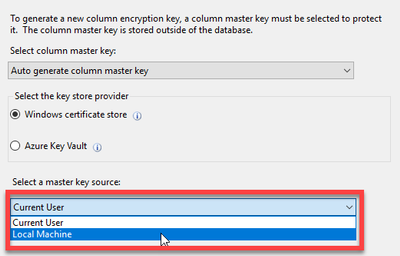
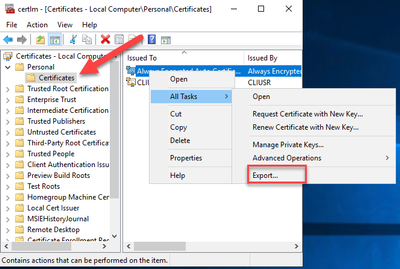
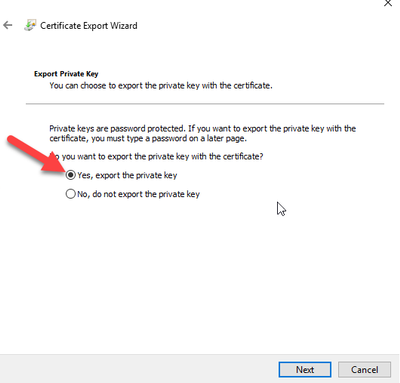
For our example we will use the Current User store to comply with the principal of “Least User Privilege“. Once we complete the Always Encrypted wizard, you can open Certificate Manager and export the cert making sure to include the private key.
Always Encrypted Certificate Import
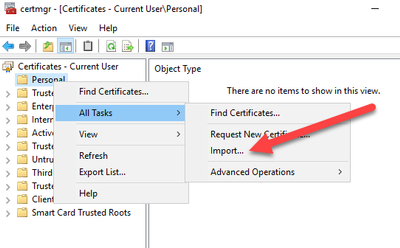
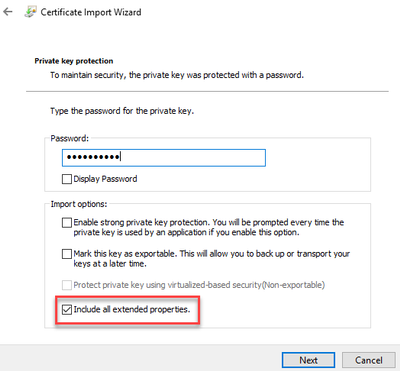
We have our column encrypted and have exported the certificate. Next, we need to import it on the SSRS server. This is where the fun begins. You might be tempted to just import the certificate into the local machine store instead of the user store so all applications can use it. This does not work, and you will have to import into the user store for the account running the SSRS service. Normally you could right click the certificate manager and select “Run As” to be in the context of the account running SSRS. This does not work with a gMSA because you don’t know the password.
Get Creative
It’s time to get creative and break out some SysInternals tools. We are going to use PSExec to open Certificate Manager under the credentials of our SSRS gMSA account. We start by opening an administrative command prompt and executing the following from the location where we downloaded the SysInternals tools.

The first parameter -i is needed since we will be launching another command prompt interactively on the desktop. The second parameter -u provides our username and, in our case, the gMSA running the SSRS service. Remember that gMSA accounts need a $ sign at the end. The third parameter -p is the password for the gMSA account, but we do not know what it is. The ~ is allowed in place of the password. The last thing we provide is the executable we want to run. For us it will be another command prompt. Ideally, we would like to just run certmgr.exe from here, but that does not work.
Once you hit enter another command prompt will open where we can enter certmgr.exe to open the Certificate Manager under the context of our gMSA account. Now we can finally import the certificate.
View Your Reports
That’s it! Now you can go open your report in SSRS and see your Always Encrypted data displayed. These are some great security technologies, but it takes some outside of the box ideas to get them working together correctly.
by Contributed | Dec 11, 2020 | Technology
This article is contributed. See the original author and article here.
Purpose:
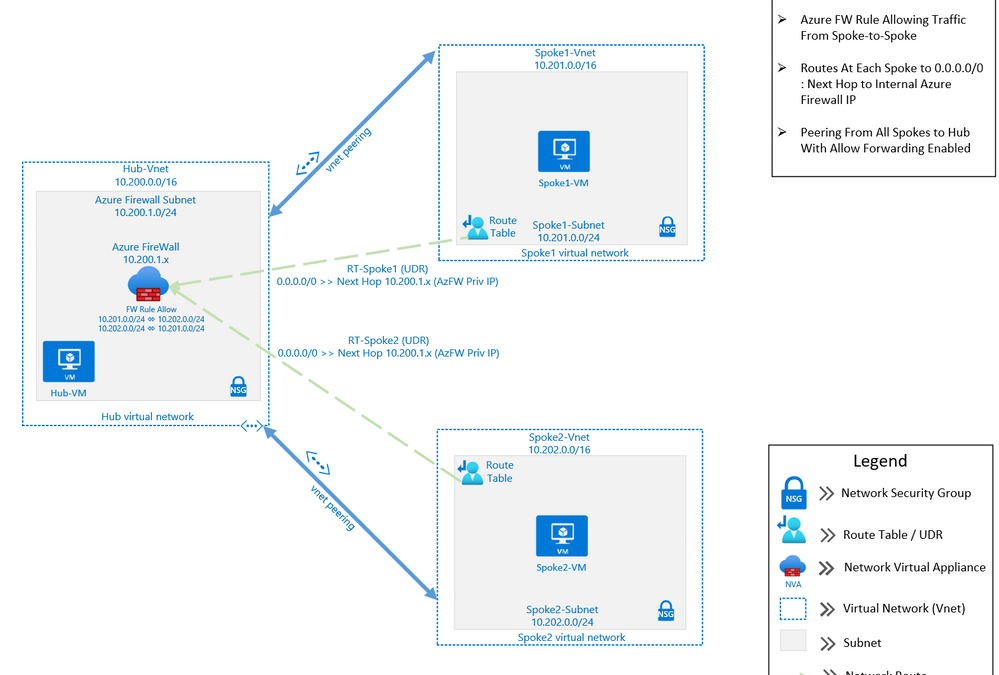
The purpose of this post is to demonstrate using Azure Firewall to control network traffic routing between Hub and Spoke networks in a Hub and Spoke Network Architecture. The Hub & Spoke Azure Architecture has become a common network topology for Azure deployments. The Cloud Adoption Framework describes this architecture in great depth. As with anything in cloud computing, there are several functional options to accomplish just about any goal but in this writing we will be focusing on how you can use the Azure Firewall as your routing device, also known as a Network Virtual Appliance, or NVA. We will walk through the process of building a Hub and Spoke Network Architecture that includes Spoke-to-Spoke routing. The key components that we will use to build this architecture are Azure Firewall, Route Tables (or UDR’s), and Virtual Network Peering (Vnet Peering).
This architecture can be used in many situations. A common scenario would be an enterprise network that may have resources that run between two or more Virtual Networks. In this scenario, there may be a web front-end, an application and a data tier that may need to communicate between with one another across those virtual networks. If these tiers are in different Virtual Networks, then routing will need to occur in order for network traffic to be able to cross those Virtual Network boundaries (e.g., data tier communicating with app or web tier). This writing will describe how to setup a solution to accomplish these goals.
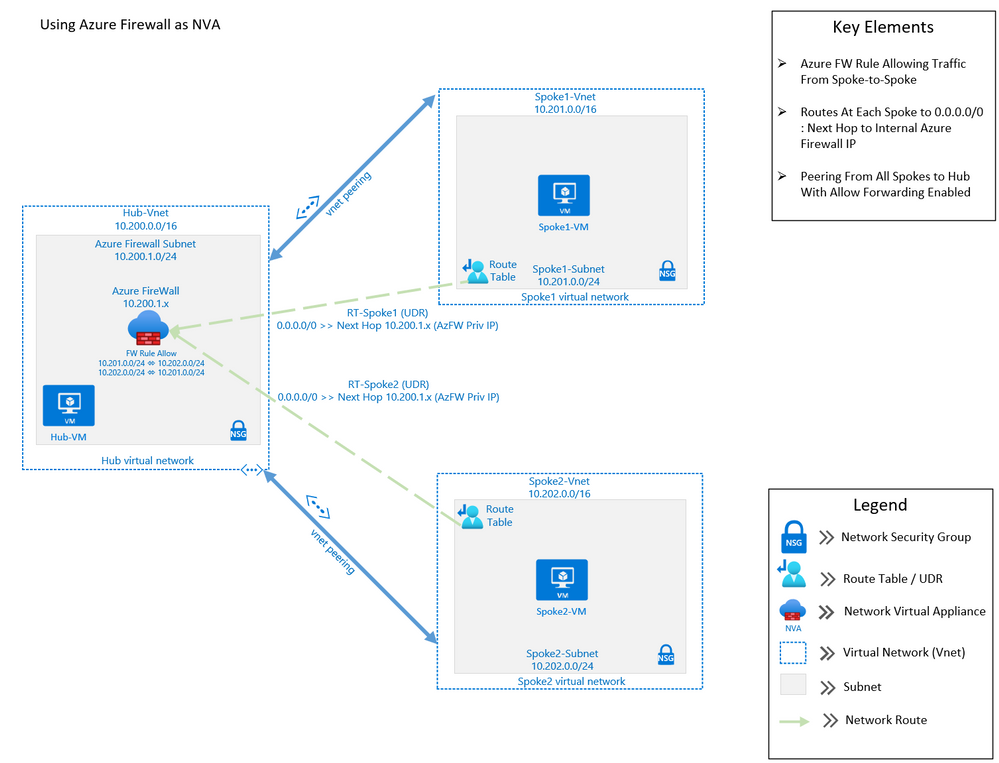
Assumptions: Knowledge of creating Azure virtual machines and Azure virtual networks, as well as user-defined routes and peering is assumed. The firewall rules described in this writing will allow all outbound traffic from resources in Spoke1 and Spoke2. This configuration is for demonstration purposes only. Depending on the security posture needed for a production environment, this configuration would likely be more tightly controlled from the firewall. For our demonstration purposes, this configuration is being used for functionality and convenience.
Here are the required items to deploy this solution:
Resource Group:
Virtual Networks:
- Hub
- Address Space: 10.200.0.0/16
- Subnet named AzureFirewallSubnet : 10.200.1.0/24
- Subnet named hub-subnet: 10.200.0.0/24
- Spoke1
- Address Space: 10.201.0.0/16
- Subnet named spoke1-subnet: 10.201.0.0/24
- Spoke2
- Address Space: 10.202.0.0/16
- Subnet named spoke2-subnet: 10.202.0.0/24
Virtual Network Peering:
- Hub peers with Spoke1 (bi-directional)
- Forwarding must be enabled
- Hub peers with Spoke2 (bi-directional)
- Forwarding must be enabled
Route Tables:
- RT-Spoke1
- Attached to default subnet in Spoke1-Vnet.
- Routes:
- 0.0.0.0/0: Next Hop: <<Azure Firewall Private IP>>
- RT-Spoke2
- Attached to default subnet in Spoke2-Vnet.
- Routes:
- 0.0.0.0/0: Next Hop: <<Azure Firewall Private IP>>
Azure Firewall:
- NAT Rule Collection:
- Rule 1, priority 1000 allow:
- Spoke1-RDP, allow traffic from any source to destination firewall public IP address on port 3389 which is translated to Spoke1 VM private IP address on port 3389
- Network Rule Collections:
- Rule 1, priority 2000, allow:
- Spoke1-Outbound, allow all traffic from source 10.201.0.0/24 to any destination, all ports
- Spoke2-Outbound, allow all traffic from source 10.202.0.0/24 to any destination, all ports
Virtual Machines:
- (3) Windows VM’s
- (1) VM in Hub VNet, hub-subnet
- (1) VM in Spoke1 VNet, spoke1-subnet
- (1) VM in Spoke2 Vnet, spoke2-subnet
Step-by-step:
- Create the three virtual networks as outlined above: one hub and two spokes. Also create two Azure Virtual Machines of any size and without public IP addresses and place one on each spoke virtual network.
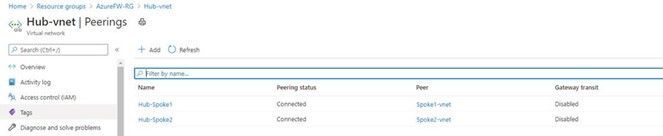
- Peer Spoke1 with the hub and peer Spoke2 with the hub. Do NOT peer Spoke1 and Spoke2. Enable the following settings on each peering:

Note: If you have a VPN gateway on the hub network and wish to use it to connect to an on-premise network, select “Use this virtual network’s gateway” on the hub peering.
When complete, the peering should indicate Connected:
- Create an Azure Firewall resource and place it in the hub virtual network. Assign an existing public IP address or add a new one. Since we are using the Azure Firewall as the virtual appliance, there is no need to enable Forced Tunneling to be able to send traffic to a secondary virtual appliance.
Azure Portal -> search for and click Firewalls -> click Add:

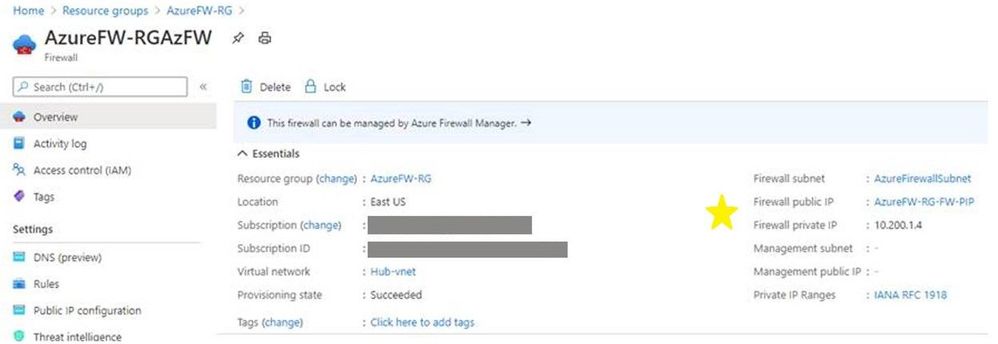
When the firewall resource is created, access it (Azure Portal -> search for and click Firewalls -> click the newly created firewall) and click Overview. Make note of the firewall’s public and private IP addresses as starred below:
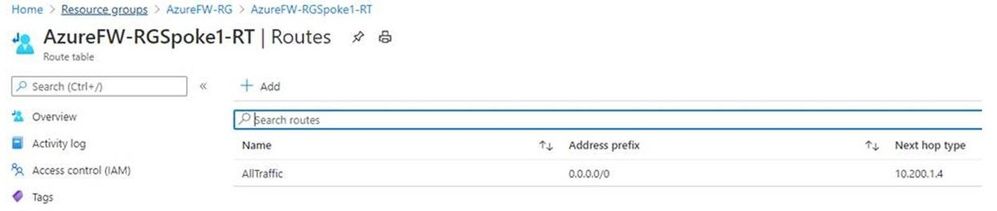
- Create a user-defined route (UDR) route for Spoke1. The route will point all traffic (0.0.0.0/0) to the Azure Firewall private IP address gathered in step 3. To complete this step, you will need to create a Route Table with the following settings:
- Routes
- Address Prefix: 0.0.0.0/0
- Next Hop Type: Virtual Appliance
- Next Hop Address: <<Private IP of Azure Firewall>>
- Subnets
- Associate to the subnet for Spoke1, in our example 10.201.0.0/24
The completed routes should look like this:
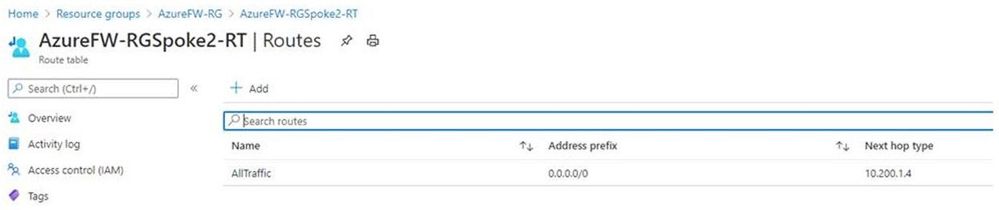
- Create a similar route for Spoke2 and associate it to that subnet. It should look like this:
- Routes
- Address Prefix: 0.0.0.0/0
- Next Hop Type: Virtual Appliance
- Next Hop Address: <<Private IP of Azure Firewall>>
- Subnets
- Associate to the subnet for Spoke2, in our example 10.202.0.0/24.
- Within Azure Firewall, create a NAT rule collection for the Spoke1 VM with priority 1000. This will allow inbound RDP to the chosen VM. Note the Destination Address in the rule is the firewall’s public IP address gathered in step 3 and the Translated address is the Spoke1 VM private IP address. Use port 3389 for both the Destination and Translated ports. This rule effectively says, “For inbound traffic to my firewall’s public IP address on port 3389, translate it to my Spoke1 VM private IP address also on port 3389.”
Note: Allowing RDP to a VM is fine in our test setting but in a production environment another more secure arrangement (such as using a jump box) would be a better practice.
Azure Portal -> search for and click Firewalls -> click the newly-created firewall -> under Settings click Rules -> click NAT rule collection -> click Add NAT rule collection -> configure the rule using the settings below -> click Add to save the rule.

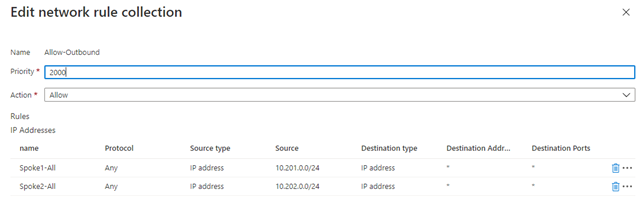
- Still in Azure Firewall, create a Network rule collection for the spokes with priority 2000 that will allow RDP traffic between the spokes and any destination.
Note it is possible to create just one rule to accomplish this but creating two rules, one per spoke, allows for changes to just one spoke, i.e., if you wanted to allow traffic from just one spoke to the other but not the internet.
In the firewall under Settings click Rules -> click Network rule collection -> click Add network rule collection -> configure the rule using the settings below -> click Add to save the rule.
- Now that everything is in place, let’s test it by using RDP to connect to the Spoke1 VM. Note to do this, you connect to the Spoke1 VM using the firewall public IP address in your RDP client. The sole NAT rule collection we created will send the traffic to the Spoke1 VM. Once logged in, perform the following tests:
- Ping the Spoke2 VM.
- Tracert to the Spoke2 VM -> verify the firewall private IP is the first hop, noting that sometimes the IP listed will not be the actual firewall IP but an IP in the same firewall subnet.
- Tracert to bing.com -> very the firewall private IP is the first hop (again, could be IP on same subnet)
- Open a web browser and visit https://whatismyipaddress.com/. Verify the public IP address this site returns matches the firewall’s public IP address listed on the firewall’s Overview page.
These tests show that intra-spoke and internet traffic goes through the Azure Firewall.
Conclusion:
If all tests are successful you have used Azure Firewall to route virtual network traffic between hub and spokes as well as the internet. Not only have you made your network more secure, but you have avoided a complex NVA solution and configuration.
Note the Azure Firewall has many deployment options, including using the Firewall Manager with Secure Virtual Networks and Hub Virtual Networks, each of which offers different security and deployment options. For further information, see the documentation for Azure Firewall and Azure Firewall Manager (links for both services found below).
Happy routing!
Further Reading:
Authors: @DJBartles / @PatrickHorn
by Scott Muniz | Dec 11, 2020 | Security
This article was originally posted by the FTC. See the original article here.
It’s the 6th day of Consumer Protection, and maybe you’re in a giving spirit. ‘Tis the season, right? If you like to donate to charities at the end of the year, ‘tis also time to make sure your donations get to the places you mean them to go. Because this year, lots of charities could really use the help.
Brought to you by Dr. Ware, Microsoft Office 365 Silver Partner, Charleston SC.
by Contributed | Dec 11, 2020 | Technology
This article is contributed. See the original author and article here.
Azure Data Factory has enhanced the Azure Database for PostgreSQL, REST and Excel connectors to fulfill your emerging data integration need:
Azure Database for PostgreSQL in Data Flow
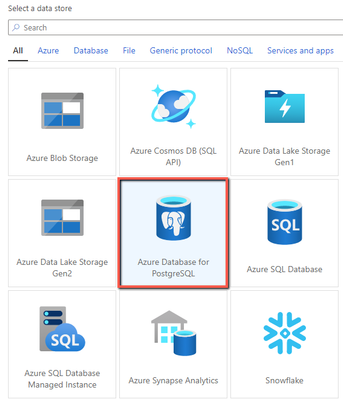
Now you can use Azure Database for PostgreSQL connector in Data Flow to build powerful ETL processes. You can read data directly from Azure Database for PostgreSQL and apply data transformations or join with other data, or post transformation you can perform inserts, updates, deletes, and upserts to publish the analytics result set into Azure Database for PostgreSQL. Learn more about Azure Database for PostgreSQL connector.
REST connector as sink
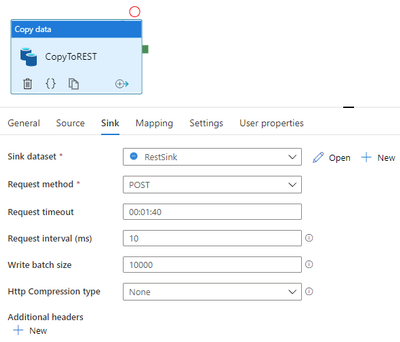
Generic REST connector is one of the most commonly used connectors in ADF to integrate with various SaaS applications or your own applications. It helps you easily extend and reach a great number of data sources than the built-in ones. Now using copy activity, not only you can use REST connector to retrieve data, ADF newly enables REST connector as sink so you can also write data via REST APIs. Learn more about REST connector.
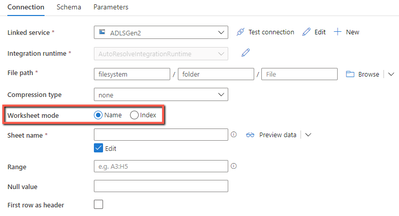
Excel format – worksheet index
When parsing Excel files using copy activity or data flow, you have a new option to point to a worksheet by index in addition to by name. For example, if you just want to read the only worksheet in your Excel files and ignore its name, you can simply specify index as 0. Learn more about Excel format.
by Contributed | Dec 11, 2020 | Technology
This article is contributed. See the original author and article here.
Scenario:
Let us say, that you are regularly putting data into the storage, be it blob, or table, or queue, or file storage. You are performing read/write operations on the storage account using various applications/tools. Thus, there is regular ingest of data to the storage account and there are applications which are pulling data from the storage account. You want to know what are the transactions done on the storage account or amount of data written/read from the storage account. The easiest way to find any metric values for the storage account, is by referring to the Storage Metrices available on the Portal. It can be used to find what are the transactions done, or what is the egress/ingress values or what is the availability of the storage account.
But, when you specify the required time stamp and service for which you want to see metrices, you are unable to get any data. You are unable to understand whether why there is no metrices seen for the storage account or there are no transactions done on the account.
Let us understand how we can troubleshoot this scenario where we are unable to find the correct metrices for the storage account. There are many causes because of which you are not able to see the correct data in the metrices tab for the storage account. Let us explore the various causes for such issue:
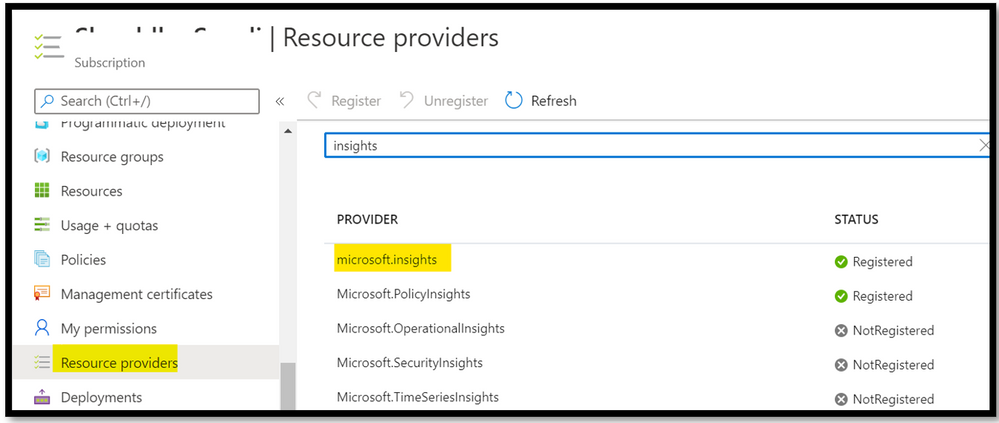
Cause 1: Any monitoring data that you see for a given resource (in this case, storage account), comes from the Resource Provider Microsoft.Insights. If this resource provider is not registered for your subscription, then there is no metrices seen for any resources. To ensure that your subscription is registered with the given resource provider, navigate to Azure Portal -> Go to the subscription settings -> Go to the Resource Provider tab -> Check if Microsoft.Insights is registered. You can refer to the below screenshot:
Alternatively, you can execute a PowerShell command to see if the resource provider is registered or not.
PS script:
Connect-AzAccount
Get-AzResourceProvider -ProviderNamespace Microsoft.Insights
|
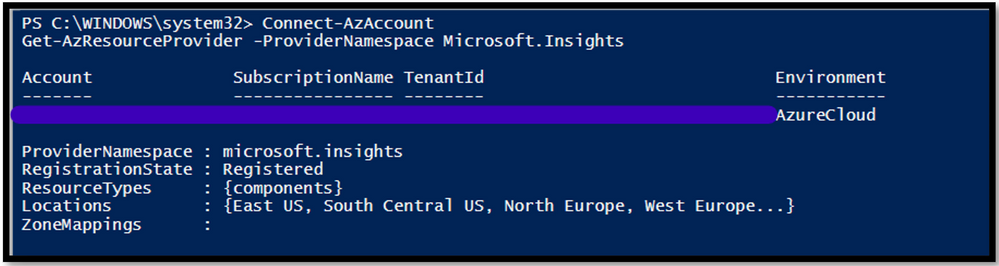
If you see that the resource provider is not registered, then you can use the below PowerShell script to register the resource:
PS script:
Connect-AzAccount
Register-AzResourceProvider -ProviderNamespace Microsoft.Insights
|
Alternatively, you can use the Azure Portal to register for the resource provider.
Cause 2: The timestamp specified for the metrices, is greater than 30 days. Please note that metrices values are saved for 93 days, but we can query 30 days’ worth data in a single query. It means that, if you need to query the metrices for past 90 days, you will need to break the timestamp into 3 slabs of 30 days each. If you are seeing blank chart or a same part of the chart is missing, please check that your start and end date is within 30days.
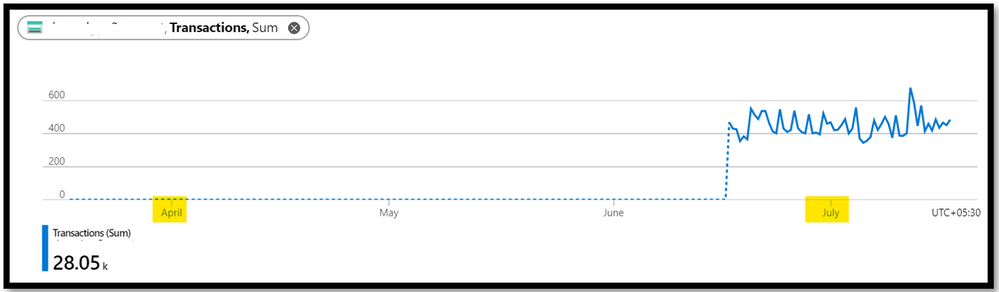
Cause 3: You have ensured that the required resource provider is registered with the Subscription and the timestamp value given to query the data is well with 30 days. But you are still seeing that there is dotted graph in metrices tab. You are seeing graph as below:
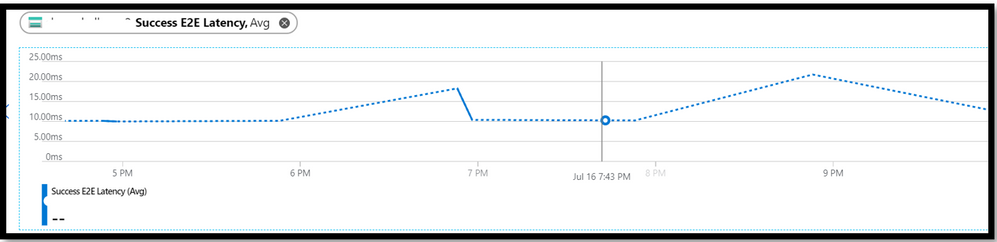
The dotted graph is seen when there is no data to present on metrices. Let’s say, you have set granularity to 1min and there is data for 6:30 PM, 6:31 PM, 6:33PM and 6:34PM. Now, as there is no data for 6:32PM, the dotted line is plotted between the data point of 6:31PM and 6:33PM. This dotted line helps us in understanding when there are no data/transactions seen for the storage account. The dashed line value is zero when the metric used is count and sum aggregation. But for the avg, min or max aggregations, the dashed line will connect to the two nearest known data points.
When there is no data to represent on graph, dotted line will be seen.
Please note that this is by design. If you still want to see the “correct data” on the metrices, then you can make use of the scatter chart. The scatter chart will represent metrices for only those time period when data is available. For more details, you can refer to the link.
Cause 4: You are seeing that there is a “Error” message written across the metrices tab. You want to know if there is any issue with the storage account performance or whether the storage account is unavailable. As many critical applications are using the storage account, you want to ensure that there is no performance degradation for the storage account. But, the metrices tab is showing “Error” message and you are unsure of what to do next. In such scenarios, you can collect Fiddler trace while reproducing the issue. Fiddler is 3rd party tool used to capture the traffic and investigate the calls made. You can download the tool from the link.
In the Fiddler trace you can check the call made to the storage metrices and see what the response on it was. If you see that the request is successful, then you can be sure that the storage account is working. Then, we can check if the storage account is emitting the metrices details or not. For the request made to access the storage metrices, in the response tab, you can select “Web View”. If you see that the data is present in it, then the storage account is emitting metrices values. Thus, the issue is not with the Azure Storage Account but with the Portal not able to render the result. Hence, you can reach out to the Azure Portal Team for assistance.
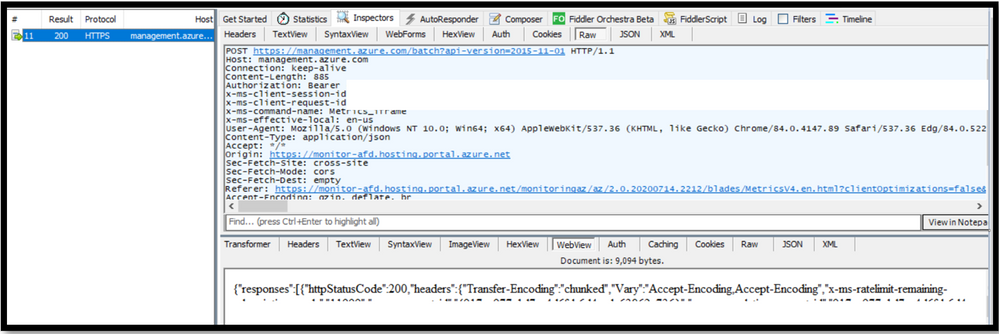
The web view will contain details as such:
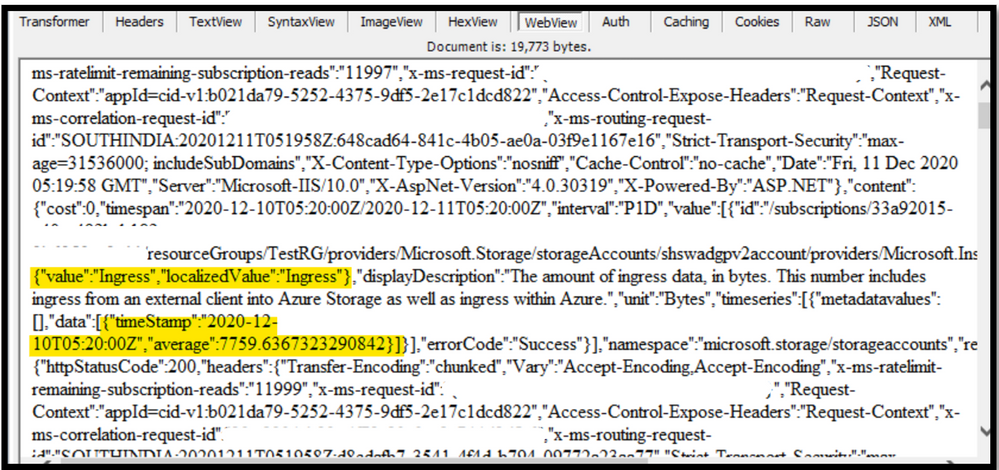
If you cannot make use of the Fiddler tool due to company/security restriction, you can collect HAR traces using browser. You can refer to the link for more details on how to capture HAR traces.
Cause 5: You are seeing that “Error” message is seen for the classic metrices.
When you put the storage account in Firewall or do VNet settings on it, you need to ensure that the trusted service is enabled in the firewall settings of the storage account. The classic metrices uses the Insight provider for listing the metrices. If is it is not enabled and the storage account is having VNet or Firewall settings done, then you will see “error” message for the classic metrics.
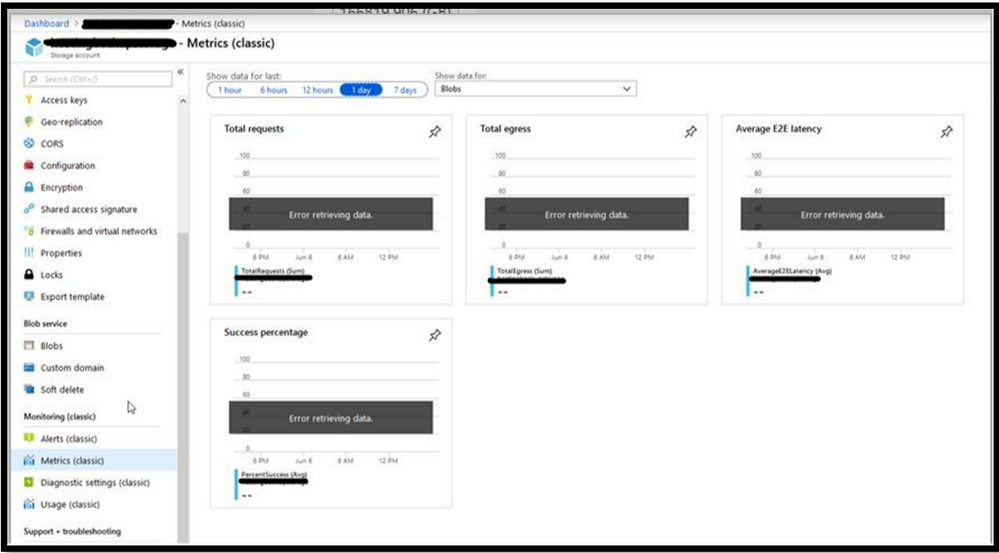
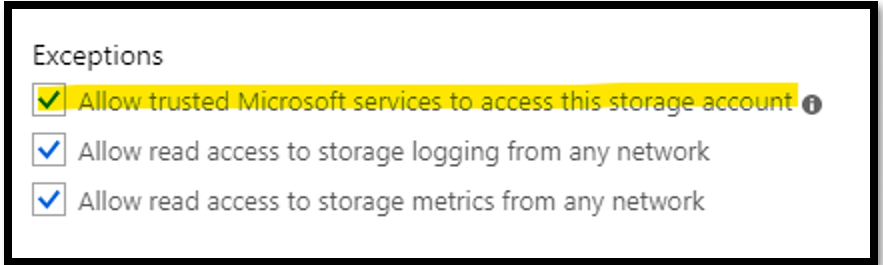
Cause 6: All the metrices values are saved in the table storage. There is dedicated table for each storage service. These tables consist of the transaction information, minute transaction information and capacity information. The transaction and minute transaction table will contain the information of request and response data. The capacity table will contain details of storage usage data. These table consists for both primary and secondary storage account.
Please note that these tables are not seen under table storage in Portal. You need to access these tables from the Azure Storage Explorer. If you do not find the metrices values in the Portal, you can access these tables to see the value.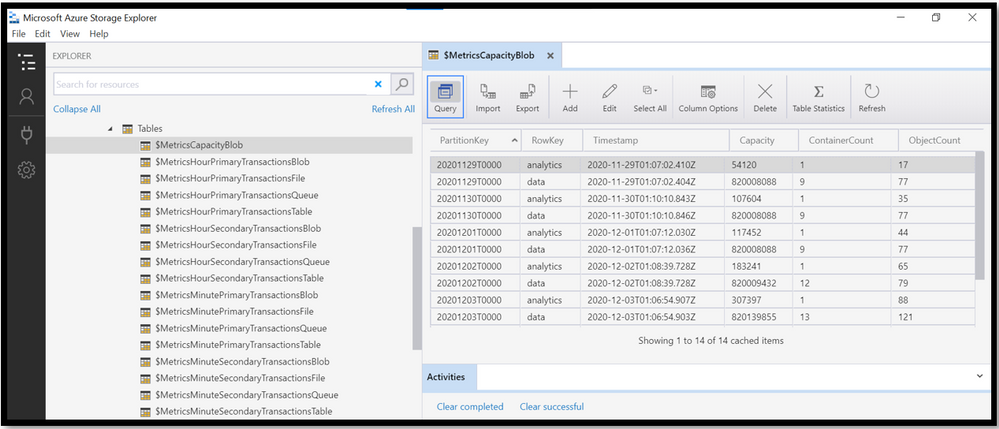
Let’s say that you are seeing values in the table storage for the respective service, but the values is not seen in the Portal Metrices. It essentially means that the storage service is emitting the metric values but is not being rendered properly on the Portal. In such a case, you can reach out to the Azure Monitoring team via Support Ticket to see if there is any issue seen at their side.
by Contributed | Dec 11, 2020 | Technology
This article is contributed. See the original author and article here.
Microsoft Learn and Java
Welcome to the Java learning path. If you want to learn more about Java on Azure, you can head up to our YouTube channel, where we have interviews of Java Champions, tutorials, online conference sessions.
The MS Learn Java learning path
The Java learning path is for Java developers who want to better understand what they can achieve with Azure. It starts with the basics of Azure, and will make you discover our main services relevant for Java developers.

Here is the Java learning path on MS Learn, in which you will be able to find the following modules:
If you want to have the latest news on Java on Azure, please follow @JavaAtMicrosoft on Twitter and subscribe to the Java on Azure YouTube channel.
by Contributed | Dec 11, 2020 | Technology
This article is contributed. See the original author and article here.
ImageStore keeps copied package and provisioned packages.
Sequence of provision in Best Practice:
- Copy package to ImageStore with compress option
- Provision package
- Remove package in ImageStore
- Upgrade app/cluster
- Unprovision old version
When step 3 and 5 are missing, ImageStore accumulates files.
Symptom:
- The ImageStoreService (fabric:/System/ImageStoreService) could fill up disk.
- ImageStoreService replica may take long time in InBuild.
Option/Configuration for automatic cleanup:
How to configure cleaning up copied application package (automatic Step 3)
- Register-ServiceFabricApplicationType –ApplicationPackageCleanupPolicy Automatic
At step 2, Register (a.k.a. Provision), the application package is deleted after successfully registering the application type.
- <Section Name=”Management”>
<Parameter Name=”CleanupApplicationPackageOnProvisionSuccess” Value=”False” />
</Section>
This configuration enabled automatic cleanup of application package after successfully registering the application type.
How to configure cleaning up automatically unused application type (automatic Step 5)
<Section Name=”Management”>
<Parameter Name=”CleanupUnusedApplicationTypes” Value=”true” />
<Parameter Name=”PeriodicCleanupUnusedApplicationTypes” Value=”true” />
<Parameter Name=”TriggerAppTypeCleanupOnProvisionSuccess” Value=”true” />
<Parameter Name=”MaxUnusedAppTypeVersionsToKeep” Value=”3″ />
</Section>
Manual Cleanup:
When ImageStoreService must be cleaned up manually, you can follow this steps.
1. Delete copied packages
#Delete Content from Image Store
$content =
Get-ServiceFabricImageStoreContent -RemoteRelativePath “” -ImageStoreConnectionString fabric:ImageStore
foreach($folder in $content)
{
Write-Host Working on $folder.StoreRelativePath
if (($folder.StoreRelativePath -ne “Store”) -and ($folder.StoreRelativePath -ne “WindowsFabricStore”))
{
Write-Host Deleting $folder.StoreRelativePath
Remove-ServiceFabricApplicationPackage -ApplicationPackagePathInImageStore $folder.StoreRelativePath -ImageStoreConnectionString fabric:ImageStore
}
}
2. Unregister
Unregister-ServiceFabricApplicationType will remove application packages from image store as well as ImageCache on nodes (after a while).
Scenario1 : Seeing zombie application package in the store, which taking most of the disk space.
- Verify whether meta data for the older version is associated with ISS [ Get-SFImageStoreContent -remoterelativepath ‘StoreIberFabric.App.PortalComercial.Services.AgendaType’ verify whether older package type is in the list ]
- If the older file is not listed in the #1, you can rdp into each VM which hosting the ISS replica, and delete it manually
- If meta data is present in #1 output, please verify the version customer wanted to delete is already in the registry by running, ‘Get-ServiceFabricApplicationType’
- In the #3 output, If the application type is already there, please un provision by ‘Unregister-ServiceFabricApplicationType’
- If the #3 output application type detail is not present, you can run ‘ Remove-ServiceFabricApplicationPackage -ApplicationPackagePathInImageStore “StoreIberFabric.App.PortalComercial.Services.AgendaType<<package with version number>>
[https://docs.microsoft.com/en-us/azure/service-fabric/service-fabric-application-upgrade-tutorial-powershell]
https://docs.microsoft.com/en-us/powershell/module/servicefabric/register-servicefabricapplicationtype?view=azureservicefabricps#optional-parameters
Note : For 6.5+ Cluster, SFX had ImageStoreService tab in Cluster, where GetSize button to get the size of Store content.
by Contributed | Dec 11, 2020 | Technology
This article is contributed. See the original author and article here.
What a busy week it’s been in the world of Azure. Here are the news items the team is covering this week: Azure Stack HCI achieves general availability status, Azure Stack Edge supporting Kubernetes and Virtual Machines, GitHub Universe announcements, Azure Digital Twins now generally available, AKS pod identity offered via Azure AD in public preview, Azure Portal to drop IE11 support and the Microsoft Learn Module of the Week.
Azure Stack HCI achieves general availability status
Azure Stack HCI is Microsoft’s new subscription service for hyperconverged infrastructure and has now reached general availability. The service allows organizations to run virtual machines, containers, and select Azure services on-premises with management, billing, and support made available through the Azure cloud. Sarah Lean recently sat down with Microsoft Sr. Program Manager Matt McSpirit to discuss what Azure Stack HCI is, how you can use it within your environment and how it works with Windows, Linux, Kubernetes, Windows Admin Centre and Azure Arc.
Further details surrounding the Azure Stack HCI announcement can be found here: Starting a new era for Azure Stack HCI
GitHub Universe announcements
This week we saw GitHub host their annual conference GitHub Universe virtually. Normally this isn’t a conference IT Pros would pay attention to however, after listening to Sarah’s chat with Martin Woodward in Azure Unblogged – GitHub I paid a little more attention to it this year. And there were some cool announcements made!
The first one was that GitHub now has a dark mode, so if you are a fan of the dark mode across your applications and workstation you can turn it on for GitHub as well.
The second was an announcement was around Discussions within GitHub. This allows for your team and community to chat and work together within your project repository in a threaded format. You can mark questions are answered and over time use this as a knowledge base for the community. This feature is currently within Beta with a few open-source communities but will be available within other projects soon.
And the third announcement I want to highlight from GitHub Universe is GitHub Sponsors for companies. Individuals can already contribute money to help support open-source projects but with this new feature is companies can how do it without having to have individual procurement agreements with each open-source project. Now organizations can support those open-source projects they rely on or believe in as easy as adding the cost to their existing GitHub bill.
Further details can be found here: News from Universe 2020: Dark mode, GitHub Sponsors for companies, and more
Azure Stack Edge supporting Kubernetes and Virtual Machines
Azure Stack Edge can now manage Kubernetes environments and host Azure virtual machines to enable organizations to run VM based IoT, AI, and business applications on an Azure appliance at your location and or deploy containerized apps to the edge. Both offerings can be invoked via the Azure Portal. Do note that hosting Azure VMs on Azure Stack Edge is currently in preview.
Learn more on how to deploy Kubernetes apps from the cloud and or host your Azure virtual machines via IoT Edge here: Purpose-built hardware-as-a-service with Azure Stack Edge
Azure Digital Twins now generally available
The now generally available Azure Digital Twins offering breaks down silos within intelligent environments by fusing data from previously deployed devices and track both past and present events to simulate possibilities to help predict future events. As an example, Bentley Systems to develop a digital twin of its wind farms allowing operators to remotely monitor equipment performance and predict energy generation based on weather conditions. They used Azure Digital Twins to combine real-time and historical IoT, weather, and other operational data with physics and machine learning-based models to accurately predict production output for each turbine in the farm.
Checkout the Azure Digital Twins technical resources available here: Azure Digital Twins Documentation
AKS pod identity offered via Azure AD in public preview
AKS applications can now access cloud resources securely using Azure Active Directory (AAD). AAD simplifies access control by using it as an identity provider to any type of resource, including cluster, node, pod, etc. Identities need to be configured and bound to a resource. Once bound, containerized applications can then access the pod and any other resources in the cloud that use AAD as an identity provider.
Further details can be viewed here: Use Azure Active Directory pod-managed identities in Azure Kubernetes Service
Azure Portal to drop IE11 support
The Azure Portal web app will no longer support IE 11 as of March 31, 2021. Internet Explorer will continue to be supported by Microsoft as a component Windows and follows the Lifecycle Policy for the product on which it is installed. Internet Explorer mode use in Microsoft Edge will not extend IE 11 access to the Azure Portal beyond the date listed above.
Further details can be found here: Azure portal to end support for Internet Explorer 11 on March 31, 2021
Community Events
- Patch and Switch – It’s been a fortnight… Catch Rick Claus and Joey Snow chat about all things IT Pro related.
- Festive Tech Calendar – Continuing this month’s content from different Azure communities and people around the globe for the month of December
- All Around Azure – A Beginners Guide to IoT – Focus on topics ranging from IoT device connectivity, IoT data communication strategies, use of artificial intelligence at the edge, data processing considerations for IoT data, and IoT solutioning based on the Azure IoT reference architecture
- Introduction to Cloud Adoption Framework – Sarah Lean investigates Microsoft’s Cloud Adoption Framework offering and what is available for organizations to take advantage of
MS Learn Module of the Week

Introduction to PowerShell
Learn about the basics of PowerShell. This cross-platform command-line shell and scripting language is built for task automation and configuration management. You’ll learn basics like what PowerShell is, what it’s used for, and how to use it.
This learning path can be completed here: Introduction to PowerShell
Let us know in the comments below if there are any news items you would like to see covered in next week show. Az Update streams live every Friday so be sure to catch the next episode and join us in the live chat.


Recent Comments