
by Scott Muniz | Feb 16, 2021 | Security
This article was originally posted by the FTC. See the original article here.
As the Coronavirus pandemic continues, so does its financial impact. For people who need help with rent or mortgage payments, or have student loans, there may be some good news about the federal relief response.
Renters — The temporary stop on evictions for certain renters now runs through March 31, 2021. The Centers for Disease Control and Prevention has information on who is eligible and the steps to take.
Homeowners — If you’re struggling to make your federally backed mortgage payments because of the pandemic, payment forbearance may still be available, and the pause on foreclosures runs through at least March 31, 2021. The Federal Housing Finance Agency tells you how to find out if your mortgage is federally backed. Contact your mortgage servicer to find out what other help is available to you.
Student Loan Borrowers — For those federal student loans that are covered, the U.S. Department of Education has automatically paused payments through September 30, 2021.
Remember that scammers are paying attention to this news and may try to take advantage of you. Here are some ways to protect yourself:
If you spot a scam, please report it to the Federal Trade Commission at ReportFraud.ftc.gov.
Brought to you by Dr. Ware, Microsoft Office 365 Silver Partner, Charleston SC.
by Contributed | Feb 16, 2021 | Technology
This article is contributed. See the original author and article here.
Azure confidential computing offers a state-of-the-art hardware, software & services platform to protect sensitive customer data in-use while minimizing the Trusted Computing Base (TCB). Customers taking advantage of Azure confidential computing can further strengthen their security posture through use of Azure Attestation, a feature that allows them to verify the compliance of various workloads according to their security policies. If their environment becomes non-compliant with their security policies, the customer can prevent exposure of data.
Azure Attestation offers a simple PaaS experience to enable customers solve the complicated problem of gaining trust and verifying the identity of an environment before they interact with it. The ability to gain this trust allows customers to develop applications and create business models that require uncompromising trust where they were previously unable to create them — in the cloud.
What is Azure Attestation?
Azure Attestation is a unified solution that supports attestation of platforms backed by Trusted Platform Modules (TPMs) alongside the ability to attest to the state of Trusted Execution Environments (TEEs) such as Intel® Software Guard Extensions (SGX) enclaves
Azure Attestation receives evidence from an environment, validates it with Azure security standards and user-defined policies, and produces cryptographic proofs (called attestation tokens) for claims-based applications. These tokens enable relying parties to gain confidence in the trustworthiness of the environment, the integrity of the software binaries running inside it and make trust-based decisions to release sensitive data to it. The tokens generated by Azure Attestation can be consumed by services in scenarios such as enclave validation, secure key sharing, and confidential multi-party computation.
Why use Azure Attestation ?
Azure Attestation provides the following benefits:
- Offers a unified solution for attesting multiple TEEs or platforms backed by TPMs
- Allows the creation of custom attestation providers and configuration of policies to customize the generation of attestation tokens
- Provides the ability to securely communicate with the attested platform with the help of data embedded in an attestation token using industry-standard formatting
- A highly available service with Business Continuity and Disaster Recovery (BCDR) configured across regional pairs
How does Azure Attestation work?
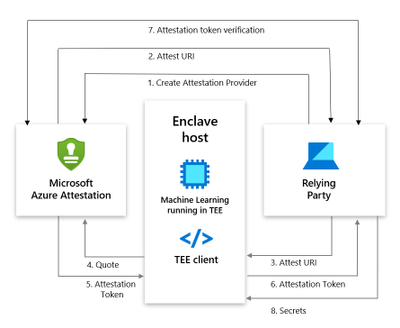
The following actors are involved in an Azure Attestation workflow:
Client: The component which collects evidence from an environment and sends attestation requests to Azure Attestation.
Azure Attestation: The component which accepts evidence from the client, validates it with Azure security standards, evaluates it against the configured policy and returns the attestation token to the client.
Relying party: The component which relies on Azure Attestation for remotely attesting the state of an environment supported by the TPM/enclave.
Consider a multi-party data sharing use-case where an organization (relying party) wants to share data with its partners and achieve great insights by running inference models on the aggregated information. To protect data confidentiality while leveraging mutual benefits, data in-use can be encrypted and stored in TEEs like SGX enclaves. However, before giving access to the encrypted content, organizations would like to validate the trust worthiness of the enclave and then securely transfer secrets to the enclave. Azure Attestation enables the remote verification process.
Below is the workflow to perform SGX attestation using custom attestation providers:
- User creates an provider using PowerShell/Portal/CLI. Note that Regional shared attestation providers can be used to perform attestation when there is no requirement for custom policies
- Attest URI is returned to the user
- Attest URI is shared with the TEE client as a reference to Azure Attestation
- The client collects enclave evidence and sends attestation request to Azure Attestation
- The service validates the submitted information and evaluates it against a configured policy. If the verification succeeds, it issues an attestation token and returns it to the client
- Client sends the attestation token back to the relying party
Getting started with Azure Attestation
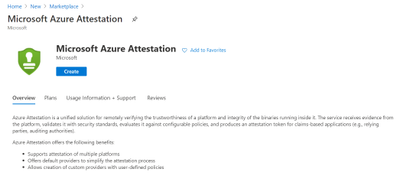
- To create an attestation provider via Azure portal, click the Create button on the Azure Attestation page in the Azure portal Marketplace menu.
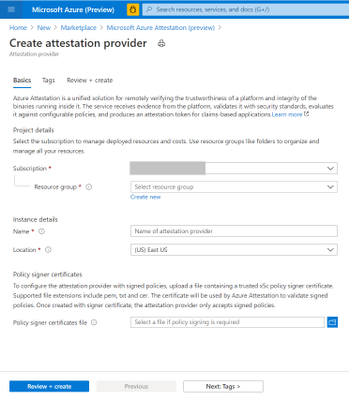
- Provide a name, location, subscription and resource group and proceed with the creation of your attestation provider.
- If needed, upload policy signer certificates file to configure the attestation provider with signed policies. Learn more.
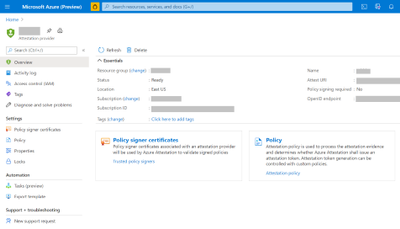
- Once created, details of the provider can be seen in Overview page.
- To view the default policy of your attestation provider, select Policy in the left-hand side Resource Menu.
- To configure a custom policy to meet your requirements, click configure and provide policy information in text/JSON Web Token format and click Save.
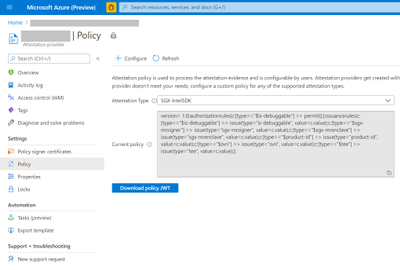
- Click the Refresh button to view the updated policy
Creation and management of attestation providers can also be performed using Command Line Interface (CLI) or Azure PowerShell.
Customer success stories
We are excited to enable multiple scenarios that benefit from Azure Attestation. Some of them include:
SQL Always Encrypted with secure enclaves
“Microsoft Azure Attestation is a key component of a solution for confidential computing provided by Always Encrypted with secure enclaves in Azure SQL Database. Azure Attestation allows database users and applications to attest secure enclaves inside Azure SQL Database are trustworthy and therefore can be confidently used to process queries on sensitive data stored in customer databases.”
– Joachim Hammer, Principal Group PM Manager, Azure SQL
ISV partners
Microsoft also works with platform partners who specialize in creating scalable software running on top of Azure confidential computing environments. Partners like Fortanix, Anjuna and Scone are already poised to use the services offered by Azure Attestation.
Future roadmap for Azure Attestation
Our long-term aspiration is to partner with people and organizations around the planet to help them achieve more, and more securely with Microsoft Azure Attestation. Azure Attestation will be the one Microsoft service that attests multiple platforms used by Azure customers such as Confidential Containers, Confidential VMs, IoT edge devices and more. We expect Azure Attestation to be the leading cloud service used by customers to establish unconditional trust in infrastructure and runtime across Azure, on-premises and at the edge. Azure Attestation will continue to strengthen customer data governance.
Learn more about Azure Attestation
by Contributed | Feb 16, 2021 | Technology
This article is contributed. See the original author and article here.
Security is at an inflection point as digital attack surfaces increase and threat attack sophistication escalates. It continues to be one of the most challenging areas our customers navigate. Our Government customers have additional obligations to data compliance and governance.
Microsoft Defender for Endpoint is a holistic, cloud delivered endpoint security solution that includes risk-based vulnerability management and assessment, attack surface reduction, behavioral based and cloud-powered next generation protection, endpoint detection and response (EDR), automatic investigation and remediation, managed hunting services, rich APIs, and unified security management.
We are excited to announce that Microsoft Defender for Endpoint is now available for customers in the Government Community Cloud (GCC). Microsoft Defender for Endpoint in GCC supports the Federal Risk and Authorization Management Program (FedRAMP) accreditation at a High Impact level. FedRAMP artifacts are available for review by customers who are required to comply with FedRAMP. Federal agencies can review these artifacts in support of their review to issue an Authority to Operate (ATO).
While Microsoft Defender for Endpoint is available for purchase, we will continue to add capabilities and features. Learn more here: Microsoft Defender for Endpoint for US Government customers – Windows security | Microsoft Docs
by Contributed | Feb 16, 2021 | Technology
This article is contributed. See the original author and article here.
We’re glad to share that you can now embed web content in the form of video, forms, slides and more in your documents on Word for the Web.
Embed Web Content
Have you ever faced a situation where you want to add a YouTube or Vimeo video from some online source into your document to make it easy for others to understand content? Have you ever thought of having a Forms inside your word document or embedding a great EdTech app such as Wakelet, Buncee or Genially?
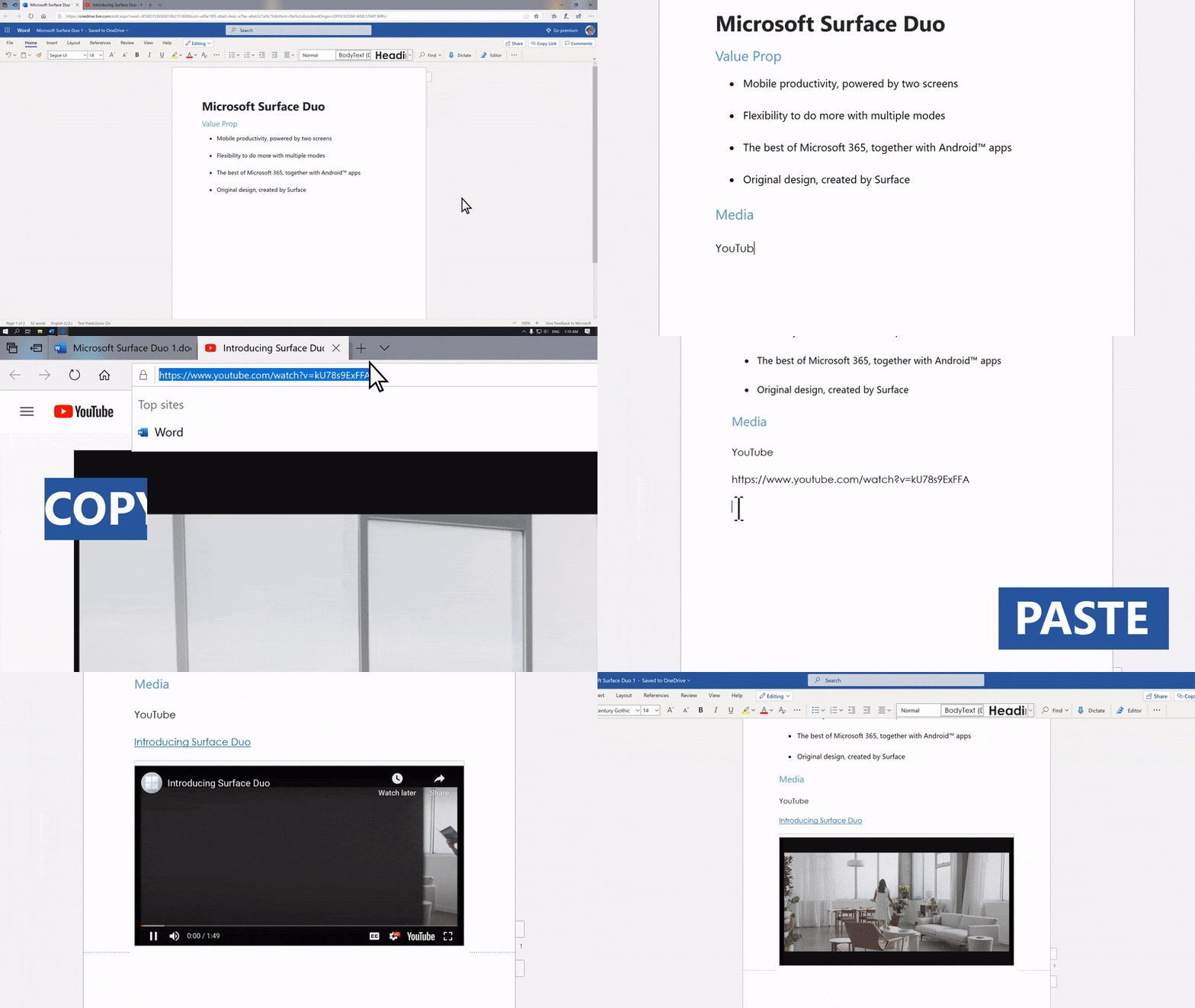
This new embed feature enables you to do all of this and in a much-simplified manner. You just need to paste a web URL from any of our supported providers into a document on Word Web and we will automatically embed web content in the document. This will help others to watch a video or fill a form by keeping within the document. Here is an example of embedding a YouTube video:
Supported sources
Word for the web currently supports embedding content from the following sites and services. The number of supported sources is growing; all current partners and new partners will be listed here. Check back regularly for more updates
How it works
- Open Word in the Web.
- Create a file/Open any existing file.
- Paste a URL from any of these sources – Youtube, Microsoft Stream, Vimeo, Microsoft Forms, SlideShare, TED Talks, Flipgrid Shorts, Microsoft Sway
- On recognizing a supported hyperlink, we automatically embed the web content.
Note- In case you want to display your content as a normal hyperlink you can choose to display it as hyperlink from the floatie menu shown below the embedded content just after inserting web content.
- You can the play the video right from the document using the website’s controls for play, pause, volume, etc.
Availability
This feature is available in Word for the Web for 100% of the users.
Feedback
Let us know whether we’re getting it right by answering the feedback prompts in the experience. To send additional feedback, you can submit them by clicking Help > Feedback.
Thanks,
Gaurav Goel
Microsoft Word Product Manager
by Contributed | Feb 16, 2021 | Technology
This article is contributed. See the original author and article here.
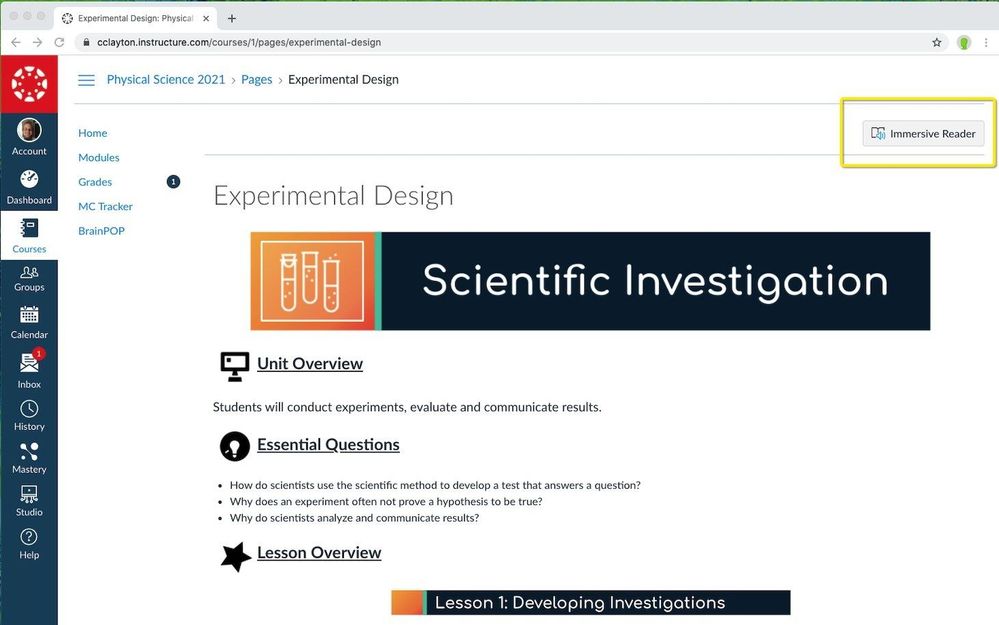
Last week, Instructure announced that the Microsoft Immersive Reader is now freely available to all Canvas users to make content more inclusive and accessible. Canvas by Instructure is the learning platform that helps great education happen. Open, intuitive, and born in the cloud, Canvas streamlines all the digital tools and content that teachers and students love, for a simpler and more connected learning experience. Since we launched Immersive Reader as a Cognitive Service all to all partners last summer, a top request from educators and schools has been to integrate with Canvas.
By integrating the Immersive Reader, Canvas makes their Pages content available for learners of all abilities and can help with access content and reading. Based on early feedback, we hope to enable Immersive Reader in even more places in the future. All of the capabilities built-in to the Immersive Reader will now be able to Canvas customers. The Immersive Reader has been in beta testing for Canvas users over the past year, and starting last week, is now at general availability, and free for institutions to enable.
“Last year Instructure became the first [LMS] provider to offer Immersive Reader for students,” said Mitch Benson, Instructure’s chief product officer, in a statement. “Our beta users love this tool because it demonstrably increases reading and writing comprehension, and is seamlessly woven inside the Canvas experience at no additional cost to schools. This is just one piece of the broader collaboration between Microsoft and Instructure that we’re excited to move forward in 2021.”
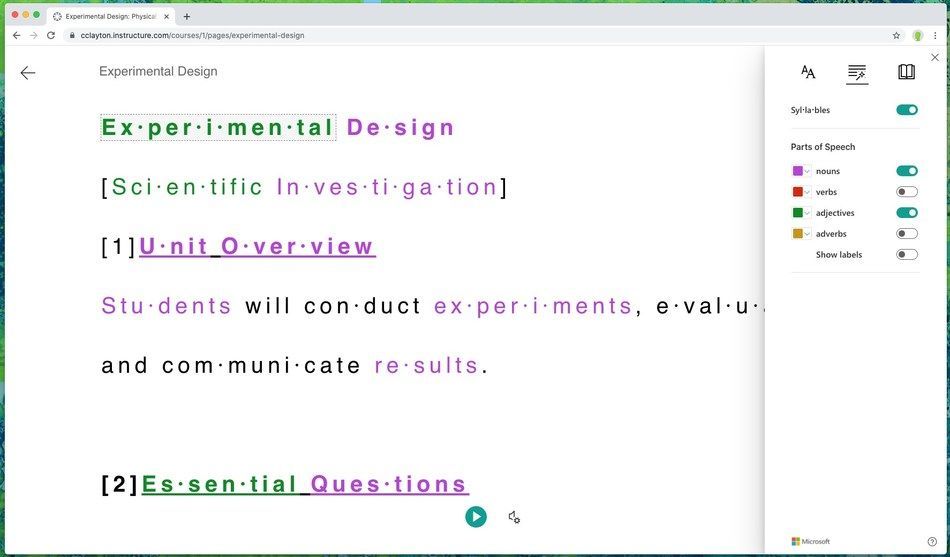
Educators are already excited about the new capabilities in Canvas. Monica Padilla, a 6th grade science teacher from Highlands Middle School, says “I love the ease and simplicity of immersive reader and how it helps me serve my students. Canvas is so easy to use and add assignments too. Immersive reader will make equal access to content available to all of my students.”
This integration is now freely available to all Canvas users worldwide. Make sure your institution or school has first enabled this via the IT Admin instructions. Once your school enables the Immersive Reader, any educator can flip it on – instructions are here.
Microsoft is thrilled to have Canvas integrate the Immersive Reader to make text and reading accessible to all!
Mike Tholfsen
Principal Product Manager, Microsoft Education
@mtholfsen
![Reaching for the Stars with Renee Wynn [M365 Meetup for Government]](https://www.drware.com/wp-content/uploads/2021/02/large-862)
by Contributed | Feb 16, 2021 | Technology
This article is contributed. See the original author and article here.
How do you digitally transform an organization whose end-users are rocket scientists and whose mission is literally out of this world?! Renee P. Wynn recently retired as the CIO of NASA after a distinguished 30-year career in federal service. In this session, she shares her perspective on leadership, mission-aligned IT, digital transformation, and effective cyber-security. Many people can say that their organization has successfully deployed Microsoft 365, but Ms. Wynn led it being deployed into orbit! This is a rare opportunity to learn and ask questions from a National Academy of Public Administration Fellow and award-winning leader.
Speaker:
 Renee P. Wynn, NASA CIO (retired)
https://www.linkedin.com/in/renee-wynn-8935a24/
Renee P. Wynn recently retired as the NASA Chief Information Officer after 30-years of federal service. She started her consulting business, RP Wynn Consulting, LLC, to continue to serve the federal government in a new capacity. As the NASA CIO, Ms. Wynn collaborated with the complex NASA mission programs to improve NASA’s global cybersecurity posture including supply chain risk management and transform IT management. Ms. Wynn oversaw an IT Portfolio of more than $2B and provided global IT services to more than 65,000 customers, including operations in Russia to support launches to the International Space Station.
by Contributed | Feb 16, 2021 | Technology
This article is contributed. See the original author and article here.
I have been playing with an IoT Starter Kit called the M5GO claiming to be accessible starting at age 7 and I have to say, I was impressed! Here is what I did and why my perspective on such kits has changed.
If you want to read the full blog post with all the details and step by step instructions, it’s this way:
How to connect the M5Go IoT Starter Kit from M5Stack to Azure IoT with no code (olivierbloch.com)
by Contributed | Feb 16, 2021 | Technology
This article is contributed. See the original author and article here.
Monthly Webinar and Ask Me Anything on Azure Data Explorer
Level: Intermediate-Expert
Azure Data Explorer offers excellent capabilities when in comes to analyze big data in various forms. Nevertheless, power is nothing without control. This session is about the enterprise readiness features which are needed to run an ADX cluster in a highly secured environment such as encryption, authentication, and network perimeter security.
09:00-09:45 AM PST Azure Data Explorer Live Webinar “Enterprise Readiness with Azure Data Explorer”
with Henning Rauch
register now- https://forms.office.com/r/UW46KJdZdc

by Contributed | Feb 16, 2021 | Dynamics 365, Microsoft 365, Technology
This article is contributed. See the original author and article here.
Despite significant headwinds in 2020a global pandemic, economic downturn, and technology budgets clippedcustomer data platform (CDP) growth is booming. Businesses are charging full steam ahead on digital transformation efforts as their customers have dramatically moved toward online channels. According to a McKinsey Global Survey of executives, organizations across sectors and geographies are likely to report a significant increase in remote working, changing customer needs, and customer preferences for remote interactions.
Here is a deeper look at the three major trends that will impact how businesses think about customer experiences moving forward, and how a powerful, real-time customer data platform like Microsoft Dynamics 365 Customer Insights can help you bring together transactional, behavioral, and demographic data to create a 360-degree view of your customers.
1. The physical will become digital
Increasingly, we are moving into an era where almost everything we see will have the potential to become a transaction. From social media to streaming channels to in-storewhen it comes to selling online or offline, it’s no longer one or the other. E-commerce gets physical with augmented reality, while stores go digital.
Augmented reality enables online shoppers to take part in bespoke, store-like experiences and try products virtually, while AI-powered personal assistants round out the experience with individualized recommendations. On the other hand, the transformation of the traditional retail space will continue as a new breed of “stores without walls” will go beyond the confines of the physical space to create a blended experience; an experience that allows in-store customers to find and order out-of-stock products online or receive location-targeted texts about items they have browsed online that are available in the store.
2. Personalization will be built in partnership
Customer experience is developed over a series of touchpoints along the customer journey that requires tight cross-functional alignment. 2021 is the year where customer experience teams will join forcesuniting marketing, sales, service, commerce, and ITto drive customer experience initiatives. A crucial part of this partnership is breaking down silos though shared access to data and analytics that offer real-time visibility. Collaboration across departments will enable businesses to serve customers intelligently all the way from acquisition to checkout and delivery.
3. Agile and integrated technologies will pave the way
Maintaining strong customer experiences require a real-time pulse on changing customer preferences and agile innovation to address them. Businesses will continue to invest in modern and adaptable technologies that meet global sustainability goals and uphold data security and privacy standards. These technologies will push the envelope as they become increasingly agile, operate in real-time, and integrate with everyday business applications. Think about AI-powered virtual agents for self-service, conversational interfaces, or augmented reality to help improve first-time fix rates and conduct remote auditsall while lowering costs and minimizing carbon footprints by avoiding unnecessary travel.
CDPs provide a foundation for personalization
As businesses seek to raise their digital game and transform customer experiences, CDPs deliver on the promise of building a rich customer view with an end-to-end look into the customer journey. Let’s see why CDPs are becoming an essential part of the tech stack and how they power personalized experiences at scale:
Eighty-one percent of customers want brands to get to know them and understand when to approach them and when not to, according to Accenture. CDPs break down the organizational and technology system silos by unifying the ever-increasing volume of data from all sources, including traditional sources like campaigns, transactions, and calls, and emerging sources like social shopping, augmented reality, virtual agents, and chatbots to create the 360-degree view of the customer. Machine learning models and built-in AI help cluster customer profiles to identify high-value and at-risk customers and recommend relevant products and services. This adaptive modeling and nimble decision-making empowers businesses to scale personalized interactions in real time.
- Center customers with care and empathy
Customer empathy means understanding their needsincluding what really matters to them, the worries, and aspirations they haveand it’s crucial for building strong customer relationships. While empathy has traditionally been limited to in-person interactions, digital empathy requires customer insights. Data is the primary way to listen to your customers and regardless of the system of engagement, CDPs help capture both explicit and implicit signals about customer behavior and intent. Advancements in machine learning have made it possible to interpret new kinds of data and even extrapolate the emotion from an interaction. With the right customer insights, businesses can apply empathy to digital interactions to not only enhance the quality of service but also help customers feel good about their interactions.
- Make personalization even more personal
The customer experience is not linearit includes the touchpoints that a company has created as well as touchpoints owned by different providers, often with no way of connecting and accessing information about these interactions. The dream that businesses are striving for is seamless, omnichannel personalization. They are putting customers at the center and creating value at every step, facilitating a consistent journey, regardless of channel. CDPs makes it possible for businesses to craft the right offers, messages, and experiences at speed. The AI-powered insights and analytics keep a real-time pulse on changing customer preferences; enabling the redesign of journeys and interactions to nurture demand, drive higher quality leads, and tailor content to fit the customer.
- Earn trust that drives loyal, lifelong customers
Tightening restrictions on data collection has made it difficult to personalize messaging. Regulatory bodies have increased standards and pressure to meet global sustainability goals and minimize carbon footprints. It’s imperative to reinforce the ethical usage of data and discover new ways to improve customer experiences while respecting the people behind the data. CDPs centralize and streamline the customer data infrastructure, helping build trust and loyalty with customers through strong consent management, data governance, and privacy controls.
Learn more about Dynamics 365 Customer Insights
Dynamics 365 Customer Insights is an AI-powered customer data platform with unmatched time to value. Trusted by enterprises across industries, it is empowering business teams across sales, service, and marketing to personalize experiences at scale. For instance, Campari Group, an alcoholic spirits manufacturer, is using Dynamics 365 Customer Insights to unify a fractured data landscape and accelerate time to market for new campaigns that support end-to-end customer journeys across the organization. Just as many bars and restaurants were closing in response to COVID-19, Campari leveraged Dynamics 365 Customer Insights to multiply its revenue five-fold through deeper customer engagement. This is just one example of how CDPs are making personalization more personal.
Take a guided tour and check out the e-book, “Delight your customer in just three steps,” to see how your organization can use Dynamics 365 Customer Insights to unlock insights and drive personalized customer experiences
The post Top 3 customer data platform trends for 2021 appeared first on Microsoft Dynamics 365 Blog.
Brought to you by Dr. Ware, Microsoft Office 365 Silver Partner, Charleston SC.
by Contributed | Feb 16, 2021 | Technology
This article is contributed. See the original author and article here.
While the responsibilities of IT professionals have become increasingly complex, the importance of having relevant technical skills and industry-recognized certifications has grown. To help our next generation succeed and attain necessary skills for jobs of the future, we are committed to supporting educational institutes, educators, and students.
For anyone starting out into the broad world of technology, our fundamentals training and certifications on Microsoft Learn are a great place to start. With eight fundamentals certifications and growing, they validate foundational understanding with mixed concepts and applied learning of Microsoft technologies, and are a springboard to our role-based certifications across emerging and in-demand jobs such as data analysts, IT administrators, developers, and security engineers. And designed for academic leaders and teachers, the new Microsoft Learn for Educators program provides instructional resources to help their students learn new technical skills and prepare for their certification journey. Microsoft Learn also includes learning paths for students to help build technical skills for the future with foundational programming languages like Python, PowerShell, HTML, JavaScript, etc.
As we continue to invest in our fundamentals and role-based learning offerings, all remaining exams associated with the Microsoft Technology Associate (MTA) certifications will retire on June 30, 2022.
Important dates and next steps:
- MTA certification exam licenses can be purchased until June 30, 2021.
- MTA certification exams will retire on June 30, 2022. Effective July 1, 2022, MTA exam deliveries by our exam delivery providers, Certiport and Pearson VUE, will cease.
- If you’re working towards an MTA certification, you’ll want to pass the required exam(s) before they retire on June 30, 2022.
If you have an existing MTA certification, it will remain on your Microsoft transcript, even after the exams retire. It will remain in the active section of your transcript for two years from June 30, 2022; at that time, the certification will be moved to the “Certification History” section of your transcript.
Be sure to visit Microsoft Learn to access free self-paced learning paths aligned to roles, and discover certifications, instructor-led training courses, and more. We look forward to you joining us on this journey as we continue to invest in helping our next generation keep pace with businesses and technology.
Still have questions? Check out our FAQ.
Existing MTA exams that will retire June 30, 2022:
MTA: Database Fundamentals
Exam 98-364
MTA: Windows Server Administration Fundamentals
Exam 98-365
MTA: Security Fundamentals
Exam 98-367
MTA: Windows Operating System Fundamentals
Exam 98-349
MTA: Introduction to Programming Using Java
Exam 98-388
MTA: Software Development Fundamentals
Exam 98-361
MTA: HTML5 Application Development Fundamentals
Exam 98-375
MTA: Introduction to Programming Using Python
Exam 98-381
MTA: Networking Fundamentals
Exam 98-366
MTA: Introduction to Programming Using HTML and CSS
Exam 98-383
MTA: Introduction to Programming Using JavaScript
Exam 98-382
MTA: Mobility and Device Fundamentals
Exam 98-368


Recent Comments