by Contributed | Apr 8, 2021 | Technology
This article is contributed. See the original author and article here.
The seasons are changing and we have a lot of news to share! This blog will cover what we’ve recently shipped and what’s coming in the next few weeks. You can also find recent updates for Yammer from Microsoft Ignite in this session on-demand.
New Yammer as default experience
The new Yammer is generally available, and starting next week, all users on web will default to the new Yammer experience. Check out our new Yammer resources for tips and a guide what’s changed. But don’t worry, users will still be able to use the slider to toggle back to the Yammer classic experience.
https://www.youtube-nocookie.com/embed/EgKC34sZbRM
New design for Yammer Discovery and Digest emails
We’re updating the design and making content enhancements to the Discovery and Digest emails in Yammer to align with the new Yammer styling and UX. Coming soon.
Essential Announcements
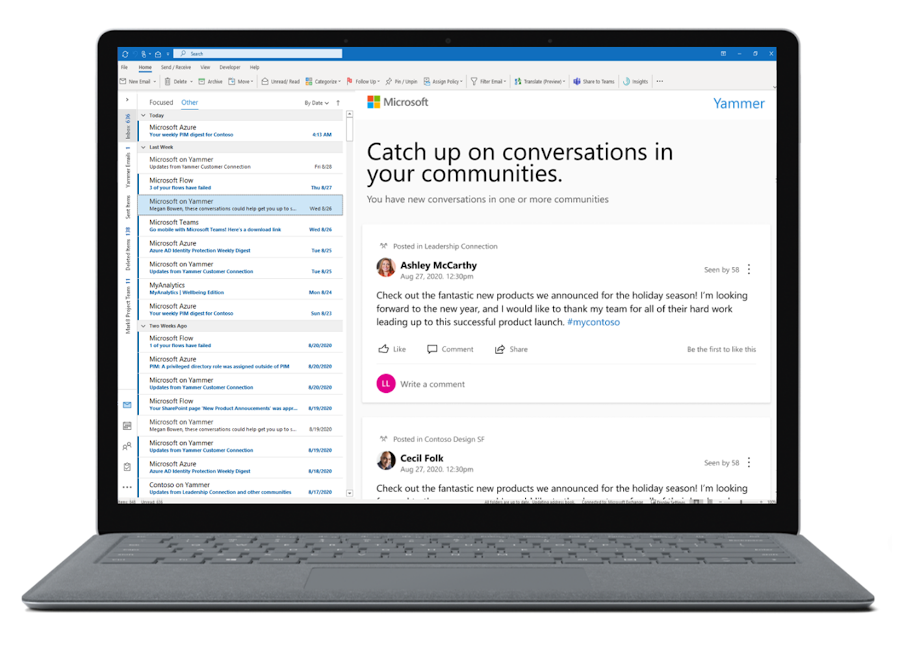
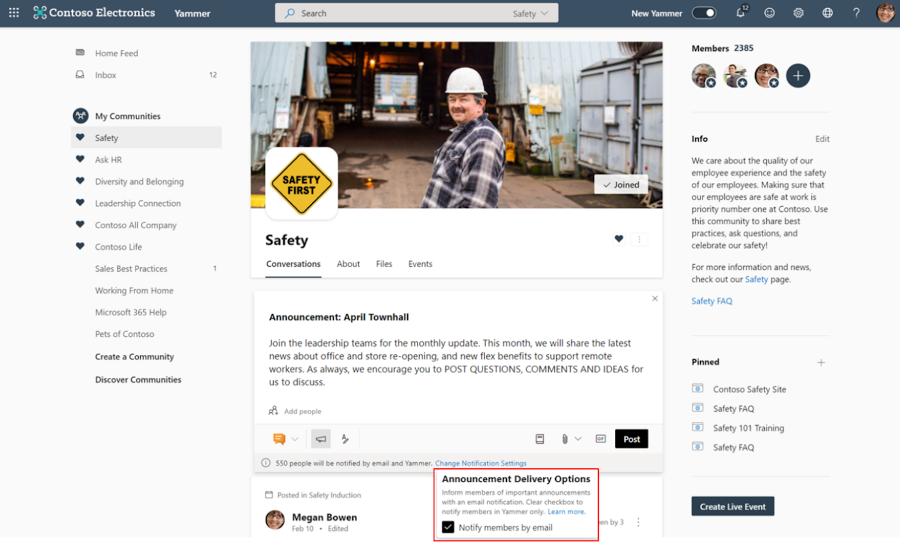
This feature allows Yammer community admins to achieve a guaranteed distribution of important community announcements via email for all members of that community, even if its outside of their preferred notification settings.
SharePoint News in the Yammer Home Feed
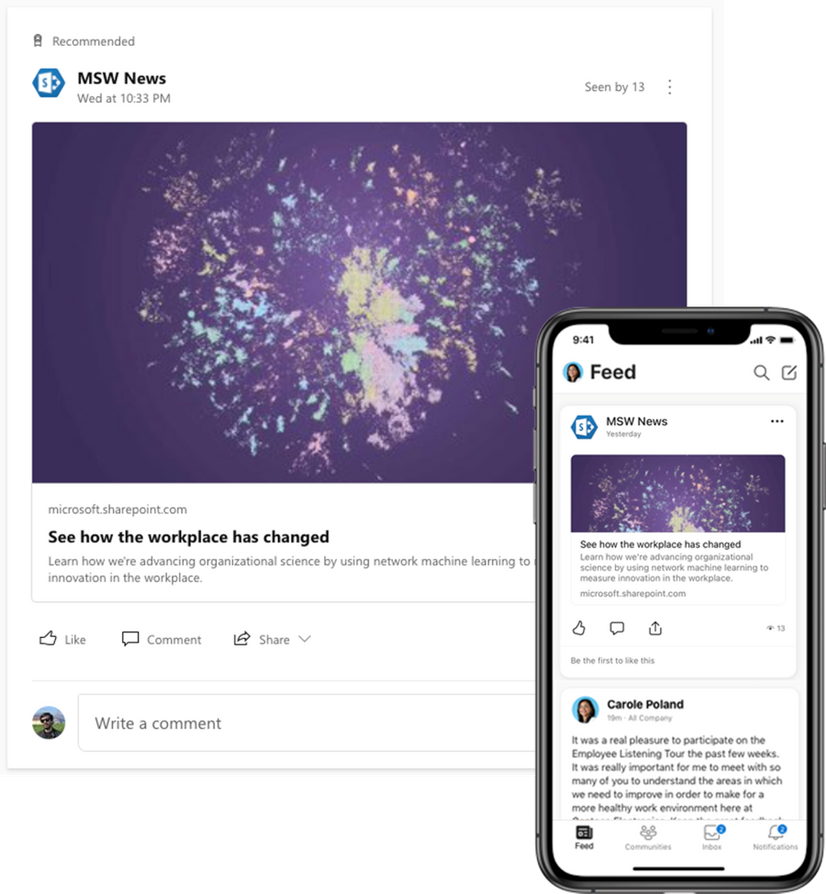
Spark conversations and share company news directly from SharePoint to the Yammer home feed. This is now available on iOS and Android mobile experiences and coming soon to the web.
New Yammer Desktop Experience (PWA)
You can now install the web version of Yammer as a progressive web app (PWA) in Microsoft Edge, Google Chrome, or Mozilla Firefox. After you install the web version of Yammer as a progressive web app, it will work like any stand-alone desktop experience. You can pin and launch the app from your computer’s home screen or task bar, and you can opt in to receive notifications for relevant announcements and messages from Yammer.
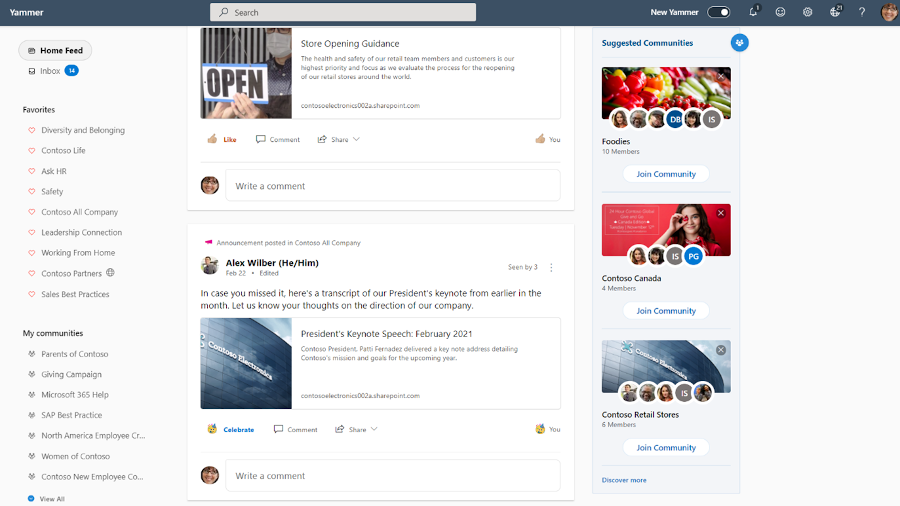
Suggested Communities
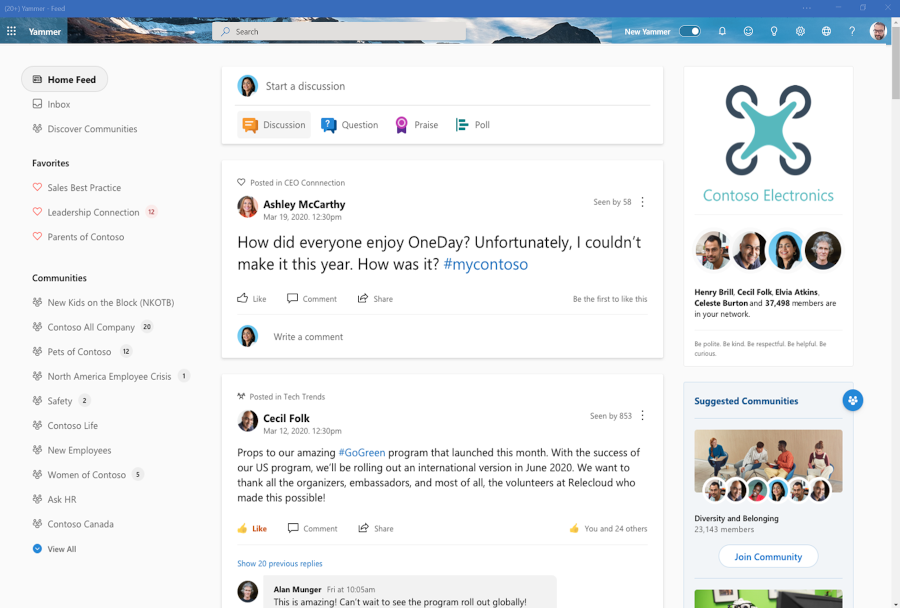
This new section on the right rail of the Yammer homepage will suggest relevant communities for people discover and join. This is rolling out now.
New Yammer Insights now available
Improve your live events viewership. Monitor attendance, measure engagement, and recognize trends.
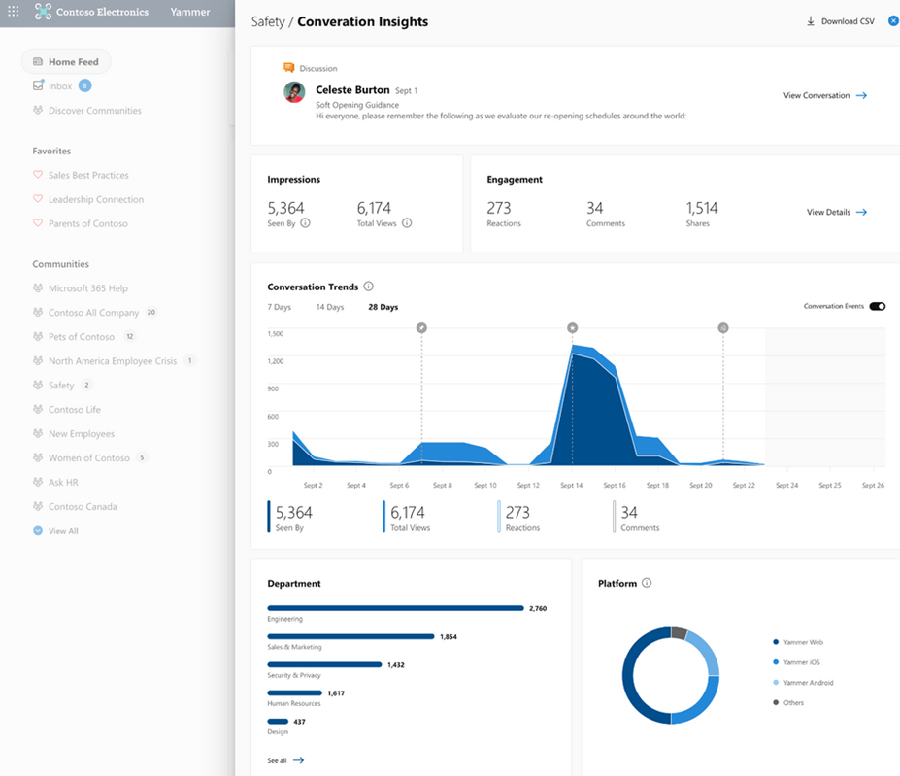
Conversation insights – See which conversations perform best. New insights into impressions, total views, click-through rate, and a breakdown of reactions.
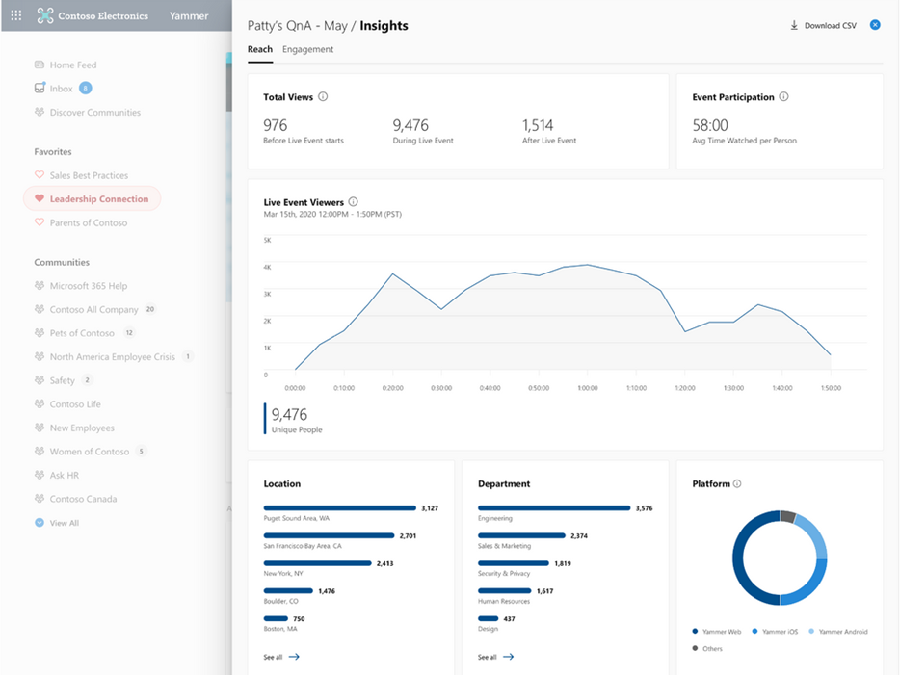
Live event insights – Improve your live events viewership. Monitor attendance, which segments had the greatest viewership, and see where those views are coming from, all geared to help you optimize your current and future events. Learn more on our announcement blog.
New Embed widget options
Allowing you to easily create and customize embeddable Yammer feeds to place on your own sites.
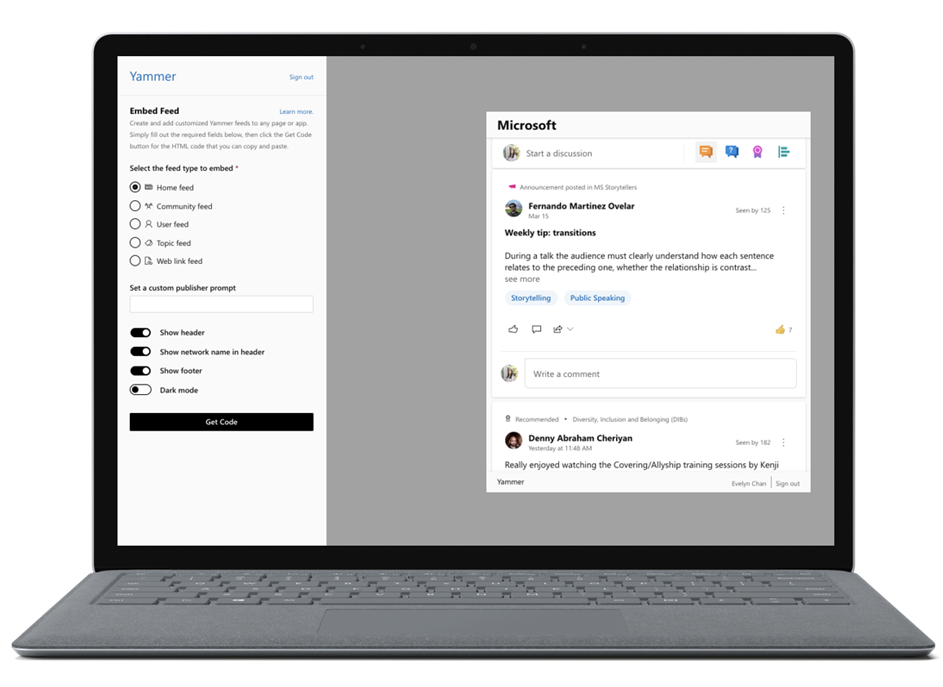
This is coming soon to preview. We are now collecting sign-ups for interest, sign up here.
Azure B2B Guest Access GA
External collaboration is a key ingredient for the success of any organization. Yammer guests allow you to call in experts, such as consultants or vendors, from outside your organization. Users can invite guests to a community and quickly start a rich conversation by sharing access to community resources like files while ensuring that privacy, access, governance and compliance policies remain intact. Now, Guest Access with Azure B2B is generally available.
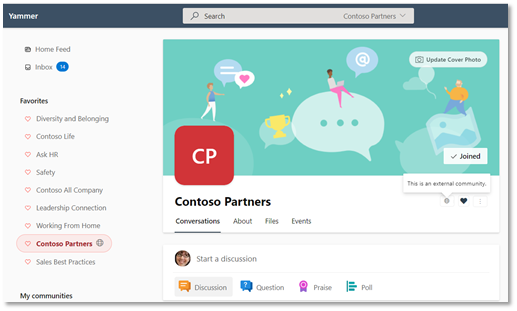 – Communities with external members are denoted by a globe icon.
Cross-geo external collaboration for External Networks for the EU
With this release, guests from Yammer networks associated located in the European Union can be invited to Yammer External Networks hosted by a Yammer network located in the United States.
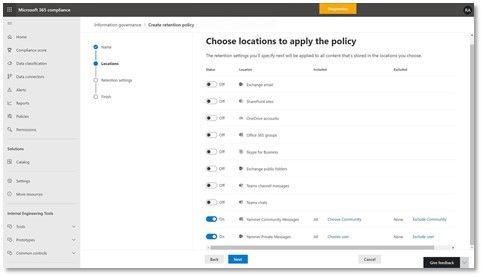
Retention policies in Yammer
This update enables organizations to apply retention policies on Yammer messages.
Additional updates
Here are a few other changes planned that you’ll be seeing in your Yammer network soon:
- New file views: Browse community files stored in SharePoint with SharePoint library structure and capabilities. You’ll also get the ability to browse files in your document library while in native mode.
- Collapse pinned posts: Pinned conversations now collapse automatically after a user has viewed them.
- Updated community settings: There are new community settings on web for communities and All Company community.
See what else Yammer has planned on our public roadmap and keep an eye on this blog for more news, updates, and best practices relating to Yammer and communities in Microsoft 365.
– Mike Holste
Michael Holste is a senior product marketing manager for Yammer + Employee Engagement

by Contributed | Apr 8, 2021 | Technology
This article is contributed. See the original author and article here.
Team 3. University of Oxford Microsoft Project 15 and Elephant Listening Project Capstone
Project Title. Gunshot Detection in Tropical African Forests
Introduction
This project is a group exercise undertaken as part of the University of Oxford Artificial Intelligence: Cloud and Edge Implementations course, as a learning challenge from Microsoft Project 15 and in association with the Elephant Listening Project. The objective is to devise solutions against illegal elephant hunting in tropical African forests by enabling sensors for instant prediction of gunshot events and thus mitigate poaching attempts.
Project Resources
Meet the Team
Our team is an interesting mix of technologists with a wide range of experience from software engineers, data scientists, dev-ops engineers and solution architects.
Elephant Listening Project Challenge
As proposed by Dr. Peter Wrege, Director Elephant Listening Project, Center for Conservation Bioacoustics, Cornell Lab of Ornithology, gunshot detection is an issue in African National Parks and environmental audio data is being collected into a public database at Congo Soundscapes as part of the Elephant Listening Project.
The current model (for gunshot detection) is very inefficient – less than .2% of tagged signals are gunshots and we typically get 10K- 15K tagged signals in a four-month deployment at just one of the 50 recording sites. The issue is we have about 200 good gunshots annotated, but because poaching is way too high, gunshots are still extremely rare in the sounds and it is extremely time-consuming to create the “truth” logs where we can say that every gunshot in a 24hr file has been tagged. From our understanding, this makes developing a detector more difficult.
How you approached the challenge
We approached the challenge by individual research about the problem in general and we gathered ideas on converting the gunshot detection problem statement into a machine learning problem. The main issue as per the challenge is the lack of tagged data for model training and also mostly the gunshot audio data for such use cases is proprietary. So we collected free gunshot samples and other environmental audio samples from random internet sources. There was some basic audio cleaning done to remove noise and clip exact audio data points post converting all formats to .wav files into the dataset. The further audio analysis was carried out using Azure Machine Learning Cloud Services. For brevity, only a part of the dataset is uploaded in the repo but all examples, notebooks, and the dataset are structured in a way to accommodate more data and scale the model training process as we move ahead.
Many features were analyzed across two different classes namely gunshot and environmental audio. The environmental audio contains audio data of elephant noises and other sounds of the tropical African forests. Some of the features analyzed are as follows,
- Spectral Centroid
- 13 MFCCs
- Zero-Crossing Rate
- Onset Detection Frequency
There could be more features relevant to this classification problem that can be analyzed to improve the model in the future and for the scope of this exercise the first thirteen Mel-Frequency Cepstral Coefficients suited best as input features for audio classification.
The input to the machine learning model will be a set of audio features and the model has to classify each input set into two classes, i.e gunshot or environmental audio. This is a binary classification problem and a suitable Dataset was created for training purposes. A feature extraction script was created to convert the raw audio .wav files into relevant feature data and corresponding true values for classification.
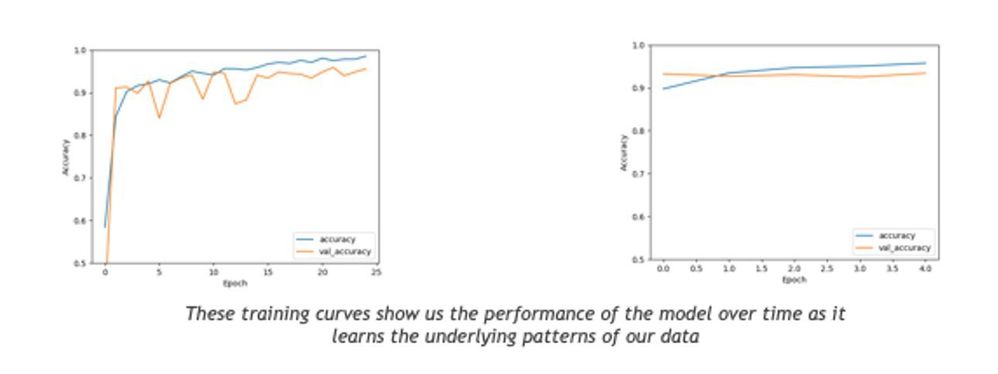
Azure Machine Learning cloud service has been leveraged for the classification model supervised training. In this case, two different model architectures were tested by running scripts from the Makefile and the following results were observed,
Neural Network Architecture
|
Train Accuracy
|
Test Accuracy
|
Multi-layer Perceptron
|
0.9756
|
0.9405
|
Convolutional Neural Network
|
0.9740
|
0.9236
|
Note: These accuracy metrics depend directly on the limited data used for model training and testing. Further improvements in contextual data collection, feature extraction and analysis, and experimentation with model architectures is needed to validate the reliability of these model metrics for practical applications.
Solution Architecture – Microsoft Project 15 – Azure Cloud Services
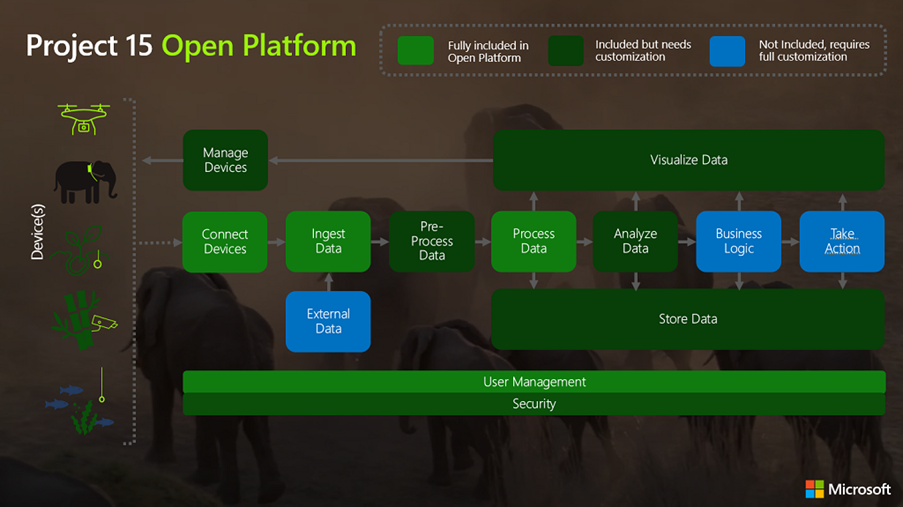
The Microsoft Project 15 Architecture is leveraged to follow the best practices in the deployment of scalable IoT solutions. One of the core goals of the Project 15 Open Platform is to boost innovation with a ready-made platform, allowing the scientific developer to expand into specific use cases.
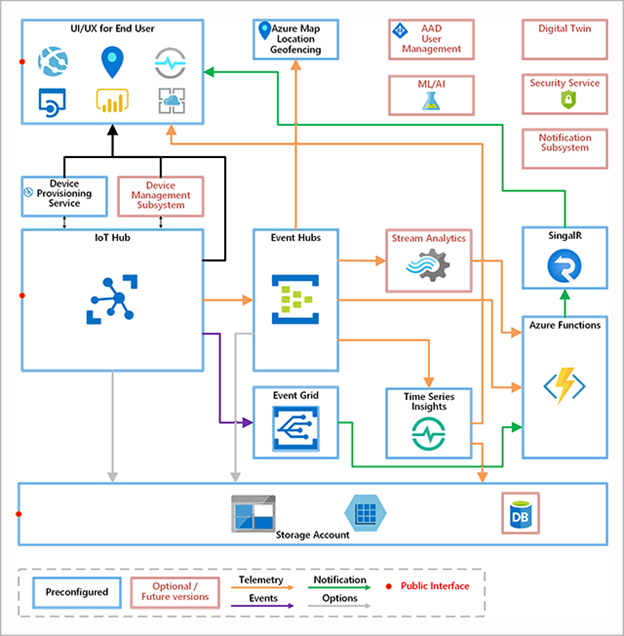
Data Scientists can train the model using Azure Machine Learning cloud service and deploy the model to edge devices using IoT services. This process can be automated using Azure cloud services for upgrading the edge devices models at runtime through a strategic rollout.
Event processing for Gunshot detection
- Edge devices continuously read audio data, extracts features, and makes ML inference to classify events as gunshot or not.
- Edge devices at multiple locations in the National park then, sends this telemetry data to Event Hub through the IoT gateway
- If an alert is required to be sent then it will be sent to Azure Notifications Hub
- We could also write the events to a structured database for long-term persistence and audit purposes later.
- Azure apps or Power BI monitoring dashboard reads and displays live telemetry data from multiple sensors at different locations.
- Rangers can monitor the notifications and live dashboard for threats.
Edge Device Simulation
For demo purposes, we have created an edge device prototype that simulates predictions from audio data and sends telemetry data to IoT Hub. This is a nodejs based application that uses tensorflow as a backend to make predictions using the model created during the training phase.
The model created during the training phase needs conversion to a tensorflow js graph model format to be used in a node js application. So we convert the models to tfjs graph format for the client to predict
Register an edge device to IoT Hub and copy IoT device connection string from the microsoft portal into .env file in the edge device source folder. Finally, run the edge device prototype to simulate gunshot predictions randomly and send telemetry data to IoT Hub
We found the challenge very interesting to begin with but finally to see the end to end prototype working as intended was extremely satisfying. Through this journey we learnt many new capabilities offered by the Azure Cloud for Model development, deployment and monitoring or the full MLOps lifecycle.
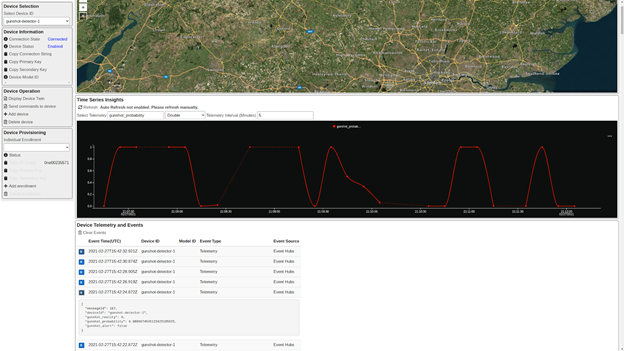
Live Monitoring and Demo
- Monitor gunshot detection from the Project 15 app
Future Work
Gunshot detection is still an unsolved problem today and there is ongoing research on this front for both military and surveillance purposes around the world. The machine learning classification model in this context can be improved with better data collection from the tropical forests in Africa. The lack of sufficient data remains the major issue with this challenge. Accurate gunshot audio should be recorded using the apposite set of hunting rifles for improved accuracy and further feature analysis can be conducted comparing gunshots with other surrounding sounds in the elephant habitat.
Further, many more model architectures can be tested and compared to understand what hyper-parameters work best for such remote environments. This can surely improve the model training process. Also, better deployment practices, telemetry, alert systems, and model upgrade processes can be explored with cloud-based IoT solutions to improve the overall efficiency of the solution.
Project GitHub Repo
https://github.com/Oxford-ContEd/project15-elp

by Contributed | Apr 8, 2021 | Technology
This article is contributed. See the original author and article here.
MICROSOFT AI FOR GOOD
PROJECT TITLE: A Baseline Elephant Infrasound Detection architecture using IoT Edge, Cloud and Machine learning frameworks for elephant behavioural monitoring.
Group 2:
Authors: Shawn Deggans, Aneeq Ur Rehman, Tommaso Pappagallo, Vivek Shaw, Giulia Ciardi, Dnyaneshwar Kulkarni
INTRODUCTION
The goal of this project is to create a platform that will allow researchers to continuously build and refine machine learning models that can recognize elephant behaviour from infrasound. This platform is based on Microsoft’s Project15 architecture- an open-source solution platform built to aid conservation and sustainability projects using IoT devices.
We aim to apply this technology stack to the tracking and understanding of elephant behaviour to contribute to an effective monitoring program. Our solution aims to achieve this goal by:
- Systematically collecting data related to elephant vocalization via IoT devices.
- Detect threats and infer behavioural patterns based on elephant vocalization by using custom machine learning and signal processing modules deployed on the IoT device using Azure IoT stack.
Furthermore, Elephants’ low-frequency vocalizations (infrasound) are produced by flow-induced self-sustaining oscillations of laryngeal tissue [1]. This unique anatomy allows elephants to communicate in a sonic range that is below the audible human hearing range (14-24hz). This means that a standard microphone will not be an adequate detect for elephant vocalization. The normal range for standard microphones is 20hz-20khz. Specialized microphones can capture sound in the range of 1hz and above. Acquiring these specialized microphones and infrasound detection tools are beyond the scope of this project, in our approach we will outline how such a tool could be created and used in the field by rangers and researchers in our proposed architecture below.
The design of this architecture can be built upon in the future, to deploy more advanced custom modules and do more advanced analytics based on these collated vocalizations. We propose an end-to-end architecture that manages these needs for the researchers and domain experts to analyse and monitor elephant behaviour and identify potential threats and take timely action.
PROPOSED APPROACH
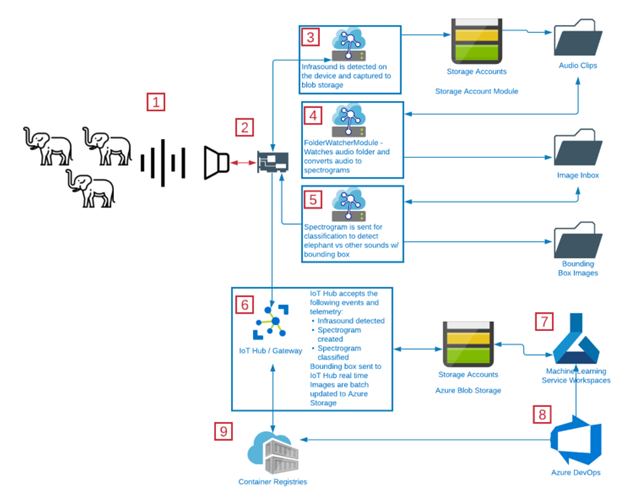
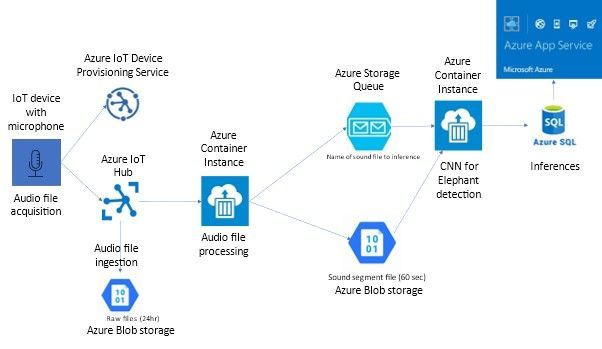
The above follows the overall proposed flow of the device-to-cloud communication, as well as the IoT Edge’s internal device logic.
1. Capture Infrasound using infrasound detection arrays on elephants:
The infrasound capture device continuously monitors for infrasound. These infrasound signals are captured and sent to the device for analysis. We are interested in exploring one type of infrasound capture device:
- Infrasound detection array
The infrastructure detection array is the capstone project of a Spring 2020 project by team members: James Berger, Tiffany Graham, Josh Wewerka, and Tyler Wyse. Project details can be explored here, “[2]“
This project was designed to detect infrasound direction using an array of infrasound microphones, but we would use the infrasound microphones in a low-powered device that could communicate over a long-range radio network, such as LoRaWAN. This network of devices would serve as the primary means for tracking elephants and recording their vocalization.
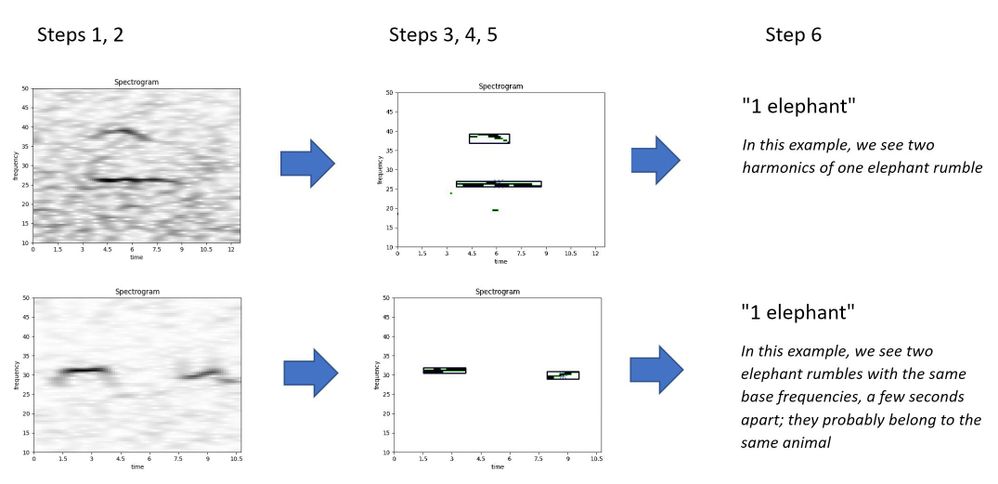
We envision this device as an IoT Edge device capable of supporting Azure Storage Account Blob Storage and custom IoT Edge Modules that are containerized machine learning modules capable to converting audio into spectrograms, and spectrograms into bounding box marked images, and delivering telemetry to IoT Hub.
2. Send infrasound data to IoT Device:
The 64-bit Raspberry Pi model captures the infrasound audio signals, breaks these into segments based on detected beginning-of-signal and end-of-signal indicators. Initially this limitation could mean we miss “conversations,” because this is the equivalent of capturing a word from each sentence in human speech. Elephants do not necessarily speak in words and sentences, so this likely will not keep us from meeting the goals of the system.
3. Storing data via Azure Blob Storage:
These audio files will be saved to an Azure Blob Storage device module in an audio clips file [3].
4. Azure Functions and Spectrogram conversion via the FileWatcher Module.
We develop a custom IoT Edge module known as the filewatcher module. This module uses an Azure Function to serve as a file watcher for the file storage. [4]
When it detects the file has been received in the blob storage account, it will convert the audio file to a spectrogram.
A MATLAB script is used to convert the raw audio files to spectrograms. The details of this script are available on our github repository. MATLAB offers better resolution images and a higher fidelity power spectrum that improves our elephant rumble detection process.
These spectrograms are stored in an image inbox in the blob storage.
5. Elephant Rumble Detection Module:
Another Azure function listens to the image inbox for new images and keeps a track of the images uploaded here.
When new images appear, the function feeds the images to the rumble detection model.
The rumble detection model is trained via the custom vision ai using the spectrogram images from the raw audio files.
The custom vision AI is a good place to prototype and to build object detection and image classification models.
An example of steps to build a custom computer vision model and deploy to IoT Edge can be found here via DevOps (https://github.com/aneeqr/DevOpsCICD_final)
The rumble detection model returns the image label (rumble or no rumble) and the bounding box coordinates. We use OpenCV to draw the coordinates on the image. Images are then saved to the Bounding Box Images folder for more backend processing within Azure ML to help feed the ML loop.
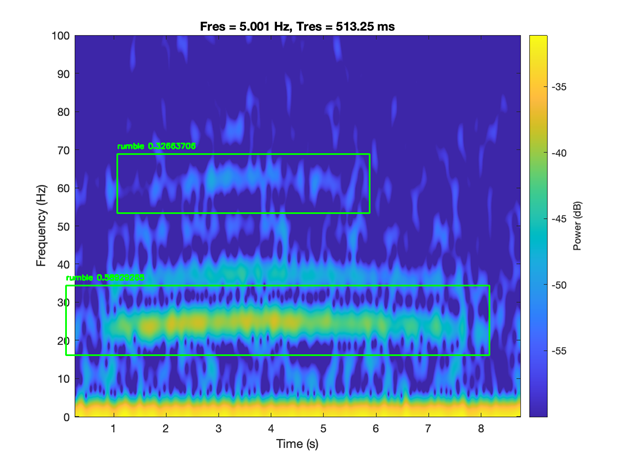
We implement this logic flow as part of a DevOps pipeline. For more detail on the pipeline components, please see technical design.
6. Elephant Spectrogram Feature Extraction and Analysis:
In addition to the above, we also extract features from the created spectrograms in our Azure storage accounts.
For our feature extraction we calculated 19 different variables with relation to flow statistic on the audio (mean, variance, etc.) and common signal characteristics (rms, peak2peak, etc.) making use of the MATLAB software here which enabled a wider array of spectral features to be extracted.
In summary for each sample, we found the frequency of the peak magnitude across the overall power spectrum, the 1st formant, the 2nd formant, the max, min, mean and finish of the fundamental. In addition, we computed the power in the low frequency range 0-30 Hz, mid frequency range 30-120 Hz and high frequency range >120 Hz. We located the frequency of the spectral kurtosis peak and the flow cumulative sum range.
7. Analysis in the ML Workspace using stored data:
Our results offer some starting points for further research particularly in relation to trying to learn any underlying structure, with regards to age groups, in our population, given unlabelled data.
By unlabelled data, we mean that the raw audio files have no annotations or additional information associated with it to classify or distinguish elephant rumbles into maturity groups.
We classify elephant rumbles into maturity groups by
1. Leveraging the extracted features such as the 1st and 2nd formant frequencies, rms, peak to peak envelopes, max, min, finish, frequencies for each sample- We then aim to classify the samples into Maturity Groups 1 or 2 We achieve this by observing the thresholds of these features extracted by setting these thresholds as proposed in this paper [5]. We also do a visual inspection by plotting these features out doing a visual inspection using various data visualisation techniques. An example of a Violin plot is shown below.
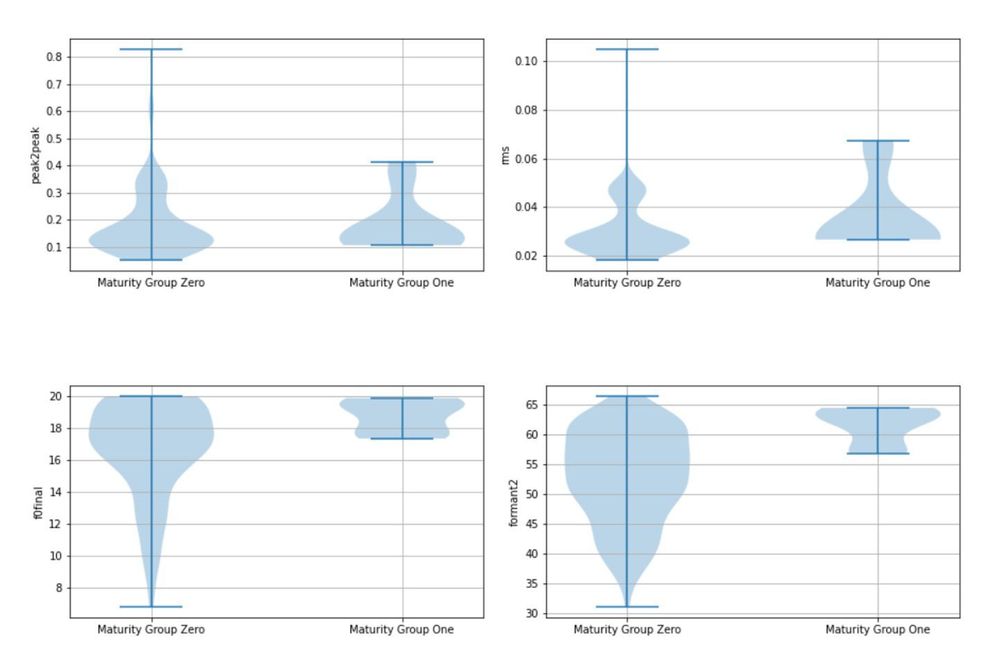
The violin plot clearly shows that at certain thresholds, we can cluster elephants into two different maturity groups.
2. We use unsupervised methods such as PCA to generate principal components and perform K-means clustering. This method showed clear signs of clustering when the points were projected into the PCA dimensions as seen in the output below.
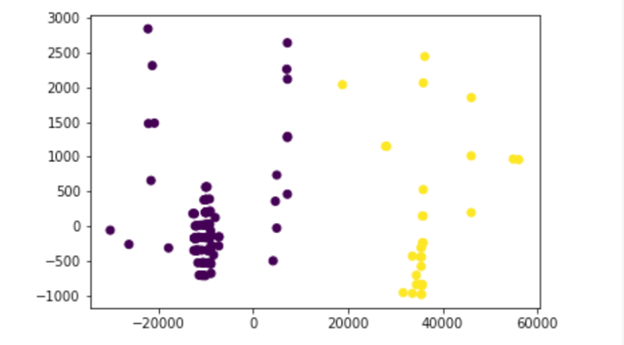
When comparing method 1 and 2 the classified maturity groups overlapped for over 75% of the data, however, to check whether this is statistically significant we would need to perform a t-test.
PROJECT OVERVIEW VIDEO
MLOPS TECHNICAL DESIGN
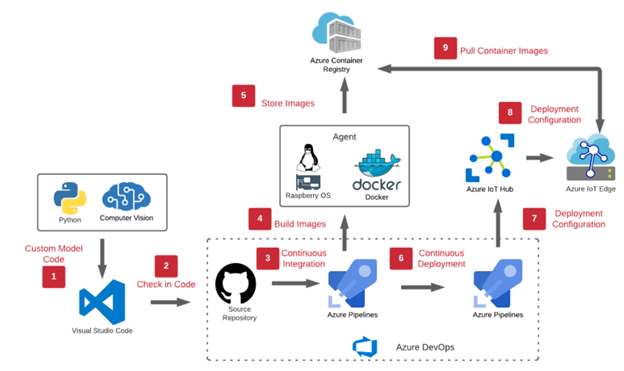
The above is the MLOPs pipeline as part of our workflow. We use the continuous integration and continuous deployment feature of azure DevOps to manage our workflows.
The following are some of the steps in this pipeline.
1. Creation of Azure Resources:
Resource Group:
Needed to create all our resources in azure.
IoT Hub:
IoT Hub is used as the primary IoT gateway. From here we manage device provisioning, IoT edge device creation, telemetry routing, and security. We will use the SAS token security and employ a regular SAS key rotation policy to keep devices secure.
IoT Edge device:
This is created in the IoT Hub and acts as our IoT device.
IoT Edge RunTime Agent:
This will be deployed on a raspberry pi OS VM container.
Azure Blob Storage:
Blob Storage holds images saved on the IoT Edge Module. This means that it also has folders that represent audio clips, image inbox, and bounding box images. This represents cold storage of data that could be studied later or needs to be archived.
Azure Container Registry:
Container Registry is used to hold the Dockerfile images that represent the IoT Edge Modules. Modules are pulled by [1] IoT Hub to automatically deploy to devices in the field. All our custom modules mentioned previously contain docker files which are pushed to azure container registry as part of the pipeline.
Azure DevOps:
Azure DevOps is one of the most important pieces of our MLOPs process. From here code is checked in and pushed out to the Container Registry. This also accounts for version control for our code base and manages pipelines. All docker files for both modules are located here and DevOps offers a continuous integration and continuous deployment scenario, as builds the code for the two custom modules, and generates a deployment manifest which is deployed on the IoT Edge device in the IoT Hub.
2. Import source code in DevOps:
We import our code files and repos in DevOps from our source repository.
3. Create a CI pipeline in DevOps:
The pipeline is then created with all environment variables defined. Environment variables include details of container registry, IoT Hub to build and push our modules to the azure container registry. We enable continuous integration.
4. Enable CD pipeline in DevOps:
We then create a release pipeline and push our deployment to the IoT Hub and hence the IoT Edge device [6].
The device is now ready to work in production.
TECHNICAL STACK AND CORE CONCEPTS APPLIED:
- Azure Custom Vision AI Portal
- Azure DevOps.
- Azure Machine learning.
- Azure Blob Storage
- Azure IoT Edge
- Azure IoT Hub
- Azure Container Registry
- Docker
- Matlab
- Python
- Jupyter notebooks
- Digital Signal Processing
- Data visualisation
CHALLENGES FACED:
- Procurement of physical device/microphone to detect elephant rumbles.
- Unlabelled data- Lack of ground truth available to classify elephant rumble type.
- Spectrogram resolutions
- Need to be good enough for the training of the object detection model in custom vision ai portal.
- We applied a variety of data augmentation methods using the Augmentor software package [7]. Some transformations yielded better results than the other but this needs to be explored in more detail.
- Noise Separation- Separating elephant rumbles from background noise.
- After research, we understand that our approach of analysing infrasound is of a limited scope on the overall communication amongst the elephants. The sounds are important, but like humans, elephants express their communication in more ways than just their voices. Elephants also express body language (visual communication), chemical communication, and tactile communication. We understand that this means the audio only component will not be able to capture the full picture. It will, however, add to the Elephant Sound Database.
- The MATLAB packages locked us into a specific vendor and made it impossible for us to use the libraries in an IoT Edge container. This was due to licensing restrictions. We used MATLAB as the spectrogram resolutions were promising.
FUTURE WORK
- Polishing baseline code to a more production ready code base.
- More literature review and access to labelled data for building machine learning models.
- Use of semi-supervised approaches to develop a clean and annotated dataset for rumble classification. Validating this dataset with domain experts to serve as a gold standard.
- Use of denoising auto-encoders for background noise cancellation in audio files.
- Use deep learning (CNNs and graph CNNs) for extracting spectrogram data when building models instead of feature engineering. Comparison of both approaches.
- Use of advanced unsupervised methods to get more insights on the data extracted from spectrograms.
- Investigate sustainability and scalability of the proposed architecture in more detail.
- Investigate paid and open-source datasets available for ML.
- Improve existing custom vision ai model by:
- Incorporating more training data and researching data augmentation strategies for spectrogram data.
- Using better data augmentation methods via spectrograms such as the following SpecAugment package [8]. Having a unified platform via python for improving spectrogram resolutions would be preferred.
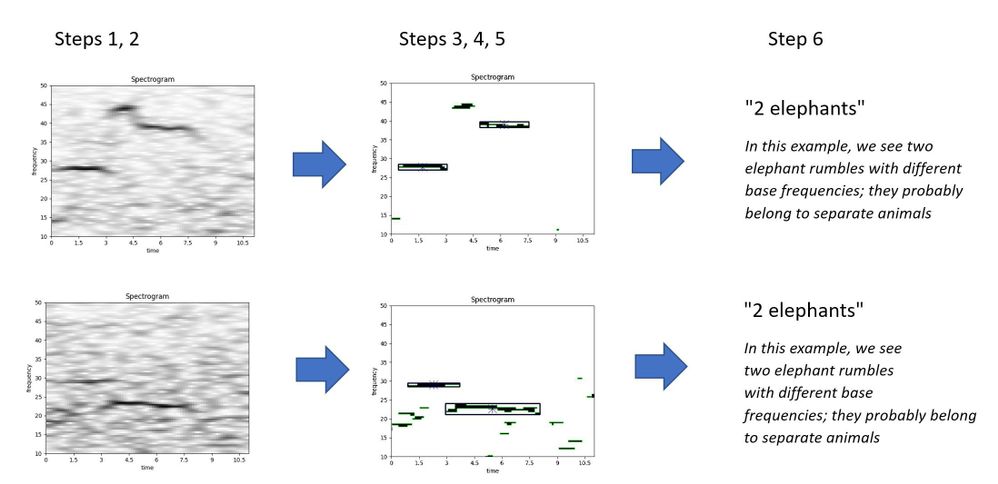
- Algorithm development around bounding box detection of fundamental frequency and harmonics in the rumbles.
REFERENCES
[1] https://jeb.biologists.org/content/216/21/4054
[2] https://engineering.ucdenver.edu/current-students/capstone-expo/archived-expos/spring-2020/electrical-engineering/elec6-improving-infrasound-detection
[3] https://docs.microsoft.com/en-us/azure/iot-edge/how-to-store-data-blob?view=iotedge-2018-06
[4] https://jaredrhodes.com/2017/11/27/create-azure-function-to-process-iot-hub-file-upload/
[5] https://www.nature.com/articles/srep27585/tables/3
[6] https://docs.microsoft.com/en-us/learn/modules/implement-cicd-iot-edge/6-exercise-create-release-pipeline-iot-edge
[7] https://augmentor.readthedocs.io/en/master/code.html
[8] https://github.com/DemisEom/SpecAugment.
LEARN MORE ABOUT PROJECT15
Project 15: Empowering all to preserve endangered species & habitats.
Date: April 22, 2021
Time: 08:00 AM – 09:00 AM (Pacific)
Location: Global
Format: Livestream
Topic: DevOps and Developer Tools
What is this session about?
If, just like us, you want to save animals and preserve our ecosystems, come celebrate Earth Day 2021 with us by learning how we are helping and how you could too!
Project 15 from Microsoft is an effort that includes an open source software platform that helps non-governmental organizations (NGOs) reduce their cost, complexity, and time to deployment by connecting scientific teams with the needed technology to empower them to solve those environmental challenges.
We will also be highlighting community efforts, Internet of Things (IoT) and Machine Learning for sustainability, Open-Source GitHub repository, and existing projects by students!
















Recent Comments