This article is contributed. See the original author and article here.
Security conscious organizations look at ways to ensure corporate data on mobile devices are protected. One method used to protect that data is through device enrollment. Device enrollment enables organizations to deploy compliance policies (PIN strength, jailbreak/root validation, etc.), as well as configuration policies (WiFi, certificates, VPN, etc.). Device enrollment also enables organizations to manage app lifecycle.
In Android 2.2, Google introduced support for device management with the device administrator API. Since that time, organizational needs have changed, as mobile devices continue to contain and access more sensitive data. These needs include separation of work and personal data, kiosk management, app configuration, and app distribution, to name a few. The device administrator API was not designed to handle these scenarios.
With Android 5.0, Google introduced a new management profile with the introduction of managed device (device owner) and work profile (profile owner) modes (what is collectively known as Android Enterprise now). As the functionality in Android Enterprise has continued to evolve, Google announced decreasing support for device administrator. For more information on Microsoft Endpoint Manager’s plans, see:
Android offers Android Enterprise work profile as an enrollment model for personally-owned devices, where IT wants to provide a clear separate boundary between work and personal data. As organizations transition from device administrator to work profile for personally-owned devices, users may experience confusion or frustration that there are now separate app instances for work and personal use.
To address this concern, Android introduced the CrossProfileApps API in Android 9. This API allows an app to recognize when it has a corresponding instance in the work or personal profile. Using this API, an app may expose an in-app user experience to end users, allowing them to switch to the cross-profile instance without having to back out to the app launcher and tap the other app icon’s instance.
Outlook and the CrossProfileApps API
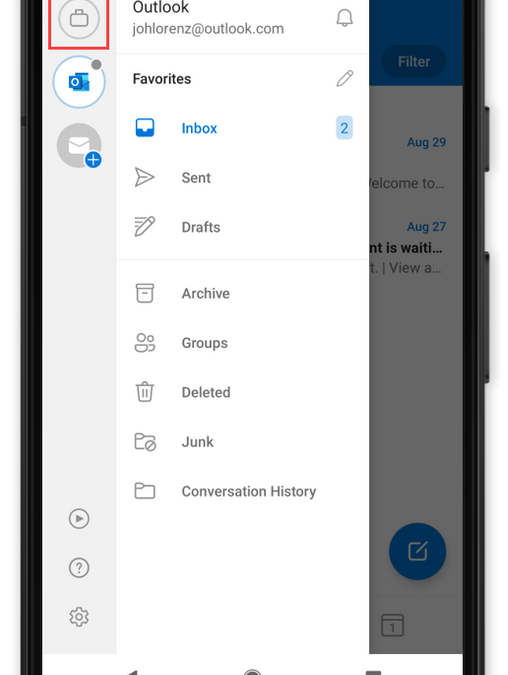
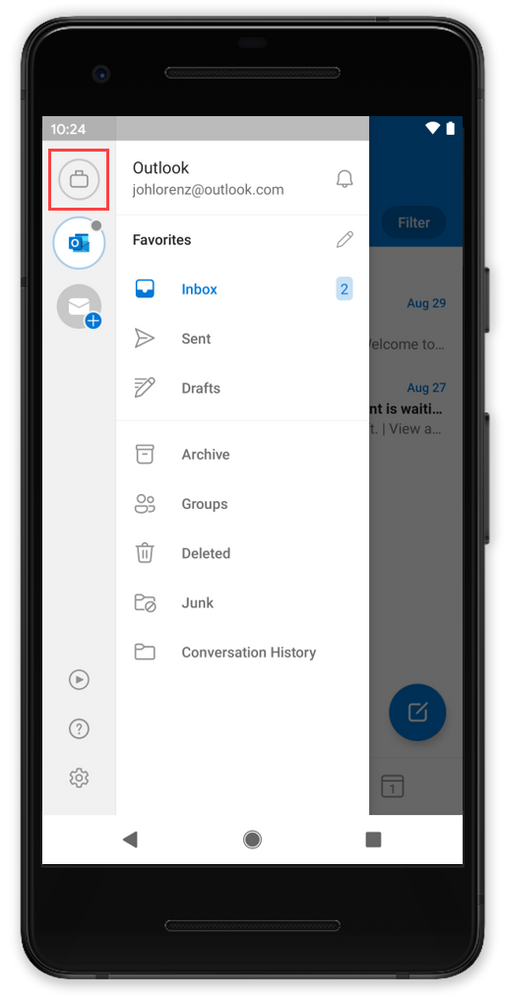
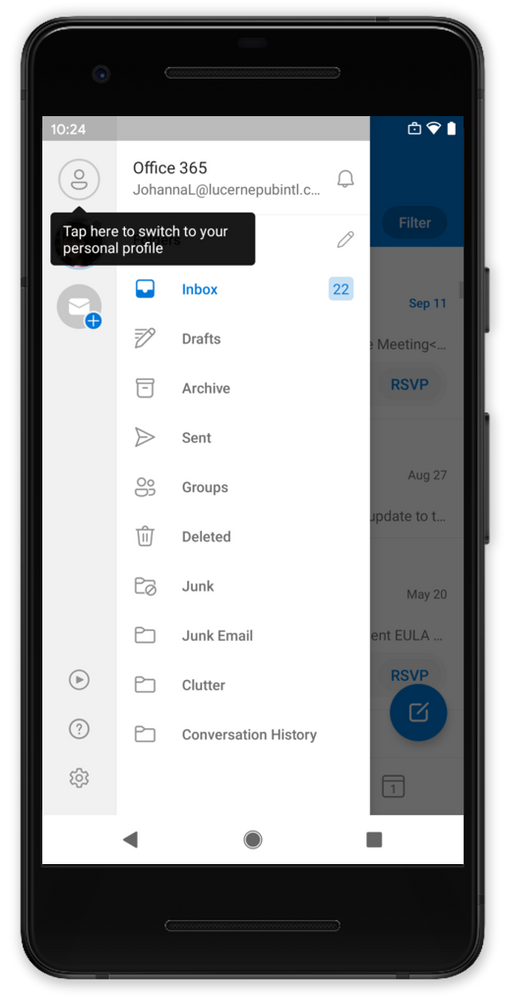
The first Microsoft app to take advantage of the CrossProfileApps API is Outlook for Android. This feature is slowly rolling out this month and requires a minimum build of 4.2039.0 with Android 9 or later. Users can leverage this functionality from within the left-hand navigation menu. When launching Outlook in the personal profile, users will see a work profile switcher button (highlighted by the red square) in the left-hand navigation account switcher section:
Switch to work profile
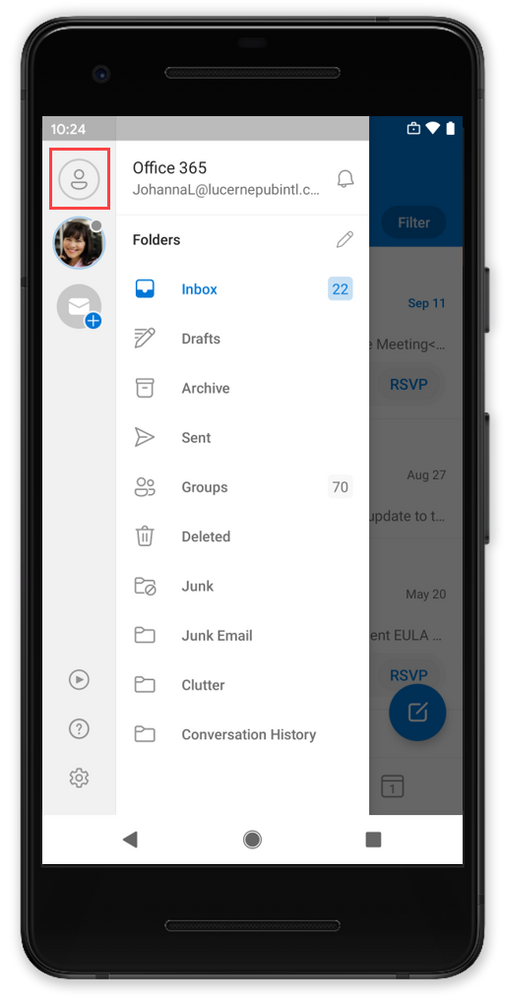
With Outlook in the work profile, users will see a personal profile switcher button (highlighted by the red square) in the left-hand navigation account switcher section:
Switch to personal profile
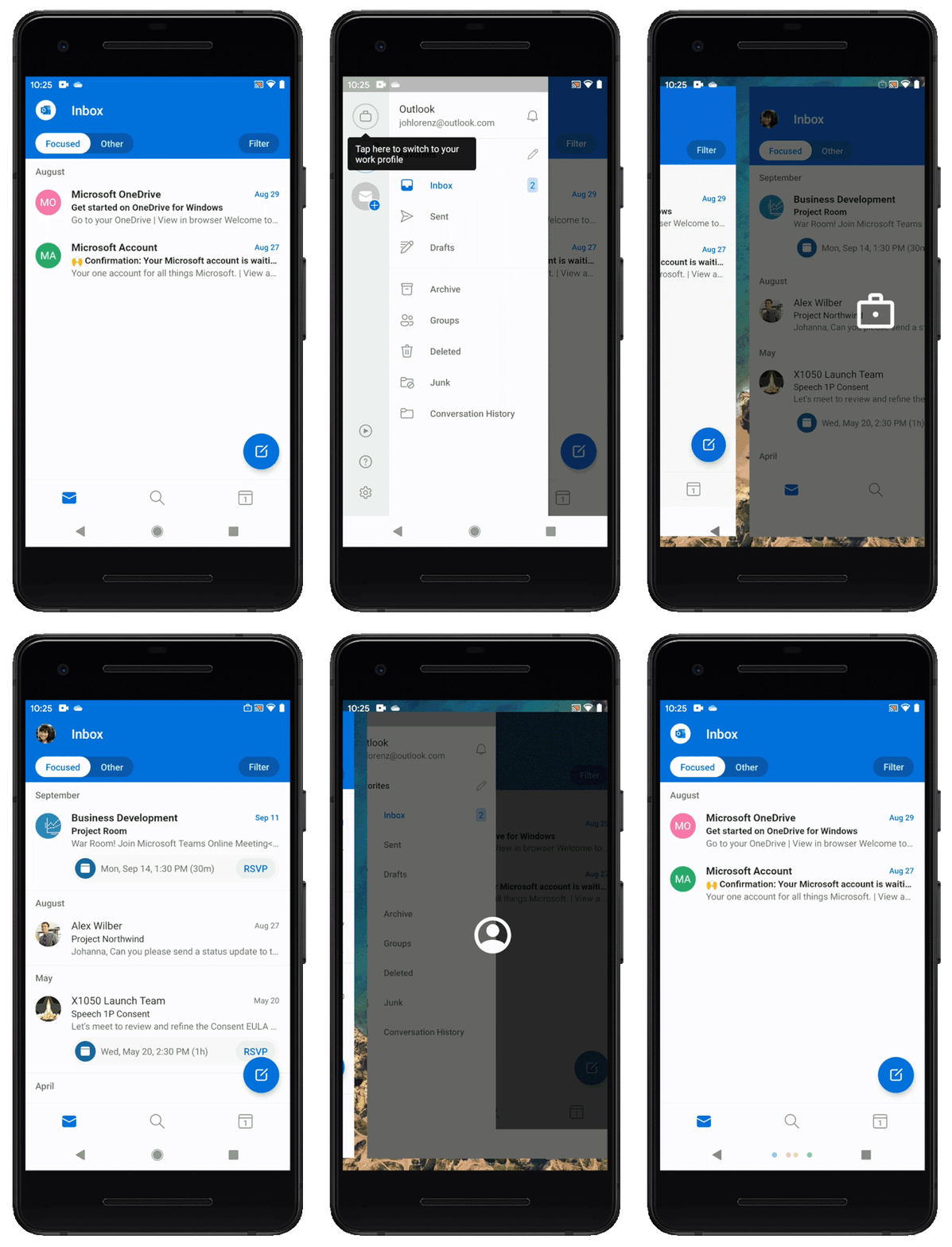
When the user taps the work or personal profile switcher button, they will be switched to the relevant instance of Outlook:
Cross-Profile switching experience
We are also releasing a teaching moment to educate users on this functionality, for example:
Work Profile teaching moment
It is important to note that this functionality only works if the user is using the same app in both profiles. Users using Gmail in their personal profile, for example, cannot use the CrossProfileApps API to switch to Outlook in the work profile.
We hope your users will find this improvement useful. If you have any questions, please let us know.
Ross Smith IV Principal Program Manager Customer Experience Engineering
This article is contributed. See the original author and article here.
Original release date: December 3, 2020
The United Kingdom (UK) National Cyber Security Centre (NCSC) has released its Annual Review 2020, which focuses on its response to evolving and challenging cyber threats. Recognizing cybersecurity as a “team sport,” the publication includes highlights of NCSC’s collaboration with many partners, including the Cybersecurity and Infrastructure Security Agency (CISA). A few examples:
This article is contributed. See the original author and article here.
Original release date: December 3, 2020
Apple has released security updates to address vulnerabilities in iCloud for Windows. An attacker could exploit some of these vulnerabilities to take control of an affected system.
The Cybersecurity and Infrastructure Security Agency (CISA) encourages users and administrators to review the Apple security page for iCloud for Windows 11.5 and apply the necessary updates.
This article is contributed. See the original author and article here.
Original release date: December 3, 2020
IBM X-Force has released a report on malicious cyber actors targeting the COVID-19 cold chain—an integral part of delivering and storing a vaccine at safe temperatures. Impersonating a biomedical company, cyber actors are sending phishing and spearphishing emails to executives and global organizations involved in vaccine storage and transport to harvest account credentials. The emails have been posed as requests for quotations for participation in a vaccine program.
The Cybersecurity and Infrastructure Security Agency (CISA) encourages Operation Warp Speed (OWS) organizations and organizations involved in vaccine storage and transport to review the IBM X-Force report Attackers Are Targeting the COVID-19 Vaccine Cold Chain for more information, including indicators of compromise. For tips on avoiding social engineering and phishing attacks, see CISA Insights: Enhance Email & Web Security.
This article is contributed. See the original author and article here.
Today, I am pleased to share with you a new episode of Azure Unblogged. I chat to Martin Woodward, Director of Developer Relations at GitHub. Martin and I discuss why GitHub is something that IT Pros and System Administrators should look at learning GitHub. The new features GitHub Actions and GitHub Codespaces and how they integrate with Azure as well as the forthcoming GitHub Universe.
I hope you enjoyed the video if you have any questions feel free to leave a comment and if you want to check out some of the resources Martin mentioned please check out the links below:
This article was originally posted by the FTC. See the original article here.
Searching for in-language information on how to avoid COVID-19 scams and other types of fraud? Check out ftc.gov/languages, the FTC’s one-stop resource for consumer education in Traditional and Simplified Chinese, Korean, Tagalog, Vietnamese, and other languages.
Brought to you by Dr. Ware, Microsoft Office 365 Silver Partner, Charleston SC.
This article is contributed. See the original author and article here.
Great to see so many people upgrading to the latest – but one issue we have heard is that the Enterprise Global template (EGT) cannot be opened in Project Server 2019 after the migration. The problem appears to be that the Project UID for the EGT is changed – then it cannot be found under its new GUID. Often this is seen to be happening when migrations start at an earlier release – like 2010 or 2013, but from the reports we have the problem only occurs at the final stage – and the EGT opened just fine in 2016.
The solution requires a bit of work in SQL Server, so if you are not comfortable working in SQL then either work with the database administrator for Project Server – or of course open a support ticket. Always best too – if you either take a SQL backup before making any changes – or make the changes just after your normal backups occur – in case you need to revert.
To detect the issue you would first run a query like this one – substituting your content database name for dbname:
use dbname
select PROJ_UID, PROJ_NAME from pjpub.msp_projects where proj_name like ‘%eglobal%’
This may return a result similar to the following:
Here, the EGlobal has the proper association to PROJ_UID = 75CDD7DB-1B68-4B70-A8D6-2FE52DA83ACD (this is the static GUID) and an older version of the EGlobal is shown here (the second row).
If the EGlobal has a different UID, then it’ll need to be updated to use the proper one.
For example, suppose the returned result looks like this:
You’d need to run an update query that looks similar to this:
use dbname
Update pjpub.msp_projects
Set PROJ_UID = ’75CDD7DB-1B68-4B70-A8D6-2FE52DA83ACD’
where PROJ_UID = ‘DF59652B-073D-4FB1-A16E-1F7233C439AE’
Use the GUID (in this example starting ‘DF59,,,’ that is the incorrect GUID returned from the previous select statement.
If this doesn’t solve the problem – or if the GUID looks to be ok, then you have a different problem and would need to open a support ticket.
Thanks to Adrian and Ajith for help with putting these details together – and Dale and Paul for alerting us to the issue.
My suspicion is that this is a 2019 client issue – as just changing the GUID to try and repro the issue in 2016 does not give any problems – the EGT opens just fine whatever GUID it has…
This article is contributed. See the original author and article here.
The Azure Sphere OS version 20.12 is now available for evaluation in the Retail Eval feed. The retail evaluation period provides 14 days for backwards compatibility testing. During this time, please verify that your applications and devices operate properly with this release before it is deployed broadly via the Retail feed. The Retail feed will continue to deliver OS version 20.10 until we publish 20.12 in two weeks. For more information on retail evaluation see our blog post, The most important testing you’ll do: Azure Sphere Retail Evaluation.
Azure Sphere OS version 20.12
The 20.12 release includes the following bug fixes and enhancements in the Azure Sphere OS. It does not include an updated SDK.
Reduced the maximum transmission unit (MTU) from 1500 bytes to 1420 bytes.
Improved device update in congested networks.
Fixed an issue wherein the Wi-Fi module stops scanning but does not respond with a completion event if a background scan is running and the active Wi-Fi network is deleted.
Fixed a bug wherein I2CMaster_Write() returns EBUSY when re-sideloading the app interrupts operation.
Azure Sphere SDK version 20.11
On Nov 30, we released version 20.11 of the Azure Sphere SDK. The 20.11 SDK introduces the first Beta release of the azsphere command line interface (CLI) v2. The CLI v2 Beta is installed alongside the existing CLI on both Windows and Linux, and it works with both the 20.10 and 20.12 versions of the OS. For the purpose of retail evaluation, continue to use the CLI v1. For more information on the v2 CLI and a complete list of additional features, see Azure Sphere CLI v2 Beta.
For more information on Azure Sphere OS feeds and setting up an evaluation device group, see Azure Sphere OS feeds.
For self-help technical inquiries, please visit Microsoft Q&A or Stack Overflow. If you require technical support and have a support plan, please submit a support ticket in Microsoft Azure Support or work with your Microsoft Technical Account Manager. If you would like to purchase a support plan, please explore the Azure support plans.
This article is contributed. See the original author and article here.
The Azure Service Fabric 7.2 fourth refresh release includes stability fixes for standalone, and Azure environments and has started rolling out to the various Azure regions. The updates for .NET SDK, Java SDK and Service Fabric Runtime will be available through Web Platform Installer, NuGet packages and Maven repositories in 7-10 days within all regions.
You will be able to update to the 7.2 fourth refresh release through a manual upgrade on the Azure Portal or via an Azure Resource Manager deployment. Due to customer feedback on releases around the holiday period we will not begin automatically updating clusters set to receive automatic upgrades.
Service Fabric Runtime
Windows – 7.2.445.9590
Service Fabric for Windows Server Service Fabric Standalone Installer Package – 7.2.445.9590
.NET SDK
Windows .NET SDK – 4.2.445
Microsoft.ServiceFabric – 7.2.445
Reliable Services and Reliable Actors – 4.2.445
ASP.NET Core Service Fabric integration – 4.2.432
Java SDK – 1.0.6
Key Announcements
.NET 5 apps for Windows on Service Fabric are now supported as a preview. Look out for the GA announcement of .NET 5 apps for Windows on Service Fabric in the coming weeks.
.NET 5 apps for Linux on Service Fabric will be added in the Service Fabric 8.0 release (Spring 2021).
Windows Server 20H2 is now supported as of the 7.2 CU4 release.
This article is contributed. See the original author and article here.
By Request! Over the last several months more organizations than ever are leveraging the power of Live Events webcasting to deliver training, executive engagement, and more within their organizations. With this proliferation of the use of both Live and On-Demand rich media content challenges have arisen around network configuration, production best practices, and more.
During this recorded webcast Microsoft’s Samantha Brown and Michael Gannotti answer questions during this customer requested Ask Me Anything webcast focusing on Microsoft Teams Live Events and Microsoft Stream. This event took place on Wednesday December 2nd.



Recent Comments