by Contributed | Apr 29, 2021 | Technology
This article is contributed. See the original author and article here.
Claire Bonaci
You’re watching the Microsoft U.S. health and life sciences, confessions of health geeks podcast, a show that offers Industry Insight from the health geeks and data freaks of the US health and life sciences industry team. I’m your host, Claire Bonaci. For this podcast, I’m switching roles. I’ll be interviewed by our producer Tracy Picon, on the importance of diversity and inclusion in pharma and life sciences, and specifically the importance of diversity in clinical trials.
Tracy Picon
Hi, Claire, welcome to the confessions of health geeks podcast, as you know, but today you’re in the hot seat, and I’m going to be the host.
Claire Bonaci
Well, thank you, Tracy. I know it’s very weird being on this side. But I’m excited. I’m excited to talk a little bit about pharma and clinical trials.
Tracy Picon
Umm, I have a couple of questions for you. But I also want to prepare you for a rapid fire question session just a little bit, just a little bit. So you know, April is diversity month and we’ve been seeing the pharma conference, DIA has been having a real focus on diversity, equity inclusion, you have worked in clinical trials and are an expert in this space in the pharma space. So in your words, how is diverse representation, or why is diverse representation so important? I guess, and also, what have you learned throughout COVID?
Claire Bonaci
Yeah, well, definitely, I think this is something that is really, really important, especially just because of the lack of diversity in pharma, and in clinical trials. And just the history of that, I think, you know, as a whole, the industry has come a long way, but there’s still a lot of way that they need to go. I think when it comes to even women and clinical trials after the Thalidomide situation in the 60s, the FDA basically excluded all women of childbearing age from early trials in the 70s. And obviously, we know that, you know, men, they do respond differently to medicines very similar to how people of different ethnicities respond different to medicine. So obviously, women will respond very differently as well. So this really posed a huge problem. In the early 90s, actually, the FDA, they removed that ban from women on in clinical trials. But a recent report, I think, was a few years ago, the FDA released it, that women only represented around 43% of clinical trial participants globally. So clearly, it’s still the ramifications from that decision are still kind of felt today. And obviously that results in women, and obviously, we have to assume minority populations as well, they’re at a greater risk of having adverse events due to maybe just a lack of representation in those trials for the medications that they’re taking. So obviously, I don’t think it’s a sex issue, in particular, I think it’s more of a overall diversity problem within the industry, but also kind of within those trials in the industry, if trials are not conducted with people from all demographic and non-demographic characteristics, that includes sex, race, ethnicity, age, even patients with like organ dysfunction, or different comorbidities, then the industry as a whole, it’s not serving the entire population equally. Obviously, that’s the ultimate goal of every pharma company. And even from a business perspective, they’re missing a large population of just people that could be buying or using their products if they’re not making the medicine for everyone. And obviously, when it comes to COVID, everything had to stop, trials had to stop. And they really had to look at, Hey, can we serve rural populations? Can we serve patients that might not be able to come into the hospital every day? Obviously, I think people are very privileged that can, you know, drive 20 minutes to a hospital, but that’s not the case globally. That’s definitely not the case in the US everywhere. I think the pandemic kind of showed much more inequities, especially in clinical trials. And I think that’s something that definitely the industry is kind of woken up to.
Tracy Picon
do you think that will continue?
Claire Bonaci
I do, I think the last 12 months of the pandemic, really expedited healthcare as a whole, probably more than in the last five or 10 years. That definitely happened in clinical trials that definitely happened in pharma. I think there’s this like huge emphasis now on decentralized clinical trials and trying to make that available to everyone. So I do think it’s probably going to continue. I mean, I hope it does.
Tracy Picon
Right? For sure. I think, how do you serve the entire population, if you don’t represent the entire population? How do you make choices for people? If you’re if they’re not a part of, you know, the entire program to start, right? How do we do that? We don’t want to do that we shouldn’t be doing that. So given you do have this expertise in clinical trials, right, this is where you spent the first part of your career. Why did you make the leap to a technology company? We all have our reasons for getting over into technology, whether it’s scale or or you know, making a bigger impact, but what why did you make the leap to a technology company?
Claire Bonaci
Yeah, well, definitely. I think you kind of hit the nail on the head there on scale, but but really, I did. I loved working on clinical trials. I loved working on a top pharma company. And I think realistically, if I was still there, I’d probably still love it. But the reason I decided to make that change to a tech company was really because I saw so many gaps in technology in the pharma and life science industry as a whole. It was, it was not just the problem within trials, or the trial data, or my company or my group, it really was a whole issue with industry. I mean, I think, you know, across every pharma company, there’s so many disparate and legacy systems and the manual tracking of data that happens every day. And what I see when I say, data, I do mean like tons and tons of data, just everywhere, everything is data. And everything is generally done pretty manually, I think that was a huge gap and an opportunity for technology to kind of play a bigger role. And so obviously, I felt that maybe my direct experience in trials and pharma could somehow be leveraged to actually create solutions for the industry as a whole and like a more scalable way that can be implemented across the whole industry. So I really thought, you know, maybe I could make more of a difference than trying to do something just in my department, or just in my company. So that’s kind of why I started looking outside of my company and trying to figure out like, how can I go to a tech company? How could I make a difference kind of on the industry as a whole?
Tracy Picon
Yeah, I love that, because that’s one of the reasons I came from med tech. And that was one of the reasons just seeing these gaps, gaps, where I thought technology was the impetus to changing and supporting all constituents, right. So the patient, the clinicians, the systems, this, you know, the C suites of all these health systems, the payer space. So we have talked about, you know, we’re talking about equity. It’s a it’s a hot topic right now. And it has been for a long time, but I think we’ve seen lots of disparity in care over the last 12 months, it’s really been highlighted. We’ve known it’s been there, but it’s been highlighted. How do clinical trials become more equitable? And then what’s the role of technology? Like how do we, how do we bridge that gap with those in those two, with, with the technology,
Claire Bonaci
I’ll say what everyone has probably heard that diversity and inclusion, they need to be focused in every industry, especially in pharma and Life Sciences. But what I really mean by that is that diversity inclusion should be part of every pharma and life science companies company blueprint and plan as a whole. If it’s not part of how the company operates daily within that company, it’s probably going to not carry over to how trials are run. So especially if they’re I know a lot of companies, they have given a yearly audits or internal audits are checks to ensure that they’re kind of living up to their values. So I think if they’re really making sure that diversity and inclusion is one of those values, and they’re keeping up on it, then it’s going to carry over into trials, I think it’s important to kind of have that diverse workforce as well, at every management level, I think, especially in middle management, since that’s where a lot of the like on the ground decisions are made for clinical operations, which typically run clinical trials. I think that would mean, you know, having more women and having more people from diverse backgrounds, whether that’s race, or age, or sex, or neurocognitive diversity, I think having all people to be in those decision making positions, or even consulted about the decisions that they are making could really expand the amount of equitable clinical trials that are out there. And I think it also, you know, when it comes to increasing diversity just in trials, if you think about specifics, even just expanding eligibility criteria for trials, sometimes just the strictness of the eligibility has some kind of unconscious bias built into it automatically. Or even expanding the location of trials, like we talked about with decentralized files to make sure that people from rural or diverse locations can still be part of it, you can still get that data. And then of course, I think something that I always like doing was kind of working with the patient advocacy groups or community based clinics, since you do get a very diverse population there as well. So although that’s not necessarily focused on technology, I think technology plays a part in all of those since, obviously, we see the work of you know, ethical AI coming into play, focusing on making sure that there’s less bias. And then, of course, just the decentralized clinical trial methods of having remote patient monitoring, or having ways that all of this can be done almost from an iPhone or from an app to make it a little bit easier. So hopefully, technology plays a role in all of it. I think it’s slow going currently.
Tracy Picon
Yeah, I remember sitting in a room, listening to a speaker, and they were talking about the millions and millions and millions of pieces of paper. And it just struck me if you have to go through all of that manual process. The last thing that’s going to be maybe on your mind is the diversity part, because you have to there’s so much that you have to go through and support, whether it’s through the FDA, you know, positioning and everything else is like so if you without the technology, how do you do that? Right? So maybe the technology will bring that visibility that we’re all talking about right and be able to scrub the data so that you know like in real time what’s happening.
Claire Bonaci
Exactly. Hopefully we can Fingers crossed.
Tracy Picon
fingers crossed. Yes. And I like that you talked about ease, right ease and then the general Working with the communities like, does that happen often? Or was that just one of your passions?
Claire Bonaci
It happens sometimes. But I think it’s harder, especially when trials are run globally. So for those larger trials, it’s really hard to be able to know, okay, how do you do this in the Ukraine? Or how do you do this in other countries, so you really have to rely on other vendors or CROs, and really making sure that you have, you kind of have to go out of your way to be like, Hey, we need to assess and make sure that we’re getting community hospitals involved, or community clinics, or advocacy groups, it’s not something that you know, it’s like built in, and it really does have to be kind of like, a check that you really make at the beginning before you start a trial. Unfortunately,
Tracy Picon
I have so many questions for you. We’re going to do another podcast, maybe several more, because I have questions. I think we need to tackle things like fear. And and how do we support our communities, if there’s a level of fear, so we have, we have more more to come for sure. But I want to get to the rapid fire questions. Okay. So, answer the first thing that pops in your head. I know, it’s kind of neat, but let’s do it. Okay. Name, your, in your vision, name, the root causes and barriers to inclusion in clinical trials?
Claire Bonaci
Well, I,I feel like the first one would probably be racism. An obvious one. I think another one is probably like language barriers. Since we saw that, and just like global trials, and then probably just like socio economic constraints, or like, just, you know, the overall kind of language barriers or communication barriers with different populations.
Tracy Picon
Yeah. Yeah, no, this is good. Okay, favorite thing about working in clinical trials,
Claire Bonaci
Ooh! I think probably designing the protocols, specifically in different regions, I feel like it was really cool to kind of understand the different cultures of that region. I think it was really cool designing the ones in Japan because they just had such a different way of doing things. And, you know, making sure that you always had to do things out of respect, like it was, it was so cool to learn about. So it really although I was designing protocols, it was more Oh, I’m learning about this Japanese culture, which I thought was super fun.
Tracy Picon
That sounds awesome. Okay, favorite part of designing those protocols. Besides the culture aspect?
Claire Bonaci
Yeah, I’d probably say working with like the medical affairs teams and the doctors, because they were the experts. They were the most knowledgeable and passionate about those disease states that it was so kind of cool to see them so excited, and talking about these disease states that they were so passionate about solving. So I think that was kind of fun of, you know, being able to talk to these really high up doctors that knew so much more than I did, obviously.
Tracy Picon
I love it. All right. Thank you so much, Claire. This has been great. I love that you’re in the hot seat now because usually, Claire is our host of confessions of health geeks. And as I said, we’re going to discuss we’ve got so much more to discuss. So definitely tune in for the next episodes of, I don’t know, should it be Confessions of Health Geeks Pharma edition?
Claire Bonaci
I love it. Exactly.
Tracy Picon
Alright, thanks, everyone. Have a good day.
Claire Bonaci
Thank you. Thank you all for watching. Please feel free to leave us questions or comments below. And check back soon for more content from the HLS industry team.

by Grace Finlay | Apr 29, 2021 | Uncategorized
When developing a new website, your first consideration should be the website design. A good website design covers the functional as well as aesthetic aspects of a site. While there are many options for designing a website, choosing the right one is crucial to ensuring that your customers enjoy your website from the first time they see it.
A website design that offers a clean layout and consistent content will help customers maintain a positive user experience. In addition, a clean design makes it easier to follow your site’s progress and promotes the look of professionalism while appealing to the senses. A clean design also allows you to add additional functionality such as shopping carts and news feeds.
Responsive websites are gaining in popularity because they provide the best overall value proposition. By offering an expandable and versatile design that adjusts itself to the screen size of every user, you are offering a solution to two of the biggest frustrations of web admins today: namely, not enough space for content and too much space for advertising. Therefore, when choosing your website design partner, it is crucial to ensure that they offer your ideal content management solutions, including fully integrated SEO and fully-featured responsive web design and development. Your partner should be able to incorporate both SEO and responsive design seamlessly into your website design and development solution.
Another excellent website design tip is to choose a partner that offers full integration with social media platforms such as LinkedIn, Twitter and Facebook. Social media has exploded in popularity over the past few years and is now one of the most popular ways to reach potential customers. In addition, today’s social media platforms have millions of users globally. By having a social media interface integrate into your website’s design and development, you can significantly increase your exposure to prospective customers while at the same time optimizing your social media pages for search engines. Furthermore, by offering links to your social media pages on your website’s design and development pages, you can improve your overall search engine rankings and get great returns on investment.
The latest trends are focused on mobile devices such as tablets and smartphones. Smartphones have opened up a whole new world of connectivity and mobility, allowing users to access websites via their cellular phones wherever they may go. With this in mind, you should make every effort to ensure that your websites are accessible on these devices through a fully integrated or fully responsive web design and development. By doing so, you will give your current customers better usability and a more extensive base from which to explore your business and establish a positive brand presence.
When it comes to brands and promoting your products or services, social media is fast becoming the wave of the future. With the vast reach of social media, businesses can connect with their consumers in a completely natural way, thereby allowing them to form a unique bond. However, creating an online brand does not end at publishing blogs, uploading pictures, and sharing social media sites. The next step is to engage your audience and build a strong relationship through social media networking. To ensure that your website design and development optimize for social media, you should hire a professional SEO company to ensure that your brand stands out through a well-designed website design and development.

by Contributed | Apr 29, 2021 | Dynamics 365, Microsoft 365, Technology
This article is contributed. See the original author and article here.
Even with 195 countries across the globe, today, our world can feel like a small place. We live in a time when you can instantaneously communicate with people who are on the other side of the planet. The digitalization of commerce means that we can quickly buy goods from all over the world. And with teleconferencing, we can even purchase services globally without the additional cost of travel. As consumers, the web has drastically changed our expectations of how and where we can transact business. Whereas global expansion used to be for big multinational brands who had the resources to address the complexities of serving local markets, the internet has made globalization a must for companies of all sizes.
While global expansion has many strategic advantages, such as a broader reach, new suppliers, and more revenue streams, it also introduces significant complexity. Trying to compete online in foreign markets or open offices in new countries can make you quickly realize the vastness of our world. With different languages, currencies, date formats, time zones, regulations, laws, taxes, banking requirements, and cultural differencesyou need the right adaptation strategies to seize the opportunities provided by effective global operations. Learn what’s new in Microsoft Dynamics 365 Finance and Globalization in our product updates.
Simplify global operations
At Microsoft, we are helping companies by making it easier for businesses to manage complex global operations, expand more efficiently, and operate more effectively around the world. The Microsoft operations apps include built-in localization and regulatory support for 43 countries and regions and are translated into 48 languages, with partners worldwide providing additional localization solutions (over 50 plus localization extensions have been published on Microsoft AppSource). And with the 2021 release wave 1, we are doing even more to help organizations manage their global operations with global expansion support, new electronic invoicing, and tax calculation services.
Expand globally with more out-of-the-box localizations
We extended support to five new countries and regions in October 2020, and we will be adding support for Egypt in May. We will continue to expand our support for country localizations, targeting regulatory requirements and languages based on demand and market opportunities.
Go paperless with electronic invoicing
Many governments now require electronic invoicing as it reduces tax fraud and accelerates the invoicing process. Businesses are also moving to electronic invoicing as it lowers costs and reduces manual data entry while also improving traceability and reducing end-to-end processing time.
Electronic invoicing also allows companies to quickly adapt systems and processes to what can often be an ever-changing regulatory environment. As a means of digitizing tax and minimizing tax evasion and fraud, governments are increasingly implementing mandatory e-invoicing, forcing buyers and sellers to register invoices with tax authorities electronically when a transaction occurs. Whether you are entering new markets or evolving software to meet new government regulations, e-invoicing provides substantial benefits to your business.
The updated electronic invoicing will roll out for Dynamics 365 Finance, Dynamics 365 Supply Chain Management, and Dynamics 365 Project Operations with other applications to follow in subsequent releases. The new hyper-scalable multitenant service enables configurable formats, processing of electronic invoice documents, and configurable document exchange. The new service allows companies to:
- Provide a consistent experience in electronic invoice processing and exchange across different geographies.
- Quickly and cost-effectively configure and exchange electronic invoices in the required local formats for business-to-business and business-to-government transactions.
- Accelerate invoice delivery by going paperless, speeding up processes, and improving traceability with configurable electronic invoice documents and exchanges.
- Simplify adherence to the latest electronic invoicing standards in different countries and regions.
Learn more about how electronic invoicing expands capabilities for Dynamics 365 business applications, or visit our electronic invoicing overview.
Improve compliance with tax calculation
The digitalization of tax and the steady stream of indirect tax regulations that global businesses encounter, such as VAT and GST, have further complicated existing processes by introducing new industry and compliance risks that challenge leaders in every global enterprise.
Tax calculation allows you to improve compliance with associated local regulations. The new configurable microservice (preview) enhances the tax determination and calculation capabilities in Dynamics 365 Finance and Dynamics 365 Supply Chain Management. Tax calculation is fully integrated out-of-the-box and enables you to:
- Automate and standardize tax determinations and calculations across countries or regions.
- Utilize a configurable tax determination matrix and flexible calculation designer to configure and execute complex tax determination rules and calculations using formulae and conditions.
- Simplify compliance maintenance for local tax regulations.
Learn more about the tax calculation features in our tax calculation overview.
Meet changing global and local requirements
In addition to the e-invoicing and tax calculation requirements mentioned above, a multinational company must meet other country-specific laws and business rules in the areas of tax reporting, banking, business document formats, etc. Some of these are legally required, while others are adopted based on local business practices. Legal requirements are frequently changed by tax authorities, often with very tight law enforcement dates. The existing configurable Electronic Reporting and Business Document Management capabilities in the Dynamics 365 operations apps make it easy for companies to handle these types of requirements on a global scale. And because document and report template configurations for both inbound and outbound transactions are no-code or low-code, users can create customizations based on the industry-standard data models and adapt to changing legal or other local requirements quickly.
Easily support custom configurations
In the 2021 release wave 1, we also enhanced the Regulatory Configuration Service (RCS), our configuration authoring and lifecycle management service. This no-code or low-code service extends Electronic Reporting authoring and lifecycle management capabilities so that users can now:
- Create custom configurations for the new electronic invoicing and tax calculation microservices.
- More simply configure, set up, and manage multi-component globalization features.
- Publish, store, and share custom configurations in the global repository to simplify configuration management without requiring the use of the Microsoft Dynamics Lifecycle Services (LCS).
Better manage global operations and expansion
With expanded out-of-the-box global coverage and no-code or low-code globalization services within Dynamics 365 operations apps, businesses can manage the challenges of global operations and expansion more effectively. This enhanced flexibility allows you to quickly adapt to the unique needs of different markets at scale. Our customers and partners are using these services and capabilities to extend the standard functionality and have already created several thousand configurations for over 100 countries and regions.
Learn more about what’s new in Dynamics 365 Finance and Globalization in our product updates.
The post Reduce complexity across global operations with Dynamics 365 appeared first on Microsoft Dynamics 365 Blog.
Brought to you by Dr. Ware, Microsoft Office 365 Silver Partner, Charleston SC.
by Contributed | Apr 29, 2021 | Technology
This article is contributed. See the original author and article here.
The popular response to our call for stories at #ProudToBeCertified has been inspiring. Anyone who’s taken a certification exam knows that passing takes dedication and an intensive time commitment. That’s just one of the reasons why these personal stories are worth sharing. In the coming weeks, we’ll be highlighting how Microsoft Certification has encouraged and empowered so many people around the world.
The perks of certification
When you expand and maintain your career by getting Microsoft-certified, the opportunities that become available are enough to make anyone proud. It increases confidence, income, professional credibility, and happiness. A study by Pearson VUE found that 67% of technical professionals say certification builds confidence; about 35% of technical professionals say getting certified led to salary or wage increases; and 41% said they’re happier in their jobs.1
Organizations also benefit from continuous learning. IDC has found that trained and certified teams responsible for core IT activities are almost 20% more productive than less proficient staff, with Microsoft-certified IT professionals performing 26% better across all roles than uncertified IT professionals with the same responsibilities.2
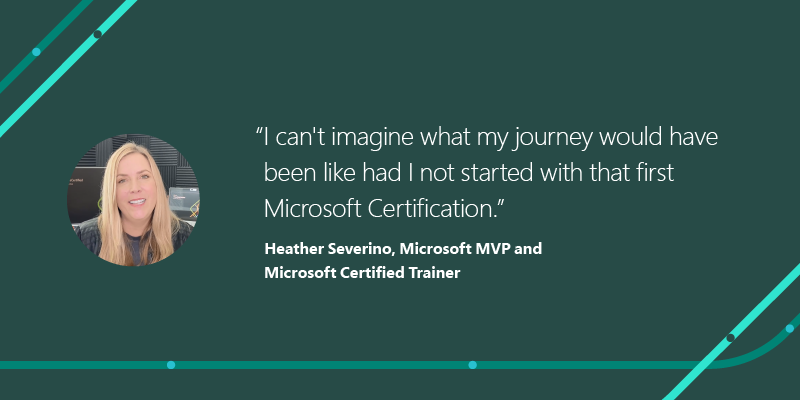
In other words, certification is a great investment in yourself, and in your team. It’s a game-changer. As Microsoft MVP and Microsoft Certified Trainer Heather Serverino said in her Proud to be Certified story, “I can’t imagine what my journey would have been like had I not started with that first Microsoft Certification.”
Microsoft Certification benefits
When you, your team, and your organization maintain a culture that celebrates learning and achievement, everyone wins. Certification supports a forward-looking culture that values up-to-date knowledge and a constant striving for the next, most useful capabilities, not only as proof of skills and expertise, but with real benefits to individuals and companies.
Microsoft Certification helps you:
- Get recognized. Build confidence and be recognized as a leader, unlock new opportunities, and share your credentials with your professional network.
- Get ahead. Stay ahead of the curve, increase your productivity, and take your career to the next level.
- Get hired. Certified technical skills help you prepare for job opportunities by proving to employers you have the skills they want.
Microsoft Certification helps your organization:
- Increase performance. Certified employees are more productive, more efficient in their roles, and bring more creative solutions to complex technical problems.
- Increase value. Organization’s benefits include improved productivity, faster troubleshooting, and fewer skills gaps.
- Increase the talent pool. By simplifying talent identification and recruiting through certification you make your screening process easier.
This is just the start
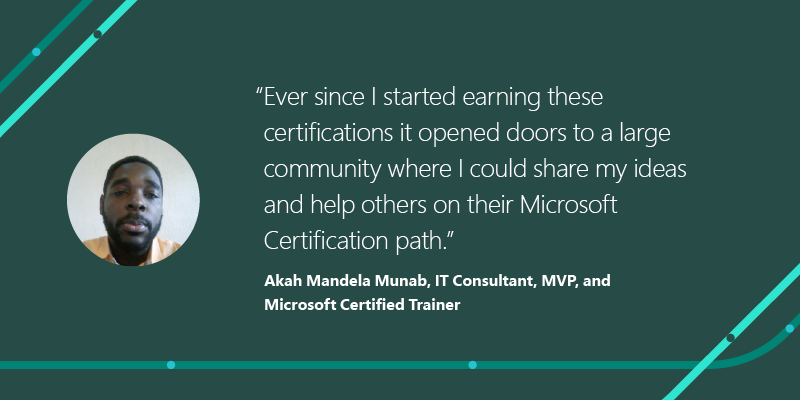
When you check out the #ProudToBeCertified videos and stories, you’ll see that certification is a continual and rewarding journey. You might even be surprised by the opportunities certification has provided for individuals around the world. IT Consultant, MVP, and Microsoft Certified Trainer Akah Mandela Munab said in his story that certifications “opened doors to a large community where I could share my ideas and help others on their Microsoft Certification path.”
This is the first in a series of posts where we’ll be sharing the personal stories, business benefits, and latest insights on creating and maintaining a personal attitude of continual learning. Plus, we’ll highlight how organizational culture encourages and supports the extra effort and time it takes for every team member to keep advancing.
Already certified? We want to hear from you – because we believe the more professionals who share their accomplishments, the more encouraged others will be to join Microsoft’s growing community dedicated to continuous improvement. You are our certification community. Now, it’s time to celebrate it.
Watch more #Proud to be Certified videos and submit your story as a video or post on Twitter, LinkedIn, or your preferred platform with #ProudToBeCertified.
Related posts:
1Pearson VUE, “2018 Value of IT Certification”
2IDC white paper sponsored by Microsoft, “Benefits of Role-based Certifications,” June 2020































































Recent Comments