by Contributed | Mar 9, 2021 | Technology
This article is contributed. See the original author and article here.
The patient journey is not just within the four walls of the hospital. Consumerism has changed our expectations of our healthcare experience. Tune in to hear two very distinct experiences from one patient.
Claire Bonaci
You’re watching the Microsoft us health and life sciences, confessions of health geeks podcast, a show that offers Industry Insight from the health geeks and data freaks of the US health and life sciences industry team. I’m your host, Claire Bonaci. On this podcast guest host, Antoinette Thomas our Us chief patient experience officer interviews colleague, John Barto on his contrasting experiences at two health institutions and the importance of the positive patient experience.
Antoinette Thomas
Welcome, everyone, to our Microsoft podcast, confessions of health geeks, my name is Antoinette Thomas, and I’m the chief patient experience officer for us health and life sciences. And today I have with me my colleague, John Barto. John, I’m hoping you’ll take a few minutes to introduce yourself.
John Barto
Sure, Antoinette. My name is obviously john Barto. I’m a former CIO from the healthcare industry, from a hospital and my job at Microsoft is to help health organizations understand how to create transition, or transformation in their environment using technology. It’s also to bring back nuggets from the customers to help our product organization to understand if there’s deficiencies in our technology and helping those transformations, how we might help overcome those. And it’s a, it’s a very rewarding experience, I get a chance to see so many different health care systems doing some wonderful things. And I get to share those amongst the different health systems. So it’s a very rewarding job. Thank you for asking.
Antoinette Thomas
You’re welcome. And it’s good to work with you. So we’re going to talk about an experience that you have had as a patient here in the last couple of months. And so as we all know, we’ve been living through a year of pandemic life in the United States. And you and I both work with our healthcare system customers. And their focus has been on pandemic protocols, frontline worker, safety, PPE, and all of that, rightly so. And this extreme stress that they’re undergoing managing through this unprecedented time have kept the patient experience front and center. However, we know their stories that are highlighted on the news every day about exceptional patient experiences. But I think it would be remiss of us to not talk about experiences where things could have gone better. And that’s why you’re here with us today. So I understand that your family was diagnosed with COVID over the Christmas season. And I’m really sorry to hear that you all had to be going through that at the same time. So I thank you for being here and willing to share this experience with us. So can you tell me more about those first few days?
John Barto
Yeah, I guess it was right before Christmas. I think the first diagnosis came in on my daughter on Christmas Eve. And we figured out that she had COVID. So we isolated her, made sure that nobody interacted with her. And we basically did. Only thing we ever did together was on Christmas Day, we went and took our presence outside and she said far away from us. And in the spirit of Christmas, we unwrapped presents. And then later that day, we served her food into her room, put her to her door, she came and got it. So we’re very close and very conscious on the isolation. But later that day, when we were having our Christmas meal, there was a bunch of texts coming in from my son, you know, the kids can’t sit at the table without having their phones and the texts come in and even on Christmas. And the texts were all saying I’ve been tested positive for COVID. I’ve been tested positive for COVID. And so that kind of threw my son and my wife and I into the thought process of we probably should be tested because we have my in laws that live in the house as well. And they’re they’re elderly, and we want to make sure we keep them from being exposed. So on Christmas day, we were looking around for a place to get tested in Christmas evening, which wasn’t very easy, right. And there was an emergency room that other people told us that they’d gone to and we went to that emergency room and we got tested and that was an awesome experience. It took us we got rapid test. It only took us probably about 45 minutes to determine where we were at test wise. And what we ended up finding out is that my son had been diagnosed as COVID and my wife and I were clear of COVID and so we sent my daughter and my son to a friend’s house. Their children that had COVID. And we kind of did this as a quarantine exercise to keep them away from everybody. And basically what happened is a couple days later, my wife was starting to feel not so good. So both her and I went for another test we we went through for a full PCR test, not a rapid test, and my wife came up diagnosed as as positive and I was still diagnosed as negative. And then a couple days later, they actually came back, this was interesting, they came back from the PCR test and determined that they had messed mine up with someone else. And that I was actually positive. So but at least they caught it, right. So they caught it. And those were those were done. And one of the local pharmacies, those PCR tests, we then isolated everyone at the other person’s house, the other family’s house, right. So the in laws didn’t get any exposure. But then we come to they started to come to some symptoms, we started to get them tested. My father in law, first of all tested positive, and then my mother in law tested positive at that same ER that we went to on Christmas where we took her. And an interesting thing about that is, while we’re covered by a good insurance, obviously working for Microsoft, my mother in law and father in law are on Medicare. And so that, er didn’t take Medicare. So we had to actually go out of pocket for the expense of getting even the test. And so that’s kind of how we learn that everyone was diagnosed with COVID. But there were some other interesting experiences that we had during away. So
Antoinette Thomas
I also think it’s really interesting that, you know, we’re talking about an entire extended family going through this at the same time. And just from you know, your comments about your testing experience, and benefits, and what that the difference was having Microsoft benefits and having Medicare benefits. So you know, that’s some interesting insights right there, from the extended family point of view. So, give me a little bit more about then what had transpired after your positive tests?
John Barto
Well, when we first when my wife first got a positive test, and I got a positive test, obviously, we work in the healthcare industry at Microsoft and I have a lot of people that had been communicating with me about, you know, you got to consider, if you have any underlying conditions, you got to consider going after this monoclonal antibody treatment. And, you know, I kind of looked around about, I didn’t really think a great deal about it, I do have one underlying condition that I’ve lived with all my life, which was actually a contributor and basically qualified me for that treatment. The first thing I did when I started to think about looking for it is I called my primary care physician, and only to find out that my primary care physician had left the practice that they were in without any notification. So I got ahold of the office where they used to work. And I started asking about these monoclonal antibody, no one there knew anything about it. I then called my benefit, my plan. And I said, You know want, to kind of investigate, how do I get this, and they told me to go call my primary care physician back. So I called the office again. And they came up with finally the solution of I needed to go to the hospital, they determine whether I was gonna be able to get that protocol. And I asked him, Well, how do you go to the hospital, the only way I know how to do that is just to go for an ER visit. And you know, you maybe get admitted maybe you won’t. But that’s the only way I know how to engage a hospital, you know, directly. And so they said, that’s probably the best thing to do. I called around to their hospitals, and asked them, which are those ers might have the treatment, I found one that said that they had been treating people in that way. And so we actually took the time to go. And by this time, after I’d done this investigation, which was roughly a two day period of time to get the investigation all done to figure out what I needed to do. My wife and I decided we were talking about going but we weren’t really overly concerned. And then my father last diagnosis came back that he was positive. And he’s definitely an in the outer condition and has some has some real needs. And so we decided we were gonna go ahead and do this, we’re going to take him along. So the three of us showed up at the ER, explaining to them at the front door of the ER and I was very articulate about this. We all know we have COVID we’re not here for that purpose. We’re here to get a monoclonal antibody. And I want to explain to you if that’s not possible, let’s just determine that right now. And we’ll go on our way and we won’t waste the resources of your health system. But we’re trying to do the right thing here. We’re trying to make sure we’re not basically putting ourselves in a position where we’re going to end up in one of your ICU units on a ventelator and those types of things. They basically took us in, they put us in rooms. After waiting for about two hours, they finally put us in a room. They did various different things to us from a treatment perspective. And every one of us was told we weren’t eligible for the monoclonal antibody. And mostly it was because they needed to know within 72 hours, within 72 hours of finding their protocol is within 72 hours of finding out you had COVID. That’s when they wanted to administer it. Well, frankly, we were at that er for six and a half hours. When I entered the ER, I was within the 72 hour protocol. When, when I, when I, when I finally got to the point, they said I wasn’t qualified, I was outside the 72 hour protocol. And so we had an experience that was very difficult for us. It made my father in law was elderly, he struggles to get around, keeping them in a place for six and a half hours and trying to do that kind of stuff. And then finding out that even though upfront, I told him directly. I wasn’t interested, if I couldn’t get it, we would leave. They basically put us in this position of spending all the time. And we’re still not sure how much money. Frankly, we haven’t been billed for those services. We don’t know how much that might have cost. And in my mind, that was a little bit crazy, because we wasted their resources, and did all that kind of stuff without really getting the result. Right. Yeah, that was one experience. And then the other side of the experience that’s actually very positive, is remember the ER I told you, we went to on Christmas Eve. That’s where my mother in law got her test to find out she was positive. And she was the last one. If you remember, she was the last one in the group that tested positive. Well, that was the day after we had just had this experience at the ER six and a half hours. We went, when we decided we needed to get her tested, we took her to the other er, the one we had a great experience with Christmas. When I showed up, they said she’s not you know covered. So you’re gonna have to come out of pocket, which was a relatively significant amount of money. But the experience was so good there on Christmas Eve that we decided we were going to go ahead and do it. And so I paid it out of pocket. We got her tested, she found that about 45 minutes later that she too had COVID. And we wrapped her up, put her in the car and took her back to the house right we were headed back to the house, got to the house, we were there for about 10 minutes. And a phone call comes in from the ER and it’s like you know you are eligible is basically a calling or is that she’s eligible for this thing called monoclonal antibody, which the irony of it is when I was doing my investigation, I checked out that ER as well as my, the place I normally go. And they said they didn’t have it yet. They were hoping to get it soon. So between that time and the time my mother in law got tested, they actually got the antibody, they followed up with us, they asked us if we wanted it, we actually negotiated a price for it since they weren’t covered under Medicare. And she went back to the hospital that night, that was actually New Year’s Eve. We went back to the hospital that night. And she spent all the way up till quarter to midnight, you know about a about a four and a half hour period getting the monoclonal antibody. So that was that was an awesome experience, from my perspective.
Antoinette Thomas
You’re just sharing two vastly different experiences. And in one thing that really stands out for me is the positive feedback loop of the second experience of taking the test for the testing and having to pay out of pocket and then being you know, upfront with you about that. And then reaching back out to you to say, Hey, wait a minute, bring her back. She’s eligible for this. And that’s very different than your your initial experience at the other facility.
John Barto
Yeah, hugely different. In fact, my father in law was probably the one that is most at risk, right from a health perspective. And what we did then is we had a tough time convincing them he still wanted to get the monoclonal antibody. So after she had that experience, we actually call that er back. Their protocol is slightly different than the one that we had originally gone to. And we basically had a lot of conversation with them and they said they would go ahead and take him in and give him the monoclonal antibody as well. So we did get it for both the in laws and you know, it’s been we’ve avoided any kind of real problems from the from the healthcare side of the business, none of us ended up in the hospital or admitted or anything like that. And we do believe that it’s because of that, that that those two are actually able to stay clear. It was pretty significant out of pocket expense for both of them. But the experience so much better, actually was a result, you know, it was better, but it also got resolved. So we were, we were very happy to go ahead and go out of pocket to pay for those kinds of expenses.
Antoinette Thomas
Yes. And it kept them out of the hospital with any, you know, awful symptomatology. So that’s good. That’s good. Um, I do have a question for you, though. So now having had these separate experiences, have you received a survey in the mail a patient experience survey? And if yes, have you filled them out to let them know,
John Barto
I have received no survey on either of the visits. And I’ve only actually been billed for the, for the one visit for my insurance, I have still not been billed for the visitor they awful visit, right, I haven’t been billed for any of that. haven’t even seen claims go gets my insurance on it. But but for the ER that we really like the one that we went to, on Christmas to get our testing done, we have received our billing and our insurance covered it all and all that kind of stuff. But I’ve never received a survey from either of the institute’s at this point. I suspect one will be coming, but it’s not
Antoinette Thomas
I hope one is going to be coming, I hope two will be coming. Because we know those are important. And we know that patients will generally remember the very last thing that happened, whether it was positive or negative, that happened inside that healthcare system. So again, two vastly different experiences for you and your family. So as we wrap this up, and you know, any words of wisdom for our listeners on what it’s like to go through this, and any recommendations you can make on if they are exploring, requesting the monoclonal antibodies, and your entire process with being diagnosed with COVID.
John Barto
Yeah, so. So first of all, while I haven’t I want to finish this thought process, well, I haven’t gotten a survey, obviously, I’m talking to you about my experiences, whether it comes through a survey or not, or it’s just consumer knowledge that is being passed around, you know, it is very important to kind of do things that are helping the experience along, if you want to get repeat business, I have chosen since to find another primary care provider, I will no longer be going to that health Health Institute that I used to go to. And, you know, that’s been the result of my experience. So first and foremost, and stay active with your primary care physicians, because I, you know, once a year, to find out there wasn’t even a primary care physician there was kind of surprising to me. So, so stay active with them. The other thing is, you know, I have a lot of people in the business, I know a lot of doctors and nurses because of my job, I think I was a little bit fortunate to get a lot of advice from them. And the fact that I needed to advocate for myself really, really heavily to make sure that the care that we received, was actually provided. And to be candid with the people as we checked into the ers and those types of things that, you know, I was aware that, that we wouldn’t qualify, and that if that was true, you know, find a different way, a different path. You need to kind of educate yourself, those types of things. And it’s not easy to do. I would say there’s a lot of when I started looking into it, there’s a lot of sites now that people are going to to kind of tell about their experiences and things like that through the process. But But this thought was ironic about it is what started the thought process for me about some press that came out that said these distributed through big warp speed, and they’re not. They’re just not being touched. And, and I think that’s why I felt like I should go after it. But I you need to advocate for yourself. I mean, it’s, you know, so accustomed [inaudlible]
Antoinette Thomas
Well, I think you’re bringing up an important point too, because, you know, john q public, joan q public, we’re so overwhelmed with all of the different bits and pieces that are coming from the news about where to go for testing, how to go for testing, you know, what’s the process after you get tested, it’s so hard to know. And this point you’re making about advocating for yourself because you know, you you know how to do that. And I tend to think of the millions of people that that don’t, you know, and how overwhelming that is. So those are very good points.
John Barto
I would say one thing, in addition to that is, it was a good learning experience for my children. Because you can imagine, with all of us having COVID, we had to take shifts as to who was helping who and, and so there were times where my daughter and my son had to be in those conversations with the medical professionals about, okay, my father in law cleared to get a monoclonal treatment, because I just had had enough I could do anywhere I needed to sleep, right. And so, so it’s actually taught a generation that they need to be able to do that. And I think they picked it up quicker than I probably would have, because their generation has got that curiosity and advocating for themselves, they got consumerism in their blood. And, you know, that’s what’s coming at the healthcare system. So you’ve got to be aware of that. We’ve got to reform stuff to be able to handle those types of resources there, those types of folks.
Antoinette Thomas
Yeah, I want to thank you again for coming on and and sharing your experience, because if it helps someone out there listening, then that’s what it’s all about. Thank you, john.
John Barto
Well, thank you. Thank you, Toni.
Claire Bonaci
Thank you all for watching. Please feel free to leave us questions or comments below. And check back soon for more content from the HLS industry team.
by Contributed | Mar 9, 2021 | Technology
This article is contributed. See the original author and article here.
Microsoft 365 Patterns and Practices (PnP) Community March 2021 update is out with a summary of the latest guidance, samples, and solutions from Microsoft or from the community for the community. This article is a summary of all the different areas and topics around the community work we do around Microsoft 365 ecosystem during the past month. Thank you for being part of this success. Sharing is caring!
What is Microsoft 365 Community (PnP)
Microsoft 365 PnP is a nick-name for Microsoft 365 Community activities coordinated by numerous teams inside of the Microsoft 365 engineering organizations. PnP is a community-driven open source initiative where Microsoft and external community members are sharing their learning’s around implementation practices for Microsoft 365. Topics vary from Microsoft Graph, Microsoft Teams, OneDrive and SharePoint. Active development and contributions happen in GitHub by providing contributions to the samples, reusable components, and documentation for different areas. PnP is owned and coordinated by Microsoft engineering, but this is work done by the community for the community.
The initiative is facilitated by Microsoft, but we have multiple community members as part of the PnP team (see team details in end of the article) and we are always looking to extend the PnP team with more community members. Notice that since this is open source community initiative, so there’s no SLAs for the support for the samples provided through GitHub. Obviously, all officially released components and libraries are under official support from Microsoft.
Some key statistics around Microsoft 365 PnP initiative from February 2021:
- Unique visitors during the past 2 weeks in PnP, OneDrive, Microsoft-Search, OfficeDev and SharePoint GitHub organization repositories – 71,936
- Overall unique contributors in the PnP, OneDrive, Microsoft-Search, OfficeDev and SharePoint GitHub organizations – 1,782
- Merged pull requests across PnP, OneDrive, Microsoft-Search, OfficeDev and SharePoint repositories (cumulative) – 20,423
- Closed issues and enhancements ideas cross PnP, OneDrive, Microsoft-Search, OfficeDev and SharePoint repositories (cumulative) – 20,724
- Microsoft 365 Community (PnP) YouTube channel had 79,339 views with 6,165 hours of watch time and 20,921 subscribers
- Microsoft 365 Developer YouTube channel had 38,802 views with 3,006 hours of watch time and 12,671 subscribers
Most viewed videos in the Microsoft 365 Community (PnP) YouTube channel during February 2021:
- Getting started with Site Designs in SharePoint Online – Laura Kokkarinen (Sulava) | 3,845
- Working with Microsoft Lists (webinar) – Harini Saladi, Miceile Barrett, Chakkaradeep Chandran and Mark Kashman | 3,631
- Architecting Your Intranet | Melissa Torres (Microsoft) | 2,278
- SharePoint Monthly Community Call – February 2021 | 1,795
- SharePoint Framework Tutorial 1 – HelloWorld WebPart | 1,764
- SharePoint App Bar – Global navigation and wayfinding | Melissa Torres (Microsoft) | 1,706
- Configure list custom header, footer and the form body with JSON | Chris Kent (DMI) | 1,588
- Introducing: New Employee Onboarding – a Microsoft Teams app template | Nidhi Sharma (Microsoft) | 1,585
- Migration to SharePoint, OneDrive, and Microsoft Teams in Microsoft 365, free and easy – Hani Loza (Microsoft) & Eric Warnke (Microsoft) | 1,578
- Latest on Power Automate integration within SharePoint Online | Chakkaradeep Chandran (Microsoft) | 1,534
Most viewed videos in the Microsoft 365 Developer YouTube channel during February 2021:
- Authenticate and connect with Microsoft Graph – June 2019 | 1,299
- Build Outlook Add-ins that integrate your solution seamlessly into your users’ Outlook experience | Juan Balmori, Hitesh Manwar – 1,213
- An introduction to Microsoft Graph for developers – Part I – Getting started – October 2019 | 1,044
- Getting Started with Microsoft Graph and Application Registration | 896
- Build and Office add-in using modern JavaScript tools and technologies | 838
- Create interactive conversational bots for Microsoft Teams | 828
- Develop multi-tenant applications with Microsoft Identity Platform – April 2020 | 763
- SharePoint Site Collection Level Permissions | 657
- Microsoft identity platform: Getting Started with Microsoft identity | 644
- Getting Started with Microsoft Graph | 644
Main resources around Microsoft 365 Community:
Latest Dev Blog posts
Here are the latest blog posts and announcements around Microsoft 365 development topics from https://developer.microsoft.com/en-us/microsoft-365/blogs.
Community call recording blog posts:
PnP Weekly video blog / podcast shows:
We highly recommend also subscribing on the Microsoft 365 Developer Podcast show, which is a great show covering also latest development in the Microsoft 365 platform from developer and extensibility perspective.
Community Calls
There are numerous different community calls on different areas. All calls are being recorded and published either from Microsoft 365 Developer or Microsoft 365 Community (PnP) YouTube channels. Recordings are typically released within the following 24 hours after the call. You can find a detailed agenda and links to specific covered topics on blog post articles at the Microsoft 365 developer blog when the videos are published.
If you are interested in doing a live demo of your solution or sample in these calls, please do reach out to the PnP Team members (contacts later in this post) and they are able to help with the right setup. These are great opportunities to gain visibility for example for existing MVPs, for community members who would like to be MVPs in the future or any community member who’d like to share some of their learnings.
Microsoft 365 Community (PnP) Ecosystem in GitHub
Most of the community driven repositories are in the PnP GitHub organization as samples are not product specifics as they can contain numerous different solutions or the solution works in multiple different applications.
- PnPjs – PnPjs Framework repository
- CLI Microsoft 365 – Cross-OS command line interface to manage Office 365 tenant settings
- generator-spfx – Open-source Yeoman generator which extends the out-of-the-box Yeoman generator for SharePoint with additional capabilities
- generator-teams – Open-source Microsoft Teams Yeoman generator – Bots, Messaging Extensions, Tabs, Connectors, Outgoing Web hooks and more
- teams-dev-samples – Microsoft Teams targeted samples from community and Microsoft engineering
- Sharing is Caring – Getting started on learning how to contribute and be active on the community from GitHub perspective.
- pnpcore – The PnP Core SDK is an SDK designed to work against Microsoft 365 with Microsoft Graph API first approach
- powershell – PnP PowerShell module which is PowerShell Core module targeted for Microsoft 365
- pnpframework – PnP Framework is a .Net Standard 2.0 library targeting Microsoft 365 containing the PnP Provisioning engine and a ton of other useful extensions
- https://github.com/pnp/teams-dev-samples – Samples around the Microsoft Teams development models from Microsoft and from the community
- sp-dev-fx-webparts – Client-side web part samples from community and Microsoft engineering
- sp-dev-fx-extensions – Samples and tutorial code around SharePoint Framework Extensions
- sp-dev-fx-library-components – Samples and tutorial code around the SharePoint Framework library components
- sp-starter-kit – Starter kit solution for SharePoint modern experiences
- sp-dev-fx-vs-extension – Open source Visual Studio IDE extension for creating SharePoint Framework solutions in the Visual Studio 2015 or 2017
- sp-dev-build-extensions – Different build extensions like gulp tasks and gulp plugins from the community and engineering around SharePoint development
- sp-dev-solutions – Repository for more polished and fine-tuned reusable solutions build with SharePoint Framework
- sp-dev-samples – Repository for other samples related on the SharePoint development topics – WebHooks etc.
- sp-dev-fx-controls-react – Reusable content controls for SharePoint Framework solutions build with React
- sp-dev-fx-property-controls – Reusable property pane controls to be used in web parts
- sp-dev-list-formatting – Open-source community-driven repository for the column and view formatting JSON definitions
- sp-dev-site-scripts – Open-source community-driven repository for community Site Designs and Site Scripts
- sp-dev-modernization – Tooling and guidance around modernizing SharePoint from classic to modern
- sp-power-platform-solutions – Solution and sample code for SharePoint Power Platform solutions
- powerfx-samples – Samples that demonstrate different usage patterns for the Power Fx low-code programming language
All SharePoint specific repositories or services supported directly by Microsoft are located in the SharePoint GitHub organization
PnP specific repositories – solution designs and tooling
- PnP – Main repository for SP add-in, Microsoft Graph etc. samples
- PnP-Sites-Core – Office Dev PnP Core component
- PnP-PowerShell – Office Dev PnP PowerShell Cmdlets
- PnP-Tools – Tools and scripts targeted more for IT Pro’s and for on-premises for SP2013 and SP2016
- PnP-Provisioning-Schema – PnP Provisioning engine schema repository
- PnP-IdentityModel – Open source replacement of Microsoft.IdentityModel.Extensions.dll
Repositories in the GitHub Microsoft Search organization controlled by the PnP initiative
Other related resources from GitHub
What’s supportability story around PnP material?
Following statements apply across all of the community lead and contributed samples and solutions, including samples, core component(s) and solutions, like SharePoint Starter Kit or PnP PowerShell. All Microsoft released SDKs and tools are supported based on the specific tool policies.
- PnP guidance and samples are created by Microsoft & by the Community
- PnP guidance and samples are maintained by Microsoft & community
- PnP uses supported and recommended techniques
- PnP is an open-source initiative by the community – people who work on the initiative for the benefit of others, have their normal day job as well
- PnP is NOT a product and therefore it’s not supported by Premier Support or other official support channels
- PnP is supported in similar ways as other open source projects done by Microsoft with support from the community by the community
- There are numerous partners that utilize PnP within their solutions for customers. Support for this is provided by the Partner. When PnP material is used in deployments, we recommend being clear with your customer/deployment owner on the support model
Please see the specifics on the supportability on the tool, SDK or component repository or download page.
Microsoft 365 PnP team model
In April 2020 we announced our new Microsoft 365 PnP team model and grew the MVP team quite significantly. PnP model exists for having more efficient engagement between Microsoft engineering and community members. Let’s build things together. Your contributions and feedback is always welcome! During August, we also crew the team with 5 new members. PnP Team coordinates and leads the different open-source and community efforts we execute in the Microsoft 365 platform.
We welcome all community members to get involved on the community and open-source efforts. Your input do matter!
Got feedback, suggestions or ideas? – Please let us know. Everything we do in this program is for your benefit. Feedback and ideas are more than welcome so that we can adjust the process for benefitting you even more.
Area-specific updates
These are different areas which are closely involved on the community work across the PnP initiative. Some are lead and coordinated by engineering organizations, some are coordinated by the community and MVPs.
Microsoft Graph Toolkit

Microsoft Graph Toolkit is engineering lead initiative, which works closely with the community on the open-source areas. The Microsoft Graph Toolkit is a collection of reusable, framework-agnostic web components and helpers for accessing and working with Microsoft Graph. The components are fully functional right of out of the box, with built in providers that authenticate with and fetch data from Microsoft Graph.
All the latest updates on the Microsoft Graph Toolkit is being presented in our bi-weekly Microsoft 365 Generic Dev community call, including the latest community contributors.
Microsoft 365 Community docs
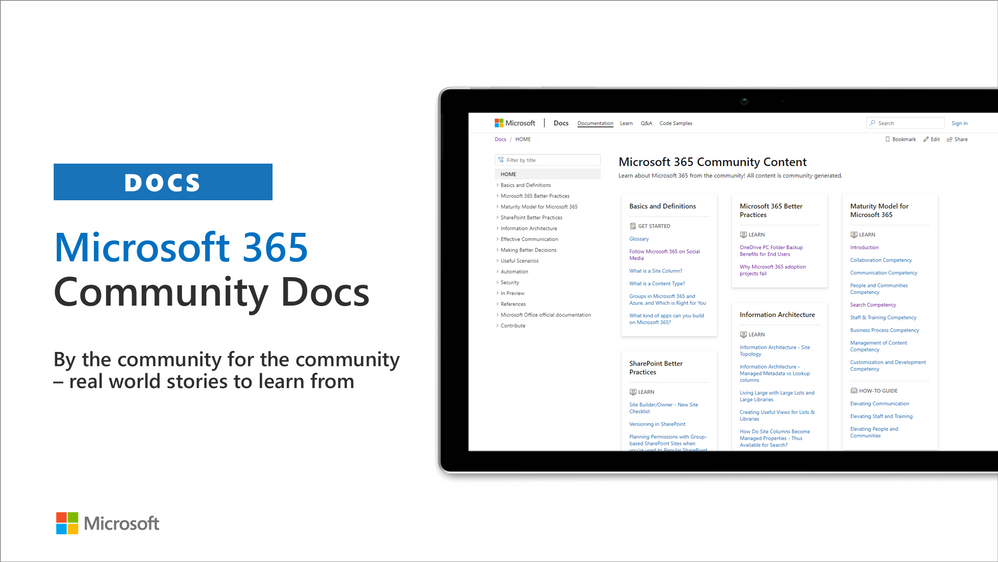
Community docs model was announced in the April 2020 and it’s great to see the interest for community to help each other by providing new guidance on the non-dev areas. See more on the announcement from the SharePoint blog – Announcing the Microsoft 365 Community Docs. We do welcome contributions from the community – our objective is to build a valuable location for articles from Microsoft and community together.
Latest updates on this area as follows:
Have ideas for articles or want to contribute yourself? – Get involved! Here are also some additional resources explaining the model more detailed.
SharePoint Framework development samples
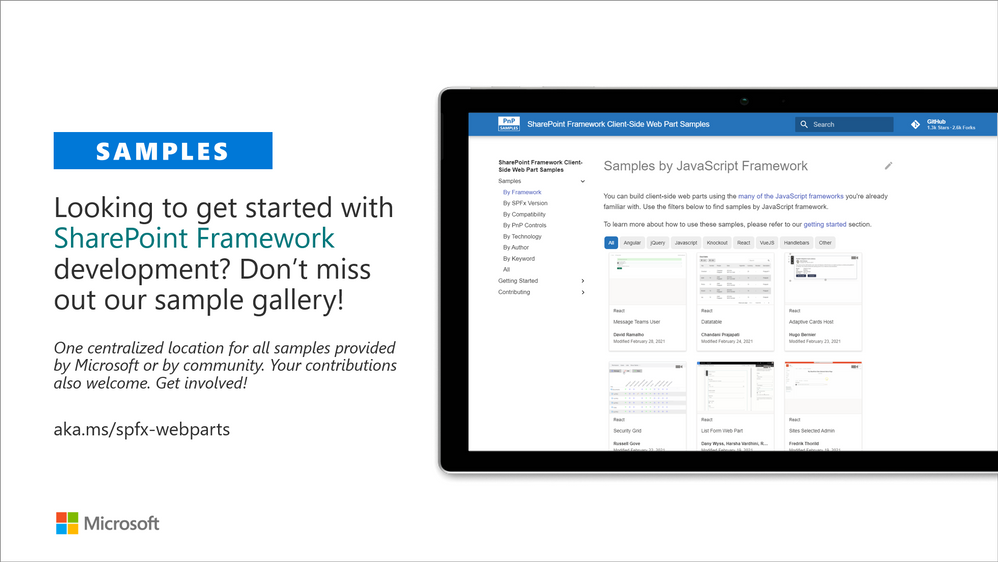
These are the updated SharePoint Framework samples which are available from the the different repositories.
How to find what’s relevant for you? Take advantage of our SharePoint Framework web part and extension sample galleries – includes also solutions which work in Microsoft Teams
Microsoft Teams community samples
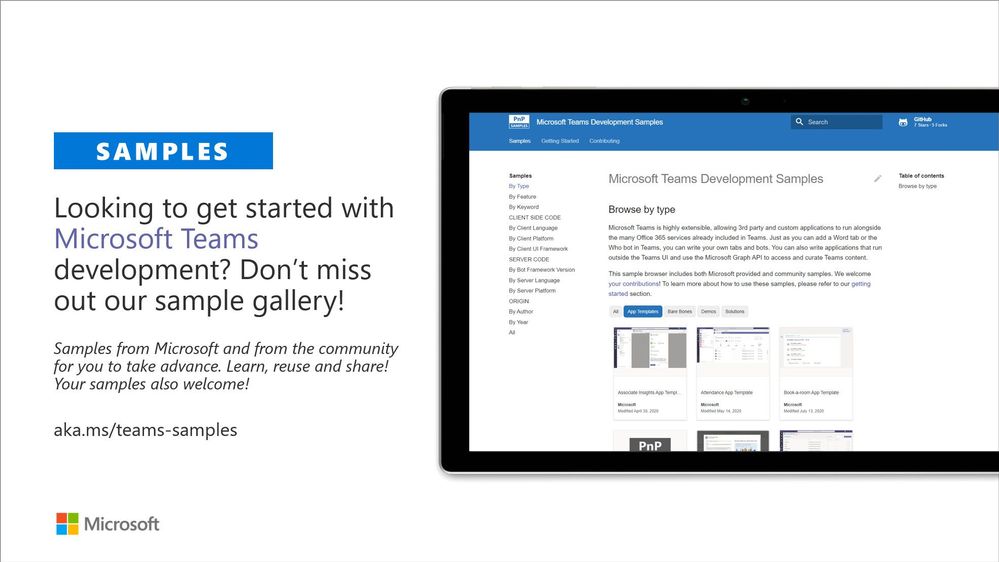
These are samples which have been contributed on the community samples since last summary. We do welcome all Microsoft Teams samples to this gallery. They can be implemented using in any technology.
- New sample bot-b2c-chat-bot by Abtin Amini, Sathya Raveendran, Saikrishna Neeli and Arun Kumar Anaparthi on building a Business to Citizen Consumer Communication Bot
- Updates to tab-sso to by Doğan Erişen to add MSAL.js support for signle sign on experience
If you are interested on Microsoft Teams samples, we have just released also new Microsoft Teams sample gallery. Contributions to Microsoft Teams samples is also more than welcome. This gallery already surfaces all Microsoft samples, Microsoft Teams app templates and community samples.
Sharing is Caring initiative
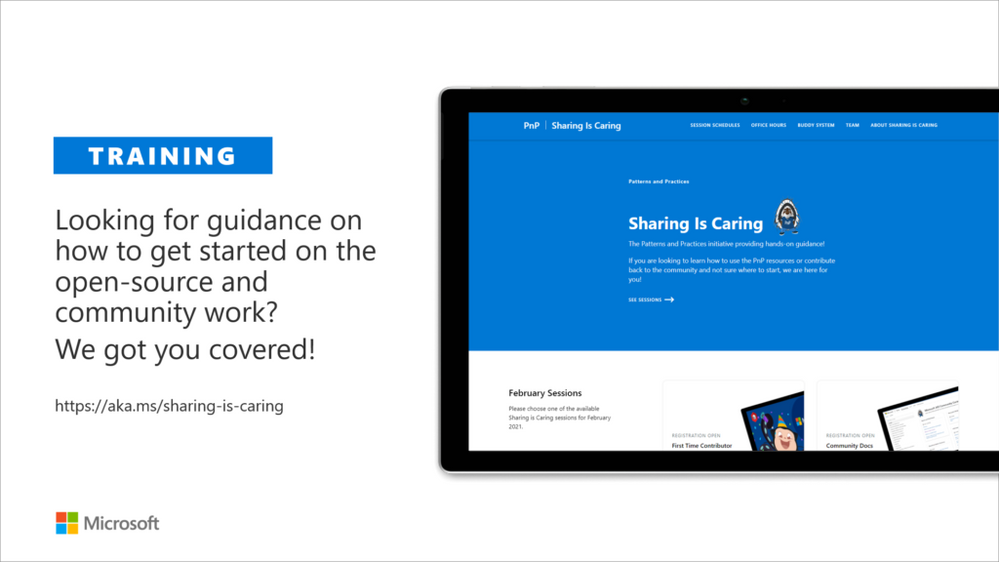
The “Sharing Is Caring” imitative is targeted for learning the basics around making changes in Microsoft Docs, in GitHub, submitting pull requests to the PnP repositories and in GitHub in general. Take advantage of this instructor lead training for learning how to contribute to docs or to open-source solutions. Everyone is welcome to learn how to get started on contributing to open-source docs or code!
- See more from the guidance documentation – including all upcoming instructor lead sessions which you can participate!
Different Microsoft 365 related open-source initiatives build together with the community
See exact details on the latest updates from the specific open-source project release notes. You can also follow up on the project updates from our community calls. There are numerous active projects which are releasing new versions with the community even on weekly basis. Get involved!
- Microsoft Look Book – Discover the modern experiences you can build with SharePoint in Microsoft 365. Look book provides design examples for SharePoint Online which can be automatically provisioned to any tenant in the world. See more from https://lookbook.microsoft.com. This service is also provided as open-source solution sample from GitHub.
- yo teams – Open-source Yeoman generator for Microsoft Teams extensibility. Supports creation of bots, messaging extensions, tabs (with SSO), connectors and outgoing Webhooks. See more from https://aka.ms/yoteams.
- PnP Framework – .NET Standard 2.0 SDK containing the classic PnP Sites Core features for SharePoint Online. More around this package from GitHub.
- PnP Core SDK – The PnP Core SDK is an SDK designed to work for Microsoft 365 with Graph API first approach. It provides a unified object model for working with SharePoint Online and Teams which is agnostic to the underlying API’s being called. See more around the SDK from documentation.
- PnP PowerShell – PnP PowerShell is a .NET Core 3.1 / .NET Framework 4.6.1 based PowerShell Module providing over 400 cmdlets that work with Microsoft 365 environments and more specifically SharePoint Online and Microsoft Teams. See more details from documentation.
- Reusable SharePoint Framework controls – Reusable controls for SharePoint Framework web part and extension development. Separate projects for React content controls and Property Pane controls for web parts. These controls are using Office UI Fabric React controls under the covers and they are SharePoint aware to increase the productivity of developers.
- Office 365 CLI – Using the Office 365 CLI, you can manage your Microsoft Office 365 tenant and SharePoint Framework projects on any platform. See release notes for the latest updates.
- PnPJs – PnPJs encapsulates SharePoint REST APIs and provides a fluent and easily usable interface for querying data from SharePoint sites. It’s a replacement of already deprecated pnp-js-core library. See changelog for the latest updates.
- PnP Provisioning Engine and PnP CSOM Core – PnP provisioning engine is part of the PnP CSOM extension. They encapsulate complex business driven operations behind easily usable API surface, which extends out-of-the-box CSOM NuGet packages. See changelog for the latest updates.
- PnP PowerShell – PnP PowerShell cmdlets are open-source complement for the SharePoint Online cmdlets. There are more than 300 different cmdlets to use and you can use them to manage tenant settings or to manipulate actual SharePoint sites. They See changelog for the latest updates.
- PnP Modern Search solution – The PnP ‘Modern Search’ solution is a set of SharePoint Online modern Web Parts allowing SharePoint super users, webmasters and developers to create highly flexible and personalized search based experiences in minutes. See more details on the different supported capabilities from https://aka.ms/pnp-search.
- Modernization tooling – All tools and guidance on helping you to transform you SharePoint to modern experiences from http://aka.ms/sppnp-modernize.
- SharePoint Starter Kit v2 – Building modern experiences with Microsoft Teams flavors for SharePoint Online and SharePoint 2019 – reference solution in GitHub.
- List formatting definitions – Community contributed samples around the column and view formatting in GitHub.
- Site Designs and Site Scripts – Community contributed samples around SharePoint Site Designs and Site Scripts in GitHub.
- DevOps tooling and scripts – Community contributed scripts and tooling automation around DevOps topics (CI/CD) in GitHub.
- Teams provisioning solution – Set of open-source Azure Functions for Microsoft Teams provisioning. See more details from GitHub.
Documentation updates
Please see all the Microsoft 365 development documentation updates from the related documentation sets and repositories as listed below:
Microsoft 365 Dev and Microsoft 365 Community (PnP) YouTube video channels
You can find all Microsoft 365 related videos on our YouTube Channel at http://aka.ms/m365pnp-videos or at Microsoft 365 Dev. These channels contains already a significant amount of detailed training material, demo videos, and community call recordings.
Here are the new Microsoft demo or guidance videos released since the last monthly summary:
Community demos as following:
PnP Weekly sessions – Community visitors and latest articles from Microsoft and community on Microsoft 365 topics.
Key contributors to the March 2021 update
Here’s the list of active contributors (in alphabetical order) since last release details in GitHub repositories or community channels. PnP is really about building tooling and knowledge together with the community for the community, so your contributions are highly valued across the Microsoft 365 customers, partners and obviously also at Microsoft.
Thank you for your assistance and contributions on behalf of the community. You are truly making a difference! If we missed someone, please let us know.
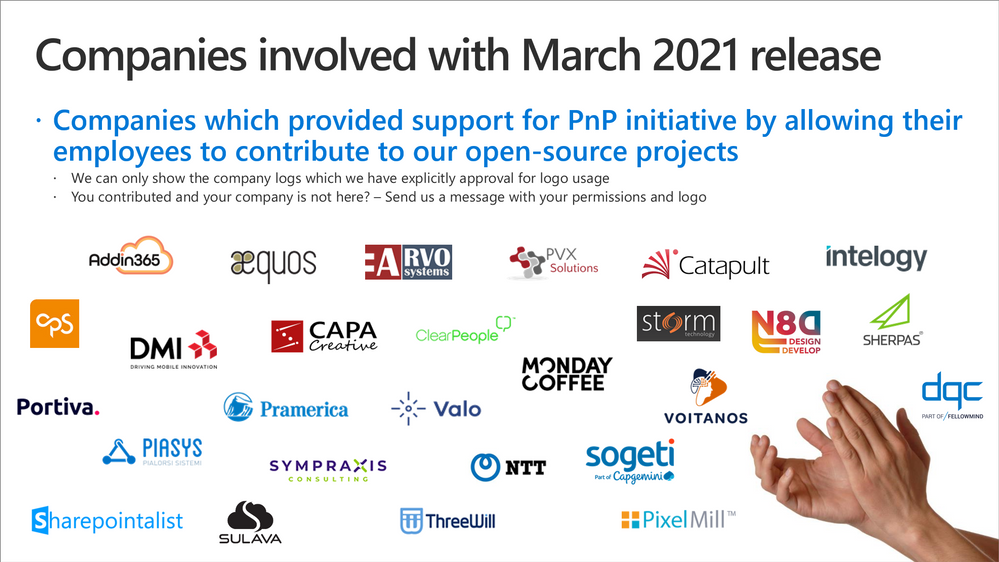
Companies: Here’s the companies, which provided support for PnP initiative for this month by allowing their employees working for the benefit of others in the community. There were also people who contributed from other companies during last month, but we did not get their logos and approval to show them in time for these communications. If you still want your logo for this month’s release, please let us know and share the logo with us. Thx.
Microsoft people: Here’s the list of Microsoft people who have been closely involved with the PnP work during last month.
PnP Team
PnP Team manages the PnP community work in the GitHub and also coordinates different open-source projects around Microsoft 365 topics. PnP Team members have a significant impact on driving adoption of Microsoft 365 topics. They have shown their commitment to the open-source and community-driven work by constantly contributing to the benefit of the others in the community.
Thank you for all that you do!
Here are the Microsoft Internal PnP Core team members:
Next steps
See all of the available community calls, tools, components and other assets from https://aka.ms/m365pnp. Get involved!
Got ideas or feedback on the topics to cover, additional partnerships, product feature capabilities? – let us know. Your input is important for us, so that we can support your journey in Microsoft 365.
“Sharing is caring”
Microsoft 365 Community (PnP) – March 9th 2021



 ) or https:// means you’ve safely connected to the .gov website. Share sensitive information only on official, secure websites.
Recent Comments