Service Fabric Community Q&A call 46
This article is contributed. See the original author and article here.

This article is contributed. See the original author and article here.
This article is contributed. See the original author and article here.
The Azure open source database team that I lead is 100% focused on security. We live, eat, and breathe security. After all, many of you rely on national and industry standard security controls to develop and improve your INFOSEC defenses. And of course you expect the same level of security and due diligence when you build your open source workloads on Azure cloud.
This post highlights some of the frequently requested compliance certifications we’ve achieved for Azure Database for PostgreSQL – Single Server.
Note, our Postgres managed database service on Azure also has another deployment option, Hyperscale (Citus), which enables you to scale out your Postgres database horizontally across a server group. Hyperscale (Citus) is a powerful and secure option for those who need the performance and scale of a multi-machine database cluster.
Because the Hyperscale (Citus) deployment option GA’d in November 2019, it has not yet achieved the same compliance certs as our single server deployment option for Postgres. Moving forward, as the Hyperscale (Citus) compliance certificates becomes available, we’ll be sure to blog about it. In the meantime, you can always reach out to our team at AskAzureDBforPostgreSQL@service.microsoft.com if you need important security certs and you don’t (yet) see them in the compliance cert table below.
|
Certificate |
Applicable to… |
|
Healthcare Providers, Healthcare Clearinghouses, and Health Plans |
|
|
Information Security Management Systems |
|
|
Public and private companies, government entities and not-for-profits that provides PII processing services via the cloud |
|
|
Public and private companies, government entities and not-for-profits |
|
|
U.S. Federal Agencies |
|
|
Cloud service providers; offers assurance to customers and stakeholders that effective internal controls that affect financial reports and operational control systems are in place |
|
|
Cloud service providers; demonstrates ISO/IEC 27001 and Cloud Controls Matrix compliance |
|
|
All EU countries Norway, Iceland, and Liechtenstein; provides assurances for personal data leaving the European Economic Area |
|
|
UK Government |
Our single server deployment option for Azure Database for PostgreSQL has achieved a comprehensive set of national, regional, and industry-specific compliance certifications in our Azure public cloud to help you comply with requirements governing the collection and use of your data.
To date, Azure Database for PostgreSQL – Single Server has amassed over 50 compliance offerings, including the more notable ones such as HIPAA, HITRUST, PCI-DSS, ISO 27001, ISO/IEC 27018, FedRAMP High, etc.
Our open source database team is continuing to pursue even more compliance certifications for Azure Database for PostgreSQL—for both Single Server and Hyperscale (Citus) which we will share in future posts about security, and as part of our documented compliance offerings for Azure.
In addition to all the certifications above for Postgres, our team has also been busy rolling out new security features on Azure Database for PostgreSQL that we’ll be blogging about next. These new Postgres features on Azure include high-demand capabilities such as data encryption for data at rest (we often call this ‘bring your own key’ or (BYOK) as well as double encryption); data security in motion (TLS and SSL); network security (firewall, service endpoint, private link); and access methods (native authentication and AAD authentication).
We also offer the Azure IP Advantage for Azure services running open source technologies. The Azure IP Advantage provides best-in-industry intellectual property protection, uncapped indemnification, the ability to deter and defend lawsuits with patent pick, and broad protection with a springing license.
We’re committed to make Azure the most secure cloud in the world for you and your applications. I’m looking forward to sharing more with you about the new security features we’ve been rolling out for Azure Database for PostgreSQL (as well as the ones our engineering team is actively working on right now).
If you have questions, please feel free to reach out to me and my team on the AskAzureDBforPostgreSQL@service.microsoft.com alias.
This article is contributed. See the original author and article here.
Polyglot Persistence is the concept of using different storage technologies by the same application or solution, leveraging the best capabilities of each component. Azure Data Services support all possible data types and its usages.
In this blog post you will learn more about Polyglot Persistence, the trade-offs of its implementation, and available Azure Data Services to implement it.
Until the 1990s most companies used a single version of a single database product. No matter the use case or the technical requirements, what prevailed was the company standard and all applications had to adapt to the official database vendor. How many times have you heard that “here in the company we use Oracle (or any other)? Yes, this not distant past is still a reality in many companies, where all the functions of all applications use the same RDMS.
In the following decade, we began to see some diversification, with the emergence of analytical databases, to support BI workloads. But usually it was still tied to a single vendor and to relational databases. Which made a lot of sense, since the data was always structured and “small” if we compare with today’s times. Storage was very expensive, and data normalization was decisive for efficient applications.
The public cloud as we know it today was born in 2006 and revolutionized the IT world. Now it was easy to scale your infrastructure and use software as a service. The licensing mode began to lose space for the subscription model. It was easy to use multi-vendor databases, taking advantage of the product’s best capabilities.
At the same time, the web and mobile popularization was generating gigantic volumes of semi-structured or unstructured data. It was named as Big Data and created the necessity for technologies like Hadoop and NoSQL databases. The relational database was no longer a solution for everything. We just understood another factor of the revolution.
The last factor was the exponential growth of Open Source Software, allowing cheap access to innovative and quality products. And the cloud providers embraced this idea, offering the products in multiple modes and adding valuable support in some cases.
At this point we started to see some Polyglot Persistence in architecture level. Modern Data Warehouses were created using multiple products and services, with the data flowing from the data sources until the best storage option for that data type. We also started to see cloud native applications using principals like server-less, containers, complex event processing (on top of event-based architectures), REST APIs, etc.
That’s when companies to finally break down their monolith systems. Some of them were still running on-prem, some of them were lifted and shifted to IaaS servers running in the cloud. Distributed services were developed by different teams, using the best persistence option for that data type or workload.
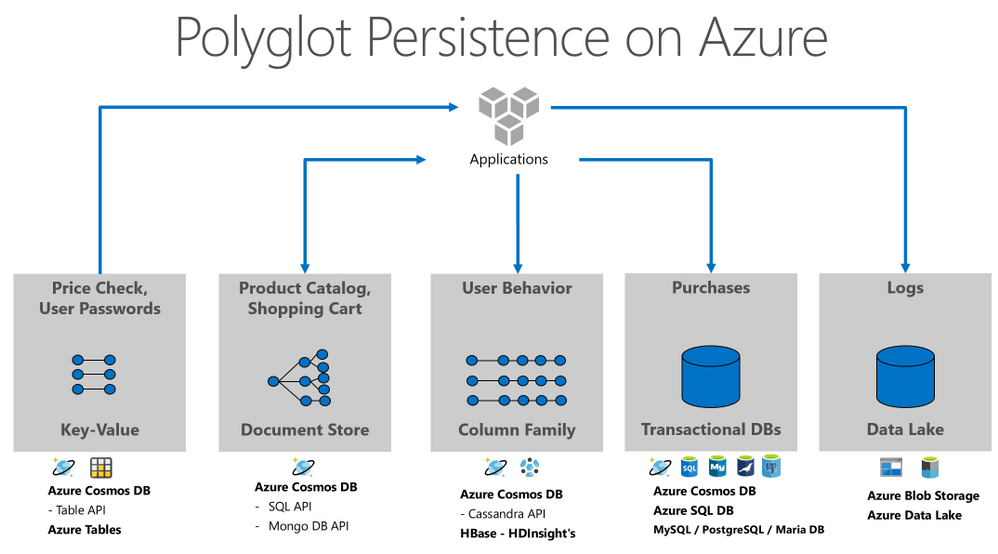
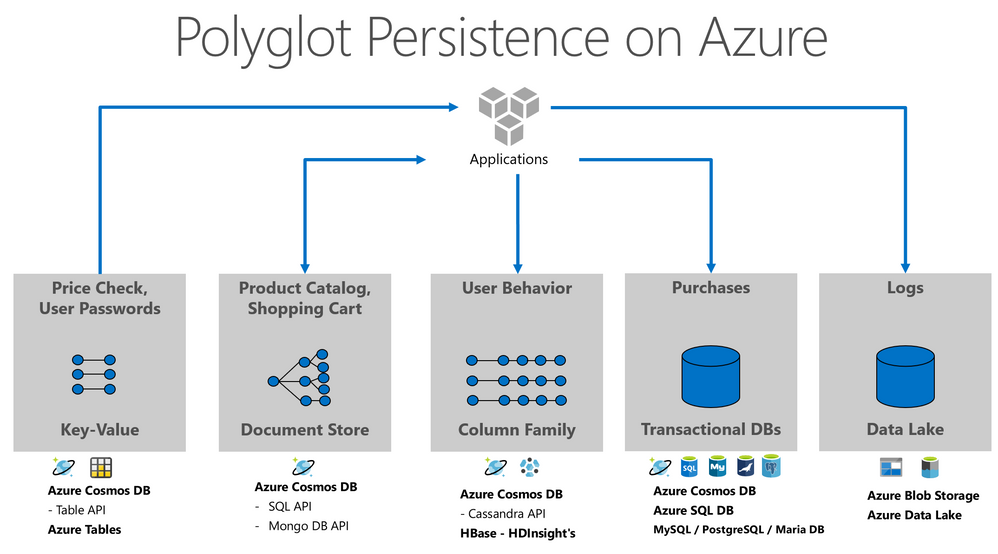
Let us see the example below. The application was sliced in 5 main persistence activities, but we could include more areas like graphs, events, or cache. For each activity we have the typical datatype and the related Azure’s storage options.
The modern data professional needs tools to handle and manage all this data, the trade-offs of polyglot persistence are orchestration and governance. Buck Woody wrote a great blog post about Azure Data Studio, a great tool to support the challenges of this new era.
Right now, we are seen the growth of concepts that extend the ideas presented in this post, like Data Mesh and micro-frontends. Also, Azure’s teams just released a data product called Azure Synapse Link, that enable HTAP scenarios in your Data Architecture. It allows NoETL analytical solutions, avoiding complexity of ETL jobs and all other data integration activities.
We can say that Big Data is too big to be moved around your environment, what created this in-place analytics, or NoETL solution. Azure Cosmos DB was the first Azure PaaS database to offer this automatically integration, but we can predict that other services will follow the same path.
This article is contributed. See the original author and article here.
Want to help foster growth in the Humans of IT Community? Passionate about using tech for good and giving back to the community by helping others thrive professionally?
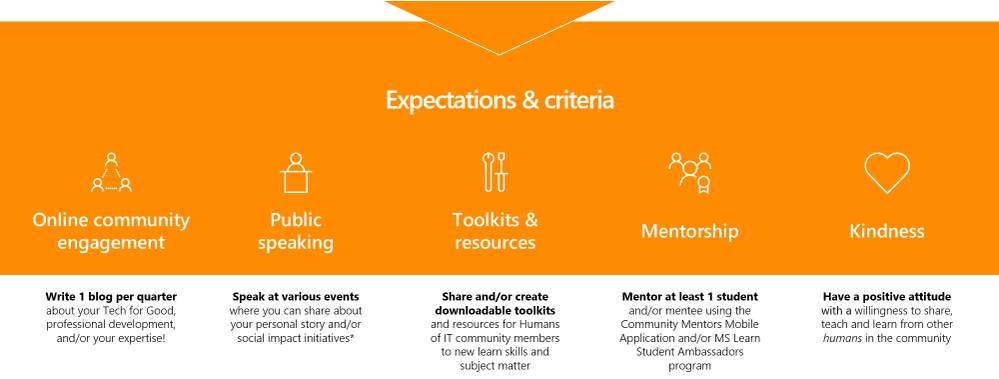
If so, apply to be a Humans of IT Community Ambassador today! You will get the opportunity to be a key representative, contributor and driver of Tech for Good and professional development initiatives, programs, and resources within the Humans of IT community.
The goals of the program are to:
Benefits for Community Ambassadors include:
The ideal ambassador is:
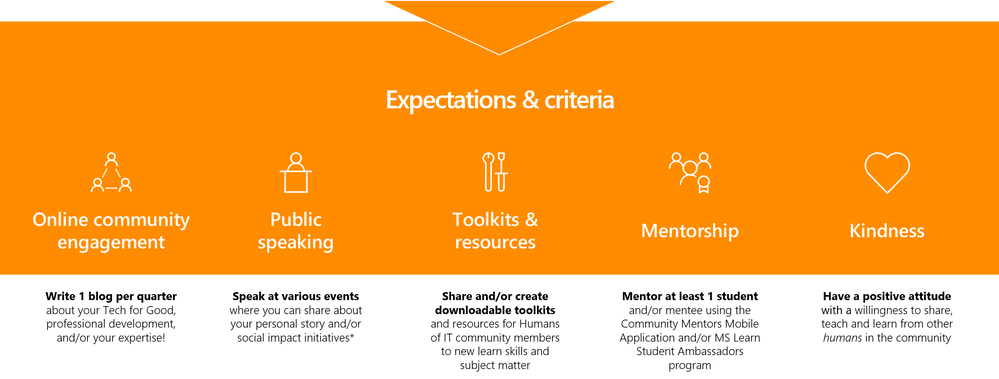
Roles and responsibilities:
The estimated time commitment for an ambassador is approximately 10-15 hours per quarter, and is for a 12-month term. Community ambassadors will have ad-hoc participation based on event calendar availability and will be required to attend quarterly check-ins with the Humans of IT team.
Ready to apply? Submit your application at https://aka.ms/communityambassador, or nominate someone awesome at https://aka.ms/nominateambassadors. Important note: Please ensure that you are a member of the Humans of IT Community before you apply. We are specifically looking for individuals who truly understand and live out the values of the Humans of IT Community.
We can’t wait to see what you will achieve in building a kinder tech industry for all!
#HumansofIT
#CommunityAmbassadors

This article is contributed. See the original author and article here.
We’re pleased to announce the new addition of several charter partners to the Microsoft 365 Content Services Partner Program. Our partners – including system integrators (SIs) and independent software vendors (ISVs) – help customers worldwide realize the value of Microsoft 365 – from migrating customers off legacy platforms to helping them implement and extend the capabilities of Microsoft Content Services and Project Cortex.
After onboarding our current set of charter partners in August 2019, we’re excited to add new partners to our set of innovators, advisors, and integrator s. This group of partners have completed all the requirements to be recognized as charter members of the program. We think it’s best to let their own success with customers speak for them. Microsoft greatly appreciates their partnership.
Below is a sampling of the projects our charter members have recently delivered to show you what’s possible with Microsoft Content Services:
To read more on the awesome work our partners have been doing, visit our Case Studies library on the Microsoft Tech Community Resource Center.
We’ll be highlighting our partners later this month at Microsoft Inspire. Our partners remind us that we all work together the help our customers achieve more, and we’ll be introducing new ways for partners to join us on this journey in the months and years to come.
To learn more about the charter members of the Microsoft Content Services Partner Program, visit the Content Services Partners page


Recent Comments