by Scott Muniz | Jul 20, 2021 | Security, Technology
This article is contributed. See the original author and article here.
This Advisory uses the MITRE Adversarial Tactics, Techniques, and Common Knowledge (ATT&CK®) framework, Version 9. See the ATT&CK for Enterprise for all referenced threat actor tactics and techniques.
Note: CISA released technical information, including indicators of compromise (IOCs), provided in this advisory in 2012 to affected organizations and stakeholders.
This Joint Cybersecurity Advisory—coauthored by the Cybersecurity and Infrastructure Security Agency (CISA) and the Federal Bureau of Investigation (FBI)—provides information on a spearphishing and intrusion campaign conducted by state-sponsored Chinese actors that occurred from December 2011 to 2013, targeting U.S. oil and natural gas (ONG) pipeline companies.
CISA and the FBI provided incident response and remediation support to a number of victims of this activity. Overall, the U.S. Government identified and tracked 23 U.S. natural gas pipeline operators targeted from 2011 to 2013 in this spearphishing and intrusion campaign. Of the known targeted entities, 13 were confirmed compromises, 3 were near misses, and 8 had an unknown depth of intrusion.
The U.S. Government has attributed this activity to Chinese state-sponsored actors. CISA and the FBI assess that these actors were specifically targeting U.S. pipeline infrastructure for the purpose of holding U.S. pipeline infrastructure at risk. Additionally, CISA and the FBI assess that this activity was ultimately intended to help China develop cyberattack capabilities against U.S. pipelines to physically damage pipelines or disrupt pipeline operations.
This advisory provides information on this campaign, including tactics, techniques, and procedures (TTPs) and IOCs. The TTPs remain relevant to help network defenders protect against intrusions. The IOCs are provided for historical awareness.
CISA and the FBI urge owners and operators of Energy Sector and other critical infrastructure (CI) networks to adopt a heightened state of awareness and implement the recommendations listed in the Mitigations section of this advisory, which include implementing network segmentation between IT and industrial control system (ICS)/operational technology (OT) networks. These mitigations will improve a CI entity’s defensive cyber posture and functional resilience by reducing the risk of compromise or severe operational degradation if the system is compromised by malicious cyber actors, including but not limited to actors associated with the campaign described in this advisory.
For more information on Chinese malicious cyber activity, see us-cert.cisa.gov/china.
Click here for a PDF version of this report.
In April 2012, CISA received reports about targeted attacks directed at multiple ONG pipeline sites; CISA (via a predecessor organization) and FBI provided incident response and remediation support to a number of victims from 2012 to 2013. CISA and FBI’s analysis of the malware and threat actor techniques identified that this activity was related to a spearphishing campaign. The U.S. Government identified and tracked 23 U.S. natural gas pipeline operators targeted in this campaign. Of the 23 known targeted entities, 13 were confirmed compromises, 3 were near misses, and 8 had an unknown depth of intrusion.
Threat Actor Activity
The spearphishing activity appears to have started in late December 2011. From December 9, 2011, through at least February 29, 2012, ONG organizations received spearphishing emails [T1566.002] specifically targeting their employees. The emails were at constructed with a high level of sophistication to convince employees to view malicious files [T1204.002]. Note: see the appendix for a table of the MITRE ATT&CK tactics and techniques observed in this campaign.
In addition to spearphishing, CISA and the FBI were made aware of social engineering attempts by malicious actors believed to be associated with this campaign. The apparent goal was to gain sensitive information from asset owners [T1598]. One asset owner reported that individuals in their network engineering department, including managers, received multiple phone calls requesting information about their recent network security practices. Other employees in other departments were not targeted. The asset owner also reported that these calls began immediately after they had identified and removed the malicious intruder from their network and performed a system-wide credential reset. The caller identified himself as an employee of a large computer security firm performing a national survey about network cybersecurity practices. He inquired about the organization’s policy and practices for firewall use and settings, types of software used to protect their network, and the use and type of intrusion detection and/or prevention systems. The caller was blocking his caller ID and when the targeted organization tried to return the call, they reached a number that was not in service.
During the investigation of these compromises, CISA and FBI personnel discovered that Chinese state-sponsored actors specifically collected [TA0009] and exfiltrated [TA0010] ICS-related information. The Chinese state-sponsored actors searched document repositories [T1213] for the following data types:
- Document searches: “SCAD*”
- Personnel lists
- Usernames/passwords
- Dial-up access information
- System manuals
Based on incident data, CISA and FBI assessed that Chinese state-sponsored actors also compromised various authorized remote access channels, including systems designed to transfer data and/or allow access between corporate and ICS networks. Though designed for legitimate business purposes, these systems have the potential to be manipulated by malicious cyber actors if unmitigated. With this access, the Chinese state-sponsored actors could have impersonated legitimate system operators to conduct unauthorized operations. According to the evidence obtained by CISA and FBI, the Chinese state-sponsored actors made no attempts to modify the pipeline operations of systems they accessed. Note: there was a significant number of cases where log data was not available, and the depth of intrusion and persistent impacts were unable to be determined; at least 8 of 23 cases (35 percent) identified in the campaign were assessed as having an unknown depth of intrusion due to the lack of log data.
CISA and FBI assess that during these intrusions, China was successful in accessing the supervisory control and data acquisition (SCADA) networks at several U.S. natural gas pipeline companies.
Chinese actors also gained information specific to dial-up access, including phone numbers, usernames, and passwords [T1120]. Dial-up modems continue to be prevalent in the Energy Sector, providing direct access into the ICS environment with little or no security and no monitoring, which makes them an optimal vector for hold-at-risk operations. The exfiltrated data provided the capabilities for the Chinese cyber actors to access ONG operational systems at a level where they could potentially conduct unauthorized operations.
Exfiltrated Information and Assessed Motives
The Chinese actors specifically targeted information that pertained to access of ICSs. Searches were made for terms involving “SCAD*,” and the actors exfiltrated documents, including personnel lists, usernames and passwords, dial-up access information, remote terminal unit (RTU) sites, and systems manuals. The Chinese actors also exfiltrated information pertaining to ICS permission groups and compromised jump points between corporate and ICS networks. The totality of this information would allow the actors to access ICS networks via multiple channels and would provide sufficient access to allow them to remotely perform unauthorized operations on the pipeline with physical consequences.
CISA and FBI assess that these intrusions were likely intended to gain strategic access to the ICS networks for future operations rather than for intellectual property theft. This assessment was based on the content of the data that was being exfiltrated and the TTPs used to gain that access. One victim organization set up a honeypot that contained decoy documents with content that appeared to be SCADA-related data and sensitive organizational information. According to this organization, the SCADA-related decoy content was exfiltrated within 15 minutes of the time it was made available in the honeypot. Other sensitive decoy information, including financial and business-related information, was ignored.
CISA and FBI assess that this activity was ultimately intended to help China develop cyberattack capabilities against U.S. pipelines to physically damage pipelines or disrupt pipeline operations.
Indicators of Compromise
Table 1 lists indicators related to this spearphishing and intrusion campaign as of May 7, 2012, which are provided in this alert for historical completeness.
Table 1: IOCs from Chinese Gas Pipeline Intrusion Campaign, 2011 to 2013
| Type |
Indicator |
Filename |
| Malware |
MD5:84873fae9cdecb84452fff9cca171004 ntshrui.dll |
|
| Malicious email content, including any attachments and/or message body |
fpso.bigish[.]net |
|
| Malware |
MD5:e12ce62cf7de42581c2fe1d7f36d521c ntshrui.dll |
|
|
User agent string
|
Mozilla/4.0 (compatible; MSIE 6.0; Windows NT 5.2; SV1; .NET CLR 1.1.4322; .NET CLR 2.0.50727) |
|
| User agent string |
Mozilla/4.0 (compatible; MSIE 8.0; Windows NT 5.1; Trident/4.0; .NET CLR 2.0.50727; .NET CLR 3.0.4506.2152; .NET CLR 3.5.30729) |
|
| Named pipe |
ssnp |
|
| Possible command and control (C2) domain |
<xxx>.arrowservice[.]net
Where xxx is the targeted company name abbreviation
|
|
| Malware |
MD5:7361a1f33d48802d061605f34bf08fb0 |
spoolsvd.exe |
| Malware |
5e6a033fa01739d9b517a468bd812162 |
AdobeUpdater.exe |
| Malware |
e62afe2273986240746203f9d55496db |
ins.exe |
| Malware |
ed92d1242c0017668b93a72865b0876b |
px.exe |
| Malware |
6818a9aef22c0c2084293c82935e84fe |
gh.exe |
| Malware |
fcbbfadc992e265c351e54598a6f6dfb |
fslist.exe |
| Malware |
05476307f4beb3c0d9099270c504f055 |
u.exe |
| Malware |
54db65a27472c9f3126df5bf91a773ea |
slm.exe |
| Malware |
a46a7045c0a3350c5a4c919fff2831a0 |
niu.exe |
| Malware |
60456fe206a87f5422b214369af4260e |
ccApp1.exe |
| Malware |
d6eaadcbcf9ea9192db1bd5bb7462bf8 |
ntshrui.dll |
| Malware |
52294de74a80beb1e579e5bca7c7248a |
moonclient2.exe |
| Malware |
e62afe2273986240746203f9d55496db |
inn.exe |
| Malware |
5e6a033fa01739d9b517a468bd812162 |
kkk.exe |
| Malware |
4a8854363044e4d66bf34a0cd331d93d |
inn.exe |
| Malware |
124ad1778c65a83208dbefcec7706dc6 |
AcroRD32.exe |
| Malware |
17199ddac616938f383a0339f416c890 |
iass.dll |
| Malicious email sender address |
“(name of victim company official)@yahoo.com” |
|
| Malicious email content, including any attachments and/or message body |
“If not read this paper, pay attention.” |
|
| Malicious email hyperlinked probable malware |
The hyperlink indicated a “.zip” file and contained the words “quality specifications” in reference to a particular component or product unique to the victim U.S. corporation. |
|
| Malicious email signature block |
Contained the name, title, phone number, and corporate email address of an actual victim company official. |
|
| Malicious attachment name |
|
Project-seems-clear-for-takeoff.zip |
| Possible C2 domain |
<xxx>.arrowservice[dot]net
Where <xxx> may be the full name of the targeted company |
|
| Possible C2 domain |
<xxx>.federalres[.]org |
|
| Possible C2 domain |
<xxx>.businessconsults[.]net
Where <xxx> may be the targeted company name abbreviation or full name |
|
| Possible C2 domain |
idahoanad[dot]org |
|
| Possible C2 domain |
energyreview.strangled[.]net |
|
| Possible C2 domain |
blackcake[.]net |
|
| Possible C2 domain |
infosupports[.]com |
|
| Malware |
7caf4dbf53ff1dcd5bd5be92462b2995 |
iTunesHelper.exe |
| Malware |
99b58e416c5e8e0bcdcd39ba417a08ed |
Solarworldsummary.exe |
| Malware |
f0a00cfd891059b70af96b807e9f9ab8 |
smss.exe |
| Malware |
ea1b46fab56e7f12c4c2e36cce63d593 |
AcroRD32.exe |
| Malicious email content, including any attachments and/or message body |
3d28651bb2d16eeaa6a35099c886fbaa |
Election_2012_Analysis.pdf |
| Possible C2 domain |
balancefitstudio[.]com |
|
| Possible C2 domain |
res.federalres[.]org |
|
| Possible C2 domain |
18center[.]com |
|
| Possible C2 domain |
milk.crabdance[.]com |
|
| Possible C2 domain |
bargainblog[.com[.]au |
|
| Possible C2 domain |
etrace-it[.]com |
|
| Possible C2 domain |
picture.wintersline[.]com |
|
| Possible C2 domain |
wish.happyforever[.]com |
|
| Possible C2 domain |
mitchellsrus[.]com |
|
| Possible C2 domain |
un.linuxd[.]org |
|
| Malicious email content, including any attachments and/or message body |
|
How_Can_Steelmakers_Compete_for_Growth_in_the_Steel_Sector_in_2012.zip |
| Malicious email content, including any attachments and/or message body |
|
(Company Name)_Summary.zip |
| Malicious email content, including any attachments and/or message body |
f5369e59a1ddca9b97ede327e98d8ffe |
Solarworldsummary.zip |
| Malicious email content, including any attachments and/or message body |
|
(Company Name)_to_Sell_RNGMS_to_(Company Name).zip |
| Malicious email content, including any attachments and/or message body |
|
Gift-Winter.zip |
| Malicious email content, including any attachments and/or message body |
|
Happy_New_Year.zip |
| Malicious email content, including any attachments and/or message body |
|
Debt_Crisis_Hits_US.zip |
| Malicious email content, including any attachments and/or message body |
|
01-12-RATEALERT.zip |
| Malicious email content, including any attachments and/or message body |
fni.itgamezone[.]net |
|
CISA and the FBI urge Energy Sector and other CI owners and operators to apply the following mitigations to implement a layered, defense-in-depth cyber posture. By implementing a layered approach, administrators will enhance the defensive cyber posture of their OT/ICS networks, reducing the risk of compromise or severe operational degradation if their system is compromised by malicious cyber actors.
- Harden the IT/corporate network to reduce the risk of initial compromise.
- Update all software, including operating systems, applications, and firmware, in a timely manner. Consider using a centralized patch management system.
- Replace all end-of-life software and hardware devices.
- Restrict and manage remote access software. Remote access tools are a common method for threat actors to gain initial access and persistence on target networks.
- Manage and restrict users and groups who are permitted to access remote capabilities. Permissions should be limited to users that require the capability to complete their duties.
- Require multi-factor authentication (MFA) for remote access.
- Limit access to resources over networks, especially by restricting Remote Desktop Protocol (RDP). If RDP is operationally necessary, restrict the originating sources and require MFA.
- Enable strong spam filters to prevent phishing emails from reaching end users.
- Implement unauthorized execution prevention by:
- Disabling macro scrips from Microsoft Office files transmitted via email. Consider using Office Viewer software to open Microsoft Office files transmitted via email instead of full Microsoft Office suite applications.
- Implementing application allowlisting, which only allows systems to execute programs known and permitted by security policy. Implement software restriction policies (SRPs) or other controls to prevent programs from executing from common malware locations, such as temporary folders supporting popular internet browsers.
- Filter network traffic to prohibit ingress and egress communications with known malicious IP addresses. Prevent users from accessing malicious websites by implementing URL blocklists and/or allow lists.
- Set antivirus/antimalware programs to regularly scan IT network assets using up-to-date signatures.
- Implement and ensure robust network segmentation between IT and ICS networks to limit the ability of cyber threat actors to move laterally to ICS networks if the IT network is compromised.
- Implement a network topology for ICS that has multiple layers, with the most critical communications occurring in the most secure and reliable layer. For more information refer to National Institute of Standard and Technology (NIST) Special Publication 800-82: Guide to ICS Security.
- Use one-way communication diodes to prevent external access, whenever possible.
- Set up demilitarized zones (DMZs) to create a physical and logical subnetwork that acts as an intermediary for connected security devices to avoid exposure.
- Employ reliable network security protocols and services where feasible.
- Consider using virtual local area networks (VLANs) for additional network segmentation, for example, by placing all printers in separate, dedicated VLANs and restricting users’ direct printer access.
- Implement perimeter security between network segments to limit the ability of cyber threat actors to move laterally.
- Control traffic between network segments by using firewalls, intrusion detection systems (IDSs), and filter routers and switches.
- Implement network monitoring at key chokepoints—including egress points to the internet, between network segments, core switch locations—and at key assets or services (e.g., remote access services).
- Configure an IDS to create alarms for any ICS traffic outside normal operations (after establishing a baseline of normal operations and network traffic).
- Configure security incident and event monitoring (SIEM) to monitor, analyze, and correlate event logs from across the ICS network to identify intrusion attempts.
- Implement the following additional ICS environment best practices:
- Update all software. Use a risk-based assessment strategy to determine which ICS network and assets and zones should participate in the patch management program.
- Test all patches in off-line text environments before implementation.
- Implement application allowlisting on human machine interfaces.
- Harden field devices, including tablets and smartphones.
- Replace all end-of-life software and hardware devices.
- Disable unused ports and services on ICS devices (after testing to ensure this will not affect ICS operation).
- Restrict and manage remote access software. Require MFA for remote access to ICS networks.
- Configure encryption and security for ICS protocols.
- Use a risk-based asset inventory strategy to determine how OT network assets are identified and evaluated for the presence of malware.
- Do not allow vendors to connect their devices to the ICS network. Use of a compromised device could introduce malware.
- Maintain an ICS asset inventory of all hardware, software, and supporting infrastructure technologies.
- Ensure robust physical security is in place to prevent unauthorized personal from accessing controlled spaces that house ICS equipment.
- Regularly test manual controls so that critical functions can be kept running if ICS/OT networks need to be taken offline.
- Manage the supply chain by adjusting the ICS procurement process to weigh cybersecurity heavily as part of the scoring and evaluation methodology. Additionally, establish contractual agreements for all outsourced services that ensure proper incident handling and reporting, security of interconnections, and remote access specifications and processes.
- Implement the following additional best practices:
- Implement IP geo-blocking, as appropriate.
- Implement regular, frequent data backup procedures on both the IT and ICS networks. Data backup procedures should address the following best practices:
- Ensure backups are regularly tested.
- Store backups separately, i.e., backups should be isolated from network connections that could enable spread of malware or lateral movement.
- Maintain regularly updated “gold images” of critical systems in the event they need to be rebuilt.
- Retain backup hardware to rebuild systems in the even rebuilding the primary system is not preferred.
- Implement a user training program to train employees to recognize spearphishing attempts, discourage users from visiting malicious websites or opening malicious attachments, and re-enforce appropriate user response to spearphishing emails.
APPENDIX: Tactics and Techniques
Table 2 provides a summary of the MITRE ATT&CK tactics and techniques observed in this campaign.
Table 2: Observed MITRE ATT&CK tactics and techniques
by Contributed | Jul 19, 2021 | Technology
This article is contributed. See the original author and article here.
The use case is as follows: I have water meter telemetry I would like to do analytics on.
Events are ingested from water meters and collected into a data lake in parquet format. The data is partitioned by Year, Month and Day based on the timestamp contained in the events themselves and not based on the time of the event processing in ASA as this is a frequent requirement.
Events are sent from the on premise SCADA systems to Event Hub then processed by Stream Analytics which then can easily:
- Convert events sent in JSON format into partitioned parquet.
- Portioning is based on Year/Month/Day.
- Date used for partitioning is coming from within the event.
The result can immediately be queried with serverless Synapse SQL pool.
Input Stream
My ASA input stream named inputEventHub is plugged into an Event Hub in JSON format.
Output Stream
The output stream is the interesting part and will define the partition scheme:
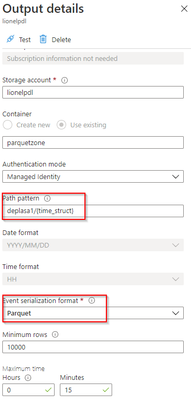
We see that its path pattern is based on a pseudo column named “time_struct” and all the partitioning logic is in the construct of this pseudo column.
Let’s have a look at the ASA query:
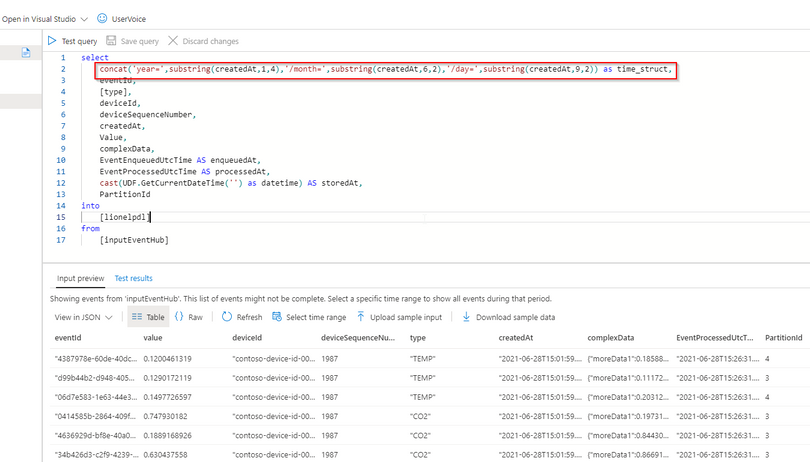
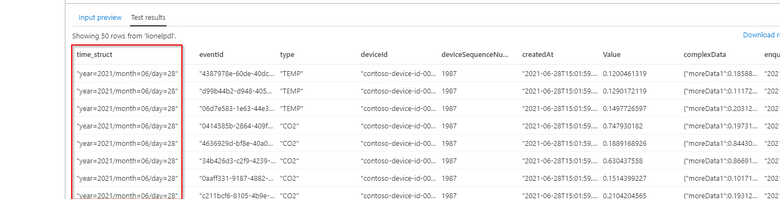
We can see now that the pseudo_column time_struct contains the path, ASA understands it and processes it literally including the “/” sign.
Here is the query code:
select
    concat('year=',substring(createdAt,1,4),'/month=',substring(createdAt,6,2),'/day=',substring(createdAt,9,2)) as time_struct,
    eventId,
    [type],
    deviceId,
    deviceSequenceNumber,
    createdAt,
    Value,
    complexData,
    EventEnqueuedUtcTime AS enqueuedAt,
    EventProcessedUtcTime AS processedAt,
    cast(UDF.GetCurrentDateTime('') as datetime) AS storedAt,
    PartitionId
into
    [lionelpdl]
from
    [inputEventHub]
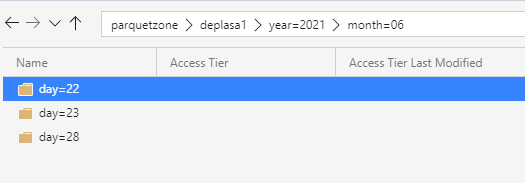
After few days of processing the output folder looks like this as a result:
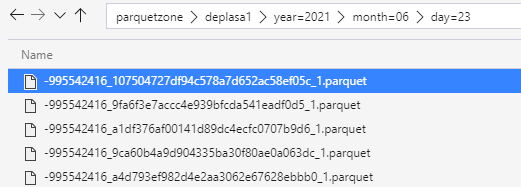
Query results with serveless SQL and take advantage of partitioning
Now I can directly query my Output Stream with serverless SQL:
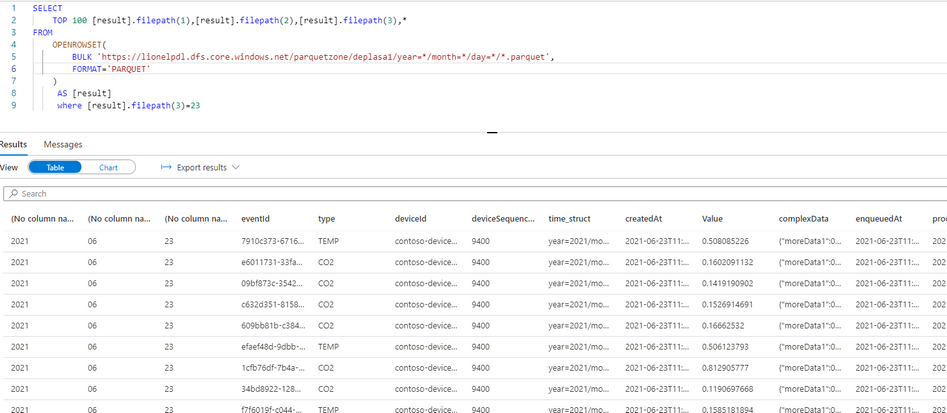
We can also notice that the metadata functions are fully functional without any additional work. For example I can run the following query using filepath metadata function:
  SELECT top 100
    [result].filepath(1) AS [year]
    ,[result].filepath(2) AS [month]
    ,[result].filepath(3) AS [day]
    ,*
FROM
    OPENROWSET(
        BULK 'https://lionelpdl.dfs.core.windows.net/parquetzone/deplasa1/year=*/month=*/day=*/*.parquet',
        FORMAT='PARQUET'
    ) AS [result]

where [result].filepath(2)=6
  and [result].filepath(3)=23
Spark post processing
Finally, to optimize my query performance I can schedule a Spark job which processes daily all events from the previous day, compacts them into fewer and larger parquet files.
As an example, I’ve decided to rebuild the partitions with files containing 2 million rows.
Here are 2 versions of the same code:
PySpark notebook (for interactive testing for instance)
from pyspark.sql import SparkSession
from pyspark.sql.types import *
from functools import reduce
from pyspark.sql import DataFrame
import datetime

account_name = "storage_account_name"
container_name = "container_name"
source_root = "source_directory_name"
target_root = "target_directory_name"
days_backwards = 4 #number of days from today, typicaly, as a daily job it'll be set to 1
adls_path = 'abfss://%s@%s.dfs.core.windows.net/%s' % (container_name, account_name, source_root)

hier = datetime.date.today() - datetime.timedelta(days = days_backwards)
day_to_process = '/year=%04d/month=%02d/day=%02d/' % (hier.year,hier.month,hier.day)
file_pattern='*.parquet'

print((adls_path + day_to_process + file_pattern))

df = spark.read.parquet(adls_path + day_to_process + file_pattern)

adls_result = 'abfss://%s@%s.dfs.core.windows.net/%s' % (container_name, account_name, target_root)

print(adls_result + day_to_process + file_pattern)

df.coalesce(1).write.option("header",True)
        .mode("overwrite")
        .option("maxRecordsPerFile", 2000000)
        .parquet(adls_result + day_to_process)
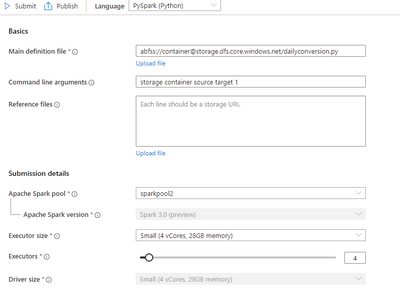
Spark job (with input parameters scheduled daily)
import sys
import datetime
from pyspark import SparkContext, SparkConf
from pyspark.sql import SparkSession
from pyspark.sql.types import *
from functools import reduce
from pyspark.sql import DataFrame

if __name__ == "__main__":

	# create Spark context with necessary configuration
	conf = SparkConf().setAppName("dailyconversion").set("spark.hadoop.validateOutputSpecs", "false")
	sc = SparkContext(conf=conf)
	spark = SparkSession(sc)

	account_name = sys.argv[1] #'storage_account_name'
	container_name = sys.argv[2] #"container_name"
	source_root = sys.argv[3] #"source_directory_name"
	target_root = sys.argv[4] #"target_directory_name"
	days_backwards = sys.argv[5] #number of days backwards in order to reprocess the parquet files, typically 1

	hier = datetime.date.today() - datetime.timedelta(days=int(days_backwards))

	day_to_process = '/year=%04d/month=%02d/day=%02d/' % (hier.year,hier.month,hier.day)
	file_pattern='*.parquet'

	adls_path = 'abfss://%s@%s.dfs.core.windows.net/%s' % (container_name, account_name, source_root)

	print((adls_path + day_to_process + file_pattern))

	df = spark.read.parquet(adls_path + day_to_process + file_pattern)
	#display (df.limit(10))
	#df.printSchema()
	#display(df)
	adls_result = 'abfss://%s@%s.dfs.core.windows.net/%s' % (container_name, account_name, target_root)

	print(adls_result + day_to_process + file_pattern)

	df.coalesce(1).write.option("header",True)
		.mode("overwrite")
		.option("maxRecordsPerFile", 2000000)
		.parquet(adls_result + day_to_process)
Conclusion
In this article we have covered:
- How to easily use Stream Analytics to write an output with partitioned parquet files.
- How to use serverless Synapse SQL pool to query Stream analytics output.
- How to reduce the number of parquet files using synapse Spark pool.
Additional resources:
by Contributed | Jul 19, 2021 | Technology
This article is contributed. See the original author and article here.
Over 95 percent of Fortune 500 companies are transforming their businesses using Azure, relying on an enterprise-grade infrastructure and deep integration with the rest of the Microsoft Cloud. The Azure Migration and Modernization Program (AMMP) has helped thousands of customers unlock the benefits of the cloud, with the right mix of expert guidance and best practices to migrate to Azure. We’ve learned through this journey that customer environments are diverse and complex – there are workloads that can be migrated and there are others that must stay on-premises due to regulatory, data sovereignty, and latency requirements. Whatever the reason, it’s clear that a hybrid approach is a reality for most companies.
Customers tell us that a key challenge with hybrid adoption is consistent management, governance, and security across distributed locations. With Azure Arc, you can organize, govern and secure your servers and Kubernetes clusters across data centers, the edge, and multi-cloud environments, in a consistent manner, along your migration journey.
To demonstrate this, today we are excited to share a new Microsoft Mechanics video with Matt McSpirit and Jeremy Chapman who will show how your resources in the Cloud can work seamlessly with resources on-premises under a single management plane enabled by Azure Arc. Check it out today!
Get started with Azure Arc
by Scott Muniz | Jul 19, 2021 | Security, Technology
This article is contributed. See the original author and article here.
CISA, the Federal Bureau of Investigation (FBI), and the National Security Agency (NSA) have observed increasingly sophisticated Chinese state-sponsored activity targeting U.S. political, economic, military, educational, and critical infrastructure personnel and organizations. In response:
- The White House has released a statement attributing recent Microsoft Exchange server exploitation activity to the People’s Republic of China (PRC).
- The Department of Justice has indicted four Chinese cyber actors from the advanced persistent threat (APT) group APT40 for malicious cyber activities, carried out on orders from PRC Ministry of State Security (MSS) Hainan State Security Department (HSSD). These activities resulted in the theft of trade secrets, intellectual property, and other high-value information from companies and organizations in the United States and abroad, as well as from multiple foreign governments.
- CISA and FBI have released Joint Cybersecurity Advisory: TTPs of Indicted APT40 Actors Associated with China’s MSS Hainan State Security Department to help network defenders identify and remediate APT40 intrusions and established footholds.
- CISA, NSA and FBI have released Joint Cybersecurity Advisory: Chinese Observed TTPs, which describes Chinese cyber threat behavior and trends and provides mitigations to help protect the Federal Government; state, local, tribal, and territorial governments; critical infrastructure, defense industrial base, and private industry organizations.
- CISA, NSA and FBI have released CISA Insights: Chinese Cyber Threat Overview for Leaders to help leaders understand this threat and how to reduce their organization’s risk of falling victim to cyber espionage and data theft.
CISA also encourages users and administrators to review the blog post, Safeguarding Critical Infrastructure against Threats from the People’s Republic of China, by CISA Executive Assistant Director Eric Goldstein and the China Cyber Threat Overview and Advisories webpage.




Recent Comments