
Barracuda Virtual Reactor on Azure
This article is contributed. See the original author and article here.
We are thrilled to welcome Barracuda Virtual Reactor® on Azure. With this technology, engineers can simulate fluid, particulate-solid, thermal and chemically reacting behavior in industrial fluid-particle processes while gaining the on-demand and virtually unlimited computing capacity of Azure.
Virtual ReactorTM is the industry-standard tool for many applications in refining, petrochemicals, cement manufacture, power generation and other energy-intensive industries. Today, the same award-winning technology is enabling, and reducing the time to market for, multiple sustainability technologies that are changing our planet for the better. Examples include advanced recycling of plastics, waste-to-energy/fuels/chemicals, renewable fuels, hydrogen production and other decarbonization applications.
Fluid-particle systems in these industries tend to operate 24/7 for years on end, and hence, even small improvements in reliability and performance lead to a tremendous economic impact. Barracuda® reduces the risk of making changes to existing processes by identifying the root cause(s) of underperformance, performing virtual testing of changes and identifying additional optimization opportunities. Similarly, the software empowers those developing new technologies to economically explore a wide range of possibilities during R&D while compressing development, scale-up and commercialization timeframes.
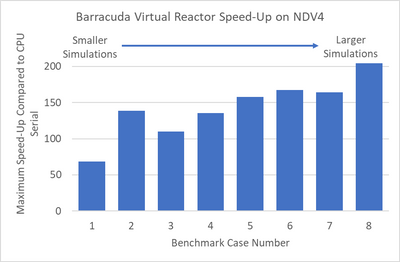
We recently tested Virtual Reactor on Azure’s state-of-the-art NDv4 virtual machines (VMs)to showcase performance scalability across a variety of models. We have highlighted the results of the Virtual Reactor with our ND96asr_v4 VM, and the performance is shown below across 8 different sizes.
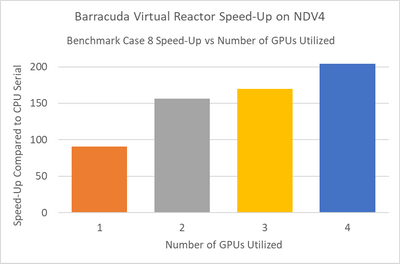
Smaller simulations which in our tests had less than 25 million computational particles, achieved maximum speed-up when running in multi-GPU mode using two NVIDIA A100 Tensor Core GPUs. Larger simulations achieved maximum speed-up when using four GPUs. The speed-up scaling1 from one to four GPUs is shown below for benchmark case 82.
NOTE: Case 8 is a simulation benchmark case containing 55M particles; for additional GPU scaling questions please contact CPFD
The ND A100 v4 series starts with a single virtual machine and eight NVIDIA A100 Tensor Core GPUs. ND A100 v4-based deployments can scale up to thousands of GPUs with 1.6 Tb/s of interconnect bandwidth per VM. Each GPU within the VM is provided with its own dedicated, topology-agnostic NVIDIA Quantum 200Gb/s InfiniBand networking. These connections are automatically configured between VMs occupying the same virtual machine scale set, and support GPUDirect RDMA.
Each GPU features third-generation NVIDIA NVLink connectivity for communication within the VM, and the instance is also backed by 96 physical second-generation AMD Epyc™ CPU cores.
These instances provide excellent performance for many AI, ML and analytics tools that support GPU acceleration ‘out-of-the-box,’ such as TensorFlow, Pytorch, Caffe, RAPIDS and other frameworks. Additionally, the scale-out InfiniBand interconnect is supported by a large set of existing AI and HPC tools built on NVIDIA’s NCCL2 communication libraries for seamless clustering of GPUs.
“Azure’s multi-GPU virtual machines powered by NVIDIA A100 Tensor Core GPUs provide the global Barracuda Virtual Reactor user community with instant access to the latest high performance computing resources without the overhead of purchasing and maintaining on-premise hardware. The observed speed-ups of over 200x, combined with the convenience of the Azure Platform, provide our clients with virtually unlimited, on-demand, compute bandwidth as they tackle some of our planet’s toughest engineering, energy and sustainability challenges.”
Peter Blaser, Vice President of Operations, CPFD Software
“We welcome Barracuda Virtual Reactor to Azure and are excited to showcase this exciting technology to customers in process industries who will benefit immensely from our purpose-built NVIDIA GPU hosts that are designed to deliver superior cost performance for this workload. Azure and CPFD have joined forces to offer customers a compelling range of options to explore Virtual Reactor on Azure and pick the best VM sizing suited to their use case requirements.”
Kurt Niebuhr, Azure Compute HPC | AI Workload Incubation & Ecosystem Team Lead
About CPFD
CPFD Software is advancing multiphase simulation and technology. Our flagship product, Barracuda Virtual Reactor, is a physics-based engineering software package capable of predicting fluid, particulate-solid, thermal and chemically reacting behavior in fluidized bed reactors and other fluid-particle systems reducing the risk associated with design, scale-up, commercialization, and trouble-shooting of industrial processes. The Virtual Reactor technology is accessible through software licensing, consulting, or engineering services.
NOTE:
1For additional GPU scaling questions please contact CPFD
2Case 8 is a simulation benchmark case containing 55M particles



Recent Comments