
by Contributed | Apr 28, 2022 | Technology
This article is contributed. See the original author and article here.
On November 10, 2020, we announced the first preview of Az.Tools.Predictor, a PowerShell module suggesting the Azure cmdlet to use with parameters and suggested values.
Today, we are announcing the general availability of Az.Tools.Predictor.
How it all started
During a study about a new module for Azure, I was surprised to see how difficult it was for the participant to find the correct cmdlet to use. Later, I was summarizing the learnings of the study, and though it would be great if we could have a solution that could help people finding the right cmdlet to use.
At the same time, we were starting to work on Predictive IntelliSense in PowerShell and after a couple of meetings with Jason Helmick, it became clear that this would be a great mechanism to address the challenge I had seen few days before by providing, in the command line, suggestions about cmdlet to use.
We quickly thought that some form of AI could help providing accurate recommendations so we involved Roshanak, Yevhen and Maoliang from our data science team to work with us on how we could build an engine that would provide recommendations for PowerShell cmdlets based on the user’s context.
Behind the scenes
Once a functional prototype was built, we wanted to confirm its usability before considering any public previews.
For our team usability is important, over time certain key combinations became a reflex and we knew that we had to fit in the existing memory muscle and become intuitive for PowerShell. For predictors to be successful, we organized several usability studies with prototypes of Az Predictors and addressed several improvements, like the color of the suggested text or the key combination to use to accept or navigate amongst predictions.
One of our initial prototypes was using the color scheme below, we wanted to have a clear color-based differentiation between typed characters and suggestions hoping this would help user navigate the suggestion. We worked with our design team to address the issue and evolve our design towards the current design.

We also evaluated if the information provided in the suggestions is helpful. Below is another of our early designs. By listening to our customers and observing how they are using the tool, we learned that showing cmdlets first then parameters and associated value samples was not as useful as showing the full line and not using more space in the terminal which is our current design.

During the last months we have done a few previews (read about preview 5) to stabilize the module as PowerShell and PS Readline which we depend on became stable. We have also improved our model based on the feedback we have collected and addressed issues reported.
Getting started
We would like to invite you to try the stable version of Az.Tools.Predictor.
To get started, follows these steps:
- Install or upgrade PowerShell v7.2
https://docs.microsoft.com/powershell/scripting/install/installing-powershell
- Install or upgrade PSReadline 2.2
Install-Module -Name PSReadLine -Force
- Install or upgrade Az.Tools.Predictor
Install-module -name Az.Tools.Predictor -Force
- Enable Az Predictor
Enable-AzPredictor -AllSession
Once installed, it is recommended that you restart your PowerShell sessions.
For more details, visit the Az Predictor documentation page: https://docs.microsoft.com/powershell/azure/az-predictor
Inline view mode (default)
Once enabled, the default view is the “inline view” as shown in the following screen capture:

This mode shows only one suggestion at a time. The suggestion can be accepted by pressing the right arrow or you can continue to type. The suggestion will dynamically adjust based on the text that you have typed.
You can accept the suggestion at any time then come back and edit the command that is on your prompt.
List view mode
This is my favorite mode!
Switch to this view either by using the “F2” function key on your keyboard or run the following command:
Set-PSReadLineOption -PredictionViewStyle ListView
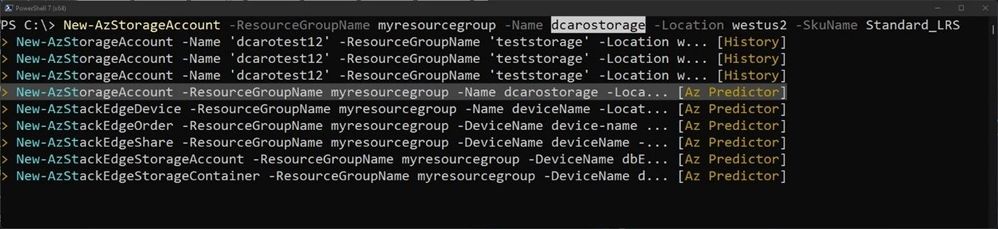
This mode shows from your current prompt a list of possible matches for the command that you are typing. It combines suggestions from your local history and from Az Predictor.
Select a suggestion and then navigate through the parameter values with “Alt + A” to quickly fill replace the proposed values with yours.
Next steps
This is just the beginning of our journey to improving the usability of Azure PowerShell!
We will be carefully listening to every feedback that you send us:
We will share soon more about how we plan to expand this experience to other environments.
Credits
“It takes a village to raise a child” Az.Tools.Predictor is the result of the close collaboration of several teams distributed across continents and time zones working hard during the pandemic.
![MAR-10376640-1.v1 – IsaacWiper and HermeticWizard]()
by Scott Muniz | Apr 28, 2022 | Security, Technology
This article is contributed. See the original author and article here.
Notification
This report is provided “as is” for informational purposes only. The Department of Homeland Security (DHS) does not provide any warranties of any kind regarding any information contained herein. The DHS does not endorse any commercial product or service referenced in this bulletin or otherwise.
This document is marked TLP:WHITE–Disclosure is not limited. Sources may use TLP:WHITE when information carries minimal or no foreseeable risk of misuse, in accordance with applicable rules and procedures for public release. Subject to standard copyright rules, TLP:WHITE information may be distributed without restriction. For more information on the Traffic Light Protocol (TLP), see http://www.cisa.gov/tlp.
Summary
Description
CISA received six files for analysis: five 32-bit Dynamic-link Library (DLL) files and one 32-bit executable file. These files have been identified as IsaacWiper and HermeticWizard. During analysis of HermeticWizard, another file was dropped and identified as HermeticWiper. The submitted files are designed to spread laterally through a network via Server Message Block (SMB) and Windows Management Instrumentation (WMI). These files attempt to overwrite the first 65536 bytes of data contained on the C: drive as well as any attached storage disks in order to render them useless to the victim user. The malware also creates a file and continuously writes to it until the disk runs out of free space and crashes. Upon reboot, the machine is no longer operable.
For a downloadable copy of IOCs, see: MAR-10376640-1.v1.stix.
Submitted Files (6)
13037b749aa4b1eda538fda26d6ac41c8f7b1d02d83f47b0d187dd645154e033 (Cleaner.dll)
2d29f9ca1d9089ba0399661bb34ba2fd8aba117f04678cd71856d5894aa7150b (exec_x32.dll)
5a300f72e221a228e3a36a043bef878b570529a7abc15559513ea07ae280bb48 (romance.dll)
a259e9b0acf375a8bef8dbc27a8a1996ee02a56889cba07ef58c49185ab033ec (Wizard.dll)
abf9adf2c2c21c1e8bd69975dfccb5ca53060d8e1e7271a5e9ef3b56a7e54d9f (Cleaner.dll)
afe1f2768e57573757039a40ac40f3c7471bb084599613b3402b1e9958e0d27a (Cleaner.exe)
Findings
5a300f72e221a228e3a36a043bef878b570529a7abc15559513ea07ae280bb48
Tags
backdoortrojanwiperworm
Details
| Name |
romance.dll |
| Size |
348424 bytes |
| Type |
PE32 executable (DLL) (console) Intel 80386, for MS Windows |
| MD5 |
0959bf541d52b6e2915420442bf44ce8 |
| SHA1 |
ac5b6f16fc5115f0e2327a589246ba00b41439c2 |
| SHA256 |
5a300f72e221a228e3a36a043bef878b570529a7abc15559513ea07ae280bb48 |
| SHA512 |
b08ce87165b82db5a35353f9e42665fa9e736603b8e131e46501c0bbf4c830abbaba7bdbb5513af6201f19ba6741aa86b7cf736a8d92fef2c43a90383bf9ba68 |
| ssdeep |
6144:zB0WZ3twfUMDH34YslWeXEuS0dOIB9LcO1bJ/fKtn7eENm2eK7mnoUSgpAY8ODcV:lDRtSUMDH34DlWQEuS0UIzLR1NXKtn7f |
| Entropy |
6.683668 |
Antivirus
| Avira |
WORM/Agent.pjgwz |
| Bitdefender |
Trojan.GenericKD.48563945 |
| Cyren |
W32/Agent.XHXW-4345 |
| ESET |
Win32/Agent.OJC worm |
| Emsisoft |
MalCert-S.OE (A) |
| IKARUS |
Worm.Win32.Agent |
| K7 |
Trojan ( 0058f30e1 ) |
| Lavasoft |
Trojan.GenericKD.48563945 |
| McAfee |
Exploit-DcomRpc.c.gen |
| Quick Heal |
APEXCFC.Backdoor.Gen |
| Sophos |
Mal/BadCert-Gen |
| Symantec |
Trojan.KillDisk |
| Trend Micro |
Worm.Wi.A1D01B0A |
| Trend Micro HouseCall |
Worm.Wi.A1D01B0A |
| VirusBlokAda |
Worm.Hermetic |
| Zillya! |
Worm.Agent.Win32.99417 |
YARA Rules
- rule CISA_10376640_02 : trojan wiper worm HERMETICWIZARD
{
meta:
Author = “CISA Code & Media Analysis”
Incident = “10376640”
Date = “2022-03-12”
Last_Modified = “20220413_1300”
Actor = “n/a”
Category = “Trojan Wiper Worm”
Family = “HERMETICWIZARD”
Description = “Detects Hermetic Wizard samples”
MD5_1 = “0959bf541d52b6e2915420442bf44ce8”
SHA256_1 = “5a300f72e221a228e3a36a043bef878b570529a7abc15559513ea07ae280bb48”
strings:
$s0 = { 70 00 69 00 70 00 65 00 5C 00 25 00 73 }
$s1 = { 6E 00 6D 00 61 00 6E 00 73 00 65 00 72 00 76 }
$s2 = { 73 61 6D 72 }
$s3 = { 62 72 6F 77 73 65 72 }
$s4 = { 6E 65 74 6C 6F 67 6F 6E }
$s5 = { 6C 73 61 72 70 63 }
$s6 = { 6E 74 73 76 63 73 }
$s7 = { 73 76 63 63 74 6C }
$s8 = { 73 74 61 72 74 20 63 6D 64 20 2F 63 20 22 70 69 6E 67 20 6C 6F 63 61 6C 68 6F 73 74 }
$s9 = { 67 00 75 00 65 00 73 00 74 }
$s10 = { 74 00 65 00 73 00 74 }
$s11 = { 75 00 73 00 65 00 72 }
$s12 = { 61 00 64 00 6D 00 69 00 6E 00 69 00 73 00 74 00 72 00 61 00 74 00 6F }
$s13 = { 51 00 61 00 7A 00 31 00 32 00 33 }
$s14 = { 51 00 77 00 65 00 72 00 74 00 79 00 31 00 32 }
$s15 = { 63 6D 64 20 2F 63 20 73 74 61 72 74 20 72 65 67 }
condition:
all of them
}
ssdeep Matches
No matches found.
PE Metadata
| Compile Date |
2022-02-22 02:30:07-05:00 |
| Import Hash |
0802be27b58612f1b2648b8a57d1acfd |
PE Sections
| MD5 |
Name |
Raw Size |
Entropy |
| 6ca6e4584fdfe512c2567bc3df334540 |
header |
1024 |
2.665881 |
| 023be81d5f495e7428cde5d930ecf8ce |
.text |
286208 |
6.662690 |
| 5ed93c823af444567d6fac7c5b868db8 |
.rdata |
43008 |
5.287553 |
| d2ceb15c0042bf0981352c5e7af10677 |
.data |
3584 |
3.239415 |
| 84a3f07cc1f758d0993531a1da9e3f6a |
.reloc |
10752 |
6.623638 |
Packers/Compilers/Cryptors
Relationships
| 5a300f72e2… |
Contained_Within |
a259e9b0acf375a8bef8dbc27a8a1996ee02a56889cba07ef58c49185ab033ec |
| 5a300f72e2… |
Dropped_By |
a259e9b0acf375a8bef8dbc27a8a1996ee02a56889cba07ef58c49185ab033ec |
Description
This application is a 32-bit DLL and has been identified as HermeticWizard. A filename is generated for the malware using the string ‘c%02X%02X%02X%02X%02X%02X’, which will create a random set of 12 characters, 6 hex bytes beginning with ‘c’. The purpose of the DLL is to spread to other machines over the SMB protocol to the Admin Share (IPC$). The malware attempts to authenticate through SMB using a set of hard-coded usernames and passwords.
–Begin Usernames–
guest
test
admin
user
root
administrator
manager
operator
–End Usernames–
–Begin Passwords–
123
Qaz123
Qwerty123
–End Passwords–
The malware is designed to use the command-line parameters below for execution:
–Begin command-line–
cmd /c start regsvr32.exe /s /i..<malicious DLL>
& start cmd /c “ping localhost -n 7 & wevtutil cl System
–End command-line–
Screenshots

Figure 1 – This screenshot shows the hard-coded usernames and passwords used to attempt authentication with the target machine.

Figure 2 – This screenshot shows the malware establishing a connection via the SMB protocol.
2d29f9ca1d9089ba0399661bb34ba2fd8aba117f04678cd71856d5894aa7150b
Tags
backdoortrojanwiperworm
Details
| Name |
exec_x32.dll |
| Size |
122632 bytes |
| Type |
PE32 executable (DLL) (GUI) Intel 80386, for MS Windows |
| MD5 |
58d71fff346017cf8311120c69c9946a |
| SHA1 |
6b5958bfabfe7c731193adb96880b225c8505b73 |
| SHA256 |
2d29f9ca1d9089ba0399661bb34ba2fd8aba117f04678cd71856d5894aa7150b |
| SHA512 |
315cc419f6ec600a345447b0f49e3de9f13c1e96d9bbc272f982204b1c7ec71cb3805f5ff7821da3e7944e327c22e5eba6f3c94b08c66b6e241395e1ea133ed1 |
| ssdeep |
3072:gnu7OIMtlhyAnF1bIoENm2eK7mnoUSgpAY8ODcDcm7cIsF4RO06loHGvJnuqO:g4OlhlzjENm2eK7mnoUSgpAY8ODcDcmT |
| Entropy |
6.646213 |
Antivirus
| AhnLab |
Trojan/Win.FoxBlade |
| Avira |
WORM/Agent.juikt |
| Bitdefender |
Trojan.GenericKD.39179683 |
| ESET |
Win32/Agent.OJC worm |
| Emsisoft |
MalCert-S.OE (A) |
| IKARUS |
Worm.Win32.Agent |
| K7 |
Trojan ( 00028d131 ) |
| Lavasoft |
Trojan.GenericKD.39179683 |
| Quick Heal |
APEXCFC.Backdoor.Gen |
| Sophos |
Mal/BadCert-Gen |
| Symantec |
Trojan.Gen.2 |
| Trend Micro |
Worm.Wi.A1D01B0A |
| Trend Micro HouseCall |
Worm.Wi.A1D01B0A |
| VirusBlokAda |
Trojan.Agent |
| Zillya! |
Worm.Agent.Win32.99414 |
YARA Rules
- rule CISA_10376640_03 : trojan wiper worm HERMETICWIZARD
{
meta:
Author = “CISA Code & Media Analysis”
Incident = “10376640”
Date = “2022-03-13”
Last_Modified = “20220413_1300”
Actor = “n/a”
Category = “Trojan Wiper Worm”
Family = “HERMETICWIZARD”
Description = “Detects Hermetic Wizard samples”
MD5_1 = “58d71fff346017cf8311120c69c9946a”
SHA256_1 = “2d29f9ca1d9089ba0399661bb34ba2fd8aba117f04678cd71856d5894aa7150b”
strings:
$s0 = { 69 73 20 70 72 6F 67 72 61 6D 20 63 61 6E 6E 6F }
$s1 = { 5C 00 5C 00 25 00 73 00 5C 00 70 00 69 00 70 00 65 00 5C 00 25 00 73 }
$s2 = { 64 00 6C 00 6C 00 00 00 2D 00 69 }
$s3 = { 2D 00 68 00 00 00 00 00 2D 00 73 }
$s4 = { 2D 00 63 00 00 00 00 00 2D 00 61 }
$s5 = { 43 6F 6D 6D 61 6E 64 4C 69 6E 65 54 6F 41 72 67 76 57 }
condition:
all of them
}
ssdeep Matches
No matches found.
PE Metadata
| Compile Date |
2022-02-22 02:23:15-05:00 |
| Import Hash |
0efd6cfc0613f20a06fa0746b2d5b8bc |
PE Sections
| MD5 |
Name |
Raw Size |
Entropy |
| 90d5fe0b84e27aef0c20e1f645feb2b0 |
header |
1024 |
2.713966 |
| 6e7013478def0b223ed6acb0a52fad70 |
.text |
81408 |
6.654914 |
| b63a5c496bdfc65b0a87074ddb5ea3ea |
.rdata |
29184 |
5.513656 |
| cd29db9b4e978a706ddf3195b7a6b9b9 |
.data |
2560 |
2.223270 |
| 463a2a119664cff0f6ea5941379a7700 |
.reloc |
4608 |
6.499252 |
Packers/Compilers/Cryptors
Relationships
| 2d29f9ca1d… |
Contained_Within |
a259e9b0acf375a8bef8dbc27a8a1996ee02a56889cba07ef58c49185ab033ec |
| 2d29f9ca1d… |
Dropped_By |
a259e9b0acf375a8bef8dbc27a8a1996ee02a56889cba07ef58c49185ab033ec |
Description
This is a 32-bit DLL file. This DLL spreads laterally through the network via the WMI protocol. The malware copies a file over to the target machine for execution. This copied filename is generated using the string ‘c%02X%02X%02X%02X%02X%02X’ which will create a random set of 12 characters, 6 hex bytes beginning with ‘c’. The copied file has been identified as HermeticWizard. The malware identifies a running process with a desired authority and uses the token for impersonation to create a new process and service to launch the copied file.
–Begin command-line–
cmd /c start
regsvr32.exe /s /i <malicious DLL path>
–End command-line–
Screenshots

Figure 3 – This screenshot shows the malware authority type and impersonation.
a259e9b0acf375a8bef8dbc27a8a1996ee02a56889cba07ef58c49185ab033ec
Tags
backdoortrojanworm
Details
| Name |
Wizard.dll |
| Size |
698632 bytes |
| Type |
PE32 executable (DLL) (GUI) Intel 80386, for MS Windows |
| MD5 |
517d2b385b846d6ea13b75b8adceb061 |
| SHA1 |
3c54c9a49a8ddca02189fe15fea52fe24f41a86f |
| SHA256 |
a259e9b0acf375a8bef8dbc27a8a1996ee02a56889cba07ef58c49185ab033ec |
| SHA512 |
1de912f50b7f5cc2f4fcea7b6d3c84a39bd15d668122f50a9b11da66447ed99f456e86e006d0dfe7ab0fca7dc8e35efa7ff57959033463d94ef37e5705515430 |
| ssdeep |
12288:J4WCTqjtByJsZrjIYlkytnSg9hcr1DnDH2iRNL5tj1XUNgASK4CTfVf1WZ62PNTr:HGqRBRtnSEhMhDH2iRNL5tj1XUNgASKw |
| Entropy |
7.451862 |
Antivirus
| AhnLab |
Trojan/Win.FoxBlade |
| Antiy |
Trojan/Win32.Agent |
| Avira |
WORM/Agent.sejyu |
| Bitdefender |
Trojan.GenericKD.48550079 |
| ClamAV |
Win.Malware.HermeticWizard-9941571-0 |
| ESET |
Win32/Agent.OJC worm |
| Emsisoft |
MalCert-S.OE (A) |
| IKARUS |
Worm.Win32.Agent |
| K7 |
Trojan ( 0058f30e1 ) |
| Lavasoft |
Trojan.GenericKD.48550079 |
| McAfee |
Generic trojan.wh |
| NANOAV |
Trojan.Win32.TrjGen.jngwij |
| Quick Heal |
APEXCFC.Backdoor.Gen |
| Sophos |
Mal/BadCert-Gen |
| Symantec |
Trojan.Gen.MBT |
| TACHYON |
Trojan/W32.HermeticWizard.698632 |
| Trend Micro |
Worm.Wi.38D94AB0 |
| Trend Micro HouseCall |
Worm.Wi.38D94AB0 |
| VirusBlokAda |
BScope.Trojan.Agent |
| Zillya! |
Worm.Agent.Win32.99423 |
YARA Rules
- rule CISA_10376640_05 : trojan wiper worm HERMETICWIZARD
{
meta:
Author = “CISA Code & Media Analysis”
Incident = “10376640”
Date = “2022-04-14”
Last_Modified = “20220414_1037”
Actor = “n/a”
Category = “Trojan Wiper Worm”
Family = “HERMETICWIZARD”
Description = “Detects Hermetic Wizard samples”
MD5_1 = “517d2b385b846d6ea13b75b8adceb061”
SHA256 = “a259e9b0acf375a8bef8dbc27a8a1996ee02a56889cba07ef58c49185ab033ec”
strings:
$s0 = { 57 69 7A 61 72 64 2E 64 6C 6C }
$s1 = { 69 6E 66 6C 61 74 65 }
$s2 = { 4D 61 72 6B 20 41 64 6C 65 72 }
condition:
all of them and filesize < 2000KB
}
ssdeep Matches
No matches found.
PE Metadata
| Compile Date |
2022-02-22 03:07:17-05:00 |
| Import Hash |
e099d3524b6906cf8460b4e6db0b11f2 |
PE Sections
| MD5 |
Name |
Raw Size |
Entropy |
| 01185a4f21be653f13b885a655da2239 |
header |
1024 |
2.945954 |
| d7ed7d880b3eed5eae7787055766502c |
.text |
312832 |
6.633510 |
| 87728459f7938f00f8d53d0bd6e6a337 |
.rdata |
60416 |
5.802039 |
| 31b2ae0f6a40196c4bce89d36302d545 |
.data |
3584 |
2.914857 |
| d77cbf49cf473a8235a67912f0edd78f |
.rsrc |
304128 |
7.948029 |
| 32ec2dc9dc4b9fc8f96ac18835fea101 |
.reloc |
12800 |
6.692458 |
Packers/Compilers/Cryptors
Relationships
| a259e9b0ac… |
Contains |
5a300f72e221a228e3a36a043bef878b570529a7abc15559513ea07ae280bb48 |
| a259e9b0ac… |
Contains |
2d29f9ca1d9089ba0399661bb34ba2fd8aba117f04678cd71856d5894aa7150b |
| a259e9b0ac… |
Dropped |
5a300f72e221a228e3a36a043bef878b570529a7abc15559513ea07ae280bb48 |
| a259e9b0ac… |
Dropped |
2d29f9ca1d9089ba0399661bb34ba2fd8aba117f04678cd71856d5894aa7150b |
Description
This is a 32-bit DLL and has been identified as HermeticWizard. The original filename for the DLL is Wizard.dll. It is designed to use the command-line parameters below for execution:
–Begin command-line–
regsvr32.exe /s /i <malicious DLL path>
–End command-line–
The application contains three 32-bit encrypted binaries that are decrypted and installed into the current directory at runtime.
–Begin files–
%current directory%exec_x32.dll
%current directory%romance.dll
%current directory%<6 randomly generated alphanumerical characters>.ocx
–End files–
At runtime, it attempts to detect all active hosts on the victim’s network. It is capable of moving laterally across the network by actively scanning ranges of reachable IP version 4 addresses and ports. It is designed to create and connect to multiple name pipes.
Displayed below are the list of port numbers it attempts to connect to.
–Begin port numbers–
20
21
22
80
135
137
139
443
445
–End port numbers–
Once an active host (system) is found, it attempts to execute the command-line below to move to the reachable machine:
–Begin command–
“C:WindowsSystem32rundll32.exe %current directory%<6 randomly generated alphanumerical characters>.ocx #1 -s <path to Wizard.dll> – i <reachable system IP address>”
–End command–
It executes the file <6 randomly generated alphanumerical characters>.ocx binary to wipe the drive. This OLE Control Extension (OCX) file has been identified as HermeticWiper. The SHA256 of the OCX file is 0385eeab00e946a302b24a91dea4187c1210597b8e17cd9e2230450f5ece21da. Note: Analysis of this file is included in MAR-10375867.r1.v1.WHITE.
Screenshots

Figure 4 – This screenshot shows the functionalities used to perform local network enumeration.
abf9adf2c2c21c1e8bd69975dfccb5ca53060d8e1e7271a5e9ef3b56a7e54d9f
Tags
trojan
Details
| Name |
Cleaner.dll |
| Size |
11264 bytes |
| Type |
PE32 executable (DLL) (GUI) Intel 80386, for MS Windows |
| MD5 |
aa98b92e3320af7a1639de1bac6c17cc |
| SHA1 |
ad602039c6f0237d4a997d5640e92ce5e2b3bba3 |
| SHA256 |
abf9adf2c2c21c1e8bd69975dfccb5ca53060d8e1e7271a5e9ef3b56a7e54d9f |
| SHA512 |
5549bdb658736c187c2d6493c82f46461dda728a0ec365833bf1987e9436a5f9e1a42cab68082af2640b5a10ab92aa9251095d3b453934d3ebeb211bfd42b212 |
| ssdeep |
192:bqSlxiV3BdNHxRvb8WZVPspRgssSt7NCphJHlHMjz5e:dnYx5RvYW3mQphJHVMjc |
| Entropy |
5.648075 |
Antivirus
| ESET |
a variant of Win32/KillMBR.NHP trojan |
| Trend Micro |
Trojan.9FABA348 |
| Trend Micro HouseCall |
Trojan.9FABA348 |
YARA Rules
- rule CISA_10376640_01 : trojan wiper ISAACWIPER
{
meta:
Author = “CISA Code & Media Analysis”
Incident = “10376640”
Date = “2022-03-14”
Last_Modified = “20220418_1900”
Actor = “n/a”
Category = “Trojan Wiper”
Family = “ISAACWIPER”
Description = “Detects ISACC Wiper samples”
MD5_1 = “aa98b92e3320af7a1639de1bac6c17cc”
SHA256_1 = “abf9adf2c2c21c1e8bd69975dfccb5ca53060d8e1e7271a5e9ef3b56a7e54d9f”
MD5_2 = “8061889aaebd955ba6fb493abe7a4de1”
SHA256_2 = “afe1f2768e57573757039a40ac40f3c7471bb084599613b3402b1e9958e0d27a”
MD5_3 = “ecce8845921a91854ab34bff2623151e”
SHA256_3 = “13037b749aa4b1eda538fda26d6ac41c8f7b1d02d83f47b0d187dd645154e033”
strings:
$s0 = { 73 00 74 00 61 00 72 00 74 00 20 00 65 00 72 00 61 00 73 00 69 00 6E 00 67 }
$s1 = { 6C 00 6F 00 67 00 69 00 63 00 61 00 6C }
$s2 = { 46 00 41 00 49 00 4C 00 45 00 44 }
$s3 = { 5C 00 6C 00 6F 00 67 00 2E 00 74 00 78 00 74 }
$s4 = { 69 73 20 70 72 6F 67 72 61 6D 20 63 61 6E 6E 6F }
$s5 = {53 74 61 72 74 40 34}
$s6 = {3B 57 34 74 2D 6A}
$s7 = {43 6C 65 61 6E 65 72 2E}
condition:
all of ($s0,$s1,$s2,$s3,$s4) or all of ($s5,$s6,$s7)
}
ssdeep Matches
No matches found.
PE Metadata
| Compile Date |
2021-10-19 10:17:30-04:00 |
| Import Hash |
8156382b4b0f02a7467108b32103b82a |
PE Sections
| MD5 |
Name |
Raw Size |
Entropy |
| 1e9e616d75f50f562b0d56edc472a8ea |
header |
1024 |
2.226630 |
| decfc792ded248587084a6329217380e |
.text |
7680 |
6.321812 |
| 99ec3d78dee2e180fa53da106a9a7540 |
.rdata |
1536 |
3.859100 |
| 9475a59226943a3ad422e18169989f66 |
.data |
512 |
0.020393 |
| 60a3ce8706953c03b2a4f22e43dccb26 |
.reloc |
512 |
2.886370 |
Description
Cleaner.dll is a 32-bit DLL which has been identified as a variant of the IsaacWiper. It attempts to overwrite the first 65536 bytes of data on the C: drive and on attached storage disks in order to render them useless to the victim user. The malware also overwrites the victim user’s files so they cannot be recovered. The data used to overwrite the disk drives and user files is random data that is generated via the Mersenne Twister algorithm.
Cleaner.dll also attempts to create a directory in the root directory of attached storage disks. The malware will then create a file within this newly created directory and attempt to fill it with random data, generated via the Mersenne Twister algorithm, in an effort to fill the drive up as another destructive method of rendering the storage device unusable to the victim user. The name of the folder created will begin with the letters “Tmd” and the remaining part of the folder name will be randomly generated alphanumerical characters. The filename created will begin with the letters “Tmf” and the remaining part of the filename will be randomly generated alphanumerical characters.
Displayed below is the format of the file installed:
–Begin file–
Filename: “C:’Tmd[4 randomly generated characters]Tmf[4 randomly generated alphanumerical characters].tmp”
Sample: “C:Tmd21D9.tmpTmf1E9E.tmp”
–End file–
Analysis indicates that the application fails to execute if the above tmp file already exists on the victim’s machine.
Screenshots

Figure 5 – This screenshot illustrates the malware overwriting the first 65536 bytes of the C: drive, or attached storage disk, using random encrypted data generated via the Mersenne Twister algorithm.

Figure 6 – This screenshot illustrates a sample file created by the malware. This malware will write random encrypted data to this file until the C: drive and attached storage devices runs out of space. This is just one method the malware utilizes in an attempt to corrupt the victim user’s machine.
afe1f2768e57573757039a40ac40f3c7471bb084599613b3402b1e9958e0d27a
Tags
trojan
Details
| Name |
Cleaner.exe |
| Size |
11264 bytes |
| Type |
PE32 executable (GUI) Intel 80386, for MS Windows |
| MD5 |
8061889aaebd955ba6fb493abe7a4de1 |
| SHA1 |
e9b96e9b86fad28d950ca428879168e0894d854f |
| SHA256 |
afe1f2768e57573757039a40ac40f3c7471bb084599613b3402b1e9958e0d27a |
| SHA512 |
27874dca36c2ebe3ac240c3c6592093ef8cd09611ede1e16de22357bea35dfb70065c2545b6381a19198139b9591e2f4fe0f882483f418a9bd2e0c2f126a0b09 |
| ssdeep |
192:9ClgiV30I+0Kxn+rgRvb865VPkMsuW089mNCEFlggO4C6z5C:gmYLY5RvY6XW0ZQslggPC6 |
| Entropy |
5.628275 |
Antivirus
| Avira |
TR/Crypt.XPACK.Gen8 |
| ESET |
a variant of Win32/KillMBR.NHP trojan |
| Trend Micro |
Trojan.9FABA348 |
| Trend Micro HouseCall |
Trojan.9FABA348 |
YARA Rules
- rule CISA_10376640_01 : trojan wiper ISAACWIPER
{
meta:
Author = “CISA Code & Media Analysis”
Incident = “10376640”
Date = “2022-03-14”
Last_Modified = “20220418_1900”
Actor = “n/a”
Category = “Trojan Wiper”
Family = “ISAACWIPER”
Description = “Detects ISACC Wiper samples”
MD5_1 = “aa98b92e3320af7a1639de1bac6c17cc”
SHA256_1 = “abf9adf2c2c21c1e8bd69975dfccb5ca53060d8e1e7271a5e9ef3b56a7e54d9f”
MD5_2 = “8061889aaebd955ba6fb493abe7a4de1”
SHA256_2 = “afe1f2768e57573757039a40ac40f3c7471bb084599613b3402b1e9958e0d27a”
MD5_3 = “ecce8845921a91854ab34bff2623151e”
SHA256_3 = “13037b749aa4b1eda538fda26d6ac41c8f7b1d02d83f47b0d187dd645154e033”
strings:
$s0 = { 73 00 74 00 61 00 72 00 74 00 20 00 65 00 72 00 61 00 73 00 69 00 6E 00 67 }
$s1 = { 6C 00 6F 00 67 00 69 00 63 00 61 00 6C }
$s2 = { 46 00 41 00 49 00 4C 00 45 00 44 }
$s3 = { 5C 00 6C 00 6F 00 67 00 2E 00 74 00 78 00 74 }
$s4 = { 69 73 20 70 72 6F 67 72 61 6D 20 63 61 6E 6E 6F }
$s5 = {53 74 61 72 74 40 34}
$s6 = {3B 57 34 74 2D 6A}
$s7 = {43 6C 65 61 6E 65 72 2E}
condition:
all of ($s0,$s1,$s2,$s3,$s4) or all of ($s5,$s6,$s7)
}
ssdeep Matches
No matches found.
PE Metadata
| Compile Date |
2022-02-24 04:48:46-05:00 |
| Import Hash |
fd8214e8ca810e64eb947f522acbead7 |
PE Sections
| MD5 |
Name |
Raw Size |
Entropy |
| c1ecc108a6c84989eb4102d2d387c3cb |
header |
1024 |
2.235812 |
| 12bbe2ed84c503c161528eb9c65e06b7 |
.text |
7680 |
6.297084 |
| a84958d0a1ba6ccf7f68b0f082a1c656 |
.rdata |
1536 |
3.901725 |
| 9475a59226943a3ad422e18169989f66 |
.data |
512 |
0.020393 |
| 4c8100d03804167a977995936cfbf536 |
.reloc |
512 |
2.937988 |
Description
Cleaner.exe is a 32-bit executable file (EXE) which has been identified as another variant of the IsaacWiper. It can be executed immediately or has a sleep function for 15 minutes. When executed, it attempts to overwrite the first 65536 bytes of data contained on the C: drive and on attached storage disks in order to render them useless to the victim user. The malware also overwrites the victim user’s files so they cannot be recovered. The data used to overwrite the disk drives and user files is random data that is generated via the Mersenne Twister algorithm.
Cleaner.exe also attempts to create a directory in the root directory of attached storage disks. The malware will then create a file within this newly created directory and attempt to fill it with random data, generated via the Mersenne Twister algorithm, in an effort to fill the drive up as another destructive method of rendering the storage device unusable to the victim user. The name of the folder created will begin with the letters “Tmd” and the remaining part of the folder name will be randomly generated alphanumerical characters. The filename created will begin with the letters “Tmf” and the remaining part of the filename will be randomly generated alphanumerical characters.
Displayed below is the format of the file installed:
–Begin file–
Filename: “C:’Tmd[4 randomly generated characters]Tmf[4 randomly generated alphanumerical characters].tmp”
Sample: “C:Tmd21D9.tmpTmf1E9E.tmp”
–End file–
Analysis indicates that the application fails to execute if the above tmp file already exists on the victim’s machine.
Screenshots

Figure 7 – This screenshot illustrates the malware overwriting the first 65536 bytes of the C: drive, or attached storage disk, using random encrypted data generated via the Mersenne Twister algorithm.

Figure 8 – This screenshot illustrates a sample file created by the malware. This malware will write random encrypted data to this file until the C: drive and attached storage devices runs out of space. This is just one method the malware utilizes in an attempt to corrupt the victim user’s machine.

Figure 9 – This screenshot show the executable’s sleep function.
13037b749aa4b1eda538fda26d6ac41c8f7b1d02d83f47b0d187dd645154e033
Tags
backdoortrojanviruswiper
Details
| Name |
Cleaner.dll |
| Size |
224768 bytes |
| Type |
PE32 executable (DLL) (console) Intel 80386, for MS Windows |
| MD5 |
ecce8845921a91854ab34bff2623151e |
| SHA1 |
736a4cfad1ed83a6a0b75b0474d5e01a3a36f950 |
| SHA256 |
13037b749aa4b1eda538fda26d6ac41c8f7b1d02d83f47b0d187dd645154e033 |
| SHA512 |
36fda34df70629d054a55823a3cc83f9599446b36576fbc86a6aac6564460789e8b141eeb168d3e4578f28182da874dd840e57b642af1a1a315dfe08a17b53e0 |
| ssdeep |
6144:pjU6yx1p7lvER8SPD/xzL0ruSSbAOfyV:Ju1pZvPuDF0ruSSbkV |
| Entropy |
6.612476 |
Antivirus
| AhnLab |
Trojan/Win.IsaacWiper |
| Avira |
TR/KillMBR.hlwrn |
| Bitdefender |
Trojan.GenericKD.39120112 |
| ClamAV |
Win.Malware.IsaacWiper-9940626-0 |
| Cyren |
W32/Killmbr.GBHG-3949 |
| ESET |
Win32/KillMBR.NHQ trojan |
| Emsisoft |
Trojan.GenericKD.39120112 (B) |
| IKARUS |
Virus.Wiper.Isaac |
| K7 |
Trojan ( 0058efff1 ) |
| Lavasoft |
Trojan.GenericKD.39120112 |
| McAfee |
RDN/Generic.dx |
| Quick Heal |
APEXCFC.Backdoor.Gen |
| Sophos |
Troj/Wiper-F |
| Symantec |
Trojan.Gen.MBT |
| Trend Micro |
Trojan.6050981D |
| Trend Micro HouseCall |
Trojan.6050981D |
| VirusBlokAda |
Trojan.Agentb |
| Zillya! |
Trojan.KillMBR.Win32.666 |
YARA Rules
- rule CISA_10376640_01 : trojan wiper ISAACWIPER
{
meta:
Author = “CISA Code & Media Analysis”
Incident = “10376640”
Date = “2022-03-14”
Last_Modified = “20220418_1900”
Actor = “n/a”
Category = “Trojan Wiper”
Family = “ISAACWIPER”
Description = “Detects ISACC Wiper samples”
MD5_1 = “aa98b92e3320af7a1639de1bac6c17cc”
SHA256_1 = “abf9adf2c2c21c1e8bd69975dfccb5ca53060d8e1e7271a5e9ef3b56a7e54d9f”
MD5_2 = “8061889aaebd955ba6fb493abe7a4de1”
SHA256_2 = “afe1f2768e57573757039a40ac40f3c7471bb084599613b3402b1e9958e0d27a”
MD5_3 = “ecce8845921a91854ab34bff2623151e”
SHA256_3 = “13037b749aa4b1eda538fda26d6ac41c8f7b1d02d83f47b0d187dd645154e033”
strings:
$s0 = { 73 00 74 00 61 00 72 00 74 00 20 00 65 00 72 00 61 00 73 00 69 00 6E 00 67 }
$s1 = { 6C 00 6F 00 67 00 69 00 63 00 61 00 6C }
$s2 = { 46 00 41 00 49 00 4C 00 45 00 44 }
$s3 = { 5C 00 6C 00 6F 00 67 00 2E 00 74 00 78 00 74 }
$s4 = { 69 73 20 70 72 6F 67 72 61 6D 20 63 61 6E 6E 6F }
$s5 = {53 74 61 72 74 40 34}
$s6 = {3B 57 34 74 2D 6A}
$s7 = {43 6C 65 61 6E 65 72 2E}
condition:
all of ($s0,$s1,$s2,$s3,$s4) or all of ($s5,$s6,$s7)
}
ssdeep Matches
No matches found.
PE Metadata
| Compile Date |
2022-02-25 10:48:07-05:00 |
| Import Hash |
a4b162717c197e11b76a4d9bc58ea25d |
PE Sections
| MD5 |
Name |
Raw Size |
Entropy |
| 28378e0c1da3cce94aa72585f5559fc6 |
header |
1024 |
2.656680 |
| 06d63fddf89fae3948764028712c36d6 |
.text |
150528 |
6.676976 |
| 48f101db632bb445c21a10fd5501e343 |
.rdata |
60416 |
5.634639 |
| 5efc98798d0979e69e2a667fc20e3f24 |
.data |
4096 |
3.256171 |
| 9676f7c827fb9388358aaba3e4bd0cc6 |
.reloc |
8704 |
6.433076 |
Packers/Compilers/Cryptors
Description
This application is a 32-bit DLL which has been identified as another variant of the IsaacWiper. It attempts to overwrite the first 65536 bytes of data on the C: drive and on attached storage disks in order to render them useless to the victim user. The malware also overwrites the victim user’s files so they cannot be recovered. The data used to overwrite the disk drives and user files is random encrypted data that is generated via the Mersenne Twister algorithm.
The malware also attempts to create a directory in the root directory of attached storage disks. The malware will then create a file within this newly created directory and attempt to fill it with random encrypted data, generated via the Mersenne Twister algorithm, in an effort to fill the drive up as another destructive method of rendering the storage device unusable to the victim user. The name of the folder created will begin with the letters “Tmd” and the remaining part of the folder name will be random. The filename created will begin with the letters “Tmf” and the remaining part of the folder name will be random.
This malware creates a log file in the location C:ProgramDatalog.txt. This file logs the malware’s process of systematically corrupting the victim user storage disks. Illustrated below is sample data the malware recorded to its log file during runtime:
–Begin log.txt Data–
getting drives…
physical drives:
— system physical drive 0: PhysicalDrive0
logical drives:
— system logical drive: C:
— logical drive: D:
start erasing system physical drive…
system physical drive — FAILED
start erasing system logical drive C:
–End log.txt Data–
Screenshots

Figure 10 – This screenshot illustrates the malware logging the beginning of its attempt to corrupt the victim user’s storage device. This log data will be recorded within the log file named log.txt.

Figure 11 – This screenshot illustrates the malware overwriting the first 65536 bytes of an attached storage disk using random encrypted data generated via the Mersenne Twister algorithm.

Figure 12 – This screenshot illustrates a sample file created by the malware. This malware will write random encrypted data to this file until the C: drive and attached storage devices runs out of space. This is just one method the malware utilizes in an attempt to corrupt the victim user’s machine.
Relationship Summary
| 5a300f72e2… |
Contained_Within |
a259e9b0acf375a8bef8dbc27a8a1996ee02a56889cba07ef58c49185ab033ec |
| 5a300f72e2… |
Dropped_By |
a259e9b0acf375a8bef8dbc27a8a1996ee02a56889cba07ef58c49185ab033ec |
| 2d29f9ca1d… |
Contained_Within |
a259e9b0acf375a8bef8dbc27a8a1996ee02a56889cba07ef58c49185ab033ec |
| 2d29f9ca1d… |
Dropped_By |
a259e9b0acf375a8bef8dbc27a8a1996ee02a56889cba07ef58c49185ab033ec |
| a259e9b0ac… |
Contains |
5a300f72e221a228e3a36a043bef878b570529a7abc15559513ea07ae280bb48 |
| a259e9b0ac… |
Contains |
2d29f9ca1d9089ba0399661bb34ba2fd8aba117f04678cd71856d5894aa7150b |
| a259e9b0ac… |
Dropped |
5a300f72e221a228e3a36a043bef878b570529a7abc15559513ea07ae280bb48 |
| a259e9b0ac… |
Dropped |
2d29f9ca1d9089ba0399661bb34ba2fd8aba117f04678cd71856d5894aa7150b |
Recommendations
CISA recommends that users and administrators consider using the following best practices to strengthen the security posture of their organization’s systems. Any configuration changes should be reviewed by system owners and administrators prior to implementation to avoid unwanted impacts.
- Maintain up-to-date antivirus signatures and engines.
- Keep operating system patches up-to-date.
- Disable File and Printer sharing services. If these services are required, use strong passwords or Active Directory authentication.
- Restrict users’ ability (permissions) to install and run unwanted software applications. Do not add users to the local administrators group unless required.
- Enforce a strong password policy and implement regular password changes.
- Exercise caution when opening e-mail attachments even if the attachment is expected and the sender appears to be known.
- Enable a personal firewall on agency workstations, configured to deny unsolicited connection requests.
- Disable unnecessary services on agency workstations and servers.
- Scan for and remove suspicious e-mail attachments; ensure the scanned attachment is its “true file type” (i.e., the extension matches the file header).
- Monitor users’ web browsing habits; restrict access to sites with unfavorable content.
- Exercise caution when using removable media (e.g., USB thumb drives, external drives, CDs, etc.).
- Scan all software downloaded from the Internet prior to executing.
- Maintain situational awareness of the latest threats and implement appropriate Access Control Lists (ACLs).
Additional information on malware incident prevention and handling can be found in National Institute of Standards and Technology (NIST) Special Publication 800-83, “Guide to Malware Incident Prevention & Handling for Desktops and Laptops”.
Contact Information
CISA continuously strives to improve its products and services. You can help by answering a very short series of questions about this product at the following URL: https://us-cert.cisa.gov/forms/feedback/
Document FAQ
What is a MIFR? A Malware Initial Findings Report (MIFR) is intended to provide organizations with malware analysis in a timely manner. In most instances this report will provide initial indicators for computer and network defense. To request additional analysis, please contact CISA and provide information regarding the level of desired analysis.
What is a MAR? A Malware Analysis Report (MAR) is intended to provide organizations with more detailed malware analysis acquired via manual reverse engineering. To request additional analysis, please contact CISA and provide information regarding the level of desired analysis.
Can I edit this document? This document is not to be edited in any way by recipients. All comments or questions related to this document should be directed to the CISA at 1-888-282-0870 or CISA Service Desk.
Can I submit malware to CISA? Malware samples can be submitted via three methods:
CISA encourages you to report any suspicious activity, including cybersecurity incidents, possible malicious code, software vulnerabilities, and phishing-related scams. Reporting forms can be found on CISA’s homepage at www.cisa.gov.
by Scott Muniz | Apr 28, 2022 | Security, Technology
This article is contributed. See the original author and article here.
Cisco has released security updates to address vulnerabilities in multiple Cisco products. An attacker could exploit some of these vulnerabilities to take control of an affected system.
CISA encourages users and administrators to review the Cisco Security Advisories page and apply the necessary updates.
by Scott Muniz | Apr 28, 2022 | Security, Technology
This article is contributed. See the original author and article here.
Google has released Chrome version 101.0.4951.41 for Windows, Mac, and Linux. This version addresses vulnerabilities that an attacker could exploit to take control of an affected system.
CISA encourages users and administrators to review the Chrome Release Note and apply the necessary updates.
![MAR-10376640-1.v1 – IsaacWiper and HermeticWizard]()
by Scott Muniz | Apr 28, 2022 | Security, Technology
This article is contributed. See the original author and article here.
Notification
This report is provided “as is” for informational purposes only. The Department of Homeland Security (DHS) does not provide any warranties of any kind regarding any information contained herein. The DHS does not endorse any commercial product or service referenced in this bulletin or otherwise.
This document is marked TLP:WHITE–Disclosure is not limited. Sources may use TLP:WHITE when information carries minimal or no foreseeable risk of misuse, in accordance with applicable rules and procedures for public release. Subject to standard copyright rules, TLP:WHITE information may be distributed without restriction. For more information on the Traffic Light Protocol (TLP), see http://www.cisa.gov/tlp.
Summary
Description
CISA received one unique file for analysis. This file is a malicious 32-bit Windows Portable Executable (PE). During runtime, this malware attempts to overwrite the victim user’s files with null bytes. The malware also attempts to overwrite the Master Boot Record of attached drives with null bytes, thereby corrupting them and rendering it impossible for the victim to access the victim’s stored data.
For a downloadable copy of IOCs, see: MAR-10376640-2.v1.stix.
Submitted Files (1)
a294620543334a721a2ae8eaaf9680a0786f4b9a216d75b55cfd28f39e9430ea (a294620543334a721a2ae8eaaf9680…)
Findings
a294620543334a721a2ae8eaaf9680a0786f4b9a216d75b55cfd28f39e9430ea
Tags
trojanviruswiper
Details
| Name |
a294620543334a721a2ae8eaaf9680a0786f4b9a216d75b55cfd28f39e9430ea |
| Size |
9216 bytes |
| Type |
PE32 executable (GUI) Intel 80386, for MS Windows |
| MD5 |
42e52b8daf63e6e26c3aa91e7e971492 |
| SHA1 |
98b3fb74b3e8b3f9b05a82473551c5a77b576d54 |
| SHA256 |
a294620543334a721a2ae8eaaf9680a0786f4b9a216d75b55cfd28f39e9430ea |
| SHA512 |
b21039ad67e07a77bbcfe73a89afd22c7e1fd782a5293c41edd0ae1dbd75c4fdf6404d8cfe5cf2191ad1822e32877ded1675e48895e8b9898778855d3dd56636 |
| ssdeep |
192:76f0CW5P2Io4evFrDv2ZRJzCn7URRsjVJaZF:76fPWl24evFrT2ZR5Cn7UR0VJo |
| Entropy |
5.108650 |
Antivirus
| AhnLab |
Trojan/Win.Agent |
| Avira |
TR/Crypt.XPACK.Gen |
| Bitdefender |
Gen:Variant.CaddyWiper.2 |
| ClamAV |
Win.Malware.CaddyWiper-9941573-1 |
| Cyren |
W32/Trojan.WXHP-9071 |
| ESET |
Win32/KillDisk.NCX trojan |
| Emsisoft |
Gen:Variant.CaddyWiper.2 (B) |
| IKARUS |
Trojan.Win32.KillDisk |
| K7 |
Trojan ( 0058f88b1 ) |
| Lavasoft |
Gen:Trojan.Heur.FU.amW@aiAsbgg |
| McAfee |
Trojan-caddywiper.b |
| NANOAV |
Virus.Win32.Gen.ccmw |
| Quick Heal |
SM.mal.generic |
| Sophos |
Troj/KillDisk-G |
| Symantec |
Trojan.Gen.MBT |
| TACHYON |
Trojan/W32.Agent.9216.ABY |
| Trend Micro |
Trojan.F383D2EE |
| Trend Micro HouseCall |
Trojan.F383D2EE |
| Vir.IT eXplorer |
Trojan.Win32.CaddyWiper.DGP |
| VirusBlokAda |
Trojan.DoS.CaddyBlade |
| Zillya! |
Trojan.KillDisk.Win32.311 |
YARA Rules
- rule CISA_10376640_04 : trojan wiper CADDYWIPER
{
meta:
Author = “CISA Code & Media Analysis”
Incident = “10376640”
Date = “2022-03-23”
Last_Modified = “20220324_1700”
Actor = “n/a”
Category = “Trojan Wiper”
Family = “CADDYWIPER”
Description = “Detects Caddy wiper samples”
MD5_1 = “42e52b8daf63e6e26c3aa91e7e971492”
SHA256_1 = “a294620543334a721a2ae8eaaf9680a0786f4b9a216d75b55cfd28f39e9430ea”
strings:
$s0 = { 44 73 52 6F 6C 65 47 65 74 50 72 69 6D 61 72 79 44 6F 6D 61 69 6E }
$s1 = { 50 C6 45 A1 00 C6 45 A2 48 C6 45 A3 00 C6 45 A4 59 C6 }
$s2 = { C6 45 A6 53 C6 45 A7 00 C6 45 A8 49 C6 }
$s3 = { C6 45 B0 44 C6 45 B1 00 C6 45 B2 52 }
$s4 = { C6 45 B8 45 C6 45 B9 00 C6 45 BA 39 }
$s5 = { C6 45 AC 43 C6 45 AD 3A C6 45 AE 5C C6 45 AF }
$s6 = { 55 C6 45 B0 73 C6 45 B1 65 C6 45 B2 72 C6 45 B3 }
$s7 = { C6 45 E0 44 C6 45 E1 3A C6 45 E2 5C C6 45 E3 }
$s8 = { 21 54 68 69 73 20 70 72 6F 67 72 61 6D 20 63 61 6E 6E 6F }
condition:
all of them
}
ssdeep Matches
No matches found.
PE Metadata
| Compile Date |
2022-03-14 03:19:36-04:00 |
| Import Hash |
ea8609d4dad999f73ec4b6f8e7b28e55 |
PE Sections
| MD5 |
Name |
Raw Size |
Entropy |
| 6194652d04e28dad063a1b6e60d110ab |
header |
1024 |
1.873192 |
| f0d4c11521fc3891965534e6c52e128b |
.text |
7168 |
5.644240 |
| d4b14cf770a6e660ba6a6e63f7c22451 |
.rdata |
512 |
0.988058 |
| 0f1286f7c8817e0974ddc3ce1edc1b59 |
.reloc |
512 |
0.081539 |
Packers/Compilers/Cryptors
Description
This file is a 32 bit Windows PE that has been identified as a variant of the malware family known as Caddy Wiper. Static analysis of this application indicates its primary purpose is to destroy victim user data. First the malware attempts to enumerate all files in the directory “C:Users”. The malware will then attempt to recursively overwrite files that it can access in this directory with null bytes, effectively “zeroing” the files out.
The malware will then attempt to access drives attached to the target system, starting with the drive “D:”, and recursively “zero” out all the files it can access on those drives too. Finally, the malware attempts to use the API DeviceIoControl to directly access the physical memory of attached drives. If it is able to access these drives, the malware will zero out the first 1920 bytes of the physical drives, effectively wiping its Master Boot Record and corrupting the drive.
Screenshots

Figure 1. – This screenshot illustrates the main structure of the malware. As illustrated, the malware’s main purpose is to recursively overwrite victim user’s files and physical drives with null bytes.

Figure 2. – Structure that malware uses to build null buffer. This buffer is utilized to overwrite the victim user’s target files.

Figure 3. – Malware trying to zero out .PHYSICALDRIVE7

Figure 4. – Malware trying to zero out .PHYSICALDRIVE4

Figure 5. – Malware trying to zero out .PHYSICALDRIVE3

Figure 6. – Malware attempting to zero out first 1920 bytes of a physical drive attached to the target system.
Recommendations
CISA recommends that users and administrators consider using the following best practices to strengthen the security posture of their organization’s systems. Any configuration changes should be reviewed by system owners and administrators prior to implementation to avoid unwanted impacts.
- Maintain up-to-date antivirus signatures and engines.
- Keep operating system patches up-to-date.
- Disable File and Printer sharing services. If these services are required, use strong passwords or Active Directory authentication.
- Restrict users’ ability (permissions) to install and run unwanted software applications. Do not add users to the local administrators group unless required.
- Enforce a strong password policy and implement regular password changes.
- Exercise caution when opening e-mail attachments even if the attachment is expected and the sender appears to be known.
- Enable a personal firewall on agency workstations, configured to deny unsolicited connection requests.
- Disable unnecessary services on agency workstations and servers.
- Scan for and remove suspicious e-mail attachments; ensure the scanned attachment is its “true file type” (i.e., the extension matches the file header).
- Monitor users’ web browsing habits; restrict access to sites with unfavorable content.
- Exercise caution when using removable media (e.g., USB thumb drives, external drives, CDs, etc.).
- Scan all software downloaded from the Internet prior to executing.
- Maintain situational awareness of the latest threats and implement appropriate Access Control Lists (ACLs).
Additional information on malware incident prevention and handling can be found in National Institute of Standards and Technology (NIST) Special Publication 800-83, “Guide to Malware Incident Prevention & Handling for Desktops and Laptops”.
Contact Information
CISA continuously strives to improve its products and services. You can help by answering a very short series of questions about this product at the following URL: https://us-cert.cisa.gov/forms/feedback/
Document FAQ
What is a MIFR? A Malware Initial Findings Report (MIFR) is intended to provide organizations with malware analysis in a timely manner. In most instances this report will provide initial indicators for computer and network defense. To request additional analysis, please contact CISA and provide information regarding the level of desired analysis.
What is a MAR? A Malware Analysis Report (MAR) is intended to provide organizations with more detailed malware analysis acquired via manual reverse engineering. To request additional analysis, please contact CISA and provide information regarding the level of desired analysis.
Can I edit this document? This document is not to be edited in any way by recipients. All comments or questions related to this document should be directed to the CISA at 1-888-282-0870 or CISA Service Desk.
Can I submit malware to CISA? Malware samples can be submitted via three methods:
CISA encourages you to report any suspicious activity, including cybersecurity incidents, possible malicious code, software vulnerabilities, and phishing-related scams. Reporting forms can be found on CISA’s homepage at www.cisa.gov.


Recent Comments