Diagnose HoloLens 2 network issues with Fiddler and Wireshark

Diagnose HoloLens 2 network issues with Fiddler and Wireshark

This article is contributed. See the original author and article here.

If network issues are an obstacle to successfully deploying and using HoloLens 2 in your organization, learn how two well-known network diagnostic tools, Fiddler and Wireshark can help you scan, diagnose, and identify problems.


Fiddler is a web debugging proxy and is used to troubleshoot HTTP(S) issues. It captures every HTTP request the computer makes and records everything associated with it. Uncovering end-user authentication issues for the HTTPS apps used in your organization drives better productivity and efficiency for your HoloLens 2 use cases.


Wireshark is a network protocol analyzer primarily used to inspect TCP/UDP traffic from and to your HoloLens 2 devices. This makes it easy to identify what traffic is crossing your network to your HoloLens 2, how much of it, how frequently, how much latency there is between certain hops, and so forth.


In this blog, we’ll go over some examples of when to use these tools, along with installing and configuring them with your HoloLens 2.


Fiddler


For example, let’s say you have an authentication issue with a custom line of business (LOB) application. After being installed on your HoloLens 2, the app can’t authenticate to the back-end server through HTTPS. To troubleshoot this, you can use Fiddler to capture and decode the HTTPS sessions, enabling discovery of network level-issues.


Configure Fiddler to capture HTTP traffic from HoloLens 2


Prerequisites:


  • HoloLens 2 devices and your PC must be on the same network

  • Note the IP address of your PC


Steps:


On your PC, install and start Fiddler. Configure Fiddler to allow remote computers to connect then:


  1. Go to Fiddler Settings and select Connections.

  2. Note the listening port for Fiddler (the default is 8866).

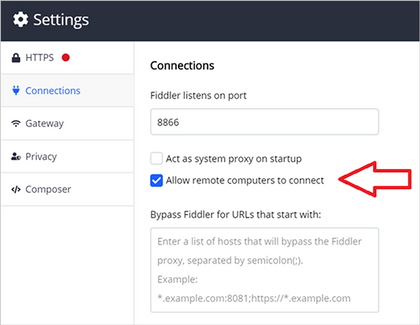
  3. Select Allow remote computers to connect.

  4. Select Save.

    Selecting "Allow remote computers to connect" in Fiddler's connections settingsSelecting “Allow remote computers to connect” in Fiddler’s connections settings


On your HoloLens 2, configure Fiddler as the proxy server*:


  1. Open the Start menu and select Settings.

  2. Select Network & Internet and then Proxy on the left menu.

  3. Scroll down to Manual proxy setup and toggle Use a proxy server to On.

  4. Enter the IP address of the PC where Fiddler is installed.

  5. Enter the port number noted above (default is 8866).

  6. Select Save.


*If your HoloLens 2 devices is running Windows Holographic builds 20279.1006 and later (Insiders and the upcoming release), use the following steps to configure proxy:


  1. Open the Start menu and go to your Wi-Fi network’s Properties page.

  2. Scroll down to Proxy.

  3. Change to Manual Setup.

  4. Enter the IP address of the PC where Fiddler is installed.

  5. Enter the port number noted above. (default is 8866).

  6. Select Apply.


Decrypt HTTPS traffic from HoloLens 2


On your PC, export the Fiddler certificate.


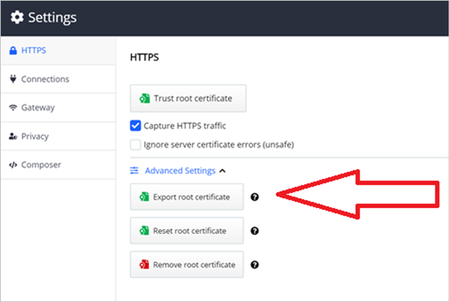
  1. Go to Fiddler Settings > HTTPS and expand Advanced Settings.

  2. Click Export Fiddler certificate. The certificate will save to your desktop.

    Exporting the root certificate in FiddlerExporting the root certificate in Fiddler
  3. Move the certificate to the Downloads folder on your HoloLens 2.


On your HoloLens 2, import the Fiddler certificate.


  1. Go to Settings > Update and Security > Certificates.

  2. Click Install Certificate, browse to the Downloads folder and select the Fiddler certificate.

  3. Change Store Location to Local Machine.

  4. Change Certificate Store to root.

  5. Select Install.

  6. Confirm the certificate is showing in the list of certificates. If not, repeat the above steps.


Inspect HTTP(S) sessions


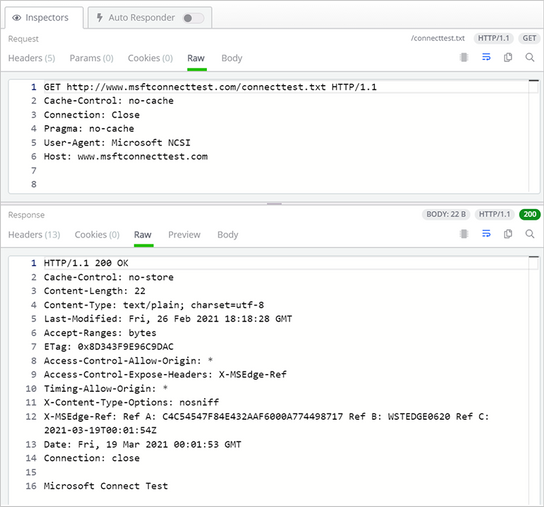
On your PC, Fiddler will show the HoloLens 2’s live HTTP(S) sessions. The Inspectors panel in Fiddler can show HTTP(S) request/response in different views – for example, the “Raw” view shows the raw request or response in plain text.


The Inspectors panel in Fiddler showing the HoloLens 2 HTTP sessionThe Inspectors panel in Fiddler showing the HoloLens 2 HTTP session

Wireshark


Applications like Dynamics 365 Remote Assist and VPN plug-ins use non-HTTPS traffic. If your HoloLens 2 has any issues with those types of apps, Wireshark can be used to capture and inspect the IP traffic to troubleshoot your internal OS level networking stack.


Configure Wireshark to capture network traffic from HoloLens 2


Prerequisites:


  • PC must have internet access and support Internet sharing over Wi-Fi.


Steps:


On your PC:


  1. Install Wireshark.

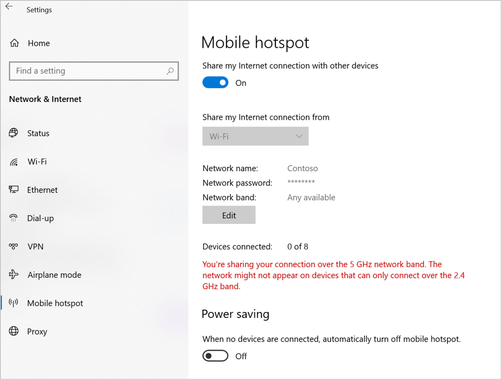
  2. In Mobile hotspot settings, turn Share my Internet connection with other devices to On.

    Mobile hotspot settings on the Windows 10 PCMobile hotspot settings on the Windows 10 PC
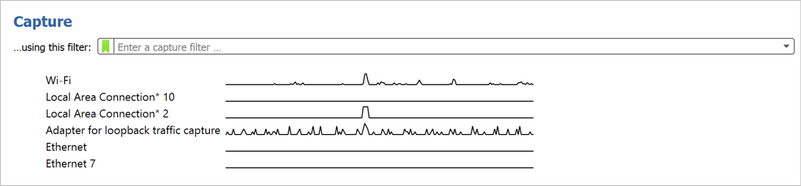
  3. Start Wireshark and capture traffic from the Mobile hotspot interface.

    The Capture screen in WiresharkThe Capture screen in Wireshark


On your HoloLens 2, change the Wi-Fi network to the PC’s mobile hotspot. HoloLens 2 IP traffic will now show up in Wireshark.


Analyze Wireshark logs


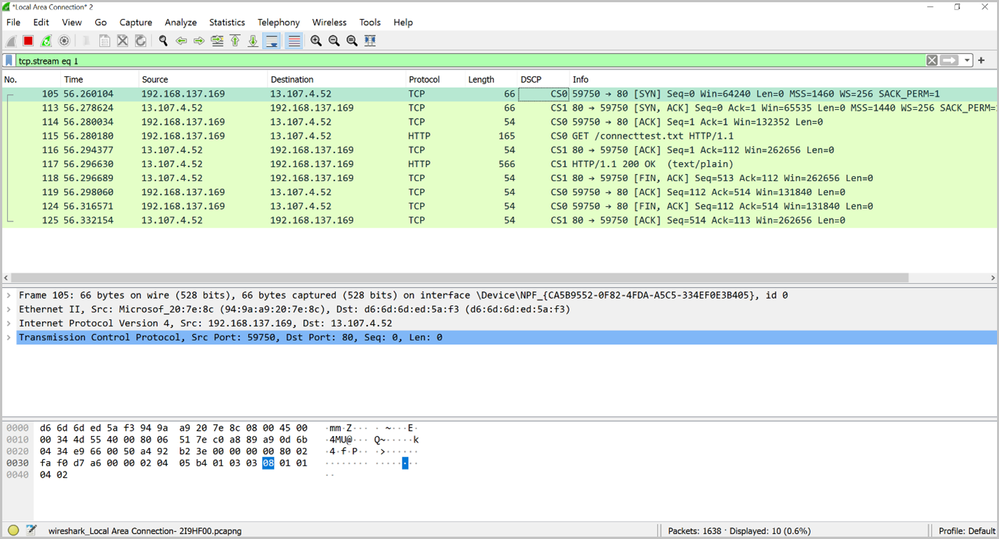
Wireshark filters can help filtering out the packets of interests. For example, “tcp.stream eq 1” shows the second TCP stream in the log (stream index starts with 0), “ip.addr == 192.168.137.1 && tcp.port == 80” filters out the TCP packets on port 80 with source/destination IP equals 192.168.137.1.


An example of the logs produced by WiresharkAn example of the logs produced by Wireshark


Conclusion


After deploying HoloLens 2 to your organization, you may need to capture network traffic for troubleshooting purposes. Both Fiddler and Wireshark will work with the HoloLens 2 to identify and diagnose problems in the HTTP(S) and TCP/UDP levels.


Feedback Hub and troubleshooting tips


HoloLens 2 provides a few methods for users to provide diagnostic logs to Microsoft for investigation. You can use Feedback Hub to submit logs for generic network connectivity issues by submitting your feedback through the “Network & Internet” category. In addition the built-in Settings Troubleshooter can collect detailed network traces for more complex issues. Please refer to Collect and use diagnostic information from HoloLens devices for instructions.


Additional resources


For additional information, please see:


Use SharePoint's new site templates today!

Use SharePoint's new site templates today!

This article is contributed. See the original author and article here.


You might not see this feature yet. Some functionality is introduced gradually to organizations that have set up the Targeted release options in Microsoft 365.


TemplatesCroppedHeader.png


Imagine you’re working on a project that needs a new SharePoint site to track deadlines, record progress, and serve as a central place to collaborate with your team. Perhaps you’ve been tasked with creating an onboarding portal for your organization complete with new hire checklists and key information to help them get startedMaybe you’re leading a training series where you need to store course files and post class announcements. Where do you begin when it comes to designing sites for these scenarios 


Now you have a starting point! We’ve made it even easier to begin on the right foot with site templates that are available to you in SharePoint. SharePoint site templates are flexible enough to address a variety of needs, make it easy to create and populate site content, and show you what’s possible. These complement those found in the SharePoint lookbook, which has been and continues to be an amazing source of inspiration for modern experiences you can build with out-of-the-box SharePoint components.   


SharePoint site template GIF.gif


Through customer conversations and user research, we identified 8 scenarios to start with that benefit from having a robust SharePoint site template. SharePoint customers can take advantage of the following SharePoint site templates:


Communication site templates


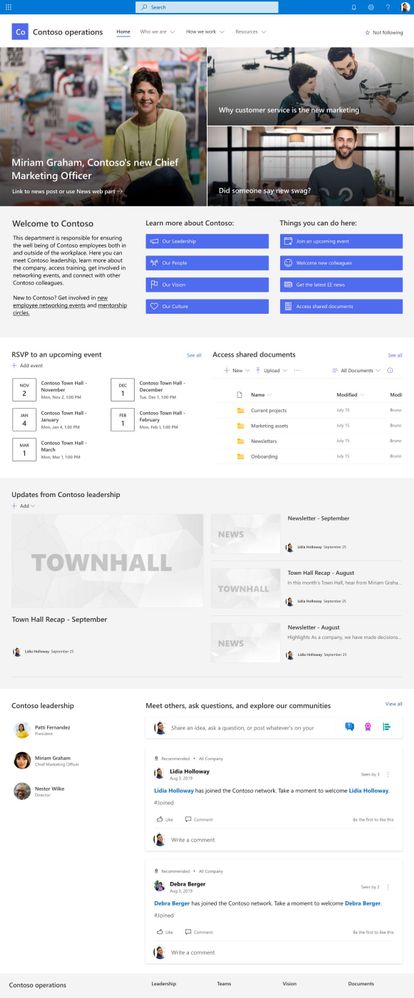
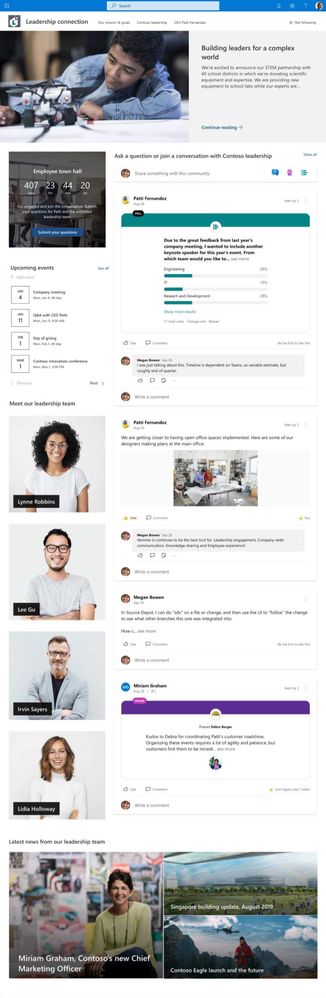
  • Department – Engage and connect viewers with departmental news and resources.

  • Leadership connection – Build community by connecting leadership and team members.

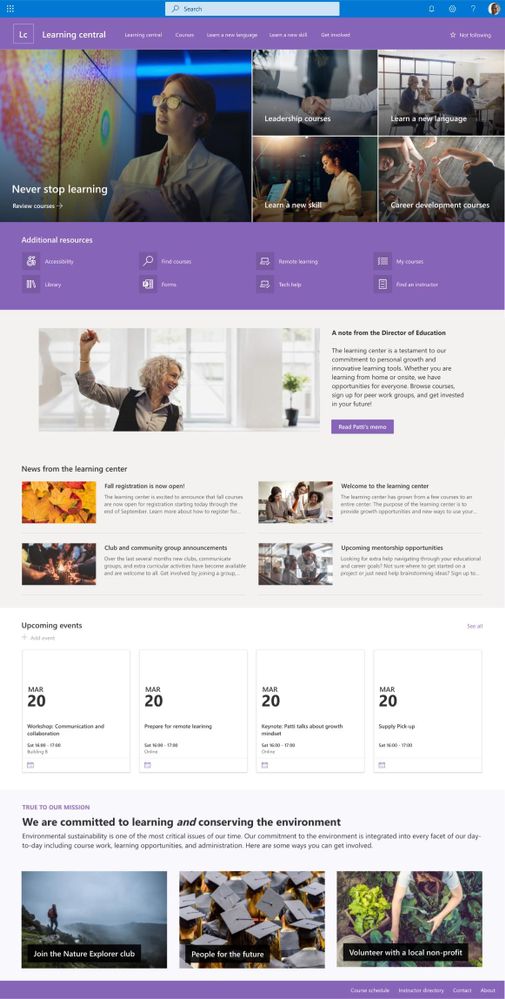
  • Learning central – Showcase learning and training opportunities.

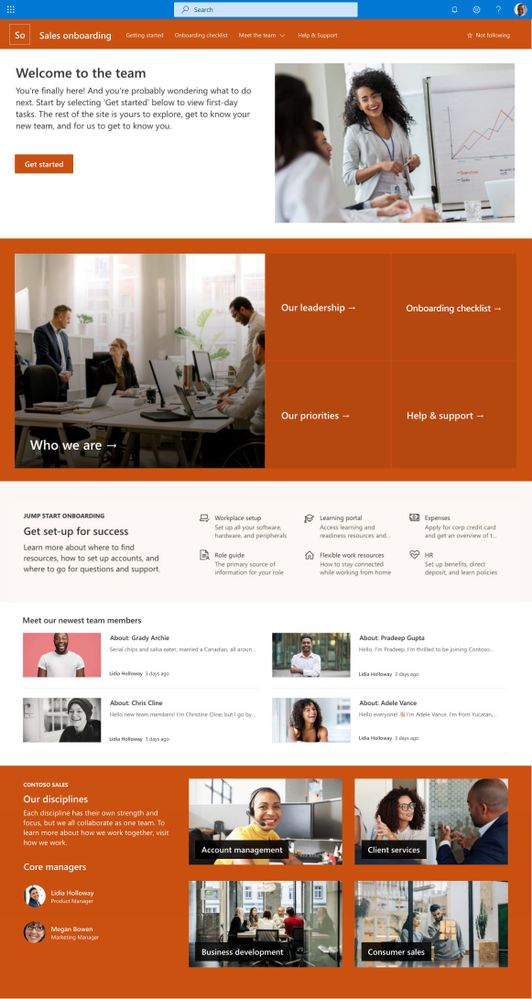
  • New employee onboarding – Streamline and refine new hire onboarding process.


Team site templates


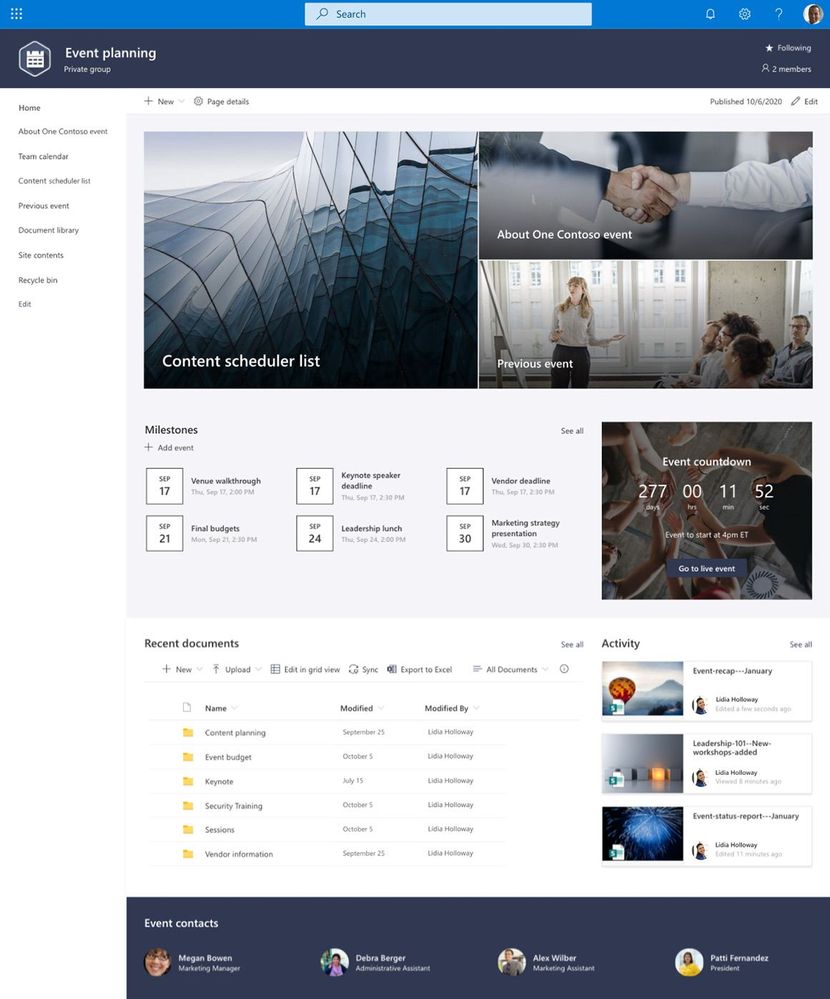
  • Event planning – Coordinate and plan event details with your team.

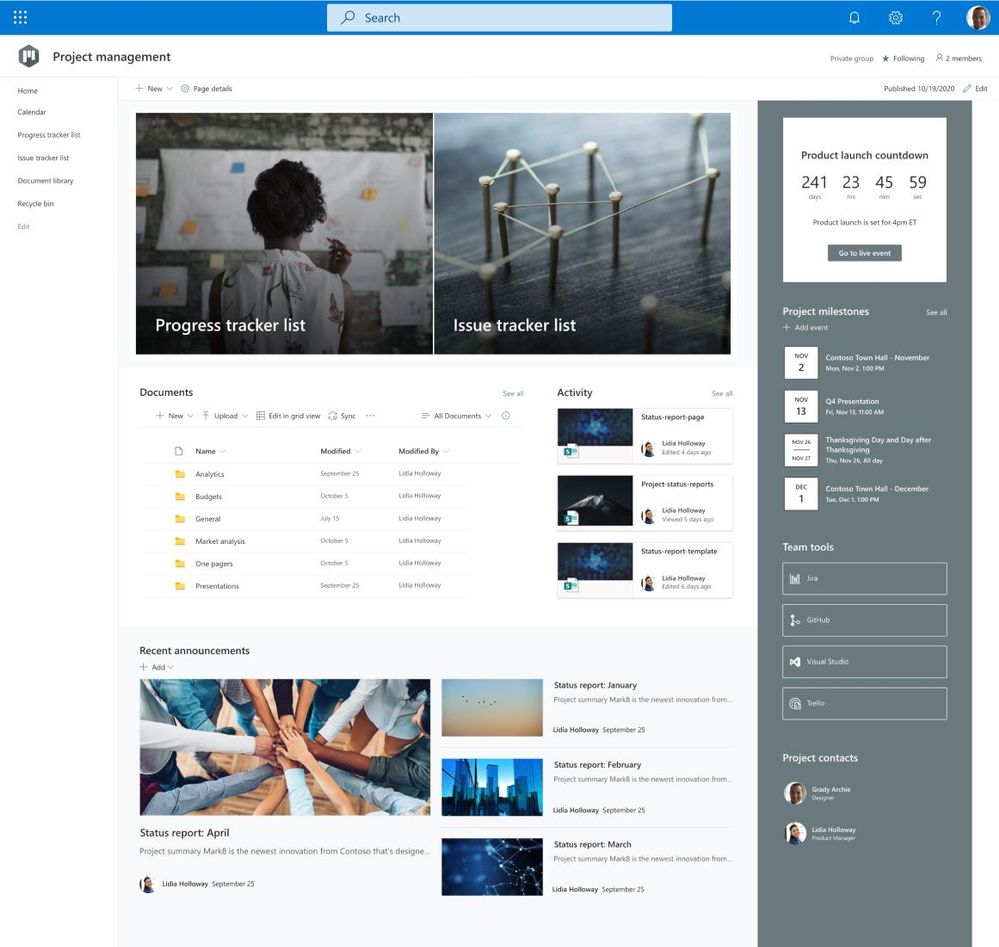
  • Project management – Create a collaboration space for your project team.

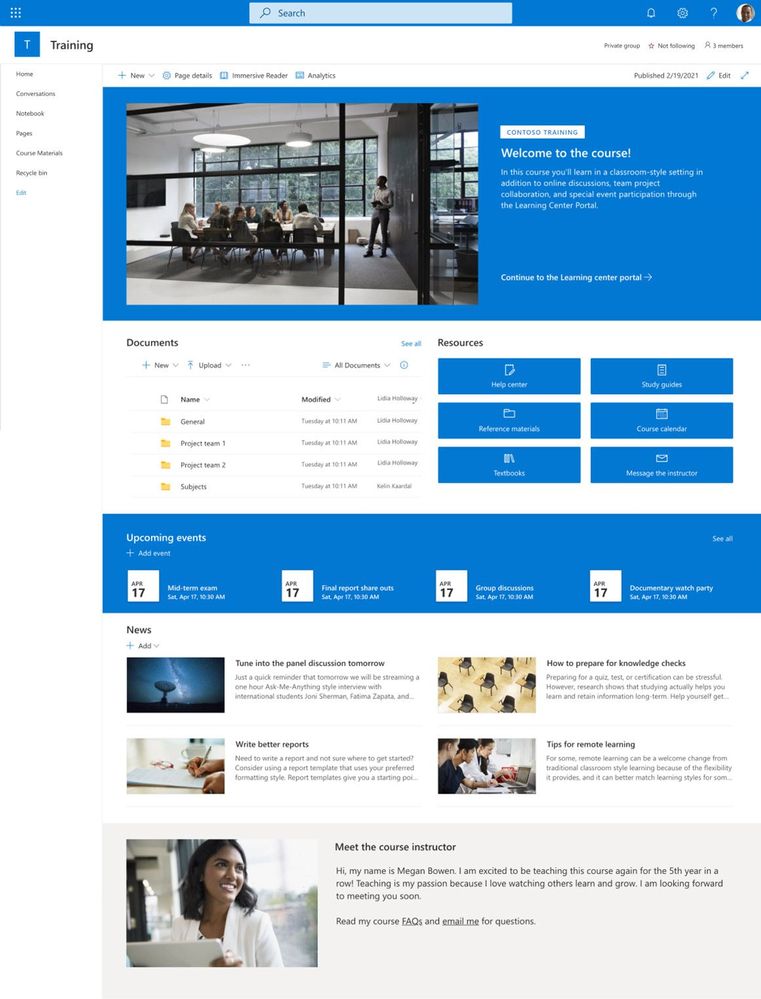
  • Training and courses – Prepare course participants for learning opportunities.

  • Training and development team – Plan opportunities to help others learn and grow.


We will continue to build on these options in the future to address even more common scenarios.


Project managementProject management


Event planningEvent planning
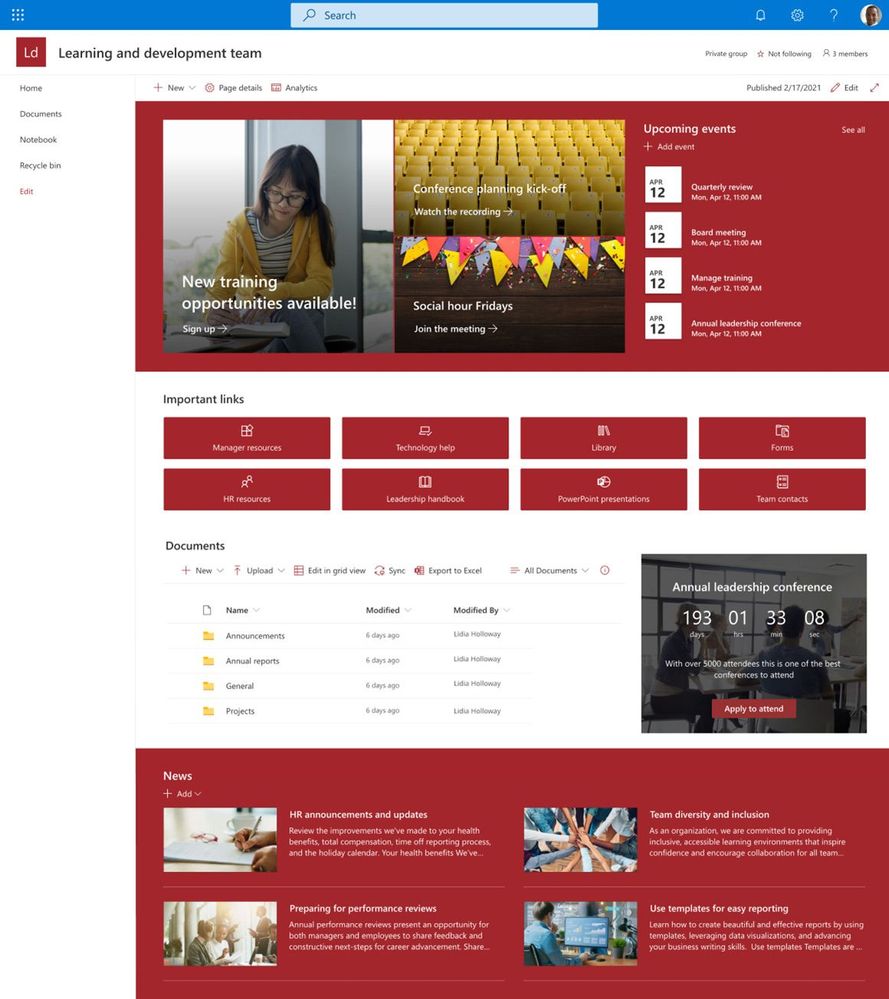
DepartmentDepartment Leadership connectionLeadership connection
New employee onboardingNew employee onboarding Learning centralLearning central
Training and coursesTraining and courses Training and development teamTraining and development team


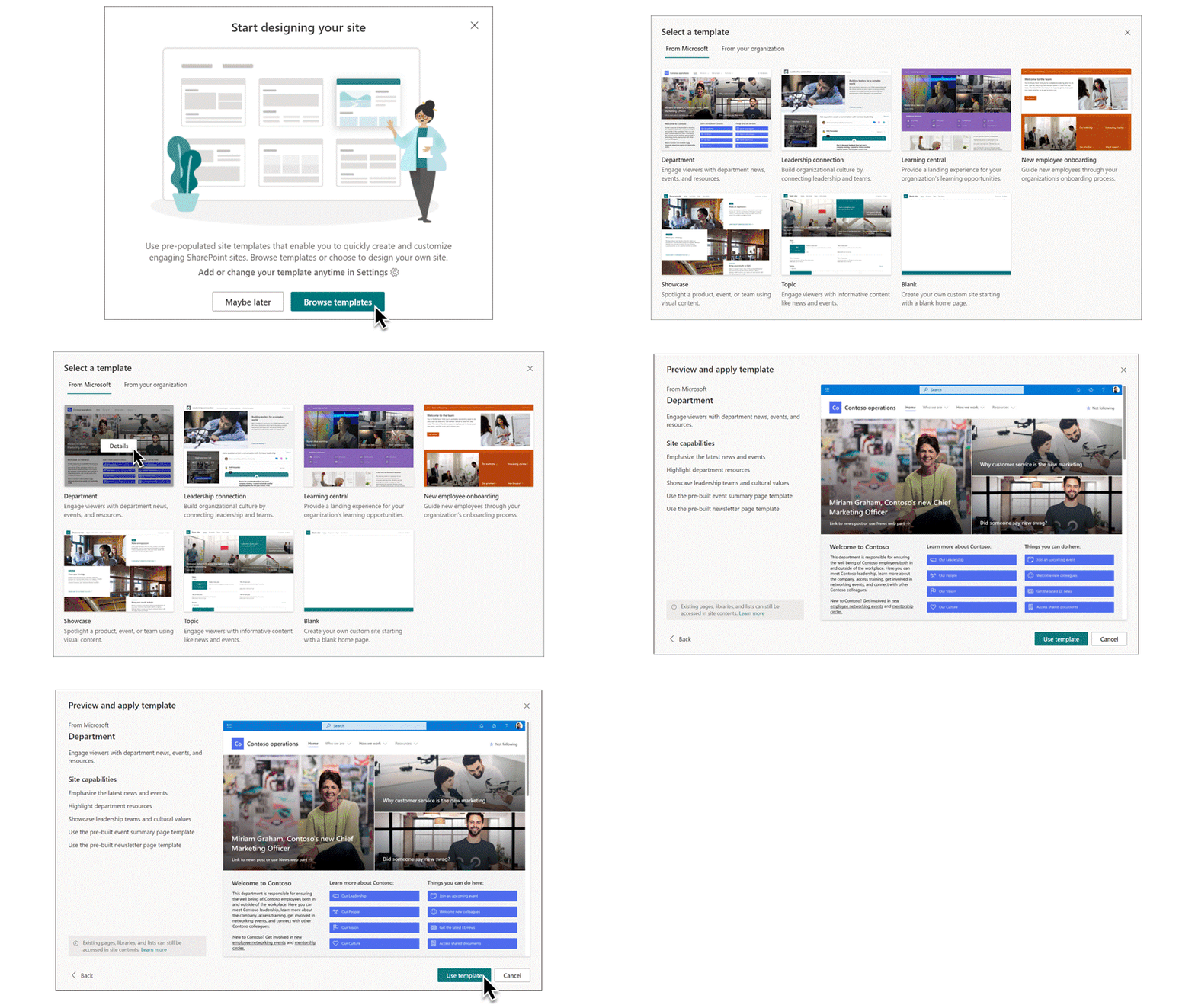
How to apply a template and what to expect


SharePoint site templates will be automatically available in SharePoint tenants and can be applied by users with site owner permissions or higher. When you create a new site, you will be asked if you’d like to use a template. Select Browse templates to see Microsoft templates and templates from your organization. Or apply a template to an existing site by navigating to Settings and then select Apply a site template.


Our site templates currently offer the following features:


  • Can be applied at the time of site creation or can be applied to existing sites.

  • Fully customizable home pages that come with pre-populated content and web parts.

  • News post templates that help users quickly and consistently publish news.

  • Pre-built pages, lists, and document library folders that make it easy to build sites and inspire your own custom content.

  • Each template has its own customization guidance to help site owners and editors get started.


What about my existing site designs?


If you’ve used site designs in the past, that experience has been incorporated into the site templates experience and will be referred to as site templates moving forward.


The Site designs entry point will be replaced by the Apply a site template entry point in the Site settings panel. You’ll find your organization’s existing site templates on the “From your organization” tab in the template gallery.


Additionally, as part of the new site template experience, a progress screen is displayed while the site template is being applied instead of a notification bar.


Learn more about how to create custom site templates for your organization using site scripts


Site template FAQs


Q: What happens when I apply a template to a site that is associated with a hub site?


A: If your site is associated with a hub, the site will inherit the theme from the hub. When you apply a template, it will automatically use the theme from the template, but will update to the hub’s theme shortly after republishing.


Q: How can I undo a template I just applied?


A: There is no automatic method to undo the application of a site template. However, there is nothing that a template does that can’t be manually applied or deleted. For example, pages and navigational elements can be deleted and themes can be update.


Q: I don’t want to use a template. How can I quickly create a site?


A: There are several resources to inspire your next SharePoint site – like the SharePoint look book and Guided walkthroughs.


Q: How can I update the theme of the site template to a theme that has not been defined by my organization?


A: For themes that don’t fit into your organization’s custom or pre-defined themes, you can change the look of your site in the Settings panel to manually update the theme. 


Q: What happened to Site designs in the Settings panel?


A: In previous versions of SharePoint, site templates were called site designs but will be referred to as site templates moving forward. The Site designs entry point has been replaced by the Apply a site template entry point in the Settings panel.


Q: How can I create custom site templates for my organization?


A: You can create site templates to provide reusable lists, themes, layouts, pages, or custom actions so that your users can quickly build new SharePoint sites with the features they need. Learn more about how to create custom site templates for your organization


Q: How can I learn more about how to customize site templates created by my organization?


A: Site templates provided by your organization will appear in the From your organization tab when selecting a template type. Customization instructions will vary depending on the site template design. Review customization resources below to learn more about site personalization options. 


Learn more


Apply and customize SharePoint site templates


SharePoint site design and site script overview


SharePoint Roadmap Pitstop April 2021 (microsoft.com)

Designing a Robust Defense for Operational Technology Using Azure Defender for IoT

Designing a Robust Defense for Operational Technology Using Azure Defender for IoT

This article is contributed. See the original author and article here.

Many IT executives are concerned about the security of Operational Technology (OT).  This concern is valid based on my experience, but sometimes the approaches to alleviating this anxiety creates a divide between the IT and OT sides of the ‘house’.  This blog will attempt to address this divide with practical suggestions about how to get the best results from a thoughtful approach.  It will also address methods to accomplish useful but non-intrusive monitoring in the OT environment.  It will provide specific technical examples to guide you.  If this tickles your interest, read further.


Passive network monitoring is one of the most effective and least intrusive tools to gain visibility into OT networks. Installed properly it provides information on inventory, network topology, protocols in use, endpoint types, switches and routers, etc.  Much of this information is not generally well documented and is only vaguely known by enterprise security teams. It lives below OT edge firewalls and is carefully guarded by the engineers who are responsible to make sure their factories continue to operate reliably.  As most security experts know, it is impossible to protect equipment you don’t know you have.


PushPull.jpgThere is a natural push-pull between enterprise security teams who are tasked with overall business protection and operational engineers who are more focused on production.  It is common for operational engineers to express concern that a network monitoring tool will affect the reliability of the OT equipment.  While they may be honestly concerned about cyber security, they fear repercussions if reliability is affected.  If corporate policy mandates monitoring, the security team is usually instructed to install their monitoring equipment as far away from the production equipment as possible.  This usually results in an installation at or near the enterprise edge firewall.  The most common argument is that anything bad will come from the internet which is on the other side of that firewall.  This is usually NOT the best location for OT network monitoring and the assumption relating to the source of threats is not accurate either. However, based on the urgency of schedules, this location is often accepted as better than nothing.  It is important to understand that the AD4IoT sensor is completely passive.  It only listens to copies of network traffic and as such is not a threat to operational technology.


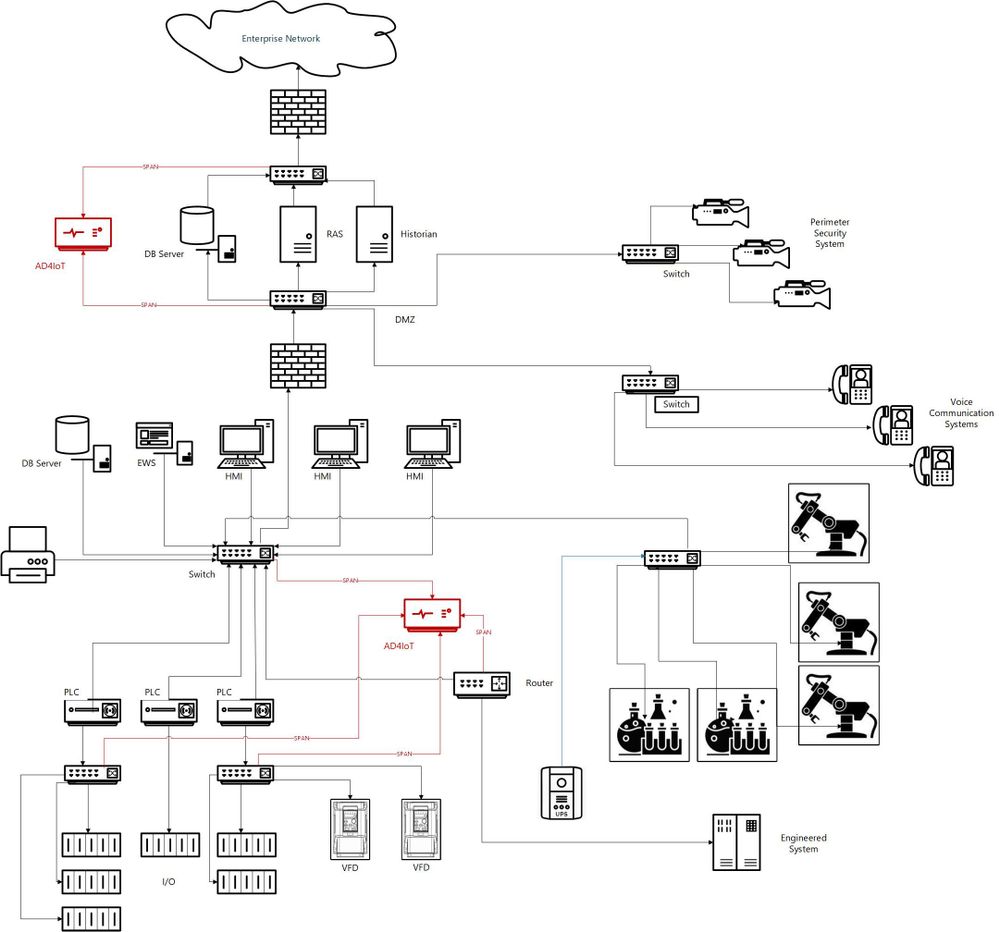
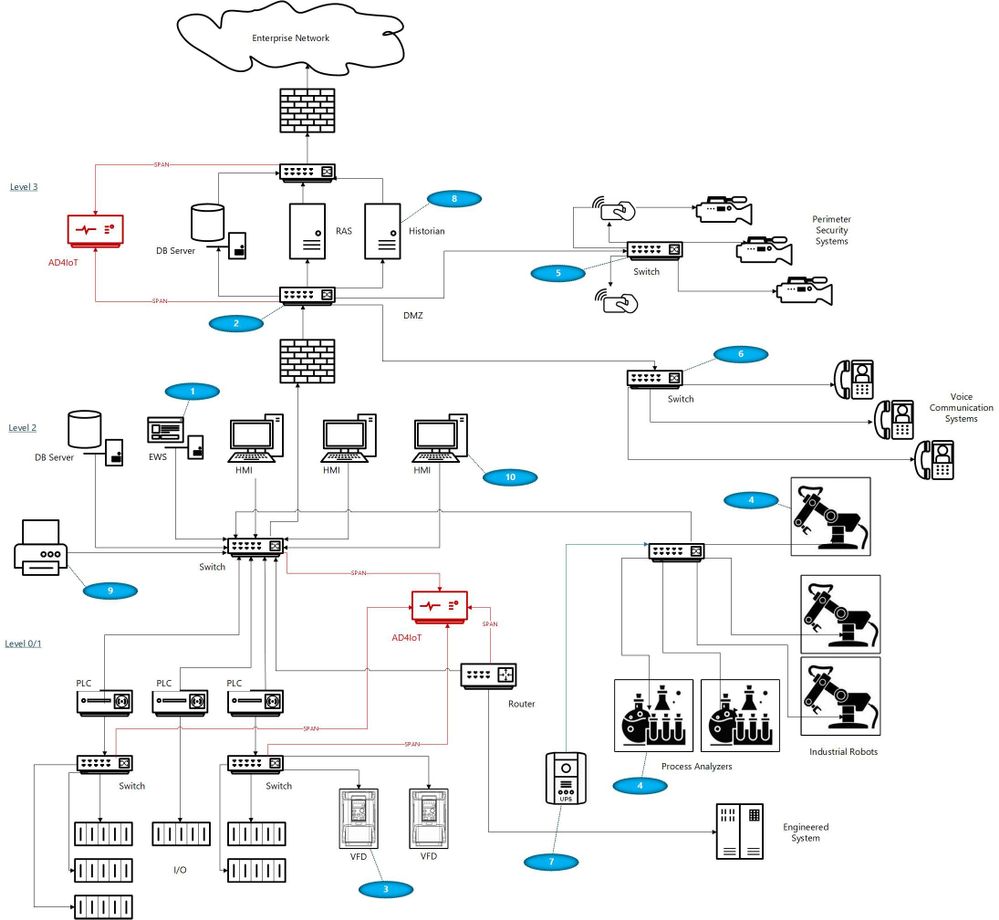
I would like to suggest a more reasoned approach, which admittedly takes more time and possibly resources, but results in a win-win for both groups if implemented well.  OT networks are often complicated by a variety of interconnected systems as shown in the next diagram.  The red sections of this diagram show the ideal locations for connections to the AD4IoT.  It is important to start implementation with a diagram of the OT system.  Diagrams of this sort are often provided as proposal documentation when Industrial Control Systems are purchased.  They may often be found in on control house walls, or in the OT engineer’s office. Because these systems continue to evolve, and are often upgraded in piecemeal fashion, these drawings are seldom up to date.  However, they still provide a reasonable starting point for understanding the best placement for sensors.  The point is to accurately and completely document the inventory of control equipment and the network architecture of the system.  If a sensor is only installed in the outgoing DMZ, much of this inventory information will not be available.  Information identifying the types and versions of Purdue level 0 to 2  devices will not be available.  To determine this information, the actual downloads to these devices must be seen by the AD4IoT sensor.


Drawing2.jpg


This is an example of an ICS diagram with the recommended locations of sensors (in red).


How can we identify if we are located at the best location?


A sample traffic taken too high in the network is analyzed below using the sensor.


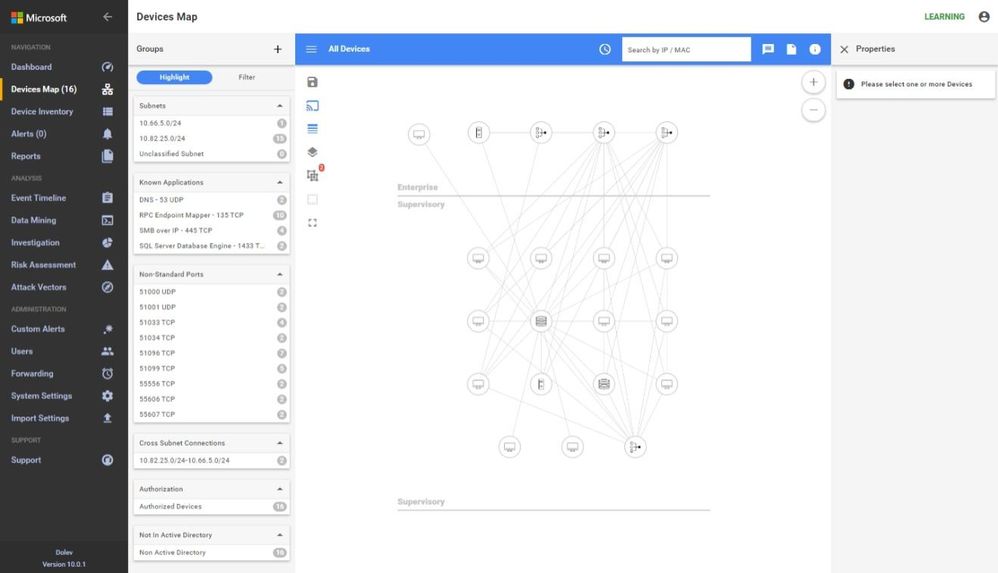
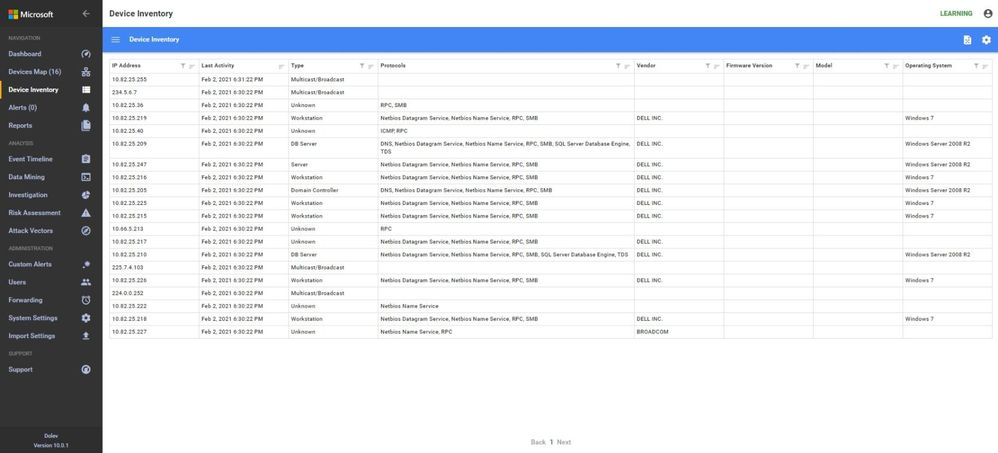
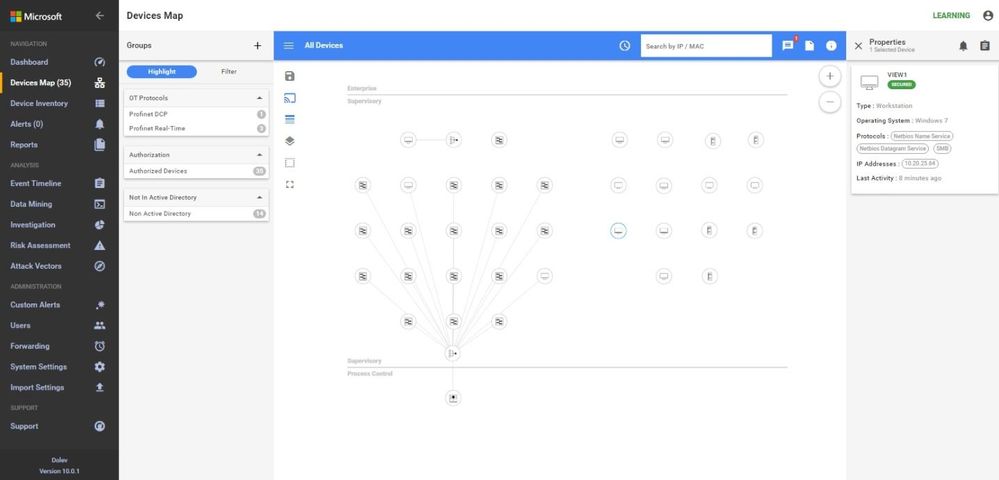
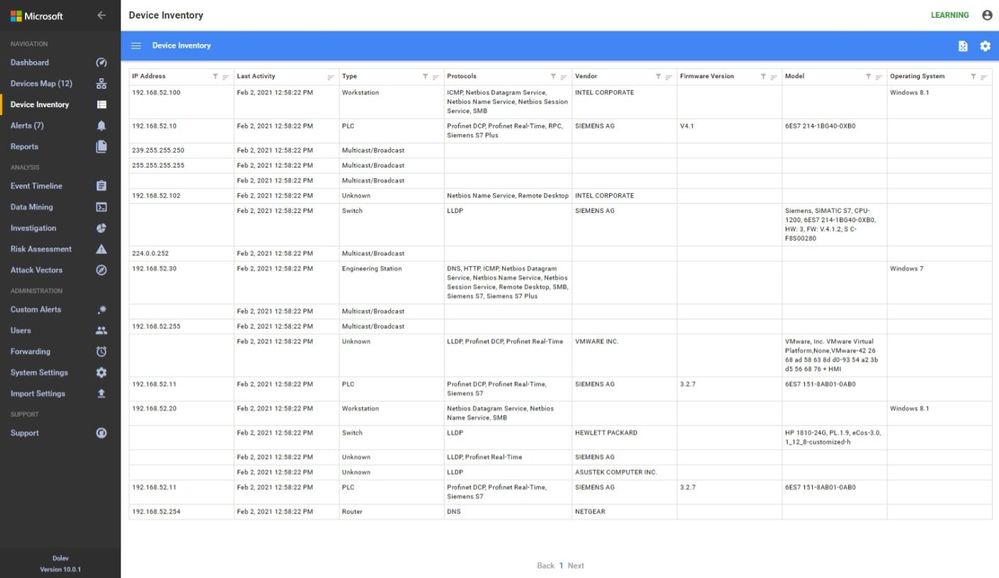
In these screen shots, the sensor is too high in the network, too close to the enterprise firewall.  Note that no devices in the Process Control Level 0/1 are shown.  The monitoring in this network shows the workstations and their interactions with database server, engineering, HMIs, and AD, some exiting traffic, but no PLC control traffic.


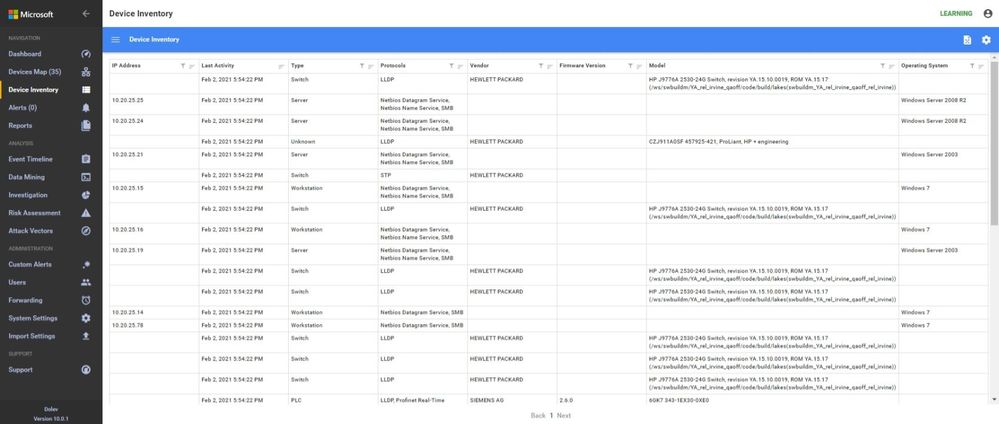
YSWE1121-devices.map.jpg.jpegIn the inventory, no firmware or model information is identified because the traffic to the PLCs is not being seen at this location in the network.


YSWE1121-device.inventory.jpg.jpegAnother similar instance is where the majority of the traffic is broadcast or multicast.  While some industrial control systems use this method for information transfer, the indications here are that the sensor is not seeing much of the control traffic.  Only one PLC is shown in the Process Control area and most devices are sending multicast traffic.  The switches are seen, the HMIs and database servers but not much control traffic as shown in the inventory view below.


omis-multicasts.device.map.jpg.jpeg


omis-multicasts.device.inventory.jpg.jpeg


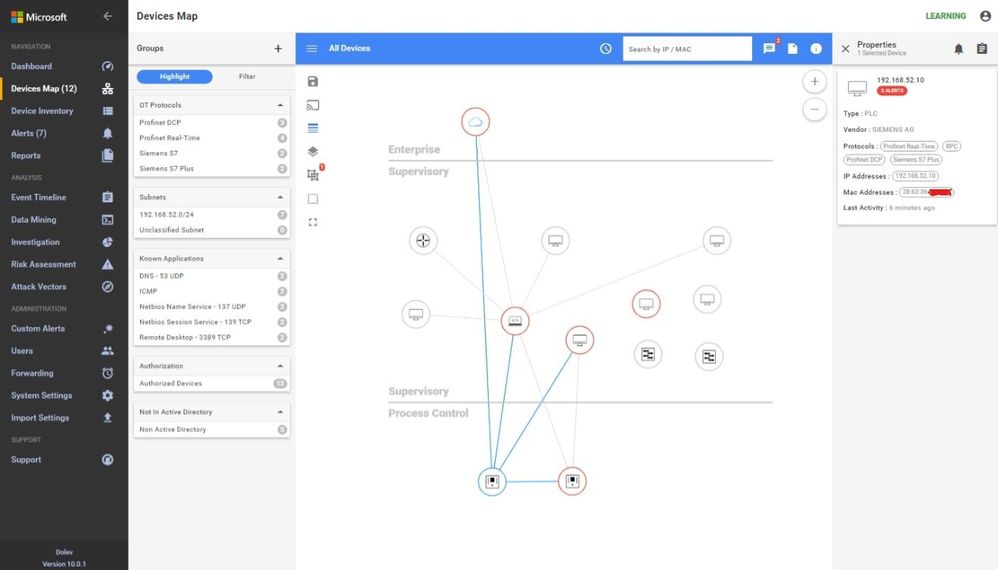
A properly configured system will look like this.  Notice the OT Protocols; Profinet DCP, Profinet Real-Time, Siemens S7 and S7 Plus.  Notice the balance between Supervisory and Process Control.  The sensor is seeing the traffic between the engineering workstation and the PLCs when they are downloaded as evidenced by the presence of firmware versions and PLC model numbers in the inventory. 


s7_profi_ether-devices.map.jpg.jpeg


s7_profi_ether-device.inventory.jpg.jpeg


Why not just monitor the enterprise edge?


I would like to address the reason for monitoring networks in the ICS in addition to monitoring at the enterprise edge.  Many people assume that this is adequate since they see this as the source of all threats.  I will use the sample ICS network shown above to discuss some potential access points for malware or data compromise, see below.


Drawing4.jpg


With your security ‘blue team’ hat on, think about these scenarios identified by numbers in blue ovals on the diagram:


  1. The ICS (or DCS) may be maintained by an external contractor, possibly the system integrator in the case of PLC systems, or generally the Original Equipment Maker (OEM), for DCS equipment. Sometimes these people are authorized to utilize laptops with specialized OEM software to perform upgrades, troubleshoot problems, install new hardware or do routine system maintenance.  Even if they are not permitted to utilize their laptops, they may install software, OS and firmware upgrades, and other activities utilizing programs they bring in on USB or other devices. 

  2. Many large organizations have network engineers who manage all or most network devices, including but not necessarily limited to switches, routers, firewalls, and the like.  Smaller organizations may contract networking engineers.  This being a rather specialized function, these folks usually operate somewhat independently of the normal operations personnel.  Exceptions would be when the ICS or DCS supplier either utilizes unmanaged devices or provides the management function as a part of their service.  Switch management and required firmware upgrades in addition to reasonable hardening is not normally on the ‘radar screen’ for many system upgrades.  The adage, ‘if it ain’t broke, don’t fix it’ is commonly the norm.

  3. Variable Frequency  Drives (VFDs) are generally maintained by the supplier.  Problem-solving, firmware upgrades, and system modifications are accomplished through contracts or purchase orders with the equipment provider.  These changes once again introduce uncontrolled laptops into the OT environment where these devices may be networked to the ICS.

  4. Very expensive process analyzers and industrial robots may be leased from the manufacturers.  This equipment often comes with a required data connection to the manufacturer for usage monitoring and troubleshooting purposes.  These connections should be and often are firewalled but may allow incoming traffic for firmware updates and other related activities.

  5. Most large organizations have physical security operations handled by separate internal organizations or through an externally contracted firm.  It is common to see security cameras that are used for both ICS and security functions.  Sometimes, the operator can even view the perimeter cameras or other cameras on his/her operator screens.

  6. It is also common to see voice communication equipment sharing switches or infrastructure devices with OT networks.  While these are generally on different VLANs, errors can connect these devices with OT equipment. 

  7. Additionally, there may be data links to Uninterruptible Power Systems (UPSs), again usually maintained by the OEM.

  8. Plant historian packages often have links to share plant data, inventory, and other information with the enterprise.

  9. Sometimes contracts are established for the maintenance of corporate printers. Since most of these devices have unpatched apache web servers, maintenance could introduce issues carried over from enterprise equipment.

  10. Operators have even been known to utilize USB ports on HMI devices to charge their phones thereby unknowingly placing the HMIs on a cellular network.

  11. Cleaning contracts, maintenance of support systems such as HVAC and fire protection generally allow access to controlled areas where physical access to ICS equipment could be leveraged by unscrupulous parties.


And the list can go on… with every industrial facility having different variations on this theme.  As any security-minded individual can readily see, the opportunities for compromise, malware infection, and data exfiltration in any large industrial campus are numerous. 


Conclusions


Coordination with operational engineers is the starting point to a win-win engagement.  The benefits are apparent to both enterprise and operations personnel.  With correct sensor placement, a complete inventory with full device information, firmware versions and model numbers can be derived. This is a benefit to both parties.  Additionally, the actual network flows can be confirmed, unexpected paths can be identified and potential vulnerabilities can be found and corrected.   


Monitoring Industrial Control Systems at the enterprise edge, while important, is by no means adequate.  Malware introduced, even if prevented from beaconing home by enterprise edge firewall rules, can still damage operational equipment and affect production or operational safety.  Data can be modified, control system programs could be changed to perform dangerous actions, company secrets could be stolen, and system backups corrupted. 


Azure Marketplace new offers – Volume 135

Azure Marketplace new offers – Volume 135

This article is contributed. See the original author and article here.


We continue to expand the Azure Marketplace ecosystem. For this volume, 79 new offers successfully met the onboarding criteria and went live. See details of the new offers below:


Applications


Adjuto.png

Adjuto: Adjuto is a liabilities, fees, and investor relationship management system for life insurance companies, asset management companies, and distributors. Adjuto helps users ensure commercial and regulatory compliance, manage fund liabilities, and remunerate intermediaries.


Assistant Anywhere.png

Assistant Anywhere: Assistant Anywhere from ACF Technologies combines its core customer experience software, Appointment Scheduling and Queue Management, with the new virtual technologies Wait Anywhere, Check-in Anywhere, and Q-Anywhere to deliver a complete virtual customer experience platform.


Bookigy.png

Bookigy: Bookigy supports flexible seating in offices, allowing employees to reserve workspace through their laptop or mobile phone. Managers can use valuable application data in the Bookigy dashboard to optimize workspaces and workflows.


Business SPECTRE.png

BusinessSPECTRE: Business SPECTRE is a business intelligence template and a data linkage framework for SAP enterprise resource planning. With Business SPECTRE, data can be rapidly extracted and transferred to Microsoft SQL Server. This app is available only in Japanese.


Comarch BSS.png

Comarch BSS: Comarch’s BSS (business support systems) portfolio allows telecommunications operators and small and medium-sized enterprises to manage billing, customer care, and service provisions through a fully digitized experience. Comarch BSS can be customized to your company’s specific requirements.


CoroPlus Machining Foresight.png

CoroPlus Machining Foresight: CoroPlus Machining Foresight performs analysis throughout the manufacturing value chain. It generates real-time and historic process reports based on data from machine tools, cutting tools, and other manufacturing software​.


CovidTestMan.png

CovidTestMan: CovidTestMan records the results of COVID-19 tests conducted by your organization and generates the necessary documents for payment by health insurance companies. This app is available only in Czech.


cta x - Control Test Automation.png

cta.x – Control Test Automation: Grant Thornton’s new control test automation solution, cta.x, can help audit departments use automation to reduce costs, create efficiencies, and enhance their value proposition. cta.x makes risk management and compliance data-driven, integrated, and automated.


DeviceOn Kiosk.png

DeviceOn/Kiosk+: Advantech’s DeviceOn/Kiosk+ makes it easy to onboard, visualize, operate, and manage your industrial IoT devices. Monitor kiosks and other devices with the solution’s easy-to-use interface, troubleshoot problems, and send software and firmware updates over the air (OTA) on-site and remotely, at scale.


EasyCSV.png

EasyCSV: Blackbox Development’s EasyCSV is an automation platform that enables you to fetch CSV or XLSX files from Microsoft OneDrive and send the data to the Zapier online automation tool or to any app or API. You can also create CSV or XLSX files directly in OneDrive with data from Zapier or API calls.


educ8e.png

Educ8e: Educ8e from Lagetronix Nigeria Limited is a web-based management system for academic institutions. Easy to use and implement, Educ8e integrates admissions, registration, student billing, financial aid, and more, with self-service portals and a secure shared database.


Footprints for Retail.png

Footprints for Retail – SaaS: Footprints for Retail is an AI platform that conducts behavioral profiling of physical shoppers, anticipating their next move with the aim of improving their experience. Its predictive models and campaign automation enable marketing teams to increase efficiency.


Hexnode UEM.png

Hexnode UEM: Hexnode UEM is a one-stop solution for your enterprise’s device management needs. Hexnode UEM offers kiosk management and digital signage features, with a user-friendly portal that makes deploying apps and configuring policies a cakewalk for IT.


Icertis Promotions, Rebates & Royalties.png

Icertis Promotions, Rebates & Royalties App: From royalty payments in drug manufacturing to holiday promotions for major retailers, Icertis’ Promotions, Rebates & Royalties App helps businesses manage and optimize their promotions. The solution is built on top of the Icertis Contract Intelligence (ICI) platform.


ICONICS Suite v10.97.png

ICONICS Suite v10.97: ICONICS Suite version 10.97 features GENESIS64, an HMI SCADA solution; Hyper Historian, a high-speed, 64-bit historian; Quality AnalytiX, a monitoring solution for statistical process control data and product quality; and Facility AnalytiX, a commissioning software solution.


IFRS 17 in a Box.png

IFRS 17 in a Box: PwC’s IFRS 17 in a Box was developed in partnership with accounting and actuarial experts knowledgeable about the new insurance reporting standard. Its built-in visualization and reporting tools enable insurers to make quick sense of the numbers populating their primary financial statements and IFRS 17 disclosures.


ignio AIOps for Azure.png

ignio AIOps for Azure: ignio AIOps for Azure uses Microsoft Azure technologies and APIs to bring visibility to a diverse set of data in enterprises’ Azure estates. The solution’s actionable insights enable better management of diverse tools and resources.


ignio Cognitive Procurement.png

ignio Cognitive Procurement: ignio Cognitive Procurement is an AI-based analytics solution for procure-to-pay that screens purchase transactions and identifies opportunities to save money. Organizations can monitor live transactions to detect and predict problems. The solution can sit atop Microsoft Dynamics 365 or other e-procurement systems.


Imperva Data Security.png

Imperva Data Security: Imperva’s Sonar platform lets businesses secure their data and gain insight into how people are using it. Analytics automate detection of noncompliant, risky, or malicious data-access behavior across the database, enterprise-wide.


IntraActive Learning.png

IntraActive Learning: The IntraActive Learning portal from ProActive gives your employees easy access to Microsoft 365 online courses to drive efficient user adoption. The portal offers training in Danish and English.


Masatomo Marketing.png

Masatomo Marketing: This lightweight customer relationship management system from Masatomo (Shanghai) Corporate Management Co. Ltd. features marketing automation and smart reports. Use it to easily integrate and manage your omnichannel data. This app is available only in Chinese.


Model9 Cloud Data Manager on Azure.png

Model9 Cloud Data Manager on Azure: Model9 moves mainframe data to Microsoft Azure without any changes to the applications, enabling secure integration with Azure’s advanced analytics tools. With Model9, enterprises can reduce mainframe data management costs.


NonProfit Power Up - Batch Donation.png

Nonprofit powerUp – Batch Donation Capture: cloudThing’s powerUps are add-ons for the Microsoft Power Platform. Nonprofits can use the Batch Donation Capture powerUp to deliver batch processing for bulk donations received through offline channels. Audit logs can be automated, and features can be customized. 


NonProfit PowerUp - Communication Preferences.png

Nonprofit powerUp – Communication Preferences: cloudThing’s powerUps are add-ons for the Microsoft Power Platform. Nonprofits can use the Communication Preferences powerUp to manage General Data Protection Regulation (GDPR) rules, donor preferences, and internal information policies.


NonProfit Power Up - Donor Engagement.png

Nonprofit powerUp – Donor Engagement Scores: cloudThing’s powerUps are add-ons for the Microsoft Power Platform. Nonprofits can use the Donor Engagement Scores powerUp to analyze interactions with their donors and score their level of engagement.


NonProfit Power Up - Donor Influence Network.png

Nonprofit powerUp – Donor Influence Network: cloudThing’s powerUps are add-ons for the Microsoft Power Platform. Nonprofits can use the Donor Influence Network powerUp to create a connected donor network, then visually dive into donor relationships and pinpoint circles of influence.


Non Profit Power Up - Gift Aid Claim.png

Nonprofit powerUp – Gift Aid Claim Submission: cloudThing’s powerUps are add-ons for the Microsoft Power Platform. Nonprofits can integrate the Gift Aid Claim Submission powerUp with their customer relationship management system to automate gift aid submissions.


NonProfit Power Up - Historical Change.png

Nonprofit powerUp – Historical Change Management: cloudThing’s powerUps are add-ons for the Microsoft Power Platform. Nonprofits can use the Historical Change Management powerUp to capture changes to donor records in real time and publish them to audit logs in multiple destinations.


Nuance COVID-19 Vaccine Solutions.png

Nuance COVID-19 Vaccine Solutions: Nuance AI solutions, such as the COVID‑19 Vaccine Bot and the COVID‑19 Vaccine Assistant, answer customer questions and concerns about COVID‑19 vaccines. Other engagement options, including live chat and messaging on demand, enable customers to get answers without losing the human connection.


OneTrust Data Discovery and Cataloging.png

OneTrust Data Discovery and Cataloging: OneTrust Data Discovery is an AI-powered solution that helps organizations comply with data privacy laws, such as GDPR, CCPA, and LGPD, while flagging IT risk and managing broader data governance policies and programs.


OnSched API.png

OnSched API: OnSched specializes in building plug-and-play booking solutions that meet the needs of complex enterprises. The OnSched API scheduling platform features a fully accessible REST API with detailed developer documentation. Configure room bookings, in-store visits, meetings, and more.


Orpheus.png

Orpheus: Orpheus is an AI-powered knowledge engine that accelerates biomedical literature by analyzing and synthesizing millions of research papers. This helps scientists stay on top of the latest research and gain the critical insights needed to unlock the next level of discoveries.


Paribus 365 Data Quality Management.png

Paribus 365 Data Quality Management: Paribus 365, a data quality management solution designed for Microsoft Dynamics 365, provides fuzzy matching to improve search functionality, duplicate detection to avoid duplicate entities, and lead management to assist the lead qualification and engagement process.


ProFile Container.png

ProFile Container: Email is a leading form of business communication, but many email clients impose a limit on file size. Mevitco ProFile is a browser-based application that enables you to upload and share files of any size. The app comes in English and German, but additional languages can be added on request.


QAChat.png

QAChat: QAChat is a customer service quality assurance product for websites or embedding in robots. Customers can install a QR code at a retail store and call the chat service on a smartphone to inquire about a product. This app is available only in Japanese.


R&S Trusted Gate Encryption.png

R&S Trusted Gate: Encryption for Microsoft Teams, Microsoft 365, and SharePoint: R&S Trusted Gate provides encryption for Microsoft Teams, Microsoft SharePoint, and Microsoft OneDrive, along with the ability to decouple data from them, helping businesses comply with data regulations.


Rock Solid SIMA.png

Rock Solid SIMA: SIMA from Rock Solid Technologies is municipal accounting software that helps city and county leaders process taxpayer transactions, keep updated financial records, and provide better service to the public. SIMA is available in English and Spanish.


rxhealth.png

Rx.Health: Designed by physicians, the Rx.Health platform supports curation, prescription, monitoring, and improvement of outcomes, with multiple digital assets included in a digital toolkit or formulary.


Sapphire Connect.png

Sapphire Connect: This virtual machine supports the use of Sapphire’s penetration testing services, functioning like a security tester’s workstation plugged into your network and operated by remote control. All test traffic remains within your private network, enabling swift but thorough tests.


Self-service Payments, Sales and Delivery.png

Self-Service Payments, Sales and Delivery: Vourity allows businesses with unattended self-service operations, such as vending machines or electric vehicle charging stations, to accept payment in a variety of ways. Vourity works with point-of-service terminals, mobile sales, online sales, or social media sales.


SITA Mission Control.png

SITA Mission Control: SITA FOR AIRCRAFT’s Mission Control app fosters collaboration across teams with real-time air-ground information exchange and automated aircraft status updates. With Mission Control, airlines can better manage operational variability, turnarounds, fuel consumption, and carbon emissions.


SlashNext Microsoft 365 Phishing Risk Assessment.png

SlashNext Microsoft 365 Phishing Risk Assessment: SlashNext Microsoft 365 Phishing Risk Assessment is a free self-service assessment that analyzes URLs inside emails in user inboxes to identify phishing missed by email security services.


SlashNext Total Phishing Protection.png

SlashNext Total Phishing Protection: SlashNext Total Phishing Protection detects zero-hour threats by performing dynamic runtime analysis on billions of URLs a day through virtual browsers and machine learning. It delivers comprehensive coverage against credential stealing, rogue software, SMishing, scams, and scareware.


Spectrio MediaBridge.png

Spectrio MediaBridge (Formerly Industry Weapon): MediaBridge, an appliance for Spectrio’s CommandCenterHD Platform, handles content distribution to one or many digital signage devices on your internal network. MediaBridge also monitors media player playback and uptime so you can manage network health.


Stactize.png

Stactize: Stactize is a platform integrated with Microsoft Azure Marketplace APIs that offers subscription lifecycle management and helps independent software vendors take advantage of Azure Marketplace features with minimal development effort.


Transcend Control Center.png

Transcend Control Center: Transcend Control Center offers a way to centrally manage your edge devices. Monitor the performance of Transcend devices and tools with Transcend Control Center’s intuitive dashboard and extend device life with its early warning system.


Universal Policy Administrator.png

Universal Policy Administrator: Universal Policy Administrator allows administrators to manage Unix, Linux, SaaS applications, and more across a wide variety of platforms. With its policy translation and simplification processes, administrators can avoid having to use complex or non-intuitive scripting methods.


Virtusa CogniSense IoT Solution.png

Virtusa CogniSense IoT Solution: Virtusa’s CogniSense is a middleware IoT framework packed with extensive capabilities, from sensor data capture to advanced analytics to a rules engine at the edge. CogniSense seamlessly integrates with Virtusa’s data science platform.


Virtusa Health Bot Solution.png

Virtusa Health Bot Solution: Virtusa’s HealthBot, a digital self-assessment and self-scheduling tool for patients, is a component of Virtusa’s telehealth platform, HealthConnect. HealthBot improves patient access to remote care and boosts patient acquisition and retention.


VU Secure Onboarding Process.png

VU Secure Onboarding Process: Secure Onboarding Process from VU LLC authenticates a user’s identity through facial or voice biometrics combined with a document scan. The platform can be integrated with one-time password generators, device identifiers, context analyzers, and multichannel hardware.


Consulting services


1-Week Cloud2.png

1-Week Cloud2 Virtual Desktop Service Proof of Concept: Cloud2 will take care of your Windows Virtual Desktop assets on Microsoft Azure with expertise and cutting-edge technologies. Cloud2’s operations center will continuously manage your infrastructure.


Adatis Data Platform for Retailers.png

Adatis Data Platform for Retailers: 1-Hour Briefing: This centralized, enterprise-level data hub helps retailers understand their data and perform real-time analysis, providing a single view of the customer, promotional effectiveness, footfall analysis, and range optimization.


Azure Cloud Migration- 6-Week Implementation.png

Azure Cloud Migration: 6-Week Implementation: Get a free consultation from Prelude Systems to help choose the right method for migrating from on-premises operations to the cloud. Prelude Systems offers a five-stage implementation process and services tailored to your business needs.


Azure Launchpad- 10-Day Assessment.png

Azure Launchpad: 10-Day Assessment: Codec’s assessment will provide a blueprint for a comprehensive implementation and adoption strategy for Microsoft Azure. Through a detailed planning session, Codec will deliver a customized plan for your environment.


Azure Sentinel SIEM Health Check.png

Azure Sentinel SIEM Health Check – Free Assessment: Achieve maximum value from your Microsoft Azure Sentinel security information and event management (SIEM) investment with a free health check from Satisnet, a leading SIEM provider in the United Kingdom.


CAF for Azure- 1-Day Cloud Strategy Workshop.png

CAF for Azure: 1-Day Cloud Strategy Workshop: The Microsoft Cloud Adoption Framework for Azure (CAF) is a step-by-step process to transition your company to Microsoft Azure. CBS IT has adapted it for Russian businesses. This service is available only in Russian.


CAF starting steps.png

CAF Starting Steps: 1-Day Assessment: If you are already using cloud platforms or thinking about migrating to one, take advantage of Gofore’s free one-day assessment to get started with the Microsoft Cloud Adoption Framework (CAF) for Azure.


Contract & Spend Management Platform.png

Contract & Spend Management Platform: 1-Hour Briefing: Manage supplier relationships to save money, identify areas of risk, and improve quality of service with Adatis’ data platform, a visualization and reporting system on Microsoft Azure with self-service capabilities. 


Cyber Security Awareness.png Cyber Security Awareness and Phishing as a Service: This program from Alliance Business Technologies will train your employees to recognize the signs of phishing and other social engineering attacks through the deployment of simulated exercises and educational content.
Data & AI Platform for Education.png

Data & AI Platform for Education: 1Hr Briefing: In recent years, educational institutions have become more conscious of data and more responsive to it. This briefing will introduce the Adatis platform, a centralized enterprise-level data hub, and detail how it can address common educational challenges. 


Datacenter Migration- 10 Weeks.png

Datacenter Migration: 10-Week Implementation: XMS Technologies, a partner in Chile specializing in SQL Server and Windows Server migrations, will plan and migrate your datacenter to Microsoft Azure. This service is available only in Spanish.


Get started with your Data Strategy.png

Get started with your Data Strategy: 1hr Briefing: Adatis will help you reach your data goals with the right Microsoft Azure data and cloud strategy, tightening governance, improving decision-making, and driving innovation.


IT Pro (RU) Data Analytics Workshop.png

IT Pro (RU) Data Analytics Workshop: Join IT Pro for an immersive experience highlighting both the theory and the practical experience of Russian companies using Microsoft Azure, Azure Synapse Analytics, and Microsoft Power BI. This offer is available only in Russian.


LAB3 Data Assessment.png

LAB3 Data Assessment: LAB3 Solutions’ data assessment will spotlight modern data platform technologies in Microsoft Azure for midsize and enterprise customers who want to better use their data. 


LAB3 IOT Assessment.png

LAB3 IOT Assessment – 4 weeks: LAB3 Solutions’ assessment will help you understand the value of the Internet of Things (IoT) within your business, and it will advise on how to use sensor data to deliver greater business value. 


Managed Azure Sentinel SIEM.png

Managed Azure Sentinel SIEM: In this managed service, Bridewell Consulting Limited will deliver a SIEM service built on top of Microsoft Azure Sentinel. Bridewell will adopt a zero-trust, perimeterless security framework and customize the SIEM service to clients’ needs.


Managed Detection and Response.png Managed Detection and Response: In this managed service, Bridewell Consulting Limited will use the Microsoft security stack to create a layered and robust security architecture. Clients will receive access to Bridewell’s shared cyber threat intelligence along with continual updates and analytic improvements.
Manufacturing GAP-FIT Model.png

Manufacturing Value Chain GAP-FIT: 10-Week Assessment: The add.BI manufacturing gap-fit model assessment is a framework kit for manufacturing organizations looking for data and analytics best practices.


Microsoft Windows Virtual Desktop- 7-Day POC.png

Microsoft Windows Virtual Desktop: 7-Day Proof of Concept: SOS Group Limited will provide professional services to deploy Windows Virtual Desktop as a proof of concept for your organization to accelerate your deployment of secure remote desktops on Microsoft Azure.


Migration to the CIO Cloud.png

Migration to the CIO Cloud: 1-Week Assessment: Solitea will help with your digital transformation and smooth transition to a hybrid environment using Microsoft 365 and Microsoft Azure services. This offering is available only in Czech.


Optimize Azure.png

Optimize Azure: 4-Week Proof of Concept: Blue Turtle’s Optimize Microsoft Azure program provides full-stack visibility and automated resource management of your business services from application through to the underlying infrastructure.


Oracle on Azure.png

Oracle on Azure: 2-Hour Briefing: Developed by Dimension Data for organizational IT and finance managers, this free briefing will provide an introduction to migrating your Oracle workloads to Microsoft Azure or to PostgreSQL on Azure.


SAP on Azure 1-day assessment.png

SAP on Azure: 1-Day Assessment: Edenhouse Solutions invites you to a free one-day workshop to discuss migrating your SAP workloads to Microsoft Azure and to provide you with a clear roadmap.


Satisnet - Security Services.png

Satisnet – Security Services: 1-Day Assessment: In this engagement, Satisnet will detail the current Microsoft security services it offers. Get the most out of the Microsoft security products and services you already have within your infrastructure.


Teams Training & Support- 8 Weeks.png

Teams Training & Support 8-Week Implementation: Divurgent offers a Microsoft Teams solution using integrated AI to deliver enterprise initiatives to lower costs and deliver self-service training. Tobias, an AI chatbot hosted on Microsoft Azure, will be implemented for your company.


Windows Virtual Desktop (Persol).png

Windows Virtual Desktop: 1-Hour Briefing: Persol will provide an overview of the features and system requirements for Windows Virtual Desktop and the system and network requirements for the deployment. This service is available only in Japanese.


Windows Virtual Desktop- 2-Hour Workshop.png

Windows Virtual Desktop: 2-Hour Workshop: Enable your employees to work remotely, productively, and securely. Start with Brainscale’s workshop to understand Windows Virtual Desktop. Brainscale also offers a fast-track Windows Virtual Desktop deployment due to the prevailing COVID-19 pandemic.


Windows Virtual Desktop for the Enterprise.png

Windows Virtual Desktop for the Enterprise: 6-Week Implementation: Enable your enterprise with an automated and scalable multi-region Windows Virtual Desktop solution. Brainscale will deliver an enterprise solution for 50 to 1,000 users with Azure DevOps integration, autoscaling, and rightsizing. 


Xamarin Mobile App.png

Xamarin Mobile App: 10-Week Implementation: With locations across Canada, MNP brings the industry and technical know-how needed to accelerate cloud transformation. MNP uses Xamarin and Microsoft Azure to build cross-platform native applications.


Preventing Azure Active Directory terms of use from blocking Intune enrollment

Preventing Azure Active Directory terms of use from blocking Intune enrollment

This article is contributed. See the original author and article here.

By Wayne Bennett – Sr Program Manager | Microsoft Endpoint Manager – Intune


Using Microsoft Endpoint Manager – Microsoft Intune to set your company’s terms and conditions meets the requirements of many organizations. However, the Azure Active Directory (Azure AD) terms of use feature offers greater functionality— including terms of use in different languages and integration with Conditional Access in the form of grant controls. You can learn more about the differences between the two solutions in this blog post.


Potential to block access to Intune


If you’ve configured the Azure AD terms of use solution and set a grant control to require users to accept terms of use in your Conditional Access policy, you need to be aware of a configuration scenario that might unintentionally block access for your users when they try to enroll into Intune.


Typical configuration


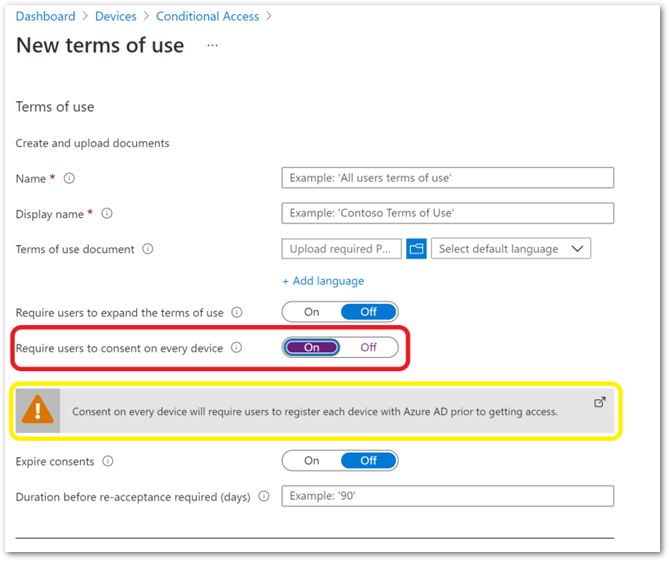
When creating an Azure AD terms of use policy, you have the option to select Require users to consent on every device. If you choose this setting, you will see the Consent on every device will require users to register each device with Azure AD prior to getting access warning. Once saved, you are unable to change this setting.


Example screenshot to register each device with Azure AD prior to getting access in a Conditional Access policyExample screenshot to register each device with Azure AD prior to getting access in a Conditional Access policy


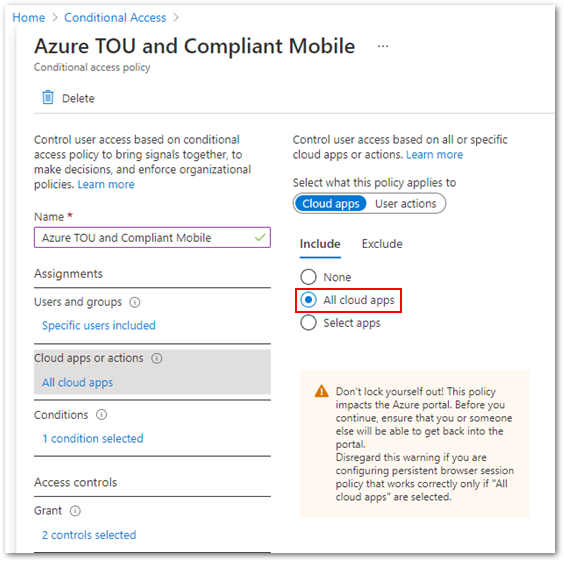
After you create the terms of use policy, the next step is to create a Conditional Access policy. As shown in the following example, many organizations will target All Cloud Apps without configuring any exclusions.


Example screenshot of targeting All cloud apps in a Conditional Access policyExample screenshot of targeting All cloud apps in a Conditional Access policy


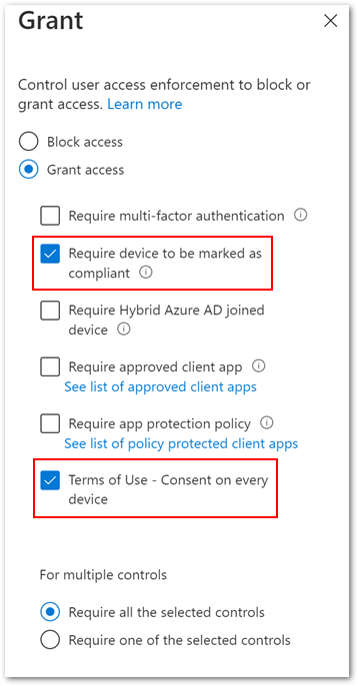
Additionally, many organizations will select Require device to be marked as compliant grant controls and require users to accept the Azure AD terms of use policy.


Example screenshot of configuring both the "Require device to be marked as compliant" and "Terms of Use" policies under the Grant controlExample screenshot of configuring both the “Require device to be marked as compliant” and “Terms of Use” policies under the Grant control


Blocking enrollment issue


The combination of Azure AD terms of use requiring users to consent on every device, Conditional Access policy targeting All Cloud Apps, and the control requiring the user to accept the Azure AD terms of use results in the following unintended behaviour during the Intune enrollment process:


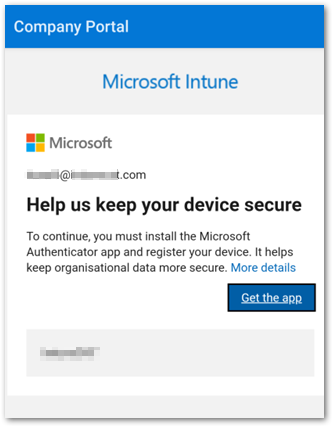
  • Once the user has authenticated in the Company Portal, prior to Azure AD terms of use appearing, the Help us keep your device secure message will appear. The user will be prompted to install the Microsoft Authenticator app, Conditional Access controls will begin a continuous registration cycle, and the user will be unable to complete enrollment.


The issue is caused by selecting Require users to consent on every device, requiring users to register each device with Azure AD prior to getting access, as per the warning, when creating the terms of use policy.


Example screenshot of the "Help us keep your device secure" messageExample screenshot of the “Help us keep your device secure” message


Prevent Intune enrollment from being blocked


There are two methods to keep the enrollment blocking scenario from occurring:


Method 1: The Terms of use dialog


The first method is to ensure that Require users to consent on every device in the Terms of use dialog remains at the default Off setting when creating the Azure AD terms of use policy.


Note


Once the Azure AD terms of use policy is created, it is not possible to edit the Require users to consent on every device setting. You must create and target a new terms of use policy in the Conditional Access policy.


Method 2: Exclude cloud apps


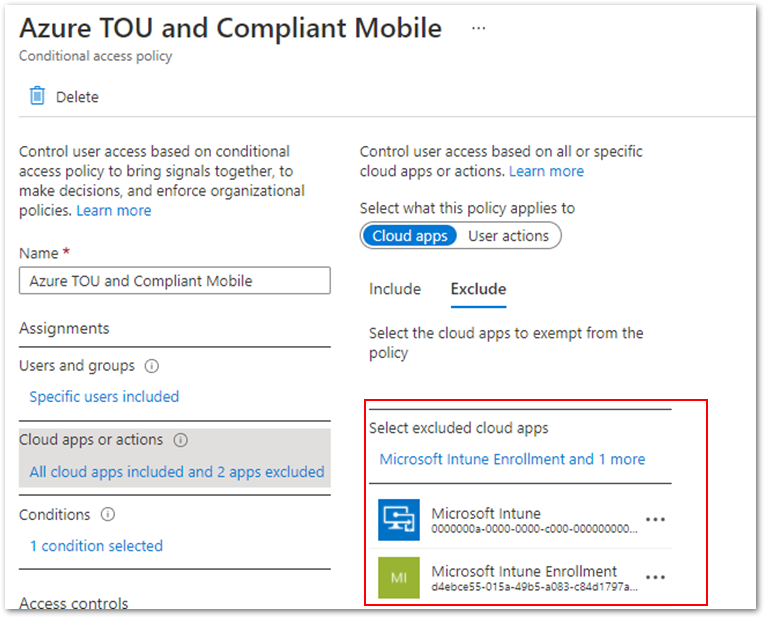
The second method is to exclude certain cloud apps from Conditional Access targeting. The Per-device terms of use section of the Azure Active Directory terms of use documentation states that “The Intune Enrollment app is not supported. Ensure that it is excluded from any Conditional Access policy requiring Terms of Use policy.” However, excluding the Microsoft Intune Enrollment cloud app is not sufficient— as the example below shows, you must also exclude the Microsoft Intune cloud app.


Example screenshot of excluding "Microsoft Intune" and "Microsoft Intune Enrollment" from the Cloud apps or actions listExample screenshot of excluding “Microsoft Intune” and “Microsoft Intune Enrollment” from the Cloud apps or actions list


Conclusion


Changing your configuration using either of the suggested methods will prevent the Intune enrollment blocking scenario. Before you make any change, be sure to evaluate the settings so you don’t impact any existing Conditional Access requirements.


More info and feedback


For further resources on this subject, please see the links below.


Plan an Azure Active Directory Conditional Access Deployment


Troubleshoot Conditional Access using the What If tool


What is Microsoft Intune


Conditional Access require terms of use


Cloud apps or actions in Conditional Access policy


Device compliance policies in Microsoft Intune


Let us know if you have any additional questions by replying to this post or reaching out to @IntuneSuppTeam  on Twitter.