by Contributed | Jun 16, 2021 | Technology
This article is contributed. See the original author and article here.
Organizations in every industry and sector are rethinking how business is done by evolving processes and products to meet new employee and customer needs. Envision being able to centrally manage equipment through low-power devices that connect legacy equipment and deliver data to Azure IoT over any protocol. Imagine modernizing how equipment is monitored and managed by using small IoT devices, instead of replacing all your infrastructure.
Tartabit IoT Bridge, a solution published to Azure Marketplace, is a complementary IoT service that extends Microsoft Azure IoT to support devices that use protocols not natively supported by Azure IoT, such as low-power wide area network (LPWAN), LightweightM2M (LWM2M), and CoAP. With Tartabit IoT Bridge, developers can rapidly integrate low-power, low-bandwidth devices into their Azure IoT-centric solutions. The low-code, no-code solution provides bi-directional options for use with Azure IoT Hub, Azure IoT Central, Azure Event Hub, and Azure Cosmos DB.
Microsoft interviewed Sigurdur Hjalmarsson, CEO at Taggr A/B, to learn what he had to say about the solution.
What do you like best about Tartabit?
Installation was painless. You just provision the devices, and they appear in Azure IoT.
We operate in the market for constrained IoT devices. These are small, battery-powered, very versatile, and efficient devices that connect legacy equipment to Azure IoT. Constrained IoT devices use network protocols and legacy protocols not natively supported by Microsoft Azure. We needed to communicate with many different types of networks.
Tartabit IoT Bridge solved our problem, and we can now focus on delivering faster to our customers. Tartabit IoT Bridge helps our devices talk to Azure IoT over any network.
How has the service helped your organization?
It straight out solves the problem of simplifying getting data from devices into Azure IoT across different networks. It is both flexible and simple to use.
Not a lot of companies pay attention to this network IoT issue. This product fills in the exact gap.
How is customer service and support for Tartabit?
Service is exceptional. We are in Europe, and when we have a problem and report it, they get on it right away and it is solved by mid-day. I wish my organization worked like that.
Any recommendations to other users considering this product?
I would recommend Tartabit IoT Bridge to any Azure customer who needs to connect various legacy devices and deliver data into Azure IoT over different protocols. Tartabit can easily turn any second-class protocols into first-class protocols.
What is your overall rating for this product?
4.5 out of 5 stars.
With over 25,000 apps and services to support innovation in your IT portfolio, Azure Marketplace is empowering users to find cloud applications built on Azure, such as Tartabit IoT Bridge. Explore Azure Marketplace to find apps and services curated by category, workload, and industry. Plus, take advantage of free, short trials on selected apps to see if they’re right for you.
by Contributed | Jun 16, 2021 | Technology
This article is contributed. See the original author and article here.
Welcome back to Reconnect, the biweekly series that catches up with former MVPs and their current activities.
This week we are thrilled to be joined by none other than four-time Windows Mobile MVP Christophe Cordonnier! Hailing from Vendée, France, Christophe currently works as a systems and networks administrator. “I’ve always loved IT and I’m really happy to have my passion for my job,” Christophe says.
Christophe started his career about 35 years ago as a computer scientist with Windows 3.1 and Windows NT3.51. Today, he remains happy to work within the Windows ecosystem and in an industry that he enjoys.
Looking back on his time as an MVP, Christophe says he is proud to have worked with Windows Phone and attend two MVP Summits. “Those summits were without a doubt the ‘best computer moments’ that I have experienced in my life, so thanks Microsoft for that!”
“It’s a shame that Microsoft no longer offers Windows Phone because they were without a doubt the best smartphones on the market.”
Nonetheless, Christophe maintains his passion for all things mobile with his website Smartphone France, which has been sharing the latest and greatest in cellular tech since 2002.
Speaking to the next generation of MVPs, Christophe recommends: “Be yourself and above all do it for fun. If you do things for fun you will become very good and can go very far.”
“I am proud today to be part of this Reconnect community. It’s really nice of Microsoft to keep in mind the ‘old guys’ and keep the passion and spirit alive!”
For more on Christophe, check out his Twitter @spfrance
by Contributed | Jun 16, 2021 | Technology
This article is contributed. See the original author and article here.
Are you looking for the right Microsoft Power Platform and Dynamics 365 certifications to help advance your career and to earn the recognition you deserve? We’re here to help you discover the career path that’s right for you—whether you’re just starting out, looking to advance, or wanting to change to something new. When you pass a Microsoft Certification exam, you let the world know that you have these in-demand skills. In addition to providing evidence of your mastery of technical skills, certifications can boost your confidence and highlight your drive to keep pace with technical change.
The combination of your growth mindset and a globally recognized, industry-endorsed Microsoft Certification sends a career-building message to employers. To help you discover your career path and choose the certifications that are right for your journey, we’re kicking off a new series of blog posts that explain the value and benefits of Microsoft Power Platform and Dynamics 365 certifications.
In this post, we offer a quick overview of our fundamentals certifications. These certifications let the world know that you’ve mastered the basics of Microsoft Power Platform or Dynamics 365—whether you’re new to the field or brushing up on your skills as a seasoned professional—and that you’re ready to advance.
The fundamentals certifications
Certifications matter. The Global Knowledge 2020 IT Skills and Salary Report points out, “A majority of certified IT professionals experience two main certification benefits: better job performance and higher salaries.”[1] A fundamentals certification is a great way to help open doors to professional advancement. If you’re new to the workforce, having a fundamentals certification on your résumé can set you apart. If you’re already in your career, you know that organizations need to keep pace with the digital transformation trend. A certification tells employers that you’ve studied for and passed an exam for specific skill sets and that you’re ready to keep learning, regardless of where you are on your career path.
A fundamentals certification can be the first milepost on your journey as you prepare for role-based or specialty certifications, but it isn’t a prerequisite for any of them.
The Microsoft Certified: Power Platform Fundamentals certification proves that you can use your Microsoft Power Platform skills to improve your team’s productivity. No experience is necessary to train for it—just basic familiarity with computer technology, data analytics, cloud computing, and the internet. You earn it by passing Exam PL-900: Microsoft Power Platform Fundamentals.
There are two fundamentals certifications for Dynamics 365. The first is for those who are familiar with customer relationship management (CRM) and are IT savvy—either generally or through work experience. The Microsoft Certified: Dynamics 365 Fundamentals (CRM) certification can highlight those skills and enhance your career journey. You earn it by passing Exam MB-910: Microsoft Dynamics 365 Fundamentals (CRM) (beta).
The other fundamentals certification is for those who have a broad exposure to the enterprise resource planning (ERP) capabilities of Dynamics 365 and who understand the basics of how finance and operations apps fit in within the overall Microsoft ecosystem. Earn Microsoft Certified: Dynamics 365 Fundamentals (ERP) by passing Exam MB-920: Microsoft Dynamics 365 Fundamentals (ERP).
These two certifications that focus on CRM and ERP skills are replacing the older Dynamics 365 Fundamentals certification, which retires on June 30, 2021.
Benefits of fundamentals certifications
Microsoft created fundamentals certifications to build and validate understanding of technologies that businesses use. These very popular technical certifications are held by professionals all over the globe. They build the foundational skills and provide a pathway for earning certifications based on deeper technical skills required to perform industry roles. We keep these certifications current with market and industry demands.
In the annual Nigel Frank survey on Dynamics 365 salary and marketing trends, 61 percent of respondents say that a certification gives you an edge in the job market. And 28 percent of professionals with a certification report that they experienced a pay increase after successfully completing their training.
People in different roles and career stages can benefit from fundamentals certifications. These include:
- IT professionals who want to show a general understanding of the applications they work with.
- Business stakeholders and others who know Microsoft Power Platform or Dynamics 365 and want to validate their skills and experience.
- Developers who want to highlight their understanding of business operations, ERP, or CRM.
- Students, recent graduates, and people changing careers who want to leverage Microsoft Power Platform or Dynamics 365 capabilities to move to the next level.
How do I get started?
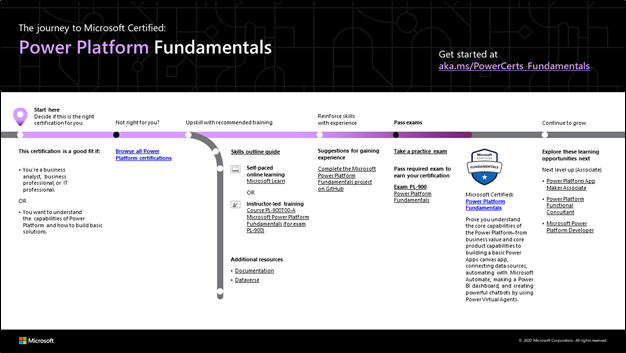
If you need more experience before you take the exam, we recommend that you work closely with a Microsoft Power Platform or Dynamics 365 expert on your team and take on a project to deepen your skills. Then explore our training opportunities. No matter where you are on your journey, we have training to fit your needs. To get started, check out our three fundamentals certification journey maps. You can also find the journey maps in the resources sections on the associated certification and exam pages.
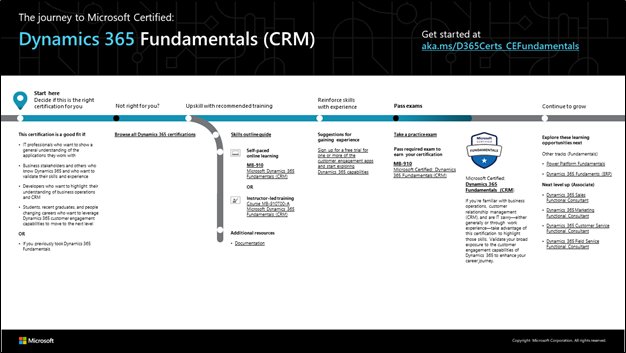
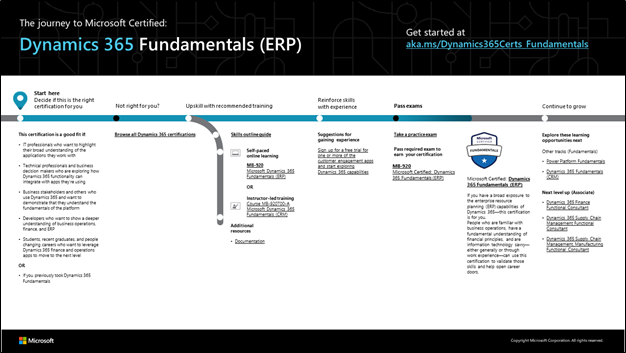
To map out your path, choose the journey map for your fundamentals certification. Then follow the sequence in the map. As shown at the beginning of the map, start by deciding whether this certification is a good fit for you.
Next, choose the training you’ll need to be prepared. To understand what you’ll be measured on when taking Exam PL-900, Exam MB-910, or Exam MB-920, review the skills outline guide on the associated exam page. Then sign up for the training that fits your learning style and experience:
Practice exams are available for some certifications. For example, you can take a trial run for the Microsoft Power Platform Fundamentals exam with the PL-900 Microsoft Official Practice Test. All the exam objectives are covered in depth, so you’ll find what you need to be ready for any question.
After you pass the exam and earn your certification, you can continue to broaden your technical expertise by taking one of the other certifications described in this blog post or by exploring other fundamentals offerings. Each certification you earn validates proven capabilities in a specific line of business. This can be very valuable for an IT professional who wears many hats. Or dive deeper into the intermediate and advanced certifications for your targeted career journey. Check out the possible Microsoft Power Platform and Dynamics 365 certification paths.
Where’s my community?
You’re not alone! Share your career journey with others who have similar interests in Microsoft Power Platform and Dynamics 365 technologies. Here are some places where you can share and gather information and learn from your peers and others.
Celebrate with the world: Post your badge on LinkedIn
When you earn a certification or learn a new skill, celebrate your accomplishment with your network. It often takes less than a minute to update your LinkedIn profile and share your achievements, highlight your skills, and help boost your career potential. Here’s how:
- If you’ve earned a certification already, follow the instructions in the congratulations email you received. Or find your badge on your Certification Dashboard, and follow the instructions there to share it. (You’ll be transferred to the Acclaim website.)
- For more information on badges, check out the Certification Badges FAQ.
- To add specific skills to your LinkedIn profile, go to your profile page and update the Skills and endorsements section. Tip: We recommend that you choose skills listed in the skills outline guide for your certification.
Related blogs and other resources
Ready to discover your career path?
Join the community of professionals who have earned a Microsoft Certification—to help land that first job, advance your career, or shift your focus to a new and exciting technology. These certifications not only validate your technical skills and experience but also help ensure that you’ve got what it takes for those key roles that employers need to fill.
1 Source: Global Knowledge, 2020 IT Skills and Salary Report, 2020.
by Contributed | Jun 16, 2021 | Technology
This article is contributed. See the original author and article here.
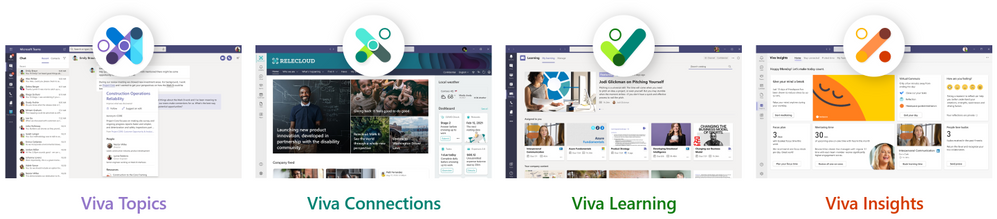
Our Microsoft Mechanics series on Microsoft Viva is almost in the books! If you’ve missed the series so far, start with our introduction to Viva, then dive into each of the modules: Viva Topics, Viva Connections, and Viva Learning. The video for Viva Insights will be available very soon. Each module video gives a brief overview of the solution, the experience across different roles, and IT guidance for implementation.
The Microsoft Mechanics videos are fantastic technical primers for deploying Microsoft Viva throughout your organization. But the employee experience platform is a robust solution, and you probably have questions the videos don’t answer. That’s why we’re hosting our first-ever Microsoft Viva Ask Microsoft Anything (AMA) on June 23 at 9:00-10:00 a.m. PST.
We’ll have some of our best folks from the Microsoft Viva team on hand to answer all your questions during this hour-long session. Curious who you should assign as knowledge managers in Viva Topics? Ask us! Wondering how to optimize your SharePoint page for Viva Connections, or what’s on the roadmap for Viva Learning? Ask us! Looking for best practices to share with your team about virtual commute settings in Viva Insights? Ask us anything! The floor is yours.
Visit our dedicated Microsoft Viva AMA page at aka.ms/VivaAMA for instructions about accessing the event and posting questions on June 23. In the meantime, add the AMA to your calendar.

See you soon!
by Contributed | Jun 16, 2021 | Technology
This article is contributed. See the original author and article here.
Hello folks,
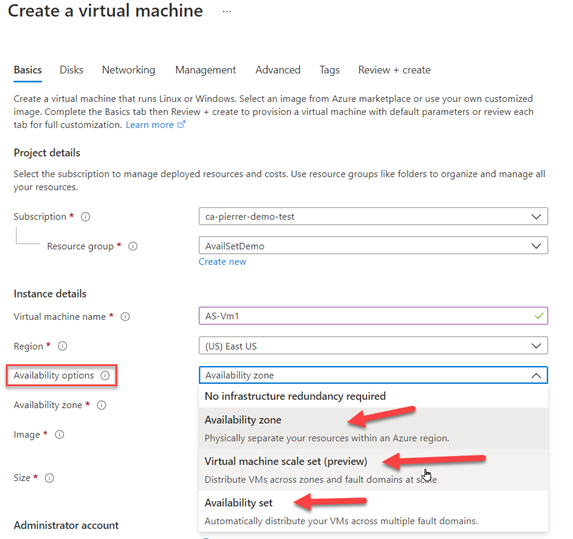
I’ve been looking at ways to scale regular VM up and down without having to create a full VM template used by the existing VM Scale Set. And I wanted a way that did not force me to choose between Availability and Scalability. I found my saving grace with Virtual Machine Scale set with flexible orchestration (VMSS Flex for short)
The way it’s been so far you almost HAD to choose. For example. If I’m doing a database cluster, I need to ensure that I have replicas up, and that some percentage of those VM are always up. (and yes I know that if I’m looking for resiliency and scalability for a database I’d be better off with a PaaS service) but for this example I can use Availability set allowing you to spread those VM across fault domains. (Azure Fault domains are defined as group of VMs that share a common power source and network switch.). I could also use Availability Zones (unique physical locations within an Azure region).
On the other side – the Scalability side – of that choice we have VM Scale Set in Uniform orchestration mode – essentially allowing me to create a VM template and “stamp” out as many as I need. (VM Scale Set is really built to deploy and manage a set of identical, virtual machines.) but with a scale set you don’t have as much control over each node as you would with a regular VM. You can only have one set of VM size for your set…
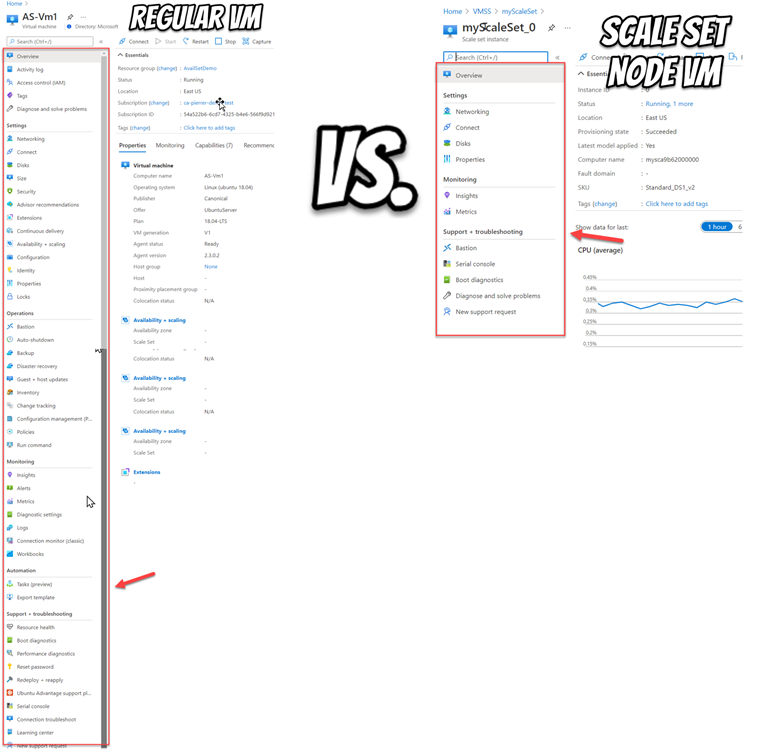
VMSS Flex is really the cumulation of all the things we learned with all the options listed above.
VMSS Flex is like a scale set, where you’re still defining a template, defining capacity and where you want them (fault domains and zones), BUT… it’s also like an Availability Set where you can put specific instance in this grouping. For example, I can setup a VM with specific configuration and place it in Fault Domain 1 and another specifically configured VM and place it in fault domain 2. VMSS Flex also support scalability (auto-scale) based on schedule or metrics. That’s where the flexibility starts but not where it stops.
The scaling out is NOT limited to VMs of the same size like we had in the traditional VM scale sets (otherwise known as VM Scale Sets with Uniform orchestration). You could start with 3 large VM for the standard load but scale out or burst with Spot instances. This enables you to scale out your application while maintaining fault domain isolation that is essential to run quorum-based or stateful workloads, including:
- Quorum-based workloads
- Open-Source databases
- Stateful applications
- Services that require High Availability and large scale
- Services that want to mix virtual machine types, or leverage Spot and on-demand VMs together
- Existing Availability Set applications
VMSS Flex now gives you FULL control over these VMs. You have control over the NICs the Disks, you can snapshot them, back them up individually, use Azure Site recovery… Everything you can do with the existing VM ecosystem.
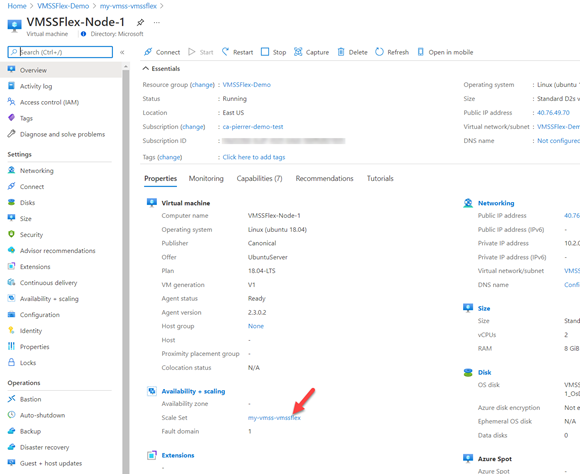
This has real potential. VMSS Flex is still in preview. If you want to check it out, follow the instructions here.
To conclude, As far as I’m concerned, VMSS Flex should be the location for ALL my VMs going forward. And By the way we are working on a series that will cover:
- Quick create
- Availability at scale
- Cost optimization
- Types of workloads
- Stateful, Open source DBs
- Stateless web apps
- Load balancing
- Managing individual VMs
- Manually scale and Metrics based scale
- Predictive autoscaling
And more…
So subscribe to this blog and don’t miss a thing.
Cheers!
Pierre


Recent Comments