by Scott Muniz | Aug 19, 2020 | Azure, Microsoft, Technology, Uncategorized
This article is contributed. See the original author and article here.
This installment is part of a broader series to keep you up to date with the latest features in Azure Sentinel. The installments will be bite-sized to enable you to easily digest the new content.
Every second counts. Some security incidents are unstoppable, but when prevention isn’t possible, the right investigation and response is everything. To help SOC analysts’ quickly reason over copious amount of security volume, we are delighted to introduce a set of enhancements that enrich and improve the investigation experience in Azure Sentinel.
Enable Line Numbers to Aid Quicker Debugging of Your Azure Sentinel KQL Queries
The Azure Monitor team released a new capability that enhances that way your SOC analyst reason and monitor the critical security data ingested into Azure Sentinel. To help enable quicker debugging for KQL queries in the Log Analytics workspace, analysts have the ability to enable line numbers to their KQL queries to quickly identify the line in which an error exist.
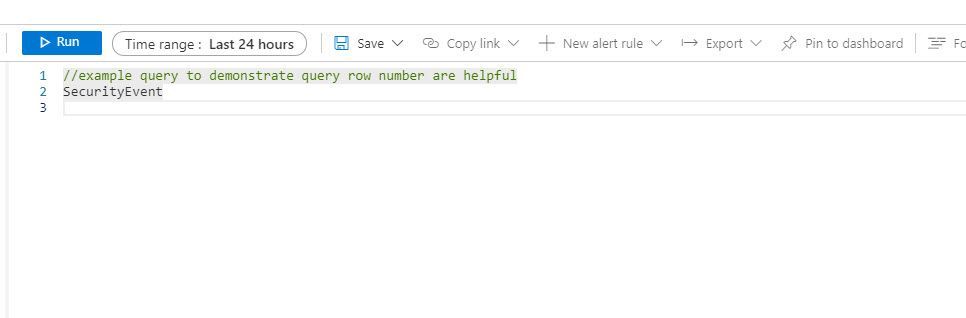
With this enhancement, when creating a Log Analytics query, each row in the query editor is indicated by a number:
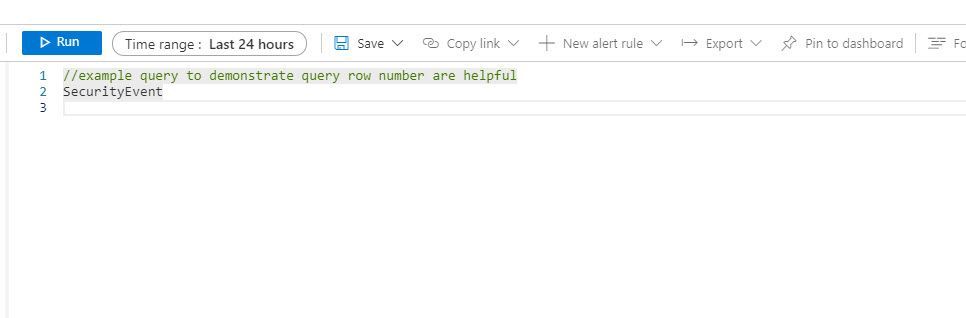
This makes it easier to find the part of the query you need, when composing a new query.. The new line numbers work in tandem with our new error messages.
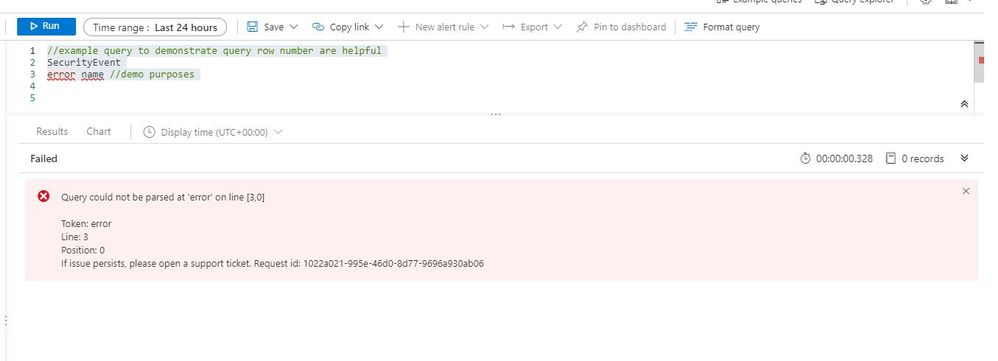
If there’s an error in the query the analysts composed, our newly designed error messages will indicate the row where an issue was found. Row numbers in query editor makes it faster and easier to find the issue and provides guidance to get rectify the error.
How to enable:
Open the Settings panel by clicking on the Settings cog icon and select the switch to turn row numbers off and on.
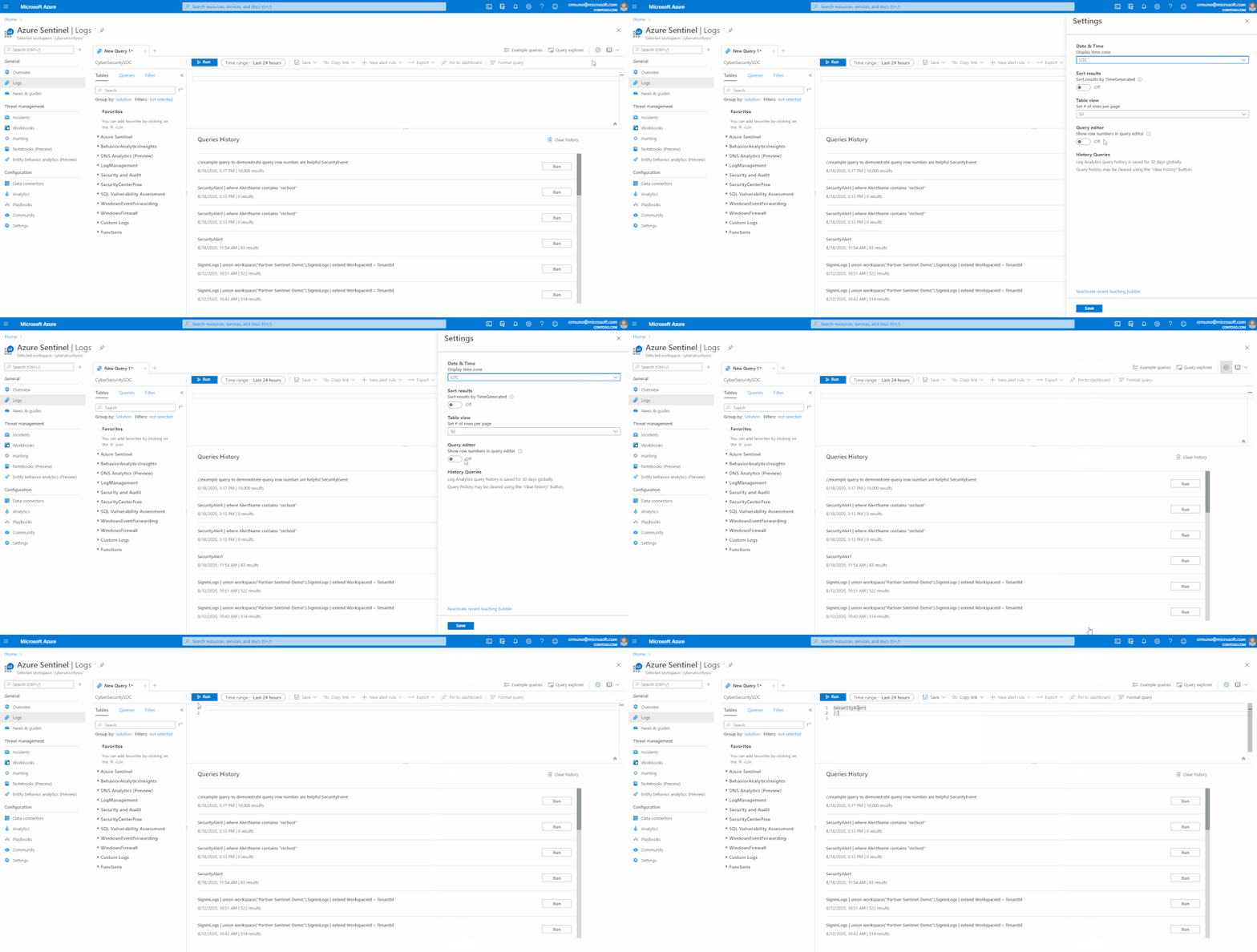
Azure Sentinel in the logs screen schema
Small, but never the less important, finally it is “Azure Sentinel”, rather than “SecurityInsights” on the schema pane of the log screen in Sentinel and in Log Analytics. This will help your SOC analysts easily identify all the data tables under the Azure Sentinel solution.
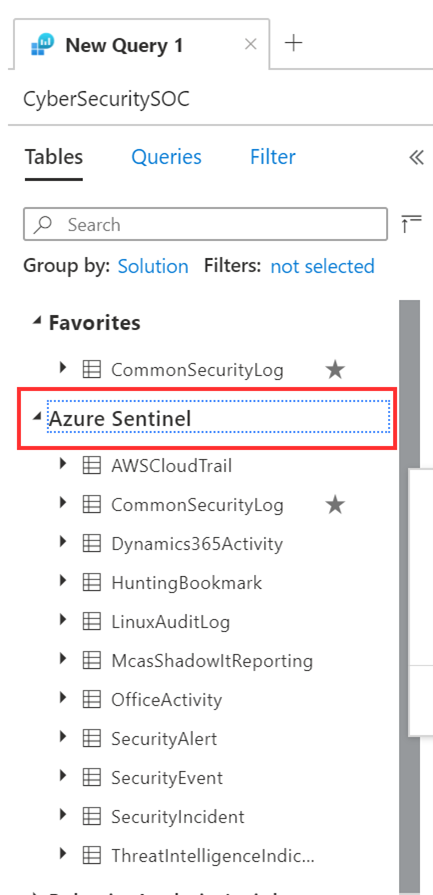
Get started today!
We encourage you to leverage the new enhancements aid in debugging and improving the investigation experience in Azure Sentinel.
Try it out, and let us know what you think!
by Scott Muniz | Aug 19, 2020 | Azure, Microsoft, Technology, Uncategorized
This article is contributed. See the original author and article here.
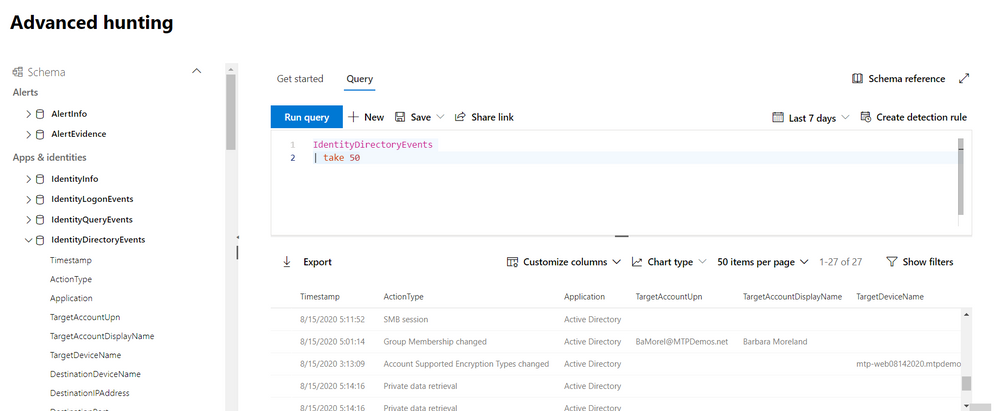
We’re thrilled to share that you can now hunt for threats using events on your domain controller with advanced hunting in Microsoft Threat Protection.
The new IdentityDirectoryEvents table—available in public preview—incorporates data from the Azure Advanced Threat Protection (Azure ATP) sensor, including various identity-related activities, such as account password changes or remote creation of scheduled tasks on the domain controller.
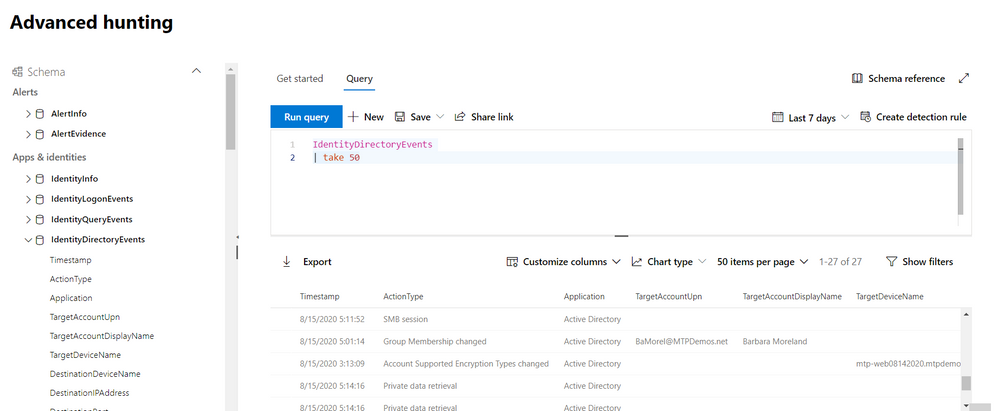
In general, the table captures three categories of events on your domain controller:
- Remote code execution
- Changes to attributes of Active Directory objects, including groups, users, and devices
- Other activities performed against the directory, such as replication or SMB session enumeration
You can get the full list of supported events or action types in the in-portal reference.
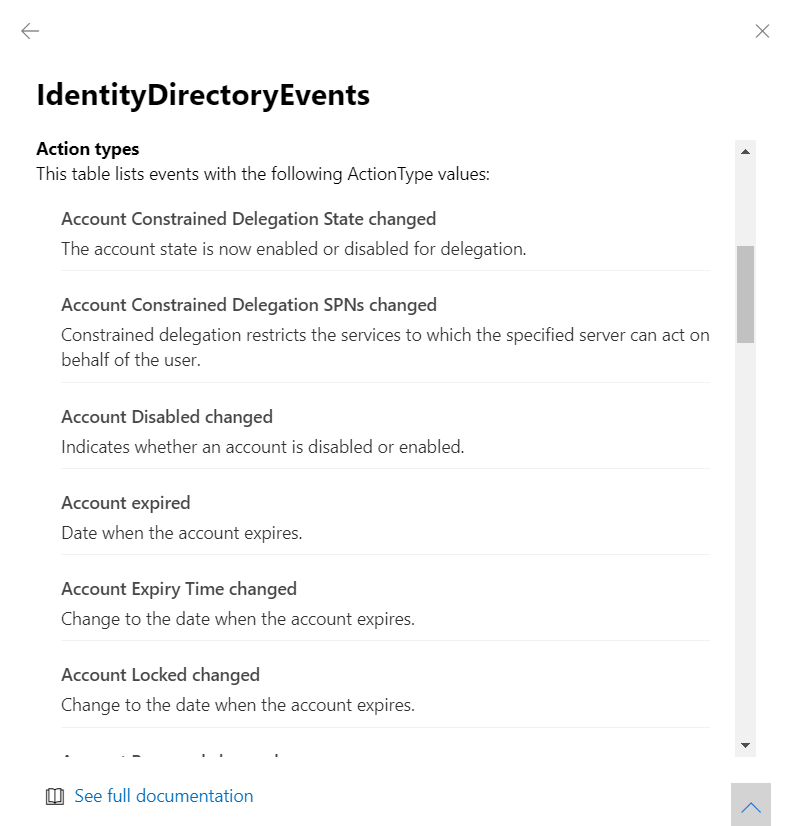
Here are some samples queries you can use:
//Track domain controller replication
IdentityDirectoryEvents
| where ActionType == "Directory Services replication"
| limit 100
Run query
//Track service creation activities on domain controllers
IdentityDirectoryEvents
| where ActionType == "Service creation"
| extend ServiceName = AdditionalFields["ServiceName"]
| extend ServiceCommand = AdditionalFields["ServiceCommand"]
| project Timestamp, ActionType, Protocol, DC = TargetDeviceName, ServiceName, ServiceCommand, AccountDisplayName, AccountSid, AdditionalFields
| limit 100
Run query
//Find the latest password change event for a specific account
let userAccount = '<insert your user account>';
let deviceAccount = '<insert your device account>';
IdentityDirectoryEvents
| where ActionType == "Account Password changed"
| where TargetAccountDisplayName == userAccount
//If you are looking for last password change of a device account comment the above row and remove comment from the below row
//| where TargetDeviceName == deviceAccount
| summarize LastPasswordChangeTime = max(Timestamp) by TargetAccountDisplayName // or change to TargetDeviceName for device account
Run query
As always, please let us know what you think and how we can tweak this enhancement further!
To learn more about advanced hunting in Microsoft Threat Protection and these new enhancements, go to the following links:
by Scott Muniz | Aug 19, 2020 | Azure, Microsoft, Technology, Uncategorized
This article is contributed. See the original author and article here.
If you are managing a Hybrid Cloud environment, you can now get a new Azure Cloud Shell extension in Windows Admin Center. Azure Cloud Shell is an interactive, authenticated, browser-accessible shell for managing Azure resources. It provides the flexibility of choosing the shell experience that best suits the way you work, either Bash or PowerShell. We are able to use Cloud Shell directly from the Azure portal, shell.azure.com, in Visual Studio Code, in the new Windows Terminal, or even in the Azure mobile app. Now with the new solution/extension, administrators can also run Cloud Shell directly within WAC.
How to run Azure Cloud Shell in Windows Admin Center
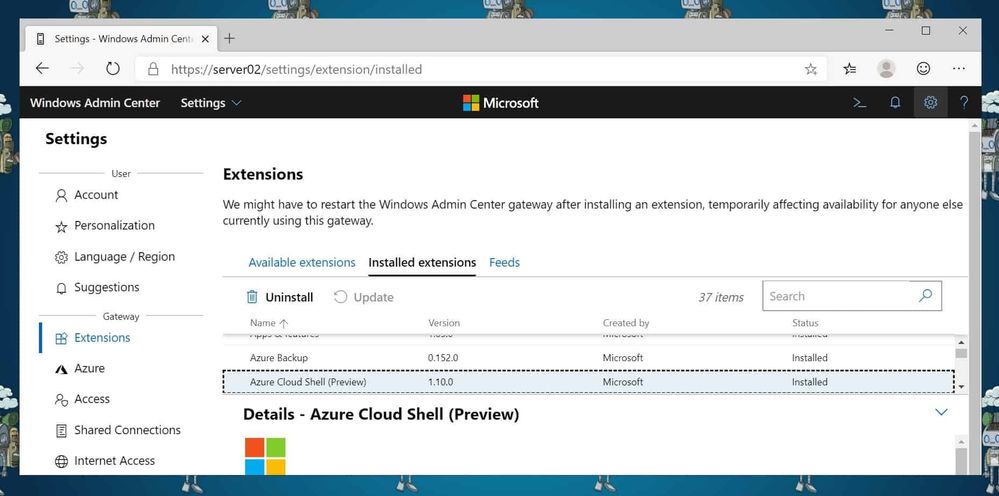
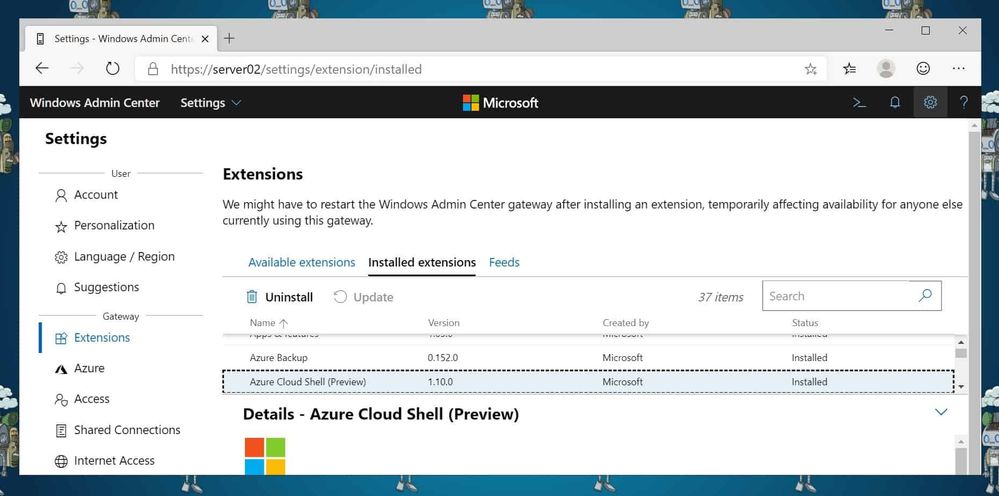
First, you will need to enable and install the new Azure Cloud Shell solution. For that open Windows Admin Center, go to Settings and in the menu click on Extensions.
 Extensions
Under available extensions, you will find the new Azure Cloud Shell (Preview) extension. Click on Install, the WAC portal will refresh automatically.
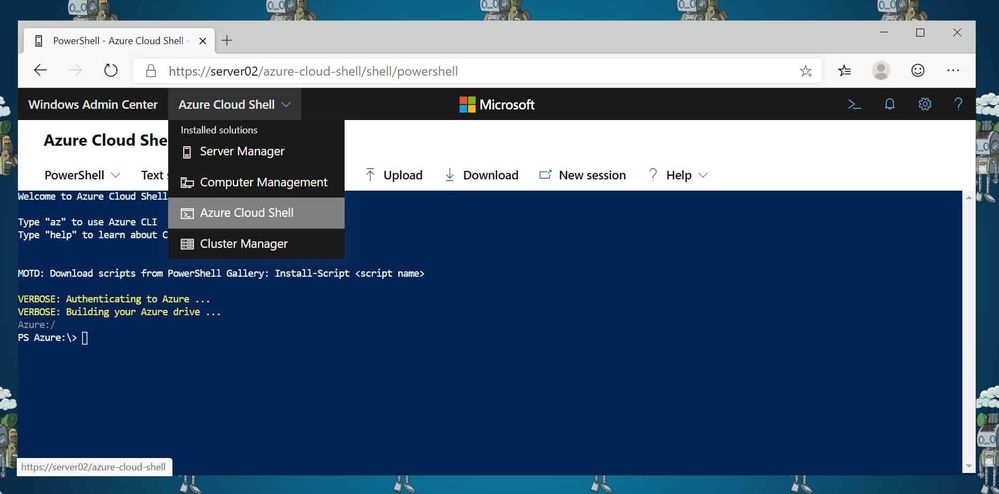
After the page has refreshed, the Cloud Shell option will show up in the top menu.
 Start Cloud Shell in Windows Admin Center
If you start Azure Cloud Shell for the first time, you will need to login to Azure.
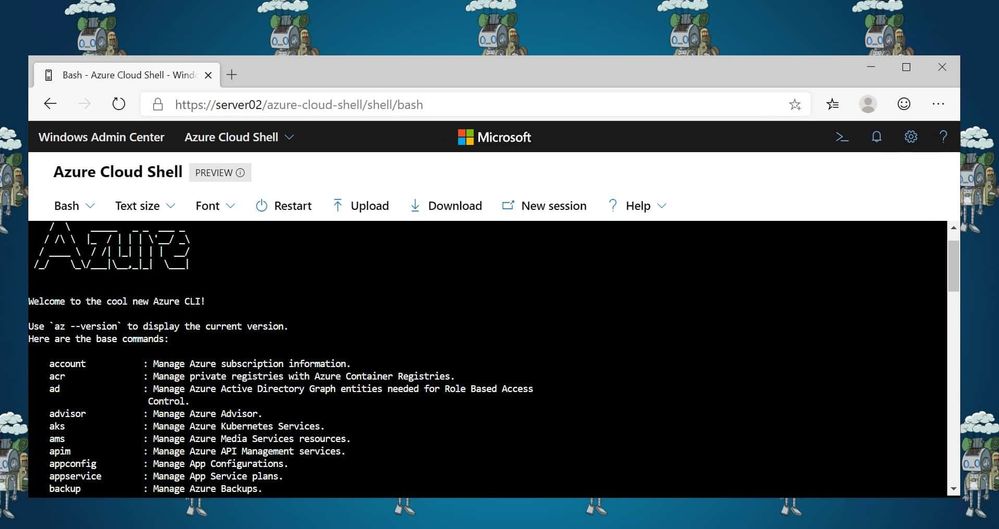
After that, you can run the PowerShell or Bash experience, depending on what you prefer. You also have access to the clouddrive which comes with Cloud Shell.
 Azure Cloud Shell in Windows Admin Center
In that, you can run tools like the Azure CLI, Azure PowerShell and much more. If you want to learn more about Azure Cloud Shell, check out my blog post, Mastering Azure with Cloud Shell. Windows Admin Center is a free download to use with your Windows Servers, you can download Windows Admin Center here. If you want to know more about the Hybrid capabilities, check out my blog post on ITOpsTalk.com.
I hope this gives you an overview of how you can run Azure Cloud Shell in Windows Admin Center. Let me know if you have any questions in the comments.
by Scott Muniz | Aug 19, 2020 | Azure, Microsoft, Technology, Uncategorized
This article is contributed. See the original author and article here.
A fully automated DevOps deployment of CMS WordPress on Azure App Services in a Linux Multi-Container. Setup with services like: App Service, Azure MySQL, Redis Cache (in a container), Azure CDN, Azure Storage and Key Vault (to store the mysqluser password).
The Github repository: https://github.com/pascalvanderheiden/multi-container-wordpress-azure
The multi-container setup is used to host WordPress and Redis Cache in one App Service. This DevOps project is inspired on this tutorial: https://docs.microsoft.com/en-us/azure/app-service/containers/tutorial-multi-container-app
The Docker Compose YML’s are based on these samples: https://github.com/Azure-Samples/multicontainerwordpress
Step by Step installation
Step 1: In the Azure Portal create a Service Principal
In the Azure Cloud Shell (https://shell.azure.com:(
- az ad sp create-for-rbac –name [your-service-principal-name]
Copy the JSON Output! We’ll be needing this information to create the service connection in Azure DevOps.
Step 2: Generate your Azure DevOps Project for Continuous Integration & Deployment with the Azure DevOps Generator
Step 3: In Azure DevOps, create a service connection
- Login with your account Azure DevOps. Go to the Project Settings of the DevOps Project you’ve created in step 2.
- Go to Service Connections*.
- Create a service connection, choose Azure Resource Manager, next.
- Select Service Principal Authentication. Choose the correct Subscription first, then click the link at the bottom: “use the full version of the service connection dialog.”.
- Enter a name for your Service Principal and copy the appId from step 1 in “Service principal client ID” and the password from step 1 in “Service principal key”. And Verify the connection.
- Tick “Allow all pipelines to use this connection.”. OK.
Step 4: In Azure DevOps, update the Variables Group
- Go to Pipelines, Library. Click on the Variable group “Shared Resources”.
- Tick “Allow access to all pipelines.
- Update the variables to match your naming conventions needs. You can leave the Storage Account and CDN empty if you don’t want to use these services. Keep in mind to pick unique naming for exposed services.
- The variable “KVMYSQLPWD” is NOT the MySQL password, but the naming tag in Key Vault for the MySQL password. Leave that as it is: “mysqladminpwd”.
- The variable “MYSQLUSER” cannot be longer than 16 characters.
- Don’t forget to save.
Step 5: In Azure DevOps, update the Build pipeline and Run it
- Go to Pipelines, Pipelines.
- Select “Build Multi-container WordPress on Azure-CI”, Edit.
- In Tasks, select the Tasks which have the explaination mark “Some settings need attention”, and update Azure Subscription to your Service Principal Connection.
- In Variables, update the variables to match your naming conventions needs. In my case I give the App Service Plan and the Resource Group of the Web App a more “generic” name. I want to re-use the App Service Plan for more websites, therefor all websites need to be deployed in the same Resource Group as the App Service plan. Keep in mind to pick unique naming for exposed services.
- Save & queue.
- Click the Agent Job to check the progress. Check if everything is create correctly, because of the unique naming for some services. And because it’s fun :)
- Keep in mind that the CLI scripts will check if the resource is already created, before creating. You can deploy using ARM Templates as well. I choose a bash script, because you are free to use whatever you prefer, right?!
Step 6: In Azure DevOps, add the Key Vault secret to the variables.
- Go to Pipelines, Library. Add Variable group. Give it a name, something like “Key Vault Secrets”.
- Tick “Allow access to all pipelines.
- Tick “Link secrets from an Azure key vault as variables”.
- Update the Azure Subscription to your Service Principal Connection.
- Select the Key vault name. If your build pipeline ran succesfully, you can select your Key vault. Add variables, and it will popup with the secret we’ve created earlier “mysqladminpwd”. Select it, OK. And Save.
Step 7: In Azure DevOps, update the Release pipeline and Run it.
- Go to Pipelines, Releases. Note. Because I’ve enabled continuous deployment in my template, there is a failed release there already. You can ignore that, because we are going to fix the release in the step.
- Select “Release Multi-container WordPress on Azure-CD”, Edit.
- In Tasks, select the Tasks which have the explaination mark “Some settings need attention”, and update Azure Subscription to your Service Principal Connection.
- In Variables, update the variables to match the naming you used in the Build pipeline. The WPDBHOST you can leave empty, because it will be updated in the pipeline.
- In Variables groups, link the “Key Vault Secrets” variable group, by clicking the Link button.
- The TARGET_YML will need to point to the yaml configuration files in repo. This will determine how the App Service is configured. In the DevOps project the TARGET_YML is default set to “docker-compose-mc-wordpress-storage.yml”, which is the most complete config. For inspiration and learning I’ve included 4 configs:
- compose-wordpress.yml (sample multi-container setup with redis, using local (not persistent) storage)
- docker-compose-wordpress.yml (sample multi-container setup with MySQL, using local (not persistent) storage)
- docker-compose-mc-wordpress-storage.yml (multi-container setup with redis, using Azure Storage for wp-content folder)
- docker-compose-mc-wordpress.yml (multi-container setup with redis, using Azure App Service as persistent storage)
- The first 2 yaml’s are more inspirational, the last 2 I would use for my deployment, because persistent storage is a must! Keep in mind that it would be illogical to use the last yaml file, and configure Azure Storage. Just leave the variable empty to skip this installation.
- Save & Create Release.
Step 8: Go to your websites
You need to run the website url one time, to trigger the compose script to download the WordPress image to the persistent storage location. This will take a 2-3 minutes to download.
Redis Object Cache Plugin in WordPress
- In WordPress, the plugin “Redis Object Cache” is already pre-installed on the this image.
- Go to Plugins and Enable the plugin.
CDN Plugin in WordPress
- In WordPress, install the plugin “CDN Enabler”. Or, when you have the wp-content folder mounted in Azure Storage, decompress the plugin from the wordpress-plugins folder in this repo and copy it into the “Plugins” folder using Azure Storage Explorer.
- Go to Plugins and Enable the plugin. Change the settings of the plugin and point it to the CDN Endpoint you’ve created earlier.
- Go to Azure, to your CDN Endpoint, and trigger a purge all to refresh. I’ve included a bash script in the deploy folder to trigger the purge in bash.
by Scott Muniz | Aug 19, 2020 | Azure, Microsoft, Technology, Uncategorized
This article is contributed. See the original author and article here.
Introduction
During the migration journey from SQL Server to Azure SQL Database or Managed Instance, the customers I meet often wondering how to deal with the Integrated Authentication, their applications, especially the legacy ones.
The following tutorial will help you to create a small sandbox based on an Azure SQL Database, an Azure Active Directory synchronized with an OnPremise Active Directory.
This tutorial is, of course, for testing/learning purpose only and is not intended to be used in production or any other environment.
Note that we’ll mainly use the Azure portal, but all of the following actions can be done using Powershell.
Subscriptions
In this example, we’ll use a MSDN subscription, providing an Azure Active Directory Free license. If using a different subscription, ensure that you’ll have sufficient administration rights at the Azure Active Directory level.
If you don’t have a subscription, you can create a free account here
Provisioning Resources
We’ll start by creating the resources required for this sandbox:
1 Windows Server Virtual Machine, playing the role of a Domain Controller
1 Windows Server Virtual Machine, playing the role of an application host
1 Azure SQL Database
To start log on : https://portal.azure.com
Domain Controller
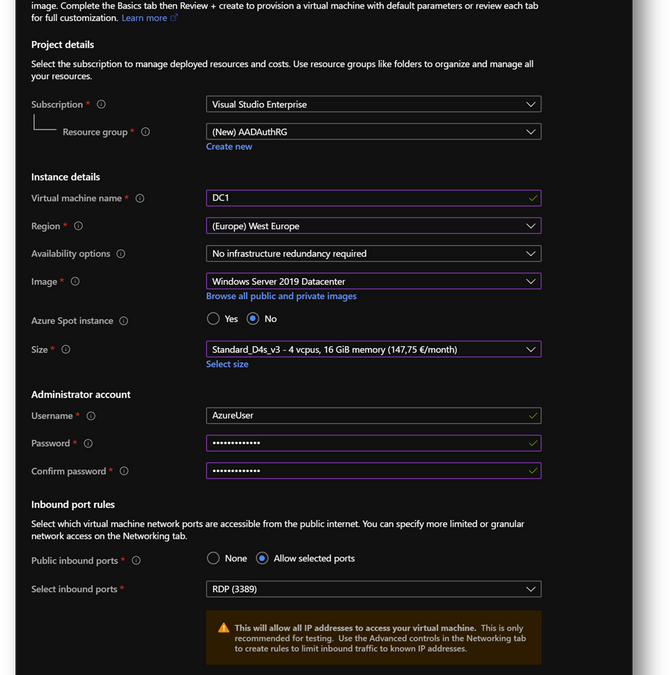
- Create a new virtual machine DC1. Then move to the [Networking] pane. (link)
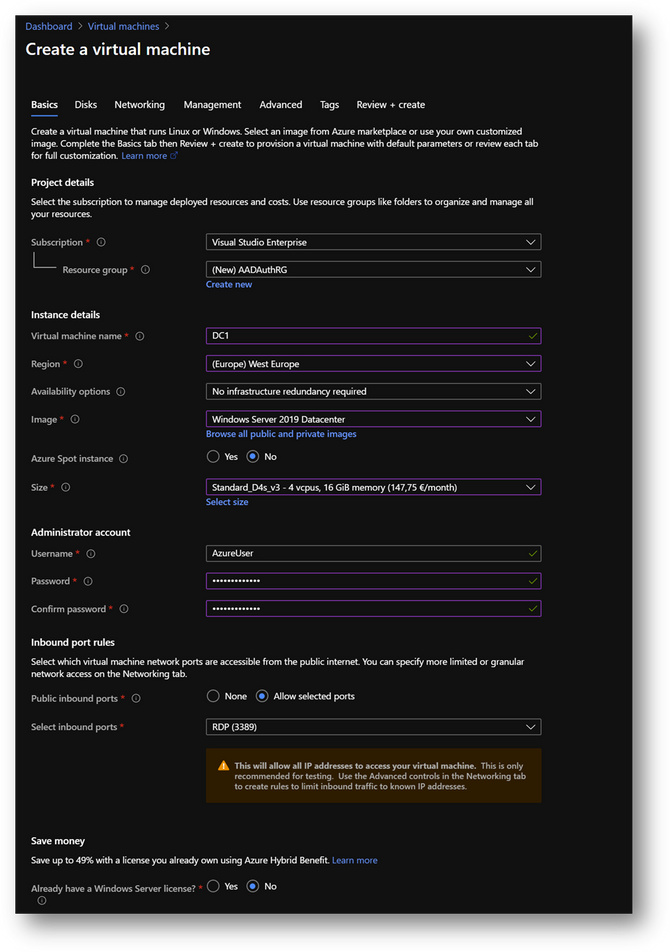
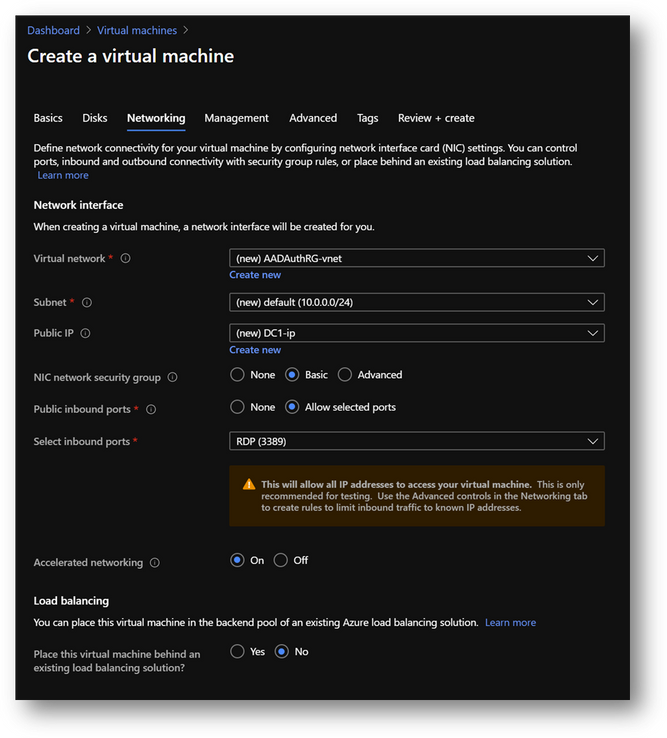
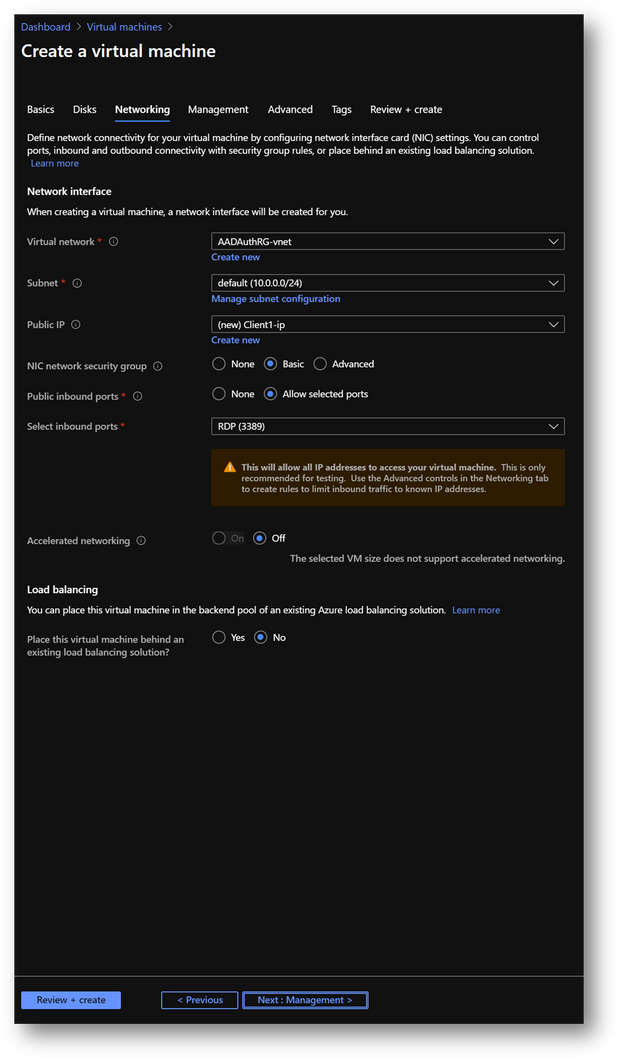
- No modification required on the [Networking] pane.
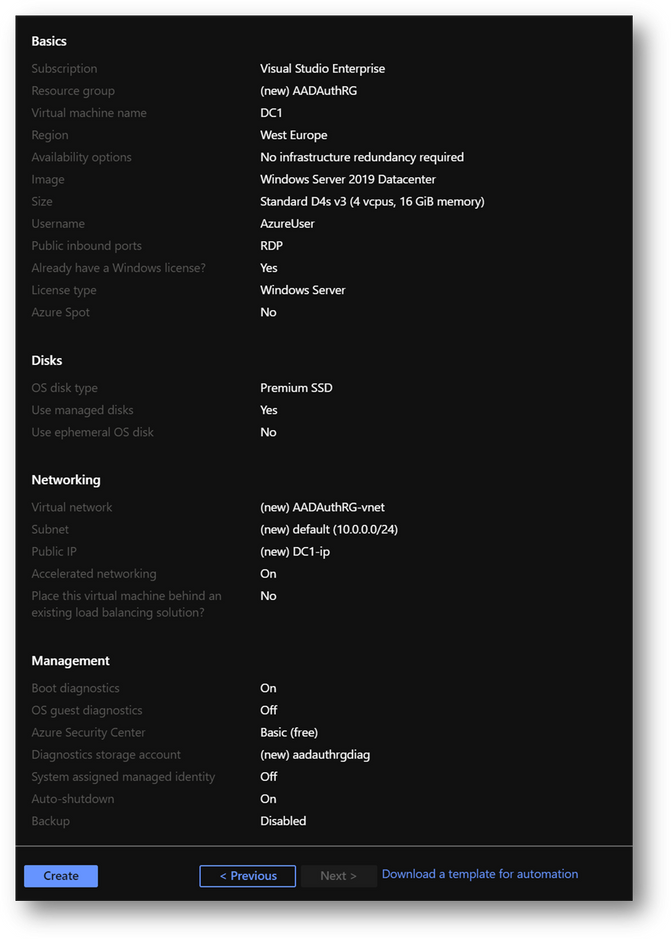
- Click on [Review and Create] and then click on [Create]
|
Summary
|
|
Resource Group
|
AADAuthRG
|
|
Virtual Machine Name
|
DC1
|
|
Virtual Machine Size
|
Standard D4s v3
|
|
Vnet Name
|
AADAuthRG-vnet
|
|
Subnet
|
10.0.0.0/24
|
|
Private IP address*
|
10.0.0.4
|
|
Local Administrator
|
AzureUser
|
|
Local Administrator Password
|
Strong Password required
|
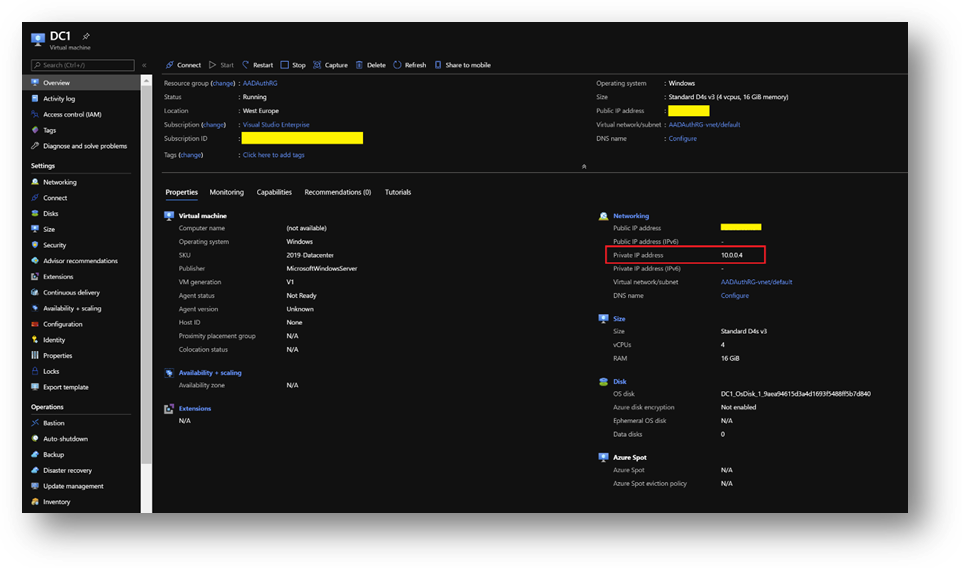
*The private IP should be the same. If not, keep yours in mind as it will be required at a later stage.
NB: To find the private IP address of DC1, select your virtual machine and go the [Overview] blade.
Application Host
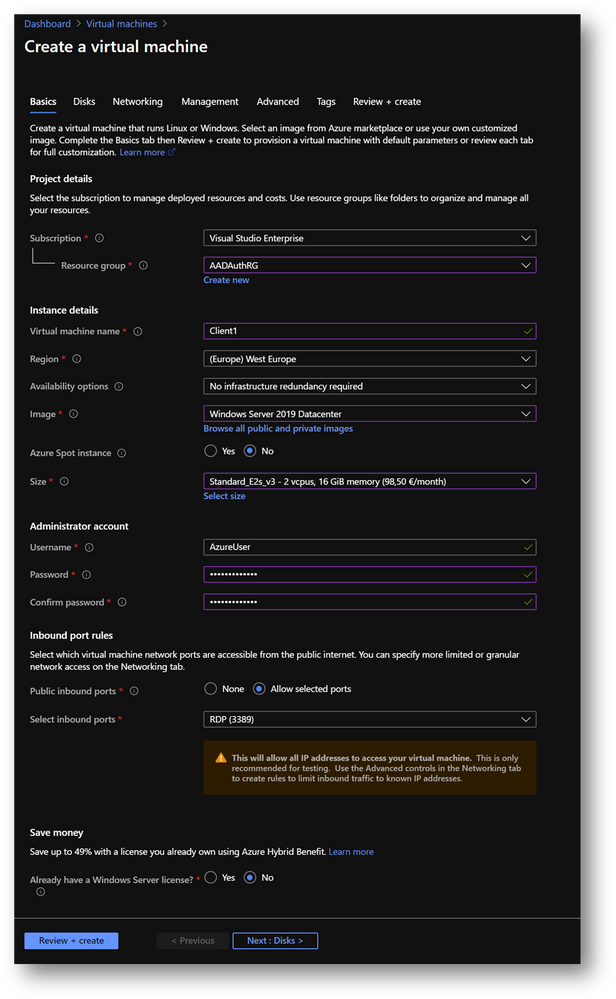
- Create a new virtual machine Client1 in the same resource group AADAuthRG
- On the [Networking] pane, use the already created virtual network AADAuthRG-vnet
- Click on [Review and Create] and then click on [Create]
|
Summary
|
|
Resource Group
|
AADAuthRG
|
|
Virtual Machine Name
|
Client1
|
|
Virtual Machine Size
|
Standard E2s v3
|
|
Vnet Name
|
AADAuthRG-vnet
|
|
Subnet
|
10.0.0.0/24
|
|
Private IP address*
|
10.0.0.5
|
|
Local Administrator
|
AzureUser
|
|
Local Administrator Password
|
Strong Password required
|
*The private IP may be different. Keep yours in mind as it will be required at a later stage.
- Once Client1 created, select it, go to the [Networking] pane and click on the [Network Interface]
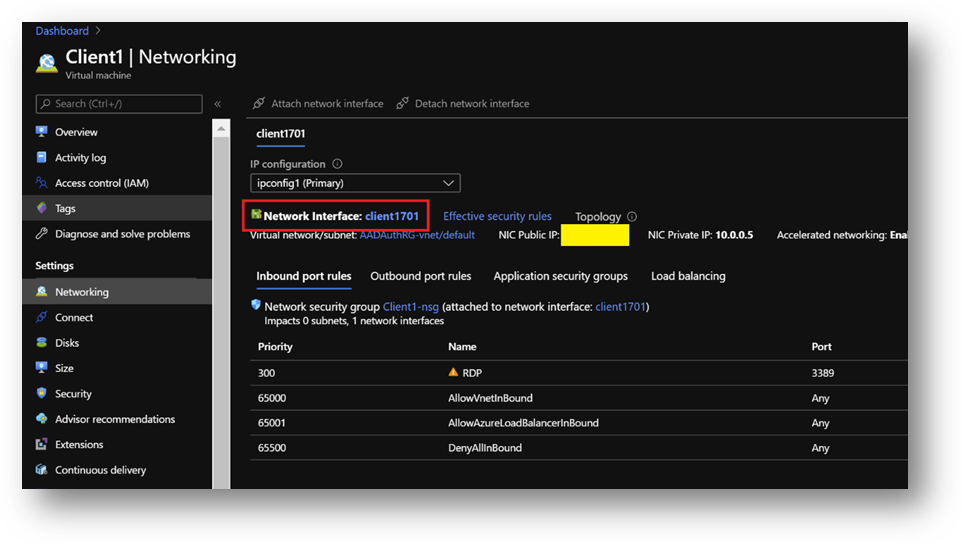
- Click on the [DNS servers] blade, select [Custom] and add the DC1 private IP address. [Save].
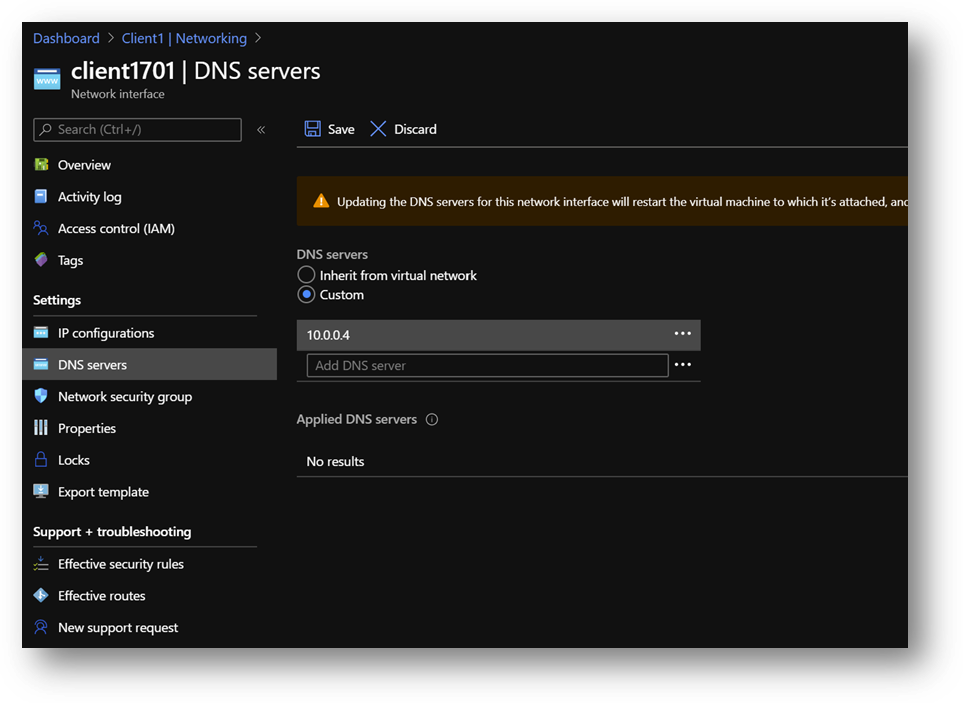
- Restart Client1 or connect and execute “ipconfig /renew” in a Command Prompt
Azure SQL Database
We will use an Azure SQL Database (link) but you can use an Azure SQL Managed Instance (link) instead. The provisioning duration will be longer.
- Create a new Azure SQL Database AdventureWorksLT in the same resource group AADAuthRG
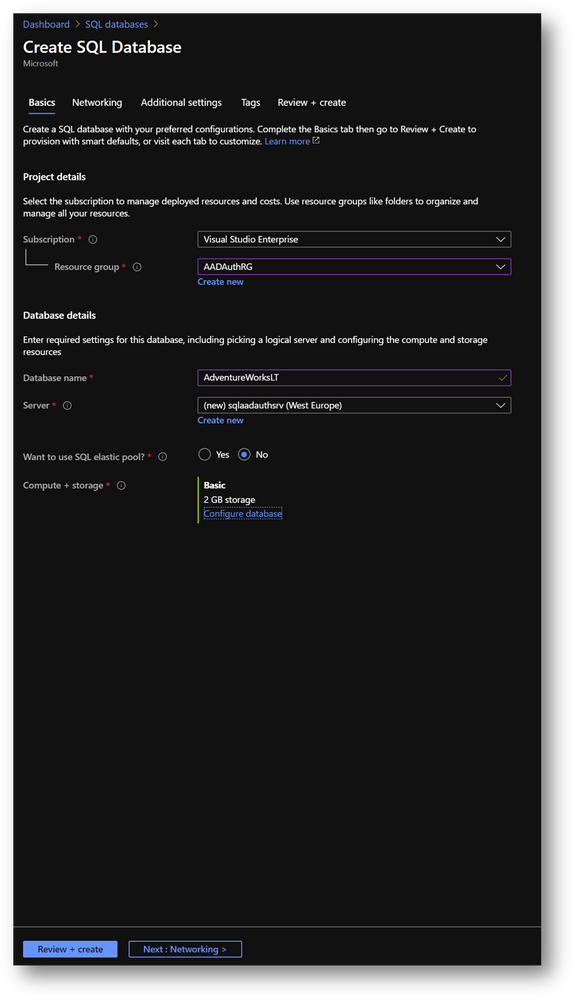
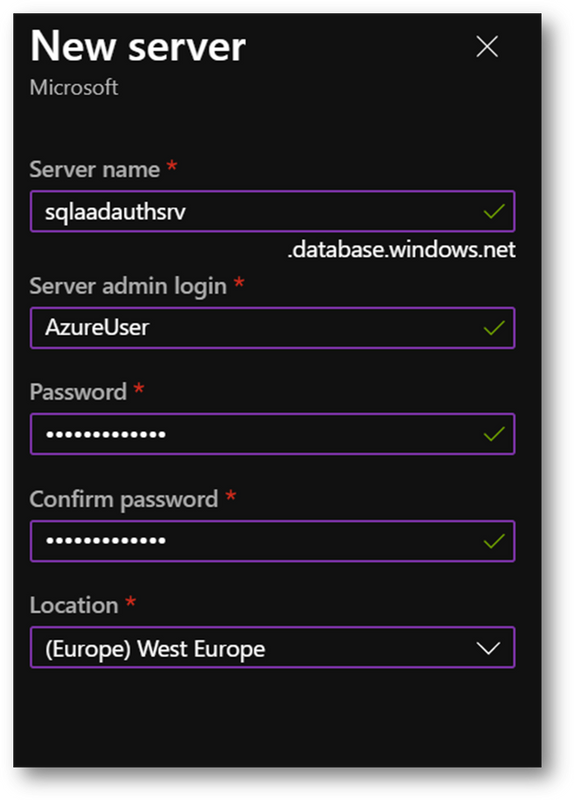
- You’ll be asked to create a new server
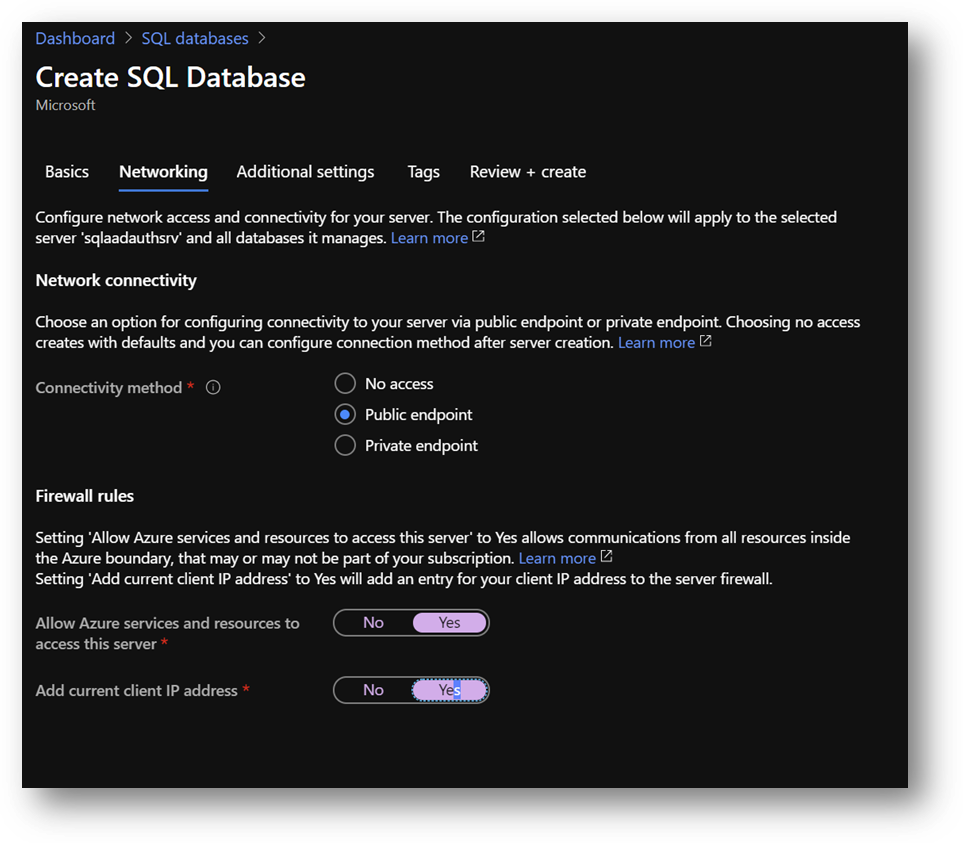
- On the [Networking] pane
- Select [Public Endpoint]
- Set [Allow Azure services and resources to access this server] to ON
- Set [Add current client IP address] to ON, if you want to access the server from your current computer
- On the [Additional settings] pane, set [Use existing data] to [Sample Data]
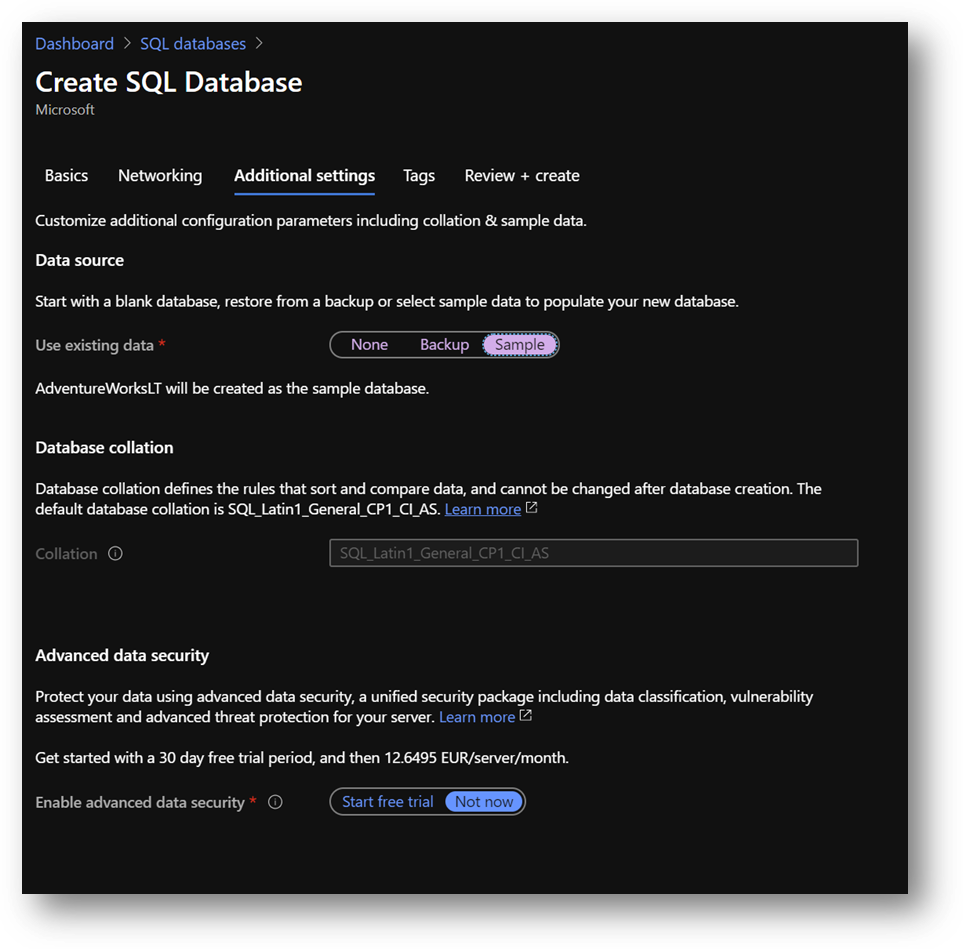
- Click [Review and create] and then [Create]
|
Summary
|
|
Resource Group
|
AADAuthRG
|
|
Azure SQL Database server name
|
sqlaadauthsrv
|
|
Azure SQL Database name
|
Standard E2s v3
|
|
Service tier
|
DTU-based – Basic
|
|
Connectivity Method
|
Public Endpoint
|
|
Allow Azure services and resources to access this server
|
On
|
|
Add current client IP address
|
On
|
|
Azure SQL Database server Administrator
|
AzureUser
|
|
Azure SQL Database server Administrator Password
|
Strong Password required
|
Azure Active Directory administrator
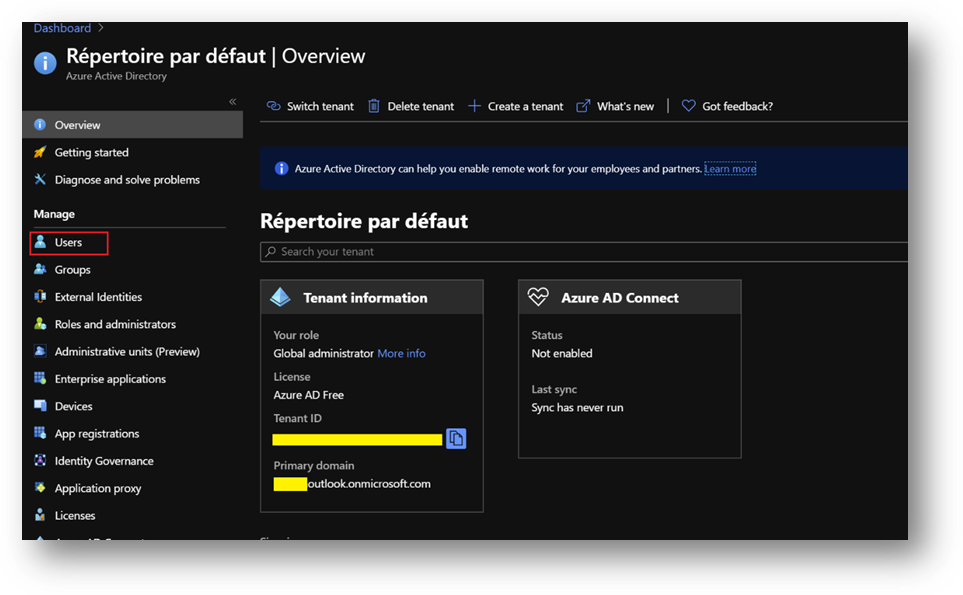
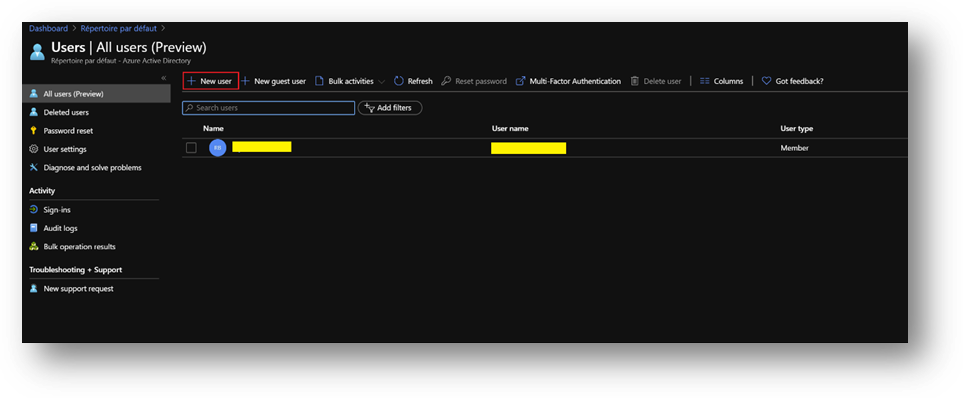
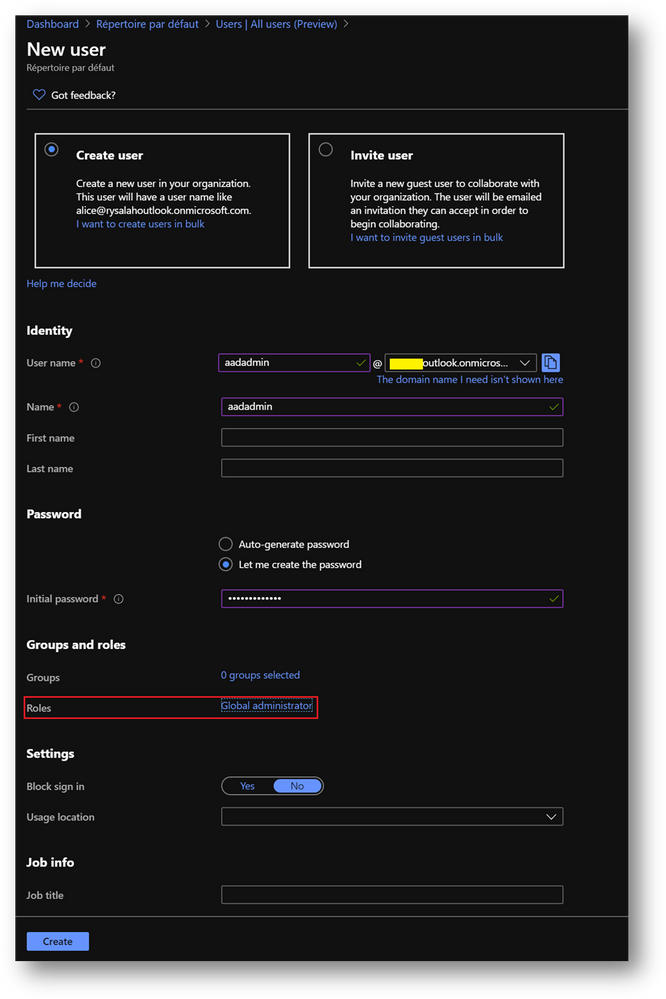
- Click on [New User] and name it
- In the [Roles] menu, select [Global administrator]
Configuration
Configure the Domain Controller
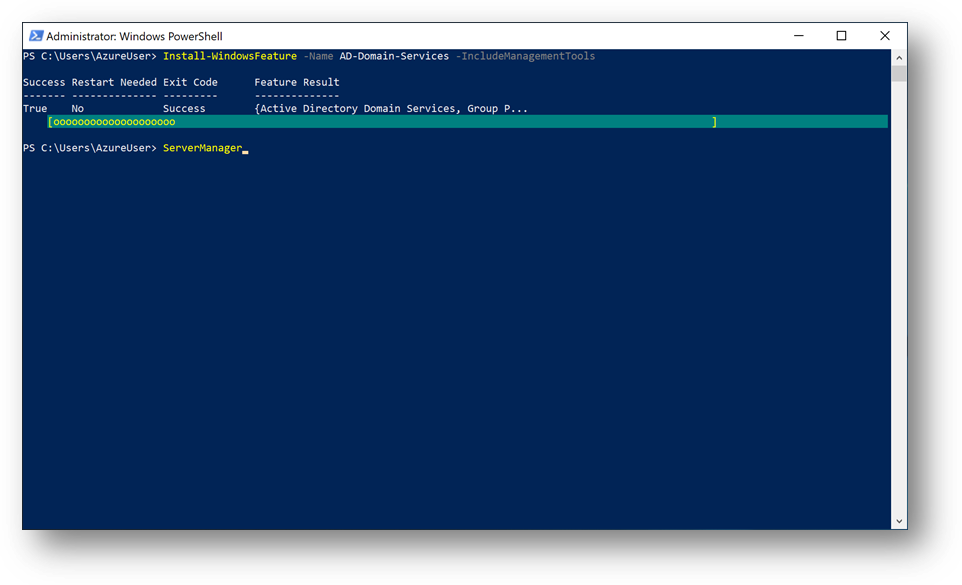
To start, we need to install the Active Directory Domain Services feature. Connect to the DC1 Virtual Machine, start a Windows Powershell session and execute the following command:
Install-WindowsFeature -Name AD-Domain-Services -IncludeManagementTools
You should have a Success exit code.
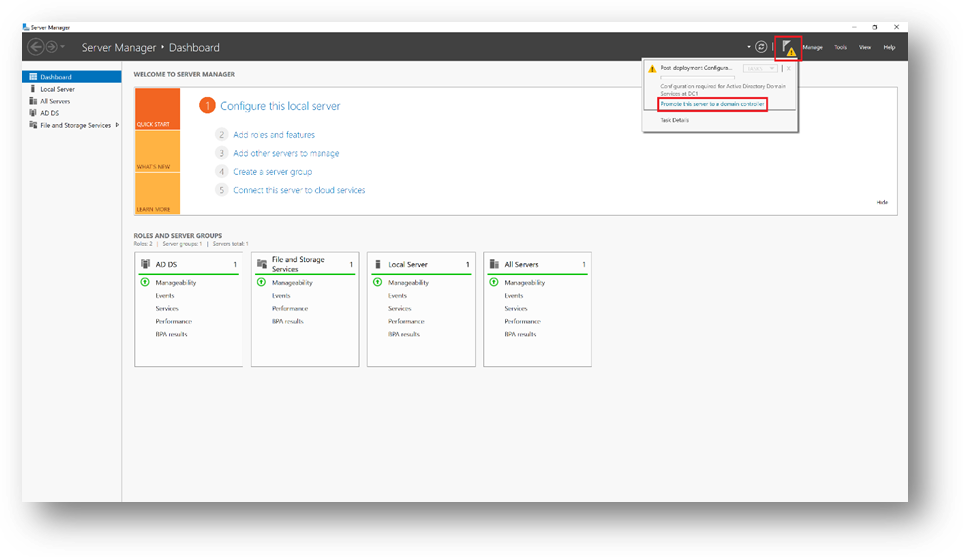
Once done, DC1 must be promoted to domain controller. To do so, start ServerManager
- Click on the flag and then click on [Promote this server to a domain controller]
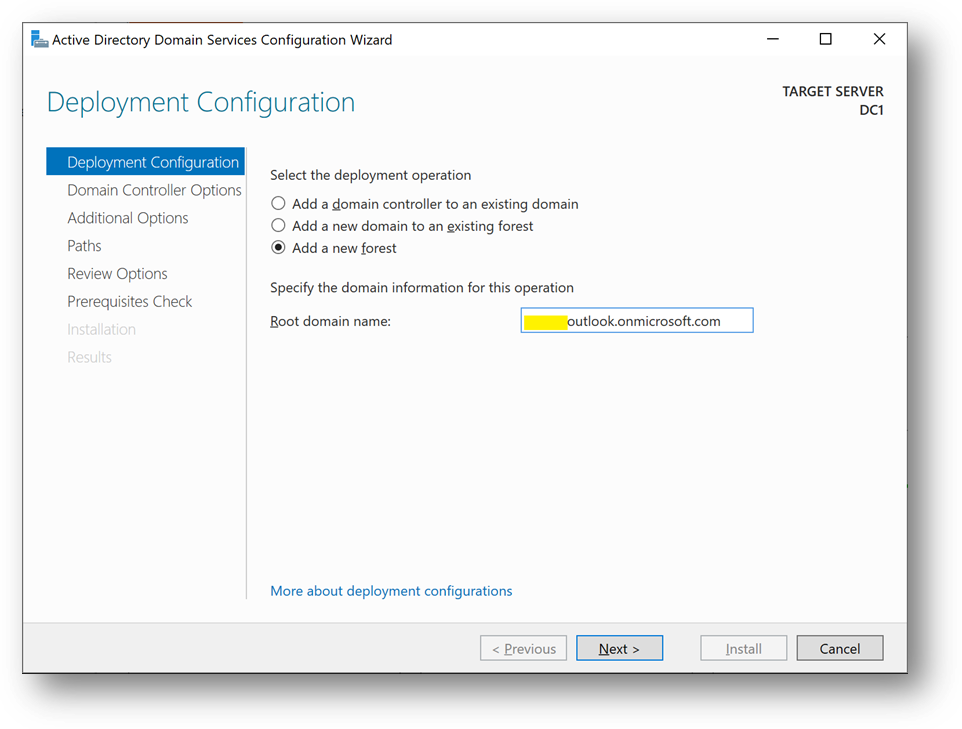
- Add a new forest. As the domain needs to be verified to be used with Azure Active Directory, we will use the domain already provided within AAD.
- You can also use a custom domain, but this way, we won’t have to create a new TXT or MX record at the domain registrar.
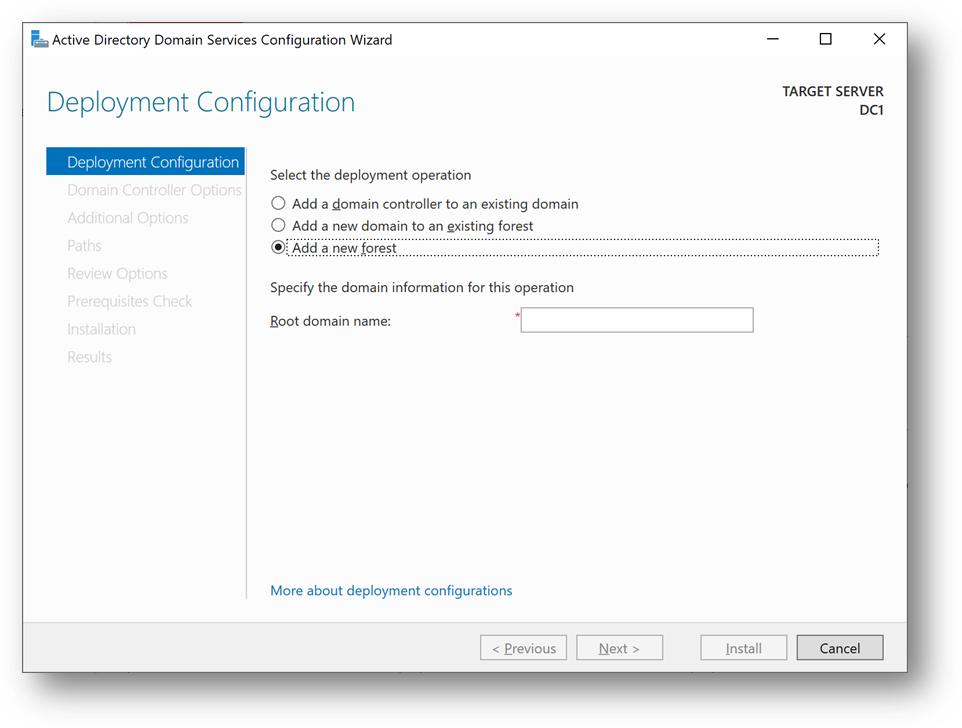
- On the Azure portal, go to [Azure Active Directory] blade, then [Overview]. You’ll find the Primary domain name. Copy it.
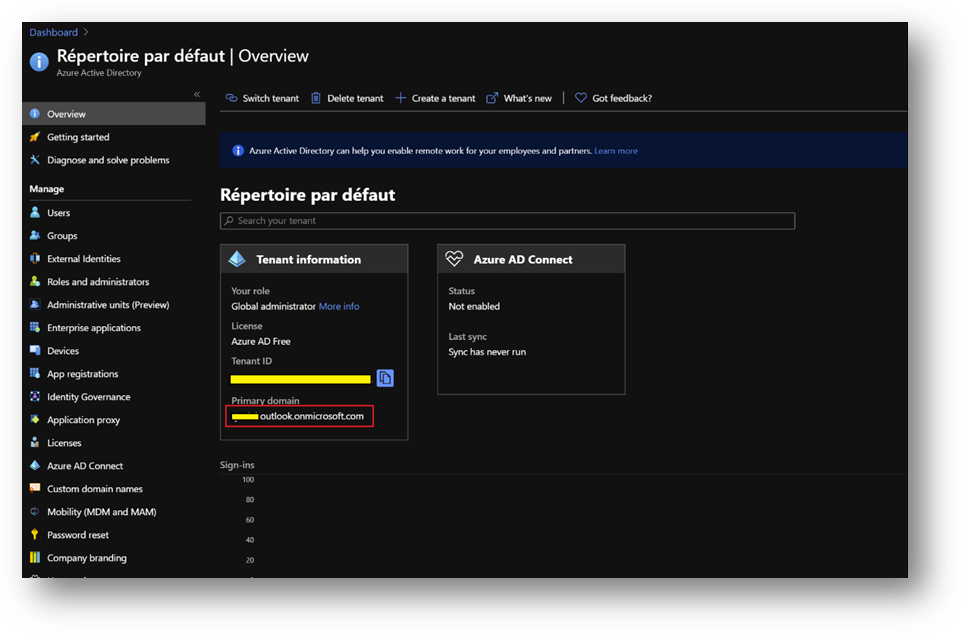
- Paste the primary domain name as the [Root domain name]
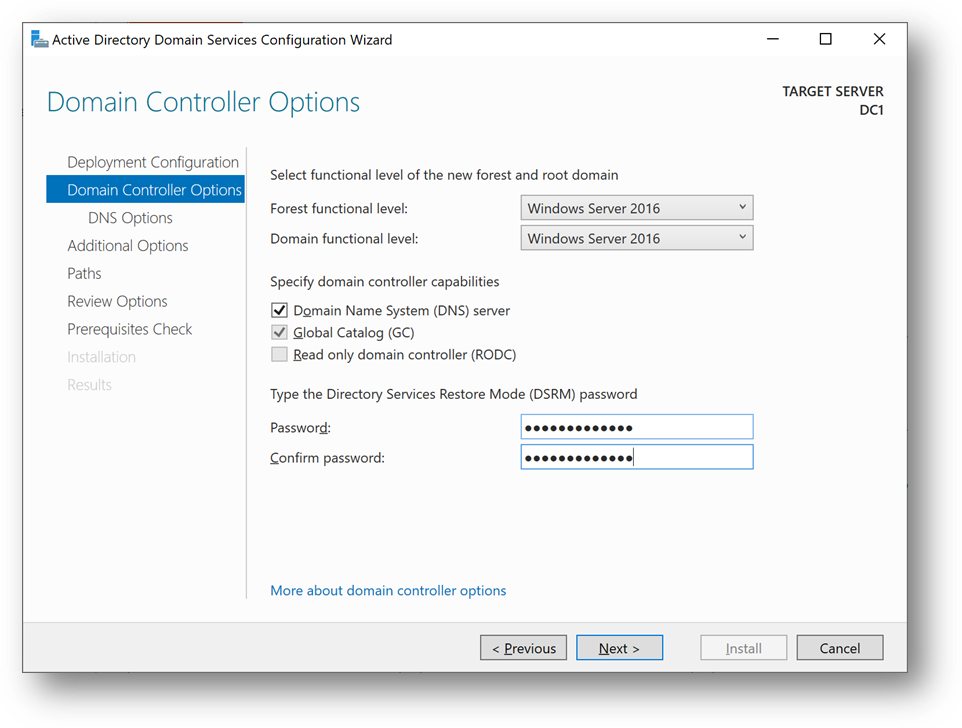
- Set a strong password and click [Next] until you reach the [Prerequisites Check]
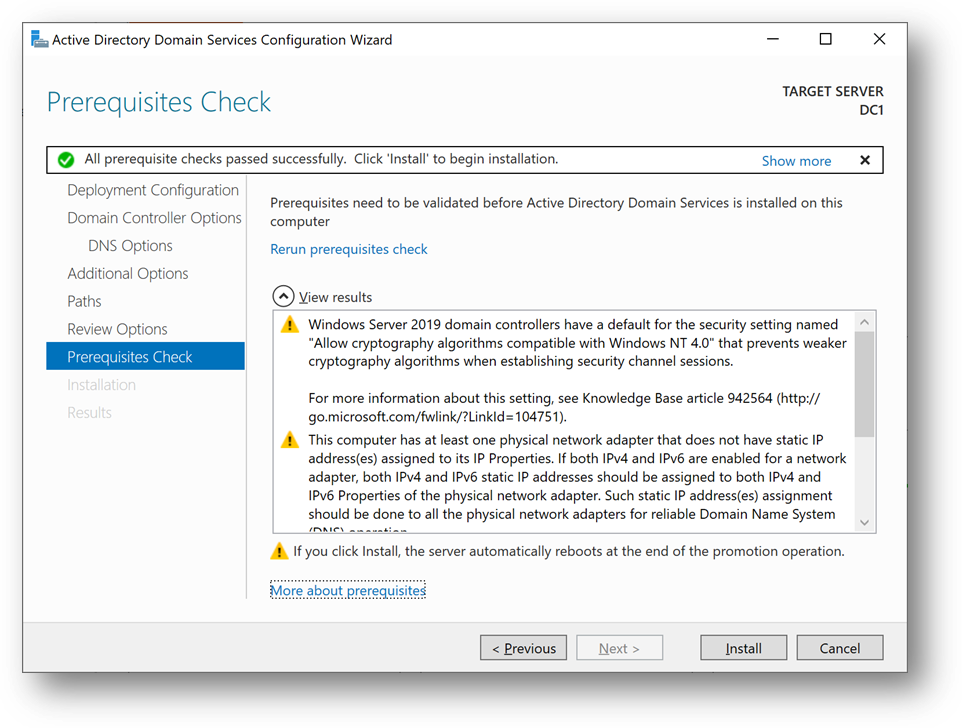
- Click on [Install]
- You can also use this Powershell script
Import-Module ADDSDeployment

Install-ADDSForest `
-CreateDnsDelegation:$false `
-DatabasePath "C:windowsNTDS" `
-DomainMode "WinThreshold" `
-DomainName "***outlook.onmicrosoft.com" `
-DomainNetbiosName "***OUTLOOK" `
-ForestMode "WinThreshold" `
-InstallDns:$true `
-LogPath "C:windowsNTDS" `
-NoRebootOnCompletion:$false `
-SysvolPath "C:windowsSYSVOL" `
-Force:$true
DC1 will restart and you’ll be disconnected. Wait a minute and reconnect.
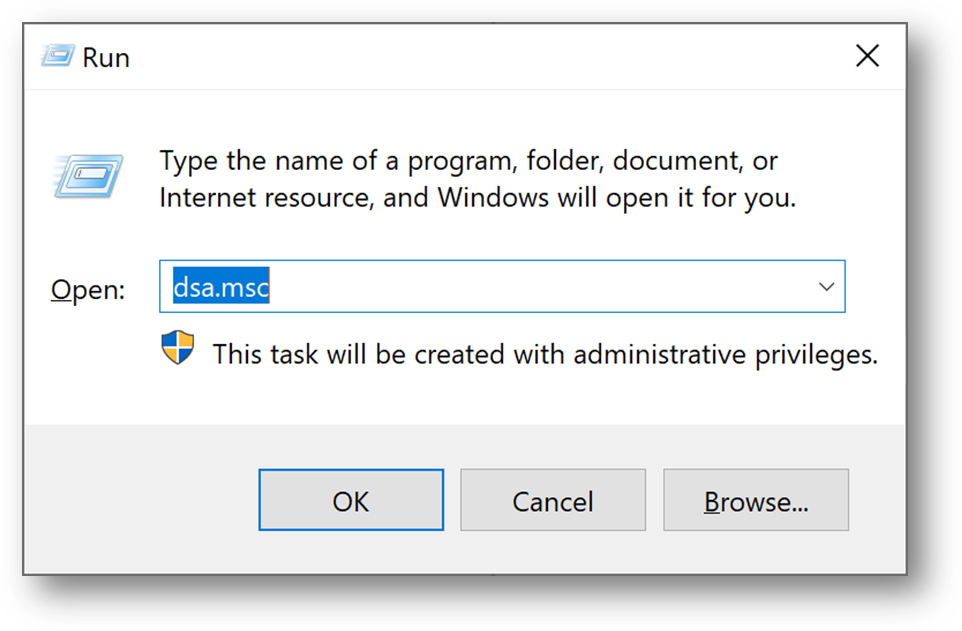
- [Windows + R] and type “dsa.msc”
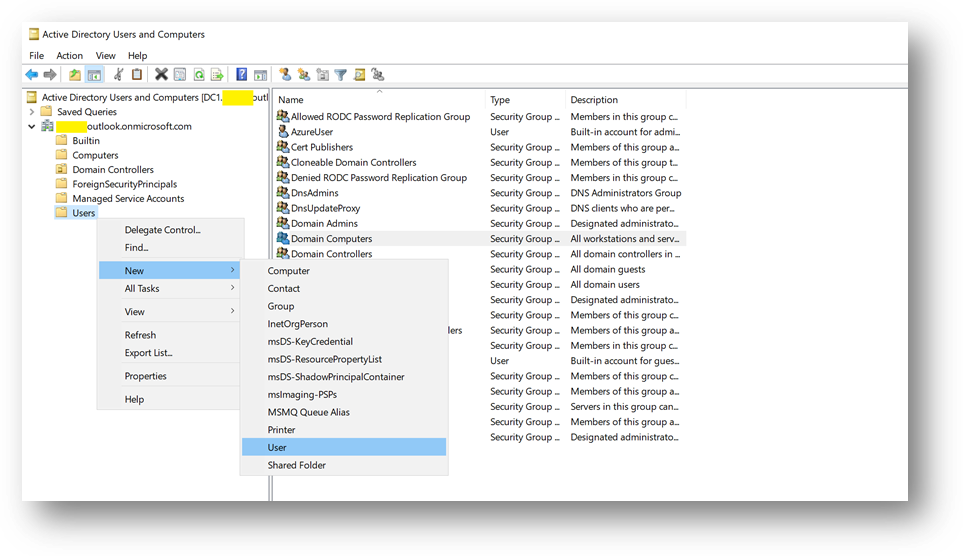
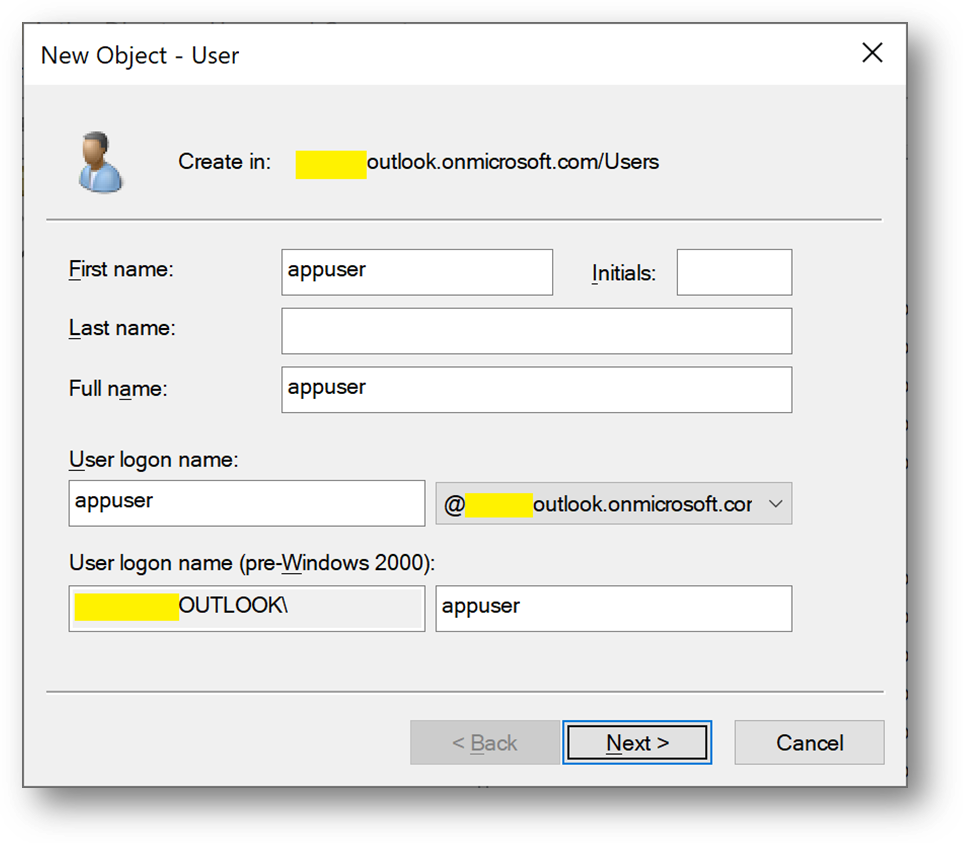
- We will now create a domain administrator. Click right on the [Users] folder in your domain and select New User
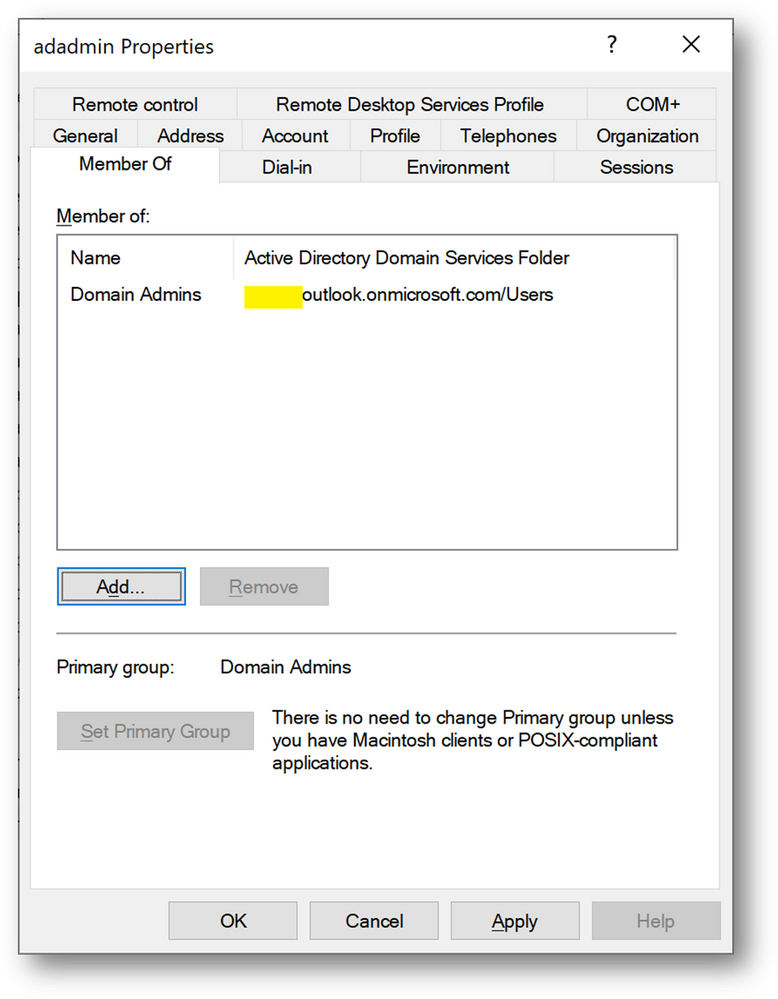
- Create a user adadmin
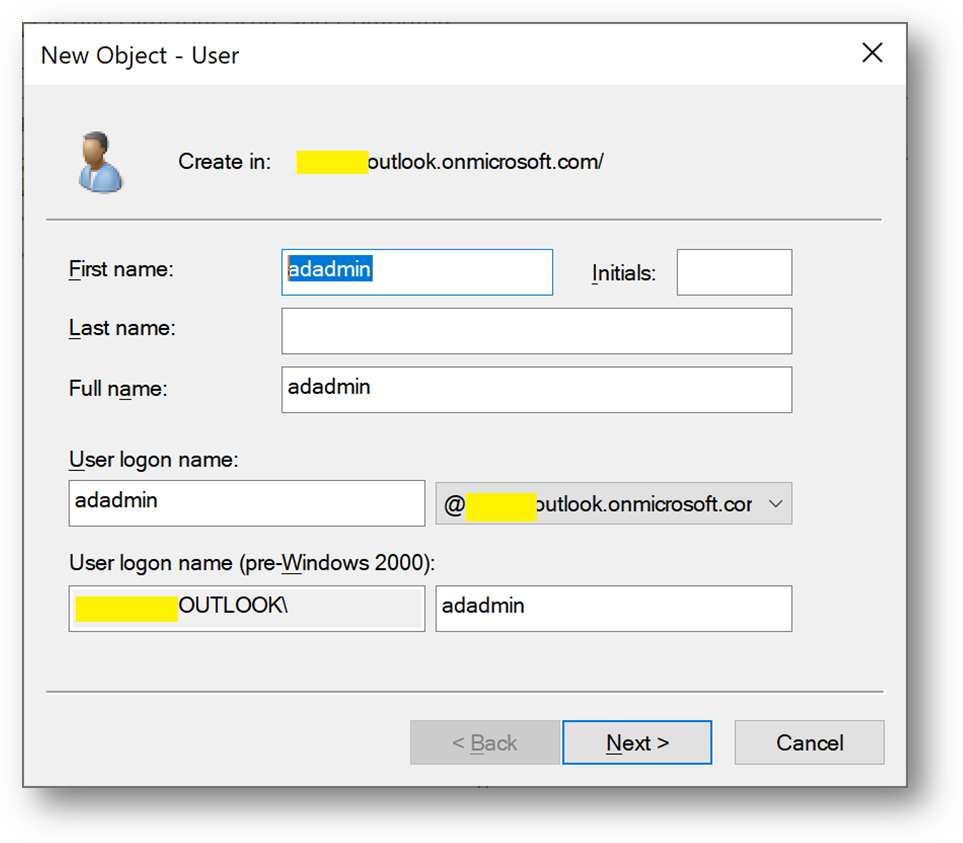
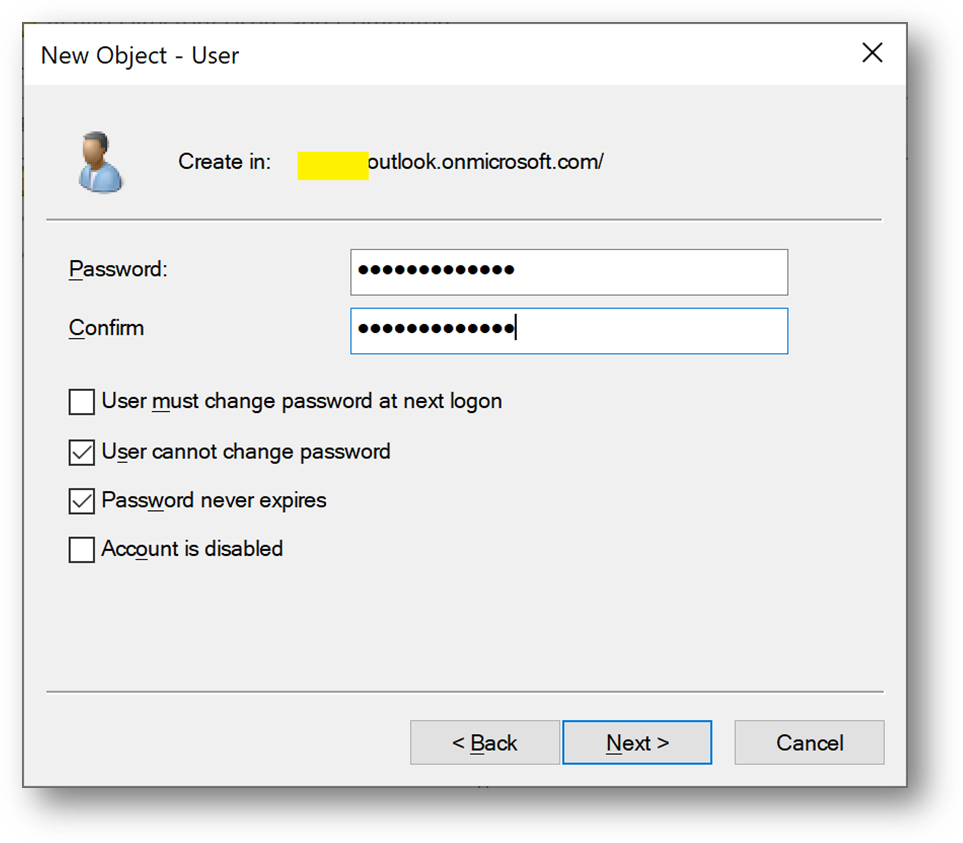
- Add this account to the [Domain Admins] group
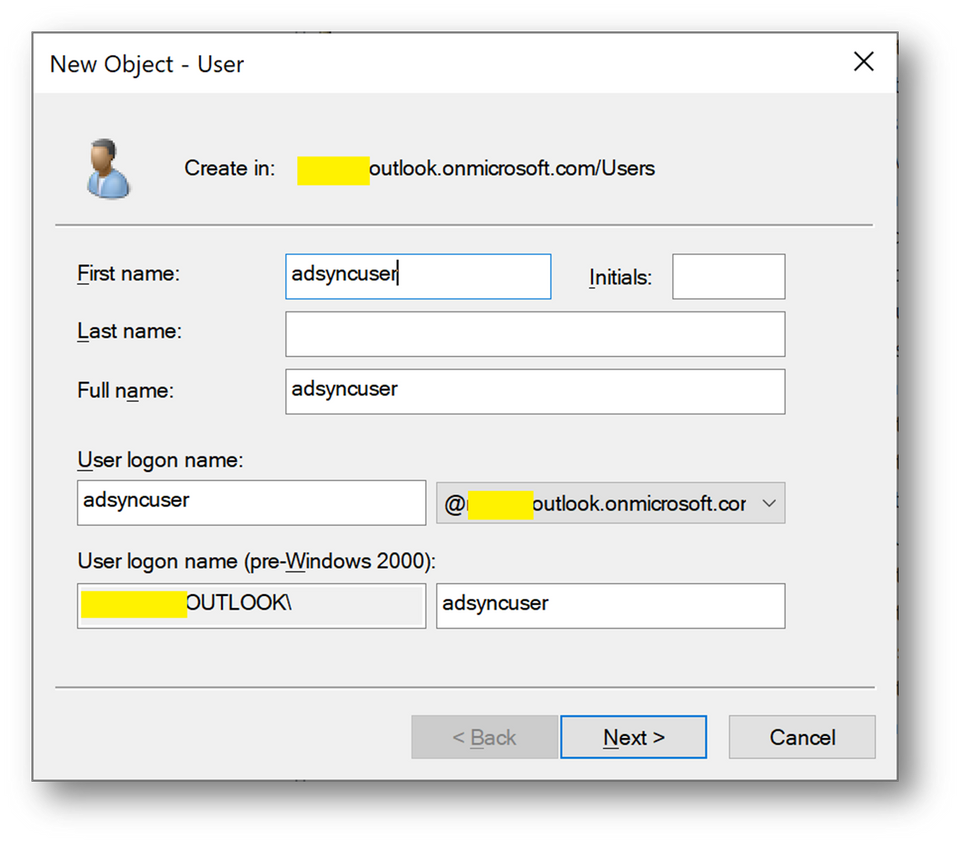
- We will need at a later stage a synchronizaiton account. We’ll create adsyncuser now
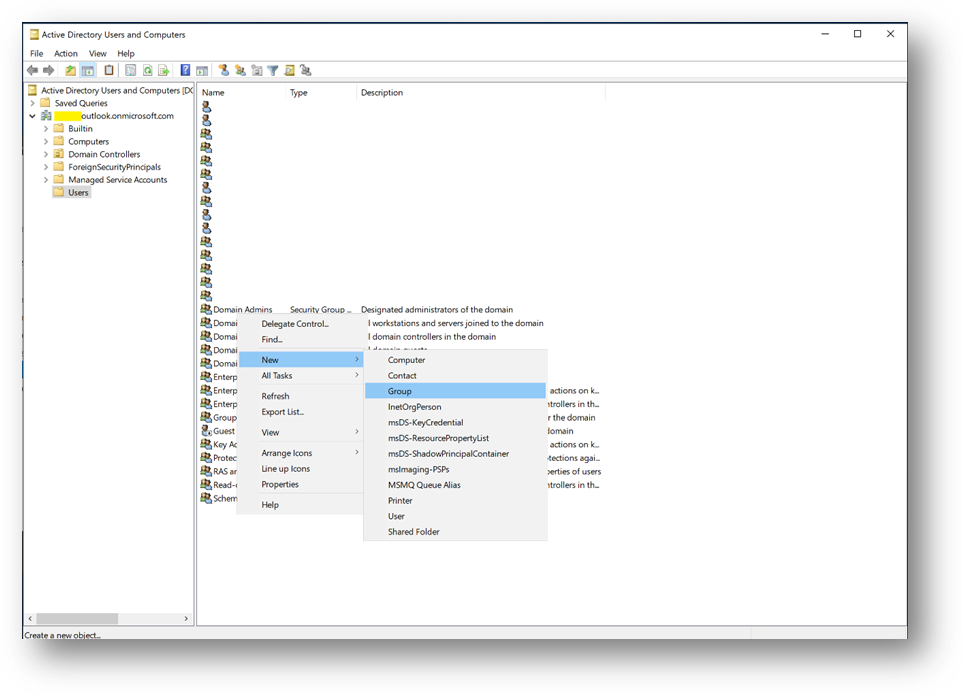
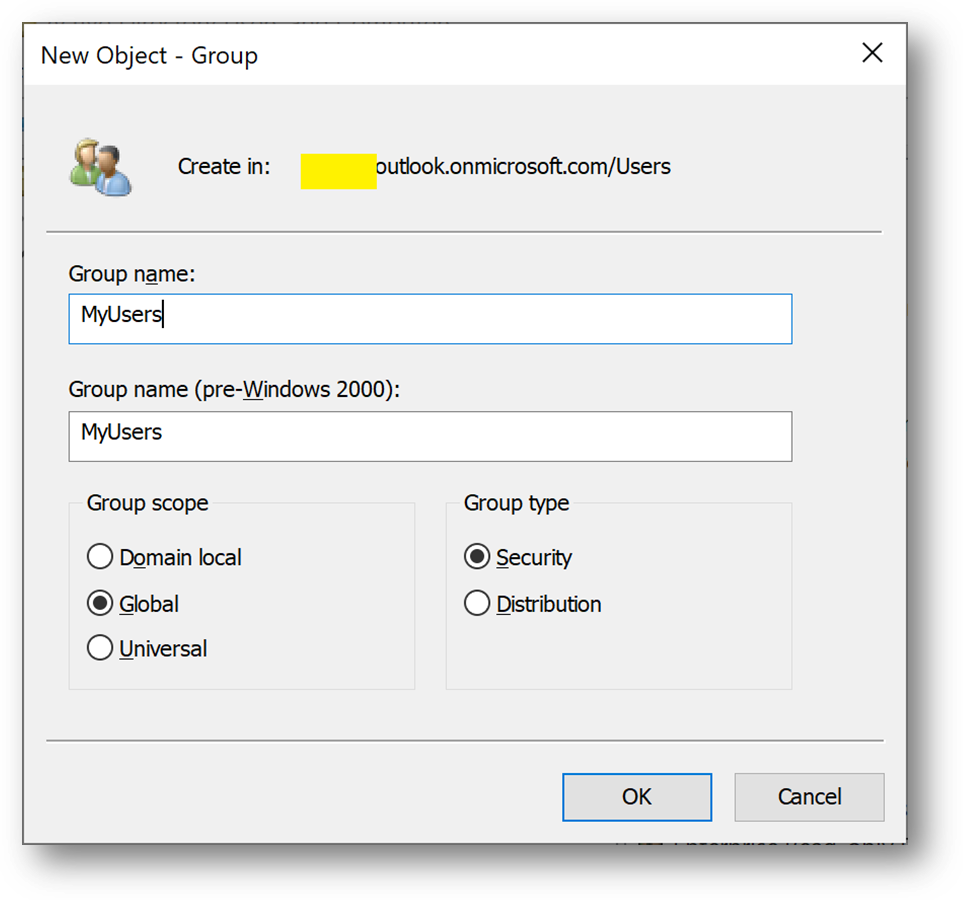
- We will also create a new Security Group containing the applicative account(s).
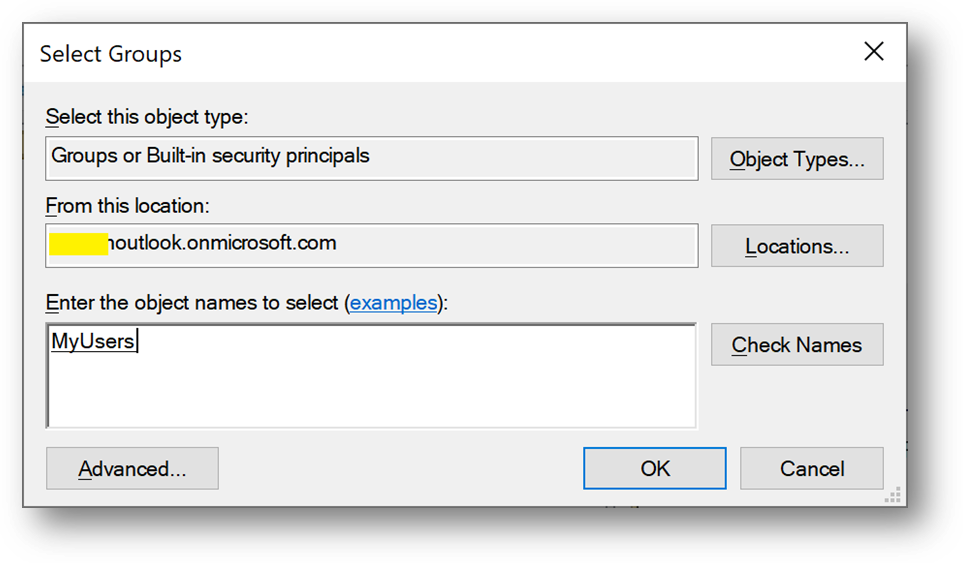
- Click right on [Users] and select New –> Group and name it MyUsers
- Then create a new user appuser, this account will be used next on the Client1 server.
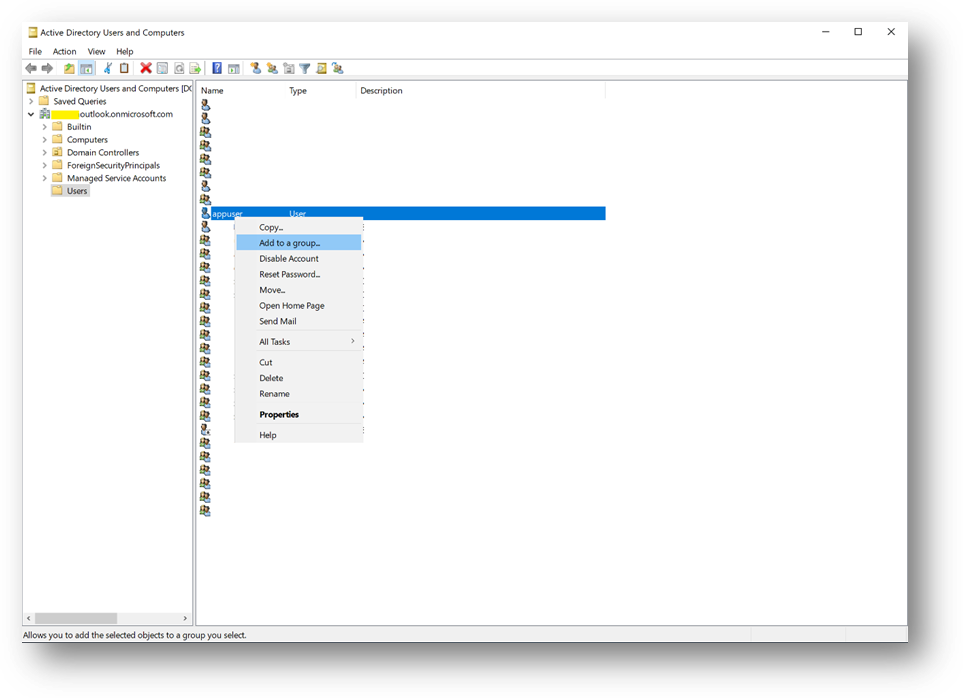
- Add appuser to the MyUser group
Configure the Applicative host
- Connect to the Client1 virtual machine
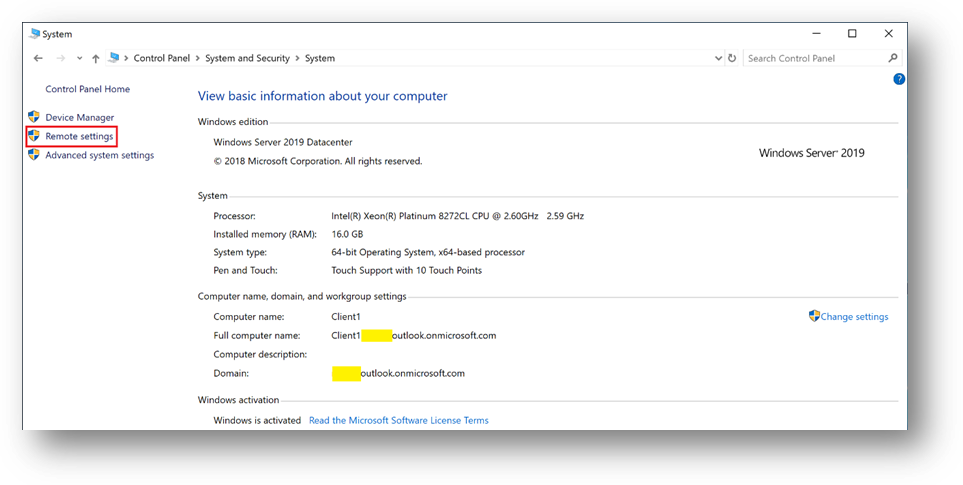
- Go to the Control Panel –> System and Security –> System. Click on [Change Settings], then [Change]
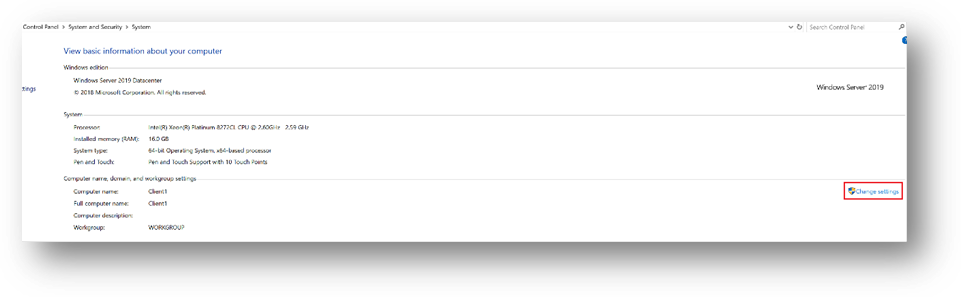
- Select [Domain] and enter your domain name
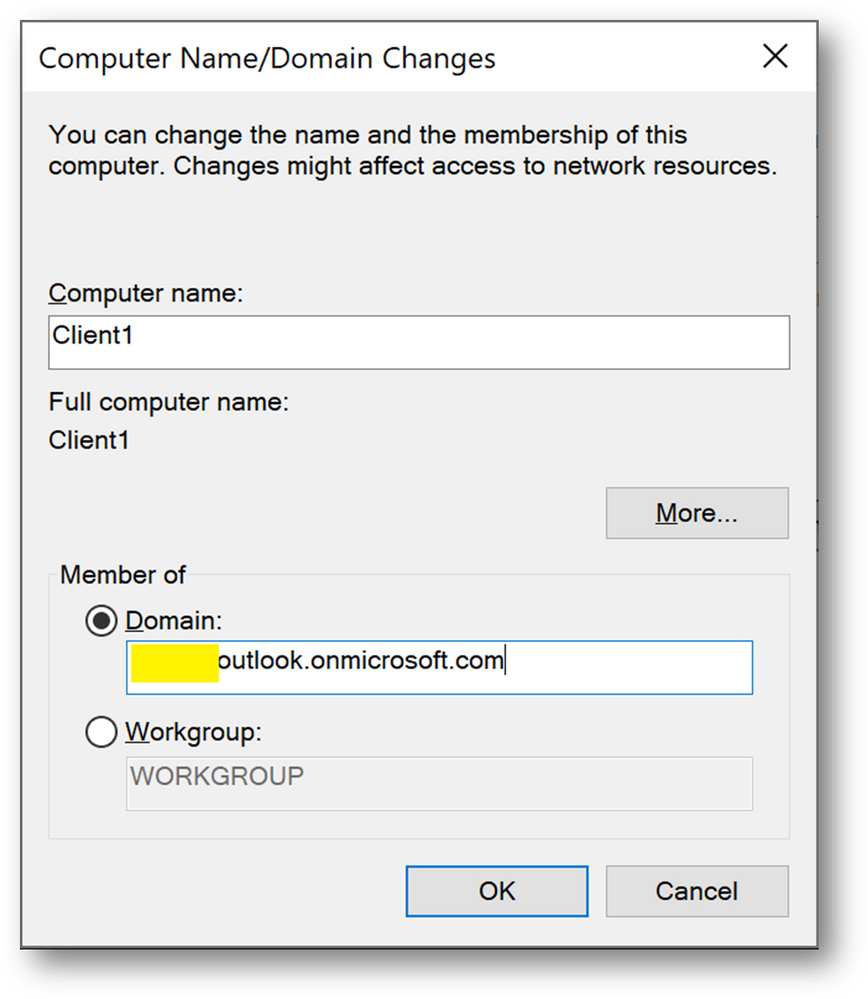
- Use the previously created credentials.
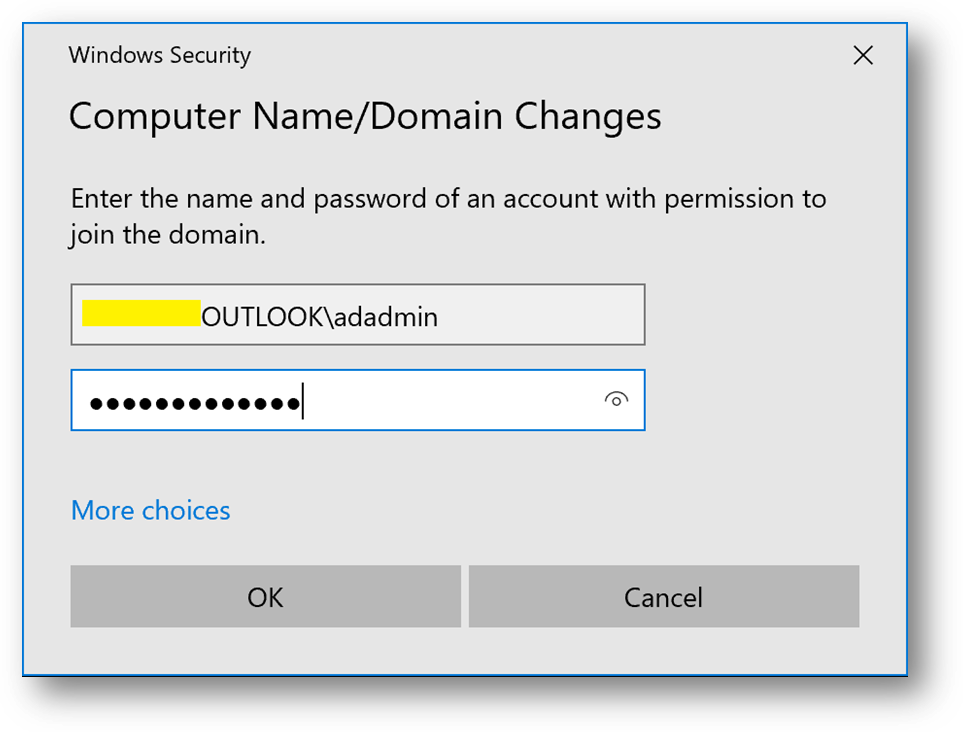
- You’ll be prompt to restart. Click on [Restart later]
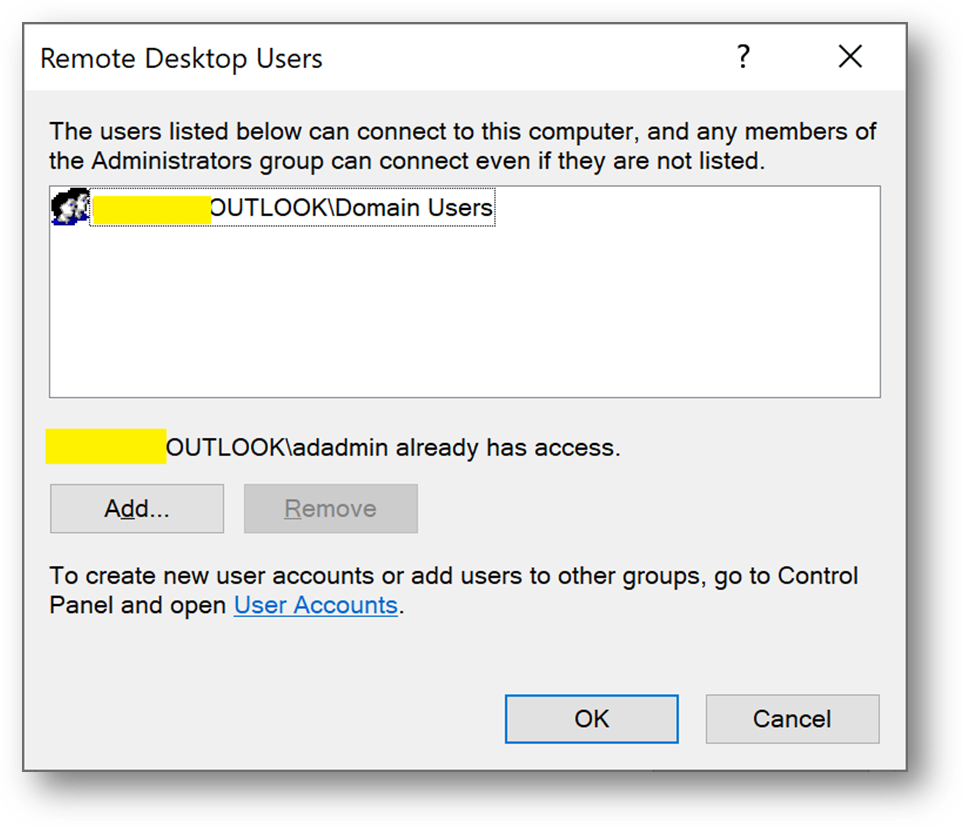
- Still in Control Panel –> System and Security –> System, Click on [Remote Settings]
- Click on [Select Users]
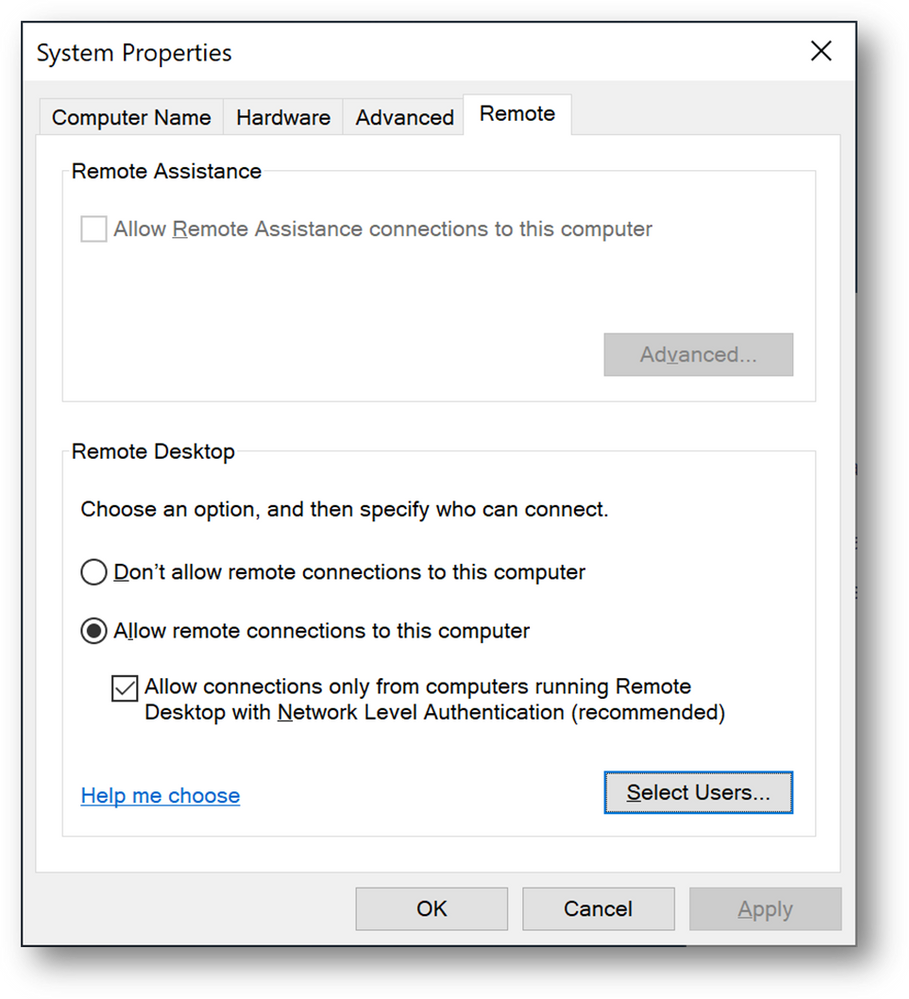
- Add the [Domain Users] group
Install ADConnect
- Download ADConnect and install it on DC1. It will start automatically. (More details)
- Installing Azure AD Connect on a Domain Controller is not recommended due to security practices and more restrictive settings that can prevent Azure AD Connect from installing correctly. (Link)
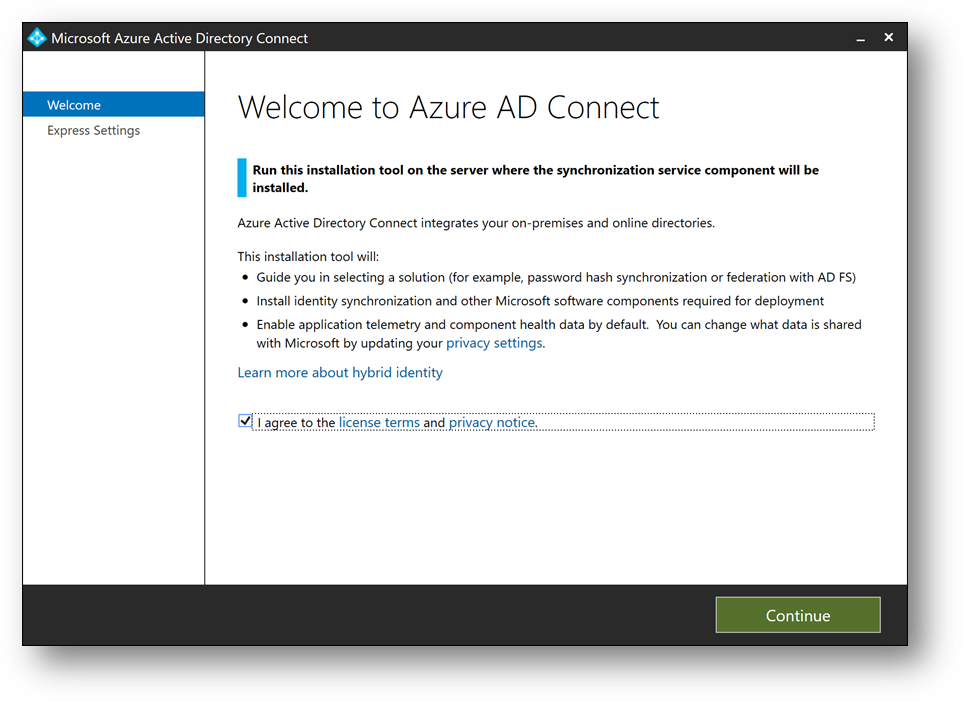
- Check [I Agree to the license terms and privacy policy] and click on [Next]
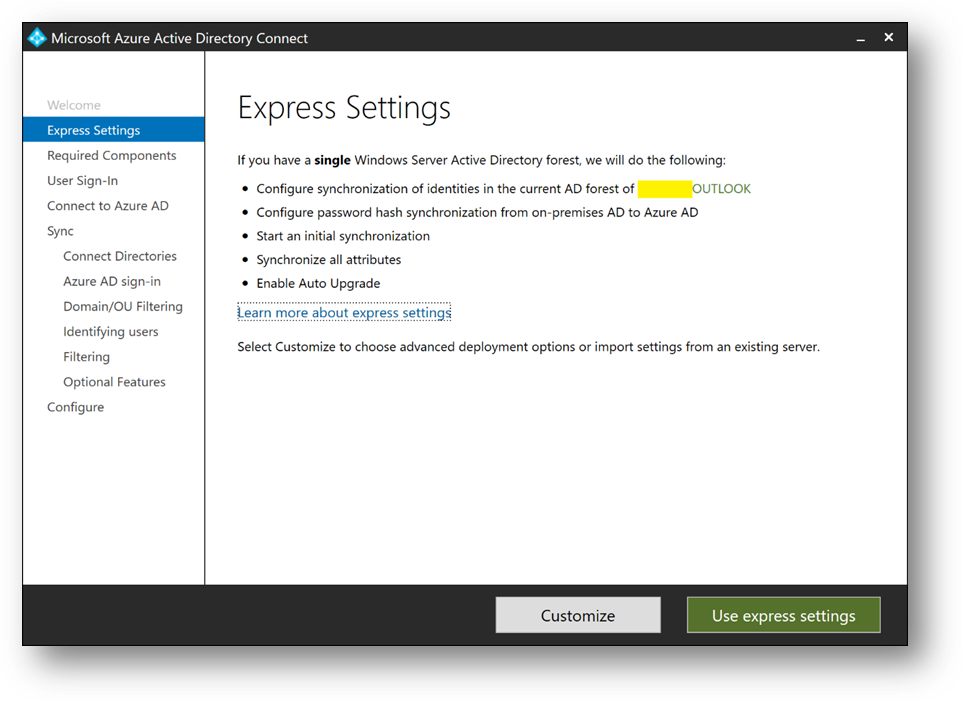
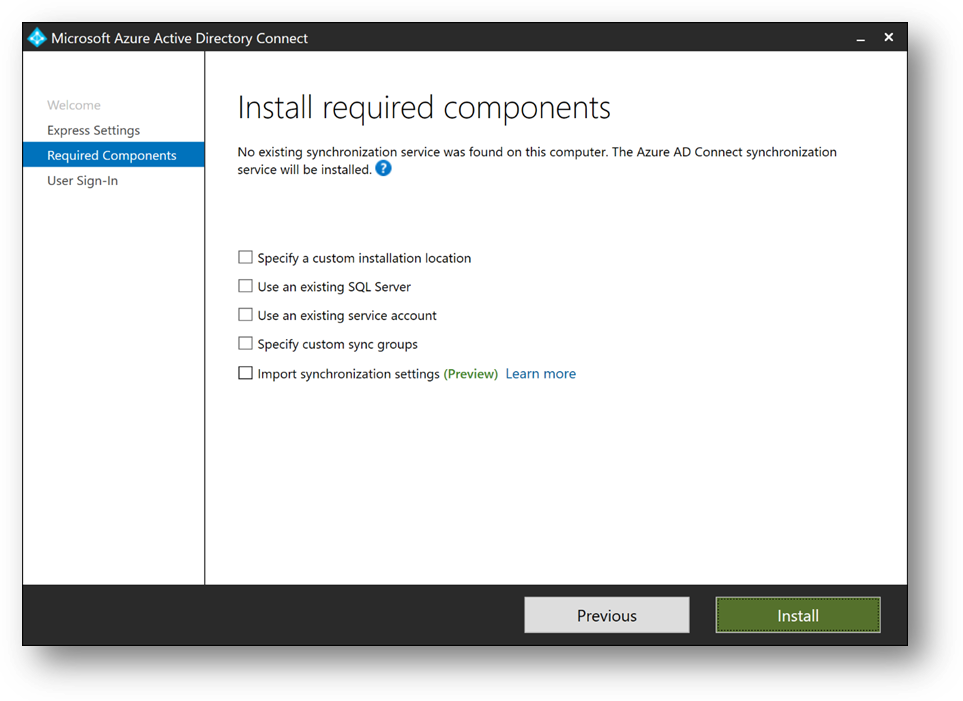
- Click on [Customize], then [Install]
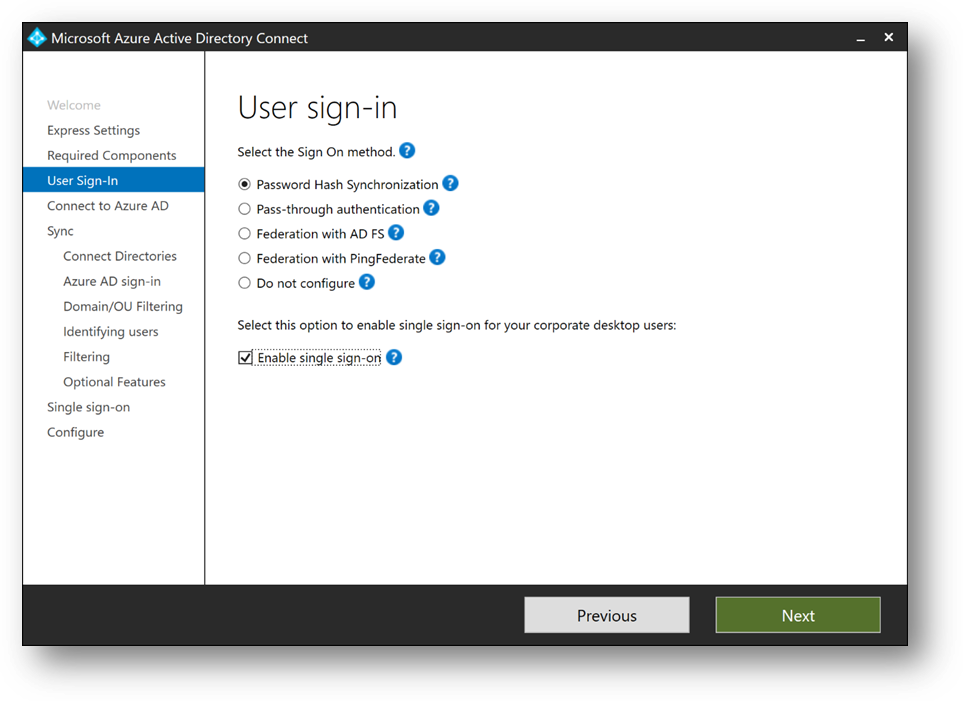
- Select [Password Hash Synchronization]
- Check [Enable single sign-on] and click on [Next]
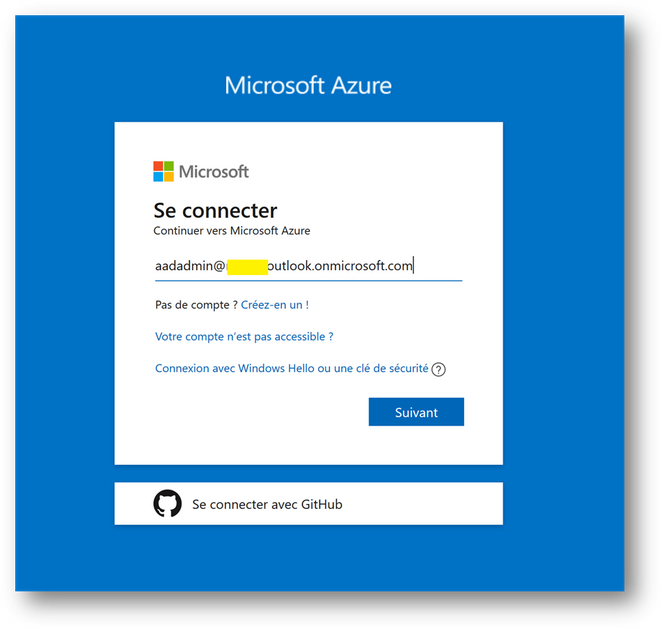
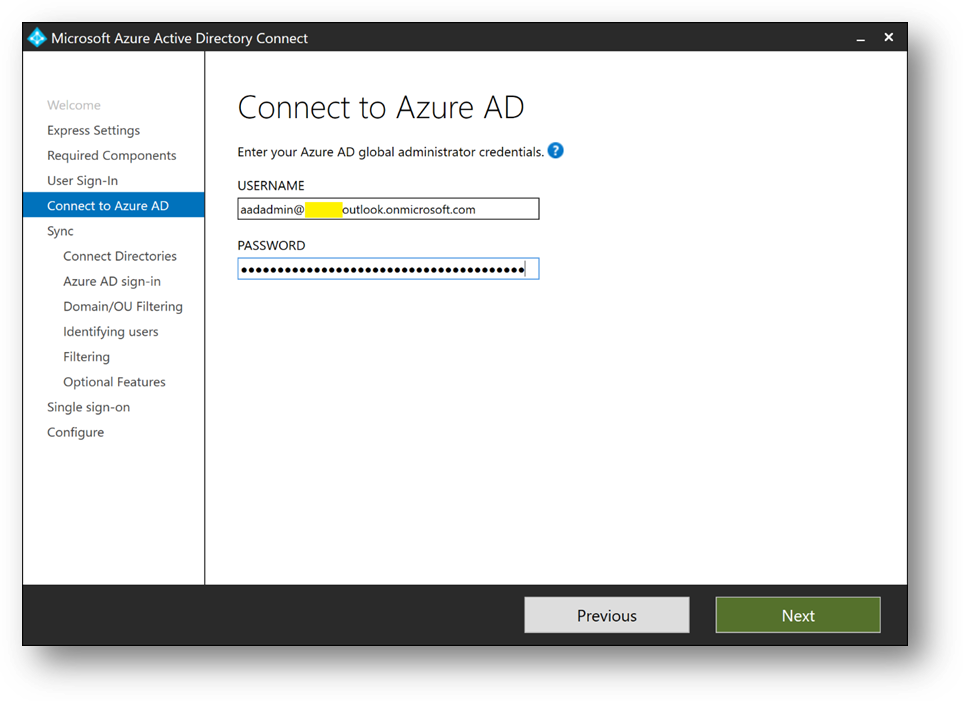
- Connect with your Azure Active Directory global administrator aadadmin.
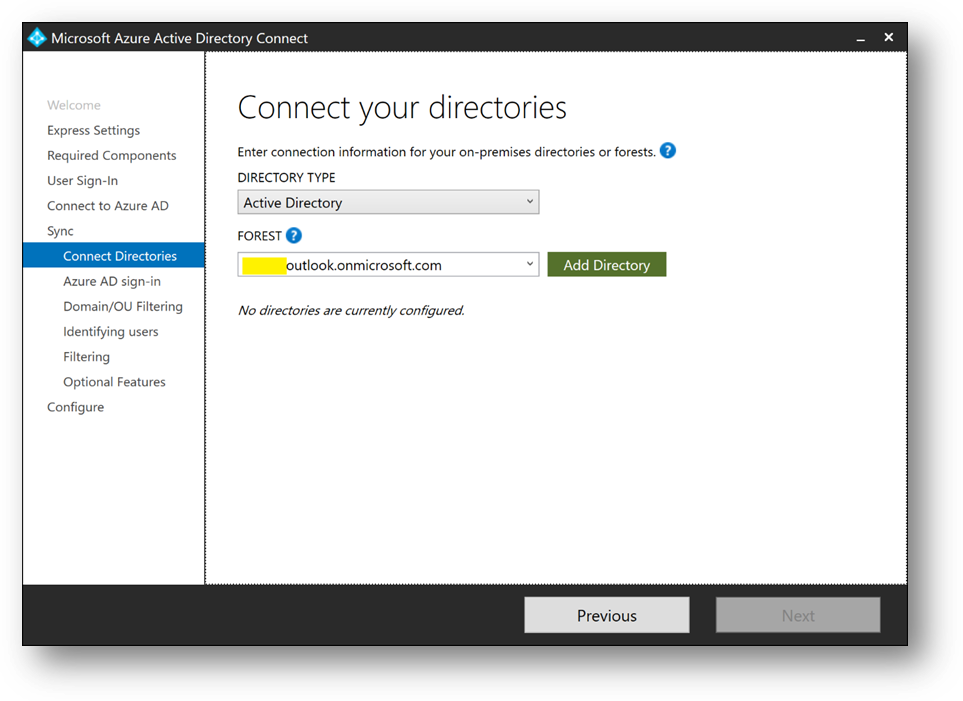
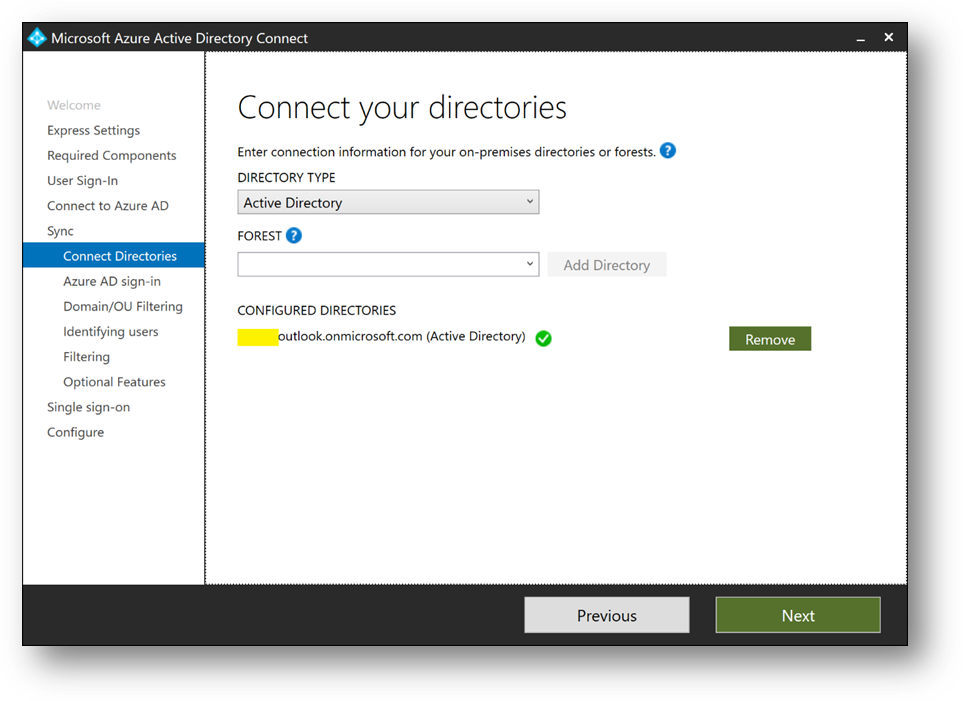
- Click on [Add directory] to connect your directory
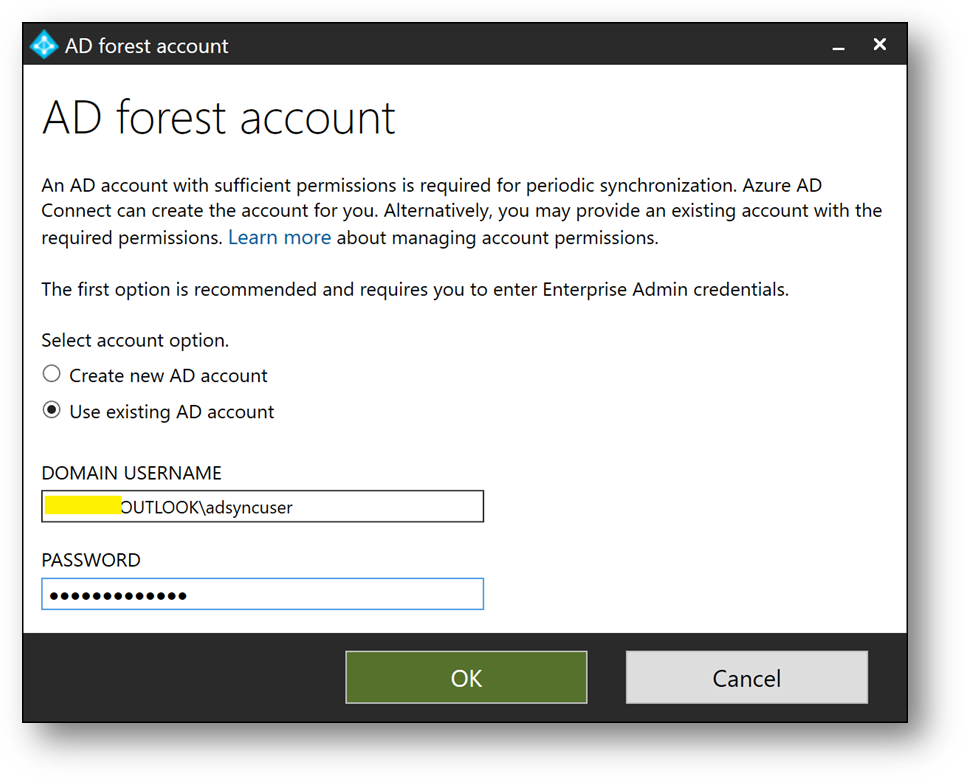
- Select [Use existing AD account], use the adsyncuser account and click on [OK]
- Click on [Next]
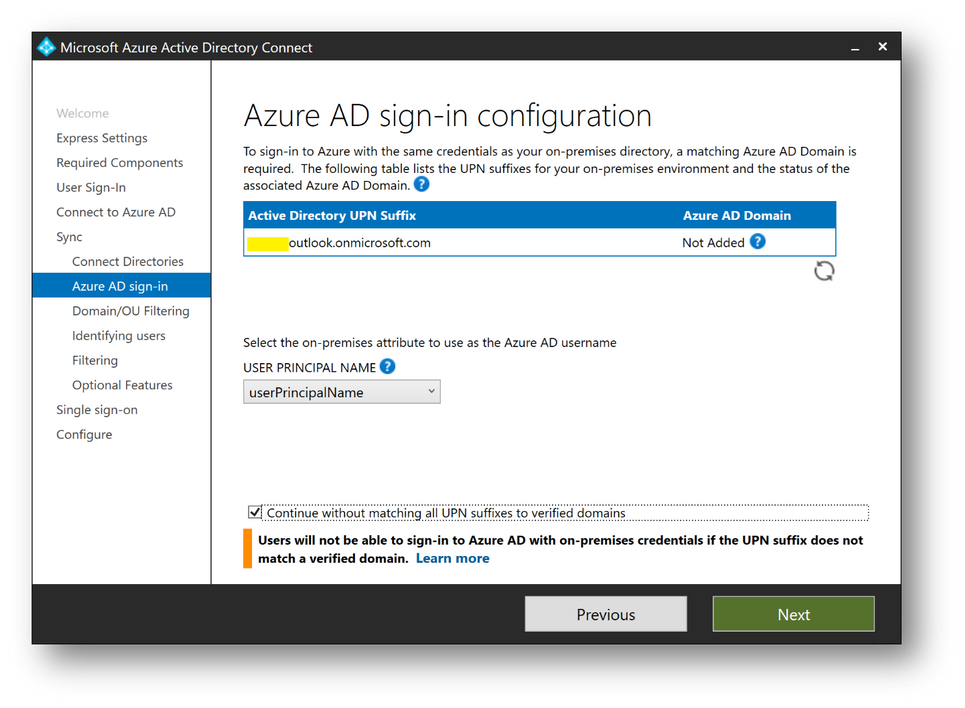
- Check [Continue without matching all UPN suffixes to verified domain] and click on [Next]
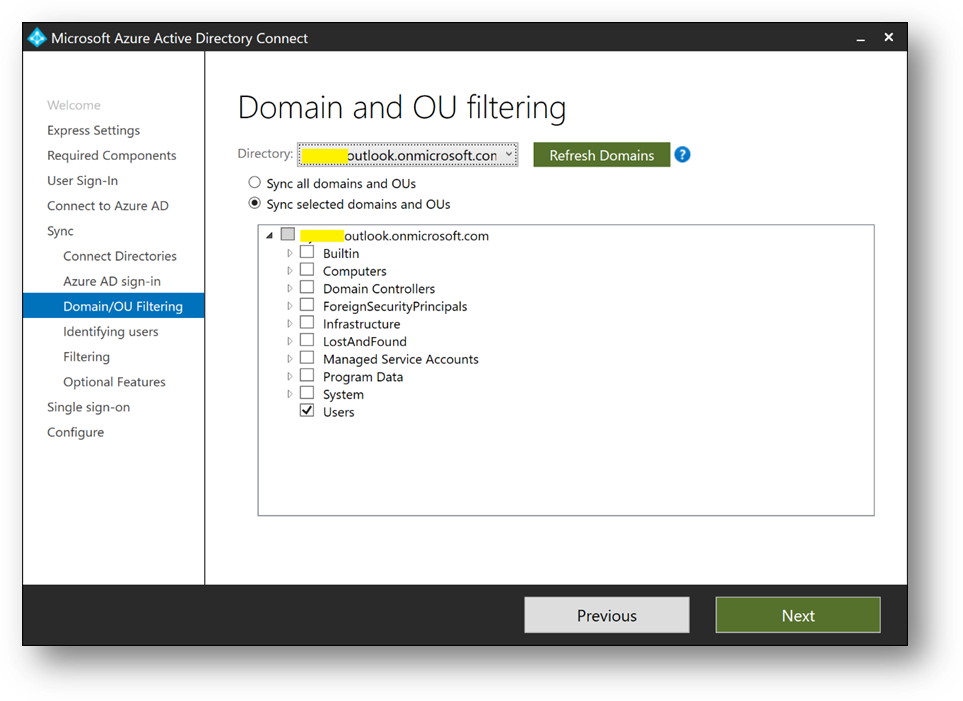
- Select [Sync select domains and OUs] and check [Users] only. Click on [Next]
- Click on [Next]
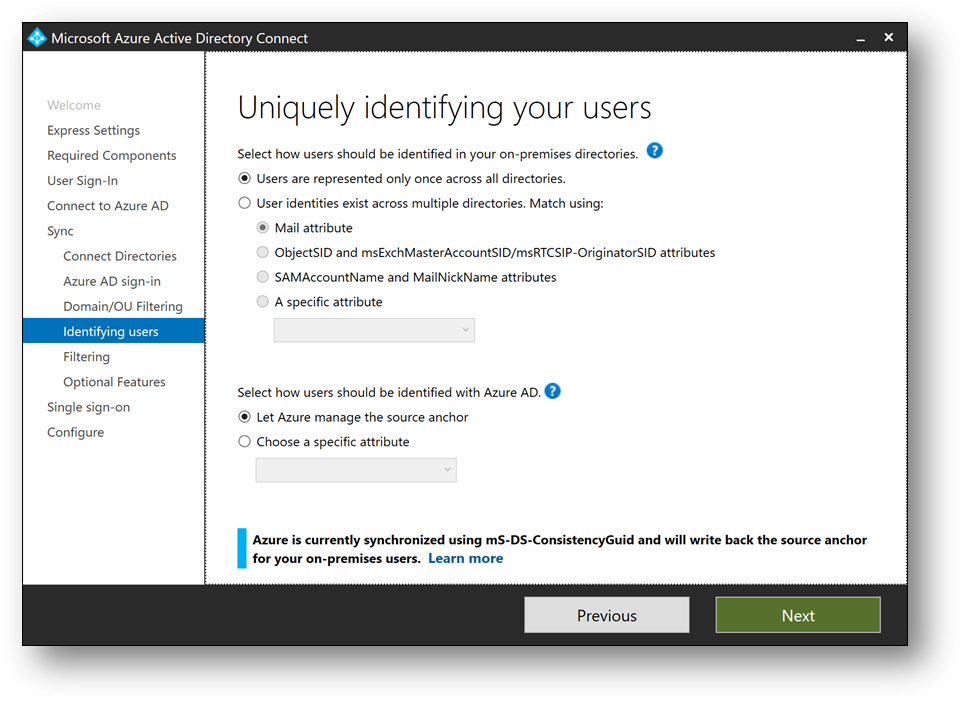
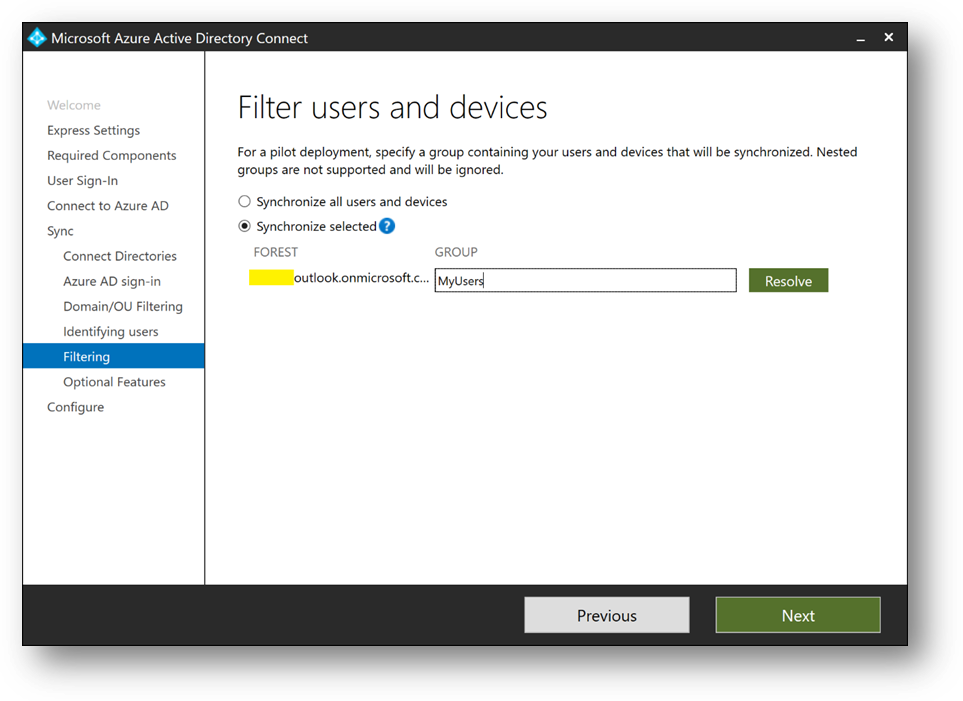
- Select [Synchronize selected] and enter MyUsers. Click [Resolve], then [Next]
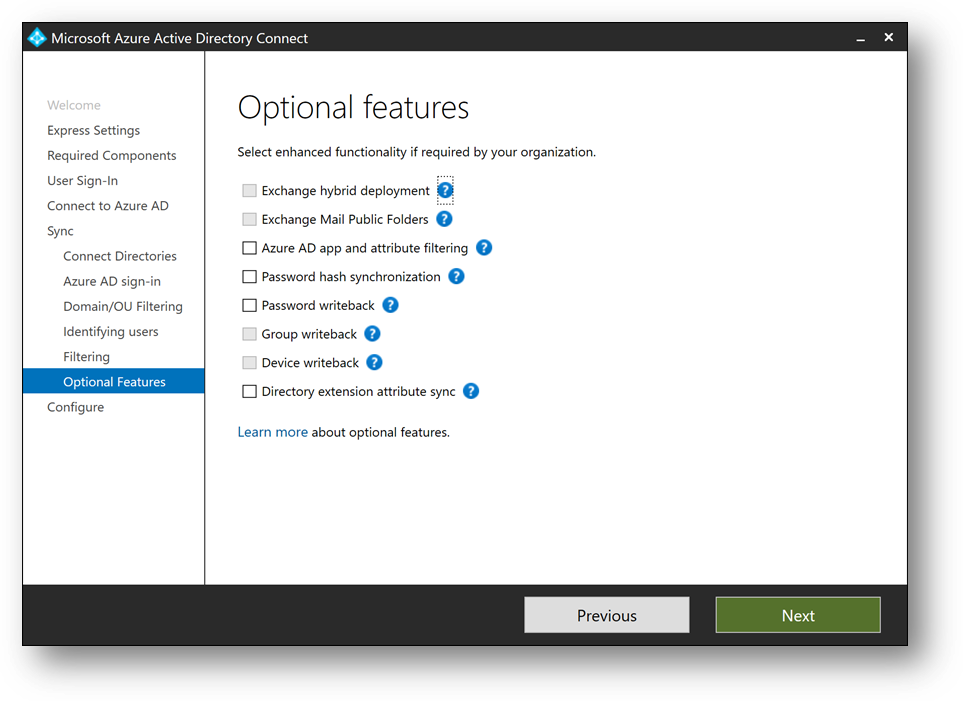
- Click on [Next]
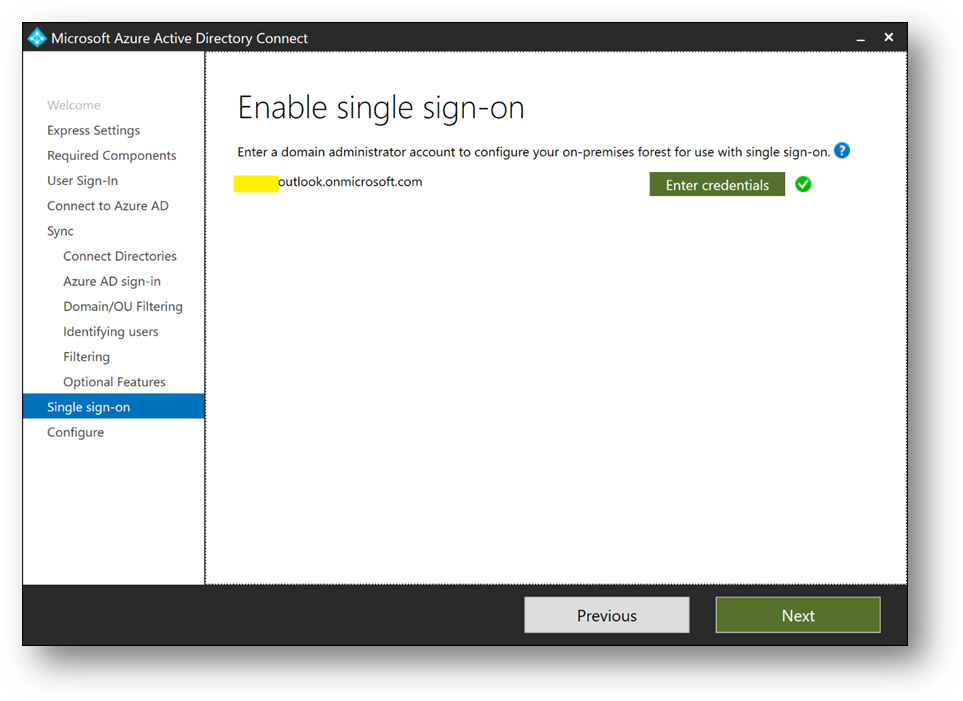
- Click on [Next]. If prompted for Forest Credentials, use adadmin
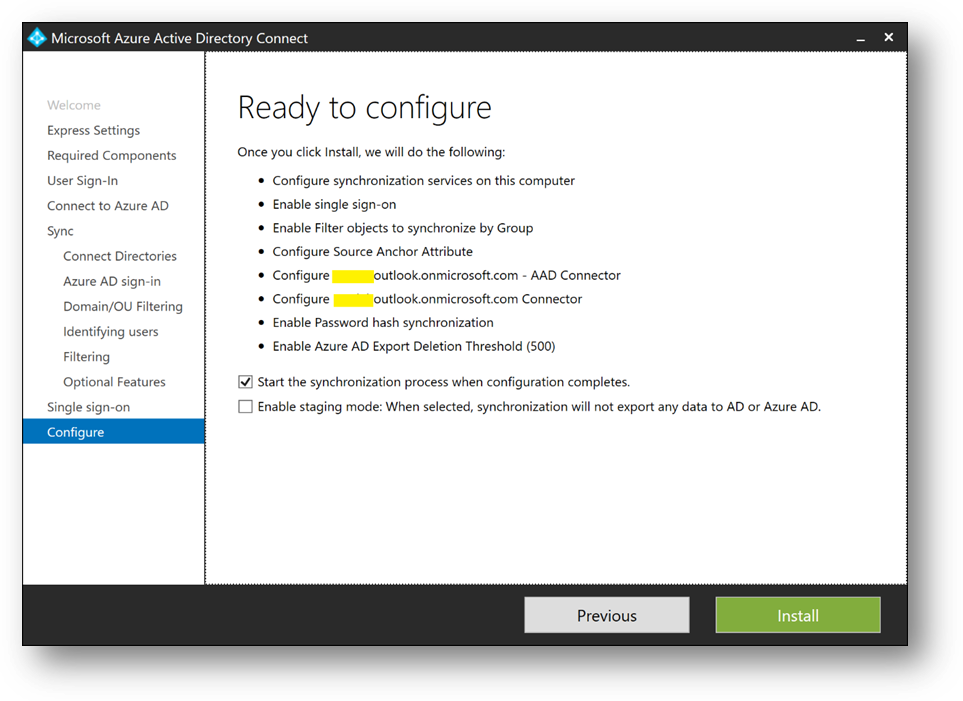
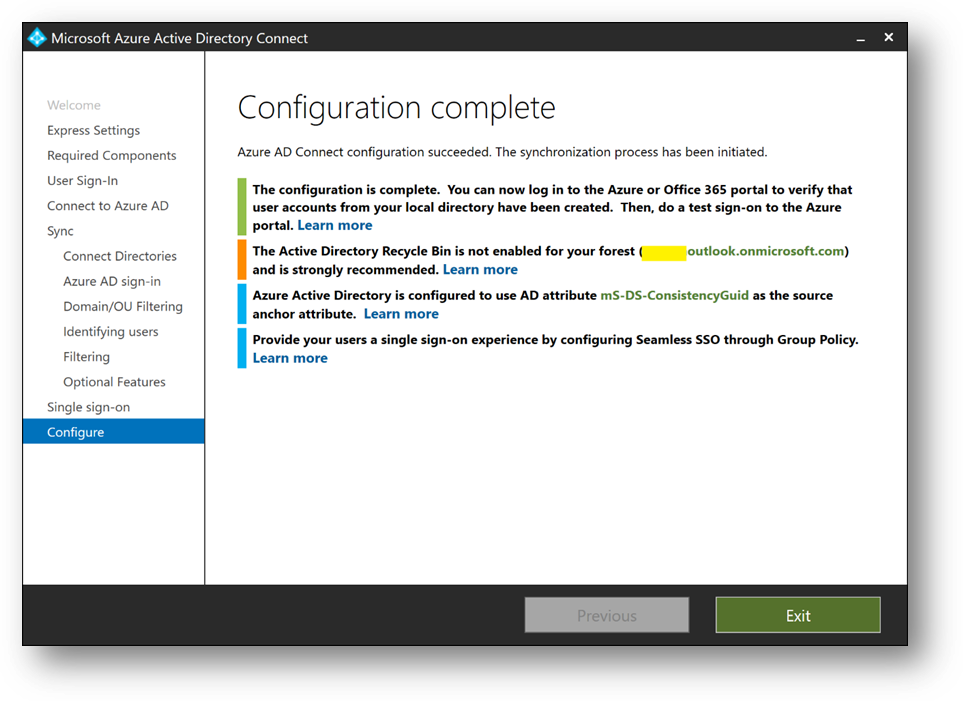
- Verify [Start the synchronization process when configuration completes] is checked and click on [Install]
- Click on [Exit]
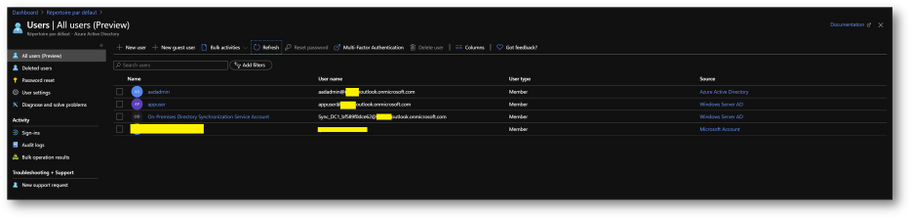
- On the Azure portal, you should now see your appuser in your Azure Active Directory
- Check Seamless Single Sign-on is enable on your forest. To do it, click on the [Azure AD Connect] blade in your Azure Active Directory
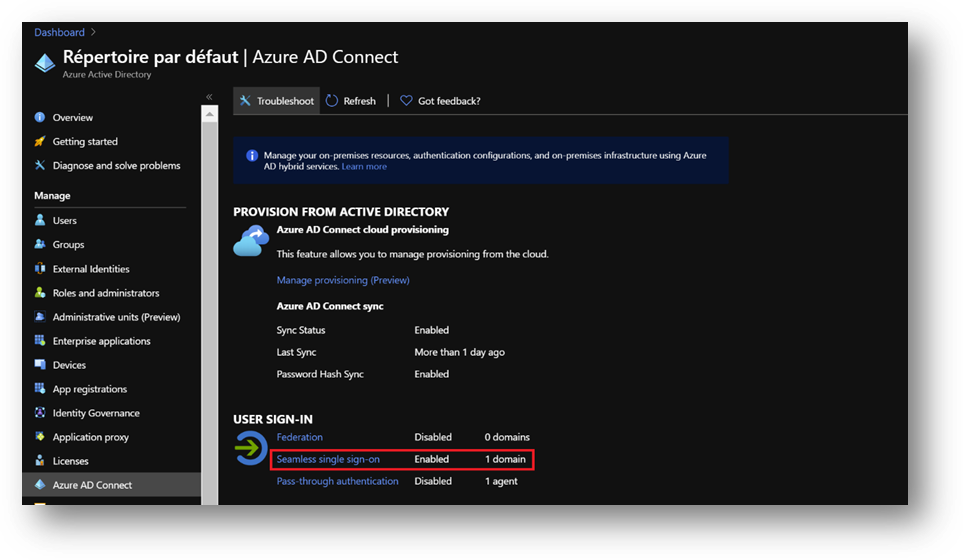
- If Seamless Single Sign-on is disable, enable it using the following procedure.
https://docs.microsoft.com/en-us/azure/active-directory/hybrid/tshoot-connect-sso#manual-reset-of-the-feature
Add a GPO
To enable Seamless Single Sign-on, we’ll use a GPO to modify some settings
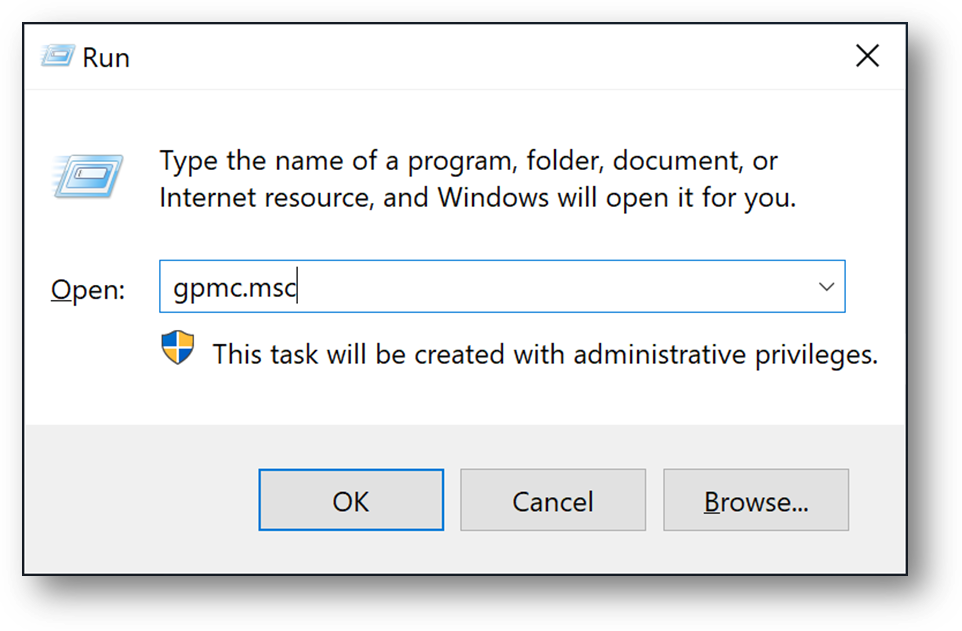
- On DC1, [Windows + R] and type “gpmc.msc”
- Click right on your domain and select [Create a GPO in this domain, and Link it here…]
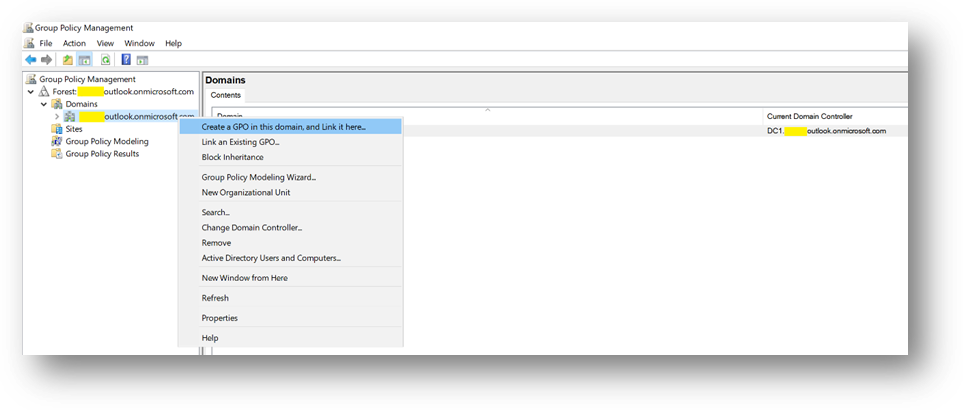
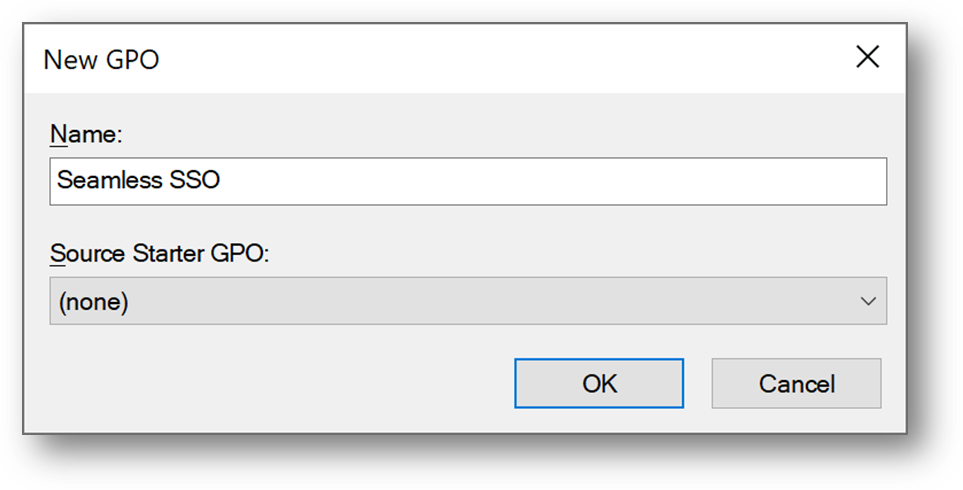
- Name it Seamless SSO
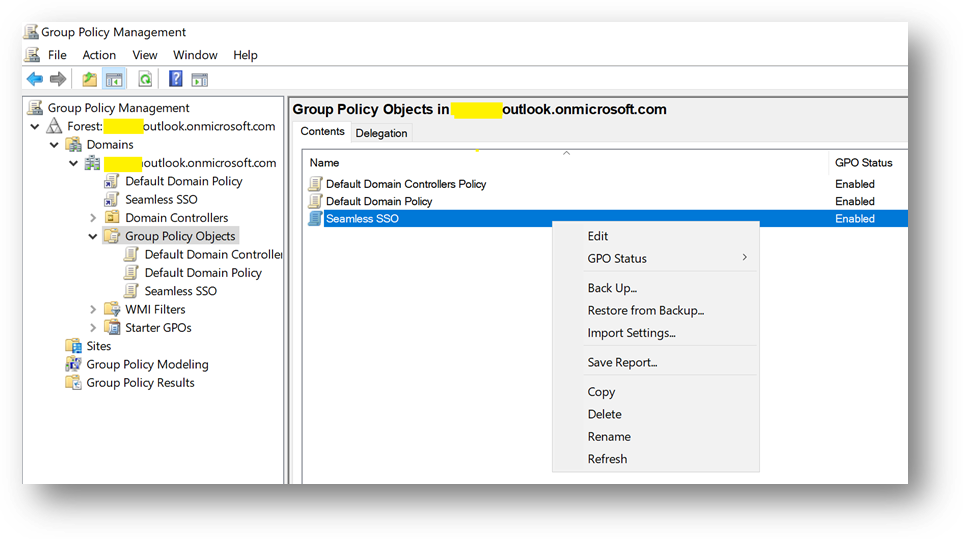
- Edit the Seamless SSO GPO
- Go to “User ConfigurationPoliciesAdministrative TemplatesWindows Componentslnternet Explorerlnternet Control PanelSecurity Page” and open “Site to Zone Assignment List”
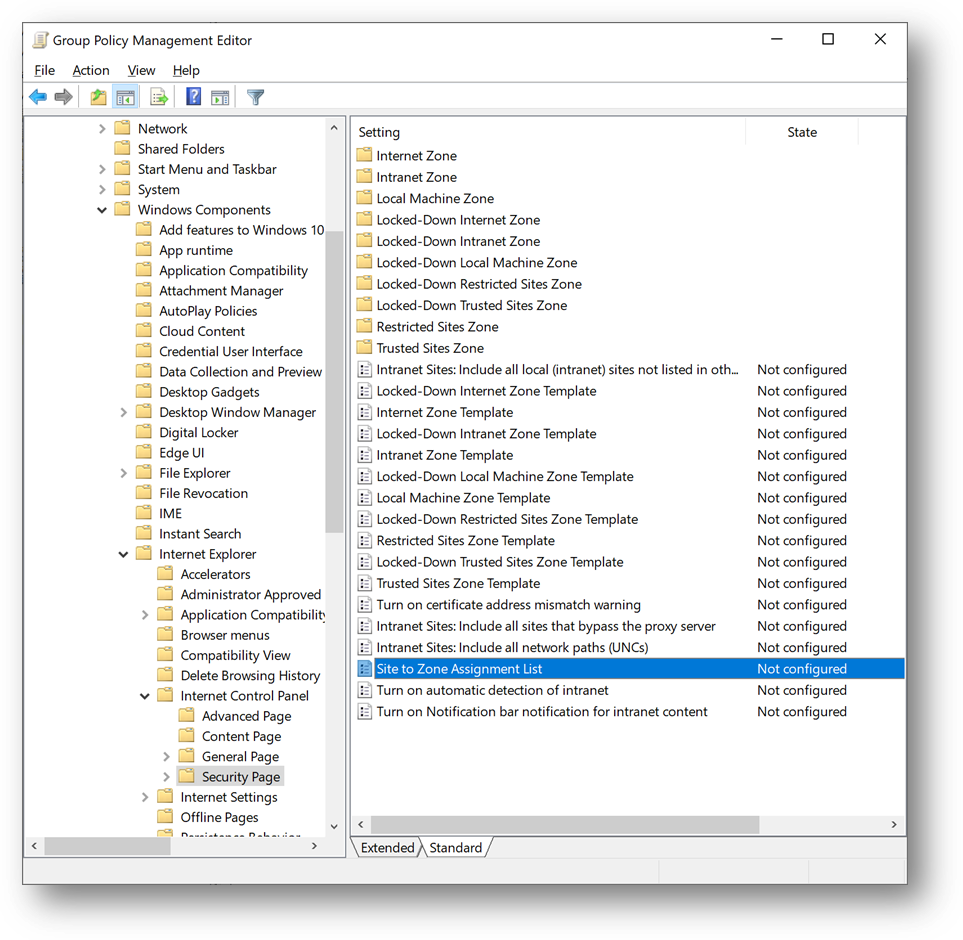
- Select [Enabled] and click on [Show]
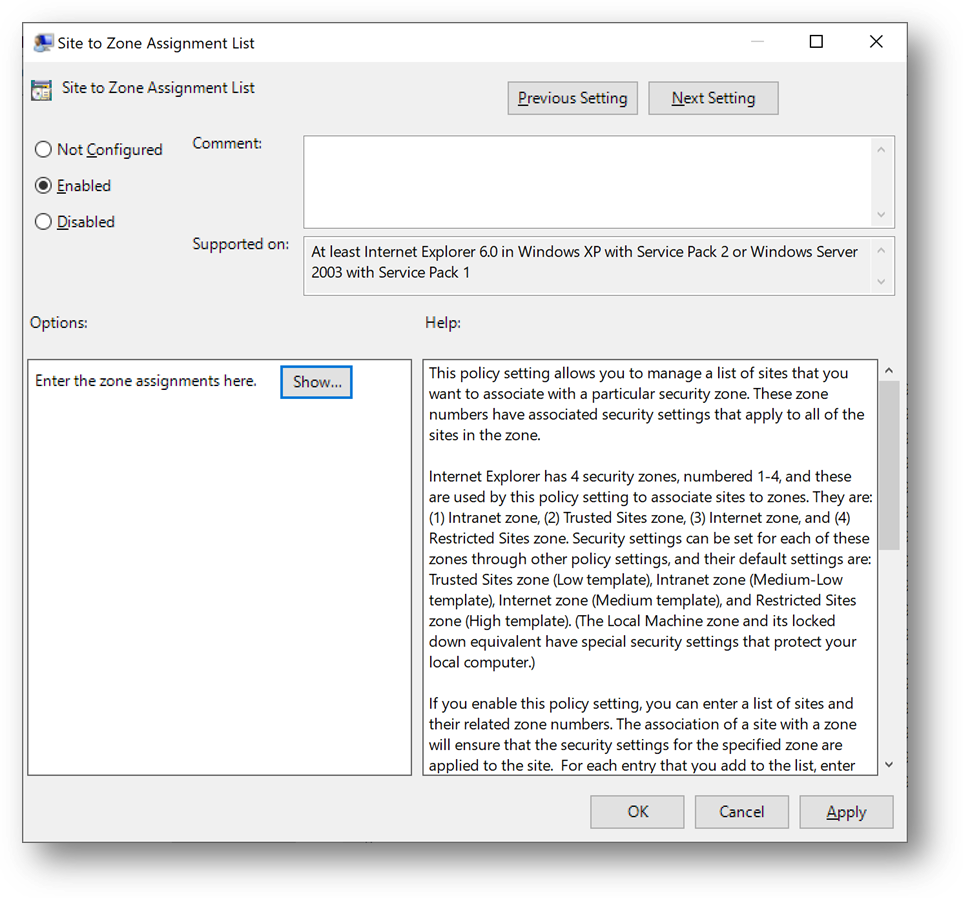
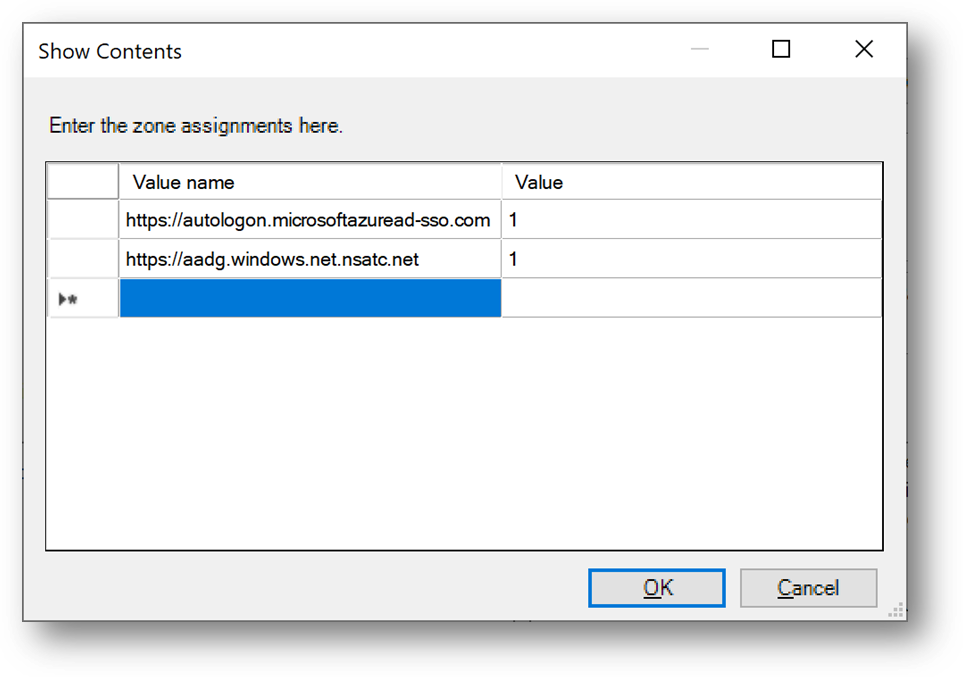
- Enter the following records and click on [OK]
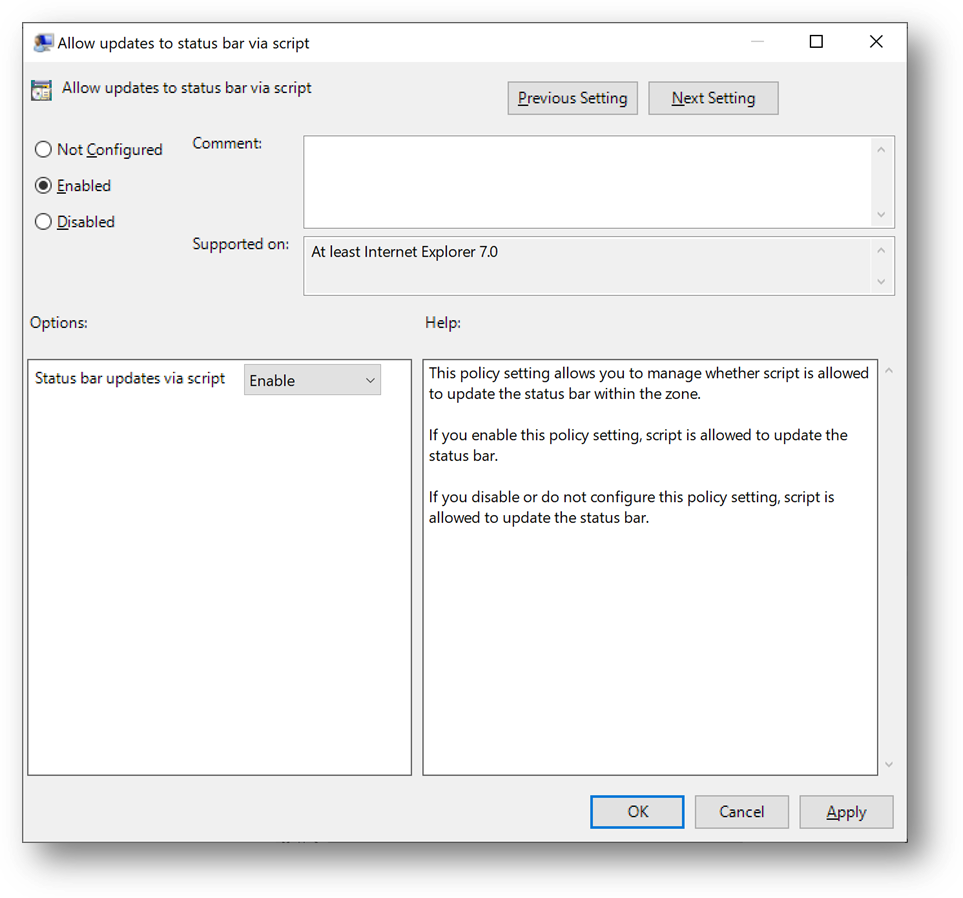
- Then go to “User TemplatesWindows Componentslnternet Explorerlnternet Control PanelSecurity Pagelntranet Zone” and open “Allow updates to status bar via script”
- Select [Enabled] and click on [OK]
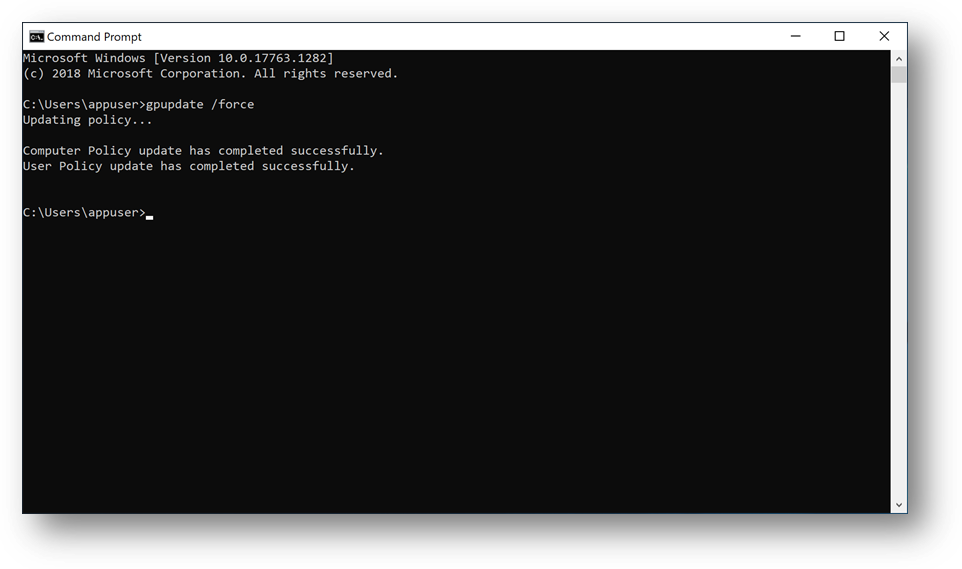
- Connect to Client1, launch a Command Prompt and type “gpudate /force”
Configure Azure SQL Database
We’ll now configure the Azure AD authentication with Azure SQL. (link)
- On the Azure portal, go to your Azure SQL Database server sqlaadauthsrv and click on [Active Directory admin] blade.
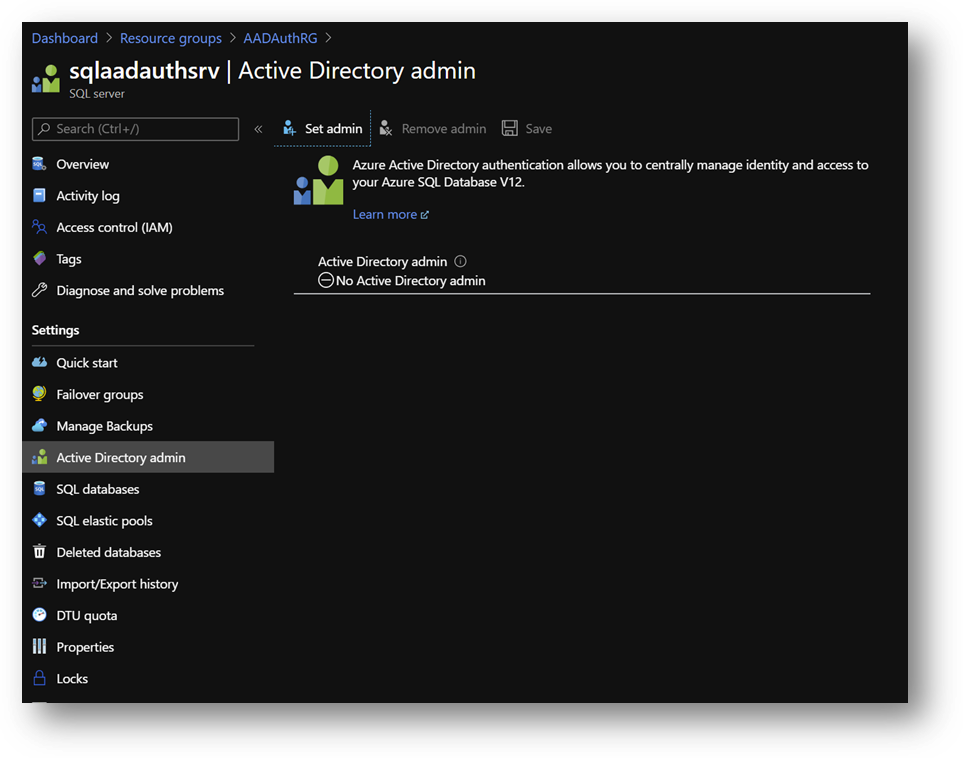
- Click on [Set admin] and select aadadmin. Then click on [Save]
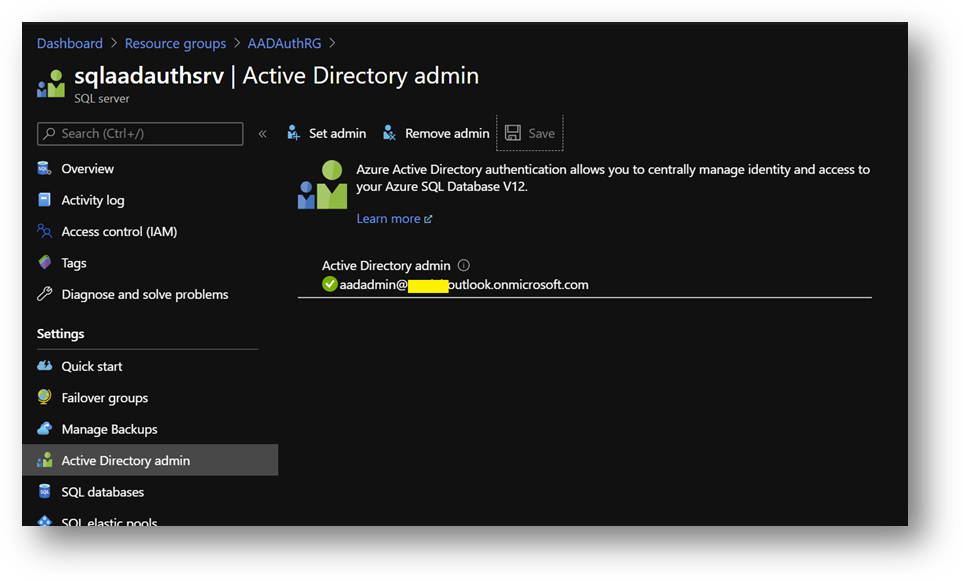
Note: For this sanbox, I use aadadmin account, which is an AAD Global Administrator, to reduce the number of tasks. However, an account with less privileges should be used for a production environment or any other environment.
- Now, open SSMS and connect to your Azure SQL Database with your aadadmin user using “Azure Active Directory – Password” authentication method.
Only connections established with Active Directory accounts can create other Active Directory users
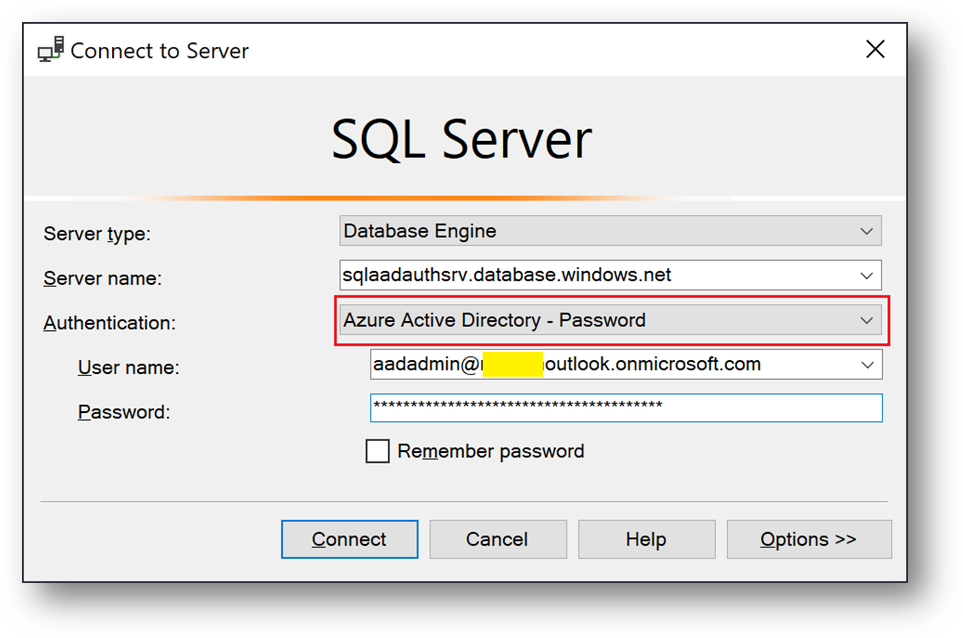
- Open a new query on AdventureWorksLT and create a database user for appuser
CREATE USER [appuser@***outlook.onmicrosoft.com] FROM EXTERNAL PROVIDER
EXEC sp_addrolemember 'db_datareader', 'appuser@***outlook.onmicrosoft.com';
- Now, connect to Client1 using <Domain>appuser account.
- You should now be able to connect your Azure SQL Database with the “Azure Active Directory – Integrated” authentication method.
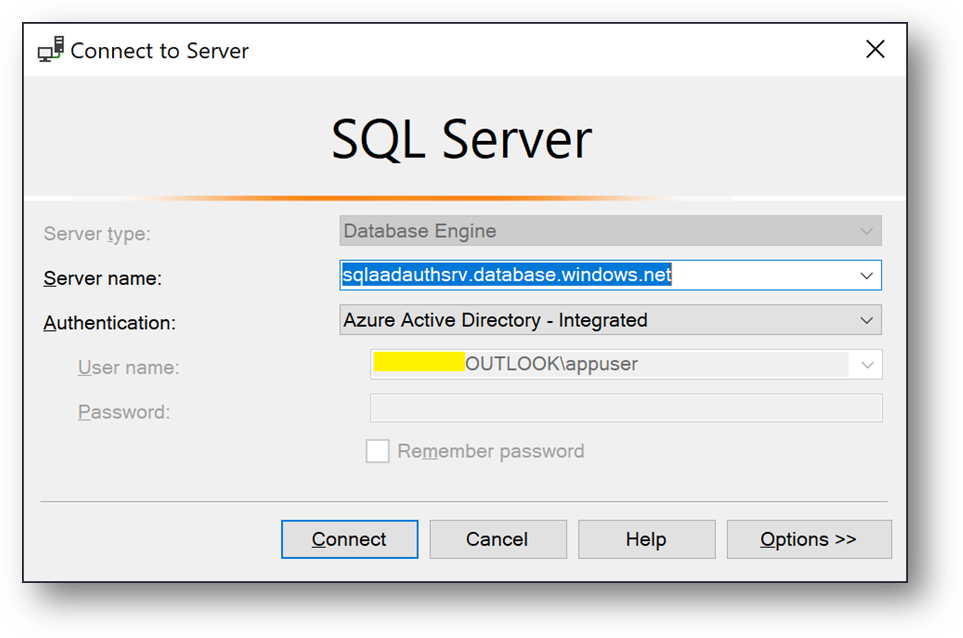
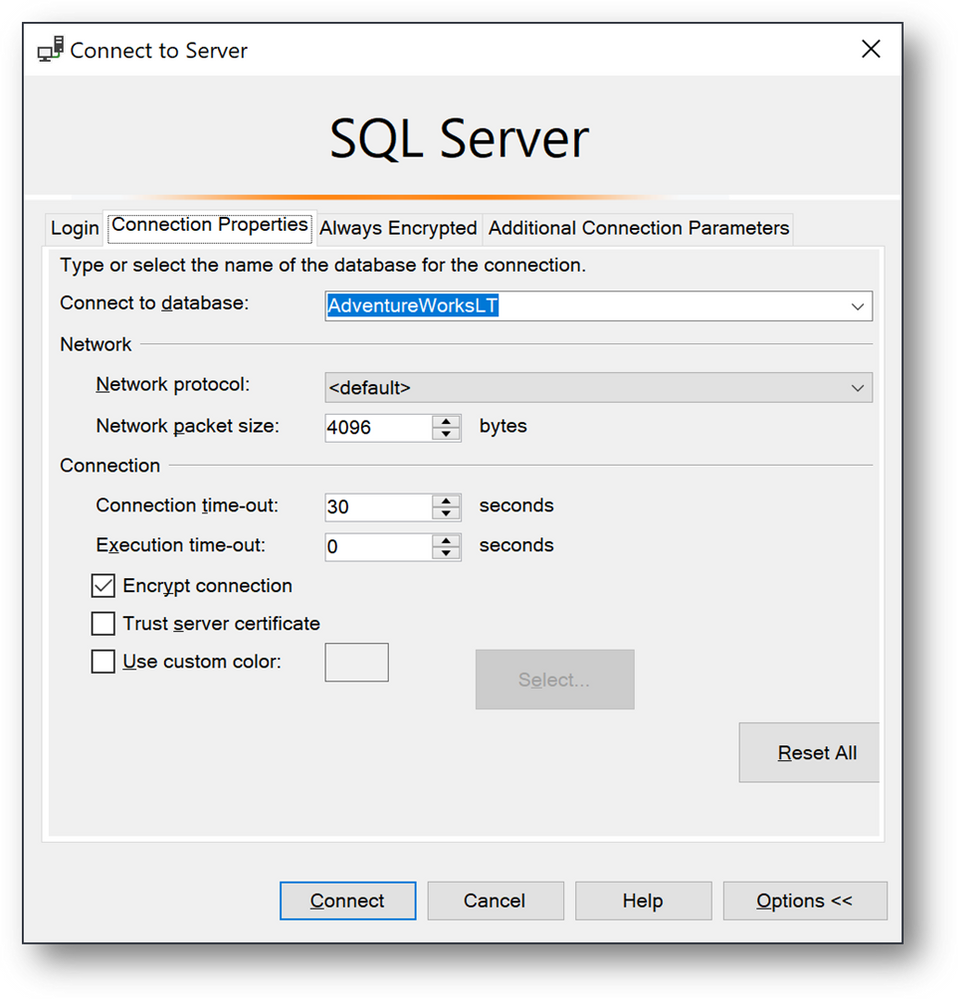
- Click on [Options], [Connection Properties] and fill the [Connect to database] field with the database Name AdventureWorksLT.
- Finally click on [Connect]
Hope this helps.
Ryad B
Customer Engineer – Data & AI
by Scott Muniz | Aug 19, 2020 | Uncategorized
This article is contributed. See the original author and article here.
Customer Story: Within this story, I will give you some insights into how user adoption is different between a company comprised of mainly office workers and a company where the main focus is to create, sell and maintain key infrastructure components on a global market.
Customer Background: During the last months, I’ve been working with a customer who’s a “hidden champion” or global player. This company is producing devices responsible for cooling in industrial, transportation, tourism, building and many more sectors. Their headquarters is in Germany.
Due to the focus on creation, sales and production, the number of people sitting behind a desk is just one third of all employees and IT is just something that must work 24×7.
The last component to make it even more difficult is the fact that this company is a holding of multiple single companies, part of the company group over months or even years, but still not (fully) integrated from the IT perspective.
So, let’s start with the hard facts:
- 60 locations worldwide
- Sizes from 3 to 500 people in each office
- Larger ones with standalone IT
- No overall governance or policy to enforce specific technology or trainings
- Small central IT with multiple local supports / admins
- Every country has its own company with a local Director, responsible for IT as well
- Microsoft 365 E5 licenses are available for all desk workers but mostly used for Office suite licensing only
Customer Target: We’ve started with the target to implement Office 365 as “another” IT solution additionally to the local IT like file servers, email systems, Skype for Business, etc.. Some in the cloud and some on-premises.
Over the initial implementation phase, we’ve figured out that Microsoft 365 needs more governance and principals to ensure a secure environment, combined with Azure infrastructures.
The main goal for the project became a M365 full stack implementation with the main driver: Microsoft Teams.
Adoption insights
We’ve started with a small but important step: we’ve involved the central IT and especially the IT Director, responsible for all IT decisions within the whole group and first contact for any IT questions of the local directors. He’s also in direct discussions with the C-Level executives for business decisions like “more cloud” or “less cloud.”
From a general change management perspective, we’ve made our first alliance with the Management level.
The next step was to identify people who are involved in many business processes in the company and willing to help the IT department for the implementation.
We found these people in a special group of persons, distributed in every department and on a global level: the assistants.
These people already had strong experiences by creating global projects and bringing some new digital workstyles into the whole company group like travel management portal. Another benefit is the direct contact of these assistants with the head of departments or even the C-Level itself. These people became the champions for the whole project.
We’ve created a strong relationship with these assistants by creating 2 weekly calls, providing direct trainings, sharing knowledge of the M365 products as well as the current project status for our global rollout.
Anyhow, all of them had different backgrounds for IT, beginning from a person with more knowledge of the manufacturing process as the PC handling, to someone who delivers IT trainings to multiple departments within the customer group.
Our initial idea was to run the following deployment process:
- Creation of the team can be done via Head of Department or Assistance only
- Every user will be enabled for Teams right away and we will announce trainings etc. on a central platform
- Rapid rollout
Within the regular champions call we’ve tried multiple trainings ideas and asked for feedback about them:
- Create an internal knowledge base with know-how articles
- Online articles from Microsoft
- Self-created Training materials
- Self-created training tasks / challenges
- Small references to Microsoft and internal training material to provide help
- Offer open office hours
- Create a test team with full access to create
- Providing showcases with a dedicated trainer
With the experiences of our Champions network, we’ve adjusted our plans. One was an “easy to use” Teams online request form, based on a request template with basic questions for all users AND the other one was the decision to provide more training and start with another rollout approach: activate the users in groups, divided by department with a slower rollout to ensure a good user experience.
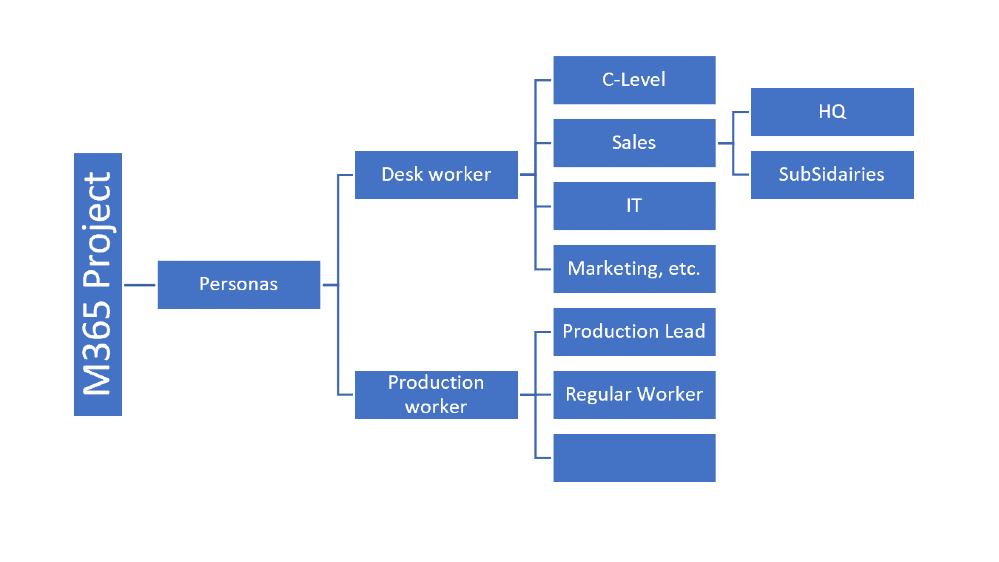
Based on these insides we’ve also identified a strong need to create valid personas for different target groups. We also made the decision to separate the persona groups by office worker and production worker.
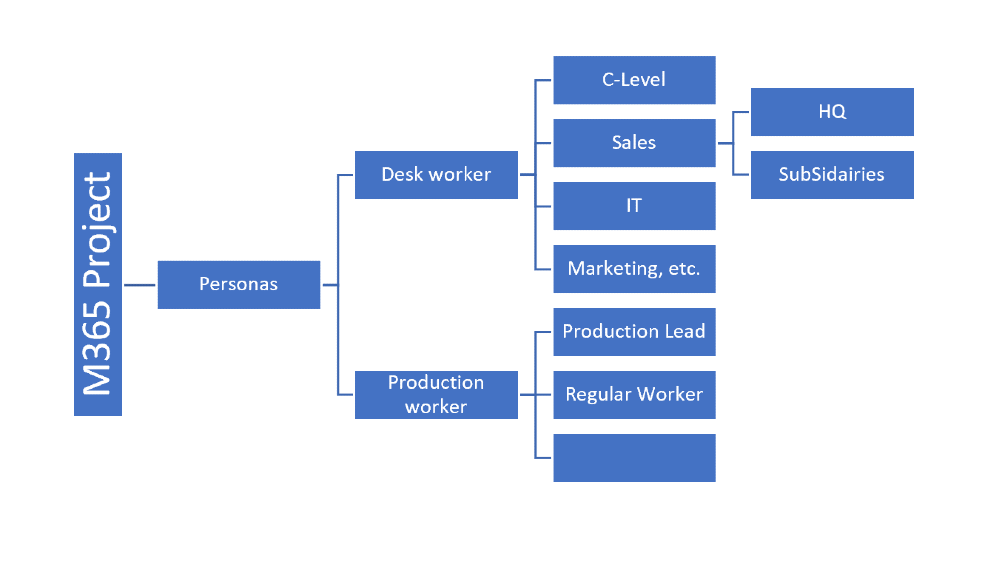
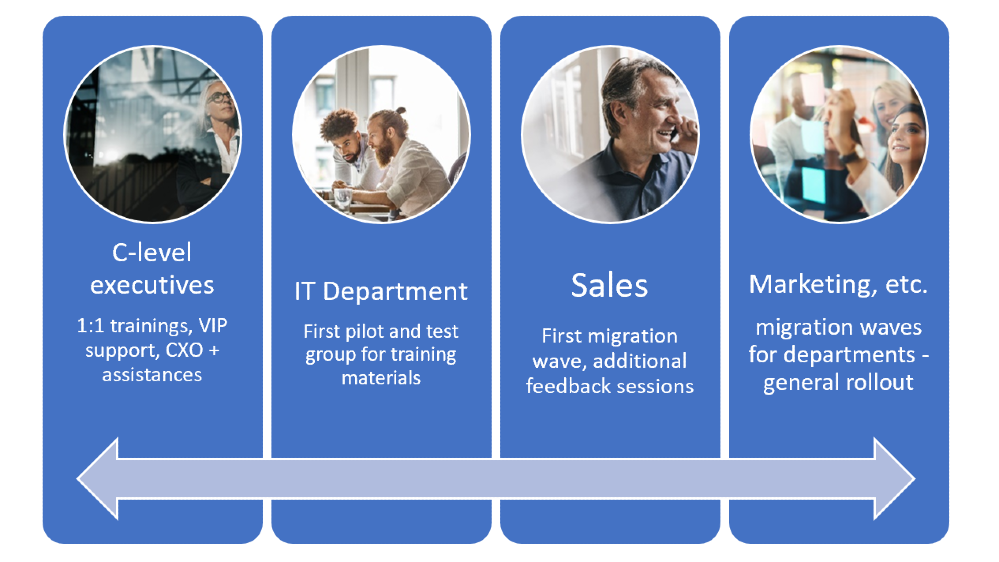
These different persona groups enforced the whole project to create different rollout plans and different training concepts.
The following onboarding concept has been used for the office workers:
Marketing
- Internal newsletter with the announcement of Microsoft Teams is coming
- Intranet-Posts on the daily startup page in the browser
- Article / extra in the internal news page magazine
Pilots
- Low risk pilots with IT friendly users
- Creating best practices and marketing
- Create a show case to visualize the success
Build up a Champions community
- Create a champions community with interested people
- Clarify the future role as a direct contact during rollout
- Announce these champions directly
Rollout – Communication
- Start with e-mail communication before the rollout starts
- multiple weeks before as announcement
- couple of days before rollout with a description what happens during the rollout
- 1 day before with some reference links to training material
- Send out a welcome Mail and invite to a welcome team with reference and training material as announcement during rollout
- Floor walkers offer a help on migration date
- Multiple open office hours during the whole migration phase
- Provide direct and anonymous feedback via feedback forms
Rollout – Trainings
- Invite for a kick-off when the rollout happens in the background
- Provide mandatory basic trainings
- offer optional advanced trainings
But this was just the on-boarding concept. We also needed a training concept as well.
Based on our experience with the champions and the feedback of the PoC / pilot users, we’ve decided to offer multiple training options, instead of single one. But the key for the rollout kick-off was a classroom training where all user of the migration wave should meet some of the champions and get some first hands-on experiences within the test-team.
Before and during rollout
- Provide training
- materials via internal knowledge base (multi-lingual)
- Know-How videos (multi-lingual)
- Create a Test-Team for each wave
- with welcome message
- specified trainings / hands on experience tasks for testing
- Add Microsoft Teams (and additional) licenses to the users of the current wave 1 day before the kick-off is planned
During Kick-Off Event
- Add these users to the Test-Team
- Present basic, quick enable knowledge during Kick-Off event
Complimentary basic training
- Invitation will be send during Kick-Off event
Optional Offers
- Multiple advanced trainings for new tools and options like Planner, Forms, PowerApps, …
- Open office hours
During all the time we’ve got constant feedback from the champions to create an additional Q&A channel to the new users but also between the champions and the IT department.
Due to multiple projects we’ve been aware of the general approach for office worker but for production worker, we had other needs and requirements. The production worker also has another “relationship” with IT.
For the production users we had the following dependencies:
- Not every worker has an account
- Generic accounts with Internet access are used in “open areas”
- The foreman has a direct account
- No mobile phones in production just customized iPads
With these prerequisites, we’ve identified the following personas:
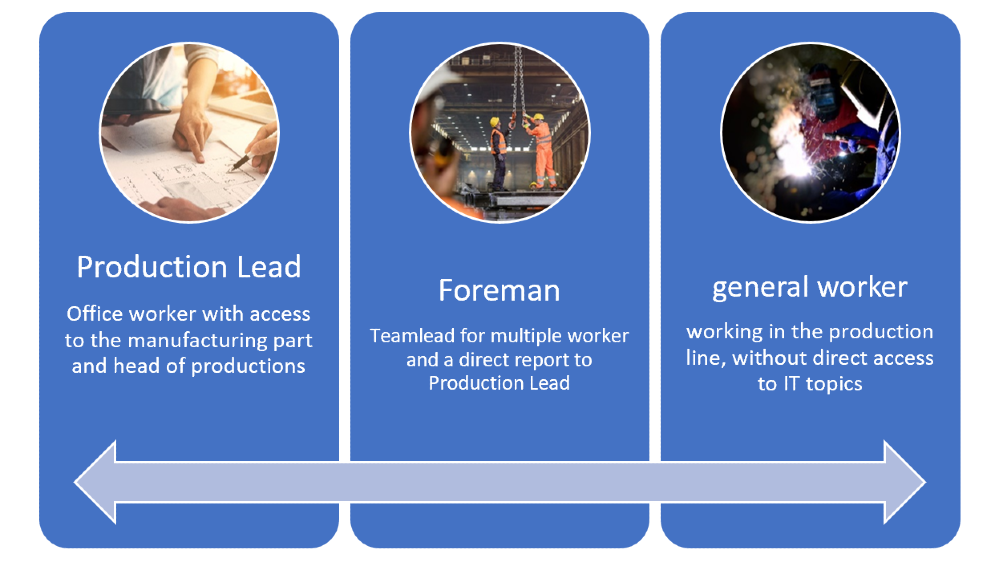
Unlucky for the integration, but good for the adoption concept: The initial idea to implement shifts for the whole production area was rejected due to the huge invest regarding training and hardware. This decision reduced the change impact to a smaller set of production users: the production lead and the foreman.
Over 2 weeks, we’ve evaluated the original way to work and identified typical business processes where we can bring in some benefits for the target groups.
This knowledge allowed the creation of specific water-proofed handouts and quick-start guides.
We’ve also created another rollout concept with single parts from the concept for desk worker but provide more production specific marketing and training strategies.


Recent Comments