This article is contributed. See the original author and article here.
Mozilla has released security updates to address vulnerabilities in Firefox, Firefox ESR, and Thunderbird. An attacker could exploit some of these vulnerabilities to take control of an affected system.
CISA encourages users and administrators to review the Mozilla security advisories for Firefox 99, Firefox ESR 91.8, and Thunderbird 91.8 and apply the necessary updates.
This article is contributed. See the original author and article here.
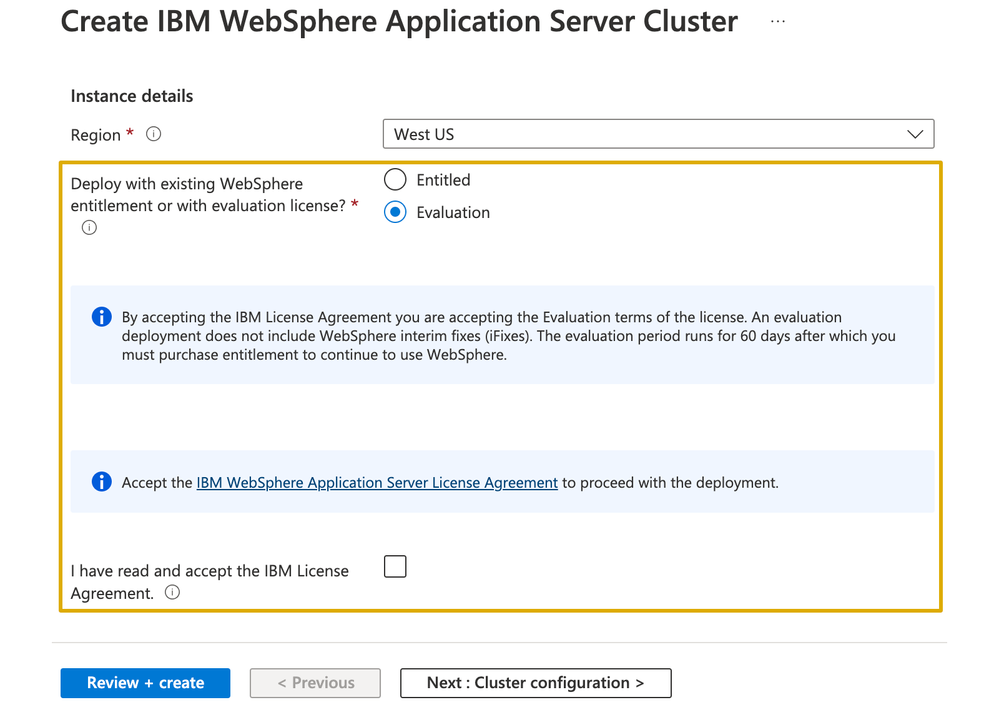
We are very happy to announce that we have enabled evaluation licenses for our WebSphere on Azure Virtual Machines (VMs) Marketplace solutions. The solutions are jointly developed and supported by IBM and Microsoft. We have also added support for standalone WebSphere Base instance on VMs deployments. In addition, we have integrated a sample getting started application into our WebSphere Liberty/Open Liberty on Azure Kubernetes Service (AKS)/Azure Red Hat OpenShift (ARO) solutions. These changes make getting started with WebSphere and Azure even easier. Evaluate the WebSphere on Azure solutions for full production usage and reach out to collaborate on migration cases.
WebSphere Base Standalone Instance on VMs
IBM and Microsoft previously released a Marketplace solution to automate WebSphere Network Deployment (ND) cluster deployments on VMs. We now have an additional offer targeting single instance deployments of WebSphere Base on VMs. The solutions automatically provision a number of resources including virtual network, storage, network security group, Java, Linux, and WebSphere. With minimal effort, you can set up a fully functional WebSphere deployment including the Console. The solutions support WebSphere 9.0.5 on Red Hat Enterprise Linux (RHEL) 8.3.
The solutions enable a variety of robust production-ready deployment architectures. Once the initial provisioning is complete, you can fully customize the deployment including integrating with a wide range of Azure services.
Evaluation Licenses for WebSphere on VMs
The WebSphere traditional on VMs solutions primarily follow a Bring Your Own License model. You must have the appropriate licenses from IBM and be properly licensed to run production workloads on Azure. The solutions ensure that you have adequate WebSphere entitlements. Now you can also use evaluation licenses for both WebSphere ND and Base. This enables key use cases such as exploration, prototyping, and trial. With the evaluation option, it is possible to apply WebSphere entitlements to a deployment later on.
Liberty on ARO/AKS Sample Application
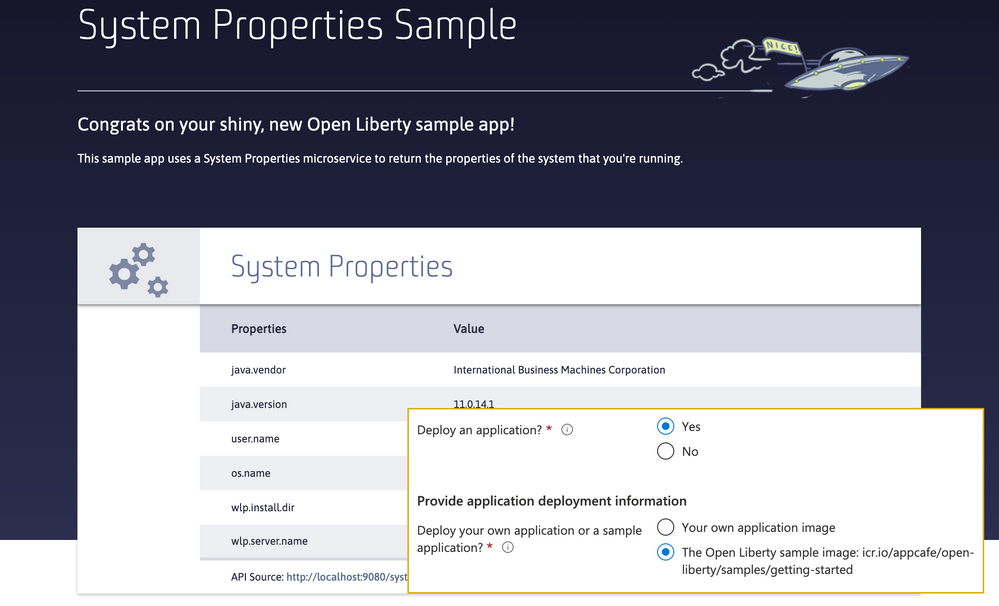
In addition to WebSphere traditional on VMs solutions, IBM and Microsoft have previously released Marketplace solutions targeting WebSphere Liberty/Open Liberty on AKS and ARO. Similar to the VM solutions, the AKS/ARO solutions enable you to focus on developing and deploying your containerized applications instead of initial provisioning and configuration of Java and Azure resources. The resources automatically provisioned by these solutions include virtual networks, an ARO/AKS cluster, the OpenShift Container Registry (OCR)/Azure Container Registry (ACR), and the Liberty Operator. The solutions can optionally deploy a Docker image that includes Open Liberty or WebSphere Liberty and your application. The image must be anonymously accessible from a registry such as Docker Hub. In addition, we now have an option in the solutions to deploy an IBM provided Liberty sample application. The sample application helps you get started with Liberty, containers, and Azure with minimal prior knowledge required.
Note, WebSphere Liberty is available as a limited trial option before entitlement must be applied to the deployment. Open Liberty is open source and free to use unsupported. You can also use Open Liberty supported through WebSphere Liberty entitlements.
Get started with WebSphere on Azure
Explore the WebSphere on Azure solutions, provide feedback, and stay informed of the roadmap. You can also take advantage of hands-on help from the engineering team behind these solutions. The opportunity to collaborate on a migration scenario is completely free while the solutions are under active initial development.
This article is contributed. See the original author and article here.
Today, we are sharing details with our customers about the future of Windows and how we are developing new experiences to enhance the way we work today, and in the future.
This article is contributed. See the original author and article here.
The changes from the past two years in working patterns and, consequently, enterprise IT architecture have created new customer needs, as well as more third-party solutions, for all “purse and purposes.” Today, we are announcing our plans to deliver new management functionality in Microsoft Endpoint Manager that will further simplify how organizations manage and protect their user computing landscape.
This article is contributed. See the original author and article here.
At Microsoft Ignite last November, we announced Context IQ, a set of capabilities across our Microsoft portfolio that intelligently connects you with the information you need, where and when you need it. Today, we’re sharing how products that leverage Context IQ are redefining work, creating new ways to collaborate, and democratizing access to and the use of information to benefit the organization and ultimately, the customer.
With this April 2022 release of Microsoft Dynamics 365, the focus continues to be on two critical departments within organizations: customer service and sales. Locating information is a pressing issue as salespeople and customer service agents continue to work across local and cloud systems in collaborative environments. Employees are consistently frustrated updating the same information across multiple platforms and having to jump from app-to-app to reference information and complete tasks.
It is with great pleasure that I share the latest Context IQ capabilities leveraged in Dynamics 365 Customer Service and Dynamics 365 Sales. We’re excited about the cross-organization collaboration features with Dynamics 365 and Microsoft Teams, including customer support swarming, embedded Teams chat within Dynamics 365, unified Teams meetings experiences with Dynamics 365 data, and sharing and updating Dynamics 365 records within Teams. These new capabilities will continue to nurture and expand collaboration within the workplace, empowering employees with the information and insights they need to thrive, be more productive, collaborate in the flow of work, and focus more time on the parts of the job that matter most.
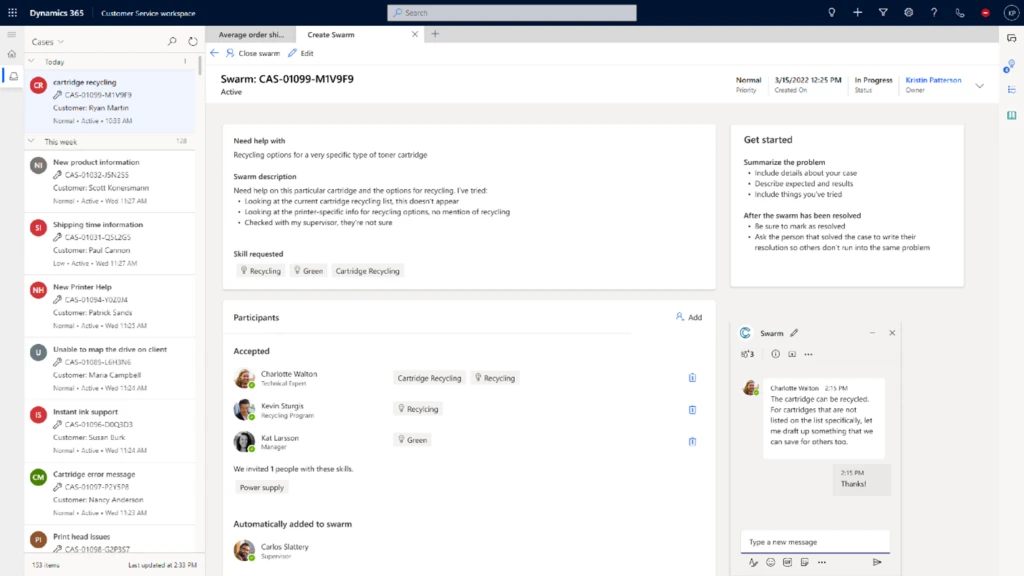
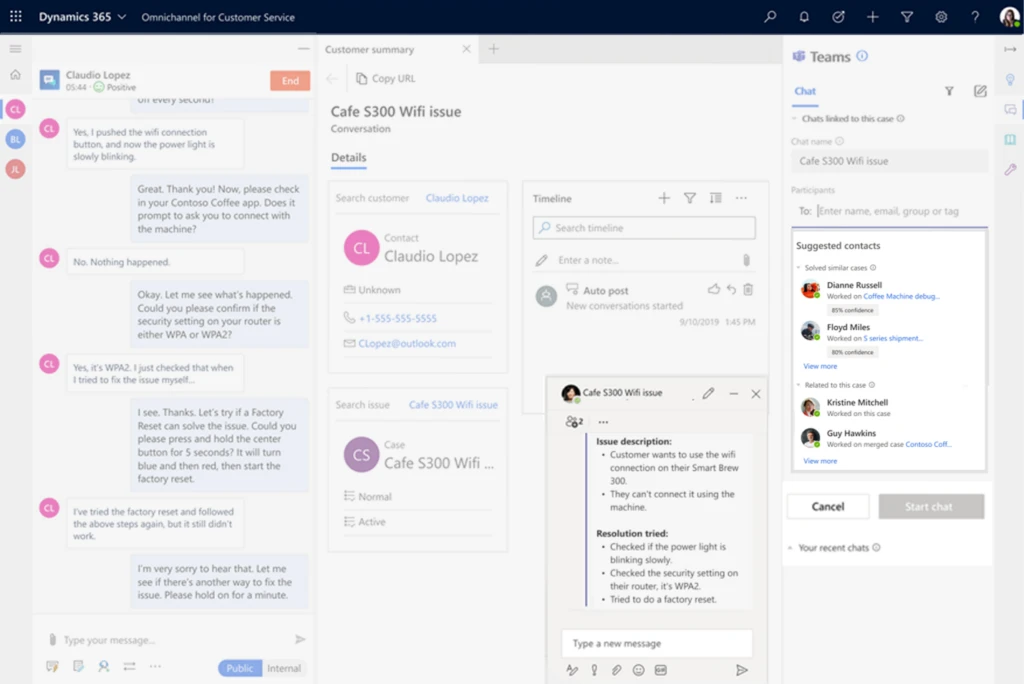
Transform an entire organization into a unified customer service team by bringing together the right talent to effectively resolve complex cases with customer support swarming. Using smart rules, customer support swarming suggests skills and invites the best relevant experts to resolve an agent’s issue. When joining the swarm, relevant skills are displayed identifying the expertise of each swarm participant. Participants with key relationships are included as each swarm member brings a unique perspective and skillset to resolve the issue at hand. Powered by Teams, customer service agents and subject matter experts can swarm cases in the applications they’re accustomed to using, including Customer Service workspace and Teams. Customer support swarming can save an agent time by bringing together the right resources to quickly resolve complex issues while maintaining focus on the customer.
Preview available in Dynamics 365 Customer Service in April.
As we announced last November at Ignite, you can collaborate with stakeholders directly from within Dynamics 365 Sales and Dynamics 365 Customer Service. This capability allows you to use Dynamics 365 data as an organizing layer for your Teams collaboration activity and link chats to Dynamics 365 records, such as sales opportunities and service cases, for convenient access for all participants.
AI-suggested contacts for Teams-based collaboration. When agents initiate a Teams chat on an active case or a service conversation, they’re proactively provided with suggestions of other agents who’ve resolved similar cases.
AI-generated conversation summary. Using intelligence, a conversation summary is automatically produced when an agent has a customer conversation and wants to collaborate with other teammates using embedded Teams.
Preview available in Dynamics 365 Sales and Dynamics 365 Customer Service in April.
Unified Teams meetings experience for Dynamics 365 and Dynamics 365 Customer Service users
The number of virtual meetings has grown significantly over the past two years, as has the value in having the customer context available for all meeting participants. Starting in April users will now be able to create and join Teams meetings from Dynamics 365 and be able to view and edit records within the context of the Teams meetings interface. Having context of the customer conveniently within the Teams meeting interface reduces the need to switch between apps during the conversation, empowering the user to be more engaged with the customer and increasing the likelihood the customer relationship management (CRM) record receives timely updates. Additionally, Conversational Intelligence capabilities will be integrated into the Teams meeting experience providing sellers with AI-guided suggestions that improve customer engagement.
Preview available in Dynamics 365 Sales and Dynamics 365 Customer Service in April.
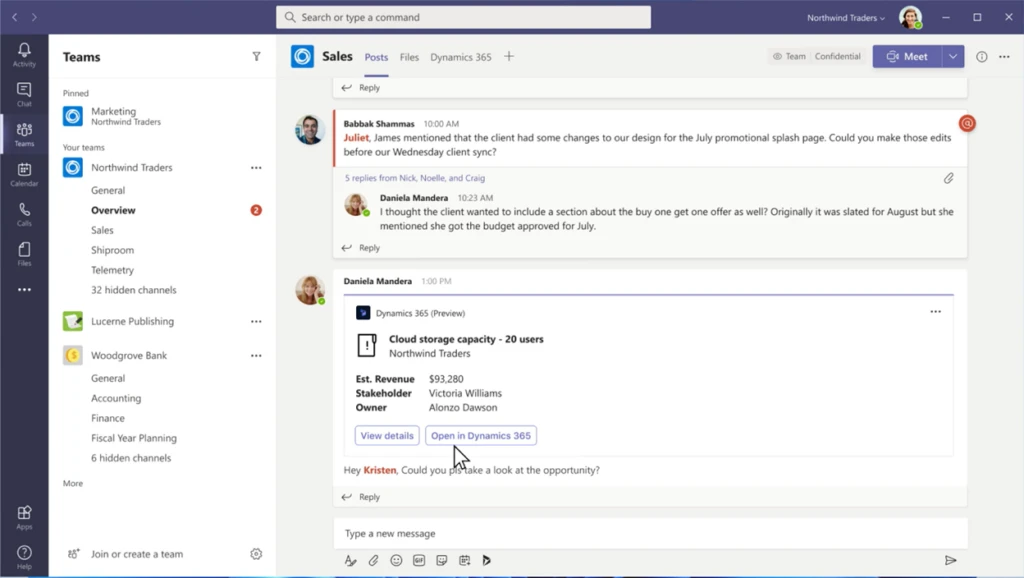
Share and update Dynamics 365 records within Teams
Teams chat and channels have become an increasingly common place for Dynamics 365 users to discuss customer records. Sellers and agents can easily share, reference, and edit Dynamics 365 records in the context of Teams chats and channels, eliminating the need to switch context or applications to get work done. Other participants of the conversation can see the summary details and choose to view or edit the record right from within Teams or Dynamics 365, whatever their preference. Users will also be able to select posts within Teams and quickly add to Dynamics 365 as an activity update to a specific record.
Preview available in Dynamics 365 Sales and Dynamics 365 Customer Service in April.
We’re continuing our investment in Context IQ, connecting users with the information they need, when they need it. The power of Context IQ brings you new ways to collaborate and enhance user productivitywhether your team resides in the same city, country, or hemisphere. We’re committed to improving employee experiences by securing real-life solutions to the everyday challenges of locating and updating siloed information across disparate systems and applications.



 ) or https:// means you’ve safely connected to the .gov website. Share sensitive information only on official, secure websites.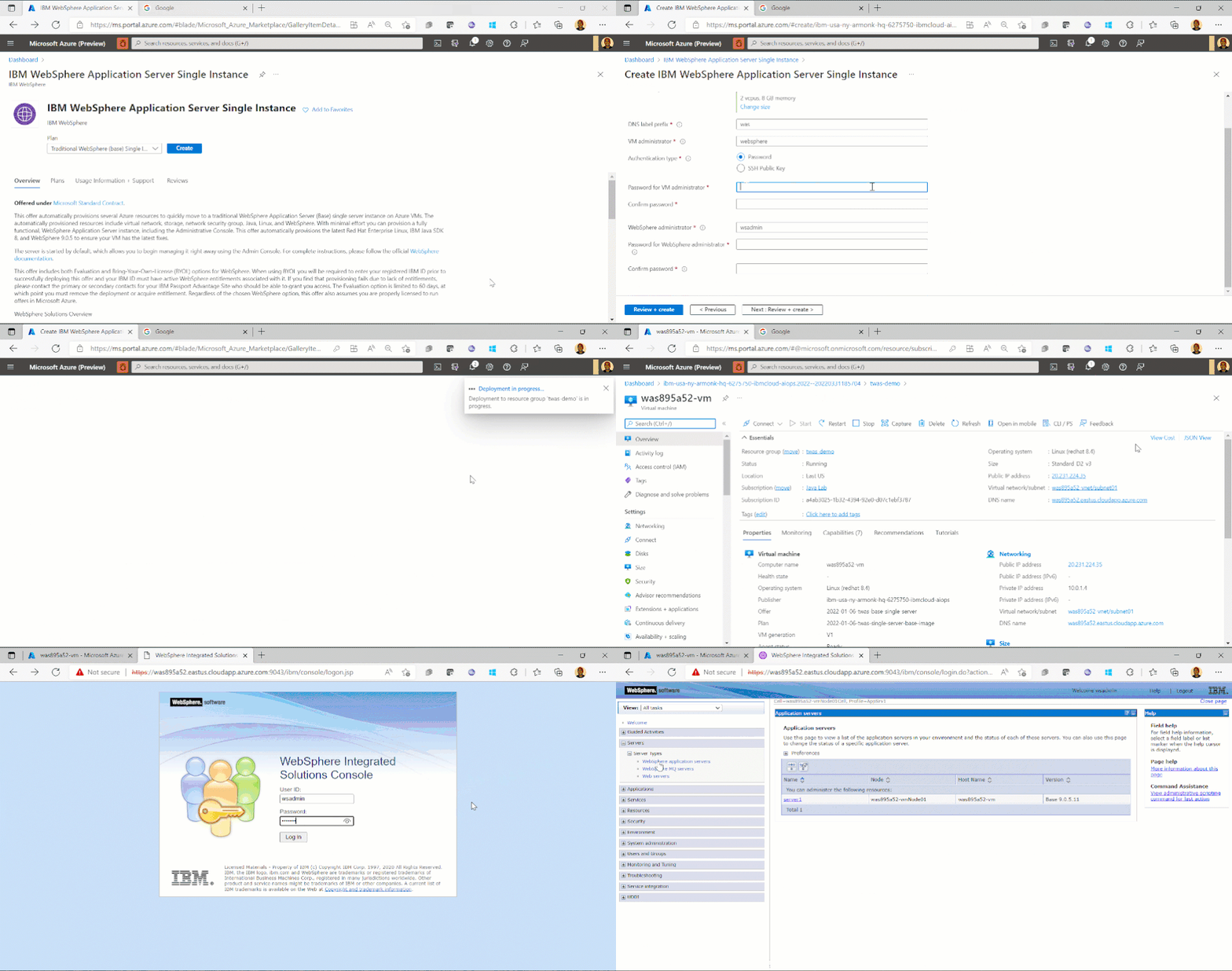



Recent Comments