

Merging of HR offerings brings capabilities together for customers

Merging of HR offerings brings capabilities together for customers

This article is contributed. See the original author and article here.

It’s time for us to bring all new and future HR capabilities and enhancements within Dynamics 365 Human Resources to all our customers.

We currently have two separate sets of human resources capabilities on two different infrastructures within Dynamics 365:

  • Dynamics 365 Human Resources, which is a complete stand-alone application running on an independent infrastructure. Our customers use this application to increase organizational agility and get workforce insights. All investments over the last three years have been focused on this application.
  • The HR module, which is a legacy set of capabilities that was previously part of our Unified Operations licensing bundle. Our customers received these HR capabilities as part of Dynamics 365 Finance or Dynamics 365 Supply Chain Management. We have not been adding capabilities or enhancements to this module. The HR module runs on the same infrastructure as the other applications within our operations portfolio, which was previously named Finance and Operations.

As you can imagine, having two ways to access HR capabilities creates a lot of confusion. It also prevents our customers from experiencing the benefits that each set of capabilities offers.

By merging these capabilities onto the same infrastructure, our customers will see:

  • All the enhancements that we have added over the last three years, including improved leave and absence, benefit management, and reporting.
  • Improved extensibility through the Microsoft Power Platform and the ability to extend business logic to personalize screens and forms.
  • Improved deployment, updates, and maintenance with consistency in terms of Application Life Cycle Management, Lifecycle Services, Geographic availability, and more.
  • More technology innovation within the roadmap, as our engineering team now can utilize shared services, tooling, and reduce platform costs.

Dynamics 365 Human Resources will continue to be licensed and sold as a stand-alone application. With the merge, it will tap into the power of the Dynamics 365 shared infrastructure, the Power Platform, and the Dataverse.

This transition will impact customers that are currently running Dynamics 365 Human Resources and those that are using the HR module.

Here are some frequently asked questions and answers to help with the transition.

When will the Dynamics 365 Human Resources infrastructure merge be completed?

The infrastructure merge will roll out in phases to better support all customers and provide time for transition planning. You will see new capabilities begin to roll out in the 2021 Wave 2 release. For more details, see the Dynamics 365 Human Resources 2021 release wave 2 plan. These phases will align with the version service updates, which start with the One Version service updates that start as a preview in December 2021. The merge will be complete in the 2022 Wave 1 release. (These dates are subject to change, so refer to the release plans for the most up-to-date information.)

When should my organization transition into the new infrastructure?

The transition for each company will depend on your current configuration and readiness to move to the new infrastructure. We recommend working with your business partner to determine the best path forward for your company.

  • Organizations that use the HR module will receive new functionality as part of the regular One Version update process. Features are planned to become generally available beginning in January 2022 (dates are subject to change, so refer to the release plans for the most up-to-date information).
  • Organizations using Dynamics 365 Human Resources will have access to migration tools to complete the infrastructure merge. Please check the release plans regularly to get up-to-date information on when these tools will be available. We will work with our customers to make the transition without an interruption in service. Customers will need to make the transition 12-18 months from when the migration tooling is available.
  • Organizations that use both Dynamics 365 Human Resources and the HR module will also need to use the migration tooling.

Will I lose any features or capabilities that I currently use?

Our objective is to minimize the impact of this transition for our customers, and we will not be removing any features. There will be functional parity between Dynamics 365 Human Resources and the HR module. In cases where the feature exists in both infrastructures, the Dynamics 365 Human Resources experience will be used.

Will the experience change for my users?

New capabilities will be managed through Feature management. This will allow our customers to decide which features they want to utilize. In some cases, we may need to change the experience; however, in those cases, documentation will be provided.

Are there any licensing changes or minimum number of user requirements?

Customers that have purchased Dynamics 365 Human Resources will not require license changes. The additional sandbox stock-keeping unit (SKU) that was specific for Human Resources will no longer be applicable. Instead, customers can choose to buy a Finance and Operations apps Tier 2 sandbox at a lower cost. Existing customers who have purchased a Human Resources sandbox will be migrated to a Finance and Operations apps Tier 2 sandbox at no additional cost. We will continue to require five minimum users for Dynamics 365 Human Resources.

Customers using the HR module will be required to purchase licenses for Dynamics 365 Human Resources starting in February 2025. These customers will get the new functionality as part of their current contract until February 2025 or until the current licensing agreement expires, whichever is earlier. Customers can also choose to move to Dynamics 365 Human Resources licenses earlier if it helps them achieve better cost savings.

What training and resources will be available to help with the migration process?

Full documentation will be provided to describe each step of the migration process in detail. We will also determine if any additional training resources, such as videos and workshops, are needed to help our partners and customers with a smooth transition to the new infrastructure.

Next steps

We recommend that you work with your partner to determine a transition plan that works best for your company. Our objective is to provide customers with the time needed for a smooth transition. You can also email specific questions to the Microsoft Team.


The post Merging of HR offerings brings capabilities together for customers appeared first on Microsoft Dynamics 365 Blog.

Brought to you by Dr. Ware, Microsoft Office 365 Silver Partner, Charleston SC.
Merging of HR offerings brings capabilities together for customers

Deliver personalized digital customer engagement with Dynamics 365

This article is contributed. See the original author and article here.

Consumers and businesses are increasingly turning to digital platforms for relevant product and service information, making it critical for companies to effectively meet and exceed customer expectations through digital services and technology. Microsoft Dynamics 365 is helping organizations meet this challenge by connecting and unifying commerce and marketing activities.

By bringing together solutions such as Dynamics 365 Commerce and Dynamics 365 Marketing, businesses can more effectively target and deliver engaging, intuitive, and user-friendly digital commerce buying experiences. These tools allow organizations to leverage machine learning models, artificial intelligence infused-personalization, and event and data-driven customer journeys, to deliver bespoke buying experiences across B2B and B2C markets.

Personalized and intuitive experiences

To effectively compete in omnichannel retail, businesses need technology solutions that allow them to deliver personalized and intuitive shopping experiences. Many customers want their shopping experience to be somehow personalized. Effective personalization can also increase store revenue. Yet, delivering personalized and intuitive experiences can be challenging for businesses that, despite multiple in-person interactions with customers and ongoing engagements with them online, cannot collect and connect the data from these experiences.

By unifying the data from every customer touchpoint, retailers can develop a more meaningful and holistic understanding of their customers. This deeper understanding can then be leveraged to quickly move customers from evaluation to purchase decision, regardless of the channel in which the customer chooses to engage. Ultimately, by delivering personalized and intuitive shopping experiences, retailers can improve overall conversion rates and maximize the lifetime value of their customers.

Ste. Michelle Wine Estates

One retailer that is seeing the benefits of delivering personalized and intuitive experiences is Ste. Michelle Wine Estates. Ste. Michelle Wine Estates, one of the largest premium wine companies in the United States, prides itself on superior consumer experiences. To unify its consumer data and provide opportunities for innovation, Ste. Michelle deployed Dynamics 365 Commerce across all of its wine brands.

“The more we know about the consumerand the more adept we can be at using that information in intelligent waysthe better we can make technology an enabler of consumer satisfaction.” Joe Gregg, Chief Information Officer, Ste. Michelle Wine Estates

Learn more: Ste. Michelle Wine Estates customer story

Seamless omnichannel services

Personalized digital customer engagement extends well beyond the confines of online marketplaces and digital storefronts. To deliver a fully seamless and frictionless buying experience, merchants must be able to effectively transition from online to brick-and-mortar and back againand do this without losing the personal touch.

Consumers are more likely to buy from retailers who reference past purchase experiences. These are easy feats for properly configured information systems in online environments, but transitioning to in-store, team member-led experiences can be tricky.

To be effective in this effort, retailers need to empower in-store team members with relevant and timely consumer data. Providing the correct data at the right time can be difficult when retailers are amassing a large amount of consumer data. Fortunately, Dynamics 365 Commerce can leverage AI and machine learning capabilities to deliver personalized recommendations, insights, and loyalty programs access directly into the hands of brick-and-mortar team members. Ultimately, by connecting digital, in-store, and back-office operations in a single retail platform, merchants can deliver the seamless purchase journeys that modern consumers and businesses have come to expect.

Signature Cosmetics & Fragrances

A retailer positioning itself to take advantage of the benefits of seamless omnichannel service is Signature Cosmetics & Fragrances. Signature Cosmetics & Fragrances, a leading cosmetics and fragrance group, understood the impact the COVID-19 pandemic and subsequent lockdowns would have on its network of more than 170 stores across South Africa, Botswana, and Namibia.

When the company began its modernization program by implementing Dynamics 365 Finance and Operations, it did not immediately consider the benefits of connecting its commercial activities in a seamless omnichannel service. As the project moved forward and they gained experience in e-commerce, they quickly grasped the value of such an approach. By implementing Dynamics 365 Commerce, Signature Cosmetics & Fragrances can now deliver a seamless experience across product categorization and loyalty programs in its brick-and-mortar stores and online. One example is that the company can now directly connect a customer’s online wish list with in-store sales opportunities.

“Part of the project plan is once we have all this data following through the productivity software in retail, e-commerce, and supply chain, we will have Power BI sitting above everything and drawing from various departments to present it as reports that really help us make decisions.” Akheel Pragjee, Managing Director of the Signature Group

Learn more: Signature Cosmetics & Fragrances customer story

Next steps

As we have seen, delivering a personalized digital customer engagement is a fundamental necessity for modern retailers. Dynamics 365 provides the ability to adapt and innovate with the only portfolio of business applications that empowers your organization to deliver operational excellence and delight every customer. Two of our solutions, Dynamics 365 Commerce and Dynamics 365 Marketing, combine to allow your company to provide a unified, or connected, commerce solution. Try our free Dynamics 365 Commerce trial today to get started creating personalized and friction-free digital commerce experiences for B2C and B2B businesses.

The post Deliver personalized digital customer engagement with Dynamics 365 appeared first on Microsoft Dynamics 365 Blog.

Brought to you by Dr. Ware, Microsoft Office 365 Silver Partner, Charleston SC.

Gartner® Recognizes Microsoft as a Leader in the 2021 Gartner Magic Quadrant™ for Cloud ERP for Product-Centric Enterprises

Gartner® Recognizes Microsoft as a Leader in the 2021 Gartner Magic Quadrant™ for Cloud ERP for Product-Centric Enterprises

This article is contributed. See the original author and article here.

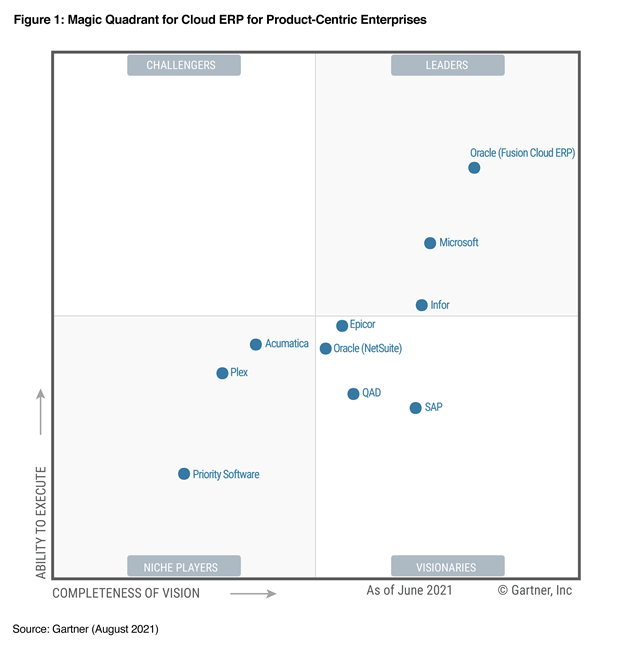
We are thrilled that Gartner has recognized Microsoft as a Leader in the 2021 Magic Quadrant for Cloud ERP for Product-Centric Enterprises for Microsoft Dynamics 365.

Magic Quadrant for Cloud ERP for Product-Centric Enterprises, August 2021.

Dynamics 365 Supply Chain Management and Dynamics 365 Finance offer businesses two standardized enterprise resource planning (ERP) capabilities on a composable ERP platform, functioning as stand-alone solutions or as a tightly integrated and extensible system. As product-centric enterprises look to renovate their existing ERP platform to improve systems and processes by moving them to the cloud, Dynamics 365 is enabling the transformation and improving IT agility to deliver business outcomes in the process.

For example, Bel Fuse recently selected Dynamics 365 Finance and Dynamics 365 Supply Chain Management to move away from a legacy version of Oracle that was highly customized and difficult to update. Bel Fuse was able to unify its data and can now more easily manage its supply chain operations and finance processes, gaining more agility to respond quickly to changes in the market.

Dynamics 365 also delivers an enterprise SaaS application capable of providing data, analytical insight, and operational application services by running on the Microsoft Azure cloud. The Azure cloud enables clients to use Microsoft Power Platform for analytics and Microsoft Power Apps for low-code/no-code extensions, allowing organizations to improve operations with real-time, AI-based predictive insights across a broader ERP strategy.

An excellent example of a company leveraging these capabilities is GN Group. GN Group recently adopted Dynamics 365 Supply Chain Management and Dynamics 365 Finance to centralize all its ERP data in the cloud. With help from Microsoft Partner Network member SCALES Group, GN Group evolved its supply chain processes to be more agile and structured. It uses Dynamics 365 Finance to unify financial data and gain AI-based predictive insights in real-time. The company also adopted Microsoft Power Platform to extend its Dynamics 365 business applications. So far, GN Group uses Microsoft Power BI for reporting and analytics and Microsoft Power Apps to build a custom, vendor-managed inventory (VMI) solution that seamlessly connects to Dynamics 365 Supply Chain Management.

And we continue to invest and expand our capabilities. At the end of July, we acquired Suplari, a leading provider of supplier spend insights that enable companies to proactively manage supplier spend by transforming data from multiple sources, such as contracts, purchase orders, invoices, expenses, and supplier risk, into valuable insight. By bringing Suplari’s spend intelligence insights together with the existing Dynamics 365 capabilities, Microsoft is further helping organizations become insight-driven and enabling business leaders to take strategic action. In August, Dynamics 365 Intelligent Order Management became generally available. It enables enterprises to optimize and automate fulfillment using real-time inventory, AI, and machine learning. Organizations can truly gain the agility they need to quickly adapt to changing business models, support the latest fulfillment methods, add new order intake channels by seamlessly integrating their existing ERP systems to manage the entire order lifecycle from intake to fulfillment.

Request a demo or take a guided tour of Dynamics 365 Supply Chain Management and Dynamics 365 Finance.

* This graphic was published by Gartner, Inc. as part of a larger research document and should be evaluated in the context of the entire document. The Gartner document is available upon request from Microsoft.

GARTNER and Magic Quadrant are registered trademarks and service mark of Gartner, Inc. and/or its affiliates in the U.S. and internationally and are used herein with permission. All rights reserved. Gartner does not endorse any vendor, product or service depicted in its research publications, and does not advise technology users to select only those vendors with the highest ratings or other designation. Gartner research publications consist of the opinions of Gartner’s research organization and should not be construed as statements of fact. Gartner disclaims all warranties, expressed or implied, with respect to this research, including any warranties of merchantability or fitness for a particular purpose.

Gartner, Magic Quadrant for Cloud ERP for Product-Centric Enterprises, 24 August 2021, Tim Faith, Denis Torii, Paul Schenck, Dixie John, Abhishek Singh.

The post Gartner® Recognizes Microsoft as a Leader in the 2021 Gartner Magic Quadrant™ for Cloud ERP for Product-Centric Enterprises appeared first on Microsoft Dynamics 365 Blog.

Brought to you by Dr. Ware, Microsoft Office 365 Silver Partner, Charleston SC.

Merging of HR offerings brings capabilities together for customers

Finance and Operations authentication upgraded to OpenIDConnect

This article is contributed. See the original author and article here.

For our customers using the client for Finance and Operations apps, we’re retiring the out-of-support WS-Federation authentication protocol, and replacing it with the industry standard OpenIdConnect OAuth security protocol. OpenIdConnect OAuth security protocol supports modern authentication, which includes multi-factor authentication and conditional access policy.

This upgrade, which will not result in any downtime or require customers to make changes to their system, was released in July 2021. It is available starting from in product version 10.0.20, platform version 7.0.6060.0 or later. The upgrade applies to all environment types except Dev Box, customer-hosted and IaaS environments.

For more information, see Authentication for Finance and Operations app upgraded to OWIN OpenIDConnect in the release plans.

Next steps

This feature is automatically enabled for customers who are on version 10.0.20 or later. If you aren’t on this version and want to upgrade, see the instructions to Self-service upgrade to the latest version.

The post Finance and Operations authentication upgraded to OpenIDConnect appeared first on Microsoft Dynamics 365 Blog.

Brought to you by Dr. Ware, Microsoft Office 365 Silver Partner, Charleston SC.

Brace yourselves: Hybrid work is hard. Here’s how Microsoft Teams and Office 365 can help

Brace yourselves: Hybrid work is hard. Here’s how Microsoft Teams and Office 365 can help

This article is contributed. See the original author and article here.

The shift to remote work over the last 18 months is one of the most significant changes in work culture since the Industrial Revolution. To understand how this change is impacting our customers and Microsoft employees, we’ve been conducting regular research and internal surveys. As reported in our recent Work Trend Index, survey data shows…

The post Brace yourselves: Hybrid work is hard. Here’s how Microsoft Teams and Office 365 can help appeared first on Microsoft 365 Blog.

Brought to you by Dr. Ware, Microsoft Office 365 Silver Partner, Charleston SC.

Brace yourselves: Hybrid work is hard. Here’s how Microsoft Teams and Office 365 can help

Brace yourselves: Hybrid work is hard. Here’s how Microsoft Teams and Office 365 can help

This article is contributed. See the original author and article here.

The shift to remote work over the last 18 months is one of the most significant changes in work culture since the Industrial Revolution. To understand how this change is impacting our customers and Microsoft employees, we’ve been conducting regular research and internal surveys. As reported in our recent Work Trend Index, survey data shows…

The post Brace yourselves: Hybrid work is hard. Here’s how Microsoft Teams and Office 365 can help appeared first on Microsoft 365 Blog.

Brought to you by Dr. Ware, Microsoft Office 365 Silver Partner, Charleston SC.