Confront the misconceptions slowing your move to Dynamics 365

Confront the misconceptions slowing your move to Dynamics 365

This article is contributed. See the original author and article here.

Has your perception of the cloud kept up with advancements in technology? Economic and logistic disruptions from COVID-19 have compelled most organizations to reassess whether their legacy systems can deliver on modern goals and priorities. While shifting market conditions have accelerated cloud adoption, some are still weighing the benefits. These businesses have allowed on-premises nostalgia to take hold and determine their cloud strategy.

Don’t allow misconceptions to dictate your journey. Get expert help through the Microsoft Dynamics 365 migration program to move from Dynamics AX or Dynamics CRM to Dynamics 365.

Addressing misconceptions about cloud migration

Moving to the cloud is no small decision. Dynamics 365 on-premises customers historically point to cost, timing, and complexity as reasons to delay or not to migrate. Cloud innovation and process advancements will only continue to erode these inaction arguments, further widening the gap with on-premises solutions.

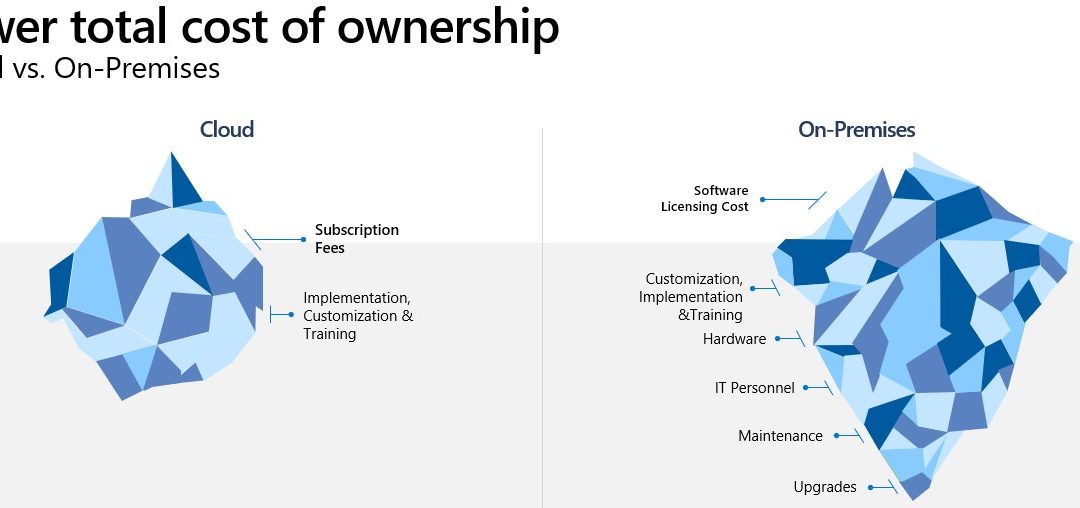
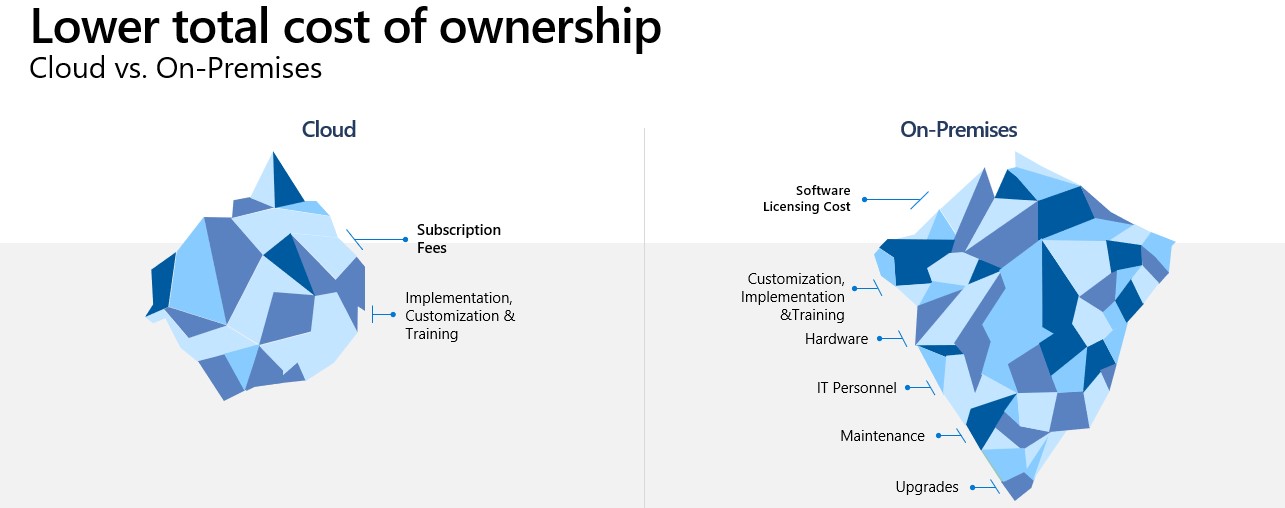
Cost is always a decision factor. Are the benefits gained greater than the expense? Migrating, like anything, requires funding and resources. However, the hidden costs of remaining on-premises and maintaining your current solution are growing. Consider the graveyard of customizations you’ve built over the years that are no longer in use. Organizations need to weigh the total cost of ownershipinfrastructure costs, support costs, and upgrade coststo make a true cloud and on-premises comparison.

Image of two icebergs representing the lower cost of ownership of cloud verses on premises costs.

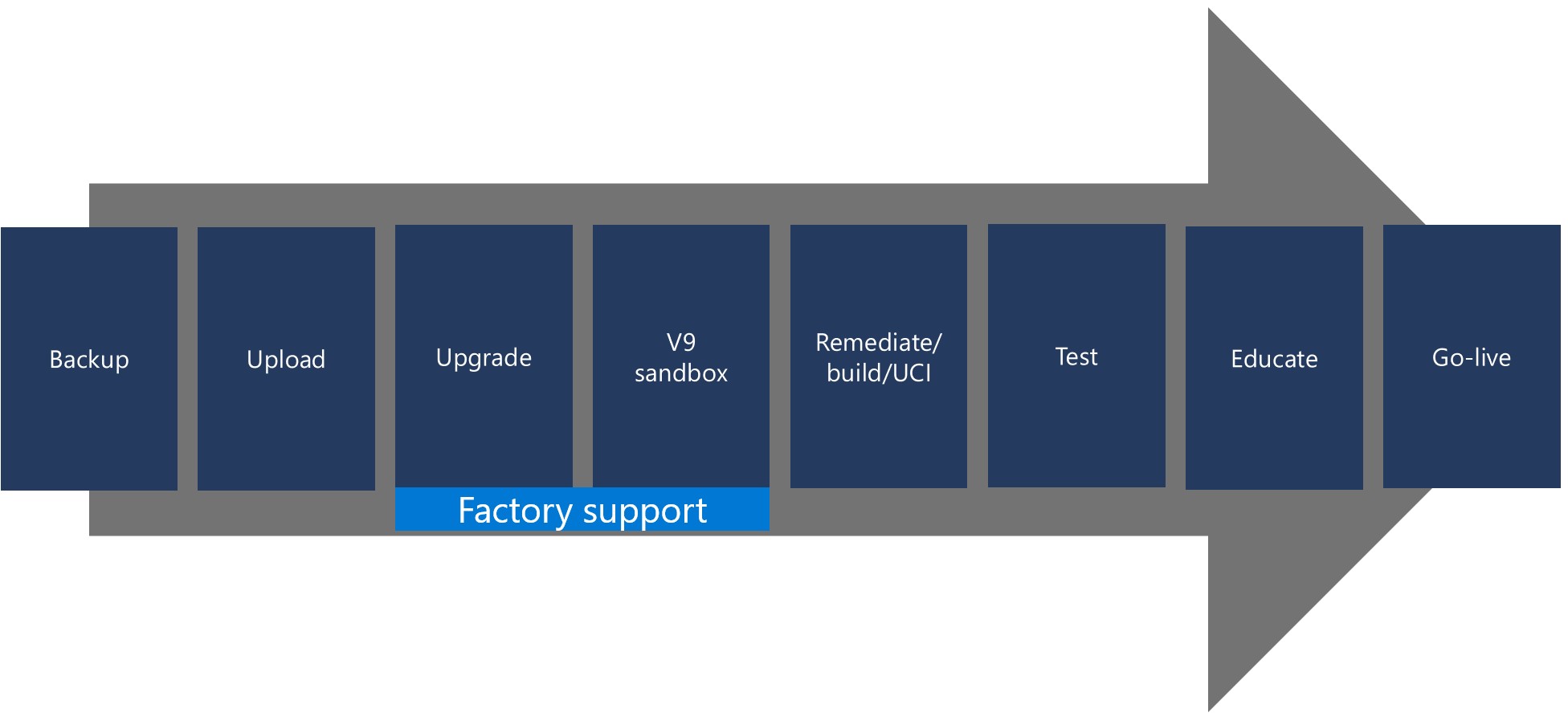
Migrating to the cloud should be a business priority. While customizations and data can make the process time-consuming, few business investments can provide similar efficiency gains. Microsoft engineered the On-Premises to Online Migration Factory to help Dynamics CRM customers. This end-to-end migration process provides a guided way to move on-premises instances without the need of reimporting the datathus reducing time and costs.

Graphic showing the 8 steps to migrate from on-premises to the cloud: backup, upload, upgrade, V9sandbox, Remediate/build/UCI, test, Educate, go-live

Customizations often hold on-premises systems together, allowing to adequately function in our modern environment. This can make knowing how to untangle your solution or what to migrate difficult. The Dynamics 365 migration program offers technical assessments to guide our Dynamics AX and Dynamics CRM customers through this process. Want to identify organization-specific benefits or optimize the transition process? Our Standard Migration Assessment can help you identify goals, understand migration benefits, and reduce outlay as you transition.

Adding value with Dynamics 365

The gap between on-premises and the cloud solutions is growing, and there’s a good reason. Innovation among cloud now outpaces on-premises development. With end-of-support dates nearing, this gap will only continue to grow, limiting productivity gains and configurability an organization might see with Power Apps, Power Automate, or Power BI functionality. Data centralized in one source only enhances the potential. Knowing usage patterns, adoption rates, and performance metrics, we can continuously update the cloud service without significant business disruption. When it comes to providing updates, Microsoft’s priority is the cloud because it’s the most efficient way to innovate, ideate, and provide value to customers. Customers no longer need to:

  • Host and secure software
  • Build a data center
  • Handle identity management
  • Manage connections to other systems

Instead, the cloud platform empowers an out-of-the-box mentality that allows users to get started with no expertise or additional tools.

The cloud is the future

As businesses continue to prioritize remote work and collaboration, the cloud will continue to be the fiber that connects employees, systems, and resources regardless of time zone. Reducing your physical footprint today is a great way to reduce costs and prepare for tomorrow. Migrating to Dynamics 365 will ensure your organization is prepared to meet future needs and challenges. To see how other companies have made this transition, visit our Dynamics 365 migration community.

The post Confront the misconceptions slowing your move to Dynamics 365 appeared first on Microsoft Dynamics 365 Blog.

Brought to you by Dr. Ware, Microsoft Office 365 Silver Partner, Charleston SC.

Customer journey orchestration: The next frontier of connected experiences

Customer journey orchestration: The next frontier of connected experiences

This article is contributed. See the original author and article here.

A decade ago, marketing was focused on guiding the customer through predictable stages of awareness, consideration, and purchase. We were relatively assured that if we reached x number of eyeballs, we could expect y number of responses and z number of conversions.

That world no longer exists. Eighty-one percent of consumers1 want to purchase from brands that get to know them, but nearly three-quarters2 are frustrated by tons of irrelevant content which makes them feel so disconnected. That feedback exposes how the customer experience is falling short and reminds us that it’s no longer enough to employ tactics that focus on volume, or even segmentation. Traditional approachescampaigns, offers, and adsexist in siloes. The customer journey doesn’t. It doubles back, skips forward, and spans digital and physical channels. The marketer’s approach should likewise cut across traditional siloes of existing functions, roles, or channels.

Brands should recognize these fundamental shifts and look for solutions that keep up with surging expectations. Customer journey orchestration in Microsoft Dynamics 365 Marketing delivers an individualized, end-to-end experience to every customer, across all touchpointsat scale. Each individual travels a unique path, based on evolving needs. The result is a refreshing two-way conversation that’s customer-centric, rather than brand-centric. Where one customer may need additional education and proof points, another may be ready to select among different models. In the past, they would both receive the same, predefined, offer after signing up on the brand’s website. This traditional approach falls flat, failing to take into account key contexts like previous interactions and intent. With customer journey orchestration, brands can harness everything they know about the customer, across all channels, and mobilize the organization to engage in the moment to deliver a fluid and seamless experience. For an organization with thousands or millions of customers, optimizing individual experiences at scale can have an enormous impact on growth through increased acquisition and retention.

According to BCG, organizations implementing customer journey orchestration have achieved3:

  • Revenue gains of 10-20 percent
  • Cost reductions of 15-25 percent
  • Customer advocacy score improvements of 20-40 points

Optimizing customer experiences with customer journey orchestration might seem daunting, but it helps to focus on three areasdata, decisioning, and delivery. Most organizations already have a lot of customer data, but they need to bring together the data to gain a 360-degree view of the customer. Then they can turn the data into actions with real-time decisioning to determine which offer to surface or what content to display or what kind of communication to send. Next is the delivery of the actions through alignment and integration with the MarTech stack.

Building a resilient data foundation

Journey optimization begins with a strong data foundation. With help from a customer data platform, organizations can create unified profiles to gain a single view of customers. Savvy organizations go a step further and consider the ever-changing nature of datafrom new data sources to regulatory and compliance requirements that seemingly spring up overnight. Adapting by identifying and bringing in new data sources like digital behavior, customer sentiment, third-party enrichment, or emerging channels contribute to a resilient data foundation that easily flexes to the ever-changing environment. With always up-to-date rich and adaptive profiles, organizations maintain an edge by gaining a deeper understanding of customersas long as it’s built with a privacy-first approach. Growing mistrust over data privacy has promoted big changes like the sunsetting of third-party cookies and data reform. A future-proof customer data platform needs to be designed from the ground up to be consent-enabled, allowing the organization to automatically honor customer consent and privacy across the entire journey.

Scaling with real-time decisioning

Decisioning enables organizations to automatically determine the next best action for an individual customer. The real-time nature of decisioning ensures immediate action, converting an expression of interest (or dissatisfaction) into continued engagement. Based on signals that reveal customer intent, decisioning determines, at the precise moment, the exact interaction to optimize the customer experience. Decisioning goes hand in hand with customer journey orchestration, mobilizing data and AI to decide how best to design and adjust individual journeys to increase customer lifetime value while decreasing cost to serve through intelligent automation and scale.

Delivering connected experiences

The focus on the longer journey, instead of a single touchpoint, is the key to elevated experiences. This end-to-end approach requires continuity and contextevery time. Decisioning works in tandem with customer journey orchestration to move analytics outputs and insights through the MarTech and AdTech stack, informing activation in the application layer, resulting in a cohesive journeybubbling up the next best offer, content, conversations, and experiences seamlessly for each customer, regardless of the place or time.

Looking ahead

Brands that recognize the fundamental shift in customer expectations are boosting their customer experience capabilities. Learn how the new customer journey orchestration capabilities in Dynamics 365 Marketing can make one-to-one experiences a reality. Visit the Dynamics 365 Marketing website and sign up for a free trial.


1-“From me to we: The rise of the purpose-led brand,” Accenture, Dec. 5. 2018

2-“Harness change to create 360 value,” Accenture

3-“Customer Journey Programs Are Hard to Get Right,” Bharat Poddar, Yogesh Mishra, and Prateek Tandon, BCG, Jan. 29. 2020

The post Customer journey orchestration: The next frontier of connected experiences appeared first on Microsoft Dynamics 365 Blog.

Brought to you by Dr. Ware, Microsoft Office 365 Silver Partner, Charleston SC.
Office LTSC is now generally available

Office LTSC is now generally available

This article is contributed. See the original author and article here.

When we look to the future of work, it’s clear it will be built on and powered by the cloud. Microsoft is leading innovations that enable our customers to empower their people to work more collaboratively, effectively, and securely.

The post Office LTSC is now generally available appeared first on Microsoft 365 Blog.

Brought to you by Dr. Ware, Microsoft Office 365 Silver Partner, Charleston SC.

Office LTSC is now generally available

Office LTSC is now generally available

This article is contributed. See the original author and article here.

When we look to the future of work, it’s clear it will be built on and powered by the cloud. Microsoft is leading innovations that enable our customers to empower their people to work more collaboratively, effectively, and securely.

The post Office LTSC is now generally available appeared first on Microsoft 365 Blog.

Brought to you by Dr. Ware, Microsoft Office 365 Silver Partner, Charleston SC.

Customer journey orchestration: The next frontier of connected experiences

The importance of empathy in customer service

This article is contributed. See the original author and article here.

The pandemic has been challenging in many ways. It has impacted nearly every facet of our lives with disruptions in supply chains, millions furloughed, and much more. Despite such, the pandemic was positive in one regardit tested our capacity to come together and innovateand frankly, we soared on so many levels. In a blink of an eye, we united to create solutions to blend the human spirit and technology to deliver resilient solutions to outlast the pandemic. This was never more evident than in customer service.

Together, we transformed into superheroes. Turning our kitchen tables into remote workspaces, sliding into our commuter slippers each morning, and logging in with a few taps on a keyboard. We accepted our instinctual need for human interaction and turned to relationship-building using communication tools like Microsoft Teams to maintain relationships and fight the isolation. We built AI-driven solutions that focus on the human element with conversational chatbots designed to answer questions at any hour of the day. We accelerated transformative changes that were expected to take years to deploy, but through sheer determination, these changes were achieved in a matter of weeks. We reached deep and ascended to new heights with empathy resonating with every word.

Customer service organizations became the epicenter of resilience, moving forward and boldly going where no customer service organization had gone before. We shifted mindsets and conquered the foreboding of implementing change and pivoted in ways we never thought possible. While the changes made were sometimes uncomfortable initially, we quickly adjusted and thrived. Customer service organizations did not combust or implode, but blossomed and prospered.

Customer service organizations overcame pandemic-induced barriers to safety and wellbeing. Maintaining social distancing and protecting employees within a contact center was next to impossible. But in a matter of weeks, agents began logging into their customer service app and resolving customer issues from the safety and comfort of their homes. Not only did cloud-based customer service and omnichannel communication solutions bridge the always-on customer service gap and help keep companies solvent, but agents also continued to strengthen relationships while resolving customer issues, growing call volumes, and less than patient customers.

Customer service managers learned much about themselves and their agents. But more importantly, they learned empathy. They learned to listen more and acknowledge the concerns of their team. Organizations that came out to stand behind their agents and their safety were rewarded with increased loyalty.

During the peak of the crisis, customer service agents became a life ring where both the organization and the customer held on tightly to maintain some sense of normalcy. The degree of empathy shared by the organization was reciprocated by the agent in terms of loyalty and lower turnover. The empathetic agent influenced the customer, creating a reciprocal and symbiotic rapport. Empathy created a domino effect and has now become a critical force in building trust and strengthening relationships with both employees and customers alike.

Empathetic organizations create a dynamic of mutual loyalty and dedication. Managers and agents are inspired and lend extra effort to achieve organizational goals. It’s no surprise that these organizations are more agile and resilient than other organizations in a volatile economic landscape.

In a recent study, empathy in the workplace positively related to job performance, and managers who practice empathetic leadership were viewed as better performers. Empathetic managers have lower turnover and increased productivity. Agents pay this empathy forward by humanizing the connection and personalizing the customer conversation. Empathetic agents are proactive, thinking, and connecting to make sure each interaction supports the customer. By demonstrating empathy, agents have the power to deliver the short-term benefit of resolving an issue and the long-term benefit of building brand loyalty through a two-way emotional connection.

Building empathy

Empathy is a skill and cannot be faked. It’s a mindset, a culture, and the core of a healthy organization. Empathy should be a driving force that envelops all activities inside an organization, whether or not it’s customer-facing. Empathy starts with listening, understanding, and anticipating the needs of another. In customer service, this means putting yourself in the shoes of the customer and seeing the issue from their point of view. Empathy is anticipating what the wants and needs are of the customer at a specific moment within their journey. Then, it is all about delivering on these wants and needs by creating a positive and friction-free experience. Remember, being empathetic doesn’t mean you have to agree with the personit simply means you understand their point of view. And unlike sympathy, in which you may feel sorrow or pity the customer’s situation, empathy reduces the distance between the two parties building upon respect and trust.

Empathy helps agents personalize the interaction, predict customer follow-up questions, and proactively answer them. Empathetic agents can also predict the customer’s response by understanding the customer’s point of view. Empathy has a direct effect on customer satisfaction and loyalty as customer satisfaction and loyalty translate to increased sales. Telling a customer “no” or that what they want will cost more or that the warranty has expired, for example, can be hard enough, but when conveyed with empathy, the agent can build trust and strengthen the relationship despite not being able to resolve the issue to the customer’s liking. When the customer’s point of view is understood, empathetic agents can address and make customers feel heard and respected, which is the first step in resolving issues.

When you don’t understand where the customer is coming from, it’s easy to assume they are overreacting. It’s not easy to be empathetic under these circumstances. To overcome this reach, figure out who your customers are and what your product or service means to them. Identify the age, gender, education, and other attributes so you can bridge the gap and grow more empathetic.

Expressing empathy

Active listening. Listening can be a challenge, especially in a noisy environment. To truly empathize, you must focus on the customer and determine the issue the customer is experiencing. Typically, customer service is contacted during the peak of customer frustration so notice not just what the customer is saying, but how they are saying it. For example, determining the tone and language used during service delivery. Real-time customer sentiment analysis is a must-have tool for agents in identifying slight nuances in the customer’s mood and responding accordingly. This may mean mirroring the tone to help navigate through the problem. It can also mean remaining silent for much of the time so the customer can converse without interruption. Be sure to ask questions to delve deeper into the customer’s issues to avoid misunderstandings. Try to put yourself in the caller’s situation. Listen for subtle cues so you can tell when you’ve achieved a positive customer interaction.

Personalize interactions. When you see the customer’s profile, strive to see the person, not just the summary of their journey. Recognize the issue and validate the customer’s feelings. Respond, restate, and summarize using the same words your customer used. Validate their point of view to encourage additional information. Promote trust, respect, and understanding by asking pertinent questions about what course of action they have already tried. Never assume the customer hasn’t tried to resolve the issue before contacting customer service.

Collect feedback. Want deeper insights into the quality of your service delivery? Ask your customer. Gather feedback directly from your customers via email, SMS, live chat, or social media. Automatically sending customer service surveys following a service interaction can help deepen customer retention. Once the survey is completed, you can share insights across applications. If you spot patterns about customers not feeling heard, respected, or helped to the best of an agent’s ability, you can bridge those gaps.

Better together

COVID-19 has touched us all, but the gift we least expected from this tragedy was learning to empathize with other human beings. Empathy has become a vital ingredient to an organization’s ability to persist, to remain resilient in times of social and economic volatility. From empathetic managers becoming better leaders to the empathetic chain reaction of frontline workers paying it forward, we all benefit by returning dividends of kindness to each other. We don’t have to agree there is a problem, but we can agree that we all deserve respect and understanding of our point of view.

Learn how Dynamics 365 Customer Service can help your organization become more resilient by personalizing the customer experience and cultivating greater empathy toward the customer by better understanding their journey.

The post The importance of empathy in customer service appeared first on Microsoft Dynamics 365 Blog.

Brought to you by Dr. Ware, Microsoft Office 365 Silver Partner, Charleston SC.
Office LTSC is now generally available

New collaborative app from ServiceNow brings employee experiences into the flow of work in Microsoft Teams

This article is contributed. See the original author and article here.

As the world shifts to hybrid work, people need tools that streamline daily tasks and bring them into the flow of their work. That’s why we’re excited about the Microsoft Teams collaborative apps our partners are delivering to customers.

The post New collaborative app from ServiceNow brings employee experiences into the flow of work in Microsoft Teams appeared first on Microsoft 365 Blog.

Brought to you by Dr. Ware, Microsoft Office 365 Silver Partner, Charleston SC.