

Honor customer data use consent with unified profiles in Dynamics 365 Customer Insights

Honor customer data use consent with unified profiles in Dynamics 365 Customer Insights

This article is contributed. See the original author and article here.

Data protection and privacy regulations, such as the General Data Protection Regulation (GDPR) in the European Union and the California Consumer Privacy Act (CCPA) in the United States, give individuals the right to govern how an organization uses their personal data. These regulations allow people to opt in or out of having their personal data collected, processed, or shared, and require organizations to implement reasonable procedures and practices to obtain and respect their customers’ data use consent.

What is consent?

What do we mean when we talk about “consent” in the context of data protection and privacy? Simply put, it’s an individual’s decision about whether and how data about them is collected and used. Easy to define, but extraordinarily complex in practice.

Organizations have multiple types of information about their customers, including transactional data (such as membership renewals), behavioral data (such as URLs visited), and observational data (such as time spent on specific webpages). Additionally, customers can have multiple types of contact points (such as email addresses, phone numbers, and social media handles). Adding to an already complex challenge, the purposes for using customer data can vary across an organization’s lines of business and can number in the dozens.

Consider the example of an online sports franchise that has two different lines of business: football merchandise and memberships. The organization will need to capture the following information to use a customer’s data with their consent:

  • Organization: Contoso Football Franchise
  • Line of business: Football merchandise
  • Contact point: someone@example.com 
  • Purpose for using data: Email communications with promotional offers for football merchandise
  • Consent preference: Opt-in/opt-out

A customer’s consent to collect and use their data must be obtained for each data source, contact point, and use or purpose.

The challenge: Obtain consent for multiple types of personal data and contact points

Every industry around the globe is affected by privacy legislation and related requirements, from the Health Insurance Portability and Accountability Act (HIPAA) in the healthcare industry, to the Children’s Online Privacy Protection Act (COPPA) in online services, to legal frameworks such as the GDPR, to state-specific acts such as the CCPA. Requesting and respecting your customer’s consent for each contact point, type of data, and the purposes to which the data is putwhich must comply with all applicable data protection and privacy regulationsquickly becomes a monumental task.

The solution: Include consent in your customer data platform

One way to be sure you’ve captured granular levels of consent preferences is to ingest customer data from various sourcestransactional, behavioral, and observationalinto a customer data platform (CDP). A CDP like Microsoft Dynamics 365 Customer Insights helps you build a complete picture of individual customers that includes their consent for specific uses of their data.

Unified customer profiles in Customer Insights provide 360-degree views of your customers, including the consent they’ve granted for using their data. Customer Insights enables companies to add their captured consent data as a primary attribute, ensuring that you can honor your customers’ preferences for the collection, processing, and use of their data. Capturing consent preferences can help you power personalized experiences for customers while at the same time respecting their right to privacy.

Respecting customers’ preferences for specific data use purposes is key to building trust relationships. Dynamics 365 Marketing automatically applies consent preferences through subscription centers to support compliance with the GDPR, CCPA, HIPAA, and other data protection and privacy regulations.

Why include consent in a unified customer profile?

Here are three common scenarios that illustrate the significant advantages to having consent data as part of a single, unified customer profile.

Consent data is specific to lines of business and, hence, is often fragmented.
Consider our earlier example of the online sports franchise with two different lines of business, football merchandise and memberships. This organization is likely to have separate consent data captured by each line of business for the same customer. It makes a lot of sense to unify these consent data sources into a single profile to enforce organization-wide privacy policies.

The customer can revoke consent at any time and expects the business to honor the change with immediate effect. For instance, when a customer who is browsing a website revokes consent for tracking, it must stop immediately. Otherwise, the business risks losing the customer’s trust and could be in violation of regulatory requirements.

When customer consent data isn’t stored with the unified profile, there can be significant delays in syncing data between the marketing application and the consent data source. As part of a unified profile, however, consent data can be updated automatically and the updated profiles can be used to refresh segments, ensuring that customers who have revoked consent are excluded from the segments in a timely manner.

Personal data is anonymized or pseudonymized. Anonymized or pseudonymized customer data is often used for machine learning and AI processing, for instance. If customers’ consent to use their data for this purpose is recorded in separate anonymized or pseudonymized user profiles, it becomes much harder to map a given customer profile across different data sources. When the consent data is stored in a unified profile, however, the organization can continue to get the benefit of data from combined customer interactions when the user identity is anonymized or pseudonymized.

Learn more

Check out the following resources to learn more about customer consent, unified profiles in Dynamics 365 Customer Insights, the GDPR, and the CCPA.

The post Honor customer data use consent with unified profiles in Dynamics 365 Customer Insights appeared first on Microsoft Dynamics 365 Blog.

Brought to you by Dr. Ware, Microsoft Office 365 Silver Partner, Charleston SC.
Introducing the Microsoft Digital Contact Center Platform: A comprehensive, flexible customer care solution

Introducing the Microsoft Digital Contact Center Platform: A comprehensive, flexible customer care solution

This article is contributed. See the original author and article here.

In today’s digital world, brand reputation is synonymous with customer experience, including the quality of customer care. Consumers expect effortless, consistent, and secure experiences across any point of contact they choosein fact, their brand perception and customer loyalty depend on it. With the stakes this high, companies need a comprehensive yet flexible solution to modernize their customer care experience.

We are thrilled to introduce the Microsoft Digital Contact Center Platform, an open, extensible, and collaborative contact center solution designed to deliver seamless customer journeys.

Microsoft Digital Contact Center Platform powered with Nuance AI, Teams, and Dynamics 365

With the Microsoft Digital Contact Center Platform, contact centers are equipped with modern digital tools to engage customers across voice, video, and other digital engagement channelspowered by Microsoft Dynamics 365, Microsoft Teams, Microsoft Power Platform, and the newest member of the Microsoft family, Nuance.

The platform brings together a comprehensive yet flexible solution for contact centers, delivering best-in-class AI that powers self-service experiences, live customer engagements, collaborative agent experiences, business process automation, advanced telephony, and fraud prevention capabilities.  

The addition of Nuance brings a new level of conversational AI, security, and automation to the contact center. This gives both customers and agents tools to resolve issues faster and with more personalized service, thus reducing resolution times while improving customer satisfaction. It also enables contact centers to offer targeted incentives to build brand loyalty and upsell opportunities to boost revenue.

We recognize that the complexity and cost of upgrading technology can hold back innovation required to transform customer service from being a cost center to becoming a revenue driver. The open nature of our platform enables companies to build on what they already have and easily add any combination of capabilities they need to take their contact center to the next level. It integrates with a variety of contact center infrastructures and customer relationship management (CRM) systems. Companies can start small or go big, on their terms, and add capabilities at the right time. We are partnering with leaders in contact center infrastructureincluding Accenture-Avanade, Avaya, Genesys, HCL, NICE, and TTECto ensure interoperability and compatibility with contact center systems and components companies use or plan to implement now and in the future.

Enable omnichannel engagement and intelligent self-service

The average consumer uses multiple channels to communicate with a brand. The Microsoft Digital Contact Center Platform makes it easy to meet consumers in the channels they use every dayfrom voice to digital messagingwith secure and protected interactions. With the platform, companies can:

  • Resolve customer needs quickly and easily with customer self-service and automation, enabling scale through automation of repeatable tasks as well as sophisticated transactions.
  • Intelligently connect customers to virtual and live agents with the best-suited skills, experience, capacity, and availability, and provide agents with AI-powered recommendations.
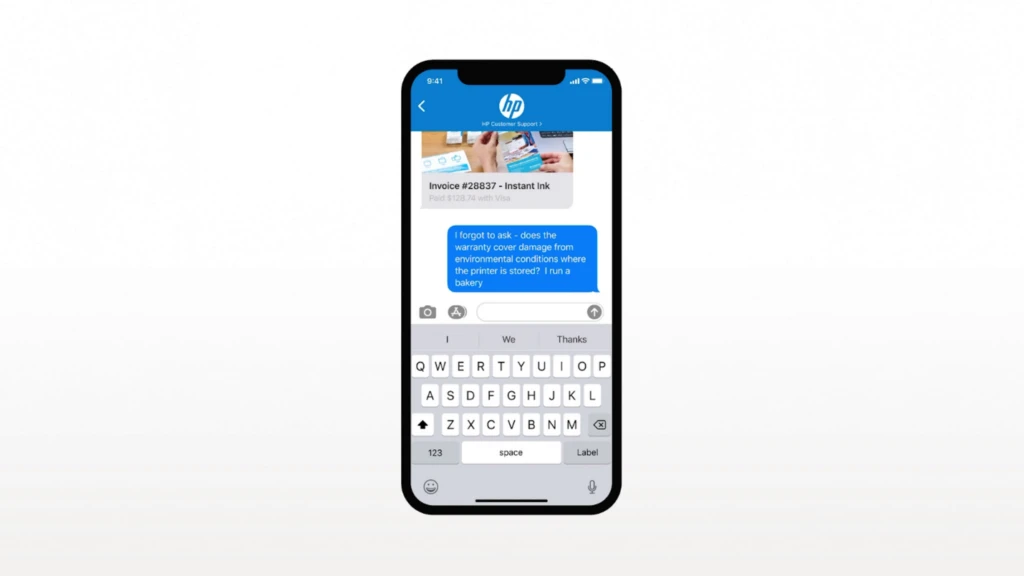
  • Deliver hyper-personalized omnichannel service across voice and digital engagement channels, including support for major social messaging platforms. Provide richer service engagement with Teams voice and video embedded within Dynamics 365 Customer Service.

HP customer service chat on phone with customer asking about warranty coverage.
Figure 1: The Microsoft Digital Contact Center Platform enables automated and live hyper-personalized omnichannel service engagement across voice and digital channels.

Personalize and protect customer interactions

Consumers today expect brands to provide tailored experiences based on their engagement with the company. Delivering personalized experiences starts with using AI to identify and authenticate consumers seamlessly and securely, and requires unlocking the power of data to understand, customize, and optimize customer journeys.

The Microsoft Digital Contact Center Platform uses AI and deep analytics to anticipate customer requests, predict intent, and provide rapid resolution, which streamlines service and increases satisfaction. Customer experiences are protected with integrated biometric identification, authentication, and fraud prevention to build and maintain brand trust. The platform:

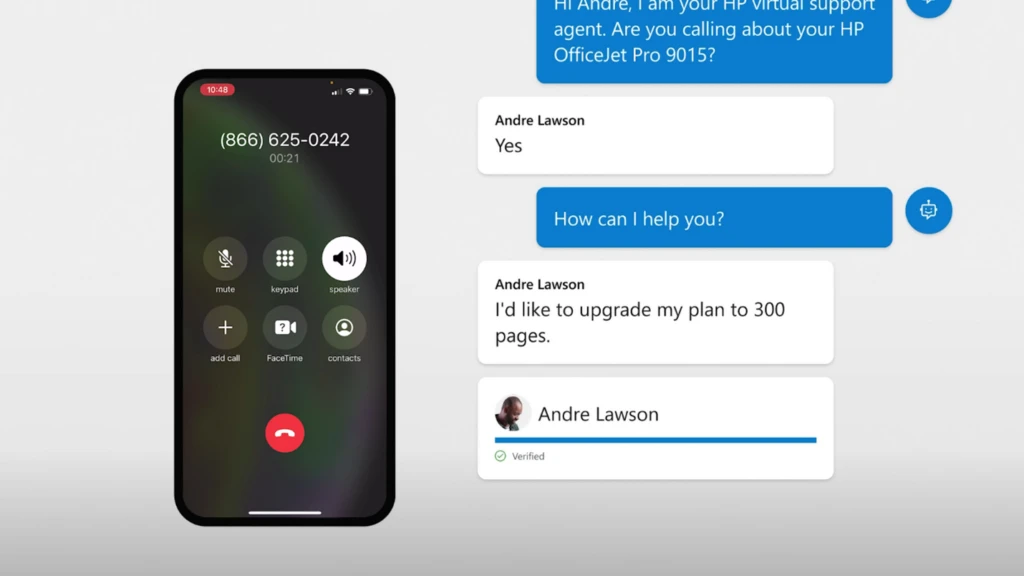
  • Uses biometric authentication to authenticate customers in seconds based on inherent biometrics and other factors.
  • Secures every customer and employee interaction, and prevents fraud while uncovering fraud patterns and attack vectors.
  • Provides insights on how consumers interact with the brand throughout their journey with customer journey analytics to improve customer acquisition and tailor personalized offers.
  • Understands why customers are calling and customizes the experience to anticipate their needs with AI intent prediction.

Customer on the phone with virtual agent looking to upgrade their plan. Customer gets verified through biometric authentication.
Figure 2: Biometric authentication capabilities create quick and secure connections for customers.

Improve agent productivity and modernize case management

The Microsoft Digital Contact Center Platform empowers agents to better serve customers by bringing the right information, people, and insights directly into the flow of work with Context IQ. It provides intelligent next-best response recommendations and sentiment analysis to enable fast resolutions. What’s more, this creates a learning loop so automated solutions continually evolve and become smarter. The platform:

  • Provides agents with a 360-degree view of the customer and their journey. Agents can manage customer requests seamlessly from any channel, even while handling multiple sessions at the same time.
  • Empowers agents with personalized conversational intelligence, including sentiment analysis, to truly understand customer emotions and needs. Next-best response and offer recommendations help create valuable upsell and cross-sell opportunities.
  • Assists the agent in identifying the resolution with AI-recommended knowledge articles.
  • Automates how agents quickly and efficiently bring together experts to resolve an open case through intelligent case swarming. With a single click, agents can collaborate with experts matched based on skillset and expertise.

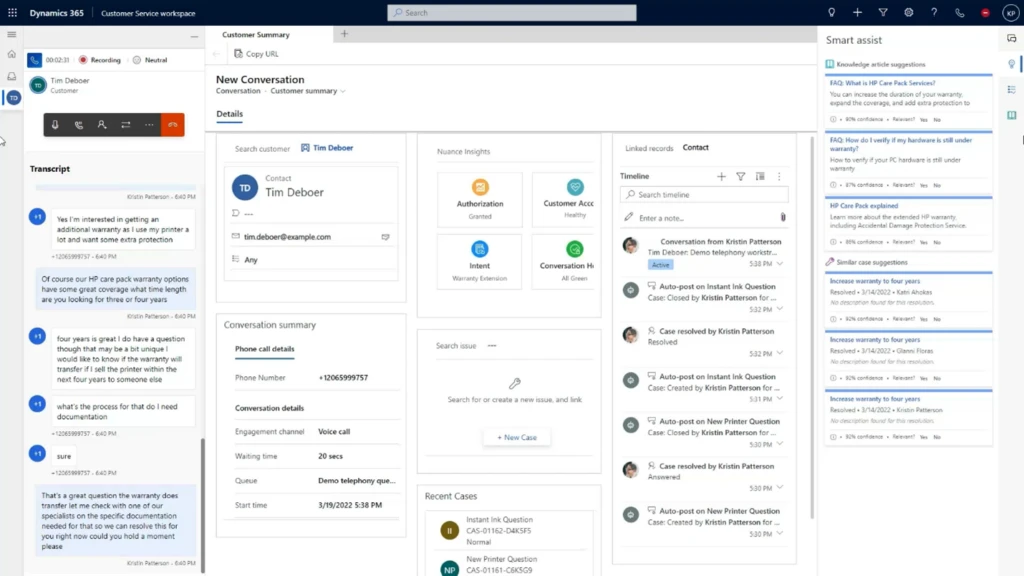
Dynamics 365 agent dashboard showing customer sentiment and suggested actions for the agent to use in conversation with a customer.
Figure 3: Agents can view a real-time call transcript, see the customer’s details, recent cases, and suggested knowledge articles and similar cases to help resolve customer issues more quickly.

Increase customer acquisition and revenue

Rich real-time insights and analytics enable data-driven decisions to improve customer satisfaction, with conversational analytics providing instant visibility into trends across engagement channels. With the Microsoft Digital Contact Center Platform, companies can:

  • Enable agents to increase conversions and drive upsell through real-time offers.
  • Help customers find and select products through personalized offer recommendations, driving upsell and cross-sell revenue.
  • Track user behavior and data to quickly identify and offer optimal engagement opportunities through predictive targeting,thereby improving satisfaction and increasing revenue.
  • Preemptively notify customers of special promotions and updates, which accelerates their purchase intent, and boosts revenue and long-term value.

Drive infrastructure simplicity, flexibility, and innovation

The Microsoft Digital Contact Center Platform simplifies implementation and support of contact center infrastructure, removing complex IT integrations while maintaining flexibility for customers and partners seeking comprehensive Contact Center and Customer Engagement solutions.

Contact center tasks and workflows ranging in complexity from routine conversations to sophisticated transactions can easily be automated using no-code, low-code, or pro-code experiences. Powerful chatbots equipped with conversational AI can be created to converse with customers intelligently and efficiently across engagement channels. Consumers can self-service a wide variety of cases, getting connected with a live agent when needed for support with complex issues.

The platform is also cloud-scale and elastic to accommodate seasonal or surging demand. It automatically adjusts to changes in contact volume, agent counts, wait times, and service levels without performance impact.

Transform the contact center with our extensive partner network

Accenture-Avanade, a customer experience (CX) transformation partner, will deliver its Customer Engagement solutions starting with the Microsoft Digital Contact Center Platform to help customers reimagine their entire customer experience and deliver business results. Additional launch partners include systems integrators EY, HCL, Hitachi, KPMG, PwC, TCS, and TTEC, and ISVs such as Avaya, Genesys, and NICE. With this robust set of launch partners, customers around the globe will be positioned to create new and sophisticated solutions to address specific contact center challenges.

Learn more

Learn more about how to transform customer and agent experiences with the Microsoft Digital Contact Center Platform and explore the full set of capabilities.

Join us at Microsoft Inspire on July 1920 to learn how to unleash customer service innovations with Dynamics 365, Teams, and Nuance.

The post Introducing the Microsoft Digital Contact Center Platform: A comprehensive, flexible customer care solution appeared first on Microsoft Dynamics 365 Blog.

Brought to you by Dr. Ware, Microsoft Office 365 Silver Partner, Charleston SC.
From enabling hybrid work to creating collaborative experiences—here’s what’s new in Microsoft 365

From enabling hybrid work to creating collaborative experiences—here’s what’s new in Microsoft 365

This article is contributed. See the original author and article here.

Now that hybrid work is just work, the challenge for organizations is to balance employee demands for flexibility with business needs. This month we made improvements to help employees work smarter and more efficiently, with integrated technology that brings people together across every role and function so they can connect and collaborate effectively in the flow of work.

The post From enabling hybrid work to creating collaborative experiences—here’s what’s new in Microsoft 365 appeared first on Microsoft 365 Blog.

Brought to you by Dr. Ware, Microsoft Office 365 Silver Partner, Charleston SC.

Honor customer data use consent with unified profiles in Dynamics 365 Customer Insights

Modernize employee expense management with automation and AI

This article is contributed. See the original author and article here.

As the world continues to rebuild and forge a path to a new normal post-COVID-19, more and more business travelers will once again hit the road. Looking further ahead, the Global Business Travel Association expects business travel to fully recover by 2024.1 While this is certainly a welcomed sign of recovery, the uptick in business travel will also mean more expense reports to file and approve for employees and managers.

Most employees have little affection for expense reports and would be happy if the process could be automated. That is exactly why we are excited about the new expense report experience for Microsoft Dynamics 365 Project Operations. The new experience utilizes automation to eliminate many pain points typically associated with expense management: countless hours scanning receipts and credit card statements; itemizing, categorizing, and matching expenditures; and working through frustrating errors that block approval workflows.

Reimagining expense reports at Microsoft

The new expense management experience in Dynamics 365 Project Operations began as an effort to improve how we file expenses here at Microsoft. Like many businesses, filing and approving expenses was a time-consuming chore for employees and managers. With operations in 112 countries and more than 130,000 business travelers worldwide, Microsoft employees spent more than 500,000 hours annually itemizing and filing expense reports. This was both an enormous drain on productivity and a source of employee dread due to the poor user experience.

“We were seeing employees spending 15-20 minutes for a simple expense. Can we automate it or give them a better tool?”Amruta Anawalikar, Senior Program Manager, Microsoft Commerce Financial Services.

To complicate matters further, Microsoft had built up an expansive collection of corporate expense tools over the years, onboarding various internal and third-party expense management platforms through acquisitions and to meet different business needs. Each of these disconnected systems also had varying configurations specific to local environments, and none of them spoke the same language. For example, what one system might call “expense purpose,” another would call “report description.” Standardization and unification were badly needed, but customization wasn’t an option because a primary third-party application didn’t support API integrations.

To learn more, check out the recent blog Automating expense reporting at Microsoft boosts employee experience

End-to-end automation, intelligence, and flexibility

From the start, our primary goal in building an expense management experience in Project Operations was to improve the user experience and productivity. To do this, we aimed to automate the end-to-end expense management process, thus eliminating employees’ need to file expense reports. Microsoft engineers succeeded by combining Microsoft Azure as a cloud base to support an internet-first approach and Microsoft Dynamics 365 as a flexible architecture to overcome the rigid structures of any third-party application and to unify expense reporting tools.

“This is where Dynamics 365 really has an edge. It gives us that flexibility of customization, which will make it extendable for any future needs as well.”Mohit Jain, Senior Software Engineer, Microsoft CFS Finance Engineering.

With a flexible, cloud-based architecture unifying and connecting all expense tools, we were then able to apply automation capabilities. This involved leveraging optical character recognition (OCR) to “read” receipt images and extract essential information such as merchant name, date, and amounts. Employees could populate expense reports in a practically touchless manner. This reduced time spent filing expenses, as well as decreased errors related to manual entry and, in turn, the number of audited expense reports. The final step was applying AI and machine learning to categorize expenses and match unattached receipts with charges from imported credit card statements.

The new expense reporting solution ultimately reduced 70 percent of the time spent by Microsoft employees filing expense reports.

To learn more, check out the recent blog Transforming Microsoft’s corporate expense tools with Microsoft Azure and Microsoft Dynamics 365

Explore Dynamics 365 Project Operations

The expense management module in Dynamics 365 Project Operations provides companies with the following capabilities:

  • Track and manage employee expenses.
  • Store payment information.
  • Automatically import credit card transactions on a recurring basis.
  • Set up expense policies and automated approvals.
  • Manage expenses in the Mobile expenses app.

Additionally, organizations can now utilize the same tools we use internally as part of the new expense reports reimagined workspace. And it’s available free of charge to current users.

What’s next?

Microsoft Dynamics 365 Project Operations connects sales, resource management, project management, and accounting teams in one application for the enhanced visibility, collaboration, and agility needed to drive successfrom prospects to payments to profits. If your organization sees increased spending on corporate travel in the near future and you are ready to see what a modern and automated expense management module can do for your business, you can learn more through a guided tour or by requesting a free demo.


Sources

1GBTA, 2021. From Setback To Surge: Business Travel Expected To Fully Recover by 2024.

The post Modernize employee expense management with automation and AI appeared first on Microsoft Dynamics 365 Blog.

Brought to you by Dr. Ware, Microsoft Office 365 Silver Partner, Charleston SC.
Honor customer data use consent with unified profiles in Dynamics 365 Customer Insights

2022 release wave 2 plans for Dynamics 365 and Power Platform now available 

This article is contributed. See the original author and article here.

On July 12, 2022, we published the 2022 release wave 2 plans for Microsoft Dynamics 365 and Microsoft Power Platform, a compilation of new capabilities that are planned to be released between October 2022 and March 2023. This second release wave of the year offers hundreds of new features and enhancements, demonstrating our continued investment to power digital transformation for our customers and partners. 

Highlights from Dynamics 365 

  • Dynamics 365 Marketing brings real-time customer journey orchestration to enable business-to-business (B2B) brands to hyper-personalize experiences across the entire buying journey and confidently grow their marketing and customer experience programs to target up to 100 million customers with up to 300 million messages and interactions per month. Intuitive lead capture forms, leads nurturing hands-off automation, and a new analytics dashboard enable alignment between sales and marketing teams like never before. Organizations can reach new levels of marketing maturity with AI-powered next best content selection and increased support for business units.  
  • Dynamics 365 Sales continues to optimize the seller experience using data and AI to help sellers prioritize their work, blending business and productivity tools to meet sellers where they are and driving in-the-moment collaboration experiences so that every seller can engage with their colleagues and customers efficiently, reclaiming their time and being more productive.  
  • Dynamics 365 Customer Service is focused on delivering the capabilities that help run contact centers optimally by providing enhancements in unified routing with features such as percentage-based routing, preferred agent routing, and longest idle routing. Customer support swarming in Microsoft Teams will help agents resolve complex cases through collaboration. Organizations can empower their customers with options to leave voicemail, callback, and dial agents directly in the voice channel. The agent experience is modernized with an enhanced conversation timeline, horizontal multisession navigation, and AI-powered conversation summary. Supervisors can view Microsoft Power Virtual Agents analytics within their omnichannel analytics dashboards.
  • Dynamics 365 Field Service brings new capabilities that enable organizations to better orchestrate service operations for workers. Organizations can now build and maintain location and assets for large facilities, keep their cost at bay by configuring “not to exceed” limits, and group similar incident types under “trade” for ease of management. We are also bringing optimization improvements on booking lock constraints and introducing a myriad of user experience improvements to the mobile app to continue empowering frontline workers.  
  • Dynamics 365 Finance is launching the general availability of vendor invoice optical character recognition (OCR) which automates the reading and recognition of vendor invoices and continues adding additional capabilities for subscription billing use cases. We will integrate tax calculation service with Dynamics 365 Project Operations (preview) and extend electronic invoicing service to support new upcoming e-invoice legislations for France, Poland, and Saudi Arabia. 
  • Dynamics 365 Supply Chain Management continues to invest in capabilities that drive agility and resilience across the supply chain. New analytics and support for multiple vendors in planning optimization help organizations optimize their sourcing strategies. Inventory visibility lets organizations track real-time consumption within allocated quantities in support of promotions, special events, and new product introductions. Guided warehouse implementation and configuration experiences enable rapid reconfiguration of supply chains and manufacturers in the process industry can use Planning Optimization for shortening their planning cycles. 
  • Dynamics 365 Intelligent Order Management has continued to expand its ecosystem of providers and built on the continued success of FedEx. We now have 14 providers that span the supply chain lifecycle from order ingestion to last-mile delivery. In the upcoming release, we are adding support for various order typesback orders, subscription orders, manual orders, and purchase orders. We will also provide the ability to simulate fulfillment so that our customers can model and understand the impact of choosing various fulfillment strategies. Finally, we also have contextual collaboration features where an order can be shared with multiple stakeholders using embedded Microsoft Teams. 
  • Dynamics 365 Project Operations is continuing to invest in capabilities to empower project managers and project teams in this release wave with project budgeting and time-phased forecasting, baselines and snapshots, and in modernizing application experiences on the web and mobile form factors. For the project accountants and back-office personas, we are lighting up advanced subcontracting and subscription billing capabilities. In addition, across-the-board investments to ease the complexity of interaction patterns and uptake of modern and fluent controls are also targeted for this release wave.
  • Dynamics 365 Guides will continue investing in capabilities to improve collaboration experiences for authors and operators on Microsoft HoloLens 2. The application will also be updated to provide more advanced content authoring workflows versioning and publishing of guides in the coming wave. 
  • Dynamics 365 Human Resources will bring improved efficiency by enabling human resource business partners to tailor experiences and automatically complete processes where manual decisions and tasks are needed today. Improved efficiency will also be available to managers and employees by providing notifications outside of the application for benefits processes and tasks. We’ll also be providing better experiences across Dynamics 365 applications by integrating employee skill and compensation, and leaving information to resource managers in Dynamics 365 Project Operations.  
  • Dynamics 365 Commerce enables new and updated B2B experiences, including sales agreements across channels and customer-specific catalogs. Omnichannel media management features streamline workflows. Key point of sale investments includes Store Commerce app availability for iOS and Android devices. And Apple Pay and Google Pay digital wallet integration, as well as new customer support options through virtual agent and live agent integration will be available for e-commerce.
  • Dynamics 365 Fraud Protection will be offering a new transaction acceptance booster (TAB) offering that allows merchants to increase their bank approval rates without having to rip and replace their incumbent fraud provider solution. Having to rip and replace a merchant’s incumbent fraud solution is costly and timely, this enables the merchant to benefit from Dynamics 365 Fraud Protection TAB capabilities with minimal disruption to their business.
  • Dynamics 365 Business Central continues to improve the reporting capabilities for customers, including new report datasets for Excel and improvements to the Microsoft Power BI reports which now will support dimensions. The Microsoft Power Apps and Microsoft Power Automate integration also continue to offer new capabilities for low-code development. The application will get several improvements like helping users do reverse entries in the payment reconciliation journal and several improvements to the supply chain functionality. We are taking steps forward in scaling productivity of our partners via more efficient and performant tooling for development and administration.
  • Dynamics 365 Customer Insights continues to invest in accelerating customer understanding by enhancing time to value with quicker out-of-the-box insights, predictions, segments, and measures with limitless extensibility across technology ecosystems. New features will allow you to power personalized experiences with real-time insights, analytics, and activations to deliver industry-leading personalization and moments-based marketing. New features also enable ubiquitous insights that allow an integrated data flow across Microsoft Dataverse, Dynamics 365, and Microsoft Power Platform for seamless workflows.
  • Dynamics 365 Connected Spaces now supports alerts and notifications via Teams or Outlook when business AI-skills detect actionable patterns within a physical space. Customers can now use Dynamics 365 Connected Spaces in Germany (besides US and UK) and connect up to 10 cameras for each Azure Stack Edge device maximizing their existing investments in expanding Dynamics 365 Connected Spaces across their physical footprint. Customers can also leverage the Azure Stack Edge Pro 2 device for configuring Dynamics 365 Connected Spaces at the edge in addition to the existing Pro 1 devices.

Highlights from Microsoft Power Platform

  • Power BI continues to invest in empowering every individual, team, and organization to drive a data culture. Creation experience is improved by aligning our experiences with Office and enabling datasets authoring on the web. By bringing power query diagram view into Power BI Desktop, creators can use a no code experience to perform extract transform load (ETL) on their data. For teams, we are bringing enhancements to metrics focused on enterprise needs and integration with Microsoft Viva Goals. In addition, big data experience is increased through automatic aggregations, query scale out, data protection capabilities via data loss prevention (DLP), and providing improved visibility into activity to admins. 
  • Power Apps will expand governance capabilities to allow organizations to enable, manage, and support citizen development across the entire organization. Makers and developers of all skill levels will be more productive over Dataverse in a unified studio, with modern experiences to build and manage data and logic, as well as infused intelligence to support development, enrich data, and optimize end-user experiences. In addition to ensuring trust and the ability to leverage rich data experiences, both makers and end-users will benefit from out-of-the-box collaboration capabilities to enable users to be more productive when working together.
  • Power Pages continues to invest inbringing more out-of-the-boxcapabilities to support both low-code/no-code development as well professional developers. Some of the salient capabilities in this release allow makers to have additional capabilities to work with forms and lists using the design studio and get them started quickly using additional solution templates. There are enhancements for professional developers to do more with the sites using Microsoft Power Platform command line interface (CLI) tool and visual studio (VS) Code as well as for administrators to better administer and govern their Power Pages sites. 
  • Power Automateis more accessible than ever before with new experiences to help users of every skill level build out their cloud and desktop flows. Organizations need to automate their deployments of Power Automate, so there are additional enhancements for application lifecycle management (ALM). And, with increased usage of robotic process automation (RPA), we areadding features to make it easier to manage machines in Azure and the credentials of your users and accounts.
  • Power Virtual Agents brings improvements in the authoring experience with commenting, Power Pages integration, data loss prevention options, proactive bot update messaging in Teams, and more. Creating a bot is typically a complex and time-intensive process, requiring long content update cycles and a team of experts. Power Virtual Agents gives anyone in your organization the ability to create powerful custom bots using an easy, code-free graphical interface, without the need for AI experts, data scientists, or teams of developers. A bot can interact with users, ask for clarifying information, and ultimately answer a user’s questions. 
  • AI Builder continues to enable citizen developers to use and customize AI capabilities to build more intelligent apps and workflows. Lifecycle and governance of AI Builder models will be improved with enhanced versioning, deployment, and monitoring capabilities. Makers will also benefit from new features for intelligent document and text processing like the ability to manage human in-the-loop validation, easier integration of large data sets for automated e-mail processing, and the ability to process contracts and multi-page tables in documents.

For a complete list of new capabilities, please check out the Dynamics 365 and Microsoft Power Platform 2022 release wave 2 plans. 

Early access period 

Starting August 1, 2022, customers and partners will be able to validate the latest features in a non-production environment. These features include user experience enhancements that will be automatically enabled for users in production environments during October 2022. Take advantage of the early access period, try out the latest updates in a non-production environment, and get ready to roll out updates to your users with confidence. To see the early access features, check out the Dynamics 365 and Microsoft Power Platform pages. For questions, please visit the Early Access FAQ page

We’ve done this work to help youour partners, customers, and usersdrive the digital transformation of your business on your terms. Get ready and learn more about the latest Dynamics 365 and Microsoft Power Platform product updates and product roadmaps, and share your feedback in the community forum for Dynamics 365 or Microsoft Power Platform

The post 2022 release wave 2 plans for Dynamics 365 and Power Platform now available  appeared first on Microsoft Dynamics 365 Blog.

Brought to you by Dr. Ware, Microsoft Office 365 Silver Partner, Charleston SC.

Honor customer data use consent with unified profiles in Dynamics 365 Customer Insights

How to build a modern field service organization

This article is contributed. See the original author and article here.

Field service organizations have traditionally operated under the break-fix modelthat is, responding to a device failure after the customer reports an issue. This operating model has grown antiquated due to rising costs and inefficiencies in labor and operations. It is also proving less than effective in satisfying the customer’s growing expectations.

The field service industry is evolving quickly in new and exciting directions with cutting-edge technology continuing to enter the arena. These innovations in technology and workflows are helping to transform field service by providing customers optimal device uptime, along with greater visibility, efficiency, and profitability. The evolution of field service includes automation, AI, new learning tools, and mixed reality to help technicians achieve success.  

The ability to capture, digest, and derive actionable insights from data is critical in modernizing a field service organization. Intelligent, predictive systems driven by AI can automate time-consuming manual tasks like collecting data, diagnosing problems, and identifying the best solution to resolve an issue. AI can optimize resource management, empower field teams through mixed reality and mobilization, and can improve customer service with proactive and predictive service. In short, AI is providing organizations the ability to optimize the delivery of field service.

While service organizations lay frameworks of sensors and solutions to capture data across every facet of their organization, AI and machine learning represent the next steps that organizations are taking to leverage the value of the captured information. The ultimate goal is to transition from a reactive, break-fix service model to one that is proactive and predictive, achieving a near constant uptime. 

One organization leveraging mixed reality and field service is Burckhardt Compression. The leading global compressor company adopted Microsoft Dynamics 365 Remote Assist and Dynamics 365 Field Service so that engineers can quickly collaborate with ship technicians in remote locations and provide specialized mechanical expertise. They successfully reduced costs, decreased its carbon footprint, and can now respond to customer needs in mere minutes instead of days.

Improve the customer experience

Field service customers need stability and reliability in their businesses. They want visibility into their assets and need to minimize downtime when breakdowns occur.

Prior to AI-empowered systems, the customer would have to actively reach out to report that the device had failed. Depending on the type of failure, work using the device could be slowed or blocked for days or weeks until a technician could complete the repairs. Without intelligent support, the technician may need to return for follow-up visits, unnecessarily wasting both time and money.

AI allows for automated, remote self-healing and predictive forecasting, monitoring, and analyzing connected devices for potential issues. If one is identified, the system can remotely attempt to resolve problems through self-healing processes, like having the device restart itself during an off-time to mitigate an overheating failure. Using historical device data and predictive analytics, the system might make a recommendation to schedule a technician site visit to head off future problems, notifying the customer of the work order. The customer could then plan around the scheduled downtime and even track the technician’s arrival to the appointment in real-time.

During the visit, using recommendations from the system, the technician would be able to discuss additional products and services with the customer that meet their specific usage and operating needs. Ultimately, the customer gains more control over their assets, and the field service organization is empowered to provide improved service delivery capabilities.

Increase technician productivity

To be the most effective and prevent costly return visits, technicians must have complete access to the information and real-time guidance they need. The technician could utilize a digital twin of the device to learn about its status and operating condition, and to train on the particular problem that requires repair. AI’s cognitive capabilities can even help optimize repairs before a technician arrives, taking care of routine diagnostics and testing for common or similar issues. These capabilities ensure the technician is better prepared for the work and that their timeand the customer’sis used efficiently.

The technician’s mobile service app empowers the technician to better manage appointment schedules and access turn-by-turn driving directions to the customer site. Onsite, this app can highlight the top two to three possibilities that might be wrong with the device. Chatbots can assist in locating customer, product, and work order information. Mixed reality tools, like Dynamics 365 Remote Assist, can create 3D renderings overlaid directly onto the device, highlighting missing or broken parts and allowing the technician to view performance data. AI can use data from predictive analytics to make just-in-time recommendations. A headset can be worn to identify irregularities and help maintain focus on the right issues without having to stop and troubleshoot, ensuring work is completed correctly the first time. And the technician can obtain assistance from a more experienced technician through Microsoft Teams if the issue is beyond their current skill set.

Optimize resource management

And finally, effectively managing resources, such as inventory and technician time, is at the heart of the challenge for any field service organization, creating a powerful competitive advantage when performed well. 

In a traditional field service organization, technicians are often dispatched based on availability, not proximity to the customer or experience with a specified device. A technician may arrive on-site with limited access to customer information and device history, impacting the ability to complete the repair on a first visit and driving up overall costs for the customer and the field service organization.

As an example, let’s look at a manufacturing customer experiencing a device failure. When a work order is scheduled in an intelligent system, assignments are optimized using multiple factors, such as a technician’s experience in handling the specific failure, the customer’s preferred technician, or the proximity to the site. Leveraging machine learning, this intelligent system can automatically assign the work order to the closest, best available technician matching specific criteria.

If the device were outfitted with an Internet of Things (IoT)-connected sensor, a real-time alert would be sent, triggering an automatic service request. The system would attempt to self-heal the issue first, and if unsuccessful, a technician would then analyze the data and commit a repair remotely, often without the customer ever knowing there was a problem. Sending the technician for an onsite visit would be the last option if the device could not be repaired remotely.

As more requests come in, the system would then optimize the technician’s schedule to create the most efficient path to navigate, allowing the technician more time to perform additional calls per day and driving greater revenue.

Real-time inventory management ensures that the replacement part is available on the scheduled date and that the technician has access to the tools needed to complete the repair. The system can identify the best parts to replace, where they should be purchased, and provide more accurate lead time predictions for the organization. Field service managers and technicians alike can synchronize and track inventory down to the truck level with real-time visibility to increase first time fix rates.

Get started today

AI enables field service organizations to evolve from the break-fix model by empowering technicians, optimizing resources, and improving customer experiences.

Microsoft offers a unique combination of world-class IoT, intelligence, scalability, and end-to-end field service capabilities. 

Learn more aboutDynamics 365 Field Service and how it can transform your service organization.

Get started today with a live demo or a free trial today.

The post How to build a modern field service organization appeared first on Microsoft Dynamics 365 Blog.

Brought to you by Dr. Ware, Microsoft Office 365 Silver Partner, Charleston SC.
