Optimize fraud control with scenario segmentation in Dynamics 365 Fraud Protection

Optimize fraud control with scenario segmentation in Dynamics 365 Fraud Protection

This article is contributed. See the original author and article here.

To protect your business in today’s rapidly evolving fraud landscape, it’s critical to incorporate the use of both rules and machine learning. Machine learning can quickly detect new and emerging fraud patterns, and output a risk score to indicate the probability of fraud for a particular event. Rules can then use that risk score to automate decisions, enabling you to control the level of risk that’s right for a particular scenario. So how do you write an effective rule set selecting just the right amount of risk to minimize fraud as well as false positives?

While it may be tempting to set a singular risk threshold for your entire business, this “one size fits all” approach can result in significant fraud loss or unnecessary friction for good users. Instead, we recommend dividing your business into meaningful segments, and setting custom risk thresholds for each segment. This technique is known as scenario segmentation and it can be a powerful tool to help you optimize decision accuracy and increase profits.

Select segments that share a common risk level

Segments can be large or small, and the number of segments may vary depending on the size and diversity of your business. However, what is most important is that the events within each segment all share a common level of risk.

These segments may slice on attributes such as product type, payment method type, or country and region. In Dynamics 365 Fraud Protection, you can use Virtual Fraud Analyst to help identify slices, which have above- or below-average fraud rates.

For example, if you sell both physical and digital goods, you may observe that the two have very different fraud rates, indicating that these would make appropriate segments. However, upon further inspection, you observe that within the digital segment, fraud rates still vary considerably. Some digital products, such as gift cards, may be heavily targeted by fraudsters and account for a disproportionate amount of all digital fraud. In contrast, other digital products, such as some low-risk subscriptions may have consistently low fraud rates, indicating that they are rarely targeted. Therefore, these two product groups can each be placed in their own segment.

Balance segmentation needs with operational efficiency

While more segments allow for more granular control, it’s important to remember that each additional segment will require additional effort to maintain. While you could create unique segments for every product in your catalog, each with their own individualized score cutoff, this would quickly become unreasonable to manage. Therefore, it’s important to be mindful of available resources and ensure that the operational load does not exceed a reasonable capacity.

Configure risk-based thresholds for each segment

After your segments have been defined, the next step is to choose appropriate score cutoffs for each segment. Generally higher-risk segments (such as gift cards) will have low cutoffs, minimizing fraud loss, while lower-risk segments (such as subscriptions) will have high cutoffs, decreasing false positives and reducing customer friction. It is important to consider factors such as profit margin, fraud rate, rejection rate, and false positive rate when setting this cutoff.

After you determine your segments and their corresponding score cutoffs, the final step is to implement your segmentation strategy using real-time rules. The rule engine in Dynamics 365 Fraud Protection provides you with the flexibility to easily segment your traffic and set custom score cutoffs for each segment.

As in the example above, given their differing fraud rates, you may want to set a lower score threshold for gift cards, and a higher threshold for subscriptions. You can accomplish this with the following rules:

RETURN Reject()WHEN @"productList.category" == "Subscription" and @"riskScore" > 700
RETURN Reject()WHEN @"productList.category" == "Gift Card" and @"riskScore" > 400

These rules are written in the custom rules language included in Dynamics 365 Fraud Protection. For more information, check out the Language guide for Fraud Protection rules.

Next steps

Segmenting your traffic and writing effective rules is a crucial step in protecting your business from fraud. Dynamics 365 Fraud Protection offers several tools to make segmentation easy and effective. Take advantage of the virtual fraud analyst to help select appropriate segments and cutoffs, and learn how to use Dynamics 365 Fraud Protection’s rule engine to create and manage rules, allowing you to automate decisions for each segment.

If you are not currently using Dynamics 365 Fraud Protection, check out the documentation to learn more and start a free trial today.

The post Optimize fraud control with scenario segmentation in Dynamics 365 Fraud Protection appeared first on Microsoft Dynamics 365 Blog.

Brought to you by Dr. Ware, Microsoft Office 365 Silver Partner, Charleston SC.

NRF 2021: enabling retailers to reimagine the road ahead with Microsoft Business Applications

NRF 2021: enabling retailers to reimagine the road ahead with Microsoft Business Applications

This article is contributed. See the original author and article here.

Truly engaged, always connected

The past year has brought complex challenges for retailers of every size, and in response many have quickly pivoted their businesses to adjust.

With store closures during lockdown, retailers leveraged Microsoft Dynamics 365 to facilitate new purchasing options for their customers, such as shipping from stores and click and collect. Once stores reopened, Dynamics 365 helped retailers realize the vitality of mobile point of sale solutions and contactless payment options to ensure safe and secure shopping experiences for both customers and sellers alike.

It’s clear that resilience and agility will be the key drivers of success for retailers moving forward, as customer demands change and new challenges emerge, and Microsoft is dedicated to empowering these organizations with the technology solutions they need.

Today at NRF 2021: Retail’s Big Show, we are introducing the private preview of Microsoft Cloud for Retail, as well as updates to Dynamics 365 that help retailers better engage both B2B and B2C customers. These new capabilities join Dynamics 365 and Microsoft Power Platform solutions that work together to help brands deliver personalized and meaningful customer experiences across physical and digital channels, uniquely connecting the end-to-end shopper journey.

We are excited to continue partnering with retailers leveraging Dynamics 365 and Power Platform solutions, including the new capabilities we’re announcing today, to drive their success in 2021. Take a look at how a few leading retailers around the world are looking to Dynamics 365 and Power Platform to build resilience, increase agility, and ultimately accelerate business outcomes.

Unify your e-commerce capabilities

With disparate retail systems, it’s difficult for retailers to scale across both traditional e-commerce and emerging channels for a truly seamless customer experience.

At NRF 2021, we are announcing the preview of B2B e-commerce functionality for Microsoft Dynamics 365 Commerceone of the solution’s most requested features. This new capability makes Dynamics 365 Commerce the optimal solution for B2B and B2C e-commerce on a single, holistic retail and commerce platform. By building on our consumer capabilities and bringing together B2B and B2C e-commerce, businesses can deliver consistent, personalized, and user-friendly purchasing options for all their customers. Combine this with close integration to Microsoft Dynamics 365 Sales and Microsoft Dynamics 365 Customer Service, retailers can enable curated self-service buying options for business accounts, along with increasing the productivity of their sales reps and empower them to provide informed and relevant offers to their buyers.

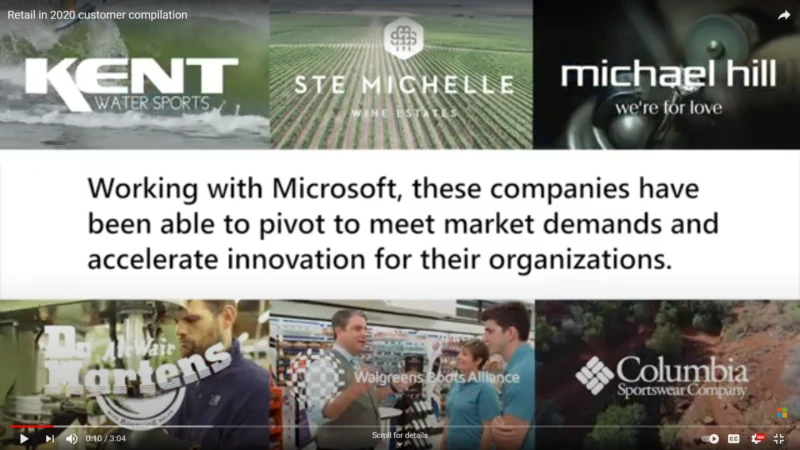
Kent Watersports is one of the largest sellers of watersports equipment globally. With a range of brands including O’Brien, Hyperlite, Connelly, Liquid Force, and more, Kent Watersports chose to work with Microsoft to help expand their e-commerce capabilities and sales capacity amidst increased online demand in 2020 and deliver a connected and user-friendly experience for both B2C and B2B customers.

“Our business customers want to be able to connect to our site and place their orders themselves. Historically, they were sharing Excel spreadsheets or calling a sales rep. We really appreciate the ability of the buyer to place the order electronically. It saves us a lot of time, and in fact it’s a better experience for the customers, and the sales reps, to actually be using our B2B e-commerce solution.”Rhett Thompson, Director of IT, Kent Watersports

Along with Kent Watersports, Columbia Sportswear also worked with Microsoft to rapidly adjust to market changes amid temporary store closures by the pandemic in early 2020. Columbia Sportswear leveraged Dynamics 365 Commerce to facilitate shipping from stores to meet customer demand and also started converting their store experiences to be compliant with local regulations. Once stores reopened, mobile point of sale solutions and contactless payment options became broadly adopted and ensured safe and secure shopping experience for both customers and sellers alike. Russel Anderson, Sr. Director Retail Operations, Columbia Sportswear shared how Dynamics 365 reduces time to value: “With Dynamics 365 Commerce we have realized that technology does not need to move as slowly as we previously thought it did, it can move faster.”

Throughout the NRF 2021 digital event, we will also showcase how retailers are using Dynamics 365 and Power Platform solutions to understand and engage customers, reduce fraud risk, and build resilient and agile supply chains.

Know your customer like never before

Providing personalized experiences at scale requires deep insights into customer needs and buying behavior. Microsoft Dynamics 365 Customer Insightsbrings together transactional, behavioral, and demographic data in real time to create a complete view of your customers and unlock insights to drive informed decisions, automate processes, and personalize customer engagement across channels.

Chipotle Mexican Grill is using Dynamics 365 Customer Insights to organize, analyze, and enrich its customer data to target marketing efforts so they’re as meaningful and effective as possible. With multiple sources of customer data but no comprehensive customer data platform, they couldn’t use that data to drive business insights or improve marketing efforts. Now, having chosen Microsoft to help navigate its customer data journey, Chipotle can understand customer preferences and customize relevant marketing messages, boosting revenue for the company and increasing personalization for customers.

Protect your customers and your bottom line

As more businesses turn to e-commerce, it also increases the exposure to fraud and abuse: a majority of fraud is committed during card-not-present transactions. Fraud is not only a burden for customers with stolen identities, account takeover, and more, but it represents a serious operational hazard for merchants. Microsoft Dynamics 365 Fraud Protection is a cloud-based SaaS solution designed to help e-commerce, brick-and-mortar, and omnichannel merchants decrease fraud costs and improve profitability. We are helping merchants globally to protect their revenue and reputation with tools and capabilities to decrease fraud and abuse, reduce operational expenses, and increase acceptance rates, while safeguarding user accounts from fraud exposure.

Darden Restaurants, operating some of the most recognizable brands in full-service dining including Olive Garden and LongHorn Steakhouse, needed to move swiftly to address a growing fraud issue during the COVID-19 pandemic. With the shift to an online-only model, Darden started noticing some fraudulent payments and looked to Microsoft for help. Darden Restaurants deployed Dynamics 365 Fraud Protection to combat purchase fraud at LongHorn Steakhouse, and together with Microsoft they had the solution quickly up and runningprotecting the restaurants and customers against fraud.

Build a supply chain that can handle any challenge

Another major repercussion of the COVID-19 outbreak has been the exposure of global supply chain vulnerabilities. Merchants need real-time visibility into their inventory to drive demand for overstock products and expedite replenishment of out-of-stock items cost effectively. Microsoft Dynamics 365 Supply Chain Management helps businesses build a resilient supply chain and agility to rapidly re-plan supply and distribution of products in near real-time with in-memory microservice to adapt to shifting customer demand. Dynamics 365 Supply Chain Management enables businesses to accomplish this in a matter of minutes, instead of days. Businesses can also seamlessly scale distribution and warehouse operations with edge computing during peaks. This capability, combined with an intelligent distributed order management system, provides businesses with a single global view of their inventory, to intelligently manage, automate, and optimize order fulfillment to ensure on-time delivery in a cost-effective manner.

One of our customers, Mobilezone, simplified the solutions landscape by choosing Dynamics 365 to get a better view of their customers and omnichannel sales capabilities for operating online, company-owned, and partner stores. Mobilezone consolidated its customer information within a single platform for heightened security, greater ease of use, and vastly improved inventory management. Mobilezone uses the synergy between Dynamics 365 Supply Chain Management and Dynamics 365 Commerce to analyze and satisfy demand.

“By using Supply Chain Management, we can automate alerts regarding inventory in specific locations, so we avoid the risks of out-of-stocks and overstocking.”Fritz Hauser, Director of IT and Logistics, Mobilezone

Another customer, Monogram Foods, is excited to enhance warehouse operations and create resiliency using edge scale units for Dynamics 365 Supply Chain Management. As Turner Foster, Senior Developer Manager, Monogram Foods explains: “Our frozen goods warehouse has a tight time constrained picking process, and it is critical for our warehouse team to have a consistent and reliably quick response throughout the entire picking operation. The architectural design of the solution ensures that these critical warehouse workloads are isolated from the rest of our operations, eliminating points of contention during these time sensitive processes.”

Retail solutions that are built to work together

Together, Dynamics 365 Commerce, Dynamics 365 Customer Insights, Dynamics 365 Supply Chain Management, and Dynamics 365 Fraud Protection help businesses streamline omnichannel operations, providing near real-time solutions for managing inventory, reducing fraud risk, and creating new customer services. Power Platform works together with Dynamics 365 to provide an additional layer of flexibility of adaptability, delivering low-code solutions to innovate with apps, automate processes, create virtual bots to improve service, and analyze data quickly to streamline reporting and gain insights across the organization, from the frontline to the supply chain, sales to service.

Get the full story

If you are registered for NRF 2021, we invite you to join Shelley Bransten, Microsoft’s Corporate Vice President, Consumer Goods and Retail Industries, to learn how Microsoft is empowering retailers from across the globe to build more intelligent, resilient, and sustainable retail operations. Tune in on Wednesday, January 13 at 1:00 PM Eastern Time.

Also, continue to visit the Dynamics 365 blog this week to learn more about how Dynamics 365 and Power Platform are helping retailers reimagine the road ahead with truly engaged, always connected solutions. Be sure to check out our new Business Applications retail industry webpage for more information.

The post NRF 2021: enabling retailers to reimagine the road ahead with Microsoft Business Applications appeared first on Microsoft Dynamics 365 Blog.

Brought to you by Dr. Ware, Microsoft Office 365 Silver Partner, Charleston SC.

Optimize fraud control with scenario segmentation in Dynamics 365 Fraud Protection

How Sunrise Technologies used Microsoft Dynamics 365 to stay productive in 2020

This article is contributed. See the original author and article here.

“It was March 13 at noon. I think that’s when we announced in the company that we were hard stopping,” said John Pence, president and founder of Sunrise Technologies. “I don’t think any of the executive team will ever forget that lunch.”

Like John, I’m sure you remember where you were in March of 2020, when the COVID-19 pandemic started to rapidly spread around the world, causing the most tumultuous year many of us have seen in our lifetimes.

As we begin a new year, we want to take a little time for reflection, to look back at the year we just went through as well as look ahead to 2021. To do so, we checked in with a few Microsoft partners who you’ll be hearing from over the course of the next several weeks. We wanted to find out how they and their customers had adapted to the sudden disruption of the pandemic, what customer and industry trends they were seeing, what lessons they had learned from facing the challenges of 2020, and what predictions they had for 2021.

Today, we focus on Sunrise Technologies and hear from John Pence, the company’s president and founder. Pence founded Sunrise Technologies in 1994, and the company became a Microsoft partner in 2003. According to Pence, Sunrise does a lot of large application system integrator work and enterprise resource planning (ERP) implementations using the Microsoft Dynamics 365 applications.

Adapting to serve customers

Sunrise Technologies is an international company with offices in China and Europe. That meant Pence got an early view into how COVID-19 was impacting operations around the world. In February of 2020, as the pandemic began to spread, Sunrise Technologies was forced to close its China offices. “Our offices in China shut down right after Chinese New Year, right at the beginning of February. We watched it all happen, and honestly, it just didn’t sink in that this was about to happen to us,” Pence said.

Two weeks later, everything changed. “It was like a tornado hit. It felt to us that on March 1, 2020 a switch flipped, and all of a sudden, we had a crazy week and it was like, oh my gosh, maybe we should start cutting back on travel, and then we had a second week like that, and it was clear we had to shut down. We’re a consulting company, so we pulled everyone off the road and closed all our offices.”

Sunrise Technologies’ customer base was significantly impacted by the sudden closures, with many of their retail customers experiencing 70 80 percent sales drops from late March through June. Throughout those early days of the pandemic, Pence noted that the Sunrise Technologies team worked hard to support their customers.

“It was a really traumatic time, but I think we handled the client interaction really well,” Pence said. “We were very flexible with the work with the clients. We extended terms, we lowered rates, we introduced free software to help with supply chain replanning activities, and we just gave it to all our clients. We did a lot of stuff trying to help them survive.”

Cloud services help organizations weather the storm

Despite the chaos and disruption caused by the pandemic, Pence said the fact that Sunrise Technologies is a cloud-based operation helped them continue to serve their customers without interruption.

“We had no idea this was going to happen. Everything suddenly shut, and yet we could just keep right on rolling. We were like a proof point all by ourselves. We are a 100 percent cloud operation internally. We use all Dynamics 365 products. We run all of our ERP operations on Dynamics 365. We use CRM for all of our sales and marketing as well as billing and time tracking. It proved out the value of the cloud in the sense of remote work.”John Pence, president and founder, Sunrise Technologies

According to Pence, many of his customers significantly benefitted from being cloud-based organizations. “Being on a cloud architecture for their basic business transaction platforms absolutely enabled our customers to survive the pandemic,” Pence said. “Some of the capabilities of Dynamic 365, like distributor management, the ability to spin up virtual stores, the ability to virtually alter their supply chains, absolutely helped.”

A surprisingly productive year

Even though they were all working remotely, Pence’s team was still able to be remarkably productive this year. “One of the things that we’ve found most mind-boggling is that we have had 21 go-lives as a company since we shut down on March 13,” Pence said. “The vast majority of those are full platform ERP implementations, and some of the biggest ones we’ve actually ever done have been done since we couldn’t travel.”

Within Sunrise Technologies, Pence said his team had learned there is much more they can do without traveling than they had previously believed was possible. “It was way more than any of us ever expected, especially for areas like sales and marketing,” Pence said. “In terms of collaborative work, we all learned that we could take some of the tools we have, like Microsoft Teams, and push them farther than we were using them before. From a productivity point of view, many things will never go all the way back to the way we used to do things.

Looking ahead to 2021, from a big picture perspective, Pence thinks businesses were reminded of the importance of supply chains, as well as the importance of visibility, flexibility, and the ability to address rapid change. “That will cause a lot of demand for what we do and what Microsoft does,” Pence said. “As people dust themselves off from this, they’re going to say, ‘we’ve got to get this stuff fixed, because if something like this happens again, we can’t be in the same place we were in this time.'”

Learn more

The post How Sunrise Technologies used Microsoft Dynamics 365 to stay productive in 2020 appeared first on Microsoft Dynamics 365 Blog.

Brought to you by Dr. Ware, Microsoft Office 365 Silver Partner, Charleston SC.
Forget about forgetting with the latest update to action items in conversation intelligence

Forget about forgetting with the latest update to action items in conversation intelligence

This article is contributed. See the original author and article here.

As the world of sales is increasing its adoption of digital transformation, we are looking for ways to help boost your sales teams’ productivity and give them tools, like conversation intelligence, that help them focus on winning deals without distractions.

After talking to sellers and managers from different sales teams, we found that the tasks that are the most energy-consuming during calls and time-consuming after calls are capturing action items, and later following up on them.

As a seller, your daily routine is full of calls with different customers regarding various deals. In each call, you need to note all your commitments to your customer and try to remember what the customer committed to do. Later, you need to find the time to follow up on those commitments: send a follow-up email, set up meetings, update information regarding the deal, and much more.

Starting today, you can forget about forgetting. With this update to action items, you can focus on what really mattersbeing more engaged in the conversation and gaining the customer’s trust.

Action items updates in conversation intelligence

In the first version of action items, we identified commitment sentences during the call and presented the seller with a quote of the commitments.

In this action items version, which was released as part of Dynamics 365 2020 release wave 2, there is an improved artificial intelligence model that better captures and contextually understands the commitments that you or your customer made throughout the call.

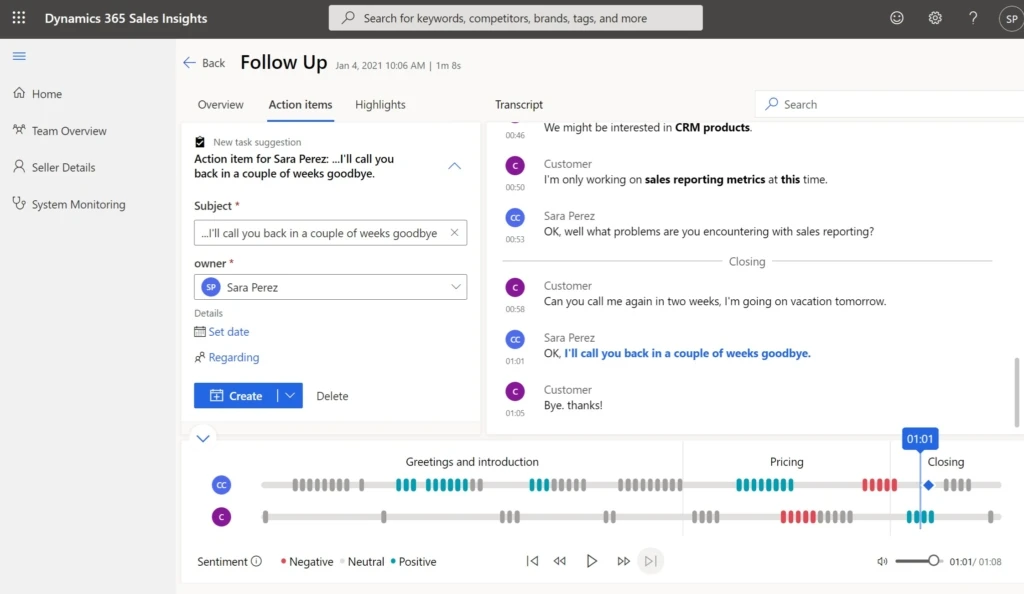
It has robust capabilities that not only capture the action items but also make them more comprehendible and actionable. In just a few clicks you can send an email, set up a meeting, or add a phone call activity or a task. No need to juggle between different apps. In this design, we give you an all-in-one app experience.

Screenshot showing sales insights in Dynamics 365

The action items updates integrate with our new call summary page design, to give the best user experience to the sellers and managers. Now, by a quick overview, you can understand which topics were discussed in different parts of the call and what was the sentiment there. Then you can drill down further to a specific point of interest and see the insights for that segment. Thus, you can better understand the customer’s needs and wishes.

Getting started with conversation intelligence

To understand the full capabilities of Dynamics 365 Sales Insights and the value it brings to Dynamics 365 sales customers, visit Dynamics 365 Sales, check out the sales insights add-in datasheet, or read these FAQs where you’ll find a list of supported languages and answers to other common questions.

Next steps

If you’re currently using conversation intelligence and have any feedback, questions, or suggestions, we’d like to hear from you on the Ideas forum.

The post Forget about forgetting with the latest update to action items in conversation intelligence appeared first on Microsoft Dynamics 365 Blog.

Brought to you by Dr. Ware, Microsoft Office 365 Silver Partner, Charleston SC.
Optimize fraud control with scenario segmentation in Dynamics 365 Fraud Protection

Microsoft at NRF: the changing landscape of retail

This article is contributed. See the original author and article here.

With NRF Chapter 1 starting this week, many retailers are looking to 2021 with one prominent thought: what’s next? Microsoft Dynamics 365 will again play a prominent role in Retail’s Big Show with new announcements and showcasing customer agility and innovation amidst a very disrupted market.

It’s clear that 2020 was a year where the retail industry went through rapid transformation; it’s less clear which of these changes are permanent and how retailers should prepare for 2021 and beyond. In a recent study by Forrester, commissioned by Microsoft, over 83 percent of executives agreed that connected and unified experiences were key to business success and digital commerce was a core ingredient. Of the 600 consumer-facing businesses surveyed, over 75 percent of companies said that improving digital commerce capabilities is their most urgent business priority.

Digital commerce is now the face of retail

The global pandemic has shifted how we buy, pushing more people to shop online than ever before. Fifty-nine percent of American consumers reported shopping online more often since the pandemic, according to CouponFollow, and data from the U.S. Department of Commerce shows that e-commerce sales grew as much from mid-June to mid-August as they did over the previous ten yearsa staggering increase. And in 2020, 71 percent of holiday shoppers planned to do most of their shopping online, up from 51 percent in 2019, according to CreditCards.com.

While we anticipate in-store sales will rebound as the pandemic subsideswe’ve already seen comfort with in-store shopping increase 65 percent since April, from 34 percent to 56 percent, according to Deloitteit’s also clear that digital commerce has seen tremendous growth during the pandemic, and this trend is expected to continue. Sixty-six percent of consumers stated they’d likely continue to purchase items online that they’d previously bought in-store prior to the pandemic, according to CouponFollow. And according to a recent report by Ipsos by 2023, e-commerce will represent 22 percent of global retail sales, amounting to $6.5 trillion USD. By 2021, it projects that 2.14 billion people worldwide will be buying goods and services online.

No matter the size of your business, digital commerce can no longer be an afterthought. Where brick-and-mortar locations were once the face of many companies, digital storefronts and online experiences now define many retail brands and will be key to unlocking growth and new opportunities.

Online shopper demographics have shifted

Younger shoppersMillennials and Gen-Zhave long been the primary users of online shopping, but the pandemic has caused major changes to who is shopping online. While Millennials and Gen-Z continue to shop online at high rates, we’ve seen 60 percent of Gen Xers and 47 percent of Boomers report increasing their online shopping from before the pandemic, according to CouponFollow. Also, according to eMarketer more than 30 percent of Boomers tried or were considering online grocery shopping, with some planning to continue doing so long-term, while 70 percent of both Gen Xers and Boomers plan on doing most of their holiday shopping online this year.

While shutdowns and safety concerns were the likely drivers of this adoption, they may not be the reason these groups are continuing to shop online. In a September poll by CreditCards.com, convenience was the top-cited reason older shoppers purchased online, with 76 percent of Boomers and 83 percent of Silent Generation shoppers agreeing. Other top-cited reasons include finding better deals (46 percent) and a bigger selection (44 percent). Interestingly, “avoiding human contact” was conversely correlated to age, with the youngest shoppers demonstrating the highest degree of caution, 59 percent of Gen-Zers, and only 48 percent and 47 percent of Boomers and Silent Generation shoppers, respectively.

The increase in online shopping among older users, in conjunction with their motivations for doing so, suggests that these changes may have been caused by the pandemic, but they are not being upheld by the pandemic. And therefore, we anticipate this shift will continue after the pandemic. Businesses need to consider these new users when developing digital retail strategies, including user experiences for customers who may be less tech-savvy than many younger users.

Customer experience means maximum flexibility

As we’ve discussed, the pandemic has driven more shoppers online. But it has done more than that; it has pushed retailers to offer maximum flexibility for their customers, both online, offline, and in bridging the gap between the two.

This started with changes to return policies, which became an important tool for retailers to help customers feel comfortable making the types of purchases that they were accustomed to making in-person, such as apparel, where fit is essential. In an April survey published by eMarketer, 40 percent of U.S. retailers had adjusted their return policies due to the coronavirus pandemic, while 27 percent were considering doing so.

To help ensure the safety of their employees and patrons, many brick-and-mortar stores made changes to their in-store environments. For many, plexiglass dividers have become commonplace at checkout. Contactless payments and mobile point of sale have also seen a surge of adoption during the pandemic. According to the State of Retail Payments study conducted by NRF and Forrester, 67 percent of retailers surveyed now accept some form of no-touch payment, with 56 percent accepting digital wallet payments on mobile phones, up from 44 percent from last year. No-touch payments have increased 69 percent since January 2020, according to retailers surveyed.

Another significant change has been the adoption of buy online, pick up in-store (BOPIS), both by retailers and consumers, especially older shoppers. Over 60 percent of Boomers are aware of BOPISmore than any of their younger counterparts, and two-thirds have tried BOPIS, with 63 percent saying it has improved their shopping experience, according to the National Retail Federation.

Flexibility has been a growing trend in retail and fulfillment, but many of the things that were once requests are now requirements. And post-pandemic, these requirements will become the expectation. Customers want and need maximum flexibility with how they engage with customerswhether through personalization, social media engagement, or omnichannel purchasingand the retailers who continue to thrive will be those that let shoppers engage on their terms.

The future of retail engagement

As we look forward to 2021, digital engagement will continue to unlock new opportunities for those retailers who choose to embrace it. For many, online has become their new norm. Others have bridged the gap between online and in-store experiences, like with BOPIS or curbside collection. And when more physical retail environments open, retailers will have to contend with the new reality that in-store shopping is less about purchasing and more about delivering a richer shopping experience.

This week at NRF 2021, the Microsoft Business Applications team will demonstrate how Dynamics 365 makes it possible for retail businesses to quickly launch and enhance their digital commerce platform, deliver secure and personalized service, and modernize their in-store experiences.

If you are a registered for NRF 2021, we invite you to join Shelley Bransten, Microsoft’s Corporate Vice President, Consumer Goods and Retail Industries, to learn how Microsoft is empowering retailers from across the globe to build more intelligent, resilient, and sustainable retail operations. Tune in on Wednesday, January 13, 2021 at 1:00 PM Eastern Time.

Also, continue to visit the Dynamics 365 blog this week to learn more about how Microsoft Dynamics 365 and Microsoft Power Platform are helping retailers reimagine the road ahead with truly engaged, always connected solutions.

The post Microsoft at NRF: the changing landscape of retail appeared first on Microsoft Dynamics 365 Blog.

Brought to you by Dr. Ware, Microsoft Office 365 Silver Partner, Charleston SC.

Optimize fraud control with scenario segmentation in Dynamics 365 Fraud Protection

How Agic Technology deployed Supply Chain Management in 2 weeks to help Invitalia fight the pandemic

This article is contributed. See the original author and article here.

Setting up or overhauling a supply chain operation has traditionally been an arduous, complex process. Now, by deploying modern, intelligent cloud applications like Dynamics 365 Supply Chain Management, organizations are demonstrating just how rapidly one can transform operations, especially when guided by the right experts.

Invitalia, the Italian national agency for economic development, provided a great example of just how rapidly an organization can ramp up a supply network, especially when faced with a monumental, global crisis that won’t wait for tedious deployment or onboarding of new technologies and processes.

When the COVID-19 pandemic spread to Italy in early 2020, the country’s prime minister, Giuseppe Conte, contacted Invitalia CEO Domenico Arcuri and requested that the organization take over emergency responsibility for the supply of personal protective equipment (PPE).

“The situation in Italy was critical at the time, and the international market for PPE was complicated, with many buyers all chasing a limited supply of equipment.”Fabrizio Bellezza, Chief Information Officer, Invitalia

Invitalia took on managing the acquisition and distribution of essential PPE, medicines, medical devices, and other supplies from a variety of international sources. The agency needed a new logistics platform so that it could simplify the complex process of purchasing and distributing thousands of units of PPE from sellers in other countries.

“Because demand for PPE around the world was so high, and supply was limited, it was very often a first-come, first-served situation, so it was essential that we react as fast as possible,” Bellezza said.

Outrunning the pandemic

To help streamline management of PPE and other COVID-19 supplies, Invitalia worked with Microsoft Services and Agic Technology, a Microsoft Gold Partner, to get the new system up and running.

“The pandemic was running fast,” said Giuseppe La Mantia, partner at Agic. “Every day, Invitalia had new requirements to manage. They were really overloaded, and the solution needed to be fast and simple, but complete. To reach the objectives on time, we had to outrun the pandemic.”

Invitalia had already established a productive relationship with Microsoft that included moving all of the agency’s datacenter IT resources to Microsoft Azure, so its leadership felt comfortable bringing in more Microsoft technology at such a crucial time. Agic helped Invitalia deploy Microsoft Dynamics 365 Supply Chain Management, which includes planning, production, inventory, and transportation features that organizations can use to build agile, resilient supply chains and maximize operational efficiencies.

Over a period of two intense weeks, the Agic and Invitalia teams worked together to install the solution. “We worked night and day, seven days a week,” La Mantia said. “In a very short time, we performed all the steps of a project plan, from analysis to deployment. We worked together to make a solution design that could be representative of COVID task force needs. Each deliverable was shared with the IT project team and then the business team to be sure they would deliver the expected results. After solution design, we made the necessary setup and simple customizations, showing defined mockups to share the intermediate results. Then we made adjustments and moved forward toward the final goals. We tested the solution and trained the users, and then we arranged everything to deploy the solution.”

Without the need to retool or replace multiple systems, Invitalia was able to maintain their existing investment while deploying SCM rapidly to meet urgent supply chain needs. In addition, Agic Technology and Invitalia streamlined the deployment process and reduced complexity, dramatically accelerating the time to value.

Invitalia expects to expand its use of Dynamics 365 into other areas of public administration. “It connects easily with other Microsoft products, giving us the opportunity to create end-to-end solutions for enterprise resource planning,” says Bellezza.

Once it was ready, the Invitalia team launched Dynamics 365 Supply Chain Management with hundreds of suppliers on file. With it, the team could learn right away when any of the suppliers had products available, and Invitalia could respond appropriately. The solution also helped the Invitalia streamline the distribution of PPE from shipping locations to hospitals around the country, so they were able to get the equipment to the people who needed it most.

Better prepared for upcoming phases

Several months later, as Invitalia prepares for a new phase of the pandemic, Agic continues to offer ongoing support, helping the agency maintain the solution and providing any updates they need to comply with new government regulations.

“Now, Invitalia is able to manage worldwide suppliers, check and report about products, quantities and prices, and respect regulations from the Italian government and internal approval processes, to track in real time where materials are,” La Mantia said.

With Dynamics 365 Supply Chain Management, Invitalia can now rely on a centralized solution that helps the agency assess medical needs across the country and then quickly provision and distribute critical medical equipment. The agency can process hundreds of orders a day and provide more than one thousand hospitals with the supplies they need to contain the spread of COVID-19 and help save the lives of affected individuals.

Overcoming personal limits to achieve a goal

Bellezza believes that the PPE project brought out the best in everyone involved.

“Agic and Microsoft really put forth their best resources to help us, and we very much valued their deep knowledge and expertise. We also learned a lot about our own capabilities because a critical moment like this teaches you a lot about yourself, and you discover strengths that you never knew you had.”Fabrizio Bellezza, Chief Information Officer, Invitalia

La Mantia agreed. “Each team member worked very hard, guided by the awareness of making a contribution to the most important cause for Italy in that moment,” La Mantia said. “As a company and team, we learned that we can reach very challenging goals, working together with partner and customers in the same direction. We also learned that if you are guided from a very strong motivation you can overcome personal limits and aim straight for the goal.”

Learn more

Dynamics 365 Supply Chain Management is agile enough to help Invitalia address their high-stakes challenges without overhauling their entire supply chain operation. It can help you too.

Learn how your customers can use Microsoft Dynamics 365 Supply Chain Management to rapidly streamline their processes and get quicker time to market while utilizing their current investment.

The post How Agic Technology deployed Supply Chain Management in 2 weeks to help Invitalia fight the pandemic appeared first on Microsoft Dynamics 365 Blog.

Brought to you by Dr. Ware, Microsoft Office 365 Silver Partner, Charleston SC.