by Contributed | May 3, 2021 | Technology
This article is contributed. See the original author and article here.
We often get questions regarding mail forwarding in Exchange Online. As you already know, Exchange Online is a shared service. We must take care that users cannot take the service down by creating mail loops. It is sometimes a little confusing for our customers that we handle this somewhat differently than in Exchange on-premises organizations. With this blog post we will give you an overview of how we handle possible mail loop scenarios and how this affects your mail flow. If you are the kind of a person that loves digging into the details, this post is for you!
Mail loop insight in the Security & Compliance Center
You may have ended up here because you ran into a possible mail loop scenario. This blog post should help you to get a better understanding about how we handle possible mail loop scenarios, how they can occur and what to do to prevent them. I recommend checking the Fix possible mail loop insight in the Recommended for you area of the Mail flow dashboard in the Security & Compliance Center (protection.office.com) or the converged security portal (security.microsoft.com). It notifies you when a mail loop is detected in your organization.
Read on now if you want to get deeper insights about our loop prevention mechanisms.
Currently stamped and preserved X-headers
It’s important to know that there are some headers which get preserved across Exchange organizational boundaries and most of them will not be removed during transport (neither by Exchange Header Firewall nor using transport rules). These headers are:
- X-MS-Exchange-Inbox-Rules-Loop
- X-MS-Exchange-Transport-Rules-Loop
- X-MS-Gcc-Journal-Report
- X-MS-Exchange-Moderation-Loop
- X-MS-Exchange-Generated-Message-Source
- X-LD-Processed
- X-MS-Exchange-ForwardingLoop
- X-EOPAttributedMessage
- X-EOPTenantAttributedMessage
Please keep in mind that we might change these headers without notice. The purpose of this list is only to provide an overview of different headers we use to prevent loops in the service. Please do not rely on them if you construct business-critical workflows.
To get a better understanding of how loop prevention in Exchange Online works, we will have a look at most of these headers.
X-MS-Exchange-Inbox-Rules-Loop header
First things first: in the cloud, the number of times a message can be redirected, forwarded, or replied to automatically is limited to 1. On-premises Exchange servers are limited to 3 (as documented here).
We set this header for example in the following scenarios:
- User created an inbox rule which forwards the message to another recipient
- User created an inbox rule which redirects the message to another recipient
The value of this header denotes the original recipient of the mail (one which has a mailbox rule to forward to the new recipient in To: header). It looks like this:
X-MS-Exchange-Inbox-Rules-Loop: john.doe@contoso.com
If you run an extended message trace:
Start-HistoricalSearch -ReportType MessageTraceDetail -ReportTitle Inbox-Rules-Loop -MessageID “<1234567890123456789012345678901@AM0PR04MB6531.eurprd04.prod.outlook.com>” -NotifyAddress john.doe@contoso.com -StartDate 05/09/2020 -EndDate 05/10/2020
And you find something like this:
Source: MAILBOXRULE
event_id: THROTTLE
reference: XLoopHeaderCount:1/1
It means that the message got silently dropped because it has reached datacenters X-MS-Exchange-Inbox-Rules-Loop limit which is (as described above) 1.
Mostly important for Exchange Online customers who run an on-premises Exchange organization in a Hybrid configuration: we also check if current recipient mail address is already present within an X-MS-Exchange-Inbox-Rules-Loop header for incoming messages. If that is the case, then we silently drop the message as well (not yet relevant in Exchange Online because the X-MS-Exchange-Inbox-Rules-Loop limit is currently 1 which means we drop the message if any X-MS-Exchange-Inbox-Rules-Loop header exists when the message arrives, regardless of which address the header contains).
X-MS-Exchange-Transport-Rules-Loop header
We set this header in the following scenario:
Mail gets redirected or recipients are added (To, Cc, Bcc) by an Exchange transport rule (ETR)
If the value of this header exceeds its thresholds (in the cloud, the number of times a message can be redirected or forwarded automatically by using a transport rule is limited to 1 – please have a look at Scenario 2 in the Real-life examples – what is the impact on email? how this can happen), we then stop processing, drop the message, log the event, and finally send out an NDR to the original sender like this:
550 5.7.128 TRANSPORT.RULES.RejectMessage; Transport rules loop count exceeded and message rejected
Note: We do not send an NDR to the original sender for any recipient added to Bcc by an Exchange transport rule during the mail flow (we only NDR for To and Cc type recipients).
X-MS-Exchange-Moderation-Loop header
Example scenario when we set this header:
- When a message is forwarded for approval, we stamp this header into the approval message followed by arbitration mailbox SMTP address:
X-MS-Exchange-Moderation-Loop: SPO_Arbitration_fa627f00-12d2-4d68-bd5d-75cd62ead0ee@M365x777241.onmicrosoft.com
- We allow at maximum 1 header. If there are more headers in place, we are going to silently drop the approval message.
You will find the following smtp status logged when running a message trace:
550 5.2.0 Resolver.MT.ModerationLoop; Loop in approval process
X-LD-Processed header
We use this header to track transport processing on a per tenant basis:
- To track potential loops due to mail contact ExternalEmailAddress (TargetAddress) redirection
- If forwarding is configured using the Set-Mailbox -ForwardingSMTPAddress or -ForwardingAddress parameter
If an action like this was detected from our service, we stamp the header followed by the ID of the tenant and a list of strings indicating the list of work that is being tracked.
This may be:
- ExtAddr if we are doing an external redirection by using ExternalEmailAddress
- ExtFwd if we are doing external forwarding by using ForwardingSMTPAddress or ForwardingAddress
If the message is redirected or forwarded to another tenant, we add another X-LD-Processed header containing the tenants ID (we do not replace any existing X-LD-Processed header). If the message comes from an external address and is redirected to another external address, we also stamp the Resent-From header to indicate that Exchange has touched it.
We allow a maximum of 3 loops per tenant for ExternalEmailAddress (TargetAddress) or ForwardingAddress/ForwardingSmtpAddress.
If we exceed the number of forwards, we track the following smtp event (you can find the event by running a message trace). We do not send out an NDR to prevent further loops:
550 5.4.142 RESOLVER.FWD.LoopingTarget; forwarding to a looping external address
We also detect if there is a loop within the directory. You normally should not run into this kind of loop. It can occur, for example, when a mailbox has forwarding configured and ForwardingAddress refers to itself. This job is done while the message is processed. If we detect a loop here, the message will be dropped and we NDR the sender with:
550 5.4.6 RESOLVER.FWD.Loop; there is a forwarding loop configured in the directory
X-MS-Exchange-ForwardingLoop header
This header is added when forwarding happens due to ForwardingSmtpAddress or ForwardingAddress properties set on a mailbox. In the case where the mailbox also has DeliverToMailboxAndForward:$true, when recipient A forwards a message to recipient B, there will be two copies of the message. One to the original recipient A and the other to the forwarded recipient B. The value of the header in the message to the forwarded recipient B will contain <SmtpAddressOfOriginalRecipient>;<TenantGuidOfOriginalRecipient>. The header looks like this:
X-MS-Exchange-ForwardingLoop: JDoe@contoso.com;53bb1ab7-edea-4e35-8c3f-e395807764bf
The purpose of this header is to detect forwarding loops like A forwards to B and B forwards to A. If B attempts to forward to A, the message will be dropped with the smtp response:
550 5.4.142 RESOLVER.FWD.LoopingTarget; forwarding to a looping external address
The message copy to the original recipient A will also have this header added with the value ForwardingHandled;< TenantGuidOfOriginalRecipient>. It looks like this one:
X-MS-Exchange-ForwardingLoop: ForwardingHandled;53bb1ab7-edea-4e35-8c3f-e395807764bf
The purpose of this header with ForwardingHandled value is to prevent forwarding message multiple times in scenarios like Centralized Mail Transport (aka CMT or CMC), where the message to the original recipient is routed out of the service and then back to the service. In a CMC scenario the message will be forwarded first when the message enters the service. When the message gets routed out and sent back to the service, duplicate forwarding will be prevented by looking at this header in the message. Please have a look at Scenario 5 at the end of this post to get a better understanding of the workflow in CMC scenario.
Note: Customers sometimes make use of the X-MS-Exchange-Inbox-Rules-Loop header to check if a message was forwarded to forwarding address or forwarding SMTP address of the mailbox. If you are doing so, you should now use the new X-MS-Exchange-ForwardingLoop header instead.
X-MS-Exchange-Generated-Message-Source header
This header is used to check for loops in Exchange agent-generated messages. In Exchange Online, we do this while they are in submission and smtp process. We make use of this header for example if an automatic reply via inbox rule is in place. We then stamp the following headers:
X-Auto-Response-Suppress: All
X-MS-Exchange-Inbox-Rules-Loop: john.doe@contoso.com
auto-submitted: auto-generated
X-MS-Exchange-Generated-Message-Source: Mailbox Rules Agent
Let us have a closer look at these X-headers:
- X-Auto-Response-Suppress
- Specifies whether a client or server application will forego sending automated replies in response to this message. There are different values available. In case of an automatic reply, Exchange sets the value to All.
- X-MS-Exchange-Inbox-Rules-Loop
- Please have a look at 1) X-MS-Exchange-Inbox-Rules-Loop
- auto-submitted
- Defined in RFC 3834. Let me quote from there:
“The purpose of the Auto-Submitted header field is to indicate that the message was originated by an automatic process, or an automatic responder, rather than by a human; and to facilitate automatic filtering of messages from signal paths for which automatically generated messages and automatic responses are not desirable.”
- X-MS-Exchange-Generated-Message-Source
- Short: This X-header is used to prevent mail loops caused by agent-generated messages.
- Long: If this header is present, it means that the mail you see is an agent-generated message. We check if it does not exceed our limits. We do these checks while the message is processed in submission and smtp. There are different limits in place. If the message is an inter-tenant one (means no intra-tenant organization header exists), we limit this to 3 agents, and they may be the same (for example three times DLP Policy Agent).
You will see multiple agents for example if you have DLP in place and an inbox rule which redirects every message to another mailbox. If your DLP policy matches and you receive a mail notification that gets redirected to another mailbox, you will see something like this:
X-MS-Exchange-Generated-Message-Source: DLP Policy Agent,Mailbox Rules Agent.
If the message is an intra-tenant one, we limit this to a maximum of 2 Exchange agents. Side effect messages are, for example, intra-tenant messages. This kind of messages are generated after a message has been delivered to the mailbox. For example, a message delivered to a mailbox triggers an auto reply or inbox rule that redirects the message to another recipient. In this case, a side effect message is generated. We drop the message if the Exchange agent is the same (for example two times DLP Policy Agent). While in progress, side effect messages are stamped with the following header which is replaced after the message has been delivered.
X-MS-Exchange-Organization-Generated-Message-Source: Mailbox Rules Agent
Some more loop protection insights
We also detect incoming messages that are looping when they pass Exchange Online Protection (EOP). We count every time a message passes through EOP frontdoor and we reject every message that reaches our thresholds. Let me explain this in a little more detail.
To do this, we need some more headers. As this is EOP related work, the headers are named like this:
- X-EOPAttributedMessage
- X-EOPTenantAttributedMessage
- Some more internal loop prevention headers for routing to quarantine and ATP
We increase the X-EOPAttributedMessage header every time the message is processed by EOP frontdoor. It looks like this:
X-EOPAttributedMessage: 1
We also stamp the X-EOPTenantAttributedMessage header with tenant guid and a number which shows how often the message was processed through this tenants EOP. A valid header of a messages that passes EOP for the first time looks like this:
X-EOPTenantAttributedMessage: 543b1ab7-eeea-4a35-8c3f-e396007764bf:0
If the message is re-routed through another tenant (for example, an ETR in Tenant A automatically forwards the message to Tenant B), the X-EOPTenantAttributedMessage header is reset. Anyway, the X-EOPAttributedMessage count is kept and increased. We drop the message if it goes several times through the same tenant (X-EOPTenantAttributedMessage) or when it exceeds a threshold of several more message being routed between different tenants).
If we exceed the number of total hops (which is currently 7 but it but can be changed in the future without being separate announced), you can find the following smtp response logged:
554 5.4.14 Hop count exceeded – possible mail loop ATTR1
If we exceed the hop count within the same tenant (which is currently 3 but can be changed in the future without separate announcement), we then NDR this one out:
554 5.4.14 Hop count exceeded – possible mail loop ATTR34
If you see any of the following smtp responses logged, you then should be open a support case for further investigation. We protocol these if a threshold associated with quarantine or ATP has been reached and a message has been dropped by the service:
454 4.4.15 Hop count exceeded – possible mail loop ATTR39
454 4.4.15 Hop count exceeded – possible mail loop ATTR40
Real-life examples – what is the impact on email?
Here are some examples of how all of this may affect your mail flow:
Scenario 1:
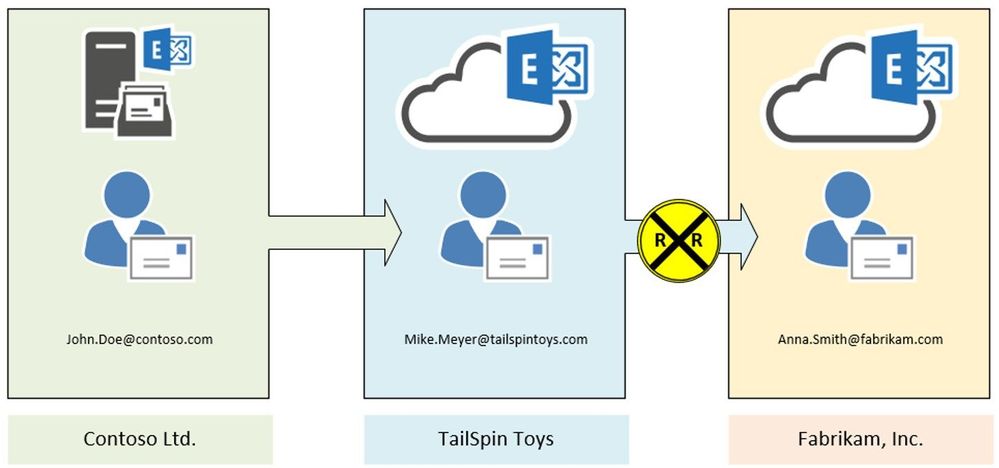
John Doe (Contoso Ltd.) creates an inbox rule to redirect every message to Mike Meyer (TailSpin Toys). Mike in turn has another inbox rule in place to redirect every incoming message to Anna Smith (Fabrikam, Inc.).
Result:
In this case, Exchange stamps the X-MS-Exchange-Inbox-Rules-Loop: John.Doe@contoso.com header after the first redirect is processed. Exchange at TailSpin Toys detects that header (message tracking reference will log XLoopHeaderCount:1/1) and does not redirect the message again. In this case Mike Meyer will not get an NDR. As an administrator you will find this event by running a message trace.
This scenario is one of the most seen and we must be very restrictive because customers can easily build a loop here. Therefore, we restrict this to only 1 redirect/forward by using inbox rules. This limit is hardcoded and cannot be changed. If you make use of Exchange on-premises, it is possible to have up to 3 redirects by inbox rules in place. As an administrator it is your task to protect your users from building loops.
Scenario 2:
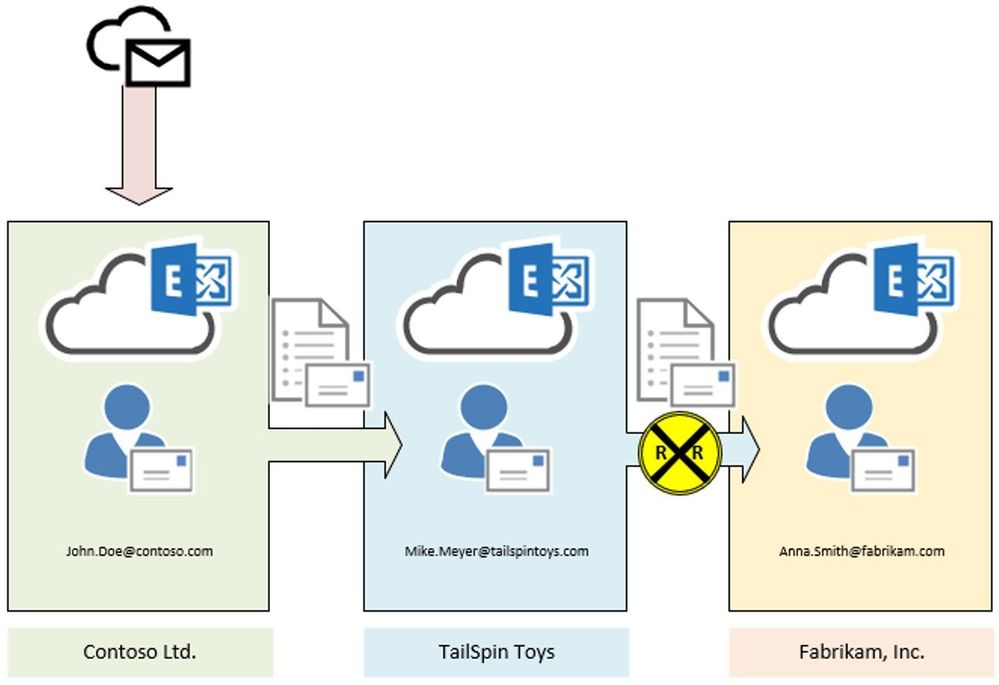
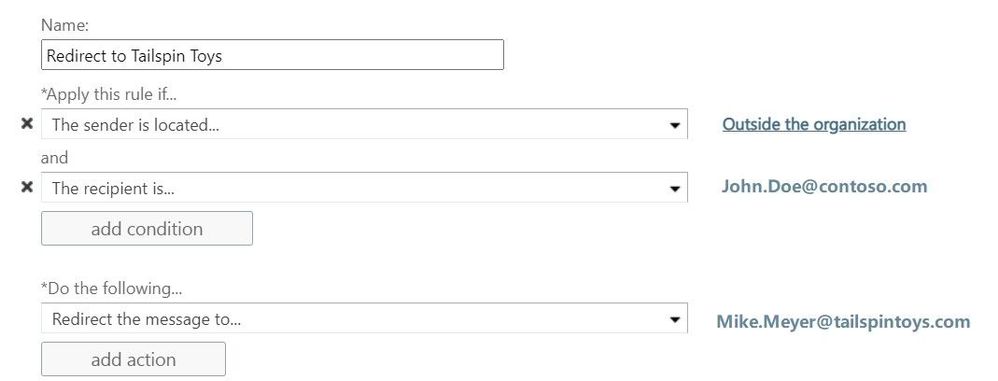
In this scenario we make use of two transport rules. The first one, located at Contoso’s Exchange organization, redirects every message addressed to John.Doe@contoso.com and coming from outside the organization, to Mike Meyer at TailSpin Toys company:
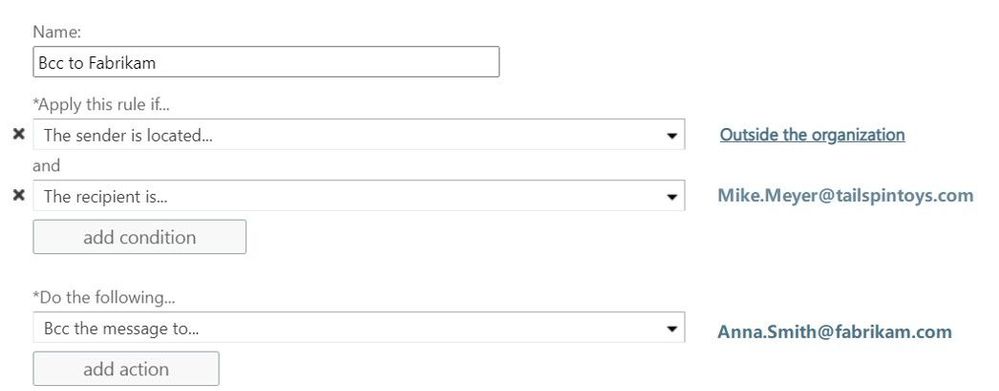
At TailSpin Toys there is also a transport rule in place, to Bcc incoming messages to Anna Smith at Fabrikam:
Result:
In this case the message is stamped at transport within Contoso organization. We see the X-MS-Exchange-Transport-Rules-Loop: 1 header. At TailSpin Toys the message is dropped due to X-MS-Exchange-Transport-Rules-Loop: 1 header. If you run a message trace, you will find the following event logged:
550 5.7.128 TRANSPORT.RULES.RejectMessage; Transport rules loop count exceeded and message rejected
Remember: We do not send out an NDR to the original sender. This is because of the second transport rule which is configured to add an additional recipient as BCC into the message. If the second transport rule is configured to add an CC-Recipient or simply redirects the message instead of an additional recipient as BCC, an NDR will be send out to the original sender.
Scenario 3:
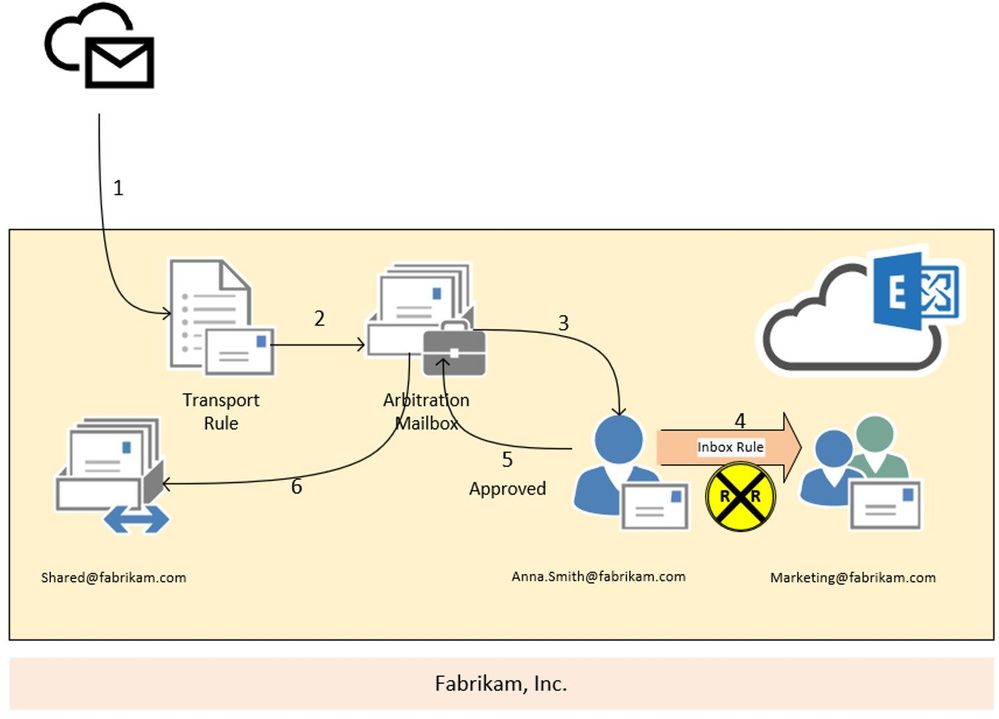
In this scenario we are going to have a look at the moderation loop protection. We have a transport rule (2) that forwards every message, send from outside the organization to shared@fabrikam.com, to Anna Smith for approval (3). Anna is going to holiday and so she has created an inbox rule to redirect every message to the marketing team (4). Unfortunately, the marketing distribution list is also moderated.
Result:
In this case, the moderation message is stamped with the X-MS-Exchange-Moderation-Loop header, followed by the smtp address of the arbitration mailbox:
X-MS-Exchange-Moderation-Loop: SPO_Arbitration_fa627f00-12d2-4d68-bd5d-75cd62ead0ee@M365x777241.onmicrosoft.com
The approval request which is forwarded via inbox rule from Anna’s mailbox to the marketing distribution list is dropped and no NDR is send out to the original sender. If you run a message trace, you will find the following smtp response stamped:
550 5.2.0 Resolver.MT.ModerationLoop; Loop in approval process
Scenario 4:
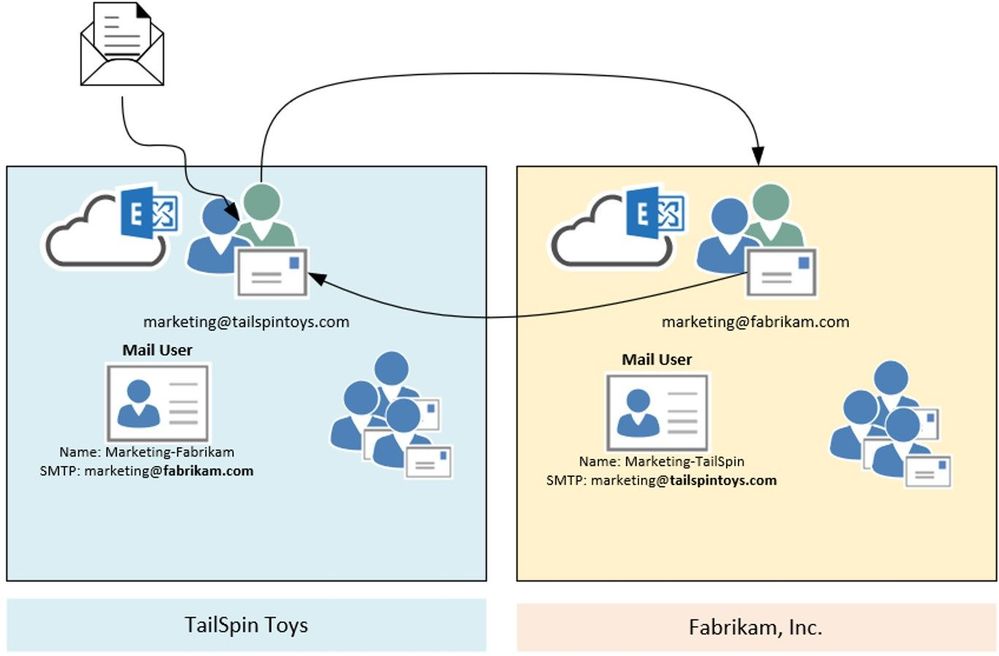
In this scenario we are going to have a look at the X-LD-Processed header and how it works. Assumed we have the following setup: We have two companies – TailSpin Toys and Fabrikam. Both have marketing departments working together. To make this workflow easier, they decide to create mail users for each other company department (Marketing-Fabrikam and Marketing-TailSpin). Unfortunately, someone added the mail users to the local marketing distribution list – and the loop begins.
Result:
What happens here? Someone sends a mail to one of the distribution lists. Exchange expands the list and starts processing the item. For the first time the mail gets processed, we check on transport if any X-LD-Processed header followed by tenants guid is present. If this is not the case, we stamp a header like this:
X-LD-Processed: 6249f43a-676b-4124-a13a-50205140b751,ExtAddr
We do this also for the other tenant. So one more X-LD-Processed header is added:
X-LD-Processed: 53bb1ab7-edea-4e35-8c3f-e395807764bf,ExtAddr
We keep doing this every time the message is processed and at the end (after the message was processed for the 3rd time), the header looks like this:
X-LD-Processed: 6249f43a-676b-4124-a13a-50205140b751,ExtAddr,ExtAddr,ExtAddr
X-LD-Processed: 53bb1ab7-edea-4e35-8c3f-e395807764bf,ExtAddr,ExtAddr,ExtAddr
If the message enters transport again, it will be dropped and NDR is send out to the original sender:
554 5.4.14 Hop count exceeded – possible mail loop ATTR1 [HE1EUR04FT048.eop-eur04.prod.protection.outlook.com]
And so, the loop ends.
Scenario 5:
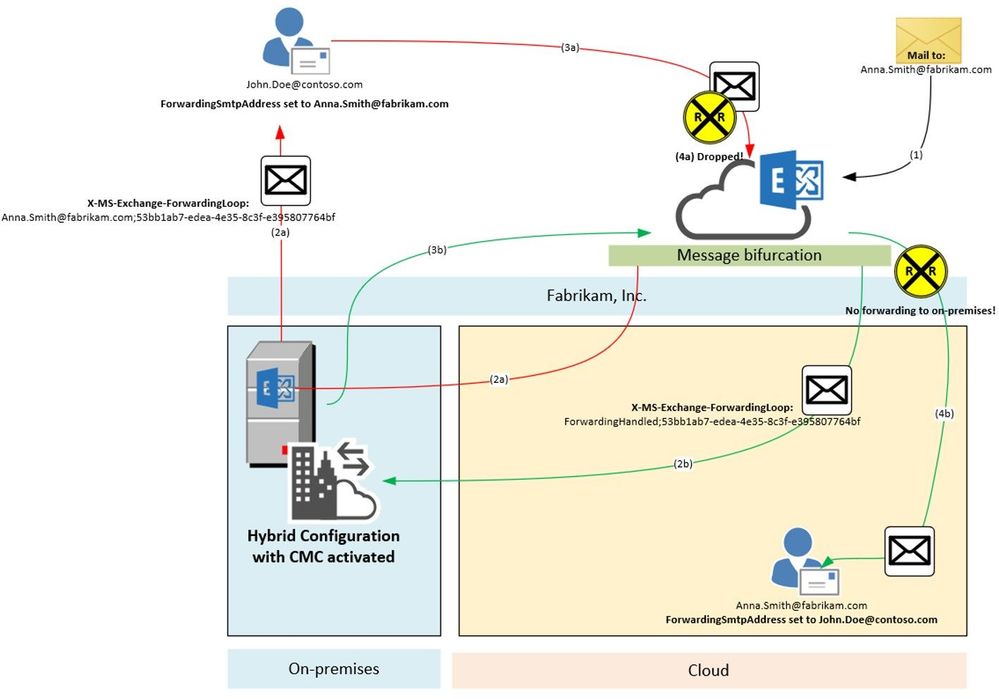
In this scenario we are going to have a look at the X-MS-Exchange-ForwardingLoop header and how it works. Assumed we have the following setup: Fabrikam has a Hybrid configuration and have also enabled Centralized Mail Transport (CMT; also known as CMC, RouteAllMessagesViaOnPremises enabled on the outbound connector). MX points to the Exchange Online service to make use of our malware and spam protection features. They need to route all outgoing messages through Exchange on-premises because of their mail signature and DLP solution which has not been migrated to cloud yet. Anna Smith of Fabrikam has set ForwardingSmtpAddress to John.Doe@contoso.com as well as DeliverToMailboxAndForward set to $true.
Result:
A message addressed to Anna.Smith@fabrikam.com enters the service (1). We notice that ForwardingSmtpAddress is set to John.Doe@contoso.com as well as DeliverToMailboxAndForward is set to $true. Now message bifurcation kicks in and creates another copy of the message. The message which goes to John.Doe@contoso.com gets stamped (2a) with following header:
X-MS-Exchange-ForwardingLoop: Anna.Smith@fabrikam.com;53bb1ab7-edea-4e35-8c3f-e395807764bf
And is routed through Exchange on-premises to John.Doe@contoso.com. Unfortunately, there is also ForwardingSmtpAddress set on John Doe’s mailbox which points to Anna.Smith@fabrikam.com. The message is now routed to the Exchange Online service again (3a). Here we detect that X-MS-Exchange-ForwardingLoop has already been set with that recipient and tenant guid. Result of this is that we drop the message with smtp response:
550 5.4.142 RESOLVER.FWD.LoopingTarget; forwarding to a looping external address
The original message copy to Anna Smith’s mailbox is also on its way. This message also makes an extra round through Exchange on-premises due to requirement imposed by having CMC enabled and it’s coming from Internet (i.e. not having passed through on-premises yet). Before being sent to on-premises, however, this copy was stamped with a header (2b). It looks a little different to the header mentioned before:
X-MS-Exchange-ForwardingLoop: ForwardingHandled;53bb1ab7-edea-4e35-8c3f-e395807764bf
As you can see, it contains ForwardingHandled instead of the recipient’s e-mail address. We need to do this in order to remember that Forwarding was already applied in cases when the message then has a routing requirement out of the EXO service such as Centralized Mail Transport. When on-premises sends it back to Exchange Online (3b), we now figure out that the X-MS-Exchange-ForwardingLoop header has already been stamped with ForwardingHandled flag. Result of this is that we don’t forward the message again (no RESOLVER REDIRECT event in Message Tracking Log/Message Trace Details Report). The message is finally delivered to Anna Smith’s mailbox (4b).
What if I need to do multiple forwards or redirects for handling business processes?
Glad you asked! Basically, there are 3 ways to go:
- Keep these mailboxes on-premises (which is not a real option if you want to use the awesome features available in Exchange Online). Remember: Some limits are different when using Exchange on-premises.
- Configure redirect via Set-Mailbox -ForwardingSMTPAddress or -ForwardingAddress parameter. As described above, we make use of the X-LD-Processed header in this scenario which allows up to 3 redirects per tenant.
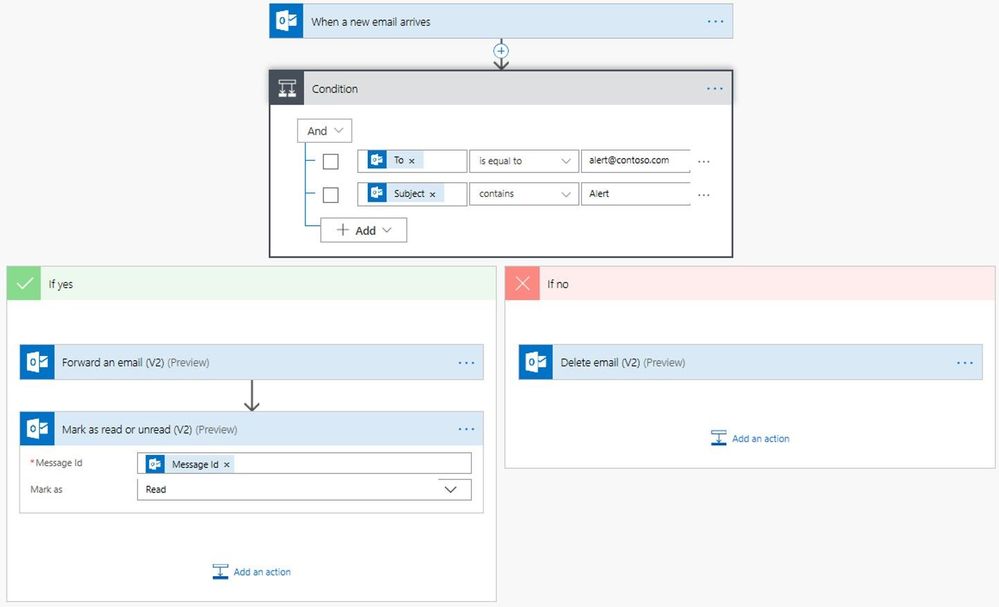
- Make use of Microsoft Power Automate. With Power Automate you can create automated workflows between your favorite apps and services in a centralized way. This includes many email actions when using the Microsoft 365 Outlook Connector. I encourage you to check out the documentation, give it a try and see the power of this Microsoft Power Platform application.
I hope all these insights help you to get a better overview and understanding of how we handle possible loop situations in Exchange Online. It is sometimes a little confusing and may look complicated, but keeping the service running for our customers is a must.
Special thanks to all contributors: Especially to Stan Aleksiev for taking care of the technical review, Arindam Thokder, Dan Li, Guru Prasad, Arnold Kermer and Dmitry Starostin!
Lukas Sassl
by Scott Muniz | May 3, 2021 | Security, Technology
This article is contributed. See the original author and article here.
akuvox — c315
|
Akuvox C315 115.116.2613 allows remote command Injection via the cfgd_server service. The attack vector is sending a payload to port 189 (default root 0.0.0.0). |
2021-04-25 |
not yet calculated |
CVE-2021-31726
MISC
MISC |
ambarella — oryx-rtsp_server
|
A buffer overflow in the RTSP service of the Ambarella Oryx RTSP Server 2020-01-07 allows an unauthenticated attacker to send a crafted RTSP request, with a long digest authentication header, to execute arbitrary code in parse_authentication_header() in libamprotocol-rtsp.so.1 in rtsp_svc (or cause a crash). This allows remote takeover of a Furbo Dog Camera, for example. |
2021-04-30 |
not yet calculated |
CVE-2020-24918
MISC
MISC
MISC |
ampache — ampache
|
Ampache before version 4.2.2 allows unauthenticated users to perform SQL injection. Refer to the referenced GitHub Security Advisory for details and a workaround. This is fixed in version 4.2.2 and the development branch. |
2021-04-30 |
not yet calculated |
CVE-2020-15153
MISC
MISC
CONFIRM |
ansible — engine
|
A flaw was found in the Ansible Engine 2.9.18, where sensitive info is not masked by default and is not protected by the no_log feature when using the sub-option feature of the basic.py module. This flaw allows an attacker to obtain sensitive information. The highest threat from this vulnerability is to confidentiality. |
2021-04-29 |
not yet calculated |
CVE-2021-20228
MISC
MISC |
apache — maven
|
Apache Maven will follow repositories that are defined in a dependency’s Project Object Model (pom) which may be surprising to some users, resulting in potential risk if a malicious actor takes over that repository or is able to insert themselves into a position to pretend to be that repository. Maven is changing the default behavior in 3.8.1+ to no longer follow http (non-SSL) repository references by default. More details available in the referenced urls. If you are currently using a repository manager to govern the repositories used by your builds, you are unaffected by the risks present in the legacy behavior, and are unaffected by this vulnerability and change to default behavior. See this link for more information about repository management: https://maven.apache.org/repository-management.html |
2021-04-23 |
not yet calculated |
CVE-2021-26291
MISC
MLIST
MLIST
MLIST
MLIST
MLIST
MLIST |
apache — ofbiz
|
Apache OFBiz has unsafe deserialization prior to 17.12.07 version |
2021-04-27 |
not yet calculated |
CVE-2021-30128
MISC
MLIST
MLIST
MLIST
MLIST
MLIST
MLIST
MLIST |
apache — ofbiz
|
Apache OFBiz has unsafe deserialization prior to 17.12.07 version An unauthenticated user can perform an RCE attack |
2021-04-27 |
not yet calculated |
CVE-2021-29200
MISC
MLIST
MLIST
MLIST
MLIST
MLIST
MLIST |
apache — ozone_cluster
|
The S3 buckets and keys in a secure Apache Ozone Cluster must be inaccessible to anonymous access by default. The current security vulnerability allows access to keys and buckets through a curl command or an unauthenticated HTTP request. This enables unauthorized access to buckets and keys thereby exposing data to anonymous clients or users. This affected Apache Ozone prior to the 1.1.0 release. Improper Authorization vulnerability in __COMPONENT__ of Apache Ozone allows an attacker to __IMPACT__. This issue affects Apache Ozone Apache Ozone version 1.0.0 and prior versions. |
2021-04-27 |
not yet calculated |
CVE-2020-17517
MISC |
apache — superset
|
Apache Superset up to and including 1.0.1 allowed for the creation of an external URL that could be malicious. By not checking user input for open redirects the URL shortener functionality would allow for a malicious user to create a short URL for a dashboard that could convince the user to click the link. |
2021-04-27 |
not yet calculated |
CVE-2021-28125
MISC
MLIST
MLIST |
apache — tapestry
|
Information Exposure vulnerability in context asset handling of Apache Tapestry allows an attacker to download files inside WEB-INF if using a specially-constructed URL. This was caused by an incomplete fix for CVE-2020-13953. This issue affects Apache Tapestry Apache Tapestry 5.4.0 version to Apache Tapestry 5.6.3; Apache Tapestry 5.7.0 version and Apache Tapestry 5.7.1. |
2021-04-27 |
not yet calculated |
CVE-2021-30638
MISC
MLIST
MISC |
| aruba — airwave_management_platform |
A remote insecure deserialization vulnerability was discovered in Aruba AirWave Management Platform version(s) prior to 8.2.12.1. Aruba has released patches for AirWave Management Platform that address this security vulnerability. |
2021-04-28 |
not yet calculated |
CVE-2021-25152
MISC |
| aruba — airwave_management_platform |
A remote SQL injection vulnerability was discovered in Aruba AirWave Management Platform version(s) prior to 8.2.12.1. Aruba has released patches for AirWave Management Platform that address this security vulnerability. |
2021-04-28 |
not yet calculated |
CVE-2021-25153
MISC |
| aruba — airwave_management_platform |
A remote escalation of privilege vulnerability was discovered in Aruba AirWave Management Platform version(s) prior to 8.2.12.1. Aruba has released patches for AirWave Management Platform that address this security vulnerability. |
2021-04-28 |
not yet calculated |
CVE-2021-25154
MISC |
aruba — airwave_management_platform
|
A remote XML external entity vulnerability was discovered in Aruba AirWave Management Platform version(s) prior to 8.2.12.1. Aruba has released patches for AirWave Management Platform that address this security vulnerability. |
2021-04-28 |
not yet calculated |
CVE-2021-25164
MISC |
aruba — airwave_management_platform
|
A remote insecure deserialization vulnerability was discovered in Aruba AirWave Management Platform version(s) prior to 8.2.12.1. Aruba has released patches for AirWave Management Platform that address this security vulnerability. |
2021-04-28 |
not yet calculated |
CVE-2021-25151
MISC |
aruba — airwave_management_platform
|
A remote URL redirection vulnerability was discovered in Aruba AirWave Management Platform version(s) prior to 8.2.12.1. Aruba has released patches for AirWave Management Platform that address this security vulnerability. |
2021-04-29 |
not yet calculated |
CVE-2021-29137
MISC |
aruba — airwave_management_platform
|
A remote XML external entity vulnerability was discovered in Aruba AirWave Management Platform version(s) prior to 8.2.12.1. Aruba has released patches for AirWave Management Platform that address this security vulnerability. |
2021-04-29 |
not yet calculated |
CVE-2021-25163
MISC |
aruba — airwave_management_platform
|
A remote authentication restriction bypass vulnerability was discovered in Aruba AirWave Management Platform version(s) prior to 8.2.12.1. Aruba has released patches for AirWave Management Platform that address this security vulnerability. |
2021-04-28 |
not yet calculated |
CVE-2021-25147
MISC |
aruba — airwave_management_platform
|
A remote unauthorized access vulnerability was discovered in Aruba AirWave Management Platform version(s) prior to 8.2.12.1. Aruba has released patches for AirWave Management Platform that address this security vulnerability. |
2021-04-29 |
not yet calculated |
CVE-2021-25167
MISC |
aruba — airwave_management_platform
|
A remote unauthorized access vulnerability was discovered in Aruba AirWave Management Platform version(s) prior to 8.2.12.1. Aruba has released patches for AirWave Management Platform that address this security vulnerability. |
2021-04-29 |
not yet calculated |
CVE-2021-25166
MISC |
aruba — airwave_management_platform
|
A remote XML external entity vulnerability was discovered in Aruba AirWave Management Platform version(s) prior to 8.2.12.1. Aruba has released patches for AirWave Management Platform that address this security vulnerability. |
2021-04-28 |
not yet calculated |
CVE-2021-25165
MISC |
| aruba — clearpass_policy_manager |
A remote disclosure of sensitive information vulnerability was discovered in Aruba ClearPass Policy Manager version(s) prior to 6.9.5, 6.8.9, 6.7.14-HF1. Aruba has released patches for Aruba ClearPass Policy Manager that address this security vulnerability. |
2021-04-29 |
not yet calculated |
CVE-2021-29141
MISC |
| aruba — clearpass_policy_manager |
A remote disclosure of sensitive information vulnerability was discovered in Aruba ClearPass Policy Manager version(s) prior to 6.9.5, 6.8.9, 6.7.14-HF1. Aruba has released patches for Aruba ClearPass Policy Manager that address this security vulnerability. |
2021-04-29 |
not yet calculated |
CVE-2021-29144
MISC |
aruba — clearpass_policy_manager
|
A local escalation of privilege vulnerability was discovered in Aruba ClearPass Policy Manager version(s) prior to 6.9.5, 6.8.9, 6.7.14-HF1. Aruba has released patches for Aruba ClearPass Policy Manager that address this security vulnerability. |
2021-04-28 |
not yet calculated |
CVE-2020-7123
MISC |
aruba — clearpass_policy_manager
|
A remote arbitrary command execution vulnerability was discovered in Aruba ClearPass Policy Manager version(s) prior to 6.9.5, 6.8.9, 6.7.14-HF1. Aruba has released patches for Aruba ClearPass Policy Manager that address this security vulnerability. |
2021-04-29 |
not yet calculated |
CVE-2021-29147
MISC |
aruba — clearpass_policy_manager
|
A remote cross-site scripting (XSS) vulnerability was discovered in Aruba ClearPass Policy Manager version(s) prior to 6.9.5, 6.8.9, 6.7.14-HF1. Aruba has released patches for Aruba ClearPass Policy Manager that address this security vulnerability. |
2021-04-29 |
not yet calculated |
CVE-2021-29146
MISC |
aruba — clearpass_policy_manager
|
A remote server side request forgery (SSRF) remote code execution vulnerability was discovered in Aruba ClearPass Policy Manager version(s) prior to 6.9.5, 6.8.9, 6.7.14-HF1. Aruba has released patches for Aruba ClearPass Policy Manager that address this security vulnerability. |
2021-04-29 |
not yet calculated |
CVE-2021-29145
MISC |
aruba — clearpass_policy_manager
|
A remote cross-site scripting (XSS) vulnerability was discovered in Aruba ClearPass Policy Manager version(s) prior to 6.9.5, 6.8.9, 6.7.14-HF1. Aruba has released patches for Aruba ClearPass Policy Manager that address this security vulnerability. |
2021-04-29 |
not yet calculated |
CVE-2021-29142
MISC |
aruba — clearpass_policy_manager
|
A remote XML external entity (XXE) vulnerability was discovered in Aruba ClearPass Policy Manager version(s): Prior to 6.9.5, 6.8.9, 6.7.14-HF1. Aruba has released patches for Aruba ClearPass Policy Manager that address this security vulnerability. |
2021-04-29 |
not yet calculated |
CVE-2021-29140
MISC |
aruba — clearpass_policy_manager
|
A remote cross-site scripting (XSS) vulnerability was discovered in Aruba ClearPass Policy Manager version(s) prior to 6.9.5, 6.8.9, 6.7.14-HF1. Aruba has released patches for Aruba ClearPass Policy Manager that address this security vulnerability. |
2021-04-29 |
not yet calculated |
CVE-2021-29139
MISC |
aruba — clearpass_policy_manager
|
A remote disclosure of privileged information vulnerability was discovered in Aruba ClearPass Policy Manager version(s) prior to 6.9.5, 6.8.9, 6.7.14-HF1. Aruba has released patches for Aruba ClearPass Policy Manager that address this security vulnerability. |
2021-04-29 |
not yet calculated |
CVE-2021-29138
MISC |
| avava — equinox_conferencing |
A vulnerability was discovered in Management component of Avaya Equinox Conferencing that could potentially allow an unauthenticated, remote attacker to gain access to screen sharing and whiteboard sessions. The affected versions of Management component of Avaya Equinox Conferencing include all 3.x versions before 3.17. Avaya Equinox Conferencing is now offered as Avaya Meetings Server. |
2021-04-28 |
not yet calculated |
CVE-2020-7038
CONFIRM |
avava — equinox_conferencing
|
An XML External Entities (XXE) vulnerability in Media Server component of Avaya Equinox Conferencing could allow an authenticated, remote attacker to gain read access to information that is stored on an affected system or even potentially lead to a denial of service. The affected versions of Avaya Equinox Conferencing includes all 9.x versions before 9.1.11. Equinox Conferencing is now offered as Avaya Meetings Server. |
2021-04-28 |
not yet calculated |
CVE-2020-7037
CONFIRM |
| ave — dominaplus |
AVE DOMINAplus <=1.10.x suffers from clear-text credentials disclosure vulnerability that allows an unauthenticated attacker to issue a request to an unprotected directory that hosts an XML file ‘/xml/authClients.xml’ and obtain administrative login information that allows for a successful authentication bypass attack. |
2021-04-28 |
not yet calculated |
CVE-2020-21994
EXPLOIT-DB
MISC |
ave — dominaplus
|
AVE DOMINAplus <=1.10.x suffers from an unauthenticated reboot command execution. Attackers can exploit this issue to cause a denial of service scenario. |
2021-04-28 |
not yet calculated |
CVE-2020-21996
MISC
EXPLOIT-DB |
ave — dominaplus
|
AVE DOMINAplus <=1.10.x suffers from an authentication bypass vulnerability due to missing control check when directly calling the autologin GET parameter in changeparams.php script. Setting the autologin value to 1 allows an unauthenticated attacker to permanently disable the authentication security control and access the management interface with admin privileges without providing credentials. |
2021-04-28 |
not yet calculated |
CVE-2020-21991
MISC
EXPLOIT-DB |
aviatrix — vpn_client
|
Aviatrix VPN Client before 2.14.14 on Windows has an unquoted search path that enables local privilege escalation to the SYSTEM user, if the machine is misconfigured to allow unprivileged users to write to directories that are supposed to be restricted to administrators. |
2021-04-29 |
not yet calculated |
CVE-2021-31776
MISC
MISC
CONFIRM |
babel — babel
|
Relative Path Traversal in Babel 2.9.0 allows an attacker to load arbitrary locale files on disk and execute arbitrary code. |
2021-04-29 |
not yet calculated |
CVE-2021-20095
MISC |
| bind — bind
|
In BIND 9.5.0 -> 9.11.29, 9.12.0 -> 9.16.13, and versions BIND 9.11.3-S1 -> 9.11.29-S1 and 9.16.8-S1 -> 9.16.13-S1 of BIND Supported Preview Edition, as well as release versions 9.17.0 -> 9.17.1 of the BIND 9.17 development branch, BIND servers are vulnerable if they are running an affected version and are configured to use GSS-TSIG features. In a configuration which uses BIND’s default settings the vulnerable code path is not exposed, but a server can be rendered vulnerable by explicitly setting values for the tkey-gssapi-keytab or tkey-gssapi-credential configuration options. Although the default configuration is not vulnerable, GSS-TSIG is frequently used in networks where BIND is integrated with Samba, as well as in mixed-server environments that combine BIND servers with Active Directory domain controllers. For servers that meet these conditions, the ISC SPNEGO implementation is vulnerable to various attacks, depending on the CPU architecture for which BIND was built: For named binaries compiled for 64-bit platforms, this flaw can be used to trigger a buffer over-read, leading to a server crash. For named binaries compiled for 32-bit platforms, this flaw can be used to trigger a server crash due to a buffer overflow and possibly also to achieve remote code execution. We have determined that standard SPNEGO implementations are available in the MIT and Heimdal Kerberos libraries, which support a broad range of operating systems, rendering the ISC implementation unnecessary and obsolete. Therefore, to reduce the attack surface for BIND users, we will be removing the ISC SPNEGO implementation in the April releases of BIND 9.11 and 9.16 (it had already been dropped from BIND 9.17). We would not normally remove something from a stable ESV (Extended Support Version) of BIND, but since system libraries can replace the ISC SPNEGO implementation, we have made an exception in this case for reasons of stability and security. |
2021-04-29 |
not yet calculated |
CVE-2021-25216
CONFIRM
MLIST
MLIST
MLIST
MLIST
DEBIAN |
bind — bind
|
In BIND 9.8.5 -> 9.8.8, 9.9.3 -> 9.11.29, 9.12.0 -> 9.16.13, and versions BIND 9.9.3-S1 -> 9.11.29-S1 and 9.16.8-S1 -> 9.16.13-S1 of BIND 9 Supported Preview Edition, as well as release versions 9.17.0 -> 9.17.11 of the BIND 9.17 development branch, when a vulnerable version of named receives a malformed IXFR triggering the flaw described above, the named process will terminate due to a failed assertion the next time the transferred secondary zone is refreshed. |
2021-04-29 |
not yet calculated |
CVE-2021-25214
CONFIRM
MLIST
MLIST
MLIST
MLIST
DEBIAN |
bind — bind
|
In BIND 9.0.0 -> 9.11.29, 9.12.0 -> 9.16.13, and versions BIND 9.9.3-S1 -> 9.11.29-S1 and 9.16.8-S1 -> 9.16.13-S1 of BIND Supported Preview Edition, as well as release versions 9.17.0 -> 9.17.11 of the BIND 9.17 development branch, when a vulnerable version of named receives a query for a record triggering the flaw described above, the named process will terminate due to a failed assertion check. The vulnerability affects all currently maintained BIND 9 branches (9.11, 9.11-S, 9.16, 9.16-S, 9.17) as well as all other versions of BIND 9. |
2021-04-29 |
not yet calculated |
CVE-2021-25215
CONFIRM
MLIST
MLIST
MLIST
MLIST
DEBIAN |
binutils — readelf
|
A flaw was found in binutils readelf 2.35 program. An attacker who is able to convince a victim using readelf to read a crafted file could trigger a stack buffer overflow, out-of-bounds write of arbitrary data supplied by the attacker. The highest impact of this flaw is to confidentiality, integrity, and availability. |
2021-04-29 |
not yet calculated |
CVE-2021-20294
MISC
MISC |
browserlist — browserlist
|
The package browserslist from 4.0.0 and before 4.16.5 are vulnerable to Regular Expression Denial of Service (ReDoS) during parsing of queries. |
2021-04-28 |
not yet calculated |
CVE-2021-23364
MISC
MISC
MISC
MISC
MISC |
buffalo — buffalo
|
The web interfaces of Buffalo WSR-2533DHPL2 firmware version <= 1.02 and WSR-2533DHP3 firmware version <= 1.24 do not properly restrict access to sensitive information from an unauthorized actor. |
2021-04-29 |
not yet calculated |
CVE-2021-20092
MISC |
buffalo — buffalo
|
The web interfaces of Buffalo WSR-2533DHPL2 firmware version <= 1.02 and WSR-2533DHP3 firmware version <= 1.24 do not properly sanitize user input. An authenticated remote attacker could leverage this vulnerability to alter device configuration, potentially gaining remote code execution. |
2021-04-29 |
not yet calculated |
CVE-2021-20091
MISC |
buffalo — buffalo
|
A path traversal vulnerability in the web interfaces of Buffalo WSR-2533DHPL2 firmware version <= 1.02 and WSR-2533DHP3 firmware version <= 1.24 could allow unauthenticated remote attackers to bypass authentication. |
2021-04-29 |
not yet calculated |
CVE-2021-20090
MISC |
buffalo — multiple_network_devices
|
Hidden functionality in multiple Buffalo network devices (BHR-4RV firmware Ver.2.55 and prior, FS-G54 firmware Ver.2.04 and prior, WBR2-B11 firmware Ver.2.32 and prior, WBR2-G54 firmware Ver.2.32 and prior, WBR2-G54-KD firmware Ver.2.32 and prior, WBR-B11 firmware Ver.2.23 and prior, WBR-G54 firmware Ver.2.23 and prior, WBR-G54L firmware Ver.2.20 and prior, WHR2-A54G54 firmware Ver.2.25 and prior, WHR2-G54 firmware Ver.2.23 and prior, WHR2-G54V firmware Ver.2.55 and prior, WHR3-AG54 firmware Ver.2.23 and prior, WHR-G54 firmware Ver.2.16 and prior, WHR-G54-NF firmware Ver.2.10 and prior, WLA2-G54 firmware Ver.2.24 and prior, WLA2-G54C firmware Ver.2.24 and prior, WLA-B11 firmware Ver.2.20 and prior, WLA-G54 firmware Ver.2.20 and prior, WLA-G54C firmware Ver.2.20 and prior, WLAH-A54G54 firmware Ver.2.54 and prior, WLAH-AM54G54 firmware Ver.2.54 and prior, WLAH-G54 firmware Ver.2.54 and prior, WLI2-TX1-AG54 firmware Ver.2.53 and prior, WLI2-TX1-AMG54 firmware Ver.2.53 and prior, WLI2-TX1-G54 firmware Ver.2.20 and prior, WLI3-TX1-AMG54 firmware Ver.2.53 and prior, WLI3-TX1-G54 firmware Ver.2.53 and prior, WLI-T1-B11 firmware Ver.2.20 and prior, WLI-TX1-G54 firmware Ver.2.20 and prior, WVR-G54-NF firmware Ver.2.02 and prior, WZR-G108 firmware Ver.2.41 and prior, WZR-G54 firmware Ver.2.41 and prior, WZR-HP-G54 firmware Ver.2.41 and prior, WZR-RS-G54 firmware Ver.2.55 and prior, and WZR-RS-G54HP firmware Ver.2.55 and prior) allows a remote attacker to enable the debug option and to execute arbitrary code or OS commands, change the configuration, and cause a denial of service (DoS) condition. |
2021-04-28 |
not yet calculated |
CVE-2021-20716
MISC
MISC |
| buffalo — multiple_routers
|
Improper access control vulnerability in Buffalo broadband routers (BHR-4GRV firmware Ver.1.99 and prior, DWR-HP-G300NH firmware Ver.1.83 and prior, HW-450HP-ZWE firmware Ver.1.99 and prior, WHR-300HP firmware Ver.1.99 and prior, WHR-300 firmware Ver.1.99 and prior, WHR-G301N firmware Ver.1.86 and prior, WHR-HP-G300N firmware Ver.1.99 and prior, WHR-HP-GN firmware Ver.1.86 and prior, WPL-05G300 firmware Ver.1.87 and prior, WZR-450HP-CWT firmware Ver.1.99 and prior, WZR-450HP-UB firmware Ver.1.99 and prior, WZR-HP-AG300H firmware Ver.1.75 and prior, WZR-HP-G300NH firmware Ver.1.83 and prior, WZR-HP-G301NH firmware Ver.1.83 and prior, WZR-HP-G302H firmware Ver.1.85 and prior, WZR-HP-G450H firmware Ver.1.89 and prior, WZR-300HP firmware Ver.1.99 and prior, WZR-450HP firmware Ver.1.99 and prior, WZR-600DHP firmware Ver.1.99 and prior, WZR-D1100H firmware Ver.1.99 and prior, FS-HP-G300N firmware Ver.3.32 and prior, FS-600DHP firmware Ver.3.38 and prior, FS-R600DHP firmware Ver.3.39 and prior, and FS-G300N firmware Ver.3.13 and prior) allows remote unauthenticated attackers to bypass access restriction and to start telnet service and execute arbitrary OS commands with root privileges via unspecified vectors. |
2021-04-28 |
not yet calculated |
CVE-2021-3512
MISC
MISC |
buffalo — multiple_routers
|
Disclosure of sensitive information to an unauthorized user vulnerability in Buffalo broadband routers (BHR-4GRV firmware Ver.1.99 and prior, DWR-HP-G300NH firmware Ver.1.83 and prior, HW-450HP-ZWE firmware Ver.1.99 and prior, WHR-300HP firmware Ver.1.99 and prior, WHR-300 firmware Ver.1.99 and prior, WHR-G301N firmware Ver.1.86 and prior, WHR-HP-G300N firmware Ver.1.99 and prior, WHR-HP-GN firmware Ver.1.86 and prior, WPL-05G300 firmware Ver.1.87 and prior, WZR-450HP-CWT firmware Ver.1.99 and prior, WZR-450HP-UB firmware Ver.1.99 and prior, WZR-HP-AG300H firmware Ver.1.75 and prior, WZR-HP-G300NH firmware Ver.1.83 and prior, WZR-HP-G301NH firmware Ver.1.83 and prior, WZR-HP-G302H firmware Ver.1.85 and prior, WZR-HP-G450H firmware Ver.1.89 and prior, WZR-300HP firmware Ver.1.99 and prior, WZR-450HP firmware Ver.1.99 and prior, WZR-600DHP firmware Ver.1.99 and prior, WZR-D1100H firmware Ver.1.99 and prior, FS-HP-G300N firmware Ver.3.32 and prior, FS-600DHP firmware Ver.3.38 and prior, FS-R600DHP firmware Ver.3.39 and prior, and FS-G300N firmware Ver.3.13 and prior) allows remote unauthenticated attackers to obtain information such as configuration via unspecified vectors. |
2021-04-28 |
not yet calculated |
CVE-2021-3511
MISC
MISC |
bundler — bundler
|
Bundler 1.16.0 through 2.2.9 and 2.2.11 through 2.2.16 sometimes chooses a dependency source based on the highest gem version number, which means that a rogue gem found at a public source may be chosen, even if the intended choice was a private gem that is a dependency of another private gem that is explicitly depended on by the application. NOTE: it is not correct to use CVE-2021-24105 for every “Dependency Confusion” issue in every product. |
2021-04-29 |
not yet calculated |
CVE-2020-36327
MISC
MISC
MISC
MISC
MISC |
cesanta — mongooseos
|
In mjs_json.c in Cesanta MongooseOS mJS 1.26, a maliciously formed JSON string can trigger an off-by-one heap-based buffer overflow in mjs_json_parse, which can potentially lead to redirection of control flow. |
2021-04-29 |
not yet calculated |
CVE-2021-31875
MISC
MISC
MISC |
chamilo — chamilo
|
A remote code execution vulnerability exists in Chamilo through 1.11.14 due to improper input sanitization of a parameter used for file uploads, and improper file-extension filtering for certain filenames (e.g., .phar or .pht). A remote authenticated administrator is able to upload a file containing arbitrary PHP code into specific directories via main/inc/lib/fileUpload.lib.php directory traversal to achieve PHP code execution. |
2021-04-30 |
not yet calculated |
CVE-2021-31933
MISC
MISC
MISC |
china — mobile_an_lianbao
|
Command injection vulnerability in China Mobile An Lianbao WF-1 1.01 via the ‘ip’ parameter with a POST request to /api/ZRQos/set_online_client. |
2021-04-29 |
not yet calculated |
CVE-2021-25812
MISC
MISC
MISC |
china_mobile — an_lianbao
|
The api/ZRAndlink/set_ZRAndlink interface in China Mobile An Lianbao WF-1 router 1.0.1 allows remote attackers to execute arbitrary commands via shell metacharacters in the iandlink_proc_enable parameter. |
2021-04-29 |
not yet calculated |
CVE-2021-30228
MISC
MISC
MISC |
china_mobile — an_lianbao_wf-1_router
|
The api/zrDm/set_zrDm interface in China Mobile An Lianbao WF-1 router 1.0.1 allows remote attackers to execute arbitrary commands via shell metacharacters in the dm_enable, AppKey, or Pwd parameter. |
2021-04-29 |
not yet calculated |
CVE-2021-30229
MISC
MISC
MISC |
china_mobile — an_lianbao_wf-1_router
|
The api/ZRFirmware/set_time_zone interface in China Mobile An Lianbao WF-1 router 1.0.1 allows remote attackers to execute arbitrary commands via shell metacharacters in the zonename parameter. |
2021-04-29 |
not yet calculated |
CVE-2021-30230
MISC
MISC
MISC |
| china_mobile — an_lianbao_wf-a_router |
The api/ZRIGMP/set_MLD_PROXY interface in China Mobile An Lianbao WF-1 router 1.0.1 allows remote attackers to execute arbitrary commands via shell metacharacters in the MLD_PROXY_WAN_CONNECT parameter. |
2021-04-29 |
not yet calculated |
CVE-2021-30234
MISC
MISC
MISC |
china_mobile — an_lianbao_wf-a_router
|
The api/zrDm/set_ZRElink interface in China Mobile An Lianbao WF-1 router 1.0.1 allows remote attackers to execute arbitrary commands via shell metacharacters in the bssaddr, abiaddr, devtoken, devid, elinksync, or elink_proc_enable parameter. |
2021-04-29 |
not yet calculated |
CVE-2021-30231
MISC
MISC
MISC |
china_mobile — an_lianbao_wf-a_router
|
The api/ZRIptv/setIptvInfo interface in China Mobile An Lianbao WF-1 router 1.0.1 allows remote attackers to execute arbitrary commands via shell metacharacters in the iptv_vlan parameter. |
2021-04-29 |
not yet calculated |
CVE-2021-30233
MISC
MISC
MISC |
china_mobile — an_lianbao_wf-a_router
|
The api/ZRIGMP/set_IGMP_PROXY interface in China Mobile An Lianbao WF-1 router 1.0.1 allows remote attackers to execute arbitrary commands via shell metacharacters in the IGMP_PROXY_WAN_CONNECT parameter. |
2021-04-29 |
not yet calculated |
CVE-2021-30232
MISC
MISC
MISC |
cisco — adaptive_security_appliance_software
|
Multiple vulnerabilities in Cisco Adaptive Security Appliance (ASA) Software and Firepower Threat Defense (FTD) Software could allow an unauthenticated, remote attacker to cause a denial of service (DoS) condition on an affected device. These vulnerabilities are due to lack of proper input validation of the HTTPS request. An attacker could exploit these vulnerabilities by sending a crafted HTTPS request to an affected device. A successful exploit could allow the attacker to cause the affected device to reload, resulting in a DoS condition. Note: This vulnerability affects only specific AnyConnect and WebVPN configurations. For more information, see the Vulnerable Products section. |
2021-04-29 |
not yet calculated |
CVE-2021-1445
CISCO |
cisco — adaptive_security_appliance_software
|
A vulnerability in the web services interface of Cisco Adaptive Security Appliance (ASA) Software and Cisco Firepower Threat Defense (FTD) Software could allow an authenticated, remote attacker to cause a buffer overflow on an affected system. The vulnerability is due to insufficient boundary checks for specific data that is provided to the web services interface of an affected system. An attacker could exploit this vulnerability by sending a malicious HTTP request. A successful exploit could allow the attacker to cause a buffer overflow condition on the affected system, which could disclose data fragments or cause the device to reload, resulting in a denial of service (DoS) condition. |
2021-04-29 |
not yet calculated |
CVE-2021-1493
CISCO |
cisco — adaptive_security_appliance_software
|
A vulnerability in the upgrade process of Cisco Adaptive Security Appliance (ASA) Software and Cisco Firepower Threat Defense (FTD) Software could allow an authenticated, local attacker to inject commands that could be executed with root privileges on the underlying operating system (OS). This vulnerability is due to insufficient input validation. An attacker could exploit this vulnerability by uploading a crafted upgrade package file to an affected device. A successful exploit could allow the attacker to inject commands that could be executed with root privileges on the underlying OS. |
2021-04-29 |
not yet calculated |
CVE-2021-1488
CISCO |
cisco — adaptive_security_appliance_software
|
A vulnerability in the SIP inspection engine of Cisco Adaptive Security Appliance (ASA) Software and Cisco Firepower Threat Defense (FTD) Software could allow an unauthenticated, remote attacker to cause a crash and reload of an affected device, resulting in a denial of service (DoS) condition.The vulnerability is due to a crash that occurs during a hash lookup for a SIP pinhole connection. An attacker could exploit this vulnerability by sending crafted SIP traffic through an affected device. A successful exploit could allow the attacker to cause a crash and reload of the affected device. |
2021-04-29 |
not yet calculated |
CVE-2021-1501
CISCO |
cisco — adaptive_security_appliance_software
|
Multiple vulnerabilities in Cisco Adaptive Security Appliance (ASA) Software and Firepower Threat Defense (FTD) Software could allow an unauthenticated, remote attacker to cause a denial of service (DoS) condition on an affected device. These vulnerabilities are due to lack of proper input validation of the HTTPS request. An attacker could exploit these vulnerabilities by sending a crafted HTTPS request to an affected device. A successful exploit could allow the attacker to cause the affected device to reload, resulting in a DoS condition. Note: This vulnerability affects only specific AnyConnect and WebVPN configurations. For more information, see the Vulnerable Products section. |
2021-04-29 |
not yet calculated |
CVE-2021-1504
CISCO |
cisco — adaptive_security_appliance_software
|
A vulnerability in the CLI of Cisco Adaptive Security Appliance (ASA) Software and Cisco Firepower Threat Defense (FTD) Software could allow an authenticated, local attacker to execute arbitrary commands on the underlying operating system (OS) of an affected device. The vulnerability is due to insufficient input validation of commands that are supplied by the user. An attacker could exploit this vulnerability by authenticating to a device and submitting crafted input for specific commands. A successful exploit could allow the attacker to execute commands on the underlying OS with root privileges. To exploit this vulnerability, an attacker must have valid administrator-level credentials. |
2021-04-29 |
not yet calculated |
CVE-2021-1476
CISCO |
cisco — firepower_device_manager
|
A vulnerability in the REST API of Cisco Firepower Device Manager (FDM) On-Box Software could allow an authenticated, remote attacker to gain read and write access to information that is stored on an affected device. This vulnerability is due to the improper handling of XML External Entity (XXE) entries when parsing certain XML files. An attacker could exploit this vulnerability by sending malicious requests that contain references in XML entities to an affected system. A successful exploit could allow the attacker to retrieve files from the local system, resulting in the disclosure of sensitive information or causing a partial denial of service (DoS) condition on the affected device. |
2021-04-29 |
not yet calculated |
CVE-2021-1369
CISCO |
cisco — firepower_device_manager_software
|
A vulnerability in filesystem usage management for Cisco Firepower Device Manager (FDM) Software could allow an authenticated, remote attacker to exhaust filesystem resources, resulting in a denial of service (DoS) condition on an affected device. This vulnerability is due to the insufficient management of available filesystem resources. An attacker could exploit this vulnerability by uploading files to the device and exhausting available filesystem resources. A successful exploit could allow the attacker to cause database errors and cause the device to become unresponsive to web-based management. Manual intervention is required to free filesystem resources and return the device to an operational state. |
2021-04-29 |
not yet calculated |
CVE-2021-1489
CISCO |
cisco — firepower_management_center_software
|
Multiple vulnerabilities in the web-based management interface of Cisco Firepower Management Center (FMC) Software could allow an unauthenticated, remote attacker to conduct a cross-site scripting (XSS) attack against a user of the interface. These vulnerabilities are due to insufficient validation of user-supplied input by the web-based management interface. An attacker could exploit these vulnerabilities by persuading a user of the interface to click a crafted link. A successful exploit could allow the attacker to execute arbitrary script code in the context of the interface or access sensitive, browser-based information. |
2021-04-29 |
not yet calculated |
CVE-2021-1458
CISCO |
cisco — firepower_management_center_software
|
A vulnerability in an access control mechanism of Cisco Firepower Management Center (FMC) Software could allow an authenticated, remote attacker to access services beyond the scope of their authorization. This vulnerability is due to insufficient enforcement of access control in the affected software. An attacker could exploit this vulnerability by directly accessing the internal services of an affected device. A successful exploit could allow the attacker to overwrite policies and impact the configuration and operation of the affected device. |
2021-04-29 |
not yet calculated |
CVE-2021-1477
CISCO |
cisco — firepower_management_center_software
|
Multiple vulnerabilities in the web-based management interface of Cisco Firepower Management Center (FMC) Software could allow an unauthenticated, remote attacker to conduct a cross-site scripting (XSS) attack against a user of the interface. These vulnerabilities are due to insufficient validation of user-supplied input by the web-based management interface. An attacker could exploit these vulnerabilities by persuading a user of the interface to click a crafted link. A successful exploit could allow the attacker to execute arbitrary script code in the context of the interface or access sensitive, browser-based information. |
2021-04-29 |
not yet calculated |
CVE-2021-1456
CISCO |
cisco — firepower_management_center_software
|
Multiple vulnerabilities in the web-based management interface of Cisco Firepower Management Center (FMC) Software could allow an unauthenticated, remote attacker to conduct a cross-site scripting (XSS) attack against a user of the interface. These vulnerabilities are due to insufficient validation of user-supplied input by the web-based management interface. An attacker could exploit these vulnerabilities by persuading a user of the interface to click a crafted link. A successful exploit could allow the attacker to execute arbitrary script code in the context of the interface or access sensitive, browser-based information. |
2021-04-29 |
not yet calculated |
CVE-2021-1457
CISCO |
cisco — firepower_managment_center_software
|
Multiple vulnerabilities in the web-based management interface of Cisco Firepower Management Center (FMC) Software could allow an unauthenticated, remote attacker to conduct a cross-site scripting (XSS) attack against a user of the interface. These vulnerabilities are due to insufficient validation of user-supplied input by the web-based management interface. An attacker could exploit these vulnerabilities by persuading a user of the interface to click a crafted link. A successful exploit could allow the attacker to execute arbitrary script code in the context of the interface or access sensitive, browser-based information. |
2021-04-29 |
not yet calculated |
CVE-2021-1455
CISCO |
cisco — firepower_threat_defense_software
|
A vulnerability in the CLI of Cisco Firepower Threat Defense (FTD) Software could allow an authenticated, local attacker to overwrite files on the file system of an affected device by using directory traversal techniques. A successful exploit could cause system instability if important system files are overwritten. This vulnerability is due to insufficient validation of user input for the file path in a specific CLI command. An attacker could exploit this vulnerability by logging in to a targeted device and issuing a specific CLI command with crafted user input. A successful exploit could allow the attacker to overwrite arbitrary files on the file system of the affected device. The attacker would need valid user credentials on the device. |
2021-04-29 |
not yet calculated |
CVE-2021-1256
CISCO |
cisco — firepower_threat_defense_software
|
A vulnerability in the software-based SSL/TLS message handler of Cisco Firepower Threat Defense (FTD) Software could allow an unauthenticated, remote attacker to trigger a reload of an affected device, resulting in a denial of service (DoS) condition. The vulnerability is due to insufficient validation of SSL/TLS messages when the device performs software-based SSL decryption. An attacker could exploit this vulnerability by sending a crafted SSL/TLS message through an affected device. SSL/TLS messages sent to an affected device do not trigger this vulnerability. A successful exploit could allow the attacker to cause a process to crash. This crash would then trigger a reload of the device. No manual intervention is needed to recover the device after the reload. |
2021-04-29 |
not yet calculated |
CVE-2021-1402
CISCO |
cisco — firepower_threat_defense_software
|
A vulnerability in the CLI of Cisco Firepower Threat Defense (FTD) Software could allow an authenticated, local attacker to execute arbitrary commands with root privileges on the underlying operating system of an affected device that is running in multi-instance mode. This vulnerability is due to insufficient validation of user-supplied command arguments. An attacker could exploit this vulnerability by submitting crafted input to the affected command. A successful exploit could allow the attacker to execute commands on the underlying operating system with root privileges. |
2021-04-29 |
not yet calculated |
CVE-2021-1448
CISCO |
cisco — multiple_products
|
Multiple Cisco products are affected by a vulnerability in the Snort detection engine that could allow an unauthenticated, remote attacker to bypass a configured file policy for HTTP. The vulnerability is due to incorrect handling of specific HTTP header parameters. An attacker could exploit this vulnerability by sending crafted HTTP packets through an affected device. A successful exploit could allow the attacker to bypass a configured file policy for HTTP packets and deliver a malicious payload. |
2021-04-29 |
not yet calculated |
CVE-2021-1495
CISCO |
ckeditor — ckeditor
|
CKEditor 5 provides a WYSIWYG editing solution. This CVE affects the following npm packages: ckeditor5-engine, ckeditor5-font, ckeditor5-image, ckeditor5-list, ckeditor5-markdown-gfm, ckeditor5-media-embed, ckeditor5-paste-from-office, and ckeditor5-widget. Following an internal audit, a regular expression denial of service (ReDoS) vulnerability has been discovered in multiple CKEditor 5 packages. The vulnerability allowed to abuse particular regular expressions, which could cause a significant performance drop resulting in a browser tab freeze. It affects all users using the CKEditor 5 packages listed above at version <= 26.0.0. The problem has been recognized and patched. The fix will be available in version 27.0.0. |
2021-04-29 |
not yet calculated |
CVE-2021-21391
MISC
MISC
MISC
MISC
CONFIRM
MISC
MISC
MISC
MISC |
cloudengine — multiple_devices
|
There is a denial of service vulnerability in some versions of CloudEngine 5800, CloudEngine 6800, CloudEngine 7800 and CloudEngine 12800. The affected product cannot deal with some messages because of module design weakness . Attackers can exploit this vulnerability by sending a large amount of specific messages to cause denial of service. This can compromise normal service. |
2021-04-28 |
not yet calculated |
CVE-2021-22393
MISC |
cloudengine — multiple_devices
|
There is a pointer double free vulnerability in some versions of CloudEngine 5800, CloudEngine 6800, CloudEngine 7800 and CloudEngine 12800. When a function is called, the same memory pointer is copied to two functional modules. Attackers can exploit this vulnerability by performing a malicious operation to cause the pointer double free. This may lead to module crash, compromising normal service. |
2021-04-28 |
not yet calculated |
CVE-2021-22332
MISC |
cncf — cortex
|
The Alertmanager in CNCF Cortex before 1.8.1 has a local file disclosure vulnerability when -experimental.alertmanager.enable-api is used. The HTTP basic auth password_file can be used as an attack vector to send any file content via a webhook. The alertmanager templates can be used as an attack vector to send any file content because the alertmanager can load any text file specified in the templates list. |
2021-04-30 |
not yet calculated |
CVE-2021-31232
MISC
MISC
MISC
MISC |
cncsoft-b — cncsoft-b
|
CNCSoft-B Versions 1.0.0.3 and prior is vulnerable to an out-of-bounds read, which may allow an attacker to execute arbitrary code. |
2021-04-27 |
not yet calculated |
CVE-2021-22660
MISC
MISC
MISC |
composer — composer
|
Composer is a dependency manager for PHP. URLs for Mercurial repositories in the root composer.json and package source download URLs are not sanitized correctly. Specifically crafted URL values allow code to be executed in the HgDriver if hg/Mercurial is installed on the system. The impact to Composer users directly is limited as the composer.json file is typically under their own control and source download URLs can only be supplied by third party Composer repositories they explicitly trust to download and execute source code from, e.g. Composer plugins. The main impact is to services passing user input to Composer, including Packagist.org and Private Packagist. This allowed users to trigger remote code execution. The vulnerability has been patched on Packagist.org and Private Packagist within 12h of receiving the initial vulnerability report and based on a review of logs, to the best of our knowledge, was not abused by anyone. Other services/tools using VcsRepository/VcsDriver or derivatives may also be vulnerable and should upgrade their composer/composer dependency immediately. Versions 1.10.22 and 2.0.13 include patches for this issue. |
2021-04-27 |
not yet calculated |
CVE-2021-29472
MISC
CONFIRM
DEBIAN |
cpanel — cpanel
|
cPanel before 94.0.3 allows self-XSS via EasyApache 4 Save Profile (SEC-581). |
2021-04-26 |
not yet calculated |
CVE-2021-31803
MISC |
cubecoders — application_deployment_service
|
AMP Application Deployment Service in CubeCoders AMP 2.1.x before 2.1.1.2 allows a remote, authenticated user to open ports in the local system firewall by crafting an HTTP(S) request directly to the applicable API endpoint (despite not having permission to make changes to the system’s network configuration). |
2021-04-30 |
not yet calculated |
CVE-2021-31926
MISC |
cumulative-distribution-function – cumulative-distribution-function
|
cumulative-distribution-function is an open source npm library used which calculates statistical cumulative distribution function from data array of x values. In versions prior to 2.0.0 apps using this library on improper data may crash or go into an infinite-loop. In the case of a nodejs server-app using this library to act on invalid non-numeric data, the nodejs server may crash. This may affect other users of this server and/or require the server to be rebooted for proper operation. In the case of a browser app using this library to act on invalid non-numeric data, that browser may crash or lock up. A flaw enabling an infinite-loop was discovered in the code for evaluating the cumulative-distribution-function of input data. Although the documentation explains that numeric data is required, some users may confuse an array of strings like [“1″,”2″,”3″,”4″,”5”] for numeric data [1,2,3,4,5] when it is in fact string data. An infinite loop is possible when the cumulative-distribution-function is evaluated for a given point when the input data is string data rather than type `number`. This vulnerability enables an infinite-cpu-loop denial-of-service-attack on any app using npm:cumulative-distribution-function v1.0.3 or earlier if the attacker can supply malformed data to the library. The vulnerability could also manifest if a data source to be analyzed changes data type from Arrays of number (proper) to Arrays of string (invalid, but undetected by earlier version of the library). Users should upgrade to at least v2.0.0, or the latest version. Tests for several types of invalid data have been created, and version 2.0.0 has been tested to reject this invalid data by throwing a `TypeError()` instead of processing it. Developers using this library may wish to adjust their app’s code slightly to better tolerate or handle this TypeError. Apps performing proper numeric data validation before sending data to this library should be mostly unaffected by this patch. The vulnerability can be mitigated in older versions by ensuring that only finite numeric data of type `Array[number]` or `number` is passed to `cumulative-distribution-function` and its `f(x)` function, respectively. |
2021-04-30 |
not yet calculated |
CVE-2021-29486
MISC
MISC
CONFIRM
MISC |
cygwin — cygwin
|
Cygwin Git is a patch set for the git command line tool for the cygwin environment. A specially crafted repository that contains symbolic links as well as files with backslash characters in the file name may cause just-checked out code to be executed while checking out a repository using Git on Cygwin. The problem will be patched in the Cygwin Git v2.31.1-2 release. At time of writing, the vulnerability is present in the upstream Git source code; any Cygwin user who compiles Git for themselves from upstream sources should manually apply a patch to mitigate the vulnerability. As mitigation users should not clone or pull from repositories from untrusted sources. CVE-2019-1354 was an equivalent vulnerability in Git for Visual Studio. |
2021-04-29 |
not yet calculated |
CVE-2021-29468
MISC
MISC
MISC
CONFIRM |
| d-link — dap-1880ac_firmware |
DAP-1880AC firmware version 1.21 and earlier allows a remote authenticated attacker to execute arbitrary OS commands by sending a specially crafted request to a specific CGI program. |
2021-04-26 |
not yet calculated |
CVE-2021-20696
MISC
MISC |
d-link — dap-1880ac_firmware
|
Improper access control vulnerability in DAP-1880AC firmware version 1.21 and earlier allows a remote authenticated attacker to bypass access restriction and to start a telnet service via unspecified vectors. |
2021-04-26 |
not yet calculated |
CVE-2021-20694
MISC
MISC |
d-link — dap-1880ac_firmware
|
Improper following of a certificate’s chain of trust vulnerability in DAP-1880AC firmware version 1.21 and earlier allows a remote authenticated attacker to gain root privileges via unspecified vectors. |
2021-04-26 |
not yet calculated |
CVE-2021-20695
MISC
MISC |
d-link — dap-1880ac_firmware
|
Missing authentication for critical function in DAP-1880AC firmware version 1.21 and earlier allows a remote attacker to login to the device as an authenticated user without the access privilege via unspecified vectors. |
2021-04-26 |
not yet calculated |
CVE-2021-20697
MISC
MISC |
| dell — emc_idrac9 |
Dell EMC iDRAC9 versions prior to 4.40.00.00 contain a Time-of-check Time-of-use (TOCTOU) race condition vulnerability. A remote authenticated attacker could potentially exploit this vulnerability to gain elevated privileges when a user with higher privileges is simultaneously accessing iDRAC through the web interface. |
2021-04-30 |
not yet calculated |
CVE-2021-21539
MISC |
| dell — emc_idrac9 |
Dell EMC iDRAC9 versions prior to 4.40.00.00 contain multiple stored cross-site scripting vulnerabilities. A remote authenticated malicious user with high privileges could potentially exploit these vulnerabilities to store malicious HTML or JavaScript code through multiple affected parameters. When victim users access the submitted data through their browsers, the malicious code gets executed by the web browser in the context of the vulnerable application. |
2021-04-30 |
not yet calculated |
CVE-2021-21543
MISC |
| dell — emc_idrac9 |
Dell EMC iDRAC9 versions prior to 4.40.00.00 contain an improper authentication vulnerability. A remote authenticated malicious user with high privileges could potentially exploit this vulnerability to manipulate the username field under the comment section and set the value to any user. |
2021-04-30 |
not yet calculated |
CVE-2021-21544
MISC |
| dell — emc_idrac9
|
Dell EMC iDRAC9 versions prior to 4.40.00.00 contain a DOM-based cross-site scripting vulnerability. A remote unauthenticated attacker could potentially exploit this vulnerability by tricking a victim application user to supply malicious HTML or JavaScript code to DOM environment in the browser. The malicious code is then executed by the web browser in the context of the vulnerable web application. |
2021-04-30 |
not yet calculated |
CVE-2021-21541
MISC |
dell — emc_idrac9
|
Dell EMC iDRAC9 versions prior to 4.40.00.00 contain a stack-based overflow vulnerability. A remote authenticated attacker could potentially exploit this vulnerability to overwrite configuration information by injecting arbitrarily large payload. |
2021-04-30 |
not yet calculated |
CVE-2021-21540
MISC |
dell — emc_idrac9
|
Dell EMC iDRAC9 versions prior to 4.40.10.00 contain multiple stored cross-site scripting vulnerabilities. A remote authenticated malicious user with high privileges could potentially exploit these vulnerabilities to store malicious HTML or JavaScript code through multiple affected while generating a certificate. When victim users access the submitted data through their browsers, the malicious code gets executed by the web browser in the context of the vulnerable application. |
2021-04-30 |
not yet calculated |
CVE-2021-21542
MISC |
dell — emc_networking_x-series
|
Dell EMC Networking X-Series firmware versions prior to 3.0.1.8 and Dell EMC PowerEdge VRTX Switch Module firmware versions prior to 2.0.0.82 contain a Weak Password Encryption Vulnerability. A remote unauthenticated attacker could potentially exploit this vulnerability, leading to the disclosure of certain user credentials. The attacker may be able to use the exposed credentials to access the vulnerable system with privileges of the compromised account. |
2021-04-30 |
not yet calculated |
CVE-2021-21507
CONFIRM |
dell — emc_unity
|
Dell EMC Unity, UnityVSA, and Unity XT versions prior to 5.0.7.0.5.008 contain a plain-text password storage vulnerability when the Dell Upgrade Readiness Utility is run on the system. The credentials of the Unisphere Administrator are stored in plain text. A local malicious user with high privileges may use the exposed password to gain access with the privileges of the compromised user. |
2021-04-30 |
not yet calculated |
CVE-2021-21547
CONFIRM |
dell — hybrid_client
|
Dell Hybrid Client versions prior to 1.5 contain a missing authentication for a critical function vulnerability. A local unauthenticated attacker may exploit this vulnerability in order to gain root level access to the system. |
2021-04-30 |
not yet calculated |
CVE-2021-21535
MISC |
dell — hybrid_client
|
Dell Hybrid Client versions prior to 1.5 contain an information exposure vulnerability. A local unauthenticated attacker may exploit this vulnerability in order to gain access to sensitive information via the local API. |
2021-04-30 |
not yet calculated |
CVE-2021-21534
MISC |
dell — hybrid_client
|
Dell Hybrid Client versions prior to 1.5 contain an information exposure vulnerability. A local unauthenticated attacker may exploit this vulnerability in order to register the client to a server in order to view sensitive information. |
2021-04-30 |
not yet calculated |
CVE-2021-21536
MISC |
dell — hybrid_client
|
Dell Hybrid Client versions prior to 1.5 contain an information exposure vulnerability. A local unauthenticated attacker may exploit this vulnerability in order to view and exfiltrate sensitive information on the system. |
2021-04-30 |
not yet calculated |
CVE-2021-21537
MISC |
dell — openmanage_enterprise-modular
|
Dell OpenManage Enterprise-Modular (OME-M) versions prior to 1.30.00 contain a security bypass vulnerability. An authenticated malicious user with low privileges may potentially exploit the vulnerability to escape from the restricted environment and gain access to sensitive information in the system, resulting in information disclosure and elevation of privilege. |
2021-04-30 |
not yet calculated |
CVE-2021-21530
CONFIRM |
dell — unisphere
|
Dell Unisphere for PowerMax versions prior to 9.2.1.6 contain an Authorization Bypass Vulnerability. A local authenticated malicious user with monitor role may exploit this vulnerability to perform unauthorized actions. |
2021-04-30 |
not yet calculated |
CVE-2021-21531
CONFIRM |
delta — industrial_automation
|
Delta Industrial Automation COMMGR Versions 1.12 and prior are vulnerable to a stack-based buffer overflow, which may allow an attacker to execute remote code. |
2021-04-27 |
not yet calculated |
CVE-2021-27480
MISC |
django — django
|
django-filter is a generic system for filtering Django QuerySets based on user selections. In django-filter before version 2.4.0, automatically generated `NumberFilter` instances, whose value was later converted to an integer, were subject to potential DoS from maliciously input using exponential format with sufficiently large exponents. Version 2.4.0+ applies a `MaxValueValidator` with a a default `limit_value` of 1e50 to the form field used by `NumberFilter` instances. In addition, `NumberFilter` implements the new `get_max_validator()` which should return a configured validator instance to customise the limit, or else `None` to disable the additional validation. Users may manually apply an equivalent validator if they are not able to upgrade. |
2021-04-29 |
not yet calculated |
CVE-2020-15225
CONFIRM
MISC
MISC
MISC |
doc — doc
|
SQL injection in the getip function in conn/function.php in ??100-???????? 1.1 allows remote attackers to inject arbitrary SQL commands via the X-Forwarded-For header to admin/product_add.php. |
2021-04-29 |
not yet calculated |
CVE-2021-29350
MISC |
dreamforver — simple_ghc
|
The unofficial vscode-ghc-simple (aka Simple Glasgow Haskell Compiler) extension before 0.2.3 for Visual Studio Code allows remote code execution via a crafted workspace configuration with replCommand. |
2021-04-25 |
not yet calculated |
CVE-2021-30502
MISC
MISC
CONFIRM
CONFIRM |
edimax — wireless_network_camera
|
The default administrator account & password of the EDIMAX wireless network camera is hard-coded. Remote attackers can disassemble firmware to obtain the privileged permission and further control the devices. |
2021-04-27 |
not yet calculated |
CVE-2021-30165
CONFIRM |
edimax — wireless_network_camera
|
The manage users profile services of the network camera device allows an authenticated. Remote attackers can modify URL parameters and further amend user’s information and escalate privileges to control the devices. |
2021-04-28 |
not yet calculated |
CVE-2021-30167
MISC
MISC
MISC
MISC |
edimax — wireless_network_camera
|
The sensitive information of webcam device is not properly protected. Remote attackers can unauthentically grant administrator’s credential and further control the devices. |
2021-04-28 |
not yet calculated |
CVE-2021-30168
MISC
MISC
MISC
MISC |
emlog — emlog
|
Cross Site Scripting (XSS) vulnerability in the article comments feature in emlog 6.0. |
2021-04-29 |
not yet calculated |
CVE-2021-30227
MISC |
emmanuel — mydomoathome
|
Emmanuel MyDomoAtHome (MDAH) REST API REST API Domoticz ISS Gateway 0.2.40 is affected by an information disclosure vulnerability due to improper access control enforcement. An unauthenticated remote attacker can exploit this, via a specially crafted request to gain access to sensitive information. |
2021-04-29 |
not yet calculated |
CVE-2020-21990
EXPLOIT-DB
MISC |
| etherpad — etherpad |
Etherpad < 1.8.3 is affected by a missing lock check which could cause a denial of service. Aggressively targeting random pad import endpoints with empty data would flatten all pads due to lack of rate limiting and missing ownership check. |
2021-04-28 |
not yet calculated |
CVE-2020-22785
CONFIRM |
| etherpad — etherpad |
In Etherpad UeberDB < 0.4.4, due to MySQL omitting trailing spaces on char / varchar columns during comparisons, retrieving database records using UeberDB’s MySQL connector could allow bypassing access controls enforced on key names. |
2021-04-28 |
not yet calculated |
CVE-2020-22784
CONFIRM |
etherpad — etherpad
|
Etherpad <1.8.3 stored passwords used by users insecurely in the database and in log files. This affects every database backend supported by Etherpad. |
2021-04-28 |
not yet calculated |
CVE-2020-22783
CONFIRM
MISC |
etherpad — etherpad
|
In Etherpad < 1.8.3, a specially crafted URI would raise an unhandled exception in the cache mechanism and cause a denial of service (crash the instance). |
2021-04-28 |
not yet calculated |
CVE-2020-22781
CONFIRM |
etherpad — etherpad
|
Etherpad < 1.8.3 is affected by a denial of service in the import functionality. Upload of binary file to the import endpoint would crash the instance. |
2021-04-28 |
not yet calculated |
CVE-2020-22782
CONFIRM |
exiv2 — exiv2
|
Exiv2 is a C++ library and a command-line utility to read, write, delete and modify Exif, IPTC, XMP and ICC image metadata. An out-of-bounds read was found in Exiv2 versions v0.27.3 and earlier. Exiv2 is a command-line utility and C++ library for reading, writing, deleting, and modifying the metadata of image files. The out-of-bounds read is triggered when Exiv2 is used to write metadata into a crafted image file. An attacker could potentially exploit the vulnerability to cause a denial of service by crashing Exiv2, if they can trick the victim into running Exiv2 on a crafted image file. Note that this bug is only triggered when writing the metadata, which is a less frequently used Exiv2 operation than reading the metadata. For example, to trigger the bug in the Exiv2 command-line application, you need to add an extra command-line argument such as `insert`. The bug is fixed in version v0.27.4. Please see our security policy for information about Exiv2 security. |
2021-04-26 |
not yet calculated |
CVE-2021-29473
MISC
CONFIRM
MISC |
exiv2 — exiv2
|
Exiv2 is a command-line utility and C++ library for reading, writing, deleting, and modifying the metadata of image files. An out-of-bounds read was found in Exiv2 versions v0.27.3 and earlier. The out-of-bounds read is triggered when Exiv2 is used to write metadata into a crafted image file. An attacker could potentially exploit the vulnerability to cause a denial of service by crashing Exiv2, if they can trick the victim into running Exiv2 on a crafted image file. Note that this bug is only triggered when writing the metadata, which is a less frequently used Exiv2 operation than reading the metadata. For example, to trigger the bug in the Exiv2 command-line application, you need to add an extra command-line argument such as `insert`. The bug is fixed in version v0.27.4. |
2021-04-30 |
not yet calculated |
CVE-2021-29463
MISC
CONFIRM |
exiv2 — exiv2
|
Exiv2 is a command-line utility and C++ library for reading, writing, deleting, and modifying the metadata of image files. An out-of-bounds read was found in Exiv2 versions v0.27.3 and earlier. The out-of-bounds read is triggered when Exiv2 is used to write metadata into a crafted image file. An attacker could potentially exploit the vulnerability to cause a denial of service by crashing Exiv2, if they can trick the victim into running Exiv2 on a crafted image file. Note that this bug is only triggered when writing the metadata, which is a less frequently used Exiv2 operation than reading the metadata. For example, to trigger the bug in the Exiv2 command-line application, you need to add an extra command-line argument such as insert. The bug is fixed in version v0.27.4. |
2021-04-23 |
not yet calculated |
CVE-2021-29470
CONFIRM
MISC |
exiv2 — exiv2
|
Exiv2 is a command-line utility and C++ library for reading, writing, deleting, and modifying the metadata of image files. A heap buffer overflow was found in Exiv2 versions v0.27.3 and earlier. The heap overflow is triggered when Exiv2 is used to write metadata into a crafted image file. An attacker could potentially exploit the vulnerability to gain code execution, if they can trick the victim into running Exiv2 on a crafted image file. Note that this bug is only triggered when writing the metadata, which is a less frequently used Exiv2 operation than reading the metadata. For example, to trigger the bug in the Exiv2 command-line application, you need to add an extra command-line argument such as `insert`. The bug is fixed in version v0.27.4. |
2021-04-30 |
not yet calculated |
CVE-2021-29464
MISC
CONFIRM |
filterediterator — filterediterator
|
Requests is a HTTP library written in PHP. Requests mishandles deserialization in FilteredIterator. The issue has been patched and users of `Requests` 1.6.0, 1.6.1 and 1.7.0 should update to version 1.8.0. |
2021-04-27 |
not yet calculated |
CVE-2021-29476
CONFIRM
MISC |
fluidsynth — fuidsynth
|
fluidsynth is a software synthesizer based on the SoundFont 2 specifications. A use after free violation was discovered in fluidsynth, that can be triggered when loading an invalid SoundFont file. |
2021-04-29 |
not yet calculated |
CVE-2021-21417
MISC
CONFIRM |
fme — server
|
Authenticated Stored XSS in FME Server versions 2019.2 and 2020.0 Beta allows a remote attacker to execute codeby injecting arbitrary web script or HTML via modifying the name of the users. The XSS is executed when an administrator access the logs. |
2021-04-28 |
not yet calculated |
CVE-2020-22790
MISC |
fme — server
|
Unauthenticated Stored XSS in FME Server versions 2019.2 and 2020.0 Beta allows a remote attacker to gain admin privileges by injecting arbitrary web script or HTML via the login page. The XSS is executed when an administrator accesses the logs. |
2021-04-28 |
not yet calculated |
CVE-2020-22789
MISC |
| foxit — studio_photo |
This vulnerability allows remote attackers to execute arbitrary code on affected installations of Foxit Studio Photo 3.6.6.931. User interaction is required to exploit this vulnerability in that the target must visit a malicious page or open a malicious file. The specific flaw exists within the parsing of JPM files. The issue results from the lack of proper validation of user-supplied data, which can result in a write past the end of an allocated structure. An attacker can leverage this vulnerability to execute code in the context of the current process. Was ZDI-CAN-12377. |
2021-04-29 |
not yet calculated |
CVE-2021-31434
MISC
MISC |
| foxit — studio_photo |
This vulnerability allows remote attackers to execute arbitrary code on affected installations of Foxit Studio Photo 3.6.6.931. User interaction is required to exploit this vulnerability in that the target must visit a malicious page or open a malicious file. The specific flaw exists within the handling of PSP files. The issue results from the lack of proper validation of the length of user-supplied data prior to copying it to a fixed-length stack-based buffer. An attacker can leverage this vulnerability to execute code in the context of the current process. Was ZDI-CAN-12443. |
2021-04-29 |
not yet calculated |
CVE-2021-31438
MISC
MISC |
| foxit — studio_photo |
This vulnerability allows remote attackers to execute arbitrary code on affected installations of Foxit Studio Photo 3.6.6.931. User interaction is required to exploit this vulnerability in that the target must visit a malicious page or open a malicious file. The specific flaw exists within the handling of SGI files. The issue results from the lack of proper validation of the length of user-supplied data prior to copying it to a heap-based buffer. An attacker can leverage this vulnerability to execute code in the context of the current process. Was ZDI-CAN-12376. |
2021-04-29 |
not yet calculated |
CVE-2021-31436
MISC
MISC |
foxit — studio_photo
|
This vulnerability allows remote attackers to execute arbitrary code on affected installations of Foxit Studio Photo 3.6.6.931. User interaction is required to exploit this vulnerability in that the target must visit a malicious page or open a malicious file. The specific flaw exists within the parsing of CMP files. The issue results from the lack of proper initialization of memory prior to accessing it. An attacker can leverage this vulnerability to execute code in the context of the current process. Was ZDI-CAN-12331. |
2021-04-29 |
not yet calculated |
CVE-2021-31435
MISC
MISC |
foxit — studio_photo
|
This vulnerability allows remote attackers to execute arbitrary code on affected installations of Foxit Studio Photo 3.6.6.931. User interaction is required to exploit this vulnerability in that the target must visit a malicious page or open a malicious file. The specific flaw exists within the parsing of ARW files. The issue results from the lack of proper validation of user-supplied data, which can result in a write past the end of an allocated data structure. An attacker can leverage this vulnerability to execute code in the context of the current process. Was ZDI-CAN-12333. |
2021-04-29 |
not yet calculated |
CVE-2021-31433
MISC
MISC |
foxit — studio_photo
|
This vulnerability allows remote attackers to execute arbitrary code on affected installations of Foxit Studio Photo 3.6.6.931. User interaction is required to exploit this vulnerability in that the target must visit a malicious page or open a malicious file. The specific flaw exists within the parsing of JP2 files. The issue results from the lack of proper validation of user-supplied data, which can result in a write past the end of an allocated structure. An attacker can leverage this vulnerability to execute code in the context of the current process. Was ZDI-CAN-12384. |
2021-04-29 |
not yet calculated |
CVE-2021-31437
MISC
MISC |
freeipa — freeipa
|
A smart proxy that provides a restful API to various sub-systems of the Foreman is affected by the flaw which can cause a Man-in-the-Middle attack. The FreeIPA module of Foreman smart proxy does not check the SSL certificate, thus, an unauthenticated attacker can perform actions in FreeIPA if certain conditions are met. The highest threat from this flaw is to system confidentiality. This flaw affects Foreman versions before 2.5.0. |
2021-04-26 |
not yet calculated |
CVE-2021-3494
MISC |
galaxyclient — galaxyclient
|
GalaxyClient version 2.0.28.9 loads unsigned DLLs such as zlib1.dll, libgcc_s_dw2-1.dll and libwinpthread-1.dll from PATH, which allows an attacker to potentially run code locally through unsigned DLL loading. |
2021-04-30 |
not yet calculated |
CVE-2021-26807
MISC
MISC |
gestsup — gestsup
|
Gestsup before 3.2.10 allows account takeover through the password recovery functionality (remote). The affected component is the file forgot_pwd.php – it uses a weak algorithm for the generation of password recovery tokens (the PHP uniqueid function), allowing a brute force attack. |
2021-04-26 |
not yet calculated |
CVE-2021-31646
MISC
MISC
MISC |
ghost — ghost
|
Ghost is a Node.js CMS. An unused endpoint added during the development of 4.0.0 has left sites vulnerable to untrusted users gaining access to Ghost Admin. Attackers can gain access by getting logged in users to click a link containing malicious code. Users do not need to enter credentials and may not know they’ve visited a malicious site. Ghost(Pro) has already been patched. We can find no evidence that the issue was exploited on Ghost(Pro) prior to the patch being added. Self-hosters are impacted if running Ghost a version between 4.0.0 and 4.3.2. Immediate action should be taken to secure your site. The issue has been fixed in 4.3.3, all 4.x sites should upgrade as soon as possible. As the endpoint is unused, the patch simply removes it. As a workaround blocking access to /ghost/preview can also mitigate the issue. |
2021-04-29 |
not yet calculated |
CVE-2021-29484
MISC
MISC
CONFIRM |
| gitee — gitee |
Directory Traversal in the fileDownload function in com/java2nb/common/controller/FileController.java in Novel-plus (?????-plus) 3.5.1 allows attackers to read arbitrary files via the filePath parameter. |
2021-04-29 |
not yet calculated |
CVE-2021-30048
MISC
MISC |
gnu — wget
|
GNU Wget through 1.21.1 does not omit the Authorization header upon a redirect to a different origin, a related issue to CVE-2018-1000007. |
2021-04-29 |
not yet calculated |
CVE-2021-31879
MISC |
google — android
|
GAEN (aka Google/Apple Exposure Notifications) through 2021-04-27 on Android allows attackers to obtain sensitive information, such as a user’s location history, in-person social graph, and (sometimes) COVID-19 infection status, because Rolling Proximity Identifiers and MAC addresses are written to the Android system log, and many Android devices have applications (preinstalled by the hardware manufacturer or network operator) that read system log data and send it to third parties. NOTE: a news outlet (The Markup) states that they received a vendor response indicating that fix deployment “began several weeks ago and will be complete in the coming days.” |
2021-04-28 |
not yet calculated |
CVE-2021-31815
MISC
MISC |
| google — chrome |
Incorrect security UI in downloads in Google Chrome on Android prior to 90.0.4430.93 allowed a remote attacker to perform domain spoofing via a crafted HTML page. |
2021-04-30 |
not yet calculated |
CVE-2021-21229
MISC
MISC
GENTOO |
| google — chrome |
Insufficient data validation in V8 in Google Chrome prior to 90.0.4430.93 allowed a remote attacker to potentially exploit heap corruption via a crafted HTML page. |
2021-04-30 |
not yet calculated |
CVE-2021-21231
MISC
MISC
GENTOO |
google — chrome
|
Insufficient policy enforcement in extensions in Google Chrome prior to 90.0.4430.93 allowed an attacker who convinced a user to install a malicious extension to bypass navigation restrictions via a crafted Chrome Extension. |
2021-04-30 |
not yet calculated |
CVE-2021-21228
MISC
MISC
GENTOO |
grafana — enterprise_metrics
|
The Alertmanager in Grafana Enterprise Metrics before 1.2.1 and Metrics Enterprise 1.2.1 has a local file disclosure vulnerability when experimental.alertmanager.enable-api is used. The HTTP basic auth password_file can be used as an attack vector to send any file content via a webhook. The alertmanager templates can be used as an attack vector to send any file content because the alertmanager can load any text file specified in the templates list. |
2021-04-30 |
not yet calculated |
CVE-2021-31231
MISC
MISC
MISC
MISC |
graphviz — graph_visualization_tools
|
Buffer Overflow in Graphviz Graph Visualization Tools from commit ID f8b9e035 and earlier allows remote attackers to execute arbitrary code or cause a denial of service (application crash) by loading a crafted file into the “lib/common/shapes.c” component. |
2021-04-29 |
not yet calculated |
CVE-2020-18032
MISC |
guix-daemon — guix-daemon
|
A security vulnerability that can lead to local privilege escalation has been found in ’guix-daemon’. It affects multi-user setups in which ’guix-daemon’ runs locally. The attack consists in having an unprivileged user spawn a build process, for instance with `guix build`, that makes its build directory world-writable. The user then creates a hardlink to a root-owned file such as /etc/shadow in that build directory. If the user passed the –keep-failed option and the build eventually fails, the daemon changes ownership of the whole build tree, including the hardlink, to the user. At that point, the user has write access to the target file. Versions after and including v0.11.0-3298-g2608e40988, and versions prior to v1.2.0-75109-g94f0312546 are vulnerable. |
2021-04-26 |
not yet calculated |
CVE-2021-27851
MISC
MISC |
gurunavi — gurunavi
|
Improper access control vulnerability in Gurunavi App for Android ver.10.0.10 and earlier and for iOS ver.11.1.2 and earlier allows a remote attacker to lead a user to access an arbitrary website via the vulnerable App. |
2021-04-26 |
not yet calculated |
CVE-2021-20693
MISC |
hame — sd1_wifi_firmware
|
An access control vulnerability in Hame SD1 Wi-Fi firmware <=V.20140224154640 allows an attacker to get system administrator through an open Telnet service. |
2021-04-26 |
not yet calculated |
CVE-2021-26797
MISC |
hardware_sentry — km
|
In Hardware Sentry KM before 10.0.01 for BMC PATROL, a cleartext password may be discovered after a failure or timeout of a command. |
2021-04-23 |
not yet calculated |
CVE-2021-31791
MISC |
hdrblobnit — hdrblobnit
|
A flaw was found in RPM’s hdrblobInit() in lib/header.c. This flaw allows an attacker who can modify the rpmdb to cause an out-of-bounds read. The highest threat from this vulnerability is to system availability. |
2021-04-30 |
not yet calculated |
CVE-2021-20266
MISC
MISC
MISC |
hedgedoc — hedgedoc
|
HedgeDoc (formerly known as CodiMD) is an open-source collaborative markdown editor. An attacker is able to receive arbitrary files from the file system when exporting a note to PDF. Since the code injection has to take place as note content, there fore this exploit requires the attackers ability to modify a note. This will affect all instances, which have pdf export enabled. This issue has been fixed by https://github.com/hedgedoc/hedgedoc/commit/c1789474020a6d668d616464cb2da5e90e123f65 and is available in version 1.5.0. Starting the CodiMD/HedgeDoc instance with `CMD_ALLOW_PDF_EXPORT=false` or set `”allowPDFExport”: false` in config.json can mitigate this issue for those who cannot upgrade. This exploit works because while PhantomJS doesn’t actually render the `file:///` references to the PDF file itself, it still uses them internally, and exfiltration is possible, and easy through JavaScript rendering. The impact is pretty bad, as the attacker is able to read the CodiMD/HedgeDoc `config.json` file as well any other files on the filesystem. Even though the suggested Docker deploy option doesn’t have many interesting files itself, the `config.json` still often contains sensitive information, database credentials, and maybe OAuth secrets among other things. |
2021-04-26 |
not yet calculated |
CVE-2021-29475
MISC
CONFIRM |
hedgedoc — hedgedoc
|
HedgeDoc (formerly known as CodiMD) is an open-source collaborative markdown editor. An attacker can read arbitrary `.md` files from the server’s filesystem due to an improper input validation, which results in the ability to perform a relative path traversal. To verify if you are affected, you can try to open the following URL: `http://localhost:3000/..%2F..%2FREADME#` (replace `http://localhost:3000` with your instance’s base-URL e.g. `https://demo.hedgedoc.org/..%2F..%2FREADME#`). If you see a README page being rendered, you run an affected version. The attack works due the fact that the internal router passes the url-encoded alias to the `noteController.showNote`-function. This function passes the input directly to findNote() utility function, that will pass it on the the parseNoteId()-function, that tries to make sense out of the noteId/alias and check if a note already exists and if so, if a corresponding file on disk was updated. If no note exists the note creation-function is called, which pass this unvalidated alias, with a `.md` appended, into a path.join()-function which is read from the filesystem in the follow up routine and provides the pre-filled content of the new note. This allows an attacker to not only read arbitrary `.md` files from the filesystem, but also observes changes to them. The usefulness of this attack can be considered limited, since mainly markdown files are use the file-ending `.md` and all markdown files contained in the hedgedoc project, like the README, are public anyway. If other protections such as a chroot or container or proper file permissions are in place, this attack’s usefulness is rather limited. On a reverse-proxy level one can force a URL-decode, which will prevent this attack because the router will not accept such a path. |
2021-04-26 |
not yet calculated |
CVE-2021-29474
CONFIRM |
| homeautomation — homeautomation |
HomeAutomation 3.3.2 suffers from an authentication bypass vulnerability when spoofing client IP address using the X-Forwarded-For header with the local (loopback) IP address value allowing remote control of the smart home solution. |
2021-04-27 |
not yet calculated |
CVE-2020-22001
EXPLOIT-DB
MISC |
| homeautomation — homeautomation |
HomeAutomation 3.3.2 suffers from an authenticated OS command execution vulnerability using custom command v0.1 plugin. This can be exploited with a CSRF vulnerability to execute arbitrary shell commands as the web user via the ‘set_command_on’ and ‘set_command_off’ POST parameters in ‘/system/systemplugins/customcommand/customcommand.plugin.php’ by using an unsanitized PHP exec() function. |
2021-04-27 |
not yet calculated |
CVE-2020-22000
MISC
EXPLOIT-DB |
homeautomation — homeautomation
|
HomeAutomation 3.3.2 is affected by persistent Cross Site Scripting (XSS). XSS vulnerabilities occur when input passed via several parameters to several scripts is not properly sanitized before being returned to the user. This can be exploited to execute arbitrary HTML and script code in a user’s browser session. |
2021-04-27 |
not yet calculated |
CVE-2020-21987
EXPLOIT-DB
MISC |
homeautomation — homeautomation
|
HomeAutomation 3.3.2 is affected by Cross Site Request Forgery (CSRF). The application interface allows users to perform certain actions via HTTP requests without performing any validity checks to verify the requests. This can be exploited to perform certain actions with administrative privileges if a logged-in user visits a malicious web site. |
2021-04-27 |
not yet calculated |
CVE-2020-21989
EXPLOIT-DB
MISC |
homeautomation — homeautomation
|
In HomeAutomation 3.3.2 input passed via the ‘redirect’ GET parameter in ‘api.php’ script is not properly verified before being used to redirect users. This can be exploited to redirect a user to an arbitrary website e.g. when a user clicks a specially crafted link to the affected script hosted on a trusted domain. |
2021-04-27 |
not yet calculated |
CVE-2020-21998
MISC
MISC |
hot_pepper — gourmet_app
|
Improper access control vulnerability in Hot Pepper Gourmet App for Android ver.4.111.0 and earlier, and for iOS ver.4.111.0 and earlier allows a remote attacker to lead a user to access an arbitrary website via the vulnerable App. |
2021-04-27 |
not yet calculated |
CVE-2021-20715
MISC |
huawei — multiple_smart_phones
|
There is an arbitrary memory write vulnerability in Huawei smart phone when processing file parsing. Due to insufficient validation of the input files, successful exploit could cause certain service abnormal. Affected product versions include:HUAWEI P30 versions 10.0.0.186(C10E7R5P1), 10.0.0.186(C461E4R3P1), 10.0.0.188(C00E85R2P11), 10.0.0.188(C01E88R2P11),10.0.0.188(C605E19R1P3), 10.0.0.190(C185E4R7P1), 10.0.0.190(C431E22R2P5), 10.0.0.190(C432E22R2P5),10.0.0.190(C605E19R1P3), 10.0.0.190(C636E4R3P4), 10.0.0.192(C635E3R2P4). |
2021-04-28 |
not yet calculated |
CVE-2021-22327
MISC |
huawei — multiple_smart_phones
|
There is an out of bounds write vulnerability in Huawei Smartphone HUAWEI P30 versions 9.1.0.131(C00E130R1P21) when processing a message. An unauthenticated attacker can exploit this vulnerability by sending specific message to the target device. Due to insufficient validation of the input parameter, successful exploit can cause the process and the service to be abnormal. |
2021-04-28 |
not yet calculated |
CVE-2021-22330
MISC |
huawei — multiple_smart_phones
|
There is a JavaScript injection vulnerability in certain Huawei smartphones. A module does not verify some inputs sufficiently. Attackers can exploit this vulnerability by sending a malicious application request to launch JavaScript injection. This may compromise normal service. Affected product versions include HUAWEI P30 versions earlier than 10.1.0.165(C01E165R2P11), 11.0.0.118(C635E2R1P3), 11.0.0.120(C00E120R2P5), 11.0.0.138(C10E4R5P3), 11.0.0.138(C185E4R7P3), 11.0.0.138(C432E8R2P3), 11.0.0.138(C461E4R3P3), 11.0.0.138(C605E4R1P3), and 11.0.0.138(C636E4R3P3). |
2021-04-28 |
not yet calculated |
CVE-2021-22331
MISC |
ibm — content_navigator
|
IBM Content Navigator 3.0.CD is vulnerable to cross-site scripting. This vulnerability allows users to embed arbitrary JavaScript code in the Web UI thus altering the intended functionality potentially leading to credentials disclosure within a trusted session. IBM X-Force ID: 199168. |
2021-04-27 |
not yet calculated |
CVE-2021-20550
XF
CONFIRM |
ibm — content_navigator
|
IBM Content Navigator 3.0.CD is vulnerable to cross-site scripting. This vulnerability allows users to embed arbitrary JavaScript code in the Web UI thus altering the intended functionality potentially leading to credentials disclosure within a trusted session. IBM X-Force ID: 199167. |
2021-04-27 |
not yet calculated |
CVE-2021-20549
CONFIRM
XF |
ibm — content_navigator
|
IBM Content Navigator 3.0.CD is vulnerable to cross-site scripting. This vulnerability allows users to embed arbitrary JavaScript code in the Web UI thus altering the intended functionality potentially leading to credentials disclosure within a trusted session. IBM X-Force ID: 196624. |
2021-04-27 |
not yet calculated |
CVE-2021-20448
CONFIRM
XF |
| ibm — spectrum_scale |
IBM Spectrum Scale 5.0.0 through 5.0.5.6 and 5.1.0 through 5.1.0.2 is potentially vulnerable to CSV Injection. A remote attacker could execute arbitrary commands on the system, caused by improper validation of csv file contents. IBM X-Force ID: 199403. |
2021-04-27 |
not yet calculated |
CVE-2021-29667
CONFIRM
XF |
ibm — spectrum_scale
|
IBM Spectrum Scale 5.0.0 through 5.0.5.6 and 5.1.0 through 5.1.0.2 is vulnerable to cross-site scripting. This vulnerability allows users to embed arbitrary JavaScript code in the Web UI thus altering the intended functionality potentially leading to credentials disclosure within a trusted session. IBM X-Force ID: 199400. |
2021-04-27 |
not yet calculated |
CVE-2021-29666
XF
CONFIRM |
ibm — spectrum_scale
|
IBM Spectrum Scale 5.0.4.1 through 5.1.0.3 could allow a local privileged user to overwrite files due to improper input validation. IBM X-Force ID: 192541. |
2021-04-27 |
not yet calculated |
CVE-2020-4981
CONFIRM
XF |
icms — icms
|
Path Traversal in iCMS v7.0.13 allows remote attackers to delete folders by injecting commands into a crafted HTTP request to the “do_del()” method of the component “database.admincp.php”. |
2021-04-30 |
not yet calculated |
CVE-2020-18070
MISC |
inim — electronics_smartliving_smart
|
Inim Electronics SmartLiving SmartLAN/G/SI <=6.x suffers from an authenticated remote command injection vulnerability. The issue exist due to the ‘par’ POST parameter not being sanitized when called with the ‘testemail’ module through web.cgi binary. The vulnerable CGI binary (ELF 32-bit LSB executable, ARM) is calling the ‘sh’ executable via the system() function to issue a command using the mailx service and its vulnerable string format parameter allowing for OS command injection with root privileges. An attacker can remotely execute system commands as the root user using default credentials and bypass access controls in place. |
2021-04-29 |
not yet calculated |
CVE-2020-21992
MISC |
inim — electronics_smartliving_smart
|
Inim Electronics Smartliving SmartLAN/G/SI <=6.x uses default hardcoded credentials. An attacker could exploit this to gain Telnet, SSH and FTP access to the system. |
2021-04-29 |
not yet calculated |
CVE-2020-21995
EXPLOIT-DB
MISC |
inim — electronics_smartliving_smart
|
An Unauthenticated Server-Side Request Forgery (SSRF) vulnerability exists in Inim Electronics Smartliving SmartLAN/G/SI <=6.x within the GetImage functionality. The application parses user supplied data in the GET parameter ‘host’ to construct an image request to the service through onvif.cgi. Since no validation is carried out on the parameter, an attacker can specify an external domain and force the application to make an HTTP request to an arbitrary destination host. |
2021-04-29 |
not yet calculated |
CVE-2020-22002
MISC
MISC |
jansson — jansson
|
** DISPUTED ** An issue was discovered in Jansson through 2.13.1. Due to a parsing error in json_loads, there’s an out-of-bounds read-access bug. NOTE: the vendor reports that this only occurs when a programmer fails to follow the API specification. |
2021-04-26 |
not yet calculated |
CVE-2020-36325
MISC |
jeesns — jeesns
|
Cross Site Scripting (XSS) in Jeesns v1.4.2 allows remote attackers to execute arbitrary code by injecting commands into the “CKEditorFuncNum” parameter in the component “CkeditorUploadController.java”. |
2021-04-29 |
not yet calculated |
CVE-2020-18035
MISC |
key_recovery_authority — key_recovery_authority
|
A flaw was found in the Key Recovery Authority (KRA) Agent Service in pki-core 10.10.5 where it did not properly sanitize the recovery ID during a key recovery request, enabling a reflected cross-site scripting (XSS) vulnerability. An attacker could trick an authenticated victim into executing specially crafted Javascript code. |
2021-04-30 |
not yet calculated |
CVE-2020-1721
MISC |
| kilbc — kilbc |
An issue was discovered in klibc before 2.0.9. Multiple possible integer overflows in the cpio command on 32-bit systems may result in a buffer overflow or other security impact. |
2021-04-30 |
not yet calculated |
CVE-2021-31872
MISC
MISC
MISC
MLIST |
kilbc — kilbc
|
An issue was discovered in klibc before 2.0.9. Multiplication in the calloc() function may result in an integer overflow and a subsequent heap buffer overflow. |
2021-04-30 |
not yet calculated |
CVE-2021-31870
MISC
MISC
MISC
MLIST |
kilbc — kilbc
|
An issue was discovered in klibc before 2.0.9. An integer overflow in the cpio command may result in a NULL pointer dereference on 64-bit systems. |
2021-04-30 |
not yet calculated |
CVE-2021-31871
MISC
MISC
MISC
MLIST |
kilbc — kilbc
|
An issue was discovered in klibc before 2.0.9. Additions in the malloc() function may result in an integer overflow and a subsequent heap buffer overflow. |
2021-04-30 |
not yet calculated |
CVE-2021-31873
MISC
MISC
MISC
MLIST |
kirby — kirby
|
Kirby is an open source CMS. An editor with write access to the Kirby Panel can upload an SVG file that contains harmful content like `<script>` tags. The direct link to that file can be sent to other users or visitors of the site. If the victim opens that link in a browser where they are logged in to Kirby, the script will run and can for example trigger requests to Kirby’s API with the permissions of the victim. This vulnerability is critical if you might have potential attackers in your group of authenticated Panel users, as they can escalate their privileges if they get access to the Panel session of an admin user. Depending on your site, other JavaScript-powered attacks are possible. Visitors without Panel access can only use this attack vector if your site allows SVG file uploads in frontend forms and you don’t already sanitize uploaded SVG files. The problem has been patched in Kirby 3.5.4. Please update to this or a later version to fix the vulnerability. Frontend upload forms need to be patched separately depending on how they store the uploaded file(s). If you use `File::create()`, you are protected by updating to 3.5.4+. As a work around you can disable the upload of SVG files in your file blueprints. |
2021-04-27 |
not yet calculated |
CVE-2021-29460
CONFIRM
MISC
MISC |
lenovo — pcmanager
|
A denial of service vulnerability was reported in Lenovo PCManager, prior to version 3.0.400.3252, that could allow configuration files to be written to non-standard locations. |
2021-04-27 |
not yet calculated |
CVE-2021-3451
MISC |
lenovo — pcmanager
|
A DLL search path vulnerability was reported in Lenovo PCManager, prior to version 3.0.400.3252, that could allow privilege escalation. |
2021-04-27 |
not yet calculated |
CVE-2021-3464
MISC |
leocad — leocad
|
LeoCAD before 21.03 sometimes allows a use-after-free during the opening of a new document. |
2021-04-26 |
not yet calculated |
CVE-2021-31804
MISC |
libezxml — ezxml
|
An issue was discovered in libezxml.a in ezXML 0.8.6. The function ezxml_decode() performs incorrect memory handling while parsing crafted XML files, leading to a heap-based buffer overflow. |
2021-04-24 |
not yet calculated |
CVE-2021-31598
MISC |
libimage-exiftool-perl –libimage-exiftool-perl
|
Improper neutralization of user data in the DjVu file format in ExifTool versions 7.44 and up allows arbitrary code execution when parsing the malicious image |
2021-04-23 |
not yet calculated |
CVE-2021-22204
MISC
MISC
CONFIRM
DEBIAN |
lilin — ip_camera_device
|
The NTP Server configuration function of the IP camera device is not verified with special parameters. Remote attackers can perform a command Injection attack and execute arbitrary commands after logging in with the privileged permission. |
2021-04-28 |
not yet calculated |
CVE-2021-30166
MISC
MISC
MISC
MISC |
lilin — webcam_device
|
The sensitive information of webcam device is not properly protected. Remote attackers can unauthentically grant user’s credential. |
2021-04-28 |
not yet calculated |
CVE-2021-30169
MISC
MISC
MISC
MISC |
linux — linux_kernel
|
The PowerVR GPU kernel driver in pvrsrvkm.ko through 2021-04-24 for the Linux kernel, as used on Alcatel 1S phones, allows attackers to overwrite heap memory via PhysmemNewRamBackedPMR. |
2021-04-24 |
not yet calculated |
CVE-2021-31795
MISC |
live555 — streaming_media
|
Vulnerability in the AC3AudioFileServerMediaSubsession, ADTSAudioFileServerMediaSubsession, and AMRAudioFileServerMediaSubsessionLive OnDemandServerMediaSubsession subclasses in Networks LIVE555 Streaming Media before 2021.3.16. |
2021-04-29 |
not yet calculated |
CVE-2021-28899
MISC |
managewiki — managewiki
|
ManageWiki is an extension to the MediaWiki project. The ‘wikiconfig’ API leaked the value of private configuration variables set through the ManageWiki variable to all users. This has been patched by https://github.com/miraheze/ManageWiki/compare/99f3b2c8af18…befb83c66f5b.patch. If you are unable to patch set `$wgAPIListModules[‘wikiconfig’] = ‘ApiQueryDisabled’;` or remove private config as a workaround. |
2021-04-28 |
not yet calculated |
CVE-2021-29483
CONFIRM
MISC
MISC |
md4c.c — md4c.c
|
md_analyze_line in md4c.c in md4c 0.4.7 allows attackers to trigger use of uninitialized memory, and cause a denial of service via a malformed Markdown document. |
2021-04-29 |
not yet calculated |
CVE-2021-30027
MISC
MISC |
media2click — media2click
|
The media2click (aka 2 Clicks for External Media) extension 1.x before 1.3.3 for TYPO3 allows XSS by a backend user account. |
2021-04-28 |
not yet calculated |
CVE-2021-31778
MISC |
| mercury — mercury |
MERCUSYS Mercury X18G 1.0.5 devices allow Denial of service via a crafted value to the POST listen_http_lan parameter. Upon subsequent device restarts after this vulnerability is exploted the device will not be able to access the webserver unless the listen_http_lan parameter to uhttpd.json is manually fixed. |
2021-04-29 |
not yet calculated |
CVE-2021-25811
MISC
MISC
MISC |
mercury — mercury
|
Cross site Scripting (XSS) vulnerability in MERCUSYS Mercury X18G 1.0.5 devices, via crafted values to the ‘src_dport_start’, ‘src_dport_end’, and ‘dest_port’ parameters. |
2021-04-29 |
not yet calculated |
CVE-2021-25810
MISC
MISC
MISC |
meshery — meshery
|
A SQL Injection vulnerability in the REST API in Layer5 Meshery 0.5.2 allows an attacker to execute arbitrary SQL commands via the /experimental/patternfiles endpoint (order parameter in GetMesheryPatterns in models/meshery_pattern_persister.go). |
2021-04-28 |
not yet calculated |
CVE-2021-31856
MISC
MISC |
micro_focus — application_performance_management
|
An arbitrary code execution vulnerability exists in Micro Focus Application Performance Management, affecting versions 9.40, 9.50 and 9.51. The vulnerability could allow remote attackers to execute arbitrary code on affected installations of APM. |
2021-04-28 |
not yet calculated |
CVE-2021-22514
MISC |
minicms — minicms
|
Cross Site Scripting (XSS) in MiniCMS v1.10 allows remote attackers to execute arbitrary code by injecting commands via a crafted HTTP request to the component “/mc-admin/post-edit.php”. |
2021-04-28 |
not yet calculated |
CVE-2020-17999
MISC |
| minthcm — release |
A weak password requirement vulnerability exists in the Create New User function of MintHCM RELEASE 3.0.8, which could lead an attacker to easier password brute-forcing. |
2021-04-26 |
not yet calculated |
CVE-2021-25839
MISC
MISC |
misp — misp
|
In app/Model/MispObject.php in MISP 2.4.141, an incorrect sharing group association could lead to information disclosure on an event edit. When an object has a sharing group associated with an event edit, the sharing group object is ignored and instead the passed local ID is reused. |
2021-04-23 |
not yet calculated |
CVE-2021-31780
MISC |
mongodb — mongodb
|
A user authorized to performing a specific type of find query may trigger a denial of service. This issue affects: MongoDB Inc. MongoDB Server v4.4 versions prior to 4.4.4. |
2021-04-30 |
not yet calculated |
CVE-2021-20326
CONFIRM |
| nacos — nacos
|
Nacos is a platform designed for dynamic service discovery and configuration and service management. In Nacos before version 1.4.1, the ConfigOpsController lets the user perform management operations like querying the database or even wiping it out. While the /data/remove endpoint is properly protected with the @Secured annotation, the /derby endpoint is not protected and can be openly accessed by unauthenticated users. These endpoints are only valid when using embedded storage (derby DB) so this issue should not affect those installations using external storage (e.g. mysql) |
2021-04-27 |
not yet calculated |
CVE-2021-29442
MISC
MISC
CONFIRM |
nacos — nacos
|
Nacos is a platform designed for dynamic service discovery and configuration and service management. In Nacos before version 1.4.1, when configured to use authentication (-Dnacos.core.auth.enabled=true) Nacos uses the AuthFilter servlet filter to enforce authentication. This filter has a backdoor that enables Nacos servers to bypass this filter and therefore skip authentication checks. This mechanism relies on the user-agent HTTP header so it can be easily spoofed. This issue may allow any user to carry out any administrative tasks on the Nacos server. |
2021-04-27 |
not yet calculated |
CVE-2021-29441
MISC
CONFIRM
MISC |
nec — aterm_devices
|
NEC Aterm devices (Aterm WF1200CR firmware Ver1.3.2 and earlier, Aterm WG1200CR firmware Ver1.3.3 and earlier, and Aterm WG2600HS firmware Ver1.5.1 and earlier) allow authenticated attackers to execute arbitrary OS commands by sending a specially crafted request to a specific URL. |
2021-04-26 |
not yet calculated |
CVE-2021-20708
MISC
MISC |
nec — aterm_devices
|
Improper validation of integrity check value vulnerability in NEC Aterm WF1200CR firmware Ver1.3.2 and earlier, Aterm WG1200CR firmware Ver1.3.3 and earlier, and Aterm WG2600HS firmware Ver1.5.1 and earlier allows an attacker with an administrative privilege to execute arbitrary OS commands by sending a specially crafted request to a specific URL. |
2021-04-26 |
not yet calculated |
CVE-2021-20709
MISC
MISC |
nec — aterm_devices
|
Cross-site scripting vulnerability in NEC Aterm devices (Aterm WG1900HP2 firmware Ver.1.3.1 and earlier, Aterm WG1900HP firmware Ver.2.5.1 and earlier, Aterm WG1800HP4 firmware Ver.1.3.1 and earlier, Aterm WG1800HP3 firmware Ver.1.5.1 and earlier, Aterm WG1200HS2 firmware Ver.2.5.0 and earlier, Aterm WG1200HP3 firmware Ver.1.3.1 and earlier, Aterm WG1200HP2 firmware Ver.2.5.0 and earlier, Aterm W1200EX firmware Ver.1.3.1 and earlier, Aterm W1200EX-MS firmware Ver.1.3.1 and earlier, Aterm WG1200HS firmware all versions Aterm WG1200HP firmware all versions Aterm WF800HP firmware all versions Aterm WF300HP2 firmware all versions Aterm WR8165N firmware all versions Aterm W500P firmware all versions, and Aterm W300P firmware all versions) allows remote attackers to inject arbitrary script or HTML via unspecified vectors. |
2021-04-26 |
not yet calculated |
CVE-2021-20680
MISC
MISC |
nec — aterm_devices
|
Improper access control vulnerability in NEC Aterm WG2600HS firmware Ver1.5.1 and earlier, and Aterm WX3000HP firmware Ver1.1.2 and earlier allows a device connected to the LAN side to be accessed from the WAN side due to the defect in the IPv6 firewall function. |
2021-04-26 |
not yet calculated |
CVE-2021-20712
MISC
MISC |
netgear — r7000_devices
|
NETGEAR R7000 1.0.11.116 devices have a heap-based Buffer Overflow that is exploitable from the local network without authentication. The vulnerability exists within the handling of an HTTP request. An attacker can leverage this to execute code as root. The problem is that a user-provided length value is trusted during a backup.cgi file upload. The attacker must add a n before the Content-Length header. |
2021-04-26 |
not yet calculated |
CVE-2021-31802
MISC
MISC |
npupnp — npupnp
|
The server in npupnp before 4.1.4 is affected by DNS rebinding in the embedded web server (including UPnP SOAP and GENA endpoints), leading to remote code execution. |
2021-04-25 |
not yet calculated |
CVE-2021-31718
MISC
MISC
MISC |
| nvidia — virtual_gpu_manager |
NVIDIA vGPU software contains a vulnerability in the Virtual GPU Manager (vGPU plugin), in which an input length is not validated, which may lead to information disclosure, tampering of data, or denial of service. vGPU version 12.x (prior to 12.2), version 11.x (prior to 11.4) and version 8.x (prior to 8.7) |
2021-04-29 |
not yet calculated |
CVE-2021-1082
CONFIRM |
| nvidia — virtual_gpu_manager |
NVIDIA vGPU driver contains a vulnerability in the guest kernel mode driver and Virtual GPU Manager (vGPU plugin), in which an input length is not validated, which may lead to tampering of data or denial of service. This affects vGPU version 12.x (prior to 12.2) and version 11.x (prior to 11.4). |
2021-04-29 |
not yet calculated |
CVE-2021-1084
CONFIRM |
| nvidia — virtual_gpu_manager |
NVIDIA vGPU driver contains a vulnerability in the Virtual GPU Manager (vGPU plugin), where there is the potential to write to a shared memory location and manipulate the data after the data has been validated, which may lead to denial of service and escalation of privileges. This affects vGPU version 12.x (prior to 12.2), version 11.x (prior to 11.4) and version 8.x (prior to 8.7). |
2021-04-29 |
not yet calculated |
CVE-2021-1085
CONFIRM |
| nvidia — virtual_gpu_manager |
NVIDIA vGPU software contains a vulnerability in the guest kernel mode driver and Virtual GPU Manager (vGPU plugin), in which an input length is not validated, which may lead to information disclosure, tampering of data, or denial of service. This affects vGPU version 12.x (prior to 12.2) and version 11.x (prior to 11.4). |
2021-04-29 |
not yet calculated |
CVE-2021-1083
CONFIRM |
nvidia — virtual_gpu_manager
|
NVIDIA vGPU driver contains a vulnerability in the Virtual GPU Manager (vGPU plugin), which could allow an attacker to retrieve information that could lead to a Address Space Layout Randomization (ASLR) bypass. This affects vGPU version 12.x (prior to 12.2), version 11.x (prior to 11.4) and version 8.x (prior to 8.7). |
2021-04-29 |
not yet calculated |
CVE-2021-1087
CONFIRM |
nvidia — virtual_gpu_manager
|
NVIDIA vGPU software contains a vulnerability in the guest kernel mode driver and Virtual GPU manager (vGPU plugin), in which an input length is not validated, which may lead to information disclosure, tampering of data, or denial of service. This affects vGPU version 12.x (prior to 12.2), version 11.x (prior to 11.4) and version 8.x (prior 8.7). |
2021-04-29 |
not yet calculated |
CVE-2021-1081
CONFIRM |
nvidia — virtual_gpu_manager
|
NVIDIA vGPU software contains a vulnerability in the Virtual GPU Manager (vGPU plugin), in which certain input data is not validated, which may lead to information disclosure, tampering of data, or denial of service. This affects vGPU version 12.x (prior to 12.2), version 11.x (prior to 11.4) and version 8.x (prior 8.7). |
2021-04-29 |
not yet calculated |
CVE-2021-1080
CONFIRM |
nvidia — virtual_gpu_manager
|
NVIDIA vGPU driver contains a vulnerability in the Virtual GPU Manager (vGPU plugin) where it allows guests to control unauthorized resources, which may lead to integrity and confidentiality loss or information disclosure. This affects vGPU version 12.x (prior to 12.2), version 11.x (prior to 11.4) and version 8.x (prior to 8.7). |
2021-04-29 |
not yet calculated |
CVE-2021-1086
CONFIRM |
open_design_alliance — sdk
|
An out-of-bounds write vulnerability exists in the file-reading procedure in Open Design Alliance Drawings SDK before 2021.6 on all supported by ODA platforms in static configuration. This can allow attackers to cause a crash, potentially enabling a denial of service attack (Crash, Exit, or Restart) or possible code execution. |
2021-04-26 |
not yet calculated |
CVE-2021-31784
MISC |
openapi — generator
|
OpenAPI Generator allows generation of API client libraries, server stubs, documentation and configuration automatically given an OpenAPI Spec. Using `File.createTempFile` in JDK will result in creating and using insecure temporary files that can leave application and system data vulnerable to attacks. OpenAPI Generator maven plug-in creates insecure temporary files during the process. The issue has been patched with `Files.createTempFile` and released in the v5.1.0 stable version. |
2021-04-27 |
not yet calculated |
CVE-2021-21429
MISC
CONFIRM |
openvpn — openvpn
|
OpenVPN 2.5.1 and earlier versions allows a remote attackers to bypass authentication and access control channel data on servers configured with deferred authentication, which can be used to potentially trigger further information leaks. |
2021-04-26 |
not yet calculated |
CVE-2020-15078
MISC
MISC
FEDORA |
oracle — vm_virtualbox
|
Vulnerability in the Oracle VM VirtualBox product of Oracle Virtualization (component: Core). The supported version that is affected is Prior to 6.1.20. Easily exploitable vulnerability allows high privileged attacker with logon to the infrastructure where Oracle VM VirtualBox executes to compromise Oracle VM VirtualBox. While the vulnerability is in Oracle VM VirtualBox, attacks may significantly impact additional products. Successful attacks of this vulnerability can result in unauthorized access to critical data or complete access to all Oracle VM VirtualBox accessible data. CVSS 3.1 Base Score 6.0 (Confidentiality impacts). CVSS Vector: (CVSS:3.1/AV:L/AC:L/PR:H/UI:N/S:C/C:H/I:N/A:N). |
2021-04-28 |
not yet calculated |
CVE-2021-2321
MISC |
orangehrm — orangehrm
|
OrangeHRM 4.7 allows an unauthenticated user to enumerate the valid username and email address via the forgot password function. |
2021-04-26 |
not yet calculated |
CVE-2021-28399
MISC
MISC |
ox — app_suite
|
OX App Suite 7.10.4 and earlier allows SSRF via a snippet. |
2021-04-30 |
not yet calculated |
CVE-2020-28943
MISC
MISC |
ox — app_suite
|
OX App Suite 7.10.4 and earlier allows XSS via a crafted contact object (payload in the position or company field) that is mishandled in the App Suite UI on a smartphone. |
2021-04-30 |
not yet calculated |
CVE-2021-31934
MISC |
ox — app_suite
|
OX App Suite 7.10.4 and earlier allows XSS via a crafted distribution list (payload in the common name) that is mishandled in the scheduling view. |
2021-04-30 |
not yet calculated |
CVE-2021-31935
MISC |
ox — guard
|
OX Guard 2.10.4 and earlier allows a Denial of Service via a WKS server that responds slowly or with a large amount of data. |
2021-04-30 |
not yet calculated |
CVE-2020-28944
MISC
MISC |
| parallels — desktop |
This vulnerability allows local attackers to disclose sensitive information on affected installations of Parallels Desktop 15.1.5-47309. An attacker must first obtain the ability to execute high-privileged code on the target guest system in order to exploit this vulnerability. The specific flaw exists within the Toolgate component. The issue results from the lack of proper initialization of memory prior to accessing it. An attacker can leverage this in conjunction with other vulnerabilities to escalate privileges and execute arbitrary code in the context of the hypervisor. Was ZDI-CAN-12528. |
2021-04-29 |
not yet calculated |
CVE-2021-31423
MISC
MISC |
| parallels — desktop |
This vulnerability allows local attackers to disclose sensitive information on affected installations of Parallels Desktop 15.1.4-47270. An attacker must first obtain the ability to execute low-privileged code on the target guest system in order to exploit this vulnerability. The specific flaw exists within the Toolgate component. The issue results from the lack of proper initialization of memory prior to accessing it. An attacker can leverage this in conjunction with other vulnerabilities to escalate privileges and execute arbitrary code in the context of the hypervisor. Was ZDI-CAN-12221. |
2021-04-29 |
not yet calculated |
CVE-2021-31418
MISC
MISC |
| parallels — desktop |
This vulnerability allows local attackers to escalate privileges on affected installations of Parallels Desktop 16.1.0-48950. An attacker must first obtain the ability to execute low-privileged code on the target guest system in order to exploit this vulnerability. The specific flaw exists within the Toolgate component. The issue results from the lack of proper validation of the length of user-supplied data prior to copying it to a fixed-length stack-based buffer. An attacker can leverage this vulnerability to escalate privileges and execute arbitrary code in the context of the hypervisor. Was ZDI-CAN-12220. |
2021-04-29 |
not yet calculated |
CVE-2021-31420
MISC
MISC |
| parallels — desktop |
This vulnerability allows local attackers to delete arbitrary files on affected installations of Parallels Desktop 16.1.1-49141. An attacker must first obtain the ability to execute high-privileged code on the target guest system in order to exploit this vulnerability. The specific flaw exists within the Toolgate component. The issue results from the lack of proper validation of a user-supplied path prior to using it in file operations. An attacker can leverage this vulnerability to delete arbitrary files in the context of the hypervisor. Was ZDI-CAN-12129. |
2021-04-29 |
not yet calculated |
CVE-2021-31421
MISC
MISC |
| parallels — desktop |
This vulnerability allows local attackers to disclose sensitive information on affected installations of Parallels Desktop 15.1.5-47309. An attacker must first obtain the ability to execute high-privileged code on the target guest system in order to exploit this vulnerability. The specific flaw exists within the IDE virtual device. The issue results from the lack of proper validation of user-supplied data, which can result in a read past the end of an allocated buffer. An attacker can leverage this in conjunction with other vulnerabilities to escalate privileges and execute arbitrary code in the context of the hypervisor. Was ZDI-CAN-13190. |
2021-04-29 |
not yet calculated |
CVE-2021-31432
MISC
MISC |
| parallels — desktop |
This vulnerability allows local attackers to escalate privileges on affected installations of Parallels Desktop 15.1.5-47309. An attacker must first obtain the ability to execute low-privileged code on the target guest system in order to exploit this vulnerability. The specific flaw exists within the Open Tools Gate component. The issue results from the lack of proper validation of the length of user-supplied data prior to copying it to a fixed-length heap-based buffer. An attacker can leverage this vulnerability to escalate privileges and execute arbitrary code in the context of the hypervisor. Was ZDI-CAN-12848. |
2021-04-29 |
not yet calculated |
CVE-2021-31424
MISC
MISC |
| parallels — desktop |
This vulnerability allows local attackers to disclose sensitive information on affected installations of Parallels Desktop 15.1.5-47309. An attacker must first obtain the ability to execute low-privileged code on the target guest system in order to exploit this vulnerability. The specific flaw exists within the Open Tools Gate component. The issue results from the lack of proper locking when performing operations on an object. An attacker can leverage this in conjunction with other vulnerabilities to escalate privileges and execute arbitrary code in the context of the hypervisor. Was ZDI-CAN-13082. |
2021-04-29 |
not yet calculated |
CVE-2021-31427
MISC
MISC |
| parallels — desktop |
This vulnerability allows local attackers to escalate privileges on affected installations of Parallels Desktop 15.1.5-47309. An attacker must first obtain the ability to execute high-privileged code on the target guest system in order to exploit this vulnerability. The specific flaw exists within the IDE virtual device. The issue results from the lack of proper validation of the length of user-supplied data prior to copying it to a fixed-length heap-based buffer. An attacker can leverage this vulnerability to escalate privileges and execute arbitrary code in the context of the hypervisor. Was ZDI-CAN-13186. |
2021-04-29 |
not yet calculated |
CVE-2021-31428
MISC
MISC |
| parallels — desktop |
This vulnerability allows local attackers to escalate privileges on affected installations of Parallels Desktop 15.1.5-47309. An attacker must first obtain the ability to execute high-privileged code on the target guest system in order to exploit this vulnerability. The specific flaw exists within the IDE virtual device. The issue results from the lack of proper validation of the length of user-supplied data prior to copying it to a fixed-length heap-based buffer. An attacker can leverage this vulnerability to escalate privileges and execute arbitrary code in the context of the hypervisor. Was ZDI-CAN-13187. |
2021-04-29 |
not yet calculated |
CVE-2021-31429
MISC
MISC |
parallels — desktop
|
This vulnerability allows local attackers to disclose sensitive information on affected installations of Parallels Desktop 15.1.5-47309. An attacker must first obtain the ability to execute high-privileged code on the target guest system in order to exploit this vulnerability. The specific flaw exists within the IDE virtual device. The issue results from the lack of proper validation of user-supplied data, which can result in a read past the end of an allocated buffer. An attacker can leverage this in conjunction with other vulnerabilities to escalate privileges and execute arbitrary code in the context of the hypervisor. Was ZDI-CAN-13189. |
2021-04-29 |
not yet calculated |
CVE-2021-31431
MISC
MISC |
parallels — desktop
|
This vulnerability allows local attackers to escalate privileges on affected installations of Parallels Desktop 16.1.2-49151. An attacker must first obtain the ability to execute low-privileged code on the target system in order to exploit this vulnerability. The specific flaw exists within the Parallels Tools component. The issue results from the lack of proper validation of user-supplied data, which can result in an integer overflow before allocating a buffer. An attacker can leverage this vulnerability to escalate privileges and execute arbitrary code in the context of the kernel on the target guest system. Was ZDI-CAN-12791. |
2021-04-29 |
not yet calculated |
CVE-2021-31426
MISC
MISC |
parallels — desktop
|
This vulnerability allows local attackers to escalate privileges on affected installations of Parallels Desktop 16.1.2-49151. An attacker must first obtain the ability to execute low-privileged code on the target guest system in order to exploit this vulnerability. The specific flaw exists within the Parallels Tools component. The issue results from the lack of proper validation of user-supplied data, which can result in an integer overflow before allocating a buffer. An attacker can leverage this vulnerability to escalate privileges and execute arbitrary code in the context of the kernel on the target guest system. Was ZDI-CAN-12790. |
2021-04-29 |
not yet calculated |
CVE-2021-31425
MISC
MISC |
parallels — desktop
|
This vulnerability allows local attackers to escalate privileges on affected installations of Parallels Desktop 16.1.1-49141. An attacker must first obtain the ability to execute high-privileged code on the target guest system in order to exploit this vulnerability. The specific flaw exists within the e1000e virtual device. The issue results from the lack of proper locking when performing operations on an object. An attacker can leverage this vulnerability to escalate privileges and execute arbitrary code in the context of the hypervisor. Was ZDI-CAN-12527. |
2021-04-29 |
not yet calculated |
CVE-2021-31422
MISC
MISC |
parallels — desktop
|
This vulnerability allows local attackers to disclose sensitive information on affected installations of Parallels Desktop 15.1.4-47270. An attacker must first obtain the ability to execute low-privileged code on the target guest system in order to exploit this vulnerability. The specific flaw exists within the Toolgate component. The issue results from the lack of proper initialization of memory prior to accessing it. An attacker can leverage this in conjunction with other vulnerabilities to escalate privileges and execute arbitrary code in the context of the hypervisor. Was ZDI-CAN-12131. |
2021-04-29 |
not yet calculated |
CVE-2021-31417
MISC
MISC |
parallels — desktop
|
This vulnerability allows local attackers to disclose sensitive information on affected installations of Parallels Desktop 15.1.5-47309. An attacker must first obtain the ability to execute high-privileged code on the target guest system in order to exploit this vulnerability. The specific flaw exists within the IDE virtual device. The issue results from the lack of proper validation of user-supplied data, which can result in a read past the end of an allocated buffer. An attacker can leverage this in conjunction with other vulnerabilities to escalate privileges and execute arbitrary code in the context of the hypervisor. Was ZDI-CAN-13188. |
2021-04-29 |
not yet calculated |
CVE-2021-31430
MISC
MISC |
parallels — desktop
|
This vulnerability allows local attackers to disclose sensitive information on affected installations of Parallels Desktop 15.1.4-47270. An attacker must first obtain the ability to execute low-privileged code on the target guest system in order to exploit this vulnerability. The specific flaw exists within the Toolgate component. The issue results from the lack of proper initialization of memory prior to accessing it. An attacker can leverage this in conjunction with other vulnerabilities to escalate privileges and execute arbitrary code in the context of the hypervisor. Was ZDI-CAN-12136. |
2021-04-29 |
not yet calculated |
CVE-2021-31419
MISC
MISC |
pdfresurrect — pdfresurrect
|
A flaw was found in PDFResurrect in version 0.22b. There is an infinite loop in get_xref_linear_skipped() in pdf.c via a crafted PDF file. |
2021-04-28 |
not yet calculated |
CVE-2021-3508
MISC
MISC |
pega — infinity
|
In versions 8.2.1 through 8.5.2 of Pega Infinity, the password reset functionality for local accounts can be used to bypass local authentication checks. |
2021-04-29 |
not yet calculated |
CVE-2021-27651
CONFIRM |
pgsync — pgsync
|
pgsync before 0.6.7 is affected by Information Disclosure of sensitive information. Syncing the schema with the –schema-first and –schema-only options is mishandled. For example, the sslmode connection parameter may be lost, which means that SSL would not be used. |
2021-04-27 |
not yet calculated |
CVE-2021-31671
MISC |
phpfusion — phpfusion
|
CSRF + Cross-site scripting (XSS) vulnerability in search.php in PHPFusion 9.03.110 allows remote attackers to inject arbitrary web script or HTML |
2021-04-29 |
not yet calculated |
CVE-2021-28280
MISC
MISC
MISC
MISC
MISC |
phpmailer — phpmailer
|
PHPMailer 6.1.8 through 6.4.0 allows object injection through Phar Deserialization via addAttachment with a UNC pathname. NOTE: this is similar to CVE-2018-19296, but arose because 6.1.8 fixed a functionality problem in which UNC pathnames were always considered unreadable by PHPMailer, even in safe contexts. As an unintended side effect, this fix eliminated the code that blocked addAttachment exploitation. |
2021-04-28 |
not yet calculated |
CVE-2020-36326
MISC |
phpshe — mall_system
|
SQL Injection in PHPSHE Mall System v1.7 allows remote attackers to execute arbitrary code by injecting SQL commands into the “user_phone” parameter of a crafted HTTP request to the “admin.php” component. |
2021-04-28 |
not yet calculated |
CVE-2020-18020
MISC |
piwigo — piwigo
|
show_default.php in the LocalFilesEditor extension before 11.4.0.1 for Piwigo allows Local File Inclusion because the file parameter is not validated with a proper regular-expression check. |
2021-04-26 |
not yet calculated |
CVE-2021-31783
MISC
MISC
MISC |
postcss — postcss
|
The package postcss before 8.2.13 are vulnerable to Regular Expression Denial of Service (ReDoS) via getAnnotationURL() and loadAnnotation() in lib/previous-map.js. The vulnerable regexes are caused mainly by the sub-pattern /*s* sourceMappingURL=(.*). |
2021-04-26 |
not yet calculated |
CVE-2021-23382
MISC
MISC
MISC |
prisma — prisma
|
Prisma is an open source ORM for Node.js & TypeScript. As of today, we are not aware of any Prisma users or external consumers of the `@prisma/sdk` package who are affected by this security vulnerability. This issue may lead to remote code execution if a client of the library calls the vulnerable method with untrusted input. It only affects the `getPackedPackage` function and this function is not advertised and only used for tests & building our CLI, no malicious code was found after checking our codebase. |
2021-04-29 |
not yet calculated |
CVE-2021-21414
MISC
CONFIRM |
prisma — vs_code
|
Prisma VS Code a VSCode extension for Prisma schema files. This is a Remote Code Execution Vulnerability that affects all versions of the Prisma VS Code extension older than 2.20.0. If a custom binary path for the Prisma format binary is set in VS Code Settings, for example by downloading a project that has a .vscode/settings.json file that sets a value for “prismaFmtBinPath”. That custom binary is executed when auto-formatting is triggered by VS Code or when validation checks are triggered after each keypress on a *.prisma file. Fixed in versions 2.20.0 and 20.0.27. As a workaround users can either edit or delete the `.vscode/settings.json` file or check if the binary is malicious and delete it. |
2021-04-29 |
not yet calculated |
CVE-2021-21415
MISC
MISC
CONFIRM
MISC |
pritunl — client
|
Pritunl Client v1.2.2550.20 contains a local privilege escalation vulnerability in the pritunl-service component. The attack vector is: malicious openvpn config. A local attacker could leverage the log and log-append along with log injection to create or append to privileged script files and execute code as root/SYSTEM. |
2021-04-30 |
not yet calculated |
CVE-2020-27519
MISC
MISC
CONFIRM |
qibsoft — qibocms
|
Cross Site Scripting (XSS) in Qibosoft QiboCMS v7 and earlier allows remote attackers to execute arbitrary code or obtain sensitive information by injecting arbitrary commands in a HTTP request to the “ewebeditor3.1.1kindeditor.js” component. |
2021-04-28 |
not yet calculated |
CVE-2020-18022
MISC |
react-draft-wysiwyg — react-draft-wysiwyg
|
react-draft-wysiwyg (aka React Draft Wysiwyg) before 1.14.6 allows a javascript: URi in a Link Target of the link decorator in decorators/Link/index.js when a draft is shared across users, leading to XSS. |
2021-04-24 |
not yet calculated |
CVE-2021-31712
MISC
MISC
CONFIRM |
| redmine — redmine |
Redmine before 4.0.9, 4.1.x before 4.1.3, and 4.2.x before 4.2.1 allows users to circumvent the allowed filename extensions of uploaded attachments. |
2021-04-28 |
not yet calculated |
CVE-2021-31865
MISC
MISC |
| redmine — redmine
|
Redmine before 4.0.9, 4.1.x before 4.1.3, and 4.2.x before 4.2.1 allows attackers to bypass the add_issue_notes permission requirement by leveraging the incoming mail handler. |
2021-04-28 |
not yet calculated |
CVE-2021-31864
MISC
MISC |
redmine — redmine
|
Redmine before 4.0.9 and 4.1.x before 4.1.3 allows an attacker to learn the values of internal authentication keys by observing timing differences in string comparison operations within SysController and MailHandlerController. |
2021-04-28 |
not yet calculated |
CVE-2021-31866
MISC
MISC |
redmine — redmine
|
Insufficient input validation in the Git repository integration of Redmine before 4.0.9, 4.1.x before 4.1.3, and 4.2.x before 4.2.1 allows Redmine users to read arbitrary local files accessible by the application server process. |
2021-04-28 |
not yet calculated |
CVE-2021-31863
MISC
MISC |
rukovoditel — rukovoditel
|
Cross Site Request Forgery (CSRF) in Rukovoditel v2.8.3 allows attackers to create an admin user with an arbitrary credentials. |
2021-04-29 |
not yet calculated |
CVE-2021-30224
MISC
MISC |
russelhaering — gosaml2
|
This affects all versions of package github.com/russellhaering/gosaml2. There is a crash on nil-pointer dereference caused by sending malformed XML signatures. |
2021-04-30 |
not yet calculated |
CVE-2020-7731
CONFIRM
CONFIRM |
rust — rkyv
|
An issue was discovered in the rkyv crate before 0.6.0 for Rust. When an archive is created via serialization, the archive content may contain uninitialized values of certain parts of a struct. |
2021-04-30 |
not yet calculated |
CVE-2021-31919
MISC |
safe-flat — safe-flat
|
Prototype pollution vulnerability in ‘safe-flat’ versions 2.0.0 through 2.0.1 allows an attacker to cause a denial of service and may lead to remote code execution. |
2021-04-26 |
not yet calculated |
CVE-2021-25927
MISC
MISC |
saltstack — salt
|
In SaltStack Salt 2016.9 through 3002.6, a command injection vulnerability exists in the snapper module that allows for local privilege escalation on a minion. The attack requires that a file is created with a pathname that is backed up by snapper, and that the master calls the snapper.diff function (which executes popen unsafely). |
2021-04-23 |
not yet calculated |
CVE-2021-31607
MISC
FEDORA |
samurai — samurai
|
samurai 1.2 has a NULL pointer dereference in writefile() in util.c via a crafted build file. |
2021-04-29 |
not yet calculated |
CVE-2021-30218
MISC
MISC |
samurai — samurai
|
samurai 1.2 has a NULL pointer dereference in printstatus() function in build.c via a crafted build file. |
2021-04-29 |
not yet calculated |
CVE-2021-30219
MISC
MISC |
screenly — screenly-ose
|
Cross Site Scriptiong vulnerabilityin Screenly screenly-ose all versions, including v1.8.2 (2019-09-25-Screenly-OSE-lite.img), in the ‘Add Asset’ page via manipulation of a ‘URL’ field, which could let a remote malicious user execute arbitrary code. |
2021-04-29 |
not yet calculated |
CVE-2020-21101
MISC |
shibboleth — service_provider
|
Shibboleth Service Provider 3.x before 3.2.2 is prone to a NULL pointer dereference flaw involving the session recovery feature. The flaw is exploitable (for a daemon crash) on systems not using this feature if a crafted cookie is supplied. |
2021-04-27 |
not yet calculated |
CVE-2021-31826
MISC
MISC
MISC
MISC
DEBIAN |
sipwise — c5_ngcp
|
Sipwise C5 NGCP CSC through CE_m39.3.1 allows call/click2dial CSRF attacks for actions with administrative privileges |
2021-04-23 |
not yet calculated |
CVE-2021-31584
MISC
MISC
MISC |
sipwise — c5_ngcp
|
Sipwise C5 NGCP CSC through CE_m39.3.1 has multiple authenticated stored and reflected XSS vulnerabilities when input passed via several parameters to several scripts is not properly sanitized before being returned to the user: Stored XSS in callforward/time/set/save (POST tsetname); Reflected XSS in addressbook (GET filter); Stored XSS in addressbook/save (POST firstname, lastname, company); and Reflected XSS in statistics/versions (GET lang). |
2021-04-23 |
not yet calculated |
CVE-2021-31583
MISC
MISC
MISC |
smartwares — home
|
Smartwares HOME easy <=1.0.9 is vulnerable to an unauthenticated database backup download and information disclosure vulnerability. An attacker could disclose sensitive and clear-text information resulting in authentication bypass, session hijacking and full system control. |
2021-04-29 |
not yet calculated |
CVE-2020-21997
MISC
EXPLOIT-DB |
sonatype — nexus_repository_manager
|
Sonatype Nexus Repository Manager 3.x before 3.30.1 allows a remote attacker to get a list of files and directories that exist in a UI-related folder via directory traversal (no customer-specific data is exposed). |
2021-04-27 |
not yet calculated |
CVE-2021-30635
MISC |
sonatype — nexus_repository_manager_3_
|
A cross-site scripting (XSS) vulnerability has been discovered in Nexus Repository Manager 3.x before 3.30.1. An attacker with a local account can create entities with crafted properties that, when viewed by an administrator, can execute arbitrary JavaScript in the context of the NXRM application. |
2021-04-28 |
not yet calculated |
CVE-2021-29159
MISC
MISC |
sonatype — nexus_repository_manager_3_pro
|
Sonatype Nexus Repository Manager 3 Pro up to and including 3.30.0 has Incorrect Access Control. |
2021-04-23 |
not yet calculated |
CVE-2021-29158
MISC
CONFIRM |
sourcecodester — budget_management_system
|
A stored cross-site scripting (XSS) vulnerability in SourceCodester Budget Management System 1.0 allows users to inject and store arbitrary JavaScript code in index.php via vulnerable field ‘Budget Title’. |
2021-04-28 |
not yet calculated |
CVE-2021-29388
MISC
MISC |
sourcecodester — equiptment_inventory_system
|
Multiple stored cross-site scripting (XSS) vulnerabilities in Sourcecodester Equipment Inventory System 1.0 allow remote attackers to inject arbitrary javascript via any “Add” sections, such as Add Item , Employee and Position or others in the Name Parameters. |
2021-04-28 |
not yet calculated |
CVE-2021-29387
MISC
MISC |
soyal_technology — 701client
|
Soyal Technology 701Client 9.0.1 is vulnerable to Insecure permissions via client.exe binary with Authenticated Users group with Full permissions. |
2021-04-27 |
not yet calculated |
CVE-2021-28269
MISC
MISC
EXPLOIT-DB |
soyal_technology — 701server
|
Soyal Technologies SOYAL 701Server 9.0.1 suffers from an elevation of privileges vulnerability which can be used by an authenticated user to change the executable file with a binary choice. The vulnerability is due to improper permissions with the ‘F’ flag (Full) for ‘Everyone’and ‘Authenticated Users’ group. |
2021-04-27 |
not yet calculated |
CVE-2021-28271
EXPLOIT-DB
MISC
MISC |
suitecrm — suitecrm
|
XSS in the client account page in SuiteCRM before 7.11.19 allows an attacker to inject JavaScript via the name field |
2021-04-30 |
not yet calculated |
CVE-2021-31792
MISC
MISC
MISC |
susi — ai_server
|
SUSI.AI is an intelligent Open Source personal assistant. SUSI.AI Server before version d27ed0f has a directory traversal vulnerability due to insufficient input validation. Any admin config and file readable by the app can be retrieved by the attacker. Furthermore, some files can also be moved or deleted. |
2021-04-30 |
not yet calculated |
CVE-2020-4039
CONFIRM |
symantec — security_analytics_web
|
An input validation flaw in the Symantec Security Analytics web UI 7.2 prior 7.2.7, 8.1, prior to 8.1.3-NSR3, 8.2, prior to 8.2.1-NSR2 or 8.2.2 allows a remote, unauthenticated attacker to execute arbitrary OS commands on the target with elevated privileges. |
2021-04-27 |
not yet calculated |
CVE-2021-30642
MISC |
synology — antivirus_essential
|
Externally controlled reference to a resource in another sphere in quarantine functionality in Synology Antivirus Essential before 1.4.8-2801 allows remote authenticated users to obtain privilege via unspecified vectors. |
2021-04-28 |
not yet calculated |
CVE-2021-27648
CONFIRM |
systeminformation — systeminformation
|
systeminformation is an open source system and OS information library for node.js. A command injection vulnerability has been discovered in versions of systeminformation prior to 5.6.4. The issue has been fixed with a parameter check on user input. Please upgrade to version >= 5.6.4. If you cannot upgrade, be sure to check or sanitize service parameters that are passed to si.inetLatency(), si.inetChecksite(), si.services(), si.processLoad() and other commands. Only allow strings, reject any arrays. String sanitation works as expected. |
2021-04-29 |
not yet calculated |
CVE-2021-21388
MISC
MISC
MISC
CONFIRM
MISC |
tyk-identity-broker — tyk-identity-broker
|
The package github.com/tyktechnologies/tyk-identity-broker before 1.1.1 are vulnerable to Authentication Bypass via the Go XML parser which can cause SAML authentication bypass. This is because the XML parser doesn’t guarantee integrity in the XML round-trip (encoding/decoding XML data). |
2021-04-26 |
not yet calculated |
CVE-2021-23365
CONFIRM
CONFIRM
CONFIRM
CONFIRM
CONFIRM |
typ03 — bootstrap_package
|
Bootstrap Package is a theme for TYPO3. It has been discovered that rendering content in the website frontend is vulnerable to cross-site scripting. A valid backend user account is needed to exploit this vulnerability. Users of the extension, who have overwritten the affected templates with custom code must manually apply the security fix. Update to version 7.1.2, 8.0.8, 9.1.4, 10.0.10 or 11.0.3 of the Bootstrap Package that fix the problem described. Updated version are available from the TYPO3 extension manager, Packagist and at https://extensions.typo3.org/extension/download/bootstrap_package/. |
2021-04-27 |
not yet calculated |
CVE-2021-21365
MISC
CONFIRM
MISC |
typo3 — dynamic_content_element
|
The dce (aka Dynamic Content Element) extension 2.2.0 through 2.6.x before 2.6.2, and 2.7.x before 2.7.1, for TYPO3 allows SQL Injection via a backend user account. |
2021-04-28 |
not yet calculated |
CVE-2021-31777
MISC
MISC |
unisys — data_exchange_management_studio
|
Unisys Data Exchange Management Studio through 5.0.34 doesn’t sanitize the input to a HTML document field. This could be used for an XSS attack. |
2021-04-27 |
not yet calculated |
CVE-2020-35542
MISC |
uniview — uniview
|
An issue was discovered in uniview ISC2500-S. This is an upload vulnerability where an attacker can upload malicious code via /Interface/DevManage/EC.php?cmd=upload |
2021-04-29 |
not yet calculated |
CVE-2020-21452
MISC |
void — aural_rec_monitor
|
An issue was discovered in svc-login.php in Void Aural Rec Monitor 9.0.0.1. Passwords are stored in unencrypted source-code text files. This was noted when accessing the svc-login.php file. The value is used to authenticate a high-privileged user upon authenticating with the server. |
2021-04-23 |
not yet calculated |
CVE-2021-25898
MISC
MISC |
void — aural_rec_monitor
|
An issue was discovered in svc-login.php in Void Aural Rec Monitor 9.0.0.1. An unauthenticated attacker can send a crafted HTTP request to perform a blind time-based SQL Injection. The vulnerable parameter is param1. |
2021-04-23 |
not yet calculated |
CVE-2021-25899
MISC
MISC |
vtiger — crm
|
An issue was dicovered in vtiger crm 7.2. Union sql injection in the calendar exportdata feature. |
2021-04-29 |
not yet calculated |
CVE-2020-22807
MISC |
webaccess/scada — webaccess/scada
|
Incorrect permissions are set to default on the ‘Project Management’ page of WebAccess/SCADA portal of WebAccess/SCADA Versions 9.0.1 and prior, which may allow a low-privileged user to update an administrator’s password and login as an administrator to escalate privileges on the system. |
2021-04-26 |
not yet calculated |
CVE-2021-22669
MISC |
wems — limited_enterprise_manager
|
In WEMS Limited Enterprise Manager 2.58, input passed to the GET parameter ’email’ is not properly sanitized before being returned to the user. This can be exploited to execute arbitrary HTML code in a user’s browser session in context of an affected site. |
2021-04-28 |
not yet calculated |
CVE-2020-21993
MISC
MISC |
wp — fastest_cache
|
Directory traversal vulnerability in WP Fastest Cache versions prior to 0.9.1.7 allows a remote attacker with administrator privileges to delete arbitrary files on the server via unspecified vectors. |
2021-04-27 |
not yet calculated |
CVE-2021-20714
MISC
MISC
MISC |
xinhu — xinhu
|
SQL Injection in Xinhu OA System v1.8.3 allows remote attackers to obtain sensitive information by injecting arbitrary commands into the “typeid” variable of the “createfolderAjax” function in the “mode_worcAction.php” component. |
2021-04-28 |
not yet calculated |
CVE-2020-18019
MISC |
xorg-x11-server — xorg-x11-server
|
A flaw was found in xorg-x11-server in versions before 1.20.11. An integer underflow can occur in xserver which can lead to a local privilege escalation. The highest threat from this vulnerability is to data confidentiality and integrity as well as system availability. |
2021-04-26 |
not yet calculated |
CVE-2021-3472
MISC
MISC
MISC
MISC
DEBIAN
MISC
MLIST
FEDORA
FEDORA
MLIST
FEDORA
FEDORA
MISC
GENTOO |
xz — xz
|
xz is a compression and decompression library focusing on the xz format completely written in Go. The function readUvarint used to read the xz container format may not terminate a loop provide malicous input. The problem has been fixed in release v0.5.8. As a workaround users can limit the size of the compressed file input to a reasonable size for their use case. The standard library had recently the same issue and got the CVE-2020-16845 allocated. |
2021-04-28 |
not yet calculated |
CVE-2021-29482
CONFIRM
MISC |
yii2_fecshop — N/A
|
An issue was found in yii2_fecshop 2.x. There is a reflected XSS vulnerability in the check cart page. |
2021-04-29 |
not yet calculated |
CVE-2020-22808
CONFIRM
MISC |
yoast_seo — yoast_seo
|
The yoast_seo (aka Yoast SEO) extension before 7.2.1 for TYPO3 allows SSRF via a backend user account. |
2021-04-28 |
not yet calculated |
CVE-2021-31779
MISC |
yzmcms — yzmcms
|
Cross Site Scripting (XSS) in yzmCMS v5.2 allows remote attackers to execute arbitrary code by injecting commands into the “referer” field of a POST request to the component “/member/index/login.html” when logging in. |
2021-04-30 |
not yet calculated |
CVE-2020-18084
MISC |
zoho — manageengine_eventlog_analyzer
|
Zoho ManageEngine Eventlog Analyzer through 12147 is vulnerable to unauthenticated directory traversal via an entry in a ZIP archive. This leads to remote code execution. |
2021-04-30 |
not yet calculated |
CVE-2021-28959
MISC
MISC |
by Contributed | May 2, 2021 | Technology
This article is contributed. See the original author and article here.
The API Management is a proxy to the backend APIs, it’s a good practice to implement security mechanism to provide an extra layer of security to avoid unauthorized access to APIs.
Configuring OAuth 2.0 Server in APIM merely enables the Developer Portal’s test console as APIM’s client to acquire a token from Azure Active Directory. In the real world, customer will have a different client app that will need to be configured in AAD to get a valid OAuth token that APIM can validate.
Prerequisites
To follow the steps in this article, you must have:
- Azure subscription
- Azure API Management
- An Azure AD tenant
API Management supports other mechanisms for securing access to APIs, including the following examples:
- Subscription keys
End-users who need to consume the APIs must include a valid subscription key in HTTP requests when they make calls to those APIs.
- Client Certificate
The second option is to use Client Certificates. In API Management you can configure to send the client certificates while making the API calls and validate incoming certificate and check certificate properties against desired values using policy expressions.
- Restrict caller Ips
The third option is Restrict caller Ips – It (allows/denies) calls from specific IP addresses and/or address ranges which is applied in the <ip-filter>Policy.
- Securing the Back End API using OAuth2.0
Another option is using OAuth 2.0, Users/services will acquire an access token from an authorization server via different grant methods and send the token in the authorization header. In the inbound policy the token can be validated.
Azure AD OAUTH2.0 authorization in APIM
OAUTH 2.0 is the open standard for access delegation which provides client a secure delegated access to the resources on behalf of the resource owner.
Note: In the real world, you will have a different client app that will need to be configured in AAD to get a valid OAuth token that APIM can validate.

The below diagram depicts different client applications like Web application/SPA, Mobile App and a server process that may need to obtain a token in Non-Interactive mode. So you must create a different App Registration for the respective client application and use them to obtain the token.
In this Diagram we can see the OAUTH flow with API Management in which:
- The Developer Portal requests a token from Azure AD using app registration client id and client secret.
- In the second step, the user is challenged to prove their identity by supplying User Credentials.
- After successful validation, Azure AD issues the access/refresh token.
- User makes an API call with the authorization header and the token gets validated by using validate-jwt policy in APIM by Azure AD.
- Based on the validation result, the user will receive the response in the developer portal.
Different OAuth Grant Types:
Grant Flow
|
Description
|
Use Case
|
Authorization Code
|
It is the most used grant type to authorize the Client to access protected data from a Resource Server.
|
Used by the secure client like a web server.
|
Implicit
|
It is intended for user-based clients who can’t keep a client secret because all the application code and storage is easily accessible.
|
Used by the client that can’t protect a client secret/token, such as a mobile app or single page application.
|
Client Credentials
|
This grant type is non interactive way for obtaining an access token outside of the context of a user.
|
It is suitable for machine-to-machine authentication where a specific user’s permission to access data is not required.
|
Resource Owner password Credentials
|
It uses the username and the password credentials of a Resource Owner (user) to authorize and access protected data from a Resource Server.
|
For logging in with a username and password (only for first-party apps)
|
High-level steps required to configure OAUTH
To configure Oauth2 with APIM the following needs to be created:
- Register an application (backend-app) in Azure AD to represent the protected API resource.
- Register another application (client-app) in Azure AD which represent a client that wants to access the protected API resource.
- In Azure AD, grant permissions to client(client-app) to access the protected resource (backend-app).
- Configure the Developer Console to call the API using OAuth 2.0 user authorization.
- Add the validate-jwt policy to validate the OAuth token for every incoming request.
Register an application (backend-app) in Azure AD to represent the API.
To protect an API with Azure AD, first register an application in Azure AD that represents the API. The following steps use the Azure portal to register the application.
Search for Azure Active Directory and select App registrations under Azure Portal to register an application:
- Select New registration.
- In the Name section, enter a meaningful application name that will be displayed to users of the app.
- In the Supported account types section, select an option that suits your scenario.
- Leave the Redirect URI section empty.
- Select Register to create the application.
- On the app Overview page, find the Application (client) ID value and record it for later.
- Select Expose an API and set the Application ID URI with the default value. Record this value for later.
- Select the Add a scope button to display the Add a scope page. Then create a new scope that’s supported by the API (for example, Files.Read).
- Select the Add scope button to create the scope. Repeat this step to add all scopes supported by your API.
- When the scopes are created, make a note of them for use in a subsequent step.
Register another application (client-app) in Azure AD to represent a client application that needs to call the API.
Every client application that calls the API needs to be registered as an application in Azure AD. In this example, the client application is the Developer Console in the API Management developer portal.
To register another application in Azure AD to represent the Developer Console:
- Follow the steps 1 – 6. mentioned in the previous section for registering backend app.
- Once the App registered, On the app Overview page, find the Application (client) ID value and record it for later.
- Create a client secret for this application to use in a subsequent step.
- From the list of pages for your client app, select Certificates & secrets, and select New client secret.
- Under Add a client secret, provide a Description. Choose when the key should expire and select Add. When the secret is created, note the key value for use in a subsequent step.
Authorization Code:
In Authorization code grant type, User is challenged to prove their identity providing user credentials.
Upon successful authorization, the token end point is used to obtain an access token.
The obtained token is sent to the resource server and gets validated before sending the secured data to the client application.
Enable OAuth 2.0 in the Developer Console for Authorization Code Grant type
At this point, we have created the applications in Azure AD, and granted proper permissions to allow the client-app to call the backend-app.
In this demo, the Developer Console is the client-app and has a walk through on how to enable OAuth 2.0 user authorization in the Developer Console.
Steps mentioned below:
- In Azure portal, browse to your API Management instance and Select OAuth 2.0 > Add.
- Provide a Display name and Description.
- For the Client registration page URL, enter a placeholder value, such as http://localhost.
- For Authorization grant types, select Authorization code.
- Specify the Authorization endpoint URL and Token endpoint URL. These values can be retrieved from the Endpoints page in your Azure AD tenant.
Browse to the App registrations page again and select Endpoints.

Important
- Use either v1 or v2 endpoints. However, depending on which version you choose, the below step will be different. We recommend using v2 endpoints.
- If you use v1 endpoints, add a body parameter named resource. For the value of this parameter, use Application ID of the back-end app.
- If you use v2 endpoints, use the scope you created for the backend-app in the Default scope field. Also, make sure to set the value for the accessTokenAcceptedVersion property to 2 in your application manifest in Azure AD Client APP and Backend app.
- Next, specify the client credentials. These are the credentials for the client-app.
- For Client ID, use the Application ID of the client-app.
- For Client secret, use the key you created for the client-app earlier.
- Immediately following the client secret is the redirect_urls
- Go back to your client-app registration in Azure Active Directory under Authentication.
- .paste the redirect_url under Redirect URI, and check the issuer tokens then click on Configure button to save.
Now that you have configured an OAuth 2.0 authorization server, the Developer Console can obtain access tokens from Azure AD.
The next step is to enable OAuth 2.0 user authorization for your API. This enables the Developer Console to know that it needs to obtain an access token on behalf of the user, before making calls to your API.
- Go to APIs menu under the APIM
- Select the API you want to protect and Go to Settings.
- Under Security, choose OAuth 2.0, select the OAuth 2.0 server you configured earlier and select save.
Calling the API from the Developer Portal:
Now that the OAuth 2.0 user authorization is enabled on your API, the Developer Console will obtain an access token on behalf of the user, before calling the API.
- Copy the developer portal url from the overview blade of apim
- Browse to any operation under the API in the developer portal and select Try it. This brings you to the Developer Console.
- Note a new item in the Authorization section, corresponding to the authorization server you just added.
- Select Authorization code from the authorization drop-down list, and you are prompted to sign in to the Azure AD tenant. If you are already signed in with the account, you might not be prompted.
- After successful sign-in, an Authorization header is added to the request, with an access token from Azure AD. The following is a sample token (Base64 encoded):
- Select Send to call the API successfully with 200 ok response.
Validate-jwt policy to pre-authorize requests with AD token:
Why JWT VALIDATE TOKEN?
At this point we can call the APIs with the obtained bearer token.
However, what if someone calls your API without a token or with an invalid token? For example, try to call the API without the Authorization header, the call will still go through.
This is because the API Management does not validate the access token, It simply passes the Authorization header to the back-end API.
To pre-Authorize requests, we can use <validate-jwt> Policy by validating the access tokens of each incoming request. If a request does not have a valid token, API Management blocks it.
We will now configure the Validate JWT policy to pre-authorize requests in API Management, by validating the access tokens of each incoming request. If a request does not have a valid token, API Management blocks it.
- Browser to the APIs from the left menu of APIM
- Click on “ALL APIS” and open the inbound policy to add the validate-jwt policy(It checks the audience claim in an access token and returns an error message if the token is not valid.) and save it.
- Go back to the developer portal and send the api with invalid token.
- You would observe the 401 unauthorized.
- Modify the token from authorization header to the valid token and send the api again to observe the 200-ok response.
Understanding <validate-jwt> Policy
In this section, we will be focusing on understanding how <validate-jwt> policy works (the image in the right side is the decoded JWT Token)
- The validate-jwt policy supports the validation of JWT tokens from the security viewpoint, It validates a JWT (JSON Web Token) passed via the HTTP Authorization header
If the validation fails, a 401 code is returned.
- The policy requires an openid-config endpoint to be specified via an openid-config element. API Management expects to browse this endpoint when evaluating the policy as it has information which is used internally to validate the token.
Please Note : OpenID config URL differs for the v1 and v2 endpoints.
- The required-claims section contains a list of claims expected to be present on the token for it to be considered valid. The specified claim value in the policy must be present in the token for validation to succeed.
The claim value should be the Application ID of the Registered Azure AD Backend-APP.
Reference Article : https://docs.microsoft.com/en-us/azure/api-management/api-management-access-restriction-policies#ValidateJWT
OAuth2 implicit grant flow:
The following diagram shows what the entire implicit sign-in flow looks like.
As mentioned, Implicit grant type is more suitable for the single page applications. In this grant type, The user is requested to signin by providing the user credentials
Once the credentials are validated the token is returned directly from the authorization endpoint instead of the token endpoint.
The token are short lived, and a fresh token will be obtained through a hidden request as user is already signed in.
NOTE : To successfully request an ID token and/or an access token, the app registration in the Azure portal – App registrations page must have the corresponding implicit grant flow enabled, by selecting ID tokens and access tokens in the Implicit grant and hybrid flows section.
Implicit Flow – DEMO
The configuration for the implicit grant flow is similar to the authorization code, we would just need to change the Authorization Grant Type to “Implict Flow” in the OAuth2.0 tab in APIM as shown below.
After the OAuth 2.0 server configuration, The next step is to enable OAuth 2.0 user authorization for your API under APIs Blade :
Now that the OAuth 2.0 user authorization is enabled on your API, we can test the API operation in the Developer Portal for the Authorization type : “Implict”.
Once after choosing the Authorization type as Implicit, you should be prompted to sign into the Azure AD tenant. After successful sign-in, an Authorization header is added to the request, with an access token from Azure AD and APIs should successfully return the 200-ok response:
Client Credentials flow
The entire client credentials flow looks like the following diagram.
In the client credentials flow, permissions are granted directly to the application itself by an administrator.
Token endpoint is used to obtain a token using client ID and Client secret, the resource server receives the server and validates it before sending to the client.
Client Credentials – Demo
- In Client Credential flow, The OAuth2.0 configuration in APIM should have Authorization Grant Type as “Client Credentials”
- Specify the Authorization endpoint URL and Token endpoint URL with the tenant ID
- The value passed for the scope parameter in this request should be (application ID URI) of the backend app, affixed with the .default suffix : ”API://<Backend-APP ID>/.default”
Now that you have configured an OAuth 2.0 authorization server, The next step is to enable OAuth 2.0 user authorization for your API.
Now that the OAuth 2.0 user authorization is enabled on your API, we can test the API operation in the Developer Portal for the Authorization type : “Client Credentials”.
Once after choosing the Authorization type as Client Credentials in the Developer Portal,
- The sign in would happen internally with client secret and client ID without the user credentials.
- After successful sign-in, an Authorization header is added to the request, with an access token from Azure AD.
- Select Send to call the API successfully.
Detailing about Client Credential Flow:
https://docs.microsoft.com/en-us/azure/active-directory/develop/v2-oauth2-client-creds-grant-flow
About .default scope : https://docs.microsoft.com/en-us/azure/active-directory/develop/v2-permissions-and-consent#the-default-scope
Resource Owner Password Credentials
The Resource Owner Password Credential (ROPC) flow allows an application to sign in users by directly handling their password.
The ROPC flow is a single request: it sends the client identification and user’s credentials to the Identity Provided, and then receives tokens in return.
The client must request the user’s email address and password before doing so. Immediately after a successful request, the client should securely release the user’s credentials from memory.
Resource Owner Password Credentials – Demo
Disclaimer: The new developer portal currently does not support the ROPC type and being worked upon by the Engineering team.
We will be covering the Demo in Legacy Developer Portal on ROPC as new portal does not support this type yet.
Please note that legacy portal is going to get expired in 2023.
The OAuth2.0 server configuration would be similar to the other grant types, we would need select the Authorization grant types as Resource Owner Password :
You can also specify the Ad User Credentials in the Resource owner password credentials section:
Please note that it’s not a recommended flow as it requires a very high degree of trust in the application and carries risks which are not present in other grant types.
Now that you have configured an OAuth 2.0 authorization server, the next step is to enable OAuth 2.0 user authorization for your API.
Now that the OAuth 2.0 user authorization is enabled on your API, we will be browsing to the legacy developer portal and maneuver to the API operation
- Select Resource Owner Password from the authorization drop-down list
- You will get a popup to pass the credentials with the option to “use test user” if you check this option it will be allowing the portal to sign in the user by directly handling their password added during the Oauth2.0 configuration and generate the token after clicking on Authorize button :
- Another option is to uncheck the “test user” and Add the username and password to generate the token for different AD User and hit the authorize button
- The access token would be added using the credentials supplied:
- Select Send to call the API successfully.
Please note that the validate jwt policy should be configured for preauthorizing the request for Resource owner password credential flow also.
Things to remember
Common issues when OAuth2.0 is integrated with API Management:
- Problem faced while obtaining a token with Client Credential Grant Type:
Error Snapshot:
Solution:
This error indicated that scope api://b29e6a33-9xxxxxxxxx/Files.Read is invalid.
As client_credentials flow requires application permission to work, but you may be passing the scope as Files.Read which is a delegated permission(user permission) and hence it rejected the scope.
To make it work, we would need to use default application scope as “api://backendappID/.default”
II. Receiving “401 Unauthorized” response
Solution:
You may be observing 401 unauthorized response returned by validate-jwt policy, its is recommended to look at the aud claims in the passed token and validate-jwt policy.
You can decode the token at https://jwt.io/ and reverify it with the validate-jwt policy used in inbound section:
For example:
The Audience in the decoded token payload should match to the claim section of the validate-jwt policy:
<claim name=”aud”>
<value>api://b293-9f6b-4165-xxxxxxxxxxx</value>
</claim>
- Validate-JWT policy fails with IDX10511: Signature validation failed:
When we go to test the API and provide a JWT token in the Authorization header the policy may fail with the following error:
IDX10511: Signature validation failed. Keys tried: ‘Microsoft.IdentityModel.Tokens.X509SecurityKey , KeyId: CtTuhMJmD5M7DLdzD2v2x3QKSRY
Solution :
If you look at the metadata for the config url (https://login.microsoftonline.com/common/.well-known/openid-configuration)you will find a jwks_uri property inside the resulting json.
This uri will point to a set of certificates used to sign and validate the jwt’s. You may find that the keyId (in this sample “CtTuhMJmD5M7DLdzD2v2x3QKSRY“) does exist there.
Something like this:
{
“keys”: [{
“kty”: “RSA”,
“use”: “sig”,
“kid”: “CtTuhMJmD5M7DLdzD2v2x3QKSRY“,
“x5t”: “CtTuhMJmD5M7DLdzD2v2x3QKSRY”,
“n”: “18uZ3P3IgOySln……”,
“e”: “AQAB”,
“x5c”: [“MII…..”]
So it seems that it should be able to validate the signature.
If you look at the decoded jwt you may see something like this:
{
“typ”: “JWT”,
“alg”: “RS256”,
“x5t”: “CtTuhMJmD5M7DLdzD2v2x3QKSRY”,
“kid”: “CtTuhMJmD5M7DLdzD2v2x3QKSRY”
}
.{
“aud”: “00000003-0000-0000-c000-000000000000”,
“iss”: “https://sts.windows.net/<tenantID>/“,
“appid”: “1950a258-227b-4e31-a9cf-717495945fc2”,
“nonce”: “da3d8159-f9f6-4fa8-bbf8-9a2cd108a261”,
There’s a nonce in play here.
This requires extra checking that validate-jwt does not do. Getting a token for the Graph api and Sharepoint may emit a nonce property. A token used to make calls to the Azure management api, however, will not have the nonce property.
The ‘nonce’ is a mechanism, that allows the receiver to determine if the token was forwarded. The signature is over the transformed nonce and requires special processing, so if you try and validate it directly, the signature validation will fail.
The validate jwt policy is not meant to validate tokens targeted for the Graph api or Sharepoint. The best thing to do here is either remove the validate jwt policy and let the backend service validate it or use a token targeted for a different audience.
- Validate-JWT policy fails with IDX10205: Issuer validation failed
Here is an example configuration a user might have added to their policy:
<validate-jwt header-name=”Authorization” failed-validation-httpcode=”401″ failed-validation-error-message=”Unauthorized. Access token is missing or invalid.”>
<openid-config url=”https://login.microsoftonline.com/72f988bf-86af-91ab-2d7cd011db47/.well-known/openid-configuration” />
<required-claims>
<claim name=”Aud” match=”any”>
<value>api://72f988bf-86af-91ab-2d7cd011db47</value>
</claim>
</required-claims>
</validate-jwt>
When a we go to test that API and provide a JWT token in the Authorization header the policy may fail with the following error:
IDX10205: Issuer validation failed. Issuer: ‘https://login.microsoftonline.com/72f988bf-86af-91ab-2d7cd011db47/v2.0‘. Did not match: validationParameters.ValidIssuer: ” or validationParameters.ValidIssuers: ‘https://sts.windows.net/72f988bf-86af-91ab-2d7cd011db47/‘.
Solution:
This error message gets thrown when the Issuer (“iss”) claim in the JWT token does not match the trusted issuer in the policy configuration.
Azure Active Directory offers two versions of the token endpoint, to support two different implementations. AAD also exposes two different metadata documents to describe its endpoints. The OpenID Config files contains details about the AAD tenant endpoints and links to its signing key that APIM will use to verify the signature of the token. Here are the details of those two endpoints and documents (for the MSFT AAD tenant):
Azure AD Token Endpoint V1: https://login.microsoftonline.com/<tenantID>/oauth2/token
Azure AD OpenID Config V1: https://login.microsoftonline.com/<tenantID>/.well-known/openid-configuration
Azure AD Token Endpoint V2: https://login.microsoftonline.com/<tenantID>/oauth2/v2.0/token
Azure AD OpenID Config V2: https://login.microsoftonline.com/<tenantID>/v2.0/.well-known/openid-configuration
Error Details:
The error usually occurs because the user is using a mix between V1 and V2. So they request a token from V1 endpoint but configured <openid-config> setting pointing to V2 endpoint, or vice versa.
The Azure AD V1 endpoint uses an issuer value of https://sts.windows.net/{tenant-id-guid}/
The Azure AD V2 endpoint uses an issuer value of https://login.microsoftonline.com/{tenant-id-guid}/v2.0
To resolve this issue you just need to make sure the <validate-jwt> policy is loading up the matching openid-config file to match the token. The easiest way is to just toggle the open-id config url within the policy and then it will move beyond this part of the validation logic.
<validate-jwt header-name=”Authorization” failed-validation-httpcode=”401″ failed-validation-error-message=”Unauthorized. Access token is missing or invalid.”>
<openid-config url=”https://login.microsoftonline.com/{tenant-id-guid}/.well-known/openid-configuration” />
- Find the <openid-config> setting in their policy
- Just switch out the openid-config url between the two formats, replace {tenant-id-guid} with the Azure AD Tenant ID which you can collect from the Azure AD Overview tab within the Azure Portal
https://login.microsoftonline.com/{tenant-id-guid}/.well-known/openid-configuration
— or —-
https://login.microsoftonline.com/{tenant-id-guid}/v2.0/.well-known/openid-configuration







Recent Comments