by Contributed | May 5, 2021 | Technology
This article is contributed. See the original author and article here.
Microsoft Defender for Identity is removing non-secure cipher suites to provide best-in-class encryption, and to ensure our service is more secure by default. As of version 2.149 (expected to be deployed on the week commencing 23rd May) Microsoft Defender for Identity will no longer support the following cipher suites. From this date forward, any connection using these protocols will no longer work as expected, and no support will be provided.
Non-secure cipher suites:
- TLS_ECDHE_ECDSA_WITH_AES_256_CBC_SHA
- TLS_ECDHE_ECDSA_WITH_AES_128_CBC_SHA
- TLS_ECDHE_RSA_WITH_AES_256_CBC_SHA
- TLS_ECDHE_RSA_WITH_AES_128_CBC_SHA
Support will continue for the following suites:
- TLS_ECDHE_ECDSA_WITH_AES_256_GCM_SHA384
- TLS_ECDHE_ECDSA_WITH_AES_128_GCM_SHA256
- TLS_ECDHE_RSA_WITH_AES_256_GCM_SHA384
- TLS_ECDHE_RSA_WITH_AES_128_GCM_SHA256
- TLS_ECDHE_ECDSA_WITH_AES_256_CBC_SHA384
- TLS_ECDHE_ECDSA_WITH_AES_128_CBC_SHA256
- TLS_ECDHE_RSA_WITH_AES_256_CBC_SHA384
- TLS_ECDHE_RSA_WITH_AES_128_CBC_SHA256
What do I need to do to prepare for this change?
Nothing – this change will be automatic and we don’t anticipate it affecting customer environments.
For additional inquiries please contact support.
– Microsoft Defender for Identity team.
by Contributed | May 5, 2021 | Technology
This article is contributed. See the original author and article here.
As schools begin to reopen across the world, concern about student wellbeing is at the forefront of many discussions. Educators want to help students recognize and navigate their emotions by providing regular opportunities to share and be heard.
This need inspired us to develop Reflect in Microsoft Teams for Education.
Reflect can help broaden learners’ emotional vocabulary and deepen empathy for their peers while also providing valuable feedback to educators for a healthy classroom community.
Whatever your role in the educational community (educator, school leader, or part of the wellbeing team), this blog post will show you how to support student wellbeing by encouraging reflective conversations in your school and making emotional check-ins a part of your routine.
Decades of research on the science of learning, and the important role emotions play in how we humans learn and process information, has finally caught up with what most educators have always known – students need more than academics to successfully navigate their way through this complex world they have inherited. Social Emotional Learning (SEL) is about treating a student as a whole person, emotions and all, and cultivating the skills we all need to become engaged citizens leading happy, healthy, successful lives.
CASEL (Collaborative for Academic, Social, and Emotional Learning) defines SEL as:
The process through which children and adults acquire and effectively apply the knowledge, attitudes, and skills necessary to understand and manage emotions, set and achieve positive goals, feel and show empathy for others, establish and maintain positive relationships, and make responsible decisions.
Once we understand SEL, we can implement it throughout the school community. One tool that can help you is the new Reflect app in Microsoft Teams, and here are some tips on how to start.
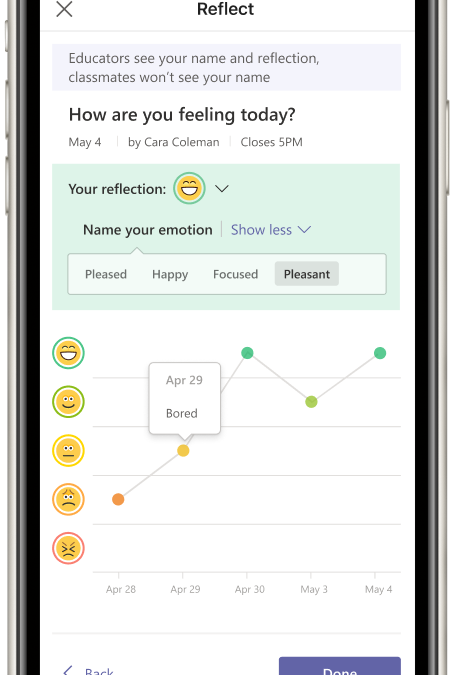
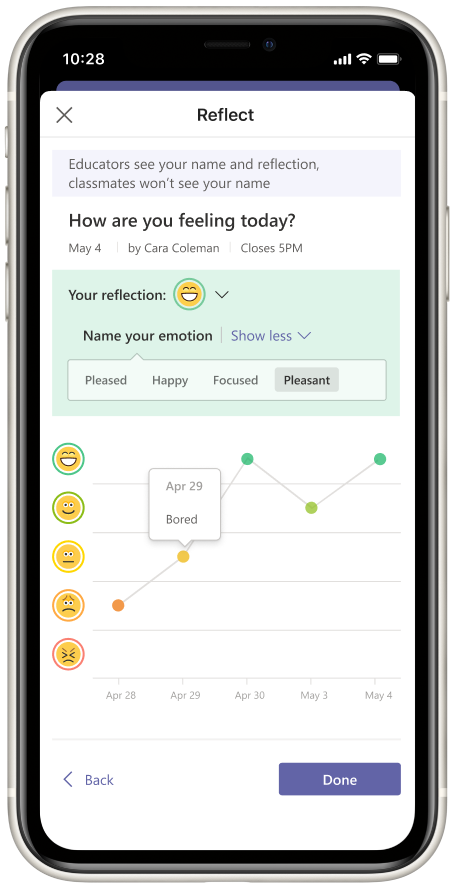 Student journal in Reflect
What is Reflect, and why it’s used
We want to build a school community that recognizes the whole student. It is important that we support them emotionally, understand when they are going through a rough time, and ensure that the classroom environment stays positive and conducive to learning.
Reflect is an emotional check-in app that helps educators support their students and the class as a whole. Reflect helps students recognize and navigate their emotions by providing regular opportunities to share and be heard. Reflect can help broaden a student’s emotional vocabulary and deepen empathy for their peers while also providing valuable feedback to educators for a healthy classroom community.
This check-in app uses emojis and research-backed emotional granularity to support educators in adding social and emotional learning and support into their routine.
Schools are reopening, Reflect is as valuable as ever
The future is unpredictable. Preparing youth for the challenges of tomorrow in the ambiguity of today is a hurdle that educators have taken in their stride. Social-emotional skills help us better navigate complexity and uncertainty while minimizing the adverse effects of disruption and sustaining the relationships that support the students. The past year’s changes have highlighted the importance of personal connection, accelerated the integration of technology in the classroom, and amplified the role of teachers. Adjusting back to in-person learning is a disruption in itself. Students will need support in re-establishing their bonds, noticing social cues, and communicating their needs to their peers and educators. A regular SEL routine like Reflect can provide an entry point for educators to host classroom conversations and a safe space for students to voice their concerns.
Privacy and Security
Reflect follows the same privacy and security standards as Education Insights to protect students’ sensitive information.
The information collected and shown through Reflect meets more than 90 regulatory and industry standards, including GDPR and the Family Education Rights and Privacy Act (FERPA) for students and children’s security and other, similar, privacy-oriented regulations.
Students never see the names of other students, only how they responded. While they can see the distribution of responses, they cannot see the student names associated with each reflection.
Steps to successful Reflect adoption
1. Enable Reflect
You can locate the Reflect app through the Teams apps gallery or using this link: https://aka.ms/getReflect.
If you don’t find the Reflect app in the gallery or if the link is not accessible, it may be that your IT Admin has limited the app in your tenant. In such a case, please refer your IT Admin to the following document: IT Admin Guide to Reflect in Microsoft Teams.
Only when Reflect is allowed can educators see and use the app in their classes.
Guest users (students or educators) cannot use Reflect.
2. Work with educators, so they understand the importance of regular check-ins and emotional granularity
Reflect helps educators easily check how their students feel in general or about a specific topic, such as learning from home, an assignment, current events, or a change within their community.
Emotional granularity is the ability to differentiate between emotions and articulate the specific emotion experienced. Developing language to talk about feelings is foundational to social and emotional learning. Accurately defining our emotions can help identify the source of the feeling and plan to meet our needs.
Introduce your educators to the app and show them how it can support a positive emotional climate in the classroom. Reflect provides an emotional safe space to grow student-teacher connections and help students develop their emotional vocabulary. We worked with SEL experts to select 50 emotion words that students can identify with as they reflect.
3. Ask educators to try Reflect and share their feedback
The first step is always the hardest. Reflect provides a variety of questions educators can ask their class for some common scenarios. The questions are a closed list, developed with the help of experts, and designed to provide Insights when associated with other data. One way to customize a Reflect check-in is to publish it and then “reply” to the message with specific guidelines.
Ask the educators to share their experiences using Reflect so that you can support them and their specific needs.
 Choose a check-in question in Reflect
We have created a resource page for educators that includes instructions, short videos, and a free course on getting started.
Listen to their feedback, and work with them to find what works best for their classes.
* The capacity to schedule repeat check-ins and access detailed data for Reflect in Insights will be available summer of 2021
4. Ask educators to use Reflect as part of their routine
Encouraging communication about emotions and supporting students in voicing their needs can go a long way toward preventing feelings of isolation, frustration, and disengagement. Once educators understand how Reflect supports them, suggest to them that they use it as part of their routine.
Here are some suggestions for using Reflect in the classroom.
- Implement a daily check-in to provide students with opportunities to practice evaluating and naming their emotions and ensure educators have a touchpoint with every student every day.
- Jumpstart conversations with students after a difficult day by asking What does the mood in our classroom feel like? This can be an excellent opportunity to model self-reflection and set goals together as a class.
- To support learning, assess student confidence about a concept or assignment, and plan accordingly.
- Celebrate wins with a Reflect check-in after a successful activity. Remember, mistakes can be framed as successes too!
- Identify dynamics between students by asking How do your friendships feel today? This can be paired with conversations or stories about sharing, bullying, and healthy relationships.
5. Empower the educator
The educator has complete control of when (or even if) to use Reflect. Only they should decide whether to post a new Reflect check-in, when and what type. If an educator feels it is not suitable for their classroom or they cannot support the students that way, they will not publish a new check-in, and you need to support them in that decision.
6. Don’t set goals for students
There is no right or wrong answer when dealing with emotions. All feelings are valid, and we want students to provide an honest assessment from their perspective and feel safe when describing their emotions. The goal is to develop a deeper understanding of student needs and work together to create a more positive climate and foster greater well-being in class.
We want to make the classroom a place where student emotions are valued, and everyone feels safe and heard.
7. Use Insights reports
Through Education Insights, educators can see how students respond to check-ins over time, making it easier to identify and address student needs.
The digital activity report now includes Reflect check-in data, with additional Reflect insights coming soon.
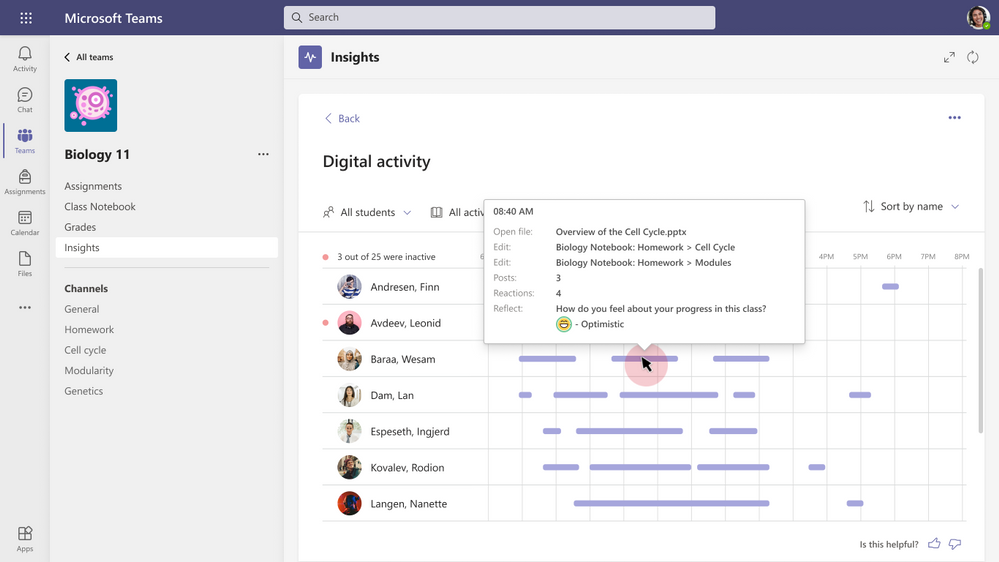 Education Insights – Reflect check-ins in the digital activity report
Educators can also track the adoption of the tool amongst their students to make sure they feel comfortable sharing their emotions. If there is low adoption, you may want to provide a framework to help establish the classroom as a safe space to share and support them in developing the emotional vocabulary needed to feel confident in sharing.
If you have Education Insights Premium (currently in preview), you can also see adoption across classes, grade level, school, etc., in your organizational view, and provide support and assistance for those who either don’t use Reflect at all or stopped using it after the initial adoption.
We’re always looking for ways to make Education Insights and Reflect better. Have questions, comments, or ideas? Let me know! Add your idea here, share your comment below, and find me on Twitter (@grelad).
Elad Graiver
Senior Program Manager, Education Insights and Reflect
by Contributed | May 5, 2021 | Technology
This article is contributed. See the original author and article here.
A Visual Guide To #Sustainability City
Welcome to the second in my series of visual guides focused on the topic of Sustainability and Green Tech. The first one focused on a Visual Guide To Sustainable Software Engineering, visualizing the core philosophies and eight principles of sustainable software engineering, as defined by this fantastic Microsoft Learn Module.
Putting Philosophy Into Practice
In fact, it was that first philosophy (“Everyone has a part to play in the climate solution”) that inspired me to work with the Microsoft Green Cloud Advocacy team on the #VisualGreenTech challenge for EarthDay and co-host a special Earth Day themed episode of #HelloWorld featuring Green Tech experts from Microsoft.
The challenge itself featured 24 prompts, three of which explored Sustainability interactively using Minecraft Education Edition resources for Earth Day. The first of these prompts focused on Sustainability City – a Minecraft world where you can take green buses around a bustling city, visiting various facilities to learn about sustainable practices targeting water treatment, food production, sustainable forestry, green buildings, energy-efficient homes, and the power grid. This community-created video does a great job of navigating the world in under eight minutes.
It was there that my personal journey into putting that philosophy to practice began!
Using Minecraft To Motivate Sustainability Education
Minecraft is an amazing resource for educating K-12 students on sustainability in actionable ways. The Minecraft Education Edition provides downloadable words that students can navigate and it has detailed lesson plans with activities and discussion guides to help students go from awareness to engagement, and action.
In my case, I took advantage of our Microsoft employee access to the Minecraft Edu Edition to begin a sustainability city journey with my 12-year-old. We took every bus, talked to every character, and had interesting follow-up conversations like: where does our water come from? how can we be more sustainable at home during the pandemic? and my favorite: should we create our own vegetable garden so we know where our food comes from?
If you are a parent, I strongly advocate for doing this exploration with kids and using the visual guide below to have a conversation once you leave the world. If you are an educator with access to this edition of Minecraft, I hope you find this visual guide a good resource for classroom conversations or continued awareness of what they learned, once they have completed that lesson.
Visual Guide & Navigation
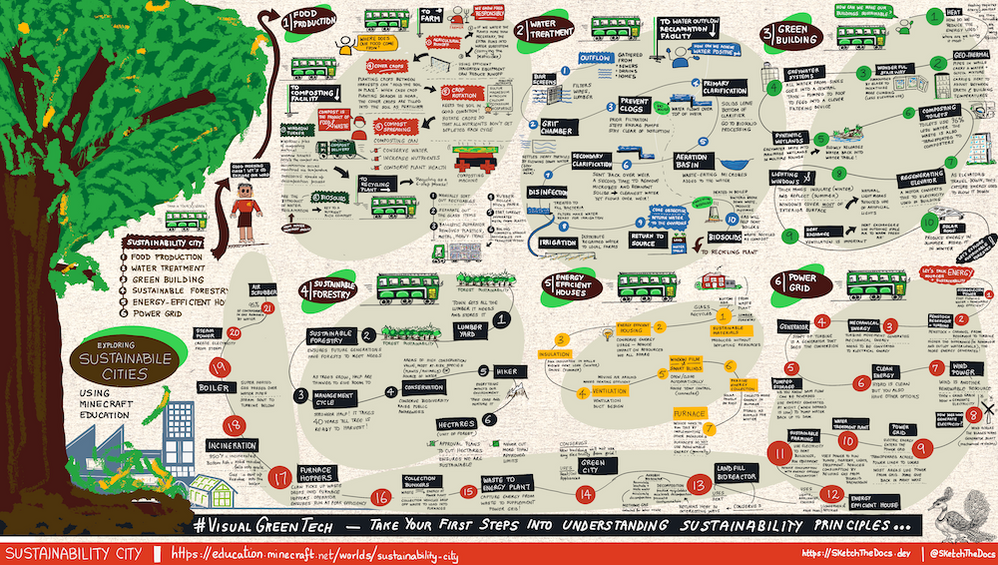
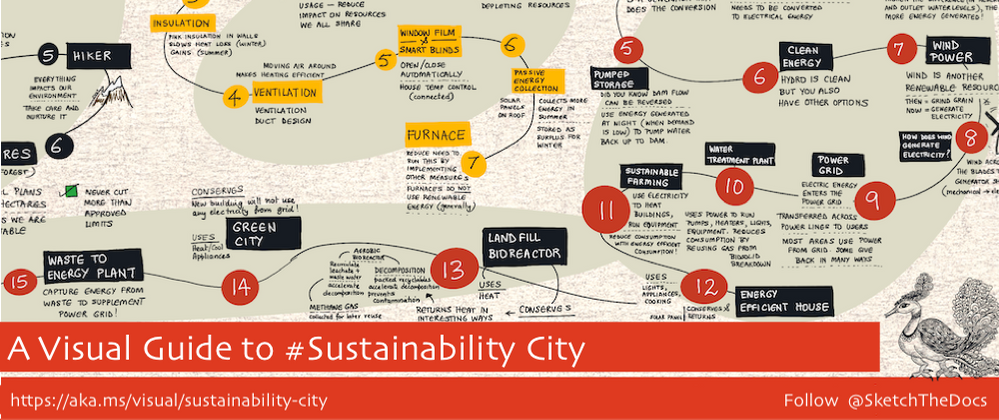
Here is the visual guide to Sustainability City. You can find a hi-res downloadable version of this visual guide here – warning: this is a large file (13MB) so make sure you have the data/bandwidth to download it. See this tweet for a behind-the-scenes time-lapse replay of how it was created.
The visual guide has six sections, each mapping to one of the regions of Sustainability City. Start from the top left and work your way clockwise to the last one. Here is what you’ll learn. Start with Food Production to explore sustainable farming practices including water reclamation and composting. Next, travel to the Water Outflow Reclamation Facility to learn how water from sewers and drains is “cleaned” and used for irrigation or returned to source (water positive) – the removed biosolids become fodder for composting.
Then, explore sustainable practices in the construction of large buildings (make them self-sustaining in energy needs) and explore sustainable forestry practices required to support our lumber needs. Finally, we look at energy-efficient housing and explore the power grid in some detail. As we know, electricity is a proxy for carbon, and understanding the various ways we generate, transport, and use, energy is critical to sustainability education.
I hope you found the guide useful. Making visual guides takes time but is infinitely rewarding. Have comments or feedback? Do leave them below.
by Contributed | May 5, 2021 | Technology
This article is contributed. See the original author and article here.
Today and every Wednesday Data Exposed goes live at 9AM PT on LearnTV. Every 4 weeks, we’ll do a News Update. We’ll include product updates, videos, blogs, etc. as well as upcoming events and things to look out for. We’ve included an iCal file, so you can add a reminder to tune in live to your calendar. If you missed the episode, you can find them all at https://aks.ms/AzureSQLYT.
You can read this blog to get all the updates and references mentioned in the show. Here’s the May 2021 update:
Product updates
The two main updates for this month are for Azure SQL Managed Instance and Azure SQL Database Hyperscale.
Azure SQL Managed Instance announced the general availability of service-aided subnet configurations. Service-aided subnet configuration allows users to remain in full control of TDS traffic, and Azure SQL Managed Instance takes responsibility to ensure uninterrupted flow of management traffic in order to meet SLAs. This configuration builds on top of the virtual network subnet delegation feature to make it easier for customers, by providing automatic network configuration management and enabling service endpoints.
These service endpoints or ‘service tags’ provide a was to reference essentially all IP addresses related to a given service in a specific region. For example, if you want to configure access to storage accounts to keep backups and audit logs in the region of West US, you could use the tag Storage.WestUs. Then, you can create a user-defined route (UDR) as the mechanism that allows traffic to leave the SQL MI virtual network and reach your storage account.
The other major announcement is a public preview for geo-replication in the Azure SQL Database Hyperscale service tier. This has been available in other Azure SQL Database tiers for a while, and this capability enables cross region business continuity and disaster recovery by allowing you to create one or more replicas in the same or different regions. This announcement brings Azure SQL Hyperscale one step closer to full feature parity with Azure SQL Database. Learn more about the preview here.
From a tools perspective, special guest Alexandra Ciortea came on to talk about SQL Server Migration Assistant (SSMA) and the latest release. She mentioned several great references for how to stay up to date, which you can find below:
Videos
We continued to release new and exciting Azure SQL episodes this month. Here is the list, or you can just see the playlist we created with all the episodes!
- Kate Smith: Understanding the Benefits of Intelligent Query Processing
- [MVP Edition] Argenis Fernandez: Storage 101 for Azure SQL and SQL Server Engineers
- Aaron Nelson: How to Parameterize Notebooks for Automation in Azure Data Studio
- Amit Khandelwal: Use Helm Charts from Windows Client Machine to Deploy SQL Server 2019 Containers on Kubernetes
- Manoj Raheja: Get Started with Azure Data Explorer using Apache Spark for Azure Synapse Analytics
- Mohamed Kabiruddin: Get Started with the New Database Migration Guides to Migrate your Databases to Azure
We’ve also had some great Data Exposed Live sessions. Subscribe to our YouTube channel to see them all and get notified when we stream. Here are some of the recent live streams.
- Something Old, Something New: Do Kangaroos Prefer Cake or Frosting?
- Azure SQL Security Series: Understanding Access and Authentication
- Ask the Experts: SQL Edge to Cloud
Blogs
As always, our team is busy writing blogs to share with you all. Blogs contain announcements, tips and tricks, deep dives, and more. Here’s the list I have of SQL-related topics you might want to check out.
- Azure Blog, data-related
- SQL Server Tech Community
- Azure SQL Tech Community
- Azure SQL Devs’ Corner
- Azure Database Support (SQL-related posts)
Special Segment: SQL in a Minute, Microsoft Docs
We introduced a new segment this month, SQL in a Minute, led by Cheryl Adams. Cheryl and Jason Roth came on to talk about the latest updates and how to contribute to Microsoft Docs. You can find the documentation at https://aka.ms/sqldocs and the contributors guide at https://aka.ms/editsqldocs.
Special Segment, Citus and Open source updates
Claire Giordano, Principal PM Manager in Azure Data, came on the show to share some resources and updates around Citus and open source databases. Here are some references if you want to learn more:
Upcoming events
As always, there are lots of events coming up this month. Here are a few to put on your calendar and register for:
May 10: SQLDay 2021
Azure SQL Workshop, Bob Ward and Anna Hoffman
Keynote, Bob Ward
SQL Day Q&A, Bob Ward and Buck Woody
Inside the Memory of SQL, Bob Ward
Presentation Skills for the Data Profession, Buck Woody
May 11: Azure Webinar Series: Debugging Web Apps on Azure App Service and Azure SQL
May 14: PyCon 2021
What we learned from Papermill to operationalize notebooks, Alan Yu and Vasu Bhog
May 15: Data Weekender
Keynote – Into the Dataverse, Buck Woody
May 15: Data Saturday Southwest US
Keynote, Buck Woody
May 18: Redgate Azure SQL Managed Instance Webinar
Inside Azure SQL Managed Instance, Bob Ward
May 18: Techorama
From Oops to Ops: Incident Response with Notebooks, Julie Koesmarno and Shafiq Rahman
May 20: Azure Webinar Series: Implementing DevOps Best Practices on Azure SQL
May 25- 27: Microsoft Build
Keynote, Rohan Kumar and Jason Anderson
Learn Live: Build full stack applications with Azure Static Web Apps and Azure SQL Database, Anna Hoffman and Davide Mauri
Roundtable: Develop Apps with SQL DB, Anna Hoffman, Davide Mauri, Sanjay Mishra
Roundtable: Mission Critical workloads on Azure SQL DB, Anna Hoffman, Abdul Sathar Sait, Sanjay Mishra, Roberto Bustos, Emily Lisa
In addition to these upcoming events, here’s the schedule for Data Exposed Live:
May 12: Azure SQL Virtual Machine Reimaged Series with David Pless and Pam Lahoud
May 19: Deep Dive: Azure SQL Insights with Alain Dormehl
Plus find new, on-demand Data Exposed episodes released every Thursday, 9AM PT at aka.ms/DataExposedyt
Featured Microsoft Learn Module
Learn with us! This month I highlighted the Deploy highly available solutions by using Azure SQL. Check it out!
By the way, did you miss Learn Live: Azure SQL Fundamentals? On March 15th, Bob Ward and I started delivering one module per week from the Azure SQL Fundamentals learning path (https://aka.ms/azuresqlfundamentals ). Head over to our YouTube channel https://aka.ms/azuresqlyt to watch the on-demand episodes!
Anna’s Pick of the Month
This month I am highlighting the Azure SQL Digital Event that happened on May 4th. This was an amazing event led by Azure Data CVP Rohan Kumar. Rohan spoke about the current and future innovations in Azure SQL, and it was hosted by Bob Ward with cameo from Scott Guthrie. I got to demo a few cool things, along with several other Microsoft Product Group members and Microsoft MVPs. You don’t want to miss the on-demand! Register at https://aka.ms/AzureSQLDigitalEvent to get the recordings.
Until next time…
That’s it for now! Be sure to check back next month for the latest updates, and tune into Data Exposed Live every Wednesday at 9AM PST on LearnTV. We also release new episodes on Thursdays at 9AM PST and new #MVPTuesday episodes on the last Tuesday of every month at 9AM PST at aka.ms/DataExposedyt.
Having trouble keeping up? Be sure to follow us on twitter to get the latest updates on everything, @AzureSQL. You can also download the iCal link with a recurring invite!
We hope to see you next time, on Data Exposed :)
–Anna and Marisa

by Contributed | May 5, 2021 | Technology
This article is contributed. See the original author and article here.
We are pleased to share a set of new resources on storytelling for Champions!
Our overall goal for delivering these new resources is to enable you and your organization to achieve greater results from your adoption and change management programs. Stories are an amazing way to connect with people through shared experiences, inspire others to act, and are an influential way to communicate. Storytelling can play a key role in any change journey as a powerful way to showcase examples of the new behavior change in action.
I have worked with enterprise customers at Microsoft for nearly two decades and have seen the impact of great adoption success stories when they are shared by champion business users who have realized the positive impact of change. This has helped them grow and enhance executive sponsorship, lowered resistance to change among later adopters, inspired new ideas, and reinforced the value of the change program.
The resources include:
- A new storytelling guide that includes:
- A framework for finding and growing good success stories: Empower, Capture, Amplify, Learn;
- A sample structure for capturing compelling stories: Situation, Complication, Resolution, The Point;
- And additional learning resources.
- A storytelling course on LinkedIn Learning where you can also earn a certificate for completion.
We encourage you to take a look and leverage with your teams. We also welcome your feedback here on how we can improve this and other resources on the site to keep inspiring your communities to achieve more!
Access the content at storytelling for Champions.


by Contributed | May 5, 2021 | Technology
This article is contributed. See the original author and article here.
By Christine Alford, Director, Commercial Marketplace Business Team
Previously, I’ve talked about Microsoft’s #BuildFor2030 campaign. As partner to the United Nations, Microsoft has pledged to support the UN Sustainable Development Goals (SDGs). The SDGs are a set of 17 initiatives adopted by member states in 2015 focused on creating a more inclusive, sustainable, and equitable world by 2030. Inspired by the UN SDGs, through the #BuildFor2030 campaign, we’re featuring Microsoft partners building solutions that enable a more inclusive economy.
This milestone of the campaign launched on Earth Day on April 22. With this milestone we are supporting climate action and sustainability by recognizing partner innovation for sustainability. Currently, on our homepages of Microsoft AppSource and Azure Marketplace you can find Microsoft partner solutions in our “featured apps” section that are innovating to build a more resilient and sustainable future.
Learn more about how Microsoft partners are helping customers leverage technology to better our environment and create a more sustainable society by reading this blog post by Nick Parker, CVP, Global Partner Solutions.
If you have a solution that supports a more inclusive, sustainable, and equitable future, we’d love to celebrate your impact. Upcoming campaign themes this year include enabling nonprofits and empowering communities. Learn more about #BuildFor2030 and how you can participate. Don’t miss out on your chance to be featured! Nominate your solution today.

by Contributed | May 5, 2021 | Dynamics 365, Microsoft 365, Technology
This article is contributed. See the original author and article here.
As the pace of manufacturing accelerates to meet demands across global customers, organizations are struggling to rapidly train and upskill workers on factory lines and the production floor. In fact, up to 2.4 million U.S. manufacturing jobs could remain unfilled between 2018 and 2028 due to this challenge.1
Today we’re introducing an exciting update to Microsoft Dynamics 365 Guides that promises to improve the way frontline workers access digital guidance in real-world scenarios, empowering them with hands-on opportunities to learn new and revised technical skills on-site. By engaging employees in hands-on, experiential learning, they are better able to retain and apply new skills to meet evolving job demands.
State of learning today
Traditional classroom training methods are not only expensive to implement and maintain but also are often ineffective. On average, employees only apply about 54 percent of new skills learned and business leaders are similarly disenfranchised.2 88 percent of human resource leaders are looking to invest in new technologies and 84 percent of business leaders want to rethink their workforce experience.3 At Microsoft, we see an opportunity to shift the way employees learn by providing organizations with the technology to attract, train, and maintain their workforce. Instead of static, hundred-page manuals that employees consume in a classroom, employees move towards immersive and collaborative experiences that are incorporated into daily workflows. With an estimated 97 million new jobs created by the year 2025, organizations need to provide employees with greater operational knowledge and a seamless, improved way to learn on the job.4 The question is, where do you get started?
On-the-job guidance with Dynamics 365 Guides and Azure Object Anchors
Dynamics 365 Guides is the mixed reality solution for organizations looking to accelerate upskilling and empower employees with transformational learning experiences. With Dynamics 365 Guides, employees can author step-by-step workflows with holograms on a head-mounted display to effectively imitate real-world scenarios.
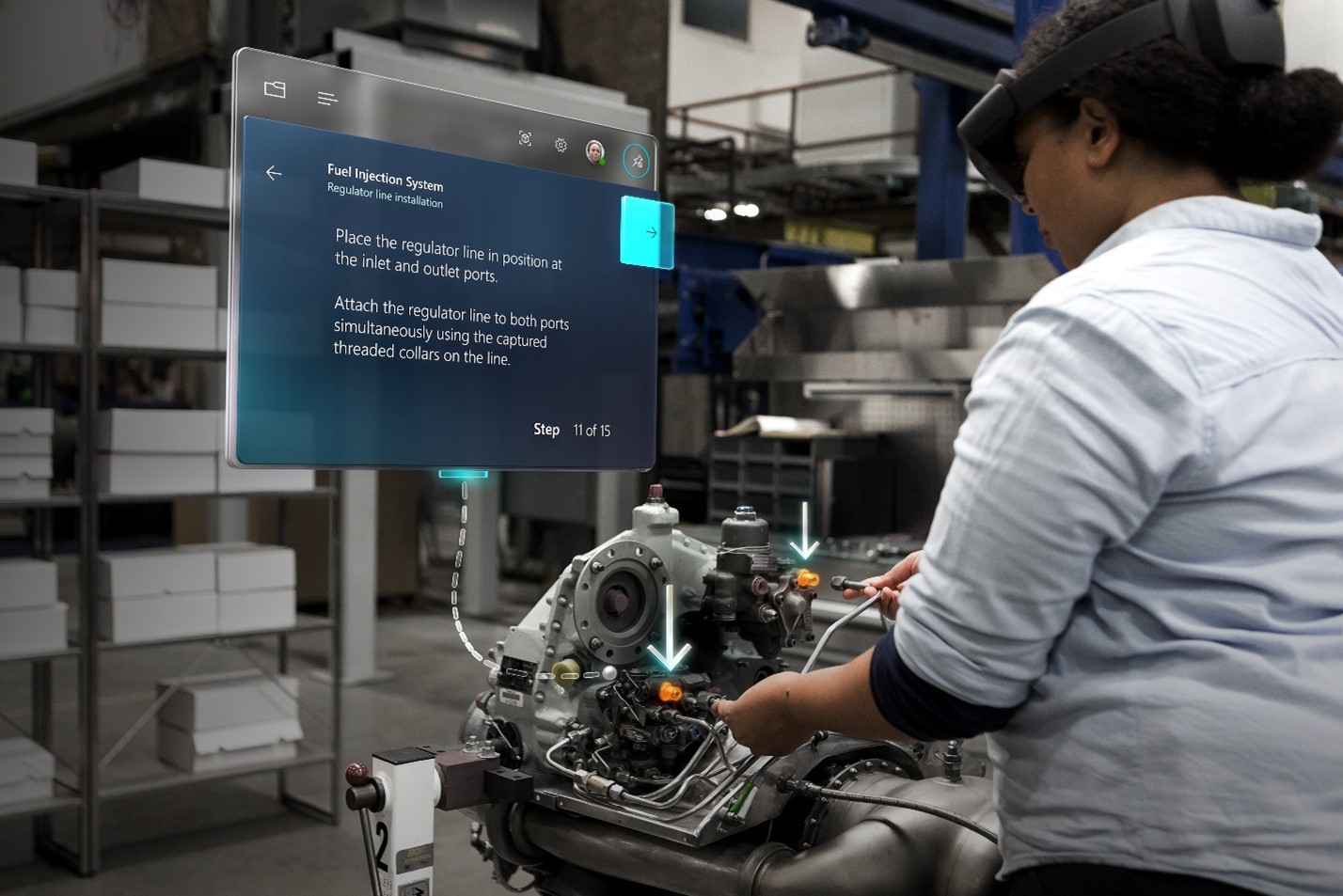
Visual overlays and markers hover over the next step, using visual reinforcements to help improve muscle memory and reduce downtime.

Non-linear guides can incorporate branching logic to account for skill level and workflow variability in which users can easily select the option best fits their skillset or situation.
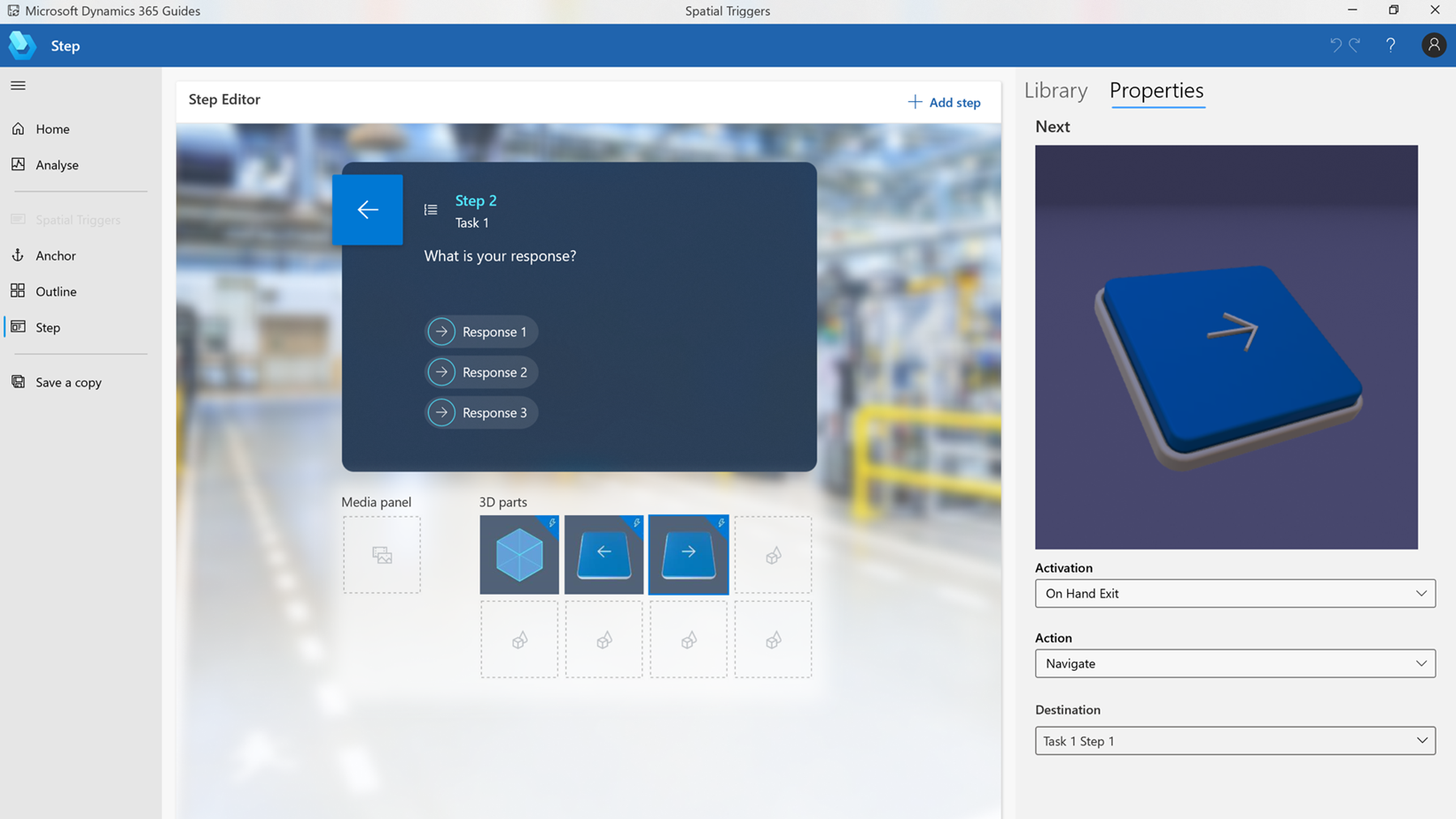
Operators can stay in the flow of work while following step-by-step instructions overlaid directly in front of them, empowering employees to learn on the job and reduce downtime spent in a classroom.
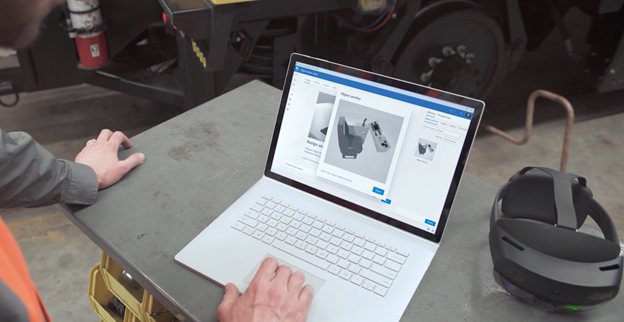
Yesterday at the Microsoft Business Applications Summit, we announced the latest development: Dynamics 365 Guides with Azure Object Anchors. Azure Object Anchors enable users to automatically align digital content with physical objects, eliminating the need for QR-code markers while improving alignment accuracy. Using Dynamics 365 Guides and Azure Object Anchors, operators can easily move from one workstream to the next as HoloLens’s spatial insight detects anchors and seamlessly launches overlaid digital content. Organizations can move from a manual process, often ripe with inaccuracies, to a walk-up and work experience that improves user learning and reduces errors.

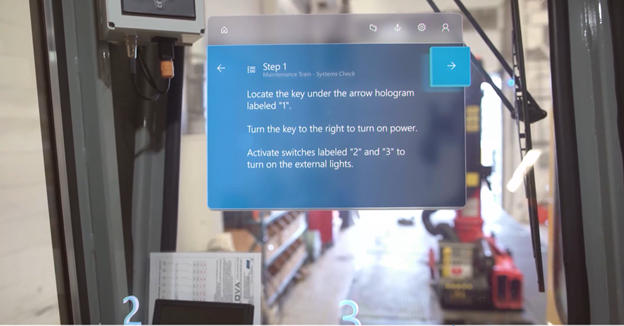
Azure Object Anchors is a recent example of the innovation that stems directly from customer feedback, and we’ve seen it in use recently at Toyota Japan, where they used Azure Object Anchoring to place digital markers in their environment to improve process efficiencies. Without the need for physical markers, Toyota was able to incorporate Azure Object Anchors across dealerships to help technicians get up and running much faster. We are excited to bring this new capability to Dynamics 365 Guides to improve the workflow experience and unlock additional operational efficiencies.
Innovative solutions and technology are needed to address the growing skills gap faced by many industries. As organizations eschew the status quo and adopt experiential learning solutions, like Dynamics 365 Guides, they are better prepared to meet this challenge and empower their employees to learn on the job more effectively.
Learn more about Dynamics 365 Guides and Azure Object Anchors.
1Deloitte Insights and the Manufacturing Institute, 2018 Deloitte and the Manufacturing Institute Skills Gap and Future of Work Study, 2018
2Baker, Mary. “Stop Training Employees in Skills They’ll Never Use.” Smarter With Gartner, August 28, 2020.
3Deloitte Human Capital Trends 2019, “Leading the Social Enterprise: Reinvent with a Human Focus,” Deloitte, 2019.
4Russo, Amanda. “Recession and Automation Changes our Future of work, but there are Jobs Coming,” World Economic Forum, 2020.
The post Improve on-the-job guidance with Dynamics 365 Guides and Azure Object Anchors appeared first on Microsoft Dynamics 365 Blog.
Brought to you by Dr. Ware, Microsoft Office 365 Silver Partner, Charleston SC.
by Contributed | May 5, 2021 | Technology
This article is contributed. See the original author and article here.
Mapping technology to Zero Trust frameworks is a challenge in many industries. We need to change our thinking in security assessment as the cloud evolves at the speed of innovation and growth, which often challenges our security requirements. We need a method to map Zero Trust approaches to technology while measuring change over time like a muscle.
Azure Sentinel: Zero Trust (TIC 3.0) Workbook
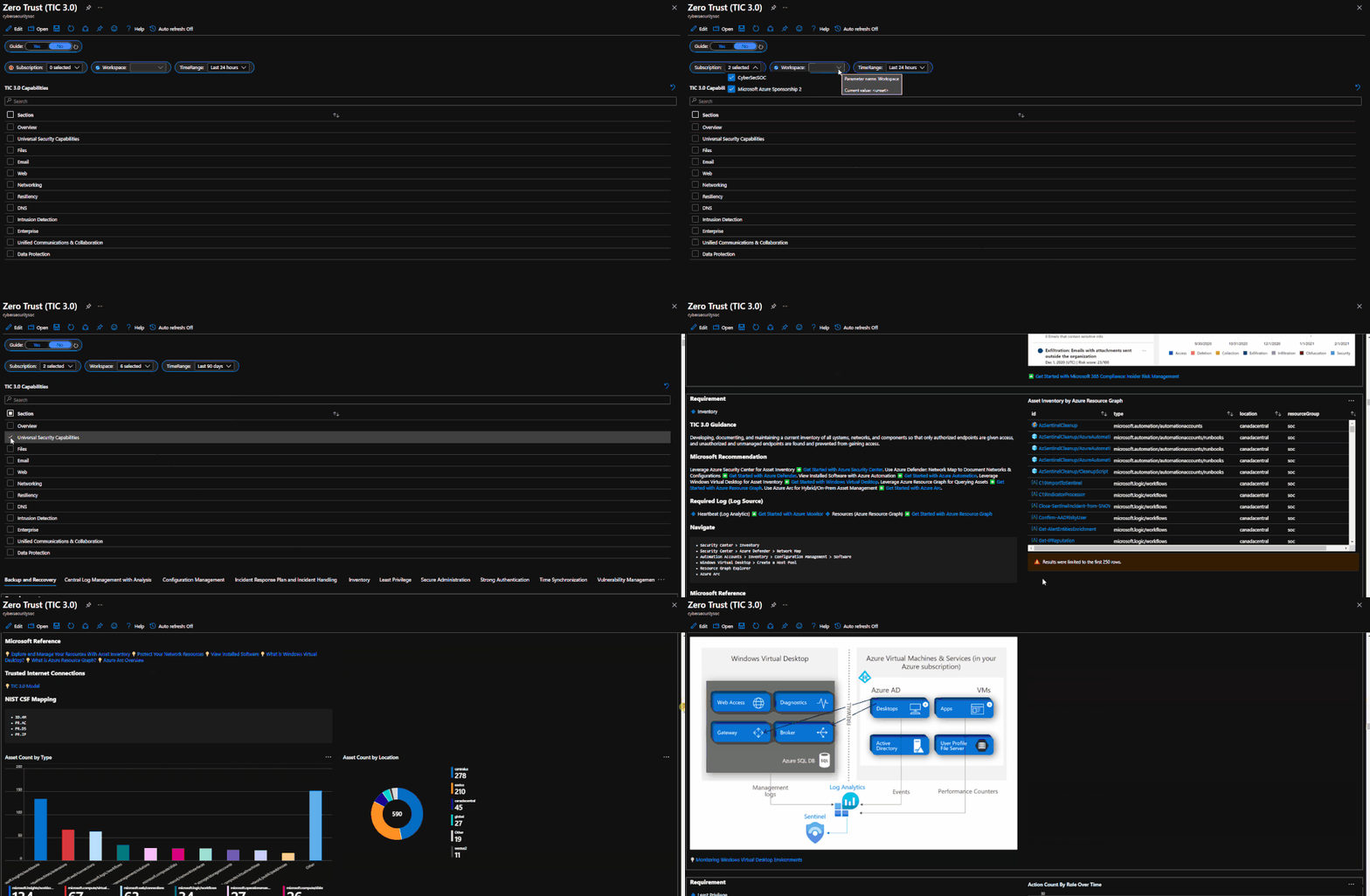
The Azure Sentinel: Zero Trust (TIC3.0) Workbook provides an automated visualization of Zero Trust principles cross walked to the Trusted Internet Connections framework. This workbook leverages the full breadth of Microsoft security offerings across Azure, Office 365, Teams, Intune, Windows Virtual Desktop, and many more. This workbook enables Implementers, SecOps Analysts, Assessors, Security & Compliance Decision Makers, and MSSPs to gain situational awareness for cloud workloads’ security posture. The workbook features 76+ control cards aligned to the TIC 3.0 security capabilities with selectable GUI buttons for navigation. This workbook is designed to augment staffing through automation, artificial intelligence, machine learning, query/alerting generation, visualizations, tailored recommendations, and respective documentation references.
Use Cases
There are several use cases for the Azure Sentinel Zero Trust (TIC 3.0) Workbook depending on user roles and requirements. The graphic below shows how a Security Engineer can leverage the workbook to review controls, evaluate tool efficiency, explore events, and investigate configurations. There are also several additional use cases where this workbook will be helpful:
Roles
- Implementers: Build/Design
- SecOps: Alert/Automation Building
- Assessors: Audit, Compliance, Assessment
- Security & Compliance Decision Makers: Situational Awareness
- MSSP: Consultants, Managed Service
Mappings
- Framework to Requirement to Microsoft Technology
Visualization
- Hundreds of Visualizations, Recommendations, Queries
Time-Bound
- Measure Posture Over Time for Maturity
Time-Saving
- Aggregation & Analysis
- Capabilities Assessment
- Navigation
- Documentation
- Compliance Mapping
- Query/Alert Generation
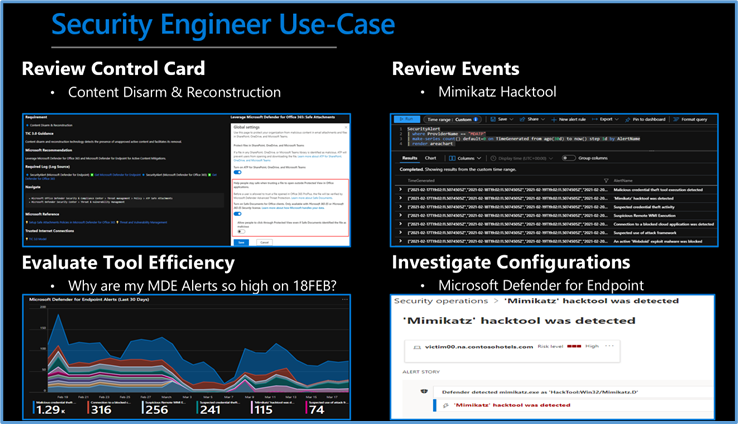 Security Engineer Use Case
Is Zero Trust Equivalent to TIC 3.0?
No, Zero Trust is a best practice model and TIC 3.0 is a security initiative. Zero Trust is widely defined around core principles whereas TIC 3.0 has specific capabilities and requirements. This workbook demonstrates the overlap of Zero Trust Principles with TIC 3.0 Capabilities. The Azure Sentinel Zero Trust (TIC 3.0) Workbook demonstrates best practice guidance, but Microsoft does not guarantee nor imply compliance. All TIC requirements, validations, and controls are governed by the Cybersecurity & Infrastructure Security Agency. This workbook provides visibility and situational awareness for security capabilities delivered with Microsoft technologies in predominantly cloud-based environments. Customer experience will vary by user and some panels may require additional configurations for operation. Recommendations do not imply coverage of respective controls as they are often one of several courses of action for approaching requirements which is unique to each customer. Recommendations should be considered a starting point for planning full or partial coverage of respective requirements.
Deploying the Workbook
It is recommended that you have the log sources listed above to get the full benefit of the Zero Trust (TIC3.0) Workbook, but the workbook will deploy regardless of your available log sources. Follow the steps below to enable the workbook:
Requirements: Azure Sentinel Workspace and Security Reader rights.
1) From the Azure portal, navigate to Azure Sentinel
2) Select Workbooks > Templates
3) Search Zero Trust and select Save to add to My Workbooks
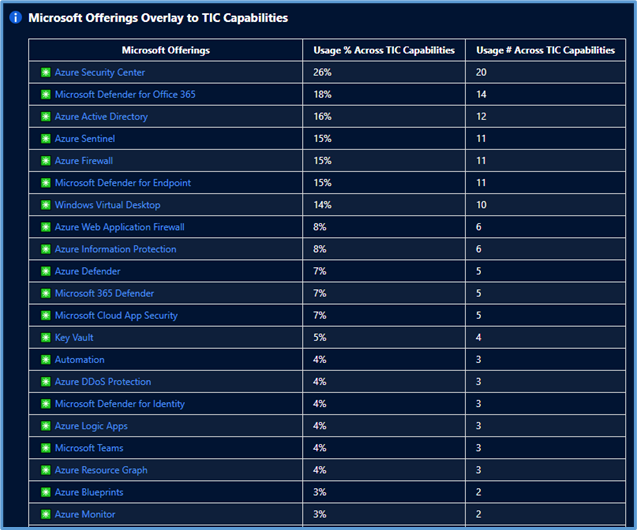 Microsoft Offerings Overlay to TIC Capabilities
Navigating the Workbook
The Legend Panel provides a helpful reference for navigating the workbook with respective colors, features, and reference indicators.
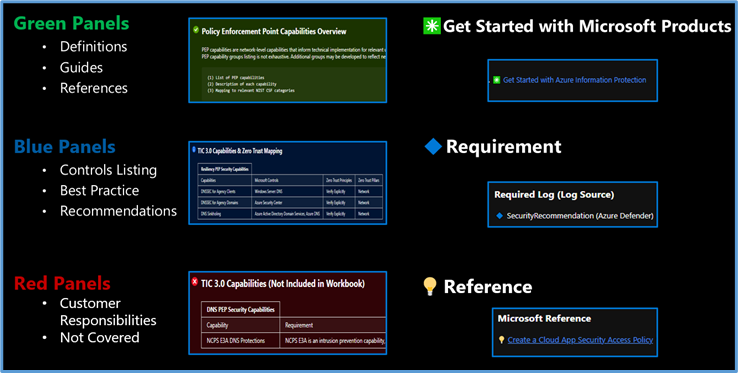 Navigating The Workbook
The Guide Toggle is available in the top left of the workbook. This toggle allows you to view panels such as recommendations and guides, which will help you first access the workbook but can be hidden once you’ve grasped respective concepts.
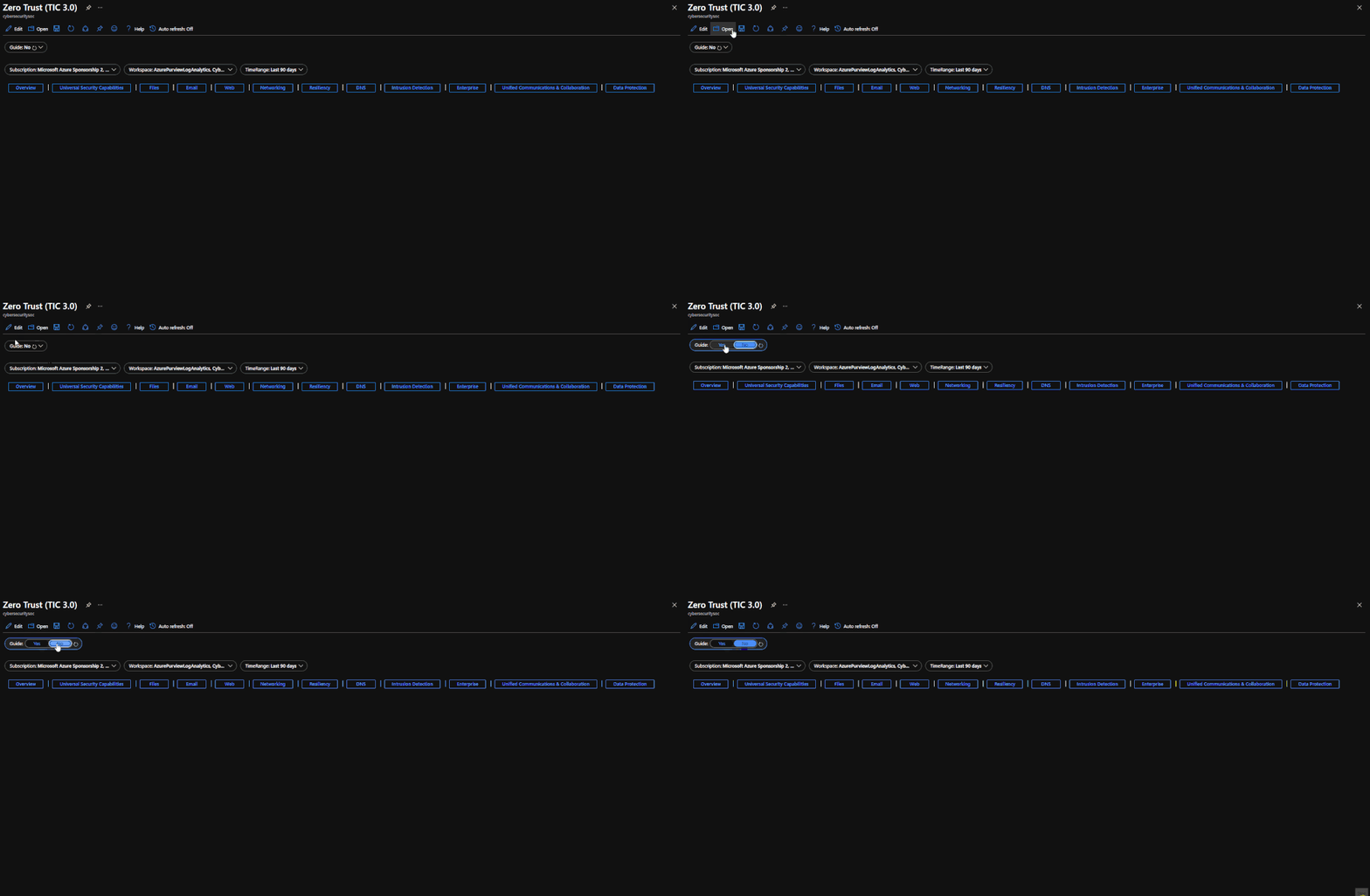 Guide Toggle
The Resource Parameter Options provide configuration options to sort control cards by Subscription, Workspace, and Time Range. The Parameter Options are beneficial for Managed Security Service Providers (MSSP) or large enterprises that leverage Azure Lighthouse for visibility into multiple workspaces. It facilitates assessment from both the aggregate and individual workspace perspectives. Time range selectors allow options for daily, monthly, quarterly, and even custom time range visibility.
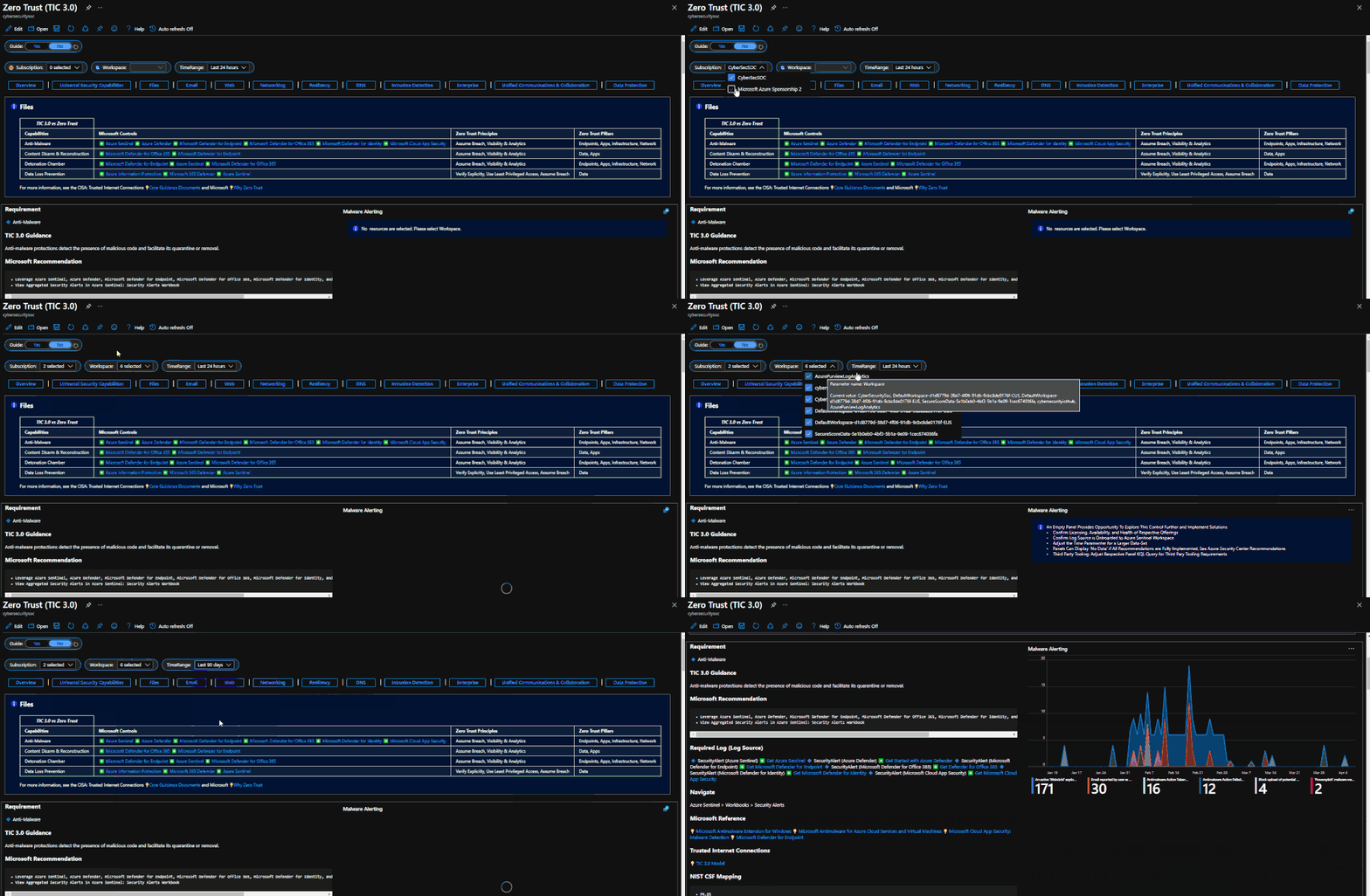 Resource Parameter Options
The Azure Sentinel Zero Trust (TIC3.0) Workbook displays each control in a Capability Card. The Capability Card provides respective control details to understand requirements, view your data, adjust SIEM queries, export artifacts, onboard Microsoft controls, navigate configuration blades, access reference materials, and view correlated compliance frameworks.
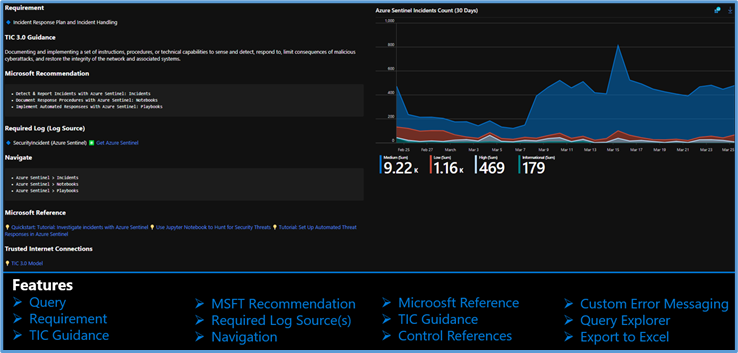 Capability Card
While using Microsoft offerings for the Zero Trust (TIC3.0) Workbook is recommended, it’s not a set requirement as customers often rely on many security providers and solutions. Below is a use-case example for adjusting a Control Card to include third-party tooling. The default KQL query provides a framework for target data, and it is readily adjusted with the desired customer controls/solutions.
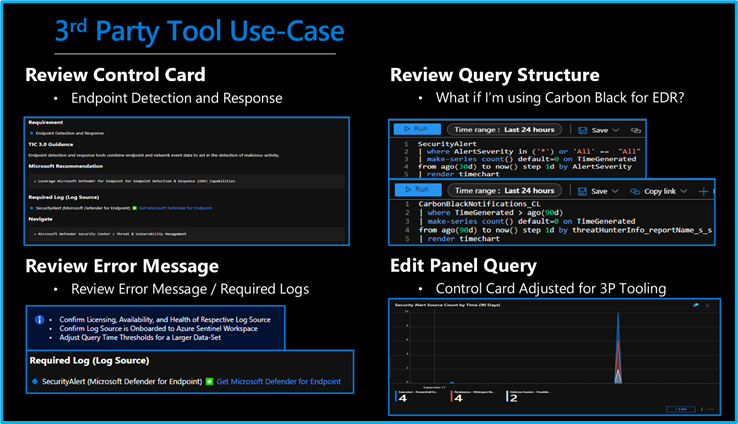 3rd Party Tool Use Case
Get Started with Azure Sentinel and Learn More About Zero Trust with Microsoft
Below are additional resources for learning more about Zero Trust (TIC3.0) with Microsoft. Bookmark the Security blog to keep up with our expert coverage on security matters and follow us at @MSFTSecurity or visit our website for the latest news and cybersecurity updates.
Disclaimer
The Azure Sentinel Zero Trust (TIC 3.0) Workbook demonstrates best practice guidance, but Microsoft does not guarantee nor imply compliance. All TIC requirements, validations, and controls are governed by the Cybersecurity & Infrastructure Security Agency. This workbook provides visibility and situational awareness for control requirements delivered with Microsoft technologies in predominantly cloud-based environments. Customer experience will vary by user, and some panels may require additional configurations and query modification for operation. Recommendations do not imply coverage of respective controls as they are often one of several courses of action for approaching requirements which is unique to each customer. Recommendations should be considered a starting point for planning full or partial coverage of respective control requirements.
by Contributed | May 5, 2021 | Technology
This article is contributed. See the original author and article here.
This blog post is the third in a series of three examining the results of a recent IDC study, Leveraging Microsoft Learning Partners for Innovation and Impact.*
Upskilling is a key requirement in today’s IT centers, and Microsoft Learning Partners can help your organization get the greatest impact from your learning initiatives, development programs, and digital transformation efforts. Given the importance of staying ahead of quickly evolving technology, we asked IDC researchers to find out what makes a Learning Partner valuable to an organization.
Our first post in the series, New study shows the value of Microsoft Learning Partners, took a high-level look at the benefits of using a Learning Partner to meet your technical skilling needs. Among the findings: the right partner, along with high-quality content, improves outcomes. The second post, Get results from end-to-end training solutions offered by Microsoft Learning Partners, highlighted the tremendous value Learning Partners bring to organizations through their capacity to provide an end-to-end solution and to deliver value-added services to support a learner’s ability to gain and retain needed skills.
This final post explores the additional benefits. Working with a Learning Partner provides:
- Scale, flexibility, and speed. Learning Partners have the scale to support global organizations, the flexibility to tailor programs to client needs, and the speed to stand up complex programs quickly.
- Quality content and delivery. They also deliver the latest in accurate, relevant content using Microsoft Official Courseware (MOC) delivered by Microsoft Certified Trainers (MCTs).
Programs with scale, flexibility, and speed meet learning goals
Learning Partners have the scale, flexibility, and speed to set up your IT skills initiatives quickly, provide all the necessary resources, and make sure programs stay on track. As learning experts, they know how to adapt to changing circumstances and schedules and to help ensure that learning initiatives succeed.
The IDC study emphasized three areas where Learning Partners make a difference to organizations:
- The scale to work locally and globally. Whether your IT group is big or small, a Learning Partner works with you to scope and adapt their programs to your organization’s needs, such as rolling out learning across time zones.
- The flexibility to adapt to change. Learning Partners have the flexibility to adapt their deliverables to your changing requirements and business constraints.
- The speed to stay ahead of the tech. Learning Partners not only keep up with the technology but also anticipate changing requirements and help you prepare for the road ahead.
Quality always makes a difference
Quality in learning programs helps accelerate your organization’s business goals, including digital transformation. Tom O’Reilly, Head of Group Strategy at QA, talks about quality as meeting the unique needs of learners and circumstances. “You cannot execute a transformation program without offering a breadth of learning modalities and a high-quality offering in each of them,” he points out.
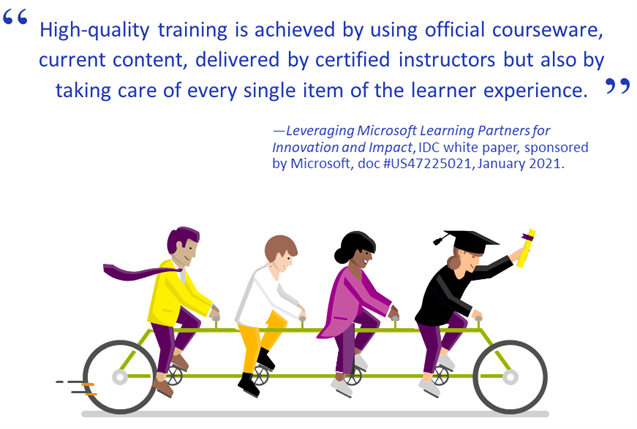
The IDC study emphasized that high-quality training comes from using official courseware and current content, delivered by certified instructors. Quality extends to the way that Learning Partners address every aspect of the learner experience—beginning with an assessment of your training needs and, for some, ending in certification exam preparation.
Some organizations view certifications as a natural outcome of a quality learning experience. Certified IT pros perform their role better,** and certifications can lead to improved IT performance. Learning Partners can help your workforce prepare for the industry’s most trusted certification.
Next step: Ask an expert about their services
To move forward with your skilling needs, consider working with a Microsoft Learning Partner with the scale, flexibility, and speed to deliver the resources that work best for your workforce—along with the quality content and instructors that can help everyone succeed.
Share your thoughts by posting your comment.
Download the IDC study white paper, Leveraging Microsoft Learning Partners for Innovation and Impact
Download the IDC study datasheet, Top reasons to get IT training from a Microsoft Learning Partner
Find a Microsoft Learning Partner

Related posts
Sharpen your technical skills with instructor-led training
Leading Learning Partners Association—a unique organization for delivering Microsoft training
Technical certifications could help drive business optimization
* IDC white paper, sponsored by Microsoft, Leveraging Microsoft Learning Partners for Innovation and Impact, #US47225021, January 2021.
** Global Knowledge, 2019 IT Skills and Salary Report, as quoted in Ten reasons to earn a Microsoft Certification.
by Contributed | May 5, 2021 | Technology
This article is contributed. See the original author and article here.
This blog dives into how to setup 1:1 call recording, end user experience and best practices for enabling this feature for users.
What is 1:1 call recording ?
This feature gives user the ability to record Microsoft® Teams call made to another user who is using Teams. Note that, this feature does not give you the ability to record 1:1 call with PSTN user.
How to enable call recording settings:
This is enabled using PowerShell. You need to modify the “Teams Calling Policy” using PowerShell. This setting is disabled by default – it must be enabled. You can either enable it for your global policy or you can create a custom policy, which has this feature enabled, and apply that policy to users who require this feature.
Set-CsTeamsCallingPolicy -Identity Global -AllowCloudRecordingForCalls $True
Note that, prior to April 12, 2021, this setting was controlled by the “Teams meeting policy”. If you allowed recording for teams meeting by setting “AllowCloudRecording” to true. After May 31, 2021, this particular setting in “Meeting Policy” only works for recording a meeting, it does not work for call recording.
End user experience:
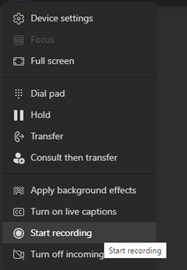
After enabling this feature the user will have the option to ‘record a call’ in teams.
After a call is connected, users will have to click on the “more actions” icon (…) and it will give the option to start recording. In this example, John called Jane, and John started the recording.
When the recording starts the user on the other end (Jane) will get a notification that recording has started. In addition, a recording icon (red button) appears right next to the timer, even if the notification is dismissed the recording icon will stay active as long as recording is going on, so that the user is aware that the call is being recorded.
The notification still says “this meeting is being recording…” even though it is a 1:1 call, you can ignore this typo.

Where is the recording stored
The recording will be stored either in Stream or OneDrive for the user who initiated the recording. The “other” user – in this example, “Jane” will have read-only access to the recording.
Both users will be notified when the recording is ready. It will show up in the chat window for the call – in this example, John called “Jane Doe” and Jane recorded the call. The link to recording appears on both their chat window and it can be played back right on the Teams client.
In this case both John and Jane are in the same organization within the same Microsoft 365 tenant.

If the user who did not initiate the recording is an external user, then, this “recorded” user will not have access to the recording. The user who initiated the recording will have to share the recording with the user on the other organization.
After July 7, 2021, all recordings will be stored in OneDrive by default, unless your organization decides to opt-out. Following article goes into details about recording and storage for both 1:1 calls and meeting recordings.
Use OneDrive for Business and SharePoint for meeting recordings – Microsoft Teams | Microsoft Docs
This feature is for end user and does not replace or complement compliance recording. The user who initiates the recording has access to the recorded file, which in certain situation can violate compliance. For example, in certain scenarios, just the notification that the user is being recorded may not meet compliance requirement, additional disclaimers might be necessary. Another possible scenario – certain users are not allowed to keep recordings of calls in their storage. In these cases, admins need to get formal approval from the compliance team before proceeding with this setting.
Recommendation:
- Consider compliance requirement prior to enabling 1:1 recording feature.
- Start with a custom policy where this feature is enabled and add select group users to the policy. If a decision is made to enable the feature for all users, then the feature can be enabled globally.
- Both 1:1 call recording and meeting recording experience should be similar for specific users – otherwise, it can create confusion for the end-user.
- Share helpful tips with the user about where the recordings are stored.
- Consider retention policy to get remove old recordings from user’s One Drive.
Seema Rahman is the Principal Architect of Zodela Technologies. Her primary focus area is Microsoft Teams – over last 3 years, she has helped multiple mid to large size customers adopt teams as their main collaboration platform.
To write your own blog on a topic of interest as a guest blogger in the Microsoft Teams Community, please submit your idea here: https://aka.ms/TeamsCommunityBlogger


Recent Comments