Over $115 million goes to MoneyGram users who paid scammers
This article was originally posted by the FTC. See the original article here.
Brought to you by Dr. Ware, Microsoft Office 365 Silver Partner, Charleston SC.

This article was originally posted by the FTC. See the original article here.
Brought to you by Dr. Ware, Microsoft Office 365 Silver Partner, Charleston SC.
This article was originally posted by the FTC. See the original article here.
Brought to you by Dr. Ware, Microsoft Office 365 Silver Partner, Charleston SC.
This article is contributed. See the original author and article here.
CISA, the National Security Agency (NSA), the Federal Bureau of Investigation (FBI), the Department of Health and Human Services (HHS), and Republic of Korea’s Defense Security Agency and National Intelligence Service have released a joint Cybersecurity Advisory (CSA), Ransomware Attacks on Critical Infrastructure Fund DPRK Espionage Activities, to provide information on ransomware activity used by North Korean state-sponsored cyber to target various critical infrastructure sectors, especially Healthcare and Public Health (HPH) Sector organizations.
The authoring agencies urge network defenders to examine their current cybersecurity posture and apply the recommended mitigations in this joint CSA, which include:
See Ransomware Attacks on Critical Infrastructure Fund DPRK Espionage Activities for ransomware actor’s tactics, techniques, and procedures, indicators of compromise, and recommended mitigations. Additionally, review StopRansomware.gov for more guidance on ransomware protection, detection, and response.
For more information on state-sponsored North Korean malicious cyber activity, see CISA’s North Korea Cyber Threat Overview and Advisories webpage.
This article is contributed. See the original author and article here.
Note: This Cybersecurity Advisory (CSA) is part of an ongoing #StopRansomware effort to publish advisories for network defenders that detail various ransomware variants and various ransomware threat actors. These #StopRansomware advisories detail historically and recently observed tactics, techniques, and procedures (TTPs) and indicators of compromise (IOCs) to help organizations protect against ransomware. Visit stopransomware.gov to see all #StopRansomware advisories and to learn about other ransomware threats and no-cost resources.
The United States National Security Agency (NSA), the U.S. Federal Bureau of Investigation (FBI), the U.S. Cybersecurity and Infrastructure Security Agency (CISA), the U.S. Department of Health and Human Services (HHS), the Republic of Korea (ROK) National Intelligence Service (NIS), and the ROK Defense Security Agency (DSA) (hereafter referred to as the “authoring agencies”) are issuing this joint Cybersecurity Advisory (CSA) to highlight ongoing ransomware activity against Healthcare and Public Health Sector organizations and other critical infrastructure sector entities.
This CSA provides an overview of Democratic People’s Republic of Korea (DPRK) state-sponsored ransomware and updates the July 6, 2022, joint CSA North Korean State-Sponsored Cyber Actors Use Maui Ransomware to Target the Healthcare and Public Health Sector. This advisory highlights TTPs and IOCs DPRK cyber actors used to gain access to and conduct ransomware attacks against Healthcare and Public Health (HPH) Sector organizations and other critical infrastructure sector entities, as well as DPRK cyber actors’ use of cryptocurrency to demand ransoms.
The authoring agencies assess that an unspecified amount of revenue from these cryptocurrency operations supports DPRK national-level priorities and objectives, including cyber operations targeting the United States and South Korea governments—specific targets include Department of Defense Information Networks and Defense Industrial Base member networks. The IOCs in this product should be useful to sectors previously targeted by DPRK cyber operations (e.g., U.S. government, Department of Defense, and Defense Industrial Base). The authoring agencies highly discourage paying ransoms as doing so does not guarantee files and records will be recovered and may pose sanctions risks.
For additional information on state-sponsored DPRK malicious cyber activity, see CISA’s North Korea Cyber Threat Overview and Advisories webpage.
Download the PDF version of this report: pdf, 661 kb.
For a downloadable copy of IOCs, see AA23-040A.stix (STIX, 197 kb).
Note: This advisory uses the MITRE ATT&CK for Enterprise framework, version 12. See MITRE ATT&CK for Enterprise for all referenced tactics and techniques.
This CSA is supplementary to previous reports on malicious cyber actor activities involving DPRK ransomware campaigns—namely Maui and H0lyGh0st ransomware. The authoring agencies are issuing this advisory to highlight additional observed TTPs DPRK cyber actors are using to conduct ransomware attacks targeting South Korean and U.S. healthcare systems.
The TTPs associated with DPRK ransomware attacks include those traditionally observed in ransomware operations. Additionally, these TTPs span phases from acquiring and purchasing infrastructure to concealing DPRK affiliation:
Actors also likely spread malicious code through Trojanized files for “X-Popup,” an open source messenger commonly used by employees of small and medium hospitals in South Korea [T1195].
The actors spread malware by leveraging two domains: xpopup.pe[.]kr and xpopup.com. xpopup.pe[.]kr is registered to IP address 115.68.95[.]128 and xpopup[.]com is registered to IP address 119.205.197[.]111. Related file names and hashes are listed in table 1.
| File Name | MD5 Hash |
|---|---|
| xpopup.rar | 1f239db751ce9a374eb9f908c74a31c9 |
| X-PopUp.exe | 6fb13b1b4b42bac05a2ba629f04e3d03 |
| X-PopUp.exe | cf8ba073db7f4023af2b13dd75565f3d |
| xpopup.exe | 4e71d52fc39f89204a734b19db1330d3 |
| x-PopUp.exe | 43d4994635f72852f719abb604c4a8a1 |
| xpopup.exe | 5ae71e8440bf33b46554ce7a7f3de666 |
Note: These mitigations align with the Cross-Sector Cybersecurity Performance Goals (CPGs) developed by CISA and the U.S. National Institute of Standards and Technology (NIST). The CPGs provide a minimum set of practices and protections that CISA and NIST recommend all organizations implement. CISA and NIST based the CPGs on existing cybersecurity frameworks and guidance to protect against the most common and impactful threats, tactics, techniques, and procedures. For more information on the CPGs, including additional recommended baseline protections, see cisa.gov/cpg.
The authoring agencies urge HPH organizations to:
In addition, the authoring agencies urge all organizations, including HPH Sector organizations, to apply the following recommendations to prepare for and mitigate ransomware incidents:
If a ransomware incident occurs at your organization:
Stairwell provided a YARA rule to identify Maui ransomware, and a Proof of Concept public RSA key extractor at the following link:
https://www.stairwell.com/news/threat-research-report-maui-ransomware/
The FBI is seeking any information that can be shared, to include boundary logs showing communication to and from foreign IP addresses, bitcoin wallet information, the decryptor file, and/or benign samples of encrypted files. As stated above, the authoring agencies discourage paying ransoms. Payment does not guarantee files will be recovered and may embolden adversaries to target additional organizations, encourage other criminal actors to engage in the distribution of ransomware, and/or fund illicit activities. However, the agencies understand that when victims are faced with an inability to function, all options are evaluated to protect shareholders, employees, and customers.
Regardless of whether you or your organization decide to pay a ransom, the authoring agencies urge you to promptly report ransomware incidents using the contact information above.
NSA, FBI, CISA, and HHS would like to thank ROK NIS and DSA for their contributions to this CSA.
The information and opinions contained in this document are provided “as is” and without any warranties or guarantees. Reference herein to any specific commercial products, process, or service by trade name, trademark, manufacturer, or otherwise, does not constitute or imply its endorsement, recommendation, or favoring by the United States Government, and this guidance shall not be used for advertising or product endorsement purposes.
Microsoft Threat Intelligence Center is a registered trademark of Microsoft Corporation. Apache®, Sonicwall, and Apache Log4j are trademarks of Apache Software Foundation. TerraMaster Operating System is a registered trademark of Octagon Systems.
This document was developed in furtherance of the authors’ cybersecurity missions, including their responsibilities to identify and disseminate threats, and to develop and issue cybersecurity specifications and mitigations. This information may be shared broadly to reach all appropriate stakeholders.
| CVE-2021-44228 CVSS 3.0: 10 (Critical) |
|---|
| Vulnerability Description Apache Log4j2 2.0-beta9 through 2.15.0 (excluding security releases 2.12.2, 2.12.3, and 2.3.1) JNDI features used in configuration, log messages, and parameters do not protect against attacker controlled LDAP and other JNDI related endpoints. An attacker who can control log messages or log message parameters can execute arbitrary code loaded from LDAP servers when message lookup substitution is enabled. From log4j 2.15.0, this behavior has been disabled by default. From version 2.16.0 (along with 2.12.2, 2.12.3, and 2.3.1), this functionality has been completely removed. Note that this vulnerability is specific to log4j-core and does not affect log4net, log4cxx, or other Apache Logging Services projects. |
| Recommended Mitigations Apply patches provided by vendor and perform required system updates. |
| Detection Methods See vendors’ Guidance For Preventing, Detecting, and Hunting for Exploitation of the Log4j 2 Vulnerability. |
| Vulnerable Technologies and Versions There are numerous vulnerable technologies and versions associated with CVE-2021-44228. For a full list, please check https://nvd.nist.gov/vuln/detail/CVE-2021-44228. |
| See https://nvd.nist.gov/vuln/detail/CVE-2021-44228 for more information. |
| CVE-2021-20038 CVSS 3.0: 9.8 (Critical) |
|---|
| Vulnerability Description A Stack-based buffer overflow vulnerability in SMA100 Apache httpd server’s mod_cgi module environment variables allows a remote unauthenticated attacker to potentially execute code as a ‘nobody’ user in the appliance. This vulnerability affected SMA 200, 210, 400, 410 and 500v appliances firmware 10.2.0.8-37sv, 10.2.1.1-19sv, 10.2.1.2-24sv and earlier versions. |
| Recommended Mitigations Apply all appropriate vendor updates Upgrade to:
System administrators should refer to the SonicWall Security Advisories in the reference section to determine affected applications/systems and appropriate fix actions. Support for 9.0.0 firmware ended on 10/31/2021. Customers still using that firmware are requested to upgrade to the latest 10.2.x versions. |
| Vulnerable Technologies and Versions Sonicwall Sma 200 Firmware 10.2.0.8-37Sv Sonicwall Sma 200 Firmware 10.2.1.1-19Sv Sonicwall Sma 200 Firmware 10.2.1.2-24Sv Sonicwall Sma 210 Firmware 10.2.0.8-37Sv Sonicwall Sma 210 Firmware 10.2.1.1-19Sv Sonicwall Sma 210 Firmware 10.2.1.2-24Sv Sonicwall Sma 410 Firmware 10.2.0.8-37Sv Sonicwall Sma 410 Firmware 10.2.1.1-19Sv Sonicwall Sma 410 Firmware 10.2.1.2-24Sv Sonicwall Sma 400 Firmware 10.2.0.8-37Sv Sonicwall Sma 400 Firmware 10.2.1.1-19Sv Sonicwall Sma 400 Firmware 10.2.1.2-24Sv Sonicwall Sma 500V Firmware 10.2.0.8-37Sv Sonicwall Sma 500V Firmware 10.2.1.1-19Sv Sonicwall Sma 500V Firmware 10.2.1.2-24Sv |
| See https://nvd.nist.gov/vuln/detail/CVE-2021-20038 for more information. |
| CVE-2022-24990 CVSS 3.x: N/A |
|---|
| Vulnerability Description The TerraMaster OS Unauthenticated Remote Command Execution via PHP Object Instantiation Vulnerability is characterized by scanning activity targeting a flaw in the script enabling a remote adversary to execute commands on the target endpoint. The vulnerability is created by improper input validation of the webNasIPS component in the api.php script and resides on the TNAS device appliances’ operating system where users manage storage, backup data, and configure applications. By exploiting the script flaw a remote unauthenticated attacker can pass specially crafted data to the application and execute arbitrary commands on the target system. This may result in complete compromise of the target system, including the exfiltration of information. TNAS devices can be chained to acquire unauthenticated remote code execution with highest privileges. |
| Recommended Mitigations Install relevant vendor patches. This vulnerability was patched in TOS version 4.2.30 |
| Vulnerable Technologies and Versions TOS v 4.2.29 |
| See https://octagon.net/blog/2022/03/07/cve-2022-24990-terrmaster-tos-unauthenticated-remote-command-execution-via-php-object-instantiation/ and https://forum.terra-master.com/en/viewtopic.php?t=3030 for more information. |
The IOC section includes hashes and IP addresses for the Maui and H0lyGh0st ransomware variants—as well as custom malware implants assumedly developed by DPRK cyber actors, such as remote access trojans (RATs), loaders, and other tools—that enable subsequent deployment of ransomware. For additional Maui IOCs, see joint CSA North Korean State-Sponsored Cyber Actors Use Maui Ransomware to Target the Healthcare and Public Health Sector.
Table 2 lists MD5 and SHA256 hashes associated with malware implants, RATs, and other tools used by DPRK cyber actors, including tools that drop Maui ransomware files.
| MD5Hash | SHA256Hash |
|---|---|
| 079b4588eaa99a1e802adf5e0b26d8aa | f67ee77d6129bd1bcd5d856c0fc5314169b946d32b8abaa4e680bb98130b38e7 |
| 0e9e256d8173854a7bc26982b1dde783 | — |
| 12c15a477e1a96120c09a860c9d479b3 | 6263e421e397db821669420489d2d3084f408671524fd4e1e23165a16dda2225 |
| 131fc4375971af391b459de33f81c253 | — |
| 17c46ed7b80c2e4dbea6d0e88ea0827c | b9af4660da00c7fa975910d0a19fda072031c15fad1eef935a609842c51b7f7d |
| 1875f6a68f70bee316c8a6eda9ebf8de | 672ec8899b8ee513dbfc4590440a61023846ddc2ca94c88ae637144305c497e7 |
| 1a74c8d8b74ca2411c1d3d22373a6769 | ba8f9e7afe5f78494c111971c39a89111ef9262bf23e8a764c6f65c818837a44 |
| 1f6d9f8fbdbbd4e6ed8cd73b9e95a928 | 4f089afa51fd0c1b2a39cc11cedb3a4a326111837a5408379384be6fe846e016 |
| 2d02f5499d35a8dffb4c8bc0b7fec5c2 | 830207029d83fd46a4a89cd623103ba2321b866428aa04360376e6a390063570 |
| 2e18350194e59bc6a2a3f6d59da11bd8 | 655aa64860f1655081489cf85b77f72a49de846a99dd122093db4018434b83ae |
| 3bd22e0ac965ebb6a18bb71ba39e96dc | 6b7f566889b80d1dba4f92d5e2fb2f5ef24f57fcfd56bb594978dffe9edbb9eb |
| 40f21743f9cb927b2c84ecdb7dfb14a6 | 5081f54761947bc9ce4aa2a259a0bd60b4ec03d32605f8e3635c4d4edaf48894 |
| 4118d9adce7350c3eedeb056a3335346 | 5b7ecf7e9d0715f1122baf4ce745c5fcd769dee48150616753fec4d6da16e99e |
| 43e756d80225bdf1200bc34eef5adca8 | afb2d4d88f59e528f0e388705113ae54b7b97db4f03a35ae43cc386a48f263a0 |
| 47791bf9e017e3001ddc68a7351ca2d6 | 863b707873f7d653911e46885e261380b410bb3bf6b158daefb47562e93cb657 |
| 505262547f8879249794fc31eea41fc6 | f32f6b229913d68daad937cc72a57aa45291a9d623109ed48938815aa7b6005c |
| 5130888a0ad3d64ad33c65de696d3fa2 | c92c1f3e77a1876086ce530e87aa9c1f9cbc5e93c5e755b29cad10a2f3991435 |
| 58ad3103295afcc22bde8d81e77c282f | 18b75949e03f8dcad513426f1f9f3ca209d779c24cd4e941d935633b1bec00cb |
| 5be1e382cd9730fbe386b69bd8045ee7 | 5ad106e333de056eac78403b033b89c58b4c4bdda12e2f774625d47ccfd3d3ae |
| 5c6f9c83426c6d33ff2d4e72c039b747 | a3b7e88d998078cfd8cdf37fa5454c45f6cbd65f4595fb94b2e9c85fe767ad47 |
| 640e70b0230dc026eff922fb1e44c2ea | 6319102bac226dfc117c3c9e620cd99c7eafbf3874832f2ce085850aa042f19c |
| 67f4dad1a94ed8a47283c2c0c05a7594 | 3fe624c33790b409421f4fa2bb8abfd701df2231a959493c33187ed34bec0ae7 |
| 70652edadedbacfd30d33a826853467d | 196fb1b6eff4e7a049cea323459cfd6c0e3900d8d69e1d80bffbaabd24c06eba |
| 739812e2ae1327a94e441719b885bd19 | 6122c94cbfa11311bea7129ecd5aea6fae6c51d23228f7378b5f6b2398728f67 |
| 76c3d2092737d964dfd627f1ced0af80 | bffe910904efd1f69544daa9b72f2a70fb29f73c51070bde4ea563de862ce4b1 |
| 802e7d6e80d7a60e17f9ffbd62fcbbeb | 87bdb1de1dd6b0b75879d8b8aef80b562ec4fad365d7abbc629bcfc1d386afa6 |
| 827103a6b6185191fd5618b7e82da292 | — |
| 830bc975a04ab0f62bfedf27f7aca673 | — |
| 85995257ac07ae5a6b4a86758a2283d7 | — |
| 85f6e3e3f0bdd0c1b3084fc86ee59d19 | f1576627e8130e6d5fde0dbe3dffcc8bc9eef1203d15fcf09cd877ced1ccc72a |
| 87a6bda486554ab16c82bdfb12452e8b | 980bb08ef3e8afcb8c0c1a879ec11c41b29fd30ac65436495e69de79c555b2be |
| 891db50188a90ddacfaf7567d2d0355d | 0837dd54268c373069fc5c1628c6e3d75eb99c3b3efc94c45b73e2cf9a6f3207 |
| 894de380a249e677be2acb8fbdfba2ef | — |
| 8b395cc6ecdec0900facf6e93ec48fbb | — |
| 92a6c017830cda80133bf97eb77d3292 | d1aba3f95f11fc6e5fec7694d188919555b7ff097500e811ff4a5319f8f230be |
| 9b0e7c460a80f740d455a7521f0eada1 | 45d8ac1ac692d6bb0fe776620371fca02b60cac8db23c4cc7ab5df262da42b78 |
| 9b9d4cb1f681f19417e541178d8c75d7 | f5f6e538001803b0aa008422caf2c3c2a79b2eeee9ddc7feda710e4aba96fea4 |
| a1f9e9f5061313325a275d448d4ddd59 | dfdd72c9ce1212f9d9455e2bca5a327c88d2d424ea5c086725897c83afc3d42d |
| a452a5f693036320b580d28ee55ae2a3 | 99b0056b7cc2e305d4ccb0ac0a8a270d3fceb21ef6fc2eb13521a930cea8bd9f |
| a6e1efd70a077be032f052bb75544358 | 3b9fe1713f638f85f20ea56fd09d20a96cd6d288732b04b073248b56cdaef878 |
| ad4eababfe125110299e5a24be84472e | a557a0c67b5baa7cf64bd4d42103d3b2852f67acf96b4c5f14992c1289b55eaa |
| b1c1d28dc7da1d58abab73fa98f60a83 | 38491f48d0cbaab7305b5ddca64ba41a2beb89d81d5fb920e67d0c7334c89131 |
| b6f91a965b8404d1a276e43e61319931 | — |
| bdece9758bf34fcad9cba1394519019b | 9d6de05f9a3e62044ad9ae66111308ccb9ed2ee46a3ea37d85afa92e314e7127 |
| c3850f4cc12717c2b54753f8ca5d5e0e | 99b448e91669b92c2cc3417a4d9711209509274dab5d7582baacfab5028a818c |
| c50b839f2fc3ce5a385b9ae1c05def3a | 458d258005f39d72ce47c111a7d17e8c52fe5fc7dd98575771640d9009385456 |
| cf236bf5b41d26967b1ce04ebbdb4041 | 60425a4d5ee04c8ae09bfe28ca33bf9e76a43f69548b2704956d0875a0f25145 |
| d0e203e8845bf282475a8f816340f2e8 | f6375c5276d1178a2a0fe1a16c5668ce523e2f846c073bf75bb2558fdec06531 |
| ddb1f970371fa32faae61fc5b8423d4b | dda53eee2c5cb0abdbf5242f5e82f4de83898b6a9dd8aa935c2be29bafc9a469 |
| f2f787868a3064407d79173ac5fc0864 | 92adc5ea29491d9245876ba0b2957393633c9998eb47b3ae1344c13a44cd59ae |
| fda3a19afa85912f6dc8452675245d6b | 56925a1f7d853d814f80e98a1c4890b0a6a84c83a8eded34c585c98b2df6ab19 |
| — | 0054147db54544d77a9efd9baf5ec96a80b430e170d6e7c22fcf75261e9a3a71 |
| — | 151ab3e05a23e9ccd03a6c49830dabb9e9281faf279c31ae40b13e6971dd2fb8 |
| — | 1c926fb3bd99f4a586ed476e4683163892f3958581bf8c24235cd2a415513b7f |
| — | 1f8dcfaebbcd7e71c2872e0ba2fc6db81d651cf654a21d33c78eae6662e62392 |
| — | f226086b5959eb96bd30dec0ffcbf0f09186cd11721507f416f1c39901addafb |
| — | 23eff00dde0ee27dabad28c1f4ffb8b09e876f1e1a77c1e6fb735ab517d79b76 |
| — | 586f30907c3849c363145bfdcdabe3e2e4688cbd5688ff968e984b201b474730 |
| — | 8ce219552e235dcaf1c694be122d6339ed4ff8df70bf358cd165e6eb487ccfc5 |
| — | 90fb0cd574155fd8667d20f97ac464eca67bdb6a8ee64184159362d45d79b6a4 |
| — | c2904dc8bbb569536c742fca0c51a766e836d0da8fac1c1abd99744e9b50164f |
| — | ca932ccaa30955f2fffb1122234fb1524f7de3a8e0044de1ed4fe05cab8702a5 |
| — | f6827dc5af661fbb4bf64bc625c78283ef836c6985bb2bfb836bd0c8d5397332 |
| — | f78cabf7a0e7ed3ef2d1c976c1486281f56a6503354b87219b466f2f7a0b65c4 |
Table 3 lists MD5 and SHA256 hashes are associated with Maui Ransomware files.
| MD5 Hash | SHA256 Hash |
|---|---|
| 4118d9adce7350c3eedeb056a3335346 | 5b7ecf7e9d0715f1122baf4ce745c5fcd769dee48150616753fec4d6da16e99e |
| 9b0e7c460a80f740d455a7521f0eada1 | 45d8ac1ac692d6bb0fe776620371fca02b60cac8db23c4cc7ab5df262da42b78 |
| fda3a19afa85912f6dc8452675245d6b | 56925a1f7d853d814f80e98a1c4890b0a6a84c83a8eded34c585c98b2df6ab19 |
| 2d02f5499d35a8dffb4c8bc0b7fec5c2 | 830207029d83fd46a4a89cd623103ba2321b866428aa04360376e6a390063570 |
| c50b839f2fc3ce5a385b9ae1c05def3a | 458d258005f39d72ce47c111a7d17e8c52fe5fc7dd98575771640d9009385456 |
| a452a5f693036320b580d28ee55ae2a3 | 99b0056b7cc2e305d4ccb0ac0a8a270d3fceb21ef6fc2eb13521a930cea8bd9f |
| a6e1efd70a077be032f052bb75544358 | 3b9fe1713f638f85f20ea56fd09d20a96cd6d288732b04b073248b56cdaef878 |
| 802e7d6e80d7a60e17f9ffbd62fcbbeb | 87bdb1de1dd6b0b75879d8b8aef80b562ec4fad365d7abbc629bcfc1d386afa6 |
| — | 0054147db54544d77a9efd9baf5ec96a80b430e170d6e7c22fcf75261e9a3a71 |
Table 4 lists MD5 and SHA256 hashes associated with H0lyGh0st Ransomware files.
| SHA256 Hash |
|---|
| 99fc54786a72f32fd44c7391c2171ca31e72ca52725c68e2dde94d04c286fccd* |
| F8fc2445a9814ca8cf48a979bff7f182d6538f4d1ff438cf259268e8b4b76f86* |
| Bea866b327a2dc2aa104b7ad7307008919c06620771ec3715a059e675d9f40af* |
| 6e20b73a6057f8ff75c49e1b7aef08abfcfe4e418e2c1307791036f081335c2d |
| f4d10b08d7dacd8fe33a6b54a0416eecdaed92c69c933c4a5d3700b8f5100fad |
| 541825cb652606c2ea12fd25a842a8b3456d025841c3a7f563655ef77bb67219 |
| 2d978df8df0cf33830aba16c6322198e5889c67d49b40b1cb1eb236bd366826d |
| 414ed95d14964477bebf86dced0306714c497cde14dede67b0c1425ce451d3d7 |
| Df0c7bb88e3c67d849d78d13cee30671b39b300e0cda5550280350775d5762d8 |
| MD5 Hash |
|---|
| a2c2099d503fcc29478205f5aef0283b |
| 9c516e5b95a7e4169ecbd133ed4d205f |
| d6a7b5db62bf7815a10a17cdf7ddbd4b |
| c6949a99c60ef29d20ac8a9a3fb58ce5 |
| 4b20641c759ed563757cdd95c651ee53 |
| 25ee4001eb4e91f7ea0bc5d07f2a9744 |
| 29b6b54e10a96e6c40e1f0236b01b2e8 |
| 18126be163eb7df2194bb902c359ba8e |
| eaf6896b361121b2c315a35be837576d |
| e4ee611533a28648a350f2dab85bb72a |
| e268cb7ab778564e88d757db4152b9fa |
This article is contributed. See the original author and article here.
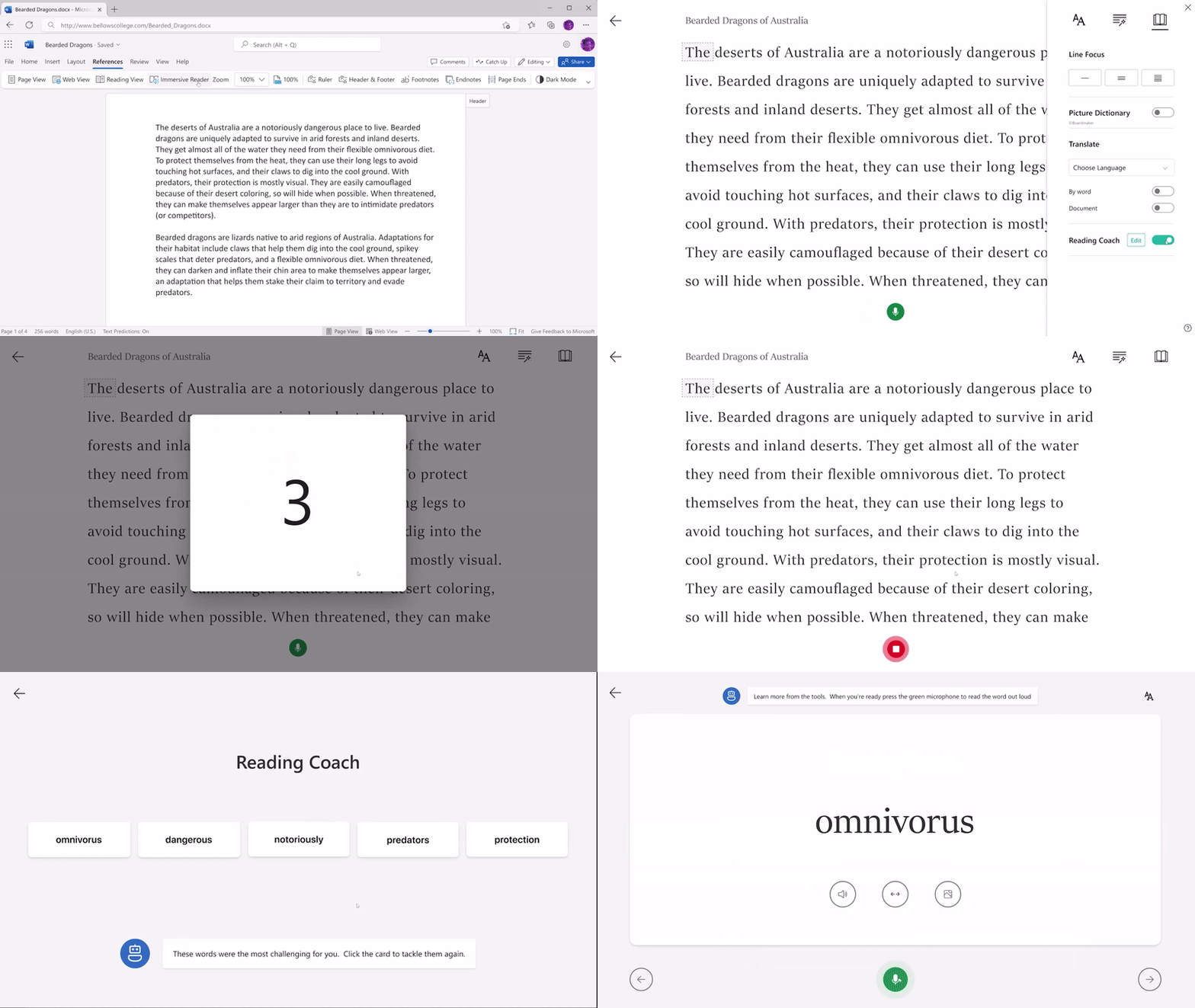
Last year, Reading Coach launched as part of Reading Progress in Microsoft Teams. Reading Coach provides students with personalized and independent practice that Reading Progress identifies a student has mispronounced. Reading Coach has proven to be popular not only with educators, but especially with students. We’ve heard stories from teachers of students “demanding more passages” from the teacher, and that they’ve set personal goals of improvement. To enable students to practice with content that aligns with their interests and focus, without the need for a teacher to make an assignment in Teams, we are rolling out Reading Coach as part of the Immersive Reader in many of our M365 apps. This will be available in school, consumer and work accounts, and in 116 languages and locales.
Now anyone using Immersive Reader, with any content they choose, can go to the Reading Preferences pane, enable Reading Coach to practice reading out loud and receive focused practice exercises. When the Reading Coach switch is enabled, the Play button in the Immersive Reader changes to a Microphone button. Students can select the Edit button near the Reading Coach toggle to customize parts of the coach inluding the voice, feedback style, and more. When the microphone button is selected, a dialog pops up that encourages the student to prepare to read out loud.
Once the student selects Let’s read, a 3…2…1 countdown appears, and practice begins. The student reads out loud for as long as they like while Immersive Reader “listens” to their performance. When finished, the reader selects Stop, and a reading report immediately provides data on their reading speed, accuracy, time spent reading, and any words to practice.
If the Practice Words button is clicked, the Reading Coach pops up to allow personalized practice. The Reading Coach interface is the exact same as the one in Reading Progress in Teams.
The initial set of apps that Reading Coach in Immersive Reader is available include Word for web, OneNote for web, Desktop, Mac and iPad, Teams Assignments, Flip and Minecraft Education. We expect to bring Reading Coach to more apps in the near future.
Updates to Education Insights Premium for Reading Progress
We’re excited to share that Education Insights Premium (including all Reading Progress data) is now included in all versions of Microsoft 365 Education including our no-cost Office 365 A1 license. Education Insights Premium enables education leaders to monitor student academic progress and wellbeing across their organization to help improve learning outcomes with actionable insights. Built with student safety, privacy, and security in mind, it helps schools support students while maintaining compliance with industry standards. Below is an example of a Reading Progress report across an entire school system.
Reading comprehension questions in Reading Progress
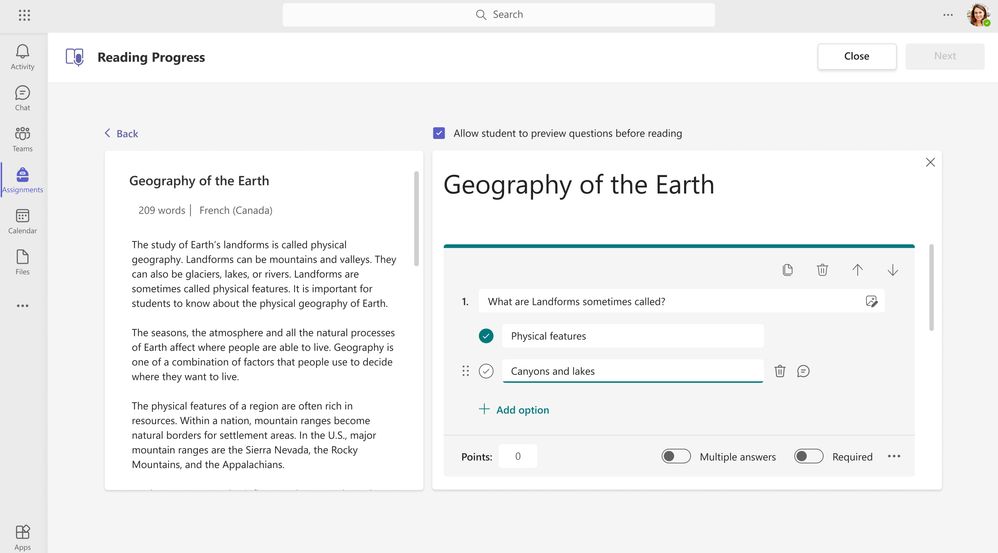
Our reading fluency app Reading Progress, launched in Microsoft Teams in fall of 2021. Reading Progress supports educators in increasing the frequency of reading fluency evaluations, helping them to differentiate more powerfully to support students on their fluency journey. The #1 request from educators and schools has been a desire to add reading comprehension questions for the student to complete after they read. We heard educator’s request and are excited to announce that we will be adding reading comprehension question support to reading progress later this year! Using Microsoft Forms technology, educators will be able to assess not only students’ fluency, but also their understanding, right in Reading Progress. Educators will be able to provide students with access to the questions prior to reading if they wish, a scaffolding strategy that can help students learn to read with purpose. The auto-grading capabilities of Microsoft Quiz will also be included to streamline grading of multiple-choice questions. We expect to have comprehension questions in private testing later in late spring of 2023.
Reading with expression (prosody) in Reading Progress
Reading fluency is composed of three pillars – speed, accuracy, and expression. The initial version of Reading Progress uses auto-detect to help track reading speed and accuracy, but historically an educator needs to listen to each student independently to gauge their expression.
With our forthcoming Expression update, Reading Progress will automatically identify students’ performance on aspects of prosody including monotone reading, long pauses, not pausing for a period or comma, voice inflection for question marks or exclamation points, and even the stress of multi-syllable words. Student expression results will be available in the teacher review experience, alongside accuracy and correct words per minute. Later, this information will be added to the student’s view of their returned work and incorporated in Insights so it can be easily monitored over time. Reading expression updates will begin rolling out to Reading Progress in late spring.
With the introduction of Reading Coach in Immersive Reader and the continued evolution of Reading Progress, we hope to maintain students’ excitement for and growth in literacy while supporting educators as they work to help every student reach their fluency goals.
Mike Tholfsen
Group Product Manager
Microsoft Education

This article is contributed. See the original author and article here.
With global volatility and inflation impacting organizations across all industries, business agility has never been more important. Leaders turn to finance teams to get real-time insight into business performance and recommendations on future initiatives that will help them thrive amid disruption. But finance teams are overwhelmed with manual tasks, cobbling together data, and disconnected teams. Achieving game-changing business agility begins with augmenting the human ingenuity of your people with intelligent process automation.
When it comes to reimagining processes with AI, automation, and analytics, many finance leaders don’t know where to start. This year, at the third annual Finance Reimagined digital event, we will delve into real-world best practices from Microsoft and industry leaders that will help you prioritize the right cost optimization, growth acceleration, and workforce transformation initiatives.
Tuesday, February 28, 2023, 9:00 AM to 10:15 AM Pacific Time (UTC-7)
Finance Reimagined is a virtual event bringing together finance leaders from around the world. On February 28, 2023, from 9:00 AM to10:15 AM PT, you can unpack the latest trends shaping the future of finance including the strategic evolution of the role of CFO within organizations, maintaining commitments to multiple stakeholders and bottom lines against a challenging economic environment, and the opportunities to drive transformation through the partnership of human ingenuity and AI.
Learn more and register for Finance Reimagined 2023.
You’ll discover best practices, trends, and priorities that are top of mind for CFOs and finance leaders. We’ve lined up experts from Microsoft, IDC, Avanade, EY, HSO, KPMG, and PwC to deliver actionable insights on how to strike the right balance between the following:
Find harmony between automation and your organization’s most important assetyour people. We will tackle one of the top concerns for CFOs today: workforce optimization. The heart of productivity sits in employee well-beingor the organization’s ability to increase creativity, job satisfaction, and ultimately, happiness. Human ingenuity is now business’ greatest investment to drive long-term vision and needs to be incentivized. Automation changes the way we work, thus organizational structures, required competencies, and roles must change as well. Get tips at Finance Reimagined on how to prioritize automation initiatives and how to use them to augment your people resources.
Embrace a dual role of gatekeeper and innovator to bring more strategic value to your organization. You’ll hear from a panel of finance leaders at Microsoft as they respond to trends from a recent study of more than 500 senior finance leaders from across all industries. Learn how Microsoft is empowering our finance leaders to do more with less to guide teams through these uncertain times. We will discuss tactics to optimize cash flow, increase operational effectiveness, and reinvest to meet growth expectations.
Organizational health has become increasingly dependent on data and tools to facilitate agile, data-driven decision making. Finance teams are doubling down on their efforts to keep up with our world’s increasingly volatile and interconnected markets that demand more fluid operating models, extending beyond the walls of an organization. This means that the role of the finance leader has evolved from being an economic guardian inside the walls of an enterprise to designing new business models that focus on delivering customer value outside of an enterprise. This evolution is only possible through a tight partnership between the CFO and Chief Technology Officer (CTO) to ensure data security while activating insights at every level of the organization. Join us for a discussion with the CFO and CTO at Robert Walters, a global recruitment and talent management company with a team of experts spanning 31 countries and serving more than 4,300 clients, to hear how they partnered to speed the time to insight within their organization.
Register today to attend Finance Reimagined for your look ahead at the emerging trends and essential insights defining how tomorrow’s businesses will thrive. We hope to see you there.
The post Leap into the future of finance at Finance Reimagined 2023 appeared first on Microsoft Dynamics 365 Blog.
Brought to you by Dr. Ware, Microsoft Office 365 Silver Partner, Charleston SC.

This article is contributed. See the original author and article here.
Official websites use .gov
A .gov website belongs to an official government organization in the United States.

Secure .gov websites use HTTPS
 ) or https:// means you’ve safely connected to the .gov website. Share sensitive information only on official, secure websites.
This article is contributed. See the original author and article here.
OpenSSL has released a security advisory to address multiple vulnerabilities affecting OpenSSL versions 3.0.0, 2.2.2, and 1.0.2. An attacker could exploit some of these vulnerabilities to obtain sensitive information.
CISA encourages users and administrators to review the OpenSSL advisory and make the necessary updates.
This article was originally posted by the FTC. See the original article here.
Brought to you by Dr. Ware, Microsoft Office 365 Silver Partner, Charleston SC.
This article was originally posted by the FTC. See the original article here.
Brought to you by Dr. Ware, Microsoft Office 365 Silver Partner, Charleston SC.




Recent Comments