by Contributed | May 26, 2021 | Technology
This article is contributed. See the original author and article here.
It’s Build week at Microsoft and I’m excited to see developers, students, and startups from around the world participate in all the great virtual sessions. During the past year, the pandemic accelerated existing trends in remote work. Even though people have recently started to transition back to the office, we expect that hybrid work will become a norm that fundamentally changes the cybersecurity landscape. As a result, most of our customers have embarked on a journey toward the modern Zero Trust security approach.
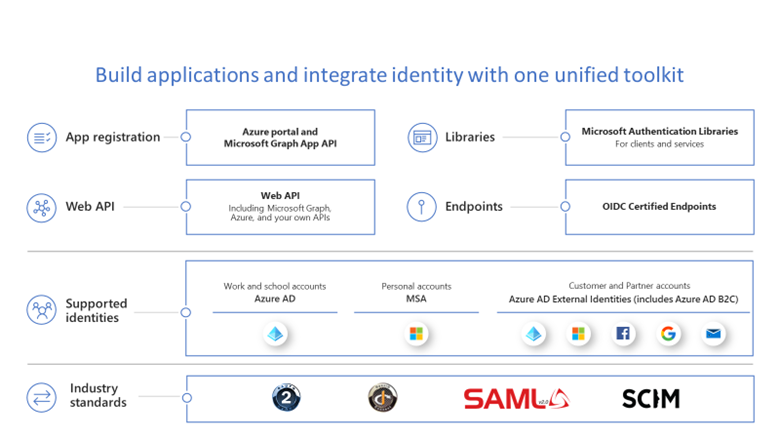
Zero Trust is a holistic security strategy that follows three simple principles – verify explicitly, use least privileged access, and assume breach. Each organization’s journey is unique and every single step of this journey can make the entire organization more secure. Every team and individual plays a role to make their organization more secure. If salute developers for their critical role in the successful implementation of Zero Trust strategies, like building trustworthy apps that follow Zero Trust principles. Applications should be ready for changes to work seamlessly when organizations start to roll out Zero Trust into their environments. To support these efforts, we have released innovative capabilities on the Microsoft identity platform that enable developers to lead the way in Zero Trust adoption. Let’s dive into the capabilities that can help you build Zero Trust-ready apps.
First Zero Trust principle: Verify explicitly
This principle recommends that apps authenticate and authorize based on all available data points, such as user identity, location, device health, and anomalies. It would be a tall order for developers to implement this principle on their own, but using the Microsoft identity platform would definitely get apps to achieve this.
Developers should maximize their chance of low-friction customer adoption in Zero Trust environments. With the Microsoft identity platform, developers can enable customers or IT teams to utilize built-in security capabilities for adhering to “Verify explicitly” principle.
For example, Conditional Access policies enable IT administrators to limit app access to only users who meet criteria specified by security. With Conditional Access authentication context, customers can leverage more granular step-up authentication available within Conditional Access policies. Also, Continuous Access Evaluation for Microsoft Graph lets Azure AD evaluate active user sessions in near real time and help IT revoke access to resources when events like device loss transpire.
We also recommend that developers use the Microsoft Authentication Libraries (MSAL) and choose modern protocols like OpenID Connect and OAuth2 to easily integrate with a great single sign-on experience and the latest innovations in identity. Also getting them publisher-verified will make it easier for customers and users to understand the authenticity of their applications. With Publisher Verification, developers can demonstrate that an application comes from a trusted publisher.
Second Zero Trust principle: Use least privileged access
According to this principle, apps and users should work with just the right amount of privileges and permissions needed to conduct their business. Some applications may be over-privileged, resulting in the blast radius being larger than it should be during a compromise.
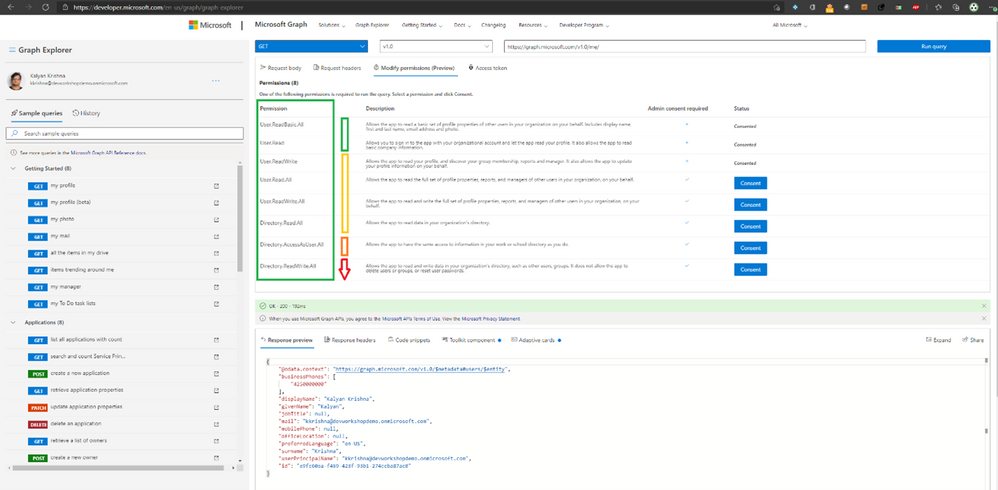
One example is the types of permission an application requests to call Microsoft Graph, the gateway to a tremendous amount of data in Microsoft Cloud. Applications request and consent to permissions to access data in Microsoft Graph, and users or admins must grant consent. Hence, it is critical to use the principle of least privilege when integrating apps with Microsoft Graph. We recommend that developers use a tool like Graph Explorer to choose the least privilege permission for the API they plan to use. Developers can request additional permissions when an app needs them using the incremental consent feature.
Another capability developers can provide to IT by integrating their apps with the Microsoft identity platform is to define app roles, such as for administrators, readers or contributors. To help customers adhere to the principle of using least privilege access, it is critical to make apps be ready to use Azure AD’s Privileged Identity Management (PIM) feature. With PIM, IT can provide just-in-time and time-bound access to sensitive app roles.
Zero Trust principle 3: Assume breach
This principle encourages app developers to assume that users are accessing apps on open networks and that breaches can affect their applications.
To minimize the blast radius, we recommend that developers keep all key secrets and credentials out of their code. Instead, consider using Azure Key Vault and Managed identities for secret rotations. These tools let IT administrators remove or rotate secrets without taking the application down or redeploying the app. To enable this, developers need to move the secret to the Azure Key Vault and access them via Managed identities.
How to build Zero Trust-ready apps
To learn more, check out the new developer and ISV guidance we’ve published to the Zero Trust Resource Center. It includes new development and integration resources for developing Zero Trust-ready apps.
Join us virtually or live, or watch on-demand
No matter where you are in the world, you can join us at Build 2021. There are plenty of live and pre-recorded sessions. To register, attend, and interact with us during these sessions, see below:
Breakout sessions
- BRK234: Build a Zero Trust-ready app starting with the Microsoft identity platform.
- BRK244: Learn three new ways to enrich your productivity apps with Microsoft Graph tools and data.
Technical session
- TS04: Enable the next generation of productivity experiences for hybrid work.
Community connections
- Ask the Experts: Build a Zero Trust-ready app (3 PM PT on 5/26, 5 AM PT on 5/27).
- Ask the Experts: Build B2C apps with External Identities.
- Product roundtable: Use managed identities in Azure to securely connect to cloud services.
- 1:1 Consults: Meet with an expert on the Microsoft identity platform.
On-demand sessions
- Best practices to build secure B2C apps with Azure Active Directory External Identities.
- Down with sign-ups, just sign-in (Decentralized Identities)
Best regards,
Alex Simons (@Alex_A_Simons)
Corporate VP of Program Management
Microsoft Identity Division
Learn more about Microsoft identity:
by Contributed | May 26, 2021 | Technology
This article is contributed. See the original author and article here.
Tuesday, June 8, 2021 (9 AM PT | 10 AM MT | 11 AM CT | 12 PM ET)
|
Join us for a live MS Teams event focused on Power BI Governance best practices for the Health & Life Sciences industry. This session will provide valuable information for organizations migrating to Power BI, expanding Power BI adoption, or launching Power BI. We’ll cover Tenant Settings, Security, Auditing and Monitoring Activity, Workspace & Gateway Settings, Deployment Pipelines, and Sharing.
P3 Adaptive presents a wealth of knowledge to the Microsoft community as a Microsoft Gold Partner and a different breed of industry and technology experts – passionate and genuinely interested in helping customers drive success in their organizations!
Connect, discover, and learn!
Use this Sign-Up Link to register for the LIVE virtual event
by Contributed | May 26, 2021 | Technology
This article is contributed. See the original author and article here.
Introduction
Log Analytics is Azure portals’ native way to edit and run log queries over data collected by Azure Monitor Logs and interactively analyze their results.
Log Analytics’ language is KQL queries – both simple and complex, KQL queries are used to create meaningful insights from the mountains of valuable data in your logs.
As your queries become more complex and interesting – the need grows to save, reuse and share those quires with your peers and colleagues.
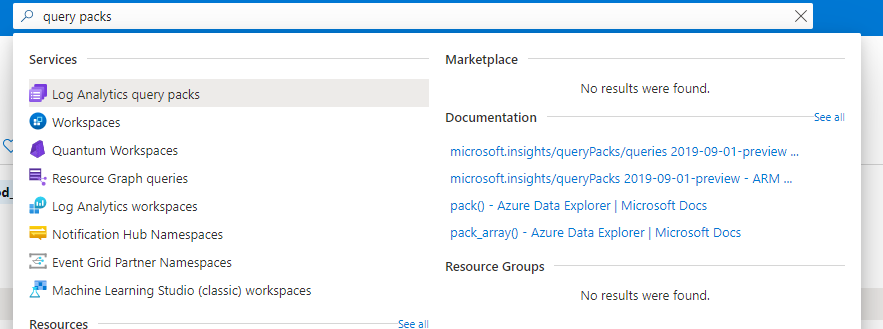
To address this we have announced in Microsoft Build the introduction of a new way to save, share and manage queries in Log Analytics – Query packs.
Log Analytics query packs
A log Analytics query pack is a container for queries, designed to store and manage queries in an effective way.
Query Packs are ARM objects – allowing users to granularly control various aspects of the query pack including permissions, where it is stored, deployment etc.
Query packs exist at the subscription level – meaning your queries stored in a Query Pack are available to your users across Log Analytics resources and workspaces – eliminating silos. Save your query once, and use it everywhere in Log Analytics.
Managing your query packs
Query packs are designed as ARM objects.
As such they allow:
1. Management of permissions at the Query Pack level.
2. Deploy by code – to your subscription or others.
3. Export Query Pack.
4. Manage Query Packs via API.
API
Query pack operations may also be carried out through our API.
This enables deployment and management of query packs via code.
Using the Query Packs API to programmatically save queries and Query packs opens additional possibilities that are not available in the UI, for example, when using the API you may define additional tags for your queries.
As those advanced capabilities have a profound effect on the user experience of queries in Log Analytics, we have only enabled them using the API – so users and organizations choosing to leverage the more advanced capabilities of Query packs will have consideration and agency when extending their tags and terminology.
To learn more about the query pack API click here.
RBAC and access control
As query packs are ARM objects you can control their permissions and access granularly – as you would any other Azure resource.
To control a Query Packs’ permissions, go to the IAM menu in the Query Packs’ resource menu:

Please note that all queries in the Query Pack will inherit permissions from the Query pack.
To learn more about query pack permissions management click here.
Queries in Log Analytics query packs
Queries stored in Log Analytics Query Packs have many advantages over legacy queries stored in a workspace:
1. Query packs are cross Log Analytics – use your query packs queries everywhere, including resource centric scenarios
2. Metadata – Query packs queries allow for tags and additional metadata making query discovery easier and more intuitive.
3. Permission control – Queries in Query Packs inherit the Query Packs’ permissions so you can manage who can see your queries and use them, and who can edit and contribute to the query pack, on a Query Pack basis.
To learn more about query metadata click here.
Discovering queries in Log Analytics
Query packs Queries are an integral part of the queries dialog and the queries sidebar.
When you enter Log Analytics, query experiences will load query packs content, right in the queries dialog and sidebar:
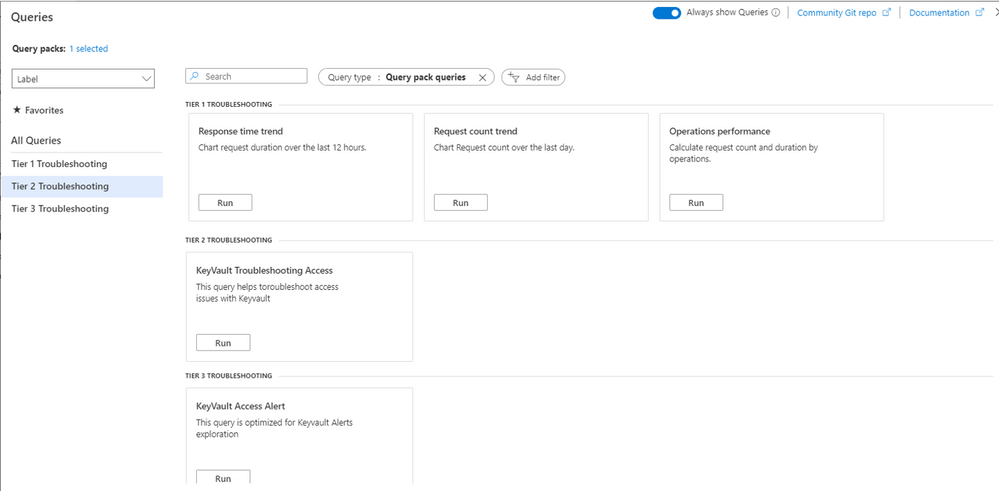
By default, Log Analytics will load the default query pack in the subscription. However, you can change the Query Packs loaded and Log Analytics will remember your choice:
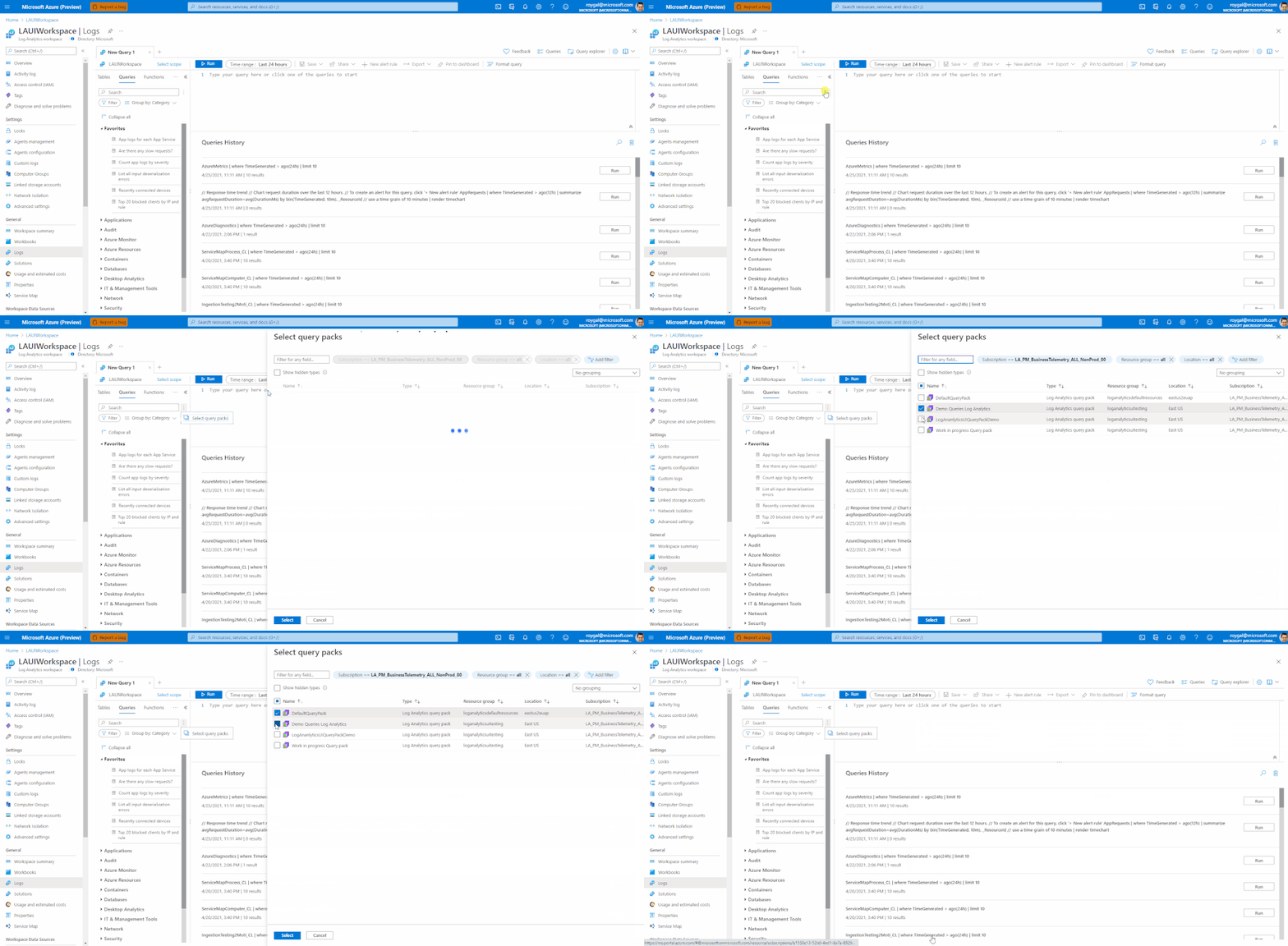
The Log Analytics UI is contextual and will automatically choose the best queries to show in context. For example, when loading queries in a specific resource, the Log Analytics UI will automatically filter your queries by resource type, building on the queries ‘resource type’ tag – defined when saving the queries to only show queries relevant for the context you are in.
The Log Analytics experience allows you to choose how to organize your queries and how to filter them – to help you get the queries you are looking for – fast:
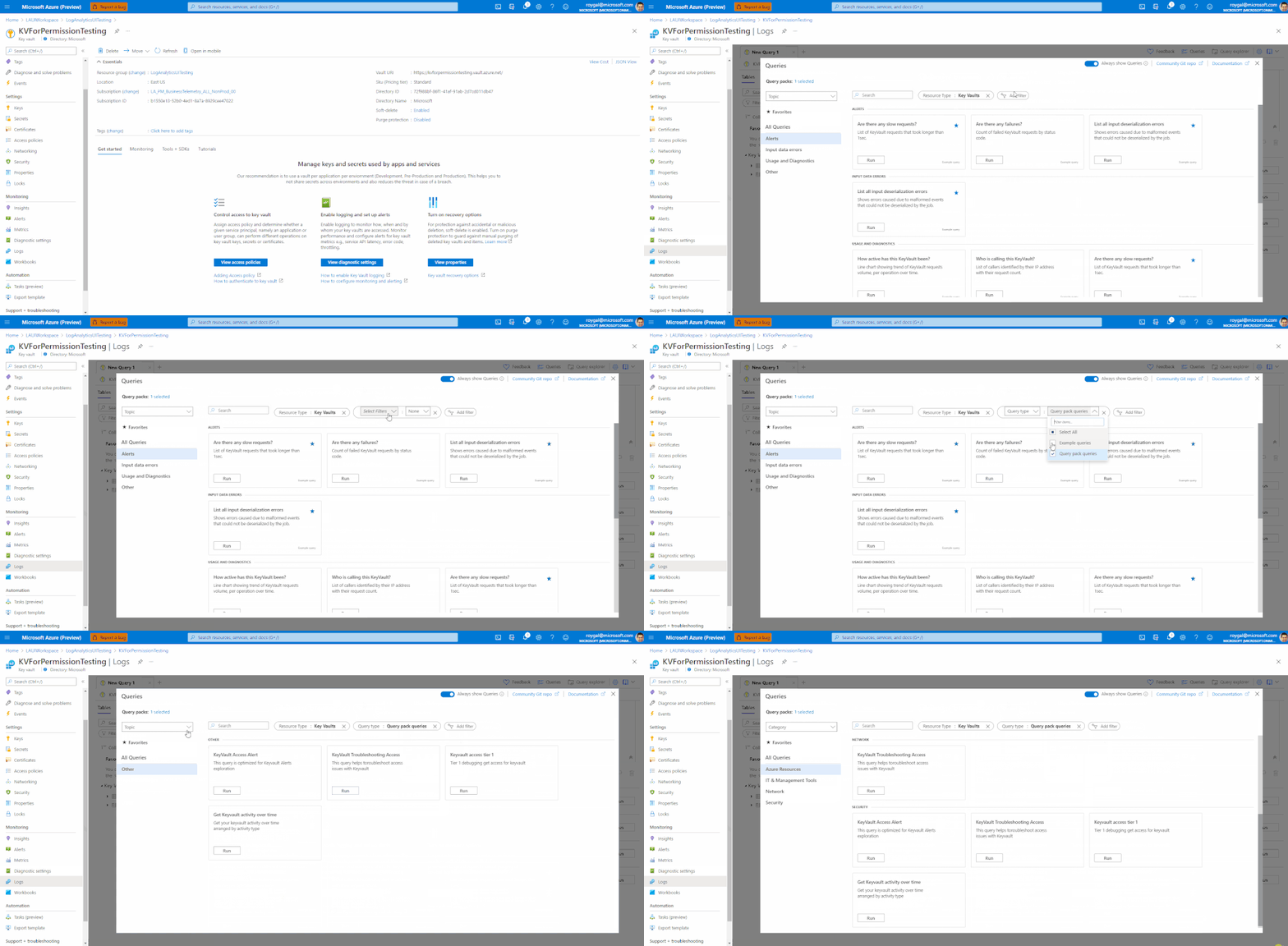
To learn more about the Query Packs discovery experience – click here.
Saving queries to a query pack
Saving a query to a query pack is quick and easy. Use Log Analytics query editor to create your query and click “save”->”Save as Log Analytics Query”.
When you save your query you will be asked to provide some metadata for your query:
1. Query name – your query’s name – that will be shown in the UI
2. Query description – a short description of your query’s functionality
3. Resource type – select the relevant resource types form a list, you may select more then one relevant resource type
4. Category – select the relevant category from a list, you may select more then one category
5. Label – this is a user controlled field. Each query pack has a set of user managed labels. You may choose an existing label or create a new one.
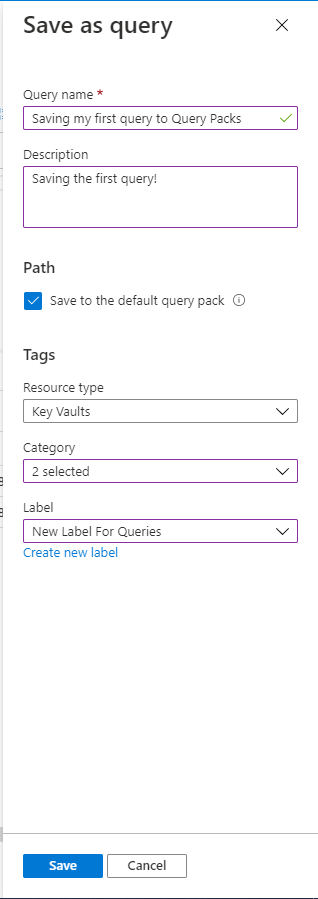
Once you are done click “Save” – Log Analytics will inform you that saving the query was successful.
Note: as Query Packs are permission controlled – you must have sufficient permissions to save and update queries in a Query Pack.
Advanced aspects in saving a query to a Query Pack:
By default, your query will be saved to the Default Query Pack. The default query pack is an automatically generated Query Pack that will be created for you by Log Analytics when a query is first saved to the subscription.
However, Log Analytics allows you to choose what Query Pack you want to use when saving queries.
To do this, simply remove the check mark from the “save to the default Query Pack” setting under the “path” section of the Query save blade.
You will now be able to choose the path for your query:

Note: Query packs are permission controlled, therefore you must have sufficient permissions to change or add queries to a query pack.
To learn more about saving a query to a Query Pack click here.
Editing a query and it’s metadata
To edit a query or its metadata – load the query to a blank Log Analytics tab.
Change your query as needed and click “Edit Query Details” under the “Save” menu to access the query metadata edit screen.
Make your adjustments and save. Your query will be updated.
Note: as a query is linked to a specific query pack, you will not be able to change the query pack when updating details. To move a query between query packs, save the query to the new Query Pack and delete the old query.
Query Explorer Queries – Legacy Queries
In the long run, Query Packs will replace the old Query Explorer queries.
In the interim, Query Explorer queries will coincide and will continue to work side by side with Query Packs queries.
Next releases will unify the consumption experiences so Query Explorer queries – now named Legacy Queries will be loaded in the same, upgraded UI as all Log Analytics queries.
We encourage you to start transferring your queries to Query Packs and enjoy the advanced functionality they offer.
Summary
Query Packs are a huge leap forward for Log Analytics. Query Packs break the silos in the organization and allows query creators and Log Analytics users to share knowledge and build on the accumulated knowledge of the organization – re using queries and assets.
Query Packs also offer the organization an opportunity to create custom experiences in Log Analytics using the API. Your organization can create queries and organize them according to the terminology and taxonomy right for you.
Permission controls and code based deployments make Query Packs perfect for the larger organizations while keeping things simple and easy with strong defaults and one click save to the default Query Pack.
We hope you enjoy Query Packs and urge you to save your first query today.
Feedback
We appreciate your feedback! comment on this blog post and let us know what you think of the this feature.
You may also use our in app feedback feature to provide us with additional feedbacks:

by Contributed | May 26, 2021 | Technology
This article is contributed. See the original author and article here.
At Microsoft, we are always looking for ways to empower our customers to achieve more by delivering our most advanced AI-enabled services. In March 2021, we launched the preview release of semantic search on Azure Cognitive Search, which allows our customers’ search engines to retrieve and rank search results based on the semantic meaning of search keywords rather than just their syntactical interpretation. We introduced this functionality by leveraging state-of-the-art language models that power Microsoft Bing search scenarios across several languages – a result of the recent advancements in developing large, pretrained transformer-based models as part of our Microsoft AI at Scale initiative.
Today, we are excited to announce that we are extending these capabilities to enable semantic search across multiple languages on Azure Cognitive Search.
Search scenarios
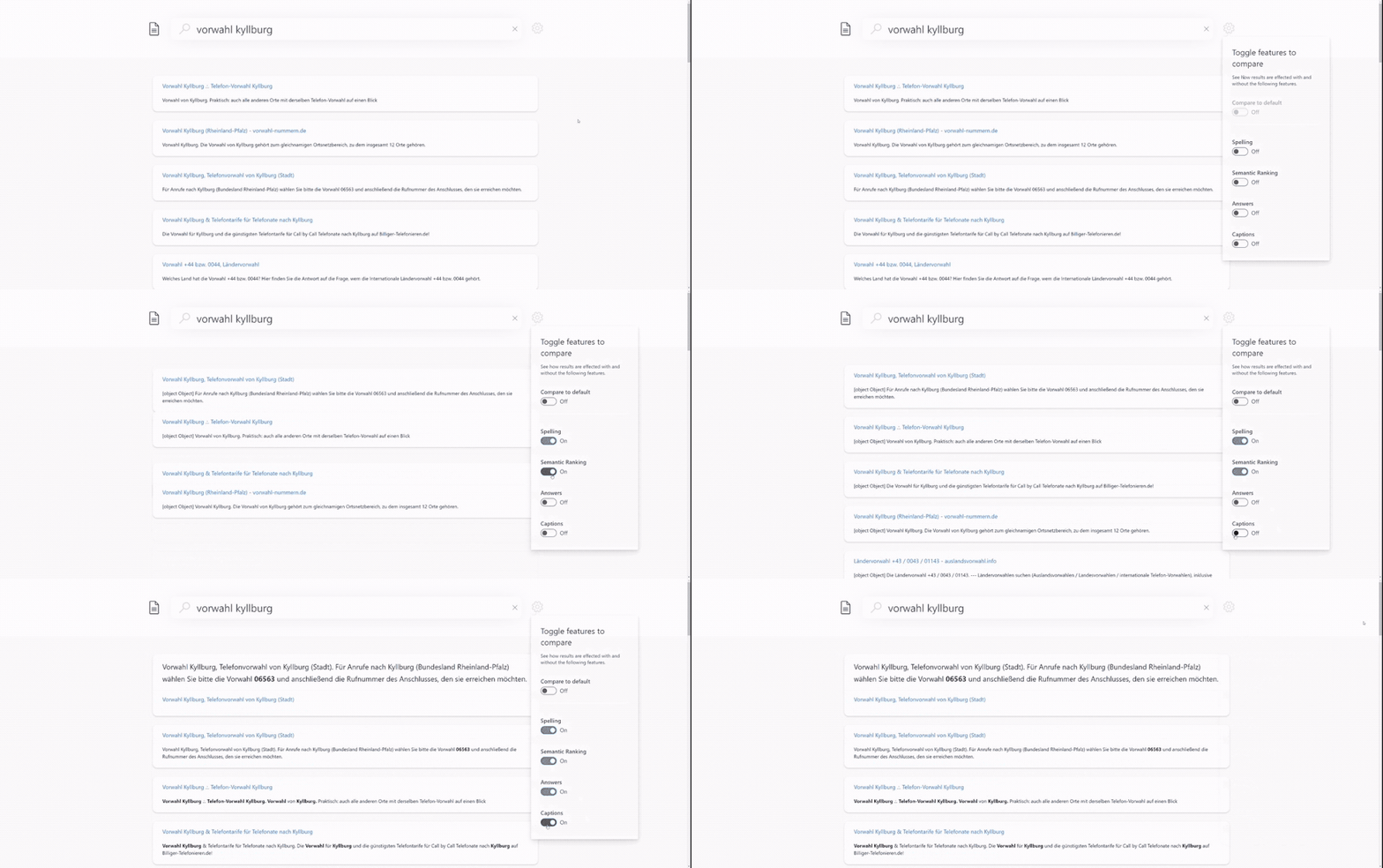
Semantic search consists of three scenarios – semantic ranking, captions and answers – and customers can easily enable them via the REST API or Azure Portal to get semantic search results. The following examples illustrate how these scenarios are being delivered across different languages, where we rank search results based on our semantic ranker, followed by extracting and semantically highlighting the answer to the search query.
Figure 1. Semantic search in German language. English translated query is {area code kyllburg}. Sample index is based on the XGLUE benchmark dataset for cross-lingual understanding.
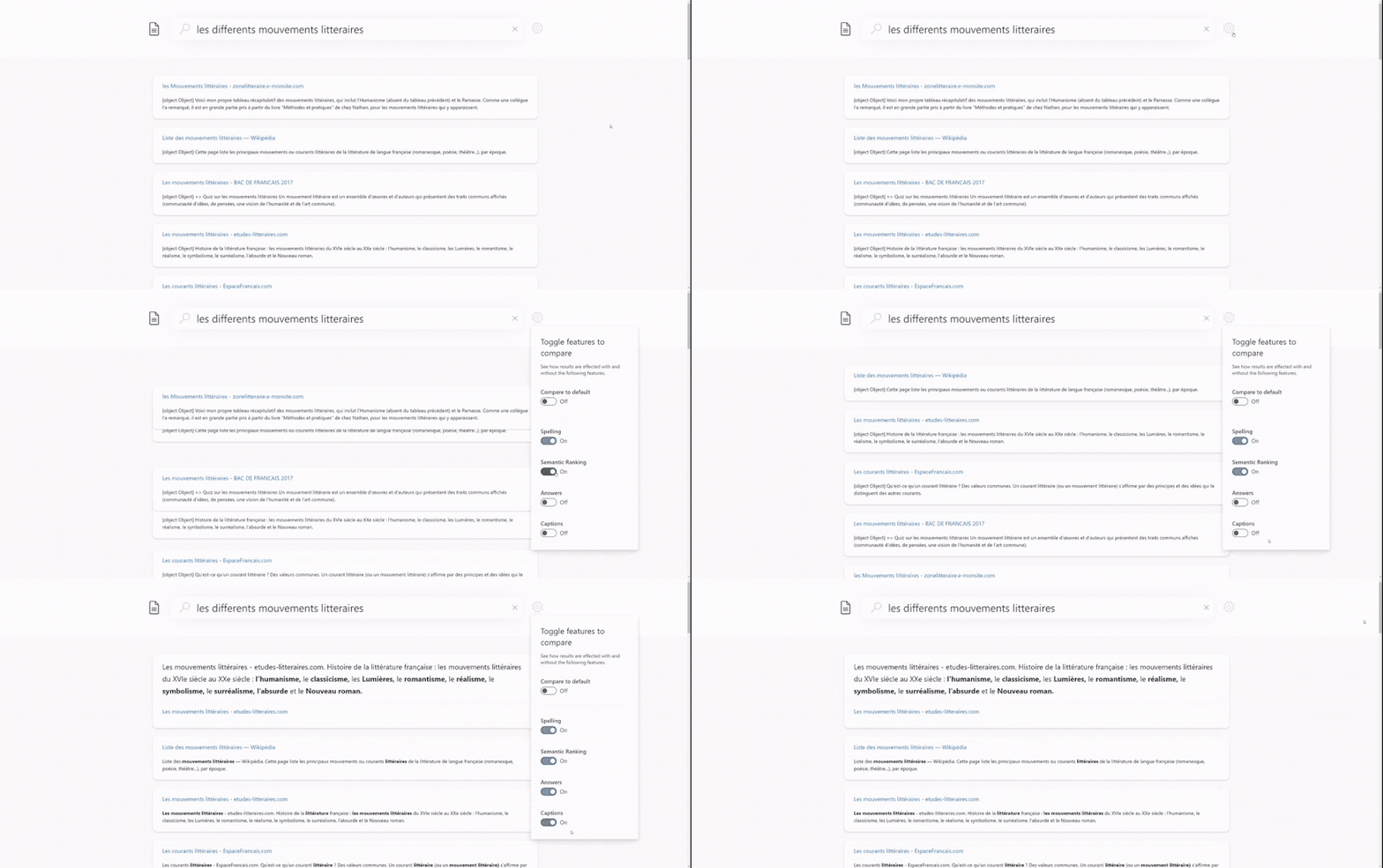 Figure 2. Semantic search in French language. English translated query is {different literary movements}. Sample index is based on the XGLUE benchmark dataset for cross-lingual understanding.
Models and evaluations
The language models powering semantic search are based on our state-of-the-art Turing multi-language model (T-ULRv2) that enables search across 100+ languages in a zero-shot fashion. Using global data from Bing, these models have been fine-tuned across various tasks to enable high-quality semantic search features for multiple languages and have been distilled further to optimize for serving real-world online scenarios at a significantly lower cost. Below is a list of the various innovations that are powering semantic search today.
UniLM (Unified Language Model pre-training)
Graph attention networks for machine reading comprehension
Multi-task deep neural networks for natural language understanding
MiniLM distillation for online serving in real-life applications
Since their introduction, the models have been serving Bing search traffic across several markets and languages, delivering high-quality semantic search results to Bing users worldwide. Additionally, we have validated the quality of semantic ranking on Azure Cognitive Search using a variety of cross-lingual datasets – these include academic benchmark datasets (e.g. XGLUE web page ranking) as well as real-world datasets from services currently powered by Azure Cognitive Search (e.g. Microsoft Docs). Our results showed several points of gain in search relevance metrics (NDCG) over the existing BM25 ranker for various languages such as French, German, Spanish, Italian, Portuguese, Chinese and Japanese. For semantic answers, our evaluations were based on multiple datasets focused on Q&A tasks. Current academic benchmark leaderboards for Q&A scenarios measure accuracy of answer extraction for a given passage. However, our assessments were required to go a step further and consider more real-world intricacies involving multiple steps (see Figure 3) to extract an answer from a search index: (1) documents retrieval from the search index, (2) candidate passage extraction from the given documents, (3) passage ranking across candidate passages, and (4) answer extraction from the most relevant passage. We observed that our model accuracy for French, Italian, Spanish and German languages is equivalent to that of English language.
 Figure 3. Semantic answer extraction in Azure Cognitive Search.
Get started
The following table summarizes the set of languages and queryLanguage parameter values that we currently support via the REST API to enable semantic search on Azure Cognitive Search. Note that we have also added speller support for Spanish, French and German languages. For languages marked as “preview”, we encourage you out to try the capability for your search index and give us your feedback. For detailed instructions on how to configure semantic search for your target language, please refer to our documentation.
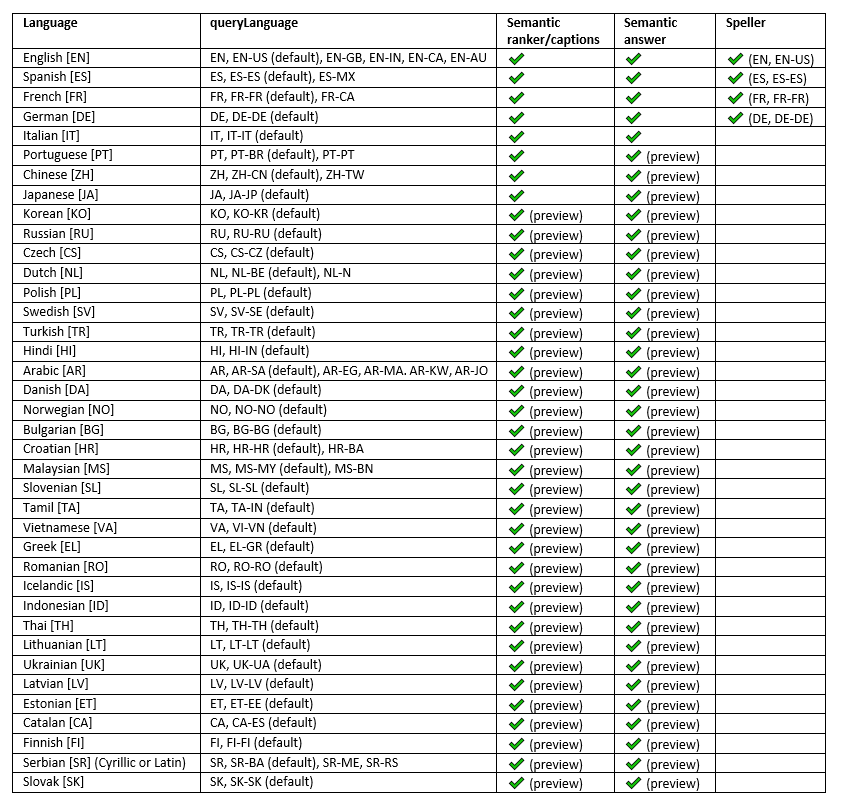 Table 1. Supported languages for semantic search on Azure Cognitive Search.
Conclusion
With additional support for new languages, we are very excited to extend access to our state-of-the-art AI-enabled search capabilities to developers and customers worldwide. Please sign up for our preview to try out semantic search today!
References
https://aka.ms/semanticgetstarted
by Contributed | May 26, 2021 | Technology
This article is contributed. See the original author and article here.
Introduction
Formik is the world’s most popular open-source form library for React and React Native. We can also use this library in our SPFx web part as well to manage form validations. Using this library we don’t have to write custom validations. so let’s start step-by-step implementation.
What is formik?
Formik is a small library that helps us with the these parts: Getting values in and out of form state. Validation and error messages. Handling form submission.
Formik is designed to manage forms with complex validation with ease.
Formik supports synchronous and asynchronous form-level and field-level validation.
Furthermore, it comes with baked-in support for schema-based form-level validation through Yup.
For more details about Fromik refer to the below articles,
Formik official documentation
Manage Forms In React With Formik
Formik validation Schema
SharePoint List Structure
Create a list called Tasks with below fields,
Field Name(Internal name) |
Field Type |
Title (default) |
Single line of text |
StartDate |
Date and Time (Date only)
|
EndDate |
Date and Time (Date only) |
ProjectName |
Single line of text |
TaskDetails |
Multiple lines of text |
After the creation of the list, we will start to create the SPFx web part.
Formik implementation with SPFx
Open a command prompt
Move to the path where you want to create a project
Create a project directory using:
md react-formik
Move to the above-created directory using:
cd react-formik
Now execute the below command to create an SPFx solution:
yo @microsoft/sharepoint
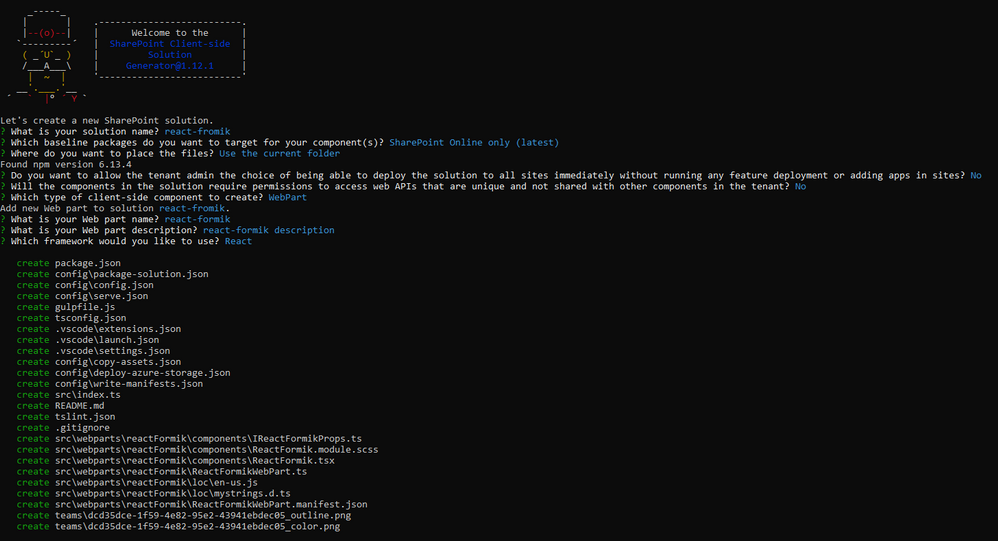
It will ask some questions, as shown below,
After a successful installation, we can open a project in any source code tool. Here, I am using the VS code, so I will execute the command:
code .
Now we will install the following packages:
npm i formik
npm i yup
npm i @pnp/spfx-controls-react
npm i @microsoft/sp-dialog
In the end, our output will be like this,
After the successful installation, we will start our form implementation.
1. Create below files
I{webpartname}State.ts inside src/webparts/reactFormik/components
SPService.ts file inside src/webparts/shared/service
In the end, our structure will be looks like this,
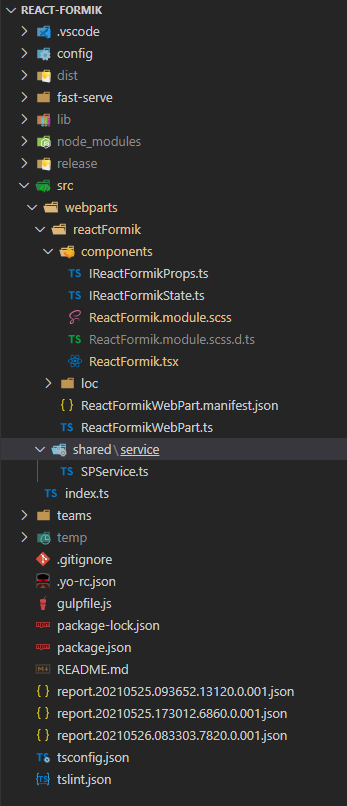
2. Create a state interface as below inside IReactFormikState.ts.
export interface IReactFormikState {
  projectName?: string;
  startDate?: any;
  endDate?: any;
}
3. Create a method to create a task inside SPService.ts.
import "@pnp/sp/webs";
import "@pnp/sp/lists";
import "@pnp/sp/items";
import "@pnp/sp/webs";
import "@pnp/sp/site-users/web";
import { Web } from "@pnp/sp/webs";

export class SPService {

    private web;

    constructor(url: string) {
        this.web = Web(url);
    }

    public async createTask(listName: string, body: any) {
        try {
            let createdItem = await this.web.lists
                .getByTitle(listName)
                .items
                .add(body);
            return createdItem;
        }
        catch (err) {
            Promise.reject(err);
        }
    }
}
4. Move to the ReactFormikWebPart.ts. In this, we will pass the current SP context and read site URL from user.
import * as React from 'react';
import * as ReactDom from 'react-dom';
import { Version } from '@microsoft/sp-core-library';
import {
  IPropertyPaneConfiguration,
  PropertyPaneTextField
} from '@microsoft/sp-property-pane';
import { BaseClientSideWebPart } from '@microsoft/sp-webpart-base';

import * as strings from 'ReactFormikWebPartStrings';
import ReactFormik from './components/ReactFormik';
import { IReactFormikProps } from './components/IReactFormikProps';
import { sp } from "@pnp/sp/presets/all";

export interface IReactFormikWebPartProps {
  description: string;
  siteUrl: string;
}

export default class ReactFormikWebPart extends BaseClientSideWebPart<IReactFormikWebPartProps> {

  protected onInit(): Promise<void> {

    return super.onInit().then(_ => {
      sp.setup({
        spfxContext: this.context
      });
    });
  }

  public render(): void {
    const element: React.ReactElement<IReactFormikProps> = React.createElement(
      ReactFormik,
      {
        description: this.properties.description,
        context: this.context,
        siteUrl: this.properties.siteUrl ? this.properties.siteUrl : this.context.pageContext.web.absoluteUrl
      }
    );

    ReactDom.render(element, this.domElement);
  }

  protected onDispose(): void {
    ReactDom.unmountComponentAtNode(this.domElement);
  }

  protected get dataVersion(): Version {
    return Version.parse('1.0');
  }

  protected getPropertyPaneConfiguration(): IPropertyPaneConfiguration {
    return {
      pages: [
        {
          header: {
            description: strings.PropertyPaneDescription
          },
          groups: [
            {
              groupName: strings.BasicGroupName,
              groupFields: [
                PropertyPaneTextField('description', {
                  label: strings.DescriptionFieldLabel
                }),
                PropertyPaneTextField('siteUrl', {
                  label: strings.SiteUrlFieldLabel
                })
              ]
            }
          ]
        }
      ]
    };
  }
}
5. Move to the ReactFormik.tsx file to render form and validations
yup syntaxs:
1. For string: yup.string().required(‘Required’)
2. For date: yup.date().required(‘Required’).nullable()
Related to Formik
1. Fromik has its own handleReset and handleSubmit method so we don not have to manage manually
2. We have to set state value and error message from control so for that I have created a common method
1. In the constructor, we will set the current SP context, bind the service and required methods and initialize the states.
2. Create createRecord() to create task list item using SPService.
3. In the render(), first we will add all the controls like date picker, text field, people picker, and dropdown, etc inside <Formik>.
then We will set properties as below,
initialValues – This is one type o state at here we will set empty or null or undefined as an initial level.
validationSchema – At here we will do validations using yup. so for this, I am creating one const and wills et this constant in this prop.
onSubmit – At here we will call the method to create a record in the SharePoint list
import * as React from 'react';
import styles from './ReactFormik.module.scss';
import { IReactFormikProps } from './IReactFormikProps';
import { IReactFormikState } from './IReactFormikState';
import { SPService } from '../../shared/service/SPService';
import { TextField } from '@fluentui/react/lib/TextField';
import { Stack, } from '@fluentui/react/lib/Stack';
import { Formik, FormikProps } from 'formik';
import { Label } from 'office-ui-fabric-react/lib/Label';
import * as yup from 'yup';
import { PeoplePicker, PrincipalType } from "@pnp/spfx-controls-react/lib/PeoplePicker";
import { DatePicker, Dropdown, mergeStyleSets, PrimaryButton, IIconProps } from 'office-ui-fabric-react';
import { sp } from '@pnp/sp';
import { Dialog } from '@microsoft/sp-dialog';

const controlClass = mergeStyleSets({
  control: {
    margin: '0 0 15px 0',
    maxWidth: '300px',
  },
});

export default class ReactFormik extends React.Component<IReactFormikProps, IReactFormikState> {

  private cancelIcon: IIconProps = { iconName: 'Cancel' };
  private saveIcon: IIconProps = { iconName: 'Save' };
  private _services: SPService = null;

  constructor(props: Readonly<IReactFormikProps>) {
    super(props);
    this.state = {
      startDate: null,
      endDate: null
    }
    sp.setup({
      spfxContext: this.props.context
    });

    this._services = new SPService(this.props.siteUrl);
    this.createRecord = this.createRecord.bind(this);
  }

  /** set field value and error message for all the fields */
  private getFieldProps = (formik: FormikProps<any>, field: string) => {
    return { ...formik.getFieldProps(field), errorMessage: formik.errors[field] as string }
  }

  /** create record in sharepoint list */
  public async createRecord(record: any) {
    let item = await this._services.createTask("Tasks", {
      Title: record.name,
      TaskDetails: record.details,
      StartDate: record.startDate,
      EndDate: new Date(record.endDate),
      ProjectName: record.projectName,
    }).then((data) => {
      Dialog.alert("Record inseterd successfully !!!");
      return data;
    }).catch((err) => {
      console.error(err);
      throw err;
    });
  }

  public render(): React.ReactElement<IReactFormikProps> {
    /** validations */
    const validate = yup.object().shape({
      name: yup.string().required('Task name is required'),
      details: yup.string()
        .min('15', 'Minimum required 15 characters')
        .required('Task detail is required'),
      projectName: yup.string().required('Please select a project'),
      startDate: yup.date().required('Please select a start date').nullable(),
      endDate: yup.date().required('Please select a end date').nullable()
    })

    return (
      <Formik initialValues={{
        name: '',
        details: '',
        projectName: '',
        startDate: null,
        endDate: null
      }}
        validationSchema={validate}
        onSubmit={(values, helpers) => {
          console.log('SUCCESS!! :-)nn' + JSON.stringify(values, null, 4));
          this.createRecord(values).then(response => {
            helpers.resetForm()
          });
        }}>
        { formik => (
          <div className={styles.reactFormik}>
            <Stack>
              <Label className={styles.lblForm}>Current User</Label>
              <PeoplePicker
                context={this.props.context as any}
                personSelectionLimit={1}
                showtooltip={true}
                showHiddenInUI={false}
                principalTypes={[PrincipalType.User]}
                ensureUser={true}
                disabled={true}
                defaultSelectedUsers={[this.props.context.pageContext.user.email as any]}
              />

              <Label className={styles.lblForm}>Task Name</Label>
              <TextField
                {...this.getFieldProps(formik, 'name')} />

              <Label className={styles.lblForm}>Project Name</Label>
              <Dropdown
                options={
                  [
                    { key: 'Project1', text: 'Project1' },
                    { key: 'Project2', text: 'Project2' },
                    { key: 'Project3', text: 'Project3' },
                  ]
                }
                {...this.getFieldProps(formik, 'projectName')}
                onChange={(event, option) => { formik.setFieldValue('projectName', option.key.toString()) }}
              />

              <Label className={styles.lblForm}>Start Date</Label>
              <DatePicker
                className={controlClass.control}
                id="startDate"
                value={formik.values.startDate}
                textField={{ ...this.getFieldProps(formik, 'startDate') }}
                onSelectDate={(date) => formik.setFieldValue('startDate', date)}
              />

              <Label className={styles.lblForm}>End Date</Label>
              <DatePicker
                className={controlClass.control}
                id="endDate"
                value={formik.values.endDate}
                textField={{ ...this.getFieldProps(formik, 'endDate') }}
                onSelectDate={(date) => formik.setFieldValue('endDate', date)}
              />

              <Label className={styles.lblForm}>Task Details</Label>
              <TextField
                multiline
                rows={6}
                {...this.getFieldProps(formik, 'details')} />

            </Stack>
            <PrimaryButton
              type="submit"
              text="Save"
              iconProps={this.saveIcon}
              className={styles.btnsForm}
              onClick={formik.handleSubmit as any}
            />
            <PrimaryButton
              text="Cancel"
              iconProps={this.cancelIcon}
              className={styles.btnsForm}
              onClick={formik.handleReset}
            />
          </div>
        )
        }
      </Formik >
    );
  }
}
6. Move to the ReactFormik.module.scss file to add some relaetd CSS.
@import '~office-ui-fabric-react/dist/sass/References.scss';
.reactFormik{
  .btnsForm {
    background-color: "[theme:themePrimary, default:#0078d7]";
    border-color: "[theme: themePrimary, default: #0078d7]";
    color: "[theme:white, default:white]" ;
    margin-left: 10px;
    margin-top: 10px;
  }
  .customErrorMeesage{
    color: var(--red-color);
    font-size: 10px;
    font-family: 'Light';
    padding: 2px;
  }
  .lblForm{
  font-size: 15px;
  margin:  5px 0px 5px 0px;
  }
}
Now serve the application using the below command,
gulp serve
Now test the webpart in SharePoint-SiteURL + /_layouts/15/workbench.aspx.
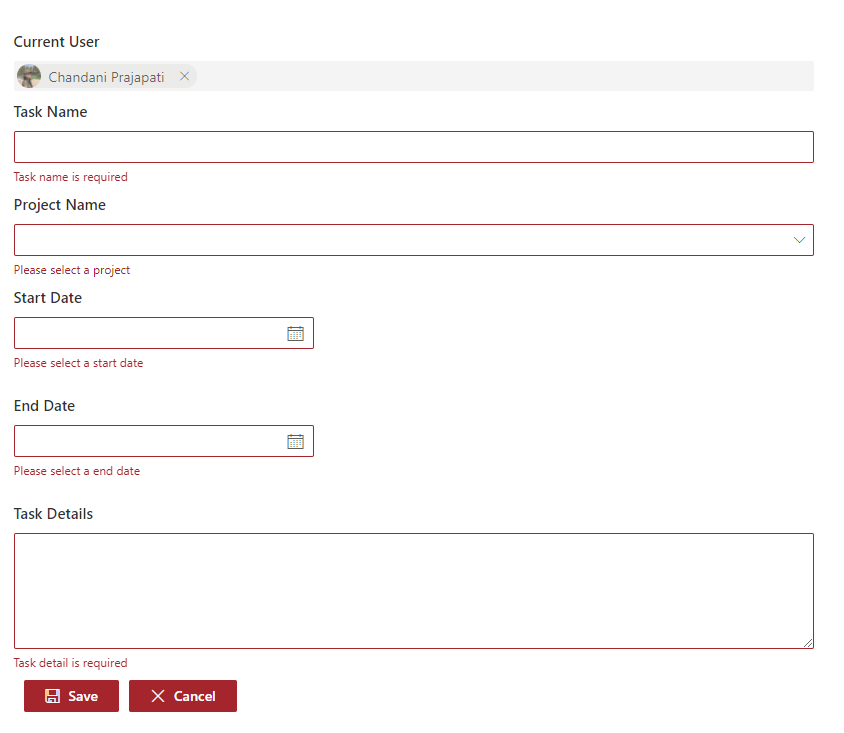
Output
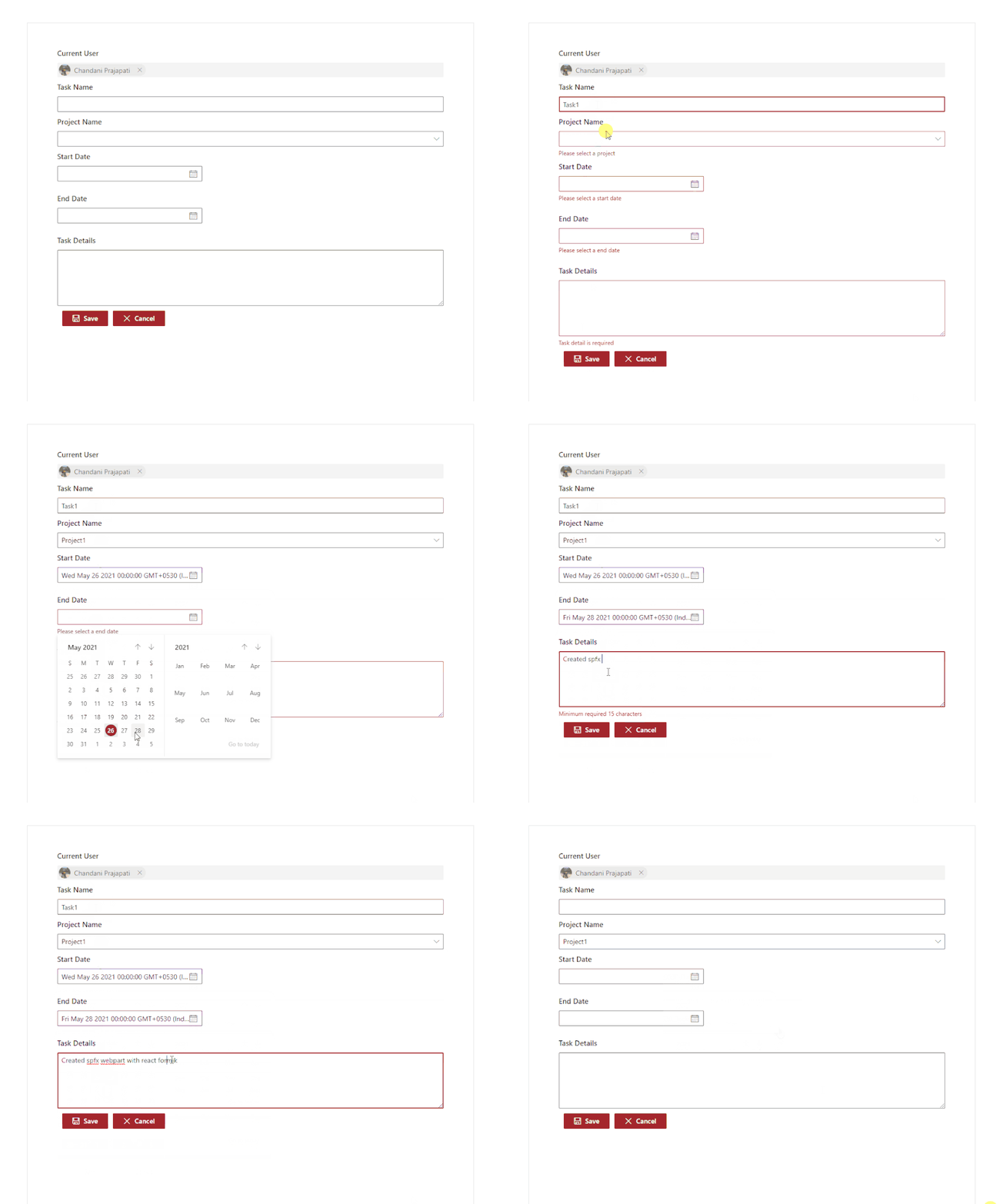
Find the full source code here.
Summary
In this article, we have seen how to implement react formik library in SPFx.
I hope this helps.
Sharing is caring!!


Recent Comments