Confront the misconceptions slowing your move to Dynamics 365

Confront the misconceptions slowing your move to Dynamics 365

This article is contributed. See the original author and article here.

Has your perception of the cloud kept up with advancements in technology? Economic and logistic disruptions from COVID-19 have compelled most organizations to reassess whether their legacy systems can deliver on modern goals and priorities. While shifting market conditions have accelerated cloud adoption, some are still weighing the benefits. These businesses have allowed on-premises nostalgia to take hold and determine their cloud strategy.

Don’t allow misconceptions to dictate your journey. Get expert help through the Microsoft Dynamics 365 migration program to move from Dynamics AX or Dynamics CRM to Dynamics 365.

Addressing misconceptions about cloud migration

Moving to the cloud is no small decision. Dynamics 365 on-premises customers historically point to cost, timing, and complexity as reasons to delay or not to migrate. Cloud innovation and process advancements will only continue to erode these inaction arguments, further widening the gap with on-premises solutions.

Cost is always a decision factor. Are the benefits gained greater than the expense? Migrating, like anything, requires funding and resources. However, the hidden costs of remaining on-premises and maintaining your current solution are growing. Consider the graveyard of customizations you’ve built over the years that are no longer in use. Organizations need to weigh the total cost of ownershipinfrastructure costs, support costs, and upgrade coststo make a true cloud and on-premises comparison.
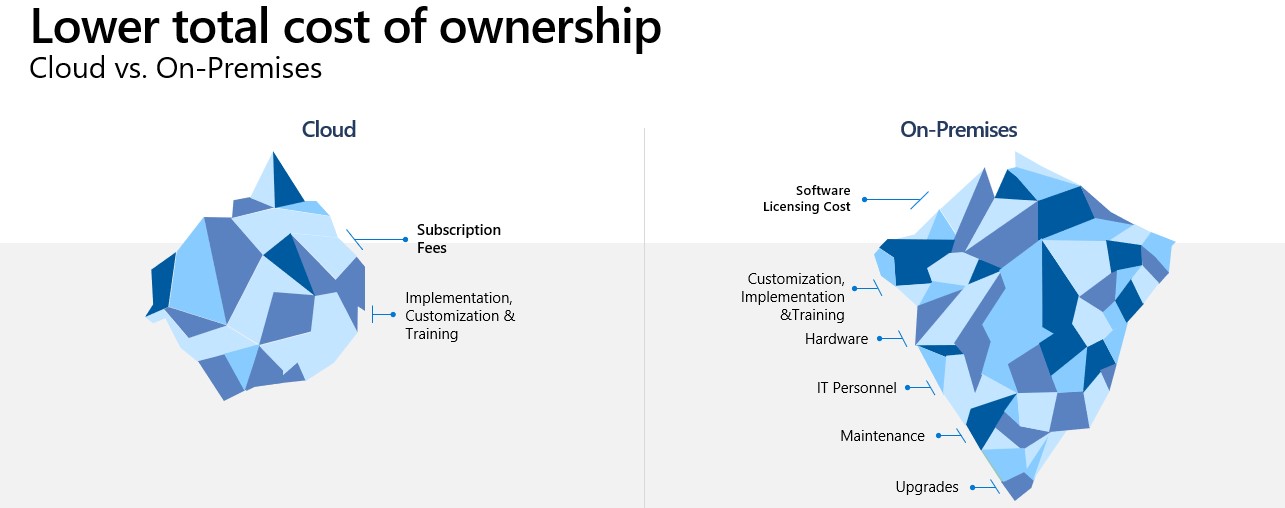
Image of two icebergs representing the lower cost of ownership of cloud verses on premises costs.

Migrating to the cloud should be a business priority. While customizations and data can make the process time-consuming, few business investments can provide similar efficiency gains. Microsoft engineered the On-Premises to Online Migration Factory to help Dynamics CRM customers. This end-to-end migration process provides a guided way to move on-premises instances without the need of reimporting the datathus reducing time and costs.
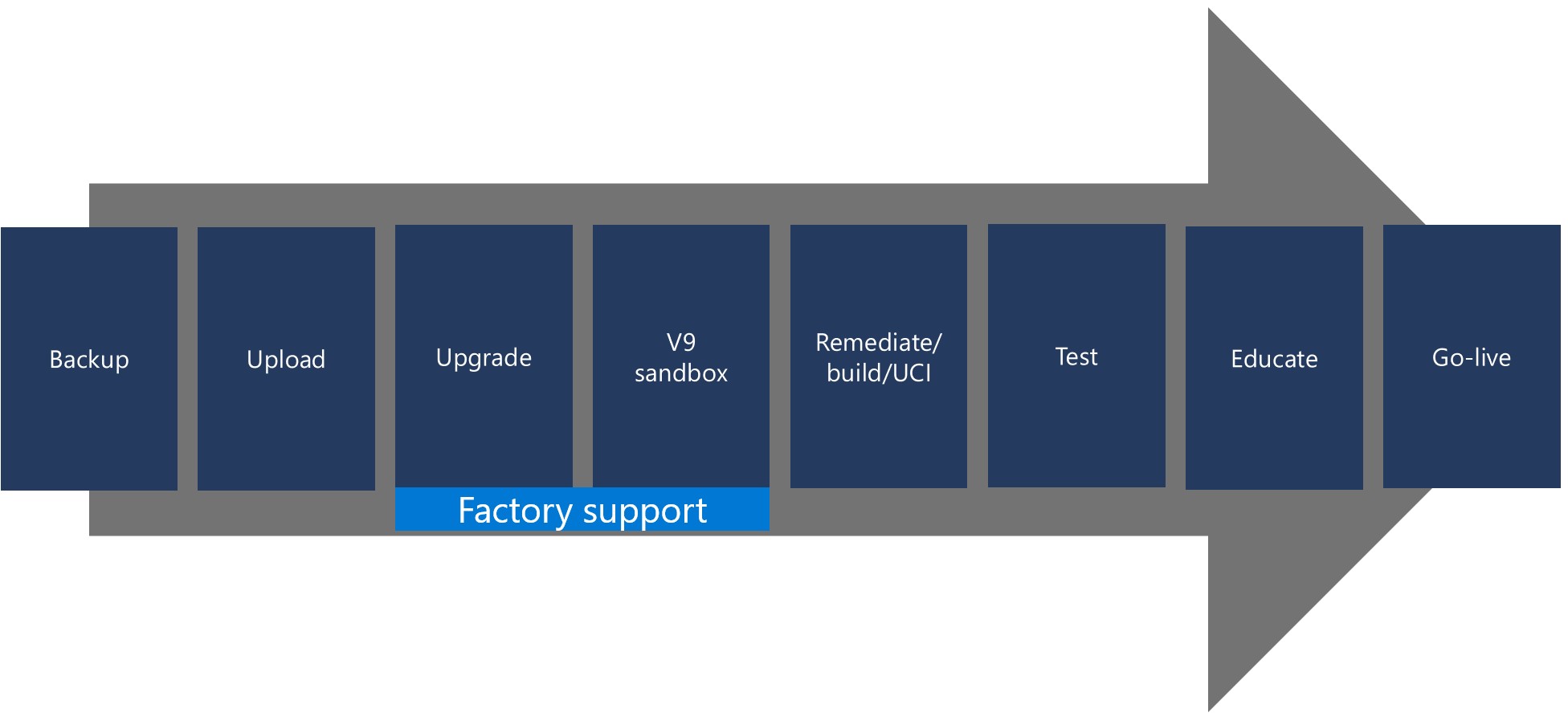
Graphic showing the 8 steps to migrate from on-premises to the cloud: backup, upload, upgrade, V9sandbox, Remediate/build/UCI, test, Educate, go-live

Customizations often hold on-premises systems together, allowing to adequately function in our modern environment. This can make knowing how to untangle your solution or what to migrate difficult. The Dynamics 365 migration program offers technical assessments to guide our Dynamics AX and Dynamics CRM customers through this process. Want to identify organization-specific benefits or optimize the transition process? Our Standard Migration Assessment can help you identify goals, understand migration benefits, and reduce outlay as you transition.

Adding value with Dynamics 365

The gap between on-premises and the cloud solutions is growing, and there’s a good reason. Innovation among cloud now outpaces on-premises development. With end-of-support dates nearing, this gap will only continue to grow, limiting productivity gains and configurability an organization might see with Power Apps, Power Automate, or Power BI functionality. Data centralized in one source only enhances the potential. Knowing usage patterns, adoption rates, and performance metrics, we can continuously update the cloud service without significant business disruption. When it comes to providing updates, Microsoft’s priority is the cloud because it’s the most efficient way to innovate, ideate, and provide value to customers. Customers no longer need to:

  • Host and secure software
  • Build a data center
  • Handle identity management
  • Manage connections to other systems

Instead, the cloud platform empowers an out-of-the-box mentality that allows users to get started with no expertise or additional tools.

The cloud is the future

As businesses continue to prioritize remote work and collaboration, the cloud will continue to be the fiber that connects employees, systems, and resources regardless of time zone. Reducing your physical footprint today is a great way to reduce costs and prepare for tomorrow. Migrating to Dynamics 365 will ensure your organization is prepared to meet future needs and challenges. To see how other companies have made this transition, visit our Dynamics 365 migration community.

The post Confront the misconceptions slowing your move to Dynamics 365 appeared first on Microsoft Dynamics 365 Blog.

Brought to you by Dr. Ware, Microsoft Office 365 Silver Partner, Charleston SC.

Upcoming September 2021 Microsoft 365 Champion Community Call

Upcoming September 2021 Microsoft 365 Champion Community Call

This article is contributed. See the original author and article here.

JoshLeporati_0-1632244271690.jpeg
Join us for our monthly community call every 4th Tuesday of the month, at either 8:00 AM or 5:00 PM PT.


This month’s call will be on September 28th, and we will be covering topics around content and features updates for Learning Pathways as well as new Microsoft Teams features.


Please note that in the September newsletter we incorrectly specified the date as the 24th, our Champion call is indeed on September 28th – sorry for the confusion!


If you have not yet joined our champion community, sign up here to get the resource links to access the calendar invites, program assets, and previous call recordings!


We look forward to seeing you there!

InnovateFPGA contest seeks sustainable solutions using Microsoft Azure and Intel IoT

InnovateFPGA contest seeks sustainable solutions using Microsoft Azure and Intel IoT

This article is contributed. See the original author and article here.

Microsoft and Intel empower technologies that can build a more environmentally sustainable future and reduce the demand we place on Earth’s resources. That’s why Microsoft Azure IoT and Intel are partnering with the InnovateFPGA Design Contest, where developers can harness Azure cloud computing and Intel® FPGA technology to create solutions that reduce environmental impacts.


The design contest is looking for inventive developers from around the globe who can create cutting-edge solutions. Internet of Things (IoT) solutions are already reducing climate impact: from smart lighting that turns off when not needed to transportation systems that reduce pollution-exacerbating car congestion. New IoT solutions could address unique challenges, such as reducing the waste of resources such as water, tracking ocean life, or increasing protection of endangered species.


FPGA Cloud Connectivity Kits, provided to qualified teams in the InnovateFPGA contest, show how an Intel® Edge-Centric FPGA (field programmable gate array) can connect seamlessly with Azure IoT. In addition, development teams will have a choice to use Azure IoT Central or IoT Hub to connect their solution to the Azure cloud. Developers interested in building sustainable solutions using this technology can register their team at www.innovatefpga.com.


Working jointly to encourage innovative developers


Azure IoT and Intel already work jointly together in advanced solutions, complementing each other’s technology to address challenges in a variety of industries. The FPGA Cloud Connectivity Kit enables innovative developers to perform new tasks and solve more challenges, as real-time handling of Azure workloads is easier with a dedicated FPGA-based hardware accelerator. FPGA circuits also can be configured specifically for various workloads to provide better performance and flexibility.


Additionally, Azure IoT Central, IoT Hub, and IoT Plug and Play help builders and developers connect devices to the cloud. IoT Central offers a secure platform, centralized management to reconfigure and update devices, and a growing selection of IoT app templates for common scenarios. IoT Hub, meanwhile, enables secure and reliable communication via the cloud between IoT applications and the devices they manage. Finally, IoT Plug and Play seeks to remove technical barriers, reducing development time, cost, and complexity.


Competition-Allup-Microsoft-InnovateFGPA-LI-Twitter-Option1 V5.jpg


How Microsoft Azure and Intel can reduce environmental impacts


Sustainability and environmental efforts by Microsoft and Intel go beyond their support of the InnovateFPGA contest. As part of our commitment to put sustainable technologies at the heart of our innovation, we’re focused on four key areas of environmental impact to local communities: carbon, water, waste, and ecosystems. We’re striving to use 100% renewable energy by 2025, replenish more water than we consume by 2030, create zero waste annually by that same year, and achieve net-zero deforestation from new construction. Enterprises looking to understand and potentially reduce their environmental impacts can use the Sustainability Calculator.


Just as Azure cloud computing can help reduce energy use, Intel FPGA-enabled architecture used with the cloud is economical and power-efficient, making high-performance computing more sustainable. Microsoft is also researching new approaches for improving computing and cloud data handling while simultaneously using less energy and more sustainable materials.


Project 15 from Microsoft also is helping to accelerate conservation organizations and scientific teams reduce costs and complexity in deploying IoT technologies through its open-source software platform. The Global Environment Facility (GEF) Small Grants Programme, implemented by the United Nations Development Program, is collaborating with the InnovateFPGA contest to task teams to create solutions for biodiversity, sustainable agriculture, and marine conservation. The GEF has shared use cases from the Project 15 initiative on the contest website.


Submit design proposals to the InnovateFPGA Design Contest


Regional teams of university students, builders, and professional engineers with the creativity and ingenuity to design solutions for challenging environmental issues are encouraged to participate in the InnovateFPGA Design Contest. Teams must register and submit their solution proposals at the contest registration page by Sept. 30, 2021. After registering, free FPGA Cloud Connectivity Kits will be shipped to teams whose proposals are selected to advance forward.


Qualifying teams will develop solutions for sustainability until Spring 2022, where they will compete in their respective regional competition. Teams at this level will have a chance to win cash prizes and an invitation to the Grand Finale event at Intel headquarters in San Jose, California, in 2022. For more details, rules, and an FAQ page, go to www.innovatefpga.com.

Customer journey orchestration: The next frontier of connected experiences

Customer journey orchestration: The next frontier of connected experiences

This article is contributed. See the original author and article here.

A decade ago, marketing was focused on guiding the customer through predictable stages of awareness, consideration, and purchase. We were relatively assured that if we reached x number of eyeballs, we could expect y number of responses and z number of conversions.

That world no longer exists. Eighty-one percent of consumers1 want to purchase from brands that get to know them, but nearly three-quarters2 are frustrated by tons of irrelevant content which makes them feel so disconnected. That feedback exposes how the customer experience is falling short and reminds us that it’s no longer enough to employ tactics that focus on volume, or even segmentation. Traditional approachescampaigns, offers, and adsexist in siloes. The customer journey doesn’t. It doubles back, skips forward, and spans digital and physical channels. The marketer’s approach should likewise cut across traditional siloes of existing functions, roles, or channels.

Brands should recognize these fundamental shifts and look for solutions that keep up with surging expectations. Customer journey orchestration in Microsoft Dynamics 365 Marketing delivers an individualized, end-to-end experience to every customer, across all touchpointsat scale. Each individual travels a unique path, based on evolving needs. The result is a refreshing two-way conversation that’s customer-centric, rather than brand-centric. Where one customer may need additional education and proof points, another may be ready to select among different models. In the past, they would both receive the same, predefined, offer after signing up on the brand’s website. This traditional approach falls flat, failing to take into account key contexts like previous interactions and intent. With customer journey orchestration, brands can harness everything they know about the customer, across all channels, and mobilize the organization to engage in the moment to deliver a fluid and seamless experience. For an organization with thousands or millions of customers, optimizing individual experiences at scale can have an enormous impact on growth through increased acquisition and retention.

According to BCG, organizations implementing customer journey orchestration have achieved3:

  • Revenue gains of 10-20 percent
  • Cost reductions of 15-25 percent
  • Customer advocacy score improvements of 20-40 points

Optimizing customer experiences with customer journey orchestration might seem daunting, but it helps to focus on three areasdata, decisioning, and delivery. Most organizations already have a lot of customer data, but they need to bring together the data to gain a 360-degree view of the customer. Then they can turn the data into actions with real-time decisioning to determine which offer to surface or what content to display or what kind of communication to send. Next is the delivery of the actions through alignment and integration with the MarTech stack.

Building a resilient data foundation

Journey optimization begins with a strong data foundation. With help from a customer data platform, organizations can create unified profiles to gain a single view of customers. Savvy organizations go a step further and consider the ever-changing nature of datafrom new data sources to regulatory and compliance requirements that seemingly spring up overnight. Adapting by identifying and bringing in new data sources like digital behavior, customer sentiment, third-party enrichment, or emerging channels contribute to a resilient data foundation that easily flexes to the ever-changing environment. With always up-to-date rich and adaptive profiles, organizations maintain an edge by gaining a deeper understanding of customersas long as it’s built with a privacy-first approach. Growing mistrust over data privacy has promoted big changes like the sunsetting of third-party cookies and data reform. A future-proof customer data platform needs to be designed from the ground up to be consent-enabled, allowing the organization to automatically honor customer consent and privacy across the entire journey.

Scaling with real-time decisioning

Decisioning enables organizations to automatically determine the next best action for an individual customer. The real-time nature of decisioning ensures immediate action, converting an expression of interest (or dissatisfaction) into continued engagement. Based on signals that reveal customer intent, decisioning determines, at the precise moment, the exact interaction to optimize the customer experience. Decisioning goes hand in hand with customer journey orchestration, mobilizing data and AI to decide how best to design and adjust individual journeys to increase customer lifetime value while decreasing cost to serve through intelligent automation and scale.

Delivering connected experiences

The focus on the longer journey, instead of a single touchpoint, is the key to elevated experiences. This end-to-end approach requires continuity and contextevery time. Decisioning works in tandem with customer journey orchestration to move analytics outputs and insights through the MarTech and AdTech stack, informing activation in the application layer, resulting in a cohesive journeybubbling up the next best offer, content, conversations, and experiences seamlessly for each customer, regardless of the place or time.

Looking ahead

Brands that recognize the fundamental shift in customer expectations are boosting their customer experience capabilities. Learn how the new customer journey orchestration capabilities in Dynamics 365 Marketing can make one-to-one experiences a reality. Visit the Dynamics 365 Marketing website and sign up for a free trial.


1-“From me to we: The rise of the purpose-led brand,” Accenture, Dec. 5. 2018

2-“Harness change to create 360 value,” Accenture

3-“Customer Journey Programs Are Hard to Get Right,” Bharat Poddar, Yogesh Mishra, and Prateek Tandon, BCG, Jan. 29. 2020

The post Customer journey orchestration: The next frontier of connected experiences appeared first on Microsoft Dynamics 365 Blog.

Brought to you by Dr. Ware, Microsoft Office 365 Silver Partner, Charleston SC.

Experiencing Data Access issue in Azure Portal for Many Data Types – 09/19 – Resolved

This article is contributed. See the original author and article here.

Final Update: Sunday, 19 September 2021 05:19 UTC

We’ve confirmed that all systems are back to normal with no customer impact as of 09/19, 05:03 UTC. Our logs show the incident started on 09/19, 00:30 UTC and that during the 4 Hours & 33 minutes that it took to resolve the issue some customers may have experienced high latency while accessing metrics and failure while receiving alerts.
  • Root Cause: The failure was due to issue with one of our dependent service.
  • Incident Timeline: 4 Hours & 33 minutes – 09/19, 00:30 UTC through 09/19, 05:03 UTC
We understand that customers rely on Application Insights as a critical service and apologize for any impact this incident caused.

-Vyom

Initial Update: Sunday, 19 September 2021 04:20 UTC

We are aware of issues within Azure Monitors and are actively investigating. Some customers may be experiencing high latency while accessing metrics and may have experienced failure while receiving alerts.
  • Work Around: None
  • Next Update: Before 09/19 09:30 UTC
We are working hard to resolve this issue and apologize for any inconvenience.
-Vyom