by Scott Muniz | Aug 10, 2021 | Security, Technology
This article is contributed. See the original author and article here.
Microsoft has released updates to address multiple vulnerabilities in Microsoft software. A remote attacker could exploit some of these vulnerabilities to take control of an affected system.
CISA encourages users and administrators to review Microsoft’s August 2021 Security Update Summary and Deployment Information and apply the necessary updates.

by Contributed | Aug 10, 2021 | Technology
This article is contributed. See the original author and article here.
There is some good news for those of you wanting to shard your Postgres database in the cloud, so that as your data grows you have an easy way to scale out your Postgres database. I’m delighted to announce that Citus 10—the latest open source release of the Citus extension to Postgres—is now generally available in Hyperscale (Citus).
Hyperscale (Citus) is a built-in option in the Azure Database for PostgreSQL managed service, which has been around for a couple of years to help those of you who would rather focus on your application—and not on spending cycles managing your database.
Newly GA features in Hyperscale (Citus) on Azure
Back in May we announced the preview of quite a few major features in Hyperscale (Citus)—including Postgres 12 and 13 support, Citus 10 with columnar compression, and read replicas to name a few. You can find all of the details are in my previous “What’s new” blog post, but here’s a quick bulleted list:
Current & upcoming region availability for Citus 10
Citus 10 and all the features above are now generally available in Hyperscale (Citus) in the East US, Germany West Central, and Korea Central regions.
This means that when you provision a new Hyperscale (Citus) server group in one of those regions, you are going to get access to all these features (and more). In the coming weeks, we will gradually roll out these new GA features in all Azure regions where Hyperscale (Citus) is available.
And if you have an existing Hyperscale (Citus) cluster: once Citus 10 and the rest of these newly GA’d features are rolled out to your region, you can expect us to plan and then update your existing server groups to give you access to the new GA features, over the course of a couple of months. We will include this update as a part of a scheduled maintenance event for your server group. Updates during scheduled maintenance are performed using failover and require a short downtime, in most cases under 60 seconds. And if you can’t wait for regular maintenance and want access to Citus 10 and the rest of these GA features sooner, we can update your server groups on demand as soon as this update reaches your region. Just ask us via e-mail.
Basic tier gives you the ability to shard Postgres on a single node
If your Postgres database doesn’t need the power of multiple nodes yet, you can select Basic tier when you first provision your Hyperscale (Citus) instance. Basic tier is what we call the new “single-node Citus” feature and it allows you to shard your Postgres tables on a single node. With Basic tier, you can be “scale-out-ready” by using a distributed data model from the start—and you can easily graduate to Standard tier and add nodes later. Or you can use Basic tier as a handy way to try out Citus. You can find more details about Basic tier in the docs.
How to get started scaling out Postgres with Hyperscale (Citus)
To figure out if Hyperscale (Citus) in Azure Database for PostgreSQL is right for you and your app, here are some ways to roll up your sleeves and try it out.
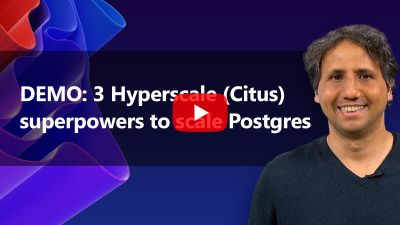
Figure 1: Watch this short video demo of Hyperscale (Citus) that showcases some of the new Citus 10 features, including Basic tier (aka single-node Citus) and columnar compression. The demo also showcases the type of performance improvements you can get by scaling out Postgres.

by Scott Muniz | Aug 10, 2021 | Security, Technology
This article is contributed. See the original author and article here.
Official websites use .gov
A .gov website belongs to an official government organization in the United States.

Secure .gov websites use HTTPS A
lock ( )
) or
https:// means you’ve safely connected to the .gov website. Share sensitive information only on official, secure websites.

by Jenna Restuccia | Aug 10, 2021 | American Sign Language
For the deaf and hard of hearing, your facial expressions convey so much meaning. “Language is grammar — it’s sentence structure,” said Sharron Hill, the director of the American Sign Language Interpreting (ASLI) Program at the University of Houston, “And so, the way that individuals who communicate with a visual mode of communication convey grammar is on the face.”
ASL uses hand movements, body language, facial expressions, and lip-reading to convey the nuances of a transmitted message. For example, it matters whether your eyebrows are up or if they’re down. This small detail decides how you answer a question. If eyebrows are up, this means a yes or no question, and if they are down, it is an open-ended question. Your mouth wide open or closed tightly conveys how large or small an object is, whether it’s thin, smooth, or thick.
The movement of the tongue can tell you how far something is. It also explains whether it’s right next to you or if it is thousands of miles away. The nod of the head determines whether you understand something or you do not. The way you turn your shoulders shows who is talking in a story or taking the lead in a race. It has been said that 50% of ASL consists of facial expressions or body movements.
These intricacies of the language are endless. The best way to learn these is through those who are native to the language. If you’re learning ASL, find those in the deaf community, and don’t be afraid to ask questions! You will find that most community members are eager to help those who sincerely want to learn. Learning ASL has personally brought me many joys. I have developed lifelong friendships with those who first taught me the language. The language and the culture have made me more in touch with the unspoken communication we all use. They have given me many opportunities to help others. I would, without doubt, suggest it to anyone who has the time to learn.
My suggestion to you, if you are currently learning, is to seek out native users. Spend time with them, get to know their history, the challenges they face. You will surely come out with a new perspective and increased incentive to learn their language.
by Scott Muniz | Aug 10, 2021 | Security, Technology
This article is contributed. See the original author and article here.
Mozilla has released security updates to address vulnerabilities in Firefox, Firefox ESR, and Thunderbird. An attacker could exploit some of these vulnerabilities to take control of an affected system.
CISA encourages users and administrators to review the Mozilla Security Advisory for Firefox 91, Firefox ESR 78.13, and Thunderbird 78.13 and apply the necessary updates.


Recent Comments