
by Contributed | May 5, 2021 | Technology
This article is contributed. See the original author and article here.
By Christine Alford, Director, Commercial Marketplace Business Team
Previously, I’ve talked about Microsoft’s #BuildFor2030 campaign. As partner to the United Nations, Microsoft has pledged to support the UN Sustainable Development Goals (SDGs). The SDGs are a set of 17 initiatives adopted by member states in 2015 focused on creating a more inclusive, sustainable, and equitable world by 2030. Inspired by the UN SDGs, through the #BuildFor2030 campaign, we’re featuring Microsoft partners building solutions that enable a more inclusive economy.
This milestone of the campaign launched on Earth Day on April 22. With this milestone we are supporting climate action and sustainability by recognizing partner innovation for sustainability. Currently, on our homepages of Microsoft AppSource and Azure Marketplace you can find Microsoft partner solutions in our “featured apps” section that are innovating to build a more resilient and sustainable future.
Learn more about how Microsoft partners are helping customers leverage technology to better our environment and create a more sustainable society by reading this blog post by Nick Parker, CVP, Global Partner Solutions.
If you have a solution that supports a more inclusive, sustainable, and equitable future, we’d love to celebrate your impact. Upcoming campaign themes this year include enabling nonprofits and empowering communities. Learn more about #BuildFor2030 and how you can participate. Don’t miss out on your chance to be featured! Nominate your solution today.

by Contributed | May 5, 2021 | Dynamics 365, Microsoft 365, Technology
This article is contributed. See the original author and article here.
As the pace of manufacturing accelerates to meet demands across global customers, organizations are struggling to rapidly train and upskill workers on factory lines and the production floor. In fact, up to 2.4 million U.S. manufacturing jobs could remain unfilled between 2018 and 2028 due to this challenge.1
Today we’re introducing an exciting update to Microsoft Dynamics 365 Guides that promises to improve the way frontline workers access digital guidance in real-world scenarios, empowering them with hands-on opportunities to learn new and revised technical skills on-site. By engaging employees in hands-on, experiential learning, they are better able to retain and apply new skills to meet evolving job demands.
State of learning today
Traditional classroom training methods are not only expensive to implement and maintain but also are often ineffective. On average, employees only apply about 54 percent of new skills learned and business leaders are similarly disenfranchised.2 88 percent of human resource leaders are looking to invest in new technologies and 84 percent of business leaders want to rethink their workforce experience.3 At Microsoft, we see an opportunity to shift the way employees learn by providing organizations with the technology to attract, train, and maintain their workforce. Instead of static, hundred-page manuals that employees consume in a classroom, employees move towards immersive and collaborative experiences that are incorporated into daily workflows. With an estimated 97 million new jobs created by the year 2025, organizations need to provide employees with greater operational knowledge and a seamless, improved way to learn on the job.4 The question is, where do you get started?
On-the-job guidance with Dynamics 365 Guides and Azure Object Anchors
Dynamics 365 Guides is the mixed reality solution for organizations looking to accelerate upskilling and empower employees with transformational learning experiences. With Dynamics 365 Guides, employees can author step-by-step workflows with holograms on a head-mounted display to effectively imitate real-world scenarios.
Visual overlays and markers hover over the next step, using visual reinforcements to help improve muscle memory and reduce downtime.

Non-linear guides can incorporate branching logic to account for skill level and workflow variability in which users can easily select the option best fits their skillset or situation.
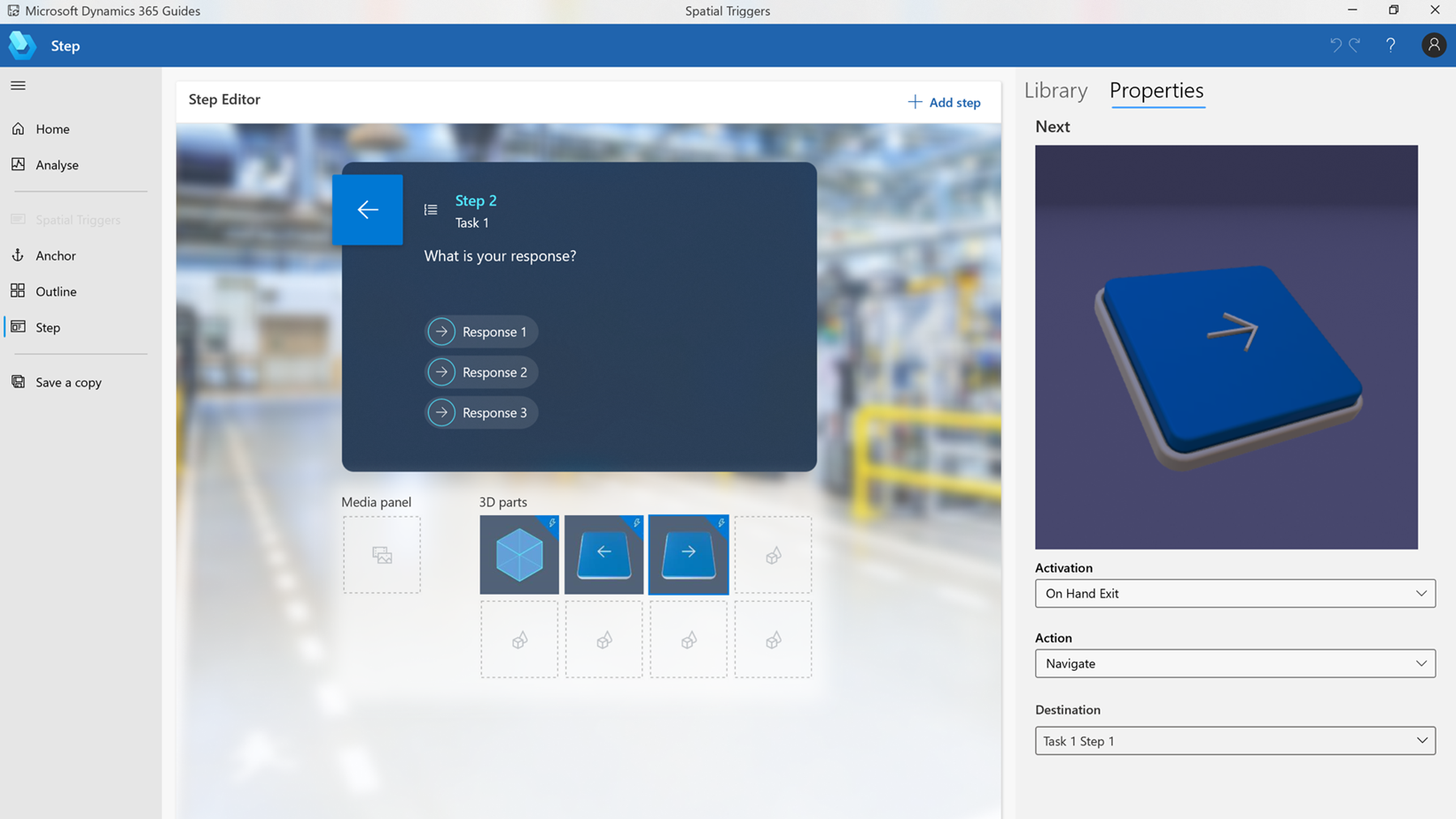
Operators can stay in the flow of work while following step-by-step instructions overlaid directly in front of them, empowering employees to learn on the job and reduce downtime spent in a classroom.
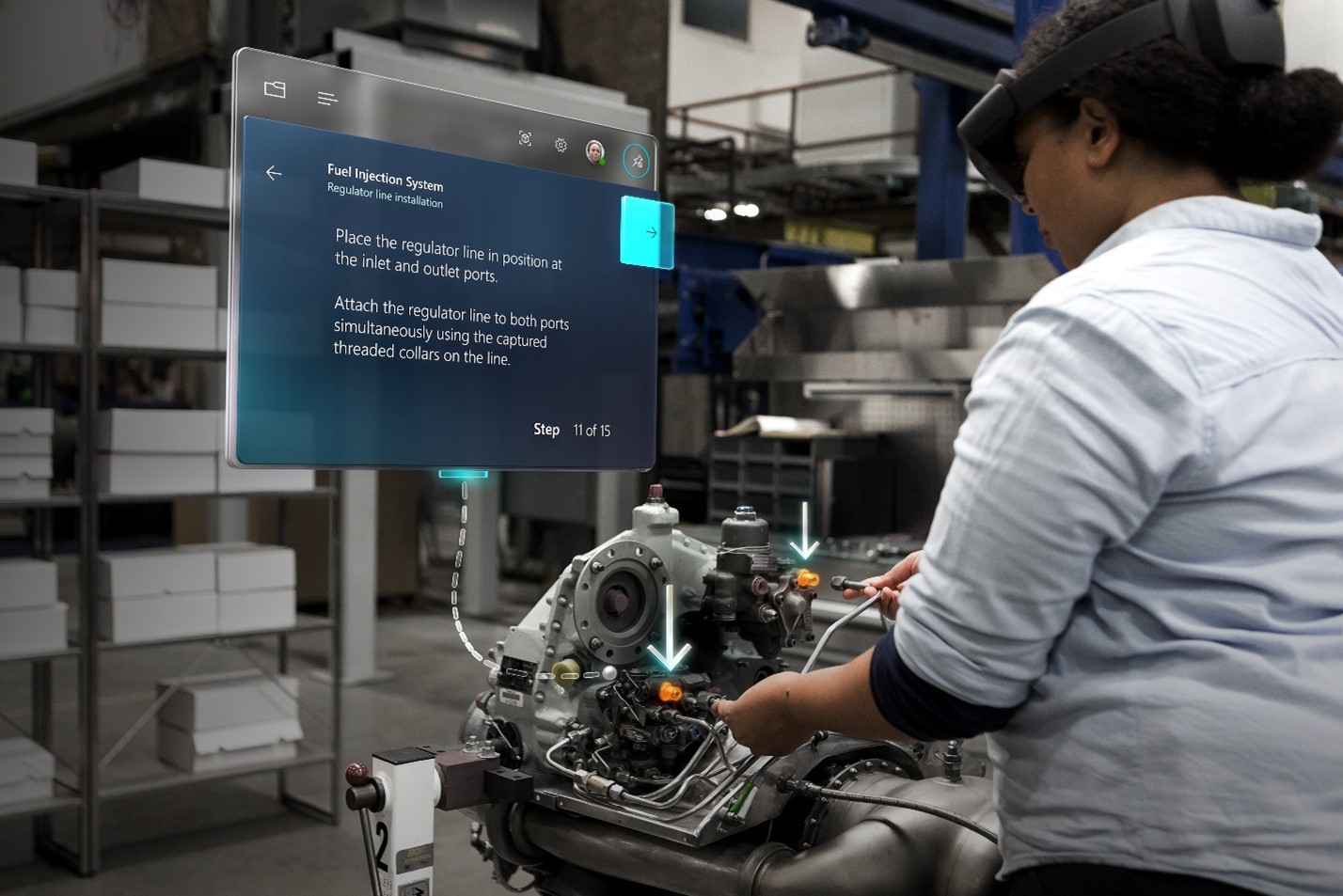
Yesterday at the Microsoft Business Applications Summit, we announced the latest development: Dynamics 365 Guides with Azure Object Anchors. Azure Object Anchors enable users to automatically align digital content with physical objects, eliminating the need for QR-code markers while improving alignment accuracy. Using Dynamics 365 Guides and Azure Object Anchors, operators can easily move from one workstream to the next as HoloLens’s spatial insight detects anchors and seamlessly launches overlaid digital content. Organizations can move from a manual process, often ripe with inaccuracies, to a walk-up and work experience that improves user learning and reduces errors.
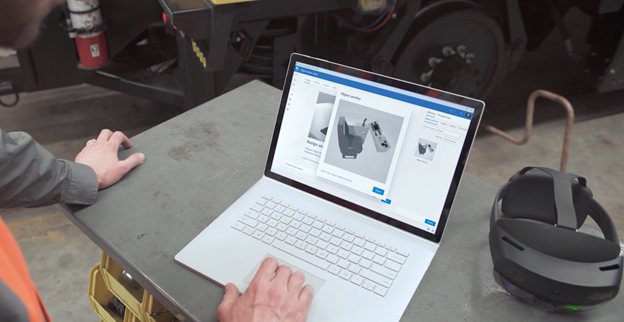

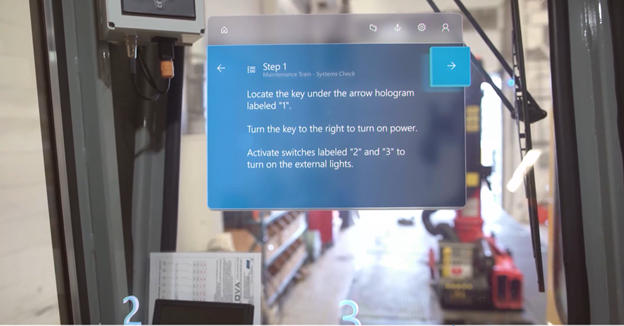
Azure Object Anchors is a recent example of the innovation that stems directly from customer feedback, and we’ve seen it in use recently at Toyota Japan, where they used Azure Object Anchoring to place digital markers in their environment to improve process efficiencies. Without the need for physical markers, Toyota was able to incorporate Azure Object Anchors across dealerships to help technicians get up and running much faster. We are excited to bring this new capability to Dynamics 365 Guides to improve the workflow experience and unlock additional operational efficiencies.
Innovative solutions and technology are needed to address the growing skills gap faced by many industries. As organizations eschew the status quo and adopt experiential learning solutions, like Dynamics 365 Guides, they are better prepared to meet this challenge and empower their employees to learn on the job more effectively.
Learn more about Dynamics 365 Guides and Azure Object Anchors.
1Deloitte Insights and the Manufacturing Institute, 2018 Deloitte and the Manufacturing Institute Skills Gap and Future of Work Study, 2018
2Baker, Mary. “Stop Training Employees in Skills They’ll Never Use.” Smarter With Gartner, August 28, 2020.
3Deloitte Human Capital Trends 2019, “Leading the Social Enterprise: Reinvent with a Human Focus,” Deloitte, 2019.
4Russo, Amanda. “Recession and Automation Changes our Future of work, but there are Jobs Coming,” World Economic Forum, 2020.
The post Improve on-the-job guidance with Dynamics 365 Guides and Azure Object Anchors appeared first on Microsoft Dynamics 365 Blog.
Brought to you by Dr. Ware, Microsoft Office 365 Silver Partner, Charleston SC.
by Contributed | May 5, 2021 | Technology
This article is contributed. See the original author and article here.
Mapping technology to Zero Trust frameworks is a challenge in many industries. We need to change our thinking in security assessment as the cloud evolves at the speed of innovation and growth, which often challenges our security requirements. We need a method to map Zero Trust approaches to technology while measuring change over time like a muscle.
Azure Sentinel: Zero Trust (TIC 3.0) Workbook
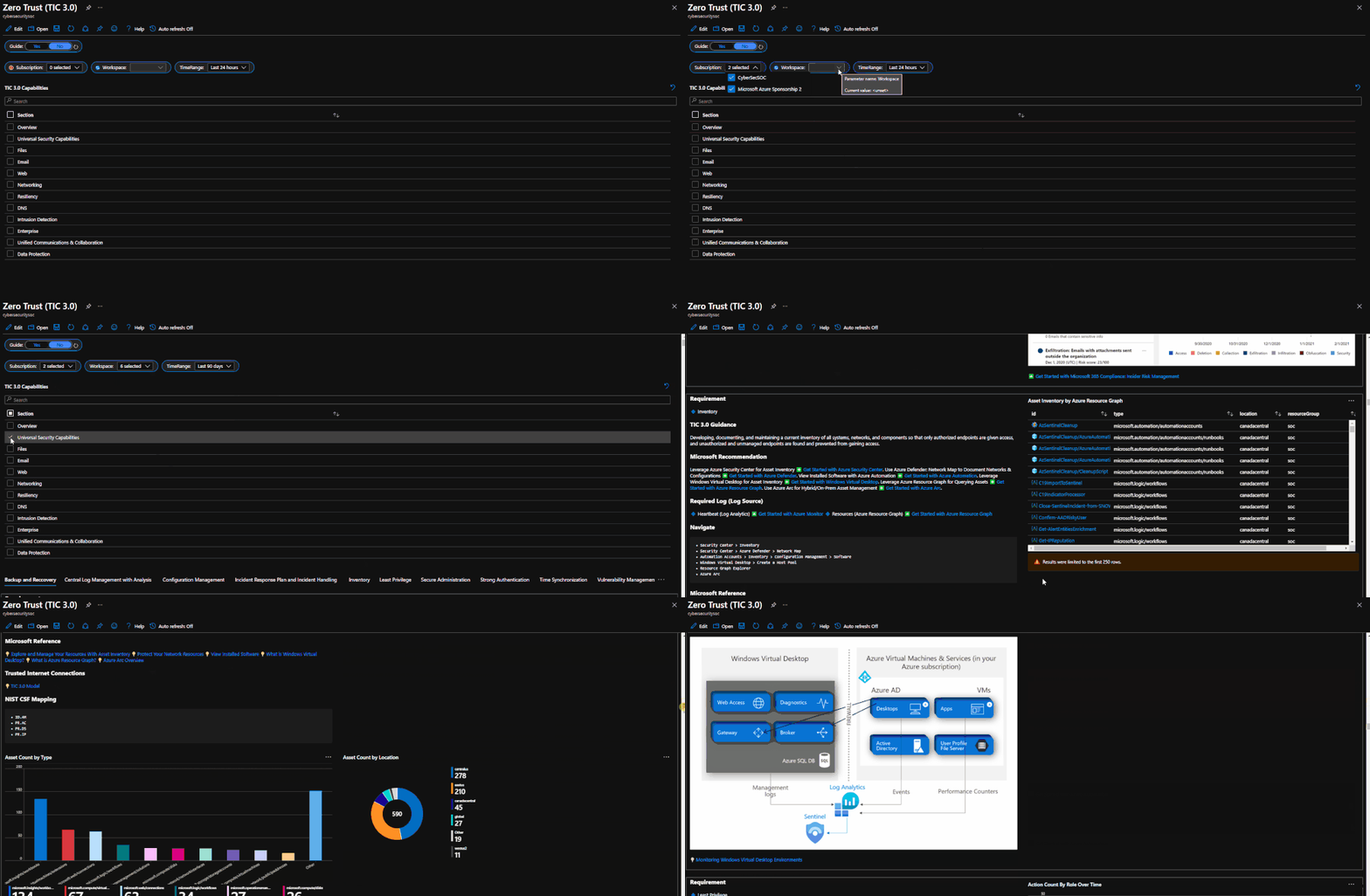
The Azure Sentinel: Zero Trust (TIC3.0) Workbook provides an automated visualization of Zero Trust principles cross walked to the Trusted Internet Connections framework. This workbook leverages the full breadth of Microsoft security offerings across Azure, Office 365, Teams, Intune, Windows Virtual Desktop, and many more. This workbook enables Implementers, SecOps Analysts, Assessors, Security & Compliance Decision Makers, and MSSPs to gain situational awareness for cloud workloads’ security posture. The workbook features 76+ control cards aligned to the TIC 3.0 security capabilities with selectable GUI buttons for navigation. This workbook is designed to augment staffing through automation, artificial intelligence, machine learning, query/alerting generation, visualizations, tailored recommendations, and respective documentation references.
Use Cases
There are several use cases for the Azure Sentinel Zero Trust (TIC 3.0) Workbook depending on user roles and requirements. The graphic below shows how a Security Engineer can leverage the workbook to review controls, evaluate tool efficiency, explore events, and investigate configurations. There are also several additional use cases where this workbook will be helpful:
Roles
- Implementers: Build/Design
- SecOps: Alert/Automation Building
- Assessors: Audit, Compliance, Assessment
- Security & Compliance Decision Makers: Situational Awareness
- MSSP: Consultants, Managed Service
Mappings
- Framework to Requirement to Microsoft Technology
Visualization
- Hundreds of Visualizations, Recommendations, Queries
Time-Bound
- Measure Posture Over Time for Maturity
Time-Saving
- Aggregation & Analysis
- Capabilities Assessment
- Navigation
- Documentation
- Compliance Mapping
- Query/Alert Generation
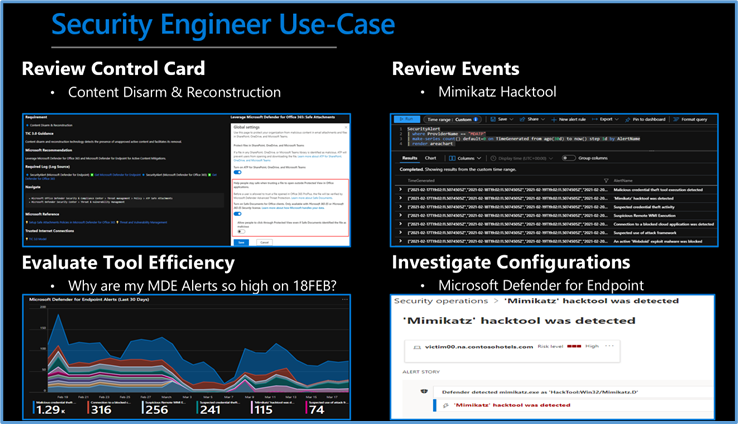 Security Engineer Use Case
Is Zero Trust Equivalent to TIC 3.0?
No, Zero Trust is a best practice model and TIC 3.0 is a security initiative. Zero Trust is widely defined around core principles whereas TIC 3.0 has specific capabilities and requirements. This workbook demonstrates the overlap of Zero Trust Principles with TIC 3.0 Capabilities. The Azure Sentinel Zero Trust (TIC 3.0) Workbook demonstrates best practice guidance, but Microsoft does not guarantee nor imply compliance. All TIC requirements, validations, and controls are governed by the Cybersecurity & Infrastructure Security Agency. This workbook provides visibility and situational awareness for security capabilities delivered with Microsoft technologies in predominantly cloud-based environments. Customer experience will vary by user and some panels may require additional configurations for operation. Recommendations do not imply coverage of respective controls as they are often one of several courses of action for approaching requirements which is unique to each customer. Recommendations should be considered a starting point for planning full or partial coverage of respective requirements.
Deploying the Workbook
It is recommended that you have the log sources listed above to get the full benefit of the Zero Trust (TIC3.0) Workbook, but the workbook will deploy regardless of your available log sources. Follow the steps below to enable the workbook:
Requirements: Azure Sentinel Workspace and Security Reader rights.
1) From the Azure portal, navigate to Azure Sentinel
2) Select Workbooks > Templates
3) Search Zero Trust and select Save to add to My Workbooks
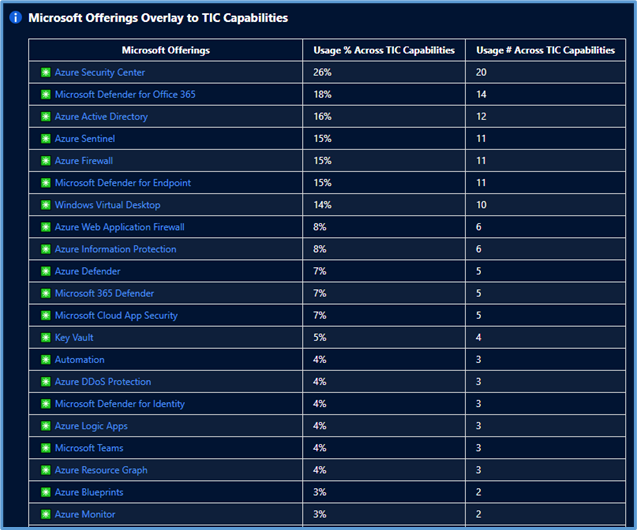 Microsoft Offerings Overlay to TIC Capabilities
Navigating the Workbook
The Legend Panel provides a helpful reference for navigating the workbook with respective colors, features, and reference indicators.
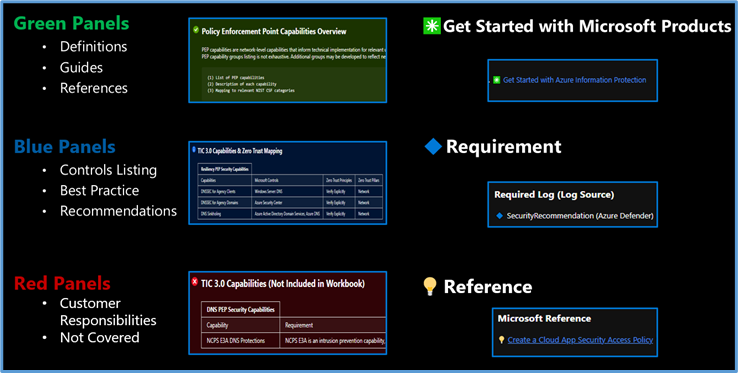 Navigating The Workbook
The Guide Toggle is available in the top left of the workbook. This toggle allows you to view panels such as recommendations and guides, which will help you first access the workbook but can be hidden once you’ve grasped respective concepts.
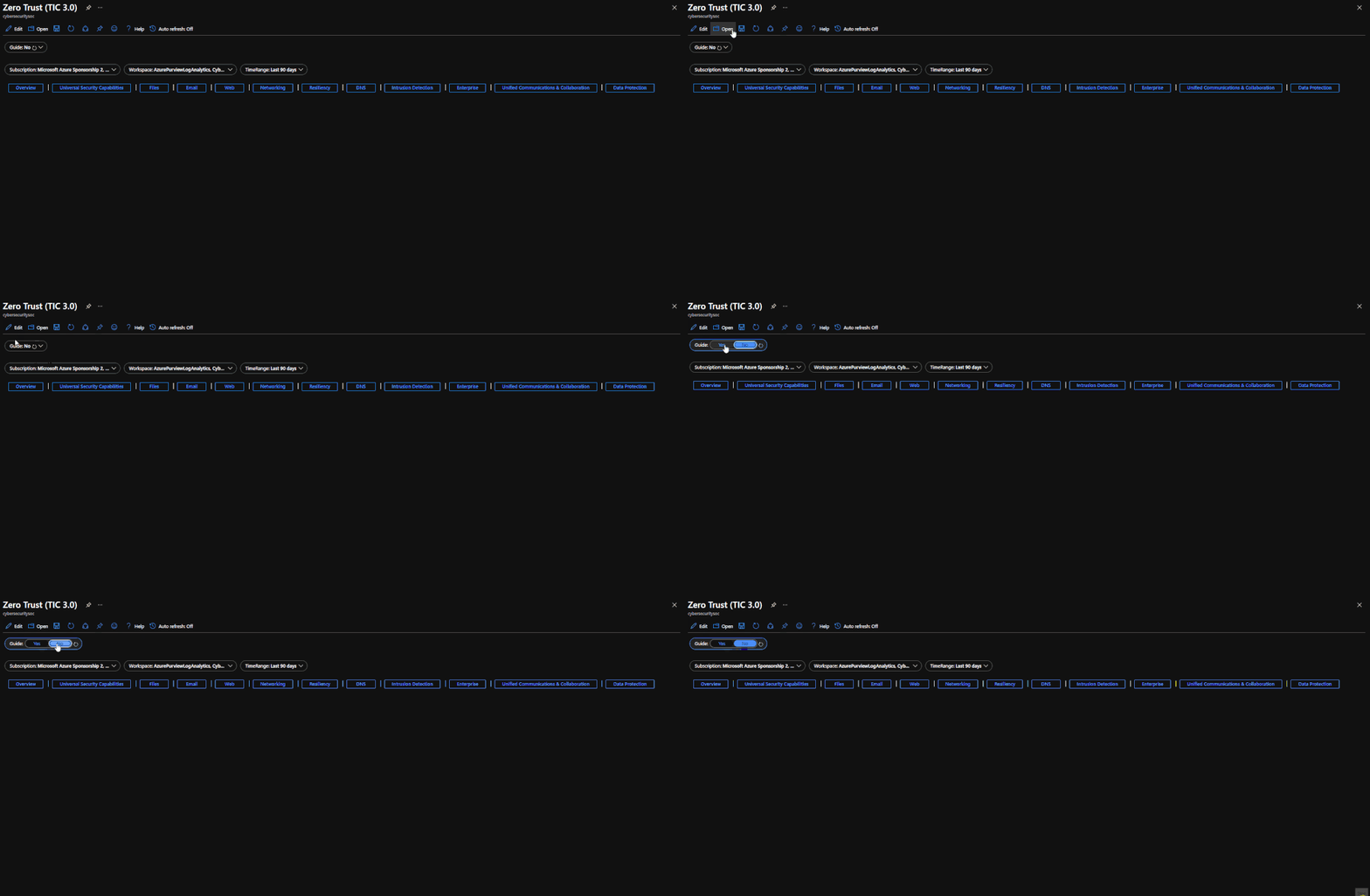 Guide Toggle
The Resource Parameter Options provide configuration options to sort control cards by Subscription, Workspace, and Time Range. The Parameter Options are beneficial for Managed Security Service Providers (MSSP) or large enterprises that leverage Azure Lighthouse for visibility into multiple workspaces. It facilitates assessment from both the aggregate and individual workspace perspectives. Time range selectors allow options for daily, monthly, quarterly, and even custom time range visibility.
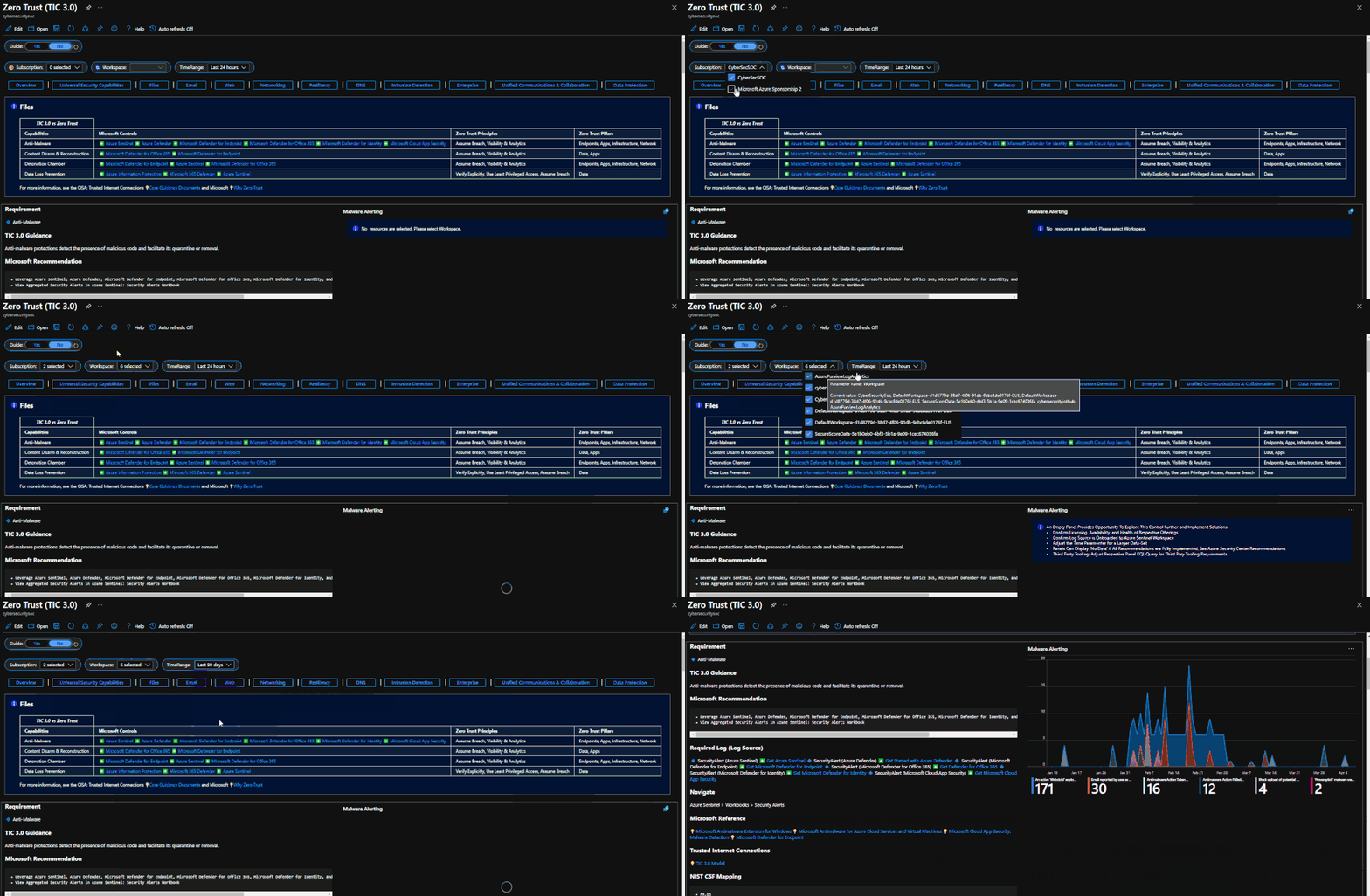 Resource Parameter Options
The Azure Sentinel Zero Trust (TIC3.0) Workbook displays each control in a Capability Card. The Capability Card provides respective control details to understand requirements, view your data, adjust SIEM queries, export artifacts, onboard Microsoft controls, navigate configuration blades, access reference materials, and view correlated compliance frameworks.
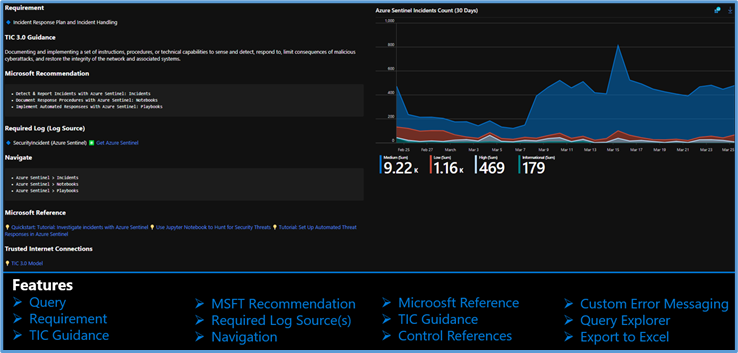 Capability Card
While using Microsoft offerings for the Zero Trust (TIC3.0) Workbook is recommended, it’s not a set requirement as customers often rely on many security providers and solutions. Below is a use-case example for adjusting a Control Card to include third-party tooling. The default KQL query provides a framework for target data, and it is readily adjusted with the desired customer controls/solutions.
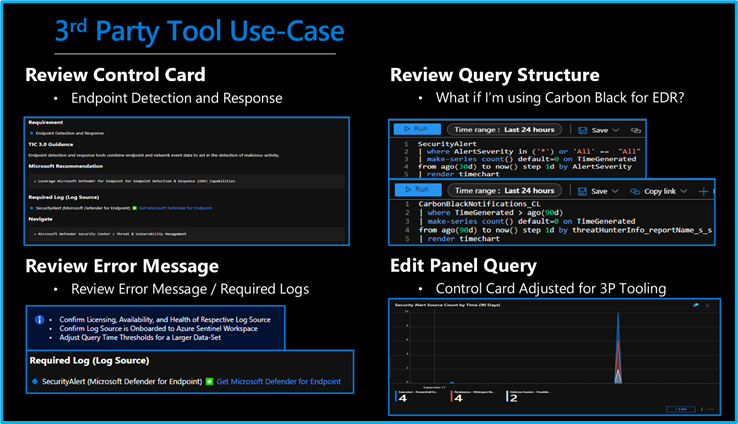 3rd Party Tool Use Case
Get Started with Azure Sentinel and Learn More About Zero Trust with Microsoft
Below are additional resources for learning more about Zero Trust (TIC3.0) with Microsoft. Bookmark the Security blog to keep up with our expert coverage on security matters and follow us at @MSFTSecurity or visit our website for the latest news and cybersecurity updates.
Disclaimer
The Azure Sentinel Zero Trust (TIC 3.0) Workbook demonstrates best practice guidance, but Microsoft does not guarantee nor imply compliance. All TIC requirements, validations, and controls are governed by the Cybersecurity & Infrastructure Security Agency. This workbook provides visibility and situational awareness for control requirements delivered with Microsoft technologies in predominantly cloud-based environments. Customer experience will vary by user, and some panels may require additional configurations and query modification for operation. Recommendations do not imply coverage of respective controls as they are often one of several courses of action for approaching requirements which is unique to each customer. Recommendations should be considered a starting point for planning full or partial coverage of respective control requirements.
by Contributed | May 5, 2021 | Technology
This article is contributed. See the original author and article here.
This blog post is the third in a series of three examining the results of a recent IDC study, Leveraging Microsoft Learning Partners for Innovation and Impact.*
Upskilling is a key requirement in today’s IT centers, and Microsoft Learning Partners can help your organization get the greatest impact from your learning initiatives, development programs, and digital transformation efforts. Given the importance of staying ahead of quickly evolving technology, we asked IDC researchers to find out what makes a Learning Partner valuable to an organization.
Our first post in the series, New study shows the value of Microsoft Learning Partners, took a high-level look at the benefits of using a Learning Partner to meet your technical skilling needs. Among the findings: the right partner, along with high-quality content, improves outcomes. The second post, Get results from end-to-end training solutions offered by Microsoft Learning Partners, highlighted the tremendous value Learning Partners bring to organizations through their capacity to provide an end-to-end solution and to deliver value-added services to support a learner’s ability to gain and retain needed skills.
This final post explores the additional benefits. Working with a Learning Partner provides:
- Scale, flexibility, and speed. Learning Partners have the scale to support global organizations, the flexibility to tailor programs to client needs, and the speed to stand up complex programs quickly.
- Quality content and delivery. They also deliver the latest in accurate, relevant content using Microsoft Official Courseware (MOC) delivered by Microsoft Certified Trainers (MCTs).
Programs with scale, flexibility, and speed meet learning goals
Learning Partners have the scale, flexibility, and speed to set up your IT skills initiatives quickly, provide all the necessary resources, and make sure programs stay on track. As learning experts, they know how to adapt to changing circumstances and schedules and to help ensure that learning initiatives succeed.
The IDC study emphasized three areas where Learning Partners make a difference to organizations:
- The scale to work locally and globally. Whether your IT group is big or small, a Learning Partner works with you to scope and adapt their programs to your organization’s needs, such as rolling out learning across time zones.
- The flexibility to adapt to change. Learning Partners have the flexibility to adapt their deliverables to your changing requirements and business constraints.
- The speed to stay ahead of the tech. Learning Partners not only keep up with the technology but also anticipate changing requirements and help you prepare for the road ahead.
Quality always makes a difference
Quality in learning programs helps accelerate your organization’s business goals, including digital transformation. Tom O’Reilly, Head of Group Strategy at QA, talks about quality as meeting the unique needs of learners and circumstances. “You cannot execute a transformation program without offering a breadth of learning modalities and a high-quality offering in each of them,” he points out.
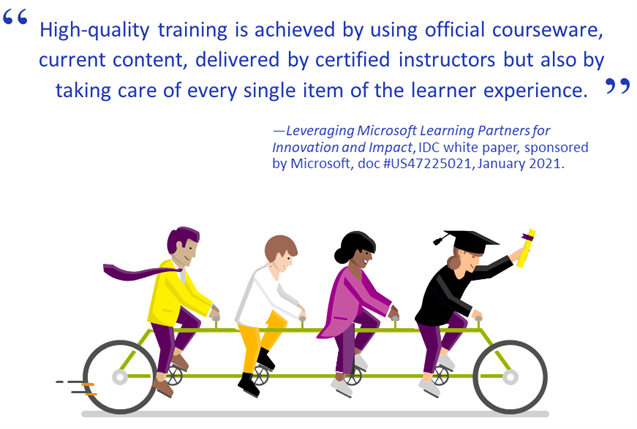
The IDC study emphasized that high-quality training comes from using official courseware and current content, delivered by certified instructors. Quality extends to the way that Learning Partners address every aspect of the learner experience—beginning with an assessment of your training needs and, for some, ending in certification exam preparation.
Some organizations view certifications as a natural outcome of a quality learning experience. Certified IT pros perform their role better,** and certifications can lead to improved IT performance. Learning Partners can help your workforce prepare for the industry’s most trusted certification.
Next step: Ask an expert about their services
To move forward with your skilling needs, consider working with a Microsoft Learning Partner with the scale, flexibility, and speed to deliver the resources that work best for your workforce—along with the quality content and instructors that can help everyone succeed.
Share your thoughts by posting your comment.
Download the IDC study white paper, Leveraging Microsoft Learning Partners for Innovation and Impact
Download the IDC study datasheet, Top reasons to get IT training from a Microsoft Learning Partner
Find a Microsoft Learning Partner

Related posts
Sharpen your technical skills with instructor-led training
Leading Learning Partners Association—a unique organization for delivering Microsoft training
Technical certifications could help drive business optimization
* IDC white paper, sponsored by Microsoft, Leveraging Microsoft Learning Partners for Innovation and Impact, #US47225021, January 2021.
** Global Knowledge, 2019 IT Skills and Salary Report, as quoted in Ten reasons to earn a Microsoft Certification.
by Contributed | May 5, 2021 | Technology
This article is contributed. See the original author and article here.
This blog dives into how to setup 1:1 call recording, end user experience and best practices for enabling this feature for users.
What is 1:1 call recording ?
This feature gives user the ability to record Microsoft® Teams call made to another user who is using Teams. Note that, this feature does not give you the ability to record 1:1 call with PSTN user.
How to enable call recording settings:
This is enabled using PowerShell. You need to modify the “Teams Calling Policy” using PowerShell. This setting is disabled by default – it must be enabled. You can either enable it for your global policy or you can create a custom policy, which has this feature enabled, and apply that policy to users who require this feature.
Set-CsTeamsCallingPolicy -Identity Global -AllowCloudRecordingForCalls $True
Note that, prior to April 12, 2021, this setting was controlled by the “Teams meeting policy”. If you allowed recording for teams meeting by setting “AllowCloudRecording” to true. After May 31, 2021, this particular setting in “Meeting Policy” only works for recording a meeting, it does not work for call recording.
End user experience:
After enabling this feature the user will have the option to ‘record a call’ in teams.
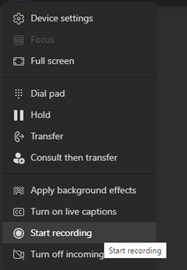
After a call is connected, users will have to click on the “more actions” icon (…) and it will give the option to start recording. In this example, John called Jane, and John started the recording.
When the recording starts the user on the other end (Jane) will get a notification that recording has started. In addition, a recording icon (red button) appears right next to the timer, even if the notification is dismissed the recording icon will stay active as long as recording is going on, so that the user is aware that the call is being recorded.
The notification still says “this meeting is being recording…” even though it is a 1:1 call, you can ignore this typo.

Where is the recording stored
The recording will be stored either in Stream or OneDrive for the user who initiated the recording. The “other” user – in this example, “Jane” will have read-only access to the recording.
Both users will be notified when the recording is ready. It will show up in the chat window for the call – in this example, John called “Jane Doe” and Jane recorded the call. The link to recording appears on both their chat window and it can be played back right on the Teams client.
In this case both John and Jane are in the same organization within the same Microsoft 365 tenant.

If the user who did not initiate the recording is an external user, then, this “recorded” user will not have access to the recording. The user who initiated the recording will have to share the recording with the user on the other organization.
After July 7, 2021, all recordings will be stored in OneDrive by default, unless your organization decides to opt-out. Following article goes into details about recording and storage for both 1:1 calls and meeting recordings.
Use OneDrive for Business and SharePoint for meeting recordings – Microsoft Teams | Microsoft Docs
This feature is for end user and does not replace or complement compliance recording. The user who initiates the recording has access to the recorded file, which in certain situation can violate compliance. For example, in certain scenarios, just the notification that the user is being recorded may not meet compliance requirement, additional disclaimers might be necessary. Another possible scenario – certain users are not allowed to keep recordings of calls in their storage. In these cases, admins need to get formal approval from the compliance team before proceeding with this setting.
Recommendation:
- Consider compliance requirement prior to enabling 1:1 recording feature.
- Start with a custom policy where this feature is enabled and add select group users to the policy. If a decision is made to enable the feature for all users, then the feature can be enabled globally.
- Both 1:1 call recording and meeting recording experience should be similar for specific users – otherwise, it can create confusion for the end-user.
- Share helpful tips with the user about where the recordings are stored.
- Consider retention policy to get remove old recordings from user’s One Drive.
Seema Rahman is the Principal Architect of Zodela Technologies. Her primary focus area is Microsoft Teams – over last 3 years, she has helped multiple mid to large size customers adopt teams as their main collaboration platform.
To write your own blog on a topic of interest as a guest blogger in the Microsoft Teams Community, please submit your idea here: https://aka.ms/TeamsCommunityBlogger


Recent Comments