by Scott Muniz | Jul 21, 2020 | Uncategorized
This article is contributed. See the original author and article here.
Through an integration with Microsoft 365, IT partners using SolarWinds N-central or RMM gain a singular view to help better protect and manage devices
SolarWinds, a leading provider of powerful and affordable IT management software, today announced collaboration with Microsoft to integrate Microsoft 365 capabilities with their remote monitoring and management tools – SolarWinds N-central and SolarWinds RMM. This will deliver monitoring of devices managed by Microsoft Intune from within the N-central and RMM dashboards, enabling a single device view, extensive management features, and impactful reporting.
As more and more businesses have shifted to a long-term work-from-home scenario with an even greater number of devices now in the care of managed services providers (MSPs), the ability to have a single device view has never been more important. The new capabilities, which are slated to go live later this year, will enable partners using N-central or RMM who deploy subscription plans such as Microsoft 365 Business Premium to discover devices managed by Intune and monitor those devices from within the N-central or RMM dashboards. This means that the entirety of client devices will be able to be managed from a single place, with the same configuration and alerting policies, strengthening data protection and streamlining monitoring and management efficiency.
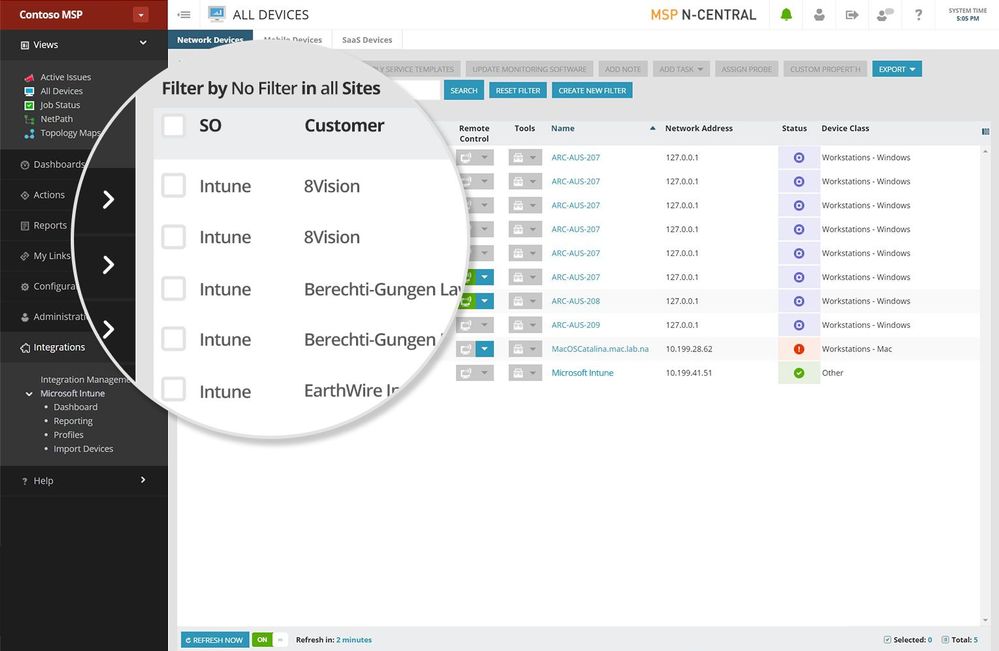
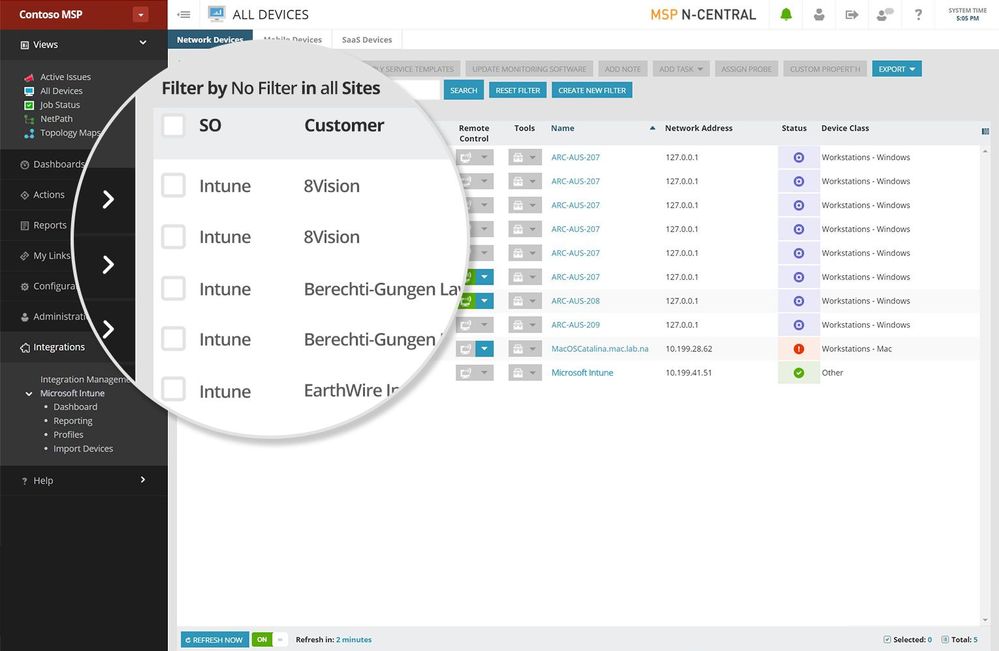 Discover devices managed by Intune and monitor those from SolarWinds N-central or RMM dashboards
Beyond monitoring, MSPs will also be able to receive notifications and alerts for all devices and pass those alerts to the professional service automation (PSA) solution, making it easier for partners to manage all their clients at scale.
“Nearly 90% of the desktop and server devices our partners manage run Microsoft software, and Microsoft 365 is the productivity suite most of them use. The ability to monitor and service devices that are managed under Microsoft Intune from right within the N-central or RMM main dashboard will be a huge productivity boost, and enable our partners to offer more comprehensive service and protection for the myriad of devices they manage.” said Mav Turner, general vice president of products for SolarWinds MSP.
“In these challenging times, small and medium-size businesses need, more than ever, to empower all their employees to work from anywhere and on any device in a secure way. Microsoft 365 integrates Office productivity apps and collaboration tools like Microsoft Teams with advanced security and device management capabilities. We collaborated with SolarWinds, a leader in the MSP software space, to make it simpler for managed service providers to secure data and devices using the security & management services in Microsoft 365.” said Nathalie Irvine, General Manager, Microsoft 365.
If you’re interested in learning more, register for this webcast from SolarWinds on Wednesday, July 29 at 10:00am EST – where specialists from SolarWinds and Microsoft will show a product demonstration and answer questions you may have.
#MSPartner
#MSInspire
————–
Frequently Asked Questions:
Q: What are SolarWinds MSP and Microsoft announcing?
A: Microsoft and SolarWinds MSP are collaborating to bring their Microsoft 365 capabilities and SolarWinds N-central and RMM platforms closer. This will enable MSPs using those remote monitoring and management products to view all the devices they monitor from their SolarWinds dashboards, whether managed with Microsoft Intune or SolarWinds solutions. This will help MSPs standardize the way they receive alerts on the health of all devices and monitor, manage, and maintain those devices. It also enables consolidated device reporting.
Q: Why are SolarWinds MSP and Microsoft doing this integration?
A: Both companies provide powerful tools to help managed services providers (MSPs) and small and medium- sized businesses (SMBs) to manage and secure their IT devices and networks. By integrating Microsoft 365 with remote monitoring and management platforms – N-Central and RMM – from SolarWinds, MSPs will be able to manage the entirety of their clients’ devices from one dashboard, increasing their efficiency and ability to keep their SMB clients secure and running smoothly.
Q: In which Microsoft 365 subscription plans is Microsoft Intune available?
A: Microsoft Intune is available as part of the Microsoft 365 Business Premium subscription plan designed for small and medium-sized businesses. It is also available as part of some enterprise, education and government focused subscription plans from Microsoft 365. More details about Microsoft 365 is available at https://docs.microsoft.com/microsoft-365/.
Q: What is SolarWinds N-central or RMM?
A: SolarWinds N-central and RMM are remote monitoring and management solutions that enables MSPs and IT professionals to maintain and secure thousands of devices from one place. They help IT professionals detect the health of workstations, servers, and other IT endpoints and proactively help ensure they are running properly and are secured with the latest software and layers of data and threat protection. Their automation capabilities and rules-based policy flexibility make N-central and RMM a key tool for both internal IT teams who want to save time to focus on strategic projects and MSPs who want to increase efficiency and take on additional clients to grow their business.
Q: Why would an MSP want both Intune and N-central or RMM?
A: Microsoft Intune, which provides capabilities for PC and mobile device management (MDM) and mobile app management (MAM), is part of Microsoft 365, and many MSPs find Intune—as well as the other components of Microsoft 365—to be beneficial to their business. Along with Intune, Microsoft 365 includes productivity apps from Office and collaboration services such as Microsoft Teams, and advanced security and device management capabilities such as Office 365 Advanced Threat Protection, Conditional Access, Data Loss Prevention, Azure Information Protection, Microsoft Defender, Windows Virtual Desktop and more.
Intune capabilities for mobile device management (MDM) complements and extends the N-central or RMM device and feature reach for service providers that have strong Microsoft 365 sales and support offerings. The integration will enable MSPs to discover clients’ Intune managed devices, bring them under a single device view, consolidate alerts from all devices on state changes to the MSP’s PSA ticketing system, and enrich their reporting information—all from their existing workflows.
Q: When will these new capabilities be available?
A: A beta version of the new capabilities will be available for SolarWinds N-central customers starting in late 2020. They’ll be inviting customers who already use Intune to test drive the new capabilities and give feedback, and they’ll be encouraging customers who have not yet tried Intune to see what it can add to their estate management capabilities.
These new capabilities are projected to be available for SolarWinds RMM solution in 2021.
Q: What will this cost?
A: The new capabilities will be included with SolarWinds N-central and SolarWinds RMM.
Q: Where can I learn more?
A: Register for this upcoming webcast from SolarWinds, where specialists from SolarWinds and Microsoft will show a product demonstration and be available to answer questions.
by Scott Muniz | Jul 21, 2020 | Alerts, Microsoft, Technology, Uncategorized
This article is contributed. See the original author and article here.
As enterprises are working to reduce their attack surface area, one area that is often overlooked is the potential database vulnerabilities and detection of anomalous activity that could indicate a sign of intrusion. In the series of blog post, we will walk you through different scenarios on, how Azure Security Center protects SQL server hosted on either Azure VMs, Azure Arc and On-prem.
Advanced Data Security (ADS) is one of many features that is included in Azure Security Center and falls under Cloud Workload Protection Platform (CWPP) capability (read this article to understand CWPP). Advanced data security for SQL machines is an extension of Azure Security Center’s advanced data security package that’s already available for Azure SQL Databases, Synapse, and SQL Managed Instances. This feature (by the time this blog was written it was in public preview) brings the same level of protection that were introduced for SQL servers on Azure VMs which includes SQL Injection vulnerabilities, brute-force against SQL credentials, and much more.
Cloud security posture management and proactive threat protection with Azure Security Center helps SOC (Security Operation Center) operators to get handle on threats and keep pace with attackers and Advanced Data Security (ADS) for SQL servers on Azure Virtual Machines, is a unified package for advanced SQL security capabilities which is in public preview at the time of this writing.
This public preview feature that was announced last year includes functionalities for identifying and mitigating potential database vulnerabilities and detecting anomalous activities that could indicate threats to your database:
- Vulnerability Assessment
- Advanced Threat Protection
Breakthroughs in big data and machine learning make it possible for Security Center to detect anomalous database access and query patterns, SQL injection attacks, and other threats targeting your SQL databases in Azure. With Azure Security Center you receive alerts on suspicious activity and recommended actions for investigating and mitigating these threats.
Advanced Data Security pricing aligns with Azure Security Center standard tier, where each protected server or managed instance is counted as one node. Newly protected resources qualify for a free trial of Security Center standard tier. For more information, see the Azure Security Center pricing page.
In this blog post, we will be covering how Azure Security Center protects SQL IaaS machines hosted on Azure.
1. SQL server on an Azure VM
SQL Server on Azure Virtual Machines enables you to use full versions of SQL Server in the cloud without having to manage any on-premises hardware. SQL Server virtual machines (VMs) also simplify licensing costs when you pay as you go. Refer this article for more understanding, plus instructions to spin the Azure SQL VM.
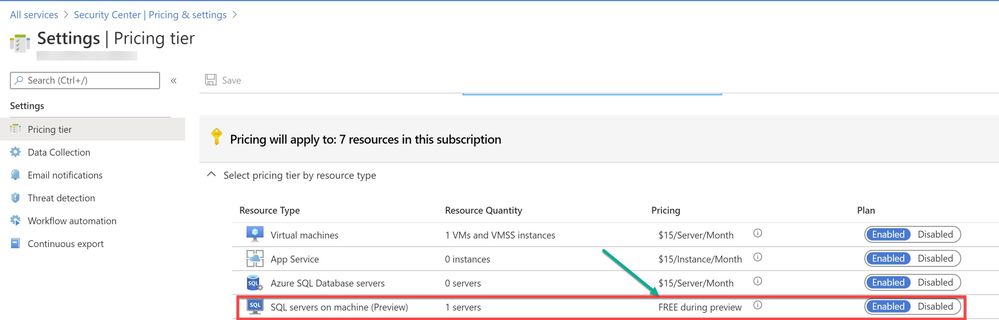
As a prerequisite, make sure the optional bundle (SQL servers on Machine) is enabled in Security Center’s pricing and settings page (Subscription) as shown in ‘Image 1’
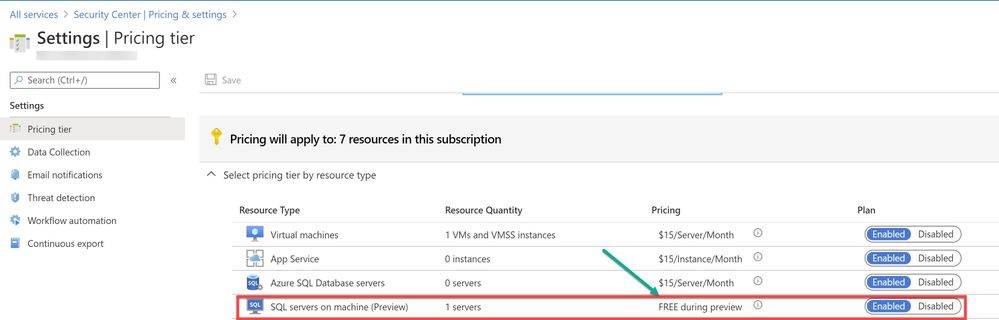
Image 1: Pricing settings in Security Center
If you have Auto-provisioning turned on (Refer, Image 2), Azure Security Center will automatically provision the Log Analytics Agent on the Azure VMs.
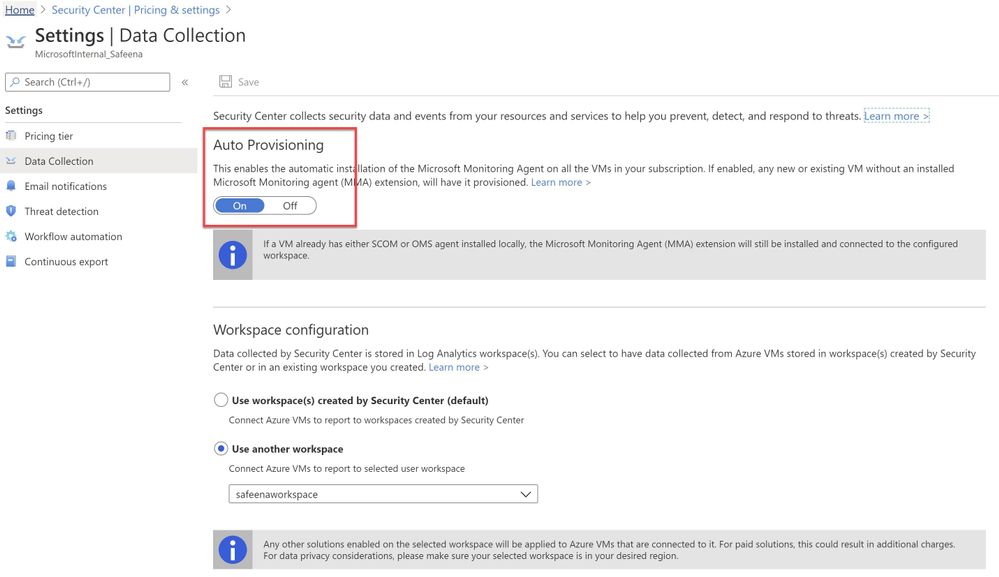
Image 2 : Auto Provisioning
In an instance where you don’t have Auto-Provisioning turned on, you would have to manually install the agent. Refer this article for step-by-step process of the installation.
You may choose to collect the data in a default workspace that Azure Security Center creates or select your own workspace. Advanced Data Security for SQL servers on machines will be enabled on all SQL servers connected to the selected workspace. The protection will be fully active after the first restart of the SQL Server.
In this sample scenario, a SQL IaaS VM (sqlserver) was provisioned. Azure Security Center installed the Log Analytics agent and started gathering data to provide security recommendations for your SQL VM under Recommendations section (as shown in ‘Image 3’). Furthermore, you can select the security option at the left pane and view recommendations from Security Center and alternatively, you may navigate to Azure Security Center for more information on a recommendation. You can enable threat protection for Azure SQL Database SQL servers at either the subscription level or resource level.
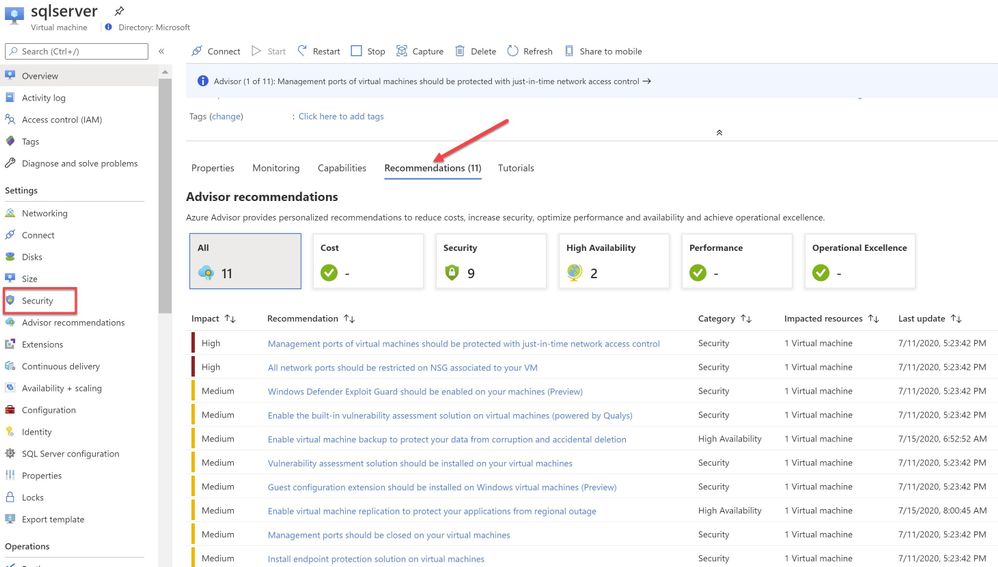
Image 3: Recommendations
You can also filter just the SQL recommendations (Data & Storage hive) from Resource security hygiene section (as shown in the Image 4)
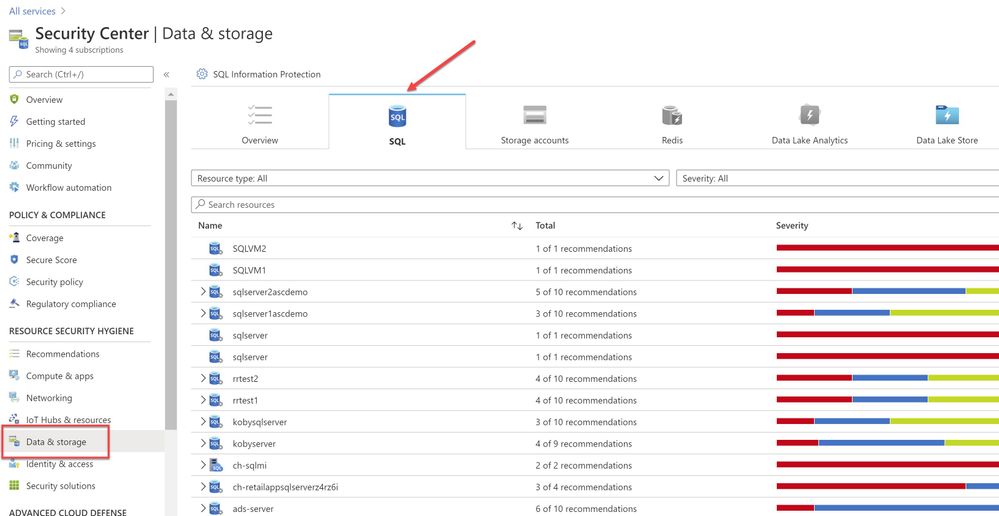
Image 4: Data & Storage
Make sure to address and review all security recommendations for the SQL databases. In my example, I have these unhealthy resources which is grouped beautifully by Severity.
1.1 Executing the Attack
Hackers are always trying to find workloads that are exposed to the Internet and databases that are very common target. As part of this type of attack, it is common to see scanning to discover public IP addresses that have SQL workloads running on it, and once they find that they will move forward to try to crack their password using different methods, such as brute force attack. “Brute Force”, which is a type of attack that attempts to calculate or guess valid username/password combinations to gain unauthorized access to a host. Oftentimes, the sheer amount of Brute Force attempts can effectively result in DDoS of the targeted system. In case threat actors can compromise the SQL database and gain access to it, they will likely find a wealth of valuable information that includes, personally identifiable information, credit card numbers, intellectual property, etc. Even if the database does not have much information, a successful attack on an insecurely configured SQL installation can be leveraged to get full system admin privileges.
For this example, a PowerShell script was utilized to simulate a SQL brute force attack against a SQL database that is connected to the Azure Security Center.
The brute force attempts occurred over TCP port 1433, which was exposed on a public facing interface. TCP port 1433 is the default port for SQL server.
Note: It is a very common recommendation to change the SQL default port 1433, this may impart a “false sensation of security”, because many port scanning tools can scan a “range” of network ports and eventually find SQL listening on ports other than 1433.
The PowerShell script used in this case is simulating the attack by trying to login with ‘sa’ account and trying with a list of commonly used password defined in the text file or the inline array of the script. (In a real-world scenario, once the attacker finds TCP/UDP ports open, it starts to brute force the login with the set of most common passwords used by database administrators to perform a successful attack)
Assuming the attack was successful, Azure Security Center was able to detect and report the attack under Security alerts dashboard as shown in the ‘Image 5’
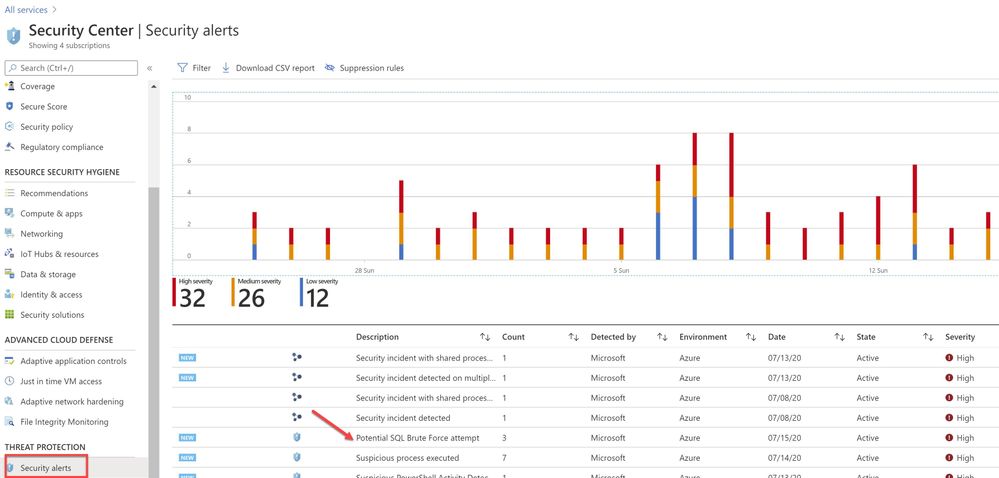
Image 5 : Security Alerts
You can further investigate the alert to view more information of the affected VM name, activity name, Environment, state of alert and more. The first step is to click on the alert itself, and see how many instances does that alert has occurred, as show in the ‘Image 6’
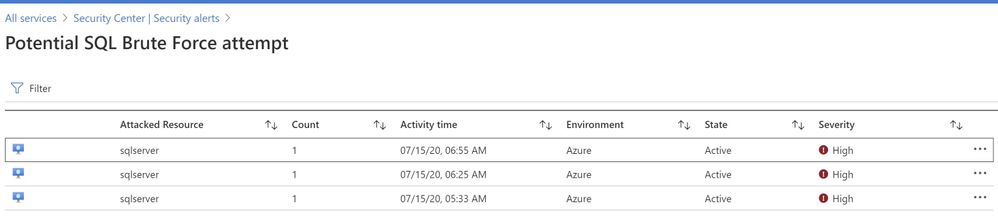
Image 6 : Brute Force attempt alert
You can further select the attacked resource to understand the extent and the details of the attack. Alert details will give you more information that could help during investigation of a security alert, such as, IP addresses, related processes, user accounts and more. ‘Image 7’ below has an example of how this looks like:
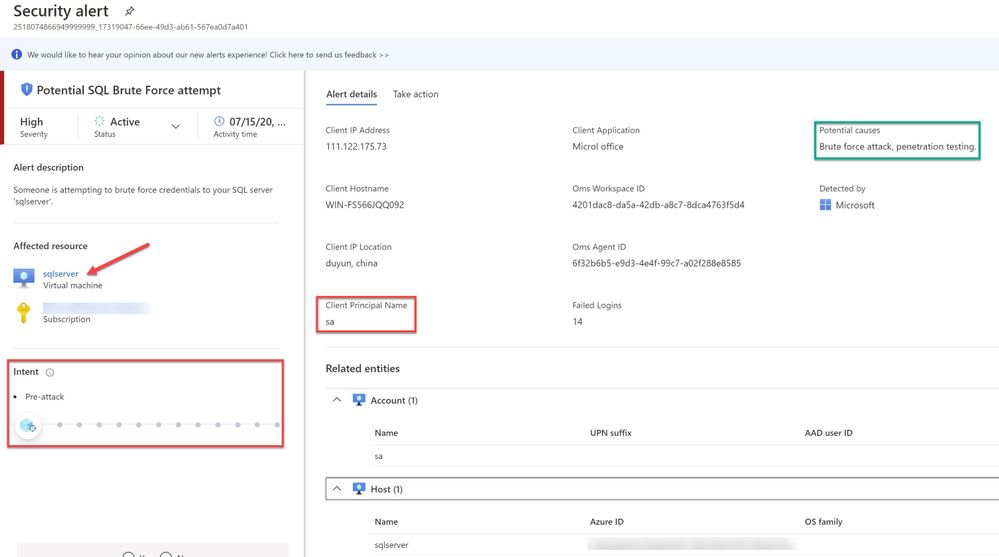
Image 7 : Security Alert details
When you further navigate to the “Take action” tab in the right pane, you can benefit from information like, remediation steps for this alert to mitigate the threat, prevent future attacks by applying the security recommendations and increase security posture.
You can create a logic app defining a workflow automation so that, when an alert is created in Security Center and if it matches the evaluation criteria that you’ve configured in an automation, then the logic app triggers. For example, you might want your Logic App to run when a security alert that contains “SQL” is generated. You can also run Logic Apps manually when viewing a security alert or any recommendation that offers Quick Fix remediation.
You will also notice the option to Suppress the future alerts with similar characteristics if the alert is not relevant for your organization as highlighted below in ‘Image 8’
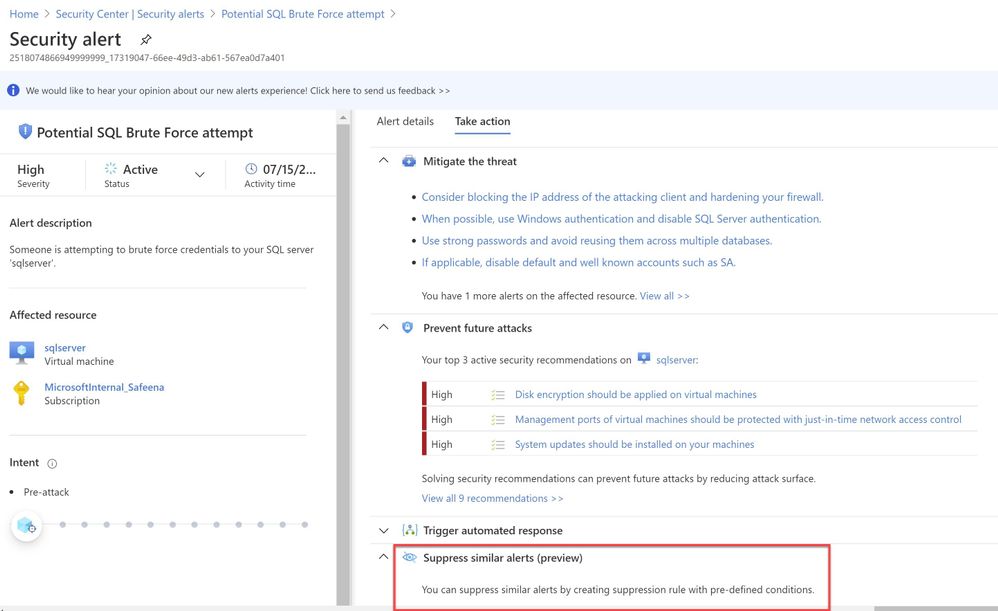
Image 8: Suppress Similar Alerts
It is recommended to configure Azure subscription(s) to receive future alerts and email notifications from Azure Security Center. Please refer to the article that explains how to configure the email settings. Below is an example of the email alert received from ASC when this SQL incident was detected:
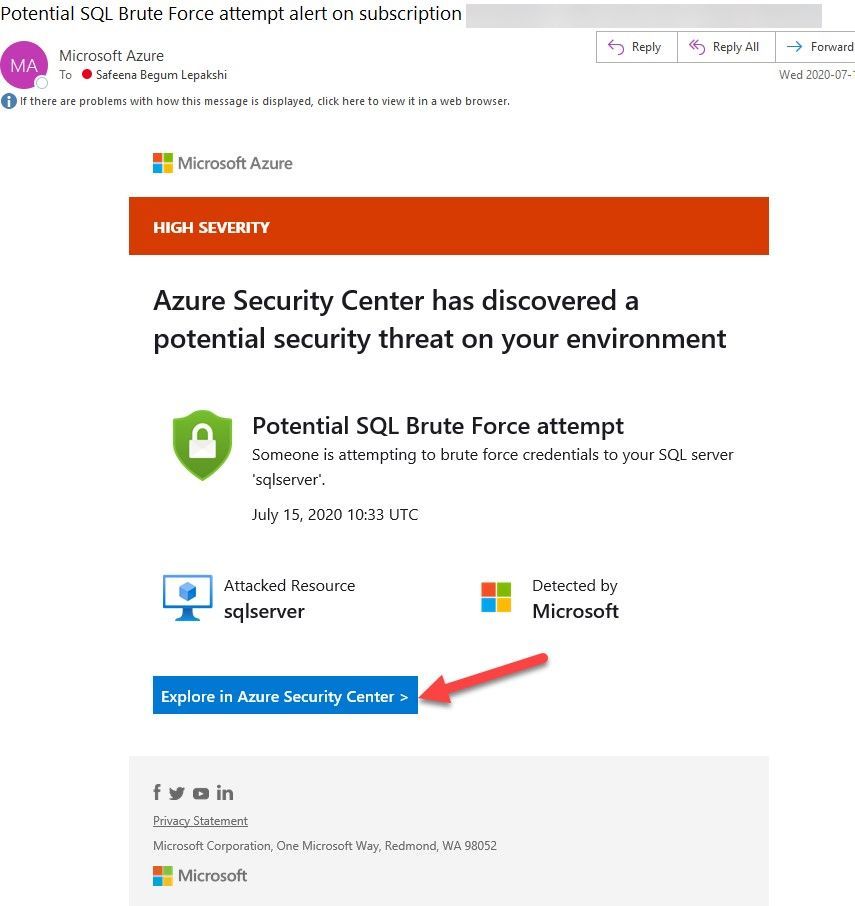
Image 9: Email Notification
In the next blog posts, we will discuss on how you can leverage Azure Security Center to protect your SQL IaaS VMs hosted on Azure Arc and On-premises. Stay Tuned!!
Special thanks to:
Yuri Diogenes, Senior PM, CxE Security – ASC Team for reviewing this post.
by Scott Muniz | Jul 21, 2020 | Uncategorized
This article is contributed. See the original author and article here.
If you see crash at the following call stack, that mostly probably is because web application is currently configured to use Legacy ASP.NET Synchronization Context, but the code is using some new features, such as Tasks (from Task Parallel Library) that require usage of what we call “Task-friendly ASP.NET Synchronization Context.” The old (Legacy) context cannot handle some asynchronous calls properly and this leads to the crash as observed in the above.
Web App Crashes frequently. Below are found in application event log each time of crash:
Application: w3wp.exe
Framework Version: v4.0.30319
Description: The process was terminated due to an unhandled exception.
Exception Info: System.NullReferenceException
at System.Web.ThreadContext.AssociateWithCurrentThread(Boolean)
at System.Web.HttpApplication.OnThreadEnterPrivate(Boolean)
at System.Web.LegacyAspNetSynchronizationContext.CallCallbackPossiblyUnderLock(System.Threading.SendOrPostCallback, System.Object)
at System.Web.LegacyAspNetSynchronizationContext.CallCallback(System.Threading.SendOrPostCallback, System.Object)
at System.Threading.Tasks.AwaitTaskContinuation.RunCallback(System.Threading.ContextCallback, System.Object, System.Threading.Tasks.Task ByRef)
at System.Runtime.ExceptionServices.ExceptionDispatchInfo.Throw()
at System.Threading.ExecutionContext.RunInternal(System.Threading.ExecutionContext, System.Threading.ContextCallback, System.Object, Boolean)
at System.Threading.ExecutionContext.Run(System.Threading.ExecutionContext, System.Threading.ContextCallback, System.Object, Boolean)
at System.Threading.QueueUserWorkItemCallback.System.Threading.IThreadPoolWorkItem.ExecuteWorkItem()
at System.Threading.ThreadPoolWorkQueue.Dispatch()
To Resolve the issue add the following in web.config:
<appSettings>
<add key=”aspnet:UseTaskFriendlySynchronizationContext” value=”true” />
</appSettings>
by Scott Muniz | Jul 21, 2020 | Alerts, Microsoft, Technology, Uncategorized
This article is contributed. See the original author and article here.
Managed Identity are automatically managed by Azure and enable you to authenticate to services that support Azure AD authentication, without needing to insert credentials into your code. You can learn more about this in the following document: how to connect with Managed Identity to Azure Database for MySQL
The blog will outline how to use Function App System Managed Identity to connect to Azure Database for MySQL.
- Step 1: Configure Azure AD Authentication for MySQL
- Step 2:Enable Managed Identity for the Function App
- Step 3: Find the Managed Identity GUID and then create a user in MySQL
- Step 4: Writing code for function app
- Step 5: Test the function app
Step 1: Configure Azure AD Authentication for MySQL
First, we need to make sure that the Azure Database for MySQL is configured for Azure AD authentication. If your server is not already configured, follow the steps in this how-to guide: Use Azure Active Directory for authentication with MySQL
Step 2: Enable Managed Identity for the Function App
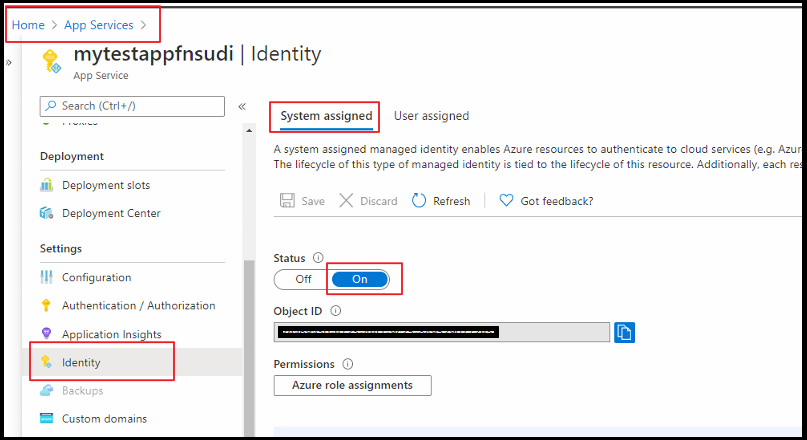
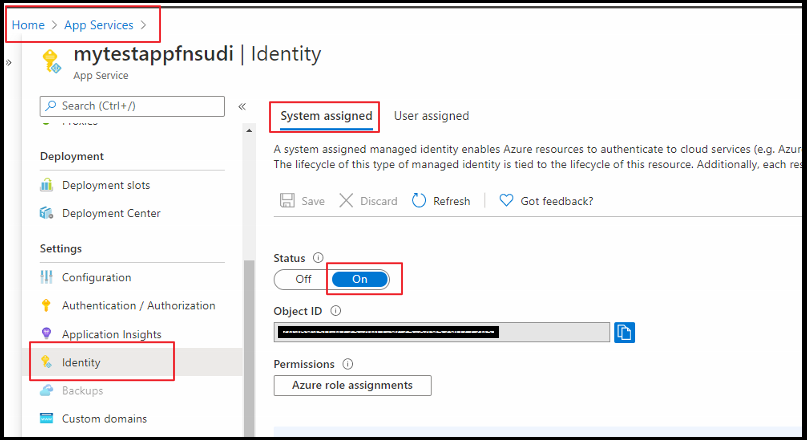
Next, enable Managed identify for a Function app. For this you need to log in to the Azure Portal and then select the Function App which you will be using. Select Identity under Settings. Change the Status to On.
Step 3: Find the Managed Identity GUID and then create a user in MySQL
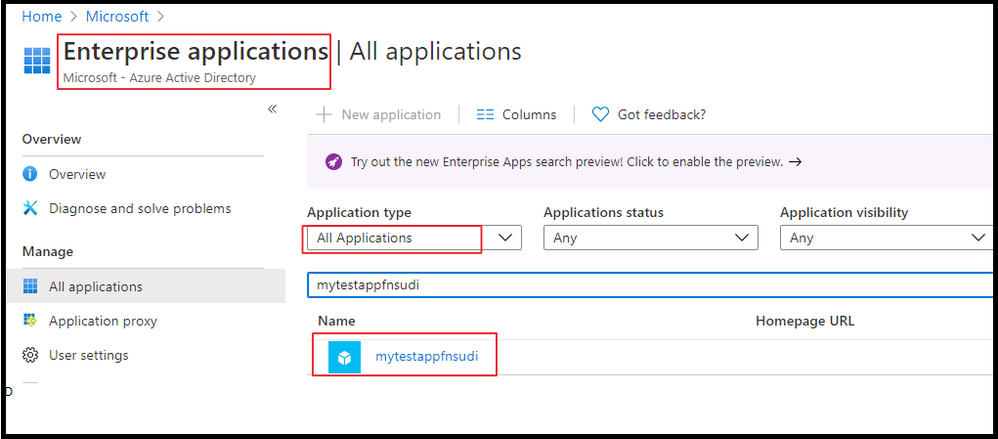
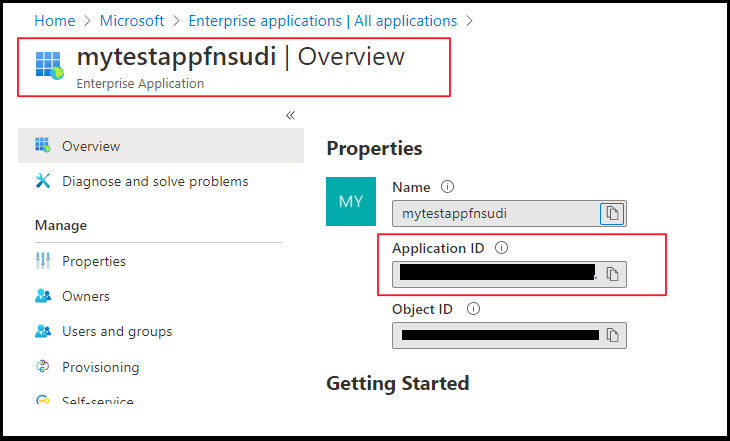
Next, create a MySQL user for your Managed Identity. For this we need to get the application ID. For that, go to Azure Active Directory from the Azure portal and then go to Enterprise Applications.
Once you select the application, you can will be able to copy the Application ID.
Once you have the Application ID, log in to Azure Database for MySQL using the AAD login and execute the below query. This query ensures the managed identity now has access when authenticating with the username myuser. Replace the Application ID (GUID) in the query with your own.
SET aad_auth_validate_oids_in_tenant = OFF;
CREATE AADUSER 'myuser' IDENTIFIED BY 'cc5e6297-6bdc-4608-9ab5-ddb0c81e2a7e';
--I would also recommend to GRANTS necessary permission in DB
GRANT SELECT, INSERT, UPDATE, DELETE, CREATE, DROP, RELOAD, PROCESS, REFERENCES, INDEX, ALTER, SHOW DATABASES, CREATE TEMPORARY TABLES, LOCK TABLES, EXECUTE, REPLICATION SLAVE, REPLICATION CLIENT, CREATE VIEW, SHOW VIEW, CREATE ROUTINE, ALTER ROUTINE, CREATE USER, EVENT, TRIGGER ON *.* TO 'myuser'@'%' WITH GRANT OPTION;
FLUSH PRIVILEGES;
Step 4: Writing code for the Function app
Next, let’s see how to get an access token using the Function app System managed identity and use it to call Azure Database for MySQL. Azure Database for MySQL natively supports Azure AD authentication, so it can directly accept access tokens obtained using managed identities for Azure resources. When creating a connection to MySQL, you pass the access token in the password field.
Here’s a .NET code example of opening a connection to MySQL using an access token. This code must run on the Function App to access the Function App system-assigned managed identity’s endpoint. .NET Framework 4.6 or higher or .NET Core 2.2 or higher is required to use the access token method.
Please note the community MySQL Connector/NET (MySql.Data)does not support cleartext plugin. You can use MySqlConnector instead.
The below is a sample code. Replace the values of “Servername”, “User”, and “Database” with your own server credentials.
using System;
using System.IO;
using System.Threading.Tasks;
using Microsoft.AspNetCore.Mvc;
using Microsoft.Azure.WebJobs;
using Microsoft.Azure.WebJobs.Extensions.Http;
using Microsoft.AspNetCore.Http;
using Microsoft.Extensions.Logging;
using Newtonsoft.Json;
using MySqlConnector;
using Microsoft.Azure.Services.AppAuthentication;

namespace myfunappmysqlapp1
{
    public static class mysqlapp
    {
        private static string Host = "<Servername>.mysql.database.azure.com";
        private static string User = "myuser@<Servername>";
        private static string mydatabase = "db";
        [FunctionName("mysqlapp")]
        public static async Task<IActionResult> Run(
            [HttpTrigger(AuthorizationLevel.Anonymous, "get", "post", Route = null)] HttpRequest req,
            ILogger log)
        {
            log.LogInformation("C# HTTP trigger function processed a request.");

            /*Gettting the Token*/
            var sqlServerTokenProvider = new AzureServiceTokenProvider();
            var SqlAccessToken = await sqlServerTokenProvider.GetAccessTokenAsync("https://ossrdbms-aad.database.windows.net");
            //log.LogInformation(SqlAccessToken); /*For troubleshooting in case you need to print the token */
            log.LogInformation("Connecting to database.");

            //
            // Open a connection to the MySQL server using the access token.
            //
            var builder = new MySqlConnectionStringBuilder
            {
                Server = Host,
                Database = mydatabase,
                UserID = User,
                Password = SqlAccessToken,
                SslMode = MySqlSslMode.Required,

            };

            using (var conn = new MySqlConnection(builder.ConnectionString))
            {
                log.LogInformation("Opening connection using access token...");
                await conn.OpenAsync();

                using (var command = conn.CreateCommand())
                {
                    command.CommandText = "SELECT VERSION()";

                    using (var reader = await command.ExecuteReaderAsync())
                    {
                        while (await reader.ReadAsync())
                        {
                            log.LogInformation("nConnected!nnMySQL version: {0}", reader.GetString(0));
responseMessage = reader.GetString(0);
                        }
                    }
                }
            }

             responseMessage = "The versions is Azure Database for Mysql is:" + responseMessage;
            return new OkObjectResult(responseMessage);
        }
    }
}
Step 5: Test the Function app
Once you publish the Application, you can test the with the following steps below.
From the Azure Portal, go to Function App you published and select Functions.
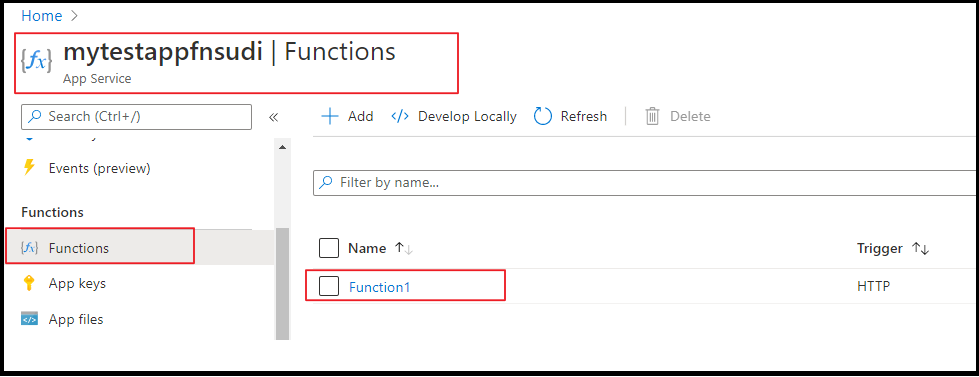
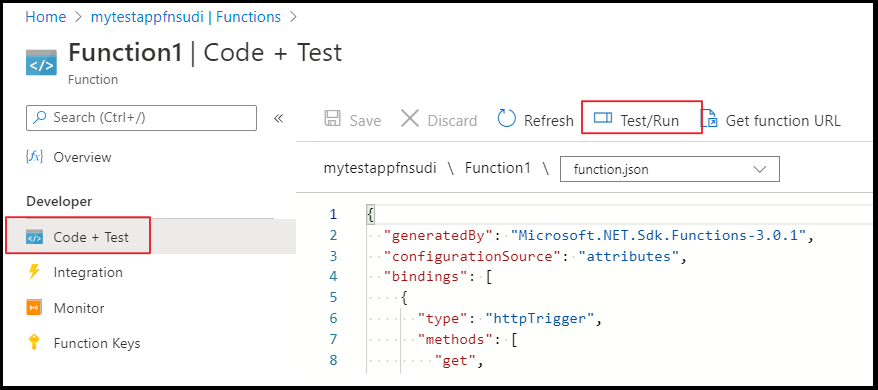
Once the Function is selected, you can select Code+Test and click on Test/Run.
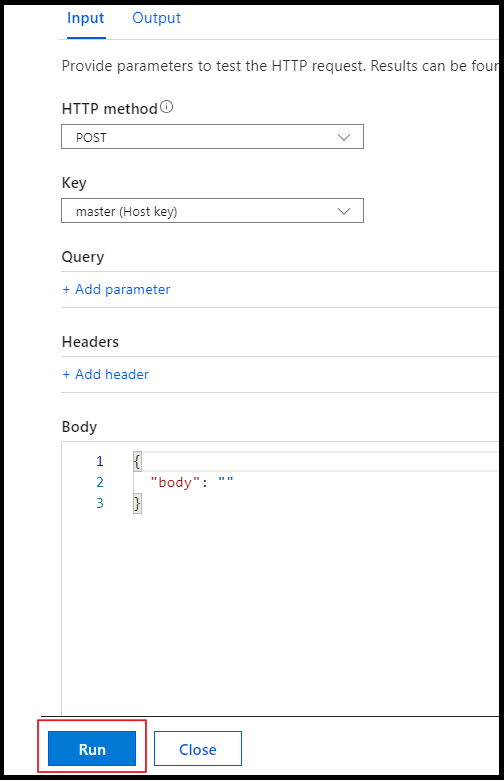
Click on Run on the on the pop up window
You can see the output in terminal for App Insights.
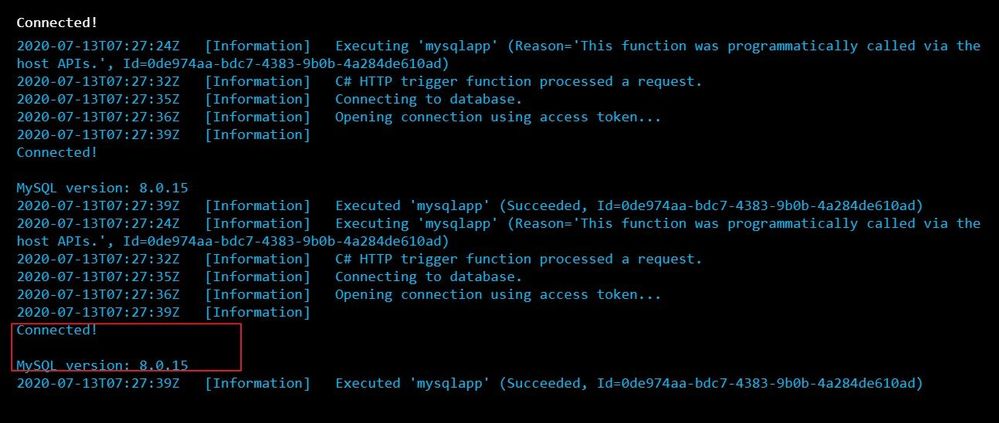
We can see that we connected to the database and could successfully run the query.
Hope this helps!
Sudheesh Narayanaswamy
Technical Support Engineer
by Scott Muniz | Jul 21, 2020 | Uncategorized
This article is contributed. See the original author and article here.
Microsoft Inspire, starting today, provides a forum for Microsoft and our partners to engage and develop plans to further our mission of empowering our customers to achieve more. Project Cortex is our newest endeavor to transform organizational productivity by connecting people with knowledge, insights and expertise.
With Microsoft Inspire offered as a free virtual event this year, we’re happy to share our latest news on availability, partners, and technical updates with everyone.
Project Cortex Availability
We’re excited by the ongoing customer engagement with Project Cortex. As we prepare for general availability, we’re happy to announce our next steps.
Our product team has been tightly focused on delivering a top-notch experience that aligns to customer expectations. One of our healthcare preview customers is eager to bring Project Cortex into production across their organization; noting:
“Cortex would have helped us identify procedural information much faster. When it comes to the treatment of pandemics, we already have workflows in our archives since that type of emergency management procedure has been thought of and written down.”
Over the past year, we’ve been working with dozens of customers in our preview program like Mott Macdonald, Arla Foods, Unilever, and Siemens Healthineers. Project Cortex capabilities are starting to ship, beginning with taxonomy experiences and APIs, which are reaching all SharePoint customers this month.
We’re happy to announce Project Cortex will go to production for existing private preview customers on August 1, 2020. You can expect additional details about general availability at Microsoft Ignite 2020.
Content Services Partner Program 2020-21
The Microsoft Content Services Partner Program is our principal program to prepare and engage partners to deliver knowledge and insights solutions to customers, featuring Project Cortex. For 2020-21, the program will offer three partnership levels for accepted partners.
- Preferred (new level) – Publicly recognized partners in the program, selected for proven customer success, training certifications and competencies, capacity and alignment to Microsoft, and close alignment to the Microsoft field
- Charter – Publicly recognized partners in the program, selected based on proven customer success, training certifications and competencies, capacity and alignment to Microsoft.
- Associate – Registered members of the program, participate in ongoing newsletter, quarterly updates, and training while they develop their competencies, evidence, and offerings to be considered as Charter or Preferred partners.
Here’s the timeline for partners to apply as new or renewed members of the Content Services Partner Program:
- July 21 to August 3 – Partners apply for the program via the application form)
- August 4 – Office hours call (download the invite) for all interested partners to walk through the 2020 CSPP application process and criteria in detail. We’ll also be available to answer questions.
- August 17-19 – Training for partners on Knowledge and Insights, Project Cortex technical details, and Microsoft field engagements. This is a repeat of the initial pilot training developed in June 2020, and we plan to continue to deliver this training periodically throughout the year. Register for the training by August 13, 11:59pm PDT. Attendees will need to be members of a registered Microsoft partner and under NDA.
- September 15 —Microsoft sends program status decisions to applicants.
- Ignite 2020 —Microsoft announces FY21 partner program members (program year runs October 2020 – September 2021)
- October 2020 — Partners participate in new partner onboarding and work begins
on publishing case studies
For more details on the CSPP application process, please see today’s blog post Microsoft 365 Content Services Partner Program – 2020 application announcement.
Project Cortex Launch Partners
As we continue to get Project Cortex ready for launch, we’re also working to ensure that our partners are ready to guide, support, and implement Cortex for our customers. The following Charter partners from our Content Services Partner Program have met the requirements to be recognized as our initial set of launch partners.
System integrators (SI’s)
Independent software vendors (ISVs)
We thank them and congratulate them on their achievement.
Technical Updates
This week, we’re happy to also announce the following technical updates. These were developed as part of Project Cortex to modernize our Microsoft 365 taxonomy service, previously known as Managed Metadata Services. They’re being made available through all Microsoft 365 licensing plans for SharePoint content:
- Our modern taxonomy end user experiences and the modern term store have now reached 100% deployment to all SharePoint customers in Microsoft 365. This week, our modern content type gallery will also reach full general availability.
- Additionally, our taxonomy APIs will be available in the Microsoft Graph APIs by the end of July, as we previewed at Microsoft Build.
These updates help you find these features in the SharePoint admin center, under the ‘Content services’ node, and modernize the user experiences. Existing terms in the term store and content types in the content type hub are all available, to make the transition seamless.
Modern administration experiences are available for the organization-wide term sets and enterprise content types. In the future, these updates will also be made available to the site level term sets and content types.
Tagging and filtering managed metadata columns
Updates to tagging and filtering content with terms are now generally available. Our updated tree view makes it easier to navigate term sets and select terms. You can also use the tree view to filter content with the full hierarchy of the term set. 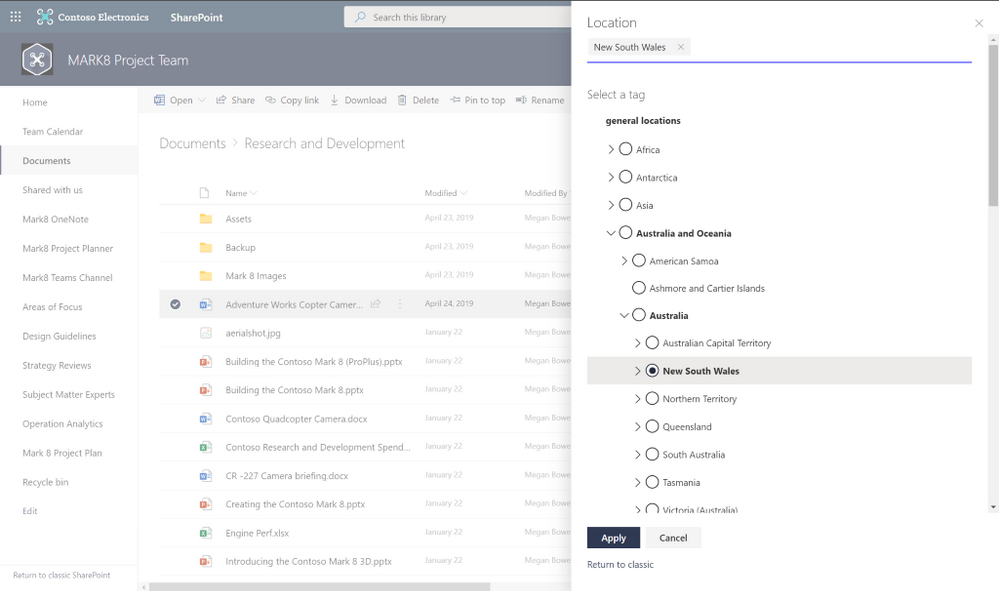 Modern taxonomy filltering
To learn more about filtering in SharePoint, please explore our documentation.
Managing taxonomies in the SharePoint admin center
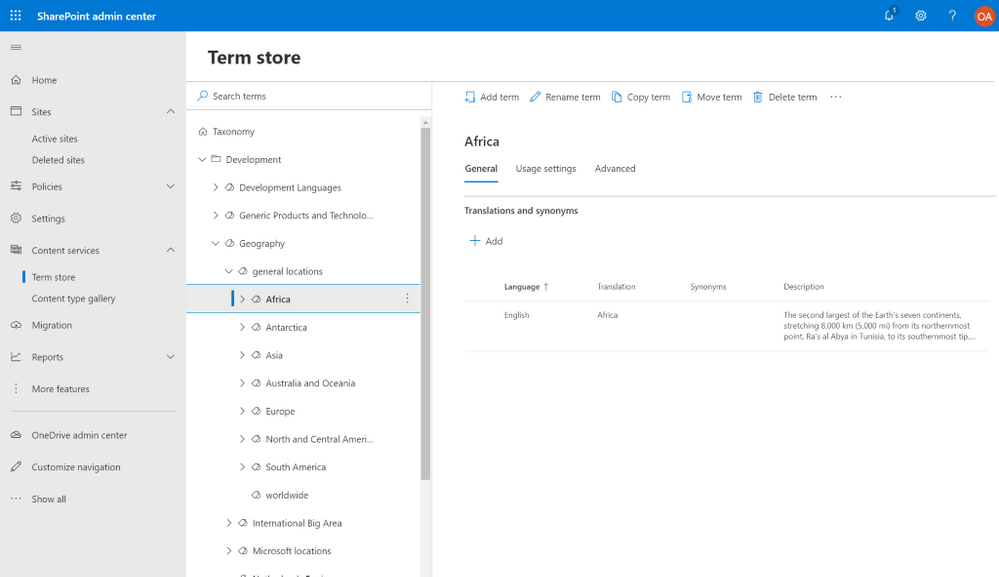
The new term manager, with its modern experiences for creating and managing taxonomies, is now generally available. Available in the new SharePoint admin center, this new manager allows you to work with your pre-existing organization-wide term sets and create new sets easily.
To learn more about taxonomies and managed metadata in SharePoint, and using the new experiences, please explore our documentation.
Content type gallery
The new content type gallery is being released and will be generally available this week. The gallery uses a modern list view of content types in the content type hub, which lets you easily group on different columns and save custom views. The content type ID is also listed for custom coded solutions. Managing your existing enterprise content types and creating new ones is smoother with modern experiences.
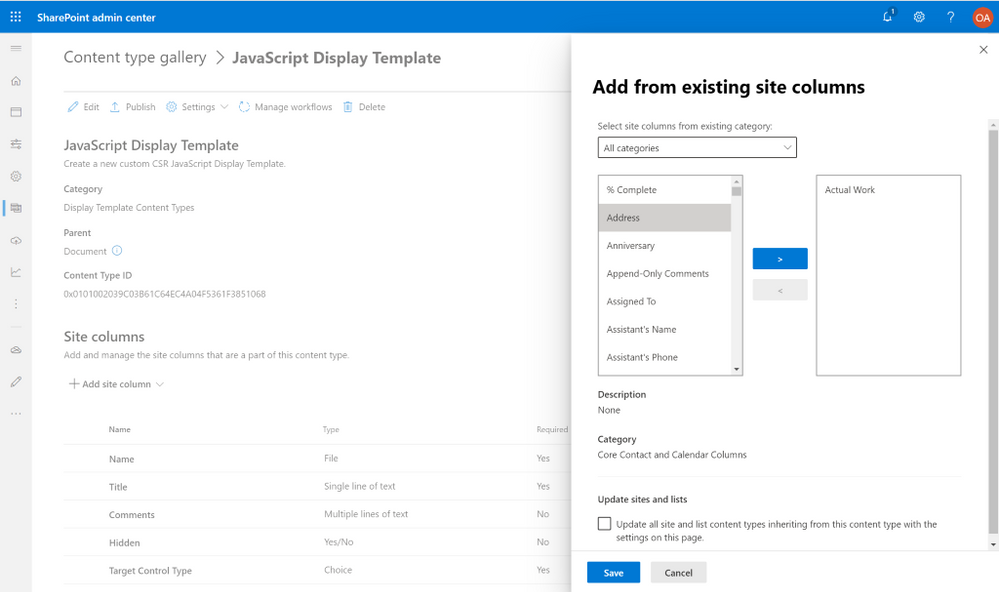
To learn more about content types and the new experiences, please explore our documentation.
Graph APIs
As mentioned at Microsoft Build, we’re developing new Microsoft Graph APIs to support operations on the taxonomy service. These APIs support listing and adding organization-wide term groups, term sets and terms. Listing and editing of most of the properties of these entities are also supported.
The taxonomy APIs will be available for preview in the beta version of Microsoft Graph by the end of July.
Microsoft Inspire
You can learn more about Project Cortex at the following sessions at Microsoft Inspire:
Thanks again. We’re excited by our news and hope you can join us this week and later this year at Microsoft Ignite.


Recent Comments