
by Contributed | Jun 11, 2021 | Technology
This article is contributed. See the original author and article here.
This series highlights Microsoft Learn Student Ambassadors who achieved the Gold milestone and have recently graduated from university. Each blog features a different student and highlights their accomplishments, their experience with the Student Ambassadors community, and what they’re up to now.
Today we’d like to introduce Arpita Gupta, who is from India and recently graduated from Vellore Institute of Technology in Vellore, India.
Responses have been edited for clarity and length.
When you became a Student Ambassador in the fall of 2019, did you have any specific goals you wanted to reach, like attain a skill or work on a particular quality? What were they, and did being a Student Ambassador help you achieve them?
My main aim when I joined the program was to enhance my technical skills and knowledge. I wanted to explore different fields and then choose the right one for me. I particularly found my interest in the field of machine learning and learnt a lot of new things.
The program has also helped me in my overall personality development. I have become more confident and tenacious. The Student Ambassador community provided me a lot of opportunities to interact with like-minded people all across the globe which helped me grow as an individual.
What are the accomplishments that you’re the proudest of and why?
In April 2020, I got a chance to conduct a session in the Global AI Virtual Tour where I covered the basics of machine learning. The main purpose was to pique interest of students unaware of the field. I wanted my session to be not just informative but to pave the way for beginners. While preparing for the talk, I learnt a lot of new things. For example, I got to know about different libraries, their usage and working, and I understood machine learning through real-life examples, like that even in minute things like filtering spam and non-spam mails, machine learning is used. Machine Learning is such a vast field that has absolutely no bounds. The more we dive into it, the more there is to learn.
In the session, I also covered how to complete a Microsoft Learn path [editor’s note: this is one of the initial milestones of the Student Ambassador program]. A lot of new Student Ambassadors wanted to know how to complete a Learning path and the correct approach to it. As my session was specifically for beginners and students who wanted to get into the field of machine learning, I decided to cover a learning path along with some basic explanations in my session. Not only it would help the students understand the subject theoretically but practically as well.
Apart from this, I have also conducted other events in college and online as well. All of them were a huge success with a good number of audience members. I am just glad that I was able to help so many students who wanted to learn and are passionate about tech.
Another accomplishment that I am proud of is when my team got ranked as first runner-up in one of the web-a-thons hosted by my college when I was in my sophomore year. We made a comparative e-commerce website user interface. Although I didn’t know a lot of things back then, I tried to develop something new with whatever knowledge I had. While working on this project, I learnt a lot of things like integrating APIs with the website and worked on a lot of new technologies like Javascript, bootstrap etc.
What do you have planned now that you’ve graduated? What’s next for you after university?
After my graduation, I will be joining F5 Networks, an American company that specializes in application delivery networking and application security. I’ll be in Hyderabad working as a Software Engineer where I will get to experience the ins and outs of the corporate world. Understanding and working on different networking technologies is absolutely amazing, and I am looking forward to this amazing experience.
If you could redo your time with the Student Ambassadors community, is there anything you would have done differently?
My only regret is that I didn’t join this community sooner. I got to know about this program in my third year. If I had known about this program earlier, I would have joined it before. As a result, I missed a lot of sessions and informative workshops which I could have attended.
Another thing that I would redo is to spend more time in this program’s activities in my fourth year. Due to certain circumstances during lockdown and also because of my placements, I was not able to spend enough time conducting events and sessions or attending them. If I could turn back time, I would manage my time more efficiently in order to take part in more sessions and events.
If you were to describe the community to a student who is considering joining, what would you say to convince them to join?
I would like to say that if you are passionate enough about technology, then this is the right platform for you. There is a lot to learn, and there are a lot of opportunities that this program provides. So come join us, grab them, and become a better version of yourself.
And what advice would you give to new Student Ambassadors?
There are mainly 2 things that I would like to advise all the newly joined Student Ambassadors:
- Be active in the community: Taking my own example, it took me quite some time to open up to my peers and to become active in the community. But the more you interact, the more you learn. All the students in this community are here to help one another. So interact with others, learn and grow together.
- Don’t be scared of making mistakes: No one is perfect. We all make mistakes. Someone who is afraid to fail has never tasted success. So embrace your failures instead of backing out of hard work. Mistakes hone your skills.
Do you have a motto in life, a guiding principle that drives you?
We learn more from failures than from success. Don’t let it stop you. Failure builds character.
Lastly, on a lighter note, can you share one random fun fact about you that not many people know?
A fun fact about me is that I love travelling and exploring new places. It helps me to relax and take some time off from my daily routine. I also get to know about the culture and lifestyle of the people living in different regions of the country. Hence, traveling is fun.
Thank you, Arpita, and good luck to you in all your future endeavors!
by Contributed | Jun 11, 2021 | Technology
This article is contributed. See the original author and article here.
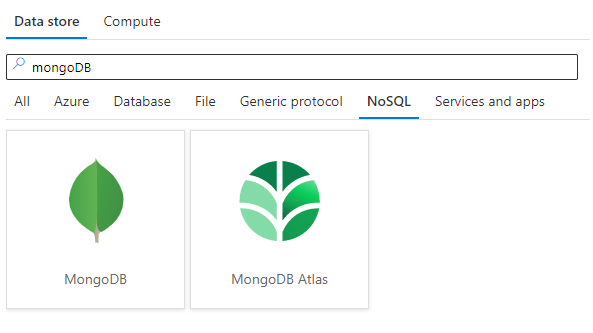
Azure Data Factory is continuously enriching the connectivity to enable you to easily integrate with diverse data stores. Now MongoDB and MongoDB Atlas are supported as both source and sink for copy. With this, you can copy data from any supported source data store to MongoDB or MongoDB Atlas database; or copy data from MongoDB or MongoDB Atlas to any supported sink data store. Besides, it’s also supported to import and export JSON documents as-is to achieve schema-agnostic copy.
Learn more from ADF MongoDB connector and MongoDB Atlas connector documentation. For a full list of data stores that are supported in ADF, see this connector overview article.
by Contributed | Jun 11, 2021 | Technology
This article is contributed. See the original author and article here.
Microsoft Teams offers scheduling capabilities through the Shifts app built into the native Teams experience. The idea is to empower teams to create, update, and manage schedules for a tighter collaborative experience. This functionality is heavily used by first-line worker groups, especially on the clinical floor. With a rich API extensibility and tight coupling with other M365 products, Shifts offers a way to truly automate the schedule management process – eliminating paper trails and removing redundancies in communication.
Process owners often struggle with adding business logic to the process of scheduling. The following use-case illustrates how Shifts can be paired with a data model (maintained in a SharePoint List), and elevated with business logic (set up using Power Automate) to create a role/eligibility-based scheduling process.
Let’s envision a scenario where we are looking to automate a Covid volunteer scheduling process for a vaccination clinic. In this clinic we likely have volunteers who are filling multiple, unique roles. Each of these roles may have defined shifts that are available to be volunteered for. For a volunteer to sign up for a specific shift they must meet a defined set of qualifications.
Clinic Roles:
- Vaccinator
- Observer
- Runner
- Check-In Support
- Documenter
Now for a volunteer to register for a vaccinator shift at the clinic they might have to be a RN, LPN, MA DO, or have some other qualification that allows them to administer vaccines. On the other hand, someone volunteering for a Check-In Support shift would not have to meet any qualifications.
Storing the Data
The first step to automating this process is determining where we want to store our volunteer data. In this example, I will be using a SharePoint list; however, any tabular data structure would work well.
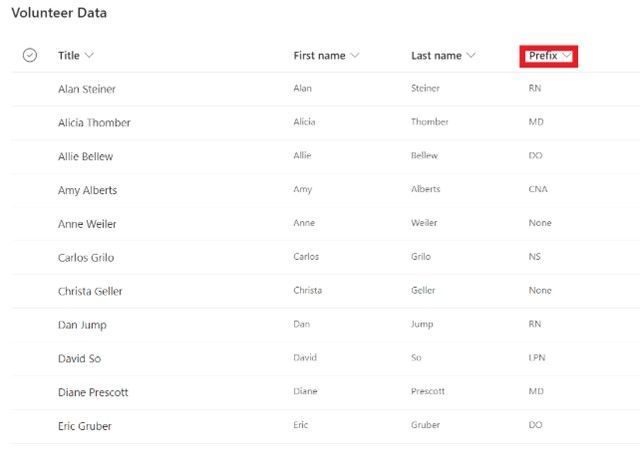
You can see the list stores basic information about the volunteer, including the UPN of the user (not pictured in screenshot), along with a prefix denoting their qualifications relevant to scheduling a shift.
Creating a Teams Shift Schedule
Before you can create a shifts schedule, you must create a Team! Once you have your team you can create a shifts schedule for that team by opening the Shifts app in Teams and creating a new team schedule.
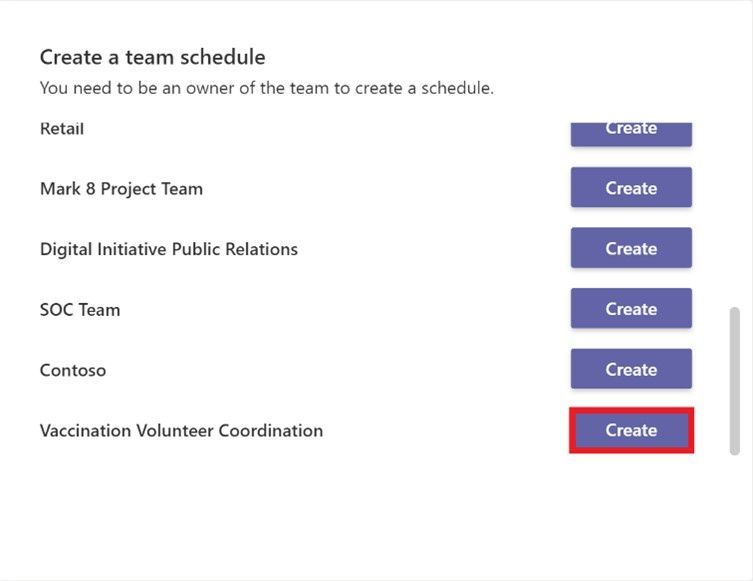
Once you have your Teams Schedule and you have added all volunteers to the team, you can create a new group within your schedule. Each group in the teams Shift Schedule can have its own unique schedule, so we will create a group for our vaccination clinic.
Creating a schedule group
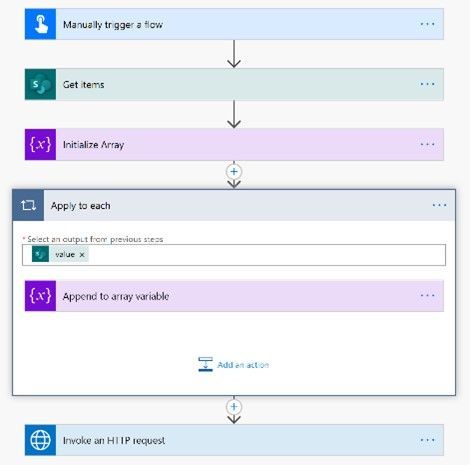
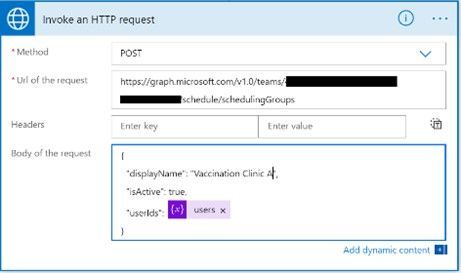
If you have only a few team members it is easy to create a schedule group and add the appropriate members through the Shifts app UI. However, if you have enough members (like in our volunteer example) it makes more sense to add members in a more automated fashion. To do this you can create a simple Power Automate that calls a Microsoft Graph API endpoint for creating a scheduling group.
A sample Power Automate is pictured below. You can see the flow loops through the volunteer data that is stored in the SharePoint list and creates an array of UPNs. The last step is calling the Microsoft Graph API endpoint to create the group with the array of users (documentation below).
Create schedulingGroup – Microsoft Graph v1.0 | Microsoft Docs
Creating Shifts
After you have run your Power Automate to add your users to the Shifts group, you are ready to create some shifts! Create shifts that can be claimed by volunteers by using the open shifts functionality and specifying how many open slots there are for each open shift. You can also add a custom label and color theming to differentiate between your shift types.
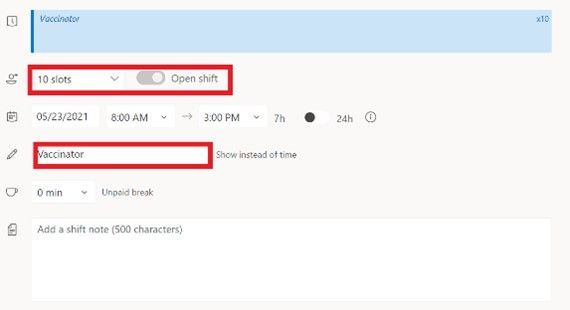

Once you have your open shifts created your team members will be able to sign up to volunteer!
Remember to share your changes with the team.
Automating Shift Approval
Once a volunteer signs up for a shift we need to make sure they are qualified for the shift. To automate this approval process again we will turn to Power Automate!
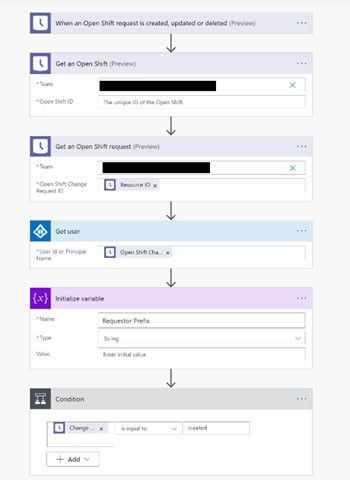
Your approval process will be specific to a set of requirements; however, in almost all cases the Power Automate will be triggered when the Open Shift request is created (a volunteer requests a shift) and will end with the Open Shift request being approved or rejected!
The beginning of my approval Power Automate for this volunteer example is pictured below. After you get some details about the open shift request, the type of shift, and validate the request was created (not deleted or updated), all you need to do is add your own business logic to validate the team member meets the requirements for the shift!
For more information on how to get started with power automate check out:
Get started with Power Automate – Power Automate | Microsoft Docs
And that’s all! Now you can use Shifts in Teams and Power Automate to quickly design a fully automated role-based scheduling solution!
*Please note that different connectors in Power Automate have different throttling limits. Keep this in mind when designing your approval solution.
Author:

Andrew Roger
Technical Architect
Microsoft Technology Center
by Contributed | Jun 11, 2021 | Technology
This article is contributed. See the original author and article here.
As announced in a previous blog post, dynamic search ads can be created within search campaigns via the use of ad group type. Within a search campaign, you now have the option to create a standard ad group (containing expanded text ads, responsive search ads, and keywords) or a dynamic ad group (containing dynamic search ads and auto targets).
Starting this month you can no longer add, update, or retrieve campaigns that only support dynamic search ads. The campaign type of your existing campaigns has been updated from “DynamicSearchAds” to “Search”. The ad groups are now considered “dynamic” ad groups, but there are no structural changes i.e., they contain the same auto targets and dynamic search ads as before.
As always please feel free to contact support or post a question in the Microsoft Advertising developer Q&A forum.
![Records Management and Driving Compliance [M365 Meetup for Government]](https://www.drware.com/wp-content/uploads/2021/06/fb_image-74.jpeg)
by Contributed | Jun 11, 2021 | Technology
This article is contributed. See the original author and article here.
How are organizations digitally transforming to become leaders in records management, information protection, and eDiscovery? Microsoft 365 provides integrated and intelligent capabilities to help you discover, protect, and govern your business-critical information across your digital estate. At this session we will hear from subject matter experts and their lessons learned for success.
When: Tuesday, June 15th, 2021 @ 5pm EDT
Register for the session today!
Presenters:
Matt Littleton, Compliance Global Blackbelt, Microsoft
https://www.linkedin.com/in/matt-littleton/
Tim Shinkle, VP, Millican & Associates, Inc.
https://www.linkedin.com/in/tim-shinkle-4583121/
https://millican-assoc.com/


Recent Comments