by Contributed | Jun 21, 2021 | Technology
This article is contributed. See the original author and article here.
> This is based on the Git Hub curriculum https://github.com/microsoft/Web-Dev-For-Beginners
There are 16 million developers in the world today. Roughly half of those, 8 million are web developers. Web development is therefore a good skill to have as you are looking to land that first job and build a career in tech. But where do you begin to learn all that? With this path
Web dev for beginners path.
It covers everything from HTML, CSS, JavaScript to Accessibility.
Intro to programming
What even is programming? Well, it’s a way to instruct your machine to do things for you. By running statements, you can things like creating a web a page, a simple script or why not a computer game. The possibilities are endless. You do need some kind of text editor to type it all in, we provide that to in this first module.
Intro to programming
Accessibility on the Web
Not everyone has perfect eyesight or see the colors you do or can even see at all. As a developer you need to realize that when you build programs, you should include everyone. There are specific tags and approaches you can use to make your app usable by anyone, regardless of disability. Be inclusive and build better apps.
Web accessibility
JavaScript variables and data types
One of the most popular programming languages right now is JavaScript. JavaScript can be used in the browser to create an interactive experience, but it can also be used on the backend to create APIs, application that can talk to other services and even databases. Learn how to think in programming by being introduced to the concept of variables and data types.
JavaScript variables and data types
Functions
When you start out, you might have all your code statements in one file. But there is a way to organize your code so it can be made more readable but also reusable. What you can do is to create named areas, functions, which can be called whenever you need them to carry out a task for you.
Functions in JavaScript
Decisions with IF/ELSE
Your code can execute differently depending on the values of different variables or some other condition. Having that flexibility makes your application useful in many different scenarios. Learn about IF, ELSE and much more.
Decisions with IF/ELSE
Arrays and loops
Sometimes your data takes on the form of a list. Imagining a recipe, or an ice cream menu or why not a receipt of things. Lists make it possible to store more than one thing and there are constructs that make it possible to operate on lists and get what you need from them such as their sum, or maybe the highest value and so on.
Arrays and loops
by Contributed | Jun 21, 2021 | Technology
This article is contributed. See the original author and article here.
This has been a tough year as we’ve been isolated and away from other people more than most would like. In an effort to intentionally reconnect – even if it means virtually in the short term – we are committed to finding every possible way of engaging with you, the HPC community, in every practical way. While we are hopeful in-person events will restart in the near future, we do not want to wait on that to re-engage with the incredible community of engineers, scientists, and developers who live and breathe HPC + AI. There has never been a greater need to rebuild personal connections and engage socially, and the technology space is no exception. Our vision is to enable fruitful informal connections between people from across the community, including Microsoft experts, through a healthy, supportive atmosphere of knowledge exchange, idea iteration, industry topic debate, and architecture comparison that improves the universal experience for everyone’s benefit.
Open Community Social Launch Event
To get the ball rolling here, we’re going to host a virtual 60-minute event during the upcoming ISC21 Conference as an inaugural ‘open community social’. There is a not-so-planned panel agenda for this event where we will discuss various topics covering HPC + AI. We have multiple topics we can banter back and forth, but that is secondary to engaging with YOUR direct questions or discussing topics that YOU suggest. Our moderator will kick-off the event and be on the lookout for your questions / comments that we’ll ask our panel of experts to respond to. While we know this does not replace in-person relationship building, we do hope you can carve out some time from your busy schedule to connect with us and each other.
Join the Azure HPC Community
We are launching an Azure HPC Discord group where you can engage with Microsoft Azure HPC subject matter experts and with one another to exchange ideas or just enjoy community interactions! Please consider joining the group prior to our ISC21 Off Hour Social Event so you can connect with us directly after the virtual event ends.
You can join the Azure HPC Discord group here.
Azure HPC Community Calendar
Below is a list of future community events that are tentatively scheduled through the end of 2021. Also, be on the lookout for more informal meetup events to be added to the schedule below. Event updates will be posted to the Discord channel.
Month
|
Event Title
|
Type
|
Description
|
June
|
HPC Community Launch
|
Virtual
|
Open Q&A Social alongside the ISC21 Conference
|
August
|
SIGGRAPH Meetup
|
Virtual
|
HPC Community social gathering at SIGGRAPH
|
September
|
HPC LIVE!
|
Virtual
|
Major community social gathering hosted by Azure HPC SMEs
|
October
|
NVIDIA GTC Meetup
|
Virtual
|
HPC + AI Social gathering
|
November
|
SC21 Meetup
|
In Person
|
HPC Community social gathering at Supercomputing
|
December
|
Design Automation Conference Meetup
|
In Person
|
HPC Community social gathering at DAC
|
While so many of the corporate investments and programs for HPC are centered around technologies, capabilities, speed, and costs, this one is refreshingly simple…it is about connecting through community.
We really hope you can join us for the launch and other events this year!
by Contributed | Jun 21, 2021 | Technology
This article is contributed. See the original author and article here.
Event Agenda
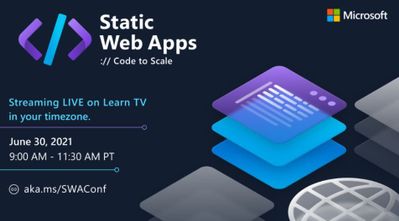
Calling all web developers! We’re so excited to announce Static Web Apps – Code to Scale, a special live event to celebrate the official release of Azure Static Web Apps! Join our team for a free live event on June 30 @ 9am PT (4pm GMT) and learn how to deploy Azure Static Web Apps on your Azure for Student subscription.
Join us at 9:00 AM PDT / 16:00 UTC 30th June
by Contributed | Jun 21, 2021 | Technology
This article is contributed. See the original author and article here.
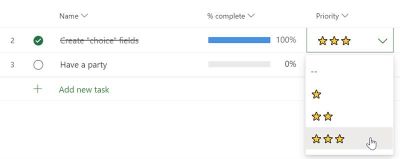
You can create a type of custom field that allows you to quickly choose from several options. Choice custom fields are great for scenarios such as having a Risk column with “High”, “Medium”, and “Low” values. Also, try using them for rough planning of tasks such as “This week”, “Next Week”, and “Later”. Like other custom fields, you can use them in the Grid, in the Board view, and in the task details card. Try them out!
Getting Started
Like other custom fields, click the “Add column” button and choose the “New field” option.
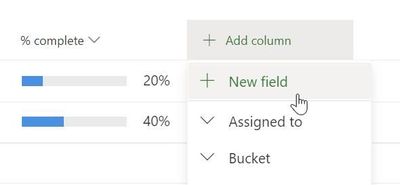
Then, select the “Choice” field type.
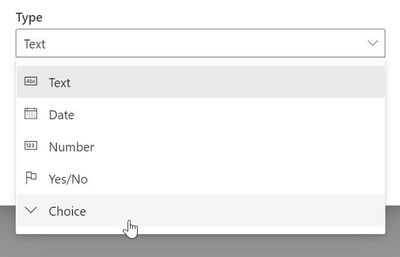
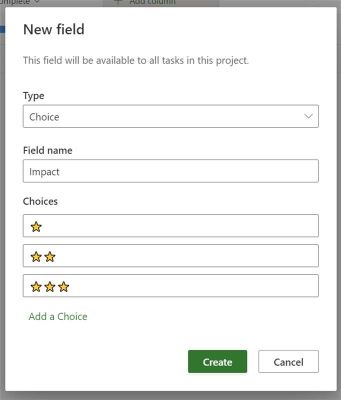
Now give your field a name and a set of options. Press the delete icon next to a choice and the Add a Choice button at the bottom to manage the number of choices you would like to have. You can use the handle on the left side to reorder the choices. You can also use Ctrl + Up/Down on Windows, or Command + Up/Down on Mac to reorder choices with your keyboard.
Frequently Asked Questions
How many choices can I make?
20 for now. We will support 25 soon. Let us know if you need more!
How can I use emojis in my fields?
Windows and Mac both include an emoji menu. Press Win + ; (Windows key plus semicolon) to open it. On Mac, press Control + Command+ Space.
Are choice fields included when I make copies of a project?
Yes! Both the fields and the values are included when you copy a project.
Where can I go to learn about the other types of custom fields?
Head over to our support site to learn more about the types of custom fields available in Project for the web.
Are these “enterprise” fields? Can I build reports using them?
No. Like the other types of custom fields, this field type is only visible in Project for the web.

by Contributed | Jun 21, 2021 | Technology
This article is contributed. See the original author and article here.
This video series shows how you can adopt a Zero Trust approach for security and benefit from the core ways in which Microsoft can help. In the past, your defenses may have been focused on protecting network access with on-premises firewalls and VPNs, assuming everything inside the network was safe. But as corporate data footprints have expanded to sit outside your corporate network, to live in the Cloud or a hybrid across both, the Zero Trust security model has evolved to address a more holistic set of attack vectors.
Based on the principles of “verify explicitly”, “apply least privileged access” and “always assume breach”, Zero Trust establishes a comprehensive control plane across multiple layers of defense:
- Identity
- Endpoints
- Applications
- Network
- Infrastructure
- Data
Introduction to Zero Trust
Identity:
Join our host, Jeremy Chapman, as he unpacks the foundational layer of the model with identity. As the primary control plane for Zero Trust, it acts as the front door for people, service accounts, and devices as each requests access to resources. Identity is at the core of the Zero Trust concepts of never trust, always verify and grant the appropriate level of access through the principle of least privilege.
Zero Trust | Identity
Endpoints & Applications:
See how you can apply Zero Trust principles and policies to your endpoints and apps; the conduits for users to access your data, network, and resources. For Zero Trust, endpoints refer to the devices people use every day — both corporate or personally owned computers and mobile devices. The prevalence of remote work means devices can be connected from anywhere and the controls you apply should be correlated to the level of risk at those endpoints.
For corporate managed endpoints that run within your firewall or your VPN, you will still want to use principles of Zero Trust: Verify explicitly, apply least privileged access, and assume breach.Jeremy Chapman walks through your options, controls, and recent updates to implement the Zero Trust security model.
Zero Trust | Endpoints & Applications


Recent Comments