by Scott Muniz | Aug 1, 2020 | Alerts, Microsoft, Technology, Uncategorized
This article is contributed. See the original author and article here.
Overview of Built-In RBAC roles in Azure API Management
Azure API Management relies on Azure Role-Based Access Control (RBAC) to enable fine-grained access management for API Management services and entities (for example, APIs and policies).
Reference Article: https://docs.microsoft.com/en-us/azure/api-management/api-management-role-based-access-control
As highlighted in the above article, Azure APIM provides a set of built-in RBAC roles for managing access to APIM services. These roles can be assigned at different scopes, which includes
- Subscription Level
- Resource Group Level
- Individual APIM service level
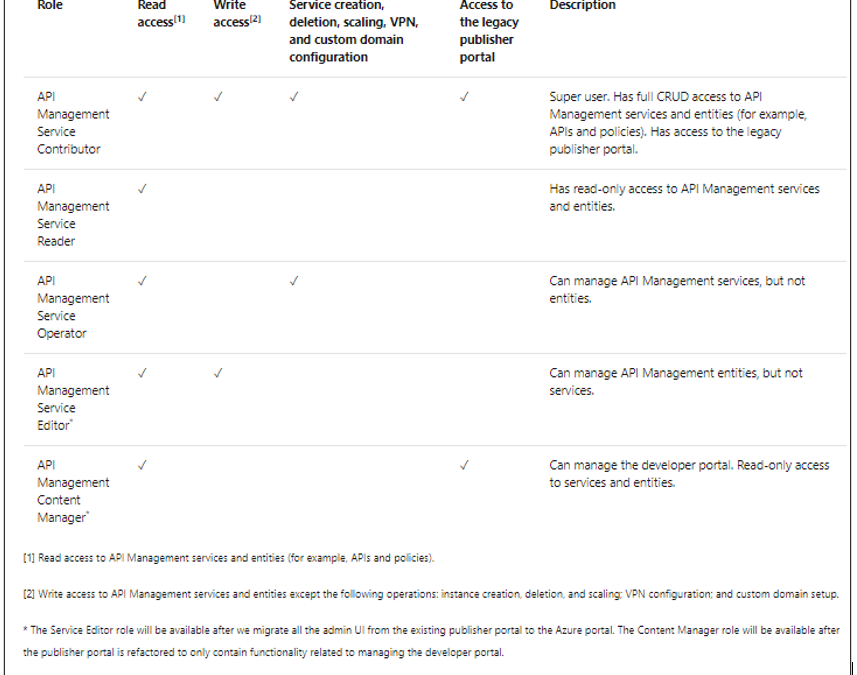
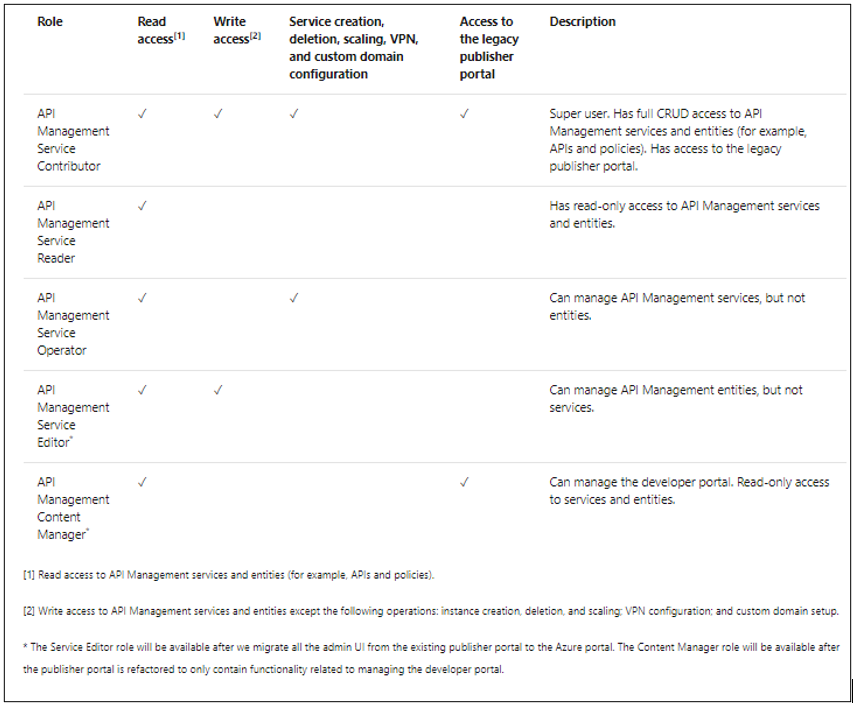
The following table provides a brief description of the built-in roles currently offered by Azure APIM. These roles can be assigned via Azure portal or other tools, including Azure PowerShell, Azure CLI, and REST API
Custom RBAC roles in Azure APIM
If the default built-in roles do not meet specific user requirements, you can create custom RBAC roles for providing a more granular access to either APIM services or any of their sub-components.
Custom Roles in Azure RBAC: https://docs.microsoft.com/en-us/azure/role-based-access-control/custom-roles
While creating a custom RBAC role, it is easier to follow the below approach in order to avoid complexities or discrepancies:
- Start with one of the built-in roles.
- Edit the attributes to add Actions, NotActions, or AssignableScopes.
- Save the changes as a new role.
- Assign the new role to the APIM services or APIM components (such as APIs, policies, et cetera).
The ARM (Azure Resource Manager) Resource Provider Operations article contains the list of permissions that can be granted on APIM level.
https://docs.microsoft.com/en-us/azure/role-based-access-control/resource-provider-operations#microsoftapimanagement
Let us consider a few scenarios where we envision the usage of custom RBAC roles to enable fine-tuned access to APIM services or their components.
Scenario 1: Deny users from deleting APIM services
RBAC roles that enable having complete write access to APIM services (such as API Management Service Contributor role) have provision for performing all management operations on an APIM service.
To avoid intentional/unintentional deletion of APIM services by any user having write access other than the APIM Administrator, you can create the below custom RBAC role for denying the operation Microsoft.ApiManagement/service/delete to users.
In this example, let us use the Azure Portal for modifying the built-in RBAC role Contributor and create a custom role for denying APIM service deletion action for all services under a particular Azure subscription. This custom role would allow users to perform all default owner operations except deleting APIM services in the subscription.
Step 1:
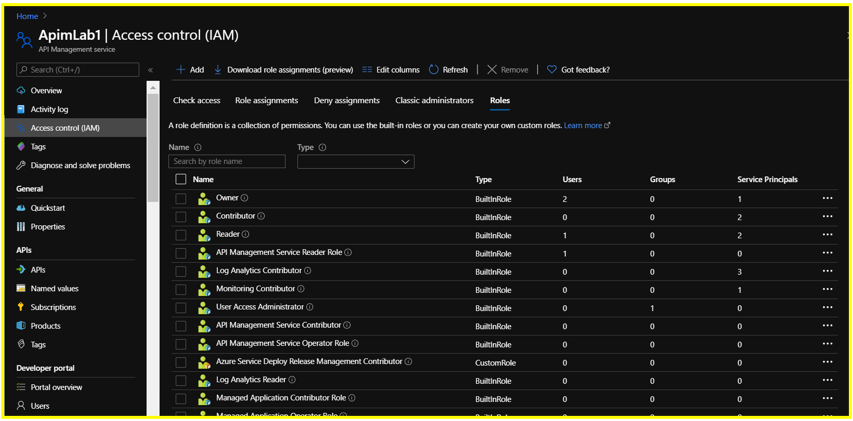
Maneuver to the Access Control (IAM) blade of a sample APIM service on the Azure Portal and click on the Roles tab. This would display the list of roles that are available for assignment.
Step 2:
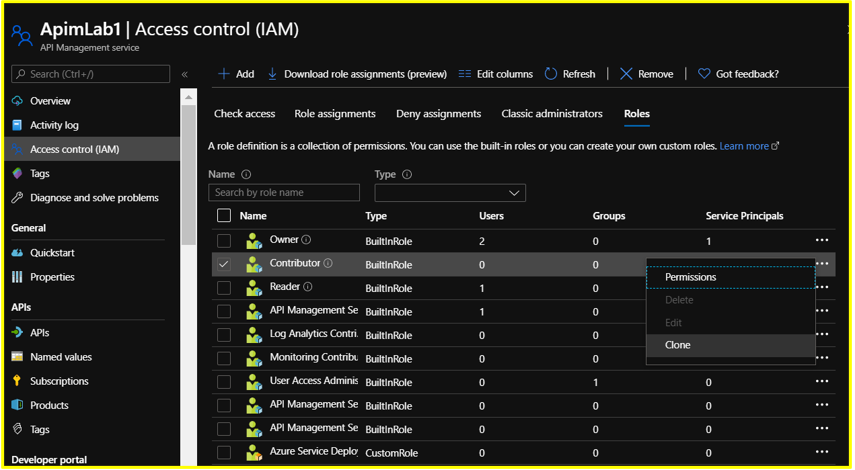
Search for the role you wish to clone (APIM Service Contributor in this case). At the end of the row, click the ellipsis (…) and then click Clone
Step 3: Configure the Basics section as follows
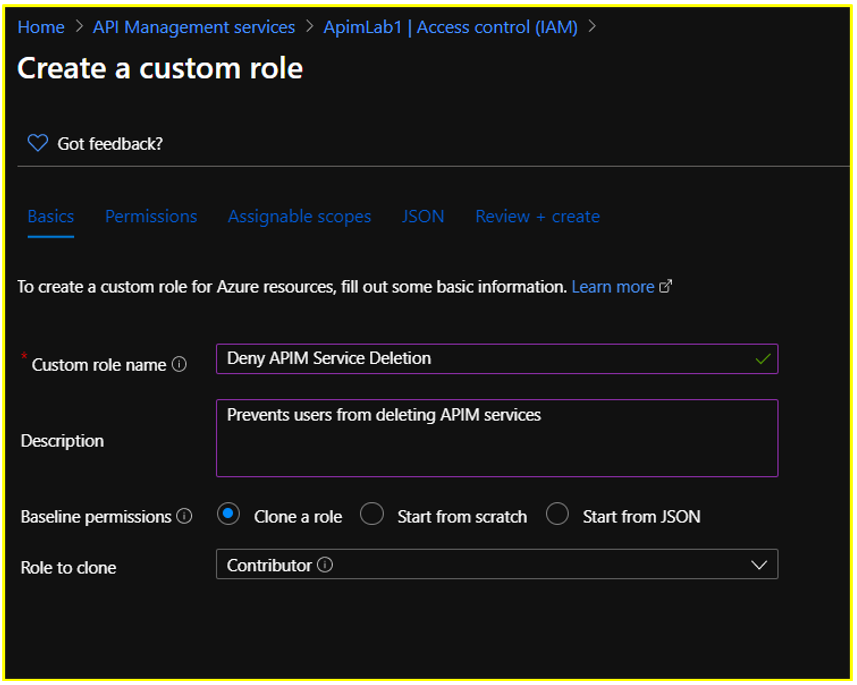
Step 4: Configure the Permissions section.
Retain the default permissions listed for this role.
Click on +Exclude Permissions and search for Microsoft API Management
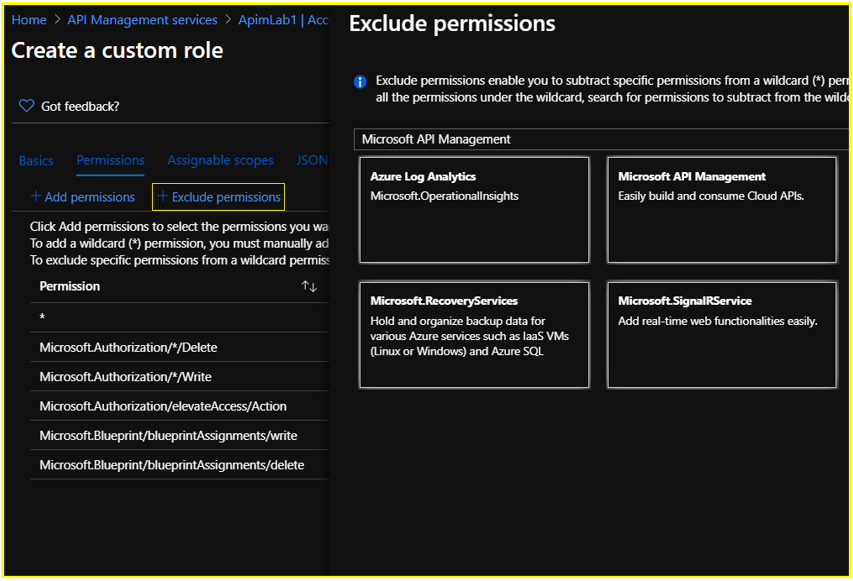
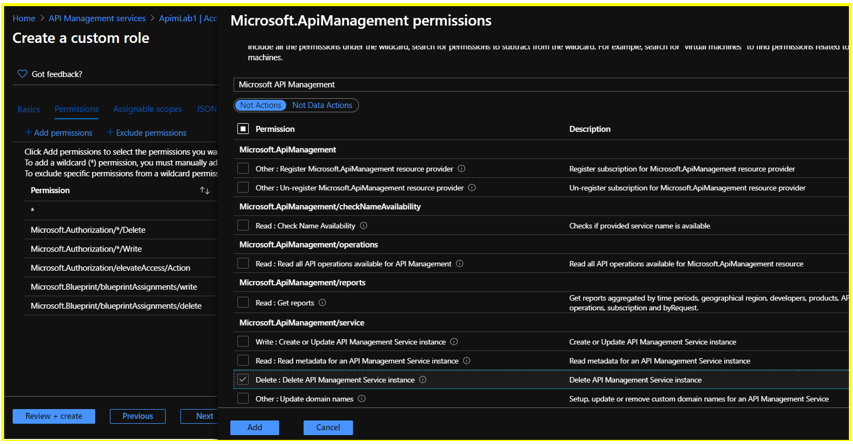
Under Not Actions, select the permission ‘Delete: Delete API Management Service instance’ under Microsoft.ApiManagement/service on the succeeding Permissions page and click the Add button.
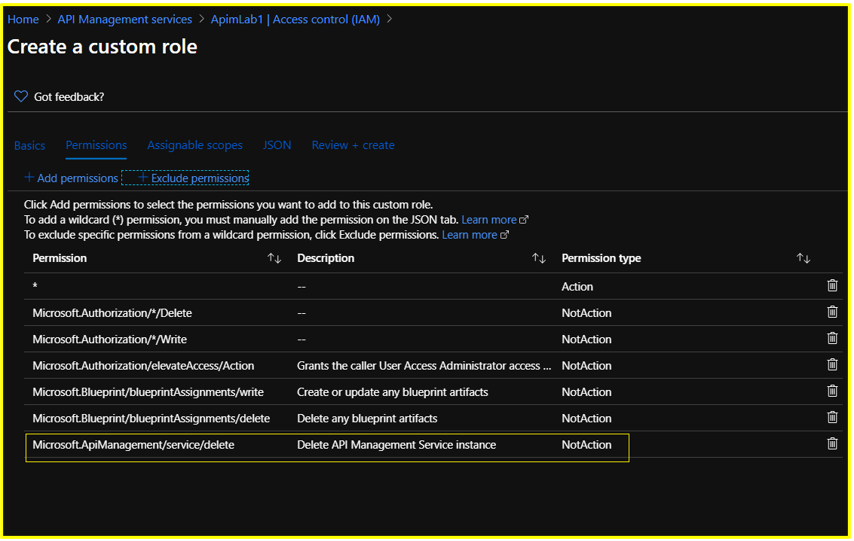
Step 5: Configure the Assignable Scopes section.
Delete the existing resource level scope. Click on +Add Assignable Scopes and set the scope to Subscription level. Click Add.
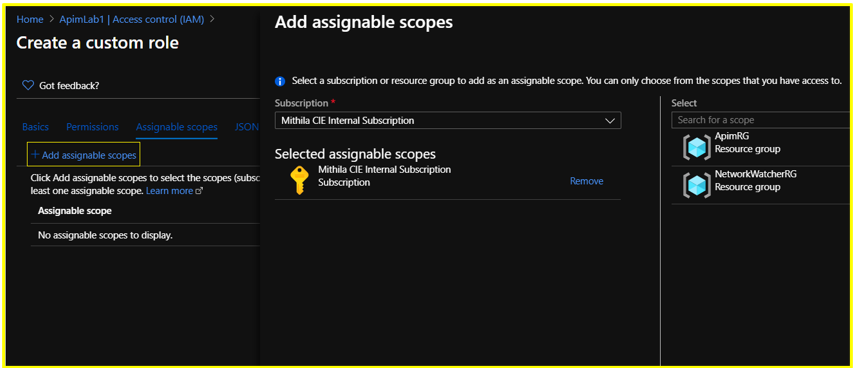
NOTE:
- Each Azure Active Directory can only have a maximum of 5000 custom roles.
Hence, for a custom role where the assignable scope is configured to be at resource level, you could consider replacing it with a subscription or resource group level scope to prevent exhausting your custom role limit.
Constraints associated with custom roles can be found documented in the below article:
https://docs.microsoft.com/en-us/azure/role-based-access-control/custom-roles#custom-role-limits
Step 6: In the JSON section, you could also Download your custom RBAC role in JSON format for future usage or reference.
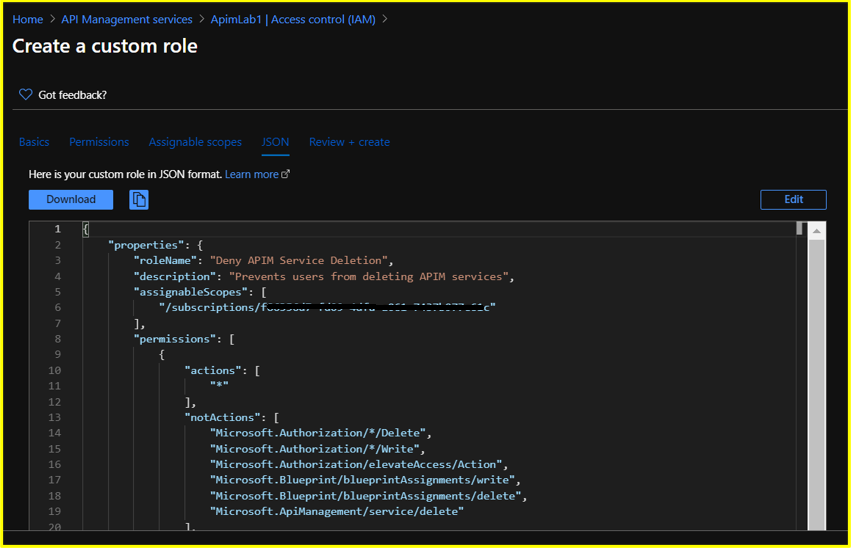
Step 7: Review the custom RBAC role details in the Review + Create section and click on Create.
It may take a few minutes for the custom role to be created and displayed under the list of available roles.
In this scenario, the newly created custom role would be available for assignment under the Roles section on the subscription’s Access Control (IAM) blade since the assignable scope was set at subscription level during creation.
NOTE:
- Post creation, custom roles appear on the Azure portal with an orange resource icon (Built-in roles appear with blue icons).
- Custom Roles would be available for assignment at the respective subscription, resource group or resource access control blade based on the assignable scope that has been configured during creation of the role.
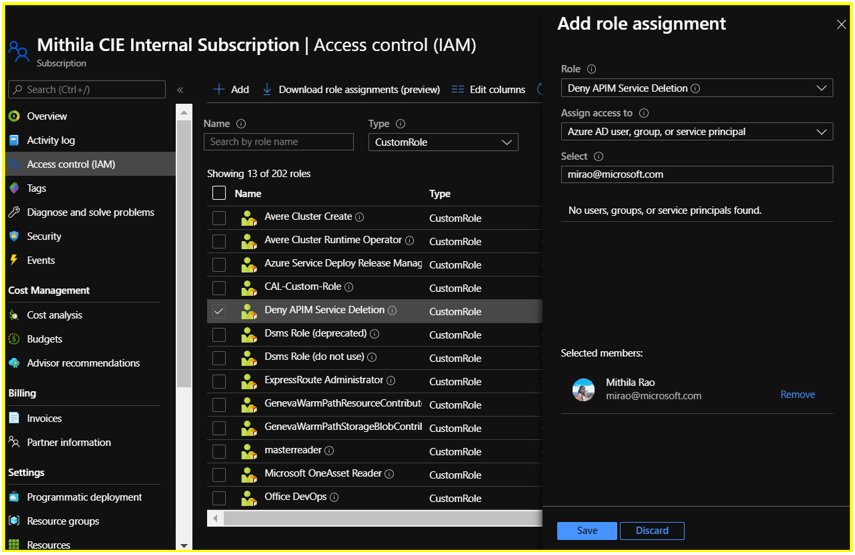
Step 8: Assign this custom role to a user. Any user having this role would be able to perform all the operations that are offered by default by the APIM Service Contributor role except deleting APIM services in the subscription.
Scenario 2: Deny users having Reader access from reading Product subscription keys
Let us consider the built-in APIM RBAC role ‘API Management Service Reader’ role for this scenario.
Users often have a misconception that only the APIM Administrators would be able to view the Product subscription keys on the Azure Portal. However, that is not the case.
The ability to read subscription keys from products (an action which is defined as Microsoft.ApiManagement/service/products/subscriptions/read) is allowed by default for users having the ‘API Management Service Reader Role’. Same is the case for navigating to the keys via APIs/subscriptions.
Hence, as a workaround, you can create a custom RBAC role in order to block the subscription keys – read action.
NOTE:
The action Microsoft.ApiManagement/service/users/keys/read does not correspond to reading subscription keys. The 2 actions are completely different.
Every user has two “secrets”, a primary and a secondary. These secrets are used to generate an encrypted SSO token that users can use to access the developer portal. These keys are not related to the subscription keys that users use to call the APIs. The /service/users/keys/read permission corresponds to the ability to read the user secrets, whereas the /service/products/subscriptions/read permission corresponds to reading subscription keys under products, which is allowed by default under the ‘API Management Service Reader’ role.
Additionally, the Microsoft.ApiManagement/service/users/subscriptions/read permission corresponds to the ability to read subscriptions associated with users via the “Users” blade on the Portal, which is also allowed by default under this role.
Here, we are creating and assigning a custom RBAC role using PowerShell for denying users having Read access over the APIM service from reading the subscription keys. Basically, this role denies users from performing the operation Microsoft.ApiManagement/service/products/subscriptions/read
The sample PowerShell script is as below:
$role = Get-AzRoleDefinition "API Management Service Reader Role"
$role.Id = $null
$role.Name = 'Deny reading subscription keys'
$role.Description = 'Denies users from reading product subscription keys'
$role.NotActions.Clear()
$role.NotActions.Add('Microsoft.ApiManagement/service/products/subscriptions/read')
$role.AssignableScopes.Clear()
$role.AssignableScopes.Add('/subscriptions/<subscription ID>/resourceGroups/<resource group name>/providers/Microsoft.ApiManagement/service/<service name>')
New-AzRoleDefinition -Role $role
New-AzRoleAssignment -ObjectId <object ID of the user account> -RoleDefinitionName 'Deny reading subscription keys' -Scope '/subscriptions/<subscription ID>/resourceGroups/<resource group name>/providers/Microsoft.ApiManagement/service/<service name>'
Known Limitations
- Current design does not allow RBAC permissions to be controlled at Product level for API creation/deletion.
For example, consider a scenario where users on the Azure Portal should have read and write access only over APIs that are associated with a particular Product. For this, you can configure an RBAC role where the assignable scope has been set at “Product” level and add the desired Actions and NotActions.
Now, even if you add the permission “Microsoft.ApiManagement/service/apis/*” at product scope, when the user who is assigned this role attempts creating a new API inside this Product, the operation would still fail.
If a user needs to create a new API in the service (irrespective of whether it is inside the same Product), they should be able to read all APIs in the service and have write permissions granted at the APIM service scope instead of Product scope.
This is because, when a user attempts to create a new API or add a new version/revision for an existing API, there is a validation check that happens in the background to verify if there is any other API in the service which is using the same path that the user is attempting to create. If the user performing this operation does not have permissions to read all APIs in the service, the operation would fail.
Hence, you would have to grant the user the permission to read all APIs in the service (granted at the service scope).
- Permissions to view APIM Diagnostics Logs cannot be configured at APIM scope.
For example, if user has configured streaming of APIM Diagnostic Logs to a Log Analytics Workspace and wishes to create a custom RBAC role only for viewing these diagnostic logs, it wouldn’t be possible to configure this role at the APIM scope. Since the log destination is Log Analytics, the permission has to be configured at the Log Analytics scope.
The APIM ARM operation “Microsoft.ApiManagement/service/apis/diagnostics/read” only controls access to the diagnostic configuration for the APIM service and not to the diagnostic telemetry that APIM streams to external resources such as Log Analytics/Application Insights, et cetera.
- Preventing users from accessing the Test Console for APIs on the Azure Portal cannot be achieved with a straight-forward approach.
This is because there are no APIM ARM operations that support actions corresponding to “Microsoft.ApiManagement/service/apis/operations/test”.
However, this limitation can be overcome if the API is protected by a subscription key. When the permission “Microsoft.ApiManagement/service/subscriptions/read” is denied to a user, the user cannot test an API protected by a subscription key since they wouldn’t be able to retrieve the subscription key required for testing the API operation.
A JSON sample for creating this custom role can be found attached below:
{
  "properties": {
    "roleName": "Deny Testing APIs",
    "description": "Deny Testing APIs",
    "assignableScopes": [
      "/subscriptions/<subscription ID>/resourceGroups/<resource group name>/providers/Microsoft.ApiManagement/service/<service name>"
    ],
    "permissions": [
      {
        "actions": [],
        "notActions": [
          "Microsoft.ApiManagement/service/subscriptions/read"
        ],
        "dataActions": [],
        "notDataActions": []
      }
    ]
  }
}
APPENDIX
- Tutorials for Creating Custom RBAC Roles:
a) Azure Portal Tutorial – https://docs.microsoft.com/en-us/azure/role-based-access-control/custom-roles-portal
b) PowerShell Tutorial – https://docs.microsoft.com/en-us/azure/role-based-access-control/tutorial-custom-role-powershell#create-a-custom-role
c) Azure CLI Tutorial – https://docs.microsoft.com/en-us/azure/role-based-access-control/tutorial-custom-role-cli
d) REST API Tutorial – https://docs.microsoft.com/en-us/azure/role-based-access-control/custom-roles-rest
e) ARM Template Tutorial and Sample – https://docs.microsoft.com/en-us/azure/role-based-access-control/custom-roles-template
by Scott Muniz | Aug 1, 2020 | Uncategorized
This article is contributed. See the original author and article here.
Initial Update: Saturday, 01 August 2020 18:52 UTC
We are aware of issues within Log Search Alerts and are actively investigating. Some customers in Australia South East may experience issues with missed or delayed log search alerts.
- Work Around: None
- Next Update: Before 08/01 23:00 UTC
We are working hard to resolve this issue and apologize for any inconvenience.
-Saika
by Scott Muniz | Aug 1, 2020 | Uncategorized
This article is contributed. See the original author and article here.
MICROSOFT DEFENDER
ADVANCED THREAT PROTECTION FOR LINUX OPERATING SYSTEM
Hi IT Pro,
I have gathered the information for MD ATP Linux in this document.
Thanks for viewing.
Enjoy your Linux ATP!
_____________
Microsoft Defender Advanced Threat Protection (MD ATP) support for Linux with kernel version 3.10.0-327 or later, including the following Linux flavours :
- Red Hat Enterprise Linux 7.2 or higher
- CentOS 7.2 or higher
- Ubuntu 16.04 LTS or higher LTS
- Debian 9 or higher
- SUSE Linux Enterprise Server 12 or higher
- Oracle Linux 7.2 or higher
MD ATP provide real-time protection for the following file system types:
|
btrfs
|
ecryptfs
|
ext2
|
|
ext3
|
ext4
|
fuse
|
|
fuseblk
|
jfs
|
nfs
|
|
overlay
|
ramfs
|
reiserfs
|
|
tmpfs
|
udf
|
vfat
|
|
xfs
|
|
|
Deployment MD ATP prerequisite:
Administrative privileges on the device (in case of manual deployment)
The fanotify kernel option must be enabled,
For RedHat Enterprise Linux 7.x and CentOS 7.x systems, the kernel module is enabled by default.
For Ubuntu, SUSE, and Oracle Enterprise Limited, Fanotify is enabled by default.
Disk space: 650 MB
No other fanotify-based security solutions running on same Linux Computer.
Network connections
Set firewall outbound connection rules to allow these URLs.
|
Service location
|
DNS record
|
|
Common URLs for all locations
|
x.cp.wd.microsoft.com
cdn.x.cp.wd.microsoft.com
eu-cdn.x.cp.wd.microsoft.com
wu-cdn.x.cp.wd.microsoft.com
officecdn-microsoft-com.akamaized.net
crl.microsoft.com
events.data.microsoft.com
|
|
European Union
|
europe.x.cp.wd.microsoft.com
eu-v20.events.data.microsoft.com
usseu1northprod.blob.core.windows.net
usseu1westprod.blob.core.windows.net
|
|
United Kingdom
|
unitedkingdom.x.cp.wd.microsoft.com
uk-v20.events.data.microsoft.com
ussuk1southprod.blob.core.windows.net
ussuk1westprod.blob.core.windows.net
|
|
United States
|
unitedstates.x.cp.wd.microsoft.com
us-v20.events.data.microsoft.com
ussus1eastprod.blob.core.windows.net
ussus1westprod.blob.core.windows.net
|
If a proxy or firewall is blocking anonymous traffic, make sure that anonymous traffic is permitted in the previously listed URLs.
For transparent proxies, no additional configuration is needed
For static proxy, follow the steps in Manual Static Proxy Configuration.
DEPLOYMENT OPTIONS
MD ATP deployment by 4 steps:
Configure the Linux software repository (Linux download channel)
Application installation
Download the onboarding package
Client configuration (Onboarding Linux Client)
MANUAL DEPLOYMENT Using YUM Utility
Install Yum Utility for package installing and uninstalling
If the Server is RHEL and newly build, you have to register it with Redhat first.
It may take more than 30 minutes for all the RHEL download and Linux update packages.
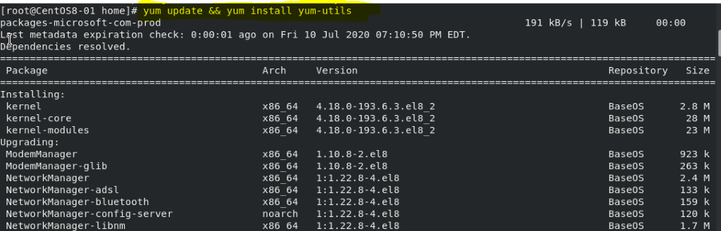
Yum update && yum install yum-utils
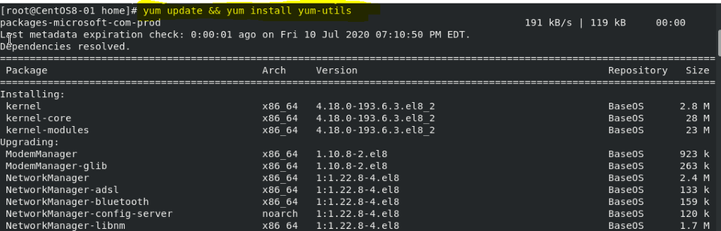
Microsoft Defender ATP for Linux can be deployed from one of the following channels (denoted below as [channel]:( insiders-fast, insiders-slow, or prod. Each of these channels corresponds to a Linux software repository
RHEL and variants (CentOS and Oracle Linux)
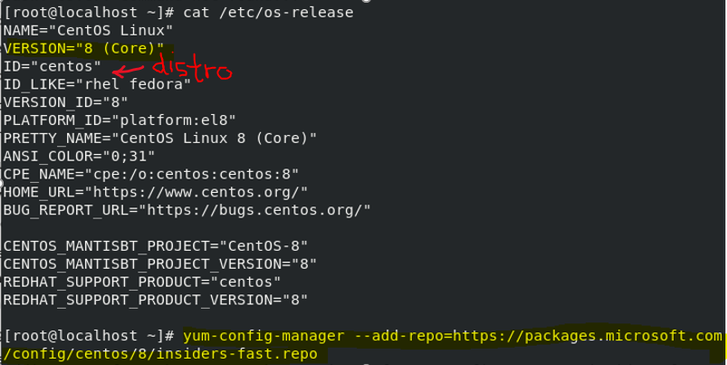
sudo yum-config-manager –add-repo=https://packages.microsoft.com/config/[distro]/[version]/[channel].repo

If you want to check current Linux distro and version, run the command:
cat/etc/os-release
Install the Microsoft GPG public key:
sudo rpm –import http://packages.microsoft.com/keys/microsoft.asc
Download and make usable all the metadata for the currently enabled yum repositories:
yum makecache
RHEL and variants (CentOS and Oracle Linux):
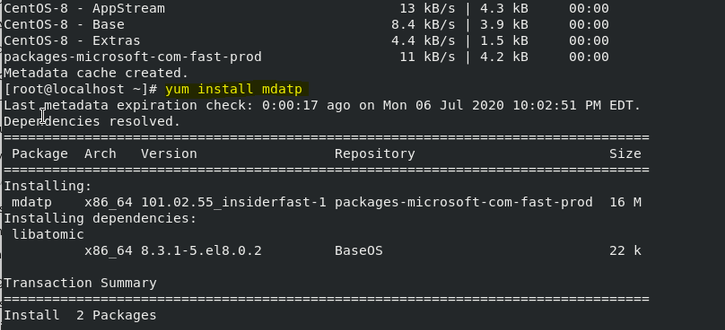
sudo yum install mdatp
Downloading the ATP Onboarding package from ATP Portal
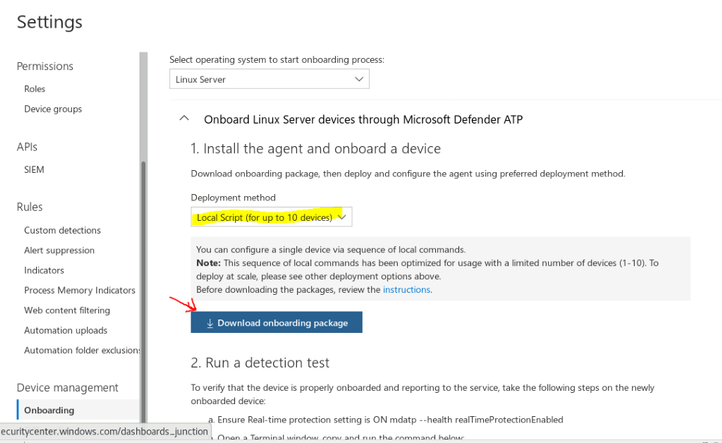
Download the onboarding package from Microsoft Defender Security Center:
In Microsoft Defender Security Center, go to Settings > Device Management > Onboarding.
In the first drop-down menu, select Linux Server as the operating system. In the second drop-down menu, select Local Script (for up to 10 devices) as the deployment method.
Select Download onboarding package. Save the file as WindowsDefenderATPOnboardingPackage.zip.
Client Configuration (Onboarding Linux Client)
Make sure Python3 is in system ‘s path
sudo alternatives –set python /usr/bin/python3
Copy MicrosoftDefenderATPOnboardingLinuxServer.py to the target device
On the target device
python MicrosoftDefenderATPOnboardingLinuxServer.py

Verify that the device is now associated with your organization
mdatp health –field org_id

Checking MD ATP Service Status with mdatp health command
verify that the device is properly onboarded and reporting to the service

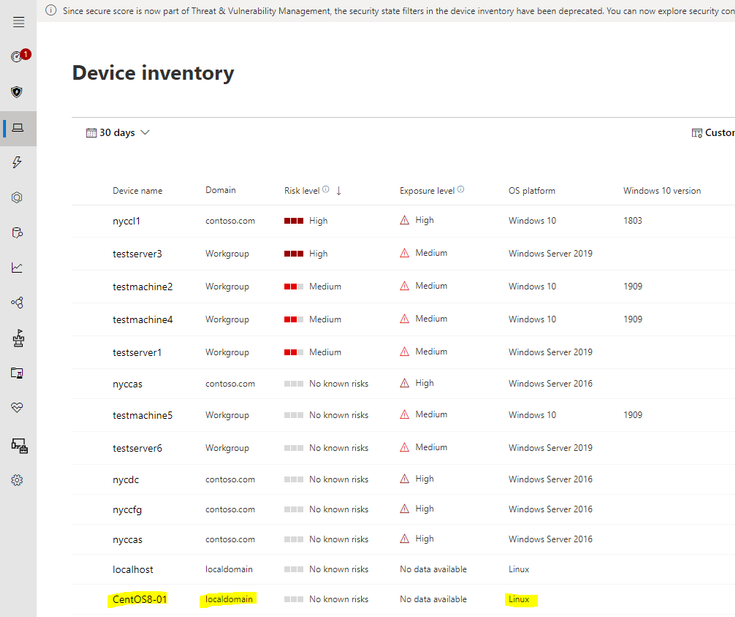
Monitoring new Linux Client on ATP Portal
Check if Linux Machine is display in ATP Portal Dashboard
How to configure Microsoft Defender ATP for Linux
Location of mdatp configuration file: /etc/opt/microsoft/mdatp/managed/mdatp_managed.json
In enterprise environments, Microsoft Defender ATP for Linux can be managed through a configuration profile
The configuration profile is a .json file that consists of entries identified by a key (which denotes the name of the preference), followed by a value.Values can be simple, such as a numerical value, or complex, such as a nested list of preferences.
Typically, you would use a configuration management tool to push a file with the name mdatp_managed.json at the location /etc/opt/microsoft/mdatp/managed/.
mdatp_managed.json preference key and value
|
|
KEY
|
VALUE
|
|
Enable / disable real-time protection
|
enableRealTimeProtection
|
true (default)/false
|
|
Enable / disable passive mode
(In passive mode:
Real-time protection is turned off.
On-demand scanning is turned on.
Automatic threat remediation is turned off.
Security intelligence updates are turned on.
Status menu icon is hidden.
|
passiveMode
|
true/false (default)
|
|
Scan exclusions
|
exclusions
|
$type
excludedPath
excludedFileExtension
excludedFileName
|
|
Path to excluded content
|
path
|
valid paths (string)
|
|
Enable/Disable Delivered Cloud Protection
|
enabled
|
true (default)/false
|
Recommended configuration profile
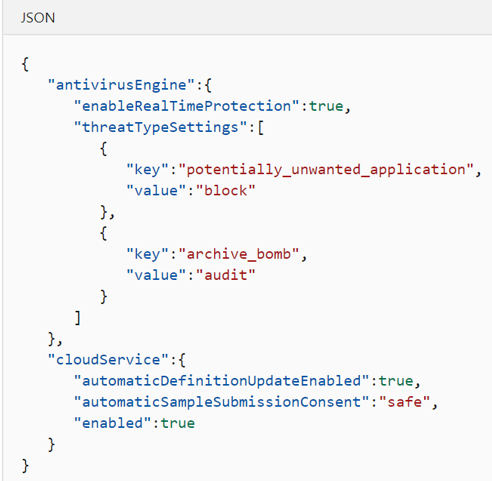
To get started, we recommend the following configuration profile for your enterprise to take advantage of all protection features that Microsoft Defender ATP provides.
The following configuration profile will:
Enable real-time protection (RTP)
Specify how the following threat types are handled:
Potentially unwanted applications (PUA) are blocked
Archive bombs (file with a high compression rate) are audited to the product logs
Enable automatic security intelligence updates
Enable cloud-delivered protection
Enable automatic sample submission at safe level
More ATP Preference Configuration
https://docs.microsoft.com/en-us/windows/security/threat-protection/microsoft-defender-atp/linux-preferences
Configuration profile deployment by Linux Management:
Once you’ve built the configuration profile for your enterprise, you can deploy it through the management tool that your enterprise is using. Microsoft Defender ATP for Linux reads the managed configuration from the /etc/opt/microsoft/mdatp/managed/mdatp_managed.json file.
Update Microsoft Defender ATP for Linux
Each version of Microsoft Defender ATP for Linux has an expiration date, after which it will no longer continue to protect your device.
To check the MD ATP expiration date, run the following bash command:
mdatp health –field product_expiration
To update Microsoft Defender ATP for Linux manually, execute one of the following commands:
RHEL and variants (CentOS and Oracle Linux)
sudo yum update mdatp
SLES and variants
sudo zypper update mdatp
Ubuntu and Debian systems
sudo apt-get install –only-upgrade mdatp
TROUBLESHOOTING
Troubleshoot installation issues
To verify if the installation succeeded, one can obtain installation.log and search the installation logs for “postinstall end” phrase, using command:
sudo journalctl | grep ‘microsoft-mdatp‘ > installation.log
grep ‘postinstall end’ installation.log

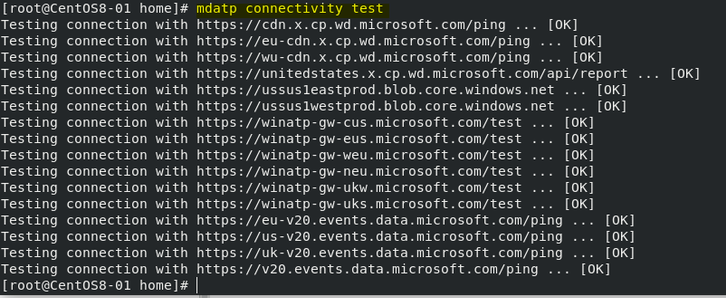
Troubleshooting Connectivity:
Run the connectivity test
mdatp connectivity test
Troubleshooting Performance
To find the applications that are triggering the most scans, you can use real-time statistics gathered by Microsoft Defender ATP for Linux.
mdatp diagnostic real_time_protection_statistics > stat.log
This feature is enabled by default on the Dogfood and InsisderFast channels. If you’re using a different update channel, this feature can be enabled from the command line:
mdatp config real-time-protection-statistics –value enabled
More Troubleshooting:
Installation
https://docs.microsoft.com/en-us/windows/security/threat-protection/microsoft-defender-atp/linux-support-install
Performance
https://docs.microsoft.com/en-us/windows/security/threat-protection/microsoft-defender-atp/linux-support-perf
Network Connectivity
https://docs.microsoft.com/en-us/windows/security/threat-protection/microsoft-defender-atp/linux-support-connectivity
I hope the information is useful to you. Please provide feedback.

by Scott Muniz | Jul 31, 2020 | Uncategorized
This article is contributed. See the original author and article here.
 Do you like this wallpaper? Download it at the bottom of the page!
What APIs do other developers love and why do they love them? Three developers from around the globe offer up their top picks!

Gian is an Italian software architect working in Zürich, Switzerland who leverages AI technology for banking and finance. According to Gian, great APIs like Azure Cognitive Search should give you super powers. He first encountered an early version of the service at Microsoft Build 2018 after discussing it with Lous Cabrera Cordon, who was on the team at Microsoft that was working to develop it.
According to Gian, “It was love at first sight. As soon as I was back in Zürich, I started making some prototypes. Later, when the technology was generally available, we introduced it into an ERP product.”
Cognitive Search is all about enriching information so it can be easily searched. It can read data from both structured and unstructured sources. Machine learning algorithms are then applied to the collected data to extract a searchable information tree. Gian’s team has used Cognitive Search for his clients to upload their PDF libraries and place them on the web for easy semantic understanding. Cognitive Search also implements the natural language processing AIs used by Bing to make searching even simpler.
If you want to learn more about Cognitive Search and related APIs, check out:

Nikola is a Principal Software Engineer at Microsoft working on the Graph Toolkit whose favorite API, perhaps unsurprisingly, is the Microsoft Graph API. What makes the Graph API so great is that it lets you pull together your data from diverse services like Office 365, Microsoft Excel, Microsoft Teams, OneNote, Outlook, SharePoint, and more into a common app or service you create. It even lets you pull in data from non-Microsoft sources using Graph connectors (currently in preview).
All of the Graph APIs can be accessed from a REST endpoint:
https://graph.microsoft.com
Nikola’s team takes this a step further by building succinct web components on top of the Graph API to accomplish powerful tasks. For instance, if you want to pull up all of a person’s planner tasks on a web app, you can do it with this snippet:
<mgt-tasks></mgt-tasks>
The snippet abstracts out a lot of code orchestrating the Graph API, which in turn abstracts a lot of service code from the different product groups that funnel data through the Graph API.
“One of the most exciting things being done, in response to COVID right now,” says Nikola, “is we’re seeing a lot of scenarios where partners pull in the education data—a lot of people don’t know this but there’s a lot of data about classes, students, teachers, assignments, and grading that they can do in the Graph—and pulling this together with files on OneDrive to build new online learning resources.”
If you want to learn more about the Graph API, check out:

Eric is an open–source developer and a Spatial Design Developer at Unity Labs in Montreal, Canada. His favorite API is the Mixed Reality Toolkit (MRTK) API abstracted over the Windows 10 SDK hand joint system that offers hand gesture support for the HoloLens 2. He has even extended them to support other devices besides the HoloLens 2, such as the Oculus Quest. This in turn allows developers to experiment with hand gestures in completely different scenarios than those originally envisioned by the HoloLens team.

Just as Graph APIs can be mashed up to create new components, Eric is fascinated with recomposing hand and finger tracking APIs to develop new gestures. He’s currently noodling over Spiderman’s web shooter and how to implement this in an AR or VR experience as a way to teleport from position to position. This involves decomposing a deceptively simple gesture into elements that can be detected with optical tracking, such as palm up, index finger open/closed, pinky finger open/closed (optional), thumb extended, etc. Then he took apart the teleportation API for HoloLens and recomposed it with hand gestures, finally porting it to the Oculus Quest. “I had to throw the previous work to the ground,” Eric says, “and go through the class hierarchy to pull out what I needed to map the API to the Oculus device manager to get it to work there, too.”
If you want to learn more about MRTK hand gestures and the underlying API, check out:
Wrap up
Great APIs—the ones that developers love—have several common features. They provide developers with capabilities they wouldn’t normally have access to, such as the AI augmentation found in Azure Cognitive Search. Like the Microsoft Graph API, they can be decomposed and recomposed into new apps and toolkits. They are flexible and designed in a way that allows them to be used not just in traditional program interfaces but even novel ones like a teleporter gesture based on web-slinging that Eric created.
What do you think? What are some of your favorite APIs and why? Be sure to share them in the comments below. If you are interested in learning more about the principles and techniques of API design, you can deep dive into this Azure API Design eBook!
Don’t forget to download this month’s wallpaper below ⬇
by Scott Muniz | Jul 31, 2020 | Uncategorized
This article is contributed. See the original author and article here.
Version 17.6 of the Microsoft ODBC Driver 17 for SQL Server has been released. Version 17.6.1 brings numerous new features and fixes to the driver.
Features
- Support Managed Identity authentication against Azure Key Vault when using Always Encrypted
- Support ADFS with Azure Active Directory authentication on Linux and macOS
- Support Azure Active Directory Integrated authentication on Linux and macOS
- Added metadata caching for prepared statements to improve performance
- Send Server Name Indication during the SSL handshake
- New SQL_COPT_SS_AUTOBEGINTXN connection attribute to control whether automatic BEGIN TRANSACTION happens after ROLLBACK or COMMIT
- Support for Ubuntu 20.04
Fixes
- Fixed a hang when a timeout occurred during an asynchronous notification operation
- Fixed driver reference count upon upgrade in Alpine Linux
- Fixed libc6 dependency version for Ubuntu
- Added missing defines to Linux/macOS msodbcsql.h
- Fixed a collation issue with variant types when using bcp
- Fixed an error when authenticating with a federated account requiring a Conditional Access policy (Windows)
Next steps
For Windows installations, you can directly download the Microsoft ODBC Driver 17 for SQL Server.
Linux and macOS packages are also available. For installation details see the online instructions.
Roadmap
We are committed to improving quality and bringing more feature support for connecting to SQL Server Azure SQL Database Azure Synapse Analytics, and Azure SQL Managed Instance through regular driver releases. We invite you to explore the latest the Microsoft Data Platform has to offer via a trial of Microsoft Azure SQL Database or by evaluating Microsoft SQL Server.
David Engel
by Scott Muniz | Jul 31, 2020 | Uncategorized
This article is contributed. See the original author and article here.
In the event that you have a large Synapse Analytics Database and you have been cleaning out large objects which were no longer required consider running a shrink on your database to reduce your database size on disk. Since July 2020 we now officially support the execution of DBCC ShrinkDatabase within Synapse Analytics.
https://docs.microsoft.com/en-us/azure/synapse-analytics/sql-data-warehouse/release-notes-10-0-10106-0#july-2020
The functionality works the same was as SQL Server and we have the same guidelines when using it, for additional information review our official documentation.
https://docs.microsoft.com/en-us/sql/t-sql/database-console-commands/dbcc-shrinkdatabase-transact-sql?view=sql-server-ver15
Or just execute the statement from your User database.
DBCC ShrinkDatabase(‘DATABASENAME’)
CONSIDERATIONS
The Shrink Operation is an IO Intensive operation, It is advised to perform the operation with no other activities running on the database. The Shrink operation can take the Synapse Database Offline.
If you have very large CCI Objects consider rebuilding your CCI Objects with the largest RC available to ensure the highest quality row groups and to optimized the overall shrink operation.
To determine the amount of unallocated space before running the shrink, run an sp_spaceused on your database and review the output to determine if it is necessary to perform the shrink.
Do not shrink frequently or make this part of regular maintenance.
Take into consideration that the shrink operation will have an affect on the data warehouse snapshot charges.


Recent Comments