4 trends to watch in consumer goods

4 trends to watch in consumer goods

This article is contributed. See the original author and article here.

There’s no doubt about it: technology has revolutionized how we do business. But the same technologies that allow consumer goods brands to reach customers worldwide have created an environment in which change happens fast and continually, competition is fiercer than ever before, and even incremental adjustments in strategy can significantly impact a company’s profitability and growth. At the same time, the past two years’ events have laid bare how companies of all sizes are vulnerable to global, social, political, and economic disruptions. With so much change it can be difficult to understand what trends are worth the investment, which is why we’ve taken a data-driven approach to cut through the noise. Four key trends are highlighted below and a more in-depth look can be read in the Consumer Goods Trends in 2022 report by Microsoft Dynamics 365 Commerce.

1. Social commerce makes every online touchpoint a potential storefront

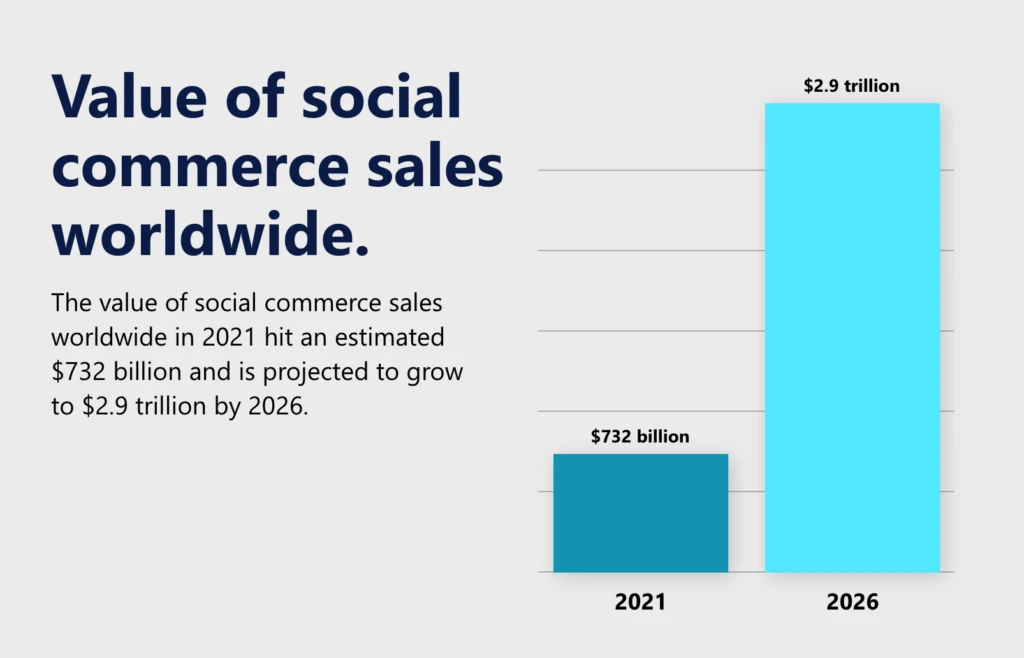
Social media has revolutionized how people connect and is now transforming the way consumers discover and engage with brands. One clear example is social commerce, which is an integrated and seamless strategy for allowing customers to discover, browse, share, and purchase without ever leaving a social media platform. Now brands are opening significant new revenue streams by delivering seamless purchasing experiences to consumers on the social media platform of their choice. The results are staggering, with the value of social commerce sales worldwide in 2021 hitting an estimated $732 billion and projected to grow to $2.9 trillion by 2026.1

Chart showing value of social commerce sales from 2021 to 2026.

Unsurprisingly, social commerce, or live commerce according Gartner Hype Cycle  for Retail Technologies, 2021, “can increase brand awareness and generate a large amount of traffic in a short time.”2 One country that is leading the live commerce trend is China.

Dynamics 365 Commerce can help organizations consistently deliver great customer experiences on any social channel or front-end application. This is because Dynamics 365 Commerce can utilize both headless and other modern commerce architectures to seamlessly connect enterprise systems, such as payment processing, content management, and omnichannel inventory.

2. Digital shelf analytics improve online merchandising

In 2021, US merchants recorded a record $870.8 billion in online sales, an increase of 14.2 percent compared to the year prior.3 As online sales continue to increase in volume and importance, brands will need to collect, measure, and monitor product and sales data from a growing variety of sources. One way brands can stay on top of this information is by using digital shelf analytics (DSA) to improve online merchandising.

DSA applications give retailers the ability to monitor data and metrics from all their digital sales channels, including retail digital commerce sites and online marketplaces. DSA solutions may often provide product data from social sites and collect competitive pricing data. These applications use API connections and automated website scraping to ingest data on metrics such as ratings and reviews, product availability and placement, search rankings, and product information content quality, alerting users to updated content.

Another technology related to DSA is the Smart Shelf. According to Gartner, “Smart shelf refers to the connected shelf in a physical retail store, which can include computer vision, weight or other sensors, electronic shelf labels (ESL) or LCD displays.” Gartner classifies the technology as “emerging” with a “high” benefit rating,2 which we believe makes it a technology to watch in the near future.

Dynamics 365 Commerce offers retailers robust DSA capabilities, including a unified view of content, assets, promotions, inventory, and pricing across physical and digital channels.

3. Immersive commerce helps retailers combat the rising cost of returns

One technology trend helping companies improve how they interact with consumers is immersive commerce (IC). IC reinvents customer experiences by integrating physical and virtual worlds via augmented reality (AR), virtual reality (VR), and mixed reality. With IC, brands can give customers a new way of visualizing a product in their space, such as seeing the way a Microsoft Surface Laptop looks on a desk in a home office or how different shades of makeup look before ordering online. Experts believe that AR-enabled shopping will soon become a must-have for furniture retailers. Home Depot, Wayfair, Target, Overstock, and Houzz have already adopted the technology.4 Significantly though, IC goes beyond improving and augmenting the customer experience. It also presents opportunities to solve costly inefficiencies, the most obvious and expensive being returns.

The growth in e-commerce and virtual shopping that accompanied the pandemic led to a corresponding increase in returns. In 2020, total return losses, including the value of lost sales, reached $428 billion, with an estimated $101 billion purely from returns.5 The loss from returns is expected to increase in the next several years, eventually reaching $1 trillion annually. According to Gartner, “Size and ‘best fit’ recommendations using AR can drastically reduce return rates and improve conversion.”2 We agree and believe that in the face of growing losses from returns, brands will likely increase their investments in AR because of its ability to help consumers avoid returns altogether. For example, by allowing customers to see how furniture will look in their house or how clothes will look in a virtual fitting room, they are more likely to purchase the product they need and will enjoy.

Immersive commerce solution from Hexaware.

Add AR, VR, and mixed reality capabilities to your digital storefronts using apps available in Microsoft AppSource, like Web AR with D365 Commerce from Hexaware Technologies.

4. Supply chain resilience is more crucial than ever

The events of 2020 unleashed a series of disruptions to global supply chains, such as border closures, stay-at-home orders, severely depressed demand in industries like travel and in-person services, and demand booms in others, such as healthcare equipment and operating supplies. The cost of these disruptions is significant: in a study conducted by Deloitte, 32 percent of chief financial officers (CFOs) said that shortages and delays were responsible for depressed sales, and 44 percent said that their costs have increased by 5 percent or more this year as a result.6

For retailers and consumer packaged goods (CPG) brands, a primary beneficiary of supply chain resilience is the consumer, who will switch retailers if an item is out of stock and expects to be able to order from any channel with fast and convenient delivery to anywhere. This means that retailers need technology solutions that enable omnichannel retail and fulfillment while also ensuring inventory availability.

Delivery person handing a package to a satisfied customer at the customer’s doorstep. Keywords: Dynamics 365; purchase; online ordering; ecommerce; delivering a box; Surface tablet; at home; receiving an order; driver; man; woman

Interested in learning more about live commerce or digital shelf analytics? Need to cut through market hype to prioritize your retail technology investments? Download Gartner Hype Cycle for Retail Technologies, 2021.

What’s next?

These are just a few trends that you can find inside our report on Consumer Goods Trends in 2022. In the full report, you’ll find relevant and impactful insights drawn from extensive research curated by industry professionals, subject matter experts, and thought leaders. Download your copy of the Consumer Goods Trends in 2022 report. And, be sure to register for the corresponding webinar on Top Retail Trends which you can attend live on Wednesday, May 4, 2022, 11:00 AM to 12:00 PM Pacific Time or watch afterward on-demand.


Sources:

1- Statista, 2021, Value of social commerce sales worldwide from 2020 to 2026

2- Gartner, 2021. Hype Cycle for Retail Technologies, 2021

3- U.S. Department of Commerce, 2022. Quarterly Retail E-commerce Sales

4- Postindustria, 2021. Top 10 AR Furniture Shopping Apps that Change the Future of Business

5- National Retail Federation, 2021. $428 billion merchandise returned in 2020

6- Deloitte, 2021. CFO Signals: 3Q 2021

Gartner does not endorse any vendor, product or service depicted in its research publications and does not advise technology users to select only those vendors with the highest ratings or other designation. Gartner research publications consist of the opinions of Gartner’s Research organization and should not be construed as statements of fact. Gartner disclaims all warranties, expressed or implied, with respect to this research, including any warranties of merchantability or fitness for a particular purpose.

GARTNER and HYPE CYCLE are registered trademarks of Gartner, Inc. and/or its affiliates in the U.S. and internationally and are used herein with permission. All rights reserved.

The post 4 trends to watch in consumer goods appeared first on Microsoft Dynamics 365 Blog.

Brought to you by Dr. Ware, Microsoft Office 365 Silver Partner, Charleston SC.
2022 release wave 1 brings true mobility to field service management

2022 release wave 1 brings true mobility to field service management

This article is contributed. See the original author and article here.

The pandemic has greatly influenced the way we work. For many of us, the option to work from home was a relatively smooth transition. Video calls, instant messaging, and other digital tools filled the colleague collaboration gapreplacing in-person meetings and chats around the water cooler. Office-based workers overcame a few technological speed bumps; however, business continued to hum along at a decent pace.

But what if the focus of your job is to physically interact with the customer and their equipment on site? This level of interaction is dependent on a whole new set of digital tools, and nowhere is this more important than in the delivery of field service. In fact, the most crucial aspect of field service is mobility.

For there to be true mobility, there must be complete and seamless functionality across any and all devices at the same time. These mobile devices keep the technician digitally tethered to operations by providing real-time access to dataincluding updated schedules, recommended travel routes, and key customer information. With the right technology and devices, offline mobile capabilities provide frontline workers what they need when they need it, even in the most remote locations.

On a mobile device (phone, tablet, or laptop), technicians can access knowledge articles, work orders, and task lists from anywhere. They can also add notes and images, which sync to the back office. If a problem is outside of his or her expertise, the technician can leverage videos and product guides, and even consult with experts by connecting with Microsoft Teams or via mixed reality tools like Microsoft Dynamics 365 Remote Assist and HoloLens 2.

About 75 percent of field service businesses that utilize mobility tools have observed increased employee productivity, while the rest have seen customer satisfaction rates rise.1

True mobility transforms the customer into a knowledgeable partner and enhances the customer experience with transparency into all facets of service delivery. Information is available for customers in real-time using an easy-to-use portal to navigate the service history and on-demand appointment scheduling. Customers can even track and trace the route of the technician enroute on any mobile device.

Connecting people, places, and things to consistently deliver customer-centric experiences is at the core of Dynamics 365 Field Service and is the foundation in transforming service delivery. And within this transformation is the art of true mobility through the Dynamics 365 Field Service mobile app.

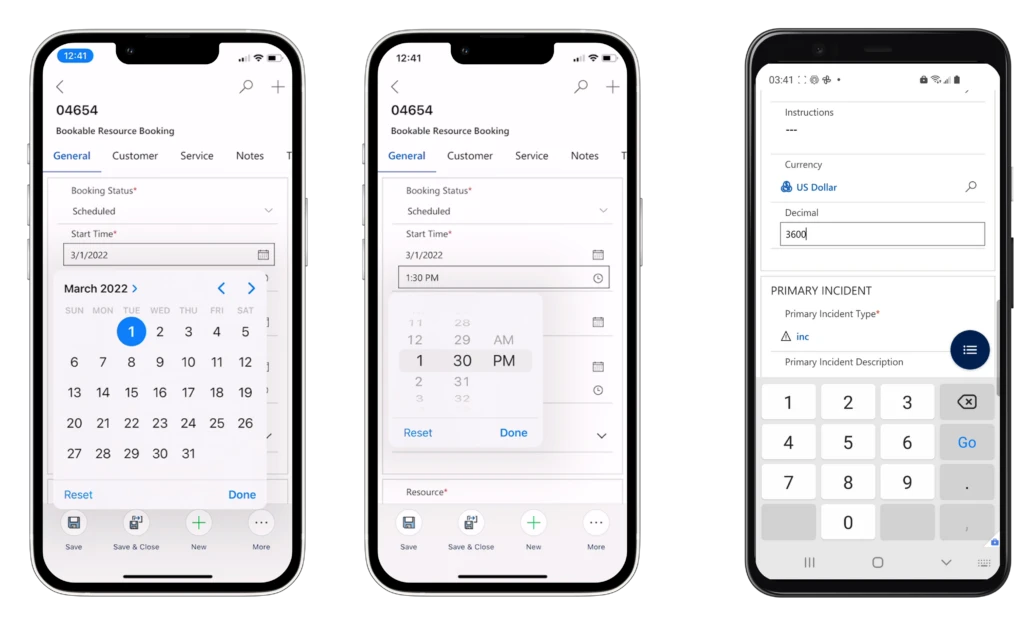
With the 2022 release wave 1, we have made notable enhancements in the Field Service mobile app. First, we improved how frontline workers perform actions, view, and update data to increase productivity and usability. These usability enhancements include:

  • Date and time input fields will leverage default input controls provided by the device operating system.
  • Mobile optimized device keyboards will be shown when interacting with numeric, phone, email, and URL input fields.
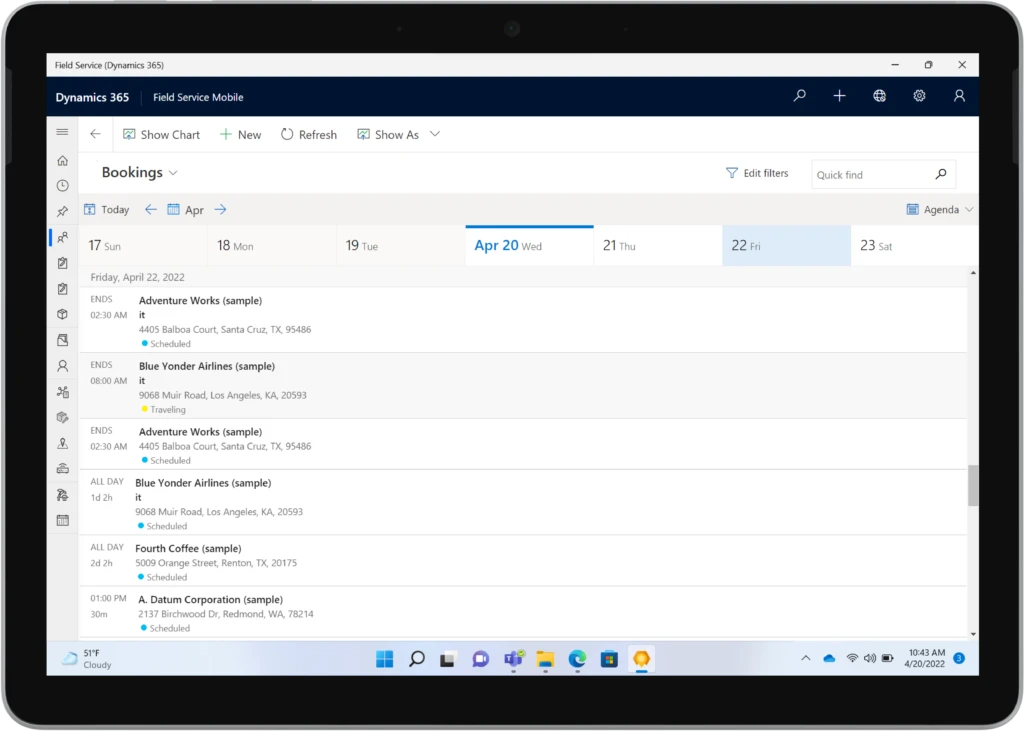
  • Large format devices (such as tablets and PCs) will have a streamlined agenda view available as part of their booking calendar.
  • Customers’ primary account phone numbers will be accessible directly on the Bookable Resource Booking Customer tab.

Field Service mobile app user interface showing technician bookings on iOS and Android devices.
A long list of enhancements to Dynamics 365 Field Service mobile are now available for iOS (left-center) and Android (right) devices.

In addition to usability enhancements, we have continued to invest in core functional and performance improvements such as:

  • Offline sync notifications to alert users when the offline-enabled application is downloading data from the cloud. This will provide clarity on the app status and feedback to the user when data is refreshing.
  • Offline Profile (Preview)configuration that will be available in the modern app designer and offer an improved experience to makers. The new offline profile can be assigned to an app module, removing the need to manually add users to the offline profile. This will greatly simplify app user management for makers and admins.

Mobility on every device

Not every frontline worker wants to perform work using their mobile device or carry multiple devices from location to location. For frontline workers that prefer working on a single tablet or laptop, or are required to use a PC for their business needs, we are pleased to announce the general availability of the Windows Dynamics 365 Field Service app. Technicians can do all of their work tasks on the same Windows device, such as a Microsoft Surface Go, without having to carry multiple devices. Technicians will be able to fulfill end-to-end scenarios without losing context or switching devices. They can view their bookings, manage their work orders, and perform inspections with this rich application that is deeply integrated with the rest of their Dynamics 365 applications.

The Field Service mobile app is now available on Windows laptops to enable seamless mobility across all devices.

This Windows Field Service app includes:

  • Offline support to keep the frontline worker productive even without internet access. While using the app offline, data is stored in the local device database and uploaded to the server when network access is restored.
  • Outlook-style calendar for bookings, with intuitive user interface which gives the frontline worker visibility into active and upcoming workincluding key information like scheduled times, duration, customer name, and address as well as the type of work to be done. The calendar can be further extended to include additional fields giving at-a-glance information a frontline worker needs to prepare for their day, such as assets they may be working on or the customer contact’s name.
  • Tailored user experiences available with Power Apps component framework with hundreds of powerful controls out of the box.
  • Access to device camera to take pictures and scan barcodes.
  • Deep-link support into the Dynamics 365 Field Service mobile app.

Field Service app provides access to detailed customer information.
Using a tablet, Surface, or laptop, frontline workers can access detailed customer information including a map showing the service account location using the Windows supported Dynamics 365 Field Service app.

Improve customer experiences with Dynamics 365 Field Service

The focus of this release was to further extend customer and worker mobility while acknowledging different work requirements and work styles. These enhancements come together to create a seamless workflow by enhancing the tools that increase productivity and optimize system operations. Our goal is to develop features to overcome barriers frontline workers experience every day when delivering superior serviceon or offsite. We will continue to laser focus on the customer experience by arming technicians with the right technology at the right time to do their job better, faster, and more efficiently.

For more on this release, visit our Dynamics 365 Field Service documentation.

Learn more by visiting the Dynamics 365 Field Service website.

Get started with a free Dynamics 365 Field Service trial.

Download the Field Service app for Windows.


Sources:

1- 111 Crucial Field Service Management Software Statistics: 2022 Market Share & Data Analysis, Finances Online

The post 2022 release wave 1 brings true mobility to field service management appeared first on Microsoft Dynamics 365 Blog.

Brought to you by Dr. Ware, Microsoft Office 365 Silver Partner, Charleston SC.
A year of new connections—thank you Power Platform and Dynamics 365 Communities

A year of new connections—thank you Power Platform and Dynamics 365 Communities

This article is contributed. See the original author and article here.

Thousands of new relationships, one big communitythank you

To all communities, we’d like to say thank you. Over the last 12 months, whether you participated, helped, or cheered us on our amazing, community-owned, Microsoft-empowered user group experience, Microsoft Power Platform and Microsoft Dynamics 365 Communities celebrates a year of new connections and collaboration.

As social beings, it’s important for each of us to have the opportunity to connect emotionally with each othereven when we’re working with such impersonal-feeling things as databases, software apps, or business goals. In the big picture, it’s all about the people. That’s why we’re a community. We need each other to feel empowered, to achieve more, and to be part of something bigger. So beyond getting an additional place to turn when you’re looking for answers or help with challenges, you have a world of support for when you feel overwhelmed, or want to commiserate about the work you’re doing.

There are many user group experiences available to you, but no other gives you such direct connection to the heart of Microsoft and to fellow members of the Microsoft Power Platform and Dynamics 365 Communities. You’re key to making those connections happen and we really appreciate you for participating in this place to create, nurture, and grow your user groups with Microsoft.

We launched this cooperative global effort in April of 2021 to give all those who work with Microsoft Power Platform and Dynamics 365 a place to connect with each other and to connect directly with Microsoft. After all, as the biggest fans of the products, you deserve a great experience.

The connections you’ve made

Why did we launch these communities? There are almost as many reasons as there are members of the community itself. But it boils down to connections. Each of us needs different kinds of links to each other. The Microsoft Power Platform and Dynamics 365 Communities provides a free platform for bringing community members closer, as well as supporting independent user groups and users worldwide. We also provide advocacy across the globe for our leaders, members, and users. The community imparts a sense of continuity and a seamless experience across all the Microsoft community sites.

It’s been quite a year. Since launching we’ve grown to welcome and include:

  • Over 400 User Groups worldwide.
  • Groups in 90 different countries.
  • Representation from over 300 cities.

Most of the credit for all this growth goes to you, the members of our lively and supportive community. People are finding what they need in the groups, the connection to Microsoft andmost delightfullyto other community members.

Man on black background next to quote that says, “I try and inspire and help those people become the next user group members and user group leaders. That’s really what this is all about.”—Matt Collins-Jones, Solution Architect, User Group Leader.

Making connections with Microsoftand each other

Our community is a great way for both leaders and group members to connect to the vast wealth of Microsoft resources, guidance, and information. Leaders can grow and manage user groups with easy-to-use tools. Through your groups you can also connect with the Microsoft product team for support with products, on Microsoft community sites, and at Microsoft events, and team speakers as well as connecting directly with Microsoft.

Matt Collins-Jones has gone from individual assistance to global connections with user groups. He started back when Dynamics 365 was called Dynamics CRM. Now he’s working with the entire Microsoft Power Platform stack. But he started by assisting others through help desk. By starting a small firm consulting on customer relationship management (CRM), he quickly jumped into managing and maintaining systems on a global scale for a multinational organization. And now, he works with TSG, a Microsoft partner in the United Kingdom, as a solution architect for their Microsoft Power Platform and Dynamics 365 team building the solutions on which he started with the help desk.

Matt now makes thousands of connections through his YouTube channel. With over 3,000 subscribers, it’s a great source of connection through technical assistance. Building on the community he’s found through his channel, Matt has become a leader in the UK Power Platform User Group. His philosophy? “I try and inspire and help those people become the next user group members and user group leaders. That’s really what this is all about. You just have to have a passion for it.” 

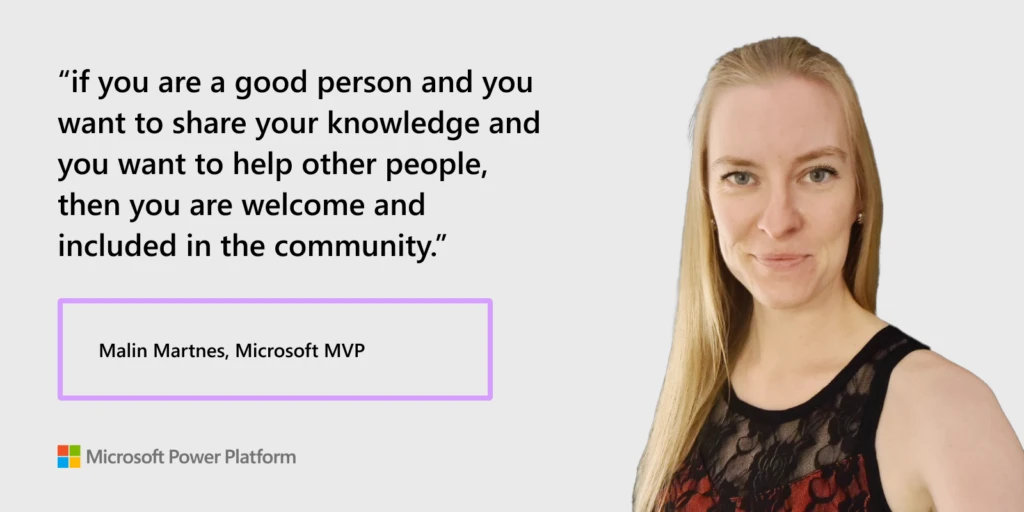
Woman on light gray background next to quote that says, “If you are a good person and you want to share your knowledge and you want to help other people, then you are welcome and included in the community.”—Malin Martnes, Microsoft MVP.

More than personalizedour community is personal

Community connections may only begin as technical support or looking for guidance from Microsoft. From there, they often take it further. That personal experience of support can naturally transform into lasting relationships with a worldwide group of like-minded people. It’s a great recipe for building friendships that go beyond professional connections.

Like many of our community members, Malin Martnes was looking for more than technical support. She found a community that welcomed her and helped her feel that she fit in. Originally from a small town in Norway, Malin grew up feeling alone and isolated. From the beginning, an online community has helped her find herself and realize she’s not different or alone because of her taste in music or interest in tech. Now as a single mom, she has found encouragement and strength from the user group community, in everything from COVID-19 to her personal life. She is a Microsoft MVP and a sought-after expert for other groups, conferences, and more.

“No matter who you are,” she says, “what gender you are, what type of color you are, what your ideas are; if you are a good person and you want to share your knowledge and you want to help other people, then you are welcome and included in the community. And that is just what I absolutely love about the community and why I do everything that I do.”

Man on tan background next to quote that says “People are more open to personal relationships, to sharing more than just talking about Microsoft products.”—Andrew Rogers, Consultant, User Group Leader.

Success at work is greatmaking friends can be life-changing

When you build your network and community recognition in a diverse and inclusive environment you’re so much more likely to succeed and do more at work. And beyond that. Through the supportive network of peers in the community you can learn from experts and leaders, build your own community status, and as we’ve seen, make lifelong friendships you’ll value forever.

When Andrew Rogers of Queensland, Australia moved from working with Office 365 support to consulting on Office, SharePoint, and Dynamics 365, he discovered that he needed more assistance to be able to help more of his colleagues. This led him to seek out like-minded people who could help him grow professionally. He found they offered more than professional guidance. “I found [a group] here in Queensland with a number of people that I already had so much to do with, and I was welcomed very easily into that space.”

User Groups became a place where he could not only benefit himself professionally, but he could share that insight and what he learned with others. “People are more open to personal relationships, to sharing more than just talking about Microsoft products that we all love using and building for others,” says Andrew about the way User Groups have grown beyond just a professional networking tool. 

He smiles when he talks about the User Group. “I really love doing this and I really love helping people connect to what they need.” He loves the satisfaction he finds in helping people find these connections. “Just seeing the joy on their faces or getting an email that says thanks so much. This makes my day.”

Project Connect: Supporting and inspiring our local communities

Introducing Project Connect: Your local Microsoft contact for your community

Project Connect is a new program that supports leaders and members who participate in our Microsoft Power Platform and Dynamics 365 community user group experience. It’s comprised of dedicated Microsoft volunteers, called Community Citizens, who engage directly with their local user group. 

Community citizens participate in these ways:

  • Support virtual and in-person user group meetings.
  • Explore customer needs, challenges, and aspirations.
  • Become the local face of our group and our products.

If you are part of the Microsoft experience, this is an added benefit for group leaders and members. To learn more and find out who your local Microsoft contact is, drop us a line at projconnect1@microsoft.com.

And again, whether you’re an active user group member, a leader, or just an outside supporter who sees the value of these deeper connections, thank you for helping, motivating, and inspiring us through this exciting first year of growth. We look forward to many more.

Join the Microsoft Dynamics 365 and Power Platform Communities today.

The post A year of new connections—thank you Power Platform and Dynamics 365 Communities appeared first on Microsoft Dynamics 365 Blog.

Brought to you by Dr. Ware, Microsoft Office 365 Silver Partner, Charleston SC.

The business case for endpoint management modernization according to Microsoft

The business case for endpoint management modernization according to Microsoft

This article is contributed. See the original author and article here.

With rising staff shortages and increasing costs from security breaches, it is time to review the business case for modernizing your endpoint management.

The post The business case for endpoint management modernization according to Microsoft appeared first on Microsoft 365 Blog.

Brought to you by Dr. Ware, Microsoft Office 365 Silver Partner, Charleston SC.

Dynamics 365 breathes composability into enterprise resource planning modernization

Dynamics 365 breathes composability into enterprise resource planning modernization

This article is contributed. See the original author and article here.

Retail executives have long understood the critical role that supply chain management plays in their organization’s ability to meet customer demand. Yet, as central as the supply chain is to success in most companies, customers rarely consider it when placing an order. This status quo shifted dramatically during the pandemic as high-profile disruptions and global shortages pushed supply chain from the boardroom to the forefront of consumer awareness. It has also cemented supply chain as a top priority for retailers, direct-to-consumer manufacturers, and distributors in the consumer goods sectormany of whom are embarking on enterprise resource planning (ERP) modernization. In this blog, we discuss composability for retailers alongside three customer success stories that showcase how Microsoft Dynamics 365 breathes composability into ERP modernization.

This embed requires accepting cookies from the embed’s site to view the embed. Activate the link to accept cookies and view the embedded content.

This site uses cookies for analytics, personalized content and ads. By continuing to browse this site, you agree to this use.

Composability for retailers

A composable business is an organization consisting of modular building blocks that can be orchestrated to rapidly adapt operations to changing market conditions, new business opportunities, and unpredictable disruptions. Unfortunately, while many sectors are reaping large benefits from composability, retailers have been slower to adopt a flexible approach. When Gartner asked retailers if they accept the risk and costs of new technology and deploy it as early as possible, only eight percent of retailers agree, compared to 21 percent for highly composable business.1 One company that certainly exemplifies the value that a composable approach can create is Signature Cosmetics.

Signature Cosmetics

Signature Cosmetics, a leading cosmetics and fragrance group, based in South Africa, began a modernization program in 2019 to rationalize the complexity that years of steady growth brought to its supply chain. When they embarked, the retailer was hard pressed with even simple tasks, like determining accurate product cost and margin. Operating three divisions (manufacturing, imports, and retail) in four countries, each with siloed and separate systems, had made even routine decision making extremely difficult.

When the company began its modernization program by implementing Dynamics 365 Finance and Operations, it was not immediately clear the value that a composable solution would provide. As the pandemic hit, it quickly understood that a pivot in strategy was necessary. Because of the composable nature of the Dynamics 365 platform, it was able to rapidly stand up a new e-commerce site in less than two months, becoming the first Dynamics 365 e-commerce solution in the Middle East and Africa (MEA) region. The company quickly went from zero online sales at the onset of the pandemic to a 20-30 percent revenue growth in its first few months.

“Pivoting to an e-commerce platform has really opened the doors for them for new revenue opportunities.”Mario Engelbrecht, Chief Technology Officer, Parity Software (Implementation partner).

Learn more: Signature Cosmetics customer story.

Inventory visibility

At Microsoft, we believe in the value that composability can bring to retailers. With new enhancements to our solutions, such as our Inventory Visibility Add-in for Dynamics 365 Supply Chain Management, retailers can begin their composability journey without significant risk or cost.

Our Inventory Visibility Add-in is a highly scalable microservice that enables real-time on-hand inventory tracking. The solution can easily connect and pull inventory from multiple third-party systems, allowing companies to create a single, global view of all inventories. By creating one pool of global inventory from which all orders can pull, companies can often increase inventory accuracy and thereby maximize sales opportunities. Plus, when coupled with the soft reservation capability, sales order fulfillment can avoid over-selling, effectively mitigating the risk of missed sales opportunities that may challenge some organizations. Ultimately, with the Inventory Visibility Add-in, users can compose a bespoke inventory system that delivers superior business value by meeting the unique needs of your operating model.

Learn more about composable solutions and microservice architectures in our blog: Dynamics 365 composable approach enables rapid deployment of a supply chain control tower.

Post-purchase experiences

According to the National Retail Federation (NRF), total returns increased from $428 billion in 20202, to $761 billion in 20213, an increase of more than 65 percent. While the growth in retail sales certainly accounts for a corresponding rise in returns, this may not be the entire story. Indeed, a 2021 Incisive survey of over 6,000 consumer transactions found that 73 percent of returns occurred due to a retailer-controlled action or inaction.4 In light of this fact, it is not surprising that savvy consumer goods companies are not inclined to treat returns as a necessary cost of doing business. Instead, they are working aggressively to stop returns from ever occurring while also focusing on reducing the operational cost of supporting the returns that they must support.

After all, it isn’t realistic to reduce returns entirely, which is why providing a quick and easy return mechanism is an essential part of delivering a quality post-purchase experience to consumers, particularly for online buyers. Still, e-commerce complexity and digital demand continue to grow, and many organizations are challenged to provide a seamless returns process. With initiatives such as our multiyear collaboration with FedEx, Microsoft is changing this situation for retailers.

We recently announced that the next step of our partnership with FedEx brings a unique integration to Dynamics 365 Intelligent Order Management. The integration, which begins the preview on April 30, 2022, will help brands deliver modern, high-value post-purchase experiences directly to their customers, including convenient, seamless returns. Users of Dynamics 365 Intelligent Order Management will gain the ability to allow their customers to take advantage of over 60,000 FedEx drop-off locations, convenient at-home pick-up, and paperless/label-less returns with easy-to-use QR codes, at no additional cost. One company that is leveraging Dynamics 365 to overcome the unique challenges of today’s retail supply chain is FOCO.

FOCO

As you saw during the Microsoft Business Applications Launch Event, FOCO, which is a leadingmanufacturer of sports and entertainment merchandise, including apparel, accessories, toys, collectibles, novelty items, and more, needs to provide a seamless returns experience for its customers. They can use the new FedEx integration returns management app to do so. As others discussed here, this composable microservice solution plugs into its existing e-commerce application.

FOCO can provide its customers with an intuitive, guided self-service returns experience. The process captures just enough information to coordinate a refund or exchange, requiring customers to visit a drop-off location of their choice and scan a simple QR code to complete the returnmeeting consumer expectations with minimal effort. The process wraps up neatly for FOCO too. The solution combines multiple return items across multiple return points into a consolidated return shipment to the warehouse. Composable solutions like these make the post-purchase experience delightfully simple for the customer while also reducing the operational burden of the returns process for companies.

Enterprise resource planning (ERP) modernization

Dynamics 365 Supply Chain Management and Dynamics 365 Finance offer businesses two standardized ERP capabilities on a composable ERP platform, functioning as stand-alone solutions or as a tightly integrated and extensible system. As product-centric enterprises look to renovate their existing ERP platform to improve systems and processes by moving them to the cloud, Dynamics 365 is enabling the transformation and improving IT agility to deliver business outcomes in the process. Another company using Dynamics 365 for ERP modernization is Simply Good Foods Company.

The Simply Good Foods Company

The Simply Good Foods Company was formed by merging two well-known brands, Atkins and Quest. Before the merger, Quest modernized its ERP system by upgrading to Dynamics 365 Supply Chain Management and Dynamics 365 Finance. One of the aims of the merger was to standardize business operations between the two companies, which led Atkins to join the implementation of the new ERP solution.

While challenging to complete alongside the merger, broadening the implementation enabled The Simply Good Foods Company to consolidate master data, increase third-party logistics, and improve its sales order process productivityall without sacrificing reporting independence. Today, the company goes to market as a multi-brand retailer, presenting a unified face to its customers but reaping the operational benefits from economies of scale created by the merger.

Learn more: The Simply Good Foods Company customer story.

What’s next?

In addition to the customer stories and new features covered here, we are honored that Gartner has recognized Microsoft as a Leader in the 2021 Gartner Magic Quadrant for Cloud ERP for Product-Centric Enterprises for Microsoft Dynamics 365. To learn more, please check out the Gartner Magic Quadrant and visit our Build a Resilient and Sustainable Supply Chain webinar.


Sources:

1- Gartner, Retail CIOs: A Composable Approach Should Top Your Agenda for the Next 24 Months, Robert Hetu, 10 November 2021.

Gartner does not endorse any vendor, product or service depicted in its research publications and does not advise technology users to select only those vendors with the highest ratings or other designation. Gartner research publications consist of the opinions of Gartner’s Research & Advisory organization and should not be construed as statements of fact. Gartner disclaims all warranties, expressed or implied, with respect to this research, including any warranties of merchantability or fitness for a particular purpose.

GARTNER and MAGIC QUADRANT are trademarks and service marks of Gartner, Inc. and/or its affiliates and are used herein with permission. All rights reserved.

2- NRF, 2021. $428 billion in Merchandise Returned in 2020.

3- NRF, 2022. Retail Returns Increased to $761 Billion in 2021 as a Result of Overall Sales Growth.

4- Incisiv, 2021. State of the Industry Report: Retail Returns.

The post Dynamics 365 breathes composability into enterprise resource planning modernization appeared first on Microsoft Dynamics 365 Blog.

Brought to you by Dr. Ware, Microsoft Office 365 Silver Partner, Charleston SC.
Data enhancements in education accelerator

Data enhancements in education accelerator

This article is contributed. See the original author and article here.

As part of our work to make Dataverse more relevant to our education partners, the 2022 release wave 1 of the Dynamics 365 education accelerator includes features that we developed in response to your feedback. In addition to new and enhanced data model entities, you’ll find updated sample applications that demonstrate how to use the entities in K-12 and higher education.

What’s new in the education data model

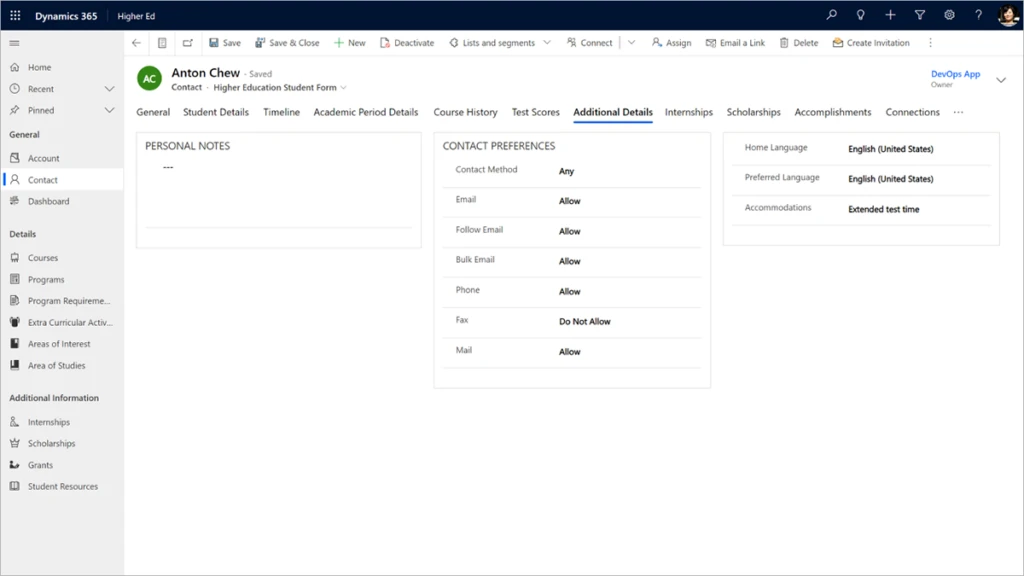
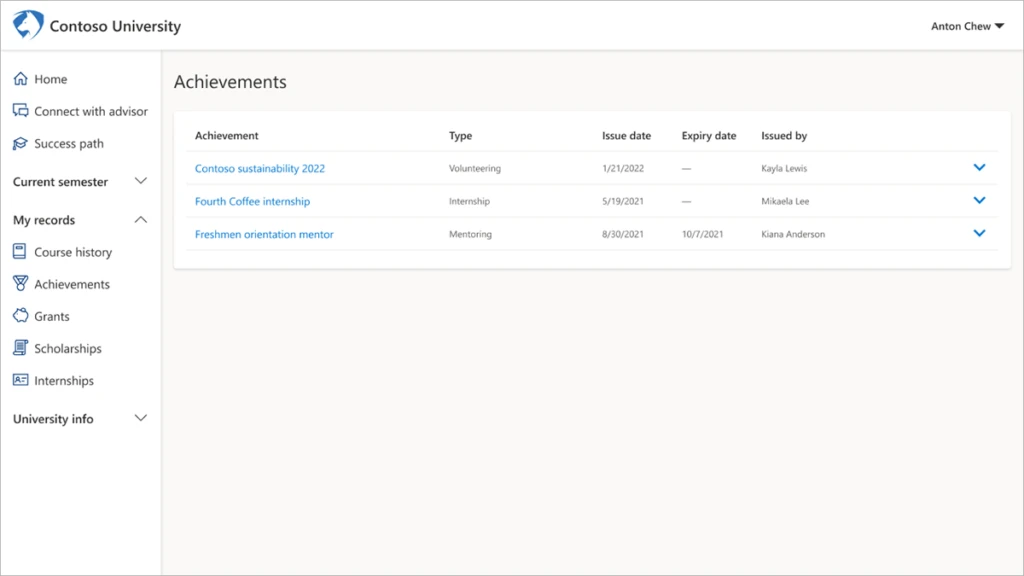
  • An enhanced learner record captures students’ home language, preferred language, accommodations, achievements, program level, and mode of study.
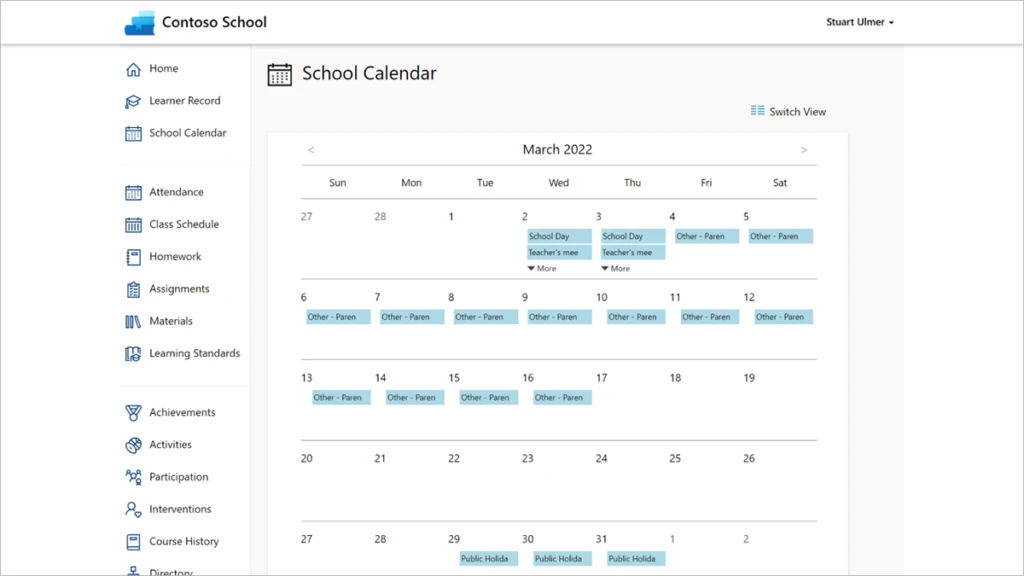
  • A new school record captures information about school hierarchy, calendar, schedule, special learning needs, and daily attendance.
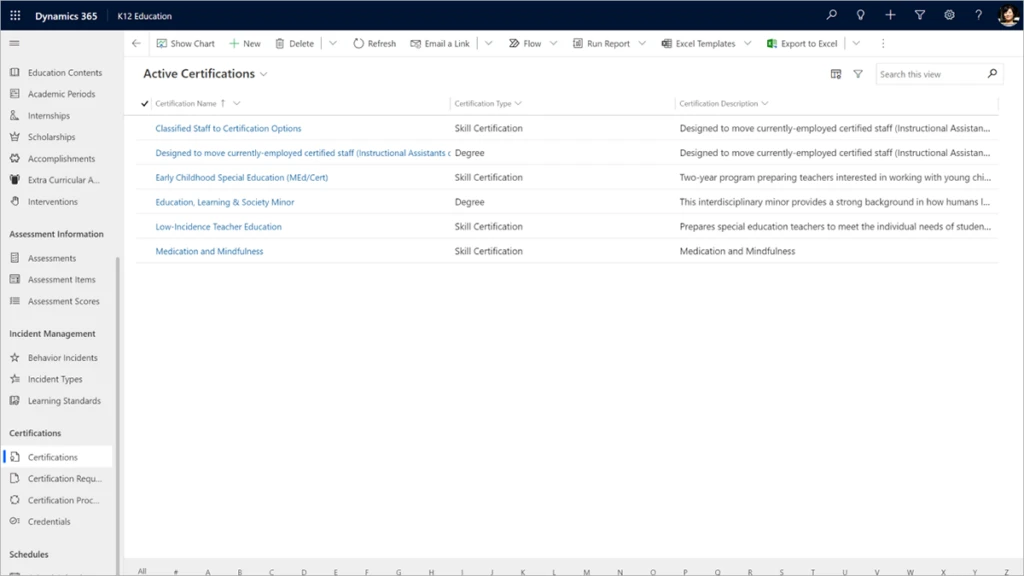
  • A new teacher certification management record captures certification requirements, process, and completions.

What’s new in the sample applications

The higher education and K-12 model-driven apps capture more detailed information in the contact data for each student, such as home and preferred languages.

Screenshot of student details page in education accelerator for higher education.

The higher education and K-12 student portals capture achievement data.

Screenshot of student achievements page in education accelerator for higher education.

The K-12 portal captures school calendar data.

Screenshot of school calendar page in education accelerator for higher education.

The K-12 model-driven app captures teachers’ certification and credential information.

Screenshot of teacher certification page in education accelerator for higher education.

What our partners are saying

“As an ISV who has aligned with the Higher Education Accelerator (HEA) since V1, we see the April 22 (V4) release of HEA as a substantial step forward for partners and customers. With the inclusion of the learner record, school calendar, instructor certifications and other new features along with the ability to leverage components from K-12 for Higher Ed, this release truly enriches our greymatter Higher Education Lifecycle CRM and allows us to deliver a comprehensive learner record and true Student 360 view to empower institutions like the College of Southern Nevada to create exceptional student experiences.”

Shekar Kadaba, CEO, Frequency Foundry

“We are seeing a real positive response from the K-12 space since the recent releases of the industry accelerator. It is providing a platform that allows schools to adjust to the ever-changing demands for their industry. The flexible nature of the accelerator has meant that schools have been able to start modernizing the way they interact with their parents and students through the different channels provided with the Dynamics 365 platform. One of the many advantages we have seen for schools is how they can move away from the traditional siloed environment. This has allowed them to interact with their data in ways they have not been able to previously. It is an exciting time being a partner in the education space and leveraging the Microsoft Education Accelerator and Power Platform to improve the whole customer experience in schools.”

Brad Orders, Solution Specialist, Fusion5

“For PwC, keeping our clients’ systems evergreen is as important as upgrading and extending their usability. Private preview allows us to plan and schedule updates in our clients’ data models. We are excited about the new release, which expands the student learning profile and workforce development and directly addresses what we have learned from schools.”

Khue Trinh, Lead Solution Architect Connected School, PwC

Next steps

  • Get started right away with version 4.0 of the Dynamics 365 education accelerator on Microsoft AppSource. The data model, solutions, sample applications and data, Power BI reports, and UX controls that come with the education accelerator are available to any Microsoft Power Platform developer.
  • For more information, read the education accelerator documentation.

The post Data enhancements in education accelerator appeared first on Microsoft Dynamics 365 Blog.

Brought to you by Dr. Ware, Microsoft Office 365 Silver Partner, Charleston SC.