Enable productivity with native mobile experiences optimized for sellers

Enable productivity with native mobile experiences optimized for sellers

This article is contributed. See the original author and article here.

In the last year, business travel and face-to-face meetings have reduced significantlybut global workforces are busier than ever. The pace of selling has sped up during the pandemic, and the common pain points sellers face have become exacerbated as they juggle more responsibilities and obligations across work, home, and multiple time zones.

Sellers need to complete their tasks quickly and efficiently, where menial functions are automated and data entry is minimal, allowing them to accomplish their goals and achieve results in less time.

The new Dynamics 365 Sales mobile app, now generally available, brings together the best of the core solutions sellers use most. With Microsoft Outlook, Microsoft Teams, and Dynamics 365 Sales, the mobile app creates a frictionless selling experience, streamlined for a seller’s hectic workday. The app integrates native mobile device capabilities with the best of Microsoft and Dynamics 365 Sales concepts: collaboration, productivity, engagement, and intelligent workflows to create a streamlined native mobile app experience.

The Sales mobile app is also easily extendable using Microsoft Power Platform. With the new mobile sales app, Dynamics 365 Sales supports the always-on expectations so today’s sellers can work from almost anywhere.

Start the day ahead of the game

The Dynamics 365 Sales mobile app keeps sellers on the critical path with real-time push notifications that the organization can customize based on individual business needs. Reminders and insights not only keeps sellers on top of updates to key record details, but it also can alert them to more complex issues, such as opportunities with upcoming closed dates that have shown little or no recent activities. The app can also extract and alert sellers to potential issues, directly from their Outlook inbox, such as licenses for an account that are soon to expire.

Inside the app, the home page highlights the most useful and relevant information for sellers to conduct their daily tasks. The app displays upcoming meetings, recent contacts, and recently viewed records, pulled from Outlook and Dynamics 365 Sales, in the primary focus mode. From the home screen, sellers can create any entity or activity, including notes and contacts. Sellers can easily drill down for more information about any entity.

graphical user interface, text, application, chat or text message

Come prepared to every customer engagement

On the meetings tab, sellers can review their calendar and join Microsoft Teams meetings with one click of a button.

For face-to-face travel, the app provides location links to quickly access the device’s native maps app. The new Dynamics 365 Sales app provides sellers with relationship and logistics data sourced from Outlook and Dynamics 365 Sales. In a single meeting card, the seller knows key meeting details and attendee responses from Outlook. Dynamics 365 Sales data is pulled so the seller sees associated opportunity title, estimated revenue, closed date, pipeline phase, notes, and AI-generated reminders.
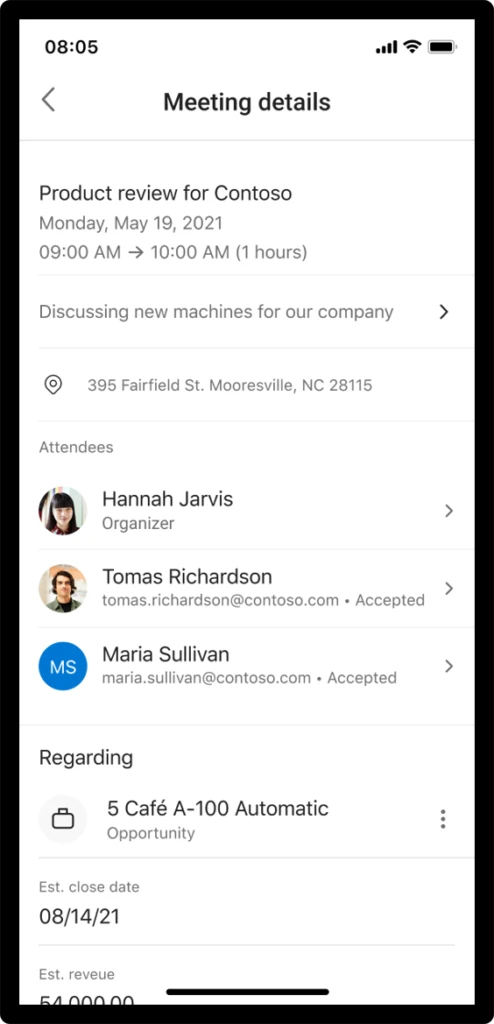
graphical user interface, text, application, chat or text message

Conduct daily tasks with ease, while on the go

Sellers can find contacts they need to reach with recently modified records with typo-proof search capabilities. With the quick view forms optimized for mobile devices, sellers have easy access to make quick updates and drill into a full view if they need more details. Sellers can quickly add notes, create contacts, and update data in relevant records.

Save time, and escape manual data entry

The Dynamics 365 Sales mobile app reduces manual entry and saves valuable time by supporting voice dictated notes while still fresh in the seller’s minds. Sellers can also take photos of their notes in hard copy and associate to the appropriate records as attachments. The app also allows sellers to scan business cards automatically into contacts so sellers have all the relevant details exactly where they are needed for future reference.

Note capture in camera on phone in Dynamics 365 Sales mobile

Work and domestic responsibilities have blurred across time zones, creating longer workdays that seemingly never end. And, as always, the pressure on sellers to hit goals and achieve results does not abate. The Dynamics 365 Sales mobile app brings together powerful, seller-specific workflows with Microsoft Teams, Outlook, and Sales to give sellers an incredibly powerful edge to stay at the top of their game.

The Dynamics 365 mobile app is a deeply integrated, on-the-go CRM (customer relationship management) that supercharges sales organizations.

Learn More

In the coming weeks, we will be encouraging users to download and begin using the new Sales mobile app.

Learn more about the mobile app and its capabilities: Using the Dynamics 365 Sales mobile app | Microsoft Docs

Enable the Dynamics 365 Sales mobile app in Advanced Settings: Prerequisites for the Dynamics 365 Sales mobile app | Microsoft Docs

To download the mobile app now:

Apple App Store: Dynamics 365 Sales on the App Store (apple.com)

Google Play: Dynamics 365 Sales – Apps on Google Play

The post Enable productivity with native mobile experiences optimized for sellers appeared first on Microsoft Dynamics 365 Blog.

Brought to you by Dr. Ware, Microsoft Office 365 Silver Partner, Charleston SC.
3 aspects to consider when migrating to Dynamics 365 in the cloud—it’s like building your next dream house

3 aspects to consider when migrating to Dynamics 365 in the cloud—it’s like building your next dream house

This article is contributed. See the original author and article here.

Migrating your on-premises business applications to the cloud can be like building your very own dream home. It’s incredibly exciting and will be perfect for your unique needs but can feel daunting when going at it alone. Ensuring you have a strong plan is crucial. Let’s explore this metaphor a bit more as we examine three critical components in your cloud journey and how you can leverage the Microsoft Dynamics 365 Migration Program all along the way.

Much like a top-notch architect and contractor makes building your dream home easier, the Dynamics 365 Migration Program enables on-premises customers to simplify and accelerate their move to the cloud. It offers end-to-end migration support working directly with Microsoft cloud architects and specialized migration partners. The program offers access to a no-charge migration assessment, pricing offers, tools, and migration support for qualified customers. Get expert help through the Dynamics 365 Migration Program to move from Dynamics AX or Dynamics CRM to the cloud.

Before you “break ground” on your cloud migration, however, there are three core aspects to considerbudget, requirements, and location.

1. Budget:

When building a dream home, ensuring you have a good understanding of your true budget is usually a good place to start. A reasonable place to begin is to compare your housing costs today with your future costs. Maybe you are renting or making mortgage payments on an existing house and you want to compare your current payments to your dream home mortgage. Chances are this new mortgage cost along with the one-time down payment may look overwhelming compared to your current rent or mortgage, but this is an incomplete view. It is incredibly important to factor in all of the service costs involved in maintenance, upgrades, and repairs of your current residence. This applies to on-premises costs as wellit is crucial to calculate the total cost of ownership, including IT costs, upgrade costs, and server costs to avoid any surprises. See the Forrester TEI study for Dynamics AX and Dynamics CRM to learn what other customers have found when making the cost comparison.

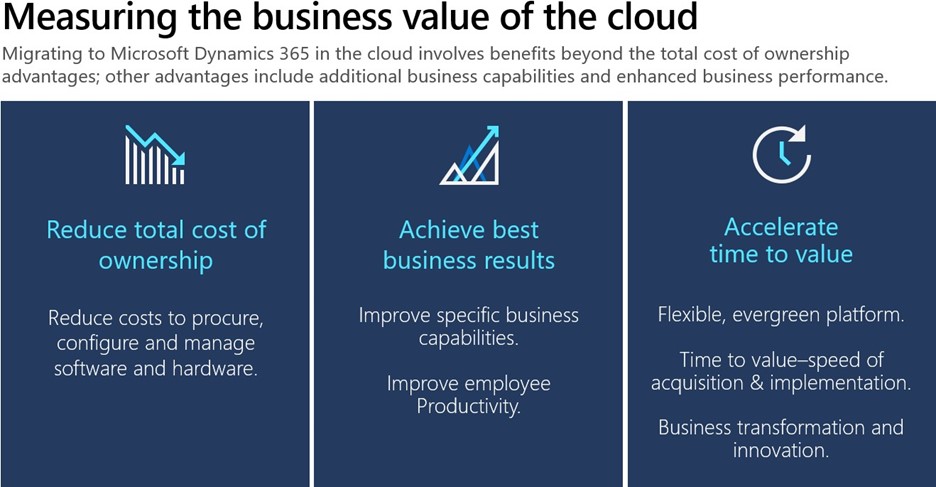
Picture highlighting the 3 benefits of moving to the cloud reduce total cost of ownership, achieve best business results, and accelerate time to value

2. Requirements:

Once you have a clear line of sight to the budget requirements, next comes the fun partthe design and specifications of your new house. When you are thinking about your future needs, why limit yourself to old ways of doing things? What about your partner’s, kids’, and pets’ changing needs? Your toddler will grow up to be a teenager in no time and will need a study room, or maybe your partner wants to start working from home and needs a quiet office space. Is all of your old stuff going to your new house, or might it make sense to get rid of the old boxes that you haven’t opened in the last 10 years? Likewise, when migrating to the cloud, it is an opportunity to refresh, evolve, or completely get rid of your old business practices that don’t make sense anymore. Do you still want that big file cabinet when you can store things securely online? To fully understand what it will take for you to migrate your existing on-premises data, customizations, integrations, and functionality to the cloud, you should sign-up for a no-charge, no-obligation Microsoft migration assessment. The assessment will give you deep insights into what it will take in terms of time and effort to migrate to the cloud. Apply today for the Microsoft migration assessment to get started.

3. Location:

Your ideal dream house should be in a spot where you feel safe and have the option to expand your living space when needed. Some neighborhoods, for example, are simply preferred because of the safety they offer in addition to the flexible zoning laws that allow future expansion. Maybe you want to build that second floor or mother-in-law suite in the future when your family grows or add those privacy hedges you have always wanted. Isn’t it great to always have that option and only invest when you are ready? With Dynamics 365 you can access cutting-edge technology, control costs, and improve IT productivity by migrating to the cloud. Dynamics 365 offers physical, infrastructure, and operational security with Microsoft Azure. It also offers scaling to the desired capacity to accommodate a variable number of users. Learn more about all the benefits of migrating from Dynamics AX and Dynamics CRM to Dynamics 365 in the cloud.

Image of a building connecting to a cloud

Finally, when considering building that future dream house, it can be exciting and nerve-wracking at the same time. Migrating your on-premises enterprise resource planning (ERP) or customer relationship management (CRM) to the cloud is no different with the same or more anxiety associated. It is very important to fully consider all the costs, design aspects, and platform features before you can determine the best migration path for your company. With Dynamics 365 Migration Program hundreds of customers like you have already benefitted from our no-charge, no-obligation Microsoft Standard Migration Assessment.

I was impressed about the information I got out of this migration assessment. It will give us confidence for the next steps” Senior Business Analyst

The Microsoft Standard Migration Assessment is the first step to help you understand the value of cloud migration and how to get there. This Microsoft-managed assessment is delivered virtually, typically requiring four to eight hours of a customer’s time. The Microsoft Standard Migration Assessment is available worldwide for users of Dynamics AX and Dynamics CRM. Download handouts for the Dynamics AX and Dynamics CRM Standard Migration Assessment.

Join the Dynamics 365 Migration Program

Get in touch with us today: Dynamics 365 Migration Program and join the Dynamics 365 Migration Community to connect with experts and fellow customers. Migration is an important decisiondo it right to minimize risk. Microsoft is here to guide you throughout the entire process.

The post 3 aspects to consider when migrating to Dynamics 365 in the cloud—it’s like building your next dream house appeared first on Microsoft Dynamics 365 Blog.

Brought to you by Dr. Ware, Microsoft Office 365 Silver Partner, Charleston SC.

Run quality assurance automatically with robotic process automation

Run quality assurance automatically with robotic process automation

This article is contributed. See the original author and article here.

Organizations have an increasing demand to automate standard business processes and provide more convenient interactions to their staff. With robotic process automation and Microsoft Power Automate, businesses gain efficiency and accuracy by using an experience to automate repetitive processes in Dynamics 365.

Read a related blog post: Enhance workplace automation with prebuilt RPA templates for Dynamics 365

Workers on the manufacturing floor use quality orders in Dynamics 365 Supply Chain Management to request quality assurance processes for selected items on manufacturing lines. Potential defects or problems are typically raised based on visual observations, abnormalities in production processes, sensor data, or AI-driven predictive analysis.

Our automation solution template for Supply Chain Management demonstrates how you can use Power Automate to automate business processes to create quality orders.

Watch a video: Utilize RPA to create quality orders in Dynamics 365 Supply Chain Management

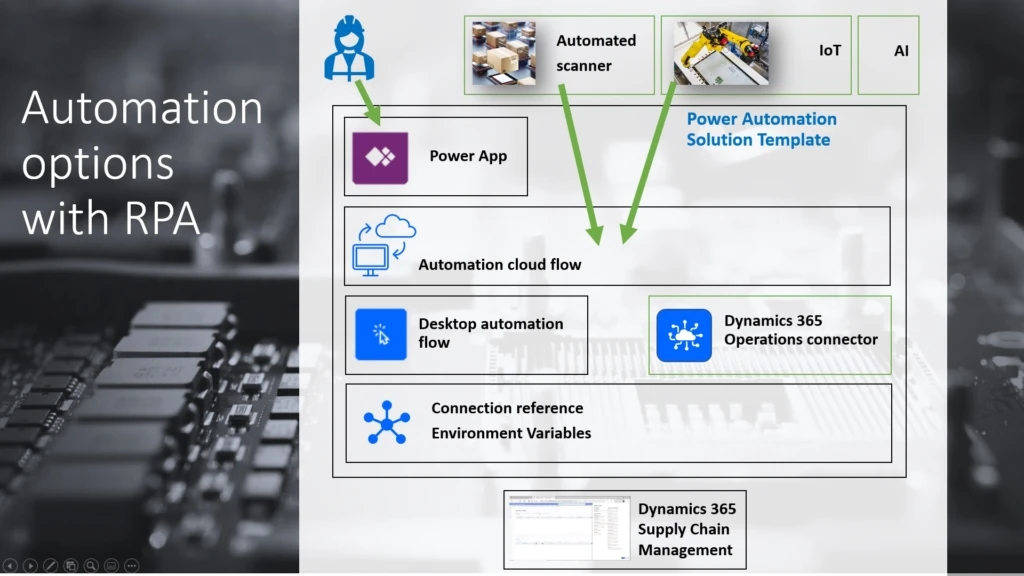
graphical user interface, application

The Power Automate solution template includes a cloud automation flow and a desktop automation flow that automate the creation of quality orders in Supply Chain Management.

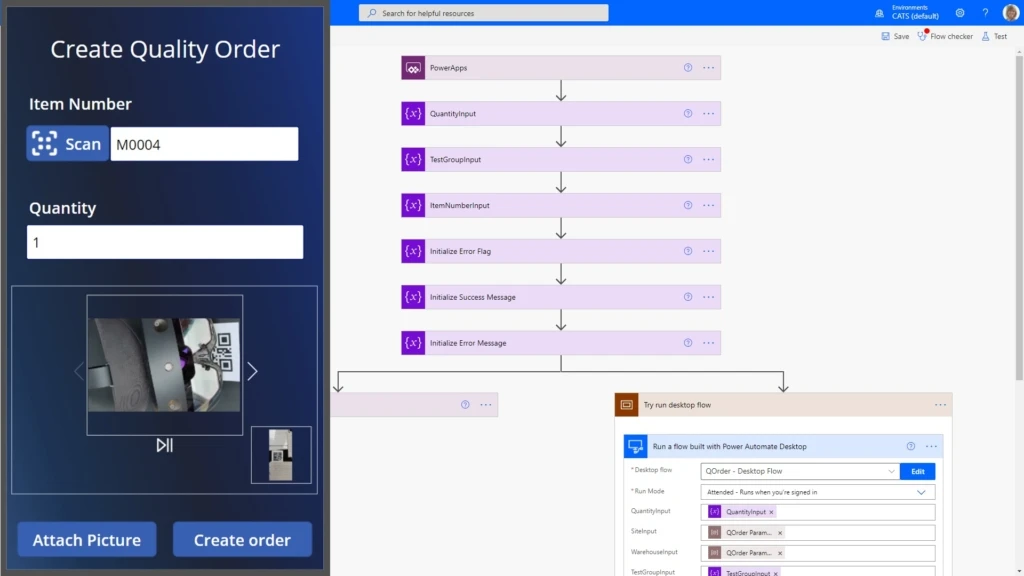
Although the automation can be started from different event sources and signals, the QOrder app is included in the solution template. It’s an example of user inputdriven automation that is typically used in visual inspections, together with scanning item QR codes, entering quantities, and attaching camera pictures.

The automation solution template also includes parameters that you can use to configure the automation for a specific use case in a production facility.

Find more information about how to use this and other automation templates

How the automation solution works

The automation solution runs in your instance of Power Automate. After you download and import the solution template into your solutions in the Power Automate portal, you first specify a set of parameters that configure quality order creation in your Supply Chain Management environment, parameters for your quality management scenario, and a connection to your desktop automation host. This host will open your Supply Chain management environment and create the quality order when requested by the automation flows.

Find more information about deployment

Download the Automation solution template

Screenshot of the QOrder application and one of the automation flows.

Solution parameters are used to provide credentials and values that are the same for all automation runs. In the preceding example, the configuration parameters are values for Site, Warehouse, and Test Group. Item numbers, quantities, and (optionally) picture attachments are entered by the initiating party for each automation. You can, of course, customize the automation solution to meet your needs.

Find more information in the installation documentation

After the solution installation and configuration are completed, you can find the assets listed in your solution. After the app has been published for your organization and shared, users can sign into Power Apps on their mobile device, open the app, and start creating quality orders.

The app will capture the input from the user and create a row in a data table called QOrder_Queue to request a new quality order. The cloud flow from the QOrder automation solution was started during the installation process and will automatically pick up the new request. It will then contact the desktop automation flow through the configured on-premises connector on the automation host. The desktop automation flow, in turn, will begin the creation of the quality order in your Supply Chain Management portal.

You can also view the history of automation runs in your solution instance. Select QOrder – Cloud Flow Monitor Queue, and review the run history.

We have also added a second cloud flow that can be used to call directly into the desktop automation of the quality order creation host. You can use this other automation flow to connect to more signals to create quality orders. The signals include signals from sensors that use IoT Central, or even AI-based predictive decision-making processes.

Note that this is the first preview version of the solution template, and some functionality is limited. In this release, a picture that is attached in the QOrder app won’t yet be attached to the quality order in Supply Chain Management. We will add this and more capabilities in iterative enhancement updates.

Next steps

For a complete step-by-step guide about how to download, install, and use the sample solution for automating quality order creation, see Automate quality order creation on Dynamics 365 Supply Chain Management with Robotic Process Automation using Power Automate Desktop

The post Run quality assurance automatically with robotic process automation appeared first on Microsoft Dynamics 365 Blog.

Brought to you by Dr. Ware, Microsoft Office 365 Silver Partner, Charleston SC.
Empower seller excellence with customer feedback solutions

Empower seller excellence with customer feedback solutions

This article is contributed. See the original author and article here.

In today’s digital landscape, sellers face new changes at a rapid pace, making it more important than ever to be equipped with the right information when connecting with customers. The sales journey is like a game of strategyyou have to carefully deliver the right details at the right time in order to successfully provide great customer experiences. However, many sellers miss the opportunity to source customer feedbacka proven way to improve the buying experience and deepen customer relationships. According to a Walker study at the end of 2020, customer experience overtook both price and product as the key brand differentiator.1

Customer feedback is an essential source of data for optimizing your customer experience throughout the sales process. Microsoft Dynamics 365 Customer Voice works with Microsoft Dynamics 365 Sales to source feedback, engaging with customers at key points within the buyer journey. This captures input on critical steps within the sales process to gain relevant, contextual customer feedback that companies can leverage to improve the customer experience. Learn more about seamlessly connecting Dynamics 365 Sales and Dynamics 365 Customer Voice in our free e-book, “The Power of Knowing Your Customers.”

KPMG leverages automation for customer obsession

Successful companies that prioritize customer experience aren’t afraid to ask customers how they can improve. They seek to understand how their customers feel about the product, service, and sales engagement in order to recognize patterns that reveal opportunities for improvement. A constant loop of gathering feedback and making improvements drives toward the best possible customer experience.

One organization that’s harnessing the power of understanding customer needs is KPMG Australia. The company deployed Dynamics 365 Sales as its end-to-end sales solution to deliver more value to customers in every interaction. After capturing and analyzing customer feedback, KPMG leverages these insights from Dynamics 365 Sales to develop strategies their sellers can use to generate more satisfied customers.

“We are using Dynamics 365 Customer Voice and Dynamics 365 Sales to provide the right solution to the right customer at the right time. And, using automation, we provide our teams the important feedback from our clients in the form of data and tasks that not only help sellers be more effective and successful in the upfront pitch, but also help them provide the greatest value in delivery.” Anthony Coops, Head of Major Projects and Pursuits, KPMG Australia

To stay in sync with the customer, feedback is critical to continued success. The right data keeps sellers constantly learning about changing customer needs, driving a customer-centric culture that leads to stronger relationships and life-long customers.

Capture feedback during the buying process

Sellers and customers know that the buying process can be complicated, but by listening to your customers, this process can be simplified.

With Dynamics 365 Customer Voice, sellers can easily capture feedback on the buying process, seamlessly connecting the data into Dynamics 365 Sales. Your sellers can become more agile and effective in their interactions with contacts, accounts, and opportunities with rich insights from customer feedback. Watch the video below to learn how to easily capture feedback with surveys in Dynamics 365.

This embed requires accepting cookies from the embed’s site to view the embed. Activate the link to accept cookies and view the embedded content.

This site uses cookies for analytics, personalized content and ads. By continuing to browse this site, you agree to this use.

Once the survey is sent, Dynamics 365 Customer Voice automatically adds the customer feedback to the contact or account record and updates the status of the survey. Responses, customer sentiment, and trigger words are all compiled into survey results within Dynamics 365 Sales, allowing users to view trends and access data quickly. Now, sellers can be empowered to collect feedback throughout any point of the buying process, utilize the data to adapt their selling strategy in the moment, and optimize their customer engagement.

The value of personalization in selling

Customers feel understood and prioritized when sellers make each interaction personalized. Many organizations know the value of personalization but don’t leverage it effectively to increase sales. KPMG utilized the power of the Dynamics 365 suite to evolve their practice and processes, turning interactions into personalized experiences.

“We are always thinking about how to use core systems to bring our teams closer to our clients in order to drive improved quality and client experience. As we mature and leverage our technology in new ways, our obsession with quality and client value has moved from an “here’s what you should do next” approach, to a system with specific personas that recognize our teams’ and our clients’ unique needs and preferences.” Anthony Coops, Head of Major Projects and Pursuits, KPMG Australia

Surveys give your customer a voice in optimizing the sales process. With Dynamics 365 Customer Voice, sellers engage customers more effectively because feedback is integrated into the unified view of the customer. Combined with Dynamics 365 Sales, seller productivity gets a boost because seller feedback improves automated processes and next best activity workstreams. By leveraging the power of customer feedback, sellers are more equipped than ever to drive revenue through every opportunity.

Learn more

To learn more about Microsoft’s feedback management solution, visit the Dynamics 365 Customer Voice website or start your free Dynamics 365 Customer Voice trial today.

Watch Dynamics 365 Sales demos or take a guided tour to see how Dynamics 365 Sales can empower your sellers with actionable insights. Start a free Dynamics 365 Sales trial today.

Learn more about seamlessly connecting Dynamics 365 Sales and Dynamics 365 Customer Voice in our free e-book, “The Power of Knowing Your Customers.”


1“Customers 2020: A Progress Remote”, Walker, 2020

The post Empower seller excellence with customer feedback solutions appeared first on Microsoft Dynamics 365 Blog.

Brought to you by Dr. Ware, Microsoft Office 365 Silver Partner, Charleston SC.
Empower seller excellence with customer feedback solutions

Save time by cloning sales forecasts in Dynamics 365 Sales

This article is contributed. See the original author and article here.

Companies need accurate sales forecasts to keep on track to meet quarterly and annual revenue goals.

In Dynamics 365 Sales 2021 release wave 1, sellers can now clone an existing forecast when they need to make edits, and gain immediate clarity on revenue scenarios. The existing forecast remains intact while you configure different scenarios quickly and seamlessly.

This enhancement helps you plan for upcoming periods, when a few simple tweaks to the scheduling timeframe in an existing forecast will give you the insights you need.

Cloning not only eliminates repetitive data entry, but it also helps prevent forecasting errors.

With forecast cloning, these capabilities are now available:

  • Change the rollup and hierarch entities and their relationship.
  • Change the top of the hierarchy.
  • Change the timeframe of a forecast.
  • Change the hierarchy entity and user lookup field that defines who can access each record of the forecast.
  • Change a forecast category option set, add columns, or modify columns.
  • Add or modify filters that limit the data which drives the forecast.

For more information, read how to bring predictability to your revenue pipeline.

Next steps


The post Save time by cloning sales forecasts in Dynamics 365 Sales appeared first on Microsoft Dynamics 365 Blog.

Brought to you by Dr. Ware, Microsoft Office 365 Silver Partner, Charleston SC.

Enhance workplace automation with prebuilt RPA templates for Dynamics 365 (preview)

Enhance workplace automation with prebuilt RPA templates for Dynamics 365 (preview)

This article is contributed. See the original author and article here.

For many businesses, success increasingly depends on having the agility to innovate and adapt to rapid change, responding to customer needs, competitive pressure, and industry trends. But this is a difficult challenge when employees are buried in time-consuming busywork like repetitive tasks or complex processes.

That’s why we are dedicated to helping organizations like yours automate manual business processes, across both legacy and modern applications, so you can focus on what’s most important for your business and customers. In March, we released robotic process automation (RPA) capabilities in Microsoft Power Automate Desktop for Windows 10 users.

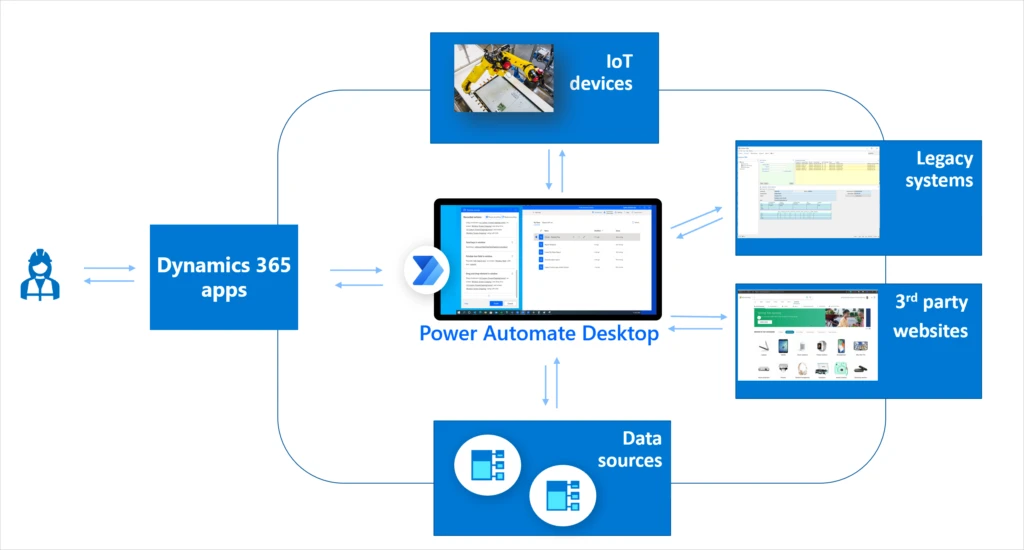
This month, we are introducing enhanced workplace automation capabilities for Microsoft Dynamics 365a set of prebuilt RPA solution templates, now available for public preview, that seamlessly integrate with select Dynamics 365 applications

Initially available for Dynamics 365 Customer Service, Dynamics 365 Supply Chain Management, and Dynamics 365 Finance, the prebuilt automation templates enable teams to rapidly automate common business scenariosfreeing time from day-to-day manual, repetitive, and error-prone tasks.

Developers can further extend any of those solutions by using custom actions, custom connectors, Microsoft Azure services, and APIs to take full advantage of Microsoft’s one cloud and data ecosystem.

Flow chart for RPA automation

Save time across customer service, finance, and supply chain roles

Explore some of the ways that RPA can help streamline processes and save valuable time across the workforce.

Dynamics 365 Customer Service: Helping call center agents rapidly validate customer credentials

Most contact centers require agents to validate or authenticate customer identities before proceeding with the service engagement. By enhancing Dynamics 365 Customer Service with RPA, agents can automate steps of the validation process, streamlining call times and helping agents to troubleshoot and solve customer issues faster.

Dynamics 365 Supply Chain Management: Streamline ordering of replacement parts for manufacturing line equipment

We’ve heard from manufacturing customers about the need to improve the process of ordering replacement parts for equipment on the factory floor. Often, technicians who identify defective parts on the manufacturing line need to write down part numbers, and then place the orders into the tracking system one by one. This is an inefficient and error-prone process. By integrating RPA processes into Dynamics 365 Supply Chain Management, technicians can simply scan or enter part details and submit orders on the spot, saving time and effort. Since Power Automate natively integrates with Azure IOT connectors, this solution can be easily extended to use the Azure IoT management system.

Watch a video to learn more about the new capabilities included in the latest update to Dynamics 365 Supply Chain Management.

Dynamics 365 Finance: Perform end of cycle financial close tasks, such as report generation and account validation

At the end of each financial period, finance team members perform standard recurring tasks in order to close the period (month-end, quarter-end, year-end). Many of these tasks include end-of-cycle report generation for the purpose of account validation and documentation. By integrating RPA capabilities in Power Automate, Dynamics 365 Finance helps streamline many of these manual and time-consuming processes, freeing up finance team members to focus on more critical strategic tasks while at the same time maintaining the accuracy that is highly demanded by the more and more restrictive finance audit regulations.

Next steps

Take the first step to enable your customer service, supply chain, and finance teams to automate processes in Dynamics 365. Get a free Power Automate RPA trial license and install Power Automate Desktop, and then import the three solutions mentioned above into your environment to set it up. Check out the documentation for steps to get started.

Send us your feedback, and we’ll work hard to address your feedback and improve the preview experience.

The post Enhance workplace automation with prebuilt RPA templates for Dynamics 365 (preview) appeared first on Microsoft Dynamics 365 Blog.

Brought to you by Dr. Ware, Microsoft Office 365 Silver Partner, Charleston SC.