
Use diagnostics to optimize unified routing for your call center 

Use diagnostics to optimize unified routing for your call center 

This article is contributed. See the original author and article here.

When unified routing is running smoothly for your customer service organization, incoming work items are routed to the best agent and the service workload is optimized and efficient. Depending on the needs of your business, the underlying routing infrastructure can get complex over time. When something goes wrong, it can take some effort to troubleshoot the issue. Recent updates to the unified routing capability in Dynamics 365 Customer Service help you streamline the problem-solving process. 

Unified routing stages for classification and assignment 

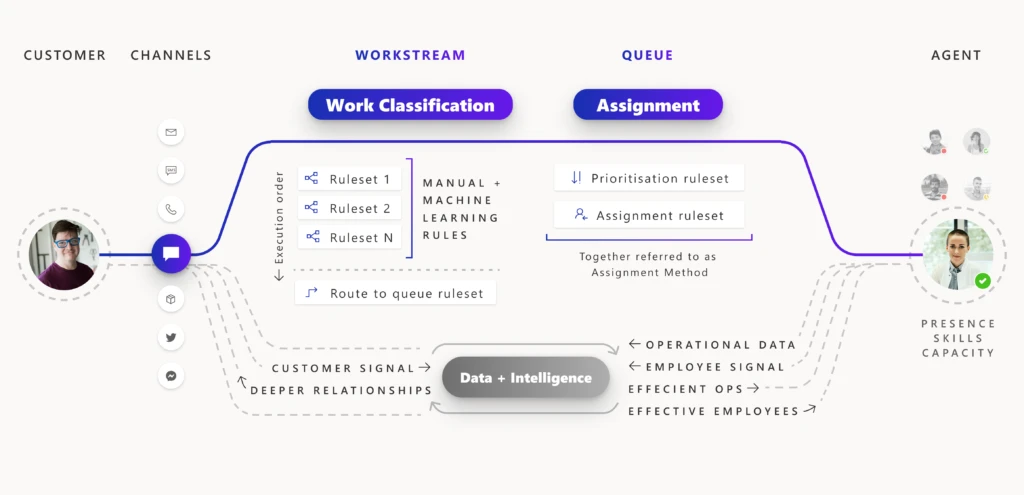
The architecture of unified routing lets you divide your routing setup into stages, and then optimize each stage individually. The classification stage lets you create rules that use customer datawhether direct or subtleto add insights to the incoming work item. You can also use machine-learning models like intelligent skill finder, sentiment prediction, and effort estimation in this stage. The insights added are then used in the assignment stage to prioritize and assign the work item to the best suited agent or queue for resolution.  

Architecture of unified routing, flowchart

For every incoming work item, rules within each applicable stage are processed so that the work item is assigned to the best agent. Diagnostics are generated from this processing, and you can view those diagnostics on each stageYou can look at how a work item was classified, how it was routed to a certain queue, and how it was prioritized and assigned.  

Problem solving with unified routing diagnostics 

When there is a problem with this routing setup, you use diagnostics to get insights into what might be wrong. You can see why certain work items are taking longer to assign, and you can also see why an item could be incorrectly assigned. More information: Diagnostics for unified routing 
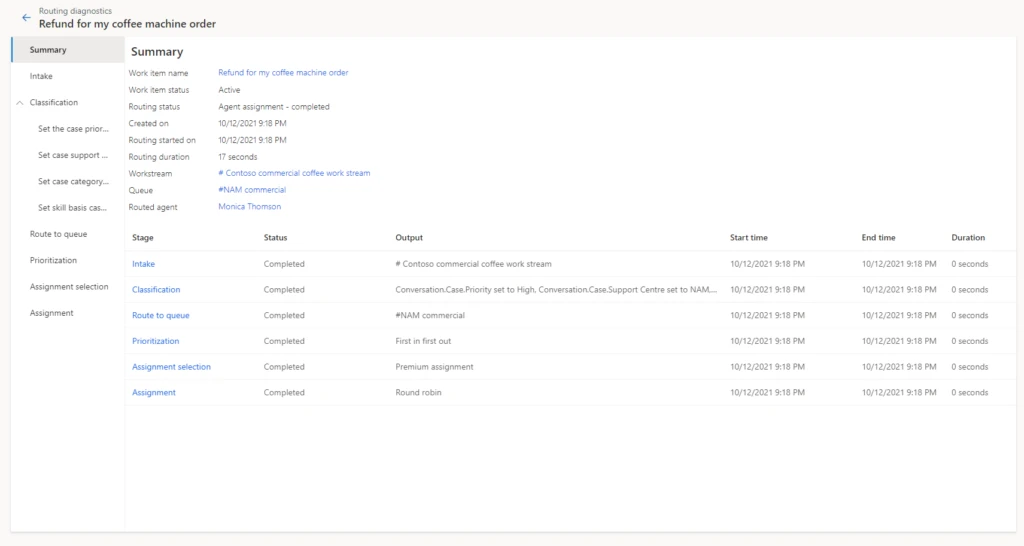
Example of routing diagnostics for a work item

Historically, only administrators had access to diagnostics from Customer Service Hub or the Omnichannel admin center app. So, only the administrator had the ability and responsibility to create rules, view diagnostics, search for misroutes, edit rules to fix issues, and optimize the routing setup.  

But during day-to-day operations, it is the supervisors and customer service managers who are responsible for the performance of the queues and the agents they manage. Issues usually surface here first, before they come to the attention of the administrator. Therefore, supervisors and managers now have access to historical analysis for unified routing. These reports surface KPIs for measuring the efficiency of all resources. While analytics tell your staff that something is not right, they need more tools to dig deep and pinpoint the core issue.  

To help with this, we have extended the access to diagnostics to supervisors. Now supervisors can look at individual work items in queues that they manage and diagnose why each work item was routed in a certain way. If the routing is not as expected, they can inform the administrator and even make suggestions to improve the current setup. 

Unified routing diagnostics scenario 

Let’s consider an example. Imagine a scenario where a supervisor is managing queues for coffee machine refund requests. Previously, there were only two queues, one for customers at the Bronze level and one for those at Gold or Silver service levels. Now, the organization has added a third queue exclusively for Gold-level service customers. The supervisor wants to ensure that the new queue for refunds to Gold status customers is working properly.   

Reviewing analytics, the supervisor can see that work items in the Silver queue have a higher session transfer rate. With access to diagnostics, the supervisor can investigate further by opening Routing diagnostics, selecting the Silver queue, and reviewing the diagnostics records for some of the recent work items.

In our scenario, the supervisor looks at the rules that are applied to the work items, as seen in the image below, and quickly notices that the route to queue rule has incorrect logic that sends work items to the Silver refunds queue instead of Gold. Note that the finalidentified queue is displayed at the top of the page in the route to queue stage, which makes it even easier for the supervisor to check the queue identified.
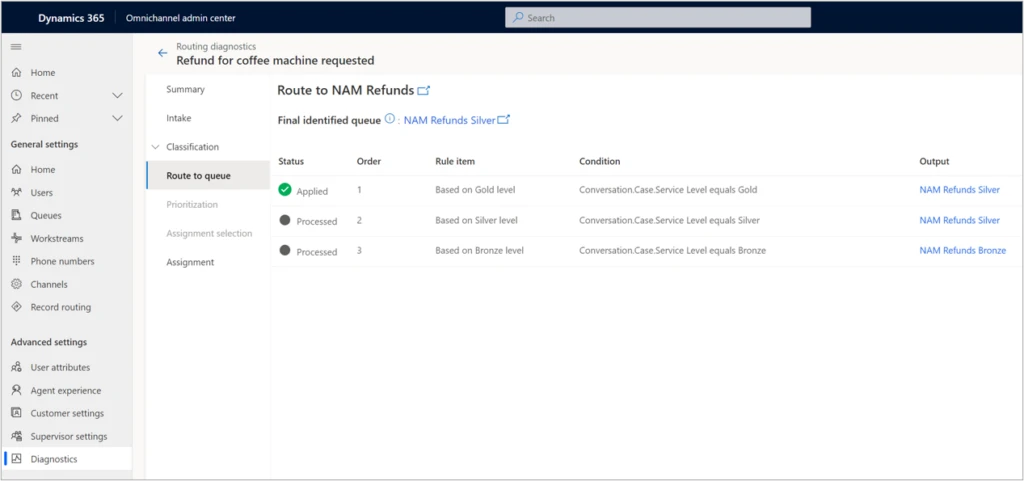
graphical user interface, application, email

To quickly mitigate this issue, the supervisor can manually assign the appropriate work items to the correct queue, where they will then be assigned to the right agents. Now that the supervisor was able to unravel the mystery behind the increase in session transfer rate, they can bring up the issue to the administrator, who can make the required rule change and fix the problem.

Analytics and diagnostics are powerful tools. With broader access to these tools, your organization can gain better efficiency as you more quickly evolve your routing setup.

Next steps

With 2021 release wave 1, take advantage of the benefits of unified routing in Dynamics 365 Customer Service. Check out the system requirements and availability in your region. Also, read more in the documentation:

This blog post is part of a series of deep dives that will help you deploy and use unified routing at your organization. See other posts in the series to learn more.

The post Use diagnostics to optimize unified routing for your call center  appeared first on Microsoft Dynamics 365 Blog.

Brought to you by Dr. Ware, Microsoft Office 365 Silver Partner, Charleston SC.

Why AI and real-time visibility are a game-changer for order lifecycle management

Why AI and real-time visibility are a game-changer for order lifecycle management

This article is contributed. See the original author and article here.

In recent years, retailers, consumer packaged goods (CPG) companies, and manufacturers have incorporated direct-to-consumer (D2C) business models into their go-to-market strategies to give end customers the options to order from anywhere and ship to everywhere. As the use of these online sales channels continues to expand, so too does the number of third-party fulfillment partners and options to evaluate and incorporate into their supply chain and commerce systems. Organizations with business-to-business (B2B), business-to-business-to-consumer (B2B2C), and D2C business models, require technology solutions that give them the ability to manage an increasingly complex order lifecycle from order source through orchestration to intelligent fulfillment and delivery.

According to Gartner, “83 percent of chief information officers (CIOs) stated they were expanding digital channels in 2021, while 79 percent plan to increase the use of self-service by customers and citizens.”1 With Microsoft Dynamics 365 Intelligent Order Management, companies can stay on top of their game through digital channels, as Dynamics 365 Intelligent Order Management enhances their digital order and delivery channels. It provides real-time visibility into each order from order intake to delivery, and customizable dashboards to help track and improve operational decision-making across every touchpoint of the order life cycle.

Overcome fulfillment complexity

Managing the entire order lifecycle is about placing your organization in a position to deliver on your order promise with every customer order. But there are other undeniable benefits, such as reducing logistics costs by overcoming fulfillment complexities that await companies, who demonstrate the ability to do this well. Indeed, according to McKinsey & Company, “since e-commerce fulfillments are significantly more complex, contract logistics can charge around 50 percent more than for traditional store fulfillment. Therefore, those companies that overcome the complexities stand to gain the most.”2

Companies can overcome the complexities of e-commerce fulfillment by utilizing Dynamics 365 Intelligent Order Management rules-based fulfillment orchestration system that uses real-time inventory and AI to optimize order flows. This solution offers advanced analytical capabilities to measure fulfillment effectiveness and business users can use the insights to re-model the order fulfillment journey using drag and drop tools to ensure that their customer needs are met on time and at the lowest possible cost. In addition, Dynamics 365 Intelligent Order Management provides out-of-the-box pre-built connectors to e-commerce order sources such as BigCommerce, Magento, and Orderful; delivery partners such as Flexe, Krber, and ShipStation, and to tax and rebate management partners such as Avalara, Flintfox, and Vertex. All these capabilities provide organizations the agility needed to overcome supply chain constraints and deliver on their order promise.

Apply artificial intelligence

To profitably manage the entire order lifecycle, companies increasingly need to use AI and machine learning (ML) technologies in the supply chain. In fact, according to McKinsey & Company, “successfully implementing AI-enabled supply-chain management has enabled early adopters to improve logistics costs by 15 percent, inventory levels by 35 percent, and service levels by 65 percent, compared with slower-moving competitors.”3

With Dynamics 365 Intelligent Order Management, AI and ML are used to analyze data to find and predict patterns in order flows and fulfillment processes. The results help bring new levels of insights that would not otherwise be possible for human team members to spot alone. These results can then be paired with AI-based classification and anomaly detection models to proactively identify and address fulfillment constraints and to improve delivery times, while simultaneously reducing costs. The use of AI and ML enhances decision-making across all order orchestration flows by delivering the capability to sense and predict constraints, disruptions, and opportunities to improve order and fulfillment processes.

Enhance inventory visibility

Dynamics 365 Intelligent Order Management solution architecture was designed to support the requirements of complex order processing environments, where there are many systems and apps in the overall order-to-fulfillment process. By bringing visibility into many disparate data sources and applications; order flows, inventory, and supporting functions can be significantly improved. Dynamics 365 Intelligent Order Management ships out-of-the-box with an integrated real-time inventory visibility service that is highly scalable and extensible, and provides a single, global view of all inventory positions across all legal entities.

Dynamics 365 Intelligent Order Management not only provides organizations with a single, global view of all inventory positions, but its fulfillment orchestration engine also uses real-time inventory data to optimize fulfillment processes to ensure optimal stock levels are maintained across all stock locations. The result is that companies can increase online product availability, improve cash flow by right-sizing stock levels, and guarantee a delightful customer experience by delivering every order on time and in full.

What’s next?

We have seen that Dynamics 365 Intelligent Order Management is an ideal tool for managing the entire order lifecycle. By utilizing rules-based order orchestration to overcome fulfillment complexities, leveraging AI and ML to derive actionable insights, and optimizing stock levels by applying a real-time inventory visibility service, companies can deliver on their order promise and turn order management into a competitive advantage. Moreover, Dynamics 365 Intelligent Order Management seamlessly integrates with any enterprise resource planning (ERP), customer relationship management (CRM), e-commerce, Dynamics 365, and non-Dynamics 365 applications, allowing organizations to skip costly rip and replace implementations.

If you are ready to see how Microsoft Dynamics 365 Intelligent Order Management can help your organization to manage the entire order lifecycle, we invite you to get started today by contacting us or signing up for a free trial. Or, to learn more about how to meet your growing digital commerce needs and scale easily, while supporting the latest fulfillment methods, check the Dynamics 365 Intelligent Order Management resources on our website: Dynamics 365 Intelligent Order Management.


Sources:

  1. “Gartner, Add Digital Payments as Part of Communications Platform as a Service Offering, Lisa Unden-Farboud, Daniel O’Connell et al, 27 August, 2021.” GARTNER is the registered trademark and service mark of Gartner Inc., and/or its affiliates in the U.S. and internationally and has been used herein with permission. All rights reserved.
  2. McKinsey & Company, Unlocking the omnichannel opportunity in contract logistics, March 12, 2021, Tom Bartman, Scott McConnell, Florian Neuhaus, and Isabell Scheringer.
  3. McKinsey & Company, Succeeding in the AI supply-chain revolution, April 30, 2021, Knut Alicke, Valerio Dilda, Stephan Grner, Lapo Mori, Pierrick Rebuffel, Sebastian Reiter, and Robert Samek.

The post Why AI and real-time visibility are a game-changer for order lifecycle management appeared first on Microsoft Dynamics 365 Blog.

Brought to you by Dr. Ware, Microsoft Office 365 Silver Partner, Charleston SC.

Why AI and real-time visibility are a game-changer for order lifecycle management

Unlock hidden insights in your Finance and Operations data with data lake integration

This article is contributed. See the original author and article here.

You chose Dynamics 365 for your enterprise to improve visibility and to transform your business with insights. Is it a challenge to provide timely insights? Does it take too much effort to build and maintain complex data pipelines?

If your solution includes using a data lake, you can now simplify data pipelines to unlock the insights hidden in that data by connecting your Finance and Operations apps environment with a data lake. With general availability of the Export to Data Lake feature in Finance and Operations apps, data from your Dynamics 365 environment is readily available in Azure Data Lake.

Data lakes are optimized for big data analytics. With a replica of your Dynamics 365 data in the data lake, you can use Microsoft Power BI to create rich operational reports and analytics. Your data engineers can use Spark and other big data technologies to reshape data or to apply machine learning models. Or you can work with a data lake the same way that you work with data in a SQL database. Serverless SQL pool endpoints in Azure Synapse Analytics conveniently lets you query big data in the lake with Transact-SQL (T-SQL).

Why limit yourself to business data? You can ingest legacy data from previous systems as well as data from machines and sensors at a fraction of the cost incurred when storing data in a SQL data warehouse. You can easily mash-up business data with signals from sensors and machines using Azure Synapse Analytics. You can merge signals from the factory floor with production schedules, or you can merge web logs from e-commerce sites with invoices and inventory movement.

Can’t wait to try this feature? Here are the steps you need to follow.

Install the Export to Data Lake feature

The Export to Data Lake feature is an optional add-in included with your subscription to Dynamics 365. This feature is generally available in certain Azure regions: United States, Canada, United Kingdom, Europe, South East Asia, East Asia, Australia, India, and Japan. If your Finance and Operations apps environment is in any of those regions, you can enable this feature in your environment. If your environment isn’t in one of the listed regions, complete the survey and let us know. We will make this feature available in more regions in the future.

To begin to use this feature, your system administrator must first connect your Finance and Operations apps environment with an Azure Data Lake and provide consent to export and use the data.

To install the Export to Data Lake feature, first launch the Microsoft Dynamics Lifecycle Services portal and select the specific environment where you want to enable this feature. When you choose the Export to Data Lake add-in, you also need to provide the location of your data lake. If you have not created a data lake, you can create one in your Azure subscription by following the steps in Install Export to Azure Data Lake add-in.

Choose data to export to a data lake

After the add-in installation is complete, you and your power users can launch the environment for a Finance and Operations app and choose data to be exported to a data lake. You can choose from standard or customized tables and entities. When you choose an entity, the system chooses all the underlying tables that make up the entity, so there is no need to choose tables one by one.

Once you choose data, the system makes an initial copy of the data in the lake. If you chose a large table, the initial copy might take a few minutes. You can see the progress on screen. After the initial full copy is done, the system shows that the table is in a running state. At this point, all the changes occurring in the Finance and Operations apps are updated in the lake.

That’s all there is to it. The system keeps the data fresh, and your users can consume data in the data lake. You can see the status of the exports, including the last refreshed time on the screen.

Work with data in the lake

You’ll find that the data is organized into a rich folder structure within the data lake. Data is sorted by the application area, and then by module. There’s a further breakdown by table type. This rich folder structure makes it easy to organize and secure your data in the lake.

Within each data folder are CSV files that contain the data. The files are updated in place as finance and operations data is modified. In addition, the folders contain metadata that is structured based on the Common Data Model metadata system. This makes it easy for the data to be consumed by Azure Synapse, Power BI, and third-party tools.

If you would like to use T-SQL to work with data in Azure Data Lake, as if you are reading data from a SQL database, you might want to use the CDMUtil tool, available from GitHub. This tool can create an Azure Synapse database. You can query the Synapse database using T-SQL, Spark, or Synapse pipelines as if you are reading from a SQL database.

You can make the data lake into your big data warehouse by bringing data from many different sources. You can use SQL or Spark to combine the data. You can also create pipelines with complex transforms. And then, you can create Power BI reports right within Azure Synapse. Simply choose the database and create a Power BI dataset in one step. Your users can open this dataset in Power BI and create rich reports.

Next steps

Read an Export to Azure Data Lake overview to learn more about the Export to Data Lake feature.

For step-by-step instructions on how to install the Export to Data Lake add-in,see Install Export to Data Lake add-in.

We are excited to release this feature to general availability. You can also join the preview Yammer group to stay in touch with the product team as we continue to improve this feature.

The post Unlock hidden insights in your Finance and Operations data with data lake integration appeared first on Microsoft Dynamics 365 Blog.

Brought to you by Dr. Ware, Microsoft Office 365 Silver Partner, Charleston SC.
Why AI and real-time visibility are a game-changer for order lifecycle management

Use intelligence to transform routing of service delivery requests

This article is contributed. See the original author and article here.

Any call center that uses unified routing to manage and assign incoming support requests is going to notice gains in efficiency. The core routing capabilities in Dynamics 365 Customer Service use skill matching and priority to help determine assignments. However, bringing intelligence to the challenge of efficient routing can move you closer to world-class service.

With the unified routing release in April of 2021, we introduced intelligent skill finder as the first capability related to intelligent work classification. It empowers organizations to identify which skills are required by the agent to address an incoming work item. AI models are trained to understand the skills required to address customer inquiries, and then a match is made to agent skills, helping to assign the calls to agents. In this new release, we’re adding two more capabilities to intelligent work classification: customer sentiment identification and effort estimation for routing. These capabilities will enable organizations to harness state-of-the-art AI to improve customer satisfaction and reduce resolution times.

Understanding customer needs with sentiment identification

Matching agents to calls based on skills is a basic capability in unified routing. What if you could also gauge customer sentiment based on keywords, and then route calls to agents best able to handle those various emotions?

Let’s better understand this with a scenario. Imagine Contoso Coffee is operating a support center and has implemented unified routing. They recently had a high volume of unhappy customers, and they brainstormed about how best to use their existing staff to address these concerns. Contoso Coffee realizes that customer sentiment could be used as a signal to influence call routing; some agents are better at managing unhappy customers. Contoso decides to adopt sentiment prediction in unified routing. They take a few simple steps:

  1. Contoso’s admin opts into the feature and tries it out using the Dry Run tool, where the admin can test phrases specific to their organization and view the sentiment prediction.
  2. The admin set up a skill for managing work items predicted to include low (unhappy) sentiment, and that skill is assigned to their agents who have the right training to handle it.
  3. The admin configured a rule to predict sentiment, and it attaches the low sentiment management skill to work items when sentiment is low.
  4. The dry run option is used to start testing out the rule, with work items assigned based on the score.
  5. Now, once the rule is in production, new work items predicted to have low sentiment have a higher priority to be matched to agents with the appropriate management skillset.

As a result, Contoso Coffee was able to address the spike in unhappy customers, leveraging their agents to maintain customer satisfaction.

Learn more about using customer sentiment in classification in this short video introduction:

This embed requires accepting cookies from the embed’s site to view the embed. Activate the link to accept cookies and view the embedded content.

This site uses cookies for analytics, personalized content and ads. By continuing to browse this site, you agree to this use.

Read more in the documentation about using sentiment prediction-based model in work classification.

Estimate effort to increase assignment efficiency

A key contributor to an effective contact center is understanding how long it will take to address support requests. Organizations do not have a simple way to understand how much time it will take agents to address incoming work items. Effort estimation replaces manual processes with the use of AI. This intelligence interprets the issue and uses historical support data to generate a work estimate.

Highlights of this capability include:

  • For training, a business admin can specify which work items to train on and define effort for their organization.
  • Use the dry run experience to test out the model on customer data and view real effort estimations prior to integrating into the routing process.
  • Add it to existing routing capabilities such as route to queue rules.
  • Review diagnostics for insight into how the work item was routed using effort estimations.
  • Train multiple custom models based on individual customer data.

Learn more about effort-based routing in this short video introduction:

This embed requires accepting cookies from the embed’s site to view the embed. Activate the link to accept cookies and view the embedded content.

This site uses cookies for analytics, personalized content and ads. By continuing to browse this site, you agree to this use.

Read more in the documentation about using the effort estimation model in unified routing.

Matching required skills to agents

In any contact center, each agent will have a different set of skills to offer, and organizations should use those skills appropriately to best address customer requests. To maximize agent potential, it is critical for any organization to understand the skills required to address a work item and identify the agent that is best suited to address it. Intelligent skill finder takes the guesswork out of this by using AI to predict the skills required to address an incoming work item, and then matching those required skills to corresponding agents.

Highlights of this capability include:

  • For training, a business admin can specify which work items to train.
  • Use it with skill-based routing.
  • Models can improve over time based on the agent feedback loop.
  • Review diagnostics for insight into how the work item was routed using skill predictions.
  • Train multiple custom models based on individual customer data.

Next steps

Visit the Dynamics 365 Customer Service Community Forum to share your thoughts.

This blog post is part of a series of deep dives that will help you deploy and use unified routing at your organization. See other posts in the series to learn more.

The post Use intelligence to transform routing of service delivery requests appeared first on Microsoft Dynamics 365 Blog.

Brought to you by Dr. Ware, Microsoft Office 365 Silver Partner, Charleston SC.

Why AI and real-time visibility are a game-changer for order lifecycle management

The most important customer experience metrics (that you’re not tracking yet)

This article is contributed. See the original author and article here.

Marketing professionals go to great lengths to understand customers. Detailed personas are written to identify the motivations, interests, and buying patterns of prospects and customers. But all too often, these personasand their resulting customer journeysare informed by data points important to the organization, not the customer. You cannot claim to be customer-centric, customer-first, or customer-obsessed if all the data you track is company-centric.

You may be thinking your organization is ahead of the customer journey curve here. After all, you’re already tracking customer-centric metrics such as net promoter score, customer satisfaction score, and customer effort score. But take a second look. These key performance indicators (KPIs) still ultimately measure benchmarks important to the organization, not the customer.

Go beyond KPIs with customer performance indicators

Nobody is arguing that an organization shouldn’t have a robust set of KPIs focused on measuring the fulfillment of important company objectives. But your toolbox of performance indicators doesn’t have to end thereand neither do the possibilities for the customer journey. Rather, take things to a whole new level by also measuring the fulfillment of customers’ objectives and optimizing the journey with the help of Microsoft Dynamics 365 Marketing.

Customer performance indicators (CPIs) quantify and measure outcomes that are desired by customers. These outcomes could include time savings, cost savings, convenience, flexibility, a sense of security, or any number of other outcomes customers deem valuable in the context of your product or service. There’s no cookie-cutter set of CPIs; they will vary widely across industries, organizations, products, and regions.

Consider the scenario of a retailer whose shoppers especially value speed. Acknowledging their shoppers’ priorities along with the need to balance services with expectations, the retailer tracks customers’ wait-time for curbside pick-up. They discover that wait times occasionally go beyond customer expectations. In response, the retailer implements a new feature that sends a flash promotional offer to high-value customers, when they are on their way during busy periods, for a complimentary drink redeemable from the in-store bar when they switch to in-store pickup. It’s a personalized gesture that acknowledges the retailer fell short of expectations but is trying to do its best to make it up to the customer. By optimizing the metrics that reflect what is important to the customer, the retailer can positively impact a whole host of KPIs, from customer satisfaction and customer loyalty to sales revenueand more.

Where KPIs end and customer performance indicators begin

There is a strong correlation between CPIs and KPIs. As illustrated by our retailer example, meeting the objective of a CPI is likely to boost associated KPIs. In fact, CPIs have been identified as powerful predictors of growth. Similarly, declining CPIs are likely to drag down associated KPIs.

CPIs also uncover insights about KPIs. Take customer satisfaction as an example. A high customer satisfaction score (a common KPI) indicates that an organization is doing something well. And while that’s critical information, this KPI on its own may not be able to provide visibility into what that something is. Or whether that something is even important to the customer. But a set of CPIs designed to measure desired customer outcomes such as personalized touches or chat availability can identify where the strongest correlations lie between what is important to the customer and what is important to the company.

CPIs and KPIs have a lot in common. They both measure performance, they both demonstrate progress toward an intended result, and they both impact the bottom line. For this reason, they can be difficult to distinguish from one another.

In the following table, we identify a few common KPIs. Alongside each KPI, we list one or more CPIs that could be used to enhance the understanding or performance of the associated KPI.

KPI CPI How CPI supports KPI
Customer lifetime value Value customer receives Customer lifetime value can be increased if there’s focus on ensuring there is a minimum, measurable value provided to the customer as well. For example, a loyalty card program could strive to save customers at least $100 a year.
Customer satisfaction score

In-person customer touches

Online chat availability

Do your customers value personalized, dedicated attention or the ability to quickly query representatives via informal chat applications? Understand the type of service interactions the customer values and implement CPIs to ensure you’re meeting expectations.
Product return rate

Ease of product return

Expense of product return

Is product return rate low because the product is superior or because the return process is unwieldy or expensive? By additionally tracking and optimizing the return experience of customers, you’ll have greater insight into the reasons behind your product return rate.
Quote to close ratio Quote turnaround time There are many factors influencing quote to close ratio. Find out what your customers valuewhether it be fast quote turnaround, flexible pricing plans, or something elseand start measuring it.


Find your customer performance indicators

What outcomes do your customers value? When you have the answer to that question, you can focus on delivering those outcomes. Every CPI identified, quantified, and measured brings new discoveries, new opportunities, and new levers to pull. Every CPI optimized is one more personalization you can bring to the customer journey, from brand voice and quote delivery to product bundling and customer service availability.

In short, it’s not enough to measure what’s important to your organizationnot if you want to optimize the customer journey and exceed customer expectations. You must also measure what’s important to your customers.

Learn how Dynamics 365 Marketing helps your organization optimize the CPIs that lead to elevated experiences.

The post The most important customer experience metrics (that you’re not tracking yet) appeared first on Microsoft Dynamics 365 Blog.

Brought to you by Dr. Ware, Microsoft Office 365 Silver Partner, Charleston SC.

Exploring the Intel manufacturing environment through mixed reality

Exploring the Intel manufacturing environment through mixed reality

This article is contributed. See the original author and article here.

Today’s organizations have seen tremendous value in using mixed reality, as it rapidly changes how employees learn, work, and understand the world around them. With the unique value of mixed reality solutions, such as Microsoft HoloLens 2, Microsoft Dynamics 365 Guides, and Microsoft Dynamics 365 Remote Assist, organizations can drive workforce transformation with on-the-job guidance, hands-on training, and collaboration that is seamless, intuitive, and embedded into everyday workflows.

Man taking an interactive training in an office room using Microsoft HoloLens 2 and Guides.

Intel technicians using HoloLens 2, Dynamics 365 Guides, and Remote Assist to resolve complex issues

Today, we’ll look at how Intel manufacturing facilities are using mixed reality solutions such as HoloLens 2, Dynamics 365 Guides, and Dynamics 365 Remote Assist globally. In some of the world’s most advanced manufacturing facilities, technicians are responsible for building, maintaining, and troubleshooting some of the most complex manufacturing products made by humans. Working at some of the smallest known geometries, every piece of maintenance must be performed precisely by continuously improving processes to ensure the production of smarter, faster, and more energy-efficient computer chips. With six wafer fabrication sites and four assembly test manufacturing locations worldwide, Intel must maintain a global, virtual network.

In Intel’s Israel manufacturing facility, HoloLens 2 and Dynamics 365 Guides have become integral to its manufacturing processes, playing a key role in the following scenarios:

  • Maintenance and repair tasks: Intel employees “learn by doing” with step-by-step instructions for conducting inspections and audits, deploying new equipment, fixing machine breaks, addressing issues faster, and increasing efficiency. Additionally, Dynamics 365 Guides allows Intel to proactively manage their assets to avoid costly downtime due to unpredicted failure. This includes conducting preventative maintenance, defining new intelligent workflows, and thoroughly completing maintenance tasks using checklists in Dynamics 365 Guides.
  • Troubleshooting: Dynamics 365 Guides brings critical information into view to help Intel technicians troubleshoot, audit, or support difficult and delicate procedures, improving first-time fix rate for urgent repairs with guidance.
  • Remote communication: Dynamics 365 Remote Assist seamlessly connects Intel experts and technicians through the calling feature to collaborate and solve problems without disrupting the flow of work. Dynamics 365 Remote Assist has also helped maintain the new normal to everyday routinewith advanced collaboration features, Intel has made it easy for their expert engineers to work from home to perform remote inspections that share video, screenshots, and annotations across devices. By avoiding unnecessary travel, Intel has helped increase safety and wellbeing during COVID-19 on a global scale.

Remote assist calling and collaboration features show real-time view of inspection in work environment.

  • Preparing interactive training materials: Intel employees can train from home, at their desk, or on the shop floor. Dynamics 365 Guides enables authors to build digital, interactive trainings that can be viewed from anywhere and easily scale any updates to keep up with real-time changes. These trainings can be produced by anyone on a PC or HoloLens device with simple 2D and 3D creation in the real-world environment.
  • Facility tour: With the power of HoloLens 2, employees can provide hands-free, digital facility tours to virtually show the inner workings of Intel’s cutting-edge facilities.

We are thrilled to see what the future holds and how mixed reality will continue to innovate manufacturing processes at Intel. To learn more, watch the video below to discover how Intel Israel is using Dynamics 365 Guides, Dynamics 365 Remote Assist, and HoloLens 2 today.

This embed requires accepting cookies from the embed’s site to view the embed. Activate the link to accept cookies and view the embedded content.

This site uses cookies for analytics, personalized content and ads. By continuing to browse this site, you agree to this use.

Get started with Dynamics 365 Guides

The post Exploring the Intel manufacturing environment through mixed reality appeared first on Microsoft Dynamics 365 Blog.

Brought to you by Dr. Ware, Microsoft Office 365 Silver Partner, Charleston SC.