by Contributed | May 10, 2021 | Technology
This article is contributed. See the original author and article here.
According to industry experts, threat intelligence (TI) is a key differentiator when evaluating threat protection solutions.
But IoT/OT environments have unique asset types, vulnerabilities, and indicators of compromise (IOCs). That’s why incorporating threat intelligence specifically tailored to industrial and critical infrastructure organizations is a more effective approach for proactively mitigating IoT/OT vulnerabilities and threats.
Today we’re announcing that TI updates for Azure Defender for IoT can now be automatically pushed to Azure-connected network sensors as soon as updates are released, reducing manual effort and helping to ensure continuous security[1].
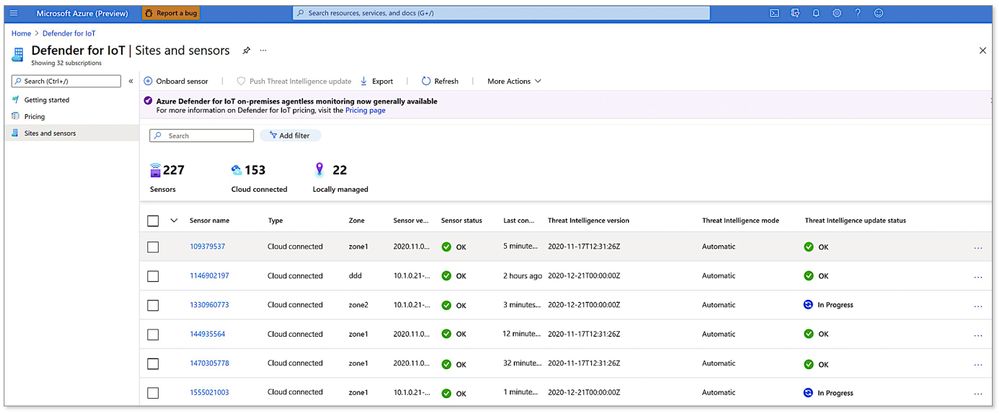
To get started, simply go to the Azure Defender for IoT portal and enable the Automatic Threat Intelligence Updates option for all your cloud-connected sensors. You can also monitor the status of updates from the “Sites and Sensors” page as shown below.
Viewing the status of network sensors and threat intelligence updates from the Azure portal
Threat intelligence curated by IoT/OT security experts
Developed and curated by Microsoft’s Section 52, the security research group for Azure Defender for IoT, our TI update packages include the latest:
- IOCs such as malware signatures, malicious DNS queries, and malicious IPs
- CVEs to update our IoT/OT vulnerability management reporting
- Asset profiles to enhance our IoT/OT asset discovery capabilities
Section 52 is comprised of IoT/OT-focused security researchers and data scientists with deep domain expertise in threat hunting, malware reverse engineering, incident response, and data analysis. For example, the team recently uncovered “BadAlloc,” a series of remote code execution (RCE) vulnerabilities covering more than 25 CVEs that adversaries could exploit to compromise IoT/OT devices.
Leveraging the power of Microsoft’s broad threat monitoring ecosystem
To help customers stay ahead of ever-evolving threats on a global basis, Azure Defender for IoT also incorporates the latest threat intelligence from Microsoft’s broad and deep threat monitoring ecosystem.
This rich source of intelligence is derived from a unique combination of world-class human expertise — from the Microsoft Threat Intelligence Center (MSTC) — plus AI informed by trillions of signals collected daily across all of Microsoft’s platforms and services, including identities, endpoints, cloud, applications, and email, as well as third-party and open sources.
Threat intelligence enriches native behavioral analytics
IOCs aren’t sufficient on their own. Enterprises regularly contend with threats that have never been seen before, including ICS supply-chain attacks such as HAVEX; zero-day ICS malware such as TRITON and INDUSTROYER; fileless malware; and living-off-the-land tactics using standard administrative tools (PowerShell, WMI, PLC programming, etc.) that are harder to spot because they blend in with legitimate day-to-day activities.
To rapidly detect unusual or unauthorized activities missed by traditional signature- and rule-based solutions, Defender for IoT incorporates patented, IoT/OT-aware behavioral analytics in its on-premises network sensor (edge sensor).
Threat intelligence complements and enriches the platform’s native analytics, enabling faster detection of IOCs such as known malware and malicious DNS requests, as shown in the threat alert examples below.
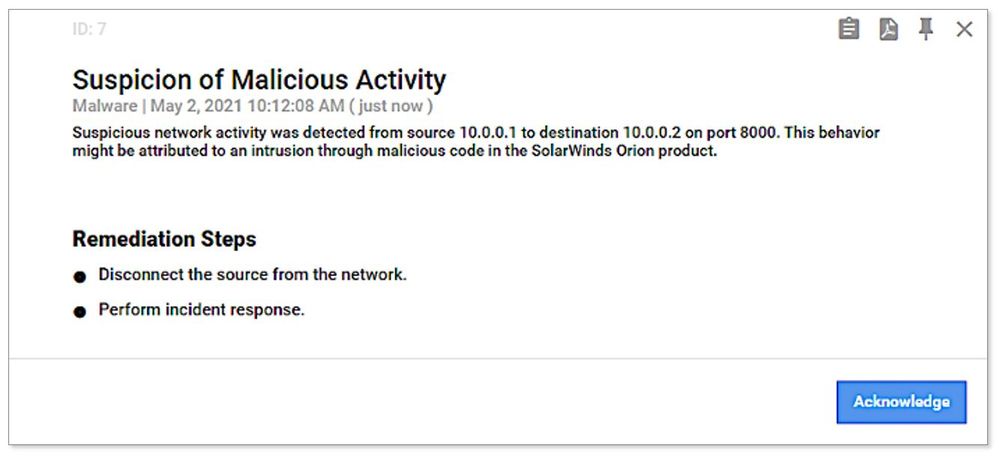 Example of SolarWinds threat alert generated from threat intelligence information
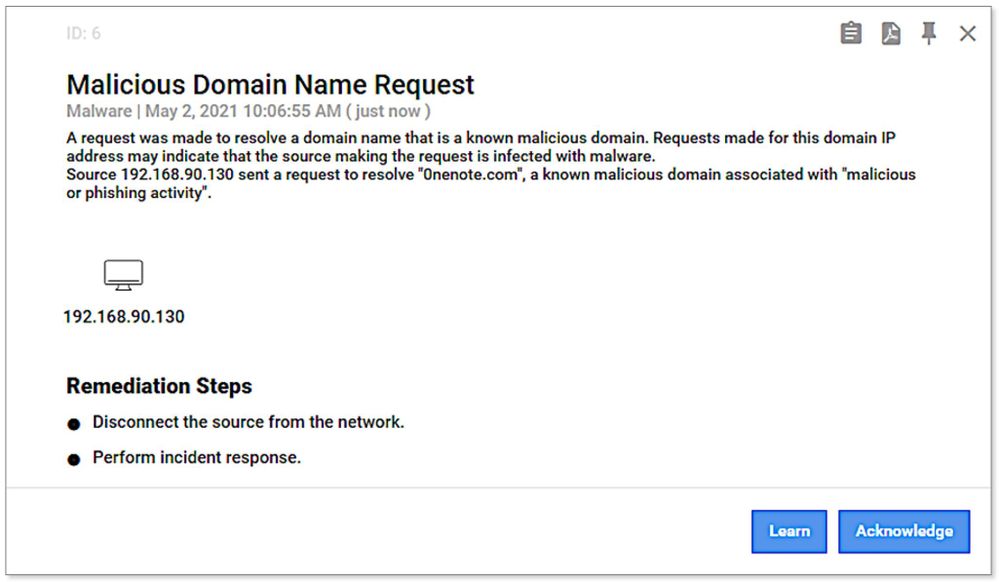 Example of malicious DNS request alert generated from threat intelligence information
Summary — Detecting Known and Unknown Threats
Effective IoT/OT threat mitigation requires detection of both known and unknown threats, using a combination of IoT/OT-aware threat intelligence and behavioral analytics.
With new cloud-connected capabilities provided with v10.3 of Azure Defender for IoT, industrial and critical infrastructure organizations can now ensure their network sensors always have the latest curated threat intelligence to continuously identify and mitigate risk in their IoT/OT environments.
Learn more
Go inside the new Azure Defender for IoT including CyberX
Update threat intelligence data – Azure Defender for IoT | Microsoft Docs
What’s new in Azure Defender for IoT – Azure Defender for IoT | Microsoft Docs
See the latest threat intelligence packages
About Azure Defender for IoT
Azure Defender for IoT offers agentless, IoT/OT-aware network detection and response (NDR) that’s rapidly deployed (typically less than a day per site); works with diverse legacy and proprietary OT equipment, including older versions of Windows that can’t easily be upgraded; and interoperates with Azure Sentinel and other SOC tools such as Splunk, IBM QRadar, and ServiceNow.
Gain full visibility into assets and vulnerabilities across your entire IoT/OT environment. Continuously monitor for threats with IoT/OT-aware behavioral analytics and threat intelligence. Strengthen IoT/OT zero trust by instantly detecting unauthorized or compromised devices. Deploy on-premises, in Azure-connected, or in hybrid environments.
[1] Of course, clients with on-premises deployments can continue to manually download packages and upload them to multiple sensors from the on-premises management console (aka Central Manager).

by Contributed | May 10, 2021 | Technology
This article is contributed. See the original author and article here.
Kahua provides project management and collaboration software focused on real estate, engineering, construction, and operations industries. Kahua’s solution helps manage project and program costs, documents, and processes from inception through implementation to improve efficiency and reduce risk.
Recently Kahua has been selected by US General Services Administration (GSA) Public Building Service for its new management information system to manage 8600+ assets, with 370 million square feet of workspace for 1.1 million federal employees and preserve 500+ historic properties.
The Challenge & Technical Requirements
Kahua needed a future-proof solution which builds on its legacy desktop application, while using C#, XAML and Azure skillsets of its developers. Kahua had a short timeline and a recurring imperative to bring new features to market quickly, on different devices – from desktop to web and mobile. In addition, Kahua’s developers wanted to reduce the time to market by maintaining a single codebase application which prevents re-implementing the same functionality for different platforms.
Due to the nature of managing access for users in high-security environments such as financial institutions and government agencies, security was a major requirement. Additionally, the solution had to enable accessibility and localization.
For users, the UI had to be modern and intuitive, providing simple onboarding and consistent, immersive experience for users on all devices.
The Solution
Kahua selected WinUI 3 – Reunion, Uno Platform and Azure to rapidly develop and deploy a multi-platform solution.
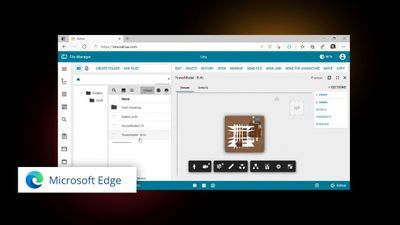
On Windows, Kahua uses WinUI 3 to deliver a delightful and modern user experience on Windows. To achieve a pure web experience, Kahua is utilizing the Uno Platform to provide a solution that is built with and runs on top of the Microsoft technology stack of Azure, .NET 5&6, and WinUI 3. To reach additional platforms such as macOS, iOS and Android, Kahua is also using Uno Platform to provide user experiences specific to mobile devices and smaller form factors.
By utilizing WinUI 3 – Reunion, Uno Platform and Azure, Kahua is meeting its requirements for security and accessibility. The Web application provides for a zero-installation experience, allowing IT departments to breathe easier and approve application updates without extensive investigation and review. Kahua can scale its operations quickly and reach users internationally.
The users can access the solution on any device, be it through any modern browser or native app on the device of their choice. The user interface across devices is modern, familiar, and consistent as it is built with the same UI technology.
Code and Skill Reuse
The Kahua development team experienced 4X productivity compared to alternative solutions evaluated. New functionality is developed once, in a single codebase. The team benefited from a mature Windows developer ecosystem and skillset on hand.
The Kahua development team was able to reuse a significant amount of the code from its legacy application, as well as utilize over 45 controls from WinUI and Windows Community Toolkit as well as 3rd party controls by Syncfusion.
“By combining Microsoft WinUI 3 and Uno Platform we are able to provide our customers with features, functionality and security that is simply unachievable with any other solution” – said Colin Whitlatch, CTO of Kahua.
by Contributed | May 10, 2021 | Technology
This article is contributed. See the original author and article here.
At Microsoft Azure, along with our partners, we obsess over solving our customers’ biggest problems in a wide range of areas such as manufacturing, energy sustainability, weather modeling, autonomous driving, and more.
Microsoft and Altair have collaborated in multiple areas ranging from EDA optimization, AI in the Cloud, and high-end simulation. Microsoft Azure is participating in the Altair HPC summit on 11th and 12th May 2021- we will be showcasing some of our recent collaborative projects as follows:
Event
|
Microsoft participant
|
Why you should tune in
|
Roundtable: AI Takes to the Clouds
|
Nidhi Chappell, GM Azure Compute
|
As companies find more ways to deploy AI for real-time predicting and prescribing, the resource requirement for training data-heavy models will yield increased demand for HPC infrastructure in the cloud. Additionally, organizations are exploring the application of AI to HPC, using AI to augment HPC optimization and even automate cloud migration.
In this panel we speak with chip industry leaders and cloud service providers to get their take on the impact and trends they are seeing from companies who are taking an AI-first approach and how it’s driving the move to the cloud.
|
Microsoft Azure: Using I/O Profiling to Migrate and Right-size EDA Workloads in Microsoft Azure
|
Michael Requa, Sr. Program Manager, Microsoft
|
When one of the largest semiconductor companies asked for help using Azure to run its EDA workloads, Microsoft teamed up with Altair.
The semiconductor company was running a relatively large design of 100 million transistors. We used Altair Breeze™, an I/O profiling tool, to troubleshoot and tune the company’s workload before and after migrating it to Azure. Breeze revealed I/O patterns that had previously gone unnoticed and showed us how to significantly improve application run time.
This presentation will outline how Microsoft used Breeze to diagnose I/O patterns, choose the workflow segments best suited for the cloud, and right-size the Azure infrastructure. The result was better performance and lower costs for our customer.
|
Microsoft, Altair nanoFluidX on Azure’s new NDv4
|
Jon Shelley, Principal PM Manager, Microsoft Azure
|
In this session Microsoft will showcase Azure’s new ND A100 v4 VM series running Altair nanoFluidX™. By leveraging Azure’s most powerful and massively scalable AI VM, available on demand from eight to thousands of interconnected Nvidia GPUs across hundreds of VMs, users can scale nanoFluidX to over 100M particles with ease.
|
About Altair:
Altair is a global technology company that provides software and cloud solutions in the areas of simulation, high-performance computing (HPC), and artificial intelligence (AI). Altair enables organizations across broad industry segments to compete more effectively in a connected world while creating a more sustainable future
References
by Contributed | May 10, 2021 | Technology
This article is contributed. See the original author and article here.
By Christine Alford, Director, Business Program Management
User-generated content has an ever-expanding impact in today’s age of online connectivity. Azure Marketplace partners like Squigl are applying user-generated content to more than just its familiar marketing business cases, bringing it into the corporate learning space. Squigl for Enterprise uses AI assistance to rapidly transform existing content into training videos. These videos are designed to increase viewer attention and boost information retention, facilitating learning.
Andrew Herkert, Vice President of GTM at Squigl, shares five tactics below for user-generated content in corporate learning and human resources environments:
Brand leaders worldwide are crowd-sourcing creative via user-generated content (UGC). This means audio clips, advertorials, social proof, video, textual content, and other forms of media are being amassed by the petabyte. This content has immense value. When used tactically, these troves of content can yield considerable ROI (10x-20x or more, according to Forrester). When making buying decisions, consumers are highly impressed by key opinion leaders and social engagement, byproducts of UGC.
Businesses can translate marketing value drivers from UGC to the disciplines of human resources or learning and development with the help of Microsoft Azure and Microsoft Cognitive Services. With the correct UGC strategies, businesses can tactically execute design and delivery of a valuable solution. More than a year into the COVID-19 pandemic, the idea of engaging with distributed teams needs to become a reality.
“In today’s remote work environments, it is more important than ever to meet employees’ varied learning and communications needs, wherever they are,” said Jake Zborowski, general manager BO&PM management at Microsoft. “Squigl, a highly innovative content creation solution available in Azure Marketplace, enables business professionals to meet those needs quickly and with demonstrable ROI. Sharing relevant, engaging, just-in-time Squigl videos will enable the remote workforce to achieve their objectives and create market value.”
Below are five example tactics taken from the Squigl install base and deployed globally, often across multiple customer instances, with considerable returns generally above 20x:
1. Storytelling: Users respond to prompts to create content on an integrated PaaS environment, combining Squigl with existing front-end content management system elements, while Squigl’s AI processes the content. AI amplifies and elevates the resonance (impact) of the message. Culturally sensitive, AI-driven media containing user stories can now be crowd-sourced from around the world with greater impact than ever.
2. Creative competition: Squigl users are given incentive to create something in the style of, or similar to, a model set forth by the brand leaders. Brand leaders create a 3-to-5-minute content piece, then prompt users to create a story of their own in response to the original content.
3. Analyst’s day: Squigl users produce meta brand content used in conjunction with fiduciary reporting to add a “human element” to index valuation discussions and beyond. Predictable growth ensued in a Fortune 10 company when deployed consistently.
4. Brand fan: Brand leaders create sequences of UGC tactics and begin to attribute and publicly recognize contributions made by power users over time. Reddit’s Karma system originated this in the mainstream. The same principles apply in B2C as in B2B.
5. FAQ and product advertisements: Brands can now rely on end users to create ”tips and tricks” and other ”power user” content oriented at accelerating product evangelism curves.
The above campaign tactics apply near-unilaterally at the global level, and are proven playbooks to drive growth from zero base as well as in established channels.
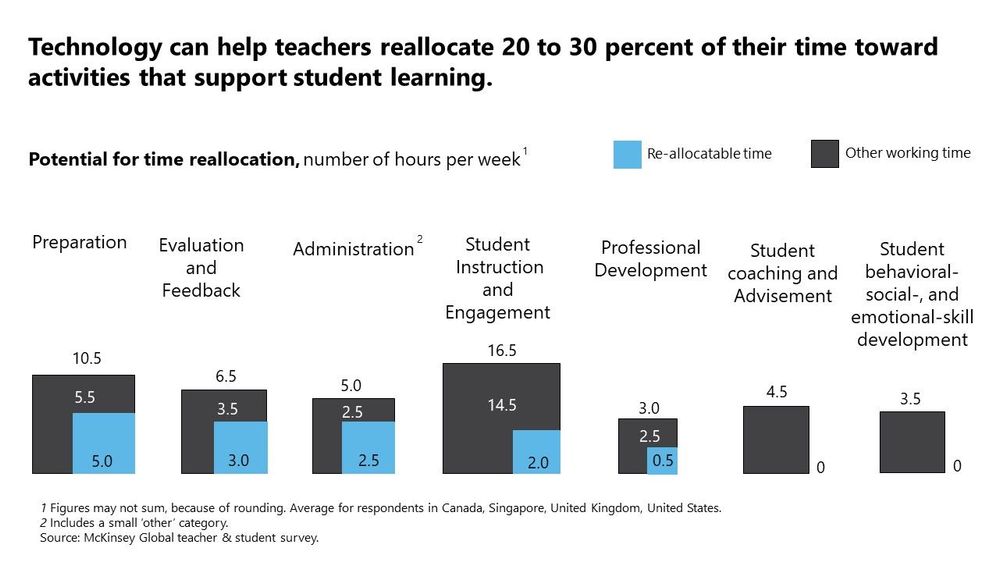
In combining AI and UGC and bringing this stack in-house, key metrics can grow by 200 percent or more if the right models are trained against the right data sets with the right outcomes in mind. The below chart illustrates how AI can reallocate time for teachers, generally showing potential to reallocate as much as 20 percent to 30 percent of their time to more meaningful interactions.
Neural networks customize delivery of content timing, process language (translate, speak, interpret, etc.), and execute event triggers. This means when applied to UGC, artificial intelligence automation (AutoML) can enhance business impact drastically. McKinsey has shown that 50 percent to 150 percent engagement uplifts driven by AI are the new benchmark.
This is an ongoing and rapidly developing trend, and Squigl is fervently pursuing this outcome for millions of end users at hundreds of multinationals worldwide.
by Contributed | May 10, 2021 | Technology
This article is contributed. See the original author and article here.
Overview
SQL Server Migration Assistant (SSMA) is a suite of 5 tools designed to automate migrations from Oracle, Access, DB2, MySQL and SAP ASE (formerly SAP Sybase ASE) to Microsoft SQL. It automates the conversion of database schemas to a Microsoft SQL Server schemas, deployment of the schemas, data migration to the target SQL Server (see below for supported versions), and validation of migrated objects.
What’s new?
The latest releases of SSMA for Oracle and SSMA for Sybase enable validation of converted database objects and transferred data to Azure SQL Database, Azure SQL Managed Instance and Azure Synapse SQL Pools. Storing and running the test cases on the client-side has streamlined the setup process and removed the extension pack requirement. Moreover, you can now easily share test cases between SSMA projects by copying the ‘tester’ folder.
In addition, this release includes the following:
- SSMA for MySQL and SSMA for Access surface minor performance improvements and bug fixes
- SSMA for DB2 is enhanced with:
- Improved
TIMESTAMP_FORMAT emulation function
- Improved foreign keys discovery for z/OS platform
- SSMA for Oracle addresses the following:
- Improved resolution logic in
SELECT list when user-defined column names match system functions
- Ignore system-defined columns (
SYS_STS*) and indexes (SYS_IL*)
- Fixed issue with packages disappearing from the objects tree after reconnect to Oracle database
- Fixed CLR assemblies deployment issue on Azure SQL Database in 32-bit SSMA package
Downloads
Supported sources and target versions
Source: For the list of supported sources, please review the information on the Download Center for each of the above SQL Server Migration Assistant downloads.
Target: SQL Server 2012, SQL Server 2014, SQL Server 2016, SQL Server 2017, SQL Server 2019, Azure SQL Database, an Azure SQL Database managed instance, and Azure SQL Data Warehouse (Azure Synapse Analytics)*.
*Azure SQL Data Warehouse (Azure Synapse SQL Pool) is supported as a target only when using SSMA for Oracle.
Resources
SQL Server Migration Assistant documentation
Testing Migrated Database Objects (OracleToSQL)
Testing Migrated Database Objects (SybaseToSQL)
by Contributed | May 10, 2021 | Technology
This article is contributed. See the original author and article here.
Claire Bonaci
You’re watching the Microsoft us health and life sciences, confessions of health geeks podcast, a show that offers Industry Insight from the health geeks and data freaks of the US health and life sciences industry team. I’m your host Claire Bonaci as part of our 2021 nurses week series. Today I talk with Stefan Torres, better known as nurse Stefan on social media platforms. Stefan discusses his journey as a nurse and influencer and the importance of patient education. Hi Stefan, and welcome to the podcast.
Stefan Torres
Hello. Thank you for being here.
Claire Bonaci
So I have a few questions for you for nurses week. Do you mind just telling us a little bit about yourself and your background?
Stefan Torres
Yeah, absolutely. Well, I’m a nurse that lives in Seattle. I’m from Philadelphia, I moved over here when I was really young. I’ve been in healthcare for probably about 17-18 years now. But as a nurse for about eight and some change. And you know, I’ve worked in a lot of different specialties, ICU, medical, surgical, you know, I’ve been trained all over the place pacu, cath lab, IR, emergency, of course, throughout my board certification, and this last year, I’ve been training, cosmetic dermatology. And so there’s also all sorts of all sorts of things you could do, you know, something for everyone. So I love nursing. And then also Yeah, since I think it was about 2018, when I got started doing kind of freelance kind of health education for healthcare professionals, and the general public, using social media, social networking to kind of, you know, reach people where they’re at. And, yeah, that’s, it’s been going great.
Claire Bonaci
Well, so what made you kind of want to do more of that education piece,
Stefan Torres
ER, was like, my happy place, and I love it so much, because it was so much patient interaction. And one of the last jobs that I had in the hospital was in the pacu and if you’re familiar with it, people are waking up from anesthesia, right. And so even if I spend two, three, sometimes four hours with them, they’re still in this, you know, anesthetized phase where they get up to the floor, or they get discharged. They don’t remember talking to me at all. And so I lost how much of that like non stop seeing 50-60 patients a day, you know, going in and out of rooms and, and just having that communication and that chance to educate and, and, and so I was like, you know, what, I want to be able to reach a lot of people and so especially in the ER, you see kind of the revolving door of people coming in and out all the time, right. And it’s usually I mean, it’s, there’s so many so many reasons of courses emergencies, of course, there’s, you know, problems that we can avoid. But a large majority of them are behavioral changes that, you know, we can do in our life. And it’s just, it’s, it’s to no one’s fault. Really, it’s, it’s a, it’s, it’s poor health literacy, just all over the place. And, and a lot of times, it’s because health education was never part of someone’s life, it’s not important to them, it wasn’t important to their family, or their culture or anything like that. And so, but they end up with the consequences of having, you know, things like stoking out at 30, and whatnot. And so, basically, you know, seeing that kind of thing, and I was thinking, you know, what, what are we teaching patients generally, you know, when it when they come to the hospital, if they’re in the ER, and they’re getting discharged, you know, you’re busy running around, you barely got time to educate, they’re like, you know, I’ve just waited three hours for a CT to come back that’s either told me that, you know, I have something that I wish I didn’t have, or we don’t know what I have, but I have something going on. And so now I’m frustrated, they don’t want to hear anything they want to get home, because sometimes they’ll stay there a long time. Or if they’re inpatient at the hospital for you know, days upon weeks. And they’re in a wheelchair, their parent or their, their, their families, they’re, they’re ready to wheel them out. And then we’re sitting there trying to do our discharge instructions. And, you know, you’re trying to teach about CHF as they’re like, ready to go and get out of there. And they’re like, just give me the paperwork, I’ll read it at home, and they end up leaving the paperwork and forgetting and so it’s, it’s not the most conducive time people aren’t receptive. You know, what, where we’re teaching in the hospital, you know, people are sick generally, or they’re in pain. And that’s, that’s not a good, it’s not a good time to be, you know, in taking all this very, very, very important information. So I realized that and I said, Well, where can I reach people that were there all at right, and so social networking, social media has just blown up even more so in the last year or so. And it’s, it’s just become the place where if you want to get a message out, that’s where you go. And so I decided that, you know, I wanted to take, you know, educating and not only deliver it on social media and social networking, but in a different way, because, to me, I’ve always thought that health education has been generally dry and Unless you’re really into the topic, it’s, it can be boring, you know what I mean? And, and there’s better things you want to be doing with your life, you know. And so my whole goal was to try and make it engaging and entertaining. And so that’s why I kind of took it upon myself to, you know, come up with storylines, and little, you know, gimmicks and gags and stuff like that, and try and be like, entertaining type of, you know, influencer out there. And then, you know, throw health education in there. And hopefully along the way, you know, someone will learn something. So that was, that was kind of a, it was kind of my motivation to do it. And it turned out to be really great. It’s turned out to be really great.
Claire Bonaci
No, I think that I think that is really great. Because honestly, I mean, I turn to Dr. Google, probably more than I would want to go do a telehealth visit. So of course, I’m going to be turning to Instagram to tick tock to anything kind of on social media where I can get more information that’s fast and kind of at my own pace or in in the kind of the way I want to get it. So I think that definitely makes sense. Is there anything that you were surprised by when you started doing this on social media or anything that really took you by surprise, as people reached out to you about what content they wanted to see? Or what was doing well, and what wasn’t doing well?
Stefan Torres
Yeah, you know,as you’re saying, you know, you use Dr. google, I mean, it’s, there’s a lot of people that, that don’t seek medical help. And a lot of times, it has to do with psychiatric reasons, mental health reasons, mental health is just, you know, everyone’s got mental health, right. It’s, it’s, it’s a lot more effect, it affects certain people a lot more than it does others. And so, you know, there’s people with, you know, that just don’t want to leave the house that are afraid to go and talk about their, their, their feelings or emotions, that might not be a part of their family, that might not be part of their culture, they might not be raised that way. And so it’s, it’s unfortunate. And so when you can get to people where they’re at, because you know, if they’re staying at home, and they’re, you know, they’re on social media, and you can get to them in that way. And you can talk about something like anxiety, depression, postpartum mood disorders, stuff like that stuff that like, they don’t feel comfortable going out and reaching out to a provider necessarily having a discussion about that, but they can learn about it and feel more comfortable with it. That’s a big deal. And I think the thing that surprised me the most was kind of, you know, how much of an impact I ended up making, because for me, it was kind of, like, if I make a video and one person is happy, you know, get something from it, I’ll be happy, right? Obviously, I want as many people as possible, I want to garner as much of an audience as I can try and, you know, talk to as many people as possible, but, you know, truthfully, speaking, if it was, you know, if it was just one, I’d be happy with that, and then keep doing what I was doing. But, you know, I was so surprised at how many people express gratitude and sent messages and, you know, flood flooding with, you know, emails and all that. And, you know, it’s, it’s funny because I, during this last year, while I was doing a lot of this cosmetic dermatology training, it was very intensive, and it took a lot of my took a lot of my time. And so I wasn’t really active on social media for several months. And and I’m thinking like, you know, okay, well, I’ll pop back in. And the other day, I just posted a picture for the first time since December. And I got so many messages and people saying, Oh, my God, I was so concerned with, with, with what was going on with you, where have you been, I thought something happened. And I’m, I’m thinking, you know, they’re all over the country. They’re, they’re over in the UK and out in Tunisia and stuff. And I’m thinking, Why do these people care about me, you know, what I mean? Like, I’ve got close friends, I haven’t talked to you for several months that don’t call me up and say that they’re, you know, concerned about my well being. And so, you know, it’s just very interesting. But when I realized that it’s just this, you know, it’s, it’s this kind of mutual relationship, that that’s unspoken, that’s kind of an unknown, almost that where I, you know, that’s they, I appreciate just human beings living healthier lives. And that’s why I do what I do. And so you know, if they reciprocate by having that appreciation that I’m giving that to them, or helping them with that, and that’s coming from my heart. And so in turn, they end up caring about me as a person. And so it’s very unique. And it’s a very, it’s really kind of bonkers when you think about it, but tell you the truth, you know, wouldn’t have it any other way. It makes it very, very special.
Claire Bonaci
Yeah, I think you really hit on an interesting point that this was a gap that you clearly saw that there was not a lot of, you know, health care, information, education, especially on social media, you filled the gap. And then really, you were making these genuine connections with people that were honestly I’m even surprised by that. I think that’s really surprising. But I think it does show that clearly this was needed. And just given this past year, where nursing professionals have really, really risen to the occasion that the pandemic, what’s some advice that you would be giving them to assist with anyone to just try to be more resilient or kind of just get through it?
Stefan Torres
No, I yeah, this I mean, it’s, it’s it’s a it’s a big, big, big topic. And last year, I don’t know if I mentioned to you but I did a video series with the Washington center nursing, Center for nursing. And, you know, it’s like seven, eight part video series where we talked about different different ways that you know, this was a, this was in the thick of it, when we were first, you know, COVID was first kicking off, and we were all worried we didn’t, you know, people were working, you know, 2436, even longer hours shifts with, you know, sleeping in the break room for a couple hours and not taking care of themselves. And so, you know, out of all the advice that I think that I that I tried to dole out during that, I’d say probably, you know, the the most important one to drive home is to advocate for yourself in any way, shape and form that you can because nurses just by nature, we have this, this nurturing that this wanting to really help help others as much as we can do whatever we can in order to help. And so what happens is, we end up sacrificing our own health, and I’m guilty of doing it at pandemic aside many times, especially, you know, when I’m doing outside work as well. And so, you know, making sure you get your rest breaks, making sure you get your lunch breaks, making sure you get your adequate breaks between shifts, making sure you’re getting enough sleep, making sure you’re getting mental health help, if you don’t know how to get it, find someone who knows how to get it, you know, because it’s it’s really the only way to survive. And it’s really the only way to maintain that, that that stable mind to be a prudent nurse. And in order to, you know, it’s it’s really on us, you know what, as whether or not we do that, and it’s hard because you want to help out the team, you want to help out your facility, you want to help out the patients, you don’t want to you don’t want to let anyone down. But it’s a disservice to yourself, it’s a disservice to the patients, it’s a disservice to the, to the to the unit to the hospital, if you’re if you’re spreading yourself so thin that you’re not the nurse that you normally are.
Claire Bonaci
And especially now It’s May, it’s Mental Health Awareness Month. So of course, hopefully everyone can can really take those to heart. Yes, you have a last fun question for you. What act of kindness has impressed you the most during COVID?
Stefan Torres
Ah, yeah, I was thinking about that one. I mean, there’s so many amazing ways that people have come together. In in so many different ways, you know, but I would have to say that the people that are out there that are volunteering their time, because the time right now is an uncertainty for us. And it has been for a while, and it’s I think it will continue to be there’s a lot of unknowns, no one knows. I mean, we had the what was it, you know, 15 days to flatten the curve, which is, you know, it’s been a while. And so, you know, how long are we going to be wearing masks for no one can answer that question, right. And so, you know, with what we’re faced with this, a lot of unknowns, and so it puts a lot of stress on us. And now on top of that we have our jobs, we have our families and we have more stressors, because now we’re around our families a lot more, now we’re around, you know, there’s just there’s, there’s so much going on. And so there’s not a lot of time to do your own research. And there is a lot of misinformation out there. And there’s a lot of, you know, stuff that gets circulated that is just not it’s stuff that people should be really mindful when they’re listening to. And finding sources that you can trust, I think is very important. You know, it’s it’s being being spoon fed with whatever people think, you know, that someone tells them that they kind of trust, you know, it is not the best idea, you really need to again, advocate for yourself, do your own research, if you can, or find someone that you know, does it that you can rely on that, you know, because a lot of times with journals and whatnot are their, their opinion pieces. And so it’s really important to find that stuff that actually has good, you know, citations and resources and documentable and demonstrable, you know, basically, facts and statistics. And, and I think the people that are out there doing that, you know, you’ve got these doctors and you scientists, and these researchers and whatnot, that are that are really dedicating their lives to helping out humanity. And that’s what this is about, because our whole world is changing entirely everything we do from the way that you know, for from the way that we you know, travel for the way that we spend money to the way that we interact with with each other as human beings, which is what you were meant to do. So, I would say the people that are doing that for the people that can’t are are people that are acting out of, you know, sincere, genuine kindness, and that to me is really special. So,
Claire Bonaci
no, I love that answer. And definitely, I think those are the unsung heroes, the people that we kind of forget about we have absolutely workers, but we kind of forget about those kinds of people that are doing the behind the scenes work.
Stefan Torres
Yeah, yeah. And there’s a lot of them. I mean, there’s so many of them.
Claire Bonaci
Yes, yeah, that’s very, very true. Well again, thank you so much, Stefan for being part of the podcast and is there any last words that you want to tell our listeners or any plugs for any upcoming events that you have?
Stefan Torres
Um, well, let’s see, I did just do a kind of a lecture speech thing. It was all about the nursing profession. It was geared towards high school students for high school career fair type thing, and that’ll be going out to a lot of different high schools a lot of different facilities and hopefullya lot of different nursing schools as well. Where I basically talk about you know, what nursing is, you know, how do you get into it? What what kind of person you got to be to be a nurse that kind of thing. And I think it’s really informative and and worth the watch so my website is nurse Stefan dot com and you know, on Instagram, it’s at nurse dot Stefan. And so that’s where you can find me and I will have links to those videos and other ones on there. So yeah, feel free to reach out you know, there’s my emails on there nursestefan@gmail.com is usually the most reliable So yeah, that’s that that’s what I got the plug for you. And so I’m looking for the nurses week. I know a lot of amazing things are gonna happen that I’m going to be involved with. So it’s coming up here shortly.
Claire Bonaci
Exactly.
Stefan Torres
if it’s not going on right now, I don’t know when this is gonna be aired.
Claire Bonaci
Spot on. It’s going to be right at nurses week. So
Stefan Torres
wonderful. Good. Good. Good. Good.
Claire Bonaci
Thank you all for watching. Please feel free to leave us questions or comments below. And check back soon for more content from the HLS industry team.
by Scott Muniz | May 10, 2021 | Security
This article was originally posted by the FTC. See the original article here.
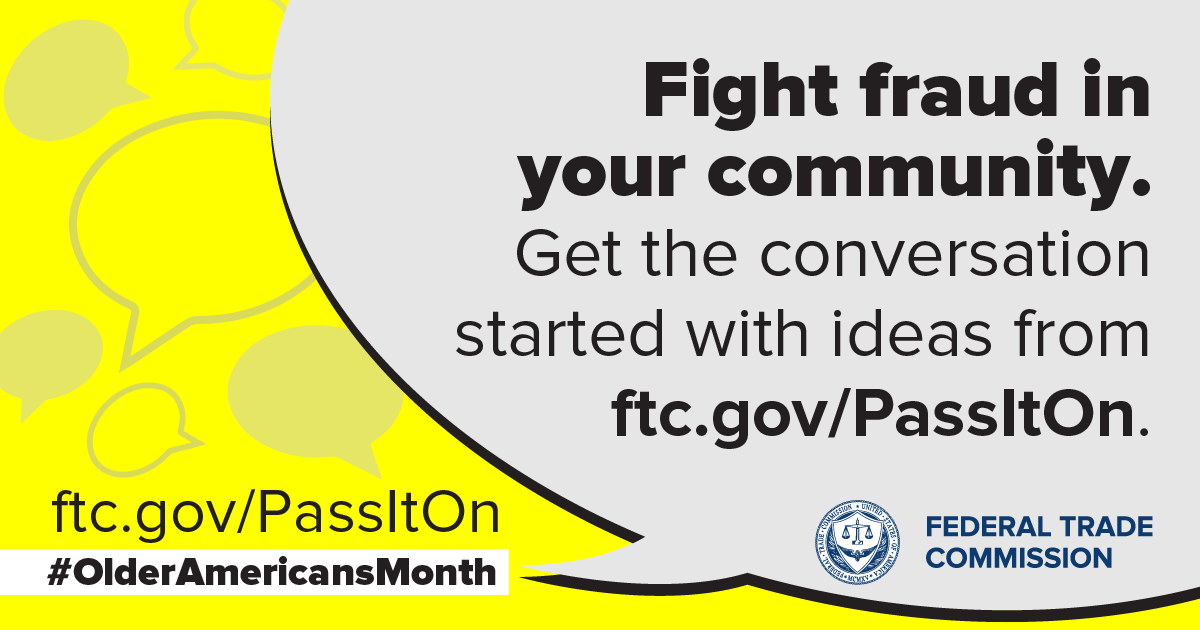 During May, the FTC and federal and state organizations nationwide will celebrate Older Americans Month, with “Communities of Strength” as its theme. The FTC works to protect older adults year round, through law enforcement actions and the Pass It On fraud prevention campaign. Pass It On encourages people to share what they know to protect someone from a fraud, and to be a resource that others can turn to. This week, we’ll share some of what we know through a series of blogs about scams affecting older adults. We hope you’ll share these blogs in your community. You can link, forward, print, or copy all FTC content freely. And if you’re on social media, share this graphic through your network.
The FTC has taken several recent enforcement actions to protect older adults. For example, it’s sued companies that tried to trick people into work-at-home and other moneymaking schemes, bogus credit card interest rate reduction offers, and health claims that aren’t supported by the necessary science. Some of those claims were related to the COVID-19 pandemic.
While scammers are busy, Pass It On gives older adults and the people who work with them tools to fight those frauds. The campaign’s fact sheets explain 13 fraud topics, including grandchild and romance scams, unwanted calls, and work-at-home scams. The campaign leverages the rich experience and accumulated knowledge of older adults, and gives them information they can pass on to family and friends, starting conversations and sharing their expertise.
Thank you for being part of our readers’ community, and for sharing information — whether it’s a way to avoid a scam or your story about an unwanted phone call — to protect the people around you. If you spot a scam, please tell the FTC at ReportFraud.ftc.gov.
Brought to you by Dr. Ware, Microsoft Office 365 Silver Partner, Charleston SC.
by Contributed | May 10, 2021 | Technology
This article is contributed. See the original author and article here.
By Seth Patton, General Manager, Microsoft 365 Next Gen Productivity & Employee Experience
As work evolves rapidly into hybrid work, we need to do more to empower people to feel connected and bring their best self to work. Microsoft Viva, which we announced in February, brings together communications, knowledge, learning, resources, and insights into an integrated employee experience through the Microsoft 365 apps you use every day. Your response to Viva, the first employee experience platform (EXP) built for the digital era, has been overwhelmingly positive. We’re just getting started on this journey and excited to help you learn more about Viva through a new Microsoft Mechanics series.
Watch our Microsoft Mechanics host, Jeremy Chapman (@JeremyChapmanMechanics), introduce Microsoft Viva and explain the underlying technology and core options for enabling and configuring the platform. In upcoming videos from this series, Jeremy will be joined by our Viva engineering leaders to take deep dives into each of the Viva modules as well as how to set up and manage the experiences for your organization.
Here are the highlights from this first overview show in the series.
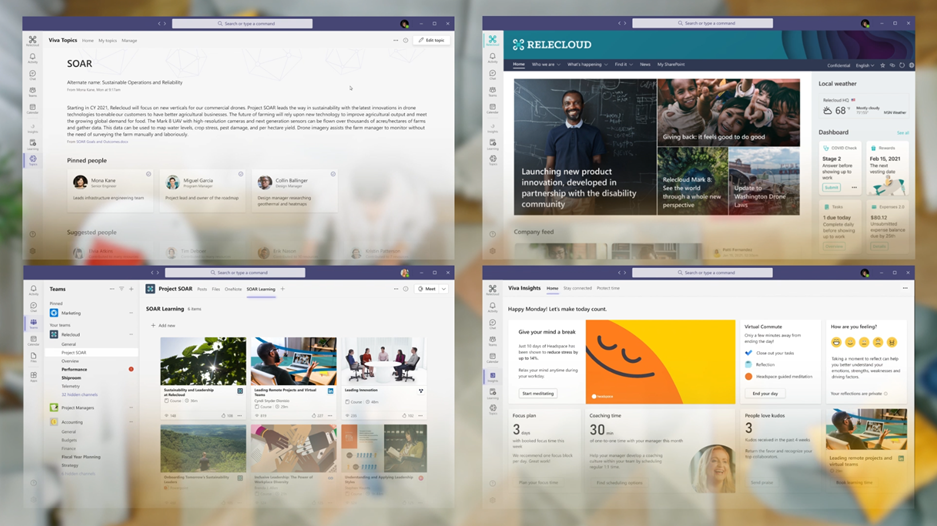
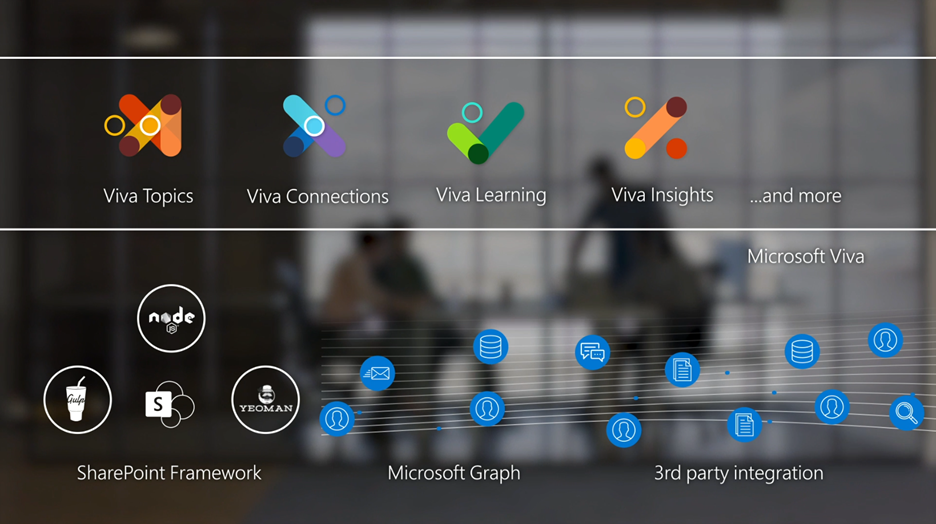
Microsoft Viva modules. Powered by the full breadth and depth of Microsoft 365, Viva is experienced through Microsoft Teams and the other Microsoft 365 apps you use every day. For now, Microsoft Viva includes four modules—Viva Connections, Viva Insights, Viva Learning, and Viva Topics—with more on the way.
- Viva Topics uses AI to automatically organize company-wide content and expertise, making it easy to discover information and put knowledge to work.
- Viva Connections is a gateway for your digital workplace. It provides a curated, company-branded experience that brings together relevant news, conversations, and other resources.
- Viva Learning centralizes your learning resources in Teams to help you quickly discover and share learning content across your organization.
- Viva Insights gives individuals, managers, and leaders personalized and actionable privacy-protected insights to improve productivity and wellbeing.
Differentiated experiences. Microsoft Viva relies on information from groups in Azure Active Directory—like roles, departments, and geographies—to give you a tailored experience, from targeted information in Viva Connections to curated learning courses in Viva Learning. If you’re a Microsoft 365 admin, you can customize those experiences further using granular but intuitive controls, like segmenting Viva Insights details for different roles or assigning knowledge managers in Viva Topics to ensure knowledge topics are accurate and appropriate.
Privacy and security. As you would expect, privacy and security are built into all Microsoft Viva experiences. Any information protection and compliance controls you have configured in Microsoft 365 are respected when you access content. Viva protects employee privacy and fully complies with local regulations, such as the General Data Protection Regulation (GDPR). For example, personal insights in Viva Insights are visible only to the individual, while insights for managers and leaders have built-in aggregation, de-identification, and differential privacy to protect individual privacy.
Platform extensibility. Designed to be an open and extensible platform with a strong and growing ecosystem of partners, Microsoft Viva is easy to integrate with the systems and tools your company already has in place. Integrations with Microsoft 365, Microsoft Power Platform, Microsoft Dynamics 365, and third-party products and services can deliver a complete employee experience in the flow of your everyday work. For example, you can build custom web parts for your home site and topic pages using the SharePoint Framework and you can use adaptive cards for your Viva Connections dashboard to expose specific content and target the right employees with the right resources.
If you’ve read through this blog without watching the video, scroll to the top and check it out. The video has more details about each of the sections in this post. This is Part One of our Microsoft Mechanics video series about Microsoft Viva. Keep visiting this site or aka.ms/VivaMechanics for the rest of the series, where we’ll go in-depth on each of the Viva modules. If you’d like more information on Viva in the meantime, head over to aka.ms/Viva.
As always, we want to hear from you! If you have any suggestions, questions, or comments, please visit us on our Microsoft Viva Tech Community page. We will also be hosting our first Microsoft Viva Ask Microsoft Anything (AMA) event on June 23, 2021. There will be more information on that event soon.
Learn more:
by Contributed | May 10, 2021 | Technology
This article is contributed. See the original author and article here.
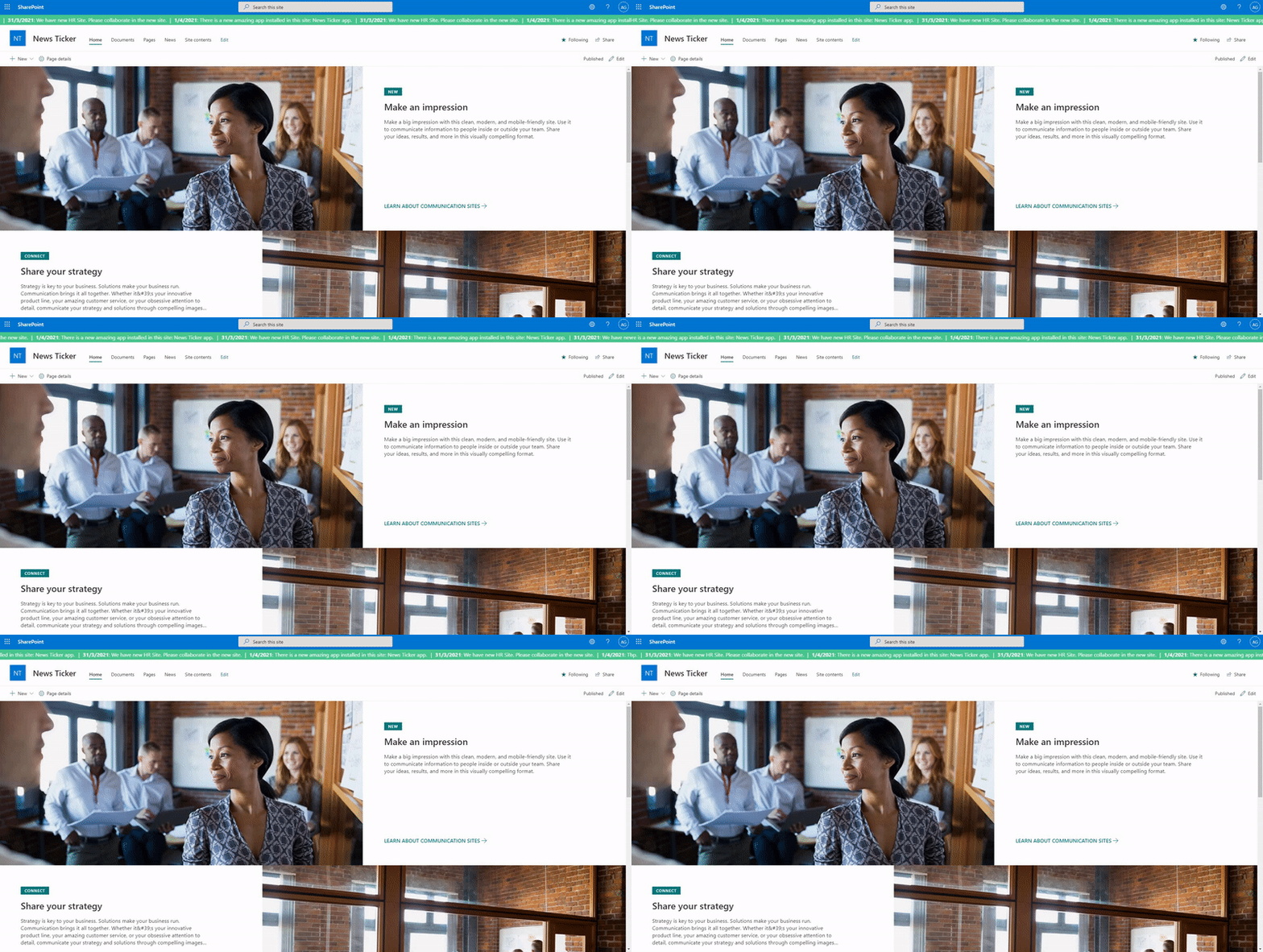
You might be familiar with the running text that shows some breaking news on a news tv channel. I think it would be nice if we have a similar thing on a SharePoint site to show some breaking news to its users so I created the News Ticker app. Basically, the app will show some news from a SharePoint list as a running text at the top of every modern page on the site. Below is how it looks:
News Ticker
Below is the data source:
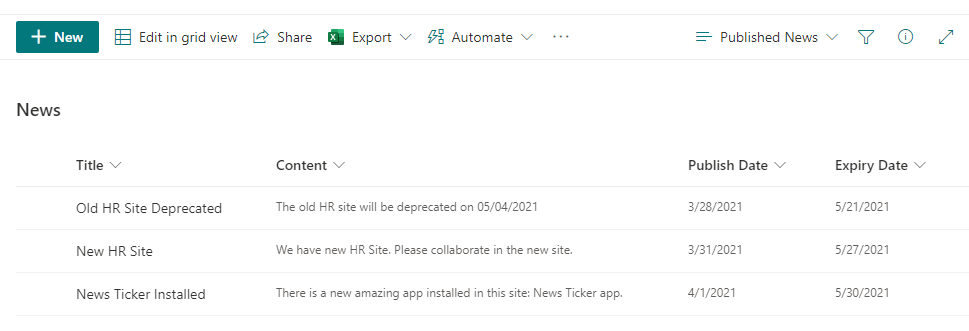 Data Source List
You can find the full source code and how to install it here.
In this article, I will share some key points from the solution code that might be useful for other SPFx projects.
1. Use React component in the SPFx Extension
SPFx extension doesn’t include React component by default but we can easily add it manually.
We just need to render our React component in the placeholder element provided by the SPFx Extension Application Customizer.
You can find my implementation code here.
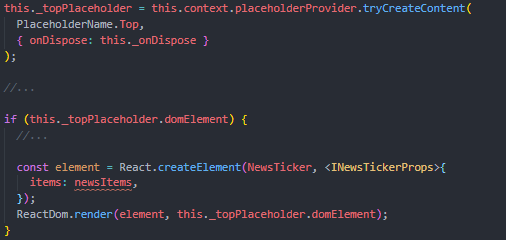 Render React Component
2. Get data from SharePoint list based on View using PnP JS
I’m using SharePoint list as the data source.
In order to make it simple to manage the news, I’m leveraging the list view and getting the data based on the view configuration.
It’s great because we don’t need to build any custom configuration mechanism in our app to configure (sort, filter, top, etc.) the data to be displayed. Just use the OOTB list view configuration.
It’s very easy to get the data based on the list view using the PnP JS. Below is my implementation:
- Get the view information using list.views.getByTitle(…)
- Get list item based on the list view XML using list.getItemsByCAMLQuery(…)
You can find my implementation code here.
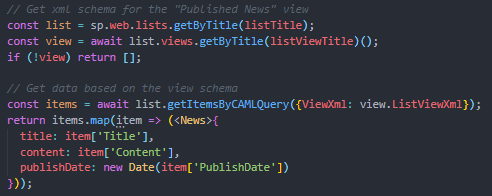 Get Data Based on List View
3. Use React third party component
I’m using an open-source React third party component for the running text component: react-ticker.
It’s easy to add any React third party components to our SPFx project.
You can find my implementation code here.
 Use Third Party Component
Thanks for reading. Hope you find this article useful 
by Contributed | May 10, 2021 | Technology
This article is contributed. See the original author and article here.
Update: Monday, 10 May 2021 12:41 UTC
We continue to investigate issues within Azure Monitor. Some customers continue to experience errors while using various features of Azure Monitor solutions including Azure Log Analytics, Service Map, VM Insights, Log Search Alerts, Scheduled Search Alerts, Application Insights, and Azure Sentinel in multiple regions.
initial findings indicate that the problem began at 05/10 ~10:30 UTC. We currently have no estimate for resolution.
- Work Around: None
- Next Update: Before 05/10 17:00 UTC
-Anmol
Initial Update: Monday, 10 May 2021 11:28 UTC
We are aware of issues within Application Insights and are actively investigating. Some customers may experience data access issues and delayed or missed Log Search Alerts.
- Work Around: None
- Next Update: Before 05/10 13:30 UTC
We are working hard to resolve this issue and apologize for any inconvenience.
-Anmol


Recent Comments