Evaluating AI Agents in Contact Centers: Introducing the Multi-modal Agents Score 

Evaluating AI Agents in Contact Centers: Introducing the Multi-modal Agents Score 

This article is contributed. See the original author and article here.

As self-service becomes the first stop in contact centers, AI agents now define the frontline customer experience. Modern customer interactions span voice, text, and visual channels, where meaning is shaped not only by what is said, but by how it’s said, when it’s said, and the context surrounding it.   

In customer service, this is even more pronounced-customers reaching out for support don’t just convey information. They convey intent, sentiment, urgency, and emotion, often simultaneously across modalities; a pause or interruption on a voice call signals frustration,  blurred document image leads to downstream reasoning failures, and flat or fragmented response erodes trust-even if the answer is correct In our previous blog post, we reflected on the evolution of contact centers from scripted interactions to AI-driven experiences. As contact center landscape continues to change, the way we evaluate AI agents must change with them. Traditional approaches fall short by focusing on isolated metrics or single modalities, rather than the end-to-end customer experience. 

Contact centers struggle to reliably assess whether their AI agents are improving over time or across architectures, channels, and deployments. While cloud services rely on absolute measures like availability, reliability and latency, AI agent evaluation today remains fragmented, relative, and modality specific. What would be useful is an absolute, normalized measure of end-to-end conversational quality- one that reflects how customers actually experience interactions and answers the fundamental question: Is this agent good at handling real customer conversations? 

Introducing the Multimodal Agent Score (MAS) 

MAS is built on the observation that every service interaction- whether human-to-human or human-to-agent- naturally progresses through three fundamental stages: (explored in more detail here: Measuring What Matters: Redefining Excellence for AI Agents in the Contact Center )

  1. Understanding the input – accurately capturing and interpreting what the customer is saying, including intent, context, and signals such as urgency or emotion. 
  1. Reasoning over that input – determining the appropriate actions, managing context across turns, and deciding how to resolve the issue responsibly. 
  1. Responding effectively – delivering clear, natural, and confident resolution in the right tone and format. 

Multimodal Agent Score directly mirrors these stages. It is a weighted composite score (0-100) designed to assess end-to-end AI agent quality across modalities- voice, text, and visual- aligned to how real conversations naturally unfold.  

MAS Dimensions and Parameters 

Conversation Stage  MAS Quality Dimension  What It Measures  Example Parameters
Understanding  Agent Understanding Quality   how well the agent hears and understands the user (e.g., latency, interruptions, speech recognition accuracy)   Intent-determination, Interruption, missed window 
Reasoning  Agent Reasoning Quality  how well the agent interprets intent and resolves the user’s request   Intent-resolution, acknowledgement 
Response  Agent Response Quality  how well the agent responds, including tone, sentiment, and expressiveness    CSAT, Tone stability 

Computing each MAS score:

MAS is computed as a weighted aggregation of three quality dimensions stated in the table above. 
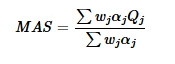
where: 

  • Qj represents one of the three quality dimensions: Agent Understanding Quality (AUQ), Agent Reasoning Quality (ARQ)Agent Response Quality (AReQ)  
  • wj represent the costs or weights of each dimension 
  • αj captures the a priori probability of the respective dimension  

Computing each MAS dimension: 

Computing each MAS dimension (AUQ, ARQ, AReQ) involves aggregating underlying parameters into a single weighted score. Raw measurements (such as interruption, intent determination, or tone stability) are first normalized into a 0–1 score before aggregating them at the dimension level. We apply a linear normalization function clipping each raw measurement at predefined thresholds suitable for the parameter being measured (for example, maximum allowed interruption or minimum required accuracy). This maintains the sensitivity of each parameter in the relevant effective range and avoids the negative impact of measurement outliers, making MAS an absolute measure of agent quality. 

MAS in Practice: Voice Agent Evaluation Example 

To ground MAS in real-world conditions, we evaluated ~2,000 synthetic voice conversations across two agent configurations using identical prompts and scenarios: 

  • Agent-1: Chained voice agent using a three-stage ASR–LLM–TTS pipeline 
  • Agent-2: Real-time voice agent using direct speech-to-speech architecture  

The evaluation dataset included noise, interruptions, accessibility effects, and vocal variability to simulate production environments.  

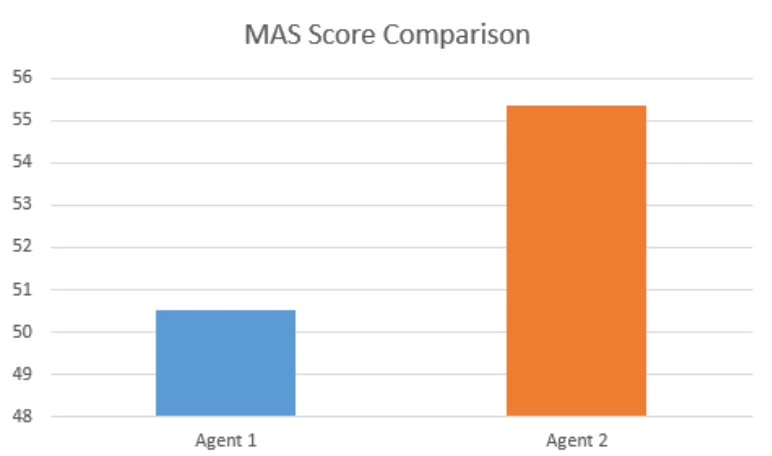
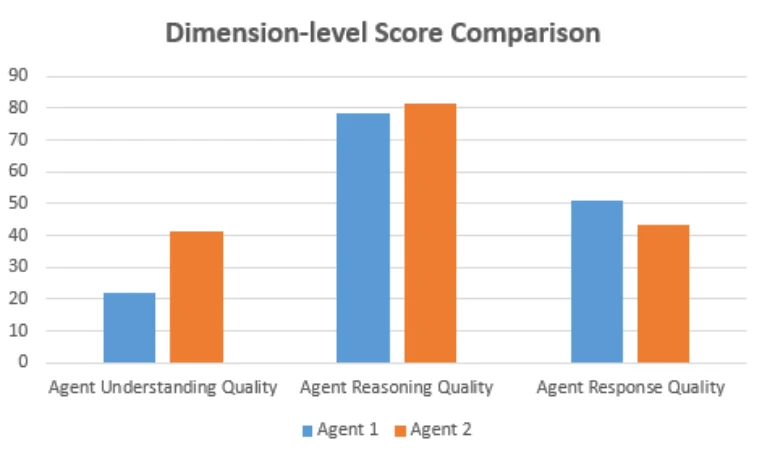
Shown below is a comparison of core MAS metrics, including dimension-level scores and the overall MAS score. 

Voice Evaluation Results (Excerpt) 

Dimension  Parameters   Agent-1  Agent-2 
AUQ  Interruption Rate (%)  0.045  0.025 
AUQ  Missed Response Windows  0.00045  0.0015 
ARQ  Intent Resolution  0.13  0.08 
ARQ  Acknowledgement Quality  0.08  0.10 
AReQ  CSAT  0.128  0.126 
AReQ  Tone stability  0.16  0.14 

Key Observations  

MAS provides flexibility to surface quality insights at an aggregate level, while enabling deeper analysis at the individual parameter level. To better understand performance outliers and anomalous behaviors, we went beyond composite scores and analyzed agent quality at the individual parameter level. This deeper inspection allowed us to attribute observed degradations to specific factors: Example: 

  1. Channel quality matters: Communication channels introduce multiple challenge such as latency, interruptions, compression and loss of information, penalizing recognition and response quality. 
  1. Turn-taking quality is critical: Missed windows and interruptions strongly correlate with abandonment. 
  1. Tone and coherence matter: Cleaner audio and uninterrupted responses lead to higher acknowledgement and perceived empathy. 
  1. MAS reveals root causes: Differences in scores clearly distinguish understandingreasoning, and response failures-something single metrics cannot do. 

Looking Forward 

We will continue to refine and evolve MAS as we validate it against real-world deployments and business outcomes. As the Dynamics 365 Contact Center team, we aim to establish MAS as our quality benchmark for evaluating AI agents across channels. Over time, we also intend to make MAS broadly available, extensible, and pluggable, enabling organizations to adapt it, to evaluate their contact center agents across modalities. For readers interested in the underlying methodology and mathematical foundations, a detailed research paper will be published separately. 

The post Evaluating AI Agents in Contact Centers: Introducing the Multi-modal Agents Score  appeared first on Microsoft Dynamics 365 Blog.

Brought to you by Dr. Ware, Microsoft Office 365 Silver Partner, Charleston SC.
Announcing General Availability of Proactive Voice Enhancements in Dynamics 365 Contact Center 

Announcing General Availability of Proactive Voice Enhancements in Dynamics 365 Contact Center 

This article is contributed. See the original author and article here.

We’re excited to announce the general availability of proactive voice engagements in Dynamics 365 Contact Center, delivering enterprise-grade outbound calling for service scenarios. We want to thank everyone who participated in the preview and shared valuable feedback. This release introduces key capabilities customers asked for during preview, including Answering Machine Detection, SIP based call outcomes, and the predictive dial mode. These will enable organizations to operationalize proactive voice scenarios with greater accuracy, consistency, and reliability. 

Answering Machine Detection (AMD) 

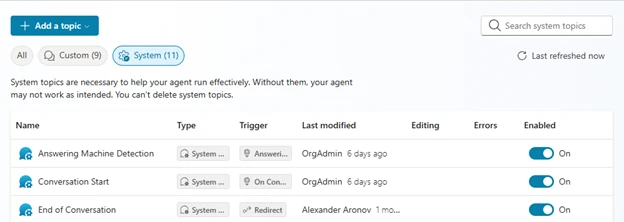
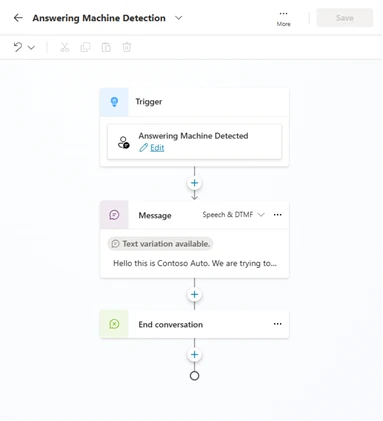
Customers can enable AMD through the answering machine detection system topic in Copilot Studio. When a machine is detected, the system automatically follows the predefined flows, like playing a customized message or ending the call. This improves predictability across outbound engagements by helping teams avoid nonproductive connections.  

SIP Based Call Outcomes 

Proactive engagement now captures detailed call outcomes using SIP codes. This allows every outbound call to be classified with results such as LiveAnswerAnsweringMachineBusyNoAnswerInvalidAddress, and other states. These outcomes are logged automatically and provide clear insight into how each call concluded without requiring additional configuration. This classification supports more accurate reporting and helps teams determine appropriate next steps. 

Predictive Dial Mode for Service Scenarios 

The predictive dial mode places calls ahead of CSR availability by estimating when CSRs will become free. By using metrics like abandonment rate and average wait time, it can pace how quickly calls are initiated. Organizations can begin managing higher volume service operations efficiently by increasing the likelihood a customer connects at the moment an CSR becomes available. This improves both throughput and customer experience.  

What’s Next 

As proactive engagement continues to mature, we are focused on expanding channel coverage and strengthening dialing performance. This will deliver more flexible options for connecting with customers at scale. 

  • Conversational SMS: Support for proactive engagement in SMS channel now in preview. Organizations can reach customers using their preferred medium while maintaining the same routing, outcome tracking, and compliance standards established for voice. 
  • Improvements to preview dialing: Preview dial mode enhancements give representatives more context prior to each call. Reviewing customer details and deciding when to initiate the connection gets simpler.

Learn more about proactive engagement

To learn more, read the documentation: Configure proactive engagement | Microsoft Learn

Try the preview and ensure your organization stays ahead of customer expectations. Send your feedback to pefeedback@microsoft.com.

The post Announcing General Availability of Proactive Voice Enhancements in Dynamics 365 Contact Center  appeared first on Microsoft Dynamics 365 Blog.

Brought to you by Dr. Ware, Microsoft Office 365 Silver Partner, Charleston SC.
Agentic AI for inventory to deliver: From procurement to fulfillment

Agentic AI for inventory to deliver: From procurement to fulfillment

This article is contributed. See the original author and article here.

When customers place an order, they expect speed, accuracy, and reliability. Behind the scenes, inventory-to-deliver processes are what makes that promise possible, helping to ensure the right products are available at the right time to meet customer expectations while controlling costs. For operational professionals, inventory isn’t just a number on a spreadsheet, it’s the lifeline of the supply chain. It determines whether you can fulfill demand without delays, avoid costly stockouts, and keep working capital flowing. From procurement and production to fulfillment and customer satisfaction, inventory-to-deliver impacts every aspect of the supply chain.

In today’s fast-paced market, poor inventory visibility can lead to stockouts, excess holding costs, and missed revenue opportunities. Conversely, a well-orchestrated inventory strategy drives efficiency, reduces waste, and strengthens resilience against disruptions. It enables businesses to optimize working capital, improve cash flow, and deliver on promises consistently. So, how can an agent-ready enterprise resource planning (ERP) platform reinvent the inventory-to-deliver process?

const currentTheme =
localStorage.getItem(‘blogInABoxCurrentTheme’) ||
(window.matchMedia(‘(prefers-color-scheme: dark)’).matches ? ‘dark’ : ‘light’);

// Modify player theme based on localStorage value.
let options = {“autoplay”:false,”hideControls”:null,”language”:”en-us”,”loop”:false,”partnerName”:”cloud-blogs”,”poster”:”https://cdn-dynmedia-1.microsoft.com/is/image/microsoftcorp/ERPprocessAgents_tbmnl_en-us?wid=1280″,”title”:””,”sources”:[{“src”:”https://cdn-dynmedia-1.microsoft.com/is/content/microsoftcorp/ERPprocessAgents-0x1080-6439k”,”type”:”video/mp4″,”quality”:”HQ”},{“src”:”https://cdn-dynmedia-1.microsoft.com/is/content/microsoftcorp/ERPprocessAgents-0x720-3266k”,”type”:”video/mp4″,”quality”:”HD”},{“src”:”https://cdn-dynmedia-1.microsoft.com/is/content/microsoftcorp/ERPprocessAgents-0x540-2160k”,”type”:”video/mp4″,”quality”:”SD”},{“src”:”https://cdn-dynmedia-1.microsoft.com/is/content/microsoftcorp/ERPprocessAgents-0x360-958k”,”type”:”video/mp4″,”quality”:”LO”}]};

if (currentTheme) {
options.playButtonTheme = currentTheme;
}

document.addEventListener(‘DOMContentLoaded’, () => {
ump(“ump-69851fdecd72e”, options);
});

Microsoft Cloud and agent platform enables inventory to deliver transformation

Microsoft Dynamics 365 can transform inventory management from a reactive task into a strategic advantage with an agent-ready foundation that spans across finance, supply chain, sales, and operations for a single source of truth that is both scalable and secure.

This same data foundation enables customers to buy, build, and customize agents to infuse across processes. For a refresher on understanding the agent landscape available today, visit Reinventing business process with AI: Agents in record to report where we explore the difference between first party, third party, and custom agents.

Automate vendor communication with a first party agent from Dynamics 365

The Supplier Communications Agent in Dynamics 365 Supply Chain Management is designed to automate routine procurement communications between purchasing teams and vendors. Traditionally, these interactions—such as following up on purchase orders or confirming changes—are manual, repetitive, and often handled via email, even in organizations using electronic data interchange (EDI). The Supplier Communications Agent can streamline these low-complexity tasks by automating vendor outreach and updates, freeing procurement professionals to focus on strategic activities. This not only seeks to improve efficiency but also reduces overall procurement costs by minimizing time spent on administrative work.

Explore partner agents to support the inventory to deliver process

Model Context Protocol (MCP) servers are configurable bridges between the business data within your line-of-business apps and the partner or custom-built agents you want to use. MCP serves as a universal intermediary, unlocking access to a unified platform and app data, modernizing how AI agents are interoperable with your apps. Let’s explore a few partner-built agents that will help you realize value across your supply chain today.

Warehouse Advisor Agent by MCA Connect

The Warehouse Advisor Agent leverages machine learning and predictive analytics to automate and improve key processes such as slotting, inventory consolidation, and cycle counting. By analyzing real-time data and historical trends, the agent delivers actionable insights that help warehouse teams make smarter, faster decisions.

This solution is ideal for warehouse managers, operations leaders, and supply chain professionals in distribution and manufacturing industries who are looking to reduce inefficiencies, improve inventory accuracy, and increase labor productivity. It integrates seamlessly with Dynamics 365’s Warehouse Management System (WMS), enabling users to deploy intelligent automation without disrupting existing workflows.

Inventory Acquisition and Re‑Balancing Agent from RSM

The Inventory Acquisition and Re‑Balancing Agent from RSM enables smarter inventory decisions by analyzing demand signals, supply availability, and stock imbalances in Dynamics 365. The agent can recommend rebalancing and acquisition actions to reduce stockouts, minimize excess inventory, and improve working capital efficiency.

Inbound Load Agent from Fellowmind

Fellowmind’s Inbound Load Agent can streamline inbound logistics by intelligently composing and optimizing loads based on demand, capacity, and operational constraints within Dynamics 365. The agent seeks to help logistics teams reduce transportation costs, improve warehouse utilization, and simplify complex inbound planning decisions.

Get started with agents for inventory-to-deliver processes

The Microsoft platform brings together secure, scalable cloud services with Dynamics 365’s unified ERP capabilities to streamline the entire inventory-to-delivery process. By leveraging real-time data and intelligent workflows, businesses gain supply chain agility to better meet customer expectations with precision. Partner-built agents, powered by MCP, amplify this value, enabling autonomous actions and predictive insights that transform operations from reactive to proactive. Together, these innovations create a resilient, future-ready foundation for delivering efficiency and growth at scale.

The post Agentic AI for inventory to deliver: From procurement to fulfillment appeared first on Microsoft Dynamics 365 Blog.

Brought to you by Dr. Ware, Microsoft Office 365 Silver Partner, Charleston SC.