This article is contributed. See the original author and article here.
Google has released Chrome version 103.0.5060.53 for Windows, Mac, and Linux. This version addresses vulnerabilities that an attacker could exploit to take control of an affected system.
CISA encourages users and administrators to review the Chrome Release Note and apply the necessary update.
This article is contributed. See the original author and article here.
Edge computing gives customers the ability to move cloud-like workloads out of the data center to the very places where data is collected—delivering real-time intelligence, and solving intermittent connectivity issues. Yet as the number of devices making up IoT increases, so do the IoT security risks that companies must address.
A recent study conducted by Microsoft in partnership with Ponemon Institute included a survey of companies that have adopted IoT solutions and 65% of them mentioned that security is a top priority when implementing IoT. Attacks targeting IoT devices put businesses at risk. Impacted devices can be bricked, held for ransom, employed as launch points for further network attacks, or used for malicious purposes. Among many consequences we often see stolen IP and data theft, and compromised regulatory status, all of which can have brand and financial implications on the business.
In keeping with the Microsoft end-to-end security promise and our belief that every IoT device should be secured by design, we are excited to announce General Availability of our Edge Secured-core program for Windows IoT devices. Below, we’ll share how Edge Secured-core addresses vulnerabilities and helps enterprise customers, device manufacturers, and solution builders accelerate the development and deployment of secure, scalable IoT solutions.
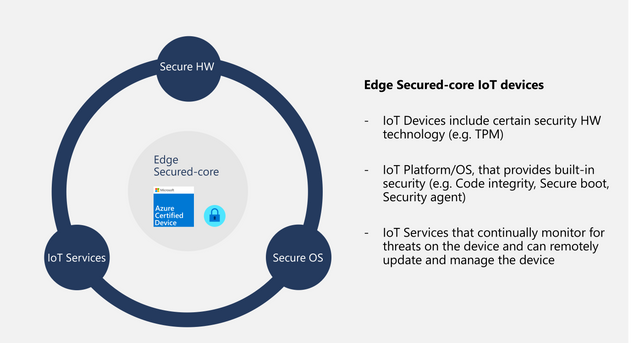
Edge Secured-core is a new certification in the Azure Certified Device program for IoT devices running a full operating system such as Linux (in preview) or Windows 10 IoT (available now). Edge Secured-core certified devices meet additional security requirements around device identity, secure boot, operating system hardening, device updates, data protection, and vulnerability disclosures. All of this is designed to help prevent attacks, protect your data, and defend against those attempting to infiltrate your infrastructure.
Building on the expertise Microsoft developed around Secured-core for commercial Windows 10 PCs, Edge Secured-core takes a similar approach for IoT devices. This certification can be used to validate that certified devices include specific security hardware technology, have an operating system with built-in security, and use IoT services such as Microsoft Defender for IoT that continually monitor for threats on the device.
For companies building devices, Edge Secured-core provides a low-cost differentiator that enables customers to easily identify your device that has been configured to meet a higher security standard.
Edge Secured-core drives scalable security
Through the use of Edge Secured-core, companies can trust that IoT devices are built with a foundation of security and can be deployed seamlessly and securely. It also provides enterprises and solution builders with the confidence that the devices they’re purchasing deliver the following security promises:
Hardware-based device identity
Capable of enforcing system integrity
Stays up to date and is remotely manageable
Provides data-at-rest protection
Provides data-in-transit protection
Built-in security agent and hardening
Here are a few specific scenarios where you can see the added value for Edge Secured-core devices compared to devices without it.
Scenario
Device without Edge Secured-core
Edge Secured-core device
Six months after purchasing the device, there’s a vulnerability. The device receives an update and the vulnerability is fixed.
At the discretion of the OEM to supply device updates.
OEMs required to supply device updates for a period of at least 60 months from the date of submission.
A malicious actor attempts to identify vulnerable devices to install malware on.
At the discretion of the OEM to supply device updates and OT to keep device secure.
This article is contributed. See the original author and article here.
We understand that for chief marketing officers (CMOs) everywhere, it feels like a precarious time to be a marketer. COVID-19 has upended supply chains and inflation spikes have accelerated a wave of digital transformation across all aspects of business. Additionally, culture is politically polarized, forcing brands to take a stand or risk alienating customers.
Disruptions to customer engagement are adding similar instability. Customer interactions across digital channels are dramatically increasing at the very same time that marketers’ ability to track and understand those interactions is rapidly decreasing.
This is creating the Marketer’s Dilemma, urging marketers to navigate the trade-offs between optimizing individual channels and investing in cohesive end-to-end customer experiences.
The problem: The digital marketing ecosystem has become less reliable
Although the term “omnichannel” marketing has been trending for more than a decade, marketing channels remain largely siloed operations. Discrete platform partners have offered marketers powerful reach and valuable services spanning adtech, search, social media, and e-commerce. Individually, each has been invaluable in enabling marketers to manage campaigns, engage customers, and track results, especially for companies that lack sophisticated in-house data and the analytical know-how. But partnerships that once offered exciting opportunities are evolving into potential vulnerabilities:
“The services that these advertising platforms provide have been particularly advantageous for less technically advanced companies that may lack the in-house data (an organization’s first-party data and/or operational data) and analytical know-how to conduct independent analyses. On the other hand, they curb the relative advantage of more sophisticated companies who may be limited in the tools and analytical techniques they can use on these platforms. This can disincentivize innovation and concentrate overall ecosystem innovation within the data platforms themselves.”1
Meanwhile, customer demand for greater privacy, transparency, and control of their data, along with the pressure of regulatory compliance, is disrupting marketers’ access to granular customer data to generate relevant insights.
Browser cookies, which once offered the ability to track users and “sidle right up to the creepy line”2 will deprecate in 2023, forcing marketers to pivot to a cookieless future even as consumers live more of their lives online.
Simply put, an over reliance on third-party relationships is putting marketers at risk of losing access to the customer data that their very survival depends on.
Marketers struggle to overcome learned helplessness
Customers expect brands to deliver digital experiences that are personalized, relevant, and consistent across touch points,3 and we can no longer afford to outsource customer relationships to third parties.
The lack of interoperability between platforms, datasets, and views of the customer makes it very challenging for marketers to reclaim ownership of their customer relationships and responsibility for orchestrating consistent experiences across journeys. Advertising platforms are effectively walled gardens and have grown so powerful due to network effects that marketers are effectively locked in. This combination of powerful but limiting capabilities encourages a dependence that leads to a sense of helplessness in marketing teams.
“The current marketing ecosystem is characterized by the concentration of significant first-party user data in a handful of advertising platforms. The data shared with marketers is carefully limited, in part to preserve data privacy. A consequence of this, however, has been that innovation has been constrained to the capacity and capabilities of these advertising platforms.“1
Tasked with delivering short-term key performance indicators (KPIs), teams are incentivized to focus on what they control: leveraging investments with current vendors, maximizing performance of individual channels, and unknowingly perpetuating a cycle that all but ensures a fragmented ecosystem.
Taking ownership of customer relationships and overcoming this dilemma is essential for long-term growth.
The solution
Marketers cannot risk falling short of current goals, nor can they continue to depend on an ecosystem of unreliable third parties and walled gardens. While it won’t be easy, marketers must build the business case, right fit the talent, and execute a strategy to establish data autonomy.
Data autonomy gives organizations the power to own customer relationships, understand customer needs, manage customer experiences, and create raving fans at the scope and scale necessary to succeed in an era where nearly all of business has been digitized.
Data ownership is the key that unlocks the Marketer’s Dilemma. And there are four questions that every marketer must address on the road to data autonomy.
1. Who truly owns your customer relationships?
Direct customer relationships should be a top imperative for every marketer. There is no perfect solution, even for large enterprises, but owning your customer relationships is critical; the value of controlling your own data cannot be understated.
Customer activity online generates enormous amounts of data, which also turns out to be an organization’s most valuable asset. As marketing leaders, how do we gain control and leverage our customer data to manage successful customer relationships? There are three steps worth considering:
Start with the data you currently own or will purchase and leverage solutions like customer data platforms (CDPs) to aggregate and analyze customer data.
“In an ideal world, you want to track the customer decision journey at the individual level, but even at an audience level it can be impactful. We are trying to build that, but a big chunk of our digital advertising goes through walled gardens. We are hoping that a CDP can help provide us with our first-party data and will be able to link with walled gardens.”Marketing Vice President, CPG Company.1
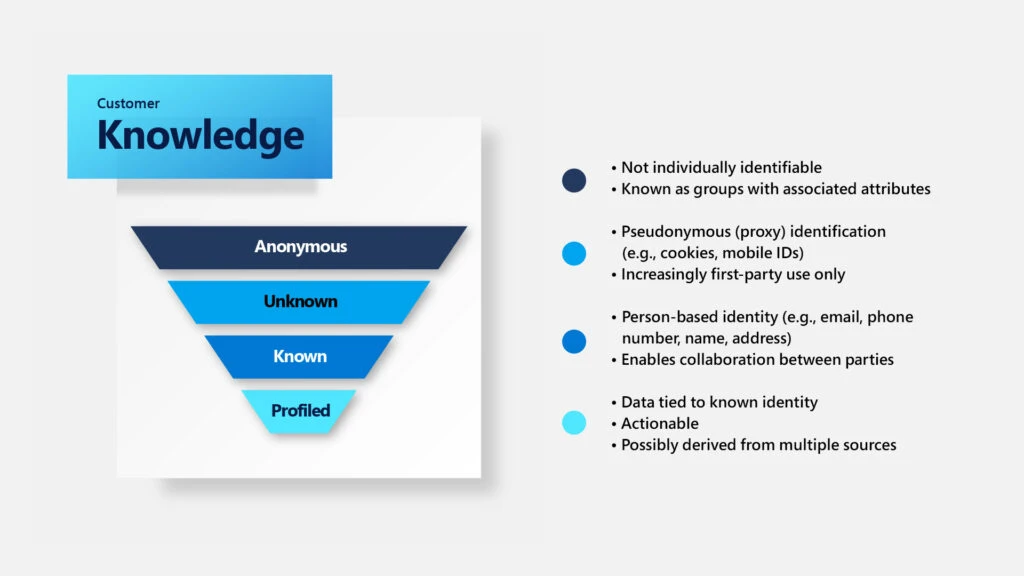
Next, take steps necessary to build your customer knowledge graph. This will entail reframing your thinking from marketing funnel to customer pyramid and establishing goals that move audiences from unknown, to known, to well understood, as you increase your level of first-party data.
Finally, employ AI to accelerate new insight and learning capacity. With the world segregated between the data-rich and the data-starvedAI-haves and AI-have-notsthe companies who are left out or cut off from the data access will likely be disrupted into oblivion.
2. Are you diversifying your portfolio?
Investments with platforms may have generated outsize returns over the past decade, but companies can no longer afford to risk relying on a small number of walled gardens. Just as disciplined investors diversify financial portfolios, so too must marketers act as disciplined data investors, diversifying their data portfolio to manage risk while balancing returns.
In practice, this will require companies to make decisions that feel riskier in the short term, while increasing the probability of success over the long term. Much as characteristics like agility and resiliency seem wasteful right up until the moment they are needed, as will a portfolio with a wider variety of players seem inefficient until the moment that adaptability, responsiveness, and self-determination prove critical.
3. Can you activate customer knowledge across all relevant channels and touch points?
Most enterprise data remains scattered across silos. As you take ownership of data relationships and diversify your portfolio, it is imperative to connect your customer knowledge graph to and from all sales, service, commerce, and marketing channels.
Internally, this means building bridges across organizational functions and acting as a kind of “customer engagement champion,” taking on responsibility for customer experience management spanning organizational divides. Externally, this means partnering with open platforms that enhance customer knowledge and are committed to the open web. To drive personalization and AI-led interactions at each moment of the customer journey, it is important to access and manage your data in open, interoperable systems.
4. Have you redesigned how you build brands?
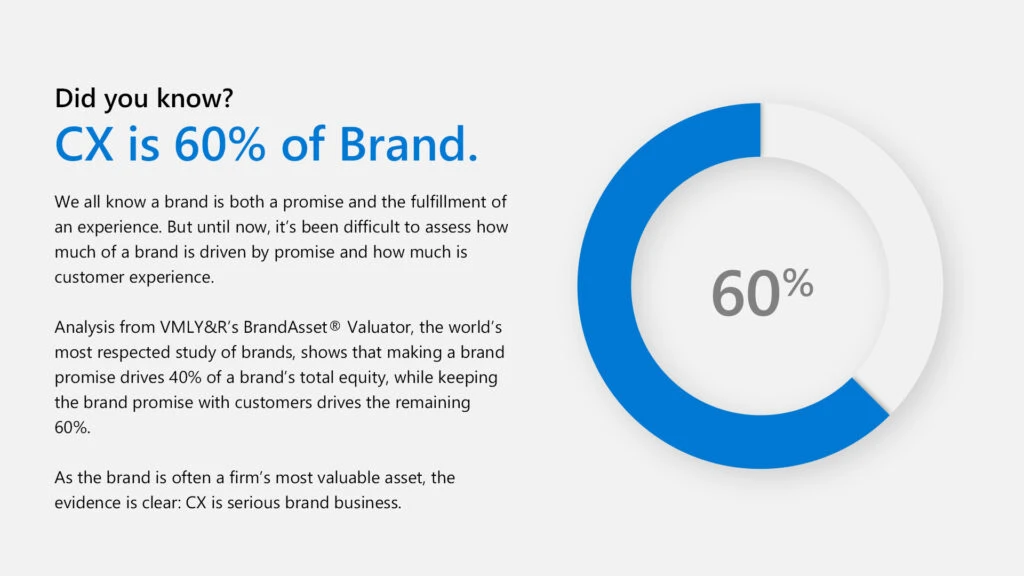
Marketers of the past could be brand-centered and idea-obsessed, but marketers of today must learn to be human-centered and experience-obsessed.
It seems deceptively simple, but the shift from “brand drives the experience” to “experience drives the brand” upends the decades of history, tradition, and superstition that make up the unwritten rules of marketing.
Cultivating lasting relationships will require an evolved set of written and unwritten rules. Marketers should aim for a virtuous cycle between customers and brands. Great experiences facilitate a fair exchange of data. Data enables deeper insight and greater personalization to improve the experience. Improved experiences facilitate greater trust and a larger exchange of data. Distinctively helpful experiences build uniquely beloved brands. In a world where customer relationships operate through personalization, automation, and journey orchestration, data-starved companies run the risk of losing to the competition.
Summary
The responsibility of today’s CMO is no enviable task. Against the backdrop of shifting customer behavior, shrinking job tenure, and a fracturing ecosystem of media and technology partners, marketers often feel they are locked into an impossible dilemma.
Data autonomy is the key to unlocking this dilemma and paving the way forward to a more proactive and empowered future. By establishing agency over customer data, marketers can better understand customers, participate in deeper customer relationships, and build capabilities to innovate across the journey.
Data autonomy is poised to become a make-or-break achievement for marketers to succeed in the experience era. Marketers can no longer afford to risk relying on a small number of walled gardens, even if the benefits to date have been large. When experience drives the larger share of brand, it’s time to prioritize deep customer relationships.
This article is contributed. See the original author and article here.
Education Insights aims to facilitate data-driven decisions, as we believe that data-informed educators and education leaders make the most significant impact in their schools. As an education professional, supporting students’ learning journeys while protecting their wellbeing is what you do. We’re here to help you identify needs and provide support from an informed perspective. We also highly value individual and organizational privacy and are committed to defending and protecting privacy for every student.
For those reasons, we provide Education Insights with attention to maintaining the highest external compliance standards, meeting GDPR, FERPA and other industry standards, as well as our own rigorous ethical and responsibility standards as established by Microsoft principles for Responsible AI.
In this blog, we will review some of the guidelines and practices Education Insights uses to help you leverage data to support your students, while maintaining peace of mind regarding your students’ data privacy and security. Additionally, we will provide some suggestions for to how to communicate Education Insights to your school community.
Guidelines and practices
1. High compliance standards
The information collected and shown through Insights meets national, regional, and industry-specific regulations for data collection and use, including GDPR and the Family Education Rights and Privacy Act (FERPA) for students and children’s security.
2. Students learning data only
Students’ digital activity data collected by Insights includes only their activity in the context of the class and of the learning journey, such as accessing learning materials, participating in meetings, uploading a resume, etc. We do not collect information about students’ private activities such as message content or working on personal files. We also respect educators’ privacy, hence no activity data from educators is displayed
3. Supportive and non-judgmental language
We believe that educators know their students best and are well positioned to make decisions about supporting their students. Education Insights doesn’t make judgements about students or educators. It aims to shine a light on student learning and digital engagement trends by providing meaningful activity data, leaving it up to the educator to follow up with students and to adapt instruction as they see fit.
4. Data access only for those who need it
To preserve students’ privacy, each person in the school community has access only to data relevant to them:
Educators can only see the activity of students assigned to their classes. They cannot access data from other classes unless a collaborating educator has shared it with them.
Education leaders get an organizational view of their students’ activity that depends on their role, organization affiliation, and the permissions assigned to them by the IT Admin.
Education Insights data belongs to the school or institution. Microsoft simply collects the data, analyzes, and stores it. Microsoft engineering does not have direct access to student data and all access is strictly controlled, logged and audited, you can learn more about it here.
5. Transparency for everyone
We are transparent in the data that is collected and how we use it. Each individual student also has a dedicated support page with authenticated access allowing them to see activity signals collected on them, along with instructions on how to contest the activity signals with their educators. Additionally, the IT admin can choose not to collect activity signals at any time; in which case Insights will not be available for the institution.
Communicating Education Insights to guardians and students
While data is critical to thoroughly support students, and while Education Insights provides data with high standards of ethical use, privacy, and security, we also understand that it is vital to communicate clearly to students and guardians the collection of data and the value it provides.
Here is a suggested baseline for communication in case it would be helpful to start a positive conversation with guardians and students. You can also share this blog for further details and links to resources :)
“Our priority as a school/district is always our students, and we aspire to equip them with the skills they need for success in school and beyond. Even before digital teaching practices were expedited by the outbreak of COVID-19, we knew that technology would make up a large part of lifelong learning.
Now, with students spending more educational time on digital platforms, our organization collects their digital activity in Microsoft Teams to support educators in adapting and supporting students’ learning and wellbeing in this changing environment. Data collected includes digital engagement, assignments status and grades, and their self-reflection of their wellbeing at school.
Any data collected is only in the context of the learning activity, non-learning activity data is not being collected. The data is shared only with the people that need it to best support the student, and with the intention of providing each student with the best educational possibilities for them and helping them thrive in school and life.
Students’ data is being collected, stored, and presented in a responsible manner, rigorously following and meets applicable national, regional, and industry-specific regulations for data collection and use, including GDPR and the Family Education Rights and Privacy Act (FERPA) .”
Some technical details for you
For those of you who are interested in some of the “backbone” of how Insights data is collected and stored:
Where do we store the ? Insights is deployed in Europe and the United States. Data for European-based users is stored on servers in Europe. Data for Australian-based and US-based users is stored on servers in the United States. Data for users outside of Europe, Australia, or the United States, will be stored in one of our geographic regions.
do we handle large volumes of data with high reliability? Insights leverages the power of Azure to ingest, process and store large amounts of signals in near-real time and with high reliability. All this is implemented on top of M365 secure environments. Each of these resources is provisioned in multiple geographical locations to honor the data locality explained above. Insights has a rich monitoring and alerting system which helps us track and mitigate potential data lost in the pipeline.
Learning more about data privacy in Education Insights
We’re always looking for ways to make Education Insights better. Have questions, comments, or ideas? Let us know! Add your ideas here or share your comment below.








Recent Comments