This article is contributed. See the original author and article here.
Final Update: Tuesday, 07 June 2022 17:22 UTC
We’ve confirmed that all systems are back to normal with no customer impact as of 6/7, 15:55 UTC. Our logs show the incident started on 6/7, 14:00 UTC and that during the 2 hours that it took to resolve the issue 100% of customers in Australia Central region would have experienced data latency and/or data loss while publishing logs to their workspace
Root Cause: The failure was due to change that got deployed and was rolled back
Incident Timeline: 1 Hour & 55 minutes – 6/7, 14:00 UTC through 6/7, 15:55 UTC
We understand that customers rely on Azure Log Analytics as a critical service and apologize for any impact this incident caused.
This article is contributed. See the original author and article here.
Knowing how your sales organization engages with your B2B customers can help you spot changes in communication patterns and understand the state of your accounts and how your organization interacts with them. Microsoft Dynamics 365 Customer Insights brings together transactional, behavioral, and demographic data, Microsoft proprietary audience intelligence, and third-party resources to create enriched, multidimensional profiles for both individual consumers (B2C) and business accounts (B2B). Data enrichment using aggregated email and meeting insights from Microsoft 365 offers even more information to help you engage with your customers more effectively.
The value of data enrichment for engagement
There are endless ways to use customer engagement insights. For B2B environments, information about organizations or companies and their related contacts can be used on its own or combined with other business data previously ingested into Dynamics 365 Customer Insights. For example, you can create a segment of accounts that have not had any meetings or emails with your organization in the last 60 days. Engage and reactivate those stale accounts using a customer journey orchestration platform like Dynamics 365 Marketing.
Here is another example, one of our favorites. You can create a measure defined as the ratio between the combined time your sales team spends in meetings with an account and the anticipated revenue from the account. Use that measure to easily identify accounts that have the largest mismatch between effort and revenue. With that insight, you can make informed choices about how much time your organization spends with those accounts.
How to enrich your account profiles with engagement data
Next, set up your enrichment options to use data from Microsoft Office 365:
Select the email addresses for which Office 365 data will be aggregated.
Review and consent to use your organization’s aggregated data in Customer Insights data enrichment.
Run the enrichment process, or let the system run the enrichment automatically as part of a scheduled refresh.
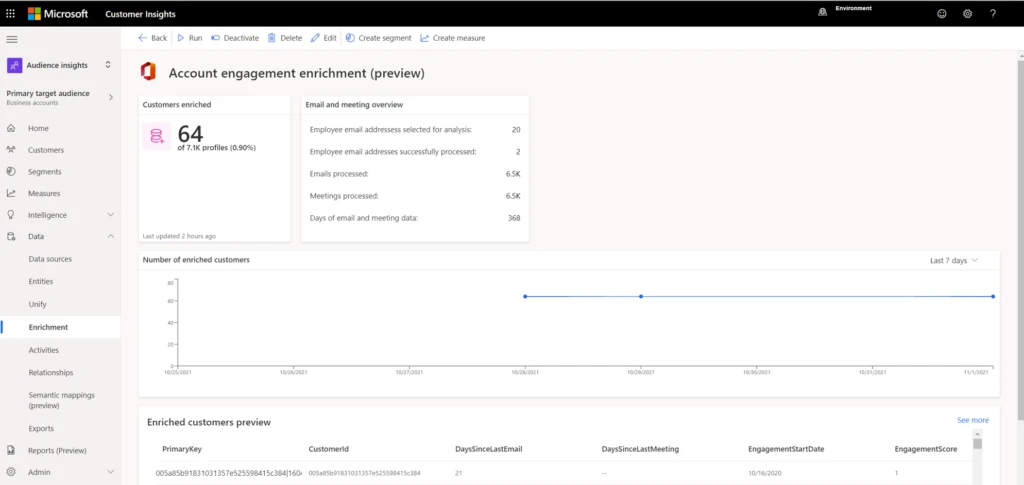
After the enrichment has finished, you can view the results, including the number of enriched customers and the number of processed emails and meetings:
All data is aggregated at the account level. A system-calculated engagement score of 0 to 100 is assigned to every account. The engagement score captures the engagement your organization has with this account relative to all your other accounts.
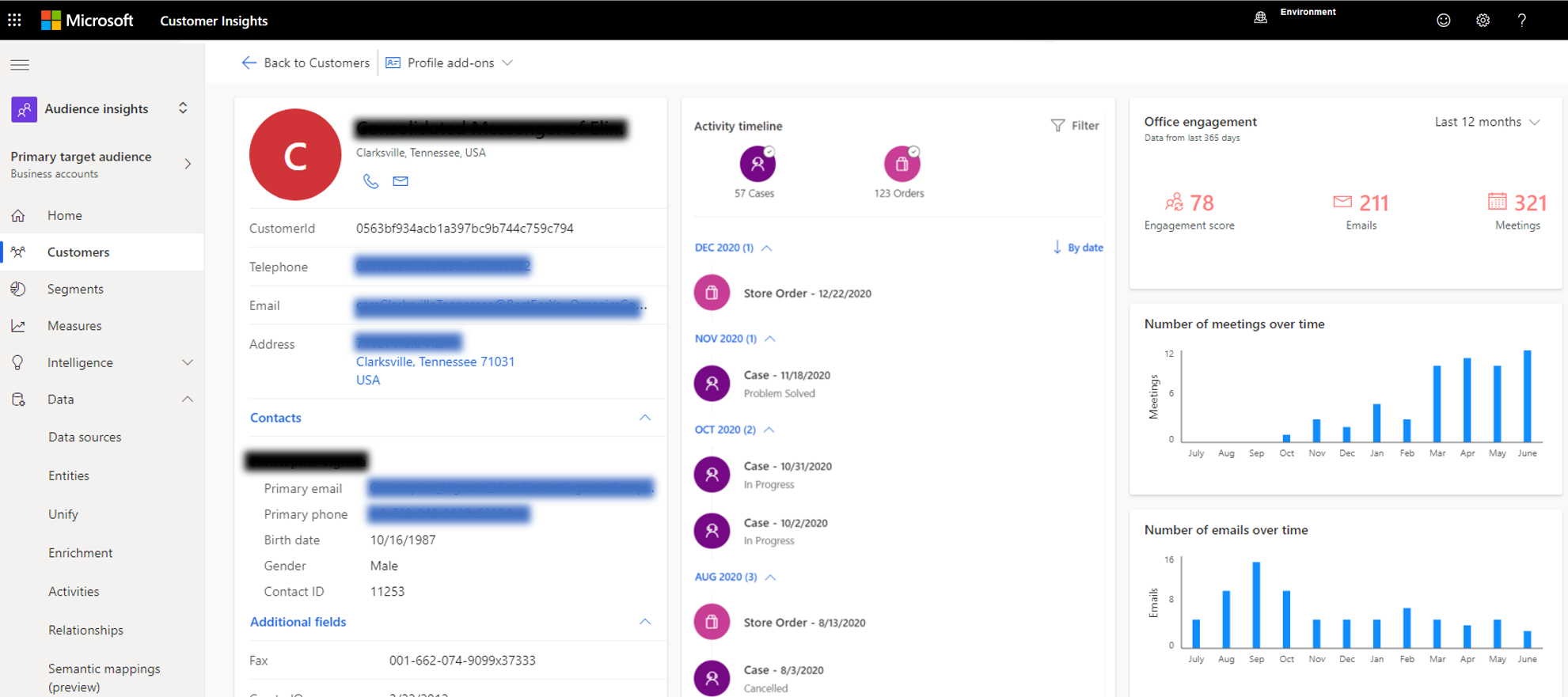
You can view account engagement, including the engagement score, on the individual customer cards. Also shown are the total number of emails and meetings over the past year, along with charts that show the email and meeting history. These views make it easy to spot any changes in communication patterns over time:
Data enrichment captures more than 15 data points, including the average duration of meetings, the number of people associated with the account who attended the meetings, and the number of days since the last email and the last meeting. Check out the documentation for the full list of aggregated data that account enrichment provides.
Next steps
Learn how your company can gain the most comprehensive view of your customers by visiting Dynamics 365 Customer Insights.
This article is contributed. See the original author and article here.
Owl Labs has released security updates to address a vulnerability (CVE-2022-31460) in Meeting Owl Pro and Whiteboard Owl. An attacker could exploit this vulnerability to obtain sensitive information.
CISA encourages users and administrators to review the Owl Labs security advisories for Meeting Owl Pro and Whiteboard Owl and update to Version 5.4.1.4.
This article is contributed. See the original author and article here.
Within hybrid work, organizations have been forced to adapt and reimagine how people will communicate and collaborate. Even with Microsoft Teams providing innovative solutions to hybrid work challenges, employees can often work with organizations outside of their own and occasionally need to join meetings from third-party meeting providers.
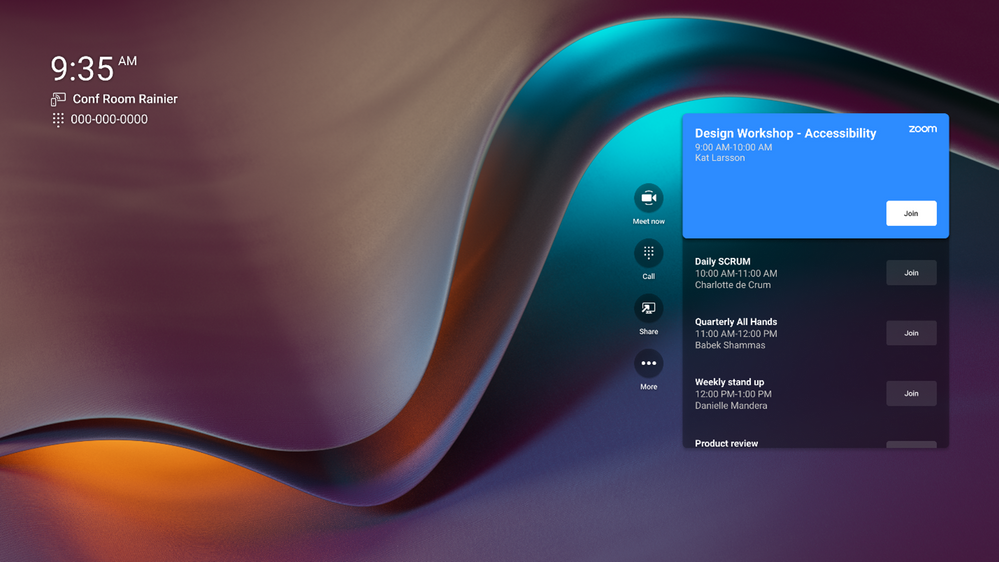
Today, Teams Rooms on Android offers Direct Guest Join, a one-touch experience that allows users to join a third-party online meeting from their Teams Rooms just as easily as they can join meetings hosted in Teams. This experience helps reduce friction when users are joining calls from external partners or clients who may not use the same meeting provider.
Teams Rooms on Android will initially offer interoperability with Zoom meetings, while Cisco Webex and other third-party partners are coming soon to the Android platform. This experience began to rollout on May 25 for Poly Teams certified devices, with Logitech and Yealink fast following, and additional device manufactures coming soon.
Under the hood Microsoft partnered with Zoom, Cisco, GoToMeeting, and BlueJeans to create an interoperability experience with Direct Guest Join. Third-party providers like Zoom provide an embedded web experience that temporarily allows Teams Rooms users to join third-party meetings and collaborate more freely. This web experience provides up-to-date software as well as enterprise-grade privacy and security. As this partnership grows, Direct Guest Join will continue to improve with new and exciting functionalities.
To learn more about the future of Rooms and its interoperability experience, be on the lookout for a joint webcast between Microsoft and Zoom, with Ilya Bukshteyn, VP of Teams Calling and Devices, and Jeff Smith, Head of Zoom Rooms and Whiteboard.


Recent Comments