Donate safely this Giving Tuesday

Donate safely this Giving Tuesday

This article was originally posted by the FTC. See the original article here.

Giving Tuesday is a great time to show your gratitude by donating to help others. But you don’t want to give money to a fake charity or scammer (any day of the week).

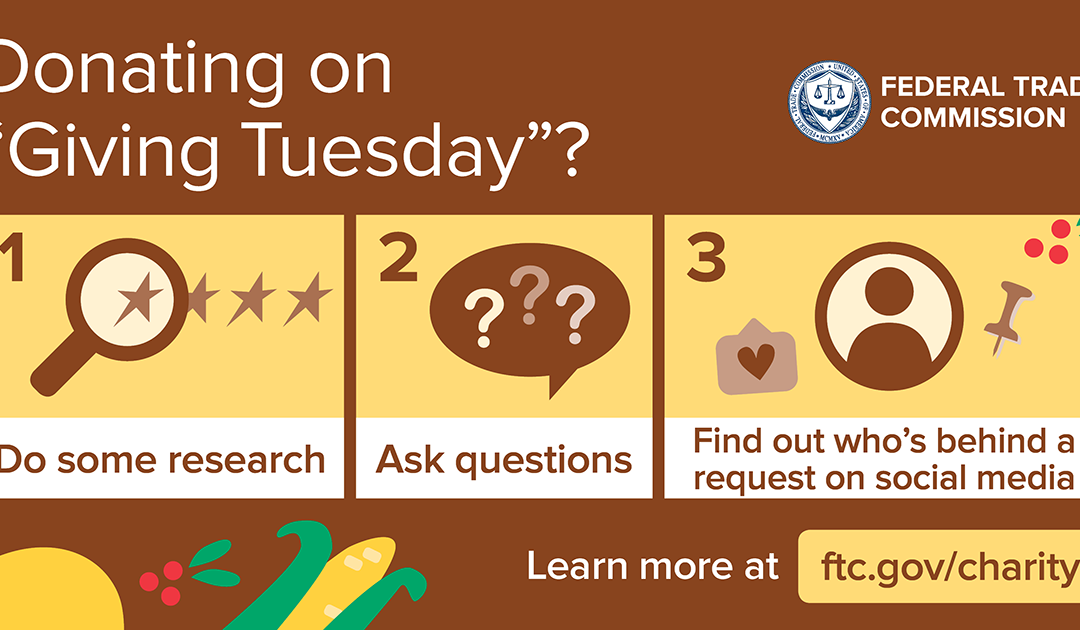
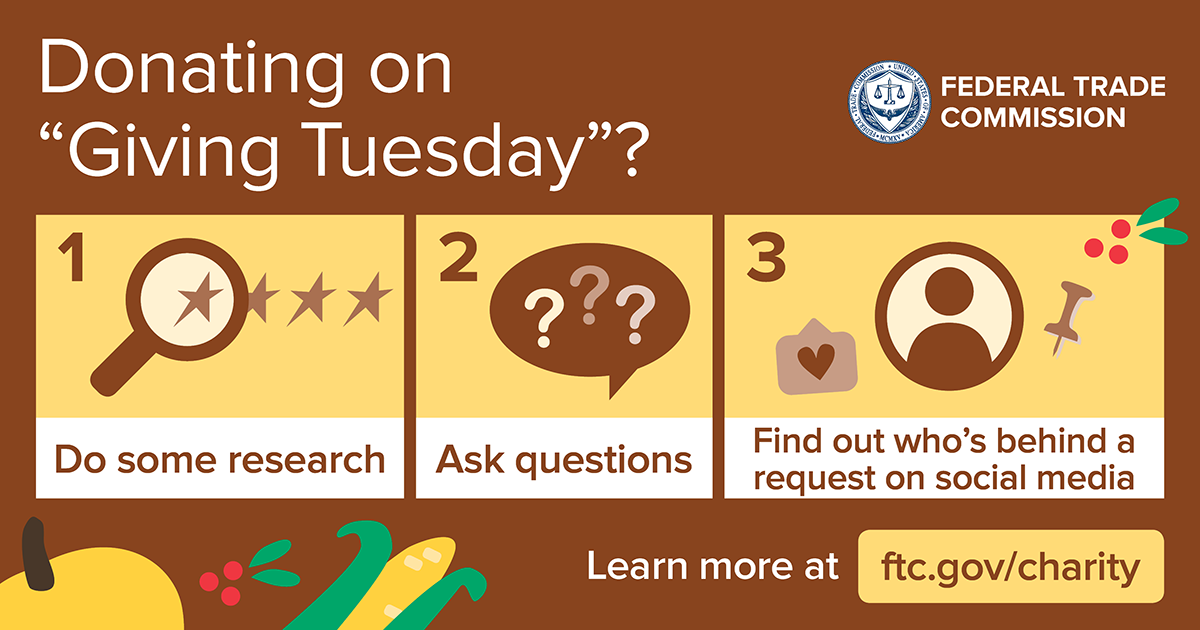
Before you donate this Giving Tuesday ― and anytime you’re asked to give to charity:

  • Research the cause or the organization. Search online for the name of the organization or cause with words like “review,” “scam,” or “complaint.” See if others have had good or bad experiences with the charity. Check out what charity watchdog groups say about that organization.
  • Know that it’s ok to ask questions. If the request for a donation is over the phone, the caller should be able to answer critical questions. For example, how much of your donation will go to the program you want to help? Is the caller raising funds for a charity or for a Political Action Committee (PAC)? (Donations to PACs are NOT tax deductible.)
  • Slow down. You don’t have to give over the phone, and anybody who pressures you might be someone you want to avoid giving to.
  • Know who’s making the request. Don’t assume a request to donate is legitimate because a friend posted it on social media. Your friend might not personally know the charity or how it spends money. When you do your own research, double-check the exact name of the organization. Scammers will pick names or use website addresses that sound very similar to legitimate well-known charities.

This Giving Tuesday, and in this season of giving, consider starting with a plan for year-end donations. That way, you have time to do research, make your gifts, and tell anyone who asks that you’ve already given. Learn more at ftc.gov/charity.

Brought to you by Dr. Ware, Microsoft Office 365 Silver Partner, Charleston SC.

Evaluation Lab: Expanded OS support & Atomic Red Team simulations

Evaluation Lab: Expanded OS support & Atomic Red Team simulations

This article is contributed. See the original author and article here.

Microsoft Defender for Endpoint’s Evaluation Lab is an environment that allows security teams to seamlessly test their defense against threats. We are excited to share that the Evaluation Lab now supports adding Windows 11, Windows Server 2016, and Linux devices. In addition, we’d also like to announce a new partnership with Red Canary’s open-source simulation library, Atomic Red Team! 


NOTE: Both updates are only available in the Microsoft 365 Defender portal at security.microsoft.com.


Expanded OS support


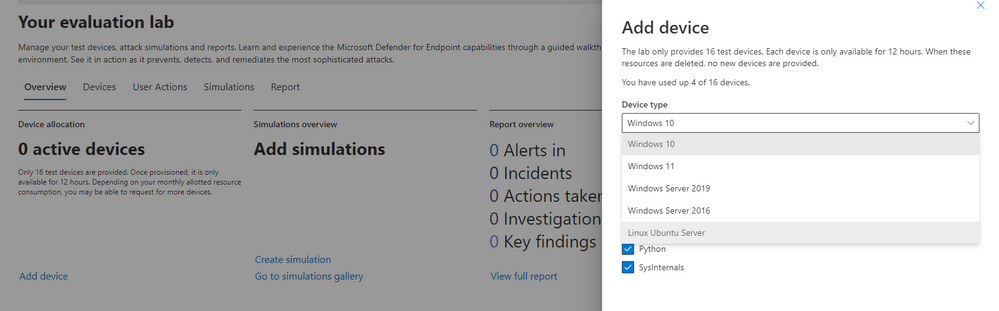
The evaluation lab now supports the following operating systems: Windows 10, Windows 11, Windows Server 2019, Windows Server 2016 and Linux (Ubuntu). To create a new device, simply select it within the “Add device” wizard. The new device will automatically be onboarded with no required additional steps.


Yaniv_Carmel_2-1637601415372.png


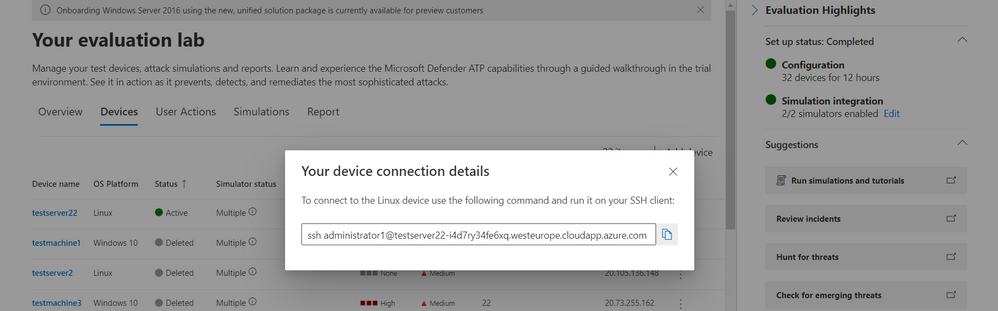
Once created, you can connect to the device via RDP (Windows) or SSH (Linux). You can connect to a Linux device using any SSH client.


Yaniv_Carmel_3-1637601415380.png


Atomic Red Team simulations


Powered by Red Canary, Atomic Red Team is an open-source library of tests that security teams can use to simulate adversarial activity in their environments. Atomic tests are simple – each test is mapped to a single MITRE ATT&CK® technique or sub-technique, most of them have no prerequisites, and many come with easy-to-use configuration and cleanup commands.


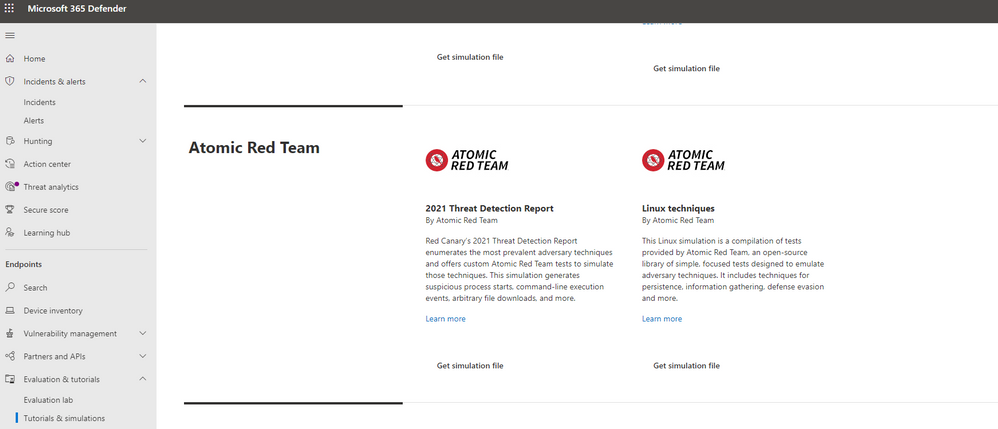
Evaluation Lab users can now use Atomic Red Team simulations to evaluate Microsoft Defender for Endpoint’s detection capabilities against both Windows and Linux threats. The simulations are provided as script files, so that security teams can choose to run them in the Evaluation lab or any other testing environment of their choice.


Yaniv_Carmel_4-1637601557153.png


The first simulation, 2021 Threat Detection Report, executes tests according to Red Canary’s latest report of top Windows techniques associated with confirmed threats, as compiled from roughly 20,000 confirmed threats detected across customer environments.


The second simulation, Linux techniques, is a collection of simple tests compiled to allow security teams to evaluate Microsoft Defender for Endpoint’s detection capabilities against common Linux persistence, discovery, and defense evasion techniques.


We’re looking forward to you trying out the Evaluation Lab updates. Let us know your thoughts and feedback in the comments below or through the feedback tool in the portal!

The most important customer experience metrics (that you’re not tracking yet)

The most important customer experience metrics (that you’re not tracking yet)

This article is contributed. See the original author and article here.

Marketing professionals go to great lengths to understand customers. Detailed personas are written to identify the motivations, interests, and buying patterns of prospects and customers. But all too often, these personasand their resulting customer journeysare informed by data points important to the organization, not the customer. You cannot claim to be customer-centric, customer-first, or customer-obsessed if all the data you track is company-centric.

You may be thinking your organization is ahead of the customer journey curve here. After all, you’re already tracking customer-centric metrics such as net promoter score, customer satisfaction score, and customer effort score. But take a second look. These key performance indicators (KPIs) still ultimately measure benchmarks important to the organization, not the customer.

Go beyond KPIs with customer performance indicators

Nobody is arguing that an organization shouldn’t have a robust set of KPIs focused on measuring the fulfillment of important company objectives. But your toolbox of performance indicators doesn’t have to end thereand neither do the possibilities for the customer journey. Rather, take things to a whole new level by also measuring the fulfillment of customers’ objectives and optimizing the journey with the help of Microsoft Dynamics 365 Marketing.

Customer performance indicators (CPIs) quantify and measure outcomes that are desired by customers. These outcomes could include time savings, cost savings, convenience, flexibility, a sense of security, or any number of other outcomes customers deem valuable in the context of your product or service. There’s no cookie-cutter set of CPIs; they will vary widely across industries, organizations, products, and regions.

Consider the scenario of a retailer whose shoppers especially value speed. Acknowledging their shoppers’ priorities along with the need to balance services with expectations, the retailer tracks customers’ wait-time for curbside pick-up. They discover that wait times occasionally go beyond customer expectations. In response, the retailer implements a new feature that sends a flash promotional offer to high-value customers, when they are on their way during busy periods, for a complimentary drink redeemable from the in-store bar when they switch to in-store pickup. It’s a personalized gesture that acknowledges the retailer fell short of expectations but is trying to do its best to make it up to the customer. By optimizing the metrics that reflect what is important to the customer, the retailer can positively impact a whole host of KPIs, from customer satisfaction and customer loyalty to sales revenueand more.

Where KPIs end and customer performance indicators begin

There is a strong correlation between CPIs and KPIs. As illustrated by our retailer example, meeting the objective of a CPI is likely to boost associated KPIs. In fact, CPIs have been identified as powerful predictors of growth. Similarly, declining CPIs are likely to drag down associated KPIs.

CPIs also uncover insights about KPIs. Take customer satisfaction as an example. A high customer satisfaction score (a common KPI) indicates that an organization is doing something well. And while that’s critical information, this KPI on its own may not be able to provide visibility into what that something is. Or whether that something is even important to the customer. But a set of CPIs designed to measure desired customer outcomes such as personalized touches or chat availability can identify where the strongest correlations lie between what is important to the customer and what is important to the company.

CPIs and KPIs have a lot in common. They both measure performance, they both demonstrate progress toward an intended result, and they both impact the bottom line. For this reason, they can be difficult to distinguish from one another.

In the following table, we identify a few common KPIs. Alongside each KPI, we list one or more CPIs that could be used to enhance the understanding or performance of the associated KPI.

KPI CPI How CPI supports KPI
Customer lifetime value Value customer receives Customer lifetime value can be increased if there’s focus on ensuring there is a minimum, measurable value provided to the customer as well. For example, a loyalty card program could strive to save customers at least $100 a year.
Customer satisfaction score

In-person customer touches

Online chat availability

Do your customers value personalized, dedicated attention or the ability to quickly query representatives via informal chat applications? Understand the type of service interactions the customer values and implement CPIs to ensure you’re meeting expectations.
Product return rate

Ease of product return

Expense of product return

Is product return rate low because the product is superior or because the return process is unwieldy or expensive? By additionally tracking and optimizing the return experience of customers, you’ll have greater insight into the reasons behind your product return rate.
Quote to close ratio Quote turnaround time There are many factors influencing quote to close ratio. Find out what your customers valuewhether it be fast quote turnaround, flexible pricing plans, or something elseand start measuring it.


Find your customer performance indicators

What outcomes do your customers value? When you have the answer to that question, you can focus on delivering those outcomes. Every CPI identified, quantified, and measured brings new discoveries, new opportunities, and new levers to pull. Every CPI optimized is one more personalization you can bring to the customer journey, from brand voice and quote delivery to product bundling and customer service availability.

In short, it’s not enough to measure what’s important to your organizationnot if you want to optimize the customer journey and exceed customer expectations. You must also measure what’s important to your customers.

Learn how Dynamics 365 Marketing helps your organization optimize the CPIs that lead to elevated experiences.

The post The most important customer experience metrics (that you’re not tracking yet) appeared first on Microsoft Dynamics 365 Blog.

Brought to you by Dr. Ware, Microsoft Office 365 Silver Partner, Charleston SC.

Reminder for Critical Infrastructure to Stay Vigilant Against Threats During Holidays and Weekends

This article is contributed. See the original author and article here.

As Americans prepare to hit the highways and airports this Thanksgiving holiday, CISA and the Federal Bureau of Investigation (FBI) are reminding critical infrastructure partners that malicious cyber actors aren’t making the same holiday plans as you. Recent history tells us that this could be a time when these persistent cyber actors halfway across the world are looking for ways—big and small—to disrupt the critical networks and systems belonging to organizations, businesses, and critical infrastructure. 

There are actions that executives, leaders, and workers in any organization can take proactively to protect themselves against cyberattacks, including possible ransomware attacks, during the upcoming holiday season—a time during which offices are often closed, and employees are home with their friends and families. Although neither CISA nor the FBI currently have identified any specific threats, recent 2021 trends show malicious cyber actors launching serious and impactful ransomware attacks during holidays and weekends, including Independence Day and Mother’s Day weekends.

CISA and the FBI strongly urge all entities–especially critical infrastructure partners–to examine their current cybersecurity posture and implement best practices and mitigations to manage the risk posed by cyber threats. Specifically, CISA and the FBI urge users and organizations to take the following actions to protect themselves from becoming the next victim:

  • Identify IT security employees for weekends and holidays who would be available to surge during these times in the event of an incident or ransomware attack. 
  • Implement multi-factor authentication for remote access and administrative accounts.
  • Mandate strong passwords and ensure they are not reused across multiple accounts. 
  • If you use remote desktop protocol (RDP) or any other potentially risky service, ensure it is secure and monitored. 
  • Remind employees not to click on suspicious links, and conduct exercises to raise awareness. 

Additionally, CISA and the FBI recommend maintaining vigilance against the multiple techniques cybercriminals use to gain access to networks, including:

Finally—to reduce the risk of severe business/functional degradation should your organization fall victim to a ransomware attack—review and, if needed, update your incident response and communication plans. These plans should list actions to take—and contacts to reach out to—should your organization be impacted by a ransomware incident. Note: for assistance, review available incident response guidance, such as the Ransomware Response Checklist in the CISA-MS-ISAC Joint Ransomware Guide, the Public Power Cyber Incident Response Playbook, and the new Federal Government Cybersecurity Incident and Vulnerability Response Playbooks.

CISA and the FBI urge users and organizations to take these actions immediately to protect themselves against this threat. For a comprehensive overview, see the joint Cybersecurity Advisory Ransomware Awareness for Holidays and Weekends. For more information and resources on protecting against and responding to ransomware, visit StopRansomware.gov, a centralized, whole-of-government webpage providing ransomware resources and alerts.

How to spot and avoid common health scams

How to spot and avoid common health scams

This article was originally posted by the FTC. See the original article here.

As a caregiver for a family member with special health needs, you know that shopping, making meals, or just regularly spending time with someone who can’t get out much can profoundly improve their quality of life.

But being a caregiver is stressful, and scammers know that, too. In fact, dishonest companies will say almost anything to get you to buy their product or service. So, as part of National Family Caregiver’s month, here are steps to take before you buy any health product or service — for yourself or someone else.

  • Do some research. Search for the name of the treatment or product online, plus the words “review,” “complaint,” or “scam.”
  • Ask a health professional first. Find out:
    • Does this product or treatment actually work?
    • What’s the scientific evidence?
    • How will it interact with other supplements or drugs the person you’re caring for takes?
  • Be skeptical about products that come with guarantees or promises. Some companies want to take advantage of your hope.
  • Know that natural” doesn’t mean either safe or effective. In fact, “natural” can be both harmful and ineffective. And some “natural” products might interfere with proven treatments recommended by a doctor.
  • Evaluate the claims. Ads must be truthful, not misleading. But remember, you are the best defense against health scams. Don’t assume that some government agency has approved a claim just because you see it in an ad.
  • Know that the government wouldn’t hide proven remedies from you. If an ad offers a treatment that the seller claims the government or pharmaceutical industry doesn’t want you to know about, it’s a scam.

If you think you’ve spotted a health scam, tell your friends and family about it. Then tell the FTC at ReportFraud.ftc.gov. Your reports help the FTC and our law enforcement partners build cases and stop scammers.

Brought to you by Dr. Ware, Microsoft Office 365 Silver Partner, Charleston SC.