
by Contributed | Jul 15, 2021 | Dynamics 365, Microsoft 365, Technology
This article is contributed. See the original author and article here.
Customer service organizations depend on incoming service requests getting to the appropriate agent to ensure high customer satisfaction. Improving routing for your organization can seem like a daunting task, but it is not something that needs to be tackled all at once. The new unified routing capabilities in Dynamics 365 Customer Service can help improve parts of your process without disruption to your overall organization.
The recent blog post Increase customer satisfaction and agent productivity with unified routing describes six benefits of unified routing for your organization. Thanks to the composability of the system, you can break down your approach and benefit from incremental improvements without having to completely overhaul your routing and assignment strategy all at once.
Where to start
The unified routing capability reimagines the routing pipeline into two broad stages: assignment and classification. Get started with your routing transformation by assessing your current system and business structure in both of those stages.
Assignment
How are your customer service agents structured? Do you have teams supporting different regions, priority cases, or languages? Is work assigned to agents based on their skills and specifications or on who has the most capacity? Your queue configuration and assignment strategy should be core to your business processes, and it can be hard to change. But this step can have the greatest impact on improving your core support KPIs.
If your organization is ready to completely adopt automated, skills-based assignments, start by building your ideal queue structure, assign the skills and agents, and ensure your workstream rules update the incoming work items with those corresponding skills. If your organization is starting incrementally, identify a smaller group of agents and a subset of work items, and start a pilot program using one workstream (such as live chat or email) and one queue. The rest of the organization can continue to work as they are today, and the pilot will provide insight into what it would take for your organization to fully migrate.
Classification
What about the cases, emails, conversations, or other incoming service requests your organization needs to route and distribute? How often do these items include all the information required to get to the appropriate agent? Do you have manual or automated steps to look up related data or extract key concepts before it can be routed? The classification stage in unified routing provides configuration and machine learning rules to help organizations ensure the work item has all the necessary details to route it to the right agent or queue.
If your organization is ready to completely adopt this stage, start by examining your existing process for steps that update the work item either manually or through a plug-in, and translate it into a classification rule. If your organization is looking to start small, identify a subset of the work items or maybe a new set of work items not being routed today such as email, and start a pilot using one workstream and one queue. Once again, the rest of the organization can continue to work as they are currently, and the pilot will provide insight into what it would take for your organization to fully use these capabilities.
Increased visibility
Maybe your current system is working well for your agent structure and the incoming work items. But do you have the visibility into the system to understand what’s going well and what needs to be improved? Unified routing provides diagnostics for any item routed, showing you clearly which rules were evaluated, what the results were, and how it was ultimately assigned to the agent. Continued monitoring will provide insight into how your routing rules are running and highlight areas in both workstream and queue configurations that should be reviewed.
How to get started
If you’re a current customer of Dynamics 365 Customer Service, you can enable unified routing in your organization to start streamlining your routing and assignments. You may already be leveraging the routing rulesets, which can still be used alongside the new unified routing workstreams. By crafting intake rules you can determine which cases and work items go through the unified routing engine and which are still processed by your existing routing rules. Don’t forget to use diagnostics to track a work item through your newly configured classification and assignment rules.
If you’re a current customer of chat or digital messaging for Dynamics 365 Customer Service, the good news is you’re already using the improved assignment capabilities. After migrating your workstreams to the new Omnichannel admin center app, you’ll be able to use the new classification capabilities as well.
If you’re not yet a customer of Dynamics 365 Customer Service, head over to Dynamics365.com to connect with a partner or start your own trial.
The post How to approach your routing and assignment transformation with unified routing appeared first on Microsoft Dynamics 365 Blog.
Brought to you by Dr. Ware, Microsoft Office 365 Silver Partner, Charleston SC.

by Contributed | Jul 15, 2021 | Technology
This article is contributed. See the original author and article here.
Cities range from the large to the small, the old to the new, and the well-known to the hardly-ever-heard-of, but the one thing they have in common is an appetite to meet the needs of their population. Smart cities are hubs of cutting-edge technology that help make municipalities work better for everyone, from giving residents better lives to enabling thriving businesses.
Smart cities are reshaping global economics, the relationship of people to their physical spaces, and the needs for new talent, skills, and attitudes to embrace the future. By leveraging cloud and edge computing powered by 5G (and LPWA, or Low Power Wireless Access), cities have new opportunities to engage residents, increase safety, and promote efficient operations at low-cost. The use of this advanced technology, including the intelligent edge, artificial intelligence (AI) and 5G, will truly transform how we live, work, and develop new applications and solutions through collaborations across government and industries.
Proximus + Microsoft deliver on Kortrijk’s vision as a smart city

Kortrijk is a smart city in Belgium that used technology to access pedestrian count to promote safety during the COVID-19 pandemic. For a city, knowing the number of people on the streets in relation to a venues’ capacity is an important element to consider when looking for innovative ways to make the municipalities safer. Beyond the pandemic, though, learning how people move in a particular area can have a great impact on a city’s activities, so having the right tools to access this data can lead to smoother operations and better engagement.
Using edge AI and IoT technology to quickly solve for city challenges
Kortrijk originally relied on webcam barometric pressure readings to gather pedestrian counts, but after several tests, it became clear that live counts were not accurate, prompting city officials to look for alternative solutions. After exploring the market for a suitable solution, Proximus, one of the largest mobile telecommunications companies in Belgium, turned to Azure Percept to propose new alternatives to Kortrijk.
Azure Percept is a comprehensive end-to-end edge AI platform with pre-built models and solution management, as well as Zero Trust security measures, to safeguard models and data. It offers the capabilities to start a proof of concept in minutes with hardware accelerators designed to integrate seamlessly with Azure AI and Azure IoT services.
With this, Microsoft partnered with Proximus, which is the leading telecom provider in Belgium, to develop an innovative, proof of concept solution that leverages Proximus’s cellular network to address the live-count limitations the city had encountered with previous technologies. The strategy was to set-up a test system which included:
- Video analysis for pedestrian count
- Video analysis with 3D cameras
- Point cloud analysis relying on millimeter wave radars
- Sound analysis based on sound sensors powered by AI
Sensors were placed in key locations and tests , which did not require an initial investment from the city, were conducted in late May. By leveraging Azure Cognitive Services and ML, Proximus was able to deliver vision and audio insights in real time. The results served to decide which model was best suited for the city by estimating the ideal technology and placement options to obtain optimal pedestrian counts—becoming one of the first operators in Europe to directly integrate Microsoft edge capabilities into the heart of its network.
Intelligent edge for smart cities

Innovation does not come without challenges though. With new applications, services, and workloads, smart cities need solutions and architecture built to support their demands. Enter the intelligent edge, a continually expanding set of connected systems and devices that gather and analyze data. Users get real-time insights and experiences, delivered by highly responsive and contextually aware apps, and when combined with the limitless computing power of the cloud, the possibilities for innovation are endless.
Bringing enterprise applications closer to data sources, such as IoT devices or local edge servers, results in faster insights, improved response times, and better bandwidth availability. Cloud flexibility and scalability allows for easy integration and deployment, and with low maintenance costs, processes can be managed centrally while still allowing deployment of software depending on the user’s needs—resulting in accelerated value, reduced operating costs, and increased efficiency. With this, smart cities can invent and innovate to meet the demands of the future.
The 5G power wave—fueling edge computing
The importance of 5G and LPWA stems from its potential to accelerate value and improve efficiency as it provides a new set of latencies and features that did not exist in the 4G environment and previous generations. This is particularly relevant in smart cities where the convergence of industry, public service, and other enterprises requires high density, speed and bandwidth and low power networks that—when paired with technology—opens a new world of possibilities.
For Kortrijk and other cities, this powerful combination offers accurate insights as well as fast and cost-efficient solutions to address their particular needs. The data gathered through computer vision—which detects objects and movement in real-time—is robust and configurable to support different scenarios, allowing city officials to evaluate their options and make decisions that lead to optimal solutions.
Full throttle toward 5G and smart cities

Thanks to advanced technology like the intelligent edge, AI, and 5G, we have the power to make smart cities a reality more easily. More and more cities around the world are welcoming this approach and solutions are being created and deployed to address the most pressing concerns that decision makers face every day.
Azure Percept, along with the entire portfolio of Azure services for smart cities, is designed to speed the development and deployment of secure and comprehensive edge AI solutions from partners like Proximus that can leverage a range of edge endpoints – cameras, gateways, environmental sensors, all leveraging telecom infrastructure including 5G and LPWA.
Ultimately, the goal is to create fully integrated smart processes that use data, technology and creativity to shape how people and goods move—making smart cities not only innovative but also safer and more reliable to support economic growth and meet the challenges of the future.
Learn more about Azure Percept.
by Scott Muniz | Jul 15, 2021 | Security
This article was originally posted by the FTC. See the original article here.
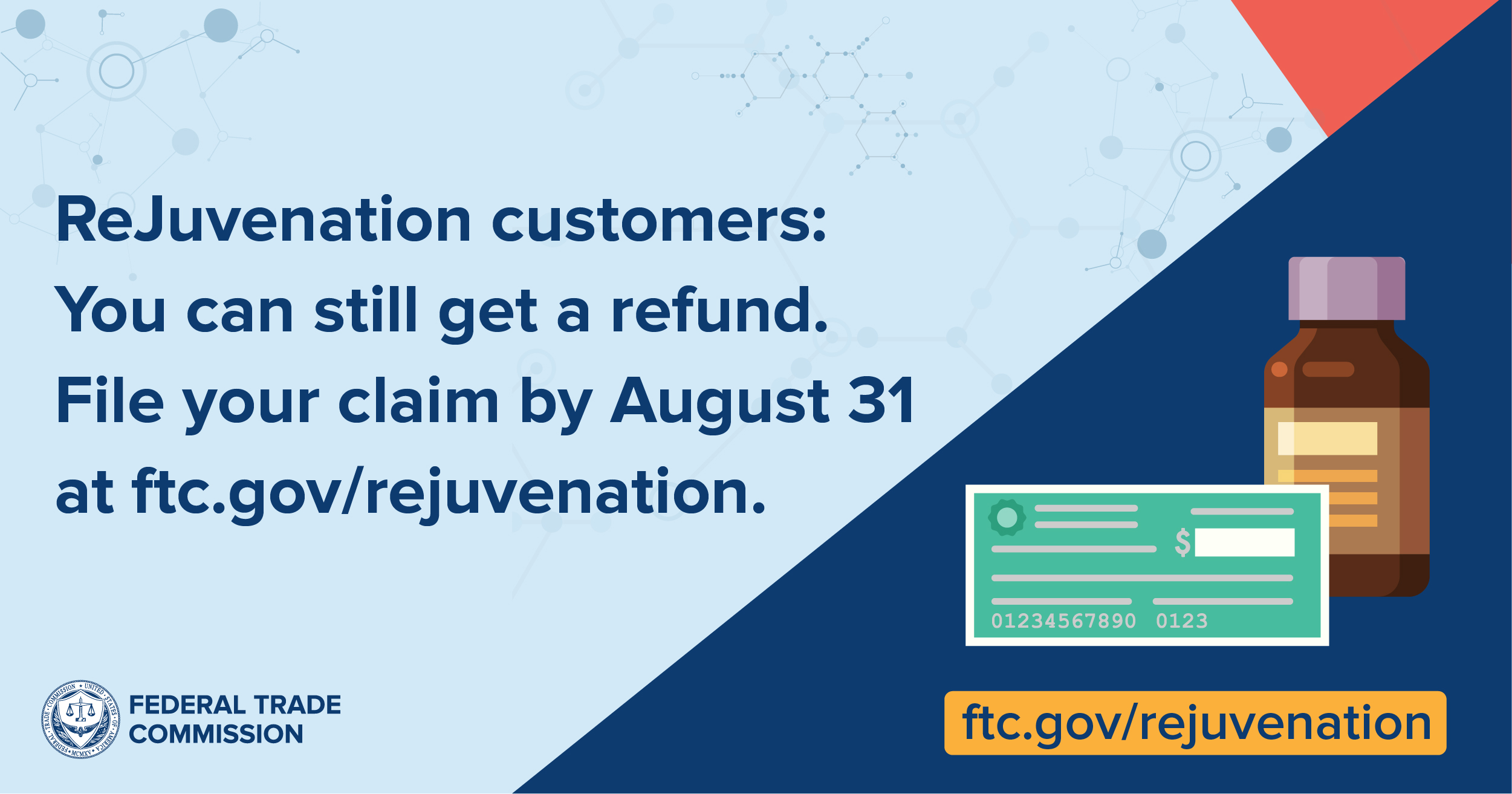 Last year, the FTC reached a settlement agreement with makers of ReJuvenation and sent refund checks to people who bought this so-called “anti-aging” pill that claimed to be a cure-all for ailments including cell damage, heart attack damage, brain damage, and deafness. If you bought ReJuvenation and haven’t already gotten a check, here’s what you should know.
It’s easy to get your money. Just go to the Quantum Refunds page at ftc.gov/rejuvenation and follow the instructions for filling out a claim. The deadline for filing claims is August 31, 2021. The average refund check has been about $113 dollars. Once you get your check, deposit it right away since it will expire after 90 days.
Also, please know that the only way these FTC refund checks will come to you is by postal mail. And you never have to pay to get a refund from the FTC. If someone contacts you and asks you to pay, or says they can help you get a refund, it’s a scam — report it to the FTC.
For more information about the ReJuvenation refunds, visit ftc.gov/ReJuvenation. And check out ftc.gov/refunds for more information on the FTC’s refund program.
Brought to you by Dr. Ware, Microsoft Office 365 Silver Partner, Charleston SC.
by Contributed | Jul 15, 2021 | Dynamics 365, Microsoft 365, Technology
This article is contributed. See the original author and article here.
On July 14, 2021, we published the 2021 release wave 2 plans for Microsoft Dynamics 365 and Microsoft Power Platform, a compilation of new capabilities that are planned to be released between October 2021 and March 2022. This second release wave of the year offers hundreds of new features and enhancements, demonstrating our continued investment to power digital transformation for our customers and partners.
Highlights from Dynamics 365
- Dynamics 365 Marketing is improving experiences and capabilities for creating moments-based and segment-based customer journeys that span all customer touchpoints taking personalization to the next level. Marketers will be able to create segments for leads and custom entities in the new segmentation builder experience using natural language to build segments and target audiences quickly and easily. Quickly generate email content using GPT-3 AI and then optimize with our streamlined AB testing tools.
- Dynamics 365 Sales launches the general availability of Deal Manager, a new, modern workspace for managing your pipeline, as well as enhancements to the integration between Dynamics 365 Sales and Microsoft Teams, including more collaboration tools and calling capabilities. Seller productivity investments include LinkedIn integration enhancements for easy access to Sales Navigator, forecasting updates, and guided selling improvements with Sales Accelerator. Several new capabilities are also coming to the Dynamics 365 Sales mobile application, now available in the iOS and Android app stores.
- Dynamics 365 Customer Service enhances knowledge authoring with AI-suggested keywords and brief descriptions for knowledge articles. The intelligent routing service uses a combination of AI models and rules to assign incoming service requests from all channels (cases, entities, chat, digital messages, and voice) to the best-suited agents. Additionally, we are investing in routing diagnostics for supervisors, machine learning-based rules for classification such as sentiment analysis and effort estimation, and improved historical analytics.
- Dynamics 365 Field Service continues down the path of providing easy customer engagement: a new customer portal will incorporate existing capabilities such as technician locator and new general availability capabilities such as self-scheduling and appointment management to enhance service and customer communication. Additionally, a refreshed work order form will enhance user productivity.
- Dynamics 365 Finance launches the general availability of Finance Insights to focus on data-driven insights empowering customers with out-of-the-box machine learning for their financial operations. To ensure that financial activities close on time, we are enabling our customers to increase productivity when it critically matters the most: we are bringing enhanced usability and performance around fixed assets, year-end close, and financial dimensions. We continue to enhance our globalization offering with additional localizations and the general availability of our Tax Calculation service.
- Dynamics 365 Supply Chain Management invests in enabling a resilient supply chain with enhancements in key areas such as resource planning, manufacturing, and warehousing. We will enable businesses to optimize their usage of available material and capacity to avoid stockout situations and keep the business flowing. New manufacturing execution scenarios are included to allow integration between Dynamics 365 Supply Chain Management, common manufacturing execution (MES) solutions, and shop floor automation systems for our customers to be able to adopt and integrate new business models with ease.
- Dynamics 365 Project Operations delivers functionally rich experiences to create and manage subcontracts with vendors for projects, as well as task scheduling enhancements.
- Dynamics 365 Guides will be updated to further leverage the hand tracking capabilities available on HoloLens 2, making Dynamics 365 Guides an easier to use and more intuitive application. While users will still be able to operate a guide with hands-free interactions, core application workflows will be simpler and faster with a touch-enabled holographic interface.
- Dynamics 365 Human Resources continues to enhance Benefits management capabilities by investing in a simplified setup and configuration user experience. We are continuing our journey to bring capabilities to employees in their flow of work and enhancing the current capability set as part of our Dynamics 365 Human Resources app for Microsoft Teams. Employees can submit, edit, and cancel their existing leave requests using the Teams app. We are also enhancing the manager’s ability to view more details about their direct reports’ leave balances and have better visibility of the team and company calendar.
- Dynamics 365 Commerce prioritizes customer segmentation and targeting using site builder to target customer segments with specific page layouts and content as well as improved understanding for how end-users interact with pages across sites, including mouse-action recordings, heatmaps, and analytics by integrating with Microsoft Clarity.
- Dynamics 365 Fraud Protection will have multiple new features that enhance Payment Service Providers (PSPs) ability to offer Fraud Protection as a value-added service to all their merchants. PSPs will be able to integrate Fraud Protection easily into their existing infrastructure to manage PSPs taxonomies that encompass many merchants and multiple hierarchies within each merchant entity.
- Dynamics 365 Business Central delivers new capabilities designed to simplify and improve the way our partners administer tenants, and the way administrators manage licensing and permissions. Application enhancements expand the integration with Microsoft 365 and add country and regional expansions with over 10 new markets.
- Dynamics 365 Customer Voice focuses this release wave on facilitating actionable insights for survey owners to act on feedback. Survey owners will be able to get feedback insights quickly and use Power Automate to define custom workflows to engage the right person at the right time.
- Dynamics 365 Customer Insights audience insights capabilities enable every organization to unify and understand their B2C and B2B customer data to harness it for intelligent insights and actions. For this release wave, in the B2B area, in addition to churn predictions for individual customer records, audience insights will predict the likelihood of churn for accounts using the same straightforward guided experience. Data ingestion enhancements in Customer Insights include additional Power Query connectors and improvements to the data ingestion process. Engagement insights (preview) in Dynamics 365 Customer Insights enable individual and holistic interactive analytics over web, mobile, and connected products customer journey touchpoints. Engagement insights expand to multichannel analytics over data from other channels for richer customer analytics, downstream actions, and optimizations.
Highlights from Microsoft Power Platform
- Power BI continues to invest in three key areas that drive a data culture: empower every individual with AI-infused insights, empower every team with BI woven into the fabric where teams work, and empower every organization to meet the most demanding enterprise needs. Power BI Pro continues to invest in our creator experiences with new report authoring tools. Consumer experiences continue to evolve, both in the Power BI service and the Power BI mobile applications. This includes improvements to Excel export from table and matrix visuals and easy creation from Microsoft Dataverse and Dynamics 365. Lastly, Power BI integration in Microsoft Teams continues to evolve, deepening the integration in channels, chats, and notifications within Teams. Power BI Premium continues to invest in the following areas: Auto-scale and pay-as-you-go pricing to scale beyond resource capacity without drops in performance. Interactive experiences over big data by making reports highly performant automatically on big data sources such as Azure Synapse Analytics.
- Power Apps brings significant improvements for developers of all skill levels, improving the sophistication and usability of apps that can be created across the web and mobile devices. We are launching the unified, modern Power Apps designer to quickly build modern apps leveraging the best of both canvas and model in a single app. Developers can now take advantage of intelligent authoring, using AI in Power Apps Studio to generate code using natural language for rapid app development. Makers will also be able to configure apps for offline use using a reinvented maker experience. PowerApps portals is focused on enhancements in the areas of portals platform, new capabilities for pro-development, and increased developer productivity. Several new capabilities are being added with a specific focus on pro-development such as the general availability of portals support for Power Apps component framework as well as support for continuous integration and continuous deployment (CI/CD) using Power Apps command-line interface (CLI)the first step toward a comprehensive Application Lifecycle Management (ALM) story for developers and ISVs.
- Power Automate continues to invest in several areas including Cloud flows with templates for Microsoft Teams and further integrations enabling administrators to push solutions that contain flows across the teams in their organization. Document automation, an end-to-end solution for processing documents at scale for document data extraction, becomes generally available during this release wave. Power Automate Desktop brings more WinAutomation actions to Desktop flows as well as new RPA-enabled scenarios for more Dynamics 365 applications, and it will be possible to use Dataverse and over 475 API connectors directly from Desktop flows.
- Power Virtual Agents brings improvements in the authoring experience with topic suggestions from bot sessions, Power Apps Portals integration, data loss prevention options, proactive bot update messaging in Microsoft Teams, and more. We’re also building on our Power Automate integration with enhanced error handling and new topic trigger management to improve your bot’s triggering capabilities.
- AI Builder will focus on providing new functionalities centered around intelligent document processing experiences. New functionalities will include the ability to extract a broader set of content types in documents such as checkboxes, signatures, typed fields like date and currency, as well as support for more prebuilt models in the Document Automation solution (for example, receipts and invoices). Integration of AI Models will also be supported through the Power Apps formula bar.
For a complete list of new capabilities, please check out the Dynamics 365 and Microsoft Power Platform 2021 release wave 2 plans.
Early access period
Starting August 2, 2021, customers and partners will be able to validate the latest features in a non-production environment. These features include user experience enhancements that will be automatically enabled for users in production environments during October 2021. Take advantage of the early access period, try out the latest updates in a non-production environment, and get ready to roll out updates to your users with confidence. To see the early access features, check out the Dynamics 365 and Power Platform pages. For questions, please visit the Early Access FAQ page.
Learn more
We’ve done this work to help youour partners, customers, and usersdrive the digital transformation of your business on your terms. Get ready and learn more about the latest product updates and plans, and share your feedback in the community forum for Dynamics 365 or Power Platform.
The post 2021 release wave 2 plans for Dynamics 365 and Power Platform now available appeared first on Microsoft Dynamics 365 Blog.
Brought to you by Dr. Ware, Microsoft Office 365 Silver Partner, Charleston SC.
by Scott Muniz | Jul 15, 2021 | Security, Technology
This article is contributed. See the original author and article here.
The U.S. Government launched a new website to help public and private organizations defend against the rise in ransomware cases. StopRansomware.gov is a whole-of-government approach that gives one central location for ransomware resources and alerts. We encourage organizations to use this new website to understand the threat of ransomware, mitigate risk, and in the event of an attack, know what steps to take next.
The StopRansomware.gov webpage is an interagency resource that provides our partners and stakeholders with ransomware protection, detection, and response guidance that they can use on a single website. This includes ransomware alerts, reports, and resources from CISA, the FBI, and other federal partners.
We look forward to growing the information and resources on StopRansomware.gov and plan to partner with additional Federal Agencies who are working to curb the rise in ransomware.


Recent Comments