by Scott Muniz | Jul 9, 2020 | Azure, Microsoft, Technology, Uncategorized
This article is contributed. See the original author and article here.
With all the changes in Azure, it is sometimes hard to keep track, that’s why I thought I would give you a quick update on a couple of exciting things I learned this week. In this update, I want to share a couple of things around updates on Azure Arc enabled SQL Servers, private endpoints for Azure File Sync, Azure Private Link support for Azure Automation, Azure Digital Twins enhanced features, and much more! Also, tune in for our livestream later today.
Preview of Azure Arc enabled SQL Server is now available
The Azure Data Services team just announced the private preview of Azure Arc enabled SQL Server. The preview includes the following features:
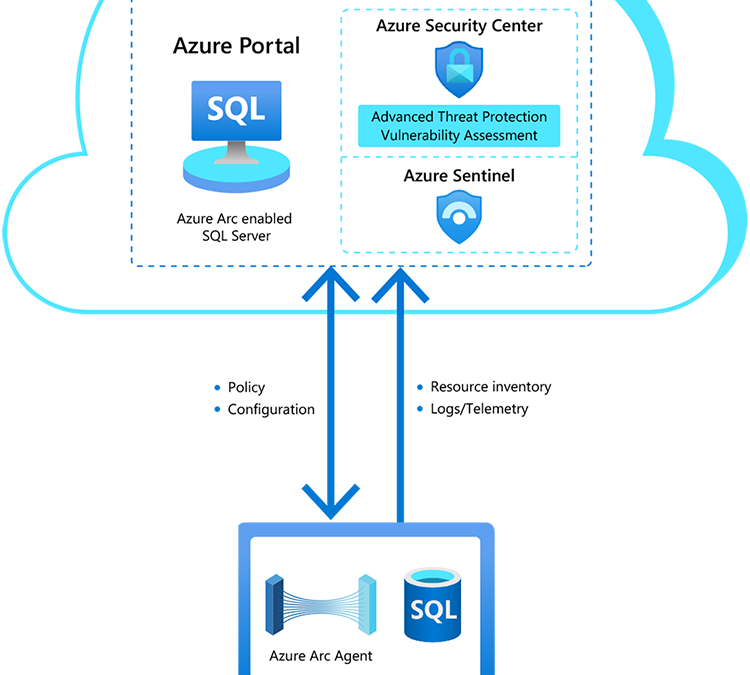
- Use the Azure Portal to register and track the inventory of your SQL Server instances across on-premises, edge sites, and multi-cloud in a single view.
- Use Azure Security Center to produce a comprehensive report of vulnerabilities in SQL Servers and get advanced, real-time security alerts for threats to SQL Servers and the OS.
- Investigate threats in SQL Servers using Azure Sentinel.
 Azure Arc enabled SQL Server is now available
You can register any Windows or Linux based SQL Server to track your inventory. Azure Security Center’s advanced data security works on Windows-based SQL Server version 2012 or higher, running on physical or virtual machines and hosted on any infrastructure outside of Azure.
If you are interested in participating in this preview, check out the full blog post here.
Azure Digital Twins enhanced features are now in preview
Continuing the #JulyOT theme from last week, Microsoft announces the preview release of Azure Digital Twins enhanced features. Create comprehensive digital models of entire environments to help gain insights that can drive better products, optimize operations, reduce costs, and create exceptional customer experiences with Azure Digital Twins Preview.
Private endpoints for Azure File Sync are now generally available
Starting with Azure File Sync agent 10.1, Azure File Sync supports private endpoints in all public and Azure US Government cloud regions where Azure File Sync is available. Private endpoints enable you to assign your Storage Sync Service private IP addresses from within the address space of your virtual network. Private endpoints for Azure File Sync allow you to:
- Securely connect to your Azure resources from on-premises networks using a VPN or ExpressRoute connection with private-peering.
- Secure your Azure resources by disabling the public endpoints for Azure Files and File Sync.
- Increase security for your Azure virtual networks by blocking exfiltration of data from your network boundaries.
You can learn more about configuring Azure File Sync network endpoints.
Azure Private Link support for Azure Automation is now available in preview
Another exciting news is the announcement of the preview of Azure Private Link Support for Azure Automation. You can now use Azure Private Link to securely connect virtual networks to Azure Automation using private endpoints (in preview).
Use Private link to:
- Establish a private connection to Automation without opening public network access.
- Ensure your Automation data is only accessed through authorized private networks.
- Protect data exfiltration with granular access to specific resources.
- Protect resources from public network access.
Use endpoints to:
- Use webhooks to start a runbook.
- Connect Hybrid Runbook Worker.
- Connect Azure DSC nodes.
You can learn how to use Private Link to securely connect networks to Automation here.
Fun IoT projects to do at home during #JulyOT
As they find themselves spending more time at home, people are finding creative ways to strike a new work-life balance using the Internet of Things. Here are the stories of three IoT hobbyists and their home projects that will inspire your creativity too. Stories include connecting a Raspberry Pi to a BBQ smoker to help grill a perfect set of ribs and monitoring moisture levels in plants.
MS Learn Module of the Week

Get started with artificial intelligence on Azure
Artificial Intelligence (AI) empowers amazing innovative solutions and experiences, and Microsoft Azure provides easy to use services to help you get started.
Conclusion
I wish you a good weekend, and I hope this short blog post provided you with some news from this week. I know there is much more than just the things I listed here. I recommend that you follow the Azure announcements blog. If you have any questions, feel free to leave a comment.
Also, check out last week’s Az Update here.
by Scott Muniz | Jul 9, 2020 | Azure, Microsoft, Technology, Uncategorized
This article is contributed. See the original author and article here.
With all the changes in Azure, it is sometimes hard to keep track, that’s why I thought I would give you a quick update on a couple of exciting things I learned this week. In this update, I want to share a couple of things around updates on Azure Arc enabled SQL Servers, private endpoints for Azure File Sync, Azure Private Link support for Azure Automation, Azure Digital Twins enhanced features, and much more! Also, tune in for our live stream later today.
Preview of Azure Arc enabled SQL Server is now available
The Azure Data Services team just announced the private preview of Azure Arc enabled SQL Server. The preview includes the following features:
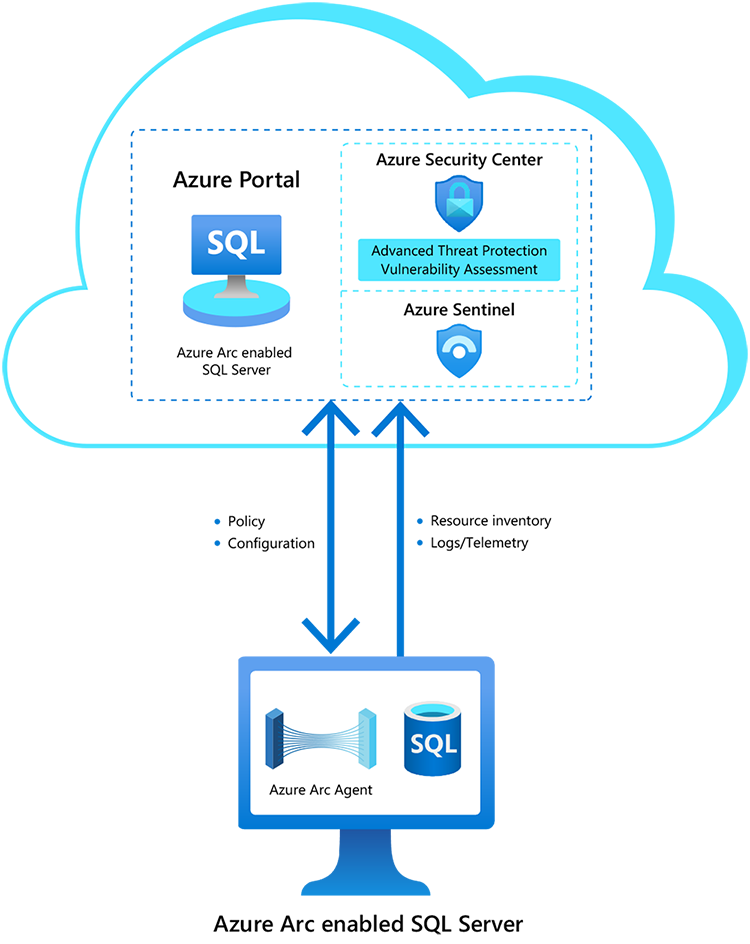
- Use the Azure Portal to register and track the inventory of your SQL Server instances across on-premises, edge sites, and multi-cloud in a single view.
- Use Azure Security Center to produce a comprehensive report of vulnerabilities in SQL Servers and get advanced, real-time security alerts for threats to SQL Servers and the OS.
- Investigate threats in SQL Servers using Azure Sentinel.
Azure Arc enabled SQL Server is now available
You can register any Windows or Linux based SQL Server to track your inventory. Azure Security Center’s advanced data security works on Windows-based SQL Server version 2012 or higher, running on physical or virtual machines and hosted on any infrastructure outside of Azure.
If you are interested in participating in this preview, check out the full blog post here.
Azure Digital Twins enhanced features are now in preview
Azure Digital Twins enhanced features are now in preview. Create comprehensive digital models of entire environments to help gain insights that can drive better products, optimize operations, reduce costs, and create exceptional customer experiences with Azure Digital Twins Preview.
Private endpoints for Azure File Sync are now generally available
Starting with Azure File Sync agent 10.1, Azure File Sync supports private endpoints in all public and Azure US Government cloud regions where Azure File Sync is available. Private endpoints enable you to assign your Storage Sync Service private IP addresses from within the address space of your virtual network. Private endpoints for Azure File Sync allow you to:
- Securely connect to your Azure resources from on-premises networks using a VPN or ExpressRoute connection with private-peering.
- Secure your Azure resources by disabling the public endpoints for Azure Files and File Sync.
- Increase security for your Azure virtual networks by blocking exfiltration of data from your network boundaries.
You can learn more about configuring Azure File Sync network endpoints.
Azure Private Link support for Azure Automation is now available in preview
Another exciting news is the announcement of the preview of Azure Private Link Support for Azure Automation. You can now use Azure Private Link to securely connect virtual networks to Azure Automation using private endpoints (in preview).
Use Private link to:
- Establish a private connection to Automation without opening public network access.
- Ensure your Automation data is only accessed through authorized private networks.
- Protect data exfiltration with granular access to specific resources.
- Protect resources from public network access.
Use endpoints to:
- Use webhooks to start a runbook.
- Connect Hybrid Runbook Worker.
- Connect Azure DSC nodes.
You can learn how to use Private Link to securely connect networks to Automation here.
Fun IoT projects to do at home during #JulyOT
As they find themselves spending more time at home, devs are finding creative ways to strike a new work-life balance using the Internet of Things. Here are the stories of three IoT hobbyists and their home projects that will inspire your creativity too.
MS Learn Module of the Week
Get started with artificial intelligence on Azure
Artificial Intelligence (AI) empowers amazing new solutions and experiences, and Microsoft Azure provides easy to use services to help you get started.
Conclusion
I wish you a good weekend, and I hope this short blog post provided you with some news from this week. I know there is much more than just the things I listed here. I recommend that you follow the Azure announcements blog. If you have any questions, feel free to leave a comment.
Also, check out last week’s Az Update here.
![[Guest blog] 5 Tips to Create Accessible Canvas Power Apps](https://www.drware.com/wp-content/uploads/2020/07/large-360)
by Scott Muniz | Jul 9, 2020 | Uncategorized
This article is contributed. See the original author and article here.
This article was written by Business Applications MVP Éric Sauvé as part of the Humans of IT Guest Bloggers series. Eric shares key tips to create canvas Power Apps that are accessible to users who may have a visual impairment or are color blind, require screen reader or do not use a mouse or a touch screen.
What a nice way for me to return to active community contribution through writing this article and sharing my own learnings and perspectives!
I am a Power Platform Practice Lead and acting Solution Architect many Dynamics and Power Platform projects. In the past few years, I have been pretty active in conferences, user groups, and community training, but recently the whole lockdown and moving into virtual mode has greatly impacted me.
It has been hard to stay motivated when my fuel is mostly based on human contact and being able to bond and connect with people. Enabling others, having an impact on their lives, and allowing them to also create positive impact in other people’s lives are reasons why I continue to share and contribute so much of my time to events. When COVID-19 happened and everything got converted to virtual events, I felt deeply saddened and alone. To me, it felt worse than being single on Valentine’s Day.
It was about this time when I was at my lowest point of this downward spiral that the Humans of IT Community suggested the idea of participating in this blog. I want to thank my CPM Rochelle Sonnenberg for helping making this connection happen and unknowingly giving me the motivation I needed to jump back on the saddle.
So, that is for my “Human” side, let us now consider the “of IT” side of the equation. For this article, I have created a series of tips that can help you create canvas Power Apps that are accessible to users who may have a visual impairment, are color blind, require screen reader or even those who do not or cannot use a mouse or a touch screen for example.
1. App Checker is Your Friend
Within the Power Apps canvas studio, there is an integrated tool that continuously validates if the app is healthy and flags any errors that should be investigated. One of the sections that this App Checker tool validates is the accessibility issues that could improve the application. It is good practice to thoroughly review this section and address those issues before publishing your app to your user base, based on their severity level:
- Errors: Means that the app has issues causing it to be difficult or impossible to use or understand for all users with a disability
- Warnings: Means that the app has issues that make it potentially difficult to use or understand for most but not all users with a disability
- Tips: Suggestions to improve the experience of users who have a disability
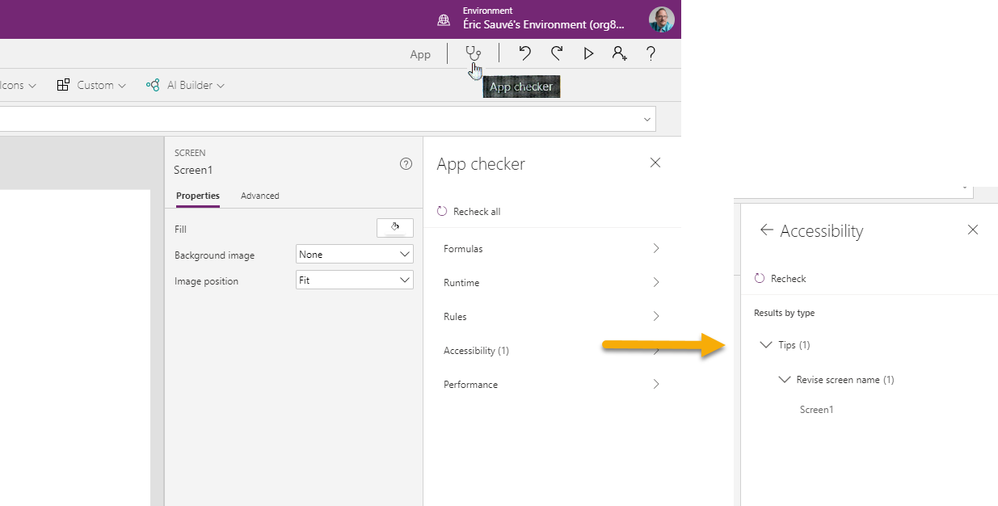
Figure 1 – App checker with Accessibility section
2. Layout and Color Matters!
The Web Content Accessibility Guidelines (WCAG) offer an exhaustive list of recommendations that any organization that is serious about providing accessible Power Apps should be familiar with and include in the revision (Q&A) cycle.
If there is one goal that an app maker should try to achieve in building an app that will be accessible to people who may have a color-based impairment, it is about the color contrasts. Any large text or other interactive UI components (such as buttons) should have a minimum contrast ratio of 3:1. As for regular text, a contrast ratio of 4.5:1 is considered the minimum value.
In the canvas apps, color settings for the components/controls, usually work in pairs:
- Color: the front-most color, can be for the text, line, border, etc.
- Fill: the background color, depending on the action/status, such as pressed, hover, focused, etc.
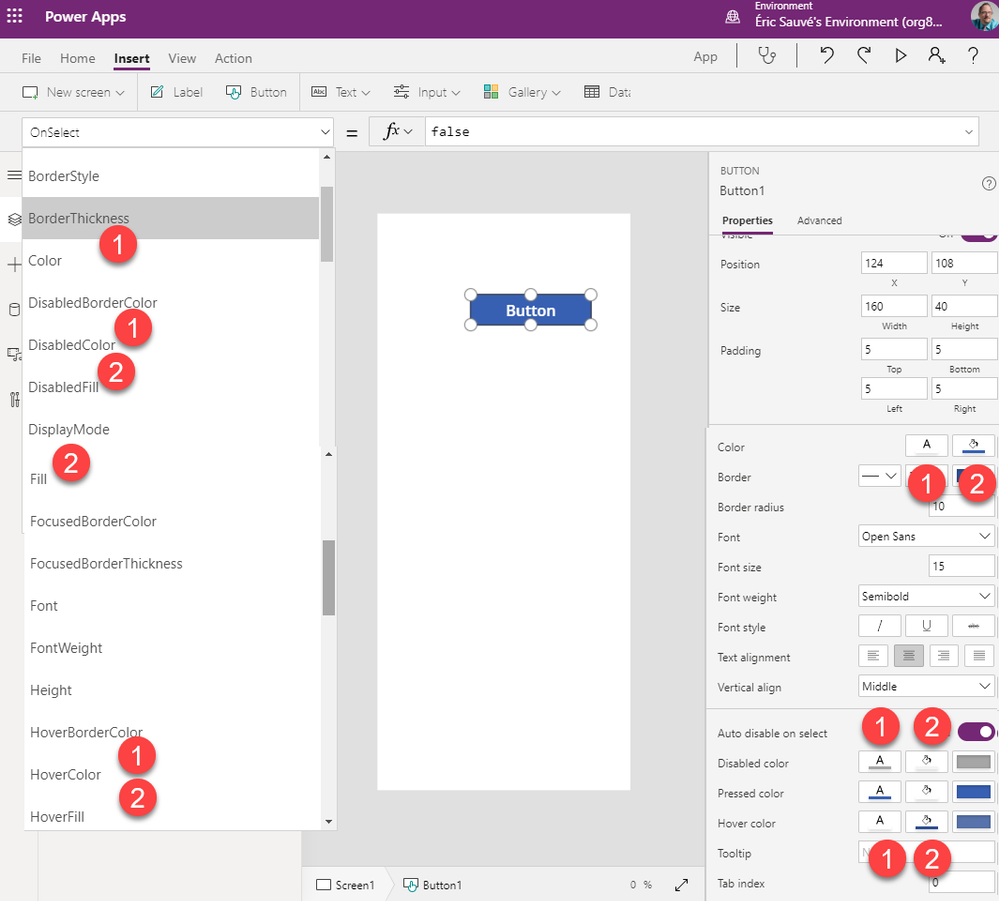
Figure 2 – Different examples of related color and fill properties for a button in a Canvas app
If you want to understand and validate your colors to ensure they are accessibility-compliant, you can use online tools such as the MSF&W color contrast ratio calculator.
3. Provide Keyboard Support
Remember that some app users may not be able to use a touch screen or a mouse, so they should be able to navigate through them via the use of keyboard only. The guidelines to ensure broader support is as follows:
- Interactive components (buttons, inputs, etc) – set TabIndex property to 0
- Decorative components (labels, images, etc) – set TabIndex property to -1
- Avoid setting tab index higher than 0 (see W3C warning)
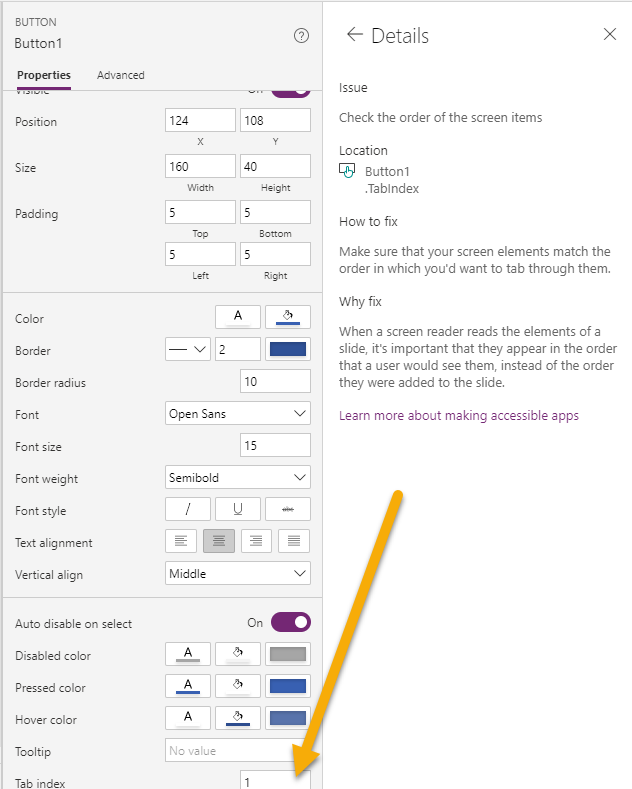
Figure 3 – Demonstration of a Tab index set to 1
4. Screen Reader Support
Power Apps offer screen support over multiple operating systems. To provide support for these, app makers should ensure that all AccessibleLabel properties are set (on input controls and images).
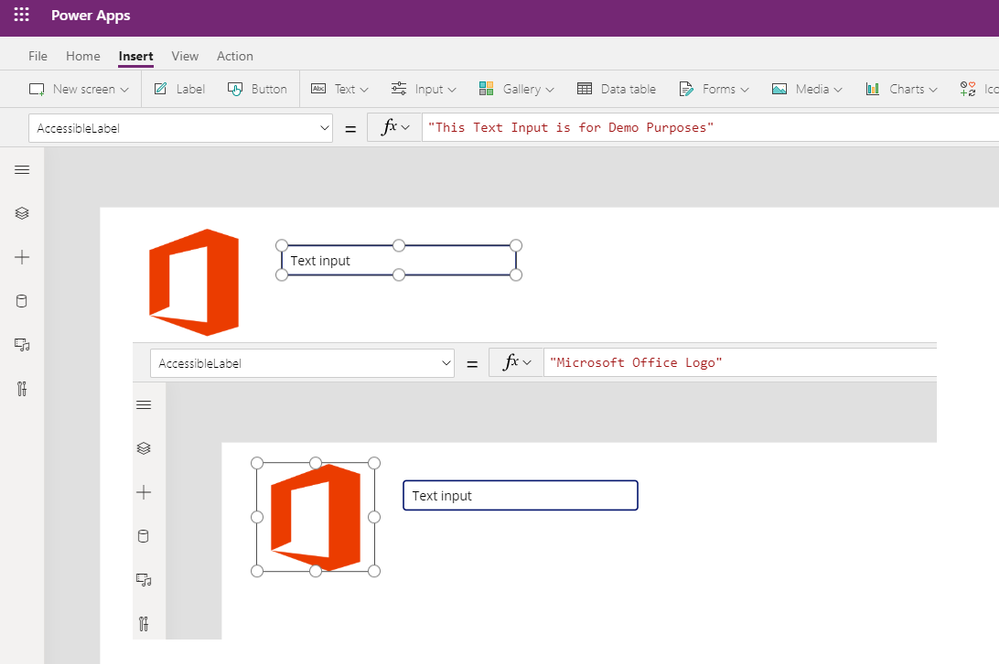
Figure 4 – Examples of image and input field with AccessibleLabel property
5. Accessibility Benefits Everyone
Keep in mind that the best Quality Assurance team you can have should include people with various accessibility needs. When designing an app, make sure you get input and feedback from fellow coworkers or community users that have various accessibility requirements so you can test that your app is truly accessible.
If you are not sure who to reach out to in your organization, try reaching out to your community or specialized centers instead. They will surely embrace the fact that you consider their needs and take them into account in your app design, and can guide you to resources that can help you test your apps.
Conclusion: It’s A Journey – Keep Trying Till It Becomes Second Nature!
This is a very high-level review of accessibility considerations and concepts that you can apply in your canvas Power Apps. Start implementing these in your upcoming projects – you’ll be amazed by what you will learn and achieve. These tips are easy to implement, and you can readily get feedback to improve until designing for accessibility becomes second nature for you. Feel free reach out to me as well if you need help!
About Eric
Éric Sauvé is a MCT & MVP (aka ZePowerDiver), Power Platform Practice Lead, Solution Architect, and Consulting Service Director at XRM Vision. He is a community leader for TDGi‘s global hackathons in Canada. A Power Platform enthusiast, he often delivers App in a Day sessions and leads local community events such as the Montreal Power Platform Happy Hour. Eric also actively participates in his local Montreal Business Application User Group, and has spoken at numerous Power Platform and Dynamics CE related conferences.
Connect with Eric:
LinkedIn: https://www.linkedin.com/in/zepowerdiver
References for this article:
Power Apps Accessibility Standards and Guidelines
Create accessible canvas apps in Power Apps
How do Power Apps support accessibility and Inclusiveness?
Accessibility properties for canvas apps
Review a canvas app for accessibility in Power Apps
Accessible colors for canvas apps in Power Apps
Screen Reader Photo by Sigmund on Unsplash
#HumansofIT
#Accessibility
#TechforGood
by Scott Muniz | Jul 9, 2020 | Uncategorized
This article is contributed. See the original author and article here.
Since the announcement of Update Staging Lab (USL) at Microsoft Ignite 2019, several things have changed. The current global health situation has dramatically shifted the way we work and socialize. As many of us adjust to a new “normal” that includes remote work, organizations big and small are turning to technology to help with collaboration and staying productive and leveraging cloud and automation solutions to ensure business continuity. With Update Staging Lab team, we have been working hard to ensure that software vendors have the capabilities they need to conduct remote application testing and support a reliable, productive experience for their end users.
What is Update Staging Lab?
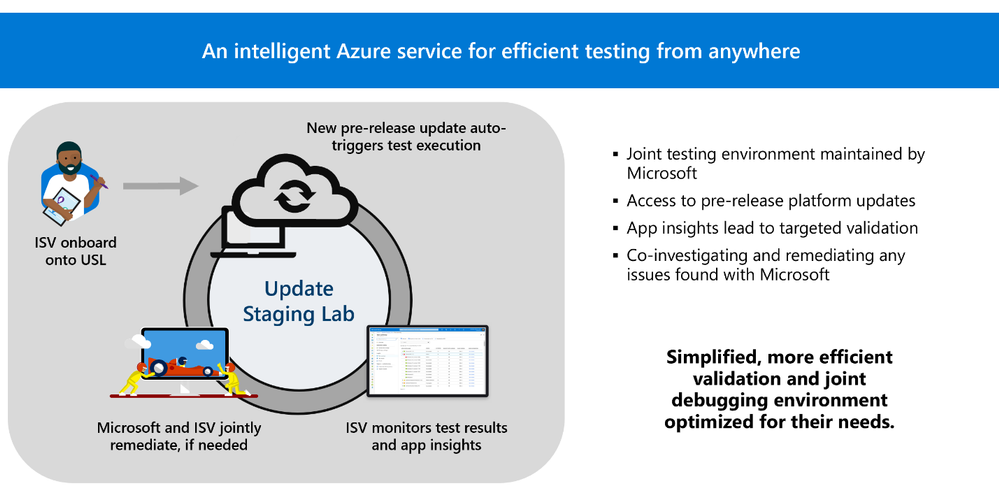
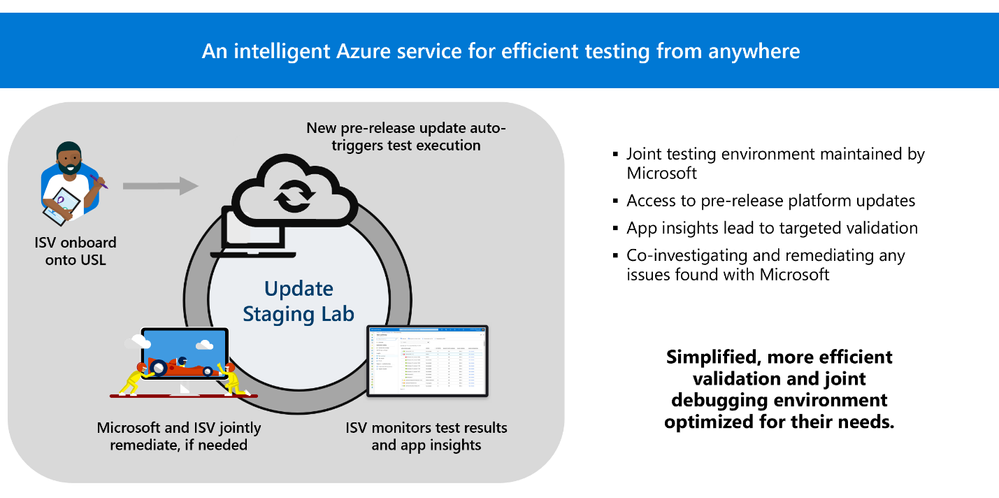
Update Staging Lab is an Azure service that facilitates data-driven testing of applications on Azure. Backed by the power of data and the cloud, the service enables you take advantage of intelligent testing from anywhere in the world. If you are a developer or a tester, you do not want to worry about whether apps will continue to work as dependencies (such as the latest Windows updates) change. That is exactly why we created Update Staging Lab. Want to learn more and sign up? Visit http://aka.ms/joinUSL.
Recent improvements to the Update Staging Lab service
During the private preview , we have continued to develop new features and capabilities based on the feedback we’ve received from customers like you. The improvements we’ve made to Update Staging include the following.
How the service works
Here’s a closer look at how the Update Staging Lab service works behind the scenes:
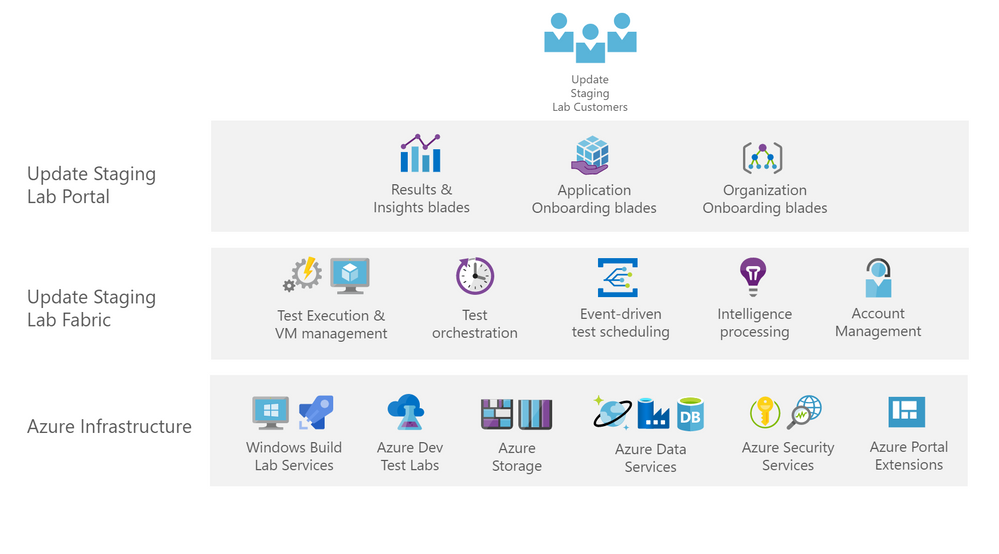
Once onboarded, software vendors interact with the Update Staging Lab service fabric through the Update Staging Lab portal on Azure. The Update Staging Lab service fabric contains key functionality valuable for orchestrating test passes on your applications. Each test pass is completely event driven. For example, in the current private preview, workflows focus on testing a user’s onboarded Windows applications against pre-release security updates every month.
For those that like the details, under the hood, this is how the service works. When Update Staging Lab service fabric gets notified that there is a new security update package in our build lab (which happens as early as three weeks prior to the release date for the monthly security update package), our microservices kick into action. A test pass is scheduled for all onboarded apps. Virtual machines (VMs) are provisioned with the upcoming pre-release monthly update on top of all the released OS versions for which the apps need to be tested. The test pass is orchestrated end-to-end, and the apps are launched on the VMs.
Specific signals that correlate with the health of applications – such as the performance footprint or application reliability data – flow into the Update Staging Lab intelligence service from the test VMs. These signals are processed by our intelligence service using algorithms that can automatically detect potential issues by comparing against the same signals collected from the previous months’ updates. The test pass also runs any automated test suites that the vendor has onboarded into Update Staging Lab. If there is any issue with any of a vendor’s onboarded applications, those issues are visible in the Update Staging Lab Portal along with test logs and additional application performance and reliability insights.
Built on top of other prominent Azure offerings, like Azure Dev Test Labs, which we use to provision and manage our VMs for test passes, Update Staging Lab is able to support testing for software vendors around the world using the same fabric employed by some of the massive internal testing we do within Microsoft.
What’s next on the roadmap for Update Staging Lab?
We are continuously listening to the software vendor community to better understand current testing practices and challenges. We then use feedback we gather to prioritize the next features and capabilities for the Update Staging Lab service. Examples of capabilities that you can expect to light up in the next few months are: support for Windows 7 monthly security updates, support for Windows Server 2016 and Windows Server 2019 monthly security updates, and easier ways to manage application packages you have already uploaded.
Join the community
If you are interested in shaping the future of this important service for the world, I invite you to come join us on the new Update Staging Lab communityU community on Tech Community where you can share your experiences and connect with other customers using (or who are interested in) the service. If you are an software vendor who is interested in onboarding your applications to Update Staging Lab, please complete the private preview sign-up form or bookmark https://aka.ms/JoinUSL to complete the form when it is convenient for you. If you are an IT professional whose organization is interested in nominating a software vendor for participation in the Update Staging Lab service, please complete the same form to nominate your vendor.
Finally, we participate in many events including Microsoft Inspire and Microsoft Ignite. If you are participating in those events, we would love to chat with you regarding your test operations and current challenges.
We look forward to hearing from you and continuing to evolve a service that we hope will help you tremendously in the months and years to come!

by Scott Muniz | Jul 9, 2020 | Uncategorized
This article is contributed. See the original author and article here.

This month at Microsoft we are celebrating July-O-T, a whole month devoted to the Internet of things. With this comes some fun projects that can be easily adapted to bring project-based-learning into the classroom to get hands on with IoT at all levels from K-12 to higher education.
We’re posting more links to different projects every Thursday in July at JulyOT.com so check back there each week, but here are the highlights so far:
Maker week – smart garden ornaments
The week of 13th July is our maker week, with a great project for younger students, or those new to programming and IoT. This is a 5 day project based around a Raspberry Pi and micro:bits. Students can program micro:bits using Microsoft MakeCode to gather sensor data about their environment and send the data to the cloud via a Raspberry Pi programmed in Python. The micro:bits act as a mesh network meaning you can build a network of sensors as large as you have micro:bits that can connect. Students can set this up around their school to track temperatures, light measurements, or even add additional sensors such as a soil sensor made out of wire and nails, and visualize the data on a dashboard.
 A plant with a home-made soil moisture sensor in the soil
This is a great first intro to IoT, and can cover learning objectives including block-based programming, algorithms, electronics, the principles of Cloud computing and the Internet of Things, and data analysis.
You can find all the instructions on GitHub in a hands on lab format, broken into 5 separate stages.
AI week – learn about AI on the edge
AI on the edge is about running AI models close to your IoT data to provide real-time analysis. This weeks project focuses on training AI models in the cloud, then running them on small, relatively low cost AI devices from NVIDIA. This project covers training an image detection model and running it in real-time against a live camera feed, then feeding back the data on what was recognized and visualizing it on dashboards.
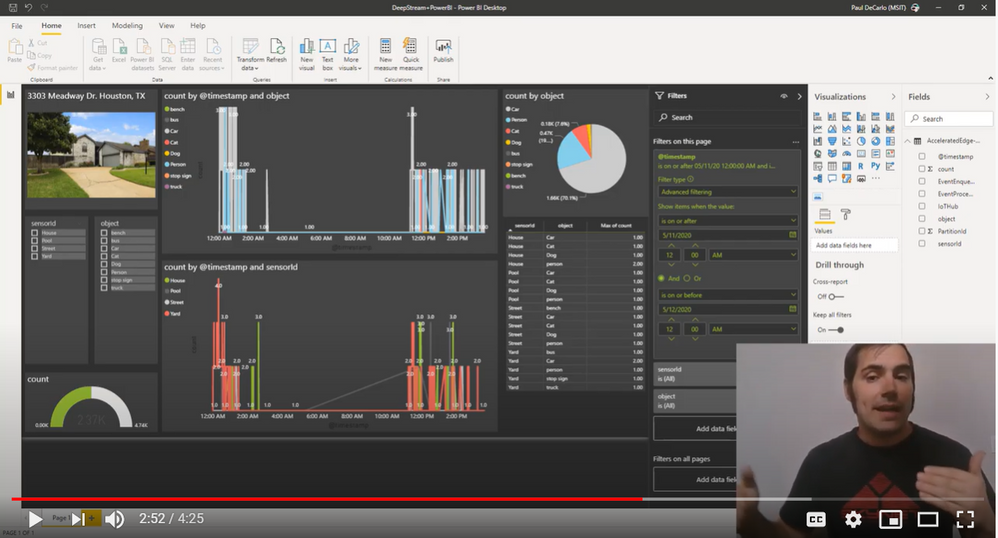 A power BI dashboard showing real time video analytics
This is a more advanced project, but is an ideal introduction to building AI models and running them on the edge. This can be used in the classroom to cover learning objectives around AI, training vision models, IoT Edge, data analysis, and data visualization.
You can find all the steps to recreate this project, as well as hands on videos on GitHub.
Get certified
A sneak preview of our last week – we’ll be focusing on all you need to get certified. Microsoft offers a certification in IoT – the AZ-220 Microsoft Azure IoT Developer certification. This is a great addition to any students CV. Some universities are even augmenting their degree programs with industry recognized certifications, and this is a great one to add to any IoT focused degree program or source.
The last week of July will focus on study guides and everything you need to prepare for this exam.
All the content you need for certification is available as part of Microsoft Learn, our on-line, self-guided, hands-on learning platform. Check out our IoT Learning paths.
There’s more!
There’s more projects coming each week, so keep checking JulyOT.com to see what’s new each week.


Recent Comments