by Scott Muniz | Mar 8, 2022 | Security, Technology
This article is contributed. See the original author and article here.
Mozilla has released security updates to address vulnerabilities in Firefox, Firefox ESR, and Thunderbird. An attacker could exploit some of these vulnerabilities to take control of an affected system.
CISA encourages users and administrators to review the Mozilla security advisories for Firefox 98, Firefox ESR 91.7, and Thunderbird 91.7 and apply the necessary updates.
by Scott Muniz | Mar 8, 2022 | Security, Technology
This article is contributed. See the original author and article here.
The Federal Bureau of Investigation (FBI) has released a Flash report detailing indicators of compromise (IOCs) associated with ransomware attacks by RagnarLocker, a group of a ransomware actors targeting critical infrastructure sectors.
CISA encourages users and administrators to review the IOCs and technical details in FBI Flash CU-000163-MW and apply the recommended mitigations.
by Scott Muniz | Mar 8, 2022 | Security, Technology
This article is contributed. See the original author and article here.
CISA has released an Industrial Controls Systems Advisory (ICSA), detailing vulnerabilities in PTC Axeda agent and Axeda Desktop Server. Successful exploitation of these vulnerabilities—collectively known as “Access:7”—could result in full system access, remote code execution, read/change configuration, file system read access, log information access, or a denial-of-service condition.
CISA encourages users and administrators to review ICS Advisory ICSA-22-067-01 PTC Axeda Agent and Axeda Desktop Server for technical details and mitigations and the Food and Drug Administration statement for additional information.
by Scott Muniz | Mar 8, 2022 | Security
This article was originally posted by the FTC. See the original article here.
This National Consumer Protection Week (NCPW), we’re focused on how scams affect every community — including the LGBTQ+ community. Scammers often like to impersonate familiar people, organizations, and companies that we know and trust. For the LGBTQ+ community, that can include “safe spaces” — or places where the LGBTQ+ community is free to proudly be ourselves.
Scammers can take advantage of those safe spaces — especially online. For example:
- Scammers target people on LGBTQ+ dating apps. Here, a scammer poses as a potential romantic partner on an LGBTQ+ dating app, chats with you, quickly sends explicit photos, and asks for similar photos in return. If you send photos, the blackmail begins.
- Job scams are everywhere. There are job boards particularly for LGBTQ+ applicants to find jobs with welcoming employers. But even if a job says it’s LGBTQ+ friendly, it might not be legit. Unfortunately, job scams can show up anywhere — including on those community boards.
And those are just two examples, and we know there are more. A lot more. So, we’re asking for your help: if you see a scam, or a friend or family member tells you about a scam — tell them to report it at ReportFraud.ftc.gov or, in Spanish, at ReporteFraude.ftc.gov. Every report helps the FTC fulfill its mission to protect every community from scammers. When you tell your story to the FTC, it’s shared with more than 3,000 law enforcers — and it helps the FTC and other law enforcement spread the word so others can avoid scams.
Check out what’s going on during #NCPW2022 at ftc.gov/ncpw. We hope to see you at some of the events.
Brought to you by Dr. Ware, Microsoft Office 365 Silver Partner, Charleston SC.
by Scott Muniz | Mar 7, 2022 | Security
This article was originally posted by the FTC. See the original article here.
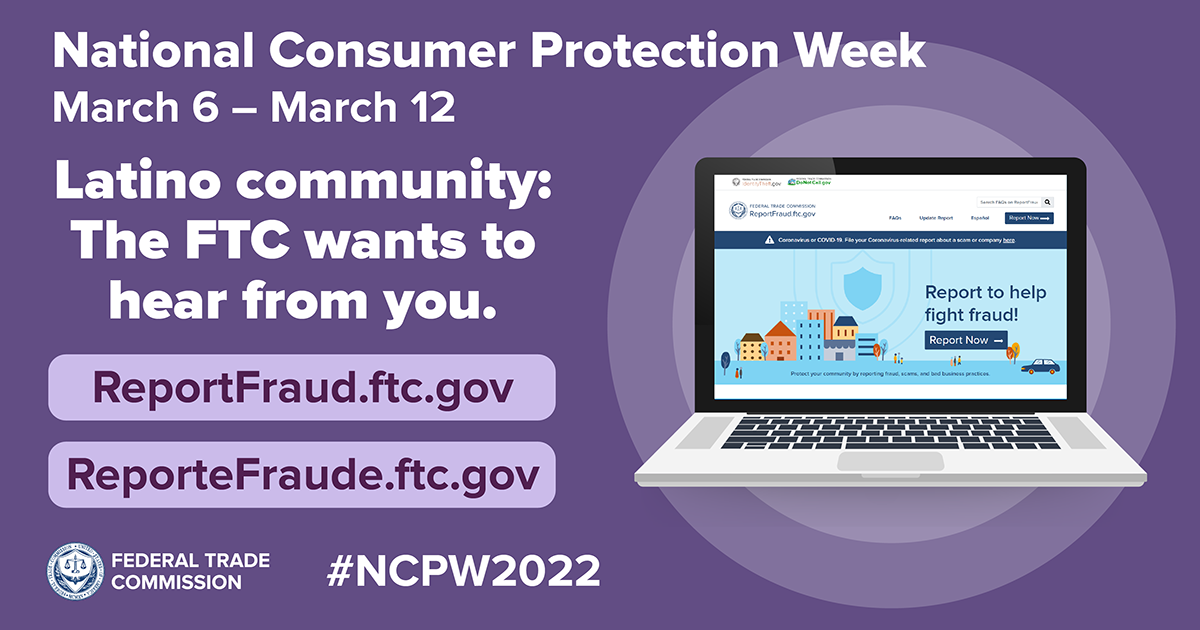
We know scammers target people everywhere. So this National Consumer Protection Week, we’re focusing on how fraud affects every community. In blog posts and events this week, we’ll highlight scams that affect some of those communities, including older adults, college students, servicemembers, and LGBTQ+ communities. Since scammers target every community, including yours, you can make a difference this NCPW: recruit your friends, family, and neighbors across all communities to report the scams they’re seeing to us.
The way fraud affects every community can look different across different demographic groups. For instance, the FTC’s Serving Communities of Color Report highlights some of the unique ways that people experience fraud in Black and Latino communities.
Here are just two examples of the differences we saw:
- Fraud and bad business practices play out differently in different communities. The FTC’s reporting data showed that the top percentage of reports by people living in majority White and majority Latino communities were about impersonator scams. In majority Black communities, the top percentage of reports were about credit bureaus.
- Scammers tell people to pay in different ways. Reports from majority Black and Latino communities show that people are more likely to end up paying scammers in ways that have few, if any, fraud protections ― so: cash, cryptocurrency, money orders, and debit cards. In contrast, reports from majority White communities show that people are more likely to pay scammers with credit cards.
Throughout the week, we’ll talk more about how fraud looks different across different communities. But today is about your community. Please remind your friends, family, and neighbors: if they see a scam, tell the FTC at ReportFraud.ftc.gov. And tune in for the rest of the week’s posts, and check out #NPCW2022 events at ftc.gov/ncpw. We hope to see you at some of them.
Brought to you by Dr. Ware, Microsoft Office 365 Silver Partner, Charleston SC.
by Scott Muniz | Mar 4, 2022 | Security
This article was originally posted by the FTC. See the original article here.
Advertised as a weight management service for kids, teens, and families, the Kurbo by WW app and website let kids as young as 8 track their weight, food intake, activity, and more. The problem? Many parents didn’t know their kids were using it, while the app and website were collecting and keeping information about kids without their parents’ permission.
Today the Department of Justice and FTC announced that Kurbo and its parent company WW International (formerly Weight Watchers) have agreed to settle charges they collected personal information from kids under 13 without notifying parents or getting their permission — something the Children’s Online Privacy Protection Rule (COPPA Rule) requires. That personal information included name, phone number, birth date, and persistent identifiers, including device IDs corresponding to specific accounts.
To settle the charges, the companies have agreed to pay a $1.5 million civil penalty, delete all personal information collected from kids under 13 without parental permission, and destroy any algorithms that used this illegally collected information. In the future, they must destroy any information they collect from kids under 13 if it’s been more than a year since the kid used their app.
Read How To Protect Your Privacy on Apps or visit ftc.gov/YourPrivacy to learn more about protecting your family’s privacy online.
Brought to you by Dr. Ware, Microsoft Office 365 Silver Partner, Charleston SC.


Recent Comments