This article is contributed. See the original author and article here.
Data is everywhere chief financial officers (CFOs) look these days. Senior finance leaders have more data in front of them than ever beforewith insights to drive financial growth, disrupt sales, and transform customer experiences often hiding in plain sight. All the while, the roles of finance leaders are evolving. Once economic guardians, they’re now being called on to take their data and drive digital transformation across business modelsfinancial, operational, and organizational.
To maximize their data’s value and thrive in the face of change, finance teams need to bring the future into focus. That’s why we’re excited to invite you to Finance Reimagined, a digital event on February 23 for forward-thinking CFOs and senior finance leaders. Register now for the Finance Reimagined event for an inside look at the latest CFO trends transforming finance, with strategic guidance for senior leaders who want to understand the forces shaping their future.
See what’s ahead for finance-first innovation
Finance Reimagined is different than other CFO events, with its exclusive content on financial analysis and reporting, strategy and forecasting, business process automation, and compliance and risk management. You’ll discover the best practices and top priorities that leading CFOs are thinking about and have a chance to ask your questions about the future of finance during the live Q&A chat. We’ve lined up experts from Microsoft, industry changemakers, and sessions from EY, PwC, and Accenture to help you:
Adapt quickly: Business as usual has fundamentally changedat unprecedented speeds. The ability to adapt fast is now a competitive edge and differentiated value to customers. Learn how to build agility into your company’s DNA by understanding the trends defining tomorrowso you’re ready to maintain core financial processes, modify business models, and reinvent experiences as market dynamics shift.
Align teams: Business model transformation requires you to look past your current financial constructs and rethink how you operate. Find out how to automate time-intensive tasks and break down silos around your dataacross financial management, project services, and customer’s experiences.
Accelerate growth: Keeping pace with business change means staying ahead of customer expectations. See how insights and AI continuously help improve financial performanceso you can bring clarity to complex questions, make sense of infinite amounts of data, and deal with increasing risk and regulations.
Think like a futurist with special guest Amy Webb
You’ll also hear from keynote speaker Amy Webb on the strategies senior finance leaders can borrow from the futurist’s toolbox. Drawing lessons from her bestselling book, “The Signals Are Talking,” Webba quantitative futurist and advisor to senior leaders at central banks, intergovernmental organizations, and global brandswill talk about how to rethink risk, embrace disruption, and know when to act. She’ll also share future scenarios of emerging technologies to help you forecast what’s next and start creating a stronger future today.
Embrace reinvention to define your future
Finance leaders like you have shown plenty of tenacity and resilience over the past few years, helping to lead the way for their partners and teams. At Finance Reimagined, you’ll see how Microsoft customers are empowering finance-first innovation with a digital transformation platform that helps them adapt faster, align resources, and accelerate growth. Topics we’ll cover include:
How to lead your modern finance team to pivot fast and focus on new areas.
The ways a subscription economy is changing the way we think about business models.
How to redesign and motivate your team to work with new stakeholders and reporting.
Five essential strategies to optimize financial and operating models.
How to drive outcomes by connecting insights and understanding performance indicators.
Register today to attend Finance Reimagined for your look ahead to the emerging trends and essential insights defining how tomorrow’s businesses will thrive. We hope to see you there.
Finance Reimagined
Wednesday, February 23, 2022 9:00 to 11:30 AM Pacific Time
This article is contributed. See the original author and article here.
With more and more customers looking to digital channels for product information, feedback, and insights, the role of the store is changing from a place that simply houses and transacts products to another integral step in building and differentiating customer experience. While this transformation has been taking place these past several years, the recent impact to in-person sales has accelerated the discussion for more retailers in what the role of the retail store will be in the future. Customer experience has been top of mind for retailers for years, but experience means different things to different people. In-store experience for a fashion retailer is dramatically different from that of a grocery store, however, this is something that each retailer has to define for their business. Microsoft sets out to help retailers bridge the gap between customer expectation and delivered experience. By utilizing the intelligent and connected tools available in Microsoft Dynamics 365, retailers can streamline the buying journey and ensure consistent and personalized customers experience across all relevant channels.
Dynamics 365 Commerce combined with Dynamics 365 Customer Insights enables retailers to streamline in-store practices and bring relevant customer data to sales agents, when and where needed, to deliver real-time personalization for customers in-store.
Transforming retail experiences to meet customer’s expectations
Mattress Firm is a great example of a retailer that has redefined their role as part of the customer sleep journey. By moving their focus from selling mattresses, to helping customers gain a better night’s sleep, it transformed their perspective on the experiences needed in store to reflect this focus.
This embed requires accepting cookies from the embed’s site to view the embed. Activate the link to accept cookies and view the embedded content.
“Customers are just asking for these elevated retail experiences, and all of these things require technology, data or both.”Jonathan Sider, CIO and COO of e-commerce, Mattress Firm.
To evolve the retail store, organizations need to deliver more robust, sensory experiences and personalized customer service. The main ways through which this can be accomplished are personalization, seamless purchasing, and expanded in-store experiences.
The value of data and personalization
Consumers today respond better to personalized experiences. In the context of brick-and-mortar retail, this means being able to connect a customer’s online activities and past purchases with an in-store team member. One means of effective personalization is to deliver customer intelligence data, such as tailored recommendations, to the point in the customer journey where this information will have the greatest impact, such as point of sale (POS) terminals in-store or to sales associate handheld devices. Automation in the retail store is about improving the customer journey while also simplifying and removing as many low-value manual processes as possible from team member responsibilities, such as inventory management, ordering, and fulfillment.
Retailers like GNC are looking to Microsoft and Dynamics 365 to help meet and exceed customer expectations at every touchpoint.
“We expect to provide our customers with a highly personalized experience tailored to their wellness journey. Whether they’re an 18-year-old high school athlete or a 70-year-old retiree, we want them to get the right message about products, programs, or deals that will appeal to them. We chose Customer Insights because with it, we have the data infrastructure to really do that right.”—Lauren Mannetti, Vice President, Marketing, GNC.
These forms of automation have rapidly become vital to providing the seamless omnichannel experience that customers demand. But, as we’ve discussed before in our Exceed customer expectations with seamless and unified commerce experiences blog post, this requires connecting data across back-end systems, which companies often overlook while focusing on their front-end process and online sales channels.
Seamless, frictionless purchasing is now an expectation
Consumers have mostly moved away from cash and now desire a fast, contactless, friction-free buying processideally without lines. For retail, this requires truly “instant checkout,” which means: Scan. Pay. Done. No lines. No hassle. No wait. The entire process occurs through the mobile point of sale application on a phone or tablet. Combining this with checkout stations and roaming team members positioned throughout the stores allows customers to bag their purchases and go on their way.
Customers like LIDS are using Dynamics 365 Commerce to get out from behind the counter and engage with customers in the isles with a user-friendly, touch-based point of sale device. With a wide variety of products and sizes, transactions are smoother when the employee can work with a customer and look up what’s in stock right from the sales floor.
“Our greatest assets are our store employees and managers, they care about the POS, and they want technology. When they walk into the store and see something that’s not a touchscreen, they kind of disconnect.”Nick Corthier, Chief Financial Officer, Lids.
Dynamics 365 also simplifies the payment experience with native integration with payment providers like Adyen, thereby enabling an easy and truly unified commerce solution for retailers.
Expanding in-store experiences
It’s up to every retailer to define what the role of their stores will be given the range and variety of retail offerings. One thing is for sure, retailers that adapt quicker are more likely to create differentiated value in the market and ultimately define what the future of their ‘retail vertical’ should look like. Technology is helping these retail leaders set the pace and standing up new models and raising the bar, especially for premium brands.
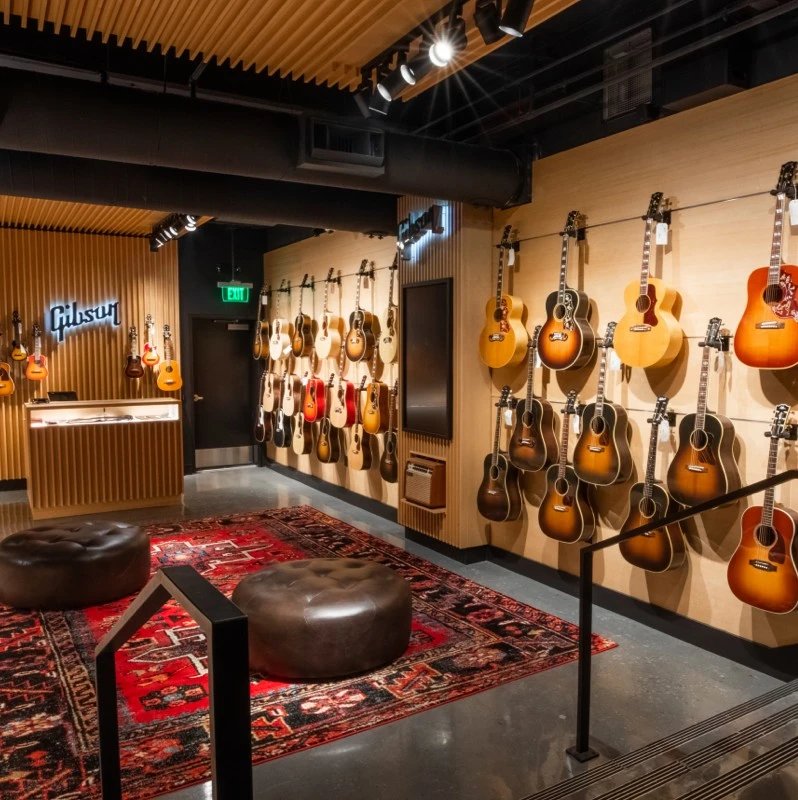
Gibson Brands is looking to lead the way in building a best-in-class retail experience for music enthusiasts. Gibson Garage, a new entertainment and retail outlet in downtown Nashville, features digitally fueled in-store experiences for customers. The Gibson Garage allows customers to see the guitar they’re buying, hear somebody play it, get excited about their purchase, and enjoy the entire music-centered hangout experience, complete with musicians and iconic gorgeous instruments. It becomes a place that musicians and music lovers alike want to gather and spend time; the way book lovers would a bookstore and caf.
“Our legacy systems were unstable, unsustainable, and not optimized for the current ways of working…They weren’t talking to each other. Dynamics 365 has brought the company to the leading edge of technology in terms of enterprise resource planning (ERP). It’s stepped up our game and unlocked so many possibilities that we’re just scratching the surface. We’re continually going through, refining processes, and unlocking different aspects of the ERP to figure out what works for us in a system.”Mallory McClain, Dealer Service Supervisor, Gibson Brands.
These are examples of combining theatre-like retail settings, personalization, and automation to create a retail sales experience that is differentiated and pushes the boundaries of what we typically think of as shopping.
What’s next?
Many companies have merged data across disparate systems to rise to the new expectations of retail as an experience. These merchants have made investments in technology to move to an integrated unified commerce solution, like Dynamics 365 Commerce.
Visit our Dynamics 365 retail page to learn how Dynamics 365 can help you deliver on your customers’ expectations by evolving your retail experiences and how Microsoft can support your business for growth.
This article is contributed. See the original author and article here.
Earlier in 2021, we had discussed how retailers can create an intelligent supply chain to successfully navigate through the disruptions and quickly adapt to changing customer behavior. As our retail customers embarked on the journey to create a resilient and intelligent supply chain, there were three key areas that emerged where our customers prioritized their investmentsoptimizing fulfillment, predicting supply chain risks, and enhancing supply chain visibility. Let’s take a look at some of Microsoft’s recent innovations in these areas that enable retailers to create a supply chain of the future.
Turning order fulfillment into a competitive advantage
A retailer’s success hinges on having the right inventory at the right place at the right time. As retailers and brands continue to adapt to meeting the growing e-commerce demand, determining where the inventory is fulfilled for e-commerce versus in-store orders becomes critical to ensure that customer demands are met on time and in a profitable manner.
As a recent Gartner report found, one of the ways to achieve supply chain excellence is by holding distribution center inventory in a channel-agnostic manner for flexible use of inventory to fulfill online and in-store demand effectively1. To achieve this level of flexibility, retailers need a system that offers rules-based order orchestration leveraging AI and real-time omnichannel inventory data to proactively address constraints and profitably fulfill orders on time and in full.
At Microsoft, we are at the forefront of these efforts, investing in solutions like Microsoft Dynamics 365 Intelligent Order Management that help retailers reimagine the future of global supply chains and turn order fulfillment into a competitive advantage.
This embed requires accepting cookies from the embed’s site to view the embed. Activate the link to accept cookies and view the embedded content.
Predict risk and enhance visibility with AI-powered insights
According to Gartner, 76 percent of supply chain executives indicated that compared to three years ago, their company today faces more frequent disruptions in their supply chain. Meanwhile, another 72 percent reported that the impact of disruptive events has increased.2
Retailers have made significant strides in 2021 to create resiliency in their supply chains but the response has still been very reactive in nature. Slow digitization of the supply chain continues to inhibit organizations from proactively planning for changing customer demand and supply challenges. With an increase in e-commerce, it is imperative to gain real-time visibility into inventory at every node of the supply chain, all the way from the manufacturer to shipping ports to distribution centers to stores and finally to the consumer. Brands gain affinity when they consistently deliver on their order promise to their customers.
With this need for increased visibility and consistency in mind, we recently launched Microsoft Dynamics 365 Supply Chain Insights in preview that enables organizations to predict risks in their supply chain based on news, weather, geo-political events, etc., and enables them to make better supply chain decisions with proactive risk mitigation via prescriptive insights powered by AI.
With Dynamics 365 Supply Chain Insights, retailers and consumer goods companies can create a digital representation of their physical supply chain. This enables them to simulate different scenarios at different nodes along the value chain and make well-informed decisions to mitigate any disruption. They can further gain visibility into the supply chains of their multiple tiers of suppliers, and improve the effectiveness of their demand and supply planning to ensure a delightful customer experience.
We also made significant enhancements to the Inventory Visibility add-in for Dynamics 365 Supply Chain Management. Retailers can now get near real-time inventory visibility across all their internal channels and disparate third-party supply chain systems in a single place. Adding multiple systems in a scalable manner allows them to add new third-party integrations as they grow their supplier network or acquire new businesses. The enhanced visibility enables businesses to proactively mitigate any out-of-stock situations. Furthermore, they can perform soft reservations based on omnichannel sales demand so that they do not incorrectly commit to a customer.
Retailers can further leverage enhanced planning capabilities to enable near real-time inventory planning by prioritizing certain orders over others with ease. For example, they can prioritize orders for products that are low on stock versus the ones that are not. Lastly, retailers can optimize and streamline back-of-house operations like receiving and replenishment using the Warehouse Management mobile app. The mobile app empowers distribution centers, warehouses, and brick-and-mortar locations to make inventory decisions like transferring goods from one location to another simply by scanning the items. By running critical warehouse operations on Edge, retailers can ensure business continuity across all locations despite latency or network issues at HQ.
All the supply chain solutions from Dynamics 365 are not only interoperable with each other but also seamlessly work with other third-party ERP, commerce, and supply chain systems.
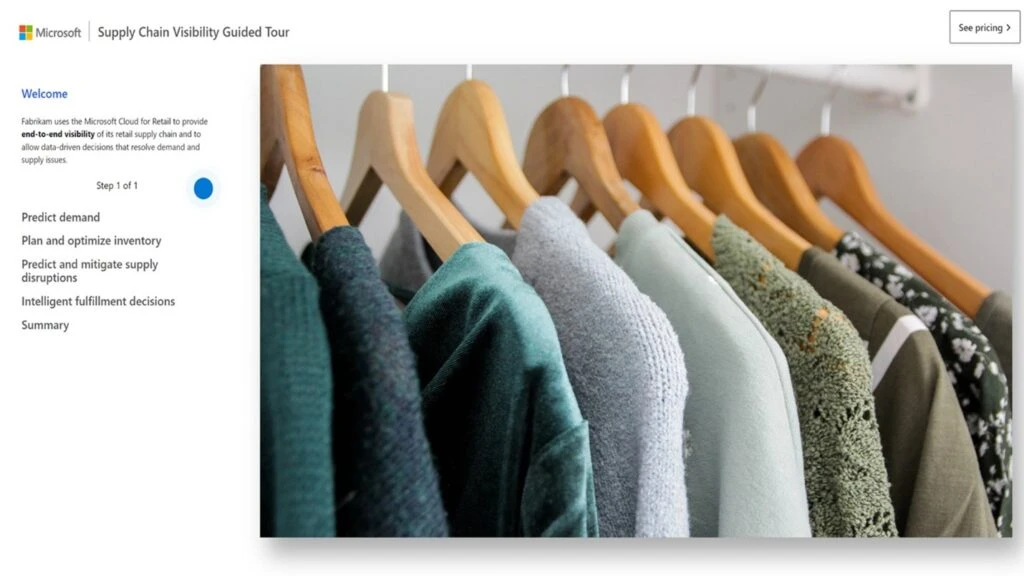
Take the Supply Chain Visibility Guided Tour to see how a retailer can enhance supply chain visibility using Dynamics 365 and Microsoft Cloud for Retail.
Here are some recent examples of our retail customers who have created a resilient supply chain this past year using Dynamics 365.
Servis Industries Limited powers direct-to-consumer expansion by moving to the cloud
Established more than 50 years ago, Servis Industries Limited (SIL) is a leading manufacturer and exporter in Pakistan. To achieve its goal of becoming a global, world-class, and diversified company, SIL moved its on-premises infrastructure to the cloud by adopting Dynamics 365 Finance, Dynamics 365 Supply Chain Management, and Dynamics 365 Commerce. Now, the company has a holistic overview of its retail stores and an infrastructure management system that can support rapid national and international growth.
“To achieve our goal, we need to open 40 to 50 outlets per year. It used to be that with each new store, our team had to be on-site to provide technical support. Now, everything is cloud-based, so we don’t have to travel. The new stores can just access the systems and start their operations almost immediately.”Faisal Rizvi, Head of IT, Servis Industries Limited.
Another challenge that SIL encountered in its journey was the need to meet the evolving customer expectation for personalized engagement, omnichannel experiences, and frictionless interactions. For this, the company turned to Distributed Order Management to deliver smooth order processing between its e-commerce platform and physical stores and to optimize order fulfillment across their network by utilizing AI, automation, and real-time inventory.
Khaadi delivers rapid omnichannel success
Founded in 1998, Khaadi is Pakistan’s premier fashion retailer with more than 70 physical stores across Pakistan, the Gulf Cooperation Council (GCC), the United Kingdom, and online stores in more than 12 countries. With its growing network of physical and online storefronts, the company needed a solution that could streamline its omnichannel sales delivery and empower its daily operations with actionable store-level insights for managers. The drive towards omnichannel was forced into overdrive when pandemic lockdowns moved all of Khaadi’s operations online. Suddenly, they needed to pivot to leverage a single inventory across the business and use their stores as fulfillment hubs.
To meet this challenge, Khaadi turned to Microsoft Power Apps and Power BI, alongside Dynamics 365 Commerce, Dynamics 365 Finance, and Dynamics 365 Supply Chain Management. With this technology in place, Khaadi successfully transitioned to omnichannel.
“We were able to draw up a blueprint for omnichannel sales rapidly and implemented a complete enterprise-level scenario in just in one weekend. IT was able to transform the dynamics of our business within just a week’s time, making Khaadi a truly omnichannel enabled retailer. From there, it was only a matter of three months before we scaled the roll out ten times with help of Dynamics 365 Commerce Distributed Order Management.”Muhammad Rehan Qadri, Chief Information Officer, Khaadi.
As you can see by these recent customer success stories, Dynamics 365 Supply Chain Management is helping companies to deliver the retail supply chain of the future by empowering direct-to-consumer expansion and accelerating omnichannel success.
What’s next?
The events of the past two years have made it essential for businesses to invest in technology that can help them sense supply chain constraints and disruptions and predict spikes and troughs in demand. Microsoft Dynamics 365 assists companies in integrating these types of new capabilities, such as real-time, end-to-end visibility, priority-based planning, and AI-empowered insights so that they can effectively compete in this new normal. As we have seen here, this can take the form of accelerating direct-to-consumer and omnichannel success, empowering retailers to turn order fulfillment into a competitive advantage, and integrating advanced warehousing solutions to improve distribution processes.
GARTNER is a registered trademark and service mark of Gartner, Inc. and/or its affiliates in the U.S. and internationally and is used herein with permission. All rights reserved.
This article is contributed. See the original author and article here.
Omnichannel has been around for more than a decade now, so it might be surprising to realize that there are still gaps in a strategy that has become table stakes for most retailers. The gap that does exist presents a lack of clarity about what omnichannel retail is and the inability of organizations to deliver on the strategy. With retail in the midst of one the largest transformations we have seen in decades, many organizations are trying to understand where to start bridging the gap between traditional and modern retail experiences. Microsoft Dynamics 365 brings together a unique set of capabilities and services that allow retailers to streamline buying experiences for customers across channels while empowering organizations to gain a deeper understanding and ownership of their sales, operations, and customer data.
Disconnected data disrupts the modern buying journey
The lack of unified data in a retailer’s current systems still proves to be a significant roadblock to providing omnichannel experiences to consumers. Like many retailers, the U.S. national retailer GNC, which specializes in health and nutrition-related products, also struggled with disconnected data across its systems. This meant, among other things, that GNC found it challenging to provide a single source of truth about its customers that would allow them to communicate efficiently and effectively. The siloed data affected customer communications, but it also kept the retailer from gaining real-time insights into things like customer preferences and inventory.
The ultimate solution for GNC and for any business looking to leverage data across systems is to use a single collection of data automatically updated across applications in real-time. This is one reason why GNC deployed Dynamics 365.
“With Dynamics 365 Customer Insights, we’re going to have a single, reliable view of each customer that updates in real-timeWe’ll use the AI capabilities in Customer Insights to better define our customer segments and ensure that every customer gets the right communication at the right time.”Lauren Mannetti, Vice President, Marketing, GNC.
Microsoft also continues to help retailers adjust to customer needs with tools like intuitive customer segmentation and experimentation capabilities. Dynamics 365 Commerce enables organizations to increase customer engagement and satisfaction by using tools in e-commerce site builder to target specific customer segments with different experiences based on the shopper’s device, geo-location, and other dynamically derived attributes from their browser request.
Regardless of the solution you choose, you need to be able to pinpoint a customer all the way through their journey, from browsing online to asking each customer for feedback. Increasingly, retailers will be tasked with offering ever-more personalized experiencesand that requires sophisticated and connected data that overcomes the limitation of siloed separate systems.
Complexity of legacy solutions
Many businesses have invested heavily in their current legacy solutions. Rightly so, most wish to maximize the benefit of these investments. Unfortunately, businesses can end up dealing with the complexity of their existing systems far longer than necessary as they attempt to avoid investing in a new unified solution. Sometimes, though, adding additional visibility and integration on top of existing solutions works well to address this problem without having to scrap the current systems being run for separate functions.
This is how Khaadi, a large Pakistani fashion retailer, figured out how to get its complex incumbent solutions to work together to keep operations going during the pandemic. It needed to be able to integrate data so that it could continue selling in-store inventory online during pandemic shutdowns.
To make this pivot, the company chose Microsoft Power Apps, which helps companies build custom apps that connect existing data, to create the brand’s integrated sales services in-house. Then, three months later, the company scaled the roll out ten times with the help of Dynamics 365 Commerce to make these capabilitiesand morepart of its new operating norm.
“It’s incredible because we know of some similar retail businesses who started their omnichannel journey 14 to 15 months back but have not yet implemented similar capabilities.”Muhammad Rehan Qadri, Chief Information Officer, Khaadi.
Using Microsoft Power Apps coupled with Dynamics 365 Commerce allowed the company to continue using its existing systems by allowing those systems to better “talk to each other” and leverage the data across them. This provides a solution that many other retailers can turn to make immediate use of their data that otherwise is isolated in separate systemswithout replacing those systems.
Inability to adapt to changing customer habits
Another roadblock to providing omnichannel experiences is an inability to adapt to changing customer needs. This can result from a business that isn’t using the right technology to streamline operations and connect all of its data. The need to streamline backend operations is just as critical to customer experience when the goal is being able to adapt to rapidly changing customer behaviors and habits.
Now, more than ever, consumers seek out reviews and social proof before making a purchase. In fact, social commerce sales in the U.S. were an estimated $36.62 billion in 2021.1 It is not surprising then that businesses without the technology infrastructure required to connect these new sources of demand and customer intelligence may fall behind.
Dynamics 365 enables retailers to easily adjust and meet customers where they are through a common data model and a natively headless commerce engine. Easily connect with customers on new and emerging platforms to ensure your business stays competitive and relevant in an ever more competitive retail environment.
Along with this, it is essential for retailers to be able to automatically track reviews across platforms, monitor them, and automate the solicitation of reviews from customers through post-shipping emails and other such activities. Also, monitoring and identifying how specific customers respond to social storytelling requires deep data that connects across platforms. This is another area where Dynamics 365 Commerce can help.
Consumers today understand that retailers can capture data of how, what, when, and where they make purchases. Not only do they understand this point, but they also expect it. This is one reason retailers face increased demands to understand consumers better and personalize experiences accordingly.
An area where customer expectations have evolved and increased is the desire for convenience. According to the National Retail Federation, 97 percent of consumers have backed out of a purchase because it was inconvenient to them.2 This can be seen by the popularity of curbside pickup, next-day delivery, and easy returns. Yet even though businesses can lose sales if they inconvenience consumers, many companies are still challenged to provide the options that customers have come to expect.
Retailers like Aubainerie are using Dynamics 365 to improve customer experience and personalize customer engagements across channels. The company’s apparel designers are using Dynamics 365 Commerce combined with Dynamics 365 Customer Insights to include more product information for staff and customers at the point of purchase. They are also able to fine-tune their understanding of customer needs to deliver more personal customer buying experiences and exceed customer expectations.
“We can designate activity filters in Dynamics 365 and then plan in advance for e-commerce and in-store displays based on those data points, which improves our omnichannel capabilities.”Simon Jacobsen, Director of e-commerce, Aubainerie.
For companies to offer these convenience features to customers and meet the expectations for personalized and relevant shopping experiences, retailers can look to Dynamics 365 to help bridge the omnichannel gap for long-term business success.
We’re ready to help you evaluate the best ways to unify and connect data by leveraging technology to overcome these four major roadblocks so that you can bridge the omnichannel gap in retail. To see how Dynamics 365 can help your retail business succeed, see how you can get started with Dynamics 365 or give our Dynamics 365 Commerce free trial a try today.
This article is contributed. See the original author and article here.
Organizations across industries and around the world are seeking new ways to unlock their customer data to provide high-quality, connected customer experiences. Microsoft’s work to help enterprises, especially those in the retail, consumer brands, healthcare, manufacturing, and media and advertising industries to meet their customers’ expectations by delivering privacy-aware, consent enabled personalization has gained some recognition.
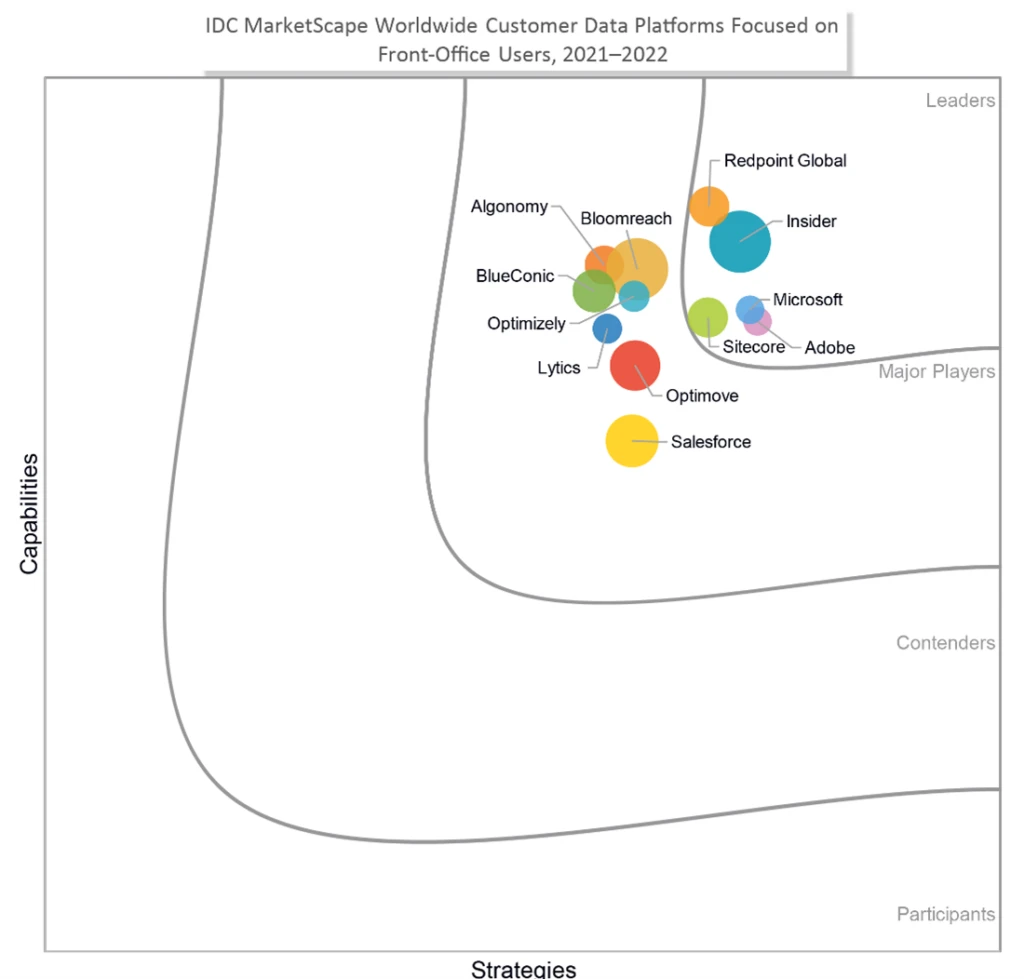
Microsoft is thrilled to be named a Leader in the IDC MarketScape for Worldwide Customer Data Platforms Focused on Front-Office Users 2021-2022 Vendor Assessment (doc # US47524621, December 2021). The IDC MarketScape is the first research by a major analyst firm evaluating customer data platform (CDP) vendors.
Source: “IDC MarketScape: Worldwide Customer Data Platforms Focused on Front-Office Users 20212022 Vendor Assessment”, By: Gerry Murray, David Wallace & Michelle Morgan, December 2021, IDC # US47524621
The report highlights customer data management, including 360-degree customer view, improving customer experience, and globalization as top capabilities within Dynamics 365 Customer Insights. Dynamics 365 Customer Insights helps customers unify all their B2C and B2B customer data to generate AI-powered insights in real-time, creating a single view of the customer. Interactive reports help marketers optimize their customers’ journeys, and AI-powered insights speed the prediction of customer needs.
Dynamics 365 Customer Insights elegantly supports both technical and non-technical usersbe it through a visual UI/drag and drop interface for marketers or through advanced analytics for data scientists. The IDC MarketScape said to, “Consider Microsoft if you have significant investments in Microsoft’s Dynamics 365 applications such as marketing or sales or if you are looking for user-friendly AI/ML modeling capabilities that do not require marketers (and other LOB users) to be data scientists.” The report also noted, “Microsoft’s CDP segments are created through automated discovery powered by AI, API configuration, and visual UI/drag and drop interface for markets and through analytic/SQL queries for data scientists. Segments are updated based on a variety of factors such as streaming web session data, geolocation, and dynamic modeling and based on batch data updates.”
The IDC MarketScape noted, “Microsoft is strong in this important area for enterprise CDP buyers as the speed, scale, and response time for processing high volumes of customer data are an important enabler of personalization and customer experience.”
The IDC MarketScape also stated, “Microsoft has strengths in all aspects of globalization: number of languages supported in its CDP; number of countries with customers, sales, service, and support; and regional implementation partners.”
IDC MarketScape vendor analysis model is designed to provide an overview of the competitive fitness of ICT suppliers in a given market. The research methodology utilizes a rigorous scoring methodology based on both qualitative and quantitative criteria that results in a single graphical illustration of each vendor’s position within a given market. The Capabilities score measures vendor product, go-to-market and business execution in the short-term. The Strategy score measures alignment of vendor strategies with customer requirements in a 3-5-year timeframe. Vendor market share is represented by the size of the circles. Vendor year-over-year growth rate relative to the given market is indicated by a plus, neutral or minus next to the vendor name.





Recent Comments