Mozilla Releases Security Update for Thunderbird

This article is contributed. See the original author and article here.

Original release date: December 2, 2020

Mozilla has released a security update to address a vulnerability in Thunderbird. An attacker could exploit this vulnerability to take control of an affected system.

The Cybersecurity and Infrastructure Security Agency (CISA) encourages users and administrators to review the Mozilla Security Advisory for Thunderbird 78.5.1 and apply the necessary update.

This product is provided subject to this Notification and this Privacy & Use policy.

Xerox Releases Security Updates for DocuShare

This article is contributed. See the original author and article here.

Original release date: December 2, 2020

Xerox has released security updates for DocuShare 6.6.1, 7.0, and 7.5 to address a vulnerability that could allow an unauthenticated attacker to obtain sensitive information.

The Cybersecurity and Infrastructure Security Agency (CISA) urges users and administrators review Xerox Mini Bulletin XRX20W and apply the necessary updates.

This product is provided subject to this Notification and this Privacy & Use policy.

Hey college students: have you seen this scam?

Hey college students: have you seen this scam?

This article was originally posted by the FTC. See the original article here.

Scammers are targeting college students. In the last year, we told you about a car wrap scam and a COVID-19 scam hitting college students. Today, we want to tell you about a fake check scam.

In this one, a scammer posing as a professor sends you an email. It uses a college domain name and a format like your.name@collegename.edu. The scammer offers you a part-time job, like personal assistant or dog walker. Then, the scammer sends you a check, asks you to deposit it, send some of the money to someone else, and keep the rest as payment. A while later, the bank realizes the check was fake and deducts the original check amount from your account. So, if you deposited a $1,000 check, they’ll take that back. But if you sent $400 to someone else, you’re now out $400 of your own money.

People report losing a lot of money to fake check scams. The median loss in 2019 was $1,988. That’s a lot of money for anyone to lose. But an FTC analysis published earlier this year showed that people in their twenties are more than twice as likely as people over 30 to report losing money to fake check scams.
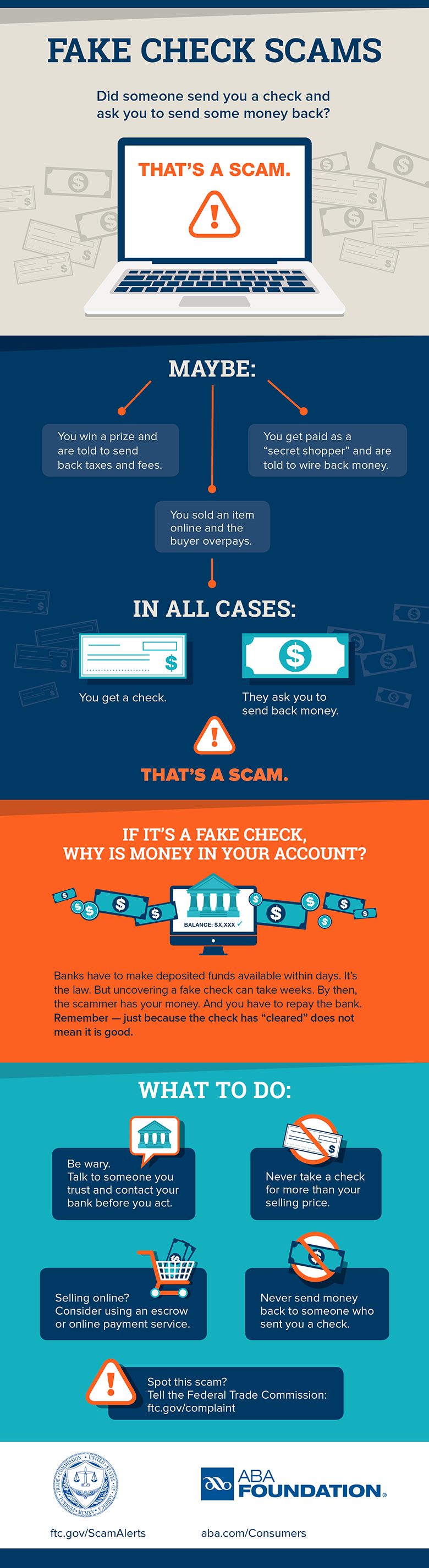
Fake Check Scams Infographic

So how do you avoid a fake check scam? Never use money from a check to send gift cards, money orders, or wire money to someone. It’s always a scam. And, once you send the money or put it on a gift card and give someone the gift card PIN, it‘s like giving them cash. It’s almost impossible to get your money back.

Banks have to give you money from deposited checks within a few days. But if the check turns out to be a fake, they’ll make sure they get that money back from your account. The bottom line is, if someone sends you a check and tells you to send money by wire transfer or gift card — it’s a scam.

Spotted a scam like this? We want to hear about it. Let us know at ReportFraud.ftc.gov.

Brought to you by Dr. Ware, Microsoft Office 365 Silver Partner, Charleston SC.

Advanced Persistent Threat Actors Targeting U.S. Think Tanks

This article is contributed. See the original author and article here.

Original release date: December 1, 2020

This Advisory uses the MITRE Adversarial Tactics, Techniques, and Common Knowledge (ATT&CK®) framework. See the ATT&CK for Enterprise for all referenced threat actor tactics and techniques.

The Cybersecurity and Infrastructure Security Agency (CISA) and the Federal Bureau of Investigation (FBI) have observed persistent continued cyber intrusions by advanced persistent threat (APT) actors targeting U.S. think tanks. This malicious activity is often, but not exclusively, directed at individuals and organizations that focus on international affairs or national security policy.[1] The following guidance may assist U.S. think tanks in developing network defense procedures to prevent or rapidly detect these attacks.

APT actors have relied on multiple avenues for initial access. These have included low-effort capabilities such as spearphishing emails and third-party message services directed at both corporate and personal accounts, as well as exploiting vulnerable web-facing devices and remote connection capabilities. Increased telework during the COVID-19 pandemic has expanded workforce reliance on remote connectivity, affording malicious actors more opportunities to exploit those connections and to blend in with increased traffic. Attackers may leverage virtual private networks (VPNs) and other remote work tools to gain initial access or persistence on a victim’s network. When successful, these low-effort, high-reward approaches allow threat actors to steal sensitive information, acquire user credentials, and gain persistent access to victim networks.

Given the importance that think tanks can have in shaping U.S. policy, CISA and FBI urge individuals and organizations in the international affairs and national security sectors to immediately adopt a heightened state of awareness and implement the critical steps listed in the Mitigations section of this Advisory.

Click here for a PDF version of this report.

This product is provided subject to this Notification and this Privacy & Use policy.

Debt collectors: Mind the “No Parking” signs on credit reports

This article was originally posted by the FTC. See the original article here.

There’s a virtual “NO PARKING” sign planted smack in the middle of your credit report. It means that debt collectors can’t report your debt — or your supposed debt — to credit reporting agencies without first trying to check with you.

Brought to you by Dr. Ware, Microsoft Office 365 Silver Partner, Charleston SC.