
by Contributed | Apr 26, 2021 | Technology
This article is contributed. See the original author and article here.
As frontline workers increasingly interact with workplace applications using mobile devices, tablets, or other mobile form factors, organizations face higher risks of these devices being lost, stolen, or temporarily misplaced. Earlier this year, Microsoft announced new licensing options for organizations with frontline workers to address these potential risks and other security threats, while also helping improve compliance capabilities.
With these offers, organizations using Microsoft Surface devices can better protect their devices and data against attacks or accidents. With security capabilities built into the firmware, operating system, and Microsoft 365, Microsoft has taken a comprehensive chip-to-cloud approach to help organizations deliver more protection for employees using Surface devices with Microsoft 365.
Surface with Microsoft 365 provides unique protection at the front line. To provide a few illustrations of how devices may be vulnerable and how this new level of protection can support organizations and frontline workers, here are a few commonplace examples:
- Scenario 1: The device is stolen while it is momentarily unattended
- Scenario 2: A malicious actor gains access to a device for a short time
- Scenario 3: An employee accidentally visits a malicious website or unknowingly joins an unsecure Wi-Fi signal
Scenario 1: The device is stolen while it is momentarily unattended
A building inspector is on a job site and sets her Surface Pro 7+ down for a second while she checks a plumbing connection. Someone steals the device, hoping to find sensitive information or perhaps intending to sell the device to a highly capable hacker. The following protections built into Surface and in the cloud with Microsoft 365 help prevent a stolen device from compromising sensitive data:
- Data on the hard drive is encrypted. Surface devices ship with BitLocker drive encryption enabled by default, so the data on the hard drive cannot be accessed without credentials or the encryption key. Even if the hard drive is removed from the device and inserted into a new device, it cannot be decrypted.
- USB booting is prevented because the organization used Microsoft Endpoint Manager to proactively turned off the ability to boot from USB through the firmware-level control that the Surface device offers.
- There is zero access to data even if the SSD is removed. If a Surface’s removable SSD is tampered with, the device will shut off power, erasing any residual data in its memory. Since the device is cloud-managed, the organization can remote wipe all the machine’s contents .
Scenario 2: A malicious actor gains access to a device for a short time
A retail employee is helping a customer in the store when they both hear a loud crash. Another customer has knocked over a display accidentally. The employee puts down their Surface Pro X and rushes over to help. Seeing the device was not locked, someone takes the device. Later, they try to access data stored on the device. With Microsoft’s cloud security, the retail establishment’s data is protected.
- A Zero Trust approach means that even if a device is authenticated, the current user profile can only access data and content they have permissions for. The retail establishment assumes that a breach is always possible and maintains strict controls over data access. Conditional access capabilities in Microsoft 365 prevent data leakage from both internal and external actors.
- Any unusual behavior on the device is automatically detected and remediated with Microsoft Defender for Endpoint, which analyzes signals from the device to recognize any abnormal behavior, like an uncommon executable running on the device. As part of the remediation path, the device is automatically quarantined from the network until the situation is resolved.
Scenario 3: An employee accidentally visits a malicious website or unknowingly joins an unsecure Wi-Fi signal
An employee joins a public Wi-Fi network, which creates the potential for a malicious actor to collect sensitive information. Or maybe the employee accidentally clicks a link that installs malicious code on a device. Surface with Microsoft 365 can keep data secure in a few ways:
- Instead of worrying about encrypting data that could be shared on a public network, the organization takes a proactive approach to having a guaranteed secure connection, especially for employees in the field, by equipping frontline workers with LTE-enabled devices. The entire Surface 2-in-1 portfolio (Surface Go 2, Surface Pro 7+, Surface Pro X) has LTE available.
- Any websites, cloud resources, or internal networks not explicitly defined as “trusted” are contained with Microsoft Defender Application Guard. These untrusted sites or files are opened in a virtualized container – essentially a separate PC within the existing PC – to isolate those potentially harmful sites or files from the rest of the device.
In addition to the ways that Surface with Microsoft 365 can help keep frontline devices secure, with cloud management and Windows Autopilot, Surface devices can also be shipped directly to a worker’s location without IT ever touching the device, saving time and effort. As frontline workers increasingly use devices in public spaces, the need to protect sensitive information at the front line has never been more important.
To learn more about Surface for Business visit Surface.com/Business or connect with your local commercial reseller.
by Contributed | Apr 26, 2021 | Technology
This article is contributed. See the original author and article here.
Join us tomorrow Tuesday, April 27, 2021 from 10:00 AM – 1:00 PM PDT
This industry-focused CMMC readiness summit, part two in the series, is a 3-hour conference designed to bring together the defense industrial base and the greater government contracting community for new perspectives from leading technology vendors and government officials. It will include exclusive insights from Suzanne Spaulding, Senior Advisor to the Department of Homeland Security from CSIS, a “titan” cloud security panel that will address the need for transparency of CMMC controls, a DIY vs. managed solution approach, and leading government officials who stand at the forefront of cyber and national security. It is truly stellar packed with trusted advisors and industry experts who are leading the charge to educate toward early adoption.
PLUS, we’ll also have our trivia again which makes it all worthwhile!
Key Takeaways:
- How we are defending forward in 2021 with supply chain vulnerability and critical infrastructure in mind.
- How cloud adoption can accelerate your CMMC compliance strategy.
- “Who” to ask “what” and “when” for help – with the “why” and “how”: decisively and strategically making the necessary changes to align with CMMC, which is the foundation to defending your business.
- Key differences between soliciting a vendor and doing it yourself.
- What industry software giants advise in managed security tech stacks.
- Updated on key impacts of the Solar Winds and Microsoft Exchange attacks, and how we accelerate our readiness against future attacks of this magnitude.
Register and save a spot for this event here.
![[Guest Blog] Once an innovator, always an innovator](https://www.drware.com/wp-content/uploads/2021/04/fb_image-206.jpeg)
by Contributed | Apr 26, 2021 | Technology
This article is contributed. See the original author and article here.
This guest blog was written by Ivana Tilca, an Innovation Evangelist & Quality Manager at 3XM Group and Microsoft AI MVP from LATAM. She shares about her career journey, from aspiring to become a computer scientist, her experience at Microsoft, and how Mixed Reality changed her life.
This story is not just about a passion for technology, but also a story of grit and motivation.
Who am I? My Career Journey
My name is Ivana Tilca, from Latin America. I was born in Salta, Argentina, a city of five hundred thousand inhabitants located in the north of Argentina. As a child, I always felt an attraction for technology, which was not common in my city. At 16, it was clear that the career I wanted to pursue was computer science. In high school, my teachers used to ask me, “What career would you like to pursue when you grow up?”. My answer was always… “I want to study computer science and would like to work or be close to Microsoft.” Imagine the face of my teachers when a female student answered that. Well, why was that my answer? When I was 16 years old, my older brother showed me the movie “Pirates of Silicon Valley,” which tells the story of Bill Gates and Steve Jobs, and how they changed the world with technology despite all the rejection and problems they faced. I was deeply inspired by that story and how they overcome obstacles to solve problems and become successful.
I wanted to impact people’s lives, and I knew I could do it through technology.
My older brother, who was studying computer engineering at the time, suggested that I learn how to program and write code. In university, I started doing research about innovation, leading me to become a Microsoft student partner which gave me the wonderful opportunity to travel to events held in other universities and mentor students. I also competed at the Imagine Cup 2008 in Paris, France.
In 2011, to my excitement and delight, Microsoft Corp came to Brazil to recruit talent. One day, an email arrived inviting me to meet them in Rio de Janeiro and of course I accepted. In 2012, I fulfilled my great dream – I was able to finally experience working in Redmond at the Microsoft headquarters on the Office Web Apps team, and eventually ended up working for Microsoft back in Argentina as Technical Evangelist as well.
When I became a Manager
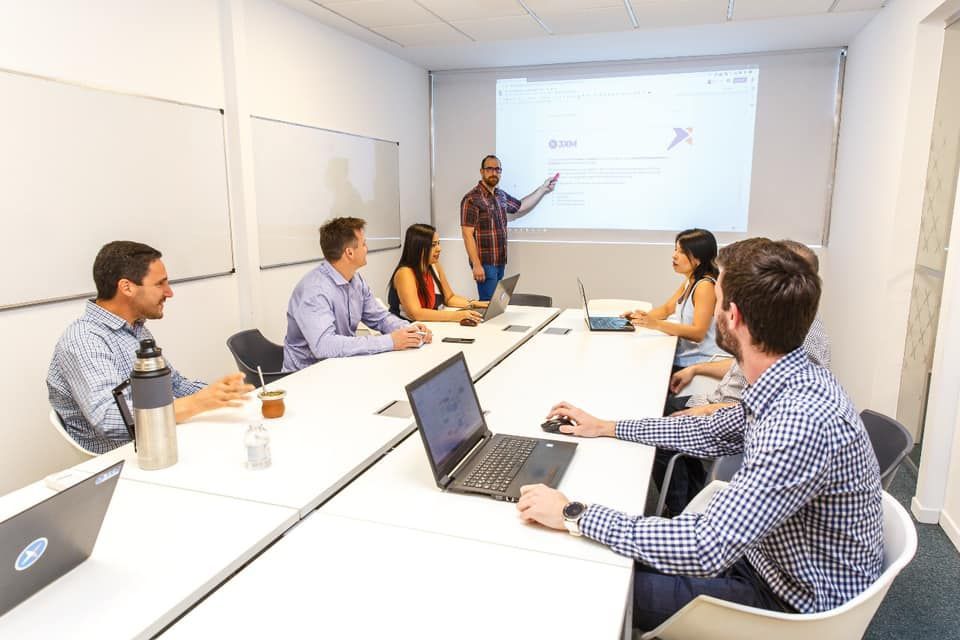
Finally, due to personal life situations, I made the difficult decision to leave Microsoft and started working as a developer in a company in the city of Còrdoba, Argentina. Then, I started to lead the quality area of 3XM Group and I put aside programming to focus on management. My passion for technology evolved into a passion for working with an amazing group of people.
I thought that the chapter on innovation had already finished in my life, but it turns out I was wrong.
During all that time I was in contact with who was always my role model, someone I like to call my “mentor”, Guadalupe Casuso Innovation Leader – Principal PM Autonomous Systems at Microsoft. At the beginning of 2019, she told me about a device that would completely transform my life.
How Mixed Reality changed my life
In January 2019, Guadalupe Casuso told me about Azure Kinect. She was testing the device with body tracking and depth. I also learnt a bit more about Microsoft’s vision for AI. At the time of having that conversation, Julia White had just presented at Microsoft Inspire 2019, where the creation of her hologram with real-time translation into another language was being spotlighted for the first time. I was hooked, listening carefully to digest all the details about how they managed to put together her hologram, using Azure Kinect, HoloLens 2, and Azure’s cognitive services.
I was so excited, and right there and then made it my personal goal to learn about this technology that was shown. I began to learn everything I could about this technology that was just emerging in Latin America. I remember that at that time, many people around me did not have much faith or believed that the world of holograms and AI existed. They saw it as something very distant or almost impossible to experience, especially due to the low availability of devices locally. I sought to become as skilled as I could in AI.
In February 2020, I received the Microsoft MVP award for Artificial Intelligence. I remember around the same time, I found Jesse McCulloch, Microsoft Program Manager of the Mixed Reality team on Twitter. He became a great resource for me from that moment on by introducing me the Mixed Reality Toolkit (MRTK). In 2020, the global pandemic and massive shift to working from home created the perfect excuse for me to finally devote more time to investigations and tests. This gave me the opportunity to participate in events worldwide, including the digital edition of Microsoft Ignite 2020. This visibility helped position me in the field of innovation, leading professionals and leaders from all over the world to contact me to help guide them in projects or research.
Companies worldwide also began to contact me to hire 3XM Group services to develop XR applications, which continues to surprise me. The field of application of XR is very broad – it includes health, safety, training, and there is more much to tapped on too. It really motivates me to keep working on this technology when a lot that companies begin to notice the potential of mixed reality and seek to apply it to positively impact and transform their business.
Finally this year, in 2021, I was given the opportunity to be interviewed live at Microsoft Ignite, and I was also named as Innovation Evangelist in 3XM Group. I fully credit all this to the fact that I regained my passion for innovation and for mixed reality technologies, where there is truly no limit for the imagination.

The future of Mixed Reality.
Extended reality is already here. I welcome you to connect with me on Twitter and share your experiences as well!
#MixedReality #CareerJourneys
by Contributed | Apr 26, 2021 | Technology
This article is contributed. See the original author and article here.
Need to share a video with AUDIO during a Microsoft Teams meeting? What used to only be possible in Windows, is now also possible in MacOS!
In this work from home tip, Jeremy Chapman, from the Microsoft 365 team, will show you how to “Include Computer Sound” while sharing your desktop or app windows using a Mac or PC. At the time of release, this is a Public Preview feature in Microsoft Teams for MacOS, so we’ll also show how to get that enabled if you don’t see the options demonstrated.
QUICK LINKS:
00:34 — Demo in Teams to Include Computer Sound
01:40 — Demo of Including Computer Sound after sharing desktop
02:20 — What to do if you don’t see the Include Computer Sound options
02:56 — Enabling Preview Features in the Teams Admin Center
03:21 — Closing remarks
Link References:
Find more shows in our work from home series at https://aka.ms/WFHmechanics
Unfamiliar with Microsoft Mechanics?
We are Microsoft’s official video series for IT. You can watch and share valuable content and demos of current and upcoming tech from the people who build it at Microsoft.
Keep getting this insider knowledge, join us on social:
Video Transcript:
Need to share a video with AUDIO during a Microsoft Teams meeting? Well, what used to only be possible in Windows is now also possible in MacOS. What I’ll show you today is currently in Public Preview, but depending on when you’re watching this, there is a pretty good chance you’ll see the controls I’ll demonstrate today in your Teams experience. If not, keep watching, and I will show you how to enable Public Preview, and if you don’t even see that, I’ll show you what your Teams admin needs to configure to make Public Preview available to you.
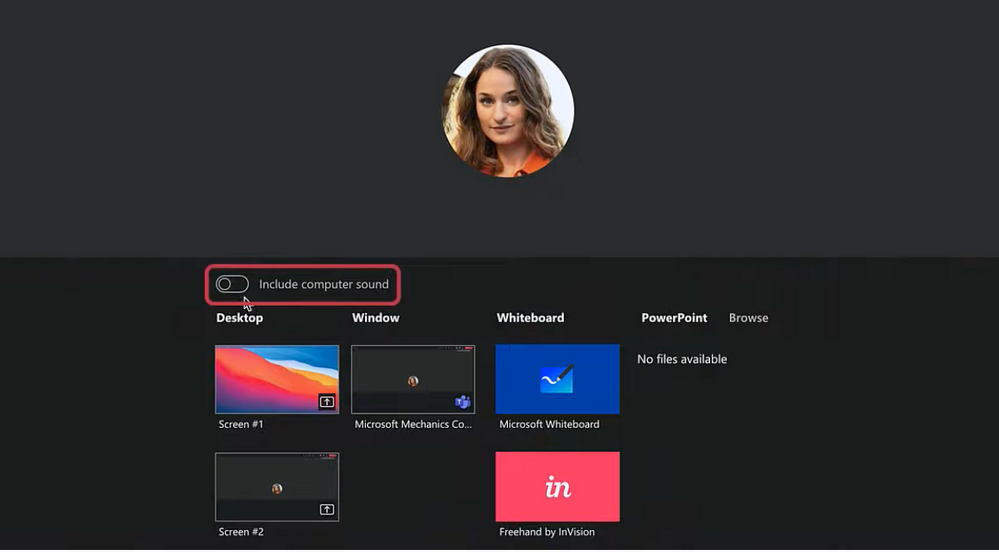
With that, let’s get started. I’m on a MacBook in a Teams meeting and I want to share a video running in YouTube, but this could anything or any app with sound running in a Mac or PC. When I hit the share tray, you’ll see I have the new option to “Include computer sound” that I can toggle on before sharing my desktop. So I’ll enable it, select my desktop in this case and hit play on my previous video explaining this process using Windows, which is by the way still more or less the same. Now let me switch over to Adele’s view and sound with the incoming audio, and you’ll hear the sound coming through.
One note here about my previous video, I said that MacOS will share audio without using this capability. That was true if audio is coming out of your Mac’s speakers. MacOS in this case is different from Windows, where Windows will usually succeed in noise-canceling speaker sound completely out. But this approach of sharing speaker audio doesn’t always work, if you’re wearing headphones, or just want the sound to be better than what you can achieve using the speakers and microphone pick-up. So, let’s switch back over to the Mac, and I’ll show you the second option to share or un-share computer sound during the meeting. If I move my cursor to the top of the screen, you’ll see another couple of screen sharing controls, I’ll pin this for now. Here I can use this little button between “Give control” and “Stop Presenting” to turn off or turn on sharing computer sound. The diagonal slash means it’s off and no slash means it’s on. Using that control means you don’t need to stop sharing, enable computer sound, then re-share your screen. Both of these control types are available in Windows and MacOS, so the same steps I just demonstrated apply to Windows as well. So now I’ll Leave the meeting.
OK, if you’ve made it this far and have realized this option isn’t available in your Teams app on MacOS, let me show you how to enable it. In Teams, click on your image in the upper right corner. Go to about, then if you DON’T have this checkmark next to Public Preview, click on it. Teams will ask to you restart the Teams app. Once you log back in, you’ll be on the Public Preview, then you should see the option to “Include computer sound” when sharing content. The very first time you try out that option on your Mac, it will ask you to install a driver, and after that it will work like I demonstrated earlier.
Finally, if you don’t even see the Public Preview option from before, that’s because your Teams admin doesn’t have this enabled in the Teams Admin Center. If you’re the Teams admin, you’ll find it under Teams, Update Policies, and “Show preview features”. Just turn that on, and you can scope it to only the users who really need it if you want — maybe that is your group of MacOS users — and they’ll see the options for enabling Public Preview appear soon.
So that was just another quick working from home tip, and to see more like this, check out aka.ms/WFHMechanics for more. Be sure to subscribe to our channel. And as always, thanks for watching!


Recent Comments