by Contributed | Nov 5, 2020 | Technology
This article is contributed. See the original author and article here.
Contributors:
Rob Garrett – Sr. Customer Engineer, Microsoft Federal
John Unterseher – Sr. Customer Engineer, Microsoft Federal
Martin Ballard – Sr. Customer Engineer, Microsoft Federal
What is Look Book?
SharePoint Look Book templates build upon the open-source Patterns and Practices site provisioning engine. |
Look Book templates are a set of Microsoft-provided site designs that programmatically add custom user interface elements to SharePoint Online sites. Microsoft has published a public web site with a set of showcase templates to should satisfy most customer needs:
https://lookbook.microsoft.com
Each category of templates targets the functionality of various industry verticals. For example, the Organization category contains templates for customizing SharePoint sites for Crisis Communication, Organization News, Leadership Information, to name a few.
SharePoint Look Book templates build upon the open-source Patterns and Practices site provisioning engine:
https://docs.microsoft.com/en-us/powershell/sharepoint/sharepoint-pnp/sharepoint-pnp-cmdlets?view=sharepoint-ps
The templates themselves are a set of web assets (CSS, images, etc.) with accompanying template XML file that instructs the provisioning engine how to apply the customizations to an existing SharePoint Online site collection. SharePoint Look Book templates follow Microsoft recommended SharePoint User Interface Design principles:
https://spdesign.azurewebsites.net/
Users of Look Book templates should understand that the templates are “after-market” customizations applied to existing site collections. The base SharePoint Online offering in Office 365 does not provide these templates, nor their associated branding/customization. The templates are not available for end users to select from a central gallery as with earlier versions of SharePoint Server on-premises.
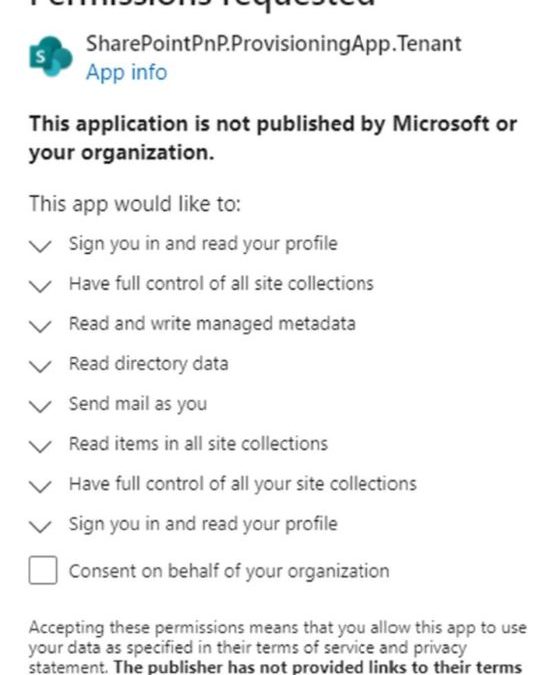
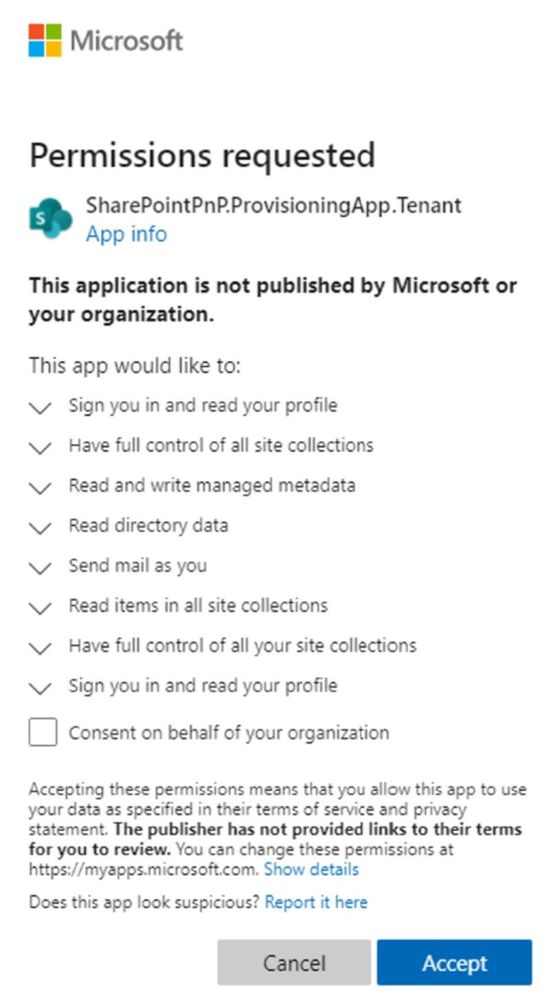
The Look Book web site facilitates the creation of a new Communication site collection and then the application of the template customizations to that site collection. The Look Book provisioning web site achieves this process via a tenant application, which requires tenant administration consent. Administrators deploying the first Look Book templates will see a consent dialog like the following:
Challenge – Using Look Book in GCC High
The Look Book provisioning service works with the regular Government Community Cloud (GCC) but not in the High variant without modification. |
Microsoft strives to implement functionality parity between all sovereign clouds. However, since each Office 365 cloud type serves a different customer audience and requirements, functionality will differ between these cloud types. Of the US clouds – Commercial, Government Community Cloud, Government Community Cloud High, and DOD Cloud, the last two offer the least functionality to observe US Federal mandates and compliance.
As Microsoft develops new functionality for Office 365 and Azure clouds, we typically release new functionality to commercial customers first, and then to the other GCC, GCC High, and DOD tenants later as we comply with FedRAMP and other US Government mandates. Open-source offerings add another layer of complexity since open-source code contains community contribution and is seldom developed with government clouds in mind.
The Look Book provisioning service (https://lookbook.microsoft.com) relies on open-source Patterns and Practices code and community developed APIs that may operate differently in GCC, GCC High, and DOD clouds. As an open-source resource, the SharePoint Look Book templates are not directly supported by Microsoft.
At the time of this writing, the Look Book provisioning service works with the regular Government Community Cloud (GCC) but not in the High variant without modification. GCC High places restrictions on cross domain access as well as script execution. GCC High and GCC reside on two different top-level domains: sharepoint.com vs. Sharepoint.us.
Solution – Apply Templates via PowerShell
We can create Communication sites in GCC High and then run PowerShell to affect the customizations after. |
Recall that the Look Book provisioning service leverages Patterns and Practices APIs to both create new site collections and lay template customization atop. Specifying a GCC High tenant, the service fails during the request to provision a new site collection. Fortunately, we do not require this service to create vanilla Communication site collections in GCC High tenants. Instead, we can create Communication sites in GCC High and then run PowerShell to affect the customizations after.
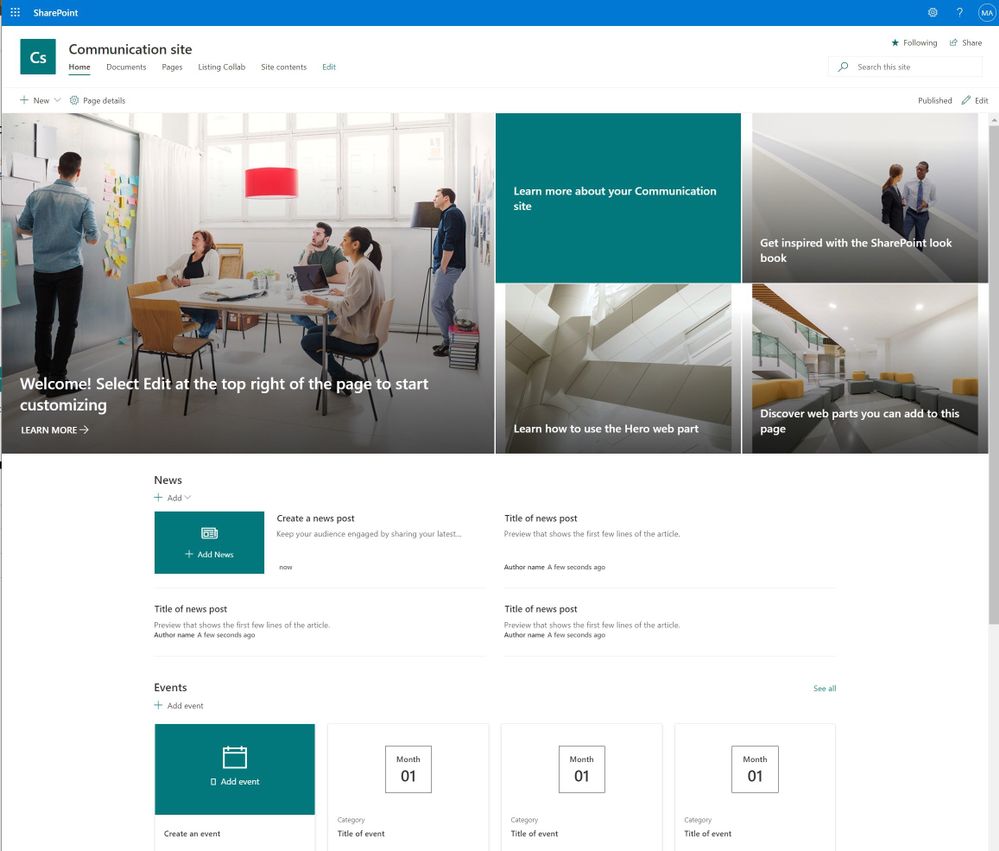
The application of Look Book templates, although existing within the Look Book provisioning service, is also available via PowerShell. Assuming a tenant administrator has pre-created an out-of-the-box Communication Site, he/she may leverage the SharePoint PnP PowerShell Module to apply a template. The following details the steps:
1. Download the desired templates from the following location:
https://github.com/SharePoint/sp-dev-provisioning-templates/tree/master/tenant
2. Open a new Windows PowerShell window (native PowerShell, not PowerShell Core 7.x or above) – as an administrator.
3. Install the SharePoint PnP module with the following (requires an Internet connection):
Install-Module SharePointPnPPowerShellOnline
4. If the module is already installed, you should update it to the latest version with:
Update-Module SharePointPnPPowerShellOnline
5. Ensure the module is loaded with the following:
Import-Module SharePointPnPPowerShellOnline
6. Choose existing Communication site or create a new one.
7. Connect to the Communication site collection:
Connect-PnPOnline -Url https://<TENANT NAME>.sharepoint.us/sites/<SITE COLLECTION> -UseWebLogin
8. In the above statement, replace the URL to the Communication site collection in your tenant.
9. The switch at the end instructs PnP to use an interactive web session to authenticate with SharePoint Online. This method requires Global Administrator to enter their username/password and pass any MFA requirements.
10. Connection to SPO, via PnP, in a batch process is possible by registering an Azure AD application and using client assertion (certificate) credentials. However, this is outside the scope of this post.
11. Apply one of the templates to your site collection with the following:
Apply-PnPProvisioningTemplate -Path <path to file><template>.pnp
12. The previous command will use the PNP file (contains XML) to instruct the PnP template API to configure the previously created site collection.
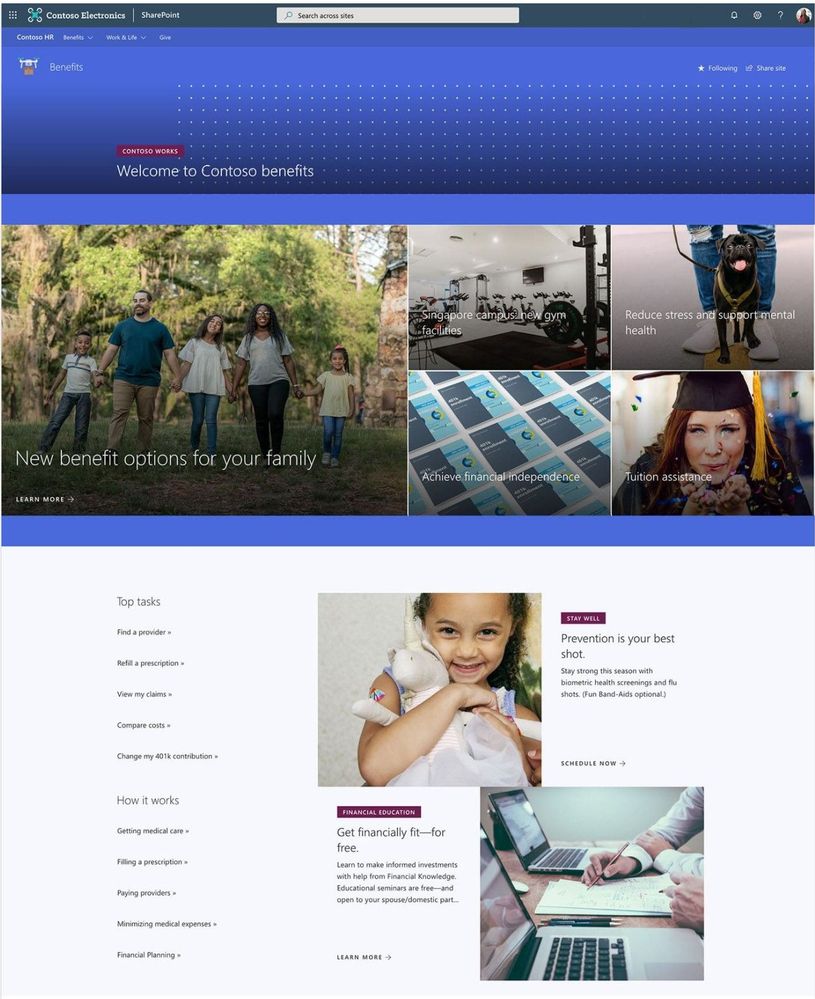
Your site collection should now be fully provisioned with the elements of the template you have chosen. It will be necessary to repeat these steps for any additional Look Book sites you wish to provision for your organization. Let us know what you think in the comments below.
Note: The SharePoint Look Book provisioning service and SharePoint PnP PowerShell modules are open-source resources not supported by Microsoft. Additionally, always know the risks associated with making change in your tenant in the Global Admin role when running scripts changing configurations. |
by Contributed | Nov 5, 2020 | Technology
This article is contributed. See the original author and article here.
It is tough to understate the potential of AI.
Silicon Valley CEOs predict the technology will have an even greater impact than the internet revolution, calling it the biggest trend of the last 30 years while heralding its ability to make medical diagnoses, operate electronic trading platforms, offer remote sensing, and much more.
On the other hand, however, Canadian AI MVP Rahat Yasir points out that many remain apprehensive about the technology’s potential side effects, like job loss, bias, data breaches, and discrimination.
“Unfortunately, we still hear a lot of myths and negative perspectives about AI these days,” Rahat says. “As an individual who is working in this domain for years, I always try to provide unbiased information to our community about AI and educate as many people as possible.”
Through his work in solving a not-for-profit’s challenge of testing thousands of cosmetic products in Quebec, Canada, Rahat is hopeful to demonstrate the good in AI.
Within Canada, ingredients in cosmetics are not reviewed for safety before they are put on the shelves, and nor are producers required to display warnings for toxicity.
While the chemical content of beauty products is displayed on packaging, the average consumer still struggles to decipher the scientific language used by products.
Protégez-Vous! (Protect Yourself!) is a non-profit organization that performs rigorous tests, studies, and surveys on thousands of products sold in the province of Quebec. Before AI, freelancers and internal community users manually collected product information and ingredient lists. Armed with AI, however, the process is automated.
The not-for-profit teamed up with Osedea AI to leverage Microsoft AI technologies like ink recognition, custom object detection, text analytics, OCR, and translation. From a single photo of the product packaging, the AI solution recognizes the language and converts the ingredients list into text.
“This automates the entire process of data collection for community users, with it only taking a few seconds of photo capturing of different products to complete the new data collection process,” says Rahat, who serves as the Lead AI Developer at Osedea AI.
“Often developing AI integrated applications are time-consuming and expensive because of a lack of training data, computational resources, and enough financial assistance,” Rahat says.
“Microsoft AI services helped us to deliver quick product development for Protégez-Vous which is currently used by internal users and getting ready to launch with general customers early next year.”
It is an application like this which makes Rahat optimistic about the future of AI. Last month, Rahat delivered the keynote address of MTL Connecte about AI for safety, security, and a better future.
“AI is saving lives, creating more jobs, increasing productivity, and saving time by bringing automation — and I’m always encouraging everyone to learn about AI technologies and be up to date!”
Rahat, who has served for the past six years as an MVP, says he enjoys sharing his knowledge and contributing to the community by mentoring others and giving feedback to Microsoft product groups. “I am badly missing in-person events and MVP Summit, but I am always in touch with MVPs through online events, social media, online forums,” Rahat says.
For more on Rahat, check out his Twitter @Anind0
by Contributed | Nov 5, 2020 | Technology
This article is contributed. See the original author and article here.
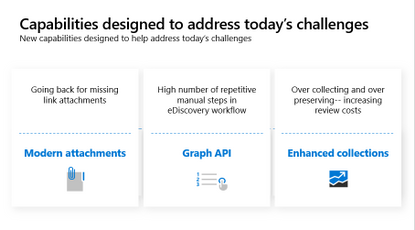
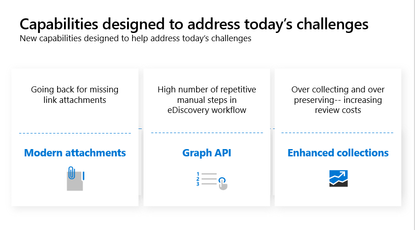
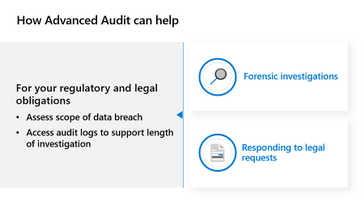
The recent shift towards remote work has accelerated digital transformation. End users are increasingly collaborating in chat-based workspaces like Microsoft Teams and Yammer, resulting in new types of data that are more dynamic than email and more complex to discover. We are excited to share several new capabilities that improve eDiscovery workflows efficiently with Advanced eDiscovery and enhance forensic investigations with Advanced Audit.
References:
This webinar was presented on October 19th, 2020, and the recording can be found here.
Attached to this post is the FAQ document that summarizes the questions and answers that came up over the course of both Webinars.
Thanks to those of you who participated during the two sessions and if you haven’t already, don’t forget to check out our resources available on the Tech Community.
Thanks!
@LaurenVaughn on behalf of the MIP and Compliance CXE team
by Contributed | Nov 5, 2020 | Technology
This article is contributed. See the original author and article here.
Microsoft offers an official IoT Developer Specialty Certification which requires passing the AZ-220 Certification Exam. This exam content was updated on September 24, 2020 and includes new areas of focus. I successfully passed this exam on October 29, 2020 and in this post will be sharing my preparation strategy in the hopes that it might assist others in completing the examination and obtaining an official designation as a “Microsoft Certified Azure IoT Developer”!

How do I know which topics to focus on, what skills does the AZ-220 exam measure?
The AZ-220 Microsoft IoT Developer examination measures the skills outlined in this document. What is interesting to note, is that the various topics / sub-sections are basically titles pulled directly from official Azure IoT related documentation available on docs.microsoft.com. This is important because, I found during my taking of practice exams and the official examination that many of the questions were rooted primarily in the official documentation content! So much so, that I would place a bet that the authors of the examination literally consulted the official documentation while creating the actual AZ-220 exam questions. Thus, I have provided below, the skills mentioned in the aforementioned document, with an additional enhancement to those line-items in the form of hyperlinks which point to the relevant documentation entry on docs.microsoft.com.
Be warned that it is not advised that one only prepare for the AZ-220 exam by merely “reading the docs”, practical application is arguably the most important preparation technique as it can create experiences that you can later draw on during test time. We will discuss resources which enforce practical application in the subsequent section.
Skills Measured
NOTE: The bullets that appear below each of the skills measured are intended to illustrate how
we are assessing that skill. This list is not definitive or exhaustive.
NOTE: In most cases, exams do NOT cover preview features, and some features will only be
added to an exam when they are GA (General Availability).
Implement the IoT Solution Infrastructure (15-20%)
Create and configure an IoT Hub
Build device messaging and communication
Configure physical IoT devices
Provision and manage devices (20-25%)
Implement the Device Provisioning Service (DPS)
Manage the device lifecycle
Manage IoT devices by using IoT Hub
Build a solution by using IoT Central
Implement Edge (15-20%)
Set up and deploy an IoT Edge device
Develop modules
Configure an IoT Edge device
Process and manage data (15-20%)
Configure routing in Azure IoT Hub
Configure stream processing
Configure an IoT solution for Time Series Insights (TSI)
Monitor, troubleshoot, and optimize IoT solutions (15-20%)
Configure health monitoring
Troubleshoot device communication
Perform end-to-end solution testing and diagnostics
Implement security (15-20%)
Implement device authentication in the IoT Hub
Implement device security by using DPS
Implement Azure Security Center (ASC) for IoT
Where can I learn how to apply the concepts measured on the AZ-220 exam in a practical / hands-on manner?
In February of 2020, the initial AZ-220 Developer exam beta was being written and at the time, a series of lab exercises were developed to prepare the initial set of test takers on the concepts that the exam would cover. Those original labs exist today at http://aka.ms/az220labs but have since evolved into a more modern and interactive format on the Microsoft Learn Platform. As one of the authors for these Learn Modules, I can assure you that the core concepts are retained, but amplified with the ability to complete the exercises using the 100% free Microsoft Learn Azure Sandbox in addition to some updates and modernization of content where applicable. In fact, you will notice that many of these Learn Modules actually have the same exact titles as the original AZ-220 labs! Thus, the secret I am about to reveal here is that you can obtain practical experience using actual the free Azure access provided by the Microsoft Learn Azure Sandbox at zero cost by completing the following Learning Paths on MS Learn which are based on the original AZ-220 preparedness labs! Below I have provided links to those Learning Paths and the Modules contained within.
Introduction to Azure IoT – Learning Path
Securely Connect IoT Devices to the Cloud
Build the Intelligent Edge with Azure IoT Edge
Develop IoT solutions with Azure IoT Central
I prefer to learn at my leisure with video content, are there any resources that cover the materials in the official docs and Microsoft Learn that I can watch?
In July 2020, in preparation for upcoming changes to the AZ-220 exam content which was updated on September 24, 2020 (Fun Fact: Coincidentally my birthday!), the IoT Advocacy team at Microsoft developed a 5 part video series that covers 60-70% of the AZ-220 exam content. Pretty much everything is covered with the exception of Implement security (15-20%) & Monitor, troubleshoot, and optimize IoT solutions (15-20%).
That content can be viewed and consumed at http://aka.ms/iotlp/blog or by clicking the image below:
So far, all of the AZ-220 prep materials that you shared are 100% free which is awesome, but what are your thoughts on paid courses / practice exams, are there any recommendations?
There is an official instructor led training for the AZ-220 Exam, which consists of 4 days of instruction with a Microsoft Certified Trainer. I have not used this service personally but understand that the content and instructors are vetted and would assume it is of high quality.
Diana Phillips from the One Commercial Partner Group at Microsoft runs a similar but 100% free study group that you can learn more about and enroll in at this link. You could almost think of it as a free alternative to the above resource which also provides video resources, prescribed homework assignments, and is rooted in the lab content mentioned previously at http://aka.ms/az220labs.
There is also an official practice exam offered by MindHub Inc., which provides access to approximately 100+ sample exam questions that are provided in a format very similar to the actual exam. You can sample what the question format for this practice test at this link. Full-time Microsoft employees may be able to access these materials at https://mslibrary.measureup.com/. I relied on this resource very heavily in the days leading up to my official examination. On my first attempt at the practice exam I scored ~70%, but noticed that the report literally breaks down into sections that map 1:1 to the skills measured!
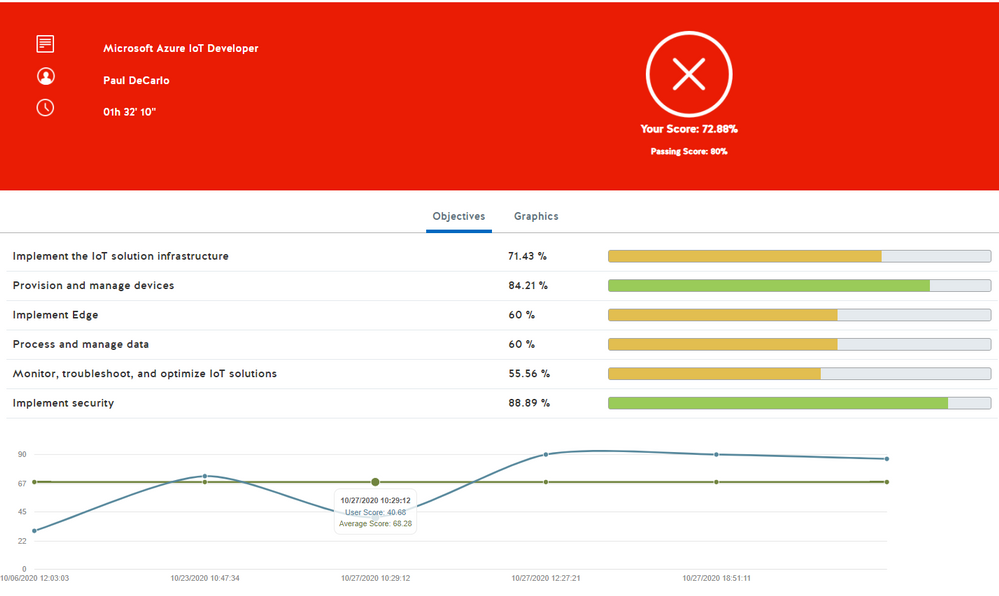
Thus, I could zero in on the exact sections I needed to brush up on and soon after was scoring in the high 80-90% range!
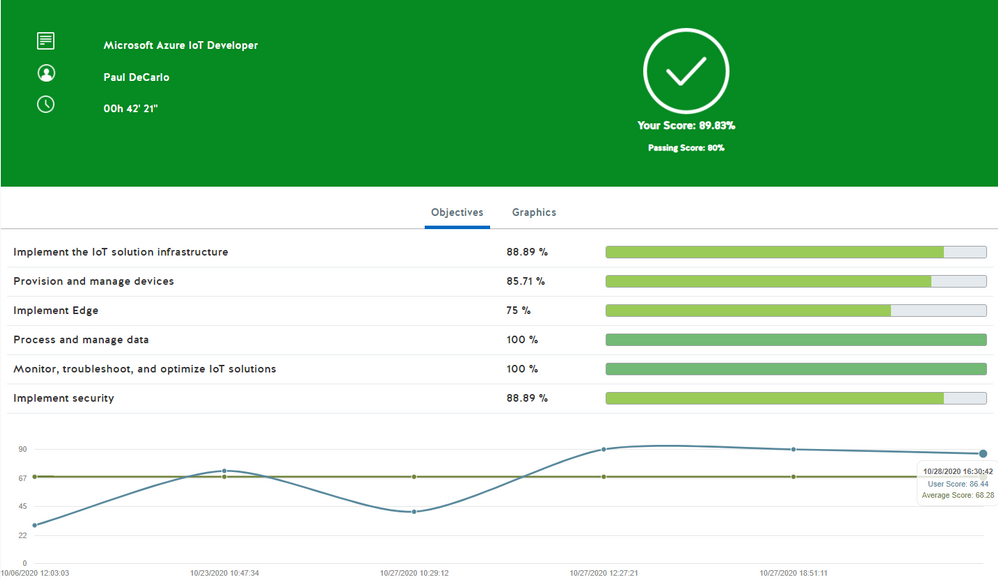
I continued forth by completing a grand total of 4 practice exams before I decided to go up for the final exam where I scored an 800 out of 1000 on my first attempt! (Note: a 700 or higher is required to pass).
Summary
The AZ-220 Certification Exam covers a broad range of topics related to Azure IoT Services and the underlying technologies that make it work. If you regularly work with these technologies and want to try your hand at the exam, you can try a free practice exam right now at this link.
Personally, I preferred to learn most of the content by following the Learn Modules and creating / reviewing the IoT Event Learning Path videos, then moved onto the official practice exam offered by MindHub Inc., then I used the results of my practice exams to hone in on the documentation areas that I needed to focus on. Once I could consistently score in the high 80s / low 90s on the practice exam I believe I was more than ready.
If you have taken the exam or are currently preparing, let us know about your experience in the comments. We have a great conversation space right here on the IoT Tech Community where you can ask your questions to the community at large, or feel free to reach out to me directly on twitter @pjdecarlo if you need any assistance. We wish everyone luck on their journey to become an officially certified Azure IoT Developer.


Recent Comments